
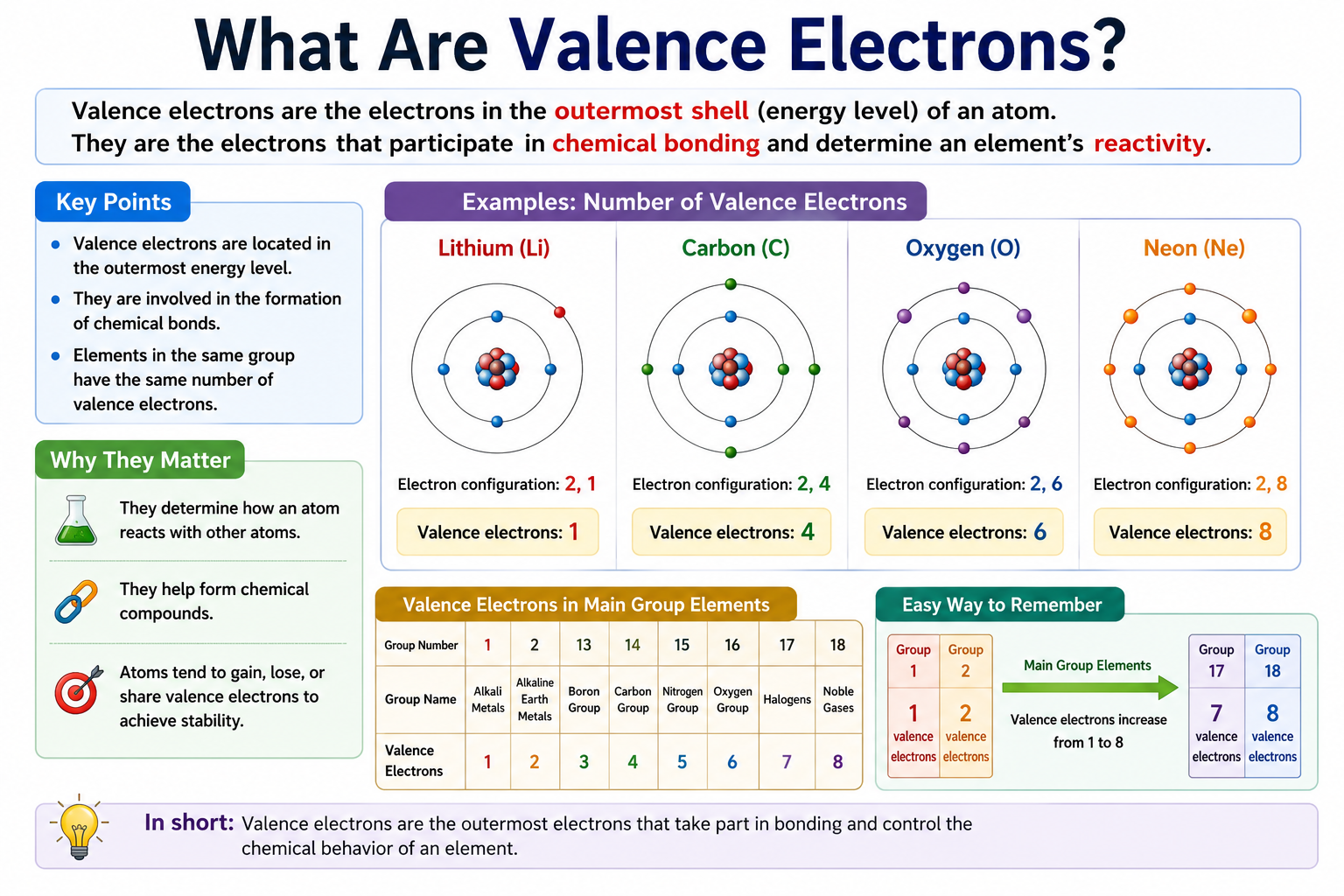
If you have ever wondered why some elements react violently with water while others seem completely unbothered by everything around them, the answer almost always comes back to valence electrons. These are the electrons sitting in the outermost shell of an atom, and they are arguably the single most important factor controlling how elements behave chemically.
Valence electrons explained in simple terms: they are the electrons available for forming bonds, transferring between atoms, and determining how reactive or stable an element is. Everything from the rusting of iron to the burning of natural gas to the reason your body needs sodium and chloride in balance — it all traces back to valence electrons doing their job.
This is a concept that appears in virtually every chemistry course at every level. GCSE, A-Level, NEET, MDCAT, ECAT — they all test it, and they test it in different ways. Some questions are straightforward (how many valence electrons does carbon have?), while others require you to apply the concept to explain bonding, reactivity, or molecular structure.
In this guide, I want to cover everything in a way that actually makes sense. We will go through the definition, how to find valence electrons using the periodic table and electron configuration, the octet and duplet rules, Lewis dot structures, chemical bonding, and a full set of practice questions. By the end, you should not just know what valence electrons are — you should be able to use that knowledge confidently in any exam situation.
Let us start from the beginning.
Key Takeaways
-
Valence electrons are the electrons in the outermost electron shell of an atom.
-
They determine an element’s chemical reactivity and the types of bonds it can form.
-
The number of valence electrons can be found directly from the group number in the periodic table for main group elements.
-
Elements in the same group have the same number of valence electrons and similar chemical behavior.
-
The octet rule states that most atoms are most stable when they have 8 valence electrons.
-
Noble gases already have full outer shells and are therefore chemically unreactive.
-
Valence electrons are different from core electrons, which are held tightly by the nucleus and do not participate in bonding.
-
Lewis dot structures use dots to represent valence electrons and help visualize bonding.
What Are Valence Electrons?
Definition
Valence electrons are the electrons located in the outermost energy shell, also called the valence shell, of an atom. These electrons are the ones most loosely held by the nucleus and are therefore the ones involved in chemical reactions, bond formation, and interactions with other atoms. The number of valence electrons an atom has is one of the most fundamental pieces of information you can know about an element.
Simple Explanation
Picture an atom as a small solar system. The nucleus sits at the center, and electrons orbit around it in different layers called shells. The innermost electrons are tucked in close to the nucleus and held very tightly. The outermost electrons, however, are farther away and experience a weaker pull from the nucleus. Those outer electrons are the valence electrons.
A good way to think about it: imagine a group of workers in a building. The ones sitting closest to the boss (the nucleus) never leave their desks and are tightly under supervision. The ones on the outer floors, though, can move around, interact with visitors from outside, and sometimes even transfer to another building entirely. Valence electrons are those outer-floor workers — they are the ones who interact with the rest of the world.
When two atoms meet and react, it is their valence electrons doing the negotiating. One atom might share some with another (covalent bonding), or one might give them away entirely (ionic bonding). That is essentially what chemistry is — valence electrons moving, sharing, and rearranging.
Why Are Valence Electrons Important?
This is one of those questions that has a genuinely satisfying answer. Valence electrons matter for several distinct reasons, and each one has real consequences for how chemistry works.
First, valence electrons determine chemical reactivity. Atoms with nearly full outer shells tend to gain electrons. Atoms with just one or two valence electrons tend to give them away. This push and pull between atoms drives chemical reactions.
Second, valence electrons control the type of bond an atom forms. When a metal loses valence electrons to a non-metal, you get an ionic bond. When two non-metals share valence electrons, you get a covalent bond. The electron count shapes the outcome.
Third, valence electrons explain why elements in the same group behave similarly. Lithium, sodium, and potassium all have 1 valence electron. They all react with water. They all form +1 ions. That pattern is entirely explained by their shared valence electron count.
Fourth, valence electrons are the basis for Lewis dot structures, which are used to predict molecular shapes, polarity, and bonding in molecules — topics that appear constantly in organic chemistry, physical chemistry, and biochemistry.
In short: if you understand valence electrons, you have a solid foundation for almost everything else in chemistry.
History of the Valence Electron Concept
The idea that atoms have a specific capacity for forming bonds has been around in various forms since the mid-1800s. Edward Frankland, a British chemist, introduced the concept of valence in 1852, noting that elements seemed to have fixed combining capacities. He did not yet know about electrons — those were not discovered until J.J. Thomson’s work in 1897 — but he saw the pattern.
After Thomson’s discovery, the picture became clearer. In 1916, Gilbert N. Lewis, an American physical chemist, introduced the concept of the electron pair bond and the idea that atoms share electrons to achieve stable configurations. His work gave rise to Lewis dot structures, a tool still used in every chemistry classroom today.
Around the same time, Irving Langmuir extended Lewis’s ideas and coined the term “valence electrons” to specifically describe the outer-shell electrons responsible for bonding. The concept was further developed through the 1920s and 1930s as quantum mechanics provided a more rigorous mathematical framework for understanding electron shells and configurations.
Linus Pauling’s work in the 1930s through the 1960s brought valence electron theory into molecular geometry and electronegativity, connecting it directly to the shapes and properties of real molecules. Today, the concept remains foundational across inorganic, organic, and physical chemistry.
Structure of an Atom
Before diving deeper into valence electrons specifically, it helps to have a clear picture of atomic structure as a whole.
Protons
Protons are positively charged particles found in the nucleus. The number of protons in an atom defines what element it is — this is the atomic number. Hydrogen has 1 proton, carbon has 6, oxygen has 8, and so on.
Neutrons
Neutrons are electrically neutral particles also found in the nucleus. They contribute to the mass of the atom but do not directly affect chemical behavior. Atoms of the same element can have different numbers of neutrons — these are called isotopes.
Electrons
Electrons are negatively charged particles that surround the nucleus in regions of space called shells or energy levels. In a neutral atom, the number of electrons equals the number of protons. Electrons have a much smaller mass than protons and neutrons, but they are the ones responsible for all chemical bonding.
Electron Shells
Electrons are arranged in shells, each of which can hold a certain maximum number of electrons:
- Shell 1 (n=1): holds up to 2 electrons
- Shell 2 (n=2): holds up to 8 electrons
- Shell 3 (n=3): holds up to 18 electrons
- Shell 4 (n=4): holds up to 32 electrons
Electrons fill shells from the inside out, starting with the shell closest to the nucleus. The last shell to be filled, even if only partially, is the valence shell.
What Is the Valence Shell?
The valence shell is simply the outermost occupied electron shell of an atom. Whatever electrons are sitting in that outermost shell are the valence electrons. The term “valence” itself comes from the Latin word “valentia,” meaning strength or capacity — and that is precisely what these electrons determine: the atom’s capacity to bond with others.
For sodium, with 11 electrons arranged as 2, 8, 1, the valence shell is the third shell, and it contains just 1 electron. For chlorine, with 17 electrons arranged as 2, 8, 7, the valence shell is also the third shell, but it contains 7 electrons.
The valence shell is where all the action happens. It is the chemical “face” that an atom presents to the world.
How to Find Valence Electrons
Using the Periodic Table
For main group elements (Groups 1, 2, and 13 through 18), finding the number of valence electrons is easy and direct:
- Group 1 elements have 1 valence electron
- Group 2 elements have 2 valence electrons
- Group 13 elements have 3 valence electrons
- Group 14 elements have 4 valence electrons
- Group 15 elements have 5 valence electrons
- Group 16 elements have 6 valence electrons
- Group 17 elements have 7 valence electrons
- Group 18 elements (noble gases) have 8 valence electrons (except helium, which has 2)
This is one of the most useful shortcuts in all of chemistry. Memorize this pattern and you can instantly identify valence electrons for most elements you will encounter in exams.
For transition metals (Groups 3 through 12), the situation is more complex. Their valence electrons include both the outer s-electrons and the d-electrons from the inner shell, which is why they can form multiple oxidation states.
Using Electron Configuration
Another reliable method is to write out the full electron configuration and identify the electrons in the highest principal quantum number shell.
For phosphorus (P), the electron configuration is 1s² 2s² 2p⁶ 3s² 3p³. The highest shell is n=3, which contains 2 + 3 = 5 electrons. So phosphorus has 5 valence electrons.
For calcium (Ca), the configuration is 1s² 2s² 2p⁶ 3s² 3p⁶ 4s². The highest shell is n=4, containing 2 electrons. Calcium has 2 valence electrons.
Step-by-Step Examples
Finding valence electrons for Nitrogen (N):
Step 1: Nitrogen has atomic number 7.
Step 2: Write the electron configuration: 1s² 2s² 2p³
Step 3: The highest shell is n=2, containing 2 + 3 = 5 electrons.
Step 4: Nitrogen has 5 valence electrons.
Finding valence electrons for Sulfur (S):
Step 1: Sulfur has atomic number 16.
Step 2: Write the electron configuration: 1s² 2s² 2p⁶ 3s² 3p⁴
Step 3: The highest shell is n=3, containing 2 + 4 = 6 electrons.
Step 4: Sulfur has 6 valence electrons.
Finding valence electrons for Potassium (K):
Step 1: Potassium has atomic number 19.
Step 2: Write the electron configuration: 1s² 2s² 2p⁶ 3s² 3p⁶ 4s¹
Step 3: The highest shell is n=4, containing 1 electron.
Step 4: Potassium has 1 valence electron.
Valence Electrons of the First 20 Elements
| Element | Symbol | Atomic Number | Electron Configuration | Valence Electrons | Group |
|---|---|---|---|---|---|
| Hydrogen | H | 1 | 1s¹ | 1 | 1 |
| Helium | He | 2 | 1s² | 2 | 18 |
| Lithium | Li | 3 | 1s² 2s¹ | 1 | 1 |
| Beryllium | Be | 4 | 1s² 2s² | 2 | 2 |
| Boron | B | 5 | 1s² 2s² 2p¹ | 3 | 13 |
| Carbon | C | 6 | 1s² 2s² 2p² | 4 | 14 |
| Nitrogen | N | 7 | 1s² 2s² 2p³ | 5 | 15 |
| Oxygen | O | 8 | 1s² 2s² 2p⁴ | 6 | 16 |
| Fluorine | F | 9 | 1s² 2s² 2p⁵ | 7 | 17 |
| Neon | Ne | 10 | 1s² 2s² 2p⁶ | 8 | 18 |
| Sodium | Na | 11 | 1s² 2s² 2p⁶ 3s¹ | 1 | 1 |
| Magnesium | Mg | 12 | 1s² 2s² 2p⁶ 3s² | 2 | 2 |
| Aluminum | Al | 13 | 1s² 2s² 2p⁶ 3s² 3p¹ | 3 | 13 |
| Silicon | Si | 14 | 1s² 2s² 2p⁶ 3s² 3p² | 4 | 14 |
| Phosphorus | P | 15 | 1s² 2s² 2p⁶ 3s² 3p³ | 5 | 15 |
| Sulfur | S | 16 | 1s² 2s² 2p⁶ 3s² 3p⁴ | 6 | 16 |
| Chlorine | Cl | 17 | 1s² 2s² 2p⁶ 3s² 3p⁵ | 7 | 17 |
| Argon | Ar | 18 | 1s² 2s² 2p⁶ 3s² 3p⁶ | 8 | 18 |
| Potassium | K | 19 | 1s² 2s² 2p⁶ 3s² 3p⁶ 4s¹ | 1 | 1 |
| Calcium | Ca | 20 | 1s² 2s² 2p⁶ 3s² 3p⁶ 4s² | 2 | 2 |
Notice the pattern: elements in the same group always have the same number of valence electrons, even though their total electron counts are very different.
Valence Electrons and the Periodic Table
The periodic table is organized precisely around valence electron patterns, which is what makes it such a powerful tool.
Group 1 Elements
Lithium, sodium, potassium, rubidium, cesium, and francium all have exactly 1 valence electron. This makes them highly reactive — that single outer electron is loosely held and easily given away to form a +1 cation. Their reactions with water, oxygen, and halogens are among the most dramatic in chemistry.
Group 2 Elements
Beryllium, magnesium, calcium, strontium, barium, and radium each have 2 valence electrons. They lose both to form +2 cations in most reactions. Less reactive than Group 1 metals but still quite chemically active, especially with water and acids.
Groups 13 to 18
This is where the diversity really shows up. Moving from left to right across periods, valence electrons increase from 3 to 8. Elements in Group 17 (halogens) with 7 valence electrons are extremely reactive — they are desperate to gain one more electron to complete their shell. Elements in Group 18 (noble gases) with 8 valence electrons (or 2 for helium) are essentially inert because their shells are already complete.
Transition Metals
Transition metals are a more complex case. They have 2 valence electrons in their outermost s-orbital, but they also have partially filled d-orbitals just beneath the surface. These d-electrons can also participate in bonding, which is why iron can be Fe²⁺ or Fe³⁺, copper can be Cu⁺ or Cu²⁺, and manganese can take on a range of oxidation states from +2 to +7.
Valence Electrons and Chemical Bonding
Ionic Bonding
Ionic bonding occurs when one atom transfers its valence electrons to another. This typically happens between metals (which tend to have few valence electrons and give them away) and non-metals (which tend to have many valence electrons and accept more to complete their shells).
Sodium has 1 valence electron. Chlorine has 7. Sodium transfers its single valence electron to chlorine. Sodium becomes Na⁺ and chlorine becomes Cl⁻. The opposite charges attract, forming sodium chloride — ordinary table salt. The driving force is the stability gained when both atoms reach a complete outer shell.
Covalent Bonding
In covalent bonding, atoms share valence electrons rather than transferring them. This is what happens between non-metals. In a water molecule (H₂O), oxygen shares 2 pairs of electrons with two hydrogen atoms. Each hydrogen gets to “count” 2 electrons in its shell (satisfying the duplet rule), and oxygen gets to count 8 (satisfying the octet rule).
The number of covalent bonds an atom typically forms is directly related to how many valence electrons it needs to complete its shell. Carbon with 4 valence electrons tends to form 4 bonds. Nitrogen with 5 tends to form 3. Oxygen with 6 tends to form 2.
Metallic Bonding
In metals, valence electrons are not tied to any specific atom. Instead, they float freely through the entire metal structure, forming what is often called a “sea of electrons.” This is metallic bonding. It explains why metals conduct electricity (those free electrons carry the current), why they are malleable (the electron sea allows layers of atoms to slide past each other), and why they have characteristic luster.
Octet Rule Explained
The octet rule is one of the most useful guiding principles in chemistry, and it flows directly from the nature of valence electrons. The rule states that most atoms are most stable when they have 8 valence electrons in their outer shell.
The number 8 comes from the fact that the second and subsequent electron shells can hold up to 8 electrons in their s and p subshells (2 in s and 6 in p). When an atom achieves this full set of 8, it reaches a configuration similar to the nearest noble gas, which is exceptionally stable.
This drive to achieve an octet is what motivates chemical bonding. Sodium loses one electron to achieve the configuration of neon (8 valence electrons in its new outer shell). Chlorine gains one electron to achieve the configuration of argon. Together, they satisfy each other’s needs — a beautifully simple explanation for an enormous range of chemical behavior.
It is worth knowing that the octet rule has exceptions. Hydrogen and helium follow the duplet rule. Some elements like boron and aluminum can exist stably with fewer than 8. Elements in the third period and beyond, such as phosphorus and sulfur, can accommodate more than 8 in what is called an expanded octet.
Duplet Rule Explained
The duplet rule applies specifically to hydrogen and helium. Unlike most elements, these two are stable with just 2 electrons in their outer shell. This is because the first electron shell can only hold a maximum of 2 electrons — so a full first shell means a full outer shell.
Hydrogen, with 1 valence electron, needs just one more to achieve a complete first shell. That is why hydrogen forms one bond in almost all of its compounds. In H₂, two hydrogen atoms share one pair of electrons, each achieving 2. In HCl, hydrogen shares one electron pair with chlorine, again reaching 2.
Helium already has 2 electrons and therefore has no need to gain, lose, or share. It is stable on its own.
Lewis Dot Structures and Valence Electrons
Lewis dot structures are a simple and elegant way to represent valence electrons visually. The symbol of the element is placed at the center, and dots are arranged around it to represent the valence electrons. Up to 4 dots can be placed around the symbol before pairing begins, following the rule of one dot on each side before doubling up.
Here is how common elements look in Lewis dot notation (described textually, since this is a written guide):
- Hydrogen (H): One dot on one side. Represents 1 valence electron.
- Carbon (C): One dot on each of four sides. Represents 4 valence electrons.
- Nitrogen (N): Three sides have single dots, one side has a pair. Represents 5 valence electrons.
- Oxygen (O): Two sides have pairs, two sides have single dots. Represents 6 valence electrons.
- Chlorine (Cl): Three sides have pairs, one side has a single dot. Represents 7 valence electrons.
- Neon (Ne): All four sides have pairs. Represents 8 valence electrons.
When drawing Lewis structures for molecules, you connect atoms by showing shared electron pairs as lines between them. Each line represents a bonding pair — two electrons shared between two atoms. Remaining dots that are not shared are called lone pairs or non-bonding pairs.
Lewis dot structures let you quickly predict how many bonds an atom will form and whether any lone pairs remain, which is essential for understanding molecular geometry and polarity.
Valence Electrons vs Core Electrons
| Feature | Valence Electrons | Core Electrons |
|---|---|---|
| Location | Outermost shell | Inner shells |
| Role in bonding | Directly involved | Not involved |
| Held tightly? | No, loosely held | Yes, tightly held |
| Affected by other atoms? | Yes | Rarely |
| Number for sodium | 1 | 10 |
| Number for chlorine | 7 | 10 |
| Determine reactivity? | Yes | No |
| Appear in Lewis structures? | Yes | No |
Core electrons are important for shielding — they reduce the effective nuclear charge felt by valence electrons, which influences atomic radius and ionization energy. But in terms of chemistry and bonding, core electrons sit on the sidelines. Valence electrons do all the work.
Valence Electrons vs Free Electrons
| Feature | Valence Electrons | Free Electrons |
|---|---|---|
| Location | Outer shell of specific atoms | Delocalized through a material |
| Found in | All elements | Primarily metals |
| Role | Bonding and chemical reactions | Electrical conductivity |
| Bonded to a specific atom? | Yes (unless bonding is forming) | No |
| Example | 1 valence electron in sodium atom | Electrons in sodium metal lattice |
| Relevant to | Chemistry and atomic structure | Physics and material science |
Free electrons in metals are actually the valence electrons that have been released into the collective electron sea of the metallic lattice. So the distinction is really about context — in an isolated atom, they are valence electrons; in a metal crystal, they become the free electrons responsible for electrical conductivity.
Common Examples of Valence Electrons
Sodium
Sodium (Na) has atomic number 11 and the electron configuration 1s² 2s² 2p⁶ 3s¹. Its single valence electron in the third shell is very loosely held. Sodium gives this electron away easily, forming Na⁺, and becoming isoelectronic with neon. This is why sodium reacts so explosively with water — that lone valence electron is practically begging to be transferred.
Carbon
Carbon (C) has atomic number 6 and the configuration 1s² 2s² 2p². With 4 valence electrons, carbon sits right in the middle of the scale. It neither strongly gains nor strongly loses electrons. Instead, it prefers to share — forming 4 covalent bonds with impressive versatility. This is why carbon is the backbone of all organic chemistry and, by extension, all life on Earth.
Oxygen
Oxygen (O) has atomic number 8 and the configuration 1s² 2s² 2p⁴. With 6 valence electrons, oxygen needs 2 more to complete its shell. It forms 2 covalent bonds in most compounds (as in H₂O) or gains 2 electrons to form the oxide ion O²⁻. Oxygen’s electronegativity — its strong pull on valence electrons — makes it central to so many important reactions, including combustion and respiration.
Chlorine
Chlorine (Cl) has atomic number 17 and the configuration 1s² 2s² 2p⁶ 3s² 3p⁵. With 7 valence electrons, chlorine is one electron short of a complete shell. It is highly reactive, readily gaining one electron to form Cl⁻ or sharing one electron in covalent compounds. Its reactivity makes it useful as a disinfectant in swimming pools, and its compounds are essential in manufacturing plastics and pharmaceuticals.
Neon
Neon (Ne) has atomic number 10 and the configuration 1s² 2s² 2p⁶. All 8 valence electrons are in place. Neon has no reason to gain, lose, or share electrons — its shell is already perfectly complete. This makes neon chemically inert, which is why it can be used safely in illuminated signs without reacting with anything.
Why Noble Gases Are Stable
Noble gases — helium, neon, argon, krypton, xenon, and radon — have full valence shells. Helium has 2, and all the others have 8 valence electrons. This complete configuration is the state of lowest energy for these atoms, meaning they have no thermodynamic motivation to react.
When chemists say an atom “wants” to achieve a noble gas configuration, what they really mean is that the filled valence shell represents a lower energy state. Reactions move atoms toward that lower energy state, just as a ball rolls downhill toward the lowest point it can reach.
This is why the noble gas configurations are used as reference points throughout chemistry — they represent the stable endpoints that other atoms are trying to reach through bonding and electron transfer.
Role of Valence Electrons in Chemical Reactivity
Reactivity in chemistry is largely a story of valence electrons seeking stability. Let us look at the trends:
- Elements with 1 or 2 valence electrons (alkali metals, alkaline earth metals) are highly reactive because they can easily achieve noble gas configurations by losing a small number of electrons.
- Elements with 6 or 7 valence electrons (oxygen, sulfur, halogens) are also very reactive because gaining 1 or 2 electrons completes their shells.
- Elements with 4 valence electrons (like carbon and silicon) tend to form stable covalent networks because sharing 4 electrons is more energetically practical than gaining or losing 4.
- Elements with full valence shells (noble gases) are essentially non-reactive under normal conditions.
This pattern runs through essentially every chemical reaction you will study. Acids, bases, redox reactions, precipitation — all of them come down to how valence electrons are transferred, shared, or rearranged.
Common Mistakes Students Make
These are the errors I see most frequently, and being aware of them will save you marks in exams:
- Using the mass number instead of atomic number: Always use the atomic number (number of protons) to write electron configurations. The mass number includes neutrons, which are irrelevant to valence electrons.
- Confusing group number with valence electrons for transition metals: The group number trick works for main group elements. For transition metals, you need to use electron configuration.
- Forgetting that helium has only 2 valence electrons: Helium is in Group 18 with noble gases, but its valence electron count is 2, not 8. This is because the first shell only holds 2.
- Assuming all octet rule exceptions are wrong answers: Boron, phosphorus, sulfur, and others are legitimate exceptions. If your electron count comes out to fewer or more than 8 for these elements in a molecule, that can be perfectly correct.
- Mixing up lone pairs and bonding pairs in Lewis structures: Lone pairs stay on one atom. Bonding pairs are shared. They both count as valence electrons, but they serve different functions.
- Thinking all elements in the same period have the same valence electrons: Same group, same valence electrons. Same period, same number of shells but different valence electron counts.
Best Tips to Study Valence Electrons
- Learn the group number pattern thoroughly — it is your fastest tool for identifying valence electrons on an exam.
- Practice writing electron configurations for the first 30 elements until it becomes automatic.
- Draw Lewis dot structures for at least 10 different elements from memory to build confidence.
- Connect valence electrons to the periodic table visually — the table itself is built around this concept.
- When you encounter any element, immediately ask yourself: how many valence electrons does it have, and what does that tell me about its bonding behavior?
- Use the octet rule as a checklist — after drawing any Lewis structure, verify that each atom (other than hydrogen) has 8 electrons around it.
- Pay attention to exceptions (H, He, B, Al, P, S) and understand why they are exceptions, rather than just memorizing them.
- Review periodic trends alongside valence electrons — ionization energy, atomic radius, and electronegativity all connect back to valence electron count.
- Do practice problems in timed conditions to simulate exam pressure.
- Teach the concept to someone else — explaining it out loud is one of the best ways to solidify your own understanding.
Real-Life Applications
Chemical Reactions
Every chemical reaction you have ever read about ultimately involves valence electrons. Combustion of hydrocarbons, acid-base neutralization, oxidation of metals — in every case, atoms are rearranging their valence electrons to reach lower energy states. Understanding valence electrons gives you a window into why reactions happen at all.
Material Science
Engineers who design new materials — from stronger alloys to lighter polymers to more efficient solar cells — need to understand how atoms bond, and that means understanding valence electrons. The electrical conductivity of a material, its melting point, its strength, and its transparency to light all relate back to how valence electrons are arranged and how freely they can move.
Electronics
Semiconductors like silicon and germanium are used in computers, phones, and solar panels precisely because of their valence electron count. Silicon has 4 valence electrons, which allows it to form a regular crystal lattice while also being “doped” with impurities that add or remove electrons, fine-tuning its electrical properties. The entire modern electronics industry is built on this principle.
Everyday Chemistry
When you use baking soda to make bread rise, when bleach cleans a stain, when antacids neutralize stomach acid — these are all valence electron interactions at work. Even the biological processes in your body, from muscle contraction to DNA replication, depend on electrons being shared and transferred in precise ways.
Common Terms Every Student Should Know
- Valence electrons: Electrons in the outermost shell of an atom, responsible for bonding and reactivity.
- Core electrons: Electrons in inner shells, not involved in chemical bonding.
- Valence shell: The outermost occupied electron shell of an atom.
- Octet rule: The principle that most atoms are most stable with 8 valence electrons.
- Duplet rule: The principle that hydrogen and helium are stable with 2 electrons.
- Lewis dot structure: A diagram using dots to represent valence electrons around an element’s symbol.
- Lone pair: A pair of valence electrons not involved in bonding.
- Bonding pair: A pair of electrons shared between two atoms in a covalent bond.
- Ionic bond: A bond formed by the transfer of valence electrons from one atom to another.
- Covalent bond: A bond formed by the sharing of valence electrons between atoms.
- Metallic bond: A bond formed by delocalized valence electrons in a metal lattice.
- Electronegativity: A measure of an atom’s tendency to attract shared valence electrons toward itself.
- Ionization energy: The energy required to remove a valence electron from an atom.
- Electron configuration: The distribution of electrons across an atom’s shells and subshells.
Valence Electrons Practice Questions
30 Multiple Choice Questions (MCQs) with Answers
- How many valence electrons does carbon have?
a) 2 b) 4 c) 6 d) 8
Answer: b) 4 - Which element has 7 valence electrons?
a) Oxygen b) Sulfur c) Chlorine d) Neon
Answer: c) Chlorine - How many valence electrons does helium have?
a) 8 b) 0 c) 2 d) 1
Answer: c) 2 - Sodium belongs to which group?
a) Group 2 b) Group 1 c) Group 11 d) Group 17
Answer: b) Group 1 - An element has the electron configuration 1s² 2s² 2p⁶ 3s² 3p³. How many valence electrons does it have?
a) 2 b) 3 c) 5 d) 8
Answer: c) 5 - Which element is most likely to form an ionic bond by giving away electrons?
a) Chlorine b) Oxygen c) Sodium d) Carbon
Answer: c) Sodium - How many valence electrons does oxygen have?
a) 2 b) 6 c) 8 d) 4
Answer: b) 6 - The octet rule states that atoms are most stable with how many valence electrons?
a) 2 b) 4 c) 6 d) 8
Answer: d) 8 - Which of the following is a noble gas?
a) Sodium b) Chlorine c) Nitrogen d) Argon
Answer: d) Argon - How many valence electrons does potassium have?
a) 2 b) 1 c) 8 d) 19
Answer: b) 1 - What type of bond is formed when valence electrons are shared between two non-metals?
a) Ionic b) Metallic c) Covalent d) Hydrogen
Answer: c) Covalent - How many valence electrons does sulfur have?
a) 4 b) 5 c) 6 d) 7
Answer: c) 6 - Which group of the periodic table contains elements with 2 valence electrons (excluding helium)?
a) Group 1 b) Group 2 c) Group 14 d) Group 18
Answer: b) Group 2 - Which element has 4 valence electrons and is the basis of all organic compounds?
a) Silicon b) Carbon c) Nitrogen d) Sulfur
Answer: b) Carbon - How many lone pairs of electrons does a nitrogen atom have in its Lewis dot structure?
a) 0 b) 1 c) 2 d) 3
Answer: b) 1 - What is the maximum number of electrons in the second shell?
a) 2 b) 6 c) 8 d) 18
Answer: c) 8 - Which of the following has a complete valence shell in its neutral state?
a) Na b) Cl c) Ne d) O
Answer: c) Ne - How many covalent bonds does hydrogen typically form?
a) 1 b) 2 c) 3 d) 4
Answer: a) 1 - An element in Group 16 has how many valence electrons?
a) 4 b) 5 c) 6 d) 7
Answer: c) 6 - Why is neon unreactive?
a) It has too many protons b) Its valence shell is complete c) It has no electrons d) It is a metal
Answer: b) Its valence shell is complete - The electron configuration of nitrogen is 1s² 2s² 2p³. How many valence electrons does it have?
a) 2 b) 3 c) 5 d) 7
Answer: c) 5 - In metallic bonding, valence electrons are:
a) Transferred completely b) Shared equally c) Delocalized through the metal d) Held tightly in shells
Answer: c) Delocalized through the metal - How many bonds can phosphorus typically form due to its valence electrons?
a) 1 b) 2 c) 3 d) 5
Answer: c) 3 (in most common compounds, though expanded octet allows 5 in some cases) - Which element has valence electrons in the fourth shell?
a) Sodium b) Potassium c) Lithium d) Nitrogen
Answer: b) Potassium - How many valence electrons does fluorine have?
a) 5 b) 6 c) 7 d) 9
Answer: c) 7 - Lewis dot structures show which electrons?
a) All electrons b) Core electrons only c) Valence electrons only d) Neutrons
Answer: c) Valence electrons only - Which of the following elements would most readily gain an electron?
a) Sodium b) Calcium c) Fluorine d) Helium
Answer: c) Fluorine - The duplet rule applies to which elements?
a) Noble gases b) Halogens c) Hydrogen and helium d) Alkali metals
Answer: c) Hydrogen and helium - How many valence electrons does magnesium have?
a) 1 b) 2 c) 3 d) 12
Answer: b) 2 - Silicon is used in semiconductors because it has how many valence electrons?
a) 2 b) 3 c) 4 d) 6
Answer: c) 4
15 Short Answer Questions
- Define valence electrons and explain their importance in chemical bonding.
- How do you determine the number of valence electrons from an element’s group number?
- Explain why elements in the same group have similar chemical properties.
- What is the difference between a bonding pair and a lone pair of electrons?
- Why does carbon form 4 covalent bonds?
- Explain why sodium is more reactive than magnesium.
- What does the octet rule predict about the bonding behavior of nitrogen?
- Why are noble gases chemically inert?
- Describe what happens to valence electrons during ionic bond formation.
- How does electronegativity relate to valence electrons?
- Explain why the duplet rule applies to hydrogen but not to oxygen.
- What is the electron sea model, and how does it relate to valence electrons in metals?
- Write the Lewis dot structure (describe it textually) for water (H₂O).
- How do the valence electrons of silicon make it suitable for use in electronic devices?
- Explain the connection between ionization energy and the number of valence electrons.
10 Electron Configuration Problems with Step-by-Step Solutions
Problem 1: Determine the number of valence electrons in Aluminum (Al).
Step 1: Atomic number of Al = 13
Step 2: Configuration: 1s² 2s² 2p⁶ 3s² 3p¹
Step 3: Highest shell is n=3 with 2 + 1 = 3 electrons
Answer: Aluminum has 3 valence electrons
Problem 2: How many valence electrons does Phosphorus (P) have?
Step 1: Atomic number of P = 15
Step 2: Configuration: 1s² 2s² 2p⁶ 3s² 3p³
Step 3: Highest shell n=3 has 2 + 3 = 5 electrons
Answer: Phosphorus has 5 valence electrons
Problem 3: Find the valence electrons of Calcium (Ca).
Step 1: Atomic number of Ca = 20
Step 2: Configuration: 1s² 2s² 2p⁶ 3s² 3p⁶ 4s²
Step 3: Highest shell n=4 has 2 electrons
Answer: Calcium has 2 valence electrons
Problem 4: How many valence electrons does Argon (Ar) have?
Step 1: Atomic number of Ar = 18
Step 2: Configuration: 1s² 2s² 2p⁶ 3s² 3p⁶
Step 3: Highest shell n=3 has 2 + 6 = 8 electrons
Answer: Argon has 8 valence electrons
Problem 5: Determine valence electrons for Sulfur (S).
Step 1: Atomic number of S = 16
Step 2: Configuration: 1s² 2s² 2p⁶ 3s² 3p⁴
Step 3: Highest shell n=3 has 2 + 4 = 6 electrons
Answer: Sulfur has 6 valence electrons
Problem 6: How many valence electrons does Boron (B) have?
Step 1: Atomic number of B = 5
Step 2: Configuration: 1s² 2s² 2p¹
Step 3: Highest shell n=2 has 2 + 1 = 3 electrons
Answer: Boron has 3 valence electrons
Problem 7: An element has configuration 1s² 2s² 2p⁶ 3s² 3p⁶ 4s² 3d¹⁰ 4p⁵. Identify its valence electrons.
Step 1: Highest principal shell is n=4
Step 2: Electrons in n=4 shell: 4s² and 4p⁵ = 2 + 5 = 7 electrons
Answer: This element has 7 valence electrons (it is Bromine)
Problem 8: How many valence electrons does Silicon (Si) have?
Step 1: Atomic number of Si = 14
Step 2: Configuration: 1s² 2s² 2p⁶ 3s² 3p²
Step 3: Highest shell n=3 has 2 + 2 = 4 electrons
Answer: Silicon has 4 valence electrons
Problem 9: Determine valence electrons for Lithium (Li).
Step 1: Atomic number of Li = 3
Step 2: Configuration: 1s² 2s¹
Step 3: Highest shell n=2 has 1 electron
Answer: Lithium has 1 valence electron
Problem 10: An element has 2 valence electrons and its third shell is the valence shell. Identify it.
Step 1: Valence shell is n=3 with 2 electrons, so configuration ends in 3s²
Step 2: Core electrons: 1s² 2s² 2p⁶ = 10 electrons
Step 3: Total electrons = 10 + 2 = 12
Step 4: Atomic number 12 is Magnesium
Answer: The element is Magnesium (Mg)
Revision Checklist
Use this checklist before any test or exam to ensure you are fully prepared:
- I can define valence electrons accurately and explain their role in bonding.
- I know how to find valence electrons using both the group number and electron configuration methods.
- I have memorized the valence electron counts for the first 20 elements.
- I understand the octet rule and can explain its exceptions.
- I understand the duplet rule and know which elements it applies to.
- I can draw Lewis dot structures for common elements from memory.
- I can explain the difference between ionic, covalent, and metallic bonding in terms of valence electrons.
- I know why noble gases are chemically stable.
- I understand why more valence electrons do not always mean more reactivity.
- I can write electron configurations and identify the valence electrons within them.
- I have practiced at least 25 MCQs and can solve electron configuration problems step by step.
- I know the common mistakes to avoid in exams.
Best Books for Learning Atomic Structure
- NCERT Chemistry (Class 11 and 12): The clearest starting point for students preparing for NEET, MDCAT, and ECAT, with straightforward explanations of electron configuration and valence electrons.
- Chemistry: The Central Science by Brown, LeMay, and Bursten: A thorough university-level resource with excellent coverage of periodic trends, Lewis structures, and bonding.
- Atkins’ Physical Chemistry: For advanced learners who want to understand the quantum mechanical foundations of electron shells and orbital theory.
- Organic Chemistry by Morrison and Boyd: Explains how valence electrons determine the behavior of carbon compounds, with practical examples throughout.
- Concise Inorganic Chemistry by J.D. Lee: Excellent for A-Level and first-year university students, covering valence electrons in the context of main group and transition metal chemistry.
Free Online Chemistry Resources
- OpenStax Chemistry (openstax.org): Free, peer-reviewed university chemistry textbooks with dedicated sections on electron configuration, valence electrons, and chemical bonding.
- Khan Academy (khanacademy.org): Video lessons and interactive practice on valence electrons, Lewis dot structures, and periodic trends — particularly good for visual learners.
- Chemistry LibreTexts (chem.libretexts.org): An extensive open-access library with detailed, searchable content on every aspect of valence electrons and atomic structure.
- American Chemical Society (acs.org): Educational resources aligned with chemistry standards, including content on atomic structure and bonding theory.
- Royal Society of Chemistry (rsc.org): High-quality chemistry education materials covering electron configurations, valence electrons, and periodic properties.
Frequently Asked Questions
1. What are valence electrons in simple terms?
Valence electrons are the electrons in the outermost shell of an atom. They are the electrons that interact with other atoms during chemical reactions and bond formation.
2. How do I find the number of valence electrons for any element?
For main group elements, the number of valence electrons equals the group number (with Group 1 having 1, Group 2 having 2, and Groups 13 through 18 having 3 through 8 respectively). For any element, you can also write the electron configuration and count the electrons in the highest-numbered shell.
3. Do all elements follow the octet rule?
No. Hydrogen and helium follow the duplet rule (stable with 2 electrons). Boron and aluminum can be stable with 6. Elements like phosphorus and sulfur can have expanded octets with more than 8. The octet rule is a useful guideline, not an absolute law.
4. Why does carbon form exactly 4 bonds?
Carbon has 4 valence electrons and needs 4 more to complete its octet. Sharing 4 electrons with other atoms through covalent bonding achieves this most efficiently. This gives carbon the ability to form chains, rings, and complex structures — making it the foundation of organic chemistry.
5. What is the difference between valence electrons and core electrons?
Valence electrons are in the outermost shell and participate in bonding. Core electrons are in inner shells, held tightly by the nucleus, and do not normally participate in chemical reactions.
6. Why are noble gases stable?
Noble gases have completely full valence shells — 2 electrons for helium and 8 for the rest. This full configuration represents a low-energy, stable state, so these elements have no drive to gain, lose, or share electrons.
7. How are valence electrons related to ionic bonding?
In ionic bonding, one atom transfers its valence electrons to another. The atom that gives away electrons becomes a cation, and the one that receives them becomes an anion. The transfer is driven by both atoms seeking to achieve a complete valence shell.
8. Can transition metals have different numbers of valence electrons?
Yes. Transition metals have variable valence electrons because their d-electrons can also participate in bonding along with their outer s-electrons. This is why many transition metals can form multiple oxidation states.
9. What happens to valence electrons in metallic bonding?
In a metal, valence electrons are released from individual atoms and become delocalized — free to move throughout the entire metal lattice. This “sea of electrons” is responsible for electrical conductivity, thermal conductivity, and the luster of metals.
10. Is it possible for an atom to have more than 8 valence electrons?
In terms of the standard definition, valence electrons are those in the outermost shell. However, elements in the third period and beyond can form compounds where the central atom is surrounded by more than 8 electrons — this is the expanded octet. Examples include PCl₅ (10 electrons around P) and SF₆ (12 electrons around S).
11. Why does fluorine have a higher electronegativity than oxygen?
Fluorine has 7 valence electrons and needs just one more to complete its shell. With a high nuclear charge (9 protons) and only a small atomic radius, it pulls shared electrons extremely strongly. Oxygen, with 8 protons and 6 valence electrons, has lower nuclear charge and slightly less pull. This makes fluorine the most electronegative element in the periodic table.
12. Do ions have valence electrons?
Yes. Ions still have electrons, and whatever electrons remain in the outermost shell after gaining or losing electrons are the valence electrons of the ion. For example, Na⁺ has 10 electrons arranged as 1s² 2s² 2p⁶ — its valence shell is now the second shell, containing 8 electrons.
Summary
Valence electrons are the outermost electrons of an atom, and they control virtually every aspect of an element’s chemical behavior. The number of valence electrons determines what types of bonds an atom will form, how reactive it is, what charge its ions will carry, and whether it follows the octet rule, the duplet rule, or an exception.
For main group elements, identifying valence electrons is as simple as reading the group number from the periodic table. For a deeper analysis, electron configurations provide an exact picture. The first 20 elements are the most commonly tested, and the pattern of valence electrons from 1 in Group 1 up to 8 in Group 18 is one of the most important patterns in all of chemistry.
Valence electrons connect to nearly every other topic in the subject. Lewis dot structures use them to visualize bonding. The octet rule uses them to predict stability. Ionic bonding involves their transfer. Covalent bonding involves their sharing. Metallic bonding releases them into a collective pool. Periodic trends in reactivity, ionization energy, electronegativity, and atomic radius all trace back to how valence electrons are arranged and how tightly the nucleus holds them.
Understanding valence electrons is not just about passing an exam — it is about developing genuine chemical intuition. Once you see chemistry through the lens of valence electrons, you will find that reactions, trends, and even exceptions start to make sense in a way that pure memorization never allows.
For further study, explore related LearnMinto articles including the
What Are Isoelectronic Species,
These articles build directly on the ideas covered here and will help you develop a well-rounded understanding of atomic and physical chemistry.
Final Thoughts
Valence electrons are where chemistry really lives. They are the reason elements react, the reason molecules form, and the reason materials have the properties they do. Whether you are preparing for a school exam, working through competitive entrance test material, or just trying to understand the world at the atomic level, getting comfortable with valence electrons is one of the best investments you can make in your chemistry education.
Keep practicing, keep asking why, and remember that every pattern you see in the periodic table is telling you something meaningful about electrons. The more you connect these ideas together, the more naturally chemistry will start to make sense.
Disclaimer
This article is intended for educational and informational purposes only. While LearnMinto strives to provide accurate and up-to-date information, readers should verify important academic concepts through official textbooks, educational institutions, examination boards, or trusted scientific resources before relying on this content for exams or academic purposes. LearnMinto is not affiliated with any specific school, university, research institution, or examination board.