
Introduction
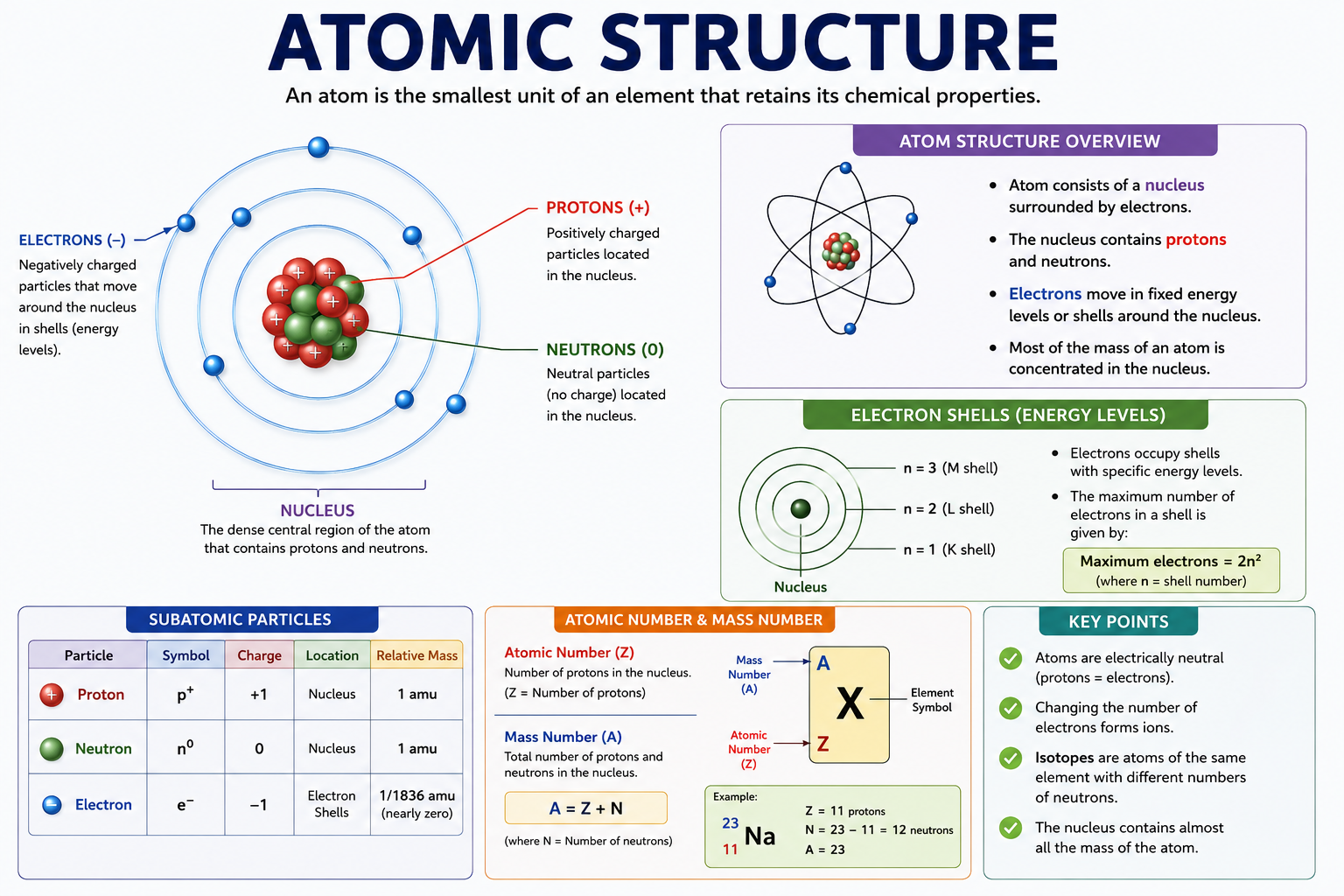
Everything you can see, touch, taste, or smell is made of atoms. The chair you’re sitting on, the air filling your lungs, the water in your glass, even you — all of it, at the most fundamental level, is a collection of atoms arranged in particular ways. That’s not a philosophical claim; it’s one of the most thoroughly verified facts in all of science.
And yet, for something so universal and so fundamental, atoms are astonishingly difficult to visualize. A single atom of hydrogen — the simplest atom that exists — is about 0.1 nanometers in diameter. You could line up roughly 10 million hydrogen atoms across a single millimeter. No microscope available to high school students can see one directly. So how do we know what atoms look like? How do we know they have a nucleus, or that electrons orbit it in specific energy levels, or that isotopes exist?
The answer is that scientists built up our understanding of atomic structure gradually, over more than two centuries, through clever experiments and the willingness to revise their models when new evidence demanded it. That process — and the final, detailed picture of atomic structure it produced — is exactly what this Atomic Structure Study Guide will walk you through.
Whether you’re a high school student encountering atoms for the first time in a serious way, a college student who needs to cement the fundamentals before tackling quantum chemistry, or someone preparing for a medical, engineering, or competitive entrance exam, this guide covers every concept you need. We’ll go through the history of atomic models, the structure of protons, neutrons, and electrons, atomic number and mass number, isotopes and ions, electron shells and orbitals, electron configuration rules, and the connection between atomic structure and the periodic table.
There’s also a comprehensive set of practice questions and a revision checklist to make sure you leave here fully exam-ready.
Let’s start at the very beginning.
Key Takeaways
Before You Dive In — Key Takeaways
- An atom is the smallest unit of an element that retains the chemical properties of that element.
- Atoms consist of a dense nucleus containing protons and neutrons, surrounded by electrons in energy levels.
- The atomic number equals the number of protons; it uniquely identifies each element.
- The mass number equals the total number of protons plus neutrons in the nucleus.
- Isotopes are atoms of the same element with different numbers of neutrons (and therefore different mass numbers).
- Ions are atoms that have gained or lost electrons, giving them a net electrical charge.
- Electrons occupy specific energy levels (shells) and sub-levels (orbitals: s, p, d, f).
- Three rules govern electron configuration: the Aufbau principle, the Pauli exclusion principle, and Hund’s rule.
- Valence electrons — those in the outermost shell — determine an element’s chemical behavior and bonding properties.
- Atomic structure directly explains the organization of the periodic table.
What Is Atomic Structure?
Atomic structure refers to the internal arrangement of an atom — specifically, how its subatomic particles (protons, neutrons, and electrons) are organized, and how that organization determines the atom’s properties. When chemists talk about atomic structure, they’re asking questions like: How many protons does this atom have? How are its electrons arranged? What energy level are those electrons in? What shape do the electron orbitals take?
These aren’t abstract questions. The answers explain why sodium explodes when it meets water, why noble gases refuse to react with almost anything, why carbon can form the backbone of millions of different molecules, and why iron rusts. The chemical behavior of every substance on Earth — every reaction, every bond, every property — is ultimately a consequence of atomic structure.
The study of atomic structure sits right at the boundary between chemistry and physics. It draws on quantum mechanics, electromagnetism, and nuclear physics while remaining absolutely central to chemistry. At the high school level, the focus is primarily on understanding the three subatomic particles, the models that describe how electrons are arranged, and how that arrangement connects to the periodic table. At the university level, the topic expands into quantum mechanical wave functions, orbital shapes, and spectroscopy.
This guide covers the full range — from the basics that every student needs, through to the depth required for competitive exams.
Why Atomic Structure Is Important
There are really two reasons to care about atomic structure: it explains the physical world, and it’s tested extensively on almost every chemistry exam that exists.
From an explanatory standpoint, atomic structure answers questions that would otherwise seem mysterious:
- Why does helium not bond with anything? Because its electron shell is completely full — it has no reason to share or exchange electrons with other atoms.
- Why is sodium a highly reactive metal while chlorine is a reactive nonmetal, and why do they combine so readily to form stable salt? Because sodium has one electron in its outer shell (which it “wants” to lose) and chlorine has seven (and needs just one more to complete its shell).
- Why do carbon atoms form so many different compounds? Because carbon has four valence electrons, allowing it to form four bonds in an extraordinary variety of combinations.
From an exam preparation standpoint, atomic structure questions appear in virtually every major chemistry assessment — GCSE, A-Level, AP Chemistry, SAT Subject Tests, IIT-JEE, NEET, MCAT chemistry sections, and university entrance examinations worldwide. Mastering this topic well gives you a foundation that pays dividends across every subsequent chemistry topic.
History of Atomic Theory
Understanding how our picture of the atom evolved is not just an interesting history lesson — it also helps you understand why we hold the current model and what experimental evidence supports it. Exam questions about atomic models are common, and they require you to know not just what each model says but what evidence led to it and what limitations it had.
Democritus
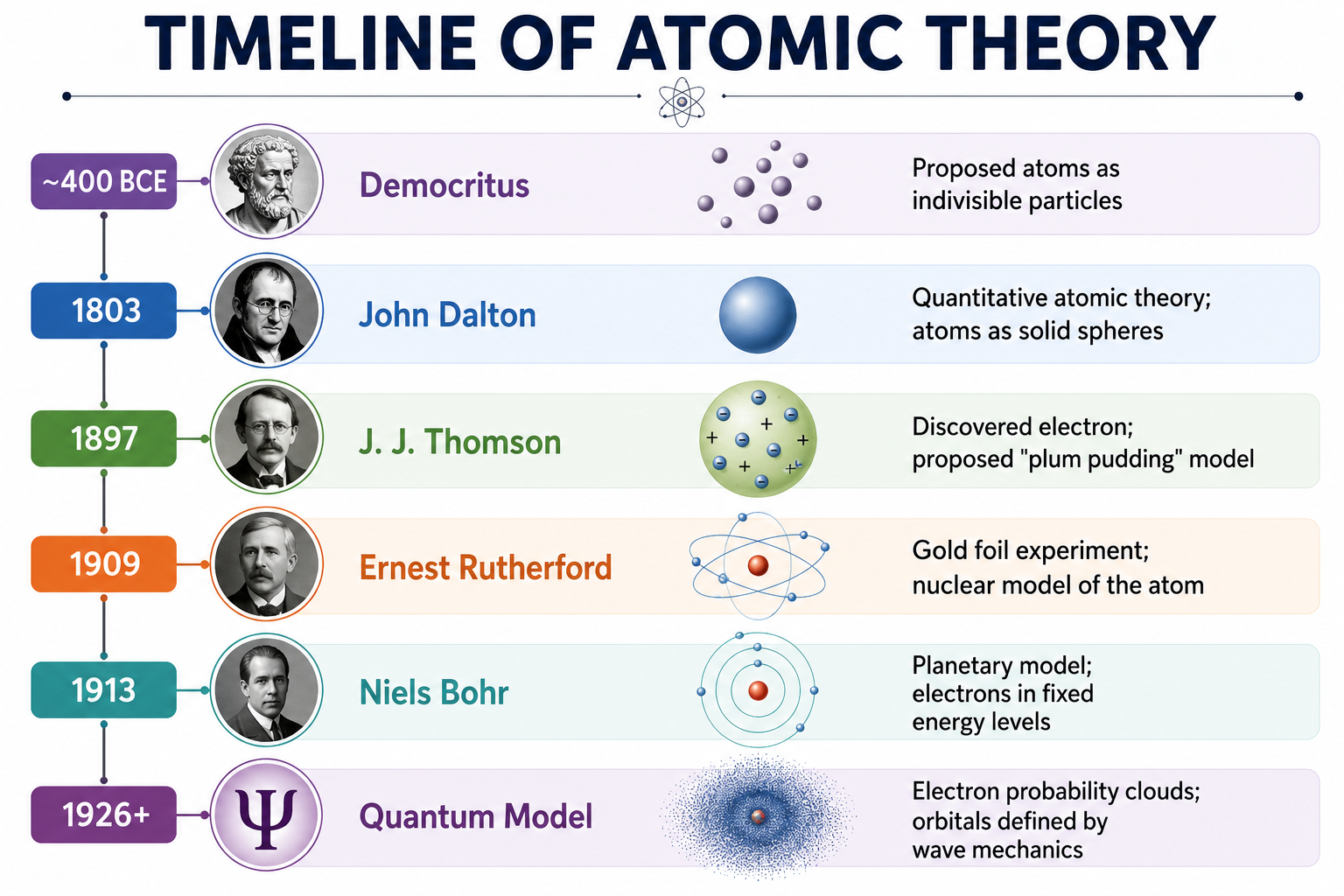
Around 400 BCE, the ancient Greek philosopher Democritus proposed that if you kept cutting matter into smaller and smaller pieces, you would eventually reach a particle so small it could not be cut further. He called these particles atomos — from the Greek for “uncuttable” or “indivisible.” He imagined them as tiny, indestructible, solid objects of different shapes and sizes.
This was a philosophical idea rather than a scientific one — Democritus had no experimental evidence, and his contemporary Aristotle rejected the idea in favor of continuous matter. It would be over 2,000 years before anyone tested the concept experimentally.
John Dalton
In the early 1800s, English chemist and schoolteacher John Dalton transformed the philosophical notion of atoms into a proper scientific theory backed by experimental evidence from chemical reactions. Between 1803 and 1808, he published his Atomic Theory, which stated:
- All matter is made of tiny, indivisible particles called atoms.
- Atoms of a given element are identical in mass and properties.
- Atoms of different elements differ in mass and properties.
- Atoms combine in simple whole-number ratios to form compounds.
- Atoms are neither created nor destroyed in chemical reactions (conservation of mass).
Dalton’s model pictured atoms as solid, featureless spheres — like tiny billiard balls. His theory explained the law of conservation of mass and the law of definite proportions beautifully. It wasn’t perfect (we now know atoms are divisible and that atoms of the same element can have different masses — isotopes), but it established the quantitative foundation of modern chemistry.
J. J. Thomson
In 1897, British physicist J. J. Thomson made a discovery that shattered Dalton’s model of the atom as indivisible. Working with cathode ray tubes — evacuated glass tubes through which electrical currents were passed — Thomson showed that the rays produced were actually streams of negatively charged particles far lighter than any atom. He had discovered the electron.
This meant atoms were not indivisible after all — they had internal structure. Thomson proposed the “plum pudding” model (he actually called it the “raisin pudding” model, but both terms appear in textbooks). In this model, the atom was pictured as a sphere of diffuse positive charge with electrons embedded in it like plums (or raisins) in a pudding.
The plum pudding model correctly recognized that atoms contain electrons and that the atom as a whole is electrically neutral (because the positive charge balances the negative electrons). But it got the internal structure fundamentally wrong, as Rutherford would soon demonstrate.
Ernest Rutherford
In 1909, New Zealand-born physicist Ernest Rutherford, working with Hans Geiger and Ernest Marsden at the University of Manchester, performed what became known as the gold foil experiment (or Geiger-Marsden experiment). The results were, in Rutherford’s own words, “almost as incredible as if you fired 15-inch shells at tissue paper and they came back and hit you.”
The experiment involved firing a beam of positively charged alpha particles at an extremely thin sheet of gold foil, with a detector screen surrounding the setup. According to the plum pudding model, the positive charge in the atom was spread out diffusely, so the alpha particles should have passed straight through with only minor deflections.
What actually happened:
- Most alpha particles passed straight through the gold foil (consistent with most of the atom being empty space)
- A small fraction were deflected at large angles
- A very small number bounced almost straight back
The only explanation that fit this data was that the positive charge of the atom was concentrated in a tiny, extremely dense central region — the nucleus — and that the rest of the atom was essentially empty space, with electrons somewhere in that space. Rutherford’s nuclear model replaced the plum pudding model immediately.
However, Rutherford’s model had a serious problem: classical physics predicted that electrons orbiting a nucleus should continuously radiate energy and spiral inward into the nucleus within a fraction of a second. Clearly, atoms don’t collapse — so something was wrong with applying classical physics to electrons in atoms.
Niels Bohr
In 1913, Danish physicist Niels Bohr solved the electron stability problem by borrowing an idea from the new field of quantum physics. He proposed that electrons could only occupy specific allowed orbits (or energy levels) around the nucleus, and that while in these orbits, they did not radiate energy. An electron could move from one energy level to another by absorbing or emitting a specific amount of energy — a quantum — corresponding to the energy difference between the levels.
This explained the observed line spectrum of hydrogen with striking accuracy. When hydrogen atoms are excited (by heat or electricity), they emit light at very specific wavelengths (colors) — not a continuous spectrum. Bohr’s model explained why: each line in the spectrum corresponds to an electron dropping from a higher energy level to a lower one, emitting a photon whose energy — and therefore frequency and color — matches the energy difference.
The Bohr model is often pictured as a planetary model: a central nucleus with electrons orbiting it in fixed circular paths at specific distances. While this image is useful and is still used in introductory chemistry, it is technically incorrect. Real electrons don’t orbit the nucleus in defined circular paths. That realization came with the development of quantum mechanics.
Modern Quantum Mechanical Model
In the 1920s, the work of de Broglie, Heisenberg, Schrödinger, and others fundamentally changed the picture. De Broglie showed that electrons have wave-like properties. Heisenberg’s uncertainty principle established that you cannot simultaneously know both the exact position and exact momentum of an electron. Schrödinger developed a wave equation whose solutions describe orbitals — regions of space where there is a high probability of finding an electron.
In the modern quantum mechanical model:
- Electrons do not orbit the nucleus in defined paths.
- Instead, they exist in probability clouds — three-dimensional regions where the electron is likely to be found.
- These regions are called orbitals, each with a specific shape and energy.
- Orbitals are organized into subshells (s, p, d, f) and shells (energy levels numbered 1, 2, 3…).
This is the model that underlies all modern chemistry, materials science, and nanotechnology.
What Is an Atom?
An atom is the smallest particle of an element that retains the chemical properties of that element. The word comes from the Greek atomos, but modern atoms are very different from Democritus’s original indivisible particles — we now know atoms have internal structure and can be split (with considerable effort and energy release, as nuclear reactions demonstrate).
To give you a sense of scale:
- A typical atom has a diameter of about 0.1 to 0.5 nanometers (1–5 × 10⁻¹⁰ meters)
- The nucleus is about 100,000 times smaller than the atom as a whole
- If an atom were the size of a sports stadium, the nucleus would be about the size of a marble at the center
- The electrons would be tiny specks somewhere in the stands — and the rest would be empty space
This means atoms are mostly empty space. The nucleus is extraordinarily dense — nuclear matter has a density of approximately 2 × 10¹⁷ kg/m³, meaning a teaspoon of pure nuclear matter would weigh about 500 million metric tons.
Parts of an Atom
Protons
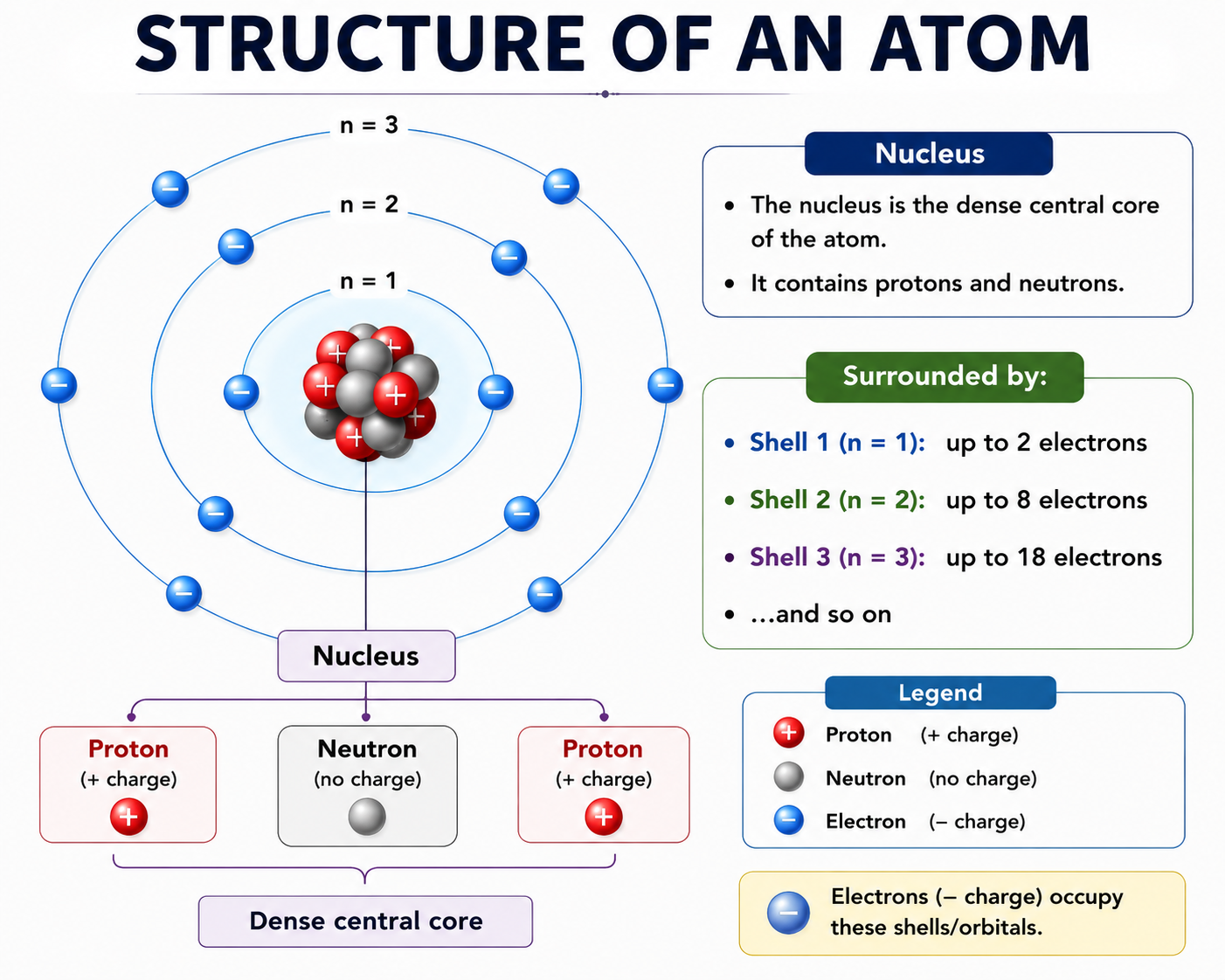
Protons are positively charged subatomic particles found in the nucleus of every atom. Each proton carries a charge of +1 (in units of elementary charge, which is 1.602 × 10⁻¹⁹ coulombs). Their mass is approximately 1.673 × 10⁻²⁷ kg — assigned a relative mass of 1 atomic mass unit (amu) for practical purposes.
The number of protons in an atom’s nucleus is the atomic number, and it determines which element the atom is. Change the number of protons, and you change the element entirely. An atom with 6 protons is always carbon. An atom with 79 protons is always gold. This is fundamental and immutable.
The strong nuclear force — one of the four fundamental forces of physics — holds protons together in the nucleus, overcoming the electrostatic repulsion between their like positive charges. Without the strong force, the protons in a nucleus would repel each other violently.
Neutrons
Neutrons are electrically neutral subatomic particles also found in the nucleus. Their mass (1.675 × 10⁻²⁷ kg) is slightly greater than that of a proton, and they are also assigned a relative mass of approximately 1 amu. Because they are neutral, neutrons contribute to the mass of the nucleus but not to its charge.
Neutrons play a crucial stabilizing role in the nucleus. As atomic number increases and more protons are packed into a nucleus, more neutrons are needed to provide sufficient strong nuclear force to hold the nucleus together against the increasing proton-proton repulsion. This is why larger nuclei have progressively higher neutron-to-proton ratios.
Atoms of the same element can have different numbers of neutrons — these are isotopes, discussed in detail below.
Electrons
Electrons are negatively charged subatomic particles that occupy the space around the nucleus. Each electron carries a charge of −1 (equal and opposite to the proton’s +1). Their mass — approximately 9.109 × 10⁻³¹ kg — is about 1/1836 that of a proton. For most chemical calculations, the mass of electrons is considered negligible; the atomic mass of an atom is essentially the combined mass of its protons and neutrons.
In a neutral atom, the number of electrons equals the number of protons, so the positive and negative charges cancel out exactly. The arrangement of electrons — particularly how many are in the outermost shell — determines almost everything about an atom’s chemical behavior.
Subatomic Particles Comparison Table
| Property | Proton | Neutron | Electron |
|---|---|---|---|
| Symbol | p or p+ | n or n0 | e or e- |
| Location | Nucleus | Nucleus | Shells/orbitals outside nucleus |
| Relative Charge | +1 | 0 | -1 |
| Relative Mass (amu) | 1 | 1 | ~1/1836 (negligible) |
| Actual Mass (kg) | 1.673 x 10⁻²⁷ | 1.675 x 10⁻²⁷ | 9.109 x 10⁻³¹ |
| Discovered By | Rutherford (1917) | Chadwick (1932) | Thomson (1897) |
| Role | Defines element identity | Provides nuclear stability | Determines chemical behavior |
Structure of the Atomic Nucleus
The nucleus sits at the center of the atom and contains virtually all of the atom’s mass. It consists of protons and neutrons (collectively called nucleons) held together by the strong nuclear force — the most powerful of the four fundamental forces, capable of overcoming the considerable electrostatic repulsion between the positively charged protons.
Nuclear size is measured in femtometers (fm), where 1 fm = 10⁻¹⁵ meters. A typical nucleus has a radius of about 1–10 fm, compared to the atom’s total radius of about 50,000–200,000 fm. The nucleus contains essentially all of the atom’s mass (because electrons contribute negligible mass) but only about 1/10⁻¹² of the atom’s volume.
Nuclear stability varies considerably. Nuclei with certain “magic numbers” of protons or neutrons are particularly stable. Unstable nuclei undergo radioactive decay, emitting radiation (alpha, beta, or gamma) to reach a more stable configuration.
Atomic Number Explained
The atomic number (symbol: Z) is the number of protons in the nucleus of an atom. It is the single most important number associated with any element because it uniquely identifies that element. Every atom of carbon has exactly 6 protons — no more, no less. Every atom of gold has exactly 79 protons. If you change the number of protons, you change the element.
In a neutral (uncharged) atom:
Number of protons = Number of electrons = Atomic number (Z)
The atomic number for each element is found on the periodic table, typically displayed above the element symbol. Elements in the periodic table are arranged in order of increasing atomic number, from hydrogen (Z = 1) to oganesson (Z = 118, the heaviest currently confirmed element).
Practical example: Carbon has an atomic number of 6. This means every carbon atom has 6 protons and, in its neutral state, 6 electrons.
Mass Number Explained
The mass number (symbol: A) is the total number of protons and neutrons in the nucleus of an atom. Since electrons have negligible mass, the mass number effectively gives the total nuclear mass in atomic mass units.
Mass Number (A) = Number of Protons (Z) + Number of Neutrons (N)
Therefore, if you know the atomic number and the mass number, you can calculate the number of neutrons:
Number of Neutrons (N) = Mass Number (A) − Atomic Number (Z)
Example: Carbon-12 (the most common carbon isotope) has a mass number of 12 and an atomic number of 6.
- Number of neutrons = 12 − 6 = 6
- So carbon-12 has 6 protons, 6 neutrons, and 6 electrons.
Atoms are typically represented using the notation: Mass number on top left, atomic number on bottom left, element symbol in center. For example, carbon-12 is written with 12 as a superscript and 6 as a subscript before the letter C.
Atomic Number vs Mass Number (Comparison Table)
| Feature | Atomic Number (Z) | Mass Number (A) |
|---|---|---|
| Definition | Number of protons in the nucleus | Total number of protons + neutrons |
| Symbol | Z | A |
| What it determines | Which element the atom is | Approximately which isotope it is |
| Can it change? | No (changing Z changes the element) | Yes (different isotopes have same Z but different A) |
| Includes neutrons? | No | Yes |
| Includes electrons? | Indirectly (equals electrons in neutral atom) | No |
| Position on periodic table | Listed for every element | Not directly listed (average atomic mass is shown) |
| Example (Carbon-14) | Z = 6 (6 protons) | A = 14 (6 protons + 8 neutrons) |
Isotopes Explained
Isotopes are atoms of the same element — meaning they have the same number of protons (same atomic number) — but different numbers of neutrons, giving them different mass numbers.
Because isotopes of an element have the same number of protons and electrons, they have essentially identical chemical properties. Their physical properties (such as mass, density, and nuclear stability) differ slightly because of the different number of neutrons.
A practical and important example: Carbon exists naturally as three isotopes:
| Isotope | Protons | Neutrons | Mass Number | Stability |
|---|---|---|---|---|
| Carbon-12 | 6 | 6 | 12 | Stable (98.9% of natural carbon) |
| Carbon-13 | 6 | 7 | 13 | Stable (1.1% of natural carbon) |
| Carbon-14 | 6 | 8 | 14 | Radioactive (used in radiocarbon dating) |
All three are chemically carbon — they form the same types of bonds, react with the same substances, and behave identically in chemical reactions. But carbon-14 is radioactive and decays over time, making it incredibly useful as a dating tool in archaeology and geology.
Other important isotopes to know:
- Hydrogen has three isotopes: protium (¹H, no neutrons), deuterium (²H, one neutron), and tritium (³H, two neutrons, radioactive).
- Uranium-235 and Uranium-238 are both uranium but differ in their suitability for nuclear fission.
- Chlorine naturally exists as a mixture of Cl-35 (75.8%) and Cl-37 (24.2%), which is why the average atomic mass of chlorine on the periodic table is approximately 35.5.
Important Fact: The average atomic mass shown on the periodic table is not the mass of any single atom — it is the weighted average of the masses of all naturally occurring isotopes of that element, weighted by their relative abundance. This is why atomic masses are rarely whole numbers.
Ions Explained
In a neutral atom, the number of electrons equals the number of protons, and the overall charge is zero. An ion is an atom (or group of atoms) that has gained or lost one or more electrons, giving it a net electrical charge.
Cations
A cation is a positively charged ion formed when an atom loses one or more electrons. Since electrons carry negative charge, losing electrons leaves the atom with more protons (positive charges) than electrons (negative charges), resulting in a net positive charge.
Metals typically form cations. Sodium (Na) has 11 protons and 11 electrons in its neutral state. When it loses one electron, it becomes Na⁺ — the sodium ion — with 11 protons and only 10 electrons.
Common cations:
- Na⁺ (sodium ion): 11 protons, 10 electrons
- Ca²⁺ (calcium ion): 20 protons, 18 electrons
- Fe³⁺ (iron(III) ion): 26 protons, 23 electrons
- Al³⁺ (aluminum ion): 13 protons, 10 electrons
Anions
An anion is a negatively charged ion formed when an atom gains one or more electrons. Gaining electrons increases the number of negative charges relative to positive charges, resulting in a net negative charge.
Nonmetals typically form anions. Chlorine (Cl) has 17 protons and 17 electrons in its neutral state. When it gains one electron, it becomes Cl⁻ — the chloride ion — with 17 protons and 18 electrons.
Common anions:
- Cl⁻ (chloride ion): 17 protons, 18 electrons
- O²⁻ (oxide ion): 8 protons, 10 electrons
- N³⁻ (nitride ion): 7 protons, 10 electrons
- F⁻ (fluoride ion): 9 protons, 10 electrons
Understanding ions is essential for understanding ionic bonding, solution chemistry, and electrochemistry.
Electron Shells and Energy Levels
Electrons don’t float randomly around the nucleus — they occupy specific energy levels, also called electron shells or principal quantum levels, designated by the principal quantum number n (where n = 1, 2, 3, 4…).
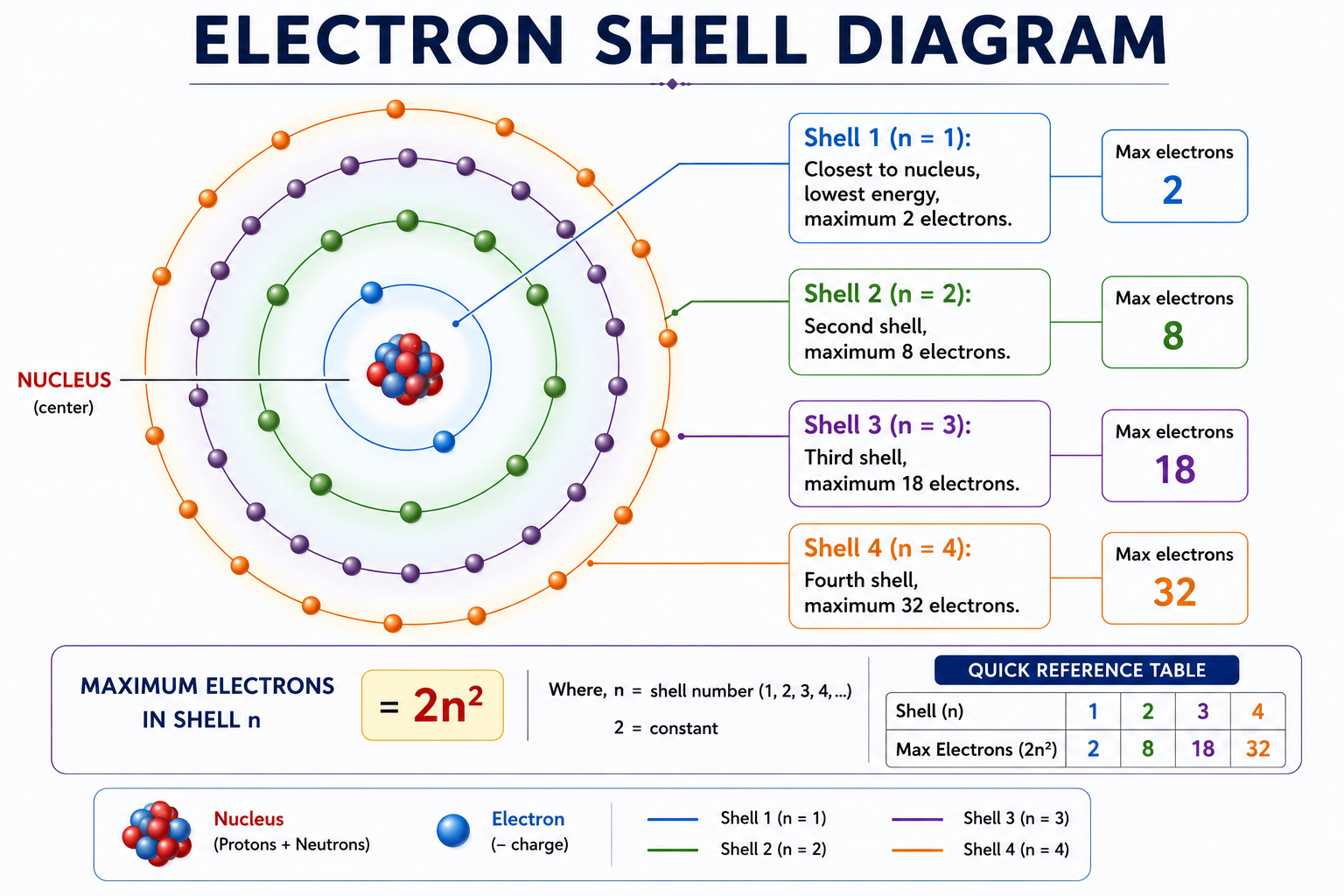
The maximum number of electrons a shell can hold is given by 2n², where n is the shell number:
| Shell (n) | Maximum Electrons (2n²) | Subshells Present |
|---|---|---|
| 1 | 2 | 1s |
| 2 | 8 | 2s, 2p |
| 3 | 18 | 3s, 3p, 3d |
| 4 | 32 | 4s, 4p, 4d, 4f |
Electrons in inner shells (closer to the nucleus) have lower energy; those in outer shells have higher energy. When an electron absorbs energy (from light, heat, or electricity), it can jump to a higher energy level — it becomes “excited.” When it falls back to a lower energy level, it releases that energy as a photon of light. This is the basis of atomic emission spectra, which are unique fingerprints for each element and are used in spectroscopy to identify elements in everything from stars to forensic samples.
For simple electron shell diagrams used in introductory chemistry, electrons are placed in shells sequentially, filling the first shell before moving to the second, and so on. For example:
- Sodium (Na, Z=11): 2, 8, 1 (2 electrons in shell 1, 8 in shell 2, 1 in shell 3)
- Chlorine (Cl, Z=17): 2, 8, 7
- Calcium (Ca, Z=20): 2, 8, 8, 2
Electron Configuration
Electron configuration is the precise description of how electrons are distributed among the energy levels and sublevels (orbitals) of an atom. Unlike the simple shell diagrams above, full electron configuration accounts for the subshells (s, p, d, f) within each principal energy level.
Three rules govern how electrons fill orbitals:
Aufbau Principle
The Aufbau principle (from the German word for “building up”) states that electrons fill orbitals in order of increasing energy — lowest energy orbitals are filled first before higher energy ones are occupied.
The general order of orbital filling is:
1s → 2s → 2p → 3s → 3p → 4s → 3d → 4p → 5s → 4d → 5p → 6s → 4f → 5d → 6p…
Notice that 4s fills before 3d, and 6s fills before 4f — this is because of complex electron-electron repulsion effects that cause some higher principal quantum level subshells to have lower energy than some lower principal quantum level subshells.
Pauli Exclusion Principle
The Pauli exclusion principle states that no two electrons in the same atom can have exactly the same set of four quantum numbers. A practical consequence: each orbital can hold a maximum of two electrons, and those two electrons must have opposite spins (one spin-up, one spin-down, often represented with arrows pointing up and down).
Think of each orbital as a seat that fits exactly two people — but they must be facing in opposite directions.
Hund’s Rule
Hund’s rule states that when electrons fill orbitals of equal energy (degenerate orbitals — for example, the three p orbitals at a given energy level), one electron fills each orbital before any orbital gets a second electron. Furthermore, the electrons in singly occupied orbitals all have the same spin.
Think of it as people boarding a bus: everyone takes their own seat before anyone starts doubling up.
Electron Configuration Examples
Let’s work through a few elements:
Hydrogen (H, Z=1): 1s¹
One electron goes into the first s orbital.
Carbon (C, Z=6): 1s² 2s² 2p²
Two electrons fill 1s, two fill 2s, then two go into the 2p subshell — one in each of two different 2p orbitals (Hund’s rule).
Sodium (Na, Z=11): 1s² 2s² 2p⁶ 3s¹
After filling the first two shells completely (1s², 2s², 2p⁶ = 10 electrons), the eleventh electron goes into 3s.
Chlorine (Cl, Z=17): 1s² 2s² 2p⁶ 3s² 3p⁵
After the first two shells and 3s, five electrons fill the 3p subshell.
Iron (Fe, Z=26): 1s² 2s² 2p⁶ 3s² 3p⁶ 4s² 3d⁶
Note that 4s fills before 3d per the Aufbau order.
Shorthand (Noble Gas) Notation: For elements with many electrons, chemists often use the noble gas notation, which abbreviates the inner core electrons using the symbol of the preceding noble gas in brackets.
Example: Iron (Fe) in noble gas notation = [Ar] 3d⁶ 4s²
(Argon has the configuration 1s² 2s² 2p⁶ 3s² 3p⁶, so [Ar] represents those 18 electrons.)
Valence Electrons Explained
Valence electrons are the electrons in the outermost principal energy level (the outermost shell) of an atom. They are the electrons involved in chemical bonding — the ones that atoms share, gain, or lose when they interact with other atoms.
The number of valence electrons determines:
- How many bonds an atom typically forms
- Whether an atom is likely to gain or lose electrons (and thereby form ions)
- An element’s position in the periodic table (specifically, which group it belongs to)
The group number (for main group elements) directly tells you the number of valence electrons:
- Group 1 (alkali metals): 1 valence electron
- Group 2 (alkaline earth metals): 2 valence electrons
- Group 13: 3 valence electrons
- Group 14: 4 valence electrons
- Group 15: 5 valence electrons
- Group 16: 6 valence electrons
- Group 17 (halogens): 7 valence electrons
- Group 18 (noble gases): 8 valence electrons (except helium with 2)
An atom is particularly stable when its outermost shell is completely filled — this is the octet rule (8 electrons in the outermost shell, or 2 for hydrogen and helium). This stability drives chemical reactions: atoms react to achieve a full outer shell, either by sharing electrons (covalent bonds), transferring electrons (ionic bonds), or other mechanisms.
Atomic Orbitals
An orbital is a region in three-dimensional space around the nucleus where there is a high probability (typically 90–95%) of finding an electron. Unlike the circular paths in the Bohr model, orbitals are probability distributions — they describe where an electron is likely to be, not a defined path it follows.
s Orbitals
- Shape: Spherical — perfectly round, extending outward equally in all directions from the nucleus
- Number per subshell: 1 (can hold maximum 2 electrons)
- In each principal level from n=1 onward: There is one s subshell
- Example: The 1s orbital is a small sphere; the 2s is a larger sphere (with a spherical node inside); 3s is larger still
p Orbitals
- Shape: Dumbbell-shaped — two lobes extending in opposite directions from the nucleus along an axis
- Number per subshell: 3 (oriented along x, y, and z axes: px, py, pz) — can hold maximum 6 electrons
- Present from n=2 onward
- Example: The three 2p orbitals extend along the x, y, and z axes respectively; they are equal in energy (degenerate)
d Orbitals
- Shape: More complex — four of the five d orbitals have a four-lobed “cloverleaf” shape; one (dz²) has a dumbbell shape with a donut-shaped ring around the middle
- Number per subshell: 5 (can hold maximum 10 electrons)
- Present from n=3 onward
- Important in: Transition metal chemistry; explains the variable oxidation states and colored compounds of transition metals
f Orbitals
- Shape: Very complex multi-lobed shapes
- Number per subshell: 7 (can hold maximum 14 electrons)
- Present from n=4 onward
- Important in: Lanthanide and actinide chemistry; less commonly tested at high school level
Orbital Summary Table
| Orbital Type | Shape | Number per Subshell | Max Electrons | First Appears in Shell |
|---|---|---|---|---|
| s | Spherical | 1 | 2 | n = 1 |
| p | Dumbbell (3 axes) | 3 | 6 | n = 2 |
| d | Complex (cloverleaf etc.) | 5 | 10 | n = 3 |
| f | Very complex | 7 | 14 | n = 4 |
Bohr Model vs Modern Atomic Model (Comparison Table)
| Feature | Bohr Model (1913) | Modern Quantum Mechanical Model |
|---|---|---|
| Electron path | Fixed circular orbits at specific distances | No defined path; probability distributions (orbitals) |
| Position of electrons | Precisely defined orbit | Only probability of finding electron in a region |
| Energy levels | Fixed, discrete energy levels | Discrete energy levels divided into sublevels (s, p, d, f) |
| Orbital shapes | Circular rings | Spherical (s), dumbbell (p), complex (d, f) |
| Basis | Quantized angular momentum assumption | Full quantum mechanics (Schrodinger wave equation) |
| Accuracy | Works well for hydrogen; fails for multi-electron atoms | Works for all atoms |
| Explains atomic spectra? | Yes, for hydrogen | Yes, for all elements |
| Electron “location” | Known precisely within orbit | Inherently uncertain (Heisenberg uncertainty principle) |
| Main limitation | Cannot explain multi-electron atoms or orbital shapes | Mathematically complex; requires quantum mechanics |
| Still used today? | Yes, as a useful simplification for introductory chemistry | Yes, this is the current accepted model |
Atomic Structure and the Periodic Table
The periodic table is not an arbitrary arrangement — it is a direct visual map of atomic structure. Once you understand atomic structure, the periodic table’s organization makes complete logical sense.
Periods (horizontal rows): Each period corresponds to a principal energy level (shell). Period 1 has elements whose outer electrons are in shell 1 (only hydrogen and helium). Period 2 has elements filling shell 2. Period 3 fills shell 3, and so on.
Groups (vertical columns): Elements in the same group have the same number of valence electrons and therefore similar chemical properties. Group 1 elements all have 1 valence electron; Group 17 elements all have 7.
Blocks: The periodic table is divided into blocks named after the subshell being filled:
- s-block: Groups 1 and 2 (plus helium) — outermost electrons in s orbitals
- p-block: Groups 13–18 — outermost electrons in p orbitals
- d-block: Transition metals (Groups 3–12) — filling d orbitals
- f-block: Lanthanides and actinides — filling f orbitals
Atomic radius trends: Moving across a period (left to right), atomic radius decreases because more protons attract the same outer shell electrons more strongly. Moving down a group, atomic radius increases because outer electrons occupy successively higher (and more distant) energy levels.
Ionization energy trends: First ionization energy (energy needed to remove the first electron from a neutral atom in the gas phase) generally increases across a period and decreases down a group — opposite trends to atomic radius.
Common Atomic Structure Terms Every Student Should Know
| Term | Definition |
|---|---|
| Atom | Smallest unit of an element that retains its chemical properties |
| Nucleus | Dense central region of an atom containing protons and neutrons |
| Proton | Positively charged subatomic particle in the nucleus |
| Neutron | Electrically neutral subatomic particle in the nucleus |
| Electron | Negatively charged subatomic particle occupying energy levels outside the nucleus |
| Atomic Number (Z) | Number of protons in an atom’s nucleus; defines the element |
| Mass Number (A) | Total number of protons and neutrons in the nucleus |
| Isotope | Atom of the same element with a different number of neutrons |
| Ion | Atom that has gained or lost electrons, carrying a net charge |
| Cation | Positively charged ion (lost electrons) |
| Anion | Negatively charged ion (gained electrons) |
| Electron Shell | Principal energy level occupied by electrons around the nucleus |
| Orbital | Region of space where an electron is likely to be found |
| Subshell | Subdivision of a shell; contains orbitals of the same type (s, p, d, f) |
| Valence Electrons | Electrons in the outermost shell; determine chemical behavior |
| Electron Configuration | Description of electron distribution across all shells and subshells |
| Aufbau Principle | Electrons fill lowest energy orbitals first |
| Pauli Exclusion Principle | No two electrons in an atom can have identical quantum numbers; max 2 per orbital |
| Hund’s Rule | Electrons fill degenerate orbitals singly before pairing |
| Degenerate Orbitals | Orbitals of equal energy within the same subshell |
| Ground State | Lowest energy electron configuration of an atom |
| Excited State | Higher-energy electron configuration after energy absorption |
| Atomic Mass Unit (amu) | Unit of atomic mass; 1 amu = 1/12 the mass of carbon-12 |
| Nuclear Force | The strong force holding nucleons together in the nucleus |
| Spectral Lines | Specific frequencies of light emitted/absorbed by electrons changing energy levels |
Common Mistakes Students Make
Even students who study hard fall into predictable traps with atomic structure. Knowing these in advance can protect your exam marks:
- Confusing mass number with atomic mass. Mass number is always a whole number (count of protons + neutrons). Atomic mass (found on the periodic table) is a weighted average of all naturally occurring isotopes and is almost never a whole number.
- Forgetting neutrons when calculating mass number. A surprisingly common error. Always: A = Z + N. Never forget that neutrons contribute to mass number even though they don’t affect charge.
- Mixing up cations and anions. A cation has lost electrons (it’s positive because it lost negative charges). An anion has gained electrons (it’s negative because it gained negative charges). Memory trick: cAtions Are positive; Anions Are negative.
- Thinking electrons in higher shells are always farther from the nucleus. While this is generally true for the same atom, comparing across elements is more complex because of how nuclear charge affects electron attraction.
- Applying the 2n² rule rigidly to electron filling. The formula gives the theoretical maximum for a shell, but electrons don’t simply fill shell 3 completely (up to 18) before starting shell 4. The Aufbau order dictates that 4s fills before 3d — this is one of the most commonly misunderstood points in electron configuration.
- Writing electron configurations without considering Hund’s rule for p and d subshells. Students often just write electrons into p orbitals without explicitly noting that each orbital gets one electron before pairing begins. This matters for predicting magnetic properties and spectroscopic behavior.
- Confusing the Bohr model with the modern atomic model. The Bohr model has fixed circular orbits. The modern model has probability-based orbitals with specific shapes. Examiners frequently test whether students can distinguish these clearly.
- Forgetting that isotopes have the same chemical properties. Because isotopes differ only in neutron number and not in electron arrangement, their chemical behavior is essentially identical. This is a common exam question disguised in various forms.
- Thinking the atomic number changes when an ion forms. Forming an ion changes the electron count, not the proton count. Na⁺ still has 11 protons — it’s still sodium. Only losing or gaining protons (through nuclear reactions) changes the element.
- Getting the noble gas notation wrong. Students sometimes include the noble gas symbol itself in the remaining configuration. The noble gas symbol in brackets replaces those electrons entirely — it is not added to what follows.
Best Tips to Study Atomic Structure
Exam Tips Box
- Memorize the Aufbau orbital filling order as a fixed sequence: 1s, 2s, 2p, 3s, 3p, 4s, 3d, 4p, 5s, 4d, 5p, 6s, 4f, 5d, 6p. Many teachers suggest writing it out from memory ten times. It becomes automatic quickly.
- For each historical atomic model, remember: what was the model, what experiment supported it, and what limitation led to its replacement. These three-point comparisons are frequently asked in structured exam questions.
- Practice writing full electron configurations for the first 36 elements (through krypton). These cover all s, p, and d subshells and represent the range most commonly tested.
- When dealing with ions, always start from the neutral atom’s electron configuration. For cations (positive), remove electrons from the highest energy subshell first. For transition metal cations, remove 4s electrons before 3d electrons — a point that trips up many students.
- Draw electron dot (Lewis dot) structures alongside electron configurations. Seeing the valence electrons visually reinforces the connection between configuration and chemical behavior.
- Connect atomic structure to the periodic table actively. When you learn a new element, immediately identify its period (which shell is being filled), its group (how many valence electrons), and its block (which subshell it’s in). This makes both topics reinforce each other.
- For isotope calculations, practice finding average atomic mass from isotope masses and abundances. This calculation appears regularly and follows a simple weighted average formula.
Atomic Structure Practice Questions
30 Multiple Choice Questions (MCQs) with Answers
1. Which subatomic particle determines the identity of an element?
- A) Neutron
- B) Electron
- C) Proton ✓
- D) Nucleon
2. What is the mass number of an atom with 17 protons and 18 neutrons?
- A) 17
- B) 18
- C) 35 ✓
- D) 1
3. Which scientist proposed the nuclear model of the atom based on the gold foil experiment?
- A) Niels Bohr
- B) J. J. Thomson
- C) Ernest Rutherford ✓
- D) John Dalton
4. How many electrons can the third electron shell (n=3) hold at maximum?
- A) 2
- B) 8
- C) 18 ✓
- D) 32
5. An atom of chlorine (Z=17) gains one electron. What is the resulting ion?
- A) Cl⁻ ✓
- B) Cl⁺
- C) Cl²⁻
- D) Cl²⁺
6. Isotopes of the same element have the same number of:
- A) Neutrons
- B) Mass numbers
- C) Protons ✓
- D) Nucleons
7. The Pauli exclusion principle states that:
- A) Electrons fill the lowest energy orbitals first
- B) Degenerate orbitals are filled singly first
- C) No two electrons in the same atom can have identical quantum numbers ✓
- D) Electrons are found in orbitals rather than fixed paths
8. What is the electron configuration of sodium (Na, Z=11)?
- A) 1s² 2s² 2p⁶ 3s²
- B) 1s² 2s² 2p⁶ 3s¹ ✓
- C) 1s² 2s² 2p⁵ 3s²
- D) 1s² 2s⁹
9. Which orbital type has a dumbbell shape?
- A) s
- B) p ✓
- C) d
- D) f
10. The atomic number of an element is 20 and its mass number is 40. How many neutrons does it have?
- A) 20 (wait — let’s check: 40−20=20 protons means answer is 20)
- Answer: 20 neutrons ✓ (A = Z + N → N = 40 − 20 = 20)
11. Which model described electrons embedded in a diffuse positive charge like raisins in pudding?
- A) Dalton’s model
- B) Rutherford’s model
- C) Thomson’s model ✓
- D) Bohr’s model
12. What does Hund’s rule describe?
- A) Maximum electrons per orbital
- B) Electron filling order from lowest to highest energy
- C) Single occupation of degenerate orbitals before pairing ✓
- D) The number of shells in an atom
13. The valence electrons of an element in Group 16 number:
- A) 2
- B) 4
- C) 6 ✓
- D) 8
14. Carbon-12 and Carbon-14 are:
- A) Different elements
- B) Allotropes of carbon
- C) Isotopes of carbon ✓
- D) Ions of carbon
15. Which subshell fills immediately after 3p in the Aufbau order?
- A) 3d
- B) 4s ✓
- C) 4p
- D) 5s
16. An atom has 26 protons and 30 neutrons. Its mass number is:
- A) 26
- B) 30
- C) 56 ✓
- D) 4
17. Noble gases are chemically inert primarily because:
- A) They have no nucleus
- B) Their atomic mass is very high
- C) Their outermost electron shells are completely filled ✓
- D) They have no neutrons
18. How many orbitals are in the d subshell?
- A) 1
- B) 3
- C) 5 ✓
- D) 7
19. Which quantum level contains only s and p subshells?
- A) n = 1 only
- B) n = 3 and above
- C) n = 2 ✓
- D) n = 4
20. A sodium ion (Na⁺) has how many electrons?
- A) 11
- B) 10 ✓
- C) 12
- D) 9
21. The Bohr model was most successful at explaining:
- A) The hydrogen emission spectrum ✓
- B) Multi-electron atom spectra
- C) Orbital shapes
- D) Nuclear structure
22. Electrons in which shell are generally the first to be involved in chemical bonding?
- A) The first shell
- B) The inner shell
- C) The outermost (valence) shell ✓
- D) The d orbital electrons always
23. Relative to a proton, the mass of an electron is approximately:
- A) 1/1836 of a proton’s mass ✓
- B) Equal to a proton’s mass
- C) Twice a proton’s mass
- D) 1/100 of a proton’s mass
24. The average atomic mass of chlorine is approximately 35.5 because:
- A) Each chlorine atom has 35.5 protons
- B) It is a weighted average of Cl-35 and Cl-37 isotopes ✓
- C) Chlorine atoms lose 0.5 electrons
- D) The mass number fluctuates
25. The element in Period 3, Group 1 of the periodic table is:
- A) Lithium
- B) Potassium
- C) Sodium ✓
- D) Magnesium
26. Which principle states electrons fill from the lowest energy orbital upward?
- A) Aufbau principle ✓
- B) Pauli exclusion principle
- C) Hund’s rule
- D) Heisenberg’s uncertainty principle
27. How many electrons can the p subshell hold at maximum?
- A) 2
- B) 6 ✓
- C) 10
- D) 14
28. What is the electron configuration of oxygen (Z=8)?
- A) 1s² 2s² 2p²
- B) 1s² 2s² 2p⁴ ✓
- C) 1s² 2s⁶
- D) 1s² 2s² 2p⁶
29. Which of the following is a cation?
- A) Cl⁻
- B) O²⁻
- C) Na⁺ ✓
- D) N³⁻
30. The modern quantum mechanical model of the atom describes electrons as:
- A) Moving in fixed circular orbits
- B) Stationary particles attached to the nucleus
- C) Probability distributions in regions called orbitals ✓
- D) Indivisible particles with no wave properties
15 Short Answer Questions
- Describe Rutherford’s gold foil experiment. What were the three key observations, and what conclusion did Rutherford draw from each?
- Define atomic number and mass number. Using an example element of your choice, show how to calculate the number of neutrons.
- What is the difference between an isotope and an ion? Can an atom be both an isotope and an ion simultaneously? Explain.
- State the three rules governing electron configuration. Give a brief example showing how each rule applies.
- Write the full electron configuration for iron (Fe, Z=26). Then write the noble gas (shorthand) notation for iron.
- Explain why the average atomic mass of chlorine shown on the periodic table is 35.5 rather than a whole number.
- Define valence electrons and explain their significance in determining an element’s chemical behavior.
- Describe the shapes of s orbitals and p orbitals. How many orbitals of each type are in the second electron shell?
- Compare the Bohr model with the modern quantum mechanical model. State two similarities and three differences.
- Explain what happens to an atom’s electron count when it forms: (a) a 2+ cation, and (b) a 2- anion. Give one example of each.
- What is the Aufbau principle? Write out the orbital filling order from 1s through 4p.
- Why do elements in the same group of the periodic table have similar chemical properties? Relate your answer to valence electrons.
- Describe the contribution of J. J. Thomson to atomic theory. What model did his discovery replace and what model did it help lead to?
- An atom has 15 protons, 16 neutrons, and 15 electrons. Identify the element, give its atomic number, mass number, and state whether it is a cation, anion, or neutral atom.
- Why are noble gases so chemically stable? Use your understanding of electron shells to explain.
10 Long Answer Questions
- Trace the historical development of atomic theory from Dalton to the modern quantum mechanical model. For each major model (Dalton, Thomson, Rutherford, Bohr, Quantum Mechanical), describe the model itself, the experimental evidence that supported it, and the key limitation that led scientists to move beyond it.
- Explain the structure of the atom in detail, including the location, charge, and relative mass of protons, neutrons, and electrons. Describe how the sizes of the nucleus and atom compare. Explain how the strong nuclear force relates to nuclear stability.
- Explain the concept of isotopes fully, including why isotopes have the same chemical properties but different physical properties. Show how the average atomic mass is calculated using isotope masses and abundances, using the example of chlorine (Cl-35: mass 34.97 amu, abundance 75.77%; Cl-37: mass 36.97 amu, abundance 24.23%).
- Describe electron shells and subshells in detail. Explain the 2n² rule for maximum shell occupancy. Describe all four subshell types (s, p, d, f), stating the number of orbitals, maximum electrons, and shape for each. Explain the Aufbau filling order and why 4s fills before 3d.
- Explain all three rules of electron configuration — Aufbau principle, Pauli exclusion principle, and Hund’s rule — in detail. For each rule, state it formally, explain what it means in practical terms, and illustrate it with an electron configuration example. Then write the full electron configurations for Na, Cl, Fe, and Ca.
- Explain how atomic structure directly explains the organization of the periodic table. In your answer, address: why elements are arranged in order of atomic number; what periods represent in terms of electron shells; what groups represent in terms of valence electrons; and what the s, p, d, f blocks correspond to.
- Describe ions in detail, explaining the difference between cations and anions, how each forms, and how ionic charge is determined from electron gain or loss. Give five examples of each type of ion, stating the number of protons and electrons in each. Explain why ionic compounds typically form between metals and nonmetals.
- Compare and contrast the Bohr model and the modern quantum mechanical model of the atom in detail. Address the treatment of electron position, the concept of orbitals vs orbits, energy levels, orbital shapes, the role of the uncertainty principle, what phenomena each model successfully explains, and the limitations of each.
- Discuss the contribution of subatomic particles to the overall properties of an atom. Explain how protons determine element identity, how neutrons contribute to nuclear stability and isotope variation, and how electron configuration governs all chemical properties. Use specific examples (at least three elements) to illustrate your points.
- Explain what valence electrons are, how to determine the number of valence electrons for any main group element from the periodic table, and why valence electrons are central to understanding chemical bonding. In your answer, discuss the octet rule, how it drives ionic and covalent bond formation, and give one example of each type of bonding in terms of valence electron behavior.
Revision Checklist
Use this comprehensively before any exam on atomic structure:
- I can name all three subatomic particles, give their relative charges and masses, and state where each is found in the atom
- I can describe the contributions and limitations of Dalton, Thomson, Rutherford, Bohr, and the quantum mechanical model
- I can explain what the gold foil experiment was, what it observed, and what conclusion it supported
- I can define atomic number and mass number and use both to calculate the number of protons, neutrons, and electrons in any atom
- I can calculate the number of neutrons: N = A − Z
- I know what isotopes are and can explain why they have the same chemical properties
- I can calculate average atomic mass from isotope masses and natural abundances
- I can define cations and anions and correctly calculate proton and electron numbers for ions
- I know the formula for maximum electrons per shell: 2n²
- I can state all three electron configuration rules (Aufbau, Pauli, Hund) and apply them correctly
- I can write full electron configurations for elements Z=1 through Z=36
- I can write noble gas (shorthand) electron configurations
- I know the shapes of s, p, d, and f orbitals and the number of each per subshell
- I understand what valence electrons are and how to identify them
- I can explain how atomic structure relates to periodic table organization (periods, groups, blocks)
- I can compare the Bohr model and modern quantum mechanical model clearly
- I have completed all 30 MCQs and reviewed any incorrect answers
- I can explain the Aufbau filling order and state why 4s fills before 3d
Best Books for Learning Atomic Structure
These books are consistently recommended by chemistry teachers and educators across educational levels:
- “Chemistry: The Central Science” by Brown, LeMay, Bursten, Murphy, and Woodward — The most widely used introductory chemistry textbook at university level worldwide. Its atomic structure chapters are exceptionally clear, well-illustrated, and pedagogically sound. An outstanding first reference for any chemistry student.
- “Physical Chemistry” by Atkins and de Paula — The standard physical chemistry reference for university students; covers quantum mechanical treatment of atomic structure in full mathematical depth. Essential for students going beyond introductory chemistry.
- “Chemistry” by Zumdahl and Zumdahl — Another widely used introductory text with very clear explanations of electron configuration, periodic trends, and atomic theory history. Particularly good for self-study because of its worked examples.
- “Inorganic Chemistry” by Shriver and Atkins — For students who want to understand how atomic and electronic structure connects to the properties of all elements; the first chapters on atomic structure are thorough and rigorous.
- “Concise Inorganic Chemistry” by J. D. Lee — Enormously popular among students preparing for university entrance exams; clear, efficient, and covers atomic structure and periodic trends excellently without excessive mathematical complexity.
Free Online Chemistry Resources
These freely accessible resources are authoritative, current, and excellent for atomic structure study:
- OpenStax Chemistry — Free, peer-reviewed university-level chemistry textbooks (Chemistry 2e and Chemistry: Atoms First) with thorough atomic structure chapters, worked examples, and practice questions.
- Khan Academy Chemistry — Free video lessons and exercises on atomic structure, electron configuration, isotopes, and periodic trends. Particularly useful for visual learners and those who need step-by-step worked examples.
- Chemistry LibreTexts — Comprehensive open-access chemistry library with detailed, academic-level content on every aspect of atomic structure from introductory through advanced levels.
- American Chemical Society (ACS) — Educational resources from the world’s largest scientific society; includes curriculum support, concept explanations, and links to visualizations of atomic and molecular structure.
- Royal Society of Chemistry (RSC) — The leading chemistry education resource from the UK’s national chemistry organization; includes lesson resources, chemistry concept guides, and interactive content on atomic structure and the periodic table.
Related Articles on LearnMinto
These connected guides will help you build on atomic structure across the full spectrum of chemistry:
- Chemistry Study Guide — A comprehensive overview of all major chemistry topics for exam success
- Periodic Table Study Guide — Understand trends, groups, and periods in depth using your knowledge of atomic structure
- Chemical Bonding Study Guide — Learn how atomic structure and valence electrons explain covalent, ionic, and metallic bonding
- Mole Concept Study Guide — Connect atomic mass and atomic number to calculations in quantitative chemistry
- Biology Study Guide — See how atomic structure underpins biochemistry, from DNA’s phosphate groups to metalloprotein active sites
Frequently Asked Questions
Q1: What is atomic structure?
Atomic structure refers to the internal organization of an atom — specifically, the arrangement of protons and neutrons in the nucleus and the distribution of electrons in shells and orbitals surrounding the nucleus. It determines every chemical and physical property of an element.
Q2: What are the three subatomic particles and where are they found?
The three subatomic particles are protons (positive charge, in the nucleus), neutrons (no charge, in the nucleus), and electrons (negative charge, in energy levels outside the nucleus). Protons and neutrons make up essentially all of the atom’s mass; electrons have negligible mass but determine chemical behavior.
Q3: What is the difference between atomic number and mass number?
The atomic number (Z) is the number of protons in the nucleus and uniquely identifies the element. The mass number (A) is the total number of protons plus neutrons. To find the number of neutrons, subtract: N = A − Z.
Q4: What are isotopes?
Isotopes are atoms of the same element (same number of protons) that have different numbers of neutrons, giving them different mass numbers. For example, carbon-12 and carbon-14 are both carbon but differ in neutron count (6 vs 8). Isotopes have identical chemical properties but differ in mass and nuclear stability.
Q5: What is the difference between a cation and an anion?
A cation is a positively charged ion formed when an atom loses one or more electrons. An anion is a negatively charged ion formed when an atom gains one or more electrons. Metals typically form cations; nonmetals typically form anions.
Q6: What are valence electrons and why do they matter?
Valence electrons are the electrons in an atom’s outermost shell. They are the electrons involved in forming chemical bonds. The number of valence electrons determines how many bonds an atom can form, whether it tends to gain or lose electrons, and its reactivity. Elements in the same group of the periodic table have the same number of valence electrons and therefore similar chemical behavior.
Q7: What is the Aufbau principle?
The Aufbau principle states that electrons fill atomic orbitals starting from the lowest energy level upward. The filling order is: 1s, 2s, 2p, 3s, 3p, 4s, 3d, 4p, 5s, 4d, 5p… Note that 4s fills before 3d because it is at a lower energy level under normal conditions.
Q8: What is the difference between the Bohr model and the modern atomic model?
In the Bohr model, electrons orbit the nucleus in fixed circular paths at specific distances, like planets orbiting the sun. In the modern quantum mechanical model, electrons don’t have defined paths — instead, they exist in probability distributions called orbitals, with specific three-dimensional shapes (spherical for s, dumbbell for p, complex for d and f). The modern model is mathematically based on Schrodinger’s wave equation and correctly describes multi-electron atoms.
Q9: How do you write electron configurations?
Start from the lowest energy orbital (1s) and fill up using the Aufbau order, placing a maximum of 2 electrons per orbital (Pauli exclusion principle) and filling degenerate orbitals singly before pairing (Hund’s rule). The superscript after each subshell designation shows the number of electrons. For example, oxygen (Z=8): 1s² 2s² 2p⁴.
Q10: Why is the average atomic mass of most elements a non-whole number?
The atomic mass shown on the periodic table is the weighted average of the masses of all naturally occurring isotopes of that element, taking into account how abundant each isotope is. Because most elements have at least two naturally occurring isotopes with different masses and different abundances, the weighted average comes out to a non-whole number. Chlorine’s average mass of 35.5 reflects its naturally occurring mixture of Cl-35 and Cl-37.
Q11: Why are noble gases so unreactive?
Noble gases have completely filled outermost electron shells — helium has 2 (filling its only shell), and all other noble gases have 8 valence electrons (a full octet). This configuration is extremely stable energetically. Since chemical reactivity involves gaining, losing, or sharing electrons to achieve a filled outer shell, noble gases have no driving force to react — they’re already in the most stable electron arrangement possible.
Q12: How does atomic structure relate to the position of elements in the periodic table?
The periodic table is organized directly around atomic structure. The period (row) an element is in corresponds to the highest principal quantum number (shell) of its electrons. The group (column) corresponds to the number of valence electrons. The block (s, p, d, f) indicates which subshell is being filled by the outermost electrons. In short, an element’s position in the periodic table is a direct readout of its electron configuration.
Summary
Atomic structure is the foundation on which all of chemistry is built. Every chemical reaction, every bond, every material property, every biological process — all of it ultimately traces back to how protons, neutrons, and electrons are arranged within and around atoms.
The story began with Democritus’s philosophical atoms, became quantitative science with Dalton, revealed internal structure through Thomson’s discovery of the electron, gained a nuclear architecture through Rutherford’s gold foil experiment, added energy quantization through Bohr’s planetary model, and reached its current form with the quantum mechanical model based on probability orbitals and wave mechanics.
An atom’s atomic number (proton count) defines which element it is; its mass number (protons plus neutrons) determines which isotope; its electron count determines whether it’s neutral or an ion. Electrons fill energy levels according to three firm rules — the Aufbau principle, the Pauli exclusion principle, and Hund’s rule — producing specific electron configurations. The outermost valence electrons govern all chemical behavior. Electrons occupy orbitals (s, p, d, f) with specific shapes and energies organized into subshells within principal energy levels. And all of this — every bit of it — maps directly onto the organization of the periodic table.
Final Thoughts
Atomic structure is one of those topics that rewards the effort you put into truly understanding it rather than just memorizing it. Once you genuinely grasp why electrons fill orbitals the way they do, or why sodium and potassium behave so similarly even though one is dramatically heavier, or why the gold foil experiment was so revolutionary — the rest of chemistry starts to feel coherent rather than like an arbitrary collection of facts.
This Atomic Structure Study Guide has aimed to give you both the conceptual depth and the factual precision needed for any exam that tests this material. Work through the practice questions without looking at answers first. Use the revision checklist honestly. And whenever a concept feels unclear, return to the relevant section and read it again, looking for the connection between structure and behavior.
The atoms you’ve been reading about are real, and they’re in everything around you and inside you. Understanding their structure is understanding something genuinely fundamental about the physical universe.
Disclaimer
This article is intended for educational and informational purposes only. While LearnMinto strives to provide accurate and up-to-date information, readers should verify important academic concepts through official textbooks, educational institutions, examination boards, or trusted scientific resources before relying on this content for exams or academic purposes. LearnMinto is not affiliated with any specific school, university, research institution, or examination board.