
Introduction
If you have ever looked at a diagram of an atom and wondered what all those circles around the nucleus represent, you are in exactly the right place. Those rings are electron shells, and understanding them is one of the most important foundations you can build in chemistry. Almost everything that follows — chemical bonding, reactivity, ion formation, the periodic table’s structure — connects back to electron shells in one way or another.
Electron shells explained simply: they are the regions around an atom’s nucleus where electrons are found. Each shell sits at a specific energy level, and each can hold only a limited number of electrons. When one shell fills up, electrons start filling the next one. This arrangement is what gives every element its unique chemical personality.
This guide covers everything you need to know about electron shells, from the basic definition and the history behind the concept to shell capacity calculations, electron distribution for the first 20 elements, valence electrons, electron configuration, and real-life applications. Whether you are studying for NEET, MDCAT, ECAT, GCSE, A-Level, or simply trying to understand chemistry at a deeper level, this article is written for you.
We will move step by step through the topic, using clear language and real examples. There are comparison tables, worked diagrams, solved problems, practice questions, and an exam-focused revision checklist. By the time you reach the end, electron shells should feel intuitive rather than intimidating.
Let us start from the beginning and work through this properly.
Key Takeaways
Here is a quick overview of the most important concepts this article covers:
- Electron shells are regions around the nucleus where electrons occupy specific energy levels.
- Shells are labeled K, L, M, N, O, P, and Q (corresponding to principal quantum numbers 1 through 7).
- The maximum number of electrons a shell can hold is given by the 2n² rule, where n is the shell number.
- Shells fill from the innermost (lowest energy) outward, following the Aufbau principle.
- The outermost shell is called the valence shell, and the electrons in it are valence electrons.
- Valence electrons determine how an element bonds with other elements and how reactive it is.
- Understanding electron shells is essential for reading the periodic table and explaining chemical reactivity.
- The concept of electron shells was introduced by Niels Bohr in 1913 as part of his atomic model.
- Electron shells are related to but distinct from orbitals, which describe the three-dimensional regions where specific electrons are most likely to be found.
Table of Contents
- What Are Electron Shells?
- Why Are Electron Shells Important?
- History of Electron Shell Theory
- Structure of an Atom
- What Are Energy Levels?
- Electron Shell Names
- Maximum Number of Electrons in Each Shell
- Electron Distribution in Shells
- Electron Shells vs Orbitals
- Electron Shells vs Energy Levels
- Electron Shells and Electron Configuration
- Valence Shell Explained
- Valence Electrons Explained
- How to Draw Electron Shell Diagrams
- Common Electron Shell Configurations
- Relationship Between Electron Shells and the Periodic Table
- Common Mistakes Students Make
- Best Tips to Study Electron Shells
- Real-Life Applications
- Common Terms Every Student Should Know
- Practice Questions
- Revision Checklist
- Best Books for Learning Electron Shells
- Free Online Chemistry Resources
- Frequently Asked Questions
- Summary
- Final Thoughts
What Are Electron Shells?
Definition
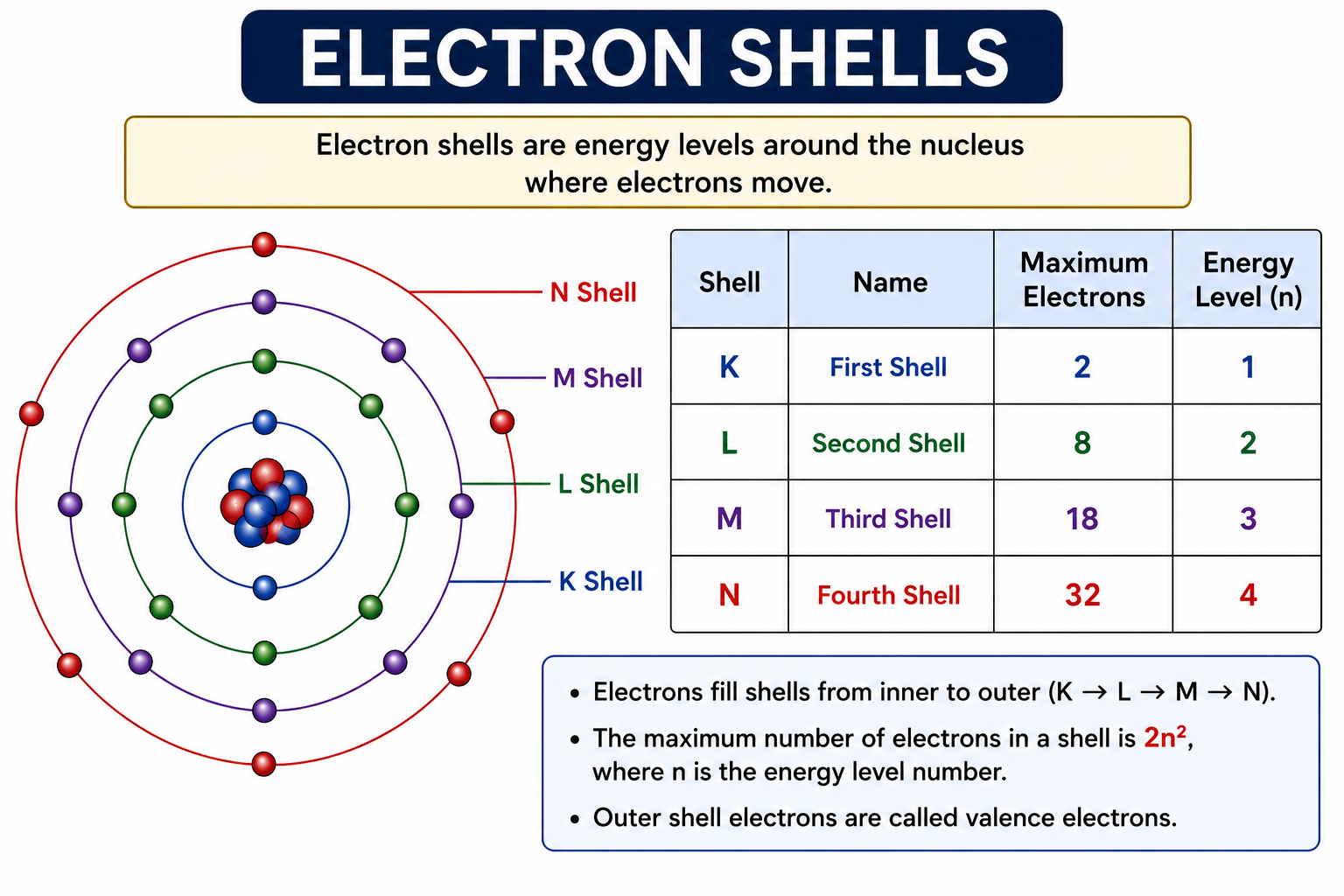
Electron shells are defined as discrete energy levels surrounding the nucleus of an atom in which electrons are arranged. Each shell corresponds to a specific principal energy level and can accommodate a fixed maximum number of electrons. Shells are numbered from the innermost outward using principal quantum numbers (n = 1, 2, 3, 4…) or named using letters (K, L, M, N…).
In formal terms, an electron shell is the set of orbitals that share the same principal quantum number. However, at the introductory level most students encounter first, shells are best understood as concentric circular regions around the nucleus — like layers of an onion, each capable of holding a specific number of electrons.
Simple Explanation
Think of the nucleus as the sun at the center of a solar system. The electron shells are like the orbits of the planets — but instead of planets, electrons travel within these regions. Just as planets closer to the sun move faster and have less energy, electrons in shells closer to the nucleus have lower energy. Electrons in outer shells are farther from the nucleus, more loosely held, and carry more energy.
Here is another way to picture it: imagine a school building with multiple floors. The ground floor is the closest to the entrance (lowest energy), and each floor above it requires more energy to reach. Electrons fill the lowest available floor first before moving to higher ones. The top floor at any given moment — the highest occupied shell — is what chemists call the valence shell.
This energy-level framework is what makes electron shells so powerful as a concept. It explains everything from why noble gases are unreactive to why sodium reacts explosively with water.
Why Are Electron Shells Important?
Understanding electron shells is not just an academic exercise — it is the key to understanding most of chemistry. Here is why they matter so much:
- Chemical bonding: Atoms form bonds by sharing or transferring valence electrons. The number of valence electrons, which comes directly from the electron shell arrangement, determines what kind of bonds an atom can form.
- Reactivity: Elements with nearly full or nearly empty outer shells tend to be the most reactive. Sodium has one electron in its outermost shell and loses it easily. Chlorine has seven electrons and readily gains one. This is purely shell-driven behavior.
- Periodic table organization: The periodic table is literally arranged around electron shell filling. Each period corresponds to a new shell being filled. Elements in the same group share the same number of valence electrons, which is why they have similar chemical properties.
- Ion formation: Atoms gain or lose electrons to achieve stable shell configurations. Understanding shells tells you exactly which ions will form and why.
- Spectroscopy: When electrons move between shells, they absorb or emit specific amounts of energy as light. This is the basis of atomic spectroscopy, a technique used in everything from chemical analysis to astronomy.
History of Electron Shell Theory
Niels Bohr’s Contribution
The concept of electron shells as we teach it today was largely developed by Niels Bohr, a Danish physicist who published his famous atomic model in 1913. Before Bohr, Rutherford had shown that atoms have a small, dense, positively charged nucleus. But Rutherford’s model could not explain why electrons did not spiral into the nucleus (which classical physics predicted they should do) or why atoms emitted light only at specific wavelengths.
Bohr proposed a revolutionary idea: electrons can only occupy certain specific orbits around the nucleus, and each orbit corresponds to a fixed energy level. As long as an electron stays in its orbit, it does not radiate energy. Only when an electron jumps from a higher energy orbit to a lower one does it emit energy — as light of a specific frequency.
Bohr applied this model to the hydrogen atom and calculated energy levels that matched experimental spectral data remarkably well. His model introduced the idea that electron energies are quantized — they come in fixed packages, not a continuous range. This was revolutionary and earned Bohr the Nobel Prize in Physics in 1922.
Development of Energy Levels
While Bohr’s circular orbit model worked brilliantly for hydrogen, it broke down for more complex atoms. Throughout the 1920s, quantum mechanics developed rapidly through the work of scientists including Werner Heisenberg, Erwin Schrödinger, Wolfgang Pauli, and Louis de Broglie. The modern quantum mechanical model replaced Bohr’s neat circular orbits with probability distributions called orbitals.
However, the core concept from Bohr — that electrons occupy distinct energy levels, fill those levels from the lowest energy upward, and that the number of electrons in the outermost level determines chemical behavior — remained fundamentally correct and continues to be taught as the foundation of atomic structure today.
Structure of an Atom
Before we go deeper into shells, let us quickly establish the atomic context in which shells exist.
Protons
Protons are positively charged particles found in the nucleus. The number of protons defines the element — it is the atomic number. Carbon always has 6 protons; oxygen always has 8. This never changes within a given element.
Neutrons
Neutrons are electrically neutral particles also found in the nucleus. They contribute to the atom’s mass but not its charge. The number of neutrons can vary within the same element (giving rise to isotopes), but has no direct effect on electron shell arrangement.
Electrons
Electrons are negatively charged particles that exist outside the nucleus, arranged in shells at different energy levels. In a neutral atom, the number of electrons equals the number of protons. Electrons are incredibly light compared to protons and neutrons — about 1/1836 of the mass of a proton.
Nucleus
The nucleus is the dense central core of the atom containing protons and neutrons. It carries essentially all of the atom’s mass. The electron shells spread out around the nucleus in increasingly larger and higher-energy regions.
What Are Energy Levels?
Energy levels are the specific, fixed amounts of energy that electrons can possess when they are in a particular shell. Think of them as the steps on a staircase — an electron can stand on any step, but it cannot hover between two steps. In atomic terms, an electron can occupy an energy level corresponding to a particular shell, but it cannot have an energy value in between two shells.
The key principles of energy levels are:
- Lower shells have lower energy: Electrons in shell 1 (K shell) have the lowest energy and are held most tightly by the nucleus.
- Higher shells have higher energy: Electrons in outer shells have progressively more energy and are held less tightly.
- Energy levels are quantized: Electrons can only absorb or release energy in exact amounts (quanta) that correspond to jumps between specific shells.
- Ground state: When an electron is in its lowest possible energy level for that atom, the atom is said to be in the ground state.
- Excited state: When an electron absorbs energy and jumps to a higher shell, the atom is in an excited state. When the electron falls back down, it releases energy as light (a photon).
This absorption and emission of specific energy packets is what produces atomic spectra — the unique fingerprints of light that identify different elements. It is also how neon signs work, how scientists identify elements in distant stars, and how lasers function.
Electron Shell Names
Each electron shell has both a number (principal quantum number, n) and a letter name. Here is a full breakdown:
K Shell
The K shell is the first and innermost shell, with n = 1. It is the lowest energy level and sits closest to the nucleus. The K shell can hold a maximum of 2 electrons (calculated as 2 × 1² = 2). Elements like hydrogen (1 electron) and helium (2 electrons) have electrons only in the K shell.
L Shell
The L shell is the second shell, with n = 2. It can hold a maximum of 8 electrons (2 × 2² = 8). Elements from lithium (Li) through neon (Ne) have their outermost electrons in the L shell. Neon, with a full L shell, is chemically inert.
M Shell
The M shell is the third shell, with n = 3. Its theoretical maximum capacity is 18 electrons (2 × 3² = 18), though in practice — when filling up through the first 20 elements — only up to 8 electrons are placed in the M shell before the N shell begins to fill. Elements from sodium (Na) through argon (Ar) have outermost electrons in the M shell.
N Shell
The N shell is the fourth shell, with n = 4. Its theoretical maximum capacity is 32 electrons (2 × 4² = 32). Potassium (K) and calcium (Ca) have electrons that begin to fill the N shell. The N shell becomes very significant for transition metals and heavier elements.
O Shell
The O shell is the fifth shell, with n = 5. It has a maximum theoretical capacity of 50 electrons (2 × 5² = 50). It accommodates electrons for elements beyond calcium in the periodic table, particularly in the heavier transition metals and the lanthanides.
P Shell
The P shell is the sixth shell, with n = 6. Maximum theoretical capacity is 72 electrons (2 × 6² = 72). It is relevant for very heavy elements in the sixth period of the periodic table.
Q Shell
The Q shell is the seventh shell, with n = 7. Maximum theoretical capacity is 98 electrons (2 × 7² = 98). This shell is relevant only for the heaviest known elements, including those in the actinide series and synthetic superheavy elements.
Maximum Number of Electrons in Each Shell
2n² Rule Explained
The maximum number of electrons that any shell can hold is given by the 2n² formula, where n is the principal quantum number (shell number). This formula comes from quantum mechanics and reflects the number of orbitals available in each shell and the fact that each orbital can hold a maximum of two electrons (one with spin up, one with spin down — per the Pauli Exclusion Principle).
Formula: Maximum electrons = 2n²
Worked examples:
- Shell 1 (K): 2 × (1)² = 2 × 1 = 2 electrons
- Shell 2 (L): 2 × (2)² = 2 × 4 = 8 electrons
- Shell 3 (M): 2 × (3)² = 2 × 9 = 18 electrons
- Shell 4 (N): 2 × (4)² = 2 × 16 = 32 electrons
- Shell 5 (O): 2 × (5)² = 2 × 25 = 50 electrons
Shell Capacity Table
| Shell | Letter Name | Principal Quantum Number (n) | Maximum Electrons (2n²) |
|---|---|---|---|
| 1st | K | 1 | 2 |
| 2nd | L | 2 | 8 |
| 3rd | M | 3 | 18 |
| 4th | N | 4 | 32 |
| 5th | O | 5 | 50 |
| 6th | P | 6 | 72 |
| 7th | Q | 7 | 98 |
Important Exam Tip: For the first 20 elements, students often use a simplified rule: shells fill with a maximum of 2, 8, 8, 2 electrons respectively (for the first four shells). This is a useful shortcut for introductory exams, but it is worth knowing that the M shell’s actual capacity is 18 — the 8-electron limit seen in the first 20 elements is a result of how subshells fill in practice.
Electron Distribution in Shells
First 20 Elements
The electron distribution for the first 20 elements is one of the most commonly tested topics in GCSE, A-Level, NEET, and similar examinations. The table below shows the electron arrangement for each element, written in the format: Shell 1, Shell 2, Shell 3, Shell 4.
| Element | Symbol | Atomic Number | Shell 1 (K) | Shell 2 (L) | Shell 3 (M) | Shell 4 (N) | Electron Configuration |
|---|---|---|---|---|---|---|---|
| Hydrogen | H | 1 | 1 | 1 | |||
| Helium | He | 2 | 2 | 2 | |||
| Lithium | Li | 3 | 2 | 1 | 2, 1 | ||
| Beryllium | Be | 4 | 2 | 2 | 2, 2 | ||
| Boron | B | 5 | 2 | 3 | 2, 3 | ||
| Carbon | C | 6 | 2 | 4 | 2, 4 | ||
| Nitrogen | N | 7 | 2 | 5 | 2, 5 | ||
| Oxygen | O | 8 | 2 | 6 | 2, 6 | ||
| Fluorine | F | 9 | 2 | 7 | 2, 7 | ||
| Neon | Ne | 10 | 2 | 8 | 2, 8 | ||
| Sodium | Na | 11 | 2 | 8 | 1 | 2, 8, 1 | |
| Magnesium | Mg | 12 | 2 | 8 | 2 | 2, 8, 2 | |
| Aluminum | Al | 13 | 2 | 8 | 3 | 2, 8, 3 | |
| Silicon | Si | 14 | 2 | 8 | 4 | 2, 8, 4 | |
| Phosphorus | P | 15 | 2 | 8 | 5 | 2, 8, 5 | |
| Sulfur | S | 16 | 2 | 8 | 6 | 2, 8, 6 | |
| Chlorine | Cl | 17 | 2 | 8 | 7 | 2, 8, 7 | |
| Argon | Ar | 18 | 2 | 8 | 8 | 2, 8, 8 | |
| Potassium | K | 19 | 2 | 8 | 8 | 1 | 2, 8, 8, 1 |
| Calcium | Ca | 20 | 2 | 8 | 8 | 2 | 2, 8, 8, 2 |
Step-by-Step Examples
Sodium (Atomic Number = 11):
Step 1: Sodium has 11 electrons to distribute.
Step 2: Fill K shell first. K shell maximum = 2. Place 2 electrons. Remaining: 11 – 2 = 9.
Step 3: Fill L shell next. L shell maximum = 8. Place 8 electrons. Remaining: 9 – 8 = 1.
Step 4: Place the remaining 1 electron in M shell.
Result: Sodium electron distribution = 2, 8, 1.
Chlorine (Atomic Number = 17):
Step 1: Chlorine has 17 electrons to distribute.
Step 2: Fill K shell. Place 2 electrons. Remaining: 17 – 2 = 15.
Step 3: Fill L shell. Place 8 electrons. Remaining: 15 – 8 = 7.
Step 4: Place 7 remaining electrons in M shell.
Result: Chlorine electron distribution = 2, 8, 7.
Calcium (Atomic Number = 20):
Step 1: Calcium has 20 electrons to distribute.
Step 2: Fill K shell. Place 2 electrons. Remaining: 20 – 2 = 18.
Step 3: Fill L shell. Place 8 electrons. Remaining: 18 – 8 = 10.
Step 4: Fill M shell. For the first 20 elements, place 8 electrons in M shell. Remaining: 10 – 8 = 2.
Step 5: Place 2 electrons in N shell.
Result: Calcium electron distribution = 2, 8, 8, 2.
Electron Shells vs Orbitals (Comparison Table)
Students frequently confuse electron shells with orbitals. They are related but distinct concepts.
| Property | Electron Shells | Orbitals |
|---|---|---|
| Definition | Energy levels surrounding the nucleus where electrons are arranged | Specific regions within a shell where individual electrons are most likely to be found |
| Represented By | Principal quantum number n (1, 2, 3…) or letters (K, L, M…) | Letters s, p, d, f with a number indicating the shell (1s, 2p, 3d, etc.) |
| Shape | Conceptually depicted as concentric circles (Bohr model) | Defined 3D shapes (s = sphere, p = dumbbell, d = complex) |
| Number per Shell | One shell per principal quantum number | Multiple orbitals per shell (n² orbitals in shell n) |
| Electron Capacity | 2n² electrons maximum | 2 electrons per orbital maximum |
| Level of Theory | Introductory atomic model (Bohr) | Quantum mechanical model |
| Used in | Basic atomic structure, GCSE, NEET introductory topics | Advanced electron configuration, A-Level, college chemistry |
| Example | Sodium has 3 shells | Sodium has 1s², 2s², 2p⁶, 3s¹ orbitals |
Electron Shells vs Energy Levels (Comparison Table)
| Property | Electron Shells | Energy Levels |
|---|---|---|
| Definition | Physical regions around the nucleus | Specific values of energy that electrons can possess |
| Nature | Structural concept | Energetic concept |
| Relationship | Each shell corresponds to one energy level | Each energy level corresponds to one shell |
| Representation | K, L, M, N… or n = 1, 2, 3… | n = 1, 2, 3… or E1, E2, E3… |
| Practical Distinction | Describes where electrons are located | Describes the energy state of electrons |
| Are They Different? | Conceptually related but distinct | They describe the same physical reality from different perspectives |
| Common Usage | Used when discussing electron distribution and atomic diagrams | Used when discussing absorption, emission spectra, and quantum jumps |
In practice, the terms “electron shell” and “energy level” are often used interchangeably in introductory chemistry — and for exam purposes at the GCSE and introductory college level, they can generally be treated as equivalent. At higher levels, the distinction becomes more meaningful.
Electron Shells and Electron Configuration
Electron configuration is the formal notation for describing how electrons are arranged in an atom. While shell diagrams (like 2, 8, 1 for sodium) are the introductory version, electron configuration takes this further by specifying which subshells (s, p, d, f) within each shell are occupied.
The relationship works like this:
- Shell 1 (K) contains: 1s subshell only
- Shell 2 (L) contains: 2s and 2p subshells
- Shell 3 (M) contains: 3s, 3p, and 3d subshells
- Shell 4 (N) contains: 4s, 4p, 4d, and 4f subshells
Electron configuration examples:
| Element | Shell Notation | Full Electron Configuration |
|---|---|---|
| Hydrogen | 1 | 1s¹ |
| Helium | 2 | 1s² |
| Carbon | 2, 4 | 1s² 2s² 2p² |
| Sodium | 2, 8, 1 | 1s² 2s² 2p⁶ 3s¹ |
| Chlorine | 2, 8, 7 | 1s² 2s² 2p⁶ 3s² 3p⁵ |
| Calcium | 2, 8, 8, 2 | 1s² 2s² 2p⁶ 3s² 3p⁶ 4s² |
The shell-based notation (2, 8, 1) and the subshell-based electron configuration (1s² 2s² 2p⁶ 3s¹) both describe the same underlying arrangement of electrons. The shell notation is simpler and works well for the first 20 elements. Formal electron configuration is used for more precise and advanced work.
Valence Shell Explained
The valence shell is the outermost occupied electron shell of an atom. It is the shell that contains the electrons that participate in chemical reactions, form bonds, and determine how an element interacts with other atoms.
For the first 20 elements:
- Hydrogen: Valence shell = K (shell 1)
- Sodium: Valence shell = M (shell 3), containing 1 electron
- Chlorine: Valence shell = M (shell 3), containing 7 electrons
- Calcium: Valence shell = N (shell 4), containing 2 electrons
The valence shell is particularly important because atoms tend to react in ways that result in a full outer shell — typically 8 electrons, following the octet rule (or 2 electrons for the K shell, following the duet rule). This drive toward a full outer shell is the underlying reason for chemical bond formation.
Valence Electrons Explained
Valence electrons are the electrons present in the valence shell (outermost shell) of an atom. They are the electrons most directly involved in chemical bonding and reactions.
Key points about valence electrons:
- The number of valence electrons can be determined directly from the electron shell distribution.
- For main group elements, the number of valence electrons equals the group number in the periodic table.
- Elements with 1 or 2 valence electrons tend to lose them (forming positive ions, or cations).
- Elements with 6 or 7 valence electrons tend to gain electrons (forming negative ions, or anions).
- Elements with 8 valence electrons (noble gases) are already stable and do not typically react.
- Elements with 4 valence electrons (like carbon) tend to share electrons through covalent bonds.
Valence Electrons for Selected Elements:
| Element | Electron Distribution | Valence Shell | Valence Electrons |
|---|---|---|---|
| Hydrogen (H) | 1 | K | 1 |
| Sodium (Na) | 2, 8, 1 | M | 1 |
| Magnesium (Mg) | 2, 8, 2 | M | 2 |
| Carbon (C) | 2, 4 | L | 4 |
| Nitrogen (N) | 2, 5 | L | 5 |
| Oxygen (O) | 2, 6 | L | 6 |
| Chlorine (Cl) | 2, 8, 7 | M | 7 |
| Argon (Ar) | 2, 8, 8 | M | 8 |
| Potassium (K) | 2, 8, 8, 1 | N | 1 |
| Calcium (Ca) | 2, 8, 8, 2 | N | 2 |
How to Draw Electron Shell Diagrams
Electron shell diagrams (also called Bohr diagrams or dot-cross diagrams at some levels) show the nucleus at the center with shells represented as concentric circles, each containing the appropriate number of electrons shown as dots or crosses.
Here is the step-by-step process for drawing these diagrams:
General Steps:
- Draw a small circle in the center to represent the nucleus. Label it with the element symbol and atomic number.
- Draw the first shell as a circle around the nucleus. Add the correct number of electrons (as dots) — maximum 2.
- Draw the second shell as a larger circle. Add electrons up to a maximum of 8.
- Continue adding shells and electrons until all electrons are placed.
- Distribute electrons evenly around each shell — do not cluster them all on one side.
Sodium
Sodium has atomic number 11, so it has 11 electrons.
- K shell: 2 electrons (shown as 2 dots on the innermost circle)
- L shell: 8 electrons (shown as 8 dots on the second circle, spaced evenly)
- M shell: 1 electron (shown as 1 dot on the outermost circle)
Sodium’s diagram shows clearly why it is reactive — that single electron in the M shell is loosely held and easily lost in chemical reactions.
Oxygen
Oxygen has atomic number 8, so it has 8 electrons.
- K shell: 2 electrons
- L shell: 6 electrons (6 dots evenly spaced on the L shell circle)
Oxygen’s diagram shows 6 electrons in the outer shell, just 2 short of a full shell of 8. This is why oxygen readily gains 2 electrons to form the O²⁻ ion and why it forms two bonds in molecules like water (H₂O).
Carbon
Carbon has atomic number 6, so it has 6 electrons.
- K shell: 2 electrons
- L shell: 4 electrons
Carbon’s four outer electrons are shown spaced evenly around the L shell circle. This diagram immediately shows why carbon forms 4 bonds — it needs 4 more electrons to complete its outer shell, so it shares 4 pairs of electrons with other atoms. This is the foundation of organic chemistry.
Chlorine
Chlorine has atomic number 17, so it has 17 electrons.
- K shell: 2 electrons
- L shell: 8 electrons
- M shell: 7 electrons
With 7 electrons in the outer shell, chlorine needs just one more to reach a full shell of 8. Its diagram makes it visually obvious why chlorine so readily gains 1 electron to form Cl⁻, or shares 1 electron in a covalent bond.
Common Electron Shell Configurations
Here are some important configurations that appear repeatedly in exam questions:
| Configuration | Characteristic | Example Elements |
|---|---|---|
| Outer shell has 1 electron | Highly reactive metals; easily lose 1 electron | H, Li, Na, K |
| Outer shell has 2 electrons | Reactive metals; lose 2 electrons | Be, Mg, Ca |
| Outer shell has 7 electrons | Highly reactive nonmetals; gain 1 electron | F, Cl |
| Outer shell has 6 electrons | Reactive nonmetals; gain 2 electrons | O, S |
| Outer shell has 8 electrons | Stable noble gas configuration | Ne, Ar |
| Outer shell has 4 electrons | Forms 4 covalent bonds | C, Si |
| Outer shell has 5 electrons | Forms 3 bonds or gains 3 electrons | N, P |
| Outer shell has 2 (K shell only) | Complete K shell; stable | He |
Relationship Between Electron Shells and the Periodic Table
One of the most elegant aspects of chemistry is how the periodic table directly reflects electron shell filling. Once you understand shells, the periodic table stops being a list to memorize and becomes a logical map.
- Periods (horizontal rows): Each period corresponds to a new outer shell being filled. Period 1 elements (H and He) are filling the K shell. Period 2 elements (Li to Ne) are filling the L shell. Period 3 elements (Na to Ar) are filling the M shell, and so on.
- Groups (vertical columns): Elements in the same group have the same number of valence electrons. Group 1 elements all have 1 valence electron. Group 17 (halogens) all have 7 valence electrons. Group 18 (noble gases) all have full outer shells.
- Predicting reactivity: Because elements in the same group share the same valence electron count, they have similar reactivity patterns. Sodium and potassium (both Group 1, both with 1 valence electron) both react vigorously with water. Fluorine and chlorine (both Group 17, both with 7 valence electrons) both gain electrons readily.
- Block structure: The periodic table’s s-block (Groups 1 and 2) corresponds to the filling of s subshells. The p-block (Groups 13 through 18) corresponds to p subshell filling. The d-block (transition metals) and f-block (lanthanides and actinides) correspond to d and f subshell filling respectively.
Understanding electron shells makes the periodic table genuinely logical rather than arbitrary.
Common Mistakes Students Make
After years of teaching atomic structure, certain errors come up constantly. Here are the most frequent ones and how to avoid them:
- Overfilling a shell: Students sometimes place more electrons in a shell than its maximum allows. Always check: K = max 2, L = max 8, M = max 18 (but in practice 8 for the first 20 elements). Never put 9 electrons in the L shell.
- Starting from the outer shell: Electrons always fill from the innermost shell outward, not the other way around. Always start with the K shell and work outward.
- Confusing valence electrons with total electrons: The valence electron count is only the electrons in the outermost shell, not the total number of electrons in the atom. Sodium has 11 total electrons but only 1 valence electron.
- Mixing up potassium and calcium shell filling: Students often place a 9th or 10th electron into the M shell when writing configurations for potassium and calcium. In reality, the 4th electron shell (N shell) starts filling before the M shell reaches its theoretical maximum of 18. Potassium is 2, 8, 8, 1 — not 2, 8, 9.
- Forgetting to distribute electrons evenly around a shell: In shell diagrams, electrons should be evenly spaced around the shell circle. Clustering them all on one side is technically incorrect and can confuse the reader.
- Assuming all shells can hold 8 electrons: Only the K shell (max 2) and the simplified view of L through early M shells use an 8-electron maximum in introductory teaching. The actual maximum for shell 3 is 18, and for shell 4 it is 32.
Best Tips to Study Electron Shells
Here are some practical strategies that genuinely work:
- Learn the 2n² formula first. Once you can calculate the maximum number of electrons for any shell, the rest follows naturally.
- Memorize the first 20 elements’ distributions. Write them out from memory every day for a week. Hydrogen through calcium — just 20 elements, and they cover almost every type of exam question you will face on this topic.
- Draw shell diagrams by hand. There is something about physically drawing the nucleus, then the K shell with 2 dots, then the L shell with 8 dots, that makes the information stick in a way that reading alone cannot match.
- Connect shells to the periodic table. Every time you look at the periodic table, identify the period number (which tells you the highest occupied shell) and the group number (which tells you the valence electron count). Make this a habit.
- Practice with common ions. Work out the electron distribution for Na⁺, Mg²⁺, Cl⁻, and O²⁻. This reinforces the connection between valence electrons and ion formation.
- Make a summary flashcard for the comparison between shells, orbitals, energy levels, isotopes, and related concepts. Being able to distinguish between these in a few sentences is a valuable exam skill.
Real-Life Applications
Chemical Bonding
Every chemical bond — whether ionic, covalent, or metallic — is fundamentally driven by electron shell behavior. Sodium gives its single outer-shell electron to chlorine (which needs one to complete its outer shell), forming sodium chloride (table salt). Carbon shares its four outer electrons in various combinations to build the millions of organic compounds that make up living organisms. None of this makes sense without understanding shells.
Reactivity of Elements
The reactivity series of metals and the reactivity of halogens are both direct consequences of electron shell arrangement. Metals with fewer electrons in the outer shell (and lower nuclear charge holding them) are more reactive. Potassium, with 1 valence electron and a larger atomic radius than sodium, reacts even more violently with water than sodium does — purely because its outer electron is held even less tightly.
Formation of Ions
Ions form when atoms gain or lose electrons to achieve stable shell configurations. Magnesium loses 2 electrons from its M shell to achieve the stable neon configuration (2, 8). Sulfur gains 2 electrons to fill its M shell to 8 and achieve the argon configuration (2, 8, 8). Understanding shells allows you to predict exactly what ions any element will form.
Modern Electronics
Silicon’s electron configuration — 2, 8, 4 — is directly responsible for its semiconducting properties. With 4 valence electrons, silicon can form a crystalline structure where each atom is bonded to four others. The behavior of these valence electrons when energy is applied or when silicon is doped with other elements forms the entire basis of transistors, computer chips, and the modern electronics industry.
Common Terms Every Student Should Know
| Term | Definition |
|---|---|
| Electron Shell | A region of discrete energy surrounding the nucleus where electrons are arranged |
| Principal Quantum Number (n) | A whole number that identifies each shell (1, 2, 3…) |
| 2n² Rule | Formula for calculating maximum electrons in a shell: 2 times n squared |
| Valence Shell | The outermost occupied electron shell |
| Valence Electrons | Electrons in the outermost shell that participate in bonding |
| Octet Rule | The tendency of atoms to achieve 8 electrons in their outer shell |
| Duet Rule | The tendency of atoms in shell 1 to achieve 2 electrons (as in H and He) |
| Ground State | The lowest energy electron arrangement possible for an atom |
| Excited State | An arrangement where one or more electrons have absorbed energy and moved to higher shells |
| Subshell | A division within a shell, designated s, p, d, or f |
| Orbital | A region within a subshell where a maximum of 2 electrons can be found |
| Electron Configuration | A notation describing the distribution of electrons across shells and subshells |
| Aufbau Principle | The rule that electrons fill the lowest available energy levels first |
| Pauli Exclusion Principle | The rule that no two electrons in an atom can have the same set of quantum numbers |
| Cation | A positively charged ion formed when an atom loses electrons |
| Anion | A negatively charged ion formed when an atom gains electrons |
| Energy Level | A fixed value of energy corresponding to a particular electron shell |
| Noble Gas Configuration | A full outer shell arrangement associated with exceptional stability |
Electron Shells Practice Questions
30 Multiple Choice Questions (MCQs) with Answers
1. What is the maximum number of electrons in the K shell?
- A) 2
- B) 8
- C) 18
- D) 32
Answer: A
2. Which formula gives the maximum number of electrons in the nth shell?
- A) n²
- B) 2n
- C) 2n²
- D) n²/2
Answer: C
3. How many electrons can the L shell (n = 2) hold?
- A) 2
- B) 4
- C) 8
- D) 18
Answer: C
4. What is the electron distribution of sodium (atomic number = 11)?
- A) 2, 9
- B) 2, 8, 1
- C) 3, 8
- D) 2, 1, 8
Answer: B
5. Which shell is closest to the nucleus?
- A) L shell
- B) M shell
- C) K shell
- D) N shell
Answer: C
6. How many valence electrons does chlorine have? (Atomic number = 17, distribution = 2, 8, 7)
- A) 17
- B) 2
- C) 8
- D) 7
Answer: D
7. The electron distribution of calcium (atomic number = 20) is:
- A) 2, 8, 10
- B) 2, 8, 8, 2
- C) 2, 10, 8
- D) 2, 8, 9, 1
Answer: B
8. What is the valence shell of potassium (Z = 19, distribution = 2, 8, 8, 1)?
- A) K shell
- B) L shell
- C) M shell
- D) N shell
Answer: D
9. Which element has the electron configuration 2, 8, 8?
- A) Calcium
- B) Argon
- C) Potassium
- D) Sulfur
Answer: B
10. What does the principal quantum number n represent?
- A) Number of protons
- B) Number of neutrons
- C) The shell number
- D) Number of valence electrons
Answer: C
11. According to the Bohr model, what happens when an electron absorbs energy?
- A) It enters the nucleus
- B) It jumps to a lower shell
- C) It jumps to a higher shell
- D) It disappears
Answer: C
12. What is the maximum number of electrons in the M shell (n = 3)?
- A) 8
- B) 12
- C) 18
- D) 32
Answer: C
13. Carbon has atomic number 6. What is its electron distribution?
- A) 6
- B) 2, 2, 2
- C) 2, 4
- D) 4, 2
Answer: C
14. How many valence electrons does oxygen have? (Z = 8, distribution = 2, 6)
- A) 2
- B) 8
- C) 6
- D) 4
Answer: C
15. What is the maximum electron capacity of the N shell (n = 4)?
- A) 8
- B) 18
- C) 32
- D) 50
Answer: C
16. Which group of the periodic table contains elements with 7 valence electrons?
- A) Group 1
- B) Group 2
- C) Group 16
- D) Group 17
Answer: D
17. Helium (Z = 2) has its electrons in which shell?
- A) L shell
- B) M shell
- C) K shell
- D) N shell
Answer: C
18. Why is neon (Z = 10, distribution = 2, 8) chemically inert?
- A) It has no protons
- B) Its outer shell is completely full
- C) It has too many neutrons
- D) It cannot form any kind of structure
Answer: B
19. Magnesium (Z = 12) has the distribution 2, 8, 2. How many valence electrons does it have?
- A) 12
- B) 8
- C) 2
- D) 4
Answer: C
20. Which principal quantum number corresponds to the M shell?
- A) n = 1
- B) n = 2
- C) n = 3
- D) n = 4
Answer: C
21. An element has the electron distribution 2, 8, 5. Which element is it?
- A) Nitrogen
- B) Oxygen
- C) Phosphorus
- D) Sulfur
Answer: C
22. Which of the following elements has only 1 valence electron?
- A) Carbon
- B) Fluorine
- C) Sodium
- D) Oxygen
Answer: C
23. What is the electron distribution of fluorine (Z = 9)?
- A) 2, 7
- B) 2, 8, 1
- C) 3, 6
- D) 9
Answer: A
24. A neutral atom has 2 electrons in K shell, 8 in L shell, and 6 in M shell. What is its atomic number?
- A) 14
- B) 16
- C) 18
- D) 10
Answer: B
25. In which period of the periodic table would an element with its outermost electron in the M shell be found?
- A) Period 1
- B) Period 2
- C) Period 3
- D) Period 4
Answer: C
26. How many electrons does the K shell of argon contain? (Z = 18, distribution = 2, 8, 8)
- A) 18
- B) 8
- C) 2
- D) 0
Answer: C
27. What principle states that electrons fill the lowest available energy levels first?
- A) Octet rule
- B) Aufbau principle
- C) Pauli Exclusion Principle
- D) Heisenberg Uncertainty Principle
Answer: B
28. Which element has the distribution 2, 3?
- A) Carbon
- B) Lithium
- C) Boron
- D) Nitrogen
Answer: C
29. An element has 4 valence electrons and is in Period 2. Which element is it?
- A) Beryllium
- B) Nitrogen
- C) Carbon
- D) Oxygen
Answer: C
30. What happens when an electron drops from a higher shell to a lower shell?
- A) It absorbs energy
- B) It emits energy as light
- C) The atom becomes an ion
- D) The nucleus changes
Answer: B
15 Short Answer Questions
1. Define an electron shell.
Sample Answer: An electron shell is a region of discrete energy around the nucleus of an atom where electrons are arranged. Each shell can hold a maximum number of electrons determined by the formula 2n², where n is the shell number.
2. State the 2n² rule and apply it to the first three shells.
Sample Answer: The 2n² rule states that the maximum number of electrons in the nth shell equals 2 times n squared. Shell 1: 2 × 1² = 2 electrons. Shell 2: 2 × 2² = 8 electrons. Shell 3: 2 × 3² = 18 electrons.
3. What are valence electrons and why are they important?
Sample Answer: Valence electrons are the electrons in the outermost shell of an atom. They are important because they determine how an atom bonds with other atoms, how reactive it is, and what ions it forms.
4. Write the electron distribution for magnesium (Z = 12).
Sample Answer: Magnesium: K shell = 2, L shell = 8, M shell = 2. Distribution written as 2, 8, 2. Magnesium has 2 valence electrons.
5. Explain why potassium’s electron distribution is 2, 8, 8, 1 rather than 2, 8, 9.
Sample Answer: Although the M shell can theoretically hold 18 electrons, in practice the N shell begins to fill before the M shell is full. After 8 electrons in the M shell, the next electron goes into the N shell. This is due to the energy ordering of subshells within each shell.
6. Why is the octet rule important in chemistry?
Sample Answer: The octet rule states that atoms tend to gain, lose, or share electrons until they have 8 electrons in their outer shell (or 2 for hydrogen and helium). This drive toward a full outer shell is what causes atoms to form chemical bonds.
7. How does the periodic table reflect electron shell filling?
Sample Answer: Each period in the periodic table corresponds to a new electron shell being filled. Elements in Period 1 fill the K shell, Period 2 fills the L shell, and so on. Elements in the same group have the same number of valence electrons, giving them similar chemical properties.
8. Distinguish between a shell and an orbital.
Sample Answer: A shell is a major energy level around the nucleus, represented by the principal quantum number n. An orbital is a specific three-dimensional region within a shell where a maximum of 2 electrons can be found. Each shell contains multiple orbitals (n² orbitals for shell n).
9. What is the ground state of an atom?
Sample Answer: The ground state is the lowest energy arrangement of electrons in an atom, where each electron occupies the lowest available shell and subshell.
10. How many electrons does the N shell hold at maximum?
Sample Answer: The N shell has n = 4. Maximum electrons = 2n² = 2 × 4² = 2 × 16 = 32 electrons.
11. Why is carbon able to form so many different compounds?
Sample Answer: Carbon has 4 valence electrons and needs 4 more to fill its outer shell. This allows it to form exactly 4 covalent bonds with a wide variety of atoms, enabling the enormous diversity of organic compounds.
12. An element has the electron distribution 2, 8, 7. What is its atomic number and how many valence electrons does it have?
Sample Answer: Total electrons = 2 + 8 + 7 = 17. Atomic number = 17. This is chlorine. It has 7 valence electrons in the outermost (M) shell.
13. Explain why sodium (Z = 11) readily loses one electron.
Sample Answer: Sodium has the electron distribution 2, 8, 1. Its single outer electron in the M shell is far from the nucleus and loosely held. By losing this one electron, sodium achieves the stable neon configuration (2, 8) with a full outer shell.
14. Name the shells from first to fourth using letter names and state the maximum electrons in each.
Sample Answer: K shell (max 2 electrons), L shell (max 8 electrons), M shell (max 18 electrons), N shell (max 32 electrons).
15. What is the significance of the emission of light when an electron drops from a higher shell to a lower shell?
Sample Answer: When an electron drops from a higher to a lower energy shell, it releases the energy difference as a photon of light at a specific wavelength. Each element produces a unique pattern of wavelengths (atomic spectrum) that acts as a fingerprint. This is used in spectroscopy to identify elements in samples, stars, and flames.
10 Numerical and Diagram-Based Questions
Problem 1: Calculate the maximum number of electrons in the fifth shell (O shell).
Solution:
- n = 5
- Maximum electrons = 2n² = 2 × 5² = 2 × 25 = 50 electrons.
- Answer: The O shell can hold a maximum of 50 electrons.
Problem 2: An element has 15 electrons. Write its electron distribution and identify the number of valence electrons.
Solution:
- K shell: 2 electrons. Remaining: 15 – 2 = 13.
- L shell: 8 electrons. Remaining: 13 – 8 = 5.
- M shell: 5 electrons.
- Distribution: 2, 8, 5 (Phosphorus)
- Answer: Valence electrons = 5 (in the M shell).
Problem 3: Write the electron distribution of an atom with atomic number 16 and draw the shell diagram description.
Solution:
- Total electrons = 16 (Sulfur)
- K shell: 2 electrons
- L shell: 8 electrons
- M shell: 6 electrons
- Distribution: 2, 8, 6
- Diagram description: Nucleus labeled “S (16)” at center. K shell (innermost circle): 2 electrons evenly spaced. L shell (second circle): 8 electrons evenly spaced. M shell (outermost circle): 6 electrons evenly spaced.
- Answer: Sulfur = 2, 8, 6. Valence electrons = 6.
Problem 4: How many total electrons can the first three shells together hold?
Solution:
- Shell 1: 2n² = 2(1)² = 2
- Shell 2: 2n² = 2(2)² = 8
- Shell 3: 2n² = 2(3)² = 18
- Total = 2 + 8 + 18 = 28 electrons.
- Answer: The first three shells can collectively hold 28 electrons.
Problem 5: An atom has 2 electrons in K shell, 8 in L shell, and 4 in M shell. What is the element, and how many electrons does it need to complete the M shell (using the simplified 8-electron rule for the M shell)?
Solution:
- Total electrons = 2 + 8 + 4 = 14. Atomic number = 14. Element = Silicon.
- M shell currently has 4 electrons. Maximum (simplified) = 8.
- Electrons needed = 8 – 4 = 4.
- Answer: Silicon needs 4 more electrons to complete its outer shell. This is why silicon forms 4 covalent bonds.
Problem 6: Calcium (Z = 20) forms a Ca²⁺ ion by losing 2 electrons. Write the electron distribution of Ca and Ca²⁺.
Solution:
- Ca (Z = 20): 2, 8, 8, 2 (neutral atom)
- Ca²⁺ loses 2 electrons from the outermost shell (N shell):
- Ca²⁺: 2, 8, 8 (18 electrons remaining)
- This matches the electron configuration of Argon.
- Answer: Ca = 2, 8, 8, 2. Ca²⁺ = 2, 8, 8. Ca²⁺ has the argon configuration.
Problem 7: Chlorine (Z = 17) forms Cl⁻ by gaining 1 electron. Write the electron distribution of Cl and Cl⁻.
Solution:
- Cl (Z = 17): 2, 8, 7 (17 electrons)
- Cl⁻ gains 1 electron in M shell: 2, 8, 8 (18 electrons)
- This matches the argon configuration.
- Answer: Cl = 2, 8, 7. Cl⁻ = 2, 8, 8. Cl⁻ has the argon configuration.
Problem 8: An element in Period 3 has 6 valence electrons. What is its atomic number and electron distribution?
Solution:
- Period 3 elements fill the M shell.
- Core electrons (K + L shells): 2 + 8 = 10 electrons.
- Valence electrons in M shell = 6.
- Total electrons = 10 + 6 = 16. Atomic number = 16. Element = Sulfur.
- Electron distribution = 2, 8, 6.
- Answer: Atomic number = 16. Sulfur. Distribution = 2, 8, 6.
Problem 9: If n = 6, what is the maximum number of electrons in that shell?
Solution:
- Maximum electrons = 2n² = 2 × 6² = 2 × 36 = 72 electrons.
- Answer: The sixth shell (P shell) can hold a maximum of 72 electrons.
Problem 10: An element has the distribution 2, 8, 8, 1. Which element is it? Which shell is its valence shell? How many electrons does it need to complete its outer shell?
Solution:
- Total electrons = 2 + 8 + 8 + 1 = 19. Atomic number = 19. Element = Potassium (K).
- Valence shell = N shell (fourth shell), containing 1 electron.
- Using the octet rule, the N shell needs 8 electrons to be full.
- Electrons needed = 8 – 1 = 7. But potassium achieves stability more easily by losing 1 electron rather than gaining 7.
- Answer: Potassium. Valence shell = N shell. Potassium loses 1 valence electron to form K⁺ with the stable configuration 2, 8, 8.
Revision Checklist
Use this checklist to confirm your readiness before any exam that covers electron shells:
- I can define an electron shell and explain what it represents physically.
- I know the letter names for each shell: K, L, M, N, O, P, Q.
- I can apply the 2n² formula to calculate maximum electron capacity for any shell.
- I can write the electron distribution for all 20 elements from hydrogen to calcium.
- I understand why potassium starts filling the N shell before the M shell is full.
- I know the valence shell is the outermost occupied shell.
- I can identify valence electrons from a shell distribution.
- I understand how shells connect to the periodic table (periods = shells, groups = valence electron count).
- I can draw electron shell diagrams for elements up to Z = 20.
- I know how ion formation relates to electron gain or loss from the outer shell.
- I can distinguish between electron shells and orbitals.
- I understand the connection between electron jumps between shells and the emission of light.
- I have practiced numerical problems calculating electron distributions, shell capacities, and valence electrons.
- I understand how valence electrons drive chemical bonding and reactivity.
- I have worked through the comparison tables for shells vs orbitals and shells vs energy levels.
Best Books for Learning Electron Shells
These resources are particularly well suited for building a strong understanding of electron shells at all levels:
- Chemistry: The Central Science by Brown, LeMay, Bursten, and Murphy — One of the most complete introductory university chemistry textbooks, with outstanding coverage of atomic structure, electron configuration, and periodic trends.
- Atkins’ Physical Chemistry by Peter Atkins and Julio de Paula — For students who want to understand the quantum mechanical basis of electron shells and orbitals at an advanced level.
- Chemistry for You by Lawrie Ryan — Particularly well suited for GCSE students. The atomic structure chapters are clear and exam-focused, with good diagrams and practice questions.
- NCERT Chemistry Textbooks (Class 11 and 12) — Essential for NEET and MDCAT preparation. The atomic structure chapters cover electron shells, the Bohr model, and electron configuration with good clarity.
- A-Level Chemistry by Andrew Hunt — A reliable textbook for A-Level students, covering electron shells, electron configuration, and the periodic table connection in a student-friendly format.
Free Online Chemistry Resources
- OpenStax Chemistry (openstax.org) — Free, peer-reviewed, university-level chemistry textbooks. The atomic structure chapters include thorough coverage of electron shells, energy levels, and electron configuration.
- Khan Academy (khanacademy.org) — Excellent video explanations and interactive exercises on electron shells, the Bohr model, energy levels, and electron configuration. Particularly good for visual learners.
- Chemistry LibreTexts (chem.libretexts.org) — A comprehensive open-access chemistry library with detailed, well-referenced articles on atomic structure, quantum numbers, orbitals, and electron distribution.
- American Chemical Society (ACS) (acs.org) — Offers educational resources and chemistry news relevant to atomic structure, bonding, and periodic trends, with material suitable for students at multiple levels.
- Royal Society of Chemistry (RSC) (rsc.org) — Provides educational materials, interactive tools, and chemistry databases, with resources covering atomic structure and electron configuration for secondary and post-secondary students.
Related LearnMinto Articles Worth Reading:
- Chemistry Study Guide
- Atomic Structure Study Guide
- Bohr Model vs Modern Atomic Model
- Electron Configuration Explained
- Valence Electrons Explained
- Periodic Table Study Guide
- Chemical Bonding Study Guide
Frequently Asked Questions
1. What are electron shells in simple terms?
Electron shells are the regions around an atom’s nucleus where electrons are found. Each shell represents a specific energy level, and electrons fill shells from the innermost outward. The K shell is closest to the nucleus and holds up to 2 electrons. The L shell holds up to 8, and so on.
2. What is the 2n² rule for electron shells?
The 2n² rule states that the maximum number of electrons in the nth shell equals 2 times n squared. For shell 1: 2 electrons. For shell 2: 8 electrons. For shell 3: 18 electrons. For shell 4: 32 electrons. This formula comes from quantum mechanics and reflects the number of orbitals available in each shell.
3. Why does potassium (Z = 19) have the distribution 2, 8, 8, 1 instead of 2, 8, 9?
In practice, the energy level of the 4s subshell (in the N shell) is lower than the energy of the 3d subshell (in the M shell). So after 8 electrons fill the 3s and 3p subshells of the M shell, the next electron goes into the 4s subshell rather than continuing into the M shell’s 3d subshell. This is why potassium starts filling the fourth shell before the third is full.
4. What is the valence shell?
The valence shell is the outermost occupied electron shell of an atom. The electrons in this shell — the valence electrons — are the ones involved in chemical bonding and reactions.
5. How many valence electrons does carbon have?
Carbon has the electron distribution 2, 4. Its valence shell is the L shell, containing 4 electrons. Carbon therefore has 4 valence electrons, which is why it forms 4 covalent bonds and can build such an enormous variety of molecular structures.
6. What is the difference between an electron shell and an orbital?
A shell is a major energy level around the nucleus, identified by the principal quantum number n. An orbital is a specific three-dimensional region within a shell where up to 2 electrons can be found. Each shell contains multiple orbitals: shell 1 has 1 orbital (1s), shell 2 has 4 orbitals (2s and three 2p orbitals), and so on.
7. Who developed the concept of electron shells?
Niels Bohr introduced the concept of electrons occupying discrete orbits (shells) around the nucleus in 1913. His model successfully explained the hydrogen atom’s spectrum. The modern quantum mechanical model later refined these “orbits” into probabilistic orbitals, but the core idea of discrete energy levels for electrons comes from Bohr.
8. What is the electron distribution of oxygen?
Oxygen has atomic number 8. Its electron distribution is 2, 6 — 2 electrons in the K shell and 6 electrons in the L shell. It has 6 valence electrons and needs 2 more to complete its outer shell, which is why it forms 2 bonds in molecules like water.
9. How do electron shells relate to chemical reactivity?
Reactivity is largely determined by the valence shell. Elements with nearly empty outer shells (like sodium with 1 valence electron) readily lose electrons and are highly reactive. Elements with nearly full outer shells (like chlorine with 7 valence electrons) readily gain electrons. Noble gases with completely full outer shells are essentially unreactive.
10. What does it mean when an electron is in an excited state?
When an electron absorbs a specific amount of energy, it jumps from its ground-state shell to a higher energy shell. This is called an excited state. The electron does not stay there permanently — it quickly drops back to a lower energy level, releasing the absorbed energy as light (a photon) at a specific wavelength.
11. How does electron shell filling explain the structure of the periodic table?
Each horizontal row (period) of the periodic table corresponds to a new electron shell being filled. Period 1 has 2 elements because the K shell holds only 2 electrons. Period 2 has 8 elements because the L shell holds 8. Elements in the same vertical column (group) have the same number of valence electrons, giving them similar properties.
12. What is the maximum number of electrons in the fourth shell?
The fourth shell (N shell) has n = 4. Maximum electrons = 2n² = 2 × 4² = 2 × 16 = 32 electrons.
Summary
Electron shells explained in full come down to this: they are the discrete energy regions surrounding the nucleus of an atom where electrons are arranged in a systematic, rule-governed way. The shells are named K, L, M, N, O, P, and Q, corresponding to principal quantum numbers 1 through 7. The maximum number of electrons each shell can hold is calculated using the 2n² formula.
Electrons always fill shells from the innermost outward, following the Aufbau principle. The outermost occupied shell is the valence shell, and its electrons — the valence electrons — govern everything from chemical bonding to reactivity to ion formation. Understanding the electron distribution for the first 20 elements is foundational knowledge for virtually every subsequent topic in chemistry.
The connection between electron shells and the periodic table is one of the most powerful insights chemistry has to offer: the table’s arrangement is a direct reflection of how electrons fill shells and subshells across the elements. Once you truly grasp electron shells, the periodic table becomes a logical and predictable system rather than a list to memorize.
The real-world significance of electron shells extends from the salt on your table to the silicon chip in your phone, from the colors produced by fireworks to the imaging technology in modern medicine. It is a concept that connects the subatomic world to the observable universe in the most direct way possible.
Final Thoughts
Getting electron shells truly right is one of the most valuable things a chemistry student can do in the early stages of their studies. Everything builds from here — electron configuration, chemical bonding, the periodic table, acid-base chemistry, organic chemistry. If your understanding of shells is solid, you have a foundation that will support you all the way through advanced chemistry.
The key is not just memorizing shell capacities and element distributions, though those are important. It is understanding the reasoning behind the rules. Why do electrons fill lower shells first? Because lower shells have lower energy, and systems naturally tend toward lower energy states. Why do atoms react to achieve a full outer shell? Because a full valence shell is the most stable electron configuration, and stability is what chemistry is always working toward.
Work through the practice questions in this guide, draw the shell diagrams by hand, and revisit the comparison tables regularly. The more you engage with the material actively rather than just reading through it, the better it will stick.
Electron shells are not complicated — they are elegant. And once they click into place, a lot of chemistry suddenly makes very good sense.
Disclaimer
This article is intended for educational and informational purposes only. While LearnMinto strives to provide accurate and up-to-date information, readers should verify important academic concepts through official textbooks, educational institutions, examination boards, or trusted scientific resources before relying on this content for exams or academic purposes. LearnMinto is not affiliated with any specific school, university, research institution, or examination board.