
Introduction
Hold your hand close to a warm radiator and you feel heat reaching your skin. Place a cold metal spoon into a hot bowl of soup and the spoon gradually warms up. Leave a cup of tea on the table and it slowly cools toward room temperature. All of these familiar experiences involve the same physical process — the transfer of energy driven by a temperature difference.
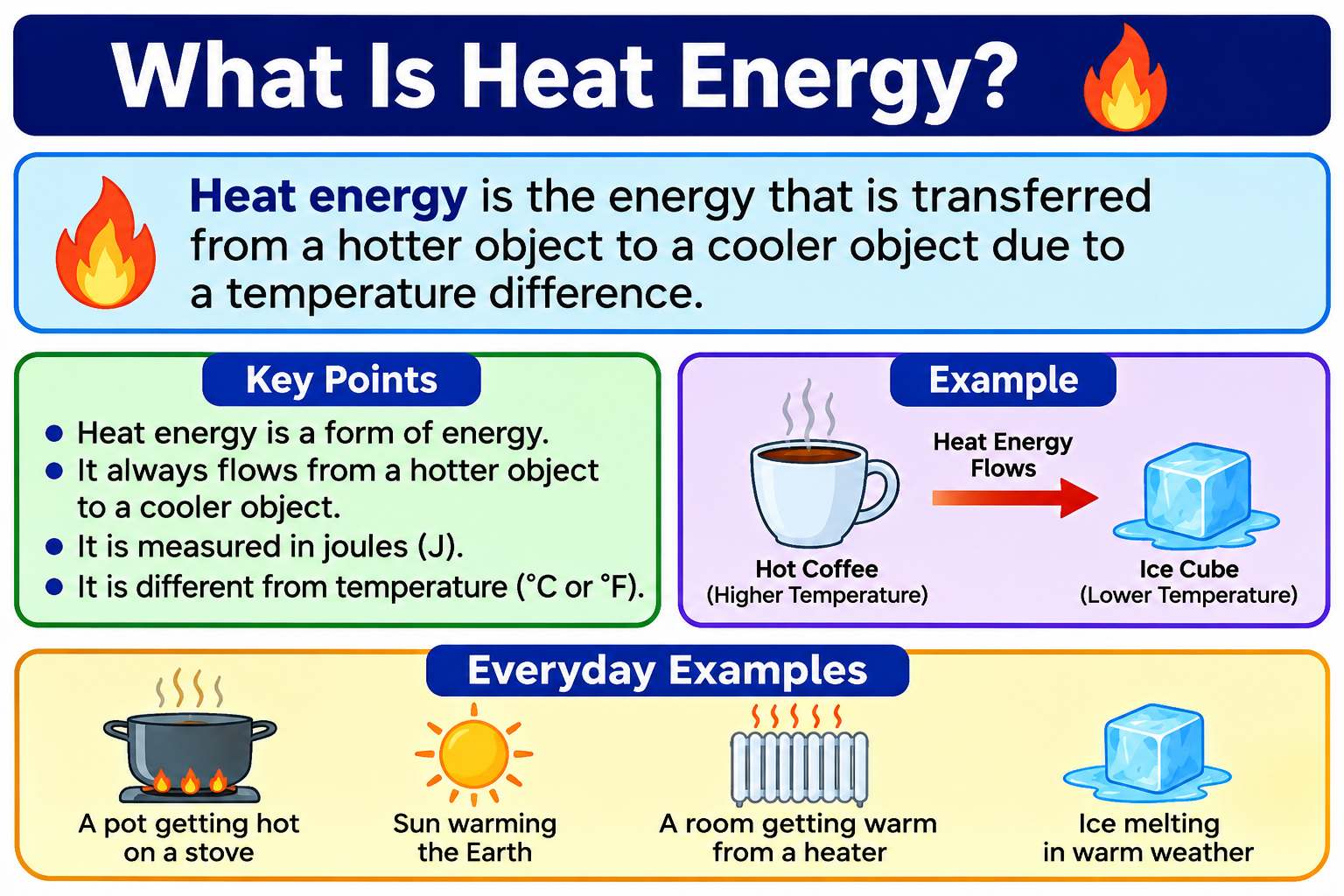
In physics, heat energy is the energy transferred between two systems or objects because of a temperature difference between them. Heat always flows spontaneously from a region of higher temperature to a region of lower temperature, continuing until both reach the same temperature — a state called thermal equilibrium.
The phrase “heat energy” is widely used in everyday language and in introductory physics. Scientifically, heat refers specifically to energy in transit — not to energy stored inside an object. Understanding this distinction, along with how heat is transferred and calculated, is essential for every physics student.
This article explains what heat energy is, how it differs from temperature and thermal energy, the three methods of heat transfer, specific heat capacity, latent heat, and how to solve heat energy problems confidently.
Key Takeaways
-
Heat energy is energy transferred from one object or system to another because of a temperature difference
-
Heat always flows from a region of higher temperature to a region of lower temperature
-
The SI unit of heat is the joule (J)
-
There are three methods of heat transfer: conduction, convection, and radiation
-
Heat is not the same as temperature or thermal energy — it specifically refers to energy in transfer
-
The formula for heat transferred during a temperature change is Q = mcΔT
-
During a phase change (such as melting or boiling), heat is transferred at constant temperature — this is described by Q = mL (latent heat)
What Is Heat Energy?
In physics, heat is defined as energy transferred between two systems or objects due to a temperature difference. It is not a substance, not a fluid, and not something stored inside an object. Heat is a process — energy moving from one place to another because of a temperature imbalance.
When a hot pan is placed on a cool surface, energy flows from the pan to the surface. When sunlight falls on your skin, electromagnetic radiation delivers energy that raises your skin temperature. When steam condenses on a cold window, it releases energy to the glass. In all these cases, heat is the energy crossing the boundary between two systems at different temperatures.
Key points about heat in physics:
- Heat is energy in transit — it exists as a process of transfer, not as energy stored within an object
- Heat flows spontaneously from higher temperature to lower temperature
- Once two objects reach the same temperature (thermal equilibrium), heat transfer between them ceases
- The amount of heat transferred depends on the temperature difference, the materials involved, and the mechanism of transfer
- Heat is measured in joules (J) in the SI system
The symbol commonly used for heat transferred is Q.
Is Heat Energy the Same as Thermal Energy?
These two terms are related but they are not identical, and confusing them is a very common mistake.
Thermal energy (also called internal energy) is the total energy associated with the random microscopic motion and interactions of the particles within a substance. It is a property of a system — it exists inside the object whether or not any transfer is taking place.
Heat is the energy that transfers between two systems because of a temperature difference. It is not a property of a system — it only exists during the process of transfer.
A helpful analogy: thermal energy is like the water stored in a tank, while heat is like the water flowing through a pipe from one tank to another. The flowing water (heat) is only defined while it is moving.
A simple example:
- A cup of tea has thermal energy stored within it
- When you hold the cup, thermal energy transfers from the hot tea to your cooler hand — this transfer is what we call heat
- Once the tea and your hand reach the same temperature, the heat transfer stops, even though both the tea and your hand still contain thermal energy
Heat vs Temperature
| Feature | Heat | Temperature |
|---|---|---|
| Definition | Energy transferred due to a temperature difference | Measure of average kinetic energy of particles |
| What it represents | Energy in transit between systems | Thermal state of a system |
| SI unit | Joule (J) | Kelvin (K) |
| Direction of transfer | Always from higher to lower temperature | Does not transfer — it is a property |
| Relationship to particles | Related to energy moved between particles | Related to average speed of particles |
| Depends on quantity? | Yes — more material can store and transfer more energy | No — independent of amount of substance |
| Example | Energy flowing from hot soup into a spoon | Water at 80°C |
The critical distinction to carry into every exam is this: temperature tells you how hot something is; heat tells you how much energy has been transferred because of that difference in hotness.
For a comprehensive explanation of temperature and how it is defined and measured, visit our article on [What Is Temperature in Physics?].
What Causes Heat Transfer?
The driving force behind heat transfer is always a temperature difference.
When two objects at different temperatures are placed in thermal contact, the particles of the hotter object have greater average kinetic energy than those of the cooler object. Through interactions between particles at the boundary — collisions, vibrations, radiation — energy passes from the hotter region to the cooler one.
This process continues as long as a temperature difference exists:
- The hotter object gradually loses energy — its temperature falls
- The cooler object gradually gains energy — its temperature rises
- Both approach the same temperature over time
The larger the temperature difference between the two objects, the faster the rate of heat transfer. The material properties (such as thermal conductivity) and the surface area in contact also affect the rate.
What Is Thermal Equilibrium?
Thermal equilibrium is the state in which two objects in thermal contact have reached the same temperature, so that there is no further net flow of heat between them.
A practical example: if you place a room-temperature metal key into a hot cup of water, heat flows from the water to the key. The water cools slightly and the key warms up. This continues until the key and the water are at the same temperature. At that point, they have reached thermal equilibrium and heat transfer effectively stops.
The zeroth law of thermodynamics formalises this idea: if two systems are each in thermal equilibrium with a third system, then they are in thermal equilibrium with each other. This principle underpins the entire concept of temperature measurement.
Units of Heat Energy
The SI unit of heat is the joule (J).
This is the same unit used for all forms of energy in the SI system — kinetic energy, potential energy, work, and internal energy are all measured in joules. Using the same unit for heat makes energy conservation calculations consistent and straightforward.
In some contexts, particularly in nutrition and older scientific literature, heat is measured in calories (cal):
- 1 calorie = the energy needed to raise 1 gram of water by 1°C
- 1 calorie = 4.184 joules
- 1 kilocalorie (kcal) = 4,184 joules
Food energy is labelled in kilocalories (often written as “Calories” with a capital C on food packaging).
In physics examinations, always use joules unless the question specifically asks for another unit.
How Is Heat Transferred?
Heat can travel from one place to another through three distinct mechanisms:
- Conduction — transfer through direct particle-to-particle interaction in a solid or between solids in contact
- Convection — transfer through the bulk movement of a fluid (liquid or gas)
- Radiation — transfer through electromagnetic waves, requiring no medium
Each mechanism operates under different conditions and involves different physical processes. In most real-world situations, more than one mechanism operates simultaneously.
What Is Conduction?
Conduction is the transfer of heat through a material by direct interaction between neighbouring particles, without any bulk movement of the material itself.
When one part of a solid is heated, the particles in that region gain kinetic energy and vibrate more vigorously. These vibrating particles collide with their neighbours, transferring energy from particle to particle through the material. In metals, free electrons also carry energy rapidly through the structure, which is why metals are particularly good thermal conductors.
Examples of conduction:
- A metal spoon placed in hot tea gradually becomes warm along its entire length as heat conducts from the hot end to the cooler handle
- The base of a metal cooking pan in contact with a gas flame conducts heat upward into the food
- Touching a metal surface at room temperature feels colder than touching a wooden surface at the same temperature, because metal conducts heat away from your skin more rapidly
Why metals conduct well:
- Metal atoms are arranged in a regular lattice with many free electrons
- These free electrons can move rapidly through the lattice, carrying kinetic energy far more efficiently than atomic vibrations alone
- Non-metals and gases conduct heat poorly because their particles are either less mobile or further apart
What Is Convection?
Convection is the transfer of heat through the bulk movement of a fluid — either a liquid or a gas. Unlike conduction, which involves energy passing between stationary particles, convection involves the physical movement of warmer material from one place to another.
How convection works:
- A fluid near a heat source is warmed and gains kinetic energy
- The warmed fluid expands, becomes less dense, and rises
- Cooler, denser fluid from above sinks to take its place
- This circulation creates a convection current that continuously transfers heat through the fluid
Examples of convection:
- Boiling water: the water near the hot base of the pan rises while cooler water from above descends, creating circulation that eventually heats the entire volume
- Room heating: a radiator heats the air near it, causing the warm air to rise toward the ceiling. Cooler air flows along the floor to replace it, creating a convection current that gradually warms the room.
- Atmospheric circulation: the Sun heats Earth’s surface unevenly, creating convection currents in the atmosphere that drive weather patterns and winds
- Ocean currents: temperature and density differences in seawater drive deep ocean circulation on a global scale
Convection cannot occur in solids because the particles are not free to move from place to place.
What Is Radiation?
Radiation is the transfer of energy through electromagnetic waves — primarily infrared radiation — and requires no material medium. It is the only form of heat transfer that can operate across a vacuum.
All objects with a temperature above absolute zero emit electromagnetic radiation. The amount and frequency of radiation emitted depend on the object’s temperature:
- Hotter objects emit more radiation and at higher frequencies
- Very hot objects (such as the Sun or a glowing iron rod) emit visible light as well as infrared radiation
- Cooler objects emit primarily infrared radiation, which is invisible to the human eye but felt as warmth
Examples of radiation:
- Sunlight reaching Earth — the Sun’s energy travels 150 million kilometres through the vacuum of space as electromagnetic radiation
- Heat from a fire or electric heater — felt even without touching the heat source
- Infrared cameras — detect radiation emitted by warm objects, allowing images to be formed in complete darkness
- Greenhouse effect — Earth’s atmosphere absorbs and re-emits infrared radiation from the surface, trapping heat
Unlike conduction and convection, radiation does not require any contact or physical medium between the heat source and the receiver.
Conduction vs Convection vs Radiation
| Feature | Conduction | Convection | Radiation |
|---|---|---|---|
| How energy transfers | Particle-to-particle interaction | Bulk movement of fluid | Electromagnetic waves |
| Medium required | Yes (solid or stationary fluid) | Yes (liquid or gas) | No |
| Can occur in vacuum? | No | No | Yes |
| Occurs in solids? | Yes | No | Yes |
| Occurs in fluids? | Yes (slowly) | Yes | Yes |
| Common examples | Metal rod in fire | Boiling water, room heating | Sunlight, heat from a fire |
| Rate depends on | Thermal conductivity, temperature difference | Fluid density and flow | Temperature, surface properties |
Heat Transfer Examples in Everyday Life
Heat transfer is not an abstract concept — it governs everything from how your food is cooked to how your house stays warm.
- Cooking: a metal pan conducts heat from the flame to the food. Boiling water heats food through convection. Grilling uses radiation from hot elements or flames.
- Refrigerators: move heat from the cool interior to the warmer surroundings, keeping food fresh by maintaining a low internal temperature.
- Air conditioners: transfer heat from the cool indoor air to the warmer outdoor environment using a refrigerant cycle.
- Solar heating: solar panels absorb radiation from the Sun and transfer the energy to water or air for practical use.
- Clothing: traps a layer of still air, reducing convection and conduction from the body to the cold surroundings.
- Thermos flasks: use a double-walled glass container with a vacuum between the walls (eliminating conduction and convection), silvered surfaces (reducing radiation), and a tight stopper (eliminating convection at the top).
- Building insulation: foam, fibreglass, or mineral wool in walls and roofs reduces conduction and convection, keeping buildings warmer in winter and cooler in summer.
- Car engines: use a liquid cooling system that circulates coolant by convection and conduction to remove waste heat from the engine.
Heat Capacity and Specific Heat Capacity
When heat is added to an object, its temperature typically rises. But the amount of temperature rise depends on both the material and the mass of the object.
Heat capacity is the energy required to raise the temperature of an entire object by 1 kelvin (or 1°C).
Specific heat capacity is the energy required to raise the temperature of 1 kilogram of a material by 1 kelvin (or 1°C). It is a property of the material, not of the object.
The formula is:
Q = mcΔT
Where:
| Symbol | Quantity | SI Unit |
|---|---|---|
| Q | Heat transferred | Joule (J) |
| m | Mass of the substance | Kilogram (kg) |
| c | Specific heat capacity | J/(kg·K) or J/(kg·°C) |
| ΔT | Change in temperature (T_final − T_initial) | Kelvin (K) or °C |
Worked example:
How much heat is needed to raise 2 kg of water from 20°C to 80°C? (Specific heat capacity of water = 4,200 J/(kg·°C))
Given: m = 2 kg, c = 4,200 J/(kg·°C), ΔT = 80 − 20 = 60°C
Q = mcΔT = 2 × 4,200 × 60 = 504,000 J = 504 kJ
What Is Specific Heat Capacity?
Different materials require different amounts of energy to reach the same temperature change. This is captured by the specific heat capacity.
| Material | Specific Heat Capacity (J/kg·°C) |
|---|---|
| Water | 4,200 |
| Aluminium | 900 |
| Iron | 450 |
| Copper | 385 |
| Lead | 128 |
| Sand | approximately 800 |
| Air | approximately 1,000 |
Water has one of the highest specific heat capacities of any common substance. This means:
- Water absorbs large amounts of heat with only a modest temperature rise — making it excellent for cooling engines and heating systems
- Coastal climates are more stable in temperature than inland areas because the sea absorbs and releases heat slowly
- The human body, which is largely water, resists rapid temperature changes
Metals generally have low specific heat capacities, meaning they heat up and cool down quickly — useful for cooking pans but potentially problematic for components that must stay cool.
Heat and Change in Temperature
When heat is added to a substance and no phase change occurs, the temperature of the substance rises. When heat is removed, the temperature falls.
The size of the temperature change depends on three factors:
- The mass of the substance: more mass requires more energy to achieve the same temperature change
- The specific heat capacity of the material: materials with higher specific heat capacity change temperature more slowly
- The amount of energy transferred: more energy transferred produces a larger temperature change
This is captured directly by the formula Q = mcΔT, which can be rearranged to find any one of the four quantities when the other three are known:
- Q = mcΔT (find heat transferred)
- m = Q / (cΔT) (find mass)
- c = Q / (mΔT) (find specific heat capacity)
- ΔT = Q / (mc) (find temperature change)
Heat During Changes of State
When a substance changes state — from solid to liquid, liquid to gas, or any other phase transition — something interesting happens to the temperature.
During a phase change at constant pressure, the temperature remains constant even though heat is being continuously added or removed. The energy being transferred is used to break or form the bonds between particles rather than to change their speed.
For example:
- Ice at 0°C melts into water at 0°C when heat is added — the temperature stays at 0°C throughout melting
- Water at 100°C boils into steam at 100°C when heat is added — the temperature stays at 100°C throughout boiling
This is why it takes time to melt ice even after it reaches 0°C, and why a kettle takes time to boil all the water away even after reaching 100°C.
Latent Heat
The heat energy required to change the state of a substance without changing its temperature is called latent heat (from the Latin word for “hidden,” because the temperature does not visibly rise).
There are two types:
- Latent heat of fusion (L_f): the energy required to melt 1 kg of a solid into liquid at constant temperature (or to freeze 1 kg of liquid into solid)
- Latent heat of vaporisation (L_v): the energy required to vaporise 1 kg of liquid into gas at constant temperature (or to condense 1 kg of gas into liquid)
The formula for latent heat is:
Q = mL
Where:
| Symbol | Quantity | SI Unit |
|---|---|---|
| Q | Heat transferred | Joule (J) |
| m | Mass of substance changing state | Kilogram (kg) |
| L | Specific latent heat | J/kg |
Example:
How much energy is needed to melt 0.5 kg of ice at 0°C? (Latent heat of fusion of water = 334,000 J/kg)
Given: m = 0.5 kg, L = 334,000 J/kg
Q = mL = 0.5 × 334,000 = 167,000 J = 167 kJ
This energy goes entirely into breaking the hydrogen bonds holding the water molecules in the ice crystal — the temperature of the water produced is still 0°C.
Sensible Heat vs Latent Heat
| Feature | Sensible Heat | Latent Heat |
|---|---|---|
| Temperature change? | Yes | No |
| Phase change? | No | Yes |
| Formula | Q = mcΔT | Q = mL |
| Example | Heating water from 20°C to 80°C | Melting ice at 0°C |
| Energy goes to | Increasing particle kinetic energy | Breaking or forming intermolecular bonds |
| Observable effect | Temperature rise or fall | Change of state |
Sensible heat is the heat you can “sense” as a temperature change. Latent heat is “hidden” because the temperature does not change during the process.
Heat and Kinetic Energy
At the microscopic level, adding heat to a substance (when no phase change occurs) generally increases the average kinetic energy of its particles. This is why temperature rises — temperature is directly related to average particle kinetic energy.
When heat flows from a hot object to a cool one:
- The faster-moving particles of the hot object transfer energy through collisions to the slower-moving particles of the cool object
- The average kinetic energy (and therefore temperature) of the hot object decreases
- The average kinetic energy (and therefore temperature) of the cool object increases
It is important to be precise: heat is the energy transferred between systems, while kinetic energy is the energy associated with particle motion within a system. They are related but not identical.
A deeper understanding of kinetic energy and how it relates to particle motion is available in our article on [What Is Kinetic Energy?].
Heat and Internal Energy
Internal energy is the total energy stored within a system at the microscopic level. It includes:
- The kinetic energy of particles due to their random translational, rotational, and vibrational motion
- The potential energy associated with the forces (bonds) between particles
Heat transfer changes a system’s internal energy:
- Adding heat to a system increases its internal energy (particles move faster or bonds are broken)
- Removing heat from a system decreases its internal energy (particles slow down or bonds form)
The first law of thermodynamics expresses this relationship:
ΔU = Q + W
Where ΔU is the change in internal energy, Q is the heat transferred to the system, and W is the work done on the system.
At introductory level, the key point is simply that heat and work are the two ways in which energy can be transferred into or out of a system, changing its internal energy.
Heat and Work
Both heat and work are ways of transferring energy between a system and its surroundings.
- Heat (Q): energy transferred due to a temperature difference
- Work (W): energy transferred by a force acting through a displacement
When you compress a gas by pushing a piston, you do work on the gas. This work can raise the gas’s internal energy and temperature. Conversely, a hot gas can push a piston outward, doing work on its surroundings — this is the basis of all heat engines.
The relationship between heat, work, and internal energy is the first law of thermodynamics, one of the most fundamental principles in all of physics.
For a thorough explanation of work in physics and how it is calculated, see our article on [What Is Work in Physics?].
Conservation of Energy and Heat
The law of conservation of energy states that energy cannot be created or destroyed — only transferred or converted from one form to another.
Heat is one of the most common forms of energy transfer:
- An electric heater converts electrical energy into thermal energy — the total energy is conserved
- A kettle uses electrical energy to heat water — energy converts but the total is unchanged
- In a car engine, chemical energy from fuel is partly converted to kinetic energy (useful work) and partly lost as waste heat — but the total energy in equals the total energy out
In practice, no process is perfectly efficient. Some energy is always converted to heat that cannot be usefully recovered — this is related to the second law of thermodynamics. But the total energy is always conserved, even if not all of it is in a useful form.
Heat and Friction
Friction is a force that opposes the relative motion between surfaces in contact. When friction acts on a moving object, it converts kinetic energy into thermal energy, raising the temperature of the surfaces in contact.
Examples:
- Rubbing hands together: kinetic energy of hand movement converts to thermal energy that warms your hands
- Bicycle brakes: the brake pads press against the wheel rim, converting kinetic energy to heat that you can feel in the brakes after a long descent
- Machine components: bearings, gears, and rotating parts generate heat through friction — this is why lubrication is essential in engineering
The thermal energy produced by friction is real energy — it represents genuine energy converted from mechanical motion. This is consistent with conservation of energy. For more on friction as a force, visit our article on [What Is Friction?].
Heat and Temperature in Everyday Life
Several everyday observations make more sense once you understand heat transfer properly:
- Hot objects cool down because heat transfers from them to the cooler surroundings until equilibrium is reached
- Cold objects warm up in a warm room because heat flows from the warmer room to the cooler object
- Dark surfaces absorb radiation better than light-coloured surfaces, which is why black objects heat up faster in sunlight and why dark-coloured clothing is warmer in the sun
- Insulation reduces heat transfer by limiting conduction (trapping still air), reducing convection (blocking air movement), and sometimes reducing radiation (using reflective surfaces)
- Metals feel colder than wood at the same temperature because metals conduct heat away from your hand much faster, creating the sensation of coldness even when both are at the same room temperature
Heat Energy in Different Materials
Different materials respond very differently to heating, due to differences in specific heat capacity and thermal conductivity.
- Metals have low specific heat capacity and high thermal conductivity — they heat and cool quickly and conduct heat efficiently. Useful for cookware and heat sinks.
- Water has high specific heat capacity and moderate thermal conductivity — it heats and cools slowly, making it excellent for thermal storage and biological temperature regulation.
- Wood has low thermal conductivity — it is a good insulator, which is why wooden handles stay cool on hot pans.
- Air has both low specific heat capacity and very low thermal conductivity in still conditions — still air is an excellent insulator.
- Ceramics have low thermal conductivity and moderate specific heat capacity — ceramic mugs keep drinks warm and cool handles simultaneously.
Good Conductors and Insulators
| Feature | Conductors | Insulators |
|---|---|---|
| Thermal conductivity | High | Low |
| Heat transfer rate | Fast | Slow |
| Examples | Copper, aluminium, iron, silver | Wood, rubber, plastic, glass, air |
| Practical applications | Cookware, heat sinks, radiators | Handles, clothing, building insulation |
| Why they behave this way | Free electrons and tightly packed atoms | Particles less mobile; fewer free electrons |
The best thermal conductors are metals, with silver and copper at the top of the list. The best thermal insulators are materials with many small trapped air pockets — still air has extremely low thermal conductivity, which is why foam and fibre insulation work by trapping air rather than by any special property of the foam or fibre itself.
How Does Insulation Reduce Heat Transfer?
Good thermal insulation does not completely stop heat transfer — it reduces the rate of heat transfer, slowing the process significantly.
How insulation works against each mechanism:
- Against conduction: uses materials with low thermal conductivity (foam, fibreglass, wool). Trapped pockets of still air are particularly effective because air conducts heat very poorly.
- Against convection: eliminates or restricts the movement of air or fluid. A vacuum (as in a thermos flask) completely eliminates convection.
- Against radiation: uses reflective surfaces (such as the silvered walls of a thermos flask) to reflect infrared radiation back toward its source rather than absorbing it.
Practical insulation applications:
- Thermos flasks use all three strategies: vacuum (no conduction or convection), silvered walls (reduced radiation), and a stopper (no convection at the top)
- House insulation in walls and lofts uses fibrous or foam materials that trap still air and resist conduction
- Winter clothing traps body heat by holding a layer of still air close to the skin
- Coolers and cold boxes use foam insulation to slow the flow of heat from warm surroundings into the cold interior
Heat Energy in the Human Body
The human body both generates and loses heat continuously as part of maintaining a stable core temperature (approximately 37°C in healthy adults).
Heat is generated by:
- Metabolism — the chemical reactions in cells that release energy from food, much of which is released as heat
- Muscle activity — exercise generates substantial heat, which is why physical activity warms you up
Heat is lost by:
- Radiation — the skin emits infrared radiation continuously
- Convection — air flowing past the skin carries heat away; wind increases this significantly (wind chill)
- Conduction — direct contact with cooler surfaces transfers heat away
- Evaporation (sweating) — as sweat evaporates from the skin, it removes latent heat, cooling the body
The body regulates temperature through several mechanisms including sweating, shivering (generating heat through muscle activity), and adjusting blood flow to the skin (vasoconstriction reduces heat loss in cold conditions; vasodilation increases it in hot conditions).
Heat Energy in the Environment
Heat transfer on a global scale drives the Earth’s climate and weather systems.
- Sun-Earth energy transfer: solar radiation travels through the vacuum of space to Earth. About 30% is reflected by clouds and the surface. The rest is absorbed by the land, ocean, and atmosphere, heating them.
- Atmospheric convection: uneven heating of Earth’s surface causes air to rise in warm regions and descend in cool regions, driving global wind patterns and jet streams.
- Ocean heat transport: warm surface currents carry heat from the tropics toward the poles. Cold deep-water currents return along the ocean floor. This “thermohaline circulation” plays a major role in regulating climate.
- Greenhouse effect: atmospheric gases (including water vapour, carbon dioxide, and methane) absorb and re-emit infrared radiation from Earth’s surface, trapping heat and warming the planet above what it would otherwise be.
Heat Engines and Heat Energy
A heat engine is a device that converts heat energy into useful mechanical work by exploiting a temperature difference between a hot source and a cold sink.
Basic principle:
- Heat (Q_H) is absorbed from a high-temperature source (such as burning fuel)
- Some of this energy is converted to useful work (W)
- The remaining energy is released as waste heat (Q_C) to a low-temperature sink (such as the environment)
Examples:
- Car engines: burn petrol or diesel to produce high-temperature gases that push pistons, producing mechanical work. Waste heat is removed by the cooling system and exhaust.
- Steam turbines: in power stations, fuel heats water to steam, which spins turbines to generate electricity. Waste heat is released through cooling towers.
- Jet engines: combustion produces high-temperature, high-pressure gas that is expelled to generate thrust.
No heat engine can convert 100% of the input heat into work — some energy is always lost as waste heat. This is a consequence of the second law of thermodynamics.
Renewable Energy and Heat
Solar thermal systems use the heat from sunlight directly for practical applications.
- Solar water heaters: rooftop collectors absorb solar radiation and transfer the heat to water circulating through pipes, providing hot water for domestic use
- Solar thermal power plants: large arrays of mirrors focus sunlight to heat a fluid to very high temperatures. The fluid drives a steam turbine to generate electricity.
- Passive solar design: buildings are designed with south-facing windows and thermal mass (such as stone or concrete walls) that absorb heat during the day and release it at night
These applications demonstrate how understanding heat transfer — radiation, conduction, and convection — can be applied to design efficient, sustainable energy systems.
Common Misconceptions About Heat Energy
Misconception 1: Heat and temperature are the same thing.
Heat is energy transferred between systems; temperature is a measure of average particle kinetic energy. They are related but measured in different units and describe different aspects of thermal physics.
Misconception 2: Heat is stored inside an object.
Heat is not stored — it is a transfer process. What is stored inside an object is internal (thermal) energy. Heat only exists while energy is being transferred.
Misconception 3: Cold is a type of energy.
Cold is not a form of energy — it is simply the absence of heat or the presence of lower thermal energy. When something feels cold, it is because heat is transferring away from your body to the cooler object.
Misconception 4: Heat always means high temperature.
Heat simply means energy transfer due to a temperature difference. Even a small temperature difference can drive heat transfer. A room-temperature object can transfer heat to a colder one.
Misconception 5: Larger objects always contain more heat.
Larger objects often contain more thermal energy, but “heat” refers to energy being transferred, not energy stored. Additionally, a small object at very high temperature can transfer more heat than a large object at a slightly elevated temperature, depending on circumstances.
Misconception 6: Metals are naturally colder than wood.
A metal surface and a wooden surface in the same room are at the same temperature. Metal feels colder because it conducts heat away from your hand much more rapidly, creating the sensation of cold.
Misconception 7: Heat transfer can only happen through direct contact.
Radiation transfers heat without any contact or medium — the Sun heats the Earth across 150 million kilometres of vacuum. Even convection can transfer heat across a gap through fluid motion.
Misconception 8: Radiation requires air.
Radiation is electromagnetic energy — it travels best through a vacuum. Air is actually a minor obstacle to radiation, not a requirement for it.
Misconception 9: Temperature always increases when heat is added.
During a phase change (such as melting or boiling), heat is added at constant temperature. The energy goes into breaking bonds rather than increasing particle speed.
Misconception 10: Heat and thermal energy are exactly the same concept.
Thermal energy is the total internal energy of particles within a system. Heat is the transfer of energy between systems due to a temperature difference. One is stored; the other is transferred.
How to Solve Heat Energy Problems
Follow these steps for any heat energy calculation:
- Read the problem carefully and identify all the given information.
- Identify what you need to find — is it Q, m, c, ΔT, or L?
- Choose the correct formula: Q = mcΔT for temperature changes, Q = mL for phase changes.
- Convert units if necessary — mass to kg, temperature differences in °C or K, energy in joules.
- Substitute the values carefully into the formula, showing each step.
- Calculate the result step by step.
- Include the correct SI unit with your answer (joules, J).
- Check whether the answer is physically reasonable — is it in the right order of magnitude?
Heat Energy Numerical Examples
Example 1: Finding heat transferred (Q = mcΔT)
How much heat is needed to heat 3 kg of iron from 20°C to 120°C? (c of iron = 450 J/kg·°C)
Given: m = 3 kg, c = 450 J/kg·°C, ΔT = 120 − 20 = 100°C
Q = mcΔT = 3 × 450 × 100 = 135,000 J = 135 kJ
Example 2: Finding mass
A substance with specific heat capacity 900 J/kg·°C absorbs 18,000 J of heat and its temperature rises by 20°C. Find the mass.
Given: Q = 18,000 J, c = 900 J/kg·°C, ΔT = 20°C
m = Q / (cΔT) = 18,000 / (900 × 20) = 18,000 / 18,000 = 1 kg
Example 3: Finding temperature change
A 2 kg block of copper (c = 385 J/kg·°C) absorbs 7,700 J. What is the temperature rise?
Given: Q = 7,700 J, m = 2 kg, c = 385 J/kg·°C
ΔT = Q / (mc) = 7,700 / (2 × 385) = 7,700 / 770 = 10°C
Example 4: Latent heat of vaporisation
How much energy is needed to vaporise 0.2 kg of water at 100°C? (Latent heat of vaporisation of water = 2,260,000 J/kg)
Given: m = 0.2 kg, L = 2,260,000 J/kg
Q = mL = 0.2 × 2,260,000 = 452,000 J = 452 kJ
Example 5: Combined problem
How much total energy is needed to heat 1 kg of water from 20°C to 100°C and then completely vaporise it? (c of water = 4,200 J/kg·°C, L_v = 2,260,000 J/kg)
Step 1 — Heat the water:
Q₁ = mcΔT = 1 × 4,200 × (100 − 20) = 1 × 4,200 × 80 = 336,000 J
Step 2 — Vaporise the water:
Q₂ = mL = 1 × 2,260,000 = 2,260,000 J
Total: Q = Q₁ + Q₂ = 336,000 + 2,260,000 = 2,596,000 J ≈ 2,596 kJ
Important Heat Energy Formulas
| Formula | Meaning | Variables | SI Unit | When to Use |
|---|---|---|---|---|
| Q = mcΔT | Heat transferred during a temperature change | Q = heat (J), m = mass (kg), c = specific heat capacity (J/kg·°C), ΔT = temperature change (°C or K) | Joule (J) | When temperature changes without a phase change |
| Q = mL | Heat transferred during a phase change | Q = heat (J), m = mass (kg), L = specific latent heat (J/kg) | Joule (J) | During melting, freezing, boiling, or condensation |
Heat Energy Practice Questions
20 Multiple Choice Questions
Question 1: What is heat in physics?
A. The temperature of an object
B. The total internal energy of an object
C. Energy transferred between objects due to a temperature difference
D. The kinetic energy of individual particles
Correct Answer: C
Heat is specifically energy in transit between systems due to a temperature difference — not stored energy and not temperature itself.
Question 2: What is the SI unit of heat?
A. Celsius (°C)
B. Kelvin (K)
C. Watt (W)
D. Joule (J)
Correct Answer: D
The SI unit of all forms of energy, including heat, is the joule (J).
Question 3: In which direction does heat naturally flow?
A. From lower temperature to higher temperature
B. From higher temperature to lower temperature
C. In both directions equally
D. Only through metals
Correct Answer: B
Heat flows spontaneously from regions of higher temperature to regions of lower temperature.
Question 4: How much heat is needed to raise 1 kg of water by 10°C? (c of water = 4,200 J/kg·°C)
A. 4,200 J
B. 420 J
C. 42,000 J
D. 42 J
Correct Answer: C
Q = mcΔT = 1 × 4,200 × 10 = 42,000 J.
Question 5: Which method of heat transfer can occur through a vacuum?
A. Conduction
B. Convection
C. Radiation
D. All three
Correct Answer: C
Radiation travels as electromagnetic waves and requires no medium — it operates through a vacuum.
Question 6: What happens to the temperature of water while it is boiling at 100°C?
A. It rises steadily
B. It drops
C. It stays constant at 100°C
D. It fluctuates randomly
Correct Answer: C
During a phase change, heat is used to break intermolecular bonds, not to increase kinetic energy. Temperature remains constant.
Question 7: A 500 g metal block (c = 400 J/kg·°C) absorbs 8,000 J of heat. What is the temperature rise?
A. 20°C
B. 40°C
C. 10°C
D. 80°C
Correct Answer: B
ΔT = Q / (mc) = 8,000 / (0.5 × 400) = 8,000 / 200 = 40°C.
Question 8: What is conduction?
A. Heat transfer through bulk movement of fluid
B. Heat transfer through electromagnetic waves
C. Heat transfer through particle-to-particle interaction in a material
D. Heat transfer through a vacuum
Correct Answer: C
Conduction is the transfer of heat through direct particle-to-particle interactions without bulk movement of the material.
Question 9: Which substance has the highest specific heat capacity from the list below?
A. Iron
B. Lead
C. Water
D. Copper
Correct Answer: C
Water has a specific heat capacity of approximately 4,200 J/kg·°C, much higher than most metals.
Question 10: What is latent heat?
A. Heat that raises the temperature of an object
B. Heat transferred during a phase change at constant temperature
C. The average kinetic energy of particles
D. Heat lost through radiation
Correct Answer: B
Latent heat is the energy transferred during a phase change, such as melting or boiling, at constant temperature.
Question 11: Convection can occur in:
A. Solids only
B. Liquids and gases only
C. Vacuum only
D. All materials
Correct Answer: B
Convection requires fluid to move in bulk. It occurs in liquids and gases but not in solids.
Question 12: How much energy is needed to melt 2 kg of ice? (Latent heat of fusion of water = 334,000 J/kg)
A. 167,000 J
B. 334,000 J
C. 668,000 J
D. 836,000 J
Correct Answer: C
Q = mL = 2 × 334,000 = 668,000 J.
Question 13: Why does a metal spoon feel colder than a wooden spoon at the same room temperature?
A. The metal spoon is actually at a lower temperature.
B. Metal conducts heat away from your hand more rapidly.
C. Wood does not transfer heat at all.
D. Metal emits more radiation.
Correct Answer: B
Both spoons are at the same temperature, but metal conducts heat from your hand to the spoon faster, making it feel colder.
Question 14: What is the formula for specific heat capacity?
A. Q = mL
B. Q = mcΔT
C. Q = mc/ΔT
D. Q = m/cΔT
Correct Answer: B
Q = mcΔT, where Q is heat transferred, m is mass, c is specific heat capacity, and ΔT is the temperature change.
Question 15: Thermal equilibrium is reached when:
A. Heat transfer rate doubles
B. Both objects reach the same temperature and net heat flow stops
C. Both objects reach 0°C
D. Only radiation remains
Correct Answer: B
Thermal equilibrium occurs when objects in thermal contact reach the same temperature and there is no further net flow of heat.
Question 16: A thermos flask reduces heat transfer by:
A. Increasing conduction only
B. Eliminating radiation only
C. Reducing conduction, convection, and radiation simultaneously
D. Converting heat into work
Correct Answer: C
A thermos uses a vacuum (stops conduction and convection), silvered walls (reduces radiation), and a stopper (stops convection at the top).
Question 17: 1 calorie equals approximately:
A. 1 joule
B. 4.184 joules
C. 100 joules
D. 0.1 joule
Correct Answer: B
1 calorie = 4.184 joules.
Question 18: Heat generated by friction is an example of:
A. Energy creation
B. Energy destruction
C. Conversion of kinetic energy to thermal energy
D. Conversion of thermal energy to electrical energy
Correct Answer: C
Friction converts mechanical (kinetic) energy into thermal energy — consistent with conservation of energy.
Question 19: Which of the following is an example of convection?
A. Heat travelling from the Sun to Earth
B. A metal spoon warming up in hot soup through direct contact
C. Warm air rising near a radiator
D. Infrared rays warming your skin
Correct Answer: C
Warm air rising near a radiator is convection — heat transferred by the bulk movement of fluid (air).
Question 20: What does the formula Q = mL calculate?
A. Heat transferred during a temperature change
B. Heat transferred during a phase change at constant temperature
C. The kinetic energy of particles
D. The internal energy of a gas
Correct Answer: B
Q = mL calculates the latent heat — the energy transferred during a phase change at constant temperature.
10 Short Answer Questions
Q1: Define heat energy in physics.
Heat energy is the energy transferred between two systems or objects because of a temperature difference between them. It flows spontaneously from the region of higher temperature to the region of lower temperature.
Q2: What is the difference between heat and thermal energy?
Thermal energy is the total internal energy stored in the microscopic motion and interactions of particles within a system. Heat is energy in transit between systems due to a temperature difference. Thermal energy is stored; heat is transferred.
Q3: Name and briefly describe the three methods of heat transfer.
Conduction — transfer through direct particle-to-particle interaction. Convection — transfer through bulk movement of a fluid. Radiation — transfer through electromagnetic waves, requiring no medium.
Q4: A 4 kg block of aluminium (c = 900 J/kg·°C) is heated from 25°C to 75°C. How much heat is absorbed?
ΔT = 75 − 25 = 50°C
Q = mcΔT = 4 × 900 × 50 = 180,000 J = 180 kJ
Q5: Why does water have a high specific heat capacity and why is this important?
Water requires approximately 4,200 J to raise 1 kg by 1°C because of the strong hydrogen bonds between molecules. This makes water excellent for cooling systems, climate regulation, and biological temperature control, as it can absorb or release large amounts of heat with relatively small temperature changes.
Q6: What is latent heat and why does temperature remain constant during a phase change?
Latent heat is the energy transferred during a phase change at constant temperature. Temperature stays constant because the energy goes into breaking or forming intermolecular bonds rather than increasing the kinetic energy of particles.
Q7: How does a thermos flask reduce all three types of heat transfer?
A vacuum between the double walls eliminates conduction and convection. Silvered walls reflect infrared radiation back. A stopper at the top prevents convection through the opening.
Q8: Explain why metals feel colder than wood at the same room temperature.
Both are at the same temperature, but metals have much higher thermal conductivity than wood. When you touch metal, it rapidly conducts heat away from your warmer hand, creating a sensation of coldness. Wood conducts heat away far more slowly.
Q9: How much energy is released when 3 kg of steam condenses to water at 100°C? (L_v = 2,260,000 J/kg)
Q = mL = 3 × 2,260,000 = 6,780,000 J = 6,780 kJ
Q10: Why can radiation transfer heat through a vacuum while conduction and convection cannot?
Radiation is the transfer of energy through electromagnetic waves, which do not require any particles to propagate — they travel freely through empty space. Conduction and convection both require particles as a medium to pass energy along, so they cannot operate in a vacuum.
5 Numerical Problems
Problem 1:
Calculate the heat needed to raise 5 kg of copper (c = 385 J/kg·°C) from 20°C to 220°C.
ΔT = 220 − 20 = 200°C
Q = mcΔT = 5 × 385 × 200 = 385,000 J = 385 kJ
Problem 2:
A 2 kg piece of ice at 0°C melts completely into water at 0°C. How much energy is required? (L_f of water = 334,000 J/kg)
Q = mL = 2 × 334,000 = 668,000 J = 668 kJ
Problem 3:
A substance absorbs 60,000 J of heat and its temperature rises by 30°C. Its mass is 2 kg. Calculate its specific heat capacity.
c = Q / (mΔT) = 60,000 / (2 × 30) = 60,000 / 60 = 1,000 J/kg·°C
Problem 4:
How much heat is released when 0.5 kg of water cools from 80°C to 20°C? (c of water = 4,200 J/kg·°C)
ΔT = 80 − 20 = 60°C
Q = mcΔT = 0.5 × 4,200 × 60 = 126,000 J = 126 kJ
Problem 5:
Calculate the total heat needed to melt 1 kg of iron at its melting point and then heat the liquid iron by a further 200°C. (L_f of iron = 272,000 J/kg; c of liquid iron = 820 J/kg·°C)
Step 1 — Latent heat to melt iron:
Q₁ = mL = 1 × 272,000 = 272,000 J
Step 2 — Heat liquid iron by 200°C:
Q₂ = mcΔT = 1 × 820 × 200 = 164,000 J
Total: Q = 272,000 + 164,000 = 436,000 J = 436 kJ
5 Exam-Style Questions
Q1: Explain the difference between heat and temperature, giving one example of each. [4 marks]
Temperature is a measure of the average kinetic energy of the particles in a substance. It is a property of the system and is measured in kelvin (K). Example: water at 80°C has a higher temperature than water at 20°C.
Heat is energy transferred between two systems or objects because of a temperature difference. It is measured in joules (J). Example: when hot water at 80°C is poured into a cool container, heat flows from the water to the container until thermal equilibrium is reached.
Q2: A student heats 2 kg of water from 15°C to 95°C using an electric kettle. Calculate the heat energy transferred to the water. (c of water = 4,200 J/kg·°C) [3 marks]
ΔT = 95 − 15 = 80°C
Q = mcΔT = 2 × 4,200 × 80 = 672,000 J = 672 kJ
Q3: Explain how a thermos flask reduces heat transfer by conduction, convection, and radiation. [6 marks]
Conduction: The double walls of the thermos are separated by a vacuum. Since conduction requires particles to interact and transmit energy, removing all particles between the walls eliminates conduction through that gap. The glass walls themselves have low thermal conductivity compared to metals.
Convection: The vacuum between the walls also eliminates convection, since convection requires a fluid (liquid or gas) to transport energy by bulk movement. There is no fluid in the vacuum gap.
Radiation: The inner surfaces of the glass walls are silvered. Shiny, reflective surfaces are poor emitters and absorbers of infrared radiation. The silvering reflects infrared radiation back toward the contents of the flask, greatly reducing energy loss through radiation.
Q4: Describe an experiment a student could perform to determine the specific heat capacity of a metal block. [5 marks]
- Measure the mass (m) of the metal block using a digital balance.
- Insert an electric immersion heater and a thermometer into drilled holes in the block.
- Record the initial temperature (T_initial).
- Supply electrical energy for a measured time. Record the energy supplied using a joulemeter, or calculate it using E = VIt (voltage × current × time) measured with a voltmeter and ammeter.
- Record the final temperature (T_final) when the heater is switched off.
- Calculate: c = Q / (mΔT), where Q is the electrical energy supplied, m is the mass, and ΔT = T_final − T_initial.
- Precautions: wrap the block in insulation to reduce heat loss to the surroundings.
Q5: A 3 kg block of ice at 0°C is heated until it has completely melted and the resulting water has reached 50°C. Calculate the total heat energy required. (L_f of ice = 334,000 J/kg; c of water = 4,200 J/kg·°C) [4 marks]
Step 1 — Melt the ice at 0°C:
Q₁ = mL = 3 × 334,000 = 1,002,000 J
Step 2 — Heat the water from 0°C to 50°C:
Q₂ = mcΔT = 3 × 4,200 × 50 = 630,000 J
Total: Q = 1,002,000 + 630,000 = 1,632,000 J = 1,632 kJ
Exam Tips
Keep these strategies in mind for heat energy examination questions:
- Heat vs temperature: Heat is measured in joules; temperature is in kelvin. They are fundamentally different. Know this distinction and state it clearly.
- Heat vs thermal energy: Heat is energy being transferred; thermal energy is energy stored within a system. Do not use them interchangeably in exam answers.
- Three methods of heat transfer: Always name all three — conduction, convection, radiation — and give a distinguishing characteristic for each. Radiation is the only one that works in a vacuum.
- Q = mcΔT: Write this formula clearly at the start of every relevant numerical question. Identify m, c, and ΔT before substituting. Make sure ΔT is the difference (final − initial), not just the final temperature.
- Units: Specific heat capacity has units J/kg·°C or J/kg·K. Always include units in your final answer.
- Latent heat: Use Q = mL for any phase change problem. Remember that temperature stays constant during the phase change. Show two separate calculations when a question involves both heating and melting/boiling.
- Phase changes: State clearly that during melting or boiling, temperature remains constant because energy is used to break bonds, not increase kinetic energy.
- Conduction in metals: Metals are good conductors because of free electrons — mention this for higher marks.
- Convection: Explain the density difference — warm fluid becomes less dense and rises; cooler, denser fluid sinks. Draw a circulation arrow if diagrams are involved.
Quick Revision Notes
- Heat = energy transferred due to a temperature difference (measured in joules)
- Thermal energy = total internal energy of particles in a system (stored, not transferred)
- Temperature = average kinetic energy of particles (measured in kelvin)
- Heat flows: hot → cold, until thermal equilibrium
- Three methods: Conduction (particle to particle), Convection (fluid movement), Radiation (electromagnetic waves, no medium needed)
- Formula for heating/cooling: Q = mcΔT
- Formula for phase changes: Q = mL
- Specific heat capacity of water: 4,200 J/kg·°C (very high — useful for cooling and climate)
- During phase change: temperature is constant; energy goes into breaking/forming bonds
- Latent heat of fusion (melting) of ice: 334,000 J/kg
- Latent heat of vaporisation of water: 2,260,000 J/kg
- Good conductors: metals (free electrons)
- Good insulators: wood, plastic, still air, foam
- Insulation works by reducing all three types of heat transfer
- Conservation of energy applies — heat is not lost, it is transformed or transferred
Heat Energy Cheat Sheet
| Concept | Definition | Formula | Unit | Example |
|---|---|---|---|---|
| Heat | Energy transferred due to temperature difference | Q = mcΔT or Q = mL | Joule (J) | Heat from hot soup to spoon |
| Specific heat capacity | Energy needed per kg per °C | c = Q / (mΔT) | J/kg·°C | Water: 4,200 J/kg·°C |
| Latent heat | Energy transferred during phase change at constant T | Q = mL | J/kg | Melting ice at 0°C |
| Conduction | Heat transfer through particle interaction | — | — | Metal spoon in hot tea |
| Convection | Heat transfer through fluid movement | — | — | Warm air rising near radiator |
| Radiation | Heat transfer through electromagnetic waves | — | — | Sunlight warming Earth |
| Thermal equilibrium | Same temperature; no net heat flow | — | — | Spoon reaching tea temperature |
| Sensible heat | Heat that changes temperature | Q = mcΔT | J | Heating water from 20°C to 80°C |
| Latent heat of fusion | Energy to melt 1 kg at constant temperature | Q = mL_f | J | Melting ice: L_f = 334,000 J/kg |
| Latent heat of vaporisation | Energy to vaporise 1 kg at constant temperature | Q = mL_v | J | Boiling water: L_v = 2,260,000 J/kg |
Frequently Asked Questions
1. What is heat energy?
Heat energy is the energy transferred between two objects or systems because of a temperature difference between them. It flows from the region of higher temperature to the region of lower temperature until thermal equilibrium is reached.
2. What is heat in physics?
In physics, heat is specifically defined as energy in transfer between systems due to a temperature difference. It is not a property stored inside an object — that is thermal energy.
3. What is the SI unit of heat?
The SI unit of heat is the joule (J), the same unit used for all forms of energy.
4. Is heat the same as temperature?
No. Temperature measures the average kinetic energy of particles and is a property of a system. Heat is energy transferred between systems because of a temperature difference. They are different concepts measured in different units.
5. What is the difference between heat and thermal energy?
Thermal energy is stored inside a system as the total kinetic and potential energy of its particles. Heat is energy moving between systems due to a temperature difference. Thermal energy is a state; heat is a process.
6. How is heat transferred?
Heat is transferred by three mechanisms: conduction (through direct particle interaction), convection (through bulk fluid movement), and radiation (through electromagnetic waves).
7. What are the three methods of heat transfer?
Conduction, convection, and radiation. Conduction and convection require a medium; radiation does not.
8. What is conduction?
Conduction is the transfer of heat through a material by direct particle-to-particle interaction, without bulk movement of the material. It is most efficient in solids, especially metals.
9. What is convection?
Convection is the transfer of heat through the bulk movement of a fluid (liquid or gas). Warm fluid becomes less dense and rises; cooler fluid sinks to replace it, creating convection currents.
10. What is radiation?
Radiation is the transfer of energy through electromagnetic waves — primarily infrared radiation. It requires no medium and can travel through a vacuum.
11. What is specific heat capacity?
Specific heat capacity is the amount of energy needed to raise the temperature of 1 kg of a substance by 1°C (or 1 K). It is measured in J/kg·°C and varies by material.
12. What is latent heat?
Latent heat is the energy transferred during a phase change (such as melting or boiling) at constant temperature. It is calculated using Q = mL, where L is the specific latent heat in J/kg.
13. Can heat transfer occur in a vacuum?
Yes — but only by radiation. Radiation is the transfer of energy through electromagnetic waves, which require no medium. Conduction and convection cannot occur in a vacuum.
14. Why does heat move from hot to cold?
Heat flows from higher temperature to lower temperature because this is the natural direction of energy transfer when a temperature difference exists. This is a consequence of the second law of thermodynamics — energy naturally moves toward equilibrium.
15. What is the difference between heat and internal energy?
Internal energy is the total energy stored within a system at the microscopic level (kinetic and potential energy of particles). Heat is one of the two ways (the other being work) by which energy can be transferred into or out of a system, changing its internal energy.
Summary
Heat energy is the energy transferred between two objects or systems because of a temperature difference. It flows spontaneously from higher temperature to lower temperature and continues until thermal equilibrium is reached.
Heat is not the same as temperature (which measures average particle kinetic energy) or thermal energy (which is stored internal energy). Heat specifically refers to energy during transfer.
The SI unit of heat is the joule (J).
Heat is transferred by three mechanisms:
- Conduction — through particle-to-particle interaction in a material
- Convection — through bulk movement of a fluid
- Radiation — through electromagnetic waves, requiring no medium
The key formulas are:
- Q = mcΔT for heat transferred during a temperature change
- Q = mL for heat transferred during a phase change at constant temperature
Different materials have different specific heat capacities, which determines how much energy is needed to change their temperature. Water has an unusually high specific heat capacity, making it invaluable for thermal management.
During phase changes, temperature remains constant while latent heat is absorbed or released to break or form intermolecular bonds.
Final Thoughts
Heat energy is a concept that sits at the very heart of physics. It governs how energy moves through the world — from the warmth of sunlight reaching Earth, to the boiling of water on a stove, to the cooling of a fever, to the operation of every engine and power station ever built.
Understanding what heat energy is in physics — precisely and correctly — means understanding that heat is not something stored in objects, not the same as temperature, and not identical to thermal energy. It is energy in motion, driven by temperature differences, obeying clear physical laws.
The principles of heat transfer, specific heat capacity, and latent heat that you have studied in this article will appear throughout thermodynamics, engineering, chemistry, environmental science, and many other fields. A firm grasp of these concepts is one of the most valuable tools any physics student can develop.
References
- OpenStax University Physics — Temperature and Heat
https://openstax.org/books/university-physics-volume-2/pages/1-introduction - Physics LibreTexts — Heat and Heat Transfer
https://phys.libretexts.org/Bookshelves/University_Physics/Book%3A_University_Physics_(OpenStax)/Map%3A_University_Physics_II_-Thermodynamics_Electricity_and_Magnetism(OpenStax)/01%3A_Temperature_and_Heat - Khan Academy — Heat and Temperature
https://www.khanacademy.org/science/physics/thermodynamics/specific-heat-and-heat-transfer - National Institute of Standards and Technology (NIST) — SI Units
https://www.nist.gov/pml/owm/metric-si/si-units - Encyclopaedia Britannica — Heat
https://www.britannica.com/science/heat
Disclaimer
This article is intended for educational and informational purposes only. While LearnMinto strives to provide accurate and up-to-date physics information, readers should verify important academic concepts through official textbooks, educational institutions, examination boards, or trusted scientific resources before using this content for exams or academic purposes. LearnMinto is not affiliated with any specific school, university, research institution, or examination board.