
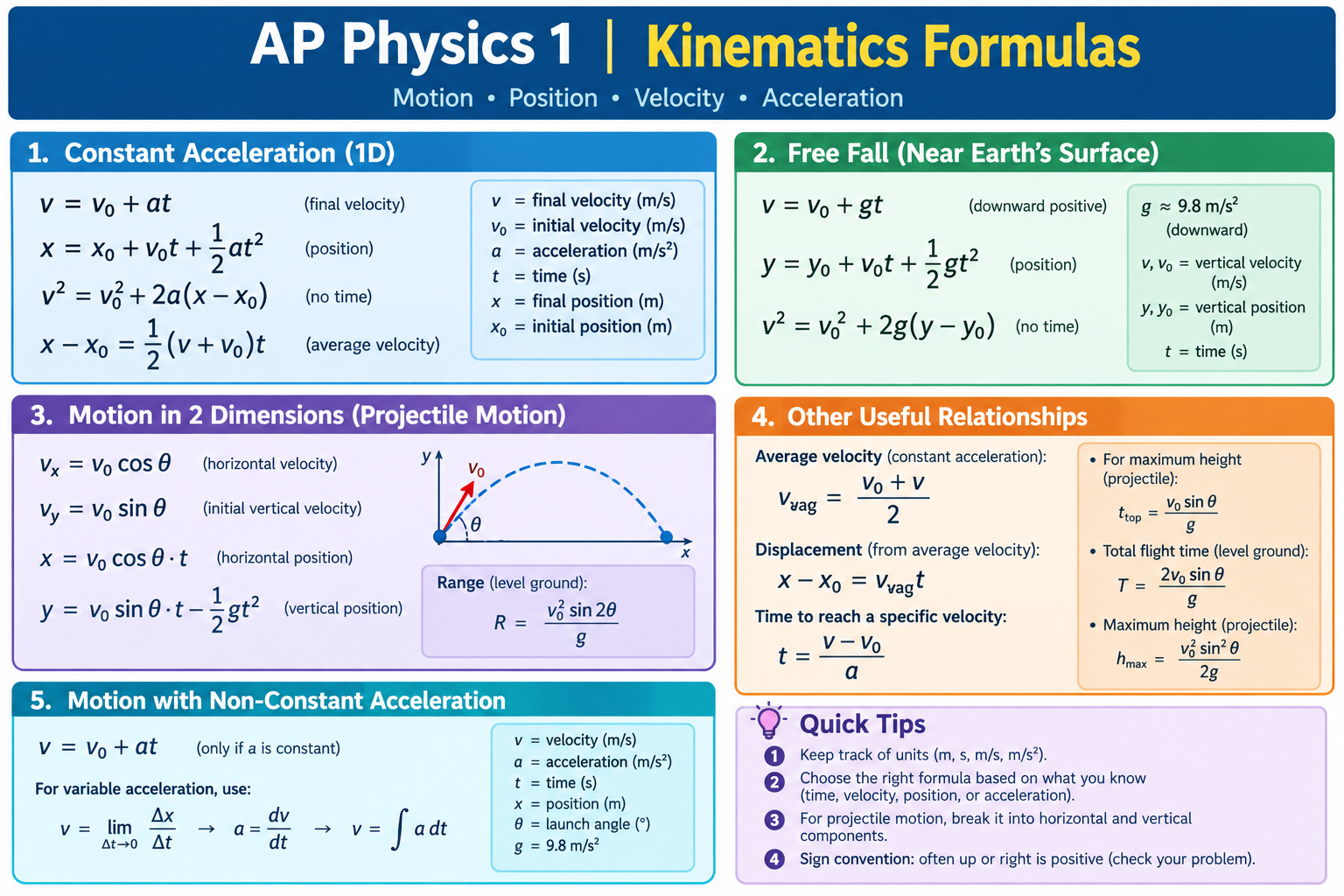
Introduction: Where AP Physics 1 Begins
Kinematics describes motion. It tells you where an object is, how fast it moves, and how its speed changes. It does not ask why. That question belongs to forces and Newton’s laws.
Every other unit in AP Physics 1 leans on kinematics. Force problems, energy problems, and momentum problems all need you to read a motion description and translate it into numbers. Students who fumble kinematics lose points in units that look unrelated.
The current AP Physics 1 Course and Exam Description (CED) lists kinematics as the opening unit and gives it a sizable share of the exam, roughly 12 to 18 percent of the score by the College Board’s published range. Confirm the exact weighting for your exam year on AP Central, since the College Board can revise it.
Here is the good news. You need only three core equations. They appear on the College Board equation sheet you receive on exam day. A fourth relationship, the average-velocity form, is not on the sheet, but you can build it yourself in ten seconds. This guide covers all four.
The equation sheet uses notation with a subscript x, such as vx and ax. This article writes v, v0, and a for clarity. Same meaning.
The Five Kinematic Variables
Every constant-acceleration problem uses some combination of five quantities.
| Symbol | Meaning | SI Unit |
|---|---|---|
| x | Final position | meters (m) |
| x0 | Initial position | meters (m) |
| v | Final velocity | meters per second (m/s) |
| v0 | Initial velocity | meters per second (m/s) |
| a | Acceleration (constant) | meters per second squared (m/s²) |
| t | Time interval | seconds (s) |
Displacement is Δx = x − x0. Many problems give you displacement directly.
Condition for every equation below: the acceleration must be constant. If acceleration changes during the motion, these equations do not apply. Split the motion into separate pieces where acceleration is constant, or use a different method.
The Core Kinematics Equations, One at a Time
Equation 1: Velocity as a Function of Time
v = v0 + at
What it says: Final velocity equals initial velocity plus the change caused by acceleration over time.
Variables: v (m/s), v0 (m/s), a (m/s²), t (s)
Missing variable: displacement (x − x0)
Use it when: the problem never mentions distance or position, and you want to relate velocity, acceleration, and time.
Example trigger phrases: “How fast is it moving after 3 seconds?” or “How long does it take to reach 20 m/s?”
Unit check: (m/s²)(s) = m/s. This matches the units of velocity.
Equation 2: Position as a Function of Time
x = x0 + v0t + ½at²
What it says: Final position equals starting position, plus the distance you would cover at constant initial velocity, plus the extra distance that acceleration adds.
Variables: x (m), x0 (m), v0 (m/s), a (m/s²), t (s)
Missing variable: final velocity (v)
Use it when: the problem gives or asks for position or displacement, and the final velocity is neither given nor requested.
Example trigger phrases: “How far does it travel in 5 seconds?” or “What is its height after 2 seconds?”
Unit check: (m/s)(s) = m, and (m/s²)(s²) = m. Every term is in meters.
Quadratic warning: Time appears squared. If you need to solve for t, you may get two roots from the quadratic formula. Reject any negative or physically meaningless time.
Equation 3: Velocity Without Time
v² = v0² + 2a(x − x0)
What it says: The change in the square of the velocity depends on acceleration and displacement.
Variables: v (m/s), v0 (m/s), a (m/s²), x − x0 (m)
Missing variable: time (t)
Use it when: the problem never mentions time and gives or asks for displacement.
Example trigger phrases: “How far does the car travel while stopping?” or “What is the speed just before it hits the ground?”
Unit check: (m/s²)(m) = m²/s². This matches v².
Sign warning: When you take a square root to find v, you get two answers, positive and negative. Choose the one that matches the direction of motion.
The Fourth Relationship: Average Velocity
x − x0 = ½(v + v0)t
What it says: For constant acceleration, average velocity is the simple average of the starting and ending velocities. Multiply by time to get displacement.
Missing variable: acceleration (a)
Use it when: you know both velocities and the time, but not the acceleration.
Where it comes from: Combine Equation 1 and Equation 2. It is not on the equation sheet, so know how to derive it, or use Equations 1 and 2 together.
How to Pick the Right Equation in 15 Seconds
Follow this routine on every problem.
-
Draw a quick sketch and mark a positive direction.
-
List the five variables. Write what you know. Write what you want.
-
Find the variable that is missing and not requested.
-
Choose the equation that leaves out that variable.
| Missing Variable | Equation to Use |
|---|---|
| Displacement (x − x0) | v = v0 + at |
| Final velocity (v) | x = x0 + v0t + ½at² |
| Time (t) | v² = v0² + 2a(x − x0) |
| Acceleration (a) | x − x0 = ½(v + v0)t |
This table is the single most useful tool in the unit. Screenshot it.
Real AP Test Example 1: A Braking Car (1D Motion)
Problem: A car travels along a straight road at 25 m/s. The driver sees an obstacle and brakes, producing a constant acceleration of −5.0 m/s². The obstacle is 50 m ahead of the point where the driver begins braking.
(a) How long does the car take to stop?
(b) How far does the car travel before stopping?
(c) Does the car hit the obstacle? Justify your answer.
(d) What is the car’s speed after it has traveled 40 m while braking?
Setup: Choose the direction of motion as positive. Then:
- v0 = +25 m/s
- a = −5.0 m/s² (negative, because the acceleration points opposite to the motion)
- Final velocity when stopped: v = 0
(a) Time to stop. Distance is not involved, so use Equation 1.
v = v0 + at
0 = 25 + (−5.0)t
t = 25 / 5.0 = 5.0 s
(b) Stopping distance. The time is known now, but it is cleaner to avoid it. Use Equation 3.
v² = v0² + 2a(x − x0)
0 = (25)² + 2(−5.0)(x − x0)
0 = 625 − 10(x − x0)
x − x0 = 625 / 10 = 62.5 m
Check with the average-velocity form: ½(25 + 0)(5.0) = 62.5 m. Both methods agree.
(c) Does it hit the obstacle? The stopping distance is 62.5 m. The obstacle is 50 m away. Since 62.5 m > 50 m, yes, the car hits the obstacle.
On the free-response section, the reasoning earns the points. Write the comparison in a sentence: “The car needs 62.5 m to stop, which is greater than the 50 m available.”
(d) Speed after 40 m. Time is not needed, so use Equation 3 again.
v² = (25)² + 2(−5.0)(40)
v² = 625 − 400 = 225
v = 15 m/s
(Take the positive root, since the car is still moving forward.)
Impact speed bonus: The car reaches the obstacle after traveling 50 m. v² = 625 − 10(50) = 125, so v ≈ 11 m/s. The car does not stop before it hits.
Teacher note: Notice how the stopping distance depends on the square of the initial speed. Double the speed and the stopping distance quadruples. The College Board likes to test that idea in conceptual questions.
Real AP Test Example 2: Free Fall From a Cliff
Problem: A ball is thrown straight up at 14.0 m/s from the top edge of a cliff that is 35.0 m above the ground below. The ball moves in free fall and misses the cliff on the way down. Ignore air resistance. Use g = 9.8 m/s².
(a) What is the maximum height above the top of the cliff?
(b) How long does the ball take to reach that highest point?
(c) How long does the ball take to reach the ground at the base of the cliff?
(d) What is the velocity of the ball just before impact?
Setup: Choose up as positive. Put the origin at the cliff top.
- v0 = +14.0 m/s
- a = −9.8 m/s² (gravity always points down, so it is negative)
- Ground position: y = −35.0 m
Free-fall fact: Acceleration is −9.8 m/s² the whole time. That includes going up, at the peak, and coming down. The acceleration at the top is not zero. Only the velocity is zero there.
(a) Maximum height. At the top, v = 0. Time is not needed, so use Equation 3.
v² = v0² + 2a(Δy)
0 = (14.0)² + 2(−9.8)(Δy)
0 = 196 − 19.6Δy
Δy = 196 / 19.6 = 10.0 m above the cliff top
(b) Time to the peak. Use Equation 1.
v = v0 + at
0 = 14.0 − 9.8t
t = 14.0 / 9.8 = 1.43 s
(c) Time to reach the ground. The final position is known, and the final velocity is not wanted. Use Equation 2.
y = y0 + v0t + ½at²
−35.0 = 0 + 14.0t + ½(−9.8)t²
−35.0 = 14.0t − 4.9t²
Rearrange into standard form:
4.9t² − 14.0t − 35.0 = 0
Apply the quadratic formula:
t = [14.0 ± √(14.0² − 4(4.9)(−35.0))] / (2 × 4.9)
t = [14.0 ± √(196 + 686)] / 9.8
t = [14.0 ± √882] / 9.8
t = [14.0 ± 29.7] / 9.8
Two roots:
- t = (14.0 + 29.7) / 9.8 = 4.46 s
- t = (14.0 − 29.7) / 9.8 = −1.60 s
Time cannot be negative here. Reject the second root. The ball reaches the ground after 4.46 s.
(d) Velocity just before impact. Use Equation 1.
v = v0 + at = 14.0 + (−9.8)(4.46) = 14.0 − 43.7 = −29.7 m/s
The negative sign means the ball moves downward. The speed is 29.7 m/s.
Check with Equation 3:
v² = (14.0)² + 2(−9.8)(−35.0) = 196 + 686 = 882
v = −√882 = −29.7 m/s ✓
Teacher notes:
- The ball passes the cliff edge again on the way down moving at 14.0 m/s downward, the same speed it had when launched. Symmetry in free fall is a favorite conceptual question.
- Many students would also try Equation 1 on part (c) and get stuck. Always check which variable is missing before you choose.
The Conceptual Trick: Scalars vs. Vectors
The College Board loves this distinction. It shows up in multiple-choice questions, free-response justification, and graph analysis.
The Definitions
A scalar has magnitude only. A vector has magnitude and direction.
| Scalar | Vector |
|---|---|
| Distance: total path length | Displacement: straight-line change in position, with direction |
| Speed: distance / time | Velocity: displacement / time, with direction |
| Acceleration: change in velocity / time, with direction |
The Classic Trap
A runner completes one full lap of a 400 m track in 80 s and finishes where she started.
- Distance: 400 m
- Displacement: 0 m (start and end are the same point)
- Average speed: 400 m / 80 s = 5.0 m/s
- Average velocity: 0 m / 80 s = 0 m/s
Her average speed is positive. Her average velocity is zero. Students who treat the two as the same lose the point.
Sign Conventions That Cause Errors
Negative acceleration does not mean slowing down.
What matters is the sign of acceleration compared with the sign of velocity.
| Velocity | Acceleration | What Happens |
|---|---|---|
| Positive | Positive | Speeding up |
| Positive | Negative | Slowing down |
| Negative | Negative | Speeding up (in the negative direction) |
| Negative | Positive | Slowing down |
If velocity and acceleration point the same way, the object speeds up. If they point opposite ways, it slows down.
Graph Reading Rules
| On This Graph | Slope Gives | Area Under the Curve Gives |
|---|---|---|
| Position vs. time | Velocity | Not used |
| Velocity vs. time | Acceleration | Displacement |
| Acceleration vs. time | Not used in this unit | Change in velocity |
Area under a velocity-time graph is displacement, not distance. Area below the time axis counts as negative. To find total distance, add the absolute values of the areas.
Units and Vectors Across Your Courses
Physics and chemistry share one habit: track your units and your signs on every line. A direction in physics works like a sign convention in chemistry. Positive and negative values carry meaning, and they must be applied consistently.
If you are taking both courses, practice on both sides. The AP Chemistry Unit 1 Practice Questions build the same precision with units, significant figures, and reading a problem carefully before calculating.
Dimensional analysis is your best defense against equation mistakes. Check that every term in an equation has the same units. In Equation 2, each term must reduce to meters. If one does not, you have the wrong equation or a wrong substitution. The same unit-tracking approach drives concentration problems in chemistry, as shown in How to Calculate Molarity and Molality.
Where Kinematics Leads Next
Kinematics tells you how an object moves. The next units tell you why. Newton’s laws connect forces to acceleration. Work and energy connect forces to changes in speed over a distance.
Once you reach work and energy, you will need to define your system and its boundaries. You will decide what is inside and what is outside, and then track energy and work crossing the boundary with correct signs. Chemistry builds the same skill with system and surroundings. A useful preview is the AP Chemistry Thermodynamics Cheat Sheet, which lays out sign conventions for heat and work in the first law.
Common Mistakes on the Exam
- Using the equations when acceleration is not constant. Check the problem statement first.
- Forgetting to pick a positive direction. Define it before you substitute any numbers.
- Using +9.8 for gravity when “up” is positive. Gravity is −9.8 m/s² in that case.
- Saying acceleration is zero at the top of a projectile’s path. Velocity is zero. Acceleration is still −9.8 m/s².
- Mixing distance and displacement. Read the question twice.
- Not rejecting extra quadratic roots. Throw out negative times.
- Leaving out units. Include them on every line, including the final answer.
- Skipping the sketch. Even a quick drawing prevents sign errors.
Practice Resources
- Work through the Khan Academy AP Physics 1 kinematics videos for worked examples and short quizzes.
- Experiment with the PhET interactive motion simulations. Change the acceleration and watch the position, velocity, and acceleration graphs update together.
Your Practice Prompt
A cyclist rolls from rest down a hill with constant acceleration, and you know her final speed and the length of the hill but not the time, so which of the three kinematic equations should you choose, and why?
Disclaimer:
This study guide is an independent educational resource and is not officially endorsed or affiliated with the College Board.
Two notes on the build. I wrote the Khan Academy anchor text as “Khan Academy AP Physics 1 kinematics videos,” because your original repeated the word “kinematics” twice. Also, the AP Physics 1 weighting range and equation sheet details reflect the College Board’s published materials as I know them, so confirm both on AP Central before publishing.