
Introduction
Chemistry has a reputation for being one of the harder sciences, and honestly, it’s not entirely undeserved. Between balancing equations, memorizing periodic trends, understanding electron configurations, and calculating moles, there’s a lot to keep track of. But here’s what most students don’t realize until they’re well into the subject: chemistry isn’t really about memorization. It’s about understanding patterns and using them to explain the world.
Once you see why sodium explodes in water, why diamonds and graphite are both pure carbon but behave so differently, why adding an acid to a base neutralizes both, or how the combustion reaction in a car engine relates to the rusting of iron — chemistry stops being a collection of abstract facts and becomes a coherent, fascinating explanation of how matter behaves.
This Chemistry Study Guide is designed to be the most complete single resource you’ll need for exam preparation at the high school and introductory college level. Whether you’re preparing for GCSE Chemistry, AP Chemistry, A-Level, IB, NEET, or a university entrance exam, the core concepts you need are covered here — clearly, accurately, and with practical examples that help the ideas stick.
We cover every major topic: atomic structure, the periodic table, chemical bonding, states of matter, acids and bases, chemical reactions, stoichiometry, the mole concept, solutions, redox chemistry, and organic chemistry basics. You’ll also find essential formulas, a complete glossary of chemistry terms, exam tips drawn from years of teaching experience, a full set of practice questions with answers, and a revision checklist to use in the days before your exam.
No topic is left half-explained. Let’s go through chemistry the right way.
Key Takeaways
Before You Dive In — Key Takeaways
- Chemistry is the study of matter, its properties, composition, structure, and the changes it undergoes.
- The six major branches are organic, inorganic, physical, analytical, biochemistry, and environmental chemistry.
- Atoms are the smallest units of elements; they consist of protons (positive), neutrons (neutral), and electrons (negative).
- The periodic table organizes elements by atomic number and groups elements with similar properties together.
- Chemical bonds — ionic, covalent, and metallic — form when atoms achieve greater stability through electron interaction.
- The five main types of chemical reactions are synthesis, decomposition, single replacement, double replacement, and combustion.
- The mole (6.022 x 10²³ particles) is the central unit connecting mass, number of particles, and gas volume in calculations.
- Acids donate protons (H⁺); bases accept them. The pH scale runs from 0 (strongly acidic) to 14 (strongly basic), with 7 being neutral.
- Redox reactions involve the simultaneous transfer of electrons: one species is oxidized (loses electrons), another is reduced (gains electrons).
- Laboratory safety is non-negotiable: always wear PPE, know the location of safety equipment, and handle chemicals with care.
What Is Chemistry?
Chemistry is the branch of science that studies matter — what it’s made of, how it’s structured, what properties it has, and how it transforms when it reacts with other matter or absorbs energy. It occupies a central position among the sciences, which is why chemists sometimes call their discipline “the central science”: it connects physics (which explains the subatomic foundations of chemistry) to biology (which depends on chemistry for everything from DNA replication to enzyme activity).
The scope of chemistry is enormous. It ranges from explaining why table salt dissolves in water to designing new pharmaceutical drugs, from understanding how stars convert hydrogen to helium to developing biodegradable plastics. If matter is involved, chemistry has something to say about it.
For students, chemistry provides the conceptual tools to understand a huge range of phenomena encountered in everyday life: cooking (chemical reactions changing food’s molecular structure), cleaning (surfactants disrupting grease), medicine (drugs binding to protein receptors), environmental issues (acid rain, ozone depletion, greenhouse gases), and technology (semiconductor chemistry, battery chemistry, materials science).
Why Studying Chemistry Is Important
Beyond passing exams, studying chemistry genuinely matters — and understanding why can help you stay motivated through the harder sections.
From a career standpoint, chemistry is a prerequisite or major component of medicine, pharmacy, nursing, dentistry, veterinary science, chemical engineering, materials science, environmental science, food science, and many other fields. Even computer science increasingly draws on chemistry through semiconductor physics and quantum computing.
From a general knowledge standpoint, chemistry literacy allows you to make better health decisions (understanding what medications do, reading nutrition labels), environmental decisions (understanding what pollutants do and why certain energy sources matter), and safety decisions (knowing what household chemicals should never be mixed and why).
Important Fact: Chemistry is the only science that creates its own subject matter. Unlike physics (which studies existing forces and particles) or biology (which studies existing organisms), chemistry regularly creates new substances that have never existed before in nature — from life-saving drugs to lightweight aerospace materials to synthetic fibers.
Major Branches of Chemistry
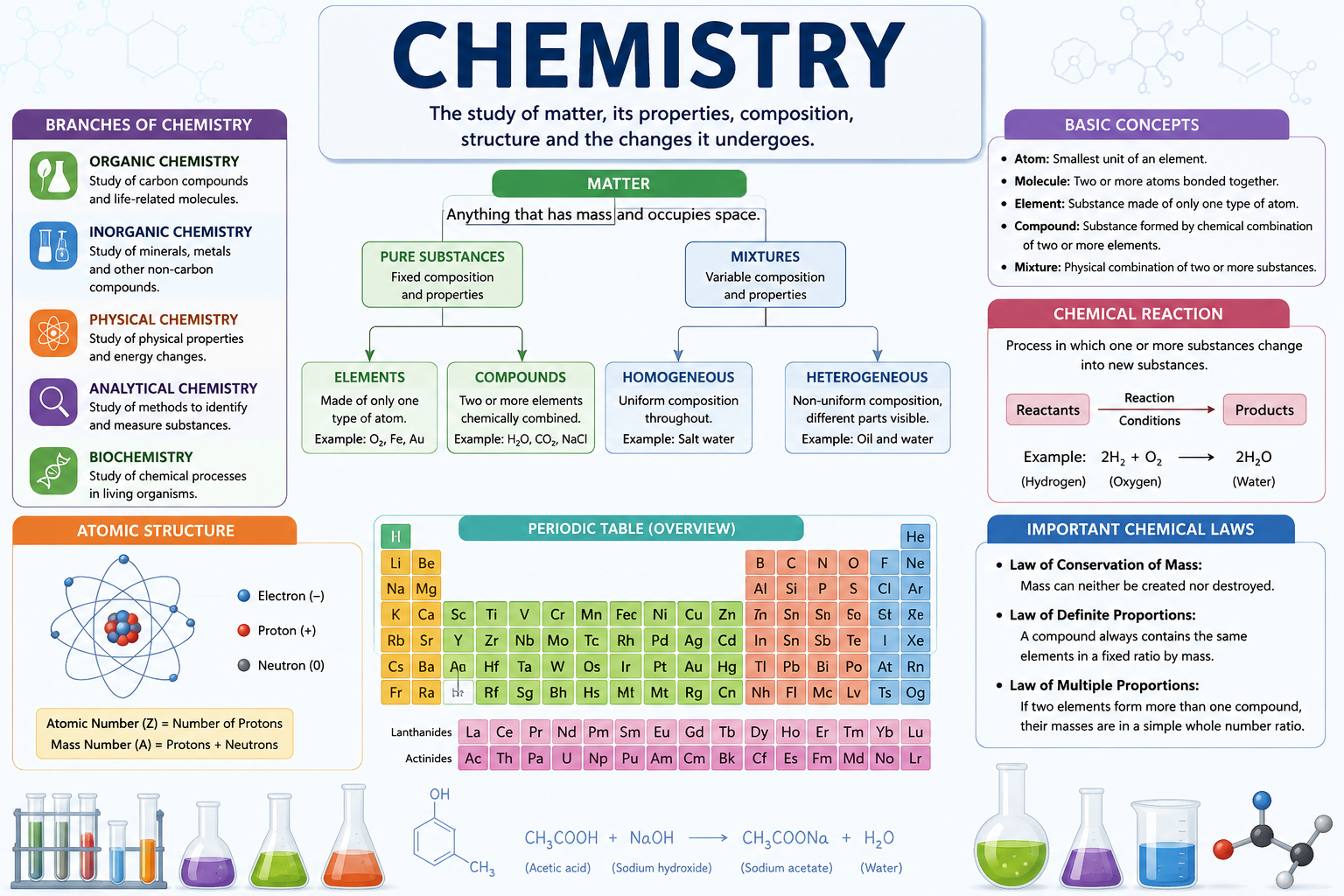
Chemistry is a broad field divided into several major branches, each focusing on different aspects of matter and its transformations.
Branches of Chemistry Summary Table
| Branch | Focus | Real-World Examples |
|---|---|---|
| Organic Chemistry | Carbon-containing compounds and their reactions | Drug synthesis, polymers, petroleum, food chemistry |
| Inorganic Chemistry | Non-carbon compounds; metals and minerals | Catalysts, ceramics, fertilizers, semiconductors |
| Physical Chemistry | Energy, thermodynamics, kinetics, quantum mechanics | Battery technology, reaction rates, spectroscopy |
| Analytical Chemistry | Identifying and quantifying substances | Drug testing, environmental monitoring, food safety |
| Biochemistry | Chemistry of living systems | Enzymes, DNA, metabolism, protein structure |
| Environmental Chemistry | Chemical processes in the environment | Acid rain, greenhouse gases, water purification |
Organic Chemistry
Organic chemistry studies compounds containing carbon, particularly those with carbon-hydrogen (C-H) bonds. Carbon’s unique ability to form four stable bonds simultaneously and link into long chains and rings produces an almost unlimited variety of molecules. Organic chemistry underlies pharmaceuticals, petrochemicals, polymers (plastics and fibers), dyes, flavors, and fragrances.
Inorganic Chemistry
Inorganic chemistry covers all compounds not classified as organic — essentially everything that doesn’t center on carbon-hydrogen bonds. This includes metals, salts, minerals, acids and bases, and coordination compounds. Inorganic chemists develop catalysts for industrial processes, study the properties of materials like ceramics and semiconductors, and investigate the role of metal ions in biological systems.
Physical Chemistry
Physical chemistry applies the principles of physics — thermodynamics, quantum mechanics, statistical mechanics, and electromagnetism — to chemical systems. It explains why and how fast reactions occur, how energy is stored and released, and what determines the structure of molecules. Physical chemistry is the theoretical backbone of all other chemistry branches.
Analytical Chemistry
Analytical chemistry develops and applies tools and methods for identifying what substances are present in a sample (qualitative analysis) and how much of each substance is present (quantitative analysis). Modern analytical chemistry includes spectroscopy, chromatography, mass spectrometry, and electrochemical methods — techniques used everywhere from clinical laboratories to forensic science.
Biochemistry
Biochemistry is the chemistry of living systems. It studies the structure and function of biological molecules — carbohydrates, proteins, lipids, and nucleic acids — and the metabolic reactions that sustain life. Biochemistry is fundamental to medicine, molecular biology, genetics, and the pharmaceutical industry.
Environmental Chemistry
Environmental chemistry examines the chemical processes occurring in air, water, and soil environments, including the behavior of pollutants and the consequences of human industrial activity. It provides the scientific basis for environmental protection policies and remediation strategies.
Basic Concepts Every Student Should Know
Before diving into more complex topics, a solid grasp of these foundational concepts is essential.
Matter
Matter is anything that has mass and occupies space. Everything you can physically interact with is matter — air, water, rock, your textbook, your own body. Energy (light, heat, sound) is not matter because it has no mass and occupies no space, though matter and energy are interconvertible (as Einstein’s E=mc² demonstrates).
Elements
An element is a pure substance consisting of atoms that all have the same number of protons. Elements are the simplest form of matter that cannot be broken down by ordinary chemical means. There are 118 known elements, 94 of which occur naturally. Each element has a chemical symbol (H for hydrogen, O for oxygen, Fe for iron from its Latin name ferrum, Au for gold from aurum).
Compounds
A compound is a pure substance formed when two or more different elements are chemically combined in fixed, definite proportions. Compounds have properties entirely different from the elements that form them. Water (H₂O) is a liquid at room temperature despite being made of two gases. Sodium chloride (NaCl) is a harmless edible salt despite being made of a toxic reactive metal and a poisonous gas. Compounds can only be separated into their elements by chemical means (not physical ones).
Mixtures
A mixture is a combination of two or more substances that are not chemically combined — each substance retains its own properties and can be separated by physical means. Air is a mixture (mostly nitrogen and oxygen). Seawater is a mixture. Pizza is a mixture. Mixtures can be:
- Homogeneous (solutions): Uniform composition throughout (saltwater, air, brass)
- Heterogeneous: Non-uniform composition (sand in water, oil and water, concrete)
Atoms
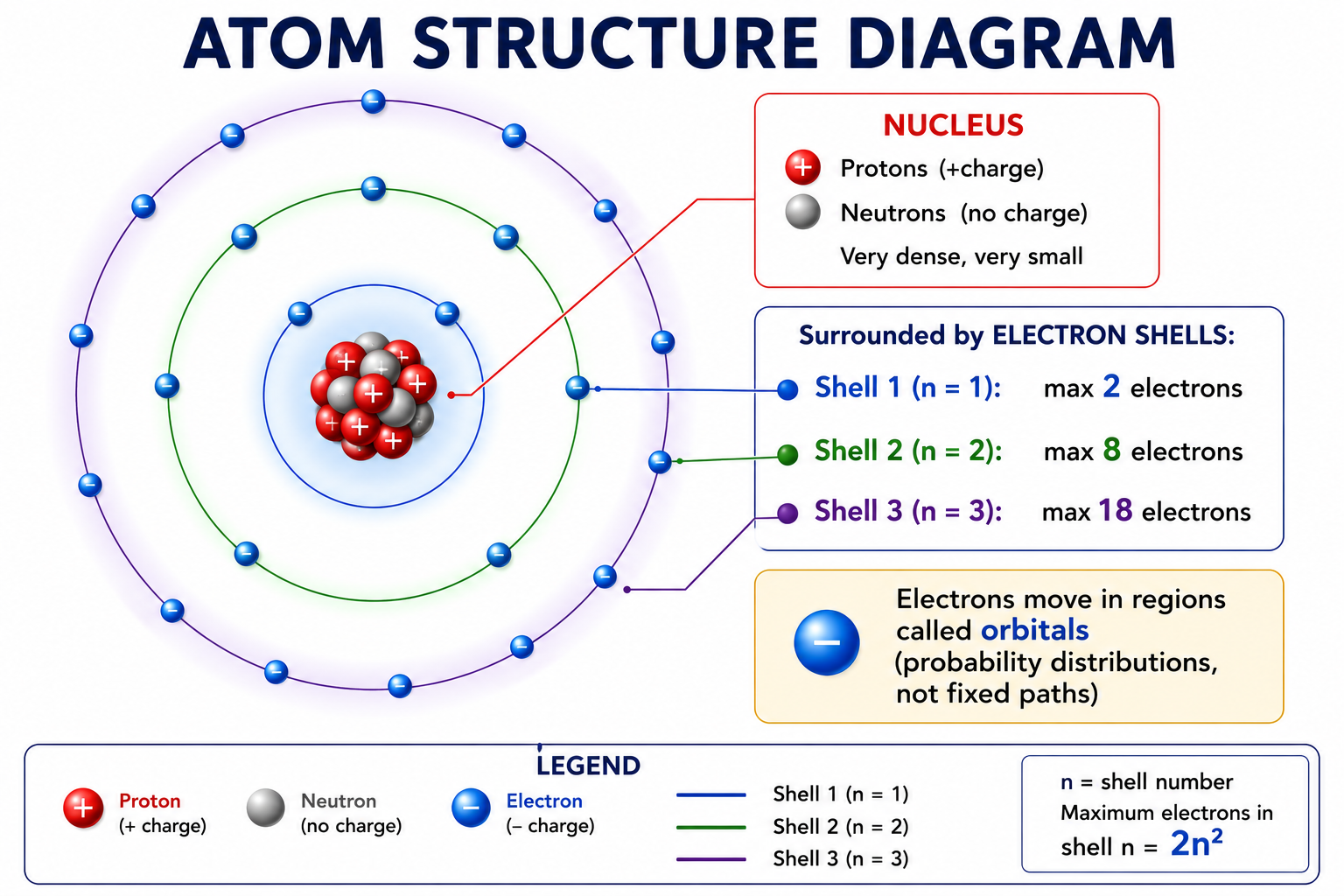
An atom is the smallest unit of an element that retains the chemical properties of that element. Atoms are extraordinarily small — a single grain of sand contains more atoms than there are grains of sand on all of Earth’s beaches. Despite their size, atoms have internal structure: a dense nucleus containing protons and neutrons, surrounded by electrons.
Molecules
A molecule is the smallest unit of a compound (or some elements) that retains its chemical properties. It consists of two or more atoms bonded together. Water molecules (H₂O) have two hydrogen atoms bonded to one oxygen atom. Some elements also exist as molecules — oxygen gas exists as O₂, nitrogen as N₂, and ozone as O₃.
Ions
An ion is an atom or molecule that has gained or lost electrons, giving it a net electrical charge. Positively charged ions (cations) have lost electrons; negatively charged ions (anions) have gained electrons. Ions are crucial to ionic bonding, electrochemistry, and biological processes (nerve signals depend on ion movements across cell membranes).
Atomic Structure
Subatomic Particles Comparison Table
| Particle | Symbol | Charge | Relative Mass | Location |
|---|---|---|---|---|
| Proton | p+ | +1 | 1 amu | Nucleus |
| Neutron | n0 | 0 | 1 amu | Nucleus |
| Electron | e- | -1 | ~1/1836 amu | Electron shells |
Protons
Protons carry a positive charge (+1) and reside in the nucleus. The number of protons — the atomic number — uniquely identifies an element. Hydrogen always has 1 proton; carbon always has 6; gold always has 79.
Neutrons
Neutrons are electrically neutral particles also in the nucleus. They add to the atom’s mass and help stabilize the nucleus by providing strong nuclear force between nucleons. Atoms of the same element with different neutron numbers are called isotopes.
Electrons
Electrons are negatively charged particles occupying energy levels (shells) around the nucleus. Their mass is negligible compared to protons and neutrons, but they are entirely responsible for an atom’s chemical behavior. The arrangement of electrons — particularly in the outermost shell — determines how an atom bonds, reacts, and behaves in every chemical context.
Atomic Number
The atomic number (Z) equals the number of protons. In a neutral atom, it also equals the number of electrons.
Mass Number
The mass number (A) equals protons + neutrons. Electrons contribute negligible mass and are excluded.
Neutrons = Mass Number − Atomic Number (N = A − Z)
The Periodic Table Explained
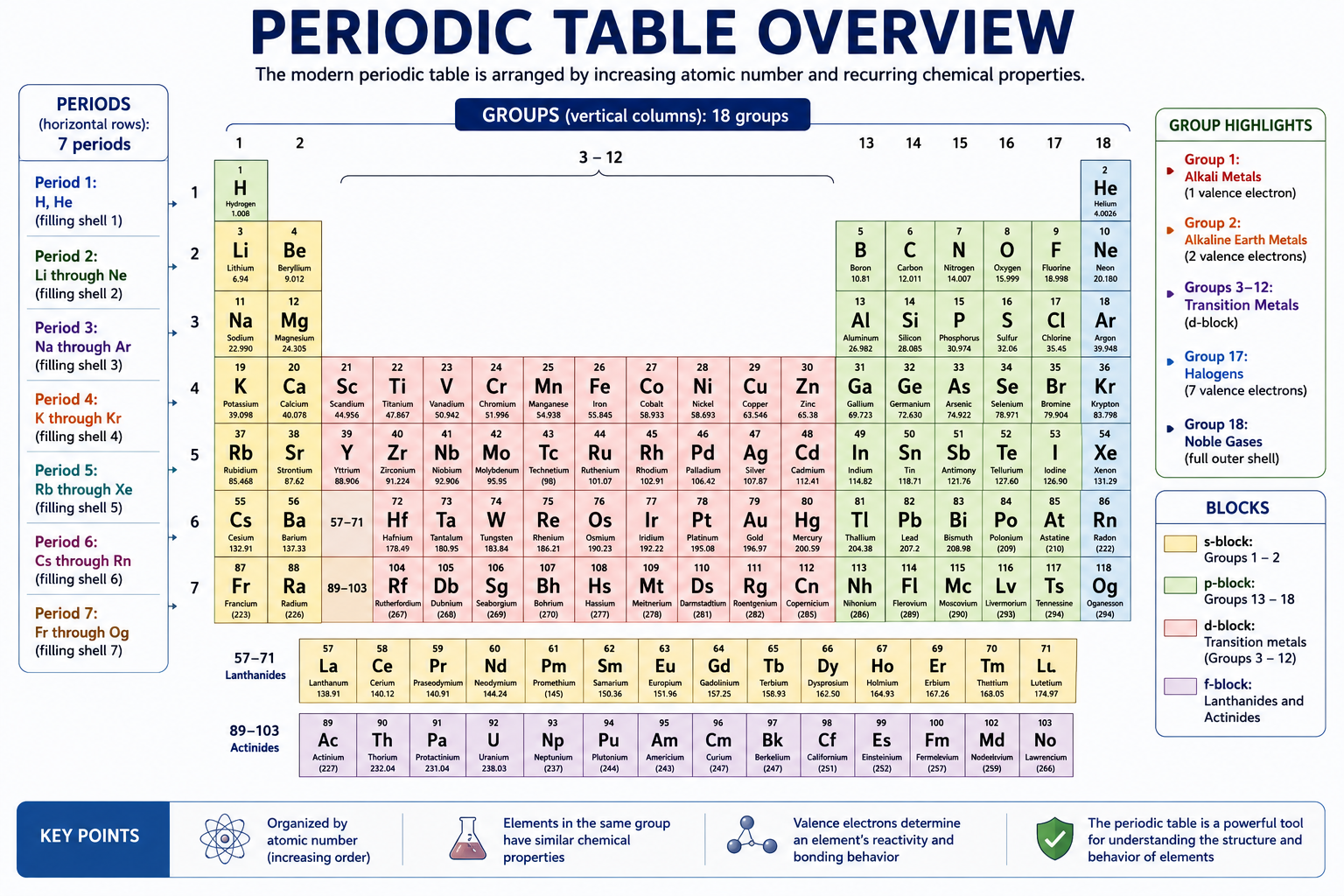
The periodic table organizes all 118 known elements by increasing atomic number. Its genius lies in what it reveals: elements arranged this way show clear, predictable patterns in their properties — patterns that directly reflect underlying atomic structure.
Groups
Groups are the vertical columns, numbered 1–18. Elements in the same group have the same number of valence electrons and therefore similar chemical properties. This is why lithium, sodium, and potassium — all Group 1 elements — all react vigorously with water and form similar compounds.
Periods
Periods are the horizontal rows, numbered 1–7. Moving across a period from left to right, the atomic number increases by 1 with each element (one more proton and one more electron added). The outermost electrons are in the same principal energy level (shell) across a period but experience increasing nuclear attraction, causing atomic radius to decrease and ionization energy to increase as you move right.
Metals
Metals occupy the left side and center of the periodic table (including all transition metals). They share characteristic properties: solid at room temperature (except mercury), shiny/lustrous, good conductors of heat and electricity, malleable (can be beaten into sheets), ductile (can be drawn into wires), and generally have low electronegativity. They tend to lose electrons and form cations.
Nonmetals
Nonmetals occupy the upper right portion of the periodic table. They are generally poor conductors, brittle in solid form, and more variable in physical state than metals (many are gases at room temperature). They tend to gain electrons and form anions, or share electrons in covalent bonds.
Metalloids
Metalloids (also called semimetals) have properties intermediate between metals and nonmetals. They include boron, silicon, germanium, arsenic, antimony, and tellurium. Silicon is the most commercially important metalloid — its semiconductor properties underlie all modern electronics and computing.
Key Periodic Trends Table
| Property | Trend Across Period (left to right) | Trend Down Group |
|---|---|---|
| Atomic Radius | Decreases | Increases |
| Ionization Energy | Increases | Decreases |
| Electronegativity | Increases | Decreases |
| Metallic Character | Decreases | Increases |
| Electron Affinity | Generally increases | Generally decreases |
Chemical Bonding
Chemical bonds form when atoms interact in ways that result in greater overall stability. The type of bond that forms depends on the nature of the atoms involved — specifically their electronegativity values and whether they’re metals or nonmetals.
Chemical Bonds Comparison Table
| Bond Type | Forms Between | Mechanism | Properties | Examples |
|---|---|---|---|---|
| Ionic | Metal + Nonmetal | Electron transfer | High melting point, conducts when dissolved, brittle | NaCl, MgO, CaCl₂ |
| Covalent | Nonmetal + Nonmetal | Electron sharing | Variable melting points, often non-conductive | H₂O, CO₂, CH₄ |
| Metallic | Metal + Metal | Electron sea (delocalized) | Conducts electricity, malleable, ductile | Cu, Fe, steel alloys |
| Hydrogen | H bonded to F, O, or N | Dipole-dipole attraction | Relatively weak but important in biology | Water, DNA base pairs |
Ionic Bond
An ionic bond forms when one atom transfers one or more electrons to another atom. This typically happens between a metal (which loses electrons easily) and a nonmetal (which gains electrons readily). The result is a cation and anion that attract each other electrostatically. The greater the electron transfer, the stronger the bond.
Classic example: Sodium (Na, Group 1, 1 valence electron) transfers its outer electron to chlorine (Cl, Group 17, 7 valence electrons). Na becomes Na⁺; Cl becomes Cl⁻. The electrostatic attraction between them forms the ionic compound NaCl (table salt).
Covalent Bond
A covalent bond forms when two atoms share one or more pairs of electrons rather than transferring them completely. This occurs most commonly between nonmetals with similar electronegativities. Sharing allows both atoms to achieve a full outer shell.
- Single bond: One shared electron pair (H-H in H₂)
- Double bond: Two shared pairs (O=O in O₂, C=O in CO₂)
- Triple bond: Three shared pairs (N≡N in N₂)
Covalent bonds can be polar (if the atoms have different electronegativities, the shared electrons are pulled unequally toward the more electronegative atom, creating a dipole) or nonpolar (if electronegativity values are equal or very similar).
Metallic Bond
Metallic bonds arise in metals, where valence electrons are not associated with individual atoms but instead form a “sea” of delocalized electrons that flow freely throughout the metal lattice. This electron sea explains why metals conduct electricity (electrons carry charge), why they’re malleable and ductile (layers of atoms can slide without breaking bonds), and why they’re good heat conductors.
Hydrogen Bond
A hydrogen bond is an intermolecular attraction between a hydrogen atom covalently bonded to a highly electronegative atom (fluorine, oxygen, or nitrogen) and a lone pair on an electronegative atom of a neighboring molecule. Hydrogen bonds are significantly weaker than covalent or ionic bonds but collectively have enormous biological importance: they hold DNA’s double helix together (between complementary base pairs), stabilize protein secondary and tertiary structure, and give water its unusually high boiling point, surface tension, and heat capacity.
States of Matter
Solids
In solids, particles are closely packed in a regular arrangement (crystalline solids) or random arrangement (amorphous solids). Particles vibrate in place but cannot move freely. Solids have definite shape and volume, are generally incompressible, and are often the densest state of a substance.
Liquids
In liquids, particles are close together but not fixed — they can flow past each other. Liquids have definite volume but take the shape of their container. The intermolecular forces are strong enough to keep particles close together but not strong enough to prevent flow.
Gases
In gases, particles are widely separated and move rapidly and randomly. They have neither definite shape nor definite volume and expand to fill any container. Gases are highly compressible. Intermolecular forces are negligible compared to thermal energy.
Plasma
Plasma is a high-energy state in which electrons have been stripped from atoms, producing a mixture of ions and free electrons. Plasma doesn’t occur under everyday conditions on Earth but is the most abundant state of matter in the universe — stars (including the sun) are composed of plasma. It is found on Earth in lightning bolts, plasma screens, and fusion reactors.
States of Matter Comparison Table
| Property | Solid | Liquid | Gas | Plasma |
|---|---|---|---|---|
| Shape | Fixed | Takes container shape | Takes container shape | No fixed shape |
| Volume | Fixed | Fixed | Variable (fills container) | Variable |
| Particle Arrangement | Ordered, close | Disordered, close | Random, far apart | Ionized, far apart |
| Compressibility | Very low | Very low | High | High |
| Energy Level | Lowest | Intermediate | High | Very high |
| Example | Ice | Water | Steam | Lightning bolt |
Physical and Chemical Changes
Understanding the difference between physical and chemical changes is fundamental to chemistry.
A physical change alters the form or appearance of matter without changing its chemical composition. The substance remains the same substance — only its state, shape, or size changes. Examples: melting ice into water, cutting a piece of iron, dissolving sugar in water (the sugar can be recovered by evaporation).
A chemical change (chemical reaction) produces one or more new substances with different chemical compositions and properties from the original substances. The change is generally not easily reversible. Signs that a chemical change has occurred include:
- Production of a gas (bubbling)
- Formation of a precipitate (solid forming in a solution)
- Color change
- Temperature change (heat absorbed or released)
- Production of light or sound
Examples: Iron rusting (iron + oxygen → iron oxide), wood burning (cellulose + oxygen → carbon dioxide + water + energy), baking soda reacting with vinegar (sodium bicarbonate + acetic acid → sodium acetate + water + CO₂).
Acids, Bases, and the pH Scale
Acids vs Bases Comparison Table
| Property | Acids | Bases |
|---|---|---|
| Arrhenius Definition | Produces H⁺ in water | Produces OH⁻ in water |
| Bronsted-Lowry Definition | Proton (H⁺) donor | Proton (H⁺) acceptor |
| Lewis Definition | Electron pair acceptor | Electron pair donor |
| pH Range | 0–6.9 | 7.1–14 |
| Taste | Sour | Bitter |
| Effect on litmus | Turns blue litmus red | Turns red litmus blue |
| Examples | HCl, H₂SO₄, vinegar (acetic acid), citric acid | NaOH, KOH, ammonia, baking soda (NaHCO₃) |
| Reaction with metal | Often produces H₂ gas | Does not react with most metals |
The pH scale runs from 0 to 14 and measures the concentration of hydrogen ions (H⁺) in a solution.
- pH = −log[H⁺]
- pH 7: neutral (pure water at 25°C)
- pH < 7: acidic (more H⁺ ions)
- pH > 7: basic/alkaline (more OH⁻ ions, fewer H⁺)
Each unit change on the pH scale represents a tenfold change in H⁺ concentration. A solution with pH 3 has 10 times more H⁺ ions than a solution with pH 4, and 100 times more than pH 5.
Real-world pH examples:
- Gastric acid (stomach): pH 1–2
- Lemon juice: pH 2–3
- Black coffee: pH ~5
- Blood: pH 7.35–7.45 (tightly regulated)
- Seawater: pH ~8.1
- Bleach: pH ~12.5
- Drain cleaner: pH ~14
When an acid and base react, they neutralize each other, producing water and a salt:
HCl + NaOH → NaCl + H₂O
Chemical Reactions
A chemical reaction occurs when chemical bonds in reactants are broken and new bonds form to create products. Every chemical reaction can be represented by a balanced chemical equation, where the number and type of atoms is the same on both sides (conservation of mass and atoms).
Synthesis (Combination)
Two or more reactants combine to form a single product.
General form: A + B → AB
Example: 2H₂ + O₂ → 2H₂O (water formed from hydrogen and oxygen)
Decomposition
A single compound breaks down into two or more simpler products.
General form: AB → A + B
Example: 2H₂O₂ → 2H₂O + O₂ (hydrogen peroxide decomposes to water and oxygen — this is the reaction responsible for the bubbling you see when hydrogen peroxide is applied to a wound)
Single Replacement
One element replaces another element in a compound.
General form: A + BC → AC + B
Example: Zn + 2HCl → ZnCl₂ + H₂ (zinc displaces hydrogen from hydrochloric acid)
Double Replacement (Metathesis)
The cations and anions of two ionic compounds switch partners.
General form: AB + CD → AD + CB
Example: AgNO₃ + NaCl → AgCl↓ + NaNO₃ (silver chloride precipitate forms — the basis of several analytical tests)
Combustion
A substance (usually a hydrocarbon) reacts with oxygen, releasing energy as heat and light. Complete combustion produces carbon dioxide and water.
General form: Hydrocarbon + O₂ → CO₂ + H₂O
Example: CH₄ + 2O₂ → CO₂ + 2H₂O (methane/natural gas burning)
Incomplete combustion (insufficient oxygen) produces carbon monoxide (CO) and/or carbon (soot) — which is why poorly ventilated gas heaters are dangerous.
The Mole Concept
The mole is the chemist’s counting unit. Just as a “dozen” means 12 of something and a “gross” means 144, a mole means 6.022 × 10²³ of something. This number is Avogadro’s number (Nₐ), named after the Italian scientist Amedeo Avogadro.
Why is this specific number used? Because it was defined so that the molar mass of any element (in grams per mole) equals its relative atomic mass — a tremendously practical choice. Carbon-12 has a relative atomic mass of 12, so one mole of carbon-12 has a mass of exactly 12 grams and contains 6.022 × 10²³ carbon atoms.
Key mole relationships:
- 1 mole of any substance = 6.022 × 10²³ particles (atoms, molecules, ions, etc.)
- Molar mass = mass in grams of one mole of a substance (in g/mol)
- Number of moles = mass (g) ÷ molar mass (g/mol)
- At STP (0°C, 1 atm), 1 mole of any ideal gas occupies 22.4 liters
Example: How many moles are in 36 grams of water (H₂O)?
- Molar mass of H₂O = 2(1) + 16 = 18 g/mol
- Moles = 36 g ÷ 18 g/mol = 2 moles
This connects beautifully to particle counts: 2 moles × 6.022 × 10²³ = approximately 1.2 × 10²⁴ water molecules in 36 grams of water.
Stoichiometry Basics
Stoichiometry is the quantitative calculation of reactants and products in chemical reactions. It uses the balanced chemical equation as a ratio tool.
The fundamental principle: the coefficients in a balanced equation represent molar ratios of reactants and products.
Example: Consider the reaction: N₂ + 3H₂ → 2NH₃
This tells you:
- 1 mole of N₂ reacts with 3 moles of H₂ to produce 2 moles of NH₃
- These ratios hold at any scale
Worked example: How many grams of ammonia (NH₃) are produced from 14 grams of N₂?
Step 1: Convert grams to moles — 14 g ÷ 28 g/mol = 0.5 moles N₂
Step 2: Use molar ratio — 0.5 mol N₂ × (2 mol NH₃ / 1 mol N₂) = 1 mole NH₃
Step 3: Convert moles to grams — 1 mol × 17 g/mol = 17 grams of NH₃
Limiting reagent: In real reactions, one reactant is often completely consumed before the others — this is the limiting reagent and it determines how much product forms. The remaining reactant(s) are in excess.
Percent yield: Theoretical yield is the maximum possible product calculated from stoichiometry. Actual yield is what you actually obtain in an experiment. Percent yield = (actual yield ÷ theoretical yield) × 100%.
Solutions and Concentration
A solution is a homogeneous mixture of two or more substances. The solute is the substance dissolved (present in smaller amount); the solvent is the substance doing the dissolving (present in larger amount). In saltwater, salt is the solute and water is the solvent.
“Like dissolves like” is the guiding principle: polar solvents (like water) dissolve polar solutes and ionic compounds; nonpolar solvents dissolve nonpolar solutes.
Concentration measures how much solute is dissolved in a given amount of solution. The most common unit in chemistry is molarity (M):
Molarity (M) = moles of solute ÷ liters of solution
Example: Dissolving 0.5 moles of NaCl in 1 liter of water gives a 0.5 M NaCl solution.
Other concentration units include percent by mass, parts per million (ppm, especially useful for very dilute solutions like pollutants in water), and molality (moles of solute per kilogram of solvent).
Dilution: When a solution is diluted (more solvent added), concentration decreases but the number of moles of solute remains constant.
M₁V₁ = M₂V₂ (concentration × volume before = concentration × volume after)
Oxidation and Reduction (Redox)
Redox reactions involve the transfer of electrons between species. The two processes always occur together — you cannot have oxidation without reduction happening simultaneously.
OIL RIG is the classic memory device:
- Oxidation Is Loss (of electrons)
- Reduction Is Gain (of electrons)
The species that loses electrons is oxidized and acts as the reducing agent (it gives electrons to the other species). The species that gains electrons is reduced and acts as the oxidizing agent (it accepts electrons from the other species).
Oxidation states (oxidation numbers) are assigned to track electron movement:
Key rules for assigning oxidation states:
- Pure elements have an oxidation state of 0
- Monatomic ions have an oxidation state equal to their charge
- Oxygen is usually −2 (except in peroxides where it’s −1)
- Hydrogen is usually +1 (except in metal hydrides where it’s −1)
- In any compound, the sum of oxidation states equals the overall charge
Practical examples of redox:
- Rusting: Fe → Fe³⁺ (iron is oxidized); O₂ → O²⁻ (oxygen is reduced)
- Batteries: Redox reactions at electrodes produce electrical current
- Photosynthesis: CO₂ is reduced to glucose; water is oxidized to O₂
- Metabolism: Glucose is oxidized (via cellular respiration) to release energy
Organic Chemistry Basics
Organic chemistry is the study of carbon-containing compounds. Carbon’s ability to form 4 bonds and link to itself in chains, branches, and rings of virtually unlimited length creates the enormous diversity of organic molecules.
Major families (functional groups):
| Functional Group | Structure | Example | Properties |
|---|---|---|---|
| Alkane | C-C single bonds only | Methane (CH₄), Propane (C₃H₈) | Nonpolar, relatively unreactive |
| Alkene | C=C double bond | Ethene (C₂H₄) | More reactive than alkanes |
| Alkyne | C≡C triple bond | Ethyne/Acetylene (C₂H₂) | Highly reactive |
| Alcohol | -OH group | Ethanol (C₂H₅OH) | Polar, can H-bond |
| Carboxylic Acid | -COOH group | Acetic acid (CH₃COOH) | Acidic, forms esters |
| Amine | -NH₂ group | Methylamine (CH₃NH₂) | Basic, often unpleasant odor |
| Ester | -COO- group | Ethyl acetate | Fruity smell; used in perfumes, flavors |
| Aldehyde | -CHO group | Formaldehyde (HCHO) | Reactive; used in preservation |
| Ketone | -CO- (between carbons) | Acetone (CH₃COCH₃) | Common solvent |
Hydrocarbons (containing only C and H) are the simplest organic compounds and form the basis of fuels. The general formula for alkanes is CₙH₂ₙ₊₂; for alkenes CₙH₂ₙ; for alkynes CₙH₂ₙ₋₂.
Isomers are compounds with the same molecular formula but different structural arrangements — and often very different properties. Butane (C₄H₁₀) and isobutane are structural isomers; both have the formula C₄H₁₀ but different carbon chain arrangements.
Common Laboratory Equipment
| Equipment | Purpose |
|---|---|
| Beaker | Mixing, heating, and holding liquids (rough volume measurements) |
| Erlenmeyer Flask | Mixing solutions; better for swirling than beakers |
| Graduated Cylinder | Accurate measurement of liquid volume |
| Burette | Precise dispensing of liquid volumes in titrations |
| Pipette | Transferring precise volumes of liquid |
| Volumetric Flask | Preparing solutions of precise concentration |
| Bunsen Burner | Heating substances in the lab |
| Test Tube | Holding small quantities of liquid for reactions |
| Evaporating Dish | Evaporating solvent from solutions |
| Crucible | Heating substances to very high temperatures |
| Thermometer | Measuring temperature |
| Balance/Scale | Measuring mass accurately |
| Separating Funnel | Separating immiscible liquids |
| Condenser | Cooling and condensing vapors in distillation |
| Spatula | Transferring solid chemicals |
Laboratory Safety Rules
Laboratory safety is not optional, and it’s worth understanding why each rule exists rather than just following it blindly.
Personal Protective Equipment (PPE):
- Safety goggles must be worn at all times — chemical splashes can cause permanent eye damage in seconds
- Lab coat or apron protects skin and clothing from chemical spills
- Gloves appropriate to the chemicals being used; not all gloves protect against all chemicals
- Closed-toe shoes — no sandals in any lab, ever
General safety rules:
- Never eat, drink, or apply makeup in a laboratory
- Know the location of the fire extinguisher, safety shower, eye wash station, and first aid kit before the experiment begins
- Read the Safety Data Sheet (SDS) for any unfamiliar chemical before use
- Never pipette by mouth — always use a pipette filler
- When diluting acids, always add acid to water (not water to acid) — the initialism “AAA” (Always Add Acid) helps remember this; adding water to concentrated acid causes violent spattering
- Never heat a closed container — pressure buildup can cause explosion
- Keep flammable materials away from open flames
- Label all containers clearly — unknown chemicals are dangerous chemicals
- Dispose of chemicals according to your institution’s waste disposal protocol, never just down the drain
- Report all accidents, spills, and injuries immediately — what seems minor may not be
Essential Chemistry Formulas
Core Chemistry Formulas Table
| Formula | Name | What It Calculates |
|---|---|---|
| n = m / M | Moles calculation | Moles of substance from mass and molar mass |
| M = n / V | Molarity | Concentration of a solution |
| M₁V₁ = M₂V₂ | Dilution equation | New concentration after dilution |
| PV = nRT | Ideal Gas Law | Relationship between pressure, volume, temperature, and moles of gas |
| pH = -log[H⁺] | pH calculation | Hydrogen ion concentration to pH |
| [H⁺] = 10⁻ᵖᴴ | H⁺ from pH | Hydrogen ion concentration from pH value |
| pH + pOH = 14 | pH/pOH relationship | Finding pOH from pH or vice versa |
| % yield = (actual/theoretical) x 100 | Percent yield | Efficiency of a chemical reaction |
| ΔH = H(products) − H(reactants) | Enthalpy change | Heat absorbed or released in a reaction |
| q = mcΔT | Heat equation | Heat absorbed/released by a substance |
| Kc = [products]/[reactants] | Equilibrium constant | Ratio of product to reactant concentrations at equilibrium |
| E°cell = E°cathode − E°anode | Cell potential | Voltage produced by an electrochemical cell |
Ideal Gas Law Constants:
- R = 8.314 J/(mol·K) or 0.08206 L·atm/(mol·K)
- Temperature must be in Kelvin: K = °C + 273.15
Common Chemistry Terms Every Student Should Know
| Term | Definition |
|---|---|
| Atom | Smallest unit of an element retaining its chemical properties |
| Molecule | Two or more atoms bonded together |
| Ion | Charged atom or group of atoms |
| Mole | 6.022 × 10²³ particles of a substance |
| Molar Mass | Mass in grams of one mole of a substance (g/mol) |
| Isotope | Atoms of the same element with different neutron numbers |
| Electronegativity | Ability of an atom to attract electrons in a covalent bond |
| Ionization Energy | Energy required to remove an electron from a gaseous atom |
| Oxidation State | Assigned charge reflecting an atom’s electron gain/loss |
| Catalyst | Substance that speeds up a reaction without being consumed |
| Equilibrium | State where forward and reverse reaction rates are equal |
| Enthalpy (H) | Heat content of a system; ΔH negative = exothermic reaction |
| Entropy (S) | Measure of disorder in a system |
| Titration | Technique to determine concentration using a known-concentration solution |
| Precipitate | Insoluble solid formed from a reaction between two solutions |
| Electrolyte | Substance that dissociates into ions in solution, conducting electricity |
| Solubility | Maximum amount of solute that dissolves in a solvent at a given temperature |
| Empirical Formula | Simplest whole-number ratio of atoms in a compound |
| Molecular Formula | Actual number of each type of atom in a molecule |
| Exothermic | Reaction that releases heat energy (ΔH negative) |
| Endothermic | Reaction that absorbs heat energy (ΔH positive) |
| Activation Energy | Minimum energy required to initiate a chemical reaction |
| Le Chatelier’s Principle | System at equilibrium shifts to counteract any imposed change |
Common Mistakes Students Make
Knowing where students typically go wrong can help you avoid the same pitfalls:
- Not balancing chemical equations properly. Every equation must have equal numbers of each type of atom on both sides. Students often change subscripts (which changes the compound itself) instead of coefficients (which is the correct approach). Only adjust coefficients when balancing.
- Confusing molarity with molality. Molarity is moles per liter of solution; molality is moles per kilogram of solvent. These are different and used in different contexts (molality is used in colligative property calculations).
- Forgetting to convert temperature to Kelvin in gas law calculations. The ideal gas law and related calculations require absolute temperature. Always convert: K = °C + 273.15. Using Celsius in PV = nRT gives completely wrong answers.
- Adding water to concentrated acid. This is not just a conceptual mistake — it’s a safety hazard. Always add acid to water when diluting.
- Mixing up oxidation and reduction. OIL RIG: Oxidation Is Loss, Reduction Is Gain (of electrons). The reducing agent is the species that gets oxidized (it gives electrons away); the oxidizing agent gets reduced.
- Ignoring significant figures. Chemistry calculations require appropriate significant figures. Using too many or too few in an answer can cost marks in exams and, in real laboratory settings, reflects poor scientific precision.
- Assuming all ionic compounds are soluble. Solubility rules must be learned. Many students assume all salts dissolve, but compounds containing Ag⁺, Pb²⁺, or Ba²⁺ are often insoluble, as are most carbonates, phosphates, and hydroxides (with Group 1 exceptions).
- Not distinguishing between empirical and molecular formulas. The empirical formula gives the simplest ratio; the molecular formula gives the actual atom count. Glucose (C₆H₁₂O₆) has an empirical formula of CH₂O.
- Forgetting state symbols in equations. State symbols — (s) for solid, (l) for liquid, (g) for gas, (aq) for aqueous (dissolved in water) — carry information about the physical state of reactants and products and are frequently required for full marks.
- Confusing physical and chemical properties. Physical properties (melting point, density, color, solubility) describe a substance without changing its chemical identity. Chemical properties describe how a substance behaves in chemical reactions (flammability, reactivity with acids, tendency to corrode).
Best Tips to Study Chemistry
Exam Tips Box
- Practice balancing chemical equations daily until it becomes second nature. Use a structured approach: balance metals first, then nonmetals, leave hydrogen and oxygen for last.
- For the mole concept, memorize just three things: Avogadro’s number (6.022 × 10²³), the molar mass calculation from the periodic table, and the formula n = m/M. Everything else follows from these.
- Create a personal formula sheet organized by topic (atomic structure, gas laws, thermochemistry, equilibrium, etc.). Writing formulas yourself embeds them better than reading them passively.
- When studying the periodic table, don’t try to memorize every element. Focus on understanding the trends (atomic radius, ionization energy, electronegativity) and what they mean physically, then apply the trend logic to any element.
- For organic chemistry functional groups, create index cards with each group’s structure, name, and one real-world example. Review them until recognition is automatic.
- Work through past exam papers under timed conditions at least two weeks before your exam. This reveals gaps in understanding that simply rereading notes will not expose.
- For equilibrium and thermodynamics, focus on understanding the direction of reasoning: what does Le Chatelier’s principle predict? What sign of ΔG tells you a reaction is spontaneous? Conceptual understanding here is more valuable than formula memorization.
- Use dimensional analysis (factor-label method) for all calculations. Setting up units so they cancel correctly virtually eliminates calculation errors.
Chemistry Practice Questions
30 Multiple Choice Questions (MCQs) with Answers
1. What is the atomic number of an element?
- A) Number of neutrons in the nucleus
- B) Number of protons plus neutrons
- C) Number of protons in the nucleus ✓
- D) Number of electrons in the outer shell
2. Which type of bond forms between sodium and chlorine?
- A) Covalent
- B) Ionic ✓
- C) Metallic
- D) Hydrogen
3. What is the pH of a neutral solution at 25°C?
- A) 0
- B) 6
- C) 7 ✓
- D) 14
4. In a balanced chemical equation, what do the coefficients represent?
- A) The charges of the ions
- B) The types of atoms present
- C) The molar ratios of reactants and products ✓
- D) The mass of each substance
5. How many moles are in 44 grams of carbon dioxide (CO₂)? (Molar mass = 44 g/mol)
- A) 0.5 moles
- B) 1 mole ✓
- C) 2 moles
- D) 22 moles
6. Which of the following is a physical change?
- A) Wood burning
- B) Iron rusting
- C) Ice melting ✓
- D) Baking soda reacting with vinegar
7. In OIL RIG, what does “RIG” stand for?
- A) Reduction Is Generated
- B) Reduction Is Gain (of electrons) ✓
- C) Reduction Involves Gas
- D) Reduction In Grams
8. Which type of reaction follows the pattern A + BC → AC + B?
- A) Decomposition
- B) Synthesis
- C) Single replacement ✓
- D) Double replacement
9. Avogadro’s number is approximately:
- A) 6.022 × 10²⁰
- B) 6.022 × 10²³ ✓
- C) 6.022 × 10²⁶
- D) 6.022 × 10¹²
10. What does molarity measure?
- A) Moles of solute per kilogram of solvent
- B) Moles of solute per liter of solution ✓
- C) Grams of solute per liter of solution
- D) Moles of solution per liter of solvent
11. Which gas law relates pressure and volume at constant temperature?
- A) Charles’s Law
- B) Boyle’s Law ✓
- C) Gay-Lussac’s Law
- D) Avogadro’s Law
12. The element silicon is best classified as:
- A) A metal
- B) A nonmetal
- C) A metalloid ✓
- D) A noble gas
13. In an exothermic reaction:
- A) Heat is absorbed from surroundings
- B) Heat is released to surroundings ✓
- C) Temperature of surroundings decreases
- D) ΔH is positive
14. Which of the following is the correct formula for sulfuric acid?
- A) HCl
- B) HNO₃
- C) H₂SO₄ ✓
- D) H₂CO₃
15. What is the correct Bronsted-Lowry definition of an acid?
- A) A substance that produces OH⁻ ions in water
- B) An electron pair acceptor
- C) A proton (H⁺) donor ✓
- D) A substance that turns litmus blue
16. Isotopes of an element differ in:
- A) Number of protons
- B) Number of neutrons ✓
- C) Number of electrons
- D) Atomic number
17. What type of reaction is: CH₄ + 2O₂ → CO₂ + 2H₂O?
- A) Decomposition
- B) Synthesis
- C) Single replacement
- D) Combustion ✓
18. The pH of a solution with [H⁺] = 10⁻⁵ mol/L is:
- A) 3
- B) 4
- C) 5 ✓
- D) 9
19. Which state of matter has both definite volume but no definite shape?
- A) Solid
- B) Liquid ✓
- C) Gas
- D) Plasma
20. The limiting reagent in a reaction is:
- A) The reagent present in the largest amount
- B) The reagent with the highest molar mass
- C) The reagent that is completely consumed first, limiting product formation ✓
- D) The product with the lowest yield
21. Which group of the periodic table contains the noble gases?
- A) Group 1
- B) Group 2
- C) Group 17
- D) Group 18 ✓
22. In electrolysis, which electrode does oxidation occur at?
- A) Cathode
- B) Anode ✓
- C) Both electrodes equally
- D) Neither electrode
23. The general formula for alkenes is:
- A) CₙH₂ₙ₊₂
- B) CₙH₂ₙ ✓
- C) CₙH₂ₙ₋₂
- D) CₙHₙ
24. When acids are diluted in the laboratory, the correct procedure is to:
- A) Add water to acid carefully
- B) Add acid to water slowly ✓
- C) Mix them simultaneously
- D) Add ice to the acid first
25. A catalyst affects a reaction by:
- A) Lowering the activation energy ✓
- B) Increasing the activation energy
- C) Changing the products formed
- D) Being consumed in the reaction
26. The electron configuration of carbon (Z=6) is:
- A) 1s² 2s⁴
- B) 1s² 2s² 2p² ✓
- C) 1s² 2s² 2p⁶
- D) 1s⁶
27. Which of the following is NOT a sign of a chemical change?
- A) Production of a gas
- B) Formation of a precipitate
- C) Change in shape of a solid ✓
- D) Color change
28. Percent yield is calculated as:
- A) (Theoretical yield / Actual yield) × 100
- B) (Actual yield / Theoretical yield) × 100 ✓
- C) Actual yield × Theoretical yield
- D) (Moles of product / Moles of reactant) × 100
29. The principle that a system at equilibrium will shift to counteract a disturbance is called:
- A) Avogadro’s principle
- B) Hess’s law
- C) Le Chatelier’s principle ✓
- D) Dalton’s law
30. Which of the following is an electrolyte?
- A) Pure water
- B) Glucose dissolved in water
- C) NaCl dissolved in water ✓
- D) Ethanol dissolved in water
15 Short Answer Questions
- Explain the difference between a compound and a mixture. Give one example of each and explain how each could be separated.
- Define oxidation and reduction. Using the reaction between copper (II) oxide and hydrogen (CuO + H₂ → Cu + H₂O), identify which species is oxidized and which is reduced.
- Calculate the number of moles in 72 grams of water (H₂O). Then calculate how many molecules of water this represents. (Molar mass of H₂O = 18 g/mol)
- Explain what a limiting reagent is and why it matters in chemical reactions. Give an original example.
- State and explain Le Chatelier’s principle. How would increasing pressure affect the equilibrium of the reaction N₂(g) + 3H₂(g) ⇌ 2NH₃(g)?
- Describe the four main types of intermolecular forces in order of increasing strength and explain which one is responsible for water’s unusually high boiling point.
- What is the difference between an empirical formula and a molecular formula? A compound has an empirical formula of CH₂O and a molar mass of 180 g/mol. What is its molecular formula?
- Explain the concept of electronegativity and describe the trend in electronegativity across a period and down a group. Which element is the most electronegative?
- Describe three signs that a chemical reaction is occurring. For each sign, give a real-world example.
- Using the dilution formula M₁V₁ = M₂V₂, calculate the volume of 12 M HCl needed to prepare 500 mL of 2 M HCl solution.
- What is the difference between an exothermic and an endothermic reaction? Give one example of each from everyday life and explain the sign of ΔH for each.
- Describe what happens to the intermolecular forces and particle arrangement when water transitions from solid to liquid to gas.
- Explain the Aufbau principle, Pauli exclusion principle, and Hund’s rule. Use them to write the electron configuration of chlorine (Z=17).
- What is a buffer solution? Why is blood pH maintained at 7.35–7.45, and what would happen if this pH shifted significantly?
- Describe the difference between ionic and covalent compounds in terms of their melting points, electrical conductivity, and solubility in water.
10 Long Answer Questions
- Describe the development of atomic theory from Dalton to the modern quantum mechanical model. For each model, explain what it proposed, what experimental evidence supported it, and what limitation led scientists to develop the next model.
- Explain the periodic table’s organization in detail, describing how atomic structure explains the arrangement of elements into periods, groups, and blocks. Discuss four major periodic trends (atomic radius, ionization energy, electronegativity, and metallic character) explaining the direction of each trend and the atomic-level reason for it.
- Compare ionic and covalent bonding in detail. Describe how each type of bond forms, what types of elements are involved, and how bonding type determines the physical properties of compounds (melting point, conductivity, solubility). Provide at least three examples of each type.
- Explain the mole concept and why it is central to chemistry. Describe the relationship between moles, mass, molar mass, Avogadro’s number, and (for gases) volume at STP. Work through a complete stoichiometry problem from balanced equation to grams of product.
- Describe acids and bases using all three definitions (Arrhenius, Bronsted-Lowry, and Lewis). Explain the pH scale fully, including how to calculate pH from hydrogen ion concentration and vice versa. Describe what happens in a neutralization reaction and explain the concept of a buffer.
- Explain oxidation-reduction reactions in detail, including the definitions of oxidation and reduction in terms of electron transfer, the roles of oxidizing and reducing agents, and how to assign oxidation states following the standard rules. Give three real-world examples of redox reactions and their importance.
- Describe the five types of chemical reactions (synthesis, decomposition, single replacement, double replacement, combustion) with a balanced equation example of each. Explain the factors that affect the rate of a chemical reaction (temperature, concentration, surface area, catalysts) using collision theory.
- Explain chemical equilibrium, including what it means for a reaction to be at equilibrium, the meaning and significance of the equilibrium constant Kc, and how Le Chatelier’s principle predicts the response of a system to changes in concentration, temperature, and pressure. Use the Haber process (N₂ + 3H₂ ⇌ 2NH₃) as a practical example throughout.
- Describe the basic principles of organic chemistry. Explain why carbon forms such a vast number of compounds, define the major functional groups (alkane, alkene, alkyne, alcohol, carboxylic acid, amine, ester), and describe the concept of isomerism. Discuss two industrial applications of organic chemistry.
- Explain the importance of laboratory safety in chemistry, describing the main categories of chemical hazards (flammable, corrosive, toxic, oxidizing), the purpose of each type of personal protective equipment, and the correct procedures for three specific safety scenarios: a chemical splash to the eyes, a small chemical fire, and an acid spill on the bench.
Chemistry Revision Checklist
Use this comprehensively before any chemistry examination:
- I can explain the difference between elements, compounds, and mixtures with examples
- I can describe the three subatomic particles (proton, neutron, electron) and state their charges, masses, and locations
- I can calculate atomic number, mass number, and number of neutrons from given information
- I know what isotopes are and can explain why average atomic mass is not a whole number
- I understand the organization of the periodic table (periods, groups, blocks, metals, nonmetals, metalloids)
- I can describe and explain four periodic trends (atomic radius, ionization energy, electronegativity, metallic character)
- I can distinguish between ionic, covalent, metallic, and hydrogen bonding and give properties and examples of each
- I understand the four states of matter and can describe particle arrangement and energy for each
- I can distinguish between physical and chemical changes with examples
- I know the Arrhenius, Bronsted-Lowry, and Lewis definitions of acids and bases
- I can calculate pH from [H⁺] and [H⁺] from pH
- I can balance chemical equations correctly using coefficients
- I can identify the five main reaction types (synthesis, decomposition, single replacement, double replacement, combustion)
- I understand the mole concept and can use n = m/M confidently
- I can perform stoichiometry calculations including limiting reagent and percent yield
- I can calculate molarity and use the dilution formula M₁V₁ = M₂V₂
- I understand oxidation and reduction and can identify oxidizing and reducing agents
- I can assign oxidation states using the standard rules
- I know the major organic functional groups and their general formulas
- I know the essential chemistry formulas in this guide
- I understand laboratory safety rules and the purpose of PPE
- I have completed all 30 MCQs and reviewed my errors
- I have practiced at least three stoichiometry problems from start to finish
Best Books for Learning Chemistry
These books are recommended by chemistry educators at high school and university levels:
- “Chemistry: The Central Science” by Brown, LeMay, Bursten, Murphy, and Woodward — The most widely used general chemistry university textbook worldwide. Exceptional balance of clarity and depth. Its problem sets are among the best available for exam preparation.
- “Chemistry” by Zumdahl and Zumdahl — Very well-organized with excellent concept checks and worked examples. Particularly strong on stoichiometry, equilibrium, and thermochemistry. A favorite among self-study learners.
- “Organic Chemistry” by Clayden, Greeves, and Warren — The definitive undergraduate organic chemistry textbook; mechanistic focus, beautifully written, and filled with real-world chemical context. Essential for anyone pursuing organic chemistry seriously.
- “Chemistry: A Very Short Introduction” by Peter Atkins — A slim, readable overview of chemistry’s big ideas for students who want conceptual orientation before diving into detailed study. Accessible and brilliantly written.
- “Atkins’ Physical Chemistry” by Atkins and de Paula — The standard physical chemistry reference at university level. Rigorous, mathematically demanding, and authoritative. Best suited to students with strong mathematical backgrounds moving into advanced study.
Free Online Chemistry Resources
These free, reputable resources provide high-quality chemistry content at all levels:
- OpenStax Chemistry — Free, peer-reviewed general chemistry textbooks (Chemistry 2e and Chemistry: Atoms First) covering all major topics with worked examples, figures, and practice problems.
- Khan Academy Chemistry — Free video lessons covering all major chemistry topics from atomic structure through organic chemistry. Practice exercises with immediate feedback make it excellent for self-study.
- Chemistry LibreTexts — Comprehensive open-access chemistry library with content ranging from high school basics through graduate-level physical chemistry. Excellent depth and accuracy.
- American Chemical Society (ACS) — Educational resources from the world’s largest scientific society, including curriculum support materials, interactive simulations, and career information.
- Royal Society of Chemistry (RSC) — Extensive chemistry education resources from the UK’s leading chemistry organization, including interactive periodic tables, lesson resources, and chemistry concept summaries.
Related Articles on LearnMinto
These related guides will extend your understanding from chemistry into connected scientific disciplines:
- Biology Study Guide — Understand how chemistry underpins biological processes from cellular respiration to DNA replication
- Cell Biology Study Guide — Explore how biochemical molecules and reactions operate within living cells
- Biomolecules Study Guide — Deep dive into the chemistry of carbohydrates, proteins, lipids, and nucleic acids
- Atomic Structure Study Guide — A dedicated, in-depth exploration of atomic models, electron configuration, and orbital theory
- Periodic Table Study Guide — Master every major periodic trend, group property, and element category in detail
Frequently Asked Questions
Q1: What is chemistry and why is it important?
Chemistry is the science of matter — it studies what substances are made of, how they’re structured, and how they transform during chemical reactions. It’s important because it underpins virtually every other science and almost every aspect of daily life, from medicine and food to materials and energy. It is a prerequisite for medicine, pharmacy, engineering, environmental science, and many other professional fields.
Q2: What is the difference between an atom and a molecule?
An atom is the smallest unit of an element that retains the chemical identity of that element. A molecule is formed when two or more atoms bond together covalently. Water (H₂O) is a molecule composed of two hydrogen atoms bonded to one oxygen atom. Some elements also exist as molecules — oxygen naturally exists as O₂.
Q3: How do I balance a chemical equation?
To balance a chemical equation: first write the unbalanced equation with correct formulas. Then count atoms of each element on each side. Adjust coefficients (the numbers in front of formulas — never change subscripts) to make atom counts equal on both sides. Balance one element at a time, leaving hydrogen and oxygen for last as they appear in the most compounds.
Q4: What is the mole and why do chemists use it?
The mole is a counting unit equal to 6.022 × 10²³ particles (Avogadro’s number). It was defined so that the molar mass of any element in grams per mole equals its relative atomic mass — making it the essential bridge between the microscopic world of atoms and the macroscopic world of grams and liters that chemists actually measure.
Q5: What is the difference between ionic and covalent bonds?
An ionic bond forms through the complete transfer of electrons from a metal to a nonmetal, creating oppositely charged ions that attract each other. A covalent bond forms through the sharing of electrons between nonmetal atoms. Ionic compounds typically have high melting points, are brittle, and conduct electricity when dissolved. Covalent compounds have more variable properties and generally don’t conduct electricity.
Q6: How does the pH scale work?
The pH scale measures the concentration of hydrogen ions (H⁺) in a solution. It runs from 0 to 14: pH 7 is neutral; values below 7 are acidic (more H⁺ ions); values above 7 are basic (fewer H⁺, more OH⁻). Each unit change on the pH scale represents a tenfold change in H⁺ concentration. pH is calculated as: pH = −log[H⁺].
Q7: What is the difference between oxidation and reduction?
Oxidation is the loss of electrons; reduction is the gain of electrons. The two always occur together — when one species loses electrons, another gains them. A useful memory device: OIL RIG (Oxidation Is Loss, Reduction Is Gain). The species that gets oxidized is the reducing agent; the species that gets reduced is the oxidizing agent.
Q8: What are the main types of chemical reactions?
The five main types are: synthesis (A + B → AB), decomposition (AB → A + B), single replacement (A + BC → AC + B), double replacement (AB + CD → AD + CB), and combustion (hydrocarbon + O₂ → CO₂ + H₂O + energy). Recognizing the pattern of a reaction helps you predict products and understand mechanisms.
Q9: What is stoichiometry and how is it used?
Stoichiometry uses the molar ratios from a balanced chemical equation to calculate the quantities of reactants and products involved in a reaction. Given the mass or moles of one substance, you can calculate the mass or moles of any other substance in the reaction. It’s used in industrial chemistry to maximize efficiency, in laboratory work to prepare correct amounts of reagents, and in environmental chemistry to calculate pollutant quantities.
Q10: What is the periodic table and how is it organized?
The periodic table organizes all 118 known elements by increasing atomic number. Elements are arranged in 7 horizontal periods (corresponding to which electron shell is being filled) and 18 vertical groups (corresponding to the number of valence electrons for main group elements). Elements in the same group have similar chemical properties. The table also divides into blocks (s, p, d, f) based on which subshell is being filled by the outermost electrons.
Q11: Why is laboratory safety important in chemistry?
Chemistry involves substances that can be flammable, corrosive, toxic, or reactive. Improper handling can cause burns, poisoning, fires, explosions, or long-term health damage. Laboratory safety rules exist because chemical hazards can cause harm extremely quickly — often before there is time to react if you haven’t prepared. Understanding why each safety rule exists (not just following it blindly) is what makes a scientist genuinely safe in the laboratory.
Q12: What are the best ways to study chemistry effectively?
Effective chemistry study involves understanding concepts (not just memorizing), practicing calculations regularly with worked examples, balancing equations daily until it’s automatic, making formula sheets and reviewing them frequently, connecting concepts across topics (atomic structure explains bonding; bonding explains reaction types), and working through past exam papers under timed conditions well before the exam date. Chemistry builds on itself — gaps in foundational topics make later topics much harder.
Summary
Chemistry is the science of matter and its transformations, and this guide has covered its full landscape from foundational concepts to exam-ready detail.
The story begins with atoms — protons, neutrons, and electrons arranged according to rules of atomic structure and quantum mechanics — and how their organization maps directly onto the periodic table, where periodic trends in atomic radius, ionization energy, and electronegativity follow directly from electron arrangement and nuclear charge.
Chemical bonds (ionic, covalent, metallic, hydrogen) form when atoms achieve greater stability through electron interaction, and the type of bond profoundly determines the properties of the resulting substance. Matter exists in four states (solid, liquid, gas, plasma) depending on the balance between intermolecular forces and thermal energy.
Acids and bases are defined by their proton-donating or proton-accepting behavior, quantified by the pH scale. Chemical reactions — synthesis, decomposition, single replacement, double replacement, and combustion — are described and balanced using stoichiometry, which connects the macroscopic world of grams and liters to the microscopic world of atoms and moles through Avogadro’s number. Redox chemistry describes the electron transfers underlying everything from battery function to biological metabolism.
This Chemistry Study Guide has aimed to give you the conceptual clarity, factual accuracy, practical examples, essential formulas, and exam-ready practice material needed to excel in chemistry at any level.
Final Thoughts
Chemistry rewards students who approach it with curiosity rather than anxiety. Yes, there are formulas to learn and calculations to practice. But underneath all of that is a genuinely elegant science — one that explains why the world is the way it is at the most fundamental level of matter.
The student who understands why sodium and chlorine form an ionic bond rather than memorizing it as a fact will remember it longer, apply it to new situations more easily, and find the topic more interesting. That’s the approach worth taking throughout your chemistry studies.
Use this guide as a living reference — return to different sections as your course progresses, work through the practice questions honestly, and use the revision checklist in the final days before your exam. Chemistry mastery is built gradually and systematically, and you’re already building it.
Disclaimer
This article is intended for educational and informational purposes only. While LearnMinto strives to provide accurate and up-to-date information, readers should verify important academic concepts through official textbooks, educational institutions, examination boards, or trusted scientific resources before relying on this content for exams or academic purposes. LearnMinto is not affiliated with any specific school, university, research institution, or examination board.