
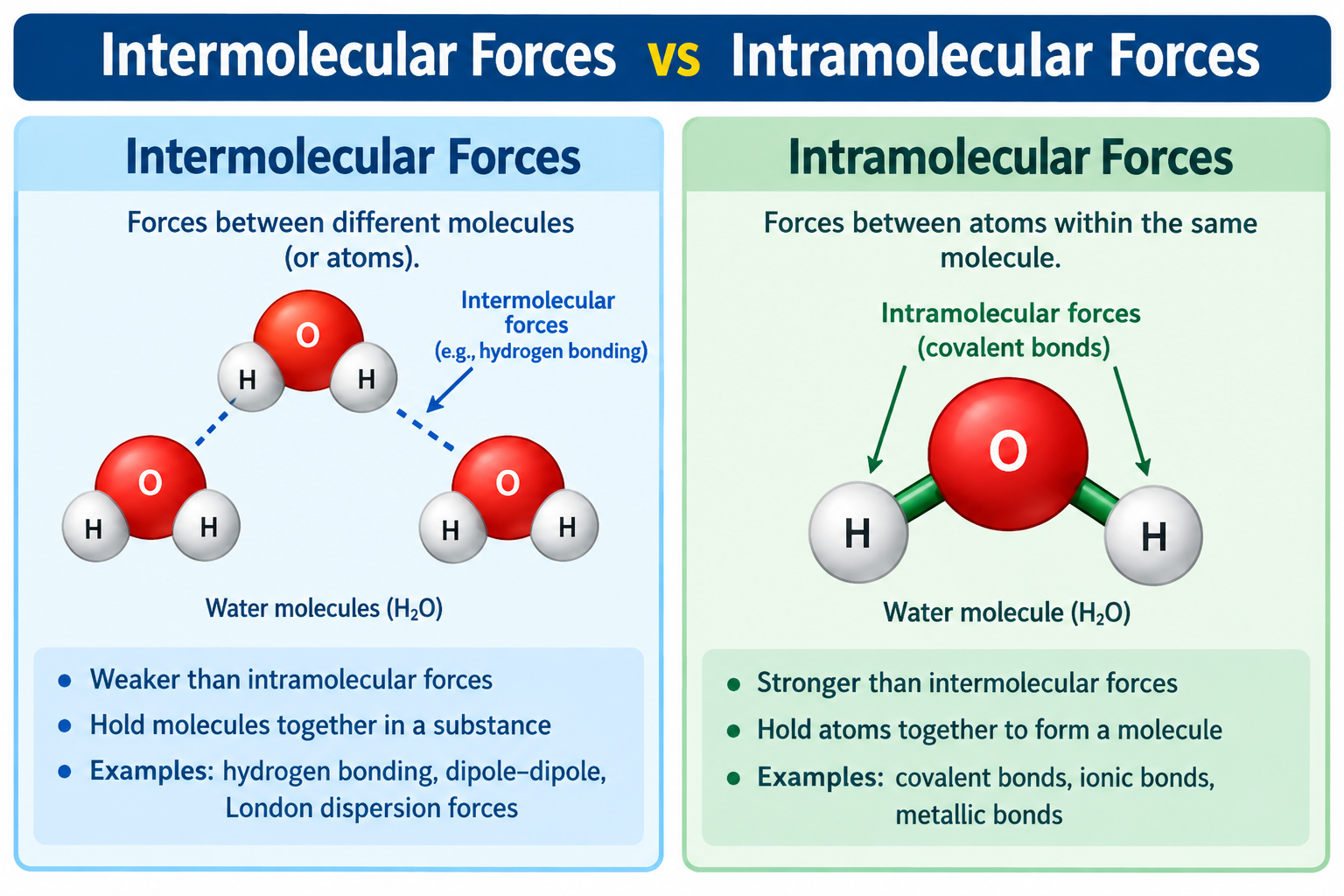
Introduction: Two Kinds of Forces, Two Different Jobs
Chemistry students mix up these two terms constantly. The names look alike. The ideas are different.
Picture a country with several cities.
- The roads inside each city are the intramolecular forces. They hold the atoms of a single molecule together. These are chemical bonds.
- The bridges and highways between cities are the intermolecular forces. They connect separate molecules to each other.
The prefix tells you where to look. Intra- means within. Inter- means between.
Why does the difference matter? Because the two types control two different things.
- Intramolecular forces decide a substance’s chemical behavior. They determine what a molecule is, how it reacts, and how stable it is.
- Intermolecular forces decide a substance’s physical behavior. They determine boiling point, melting point, viscosity, surface tension, and vapor pressure.
When water boils, the water molecules separate from each other. The O-H bonds inside each molecule stay intact. Boiling water does not produce hydrogen and oxygen gas. It produces water vapor.
If you hold on to that single fact, half of this topic is already clear.
The Comparison Table
| Feature | Intramolecular Forces | Intermolecular Forces |
|---|---|---|
| Definition | Forces that hold atoms or ions together within a compound or metal | Attractions between separate molecules or particles |
| Strength | Strong. Roughly 150 to over 1,000 kJ/mol for covalent bonds. Ionic lattice energies can reach several thousand kJ/mol. | Weak. Roughly 0.05 to 40 kJ/mol |
| Energy required to break | High. Breaking bonds requires a chemical reaction or very high temperatures. | Low. Often a small amount of heat is enough to overcome them. |
| Types | Ionic bonds, covalent bonds (polar and nonpolar), metallic bonds | London dispersion forces, dipole-dipole forces, hydrogen bonding, ion-dipole forces |
| Effect on properties | Determines chemical properties: reactivity, bond length, molecular shape, stability | Determines physical properties: boiling point, melting point, vapor pressure, viscosity, solubility |
| What happens in a phase change | Usually unaffected for molecular substances | Overcome during melting, boiling, and sublimation |
| Example in water | The O-H covalent bonds (about 463 kJ/mol each) | Hydrogen bonds between water molecules (about 20 kJ/mol) |
One note on the last two rows. For ionic, metallic, and network covalent solids (like NaCl, copper, and diamond), melting does involve breaking the bonds that hold the whole structure together. These substances are not made of discrete molecules. The clean “phase changes only affect intermolecular forces” rule applies to molecular substances.
Foundation: Why Atoms Form Bonds at All
Every force in this article comes from the same source: electrical attraction between positive and negative charges. Protons attract electrons. Electrons repel other electrons. The balance of those pulls decides how atoms bond and how molecules interact.
Before going further, make sure you can do these three things:
-
Write an electron configuration and identify valence electrons
-
Explain periodic trends in electronegativity and atomic radius
-
Describe how effective nuclear charge and shielding affect an atom’s attraction for electrons
If any of those feel shaky, work through AP Chemistry Unit 1 Practice Questions first. Electronegativity, in particular, is the key to everything that follows. It tells you whether a bond is ionic, polar covalent, or nonpolar covalent, and whether a molecule has a permanent dipole.
Deep Dive: Intramolecular Forces (Chemical Bonds)
Intramolecular forces are the bonds themselves. There are three main types.
Ionic Bonds
An ionic bond is the electrostatic attraction between a positive ion (cation) and a negative ion (anion). It usually forms between a metal and a nonmetal. One atom transfers electrons to the other.
Example: sodium chloride (NaCl).
- Sodium loses one electron and becomes Na+.
- Chlorine gains one electron and becomes Cl-.
- The opposite charges lock into a repeating three-dimensional crystal lattice.
Key properties:
- High melting and boiling points (NaCl melts at 801 degrees Celsius)
- Brittle solids
- Conduct electricity when molten or dissolved, not as solids
Strength rule: Ionic attraction increases with higher ion charges and smaller ion sizes. This is Coulomb’s law. Magnesium oxide (Mg2+ and O2-) has a far higher melting point than sodium chloride (Na+ and Cl-) because the charges are twice as large.
Covalent Bonds
A covalent bond forms when two atoms share electrons. It usually forms between nonmetals.
Nonpolar covalent bonds share electrons equally. This happens between identical atoms or atoms with nearly equal electronegativity.
- Examples: H2, Cl2, CH4 (C-H bonds are very close to nonpolar)
Polar covalent bonds share electrons unequally. The more electronegative atom pulls the shared electrons closer and gains a partial negative charge (written as delta minus). The other atom gains a partial positive charge (delta plus).
- Examples: H-Cl, O-H, C=O
Key properties of covalent compounds:
- Wide range of melting and boiling points, depending on the intermolecular forces
- Generally poor electrical conductors
- Bond strength increases with bond order. A triple bond is stronger and shorter than a double bond, which is stronger and shorter than a single bond.
Network covalent solids are a special case. Diamond, graphite, and silicon dioxide (SiO2) form one giant covalent network. There are no separate molecules. Melting them means breaking covalent bonds, so their melting points are extremely high. Diamond does not melt at normal pressure and instead converts to other forms at very high temperatures.
Metallic Bonds
A metallic bond is the attraction between positive metal ions and a surrounding “sea” of delocalized valence electrons.
Example: copper. Each copper atom contributes electrons to a shared pool. The pool moves freely through the structure of fixed copper ions.
What the electron sea explains:
- Electrical conductivity: Free electrons carry charge.
- Malleability and ductility: Layers of ions can slide past each other without breaking the bonding, because the electron sea adjusts.
- Luster: Free electrons interact with light.
Metallic bond strength varies. Sodium melts at 98 degrees Celsius. Tungsten melts above 3,400 degrees Celsius. More valence electrons and smaller ions generally mean stronger metallic bonding.
Quick Bond-Type Guide
| Bond Type | Electrons | Typical Elements | Example |
|---|---|---|---|
| Ionic | Transferred | Metal and nonmetal | NaCl, MgO |
| Polar covalent | Shared unequally | Two different nonmetals | HCl, H2O |
| Nonpolar covalent | Shared equally | Identical or similar nonmetals | O2, CH4 |
| Metallic | Delocalized | Metals | Cu, Fe, Na |
Deep Dive: Intermolecular Forces (Attractions Between Molecules)
Intermolecular forces (IMFs) are weaker than bonds, but they decide whether a substance is a gas, liquid, or solid at room temperature. Three types matter most for molecular substances. They are ranked below from weakest to strongest in general. The ranking depends on the specific molecules, so always compare case by case.
London Dispersion Forces (LDFs)
Every molecule and atom has LDFs. They are the only IMF in nonpolar substances such as noble gases, N2, and hydrocarbons.
How they work: temporary dipoles.
- Electrons constantly move around a molecule or atom.
- At any instant, the electrons may bunch up on one side. That side becomes slightly negative. The opposite side becomes slightly positive.
- This is an instantaneous dipole, and it lasts only a moment.
- The instantaneous dipole distorts the electron cloud of a neighboring molecule. This creates an induced dipole in the neighbor.
- The two temporary dipoles attract each other.
The pattern shifts constantly, but on average there is a net attraction.
What makes LDFs stronger:
- More electrons. A larger electron cloud is more polarizable, which means it distorts more easily.
- Larger surface area. Long, chain-like molecules have more contact points than compact, spherical ones.
Evidence from boiling points:
| Substance | Number of Electrons | Boiling Point (degrees C) |
|---|---|---|
| Ne | 10 | -246 |
| Ar | 18 | -186 |
| Kr | 36 | -153 |
| Xe | 54 | -108 |
More electrons give stronger LDFs and a higher boiling point.
Shape example: Pentane (a straight chain) and neopentane (a compact, branched shape) have the same formula, C5H12. Pentane boils at about 36 degrees Celsius. Neopentane boils at about 9.5 degrees Celsius. The straight chain has more surface contact, so stronger LDFs.
Dipole-Dipole Interactions
Polar molecules have a permanent dipole. This is different from the temporary dipoles in LDFs.
How they work: permanent dipoles.
- A polar bond pulls electron density toward the more electronegative atom.
- If the molecular shape does not cancel the bond dipoles, the molecule has a net dipole. One end is always partially positive. The other end is always partially negative.
- The positive end of one molecule attracts the negative end of a neighbor.
Example: hydrogen chloride (HCl). Chlorine is more electronegative than hydrogen. Each HCl molecule has a permanent positive end (H) and a negative end (Cl).
Shape matters. CO2 has two polar C=O bonds, but the molecule is linear. The dipoles point in opposite directions and cancel. CO2 is nonpolar overall. Water is bent. Its O-H dipoles do not cancel. Water is polar.
Polarity also controls how substances mix. Polar solvents dissolve polar and ionic solutes. Nonpolar solvents dissolve nonpolar solutes. Once you move into solutions, concentration becomes the next question. What Is Molarity in Chemistry explains how to measure it.
Comparing molecules of similar size: When two molecules have similar molar mass and similar numbers of electrons, the polar one usually has the higher boiling point. This is because dipole-dipole forces add to the LDFs.
Hydrogen Bonding
Hydrogen bonding is a special, strong type of dipole-dipole attraction. It is an intermolecular force. It is not a true chemical bond, despite the name.
Requirements for a hydrogen bond:
- A hydrogen atom covalently bonded to N, O, or F
- A lone pair on a nearby N, O, or F atom in another molecule (or in another part of a large molecule)
Why it is so strong. Nitrogen, oxygen, and fluorine are small and highly electronegative. They pull electron density away from hydrogen very strongly. Hydrogen is left with a large partial positive charge and has no inner electron shell to shield its nucleus. The exposed hydrogen nucleus is attracted to the lone pair on a neighboring N, O, or F atom.
Strength: About 10 to 40 kJ/mol, which is much stronger than typical dipole-dipole forces and LDFs between small molecules, but still far weaker than a covalent bond.
Evidence from boiling points:
| Compound | Boiling Point (degrees C) | Main IMFs |
|---|---|---|
| CH4 | -162 | LDF only |
| NH3 | -33 | LDF and hydrogen bonding |
| H2O | 100 | LDF and extensive hydrogen bonding |
| H2S | -60 | LDF and dipole-dipole |
| HF | 20 | LDF and hydrogen bonding |
| HCl | -85 | LDF and dipole-dipole |
Water, sitting just above hydrogen sulfide in the periodic table, boils about 160 degrees higher. Hydrogen bonding explains that gap.
Same molar mass, different IMFs:
- Ethanol (CH3CH2OH) has a boiling point of about 78 degrees Celsius. It has an O-H group, so it forms hydrogen bonds.
- Dimethyl ether (CH3OCH3) has the same formula (C2H6O) and a boiling point of about -24 degrees Celsius. It has no H bonded to oxygen, so it cannot hydrogen bond with itself.
This pair is a favorite exam example.
Extra effects of hydrogen bonding in water:
- Ice is less dense than liquid water, because hydrogen bonding locks the molecules into an open hexagonal lattice.
- Water has high surface tension and a high specific heat.
A Fourth Type: Ion-Dipole Forces
When an ionic compound dissolves in water, ion-dipole forces form between ions and polar water molecules. The negative end of water (oxygen) surrounds cations. The positive end (hydrogen) surrounds anions. These forces are stronger than hydrogen bonds and explain why many salts dissolve readily.
IMF Summary Table
| IMF Type | Occurs In | Origin | Relative Strength |
|---|---|---|---|
| London dispersion | All substances | Temporary, induced dipoles | Weakest per interaction for small molecules, but dominant in large nonpolar molecules |
| Dipole-dipole | Polar molecules | Permanent dipoles | Moderate |
| Hydrogen bonding | Molecules with H bonded to N, O, or F | Strong permanent dipole with exposed H | Strongest of the molecule-to-molecule IMFs |
| Ion-dipole | Ions in polar solvents | Ion charge and permanent dipole | Stronger than hydrogen bonding |
How Forces Connect to Phase Changes and Energy
This is where the two force types separate most clearly.
Boiling a molecular liquid:
- Energy goes into pulling molecules apart from each other.
- Intermolecular forces are overcome.
- Bonds inside each molecule are unchanged.
Decomposing a molecule:
- Energy goes into breaking covalent bonds.
- A chemical change happens, and new substances form.
Compare the energy scale for water:
| Process | Energy (approximate) |
|---|---|
| Vaporizing 1 mol of water (breaking intermolecular forces) | 40.7 kJ |
| Breaking one mole of O-H bonds in water | 463 kJ |
Intermolecular forces are overcome with far less energy. That is why water boils at 100 degrees Celsius but does not decompose until thousands of degrees higher.
The energy accounting for these processes uses enthalpy of vaporization, enthalpy of fusion, and bond enthalpies. For the equations and sign conventions, see the AP Chemistry Thermodynamics Cheat Sheet.
Common Mistakes Students Make
- Saying water boiling “breaks the bonds.” Boiling breaks the intermolecular hydrogen bonds. The covalent O-H bonds stay.
- Calling hydrogen bonds “bonds” in the same sense as covalent bonds. They are attractions between molecules.
- Saying nonpolar molecules have no IMFs. All molecules have London dispersion forces.
- Assuming any molecule with H has hydrogen bonding. The hydrogen must be attached directly to N, O, or F. Methane does not hydrogen bond.
- Ignoring molecular shape. Polar bonds do not always make a polar molecule. Check whether the dipoles cancel.
- Forgetting that size matters for LDFs. A large nonpolar molecule can have a higher boiling point than a small polar molecule.
Study Resources
Visual practice helps this topic stick. Try these:
- The Khan Academy chemical bonds tutorials walk through bond types and polarity with short lessons and quiz questions.
- The PhET molecular polarity simulations let you change electronegativity and watch the dipole form in real time. This is one of the fastest ways to understand why shape matters.
Practice Challenge
Try this one before reading the answer.
Question: Consider a sample of liquid water, H2O.
(a) Identify the force that holds the hydrogen and oxygen atoms together within a single water molecule. Classify it as intramolecular or intermolecular.
(b) Identify the strongest force between separate water molecules. Classify it.
(c) When water boils, which of these forces is overcome?
(d) Methane (CH4) boils at -162 degrees Celsius. Water boils at 100 degrees Celsius. Explain the difference using intermolecular forces.
Answer:
(a) A polar covalent bond holds the atoms together within each molecule. This is an intramolecular force.
(b) Hydrogen bonding is the strongest force between water molecules. Each hydrogen is bonded to oxygen and is attracted to a lone pair on a neighboring molecule’s oxygen. This is an intermolecular force.
(c) Boiling overcomes the intermolecular hydrogen bonds (and the weaker LDFs). The covalent O-H bonds remain intact.
(d) Methane is nonpolar and has only London dispersion forces, which are weak for a small molecule with 10 electrons. Water has LDFs, dipole-dipole forces, and extensive hydrogen bonding. More energy is needed to separate water molecules, so water has a much higher boiling point.
Got all four? Try one more. Predict which has the higher boiling point, ethanol or dimethyl ether, and write a two-sentence explanation. Then check it against the example in the hydrogen bonding section.
Disclaimer:
This study guide is an independent educational resource intended solely for academic support and self-study purposes.