
Introduction: Why Concentration Matters
Most chemistry in the lab happens in solution. You rarely weigh out a pure reactant and drop it into a flask. You measure a volume of a solution with a known concentration, and you use that number to find moles.
That makes concentration the bridge between what you measure and what you calculate. Get it wrong, and every later step in your stoichiometry is wrong too.
AP Chemistry uses two concentration units, and students mix them up all the time.
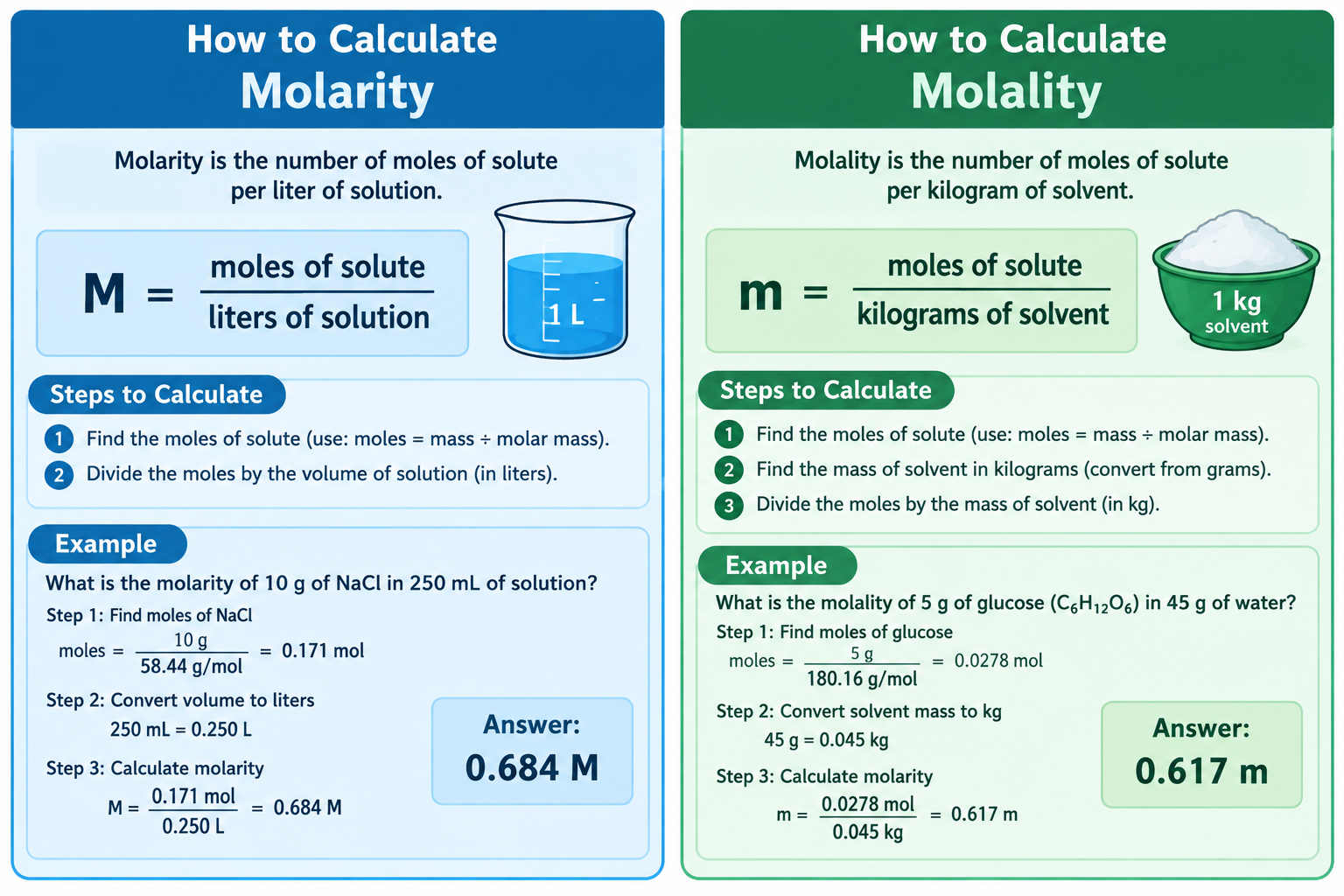
- Molarity (M) tells you how many moles of solute sit in one liter of solution.
- Molality (m) tells you how many moles of solute sit with one kilogram of solvent.
The symbols look alike. The denominators are different. That one difference drives everything in this guide.
If you want a slower walkthrough of the basics first, start with What Is Molarity in Chemistry. Then come back and work through the four problems below.
Core Definitions and Formulas
Molarity
Molarity (M) = moles of solute / liters of solution
M = n / V
Units: mol/L, read as “molar”
Molality
Molality (m) = moles of solute / kilograms of solvent
m = n / mass of solvent (kg)
Units: mol/kg, read as “molal”
The Critical Difference
Look at the denominators.
- Molarity divides by the volume of the whole solution. That includes the solute and the solvent together.
- Molality divides by the mass of the solvent only. The solute is not in the denominator.
Two more points to lock in:
- Volume changes with temperature. Mass does not. So molarity changes slightly as a solution warms or cools. Molality stays constant.
- Chemists use molality when temperature changes matter, such as freezing point depression and boiling point elevation.
Moles Refresher
Every problem starts the same way. Convert grams to moles first.
n = mass (g) / molar mass (g/mol)
Molar mass comes from the periodic table. Add up the atomic masses of every atom in the formula. If you want to sharpen that skill, work through the AP Chemistry Unit 1 Practice Questions. Moles and molar mass drive every solution stoichiometry problem you will see on the exam.
A Four-Step Method for Any Concentration Problem
Use this method on every problem in this guide.
-
Identify what you are given and what you need. Write them down with units.
-
Convert to moles. Use molar mass.
-
Convert to the correct denominator. Liters of solution for M. Kilograms of solvent for m.
-
Divide, then check units and significant figures.
Solved Problem 1: Basic Molarity From Mass and Volume
Problem: A student dissolves 45.0 g of glucose (C6H12O6) in enough water to make 500.0 mL of solution. What is the molarity of the solution?
Step 1: Find the molar mass of glucose.
- C: 6 x 12.01 = 72.06
- H: 12 x 1.008 = 12.096
- O: 6 x 16.00 = 96.00
- Molar mass = 180.16 g/mol
Step 2: Convert grams to moles.
n = 45.0 g / 180.16 g/mol = 0.2498 mol
Step 3: Convert milliliters to liters.
500.0 mL x (1 L / 1000 mL) = 0.5000 L
Step 4: Divide.
M = 0.2498 mol / 0.5000 L = 0.500 M
Teacher note: The problem says “enough water to make 500.0 mL of solution.” That phrase tells you the 500.0 mL is the total solution volume. This is molarity. Watch for that wording on the exam.
Solved Problem 2: Basic Molality From Mass of Solute and Solvent
Problem: A chemist dissolves 15.0 g of sucrose (C12H22O11) in 250.0 g of water. What is the molality of the solution?
Step 1: Find the molar mass of sucrose.
- C: 12 x 12.01 = 144.12
- H: 22 x 1.008 = 22.176
- O: 11 x 16.00 = 176.00
- Molar mass = 342.30 g/mol
Step 2: Convert grams of solute to moles.
n = 15.0 g / 342.30 g/mol = 0.04382 mol
Step 3: Convert grams of solvent to kilograms.
250.0 g x (1 kg / 1000 g) = 0.2500 kg
Step 4: Divide.
m = 0.04382 mol / 0.2500 kg = 0.175 m
Teacher note: Here the problem gives the mass of the water, not the volume of the solution. That is your cue for molality. Do not add the sugar’s mass to the denominator. Only the solvent counts.
Why does sugar dissolve in water at all? It comes down to attractions between solute and solvent particles. Review Intermolecular Forces vs Intramolecular Forces to see why polar solvents like water dissolve polar solutes like sucrose.
Solved Problem 3: Converting Molarity to Molality Using Density
This is the problem type that trips up the most students. It combines both units and requires one extra piece of data: density.
Problem: A hydrochloric acid solution is 6.00 M HCl and has a density of 1.10 g/mL. Calculate its molality.
Strategy: Pick a convenient sample size. Assume exactly 1.000 L of solution. Then find the mass of solute and the mass of solvent.
Step 1: Find the moles of HCl in 1.000 L.
n = 6.00 mol/L x 1.000 L = 6.00 mol HCl
Step 2: Find the total mass of the solution using density.
1.000 L = 1000 mL
Mass of solution = 1000 mL x 1.10 g/mL = 1100 g
Step 3: Find the mass of HCl.
Molar mass of HCl = 1.008 + 35.45 = 36.46 g/mol
Mass of HCl = 6.00 mol x 36.46 g/mol = 218.8 g
Step 4: Find the mass of the solvent (water).
Mass of solvent = mass of solution – mass of solute
Mass of solvent = 1100 g – 218.8 g = 881.2 g = 0.8812 kg
Step 5: Calculate molality.
m = 6.00 mol / 0.8812 kg = 6.81 m
Teacher notes:
- The molality (6.81 m) is higher than the molarity (6.00 M). That makes sense. The solvent mass (0.8812 kg) is smaller than 1 kg because the solute takes up part of the solution mass.
- For very dilute aqueous solutions, molarity and molality are nearly equal. One liter of water has a mass of about one kilogram, so the denominators are almost identical.
- The assumption of 1.000 L is a standard trick. You can choose any sample size, because concentration does not depend on how much you have. One liter keeps the arithmetic simple.
Solved Problem 4: Dilution Using M1V1 = M2V2
Dilution adds solvent. It does not change the number of moles of solute. That fact gives you the equation.
M1V1 = M2V2
M1 = initial (stock) molarity, V1 = initial volume
M2 = final molarity, V2 = final volume
V1 and V2 can be in any matching unit, such as mL.
Problem: A lab technician needs 500.0 mL of 0.600 M HCl. The stock solution is 12.0 M HCl. What volume of stock solution is required?
Step 1: List what you know.
- M1 = 12.0 M
- M2 = 0.600 M
- V2 = 500.0 mL
- V1 = ?
Step 2: Rearrange the equation.
V1 = (M2 x V2) / M1
Step 3: Substitute and solve.
V1 = (0.600 M x 500.0 mL) / 12.0 M = 25.0 mL
Step 4: Check with moles.
Moles in the final solution = 0.600 mol/L x 0.5000 L = 0.300 mol
Moles in the stock sample = 12.0 mol/L x 0.0250 L = 0.300 mol
The moles match. The dilution is correct.
Procedure note: Measure 25.0 mL of stock acid. Add it to a volumetric flask that already contains some water. Then add water up to the 500.0 mL mark. Always add acid to water, never water to acid. Concentrated acid releases a large amount of heat when it mixes with water.
That heat release is a real thermodynamic effect. It is the enthalpy of solution. To see how it connects to enthalpy, calorimetry, and sign conventions, read the AP Chemistry Thermodynamics Cheat Sheet.
Using Concentration in Reaction Problems
Once you know a concentration, you can use it for solution stoichiometry. The path is always:
- Volume (L) x molarity (mol/L) = moles of reactant
- Use the mole ratio from the balanced equation
- Convert moles of product or other reactant to the quantity requested
Titrations and redox reactions in solution follow this path. A wrong coefficient gives a wrong answer by a whole-number factor. If you need to balance an equation before you can use the mole ratio, work through How to Balance Redox Reactions Step-by-Step.
Summary Comparison Table
| Feature | Molarity | Molality |
|---|---|---|
| Symbol | M | m |
| Formula | moles of solute / liters of solution | moles of solute / kilograms of solvent |
| Denominator | Volume of the whole solution | Mass of the solvent only |
| Units | mol/L | mol/kg |
| Temperature dependence | Changes with temperature, because volume expands and contracts | Does not change with temperature, because mass is constant |
| Typical use | Titrations, dilutions, solution stoichiometry | Colligative properties, such as freezing point depression and boiling point elevation |
| Needs density to convert? | Yes, to convert to molality | Yes, to convert to molarity |
Common Mistakes to Avoid
- Using grams instead of kilograms for molality. Divide grams by 1000 before you calculate.
- Using milliliters instead of liters for molarity. Convert first.
- Using the solution mass as the solvent mass. In molality, subtract the solute mass.
- Mixing up the two symbols. Capital M is molarity. Lowercase m is molality. Write them clearly on your free-response answers.
- Skipping the units. Write the unit on every line. Units show you when you are about to divide by the wrong thing.
- Forgetting significant figures. Match your answer to the least precise measurement in the problem.
Practice and Study Resources
- Work extra problems with the Khan Academy concentration and solubility tutorials. They include short videos and instant feedback.
- Use the PhET online concentration simulations to see how adding solute or solvent changes concentration. Watching the particles helps the dilution idea make sense.
Your Practice Prompt
Calculate the molarity of a solution made by dissolving 10.0 g of NaOH (molar mass 40.00 g/mol) in enough water to make 250.0 mL of solution.
Disclaimer:
This study guide is an independent educational resource intended solely for academic support and self-study purposes.