
Introduction
Thermodynamics answers two questions: how much energy moves in a process, and whether the process will happen at all.
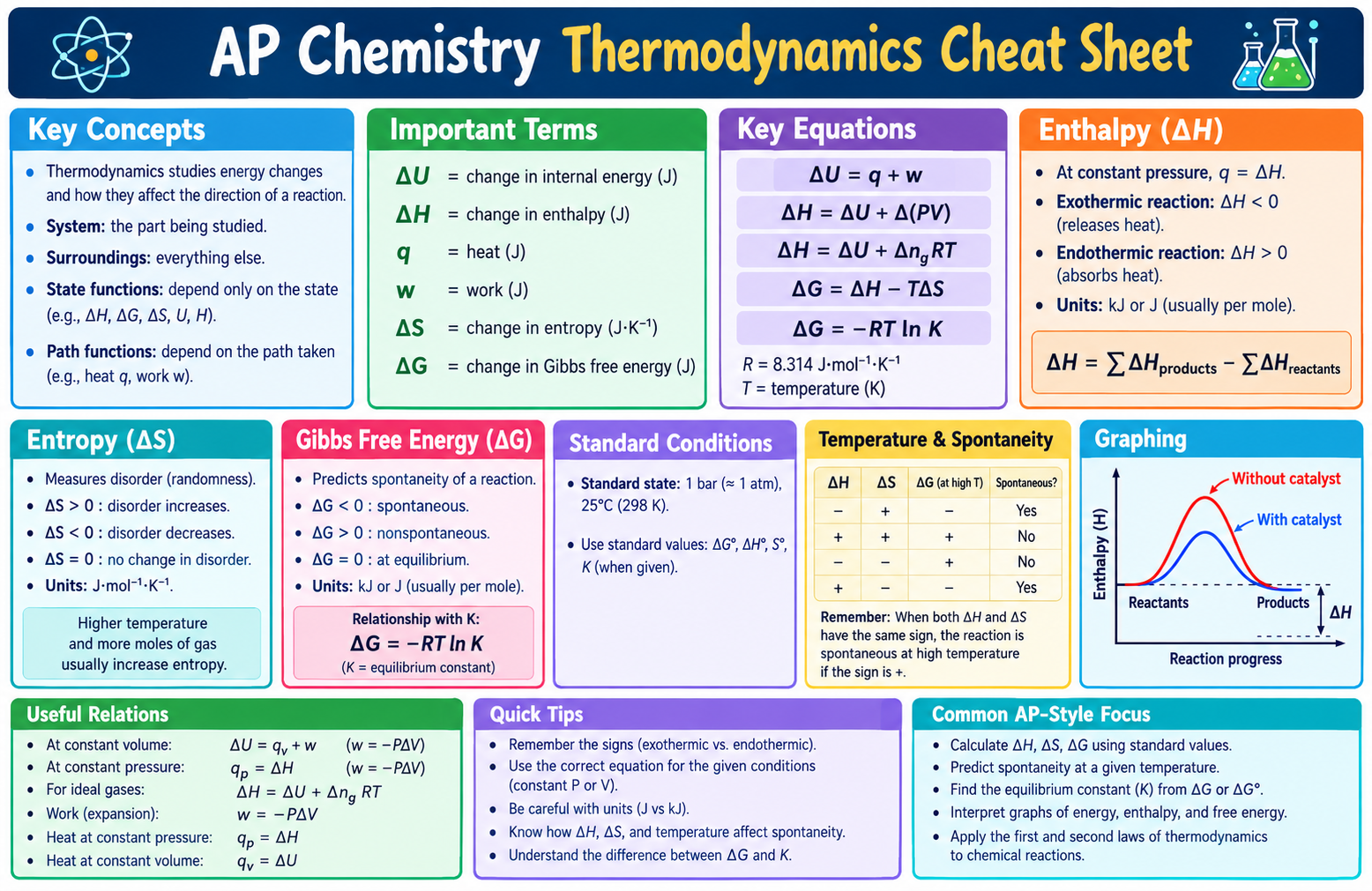
AP Chemistry builds the topic around three quantities:
-
Enthalpy (ΔH): the heat absorbed or released at constant pressure.
-
Entropy (ΔS): the dispersal of energy and matter among available microstates.
-
Gibbs free energy (ΔG): the single value that combines the first two and predicts spontaneity.
Exam weightage. The College Board Course and Exam Description (CED) places thermodynamics in two units. Unit 6 (Thermodynamics) and Unit 9 (Applications of Thermodynamics) are each listed at roughly 7 to 9 percent of the exam score. Together, that is about one-sixth of your exam. Thermodynamics also feeds into equilibrium (Unit 7) and electrochemistry (Unit 9), so the real impact is larger. Confirm current weightings on AP Central, because the College Board can adjust details between exam years.
Use this sheet in two ways. Read it straight through once. Then keep the tables open while you work practice problems.
The Three Laws of Thermodynamics
First Law: Conservation of Energy
Energy cannot be created or destroyed. It can only transfer between a system and its surroundings, or change form.
- ΔU = q + w
- q is heat transferred. Positive means heat flows into the system.
- w is work. Positive means work is done on the system.
- For an isolated system, ΔU = 0.
Second Law: Entropy of the Universe Increases
In any spontaneous process, the total entropy of the universe increases.
- ΔS_universe = ΔS_system + ΔS_surroundings > 0 for a spontaneous process
- ΔS_surroundings = −ΔH_system / T
- Local entropy can decrease. The system freezes water, for example, but the surroundings must gain more entropy than the system loses.
Third Law: Absolute Zero Sets the Entropy Baseline
A perfect crystal at 0 K has zero entropy. This gives every substance a reference point, which is why tables list absolute standard molar entropies (S°) rather than entropies of formation. Elements in their standard states still have S° greater than zero at 298 K.
Core Equation Master Tables
Table 1: Enthalpy and Calorimetry
| Quantity | Equation | Units and Notes |
|---|---|---|
| Heat transfer (no phase change) | q = mcΔT | q in J; m in g; c in J/(g·K); ΔT = T_final − T_initial. Specific heat of water is 4.18 J/(g·K). |
| Heat transfer (molar form) | q = nCΔT | C is molar heat capacity in J/(mol·K). |
| Calorimeter energy balance | q_reaction = −q_solution | The reaction and the solution exchange equal and opposite heat. |
| Enthalpy per mole | ΔH = q_reaction / n | Report in kJ/mol. Divide J by 1000. |
| Enthalpy of reaction from formation data | ΔH°_rxn = ΣΔH°f(products) − ΣΔH°f(reactants) | Multiply each term by its stoichiometric coefficient. ΔH°f of an element in its standard state is 0. |
| Enthalpy of reaction from bond energies | ΔH°_rxn = Σ(bonds broken) − Σ(bonds formed) | Breaking bonds absorbs energy. Forming bonds releases it. |
| Hess’s law | ΔH°_total = ΣΔH°_steps | Add the enthalpy changes of the steps that combine to the target reaction. |
ΔH manipulation rules for Hess’s law:
| Action on the Equation | Effect on ΔH |
|---|---|
| Reverse the reaction | Change the sign of ΔH |
| Multiply coefficients by n | Multiply ΔH by n |
| Add reactions | Add ΔH values |
Sign convention for ΔH:
| ΔH | Meaning |
|---|---|
| Negative | Exothermic. The system releases heat. |
| Positive | Endothermic. The system absorbs heat. |
Table 2: Entropy and Gibbs Free Energy
| Quantity | Equation | Units and Notes |
|---|---|---|
| Entropy change of a reaction | ΔS°_rxn = ΣS°(products) − ΣS°(reactants) | S° in J/(mol·K). Multiply by coefficients. |
| Gibbs free energy (definition) | ΔG° = ΔH° − TΔS° | T in Kelvin. Convert ΔS from J to kJ, or ΔH from kJ to J. |
| Gibbs from formation data | ΔG°_rxn = ΣΔG°f(products) − ΣΔG°f(reactants) | ΔG°f of an element in its standard state is 0. |
| Gibbs and equilibrium constant | ΔG° = −RT ln K | R = 8.314 J/(mol·K). Use J consistently. |
| Gibbs under nonstandard conditions | ΔG = ΔG° + RT ln Q | At equilibrium, ΔG = 0 and Q = K. |
| Gibbs and cell potential | ΔG° = −nFE° | F = 96,485 C/mol e⁻. E° in volts, ΔG° in J. |
| Spontaneity condition | ΔG < 0 | Spontaneous (thermodynamically favorable) as written. |
Spontaneity by sign (the four cases):
| ΔH | ΔS | Spontaneity | Condition |
|---|---|---|---|
| Negative | Positive | Always spontaneous | All temperatures |
| Positive | Negative | Never spontaneous | All temperatures |
| Negative | Negative | Spontaneous at low T | When T < ΔH/ΔS |
| Positive | Positive | Spontaneous at high T | When T > ΔH/ΔS |
Link between ΔG° and K:
| ΔG° | K | Products or reactants favored at equilibrium |
|---|---|---|
| Negative | K > 1 | Products |
| Zero | K = 1 | Neither strongly |
| Positive | K < 1 | Reactants |
Worked Examples
Example 1: Calorimetry With a Solution
You mix 100.0 mL of 1.00 M HCl with 100.0 mL of 1.00 M NaOH in a coffee-cup calorimeter. The temperature rises by 6.8 °C. Assume the solution has the density and specific heat of water. Calculate ΔH per mole of water formed.
Solution problems like this depend on concentration. If moles from volume and concentration feels shaky, review What Is Molarity in Chemistry first.
- Moles of reaction. n = M × V = 1.00 mol/L × 0.1000 L = 0.100 mol (the acid and base are present in equal amounts).
- Mass of solution. 200.0 mL × 1.00 g/mL = 200.0 g.
- Heat absorbed by the solution. q = mcΔT = (200.0 g)(4.18 J/(g·K))(6.8 K) = 5,685 J = 5.69 kJ.
- Heat of the reaction. q_rxn = −5.69 kJ. The solution warmed, so the reaction released heat.
- Per mole. ΔH = −5.69 kJ ÷ 0.100 mol = −56.9 kJ/mol.
Example 2: Enthalpy From Formation Data
Calculate ΔH°_rxn for: CH₄(g) + 2O₂(g) → CO₂(g) + 2H₂O(l)
Given ΔH°f: CH₄ = −74.8 kJ/mol; CO₂ = −393.5 kJ/mol; H₂O(l) = −285.8 kJ/mol.
- Products: (−393.5) + 2(−285.8) = −965.1 kJ
- Reactants: (−74.8) + 2(0) = −74.8 kJ
- ΔH°_rxn = −965.1 − (−74.8) = −890.3 kJ
Example 3: Gibbs Energy, Crossover Temperature, and K
For N₂(g) + 3H₂(g) → 2NH₃(g): ΔH° = −92.2 kJ and ΔS° = −198.7 J/K.
Part A: ΔG° at 298 K.
- Convert ΔS° to kJ/K: −0.1987 kJ/K.
- ΔG° = ΔH° − TΔS° = −92.2 − (298)(−0.1987) = −92.2 + 59.2 = −33.0 kJ
Part B: The temperature where spontaneity changes.
ΔH and ΔS are both negative, so the reaction is spontaneous at low T.
T = ΔH/ΔS = (−92.2)/(−0.1987) = 464 K. Above this temperature, ΔG° becomes positive.
Part C: K at 298 K.
- ΔG° = −33,000 J = −RT ln K
- ln K = 33,000 ÷ (8.314 × 298) = 13.3
- K = e^13.3 ≈ 6 × 10⁵
A negative ΔG° and K much greater than 1 agree, as they must.
Entropy Trends: Quick Prediction Guide
Use these to predict the sign of ΔS without a calculation.
| Change | Entropy Effect |
|---|---|
| Solid to liquid to gas | Increases |
| Dissolving most solids in water | Usually increases |
| More moles of gas in products than reactants | Increases |
| Fewer moles of gas in products than reactants | Decreases |
| Increase in temperature | Increases |
| Larger, more complex molecules | Higher S° |
Common Exam Pitfalls
Pitfall 1: Mixing Joules and Kilojoules
This is the most frequent error on thermodynamics free-response questions.
- q = mcΔT gives joules, because c is in J/(g·K).
- ΔH and ΔG are usually given in kJ/mol.
- ΔS is given in J/(mol·K).
- R is 8.314 J/(mol·K).
Convert before you combine. In ΔG = ΔH − TΔS, a ΔS of 198.7 J/K must become 0.1987 kJ/K when ΔH is in kJ. Skip the conversion and your answer is off by a factor of 1,000. Write the units on every line.
Pitfall 2: Sign Conventions
Three sign errors cost points every year.
- System versus surroundings. When a solution warms in a calorimeter, q_solution is positive. The reaction’s q is negative. Always write q_rxn = −q_solution.
- ΔH sign and meaning. A negative ΔH means exothermic. Students flip this under pressure. A temperature rise in the surroundings means an exothermic reaction.
- Reversing a reaction. The sign of ΔH, ΔS, and ΔG all change. K becomes 1/K.
Pitfall 3: Confusing Spontaneous With Fast, and ΔG With ΔG°
- Spontaneous means thermodynamically favorable. It says nothing about rate. Diamond converting to graphite is spontaneous at room conditions. It takes geological time. Rate belongs to kinetics and activation energy.
- ΔG° applies at standard conditions (1 M solutions, 1 atm gases). ΔG applies to the actual conditions and uses Q. A reaction with a positive ΔG° can still proceed if Q is small enough to make ΔG negative.
- Temperature must be in Kelvin. Never plug in Celsius for T in ΔG = ΔH − TΔS or in ΔG° = −RT ln K. For ΔT in calorimetry, Celsius and Kelvin differ only by an offset, so the size of the change is identical.
Exam Prep Layout
Build your review in this order:
- Rebuild the foundation. Moles, molar mass, and stoichiometry underlie every enthalpy-per-mole calculation. Work through AP Chemistry Unit 1 Practice Questions if any of those skills feel rusty.
- Memorize the sign tables. Spend ten minutes on the four-case spontaneity table until you can write it from memory.
- Practice calorimetry daily. Do two problems each day for a week. Include one with a solution and one with a metal sample.
- Link thermodynamics to equilibrium. Drill ΔG° to K conversions in both directions.
- Add visual practice. The Khan Academy thermodynamics lessons offer short video explanations and quizzes. The PhET online science simulations let you watch energy transfer and temperature change in real time.
- Use official materials. Practice with past free-response questions on AP Central, and compare your answers with the scoring guidelines.
Reference sheet reminder: The exam provides an equations and constants sheet, but it does not give you the reasoning. You must still know when each equation applies and which units to use.
Your Next Step
You now have the laws, the equations, the sign rules, and the traps in one place. Print this page. Quiz yourself with the tables covered.
Tell me what you need next. Which unit or cheat sheet should come next: Equilibrium, Acids and Bases, Kinetics, or Electrochemistry? Leave your pick in the comments, and I will build it around the questions students miss most.
Disclaimer:
This study guide is an independent educational resource and is not officially endorsed or affiliated with the College Board.