
Introduction
Pick up any object near you — a glass of water, a piece of copper wire, a crystal of salt, a plastic pen cap — and you’re holding evidence of chemical bonding at work. Every material you can touch, every substance you can smell or taste, every medicine you take and fuel you burn exists because atoms have bonded together in particular ways. The type of bond that forms between atoms determines almost everything about the resulting substance: whether it conducts electricity, whether it dissolves in water, how high its melting point is, whether it’s hard or soft, brittle or malleable.
This Chemical Bonding Study Guide is designed to give you a complete, exam-ready understanding of why atoms form bonds, what the main types of bonds are, how to represent them, and how bonding type determines the properties of substances. Whether you’re studying for GCSE, A-Level, AP Chemistry, IB Chemistry, or a medical or engineering entrance exam, chemical bonding is one of the most heavily tested and conceptually important topics you’ll encounter.
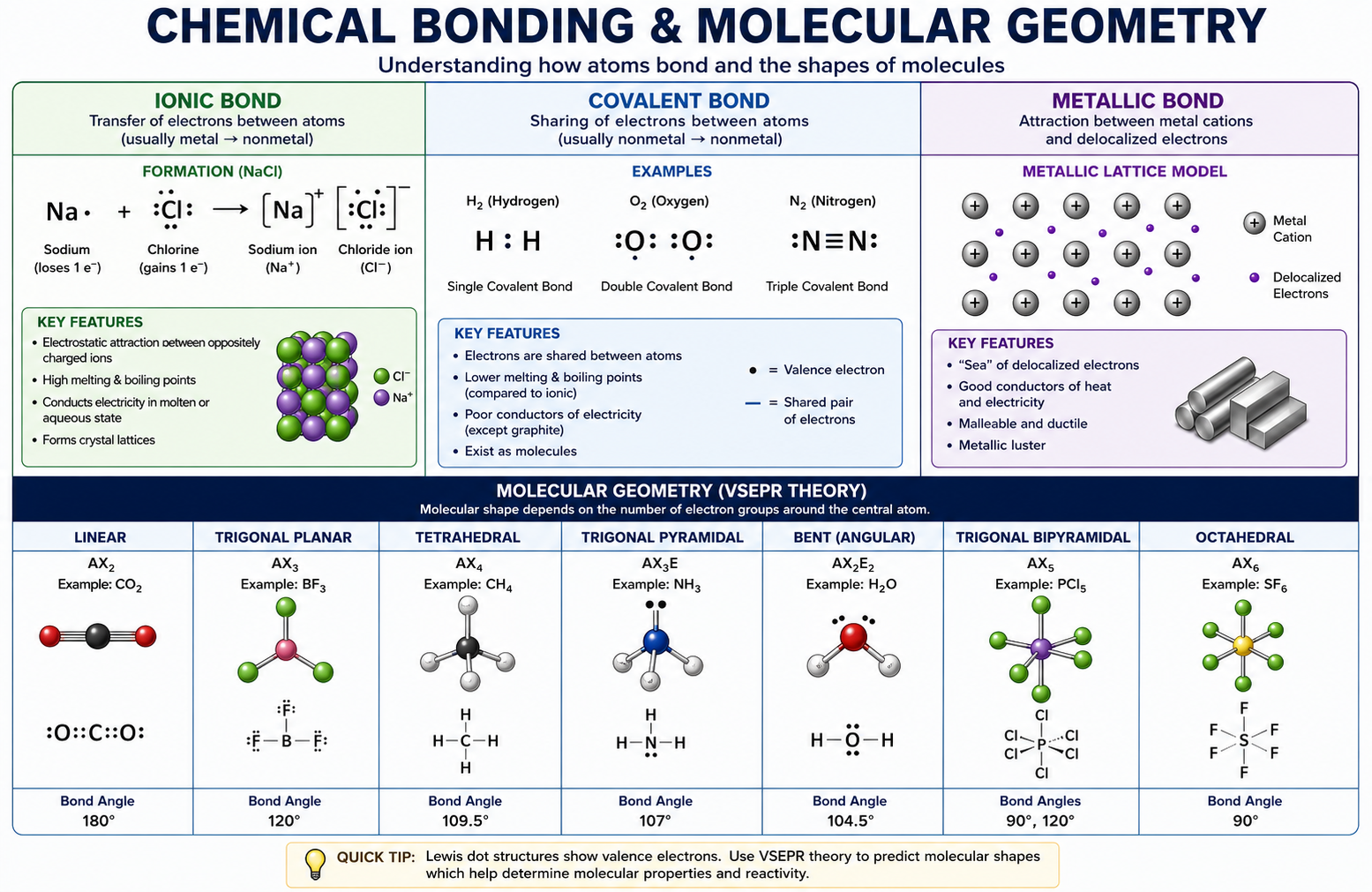
We’ll cover everything: the octet rule and why atoms seek it, ionic bonds and how they form between metals and nonmetals, covalent bonds including single, double, and triple bonds and the distinction between polar and nonpolar varieties, metallic bonds and the electron sea model, hydrogen bonds and Van der Waals forces, Lewis dot structures, resonance, VSEPR molecular geometry, bond length and bond energy, electronegativity and polarity, and intermolecular forces.
The goal isn’t just to list definitions — it’s to help you understand the logic connecting structure to properties, so that when you encounter an unfamiliar compound on an exam, you can reason about its behavior from first principles rather than guessing.
Let’s build that understanding from scratch.
Key Takeaways
Before You Dive In — Key Takeaways
- Chemical bonds form when atoms interact in ways that result in lower overall energy and greater stability.
- The octet rule states that atoms generally achieve stability by having 8 electrons in their outermost shell (2 for hydrogen and helium).
- The three primary bond types are ionic (electron transfer between metal and nonmetal), covalent (electron sharing between nonmetals), and metallic (delocalized electron sea between metal atoms).
- Ionic compounds are typically hard, brittle, high-melting solids that conduct electricity when dissolved or molten.
- Covalent compounds have highly variable properties; polar covalent bonds form when electronegativities differ; nonpolar when they are equal or very similar.
- Metallic bonding explains conductivity, malleability, ductility, and luster of metals through delocalized electrons.
- Hydrogen bonds are unusually strong intermolecular forces that arise when H is bonded to F, O, or N.
- VSEPR theory predicts molecular geometry based on electron pair repulsion around a central atom.
- Electronegativity difference between bonded atoms determines bond type: greater than 1.7 is ionic, 0.4–1.7 is polar covalent, less than 0.4 is nonpolar covalent.
What Is Chemical Bonding?
Chemical bonding refers to the attractive forces that hold atoms together in compounds and molecules. When atoms bond, they form a more stable arrangement than they would have existed in as isolated atoms. This stability arises because bonded atoms have lower overall potential energy than their separated counterparts — and in nature, systems tend toward lower energy states.
Chemical bonds are not physical objects you can see directly, but their effects are everywhere. The strength and type of bonds in a substance determine its melting and boiling points, solubility, electrical conductivity, hardness, color, and reactivity. Understanding chemical bonding is, in a very real sense, understanding why matter behaves the way it does.
There are three primary types of chemical bonds — ionic, covalent, and metallic — and two important categories of weaker intermolecular forces — hydrogen bonds and Van der Waals forces. Each arises from different interactions between electrons and nuclei, and each produces substances with characteristic properties.
Why Chemical Bonding Is Important
Chemical bonding is one of the central unifying concepts of chemistry. Once you understand bonding, you can:
- Predict whether a substance will conduct electricity
- Understand why some substances dissolve in water and others don’t
- Explain why metals are malleable but ionic crystals shatter
- Predict the shape of molecules and how shape affects their function
- Understand why water has such an unusually high boiling point for its molecular weight
- Explain enzyme-substrate interactions in biochemistry
- Understand how pharmaceuticals interact with biological receptors
- Predict reactivity trends in chemical reactions
For exam purposes, chemical bonding questions appear in essentially every major chemistry examination, and the concepts connect directly to acid-base chemistry, thermochemistry, reaction kinetics, electrochemistry, and organic chemistry.
Why Atoms Form Chemical Bonds
Atoms form chemical bonds because doing so reduces their energy. An isolated atom in the gas phase has a certain potential energy associated with the configuration of its electrons relative to its nucleus. When two atoms approach each other and interact favorably — sharing electrons or transferring them — the combined system reaches a lower energy state than the two isolated atoms had separately.
This energy reduction is called the bond energy (or bond dissociation energy): the energy released when a bond forms, which is also the energy required to break the same bond. The deeper the energy minimum, the more stable and stronger the bond.
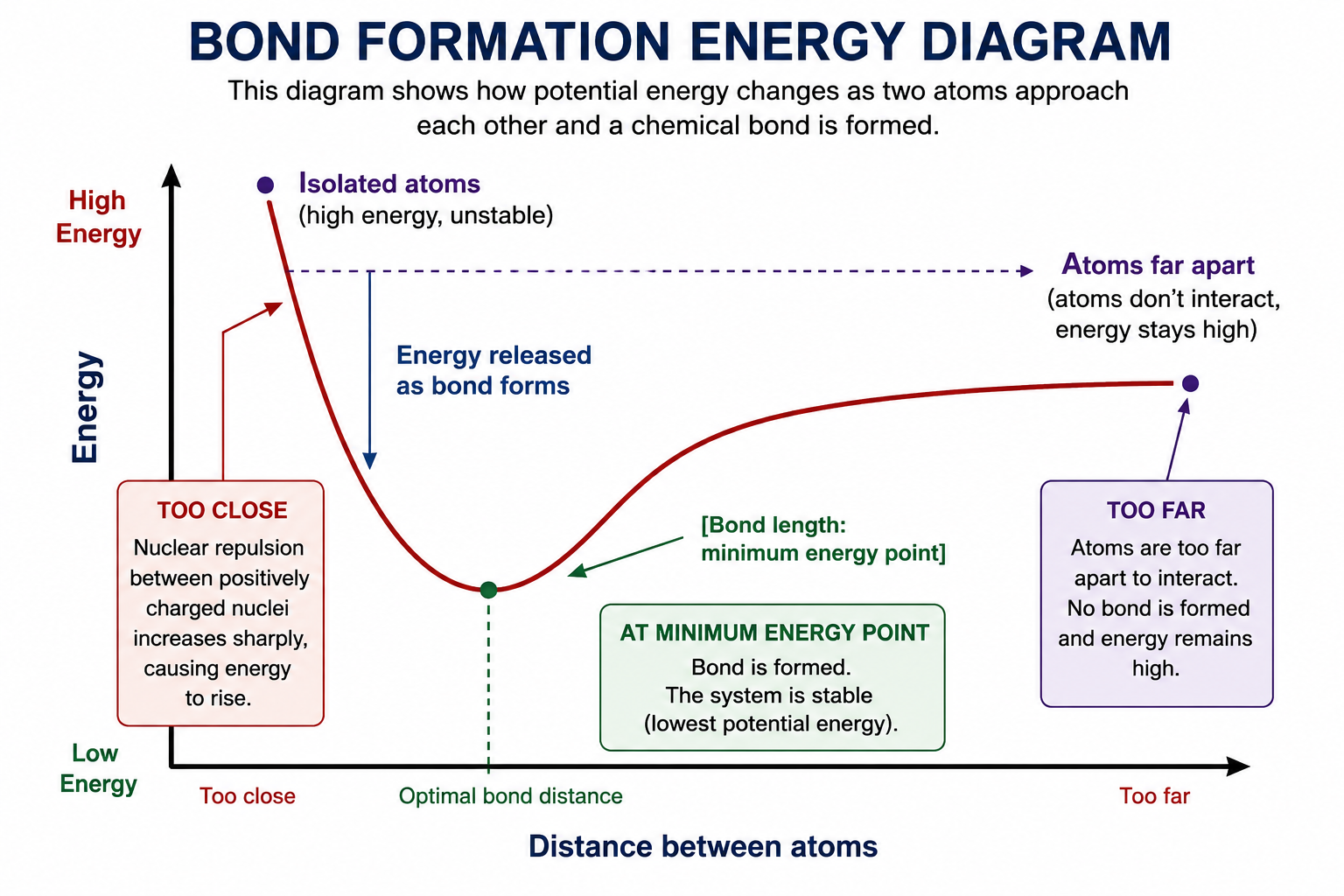
Atoms are most likely to bond when doing so gives each atom a more complete outer electron shell. For most atoms, the most stable configuration is 8 valence electrons — the octet rule.
Octet Rule Explained
The octet rule states that atoms tend to form bonds in ways that give each atom 8 electrons in its outermost shell — matching the stable electron configuration of noble gases. The rule derives from the observation that noble gases (with full outer shells) are chemically inert, suggesting that a full outer shell represents maximum stability.
The octet rule explains:
- Why sodium loses 1 electron to form Na⁺ (giving it the neon configuration: 2, 8)
- Why chlorine gains 1 electron to form Cl⁻ (giving it the argon configuration: 2, 8, 8)
- Why carbon forms 4 bonds (it has 4 valence electrons and needs 4 more to complete an octet)
- Why oxygen forms 2 bonds (it has 6 valence electrons and needs 2 more)
Exceptions to the octet rule are important to know:
- Hydrogen and helium only need 2 electrons (filling their one shell completely)
- Beryllium often forms compounds with only 4 electrons around it (e.g., BeCl₂)
- Boron often forms compounds with only 6 electrons (e.g., BF₃)
- Expanded octets occur with elements in Period 3 and below (such as phosphorus in PCl₅ with 10 electrons, and sulfur in SF₆ with 12 electrons), because they have d orbitals available
Valence Electrons Explained
Valence electrons are the electrons in an atom’s outermost principal energy level. They are the electrons that participate in chemical bonding — the ones atoms share, transfer, or delocalize when they interact with other atoms.
The number of valence electrons for main group elements is directly readable from the periodic table group number:
- Group 1: 1 valence electron
- Group 2: 2 valence electrons
- Group 13: 3 valence electrons
- Group 14: 4 valence electrons
- Group 15: 5 valence electrons
- Group 16: 6 valence electrons
- Group 17: 7 valence electrons
- Group 18: 8 valence electrons (2 for helium)
Valence electrons determine how many bonds an atom will typically form, what type of ion it will form, and how it behaves in chemical reactions. Everything else about bonding follows from understanding valence electrons.
Types of Chemical Bonds
Ionic Bond
Formation of Ionic Bonds
An ionic bond forms when one atom transfers one or more electrons to another atom, producing oppositely charged ions that are held together by electrostatic attraction. This typically occurs between a metal (which loses electrons easily due to low ionization energy) and a nonmetal (which gains electrons readily due to high electron affinity).
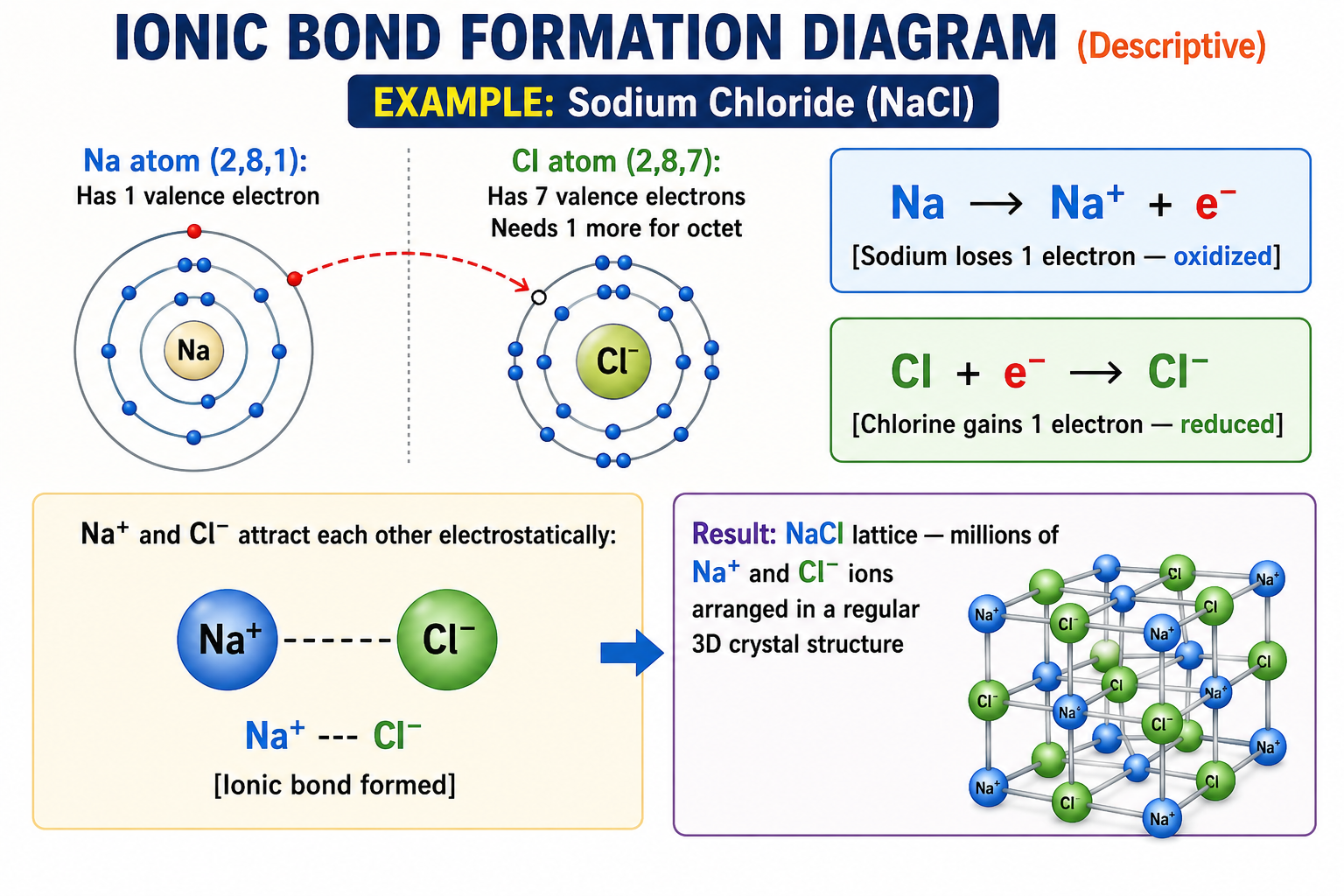
The strength of an ionic bond depends on:
- The charges of the ions (higher charge = stronger bond; MgO with 2+/2- is much stronger than NaCl with 1+/1-)
- The size of the ions (smaller ions pack closer together, giving stronger attractions)
Properties of Ionic Compounds
- High melting and boiling points: The strong electrostatic forces between ions require a large amount of energy to overcome. NaCl melts at 801°C; MgO melts at 2852°C.
- Brittle: Ionic crystals shatter when struck because displacing a layer shifts like charges next to like charges, causing violent repulsion that fractures the crystal.
- Conduct electricity when molten or dissolved (but not when solid): In solid form, ions are locked in the lattice and cannot move. When melted or dissolved in water, ions become mobile and can carry electrical current.
- Soluble in polar solvents (often water): Water molecules surround and stabilize the individual ions through ion-dipole interactions, pulling them away from the lattice.
- Generally soluble in water but insoluble in nonpolar solvents
- Form crystalline solids with regular lattice structures
Examples of Ionic Bonds
| Ionic Compound | Cation | Anion | Common Use |
|---|---|---|---|
| Sodium Chloride (NaCl) | Na⁺ | Cl⁻ | Table salt, food preservation |
| Calcium Fluoride (CaF₂) | Ca²⁺ | F⁻ | Fluorite mineral, optical lenses |
| Magnesium Oxide (MgO) | Mg²⁺ | O²⁻ | Refractory materials, antacids |
| Potassium Iodide (KI) | K⁺ | I⁻ | Thyroid health supplements |
| Iron(III) Oxide (Fe₂O₃) | Fe³⁺ | O²⁻ | Rust; red pigment |
Covalent Bond
A covalent bond forms when two atoms share one or more pairs of electrons rather than transferring them completely. This occurs most commonly between two nonmetal atoms where neither has a strong enough tendency to fully remove electrons from the other.
Single Covalent Bond
A single covalent bond involves the sharing of one pair of electrons (two electrons total) between two atoms. It is represented by a single line in structural formulas.
Examples: H-H (hydrogen gas, H₂), H-Cl (hydrogen chloride, HCl), C-H bonds in methane (CH₄)
Single bonds allow free rotation around the bond axis (which is important in understanding the flexibility of long organic molecules).
Double Covalent Bond
A double covalent bond involves the sharing of two pairs of electrons (four electrons total). It is represented by a double line (=).
Examples: O=O (oxygen gas, O₂), C=O in carbon dioxide (CO₂), C=C in ethene (H₂C=CH₂)
Double bonds are shorter and stronger than single bonds and restrict rotation around the bond axis — which is why cis/trans isomerism exists in alkenes.
Triple Covalent Bond
A triple covalent bond involves the sharing of three pairs of electrons (six electrons total). It is represented by a triple line (≡).
Examples: N≡N (nitrogen gas, N₂), C≡C in ethyne/acetylene (H-C≡C-H), C≡N in hydrogen cyanide (HCN)
Triple bonds are the shortest and strongest covalent bonds. The N≡N triple bond in nitrogen gas is so strong (945 kJ/mol) that it makes N₂ extremely unreactive under normal conditions — which is why the Haber process for ammonia synthesis requires high temperature, high pressure, and an iron catalyst to overcome it.
Polar Covalent Bond
A polar covalent bond forms between two atoms with different electronegativities. The more electronegative atom attracts the shared electrons more strongly toward itself, creating a partial negative charge (δ-) at that end and a partial positive charge (δ+) at the other end. The bond has an electric dipole.
Example: In H-Cl, chlorine (electronegativity 3.16) pulls electrons toward itself more than hydrogen (electronegativity 2.20) does. The chlorine end is δ- and the hydrogen end is δ+.
Nonpolar Covalent Bond
A nonpolar covalent bond forms between two atoms with identical or very similar electronegativities. Electrons are shared equally (or nearly equally) and there is no significant charge separation.
Examples: H-H (both hydrogen, identical electronegativity), Cl-Cl (Cl₂), C-H bonds (electronegativity difference ~0.4, considered essentially nonpolar)
Properties of Covalent Compounds
Covalent compounds have much more variable properties than ionic compounds because their properties depend on molecular size, polarity, and structure. However, some generalizations hold:
- Lower melting and boiling points (generally) than ionic compounds — molecular covalent compounds are held together by weaker intermolecular forces rather than strong electrostatic lattices
- Poor electrical conductors — no ions or mobile electrons in most covalent substances
- Solubility follows polarity — polar covalent compounds dissolve in polar solvents (water); nonpolar in nonpolar solvents
- Variable physical states — many are gases or liquids at room temperature (water, carbon dioxide, methane)
- Network covalent solids (like diamond and silicon dioxide) are major exceptions — they have extremely high melting points because every atom is covalently bonded to its neighbors in a giant 3D network, requiring enormous energy to break
Examples of Covalent Bonds
| Covalent Compound | Bond Type | Property |
|---|---|---|
| Water (H₂O) | Polar covalent | Liquid at room temperature; universal solvent |
| Carbon Dioxide (CO₂) | Polar covalent (nonpolar molecule) | Gas; greenhouse gas |
| Methane (CH₄) | Nonpolar covalent | Gas; natural gas fuel |
| Glucose (C₆H₁₂O₆) | Polar covalent | Solid; primary cellular fuel |
| Diamond (C-C network) | Nonpolar covalent (network) | Hardest natural material; very high melting point |
| Nitrogen (N₂) | Nonpolar covalent (triple bond) | Gas; makes up 78% of atmosphere |
Metallic Bond
Formation of Metallic Bonds
Metallic bonds form in pure metals and metal alloys. Unlike ionic bonds (electron transfer) or covalent bonds (electron sharing between specific atoms), metallic bonds involve electrons that are delocalized — not associated with any specific pair of atoms, but instead spread throughout the entire metal structure.
Sea of Electrons Model
The simplest and most widely used model of metallic bonding is the electron sea model:
In this model, metal atoms release their valence electrons into a communal “sea” of delocalized electrons. The metal cations (positive ions formed when atoms release their valence electrons) sit in a regular lattice embedded in this electron sea. The attraction between the positive cations and the negatively charged electron sea holds the structure together.
Properties of Metals
All the characteristic properties of metals follow logically from the electron sea model:
- Electrical conductivity: Delocalized electrons can flow through the metal in response to a potential difference, carrying charge. This is why metals are excellent electrical conductors.
- Thermal conductivity: Mobile electrons also transfer kinetic energy efficiently, explaining why metals feel cold to the touch (they rapidly conduct heat away from your hand) and why metal cookware heats evenly.
- Malleability and ductility: When a force deforms the metal, layers of metal cations slide past each other while remaining immersed in the electron sea. The electron sea adjusts to the new arrangement, maintaining the bond. This is why metals bend and stretch rather than shatter.
- Luster: The free electrons absorb and re-emit light of many frequencies, giving metals their characteristic shiny appearance.
- High melting points (generally): Strong attraction between cations and the electron sea requires substantial energy to disrupt. (Notable exception: mercury is liquid at room temperature because its electron configuration makes the metallic bonding unusually weak.)
Examples of Metallic Bonds
Copper (Cu) — excellent electrical conductor; used in wiring. Iron (Fe) — structural metal; strong metallic bonds give iron its hardness and high melting point. Aluminum (Al) — lightweight with good conductivity; used in aircraft and power lines. Gold (Au) — highly malleable and ductile; used in jewelry and electronics.
Hydrogen Bond Explained
A hydrogen bond is a relatively strong intermolecular force (it’s not a true chemical bond in the primary sense) that forms when a hydrogen atom covalently bonded to a highly electronegative atom (fluorine, oxygen, or nitrogen) is attracted to a lone pair of electrons on another electronegative atom in a neighboring molecule.
The logic is straightforward: when H is bonded to F, O, or N, the shared electrons are pulled so strongly toward the electronegative atom that the hydrogen carries a significant partial positive charge (δ+). This positively charged hydrogen is then attracted to a lone pair on a neighboring electronegative atom.
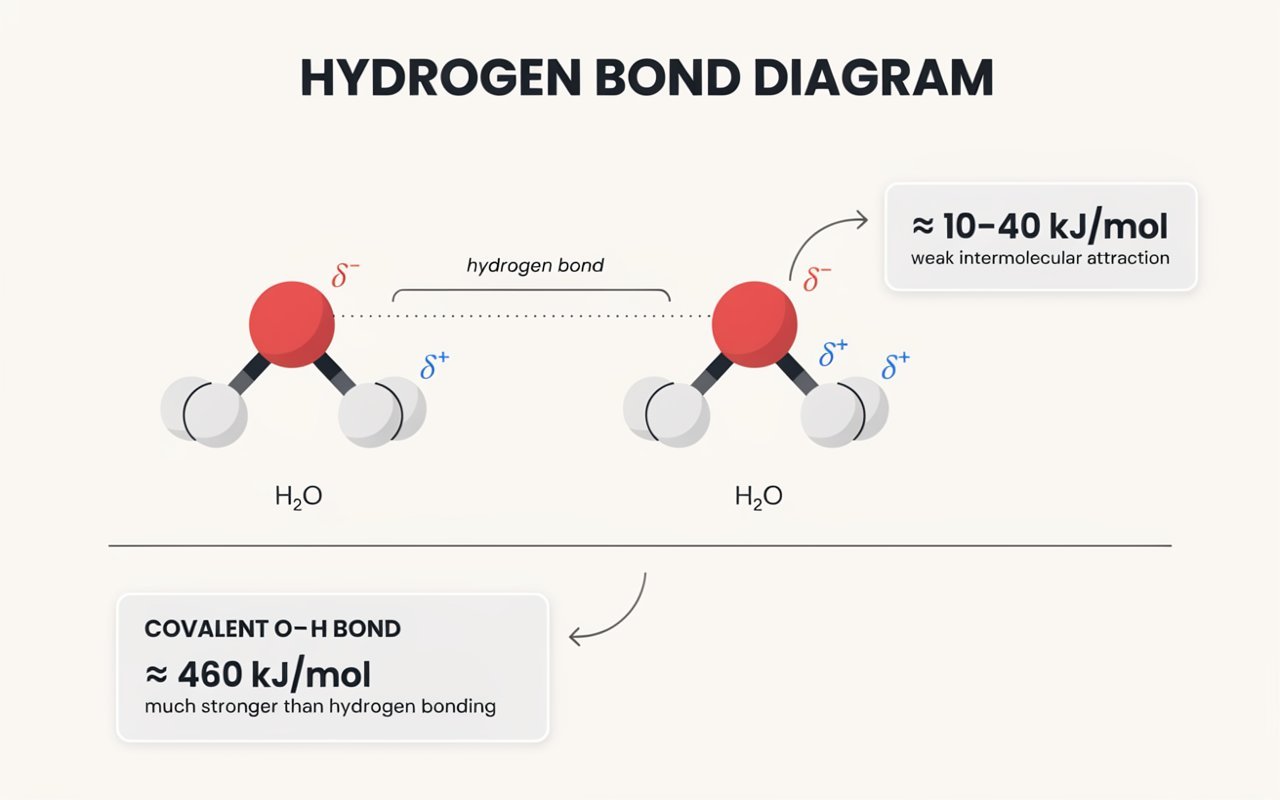
Hydrogen bonds are approximately 5–10 times weaker than typical covalent bonds but 5–10 times stronger than typical Van der Waals forces. Their collective effect — especially in water, where each molecule can form up to 4 hydrogen bonds — produces enormous consequences:
- Water’s boiling point is 100°C, extraordinarily high for a molecule of its small size (without hydrogen bonding, it would boil around −80°C)
- Water has high surface tension and cohesion (water striders walk on water because of hydrogen bonding)
- DNA’s double helix is held together by hydrogen bonds between complementary base pairs — weak enough to unzip during replication, but stable enough to store genetic information reliably
- Proteins’ secondary and tertiary structures are maintained partly by hydrogen bonds between backbone and side chain groups
- Ice is less dense than liquid water because hydrogen bonds in ice lock molecules into a hexagonal lattice with open space — which is why ice floats, insulating aquatic ecosystems in winter
Important Fact: The hydrogen bond is one of the most biologically important interactions in nature. Without it, water as we know it wouldn’t exist as a liquid at Earth’s surface temperatures, and the structure of DNA and proteins — and therefore all life — would be impossible.
Van der Waals Forces Explained
Van der Waals forces is a collective term for weak intermolecular attractions that arise from temporary or permanent dipoles in molecules. They operate between all molecules, even nonpolar ones, and become increasingly important with molecular size.
The two main types are:
1. London Dispersion Forces (also called induced dipole-induced dipole forces)
These are the weakest Van der Waals forces and the only type that acts between nonpolar molecules. At any instant, the electron cloud of a molecule may be distributed unevenly, creating a temporary (instantaneous) dipole. This temporary dipole induces a complementary dipole in a neighboring molecule, and the two attract each other briefly.
Although individually very weak, London dispersion forces increase significantly with molecular size (larger molecules have more electrons and larger electron clouds, allowing bigger temporary dipoles) and with surface area (more contact area between molecules means more simultaneous interactions). This is why larger nonpolar molecules have higher boiling points: iodine (I₂) is a solid at room temperature while fluorine (F₂) is a gas.
2. Dipole-Dipole Forces
These act between polar molecules. The permanent partial positive end of one polar molecule attracts the permanent partial negative end of a neighboring polar molecule. Dipole-dipole forces are stronger than London dispersion forces between similar-sized molecules.
Ionic vs Covalent vs Metallic Bonds (Detailed Comparison Table)
| Feature | Ionic Bond | Covalent Bond | Metallic Bond |
|---|---|---|---|
| Formed Between | Metal + Nonmetal | Nonmetal + Nonmetal | Metal + Metal |
| Electron Behavior | Transfer (complete) | Sharing (between specific atoms) | Delocalized (communal sea) |
| Structure | Giant ionic lattice | Discrete molecules OR giant covalent lattice | Giant metallic lattice |
| Melting Point | High (801°C for NaCl) | Low-moderate for molecular; very high for network | Moderate to very high |
| Electrical Conductivity | Poor when solid; good when molten or dissolved | Generally poor | Excellent in all states |
| Solubility in Water | Generally soluble | Polar: soluble; Nonpolar: insoluble | Insoluble (reacts with some) |
| Mechanical Properties | Hard but brittle | Soft/variable for molecular; very hard for network | Malleable and ductile |
| Appearance | Usually white/colorless crystals | Variable (gases, liquids, solids) | Shiny, metallic luster |
| Examples | NaCl, MgO, CaCl₂ | H₂O, CO₂, CH₄, diamond | Cu, Fe, Al, Au |
| Bond Strength | Strong | Variable (weak molecular to very strong network) | Moderate to strong |
Polar vs Nonpolar Covalent Bonds (Comparison Table)
| Feature | Polar Covalent Bond | Nonpolar Covalent Bond |
|---|---|---|
| Electron Distribution | Unequal; electrons pulled toward more electronegative atom | Equal; electrons shared symmetrically |
| Electronegativity Difference | 0.4 to 1.7 | Less than 0.4 (or identical atoms) |
| Partial Charges | Yes (δ+ and δ-) | No partial charges |
| Dipole Moment | Present | Zero (or near zero) |
| Examples | H-Cl, H-O, H-F, H-N | H-H, Cl-Cl, C-C, C-H |
| Molecule Polarity | Depends on molecular symmetry | Nonpolar if symmetrical |
| Solubility | Often water-soluble if polar molecule | Often water-insoluble; dissolves in nonpolar solvents |
Lewis Dot Structures
Lewis dot structures (also called Lewis structures or electron dot diagrams) are simple representations showing the valence electrons of atoms in a molecule. They show which atoms are bonded, what type of bonds connect them, and where lone pairs of electrons are located.
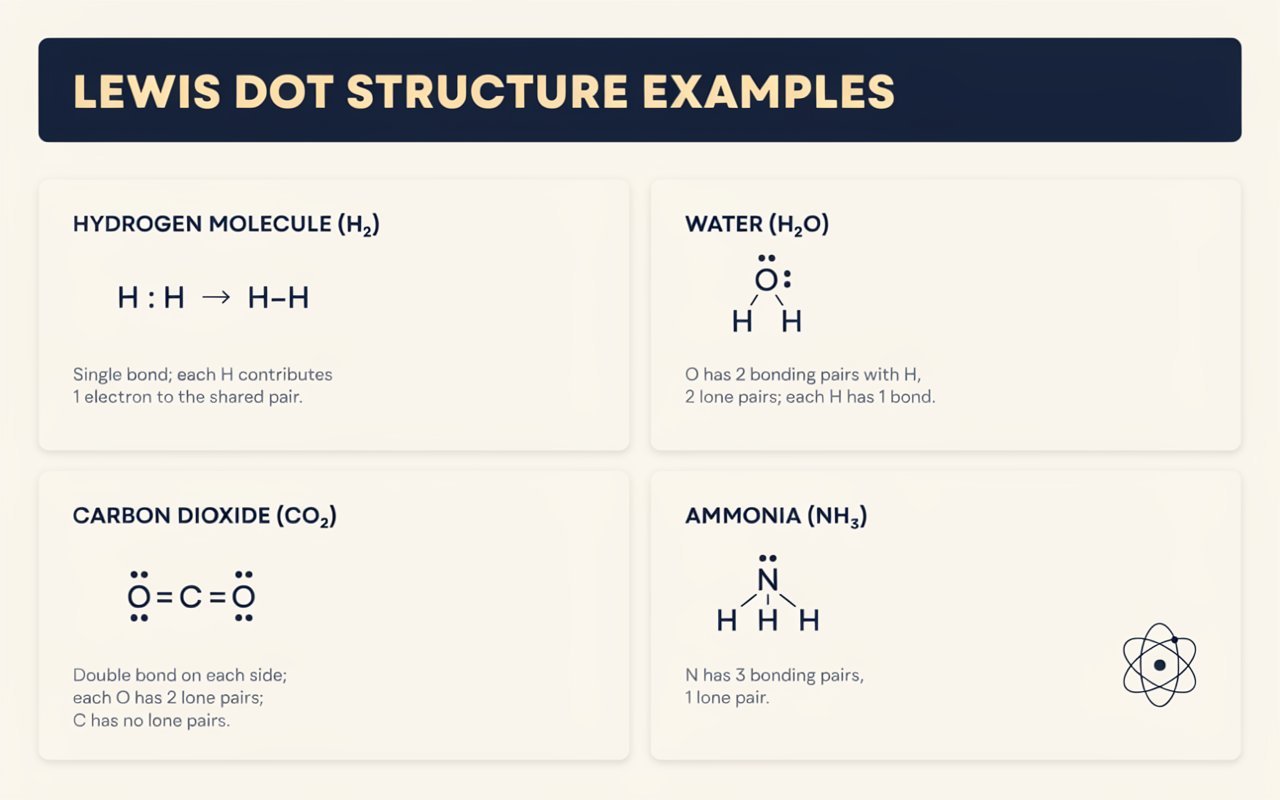
Steps for drawing Lewis dot structures:
- Count the total number of valence electrons (sum from all atoms; add 1 for each negative charge; subtract 1 for each positive charge)
- Identify the central atom (usually the atom that appears once, or the least electronegative atom — hydrogen is never central)
- Connect atoms with single bonds; each bond uses 2 electrons
- Distribute remaining electrons as lone pairs, filling outer atoms first (satisfying their octets), then the central atom
- If the central atom doesn’t have an octet, form double or triple bonds using lone pairs from outer atoms
- Check: total electron count should match the number calculated in step 1
Resonance Structures
Resonance occurs when a single Lewis structure cannot adequately represent the electron distribution in a molecule or ion because the true structure is a blend (average) of several possible Lewis structures.
The classic example is ozone (O₃):
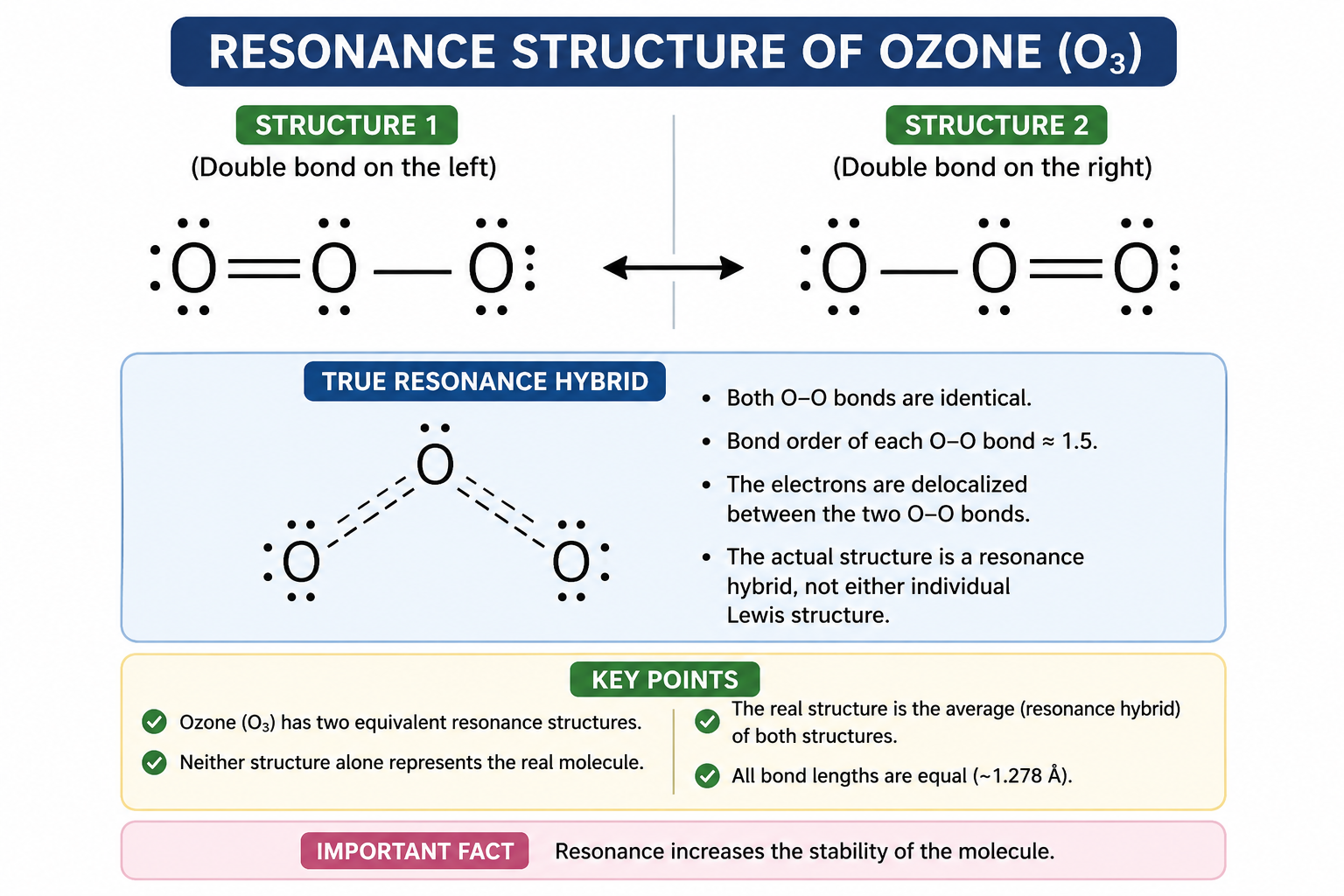
The true ozone molecule has two O-O bonds of identical length — intermediate between a single and double bond — because the electrons are delocalized across the entire molecule rather than fixed in one position. Neither Lewis structure alone is correct; the reality is the average of all resonance contributors.
Other important examples: benzene (C₆H₆, alternating double and single bonds that are actually all equivalent), nitrate ion (NO₃⁻), carbonate ion (CO₃²⁻).
Resonance structures are drawn with a double-headed arrow between them: Structure 1 ↔ Structure 2
Molecular Geometry (VSEPR Theory)
VSEPR (Valence Shell Electron Pair Repulsion) theory predicts the three-dimensional shape of molecules by assuming that electron pairs (both bonding pairs and lone pairs) around a central atom repel each other and arrange themselves as far apart as possible to minimize repulsion.
Lone pairs repel more strongly than bonding pairs, which means they compress bond angles slightly.
Molecular Geometry Shapes Table
| Electron Groups | Lone Pairs | Molecular Shape | Bond Angle | Example |
|---|---|---|---|---|
| 2 | 0 | Linear | 180° | CO₂, BeCl₂ |
| 3 | 0 | Trigonal planar | 120° | BF₃, SO₃ |
| 3 | 1 | Bent (V-shaped) | ~120° | SO₂, O₃ |
| 4 | 0 | Tetrahedral | 109.5° | CH₄, CCl₄ |
| 4 | 1 | Trigonal pyramidal | ~107° | NH₃, PCl₃ |
| 4 | 2 | Bent (V-shaped) | ~104.5° | H₂O |
| 5 | 0 | Trigonal bipyramidal | 90°/120° | PCl₅, PF₅ |
| 6 | 0 | Octahedral | 90° | SF₆, XeF₄ |
Linear
Linear molecules have 2 bonding regions and 0 lone pairs on the central atom. All atoms lie in a straight line with a bond angle of 180°. Example: CO₂ — the double bonds on each side are identical and the molecule is perfectly linear and symmetrical. Despite having polar C=O bonds, CO₂ is a nonpolar molecule because the dipoles cancel.
Bent
Bent shapes arise when a tetrahedral or trigonal planar electron arrangement is modified by 1 or 2 lone pairs. In water (H₂O), the oxygen has 4 electron groups (2 bonding pairs and 2 lone pairs), giving tetrahedral electron geometry but bent molecular geometry. The lone pairs compress the H-O-H bond angle from the ideal 109.5° to approximately 104.5°.
Trigonal Planar
Trigonal planar molecules have 3 bonding groups and 0 lone pairs, producing a flat, triangular arrangement with 120° bond angles. BF₃ and SO₃ are trigonal planar. These molecules are symmetrical and therefore nonpolar even if the individual bonds are polar.
Tetrahedral
Tetrahedral geometry — the most common molecular shape — arises from 4 bonding groups with no lone pairs. The four bonds point toward the corners of a tetrahedron with bond angles of 109.5°. Methane (CH₄) is the classic example: perfectly symmetrical, nonpolar despite 4 C-H bonds.
Trigonal Bipyramidal
Five bonding groups with no lone pairs produce a trigonal bipyramidal shape with two sets of bond angles: 90° (axial to equatorial) and 120° (equatorial to equatorial). PCl₅ is the standard example.
Octahedral
Six bonding groups with no lone pairs produce octahedral geometry with 90° bond angles. SF₆ is a classic example: six fluorines arranged symmetrically around a central sulfur, giving a highly symmetrical nonpolar molecule.
Bond Length and Bond Energy
Bond length is the average distance between the nuclei of two bonded atoms when they are in their ground state. Bond energy (or bond dissociation energy) is the energy required to break one mole of a specific bond in the gas phase.
These two properties are inversely and directly related to bond order in a predictable way:
| Bond Type | Bond Order | Bond Length | Bond Energy | Example |
|---|---|---|---|---|
| C-C single | 1 | 154 pm | 347 kJ/mol | Ethane |
| C=C double | 2 | 134 pm | 614 kJ/mol | Ethene |
| C≡C triple | 3 | 120 pm | 839 kJ/mol | Ethyne |
| N-N single | 1 | 145 pm | 163 kJ/mol | Hydrazine |
| N=N double | 2 | 123 pm | 418 kJ/mol | Diazene |
| N≡N triple | 3 | 110 pm | 945 kJ/mol | Nitrogen gas |
As bond order increases (from single to double to triple): bond length decreases and bond energy increases. More shared electron pairs pull nuclei closer together and hold them more strongly.
Bond energy is directly used in thermochemical calculations:
- Breaking bonds requires energy (endothermic)
- Forming bonds releases energy (exothermic)
- The overall enthalpy change of a reaction = Energy to break reactant bonds − Energy released forming product bonds
Electronegativity and Bond Formation
Electronegativity is a measure of an atom’s ability to attract shared electrons toward itself in a covalent bond. It was quantified by Linus Pauling, and the Pauling scale (running from about 0.7 to 4.0) is the most widely used.
Electronegativity increases across a period (left to right) and decreases down a group. Fluorine (3.98) is the most electronegative element.
The electronegativity difference between two bonded atoms determines the bond character:
| Electronegativity Difference | Bond Type | Character |
|---|---|---|
| 0.0 – 0.4 | Nonpolar Covalent | Equal or near-equal sharing |
| 0.4 – 1.7 | Polar Covalent | Unequal sharing; partial charges |
| Greater than 1.7 | Ionic | Essentially complete electron transfer |
These boundaries are approximate guidelines, not sharp cutoffs. Some sources use 2.0 as the ionic threshold; the concept is a spectrum rather than a step change.
Practical example: The bond between sodium (Na, electronegativity 0.93) and chlorine (Cl, 3.16) has a difference of 2.23, which is well above 1.7 — so NaCl is correctly classified as ionic. The bond between hydrogen (2.20) and chlorine (3.16) has a difference of 0.96, placing it in the polar covalent range.
Bond Polarity Explained
Bond polarity refers to the unequal distribution of electron density in a covalent bond, creating a dipole (two poles: a partial positive end and a partial negative end). Bond polarity is a property of individual bonds.
However, molecular polarity depends on both bond polarity AND molecular geometry. A molecule with polar bonds can be nonpolar overall if the individual bond dipoles cancel due to symmetry.
Classic examples:
- CO₂ (linear): Two polar C=O bonds, but they point in exactly opposite directions and cancel completely → nonpolar molecule
- H₂O (bent): Two polar O-H bonds, and because of the bent geometry, the dipoles don’t cancel → polar molecule
- CCl₄ (tetrahedral): Four polar C-Cl bonds, but perfectly symmetrical → dipoles cancel → nonpolar molecule
- CHCl₃ (tetrahedral, but asymmetric): Three C-Cl bonds and one C-H; different bonds have different polarities, symmetry is broken → polar molecule
This distinction between bond polarity and molecular polarity is critical for understanding solubility (“like dissolves like”) and intermolecular forces.
Intermolecular Forces
Intermolecular forces are the attractions between separate molecules (as opposed to intramolecular bonds, which hold atoms together within a molecule). They are much weaker than primary chemical bonds but profoundly affect physical properties: melting point, boiling point, viscosity, surface tension, and solubility.
Dipole-Dipole Forces
Dipole-dipole forces act between polar molecules. The permanent partial positive end of one polar molecule attracts the partial negative end of a neighboring polar molecule. They are stronger than London dispersion forces between molecules of similar size.
Example: HCl molecules attract each other through dipole-dipole interactions (the δ+ hydrogen of one HCl is attracted to the δ- chlorine of a neighboring HCl), giving HCl a higher boiling point than H₂ despite being a heavier molecule.
London Dispersion Forces
London dispersion forces (induced dipole-induced dipole forces) arise from temporary fluctuations in electron distribution that create instantaneous dipoles, which in turn induce dipoles in neighboring molecules. They act between all molecules — polar and nonpolar alike — but are the only intermolecular force acting between nonpolar molecules.
Strength increases with: molecular size (more electrons = larger instantaneous dipoles), surface area (more contact between molecules = more simultaneous interactions), and branching (less branching = more surface contact).
Example: Straight-chain octane (C₈H₁₈) has a higher boiling point than branched 2,2,4-trimethylpentane (same molecular formula) because the linear molecule has more surface area for London dispersion interactions.
Hydrogen Bonding
Hydrogen bonding is the strongest of the three intermolecular forces discussed here. It specifically requires H bonded to F, O, or N (the three most electronegative small atoms). The resulting H carries a significant δ+ charge and is attracted to a lone pair on F, O, or N of a neighboring molecule.
Hydrogen bonding is responsible for:
- Water’s anomalously high boiling point (100°C vs. expected approximately −80°C based on its molecular weight alone)
- The high boiling points of alcohols, amines, and carboxylic acids compared to similar-sized nonpolar compounds
- The secondary structure (alpha helices and beta sheets) of proteins
- The complementary base pairing in DNA
Intermolecular Forces Comparison Table
| Force | Acts Between | Relative Strength | Example |
|---|---|---|---|
| London Dispersion | All molecules | Weakest (but ubiquitous) | Noble gases, alkanes, I₂ |
| Dipole-Dipole | Polar molecules | Moderate | HCl, SO₂, acetone |
| Hydrogen Bonding | H-F, H-O, H-N containing molecules | Strongest intermolecular force | H₂O, HF, NH₃, DNA |
Chemical Bonding in Everyday Life
Chemical bonding isn’t an abstract classroom concept — it explains virtually everything about the material world:
Salt dissolving in water: NaCl (ionic) dissolves because water molecules (polar covalent, with partial charges) surround the ions and pull them into solution through ion-dipole interactions.
Oil and water don’t mix: Cooking oil consists of nonpolar covalent molecules; water is polar. Polar substances preferentially interact with other polar substances through dipole-dipole and hydrogen bonding; nonpolar substances interact through London dispersion forces. The energy cost of disrupting water’s hydrogen bond network to accommodate nonpolar oil molecules is too high — so they separate.
Diamond’s hardness: Diamond is a network covalent solid — every carbon atom is bonded to four others in a giant interlocking tetrahedral lattice of covalent bonds. Breaking diamond requires breaking covalent bonds in every direction simultaneously, requiring enormous energy.
Copper wiring: Metallic bonding in copper provides delocalized electrons that carry electrical current efficiently. Copper’s excellent conductivity, combined with its ductility (it can be drawn into thin wires without breaking), make it the dominant material in electrical wiring worldwide.
Cooking an egg: Heat denatures (unfolds) the egg white proteins by breaking the hydrogen bonds and other intermolecular forces that maintain the protein’s 3D structure. The protein chains then form new random bonds with each other, creating the opaque white solid.
Applications of Chemical Bonding
Understanding chemical bonding has driven some of humanity’s most important technological advances:
- Pharmaceutical design: Drug molecules are designed to bind to specific protein receptors through a combination of hydrogen bonds, ionic interactions, and London dispersion forces. Understanding the bonding requirements of a target receptor guides the synthesis of effective drugs.
- Materials science: Selecting materials for specific applications (semiconductors for electronics, ceramics for heat resistance, polymers for flexibility) relies on understanding how bonding type determines material properties.
- Catalysis: Industrial catalysts (like platinum in catalytic converters and iron in the Haber process) work by forming temporary bonds with reactant molecules that lower the activation energy of reactions.
- Battery technology: Lithium-ion batteries depend on the controlled movement of Li⁺ ions between electrode materials through an ionic-conducting electrolyte — electrochemistry built on ionic and metallic bonding principles.
- Nanotechnology: Engineering at the nanoscale requires precise manipulation of covalent bonds to build specific molecular architectures.
Common Chemical Bonding Terms Every Student Should Know
| Term | Definition |
|---|---|
| Chemical Bond | Attractive force holding atoms together in a compound |
| Ionic Bond | Bond formed by transfer of electrons between metal and nonmetal |
| Covalent Bond | Bond formed by sharing electrons between nonmetals |
| Metallic Bond | Bond formed by delocalized electrons in a metal lattice |
| Valence Electrons | Outermost shell electrons; involved in bonding |
| Octet Rule | Atoms tend to bond to achieve 8 valence electrons |
| Electronegativity | Atom’s ability to attract shared electrons |
| Bond Energy | Energy required to break one mole of a specific bond |
| Bond Length | Average distance between bonded nuclei at equilibrium |
| Bond Order | Number of shared electron pairs between two atoms |
| Lewis Dot Structure | Diagram showing valence electrons and bonds in a molecule |
| Lone Pair | Pair of valence electrons not involved in bonding |
| Resonance | When two or more equivalent Lewis structures describe a molecule |
| VSEPR Theory | Model predicting molecular geometry from electron pair repulsion |
| Polar Bond | Covalent bond with unequal electron distribution; has dipole moment |
| Nonpolar Bond | Covalent bond with equal electron distribution |
| Dipole Moment | Measure of bond or molecular polarity |
| Intermolecular Force | Attractive force between separate molecules |
| Hydrogen Bond | Strong intermolecular force; H bonded to F, O, or N attracts neighboring lone pair |
| London Dispersion | Weak intermolecular force from temporary dipoles; acts on all molecules |
| Lattice Energy | Energy released when gaseous ions form an ionic crystal lattice |
| Network Covalent Solid | Solid where all atoms are covalently bonded in a giant lattice (e.g., diamond) |
| Delocalization | Electrons spread over multiple atoms rather than fixed between two |
Common Mistakes Students Make
These are the errors chemistry teachers see most often on chemical bonding questions:
- Confusing intermolecular forces with intramolecular bonds. Intramolecular bonds (ionic, covalent, metallic) hold atoms together within compounds. Intermolecular forces (London dispersion, dipole-dipole, hydrogen bonding) act between separate molecules. When a liquid evaporates, you are breaking intermolecular forces — not covalent bonds. The distinction is fundamental and frequently confused.
- Assuming polar bonds always make polar molecules. CO₂ has two polar C=O bonds but is a nonpolar molecule because they are equal and opposite. Always check molecular geometry before concluding about molecular polarity.
- Thinking ionic compounds always dissolve in water. Most ionic compounds are water-soluble, but solubility rules have many exceptions. Silver chloride, barium sulfate, and many other ionic compounds are insoluble. “Ionic” does not automatically mean “soluble.”
- Drawing Lewis structures that violate the octet rule unnecessarily. Before assigning expanded octets or incomplete octets to a central atom, check whether a conventional octet structure is possible. Expanded octets are only valid for Period 3 and beyond (elements with available d orbitals).
- Misidentifying lone pairs and bond pairs in VSEPR. Both lone pairs and bonding pairs count toward the electron geometry in VSEPR, but only bonding pairs determine the molecular geometry shape. Students frequently neglect lone pairs, producing wrong shape predictions.
- Confusing bond order with the number of bonds. Bond order of 1 means one pair of shared electrons (single bond). Bond order 2 means two pairs (double bond). Resonance structures can have fractional bond orders (benzene has bond order 1.5 for each C-C bond) — these aren’t “between structures,” they represent the actual delocalized electron distribution.
- Applying the electronegativity cutoffs as exact rules. The boundaries between nonpolar covalent, polar covalent, and ionic bonding are approximate guidelines based on the Pauling scale. Real bonding exists on a spectrum. A bond with a difference of 1.8 doesn’t suddenly become “fully ionic” — it just has substantial ionic character.
- Forgetting that hydrogen bonding requires specific atoms. Hydrogen bonds only form when H is directly bonded to F, O, or N. Hydrogen bonded to carbon does not form hydrogen bonds (because C is not electronegative enough to make the H sufficiently positive). This matters when predicting boiling points of organic compounds.
Best Tips to Study Chemical Bonding
Exam Tips Box
- Master Lewis dot structures before moving to VSEPR. You cannot predict molecular geometry without first correctly drawing the Lewis structure. Practice drawing structures for at least 20 different molecules until the process is automatic.
- For VSEPR shapes, remember that the molecular geometry name describes only the positions of ATOMS, not lone pairs. Count electron groups (bonding pairs + lone pairs) for electron geometry; count only bonded atoms for molecular geometry.
- Learn the electronegativity values for the most common nonmetals: F (4.0), O (3.5), N (3.0), Cl (3.2), C (2.5), H (2.2). These allow you to assess bond polarity without a table.
- For resonance, the key insight is that resonance structures are not separate forms that interconvert — they are a way of expressing that the true structure cannot be captured by a single Lewis structure. The actual molecule is a blend of all resonance contributors simultaneously.
- Connect bonding type to properties systematically. For any compound, ask: What type of bonding holds it together? What are the intermolecular forces between molecules? Then deduce: high or low melting point? Does it conduct? Does it dissolve in water? This deductive approach handles any compound you haven’t specifically studied.
- When in doubt about bond type, calculate the electronegativity difference. This single calculation sorts ionic, polar covalent, and nonpolar covalent bonds reliably.
Chemical Bonding Practice Questions
30 Multiple Choice Questions (MCQs) with Answers
1. Which type of bond involves complete transfer of electrons?
- A) Covalent
- B) Ionic ✓
- C) Metallic
- D) Hydrogen
2. The octet rule states that atoms tend to achieve stability by having how many valence electrons?
- A) 2
- B) 4
- C) 8 ✓
- D) 18
3. Which bond type is found in N₂?
- A) Single covalent bond
- B) Double covalent bond
- C) Triple covalent bond ✓
- D) Ionic bond
4. The “sea of electrons” model describes which type of bonding?
- A) Ionic bonding
- B) Covalent bonding
- C) Metallic bonding ✓
- D) Hydrogen bonding
5. An electronegativity difference of 1.2 between two bonded atoms indicates:
- A) Ionic bond
- B) Polar covalent bond ✓
- C) Nonpolar covalent bond
- D) Metallic bond
6. Which molecule has a bent molecular geometry?
- A) CO₂
- B) BF₃
- C) H₂O ✓
- D) CH₄
7. What is the bond angle in a tetrahedral molecule?
- A) 90°
- B) 120°
- C) 109.5° ✓
- D) 180°
8. Hydrogen bonds form when hydrogen is bonded to which type of atom?
- A) Carbon, nitrogen, or oxygen
- B) Fluorine, oxygen, or nitrogen ✓
- C) Any highly charged atom
- D) Metals only
9. Which property of metals is explained by delocalized electrons?
- A) Brittleness
- B) Low melting point
- C) Electrical conductivity ✓
- D) Insolubility in water
10. CO₂ is a nonpolar molecule because:
- A) It has no polar bonds
- B) It has no lone pairs
- C) Its polar bonds are equal and opposite, canceling the dipole ✓
- D) Carbon has zero electronegativity
11. Resonance structures are used when:
- A) A molecule has only single bonds
- B) A single Lewis structure cannot adequately represent the electron distribution ✓
- C) A molecule has no lone pairs
- D) The bond angles are irregular
12. Which of the following has the highest bond energy?
- A) C-C single bond
- B) C=C double bond
- C) C≡C triple bond ✓
- D) C-H bond
13. London dispersion forces act between:
- A) Only polar molecules
- B) Only ions
- C) All molecules and atoms ✓
- D) Only metals
14. Which of the following is NOT a property of ionic compounds?
- A) High melting point
- B) Brittle
- C) Good conductor of electricity in solid state ✓
- D) Forms crystalline lattice
15. In VSEPR theory, lone pairs are treated as:
- A) Negligible; only bonding pairs matter
- B) Attractors that pull atoms closer
- C) Electron groups that repel other pairs (more than bonding pairs) ✓
- D) Fixed in position
16. What molecular shape does NH₃ adopt?
- A) Tetrahedral
- B) Trigonal planar
- C) Trigonal pyramidal ✓
- D) Bent
17. Which intermolecular force is responsible for water’s unusually high boiling point?
- A) London dispersion
- B) Dipole-dipole
- C) Hydrogen bonding ✓
- D) Ionic attraction
18. A bond with bond order 2 is:
- A) A single bond
- B) A double bond ✓
- C) A triple bond
- D) A metallic bond
19. Which of the following is a polar molecule?
- A) CO₂
- B) CCl₄
- C) HCl ✓
- D) BF₃
20. What determines whether a covalent bond is polar or nonpolar?
- A) The number of shared electrons
- B) The number of lone pairs
- C) The electronegativity difference between the bonded atoms ✓
- D) The molecular geometry
21. Diamond’s extraordinary hardness is due to:
- A) Metallic bonding throughout the structure
- B) Covalent bonds in a giant 3D network lattice ✓
- C) Strong ionic attractions between carbon atoms
- D) Hydrogen bonding between carbon layers
22. The bond angle in a linear molecule is:
- A) 90°
- B) 120°
- C) 109.5°
- D) 180° ✓
23. Which of the following molecules is expected to have the highest boiling point due to hydrogen bonding?
- A) CH₄
- B) HCl
- C) H₂O ✓
- D) CO₂
24. In the Lewis structure of CO₂, the carbon atom has:
- A) Two single bonds and two lone pairs
- B) Two double bonds and no lone pairs ✓
- C) One double bond, one single bond, and one lone pair
- D) One triple bond and one lone pair
25. Which of the following best explains why metals are malleable?
- A) The ionic bonds between metal atoms break easily
- B) Metal atoms have low electronegativity
- C) Layers of metal cations can slide without disrupting the delocalized electron sea ✓
- D) Metals have very weak bonds that allow easy deformation
26. The symbol δ+ in a polar bond indicates:
- A) A full positive charge on the atom
- B) A partial positive charge due to unequal electron sharing ✓
- C) The atom has gained electrons
- D) The atom is a cation
27. Which of the following has the SHORTEST bond length?
- A) N-N (single bond)
- B) N=N (double bond)
- C) N≡N (triple bond) ✓
- D) All N-N bonds are the same length
28. The shape of PCl₅ (no lone pairs) is:
- A) Trigonal bipyramidal ✓
- B) Tetrahedral
- C) Octahedral
- D) Trigonal pyramidal
29. Why does NaCl conduct electricity when dissolved in water but not in solid form?
- A) Water breaks the ionic bonds permanently
- B) Dissolved Na⁺ and Cl⁻ ions are mobile and can carry charge ✓
- C) Water donates electrons to the NaCl
- D) Solid NaCl has no ions
30. Beryllium in BeCl₂ has only 4 electrons around it. This is:
- A) Impossible because the octet rule cannot be broken
- B) An exception to the octet rule; Be commonly forms compounds with incomplete octets ✓
- C) Incorrect; BeCl₂ must have 8 electrons around beryllium
- D) Only possible because chlorine donates extra electrons
15 Short Answer Questions
- Explain why ionic compounds conduct electricity when dissolved in water but not in their solid form.
- What is the octet rule? Give two examples of elements that commonly violate it and explain why.
- Draw the Lewis dot structure for methane (CH₄). Identify its molecular geometry using VSEPR theory and state the H-C-H bond angle.
- Explain the difference between bond polarity and molecular polarity. Use CO₂ and H₂O as contrasting examples.
- Describe the electron sea model of metallic bonding. Use it to explain why metals conduct electricity and are malleable.
- What conditions must be met for hydrogen bonding to occur? Why does water have a much higher boiling point than H₂S, even though H₂S has a higher molecular weight?
- Explain the relationship between bond order, bond length, and bond energy. Use carbon-carbon single, double, and triple bonds as examples.
- What is resonance? Why does ozone (O₃) require resonance structures to accurately represent its bonding? What does the true structure of ozone look like?
- Using electronegativity differences, classify the following bonds as ionic, polar covalent, or nonpolar covalent: H-H, Na-F, H-Cl, C-H. (Electronegativities: H=2.2, Na=0.93, F=4.0, Cl=3.16, C=2.55)
- Compare London dispersion forces and dipole-dipole forces. Between which types of molecules does each act? Which is generally stronger between similar-sized molecules?
- Explain what VSEPR theory is and how it predicts molecular geometry. Apply it to predict the shape of NH₃ and explain why its bond angle is approximately 107° rather than 109.5°.
- Describe the properties of ionic compounds (melting point, conductivity, solubility, mechanical properties) and explain each property in terms of the ionic lattice structure.
- What is the difference between a nonpolar covalent bond and a polar covalent bond? Under what conditions does a molecule with polar bonds become a nonpolar molecule overall?
- Explain how a metallic bond differs from both ionic and covalent bonds. What is the key structural feature of metallic bonding that explains both electrical conductivity and malleability?
- Why does increasing the bond order of a bond (from single to double to triple) decrease the bond length and increase the bond energy? Explain at the atomic level.
10 Long Answer Questions
- Compare and contrast ionic, covalent, and metallic bonding in detail. For each type, describe the mechanism of bond formation, the types of atoms involved, the resulting structure, and how the bonding explains the physical properties (melting point, conductivity, solubility, mechanical properties) of compounds formed. Give three examples of each bond type.
- Explain polar and nonpolar covalent bonding in full, including the role of electronegativity, the meaning of dipole moments, how molecular geometry determines whether a molecule with polar bonds is itself polar or nonpolar, and give examples of at least three polar and three nonpolar covalent molecules, justifying your classification of each.
- Describe Lewis dot structure theory completely: explain what valence electrons are, why they matter, the step-by-step method for drawing Lewis structures, how to handle expanded octets and incomplete octets, and the concept of resonance. Draw and explain the Lewis structures for H₂O, CO₂, NH₃, PCl₅, and O₃ (including resonance for ozone).
- Explain VSEPR theory in full. Describe how to use it to predict molecular geometry, including the difference between electron geometry and molecular geometry, the effect of lone pairs on bond angles, and the six molecular geometries covered in this guide. Apply the theory to at least six different molecules, predicting their shape and bond angles.
- Discuss hydrogen bonding in full detail. Explain what conditions must be met for hydrogen bonds to form, why they are stronger than other intermolecular forces, and describe their biological importance (DNA structure, protein structure, enzyme activity, properties of water). Quantitatively compare the boiling points of substances with and without hydrogen bonding.
- Explain bond length and bond energy as properties of chemical bonds. Describe how bond order affects both properties, and show how bond energies can be used to calculate the approximate enthalpy change of a chemical reaction using bond breaking and bond forming energy calculations. Work through a complete numerical example.
- Describe intermolecular forces in detail: London dispersion forces, dipole-dipole forces, and hydrogen bonding. For each, explain the mechanism, the types of molecules involved, and the relative strength. Explain how these forces determine boiling points of molecular substances, and use examples to show how molecular size, polarity, and structure affect the strength of intermolecular forces.
- Explain electronegativity fully: what it measures, the Pauling scale, its trends across periods and down groups, and how electronegativity differences determine bond character (nonpolar covalent, polar covalent, ionic). Discuss how electronegativity relates to bond polarity, molecular polarity, and the principle “like dissolves like” in solubility.
- Discuss the metallic bond in depth. Explain the electron sea model and how it accounts for all major properties of metals (conductivity, thermal conductivity, luster, malleability, ductility, high melting points). Discuss alloys and how mixing metals changes properties. Describe at least four technologically important metals and explain how their bonding and properties make them suited to their applications.
- Write a comprehensive essay on the relationship between chemical bonding and the properties of matter. Use specific examples from at least four categories of substances (ionic compounds, molecular covalent compounds, network covalent solids, and metals) to show how bonding type and structure directly determine observable physical and chemical properties such as melting point, electrical conductivity, solubility, hardness, and reactivity.
Revision Checklist
Use this comprehensively before any chemical bonding examination:
- I can explain why atoms form chemical bonds in terms of energy and stability
- I can state the octet rule and name at least three common exceptions with examples
- I can determine the number of valence electrons for any main group element from its group number
- I can explain ionic bond formation, including which types of atoms are involved
- I can describe the properties of ionic compounds and explain each property from the lattice structure
- I can explain covalent bonding and distinguish between single, double, and triple bonds
- I can distinguish between polar and nonpolar covalent bonds using electronegativity differences
- I can explain metallic bonding using the electron sea model
- I can explain all major metal properties in terms of delocalized electrons
- I can draw Lewis dot structures for simple molecules following the step-by-step method
- I understand resonance and can draw resonance structures for at least two examples
- I can apply VSEPR theory to predict the shape and bond angles of at least six molecule types
- I understand the distinction between electron geometry and molecular geometry
- I know how lone pairs affect bond angles
- I can explain what hydrogen bonding is and state the conditions required for it
- I understand London dispersion forces and dipole-dipole forces
- I can explain the relationship between bond order, bond length, and bond energy
- I can use electronegativity differences to classify bonds
- I understand the difference between bond polarity and molecular polarity
- I have completed all 30 MCQs and reviewed any incorrect answers
- I can connect bonding type to physical properties for any given compound
Best Books for Learning Chemical Bonding
These books are recommended by chemistry educators for students at all levels:
- “Chemistry: The Central Science” by Brown, LeMay, Bursten, Murphy, and Woodward — The most widely used general chemistry text at university level; its chapters on chemical bonding, Lewis structures, VSEPR, and intermolecular forces are exceptionally thorough and well-illustrated.
- “Chemical Bonding” by Mark Winter and John Andrew — A focused text specifically on bonding concepts, ideal for students who want to go deeper on bonding theory without wading through a full general chemistry text.
- “Inorganic Chemistry” by Shriver and Atkins — For students moving beyond introductory bonding into more advanced treatments of molecular orbital theory, metal bonding, and coordination chemistry.
- “Organic Chemistry” by Clayden, Greeves, and Warren — Exceptional coverage of covalent bonding, resonance, and molecular orbitals in the context of organic molecules. The first few chapters alone are worth reading for any serious chemistry student.
- “Physical Chemistry” by Atkins and de Paula — The definitive quantum mechanical treatment of chemical bonding, including molecular orbital theory, band theory in metals, and the quantum basis of intermolecular forces. Best suited to advanced students with mathematical confidence.
Free Online Chemistry Resources
These freely accessible resources provide excellent chemical bonding content:
- OpenStax Chemistry — Free peer-reviewed university chemistry textbooks with complete chapters on chemical bonding, Lewis structures, VSEPR, and intermolecular forces, with worked examples and practice problems.
- Khan Academy Chemistry — Free video lessons and exercises covering ionic bonding, covalent bonding, Lewis structures, VSEPR theory, and intermolecular forces. Particularly effective for visual learners.
- Chemistry LibreTexts — Comprehensive open-access library with academic-level content on all bonding topics, including advanced treatments of molecular orbital theory and valence bond theory.
- American Chemical Society (ACS) — Resources from the world’s largest chemistry organization, including educational materials, interactive simulations, and career information connecting chemistry to real-world applications.
- Royal Society of Chemistry (RSC) — Educational materials from the UK’s leading chemistry body, including interactive bond and molecular geometry visualizations and curriculum-aligned teaching resources.
Related Articles on LearnMinto
These connected guides will help you build on chemical bonding concepts across the full chemistry curriculum:
- Chemistry Study Guide — Comprehensive overview of all major chemistry topics including reactions, stoichiometry, and thermochemistry
- Atomic Structure Study Guide — Deep understanding of electron configuration and orbitals that underlies all bonding concepts
- Periodic Table Study Guide — Mastery of periodic trends including electronegativity that determines bond character
- Mole Concept Study Guide — Quantitative chemistry skills essential for calculating bond energies and reaction enthalpies
- Acids and Bases Study Guide — How bonding concepts explain acid-base behavior, proton transfer, and Lewis acid-base theory
Frequently Asked Questions
Q1: What is a chemical bond?
A chemical bond is an attractive force that holds atoms together in a compound or molecule. Bonds form because the bonded state has lower energy than the separated atoms. The three primary types are ionic bonds (electron transfer), covalent bonds (electron sharing), and metallic bonds (delocalized electron sea). Weaker intermolecular forces (hydrogen bonds, dipole-dipole, London dispersion) hold molecules together in bulk matter.
Q2: What is the difference between ionic and covalent bonds?
An ionic bond forms by the complete transfer of electrons from a metal to a nonmetal, creating oppositely charged ions that attract each other electrostatically. A covalent bond forms when two nonmetal atoms share electrons, with both atoms simultaneously attracted to the shared electron pair. Ionic compounds typically have high melting points and conduct electricity when dissolved; covalent compounds have more variable properties and generally don’t conduct electricity.
Q3: How do you draw a Lewis dot structure?
Count all valence electrons, identify the central atom (usually the least electronegative atom, never hydrogen), connect atoms with single bonds, distribute remaining electrons as lone pairs to complete outer atom octets, and then give any remaining electrons to the central atom. If the central atom lacks an octet, convert lone pairs from outer atoms into additional bonds (creating double or triple bonds).
Q4: What is the octet rule and when does it not apply?
The octet rule states that atoms tend to form bonds achieving 8 electrons in their outer shell (matching noble gas configurations). Exceptions include hydrogen and helium (only need 2 electrons), beryllium (often only 4 electrons in compounds), boron (often only 6), and elements in Period 3 and beyond (like phosphorus and sulfur) that can accommodate more than 8 electrons by using d orbitals — called expanded octets.
Q5: What is VSEPR theory and how is it used?
VSEPR (Valence Shell Electron Pair Repulsion) theory predicts molecular geometry by assuming all electron groups (bonding pairs and lone pairs) around a central atom repel each other and arrange as far apart as possible. Count electron groups around the central atom, determine the electron geometry, then identify the molecular geometry based on the positions of atoms only (ignoring lone pairs in naming, though they affect bond angles).
Q6: What is the difference between a polar bond and a polar molecule?
A polar bond has unequal electron distribution between two atoms (due to electronegativity difference), creating a dipole. A polar molecule has an overall net dipole moment — the individual bond dipoles don’t cancel. A molecule can have polar bonds but be nonpolar overall if its geometry is perfectly symmetrical (CO₂ and CCl₄ are examples). Always check both bond polarity and molecular geometry before determining molecular polarity.
Q7: What are intermolecular forces?
Intermolecular forces are the attractions between separate molecules (not within them). The three main types are London dispersion forces (temporary dipoles; act between all molecules), dipole-dipole forces (act between polar molecules), and hydrogen bonding (H bonded to F, O, or N attracting a lone pair on a neighboring electronegative atom). They determine physical properties like boiling point, melting point, viscosity, and solubility.
Q8: Why is hydrogen bonding stronger than other intermolecular forces?
Hydrogen bonding is stronger because it combines electrostatic attraction (the δ+ hydrogen and the δ- lone pair) with a very short interaction distance — hydrogen is the smallest atom, allowing the interacting groups to get very close. The very high electronegativity of F, O, and N creates a large partial positive charge on the hydrogen, maximizing the attraction. Collectively, hydrogen bonds are about 5–40 kJ/mol, compared to typical London dispersion forces of 1–10 kJ/mol.
Q9: How does metallic bonding explain electrical conductivity?
In metallic bonding, valence electrons are delocalized — not associated with any specific atom, but free to move throughout the metal. When a voltage is applied across a metal, these free electrons experience an electrical force and flow in one direction, constituting an electric current. This is why all metals conduct electricity: delocalized electrons are always available to carry charge. Other bonding types (ionic in solid state, covalent in molecular compounds) don’t have freely mobile charge carriers.
Q10: What is bond order and how does it relate to bond strength?
Bond order is the number of shared electron pairs between two bonded atoms. A single bond has bond order 1; a double bond has order 2; a triple bond has order 3. Higher bond order means more electron pairs holding the nuclei together, resulting in a shorter and stronger bond. Resonance structures can have fractional bond orders (benzene’s C-C bonds have order 1.5). Bond energy increases and bond length decreases with increasing bond order.
Q11: How does electronegativity determine bond type?
Electronegativity measures how strongly an atom attracts shared electrons. The difference in electronegativity between two bonded atoms determines bond character. A difference less than 0.4 indicates nonpolar covalent bonding; 0.4–1.7 indicates polar covalent bonding; greater than 1.7 indicates ionic bonding. These boundaries are approximate — bonding exists on a spectrum from perfectly nonpolar to fully ionic, and the electronegativity difference gives a practical tool for classifying where along that spectrum a given bond falls.
Q12: Why do ionic compounds have high melting points?
Ionic compounds consist of enormous three-dimensional lattices of alternating positive and negative ions, each ion attracted simultaneously to multiple oppositely charged neighbors. Melting an ionic compound requires breaking this entire lattice structure — supplying enough thermal energy to overcome all of those electrostatic attractions simultaneously across billions of ions. The strength of these attractions (governed by ion charge and ion size) is substantial, producing melting points that typically range from several hundred to over 2000°C.
Summary
Chemical bonding is the foundation on which virtually all of chemistry is built. The type of bond that forms between atoms — whether ionic, covalent, or metallic — determines the properties of the substance created: its melting point, electrical conductivity, solubility, mechanical behavior, and reactivity.
Ionic bonds form through electron transfer between metals and nonmetals, producing lattices of oppositely charged ions with high melting points, brittleness, and conductivity when dissolved or molten. Covalent bonds form through electron sharing between nonmetals, producing either discrete molecules (with lower melting points and variable properties) or giant network solids (with extremely high melting points). Metallic bonds involve a sea of delocalized electrons that give metals their characteristic conductivity, malleability, and luster.
Beyond primary bonds, hydrogen bonds and Van der Waals forces (dipole-dipole interactions and London dispersion forces) govern the physical properties of molecular substances. The extraordinary biological importance of hydrogen bonding — in DNA structure, protein folding, enzyme activity, and water’s unique properties — makes it one of the most consequential intermolecular interactions in nature.
Lewis structures provide a visual language for representing electron distribution in molecules. VSEPR theory translates those structures into three-dimensional molecular geometries. Electronegativity connects atomic identity to bond polarity and molecular polarity. And bond length and bond energy quantify the strength of the connections holding matter together.
This Chemical Bonding Study Guide has aimed to give you all the tools you need to reason about bonding from first principles rather than memorizing rules — and that reasoning ability is what will serve you in exams and beyond.
Final Thoughts
Chemical bonding is one of those topics that genuinely rewards deep understanding over surface memorization. A student who understands why CO₂ is nonpolar despite having polar bonds, or why water’s anomalously high boiling point makes liquid water exist on Earth’s surface, or why metals are malleable while ionic crystals shatter, has built a mental model of matter that will support understanding across all of chemistry.
The practice questions in this guide are designed to test that understanding — not just recall. Work through them honestly, explain your reasoning rather than just stating answers, and revisit any section where you find gaps. Chemical bonding connects to nearly every other chemistry topic you’ll study, and time invested in mastering it thoroughly is time that pays off repeatedly.
Disclaimer
This article is intended for educational and informational purposes only. While LearnMinto strives to provide accurate and up-to-date information, readers should verify important academic concepts through official textbooks, educational institutions, examination boards, or trusted scientific resources before relying on this content for exams or academic purposes. LearnMinto is not affiliated with any specific school, university, research institution, or examination board.