
Introduction
Stir a spoonful of salt into a glass of water and it disappears. Add a second spoonful and the water tastes saltier. The solution is the same kind of mixture, but it is now more concentrated. Chemists need a precise way to say how concentrated a solution is, because “a little salty” or “very strong” is no use in a laboratory.
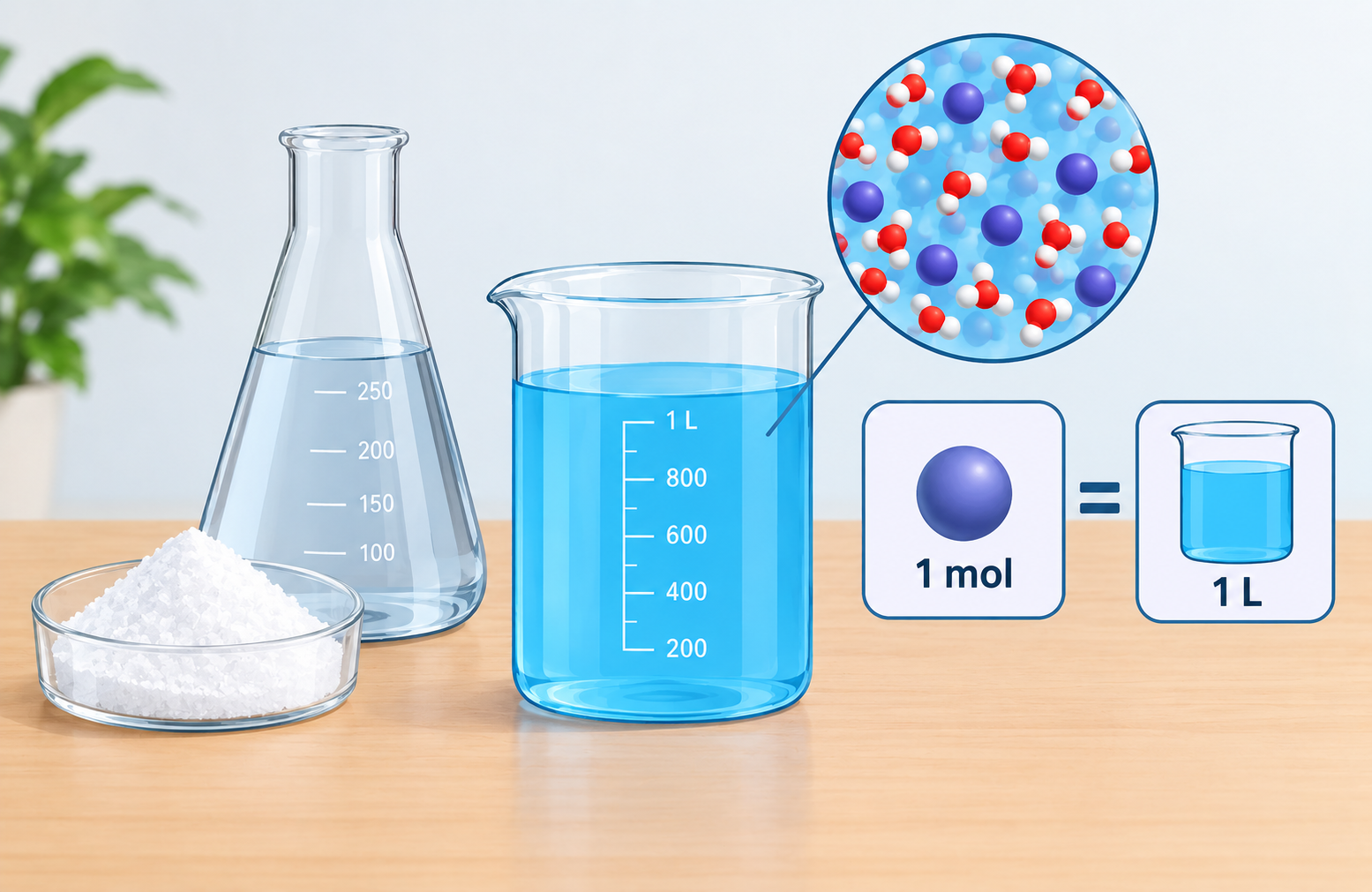
That is where molarity comes in. So, what is molarity in chemistry? Molarity tells you how many moles of a dissolved substance are present in each liter of solution. Once you understand it, you can prepare solutions, predict how much reactant you have, and solve many problems in stoichiometry and titration.
This guide starts from the basic idea of concentration and builds up to worked examples, common mistakes, and practice questions. If you want wider context as you read, our Chemistry Study Guide shows where solutions and concentration fit into the whole subject.
Key Takeaways
-
Molarity is the number of moles of solute per liter of solution, and it measures concentration.
-
The formula is M = n / V, and the unit is mol/L, written as M.
-
V must be the volume of the final solution in liters, not just the solvent.
-
Convert milliliters to liters by dividing by 1000 before substituting.
-
The three forms of the equation are M = n/V, n = M × V, and V = n/M.
-
A mole is an amount, but molarity is a concentration.
-
Common mistakes include forgetting to convert units, using solvent volume, and confusing molarity with molality.
What Is Molarity in Chemistry?
A solution is a homogeneous mixture of a solute (the substance being dissolved) in a solvent (the substance doing the dissolving). In salt water, salt is the solute and water is the solvent.
Concentration describes how much solute is present in a given amount of solution. Molarity, also called molar concentration, is one specific way of expressing it:
Molarity is the number of moles of solute dissolved per liter of solution.
Key points:
- Molarity is a measure of concentration.
- It is expressed in moles per liter (mol/L).
- It is represented by the symbol M, or sometimes written in square brackets, such as [NaCl].
- A higher molarity means more solute particles in the same volume of solution.
Chemists use molarity because reactions happen between particles, and moles count particles. If you know the molarity and the volume, you can work out the number of moles in a sample, and from that you can predict how much will react.
A simple picture: Imagine two beakers, each holding 1 L of solution. One contains 0.1 mol of sugar and the other contains 2 mol of sugar. Both have the same volume, but the second is far more concentrated. The molarities are 0.1 M and 2 M.
Molarity Formula
The molarity formula, sometimes called the molarity equation, is:
M = n / V
where:
- M = molarity (mol/L)
- n = amount of solute in moles
- V = volume of the solution in liters
The most common error is using the wrong volume. V is the volume of the entire final solution, not the volume of solvent you started with. When a solid dissolves, the total volume can differ slightly from the volume of water you poured in. If you dissolve 1 mol of sugar in “1 L of water,” you will end up with more than 1 L of solution, so the molarity will be a little less than 1 M. In practice, chemists dissolve the solute in some solvent and then add solvent until the total reaches the required mark on a volumetric flask.
The unit of molarity is mol/L, which is read “moles per liter.” This unit is so common that it has its own shorthand: 1 mol/L = 1 M. So a “0.5 M NaCl solution” contains 0.5 mol of NaCl in every liter of solution.
If you want to see how the liter fits into the wider system of measurement, the guide What Are SI Units in Physics? explains how base units and derived units work. Strictly, the SI unit of volume is the cubic meter, but the liter is accepted for use alongside SI and is standard in chemistry.
What Do the Symbols in the Molarity Formula Mean?
| Symbol | Meaning | Common Unit |
|---|---|---|
| M | Molarity (molar concentration of the solution) | mol/L or M |
| n | Amount of solute | mol |
| V | Volume of the solution | L |
- M is the result you usually calculate. It tells you the concentration.
- n is the amount of solute counted in moles. If you are given a mass instead, convert it with n = mass ÷ molar mass.
- V is the total volume of the finished solution. It must be in liters for the answer to come out in mol/L.
Each of these is a measurable property of a system. If the idea of a quantity with a number and a unit is new to you, What Is a Physical Quantity? is a helpful short read.
How to Calculate Molarity Step by Step
Here is a reliable method for any molarity calculation:
Step 1: Identify the moles of solute. If the question gives grams, calculate moles first using n = mass ÷ molar mass.
Step 2: Identify the total volume of solution. Make sure it is the final volume, not just the solvent.
Step 3: Convert the volume to liters if necessary. Divide milliliters by 1000.
Step 4: Substitute into M = n / V.
Step 5: Calculate and write the unit. Your answer should end in mol/L or M.
Unit conversion matters because molarity is defined per liter. If you substitute 500 for a volume in milliliters, your answer will be 1000 times too small, and it will not mean what you think it means. Writing units on every line of your working helps you catch this early.
Simple Molarity Examples
Example 1: Volume already in liters
0.5 mol of NaCl is dissolved to make 1.0 L of solution. Find the molarity.
- Given: n = 0.5 mol, V = 1.0 L
- Formula: M = n / V
- Substitution: M = 0.5 mol / 1.0 L
- Calculation: M = 0.5 mol/L
- Final answer: 0.5 M
Example 2: Larger volume
2 mol of a solute are present in 4 L of solution. Find the molarity.
- Given: n = 2 mol, V = 4 L
- Formula: M = n / V
- Substitution: M = 2 mol / 4 L
- Calculation: M = 0.5 mol/L
- Final answer: 0.5 M
Examples 1 and 2 have the same molarity even though the amounts differ. Molarity is a ratio, so doubling both the moles and the volume leaves the concentration unchanged.
Example 3: Volume in milliliters
0.25 mol of solute is present in 500 mL of solution. Find the molarity.
- Given: n = 0.25 mol, V = 500 mL
- Convert: 500 mL ÷ 1000 = 0.500 L
- Formula: M = n / V
- Substitution: M = 0.25 mol / 0.500 L
- Calculation: M = 0.50 mol/L
- Final answer: 0.50 M
Molarity When Volume Is Given in Milliliters
Laboratory glassware such as beakers, pipettes, and volumetric flasks is usually marked in milliliters, so you will often need to convert. The relationship is:
1000 mL = 1 L
so
V (in L) = V (in mL) ÷ 1000
Molarity has liters in the denominator. Using milliliters would give “moles per milliliter,” which is a different unit and 1000 times smaller numerically.
Example 4: 250 mL
0.10 mol of solute is dissolved to make 250 mL of solution.
- Convert: 250 mL ÷ 1000 = 0.250 L
- M = 0.10 mol / 0.250 L = 0.40 M
Example 5: 750 mL
1.5 mol of solute is dissolved to make 750 mL of solution.
- Convert: 750 mL ÷ 1000 = 0.750 L
- M = 1.5 mol / 0.750 L = 2.0 M
Check that your answer is reasonable. In Example 5, 750 mL is less than 1 L, so the molarity must be larger than the number of moles. Here 2.0 is greater than 1.5, which fits.
How to Find Moles From Molarity
Sometimes you know the concentration and volume and need the amount of solute. Start with M = n / V and multiply both sides by V:
n = M × V
The result is in moles when M is in mol/L and V is in liters.
Example 6
How many moles are present in 2 L of a 0.5 M solution?
- Given: M = 0.5 mol/L, V = 2 L
- Formula: n = M × V
- Substitution: n = 0.5 mol/L × 2 L
- Final answer: 1 mol (the liters cancel)
Example 7
How many moles of solute are in 250 mL of 0.20 M solution?
- Convert: 250 mL = 0.250 L
- n = 0.20 mol/L × 0.250 L = 0.050 mol
Going further: from moles to mass
Once you have moles, you can find mass using mass = n × molar mass. For NaCl (molar mass about 58.5 g/mol), 0.050 mol has a mass of 0.050 × 58.5 = 2.925 g, or about 2.9 g. This is exactly how a technician decides how much solid to weigh out when preparing a solution.
How to Find Volume From Molarity
If you know the moles of solute and the molarity you want, you can find the volume. Start with n = M × V and divide both sides by M:
V = n / M
When molarity is in mol/L, the volume you get is in liters.
Example 8
What volume of 0.30 M solution contains 0.60 mol of solute?
- V = n / M = 0.60 mol / 0.30 mol/L = 2.0 L
Example 9
What volume of 2.0 M solution contains 0.050 mol of solute?
- V = 0.050 mol / 2.0 mol/L = 0.025 L
- Convert to milliliters: 0.025 L × 1000 = 25 mL
Molarity and Moles: What Is the Difference?
Students often mix these two ideas because the words look alike.
- A mole measures the amount of a substance. One mole contains 6.022 × 10²³ particles.
- Molarity measures concentration: how many moles are packed into each liter of solution.
Think of a mole as a number of people, and molarity as how crowded a room is. Knowing that 50 people are present tells you the count, but not whether the room is packed or spacious. You also need the size of the room. Likewise, 2 mol of solute could make a very strong solution or a very weak one, depending on the volume.
Moles have the unit mol. Molarity has the unit mol/L. If you need to revise how to convert between grams, moles, and particles, our Mole Concept Study Guide covers it step by step.
Molarity vs Molality
Molality has a similar name but a different definition. Molality uses the mass of the solvent in kilograms, whereas molarity uses the volume of the whole solution in liters.
| Feature | Molarity | Molality |
|---|---|---|
| Definition | Moles of solute per liter of solution | Moles of solute per kilogram of solvent |
| Formula | M = n / V(solution in L) | m = n / mass of solvent (kg) |
| Basis | Volume of solution | Mass of solvent |
| Common unit | mol/L (M) | mol/kg (m) |
| Temperature dependence | Changes with temperature, because volume expands or contracts | Does not change with temperature, because mass stays constant |
Molarity is more convenient in the lab because measuring volume is easy. Molality is preferred when temperature changes matter, as in studies of boiling-point elevation and freezing-point depression.
Molarity vs Concentration
Concentration is the general idea of how much solute is present in a given quantity of solution or solvent. Molarity is one particular way of expressing it. Other common expressions include:
- Mass per volume: grams per liter (g/L)
- Percentage by mass: grams of solute per 100 g of solution
- Percentage by volume: mL of solute per 100 mL of solution
- Parts per million (ppm): used for very dilute solutions
- Molality: mol/kg of solvent
So every molarity is a concentration, but not every concentration is a molarity. Chemists favor molarity because it connects directly to moles, which is what chemical equations are written in.
Molarity in Dilution Calculations
Dilution means adding more solvent to a solution to lower its concentration. The amount of solute does not change, only the volume does. Since n = M × V, the moles before and after must be equal:
M₁V₁ = M₂V₂
- M₁ = initial molarity
- V₁ = initial volume
- M₂ = final molarity (after dilution)
- V₂ = final volume
V₁ and V₂ must be in the same unit, but the unit does not have to be liters because it cancels.
Example 10
100 mL of 1.0 M solution is diluted to a final volume of 500 mL. What is the new molarity?
- M₂ = (M₁ × V₁) / V₂
- M₂ = (1.0 M × 100 mL) / 500 mL = 0.20 M
The volume increased five times, so the concentration dropped to one-fifth.
Common Mistakes Students Make When Calculating Molarity
- Using milliliters instead of liters. Always convert first: divide mL by 1000.
- Using solvent volume instead of final solution volume. Check whether the question gives the total volume of solution.
- Confusing moles with molarity. Moles are an amount in mol. Molarity is a concentration in mol/L.
- Using the wrong formula. If you are unsure, write M = n/V first, then rearrange only if necessary.
- Forgetting units. Write mol, L, and mol/L on every line to keep track of what you are calculating.
- Incorrect decimal conversions. Remember 250 mL is 0.250 L, not 2.50 L or 0.0250 L.
- Confusing molarity with molality. Molarity uses liters of solution. Molality uses kilograms of solvent.
- Making arithmetic errors. Estimate first. If the volume is under 1 L, molarity should be larger than the moles. If the volume is over 1 L, it should be smaller.
Real-Life and Laboratory Uses of Molarity
Molarity is one of the most practical ideas in chemistry:
- Preparing laboratory solutions: Technicians calculate how much solute to weigh out and dissolve to make a solution of a required molarity.
- Titration: In a titration, the known molarity and volume of one solution are used to find the unknown concentration of another.
- Chemical reactions and stoichiometry: Molarity multiplied by volume gives moles, which you can compare using the mole ratios in a balanced equation.
- Calculating concentrations: It lets you compare solutions of different substances on a common basis, particles per liter.
- Pharmaceutical and scientific work: Solutions of defined concentration are used in research and testing, where reproducible concentrations matter. Some laboratories use molar concentration alongside other units such as mg/mL.
Practice Questions
Try these on your own before checking the answers.
- A solution contains 2.0 mol of NaCl in 4.0 L of solution. What is its molarity?
- 0.75 mol of glucose is dissolved to make 250 mL of solution. Find the molarity.
- How many moles of solute are present in 0.25 L of a 2.0 M solution?
- What volume of 1.5 M solution contains 3.0 mol of solute?
- Convert 640 mL to liters.
- 5.85 g of NaCl (molar mass 58.5 g/mol) is dissolved to make 500 mL of solution. Calculate the molarity.
- How many moles of solute are in 150 mL of 0.40 M solution?
- 50.0 mL of 2.0 M solution is diluted to 200 mL. What is the new molarity?
- What volume of 0.20 M solution contains 0.050 mol of solute? Give your answer in mL.
- 4.0 g of NaOH (molar mass 40 g/mol) is dissolved to make 250 mL of solution. Find the molarity.
Answers
- M = n/V = 2.0 mol / 4.0 L = 0.50 M
- V = 250 mL = 0.250 L. M = 0.75 / 0.250 = 3.0 M
- n = M × V = 2.0 × 0.25 = 0.50 mol
- V = n/M = 3.0 / 1.5 = 2.0 L
- 640 ÷ 1000 = 0.640 L
- n = 5.85 / 58.5 = 0.100 mol. V = 0.500 L. M = 0.100 / 0.500 = 0.200 M
- V = 0.150 L. n = 0.40 × 0.150 = 0.060 mol
- M₂ = (2.0 × 50.0) / 200 = 100 / 200 = 0.50 M
- V = n/M = 0.050 / 0.20 = 0.25 L = 250 mL
- n = 4.0 / 40 = 0.10 mol. V = 0.250 L. M = 0.10 / 0.250 = 0.40 M
Frequently Asked Questions About Molarity
What is molarity in simple words?
Molarity tells you how much solute is dissolved in a solution. Specifically, it is the number of moles of solute in each liter of solution.
What is the formula for molarity?
M = n / V, where M is molarity in mol/L, n is moles of solute, and V is the volume of solution in liters.
What is the unit of molarity?
Moles per liter (mol/L), usually abbreviated as M.
How do you calculate molarity from moles and liters?
Divide the moles of solute by the liters of solution. For example, 3 mol in 2 L gives 3 ÷ 2 = 1.5 M.
How do you calculate molarity when volume is in mL?
Convert milliliters to liters by dividing by 1000, then use M = n/V. For 0.50 mol in 200 mL, V = 0.200 L, so M = 2.5 M.
What is the difference between molarity and molality?
Molarity is moles of solute per liter of solution. Molality is moles of solute per kilogram of solvent. Molarity depends on temperature because volume changes with temperature. Molality does not.
What does 1 M mean in chemistry?
A 1 M solution contains 1 mole of solute in every liter of solution.
Can molarity be greater than 1?
Yes. A 2 M or 5 M solution is perfectly possible. The upper limit depends on how much of the solute can dissolve.
Why is molarity based on liters of solution?
Volume is easy to measure in the laboratory, and using the whole solution volume makes it simple to take a measured portion and know how many moles it contains.
References / Further Reading
- OpenStax, Chemistry 2e (free textbook): chapters on solutions and concentration
- Chemistry LibreTexts: sections on molarity, solution concentration, and dilution
- Khan Academy Chemistry: lessons on molarity and solution preparation
- National Institute of Standards and Technology (NIST): information on SI units and the mole
- Royal Society of Chemistry: educational resources on solutions and concentration
Disclaimer:
This article is intended for educational and informational purposes only. While LearnMinto strives to provide accurate and up-to-date mathematics information, readers should verify important academic concepts through official textbooks, educational institutions, examination boards, or trusted educational resources before using this content for exams or academic purposes. LearnMinto is not affiliated with any specific school, university, research institution, or examination board.