
Introduction
Pick up a cup of hot tea and hold a glass of cold water in your other hand. You instantly know which is hotter and which is colder. That difference you are sensing — that measure of hotness or coldness — is what physicists call temperature.
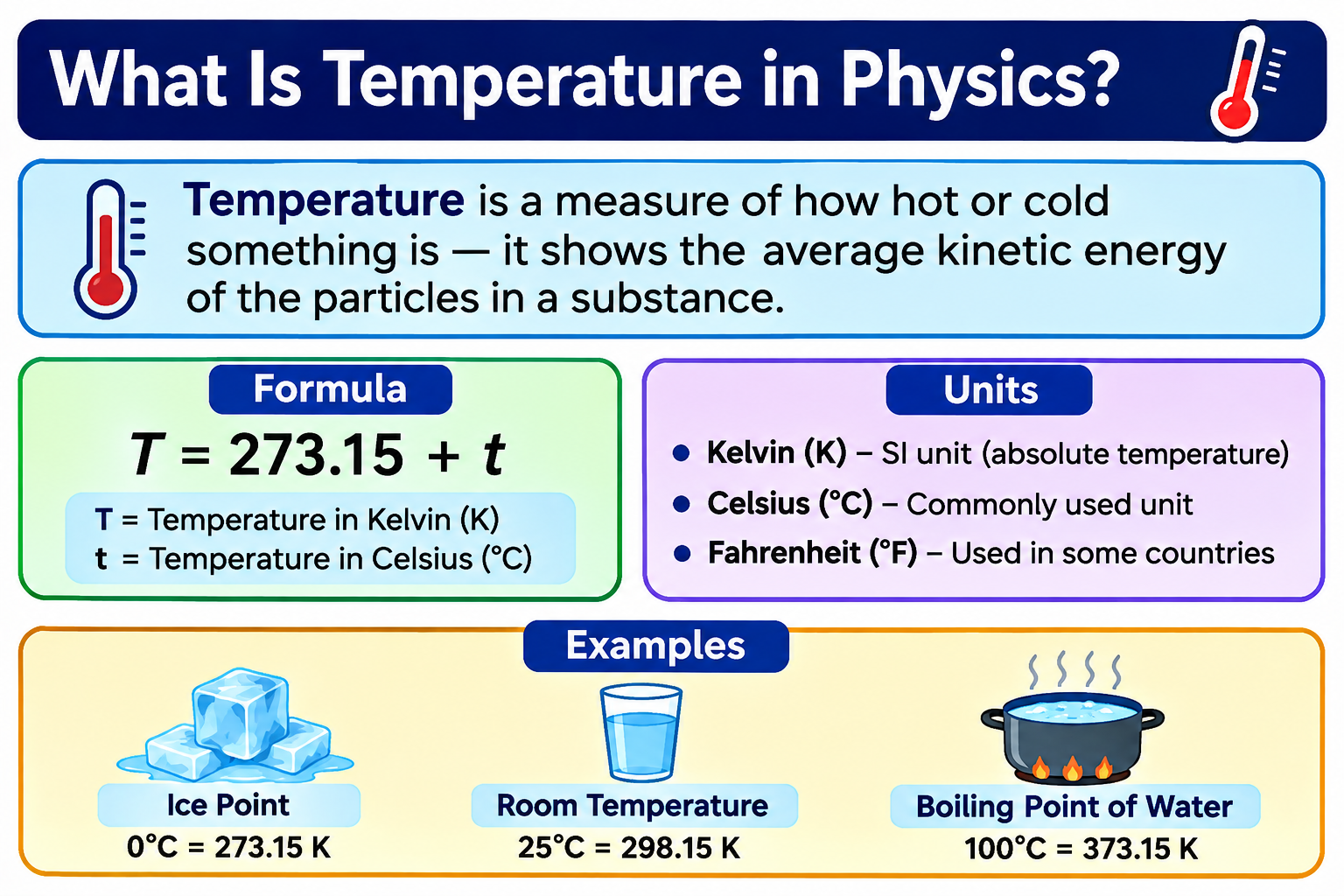
In physics, temperature is a physical quantity that indicates how hot or cold an object or system is and is closely related to the average kinetic energy of its particles. The faster the particles of a substance move and vibrate on average, the higher its temperature. The slower they move on average, the lower its temperature.
Temperature is one of the seven SI base quantities and plays a central role in thermodynamics, heat transfer, gas behaviour, and changes of state. It is not the same as heat, and it is not the same as the total amount of thermal energy a substance contains. Understanding these distinctions is essential for any physics student.
This article explains what temperature is in physics, how it is measured, which scales are used, how it relates to particle motion and energy, and how it affects matter in the real world.
Key Takeaways
-
Temperature is a measure of the average kinetic energy of the particles in a substance
-
The SI base unit of temperature is the kelvin (K)
-
The three main temperature scales are Kelvin, Celsius, and Fahrenheit
-
Absolute zero (0 K = −273.15°C) is the lowest theoretically possible temperature
-
Temperature and heat are not the same thing — heat is energy transferred due to a temperature difference
-
Temperature does not depend on the amount of substance — a small cup and a large tank of water at the same temperature have particles with the same average kinetic energy
-
Temperature is a scalar quantity — it has magnitude only, with no direction
What Is Temperature in Physics?
Temperature is a physical quantity that describes the thermal state of a system. More precisely, it is a measure of the average kinetic energy of the particles — atoms and molecules — that make up a substance.
When we say an object is hot, we mean its particles are moving rapidly on average. When we say it is cold, we mean its particles are moving more slowly on average. Temperature gives us a single number that captures this average thermal activity.
Temperature tells us:
- How hot or cold a substance is relative to a reference point
- In which direction heat will flow when two objects are placed in contact (heat flows from higher temperature to lower temperature)
- The average kinetic energy of the microscopic particles of a substance
What temperature does not tell us directly:
- How much thermal energy the substance contains in total
- How large or massive the substance is
- How much heat has been transferred
Temperature is one of the most important physical quantities in science. It governs chemical reactions, the behaviour of gases, the flow of heat, changes of state, and the operation of nearly every machine or engine in existence.
Temperature and Particle Motion
All matter is made up of atoms and molecules that are in constant, random motion. This motion never completely stops under normal conditions — it is a fundamental feature of matter.
The temperature of a substance is directly related to the average kinetic energy of these particles:
- In a solid, particles vibrate back and forth around fixed positions
- In a liquid, particles move more freely but remain close together
- In a gas, particles move rapidly in all directions with large gaps between them
When you heat a substance:
- You transfer energy to its particles
- The particles move faster on average
- The average kinetic energy increases
- The temperature rises
When you cool a substance:
- Particles lose energy
- They slow down on average
- The average kinetic energy decreases
- The temperature falls
The critical word here is average. Not every particle has the same kinetic energy at a given temperature — there is a distribution of energies. Temperature reflects the average across all the particles in the sample.
This also explains why temperature does not depend on the size of the sample. A small and a large sample of water at 60°C have particles with the same average kinetic energy, even though the larger sample contains far more particles and far more total energy overall.
Is Temperature a Scalar or Vector Quantity?
Temperature is a scalar quantity.
It has magnitude — a numerical value with a unit — but no direction. You cannot say that a temperature of 80°C is “pointing northward” or has any spatial direction associated with it.
This makes temperature different from vector quantities such as force, velocity, or momentum, which always have both magnitude and direction.
Because temperature is scalar, it is fully described by a single number and its unit.
SI Unit of Temperature
The SI base unit of temperature is the kelvin, symbol K.
Note that the kelvin does not use a degree symbol (°). You write 300 K, not 300°K.
The other two scales in common use are:
| Scale | Symbol | Common Use | Key Reference Points |
|---|---|---|---|
| Kelvin | K | Physics and science | 0 K = absolute zero; 273.15 K = water freezes; 373.15 K = water boils |
| Celsius | °C | Everyday use worldwide | 0°C = water freezes; 100°C = water boils |
| Fahrenheit | °F | Everyday use in USA | 32°F = water freezes; 212°F = water boils |
The kelvin is used in scientific work because it starts at absolute zero — the lowest possible temperature — making it ideal for calculations involving gas laws and thermodynamics.
Celsius, Fahrenheit and Kelvin
The Kelvin Scale
The Kelvin scale is the SI temperature scale. It begins at absolute zero (0 K), which is the theoretically lowest possible temperature. The size of one kelvin is exactly equal to the size of one degree Celsius.
The Celsius Scale
The Celsius scale (°C) is based on the freezing and boiling points of pure water at standard atmospheric pressure:
- 0°C = freezing point of water
- 100°C = boiling point of water
The Fahrenheit Scale
The Fahrenheit scale (°F) is used primarily in the United States. Its reference points are:
- 32°F = freezing point of water
- 212°F = boiling point of water
Conversion Formulas
Celsius to Kelvin:
K = °C + 273.15
Kelvin to Celsius:
°C = K − 273.15
Celsius to Fahrenheit:
°F = (9/5 × °C) + 32
Fahrenheit to Celsius:
°C = 5/9 × (°F − 32)
Fahrenheit to Kelvin:
K = 5/9 × (°F − 32) + 273.15
Each formula is straightforward to apply with a clear step-by-step approach, as shown in the worked examples section below.
What Is Absolute Zero?
Absolute zero is the lowest theoretically possible temperature: 0 K, which equals −273.15°C or −459.67°F.
At absolute zero, the thermal motion of particles reaches its minimum possible value. Particles would have the lowest possible energy state permitted by the laws of physics. It is important to state this carefully: at absolute zero, particles do not completely stop all motion — quantum mechanical effects mean that even at 0 K, a residual ground-state energy (called zero-point energy) remains.
Absolute zero has never been achieved in practice. Scientists have come extremely close — within billionths of a kelvin — in highly specialised laboratory experiments, but the laws of thermodynamics make it impossible to actually reach 0 K in a finite number of steps.
Why absolute zero matters in physics:
- It defines the starting point of the Kelvin scale
- It is essential for the correct use of gas laws (which require temperature in kelvin)
- It is a fundamental concept in thermodynamics and quantum physics
- It represents the state of minimum particle energy
How Is Temperature Measured?
Temperature is measured using a thermometer — any device that uses a physical property that changes predictably and reproducibly with temperature.
The principle behind all thermometers is thermal equilibrium. When a thermometer is placed in contact with an object, heat flows between them until they reach the same temperature. At that point, the thermometer reading reflects the temperature of the object.
For a thermometer to work reliably, it must:
- Reach thermal equilibrium quickly
- Use a physical property that changes uniformly with temperature
- Be calibrated against known reference points (such as the freezing and boiling points of water)
Common physical properties used to measure temperature:
- Expansion of a liquid (liquid-in-glass thermometers)
- Change in electrical resistance (digital thermometers)
- Emission of infrared radiation (infrared thermometers)
- Pressure of a gas at constant volume (gas thermometers)
Types of Thermometers
Liquid-in-Glass Thermometers
These are the traditional thermometers you may have seen in science lessons. They contain a liquid — usually mercury or coloured alcohol — sealed inside a glass tube with a narrow bore.
When temperature rises, the liquid expands and rises up the tube. When temperature falls, it contracts and falls. The level of liquid against a calibrated scale gives the temperature.
Mercury thermometers are accurate but have been largely replaced in many applications due to the hazards of mercury. Alcohol thermometers are safer and can measure lower temperatures.
Digital Thermometers
Digital thermometers use electronic sensors — typically a thermistor or resistance temperature detector — whose electrical resistance changes with temperature. A circuit converts this change in resistance to a temperature reading on a digital display.
They are fast, accurate, easy to read, and widely used in medical, laboratory, and household settings.
Infrared Thermometers
Infrared thermometers detect the infrared radiation emitted by a surface and use this to calculate the surface temperature without making direct contact with the object.
They are useful for measuring the temperature of moving objects, very hot surfaces, or situations where contact measurement is impractical. Infrared thermometers became widely known during the COVID-19 pandemic when they were used for rapid temperature screening.
Gas Thermometers
Gas thermometers measure temperature by monitoring the pressure of a fixed amount of gas at constant volume (or the volume of gas at constant pressure). Since the pressure and volume of an ideal gas are directly proportional to absolute temperature, gas thermometers are highly accurate and are used in scientific calibration.
They are too large and fragile for everyday use but are important reference instruments in precision science.
What Is Thermal Equilibrium?
Thermal equilibrium is the state reached when two objects that are in thermal contact — able to exchange heat — have reached the same temperature, so that there is no further net flow of heat between them.
A practical example: if you place a cool metal spoon into a cup of hot soup, heat flows from the hot soup into the cooler spoon. Eventually, the spoon and the soup reach the same temperature. At that point, they are in thermal equilibrium and heat transfer between them effectively stops.
The zeroth law of thermodynamics builds on this idea: if two systems are each in thermal equilibrium with a third system, then they are in thermal equilibrium with each other. This law underpins the entire concept of temperature measurement.
For a detailed explanation of the energy involved in heat transfer processes, our article on [What Is Heat Energy?] provides an excellent foundation.
Temperature vs Heat
This is one of the most important distinctions in physics, and one that students frequently confuse.
| Feature | Temperature | Heat |
|---|---|---|
| Meaning | Measure of average kinetic energy of particles | Energy transferred due to a temperature difference |
| SI unit | Kelvin (K) | Joule (J) |
| Relationship to particles | Related to average particle speed | Related to total energy transferred |
| Transfer | Does not transfer — it is a state | Transfers from higher to lower temperature |
| Depends on amount of substance | No | Yes |
| Example | Water at 80°C | Energy flowing from hot water to a cold hand |
The key distinction is this:
- Temperature is a property of a system — it describes its thermal state at a given moment
- Heat is a process — it is energy in transit between systems because of a temperature difference
Heat flows from a region of higher temperature to a region of lower temperature until thermal equilibrium is reached. Once equilibrium is reached, heat transfer stops — even though both objects still have a temperature.
Temperature vs Thermal Energy
While temperature is related to the average kinetic energy of particles, thermal energy (also called internal energy) is related to the total energy of all the particles in a substance.
Consider two containers of water:
- Container A: 200 ml of water at 80°C
- Container B: 2 litres of water at 60°C
Container A has a higher temperature, meaning its particles have a higher average kinetic energy. But container B, despite its lower temperature, contains far more water and therefore a much larger total amount of thermal energy.
This example shows clearly why temperature alone cannot tell you how much total energy a substance contains. The amount of substance matters too.
This distinction is explored in greater depth in our article on [What Is Kinetic Energy?], which covers how the kinetic energy of particles relates to both temperature and thermal energy.
Does Higher Temperature Mean More Energy?
The answer depends on what is meant by “more energy.”
Higher temperature does mean higher average kinetic energy per particle. In this sense, yes — a hotter substance has more average energy per particle.
But higher temperature does not necessarily mean more total thermal energy. A small piece of iron at 500°C contains less total thermal energy than a large swimming pool at 30°C, even though the iron is at a much higher temperature.
To summarise:
- Temperature → average kinetic energy per particle
- Total thermal (internal) energy → depends on both temperature and the number of particles (amount of substance)
This is why a spark from a fire, despite being at a very high temperature, will not seriously burn you if it lands on your skin — it contains very little total energy because it has so little mass.
Temperature and Kinetic Energy
At the microscopic level, the temperature of an ideal gas is directly proportional to the average kinetic energy of its molecules.
The relationship is:
Average kinetic energy = (3/2) × k_B × T
Where:
- k_B = Boltzmann constant = 1.38 × 10⁻²³ J/K
- T = absolute temperature in kelvin (K)
This formula is typically encountered in A-Level and introductory university physics. At GCSE level, the key idea is simply that:
- Higher temperature → greater average kinetic energy of particles
- Lower temperature → lower average kinetic energy of particles
The Boltzmann constant k_B is the bridge between the macroscopic quantity of temperature and the microscopic world of individual particle energies. This connection between temperature and kinetic energy is what makes the Kelvin scale so important — the relationship only holds when temperature is expressed in kelvin, not Celsius or Fahrenheit.
Temperature and Internal Energy
Internal energy is the total energy stored within a system due to the microscopic motion and interactions of its particles. It includes:
- The kinetic energy of particles due to their random motion (vibration, rotation, translation)
- The potential energy associated with the forces between particles
Temperature is related to the kinetic energy component of internal energy. When the temperature of a substance rises, the kinetic energy of its particles increases. However, internal energy can also change during phase changes (such as melting or boiling) even when temperature remains constant — because energy is used to overcome the forces holding particles together rather than increasing their speed.
This is why a pan of water at 100°C does not immediately turn into steam just because it has reached the boiling point. Additional energy must be supplied (the latent heat) to actually change the state, while the temperature stays at 100°C throughout the boiling process.
Temperature and Heat Transfer
Heat transfers spontaneously from a region of higher temperature to a region of lower temperature whenever a temperature difference exists between two objects or regions in thermal contact.
This continues until thermal equilibrium is reached — when both objects are at the same temperature and net heat transfer ceases.
The rate of heat transfer depends on:
- The size of the temperature difference (larger difference → faster transfer)
- The nature of the materials involved (some conduct heat better than others)
- The method of heat transfer (conduction, convection, or radiation)
Temperature and the Three Methods of Heat Transfer
Conduction
Conduction is the transfer of thermal energy through a material by direct particle-to-particle interaction, without any bulk movement of the material itself.
When one end of a metal spoon is placed in hot soup, the particles at the hot end gain kinetic energy and vibrate more vigorously. These vibrating particles collide with and pass energy to neighbouring particles, gradually transferring heat along the spoon toward the cooler handle.
Materials that conduct heat well (such as metals) are called conductors. Materials that conduct heat poorly (such as wood, plastic, and air) are called insulators.
Convection
Convection is the transfer of thermal energy by the bulk movement of a fluid (liquid or gas).
When water in a pan is heated, the water near the bottom becomes warmer, expands, becomes less dense, and rises. Cooler, denser water from above sinks to replace it. This circulation creates a convection current that gradually heats the entire volume of water.
Convection cannot occur in solids because the particles are not free to move from place to place.
Radiation
Radiation is the transfer of energy by electromagnetic waves — primarily infrared radiation — and does not require any medium or direct contact.
The Sun transfers energy to the Earth across approximately 150 million kilometres of empty space entirely by radiation. All objects with a temperature above absolute zero emit some infrared radiation. Hotter objects emit more radiation and at higher frequencies.
How Does Temperature Affect Matter?
Temperature changes cause measurable changes in the physical properties and behaviour of matter in all three states.
Solids:
- Particles vibrate faster with increasing temperature
- The material expands slightly as particle spacing increases
- At the melting point, particles have enough energy to break free from their fixed positions
Liquids:
- Particles move more quickly with increasing temperature
- The liquid becomes less viscous (flows more easily)
- Evaporation increases because more surface particles have sufficient energy to escape
- At the boiling point, particles throughout the liquid gain enough energy to escape into the gas phase
Gases:
- Particles move faster and collide more frequently and forcefully with increasing temperature
- At constant volume, pressure increases
- At constant pressure, the gas expands (volume increases)
Temperature and Changes of State
When a substance changes state — from solid to liquid, liquid to gas, or any other phase transition — the temperature behaves in a particularly interesting way.
During a phase change at constant pressure, the temperature of a substance typically remains constant even though energy is being continuously supplied. This energy is used to overcome the intermolecular forces holding the particles in their current arrangement, rather than increasing their kinetic energy.
The energy required to change state at constant temperature is called latent heat.
Common phase changes and the associated temperature behaviour:
| Phase Change | Direction | Temperature During Change |
|---|---|---|
| Melting | Solid → Liquid | Constant (at melting point) |
| Freezing | Liquid → Solid | Constant (at freezing point) |
| Boiling/Vaporisation | Liquid → Gas | Constant (at boiling point) |
| Condensation | Gas → Liquid | Constant (at condensation point) |
| Sublimation | Solid → Gas | Constant (at sublimation point) |
| Deposition | Gas → Solid | Constant (at deposition point) |
The melting point of ice (0°C) and the boiling point of water (100°C at standard atmospheric pressure) serve as the reference points for the Celsius scale.
Temperature and Thermal Expansion
Most materials expand when heated and contract when cooled. This happens because as particles gain kinetic energy, they vibrate more vigorously and push their neighbours slightly further away, increasing the average spacing between particles and therefore the overall size of the material.
Real-life examples of thermal expansion:
- Railway tracks have small gaps left between sections to allow for expansion in summer. Without these gaps, the tracks could buckle.
- Bridges are built with expansion joints that allow the structure to lengthen in hot weather.
- Overhead power lines sag more in summer because the metal cables expand in the heat.
- Liquid-in-glass thermometers rely directly on the thermal expansion of liquid to indicate temperature.
- Metal jar lids can be loosened by running them under hot water — the metal expands faster than the glass, loosening the seal.
Water is a notable exception to the general rule of thermal expansion. Liquid water is actually densest at 4°C and expands when cooled below this temperature. This is why ice is less dense than liquid water and floats — a property that is vital for aquatic life surviving cold winters, as the floating ice insulates the liquid water below.
More details on the physics of thermal expansion are covered in our article on [What Is Physics].
Temperature and Gas Laws
Temperature is central to the behaviour of gases. The key relationships are:
At constant volume (Gay-Lussac’s Law):
The pressure of a fixed amount of gas is directly proportional to its absolute temperature.
P ∝ T (at constant V and n)
If temperature increases, pressure increases proportionally.
At constant pressure (Charles’s Law):
The volume of a fixed amount of gas is directly proportional to its absolute temperature.
V ∝ T (at constant P and n)
If temperature increases, volume increases proportionally.
Combined Gas Law:
PV / T = constant (for a fixed amount of gas)
In all gas law equations, temperature must be expressed in kelvin. Using Celsius values in these equations gives incorrect results because the Celsius scale does not start at absolute zero.
For example: doubling the Celsius temperature from 100°C to 200°C does not double the pressure of a gas at constant volume — but doubling the kelvin temperature from 373 K to 746 K does.
This is one of the most practical reasons why physicists use the Kelvin scale.
Temperature in Everyday Life
Temperature is not just a physics concept confined to laboratories. It governs almost every aspect of everyday life:
- Weather: the temperature of the atmosphere determines whether we experience sun, rain, or snow, and drives wind patterns and ocean currents
- Cooking: heat changes the temperature of food, altering its physical structure and enabling chemical reactions
- Refrigerators and freezers: lower the temperature of stored food to slow bacterial growth and preserve freshness
- Air conditioners and heat pumps: transfer heat between regions to control indoor temperature
- Human body temperature: the normal core body temperature is approximately 37°C (98.6°F). Fever (above about 38°C) is a sign of illness; hypothermia (below about 35°C) is medically dangerous.
- Industrial processes: steelmaking, chemical production, and materials processing all depend on precise temperature control
- Engines: combustion engines generate heat at high temperature to produce mechanical work
- Weather forecasting: temperature measurements from thousands of stations worldwide are used to model and predict weather patterns
Why Is Temperature Important in Physics?
Temperature is one of the most fundamental quantities in physics because it appears in virtually every area of the subject:
- Thermodynamics: the laws of thermodynamics are built around temperature, heat, and energy
- Heat transfer: the rate and direction of heat transfer depend directly on temperature differences
- Gas laws: the pressure, volume, and behaviour of gases all depend on temperature
- Energy transformations: the efficiency of engines and heat pumps is determined by temperature ratios
- Phase changes: melting, boiling, and other phase transitions occur at specific temperatures
- Statistical mechanics: temperature determines the distribution of energies among particles in a system
- Astrophysics: the temperature of stars determines the radiation they emit and their colour
- Chemistry: reaction rates, equilibrium constants, and solubility all depend on temperature
- Engineering: materials selection, thermal management, and design of engines all require precise temperature knowledge
Without a precise definition of temperature, none of these fields could be quantified or calculated. It is truly a cornerstone quantity of physical science.
Common Misconceptions About Temperature
Misconception 1: Temperature and heat are the same thing.
They are not. Temperature is a property of a system that describes its thermal state. Heat is energy transferred between systems because of a temperature difference. One is a state; the other is a process.
Misconception 2: A larger object must have a higher temperature than a smaller one.
Temperature does not depend on size. A small cup of boiling water at 100°C is at a higher temperature than a large swimming pool at 25°C, despite containing far less total thermal energy.
Misconception 3: Celsius and Kelvin are completely different physical quantities.
They are actually the same size of unit — one degree Celsius equals one kelvin. They differ only in their starting point. 0°C = 273.15 K.
Misconception 4: Temperature measures total thermal energy.
Temperature measures the average kinetic energy of particles, not the total energy. Total thermal energy depends on both temperature and the amount of substance.
Misconception 5: Absolute zero means every particle completely stops moving.
At absolute zero, particles have the minimum possible energy — their ground state. Quantum mechanics requires that some residual energy (zero-point energy) remains. Particles do not become completely stationary.
Misconception 6: Something described as “hot” always has a high temperature.
In everyday language this is usually true, but in physics, “hot” is relative. A substance at 100°C is hot compared to room temperature but cool compared to a furnace at 1,500°C.
Misconception 7: A higher temperature always means an object contains more total energy.
Not necessarily. Total thermal energy depends on both temperature and mass. A bath of water at 40°C contains far more total thermal energy than a hot spark at 1,000°C, because the mass of water is enormously greater.
Temperature Conversion Examples
Example 1: Celsius to Kelvin
Convert 25°C to kelvin.
Given: T = 25°C
Formula: K = °C + 273.15
Substitution: K = 25 + 273.15
Answer: 298.15 K
Example 2: Kelvin to Celsius
Convert 373 K to Celsius.
Given: T = 373 K
Formula: °C = K − 273.15
Substitution: °C = 373 − 273.15
Answer: 99.85°C ≈ 100°C
This confirms that 373 K is approximately the boiling point of water.
Example 3: Celsius to Fahrenheit
Convert 37°C (normal body temperature) to Fahrenheit.
Given: T = 37°C
Formula: °F = (9/5 × °C) + 32
Substitution: °F = (9/5 × 37) + 32 = 66.6 + 32
Answer: 98.6°F
Example 4: Fahrenheit to Celsius
Convert 212°F to Celsius.
Given: T = 212°F
Formula: °C = 5/9 × (°F − 32)
Substitution: °C = 5/9 × (212 − 32) = 5/9 × 180 = 100
Answer: 100°C
This confirms that 212°F is the boiling point of water.
Example 5: Fahrenheit to Kelvin
Convert 32°F to kelvin.
Given: T = 32°F
Step 1 — Convert to Celsius: °C = 5/9 × (32 − 32) = 0°C
Step 2 — Convert to Kelvin: K = 0 + 273.15
Answer: 273.15 K
This confirms that 32°F = 0°C = 273.15 K (the freezing point of water).
Temperature Practice Questions
15 Multiple Choice Questions
Question 1: What does temperature measure in physics?
A. The total thermal energy of a substance
B. The amount of heat transferred to a substance
C. The average kinetic energy of the particles of a substance
D. The mass of particles in a substance
Correct Answer: C
Temperature is directly related to the average kinetic energy of the particles in a substance, not the total energy.
Question 2: What is the SI unit of temperature?
A. Degree Celsius (°C)
B. Degree Fahrenheit (°F)
C. Joule (J)
D. Kelvin (K)
Correct Answer: D
The kelvin (K) is the SI base unit of temperature.
Question 3: Convert 100°C to kelvin.
A. 100 K
B. 273 K
C. 373 K
D. 473 K
Correct Answer: C
K = °C + 273.15 = 100 + 273.15 ≈ 373 K.
Question 4: What is absolute zero?
A. 0°C
B. −100°C
C. 0 K (−273.15°C)
D. 273 K
Correct Answer: C
Absolute zero is 0 K, which equals −273.15°C — the theoretically lowest possible temperature.
Question 5: Is temperature a scalar or vector quantity?
A. Vector
B. Scalar
C. Neither
D. Both, depending on the situation
Correct Answer: B
Temperature has magnitude only and no direction. It is a scalar quantity.
Question 6: A large container of warm water and a small cup of hot water are compared. Which statement is correct?
A. The large container has a higher temperature.
B. The small cup has more total thermal energy.
C. The small cup has a higher temperature but may have less total thermal energy.
D. They must have the same temperature.
Correct Answer: C
Temperature is independent of quantity. The small cup may be hotter, but the large container may hold more total thermal energy.
Question 7: Convert 0°F to Celsius.
A. 0°C
B. 32°C
C. −17.8°C
D. −32°C
Correct Answer: C
°C = 5/9 × (0 − 32) = 5/9 × (−32) = −17.8°C.
Question 8: What happens to the temperature of water while it is boiling at 100°C at standard pressure?
A. It keeps rising steadily.
B. It remains constant at 100°C.
C. It drops slightly.
D. It jumps to 200°C instantly.
Correct Answer: B
During a phase change (boiling), energy is used to overcome intermolecular forces. Temperature remains constant until the phase change is complete.
Question 9: Which temperature scale is most appropriate for use in gas law calculations?
A. Celsius
B. Fahrenheit
C. Kelvin
D. All scales are equally suitable
Correct Answer: C
Gas laws require absolute temperature. Only the Kelvin scale starts at absolute zero, making it the correct scale for gas law equations.
Question 10: When two objects reach thermal equilibrium:
A. One object melts and the other solidifies.
B. Heat continues to flow from hot to cold indefinitely.
C. Both objects reach the same temperature and net heat transfer stops.
D. The temperature of both objects becomes zero.
Correct Answer: C
Thermal equilibrium is when both objects reach the same temperature and no further net heat flows between them.
Question 11: Convert 300 K to Celsius.
A. 573°C
B. 27°C
C. −27°C
D. 300°C
Correct Answer: B
°C = K − 273.15 = 300 − 273.15 = 26.85°C ≈ 27°C.
Question 12: Which method of heat transfer does not require a medium?
A. Conduction
B. Convection
C. Radiation
D. Diffusion
Correct Answer: C
Radiation transfers energy through electromagnetic waves and does not require any medium — it travels through a vacuum.
Question 13: A small hot spark at 1,000°C and a large warm bath at 40°C are compared. Which statement is correct?
A. The spark contains more total thermal energy.
B. The bath contains more total thermal energy.
C. They contain equal thermal energy because they are both above 0°C.
D. Temperature alone determines total thermal energy.
Correct Answer: B
The bath has far greater mass, so despite its lower temperature, its total thermal energy is much greater than that of the tiny spark.
Question 14: Which of the following best describes heat in physics?
A. A property of an object describing how hot it is
B. The average kinetic energy of particles
C. Energy transferred between objects due to a temperature difference
D. The total energy of particles in a system
Correct Answer: C
Heat is energy in transit — it flows from a higher temperature region to a lower temperature region.
Question 15: A gas is heated at constant volume. What happens to its pressure?
A. Pressure decreases
B. Pressure stays the same
C. Pressure increases
D. Pressure becomes zero
Correct Answer: C
When temperature increases at constant volume, particles move faster, collide more forcefully with the container walls, and pressure increases (Gay-Lussac’s Law).
10 Short Answer Questions
Q1: Define temperature in physics.
Temperature is a physical quantity that measures the average kinetic energy of the particles in a substance. It indicates how hot or cold a system is and determines the direction of heat flow.
Q2: What is the SI unit of temperature and why is it used in science?
The SI unit is the kelvin (K). It is used in science because it starts at absolute zero, making it proportional to the average kinetic energy of particles. This makes it essential for gas law and thermodynamic calculations.
Q3: What is absolute zero?
Absolute zero is 0 K (−273.15°C), the theoretically lowest possible temperature. At absolute zero, particles have their minimum possible energy. It has never been achieved in practice.
Q4: A student says “heat and temperature are the same thing.” Explain why this is incorrect.
Heat is energy transferred between systems due to a temperature difference. Temperature is a property of a system describing its thermal state. Heat is a process; temperature is a property. They are measured in different units (joules and kelvin respectively).
Q5: Convert 37°C to kelvin.
K = 37 + 273.15 = 310.15 K
Q6: Why must temperature be in kelvin when using gas laws?
Gas laws describe proportional relationships between temperature, pressure, and volume. These relationships are only valid when temperature is measured from absolute zero — the point at which molecular motion is at its minimum. The Kelvin scale starts at absolute zero, making it the only appropriate scale.
Q7: Explain thermal equilibrium using an everyday example.
When a cold metal spoon is placed in hot tea, heat flows from the tea to the spoon. After some time, both reach the same temperature and heat transfer effectively stops. This is thermal equilibrium.
Q8: Why does temperature remain constant during boiling?
During boiling, energy is used to overcome the attractive forces between liquid molecules rather than increasing their kinetic energy. Because the kinetic energy does not increase, the temperature does not rise during the phase change.
Q9: Convert −40°F to Celsius.
°C = 5/9 × (−40 − 32) = 5/9 × (−72) = −40°C.
Interestingly, −40°F = −40°C. This is the only temperature where the Fahrenheit and Celsius scales give the same numerical value.
Q10: What is the difference between temperature and thermal energy?
Temperature measures the average kinetic energy per particle. Thermal energy is the total energy of all the particles in a substance. A large, cool sample can contain more total thermal energy than a small, hot sample.
5 Numerical Problems
Problem 1: Convert the boiling point of water (100°C) to Fahrenheit and Kelvin.
Celsius to Fahrenheit:
°F = (9/5 × 100) + 32 = 180 + 32 = 212°F
Celsius to Kelvin:
K = 100 + 273.15 = 373.15 K
Problem 2: A gas thermometer reads 500 K. Convert this to Celsius and Fahrenheit.
Kelvin to Celsius:
°C = 500 − 273.15 = 226.85°C
Celsius to Fahrenheit:
°F = (9/5 × 226.85) + 32 = 408.33 + 32 = 440.33°F
Problem 3: The surface temperature of the Sun is approximately 5,778 K. Convert to Celsius.
°C = 5,778 − 273.15 = 5,504.85°C ≈ 5,505°C
Problem 4: A patient has a temperature of 104°F. Is this a fever? Convert to Celsius and Kelvin.
°C = 5/9 × (104 − 32) = 5/9 × 72 = 40°C
K = 40 + 273.15 = 313.15 K
Yes, this is a fever. Normal body temperature is approximately 37°C; 40°C is well above this.
Problem 5: Liquid nitrogen boils at −196°C. Convert this to Kelvin and Fahrenheit.
Celsius to Kelvin:
K = −196 + 273.15 = 77.15 K
Celsius to Fahrenheit:
°F = (9/5 × −196) + 32 = −352.8 + 32 = −320.8°F
Exam Tips
Keep these points in mind when answering examination questions on temperature:
- SI unit: Always state that the SI unit of temperature is the kelvin (K) — not Celsius, not Fahrenheit.
- Kelvin scale: The kelvin starts at absolute zero. There are no negative kelvin values. Add 273.15 to Celsius to convert.
- Celsius to Kelvin: K = °C + 273.15. This formula is the most commonly needed conversion in physics.
- Celsius to Fahrenheit: °F = (9/5 × °C) + 32. Know this for exam completeness.
- Absolute zero: State it as 0 K and −273.15°C. Do not say particles “stop completely” — say they reach their minimum energy state.
- Heat vs temperature: Heat is energy transferred; temperature is a property. They are measured in different units (J and K). Knowing this distinction earns marks in explanation questions.
- Temperature vs thermal energy: Emphasise that temperature is an average (per particle) while thermal energy is a total. Use the cup vs tank example.
- Thermal equilibrium: State that both objects reach the same temperature and net heat flow stops. Link this to the zeroth law of thermodynamics at A-Level.
- Temperature and particle motion: Higher temperature → faster average particle motion → higher average kinetic energy. State this clearly in any explanation.
- Gas laws and kelvin: Always convert to kelvin before substituting into any gas law formula.
Quick Revision Notes
- Temperature = measure of average kinetic energy of particles
- SI unit = kelvin (K)
- Common scales: Kelvin (science), Celsius (everyday), Fahrenheit (USA)
- K = °C + 273.15
- °F = (9/5 × °C) + 32
- Absolute zero = 0 K = −273.15°C = minimum energy state
- Temperature is a scalar — magnitude only, no direction
- Higher temperature → faster particle motion → greater average kinetic energy
- Temperature ≠ heat: temperature is a state; heat is energy transfer
- Temperature ≠ thermal energy: temperature is per particle average; thermal energy is total
- Thermal equilibrium: two objects at the same temperature; no net heat flow
- Temperature remains constant during a phase change (latent heat is supplied)
- Most materials expand when heated (thermal expansion)
- Gas laws require temperature in kelvin
- Heat transfers: conduction (particle to particle), convection (fluid movement), radiation (electromagnetic waves)
Temperature Cheat Sheet
| Concept | Definition | Unit | Example |
|---|---|---|---|
| Temperature | Average kinetic energy of particles | Kelvin (K) | Water at 373 K (100°C) |
| Kelvin scale | Absolute scale starting at 0 K | K | 0 K = −273.15°C |
| Celsius scale | Scale based on freezing/boiling points of water | °C | 0°C = freezing, 100°C = boiling |
| Fahrenheit scale | Scale used in USA | °F | 32°F = freezing, 212°F = boiling |
| Absolute zero | Minimum possible temperature | 0 K (−273.15°C) | Lowest achievable thermal state |
| Thermal equilibrium | Same temperature, no net heat flow | K or °C | Spoon reaching tea temperature |
| Heat | Energy transferred due to temperature difference | Joule (J) | Heat flowing from hot pan to cold hand |
| Thermal energy | Total energy of all particles | Joule (J) | Large pool contains more than small cup |
| Celsius to Kelvin | K = °C + 273.15 | K | 25°C = 298.15 K |
| Celsius to Fahrenheit | °F = (9/5 × °C) + 32 | °F | 100°C = 212°F |
Frequently Asked Questions
1. What is temperature in physics?
Temperature is a physical quantity that measures the average kinetic energy of the particles in a substance. It describes how hot or cold a system is and determines the direction of spontaneous heat flow.
2. What is the SI unit of temperature?
The SI base unit of temperature is the kelvin (K). Unlike Celsius and Fahrenheit, the Kelvin scale starts at absolute zero.
3. Is temperature a scalar or vector quantity?
Temperature is a scalar quantity. It has magnitude only and does not have a direction.
4. What is the difference between heat and temperature?
Temperature is a property of a system — it describes the average kinetic energy of its particles. Heat is energy in transit — it flows between systems because of a temperature difference. They are measured in different units: temperature in kelvin, heat in joules.
5. What is absolute zero?
Absolute zero is 0 K (−273.15°C) — the theoretically lowest possible temperature. At this temperature, particles are in their minimum energy state. It has never been perfectly achieved experimentally.
6. How is temperature measured?
Temperature is measured using a thermometer, which works by using a physical property (such as liquid expansion or electrical resistance) that changes predictably with temperature. The thermometer must reach thermal equilibrium with the object being measured.
7. What is the Kelvin temperature scale?
The Kelvin scale is the SI temperature scale. It starts at absolute zero (0 K) and uses the same size unit as Celsius. It is used in scientific calculations, particularly those involving gas laws and thermodynamics.
8. How do you convert Celsius to Kelvin?
Add 273.15 to the Celsius temperature: K = °C + 273.15. For example, 25°C = 298.15 K.
9. How do you convert Celsius to Fahrenheit?
Use: °F = (9/5 × °C) + 32. For example, 100°C = 212°F.
10. How is temperature related to kinetic energy?
Temperature is proportional to the average kinetic energy of the particles in a substance. Higher temperature means particles move faster on average and therefore have greater average kinetic energy.
11. What is thermal equilibrium?
Thermal equilibrium is the state when two objects in thermal contact have reached the same temperature, so there is no further net flow of heat between them.
12. Does higher temperature mean more thermal energy?
Not necessarily. Total thermal energy depends on both temperature and the amount of substance (number of particles). A large, cooler body may contain more total thermal energy than a small, hotter one.
13. What happens to particles when temperature increases?
When temperature increases, the particles of a substance gain kinetic energy and move faster on average. In solids they vibrate more vigorously; in liquids and gases they move more rapidly.
14. What is the difference between temperature and thermal energy?
Temperature measures the average kinetic energy per particle. Thermal (internal) energy measures the total energy of all particles in a substance. Temperature is independent of amount; thermal energy is not.
15. Why is Kelvin used in physics?
Kelvin is used because it starts at absolute zero, making it directly proportional to average particle kinetic energy. This proportionality is essential for gas law equations and thermodynamic calculations, which do not work correctly with Celsius or Fahrenheit.
Summary
Temperature is a fundamental physical quantity in physics that describes the average kinetic energy of the particles within a substance. The higher the temperature, the greater the average kinetic energy of those particles, and the faster they move.
The SI unit of temperature is the kelvin (K). The three major scales in use are Kelvin, Celsius, and Fahrenheit. They are related by simple conversion formulas: K = °C + 273.15 and °F = (9/5 × °C) + 32.
Absolute zero (0 K = −273.15°C) is the theoretically lowest possible temperature, representing the minimum energy state of matter.
Temperature is not the same as heat or thermal energy. Heat is energy transferred between systems due to a temperature difference. Thermal energy is the total energy stored in all the particles of a substance. Temperature is an average — it does not depend on the size of the sample.
Temperature governs heat transfer (conduction, convection, and radiation), changes of state, thermal expansion, gas behaviour, and countless physical and chemical processes. Understanding temperature is foundational to thermodynamics, engineering, chemistry, and the physical sciences.
Final Thoughts
Temperature is a fundamental physical quantity used to describe the thermal state of matter. Whether you are studying the behaviour of gases, the transfer of heat, the melting of a solid, or the operation of an engine, temperature is always central to the analysis.
In physics, a precise understanding of what temperature is — how it relates to particle motion, how it differs from heat and thermal energy, how it is measured, and how the Kelvin scale connects it to absolute zero — is essential for every student at every level.
From the hot plasma of the Sun at millions of kelvin to the near-absolute-zero temperatures of quantum experiments in laboratories, temperature spans one of the widest ranges of any physical quantity and remains one of the most important concepts in all of science.
References
- OpenStax University Physics — Temperature and Heat
https://openstax.org/books/university-physics-volume-2/pages/1-introduction - Physics LibreTexts — Temperature and Thermal Equilibrium
https://phys.libretexts.org/Bookshelves/University_Physics/Book%3A_University_Physics_(OpenStax)/Map%3A_University_Physics_II_-Thermodynamics_Electricity_and_Magnetism(OpenStax)/01%3A_Temperature_and_Heat - Khan Academy — Temperature, Kinetic Theory, and the Ideal Gas Law
https://www.khanacademy.org/science/physics/thermodynamics - National Institute of Standards and Technology (NIST) — SI Unit of Temperature: Kelvin
https://www.nist.gov/pml/owm/metric-si/si-units - Encyclopaedia Britannica — Temperature
https://www.britannica.com/science/temperature
Disclaimer
This article is intended for educational and informational purposes only. While LearnMinto strives to provide accurate and up-to-date physics information, readers should verify important academic concepts through official textbooks, educational institutions, examination boards, or trusted scientific resources before using this content for exams or academic purposes. LearnMinto is not affiliated with any specific school, university, research institution, or examination board.