
Introduction
Drop a small stone into a still pond and watch what happens. Circular ripples spread outward from the point of impact, moving across the surface in all directions. The water at any given point bobs up and down as each ripple passes, but the water itself does not travel outward with the ripples. Only the disturbance moves — and with it, the energy.
In physics, a wave is a disturbance that transfers energy from one place to another without transferring matter. This single idea lies at the heart of one of the most important topics in all of physics.
Waves are everywhere. The sound reaching your ears right now is a wave. The light entering your eyes is a wave. The signal connecting your mobile phone to a network is a wave. The tremors from an earthquake spreading through the Earth are waves. Understanding what waves are, how they behave, and how to calculate their properties is essential for every physics student.
This article covers everything you need to know about waves — from the basic definition and types, through all the key properties, to reflection, refraction, diffraction, interference, sound, light, seismic waves, the electromagnetic spectrum, and how to solve wave problems confidently.
Key Takeaways
-
A wave is a disturbance that transfers energy from one place to another without transferring matter
-
The two main categories of waves are mechanical waves (which require a medium) and electromagnetic waves (which do not)
-
Waves are described by five key properties: amplitude, wavelength, frequency, period, and wave speed
-
The wave equation connects these properties: v = fλ
-
Transverse waves have particles vibrating perpendicular to the direction of travel; longitudinal waves have particles vibrating parallel to the direction of travel
-
All electromagnetic waves travel at the speed of light in a vacuum: c = 3 × 10⁸ m/s
-
Wave energy is proportional to the square of the amplitude: E ∝ A²
What Is a Wave in Physics?
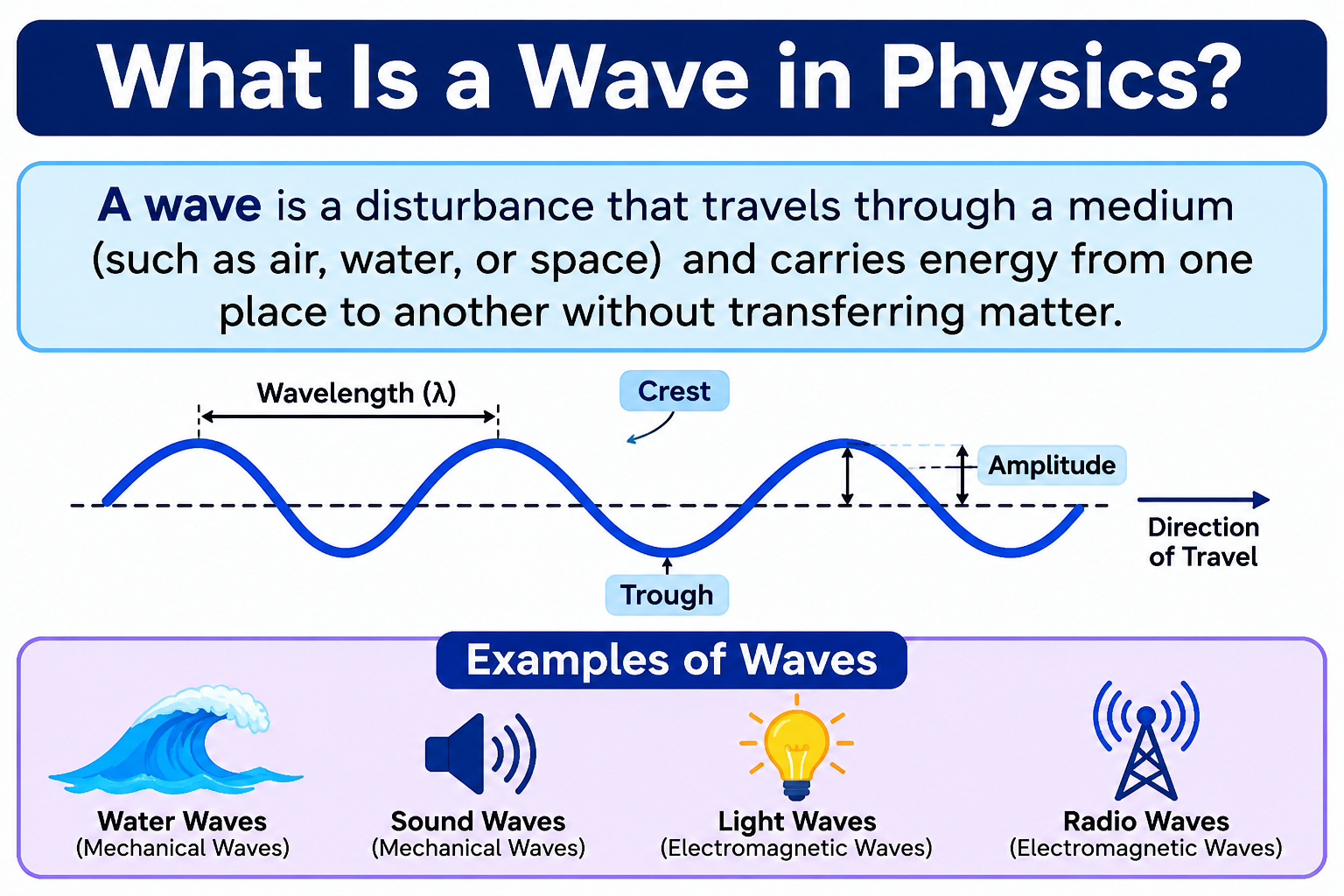
A wave is a disturbance that travels through space or through a medium, transferring energy from one location to another without causing any permanent displacement of the matter through which it moves.
This definition contains two ideas that are both important and sometimes misunderstood.
First, a wave transfers energy, not matter. When a sound wave travels from a loudspeaker to your ear, the air molecules do not flow from the speaker to you. Instead, each air molecule vibrates back and forth around its rest position, passing energy to the next molecule, which passes it to the next, and so on. The energy arrives at your ear even though no individual molecule made the journey.
Second, a wave is produced by a vibrating or oscillating source. Something must disturb the medium — or the electromagnetic field — to get a wave started. Without a source of vibration, there is no wave.
Key points to understand from the start:
- Particles of the medium vibrate around their fixed equilibrium positions — they do not travel with the wave
- The wave pattern (and the energy it carries) travels forward; the matter does not
- Waves are produced whenever a source vibrates or oscillates
- Waves are one of the most fundamental concepts in physics — they explain sound, light, heat radiation, radio communication, medical imaging, and much more
Real-life examples of waves:
- Sound waves — produced by a vibrating loudspeaker, vocal cord, or musical instrument
- Light waves — produced by the Sun, a lamp, or any source of electromagnetic radiation
- Water waves — produced by a stone dropped into water or by wind blowing across a surface
- Seismic waves — produced by earthquakes or underground explosions
- Radio waves — produced by oscillating electric currents in a transmitter antenna
How Are Waves Produced?
Every wave, without exception, is produced by a vibrating or oscillating source.
The source disturbs the surrounding medium or field, and this disturbance then propagates outward as a wave. The key connection between source and wave is this: the frequency of the wave equals the frequency of the vibrating source.
Clear examples:
- A vibrating guitar string disturbs the surrounding air, pushing air molecules back and forth and producing sound waves of the same frequency as the string’s vibration
- A vibrating loudspeaker cone pushes air particles rhythmically, generating sound waves that travel outward through the air
- An oscillating electric charge creates changing electric and magnetic fields that spread outward as electromagnetic waves
- An earthquake releases energy suddenly, causing rock to vibrate and producing seismic waves that travel through the Earth in all directions
- Shaking one end of a rope creates a transverse wave that travels along the rope toward the other end
There is an important relationship between source frequency and wavelength. At a fixed wave speed, a source vibrating at a higher frequency produces waves with a shorter wavelength. A source vibrating more slowly produces waves with a longer wavelength. This is captured precisely by the wave equation, which is explained fully later in this article.
Types of Waves
Mechanical Waves
Mechanical waves require a physical medium — a solid, liquid, or gas — to travel through. Without a medium, a mechanical wave cannot exist.
How they work:
- The vibrating source disturbs the particles of the medium
- Those particles push or pull their neighbours, passing the disturbance along
- Energy travels through the medium as each particle oscillates
- The particles themselves do not travel — only the disturbance and the energy move forward
Mechanical waves cannot travel through a vacuum because there are no particles to carry the disturbance.
The speed of a mechanical wave depends on the physical properties of the medium — primarily its density and elasticity — not on the frequency of the wave.
Examples of mechanical waves:
- Sound waves travelling through air, water, or solid steel
- Water waves moving across the surface of a lake or ocean
- Seismic waves spreading through the Earth after an earthquake
- Waves travelling along a vibrating string or rope
Electromagnetic Waves
Electromagnetic waves are fundamentally different from mechanical waves. They are produced by oscillating electric and magnetic fields and do not require any physical medium to travel through.
Key properties of electromagnetic waves:
- They can travel through a complete vacuum
- All electromagnetic waves travel at the same speed in a vacuum:
c = 3 × 10⁸ m/s
- They are all transverse waves — the oscillating electric and magnetic fields are perpendicular to the direction of travel
- They form a continuous spectrum ordered by frequency and wavelength
The full range of electromagnetic waves — from radio waves to gamma rays — is called the electromagnetic spectrum. All types of electromagnetic radiation share the same fundamental nature; only their frequencies and wavelengths differ.
Examples of electromagnetic waves:
- Visible light
- Radio waves
- Microwaves
- Infrared radiation
- Ultraviolet radiation
- X-rays
- Gamma rays
Transverse Waves
In a transverse wave, the particles of the medium vibrate perpendicular (at right angles) to the direction in which the wave travels.
Imagine holding one end of a rope and shaking it up and down while the wave travels horizontally along the rope. The rope moves vertically; the wave moves horizontally. That is a transverse wave.
Examples of transverse waves:
- All electromagnetic waves, including light
- Waves on a stretched rope or string
- Water surface waves (approximately)
- S-waves (seismic secondary waves)
Key features visible in a transverse wave:
- Crests — the highest points, where displacement is maximum in the positive direction
- Troughs — the lowest points, where displacement is maximum in the negative direction
- Amplitude — the distance from the equilibrium position to a crest or trough
- Wavelength — the distance from one crest to the next (or trough to trough)
Longitudinal Waves
In a longitudinal wave, the particles of the medium vibrate parallel to the direction in which the wave travels.
Sound is the most important example. When a loudspeaker cone pushes forward, it compresses the air particles in front of it. When it pulls back, those particles spread apart. This creates a series of compressions and rarefactions that travel forward through the air as a longitudinal wave.
Examples of longitudinal waves:
- Sound waves in air, water, or any solid
- P-waves (seismic primary waves)
- Compression waves travelling along a slinky spring
Key features of longitudinal waves:
- Compressions — regions where particles are pushed close together, creating areas of higher pressure
- Rarefactions — regions where particles are spread further apart, creating areas of lower pressure
- Wavelength — measured from the centre of one compression to the centre of the next compression
Surface Waves
Surface waves travel along the interface (boundary) between two different media rather than through either medium alone.
Examples:
- Ocean waves travel at the boundary between water and air
- Seismic surface waves (Love waves and Rayleigh waves) travel along the Earth’s surface rather than through its interior
The motion of particles in surface waves is more complex than in purely transverse or longitudinal waves. Particles trace elliptical paths, combining elements of both types of motion. This is why ocean waves can be so destructive — they carry large amounts of energy and produce complex motion at the surface.
Transverse Waves vs Longitudinal Waves
| Feature | Transverse Waves | Longitudinal Waves |
|---|---|---|
| Direction of particle vibration | Perpendicular to wave travel | Parallel to wave travel |
| Direction of wave travel | Along the wave’s path | Along the wave’s path |
| Crests and troughs | Yes | No |
| Compressions and rarefactions | No | Yes |
| Examples | Light, rope waves, S-waves | Sound, P-waves, slinky waves |
| Can travel in a vacuum? | Yes (electromagnetic only) | No |
| Requires a medium? | Yes (mechanical) / No (electromagnetic) | Yes |
Properties of Waves
Amplitude
Amplitude is the maximum displacement of a particle from its equilibrium (undisturbed) position.
- Symbol: A
- SI unit: metres (m)
For a transverse wave, amplitude is the height of a crest or the depth of a trough, measured from the undisturbed centre line.
For a longitudinal wave, amplitude describes the maximum displacement of a particle from its rest position during compression or rarefaction.
What amplitude tells you:
- A greater amplitude means the wave carries more energy
- For sound waves: greater amplitude → louder sound
- For light waves: greater amplitude → brighter light
- Amplitude has no effect on wave speed in a given medium
Wavelength
Wavelength is the distance between two consecutive points that are in phase — that is, at exactly the same stage of their oscillation at the same moment.
For a transverse wave, this is the distance from one crest to the next, or from one trough to the next.
For a longitudinal wave, this is the distance from the centre of one compression to the centre of the next.
- Symbol: λ (the Greek letter lambda)
- SI unit: metres (m)
The relationship between wavelength and frequency (at a fixed wave speed):
- Longer wavelength → lower frequency
- Shorter wavelength → higher frequency
Frequency
Frequency is the number of complete wave cycles that pass a fixed point in one second.
- Symbol: f
- SI unit: hertz (Hz)
- 1 Hz = 1 complete wave cycle per second
Frequency is determined entirely by the vibrating source. It does not change when a wave moves from one medium to another.
What frequency tells you:
- Higher frequency → more waves per second → shorter wavelength (at constant speed)
- For sound: higher frequency → higher pitch (a higher musical note)
- For light: higher frequency → the colour shifts toward the violet end of the visible spectrum
Period
The period is the time taken for one complete wave cycle to pass a fixed point, or equivalently, the time for one complete oscillation of a particle in the medium.
- Symbol: T
- SI unit: seconds (s)
The relationship between period and frequency is:
T = 1 / f
and
f = 1 / T
Example:
A wave has a frequency of 50 Hz. What is its period?
T = 1 / f = 1 / 50 = 0.02 s
A wave with a frequency of 50 Hz completes one full cycle every 0.02 seconds.
Wave Speed
Wave speed is the distance a wave travels per unit time.
- Symbol: v
- SI unit: metres per second (m/s)
Wave speed depends on the type of wave and the medium through which it travels. It does not depend on frequency or amplitude.
This last point is important and frequently misunderstood. If you increase the frequency of a wave in a given medium, the wave speed stays the same — but the wavelength decreases to compensate. The wave equation makes this relationship precise.
The Wave Equation
The wave equation connects wave speed, frequency, and wavelength:
v = fλ
Where:
- v = wave speed (m/s)
- f = frequency (Hz)
- λ = wavelength (m)
Physical meaning:
- Wave speed equals the number of complete waves passing a point per second (frequency) multiplied by the length of each wave (wavelength)
- At a fixed wave speed: if frequency increases, wavelength must decrease
- At a fixed wave speed: if frequency decreases, wavelength must increase
Rearranged forms:
f = v / λ (to find frequency)
λ = v / f (to find wavelength)
Worked Example 1:
A wave has a frequency of 200 Hz and a wavelength of 1.7 m. Find the wave speed.
v = fλ = 200 × 1.7 = 340 m/s
This is approximately the speed of sound in air at room temperature.
Worked Example 2:
A radio wave travels at 3 × 10⁸ m/s and has a wavelength of 3 m. Find the frequency.
f = v / λ = (3 × 10⁸) / 3 = 1 × 10⁸ Hz = 100 MHz
Phase
Phase describes where a particle is in its cycle of oscillation at a given moment in time.
Two points on a wave are said to be in phase if they are at exactly the same stage of their cycle simultaneously — for example, both at a crest, both at a trough, or both moving upward through the equilibrium position at the same instant.
Two points are in antiphase (180° out of phase) if one is at a crest while the other is at a trough. They are displaced in exactly opposite directions at every moment.
Phase difference is measured in degrees or radians:
- 0° (or 0 radians): completely in phase
- 180° (or π radians): completely out of phase (antiphase)
A simple example: imagine two people on a seesaw who always move in opposite directions. They are in antiphase. Two people bouncing on separate trampolines who always go up and down together are in phase.
Understanding phase is essential for explaining interference, which is discussed in the wave behaviour section below.
The Wave Equation in Detail
The wave equation v = fλ is the most important formula in wave physics. It connects the three most commonly measured wave quantities.
Example 1: Find wave speed given frequency and wavelength
A sound wave in water has a frequency of 1,000 Hz and a wavelength of 1.48 m. Find the wave speed.
Given: f = 1,000 Hz, λ = 1.48 m
Formula: v = fλ
Substitution: v = 1,000 × 1.48
Answer: v = 1,480 m/s
This confirms the approximate speed of sound in water.
Example 2: Find frequency given wave speed and wavelength
A light wave in a vacuum has a wavelength of 500 nm (500 × 10⁻⁹ m). The speed of light is 3 × 10⁸ m/s. Find the frequency.
Given: v = 3 × 10⁸ m/s, λ = 500 × 10⁻⁹ m
Formula: f = v / λ
Substitution: f = (3 × 10⁸) / (500 × 10⁻⁹)
Calculation: f = (3 × 10⁸) / (5 × 10⁻⁷) = 6 × 10¹⁴
Answer: f = 6 × 10¹⁴ Hz
This is in the visible light range, corresponding to green light.
Example 3: Find wavelength given wave speed and frequency
A sound wave travels through air at 340 m/s. A tuning fork vibrates at 440 Hz (musical note A). Find the wavelength.
Given: v = 340 m/s, f = 440 Hz
Formula: λ = v / f
Substitution: λ = 340 / 440
Answer: λ ≈ 0.77 m
Energy Transfer by Waves
One of the defining characteristics of waves is that they transfer energy without transferring matter. This is not just a definition to memorise — it has a real physical explanation.
When a vibrating source disturbs a medium:
- The source causes the nearest particles of the medium to vibrate
- Those particles push and pull their neighbouring particles
- Energy is passed from particle to particle through these interactions
- Each particle vibrates around its own fixed rest position — it does not travel along with the wave
- The energy propagates forward through the medium even though no individual particle makes the full journey
Real-life illustrations:
- When a loudspeaker plays music, the sound energy travels through the air to your ears. The air molecules in the room do not flow from the speaker to you — they simply oscillate back and forth. Yet the energy reaches your ears because each molecule passes it along to the next.
- Sunlight reaches the Earth from 150 million kilometres away, travelling through the vacuum of space. No matter travels across that distance — only electromagnetic energy in the form of light waves.
- Ocean waves travel thousands of kilometres across the Pacific Ocean. The water does not travel with the waves — individual water molecules move in small circles. Yet the energy arrives at the coastline, sometimes with enough force to reshape it.
Wave energy and amplitude:
The energy carried by a wave is proportional to the square of the amplitude:
E ∝ A²
This means that doubling the amplitude of a wave increases the energy it carries by a factor of four, not two. Tripling the amplitude increases the energy by a factor of nine.
This relationship explains why large ocean waves cause far more damage than small ones, and why loud sounds (large amplitude) feel much more powerful than quiet sounds.
Wave Behaviour
Reflection
Reflection occurs when a wave strikes a surface or boundary and bounces back into the medium from which it came.
The law of reflection states:
The angle of incidence equals the angle of reflection.
Both angles are measured from the normal — an imaginary line perpendicular to the surface at the point of incidence.
Real-life examples of reflection:
- Echo: sound waves reflecting off a hard wall, cliff face, or building. You hear your own voice returned to you after the sound has bounced back.
- Mirrors: light waves reflecting off a smooth, shiny surface to form an image.
- Radar: radio waves are transmitted, bounce off aircraft, ships, or weather systems, and return to the receiver, revealing the position and speed of the object.
- Sonar: ultrasound pulses are sent into the ocean, reflect off the seabed or submarines, and return to the ship, allowing depth mapping.
Reflection can occur for any type of wave — sound, light, water waves, and seismic waves all exhibit reflection.
Refraction
Refraction occurs when a wave passes from one medium into another and changes speed, causing it to change direction — provided it does not strike the boundary at exactly 90° (the normal direction).
Key rules of refraction:
- When a wave slows down on entering a new medium, it bends toward the normal
- When a wave speeds up, it bends away from the normal
- Frequency does not change during refraction — the colour of light and the pitch of sound stay the same
- Both wave speed and wavelength change during refraction, while frequency remains constant
Real-life examples of refraction:
- Light passing from air into glass: light slows down and bends toward the normal, which is why a glass lens can focus light
- A straw in a glass of water: light bends as it passes from water to air, making the straw appear broken or displaced
- Sound refraction in the atmosphere: sound waves bend as they pass through layers of air at different temperatures, which is why you can sometimes hear distant sounds more clearly at night
Diffraction
Diffraction is the spreading of a wave as it passes through a gap or around the edge of an obstacle.
Key points about diffraction:
- Diffraction is most noticeable when the gap size is similar to or smaller than the wavelength of the wave
- When the gap is much larger than the wavelength, the wave passes through with very little spreading
- Diffraction does not change the wave speed, frequency, or wavelength — only the direction of travel spreads out
Real-life examples of diffraction:
- Sound around corners: sound has a relatively long wavelength (roughly 0.02 m to 17 m in air), so it diffracts easily around walls, furniture, and building corners. This is why you can hear someone speaking in another room even when there is no direct line of sight.
- Radio waves around hills: long-wavelength radio waves diffract around geographical obstacles, allowing reception in valleys and behind hills.
- Light through a narrow slit: when light passes through a very narrow gap comparable in width to its wavelength (around 500 nm), it spreads out and produces a diffraction pattern with alternating light and dark bands.
Understanding diffraction in physics also connects naturally to understanding [What Is Pressure in Physics?], since both topics involve how disturbances spread through or around physical boundaries.
Interference
Interference occurs when two or more waves overlap in the same region of space at the same time.
The result of interference depends on the phase relationship between the overlapping waves.
Constructive interference:
- Occurs when two waves arrive in phase — their crests align and their troughs align
- The displacements of the two waves add together
- The result is a wave with a larger amplitude than either individual wave
- More energy is concentrated at that point
Destructive interference:
- Occurs when two waves arrive in antiphase — the crest of one aligns with the trough of the other
- The displacements cancel each other out
- The result is a wave with a smaller amplitude, or zero amplitude if the waves are identical in size
- Energy is redistributed to other points
Real-life examples of interference:
- Noise-cancelling headphones: the device generates a sound wave that is in antiphase with the incoming noise. The two waves interfere destructively, cancelling out the unwanted sound before it reaches your ears.
- Ripple tank experiments: two dippers vibrating in phase on a water surface create an interference pattern with clear regions of constructive and destructive interference.
- Young’s double-slit experiment: a classic experiment in which light passes through two closely spaced slits and produces an interference pattern of bright and dark fringes on a screen, demonstrating the wave nature of light.
Superposition
The principle of superposition is the underlying rule that explains interference:
When two or more waves meet at a point, the resultant displacement at that point is the algebraic sum of the displacements of each individual wave at that moment.
This means:
- If two waves each have a displacement of +3 cm at the same point at the same time, the resultant displacement is +6 cm (constructive)
- If one wave has a displacement of +3 cm and another has −3 cm at the same point, the resultant is 0 cm (destructive)
After the waves have passed through each other, each wave continues with its original speed, frequency, wavelength, and amplitude, completely unchanged. They do not permanently affect each other — only the combined effect at the moment of overlap is altered.
Sound Waves
Sound is one of the most important and familiar examples of a wave in physics. Understanding it well prepares you for many exam questions.
Sound waves are longitudinal mechanical waves. This means:
- The particles of the medium vibrate parallel to the direction of wave travel, creating compressions and rarefactions
- Sound requires a medium — it cannot travel through a vacuum
- This is why there is no sound in outer space
Speed of sound in different media:
| Medium | Speed of Sound |
|---|---|
| Air (at 20°C) | ≈ 340 m/s |
| Water | ≈ 1,480 m/s |
| Steel | ≈ 5,000 m/s |
Sound travels faster in denser, more rigid materials because the particles are closer together and interact more strongly, allowing vibrations to be passed on more quickly.
Frequency and pitch:
- Higher frequency → higher pitch (treble sounds)
- Lower frequency → lower pitch (bass sounds)
- Human hearing range: approximately 20 Hz to 20,000 Hz (20 kHz)
- Infrasound: below 20 Hz — inaudible to humans, produced by elephants and earthquakes
- Ultrasound: above 20,000 Hz — inaudible to humans, used in medical scanning and sonar
Amplitude and loudness:
- Greater amplitude → louder sound
- Smaller amplitude → quieter sound
- Loudness is measured in decibels (dB)
Light Waves
Light is the most important example of an electromagnetic wave. It is a transverse wave consisting of oscillating electric and magnetic fields.
Key properties of light:
- Light does not require a medium — it travels freely through a vacuum
- Speed of light in a vacuum: c = 3 × 10⁸ m/s
- Light slows down when it enters a denser optical medium such as glass or water (this causes refraction)
- Visible light has wavelengths from approximately 400 nm (violet) to 700 nm (red)
- Different colours correspond to different frequencies and wavelengths
- Red light has the lowest frequency and longest wavelength in the visible spectrum
- Violet light has the highest frequency and shortest wavelength in the visible spectrum
- White light is a mixture of all visible colours — a prism can separate them by refraction
Understanding the speed of light connects naturally to broader discussions in our article on [What Is Speed in Physics?], where the concept of speed is examined in depth.
Seismic Waves
Seismic waves are mechanical waves produced by earthquakes, volcanic eruptions, or underground explosions. They travel through the Earth and carry enormous amounts of energy.
There are two main types of seismic body waves:
P-waves (Primary waves or Pressure waves):
- Longitudinal waves — particles vibrate in the same direction the wave travels
- Travel through solids, liquids, and gases
- The fastest seismic waves
- The first to arrive at a seismograph after an earthquake
- Speed in the Earth’s mantle: approximately 8,000 m/s
S-waves (Secondary waves or Shear waves):
- Transverse waves — particles vibrate perpendicular to the direction of travel
- Travel only through solids — they cannot pass through liquids or gases
- Slower than P-waves
- The second to arrive at a seismograph
Two important applications of seismology:
- Locating an earthquake epicentre: by comparing the arrival times of P-waves and S-waves at multiple seismograph stations around the world, seismologists can calculate where the earthquake originated.
- Understanding Earth’s interior: S-waves cannot pass through the Earth’s liquid outer core. Seismologists discovered this because S-waves are absent in the shadow zone on the far side of the Earth from an earthquake. This provided critical evidence that the Earth’s outer core is liquid — a finding that could not have been confirmed by any other means at the time.
The Electromagnetic Spectrum
The electromagnetic spectrum is the complete range of all electromagnetic waves, arranged in order of increasing frequency (or equivalently, decreasing wavelength).
All electromagnetic waves share the same fundamental nature — they are transverse waves consisting of oscillating electric and magnetic fields — but they differ vastly in their frequencies, wavelengths, and the effects they produce.
The electromagnetic spectrum from lowest to highest frequency:
| Wave Type | Approximate Frequency Range | Approximate Wavelength Range | Common Uses |
|---|---|---|---|
| Radio waves | 3 Hz – 300 GHz | 1 mm – 100,000 km | Radio and TV broadcasting, WiFi, Bluetooth |
| Microwaves | 300 MHz – 300 GHz | 1 mm – 1 m | Microwave ovens, mobile phone networks, radar |
| Infrared | 300 GHz – 430 THz | 700 nm – 1 mm | Remote controls, thermal imaging, heating |
| Visible light | 430 THz – 750 THz | 400 nm – 700 nm | Human vision, photography, optical fibres |
| Ultraviolet | 750 THz – 30 PHz | 10 nm – 400 nm | Sterilisation, tanning, fluorescent lighting |
| X-rays | 30 PHz – 30 EHz | 0.01 nm – 10 nm | Medical imaging, security scanning |
| Gamma rays | Above 30 EHz | Below 0.01 nm | Cancer treatment, sterilisation, nuclear physics |
Key facts about the electromagnetic spectrum:
- All electromagnetic waves travel at c = 3 × 10⁸ m/s in a vacuum
- Higher frequency → shorter wavelength → greater energy per photon
- Lower frequency → longer wavelength → less energy per photon
- Only the visible light portion of the spectrum can be detected by the human eye
Waves and Energy
The energy carried by a wave is directly related to two quantities: amplitude and frequency.
Amplitude and energy:
For all types of waves, the energy is proportional to the square of the amplitude:
E ∝ A²
This relationship has practical consequences:
- A sound wave with twice the amplitude carries four times the energy
- A large ocean wave with three times the amplitude of a small ripple carries nine times the energy
- This is why high-amplitude waves — whether sound, water, or seismic — can be so destructive
Frequency and energy (for electromagnetic waves):
For electromagnetic waves, the energy carried per photon is proportional to frequency:
E = hf
Where h is Planck’s constant (h = 6.63 × 10⁻³⁴ J·s). At introductory level, the key point is that higher-frequency electromagnetic waves carry more energy per photon.
Real-life implications:
- Gamma rays (very high frequency) carry enormous energy per photon, which is why they are highly dangerous to living tissue and are used in cancer radiotherapy
- X-rays carry enough energy to penetrate soft tissue but are absorbed by denser bone, making them invaluable in medical imaging
- Ultraviolet radiation carries enough energy to damage DNA, causing sunburn and increasing cancer risk
- Radio waves (very low frequency) carry very little energy per photon and are generally safe at normal exposure levels
- Loud sounds (large amplitude) carry significantly more energy than quiet sounds at the same frequency
Understanding energy in waves connects closely to the broader study of energy in physics. Our article on [What Is Kinetic Energy?] explores how moving particles carry and transfer energy, which is closely related to how mechanical waves propagate.
Waves in Everyday Life
Once you understand what waves are, you start noticing them absolutely everywhere.
- Mobile phone calls and data use radio waves and microwaves transmitted between your phone and nearby masts
- Microwave ovens use microwaves at a specific frequency (2.45 GHz) that causes water molecules in food to vibrate, generating heat
- Sunlight delivers energy to Earth as a mixture of visible light, infrared radiation, and ultraviolet radiation
- Medical X-rays pass through soft tissue and are absorbed by bone, creating images that reveal fractures and other internal structures
- Music and speech travel as sound waves — longitudinal mechanical waves in air — from the source to your ears
- Earthquakes generate seismic waves that can travel through the entire Earth
- Ultrasound scans use very high-frequency sound waves (above 20,000 Hz) to create images of soft tissue inside the body — including developing babies during pregnancy
- WiFi and Bluetooth transmit data using radio waves at frequencies around 2.4 GHz and 5 GHz
- Infrared remote controls use infrared radiation to send signals from your remote to a television or other device
- Optical fibres carry data as pulses of light waves across continents and oceans, forming the backbone of the internet
Standing Waves
A standing wave (also called a stationary wave) is a special wave pattern formed when two identical waves travel in opposite directions through the same medium and overlap.
Unlike a travelling wave, a standing wave does not appear to move. Instead, it creates a fixed pattern of:
- Nodes: fixed points where the displacement is always zero. The two waves always interfere destructively at these points, so they never move.
- Antinodes: points halfway between the nodes where the displacement reaches its maximum amplitude. The two waves always interfere constructively here.
The distance between two adjacent nodes (or two adjacent antinodes) is half a wavelength.
Examples of standing waves:
- A vibrating guitar string fixed at both ends. The string vibrates in a standing wave pattern, with nodes at each fixed end. Different standing wave patterns correspond to different musical notes.
- Sound waves in a closed pipe (such as a clarinet or organ pipe) form standing waves that determine the pitch of the note produced.
- Microwave ovens can create standing wave hot spots inside the oven cavity, which is why most microwave ovens have a rotating turntable to move food through regions of varying intensity.
Understanding standing waves is essential for studying musical acoustics, resonance, and many areas of engineering where vibrations need to be controlled.
Wave Speed in Different Media
Wave speed is not a fixed property of a wave type — it varies depending on the medium through which the wave travels.
Sound waves:
- Sound travels fastest in solids, slower in liquids, and slowest in gases
- In solids, particles are closely packed and strongly bonded, so vibrations are passed on very quickly
- In gases, particles are far apart, and interactions between them are weaker, so vibrations travel more slowly
| Medium | Speed of Sound |
|---|---|
| Air | ≈ 340 m/s |
| Water | ≈ 1,480 m/s |
| Steel | ≈ 5,000 m/s |
Light and electromagnetic waves:
- Light travels at its maximum speed only in a vacuum (c = 3 × 10⁸ m/s)
- When light enters a physical medium such as glass or water, it slows down
- The ratio of the speed of light in a vacuum to its speed in a given medium is the refractive index of that medium
- Glass has a refractive index of approximately 1.5, meaning light travels at about 2 × 10⁸ m/s inside glass
An important principle: changing the frequency of a wave does not change its speed in a given medium. If you increase the frequency, the wavelength adjusts so that the product fλ stays equal to v. The speed is determined by the medium, not the frequency.
Waves vs Particles
| Feature | Wave Motion | Particle Motion |
|---|---|---|
| What moves | The disturbance (energy) | The particle itself |
| What is transferred | Energy only | Energy and matter |
| Vibration direction | Perpendicular or parallel to wave travel | In any direction |
| Requires medium? | Mechanical waves yes; EM waves no | Yes (a particle needs space to move) |
| Examples | Sound, light, seismic waves | A thrown ball, a moving car |
Wave-particle duality:
One of the most profound discoveries in modern physics is that light — and indeed all matter at the quantum level — can behave as both a wave and a particle, depending on the experiment.
- Light behaves as a wave in experiments involving diffraction and interference
- Light also behaves as a particle (called a photon) in the photoelectric effect, where it ejects electrons from a metal surface
This dual nature is one of the foundations of quantum physics. At the introductory level, the key point is simply that the boundary between waves and particles is not as sharp as classical physics once suggested. The study of force in physics, covered in our article [What Is Force in Physics?], provides useful background for understanding how particles interact — which in turn helps contextualise wave-particle interactions.
How to Calculate Wave Speed
Example 1: Calculate wave speed from frequency and wavelength (sound wave)
A sound wave in air has a frequency of 680 Hz and a wavelength of 0.5 m.
Given: f = 680 Hz, λ = 0.5 m
Formula: v = fλ
Substitution: v = 680 × 0.5
Answer: v = 340 m/s
Example 2: Calculate frequency from wave speed and wavelength (electromagnetic wave)
A microwave has a wavelength of 0.12 m and travels at 3 × 10⁸ m/s.
Given: v = 3 × 10⁸ m/s, λ = 0.12 m
Formula: f = v / λ
Substitution: f = (3 × 10⁸) / 0.12
Answer: f = 2.5 × 10⁹ Hz = 2.5 GHz
Example 3: Calculate wavelength from wave speed and frequency
A sound wave travels through water at 1,480 m/s with a frequency of 5,000 Hz.
Given: v = 1,480 m/s, f = 5,000 Hz
Formula: λ = v / f
Substitution: λ = 1,480 / 5,000
Answer: λ = 0.296 m
Example 4: Use T = 1/f to find period, then find wave speed
A wave has a frequency of 250 Hz and a wavelength of 1.36 m. Find the period and the wave speed.
Step 1 — Find the period:
T = 1 / f = 1 / 250 = 0.004 s
Step 2 — Find the wave speed:
v = fλ = 250 × 1.36 = 340 m/s
Example 5: Real-world radio station application
A radio station broadcasts at a frequency of 98.4 MHz (98.4 × 10⁶ Hz). Radio waves travel at 3 × 10⁸ m/s. Find the wavelength of the broadcast signal.
Given: f = 98.4 × 10⁶ Hz, v = 3 × 10⁸ m/s
Formula: λ = v / f
Substitution: λ = (3 × 10⁸) / (98.4 × 10⁶)
Answer: λ ≈ 3.05 m
Common Misconceptions About Waves
Misconception 1: Matter travels with the wave.
This is the most common misunderstanding. In a mechanical wave, the particles of the medium vibrate around fixed positions. They do not travel along with the wave. Only energy moves forward.
Misconception 2: Amplitude and wavelength are the same thing.
Amplitude is the maximum displacement of a particle from its rest position (measured vertically in a transverse wave diagram). Wavelength is the distance between two consecutive points in phase (measured horizontally). They measure completely different things.
Misconception 3: Frequency and amplitude are related.
They are independent properties. You can have a high-frequency, low-amplitude wave or a low-frequency, high-amplitude wave. Frequency determines the number of cycles per second; amplitude determines the maximum displacement and the energy.
Misconception 4: All waves require a medium.
Mechanical waves do require a medium. But electromagnetic waves do not — they can travel through a vacuum. Light travels from the Sun to Earth through 150 million kilometres of empty space.
Misconception 5: Sound is a transverse wave.
Sound is a longitudinal wave. The air particles vibrate in the same direction the sound travels, creating compressions and rarefactions. Sound does not have crests and troughs — it has compressions and rarefactions.
Misconception 6: Higher frequency always means higher amplitude.
Frequency and amplitude are completely independent. A high-frequency wave can have any amplitude, large or small.
Misconception 7: Period and frequency are the same.
Period and frequency are reciprocals of each other: T = 1/f. A wave with a high frequency has a short period. They measure different things: frequency counts waves per second; period measures seconds per wave.
Misconception 8: Light cannot travel through a vacuum.
Light not only can travel through a vacuum — it travels fastest in a vacuum. The speed of light in a vacuum (c = 3 × 10⁸ m/s) is the maximum speed at which information or energy can travel in the universe.
Misconception 9: Wave speed increases with frequency.
In a given medium, wave speed is fixed and does not depend on frequency. If frequency increases, the wavelength decreases by exactly the right amount to keep the product fλ equal to v.
How to Solve Wave Problems
Use this reliable method for every wave calculation:
- Read the problem carefully and identify the type of wave (sound, light, mechanical, electromagnetic).
- List all given quantities with their correct units (v, f, λ, T, A).
- Identify the quantity to be found.
- Select the correct formula: v = fλ, T = 1/f, or f = 1/T.
- Rearrange the formula for the unknown quantity if it is not already the subject.
- Convert all quantities to SI units before substituting (e.g., MHz to Hz, nm to m, minutes to seconds).
- Substitute the values carefully, showing each step.
- Calculate the result using correct arithmetic.
- Write the answer with the correct SI unit (m/s, Hz, m, or s).
- Check whether the answer is physically reasonable. The speed of sound in air should be close to 340 m/s. The speed of light should be 3 × 10⁸ m/s. Wavelengths of visible light are in the nanometre range.
Important Wave Formulas
| Formula | Meaning | Variables | SI Unit | When to Use |
|---|---|---|---|---|
| v = fλ | Wave equation: speed equals frequency times wavelength | v = speed, f = frequency, λ = wavelength | m/s | Any wave — the fundamental wave calculation |
| T = 1 / f | Period equals the reciprocal of frequency | T = period, f = frequency | s | Finding the period when frequency is known |
| f = 1 / T | Frequency equals the reciprocal of period | f = frequency, T = period | Hz | Finding the frequency when period is known |
| f = v / λ | Frequency from speed and wavelength | f = frequency, v = speed, λ = wavelength | Hz | Finding frequency when speed and wavelength are given |
| λ = v / f | Wavelength from speed and frequency | λ = wavelength, v = speed, f = frequency | m | Finding wavelength when speed and frequency are given |
| E ∝ A² | Energy is proportional to amplitude squared | E = energy, A = amplitude | J (qualitative) | Comparing wave energies; explaining loudness and brightness |
Wave Practice Questions
20 Multiple Choice Questions
Question 1: What is the correct definition of a wave in physics?
A. The movement of matter from one place to another
B. A disturbance that transfers energy without transferring matter
C. A stream of particles moving through a medium
D. The vibration of a medium without energy transfer
Correct Answer: B
A wave transfers energy from place to place without causing any net movement of matter.
Question 2: Which of the following is a longitudinal wave?
A. Light
B. A wave on a rope
C. Sound
D. A water surface wave
Correct Answer: C
Sound is a longitudinal wave — air particles vibrate parallel to the direction of wave travel.
Question 3: What is the SI unit of frequency?
A. Metre (m)
B. Second (s)
C. Hertz (Hz)
D. Metre per second (m/s)
Correct Answer: C
Frequency is measured in hertz (Hz), where 1 Hz = 1 cycle per second.
Question 4: A wave has a frequency of 400 Hz and a wavelength of 0.85 m. What is its speed?
A. 470 m/s
B. 340 m/s
C. 0.002 m/s
D. 400 m/s
Correct Answer: B
v = fλ = 400 × 0.85 = 340 m/s.
Question 5: Which of the following waves can travel through a vacuum?
A. Sound waves
B. Water waves
C. Seismic waves
D. Light waves
Correct Answer: D
Light is an electromagnetic wave and does not require a medium — it travels freely through a vacuum.
Question 6: In a transverse wave, particles vibrate:
A. Parallel to the direction of wave travel
B. Perpendicular to the direction of wave travel
C. In a circular path
D. In the same direction as the wave energy
Correct Answer: B
In transverse waves, particle vibration is at right angles (perpendicular) to the direction of wave propagation.
Question 7: What is the speed of all electromagnetic waves in a vacuum?
A. 340 m/s
B. 1,500 m/s
C. 3 × 10⁸ m/s
D. 3 × 10⁶ m/s
Correct Answer: C
All electromagnetic waves travel at c = 3 × 10⁸ m/s in a vacuum.
Question 8: A wave has a period of 0.005 s. What is its frequency?
A. 5 Hz
B. 50 Hz
C. 200 Hz
D. 2,000 Hz
Correct Answer: C
f = 1/T = 1/0.005 = 200 Hz.
Question 9: Constructive interference occurs when two waves:
A. Are in antiphase
B. Have different frequencies
C. Are in phase
D. Travel at different speeds
Correct Answer: C
Constructive interference occurs when two waves are in phase — their crests and troughs align, producing a larger amplitude.
Question 10: Which property of a wave determines its loudness when heard as sound?
A. Frequency
B. Wavelength
C. Wave speed
D. Amplitude
Correct Answer: D
Loudness depends on amplitude. Greater amplitude → louder sound.
Question 11: Diffraction of a wave is greatest when:
A. The gap is much larger than the wavelength
B. The gap is much smaller than the wavelength
C. The gap size is similar to the wavelength
D. The wave speed is very high
Correct Answer: C
Diffraction is most significant when the gap size is comparable to the wavelength of the wave.
Question 12: Which seismic wave can travel through both solids and liquids?
A. S-waves only
B. P-waves only
C. Both P-waves and S-waves
D. Neither P-waves nor S-waves
Correct Answer: B
P-waves are longitudinal and can travel through solids, liquids, and gases. S-waves are transverse and can only travel through solids.
Question 13: The wavelength of a wave is 2 m and its speed is 300 m/s. What is the frequency?
A. 600 Hz
B. 298 Hz
C. 150 Hz
D. 302 Hz
Correct Answer: C
f = v / λ = 300 / 2 = 150 Hz.
Question 14: What happens to the wavelength of a wave when it slows down on entering a denser medium? (Frequency stays the same.)
A. Wavelength increases
B. Wavelength stays the same
C. Wavelength decreases
D. Wavelength becomes zero
Correct Answer: C
Since v = fλ and f remains constant, a decrease in v requires a proportional decrease in λ.
Question 15: Which of the following correctly describes the law of reflection?
A. The angle of incidence equals the angle of refraction
B. The angle of refraction equals the angle of diffraction
C. The angle of incidence equals the angle of reflection
D. The angle of reflection equals the angle of diffraction
Correct Answer: C
The law of reflection states that the angle of incidence equals the angle of reflection, both measured from the normal.
Question 16: Doubling the amplitude of a wave changes the energy carried by a factor of:
A. 2
B. 4
C. 8
D. 0.5
Correct Answer: B
E ∝ A². Doubling A gives A² × 4 = four times the energy.
Question 17: What is the correct order of the electromagnetic spectrum from lowest to highest frequency?
A. Gamma, X-ray, UV, visible, IR, microwave, radio
B. Radio, microwave, IR, visible, UV, X-ray, gamma
C. Visible, UV, IR, X-ray, radio, microwave, gamma
D. Radio, visible, UV, IR, microwave, X-ray, gamma
Correct Answer: B
From lowest to highest frequency: radio, microwave, infrared, visible, ultraviolet, X-ray, gamma ray.
Question 18: A standing wave has nodes and antinodes. What is a node?
A. A point of maximum displacement
B. A point of zero displacement
C. The wavelength of the standing wave
D. The frequency of the standing wave
Correct Answer: B
A node is a fixed point of zero displacement where destructive interference always occurs.
Question 19: Which wave behaviour is responsible for the bending of light as it enters glass from air?
A. Reflection
B. Diffraction
C. Refraction
D. Interference
Correct Answer: C
Refraction — the change in wave speed as light enters a denser medium — causes it to change direction (bend).
Question 20: The principle of superposition states that when two waves meet:
A. They destroy each other permanently
B. The resultant displacement equals the algebraic sum of individual displacements
C. Only the larger wave survives
D. Wave speed doubles
Correct Answer: B
Superposition: resultant displacement = sum of individual displacements. After passing through each other, the waves continue unchanged.
10 Short Answer Questions
Q1: Define a wave in physics.
A wave is a disturbance that travels through space or a medium, transferring energy from one place to another without causing any permanent displacement of matter.
Q2: What is the difference between a transverse wave and a longitudinal wave?
In a transverse wave, particles vibrate perpendicular to the direction of wave travel (example: light). In a longitudinal wave, particles vibrate parallel to the direction of wave travel (example: sound).
Q3: State the wave equation and define all variables.
v = fλ, where v is wave speed (m/s), f is frequency (Hz), and λ is wavelength (m).
Q4: A wave has a speed of 300 m/s and a frequency of 150 Hz. Calculate the wavelength.
λ = v / f = 300 / 150 = 2 m
Q5: What is amplitude and how does it relate to the energy of a wave?
Amplitude is the maximum displacement of a particle from its equilibrium position. Wave energy is proportional to the square of the amplitude (E ∝ A²). Greater amplitude means more energy.
Q6: Explain why sound cannot travel through outer space.
Sound is a mechanical wave that requires a medium (solid, liquid, or gas) to travel through. Outer space is a near-perfect vacuum with no particles to carry the vibration, so sound cannot propagate there.
Q7: What is the relationship between frequency and period?
Frequency and period are reciprocals: T = 1/f and f = 1/T. A high-frequency wave has a short period.
Q8: Explain constructive and destructive interference.
Constructive interference occurs when two waves in phase overlap, producing a larger amplitude. Destructive interference occurs when two waves in antiphase overlap, producing a smaller or zero amplitude.
Q9: Why do S-waves provide evidence that the Earth’s outer core is liquid?
S-waves are transverse mechanical waves that can only travel through solids. Since S-waves do not pass through the Earth’s outer core, seismologists concluded that the outer core must be liquid.
Q10: State one difference between refraction and diffraction.
Refraction is the change in direction of a wave caused by a change in speed as it enters a different medium. Diffraction is the spreading of a wave as it passes through a gap or around an obstacle, without any change in speed or frequency.
5 Numerical Problems
Problem 1:
A guitar string vibrates at 330 Hz and produces a sound wave in air. The speed of sound in air is 340 m/s. Calculate the wavelength of the sound wave.
Given: f = 330 Hz, v = 340 m/s
λ = v / f = 340 / 330 = 1.03 m
Problem 2:
A radio wave has a wavelength of 1,500 m. The speed of radio waves is 3 × 10⁸ m/s. Find (a) the frequency and (b) the period.
(a) f = v / λ = (3 × 10⁸) / 1,500 = 2 × 10⁵ Hz = 200 kHz
(b) T = 1 / f = 1 / (2 × 10⁵) = 5 × 10⁻⁶ s = 5 μs
Problem 3:
An ultrasound wave used in a medical scanner has a frequency of 5 MHz (5 × 10⁶ Hz) and travels through soft tissue at 1,540 m/s. Calculate the wavelength.
Given: f = 5 × 10⁶ Hz, v = 1,540 m/s
λ = v / f = 1,540 / (5 × 10⁶) = 3.08 × 10⁻⁴ m = 0.308 mm
Problem 4:
A water wave has a wavelength of 4 m and a period of 2 seconds. Calculate (a) the frequency and (b) the wave speed.
(a) f = 1 / T = 1 / 2 = 0.5 Hz
(b) v = fλ = 0.5 × 4 = 2 m/s
Problem 5:
A seismic P-wave travels through the Earth’s mantle at 8,000 m/s. It has a frequency of 2 Hz. Calculate the wavelength.
Given: v = 8,000 m/s, f = 2 Hz
λ = v / f = 8,000 / 2 = 4,000 m = 4 km
5 Exam-Style Questions
Q1: A student states that “when a sound wave travels through air, the air moves from the source to the listener.” Explain why this statement is incorrect. [3 marks]
The statement is incorrect. Sound is a longitudinal mechanical wave in which air particles vibrate back and forth parallel to the direction of wave travel. Each particle oscillates around its own fixed equilibrium position and does not travel from the source to the listener. What actually travels from source to listener is the disturbance — the pattern of compressions and rarefactions — and with it, the energy. The air itself remains in approximately the same location.
Q2: A wave machine in a swimming pool produces waves with a frequency of 1.5 Hz and a wavelength of 2.0 m. (a) Calculate the wave speed. (b) Calculate the period of the waves. [4 marks]
(a) v = fλ = 1.5 × 2.0 = 3.0 m/s
(b) T = 1/f = 1/1.5 = 0.67 s
Q3: Explain, using the concept of diffraction, why you can hear someone talking around the corner of a building even though you cannot see them. [3 marks]
Sound waves have wavelengths typically in the range of 0.02 m to 17 m in air, which are comparable to the size of buildings and gaps between them. When sound waves encounter the corner of a building, they diffract — they spread out around the edge of the obstacle. Because the wavelength of sound is similar in size to the obstacle, significant diffraction occurs, allowing the sound to bend around the corner and reach your ears. Light has a much shorter wavelength (around 500 nm), so it does not diffract significantly around the building corner, meaning you cannot see around it.
Q4: Describe the difference between constructive and destructive interference. Give one real-life application of each. [4 marks]
Constructive interference occurs when two waves arrive at a point in phase — their crests and troughs align. The displacements add together, producing a wave with a larger amplitude than either individual wave. Real-life application: the design of concert halls uses constructive interference to direct sound energy toward the audience.
Destructive interference occurs when two waves arrive at a point in antiphase — the crest of one aligns with the trough of the other. The displacements cancel out, reducing or eliminating the amplitude. Real-life application: noise-cancelling headphones generate a sound wave in antiphase with incoming noise, causing destructive interference and reducing the noise that reaches the listener’s ear.
Q5: The electromagnetic spectrum contains many types of waves. (a) State what all electromagnetic waves have in common. (b) List three types of electromagnetic wave in order from lowest to highest frequency. (c) A gamma ray has a frequency of 3 × 10²⁰ Hz. Calculate its wavelength. [5 marks]
(a) All electromagnetic waves:
- Are transverse waves
- Travel at the same speed in a vacuum: c = 3 × 10⁸ m/s
- Do not require a medium — they can travel through a vacuum
- Consist of oscillating electric and magnetic fields
(b) From lowest to highest frequency: radio waves → microwaves → infrared (or any correct three consecutive members of the spectrum in the correct order)
(c) λ = v / f = (3 × 10⁸) / (3 × 10²⁰) = 1 × 10⁻¹² m = 1 pm (picometre)
Exam Tips
Keep these points in mind for any examination involving waves:
- Wave definition: Always state that a wave transfers energy without transferring matter. Both parts are needed for full marks.
- Transverse vs longitudinal: Link particle vibration direction to wave travel direction. Transverse = perpendicular. Longitudinal = parallel. Give examples (light vs sound).
- The wave equation v = fλ: Write it out at the start of every numerical question. Rearrange it clearly before substituting values. Always check your units are in m/s, Hz, and m.
- T = 1/f: Remember this simple reciprocal relationship. Period and frequency are not the same — they are inverses of each other.
- Reflection: State the law clearly: angle of incidence = angle of reflection, both measured from the normal. Not from the surface.
- Refraction: State that frequency does not change. Speed and wavelength both change. The wave bends toward the normal when it slows down.
- Diffraction: State that it is most significant when the gap is similar in size to the wavelength. Speed, frequency, and wavelength do not change during diffraction.
- Interference: Name the type (constructive or destructive) and link it to phase (in phase → constructive; antiphase → destructive).
- Electromagnetic spectrum order: Learn from lowest to highest frequency — Radio, Microwave, Infrared, Visible, Ultraviolet, X-ray, Gamma. Use a memory phrase if helpful.
- Amplitude and energy: E ∝ A². Doubling amplitude multiplies energy by four. This explains loudness in sound and brightness in light.
- Energy transfer: Emphasise that particles vibrate around fixed positions — they do not travel with the wave. Only energy moves forward.
Quick Revision Notes
- A wave transfers energy without transferring matter
- All waves are produced by a vibrating source
- Mechanical waves require a medium; electromagnetic waves do not
- Transverse waves: particle vibration perpendicular to wave travel (light, rope, S-waves)
- Longitudinal waves: particle vibration parallel to wave travel (sound, P-waves)
- Amplitude (A): maximum displacement from equilibrium; SI unit: m; determines energy
- Wavelength (λ): distance between two consecutive in-phase points; SI unit: m
- Frequency (f): number of complete cycles per second; SI unit: Hz
- Period (T): time for one complete cycle; SI unit: s; T = 1/f
- Wave speed (v): distance per unit time; SI unit: m/s; depends on medium
- Wave equation: v = fλ
- Energy ∝ amplitude²: doubling amplitude quadruples energy
- Reflection: bouncing off a surface; angle of incidence = angle of reflection
- Refraction: wave changes speed (and direction) at a boundary; frequency unchanged
- Diffraction: spreading through a gap; greatest when gap ≈ wavelength
- Constructive interference: in phase → larger amplitude
- Destructive interference: antiphase → smaller or zero amplitude
- Superposition: resultant displacement = algebraic sum of individual displacements
- Speed of sound in air ≈ 340 m/s; speed of light in vacuum = 3 × 10⁸ m/s
- P-waves (longitudinal) travel through solids and liquids; S-waves (transverse) travel only through solids
- Electromagnetic spectrum (low to high frequency): Radio → Microwave → IR → Visible → UV → X-ray → Gamma
Wave Cheat Sheet
| Concept | Definition | Formula or Key Fact | SI Unit | Example |
|---|---|---|---|---|
| Wave | Disturbance transferring energy without matter | — | — | Sound, light, water waves |
| Amplitude | Maximum displacement from equilibrium | E ∝ A² | m | 0.02 m for a quiet sound |
| Wavelength | Distance between two consecutive in-phase points | λ = v / f | m | 1.7 m for a 200 Hz sound in air |
| Frequency | Complete cycles per second | f = 1 / T | Hz | 440 Hz for musical note A |
| Period | Time for one complete cycle | T = 1 / f | s | 0.0023 s for 440 Hz |
| Wave speed | Distance per unit time | v = fλ | m/s | 340 m/s for sound in air |
| Transverse wave | Particle vibration perpendicular to wave travel | — | — | Light, rope wave |
| Longitudinal wave | Particle vibration parallel to wave travel | — | — | Sound, P-waves |
| Reflection | Wave bounces off a surface | Angle incidence = angle reflection | — | Echo, mirror |
| Refraction | Wave changes speed and direction at boundary | — | — | Light bending in glass |
| Diffraction | Wave spreads through a gap | Greatest when gap ≈ λ | — | Sound around corners |
| Constructive interference | Two in-phase waves produce larger amplitude | — | — | Noise amplification |
| Destructive interference | Two antiphase waves cancel | — | — | Noise-cancelling headphones |
| Speed of light | Maximum speed in vacuum | c = 3 × 10⁸ m/s | m/s | Light, radio waves in vacuum |
Frequently Asked Questions
1. What is a wave in physics?
A wave is a disturbance that travels through space or a medium, transferring energy from one place to another without transferring matter. The particles of the medium vibrate around fixed positions while the energy moves forward.
2. What are the main types of waves?
The two main categories are mechanical waves (which require a medium, such as sound and seismic waves) and electromagnetic waves (which do not require a medium, such as light and radio waves). Waves are also classified as transverse or longitudinal based on the direction of particle vibration.
3. What is the difference between transverse and longitudinal waves?
In transverse waves, particles vibrate perpendicular to the direction of wave travel (example: light). In longitudinal waves, particles vibrate parallel to the direction of wave travel (example: sound).
4. What is the wave equation?
The wave equation is v = fλ, where v is wave speed (m/s), f is frequency (Hz), and λ is wavelength (m). It can be rearranged to find any one of the three quantities when the other two are known.
5. What is amplitude?
Amplitude is the maximum displacement of a particle from its equilibrium (undisturbed) position. It is measured in metres and determines how much energy the wave carries. E ∝ A².
6. What is wavelength?
Wavelength is the distance between two consecutive points on a wave that are in phase — for example, crest to crest or trough to trough for a transverse wave, or compression to compression for a longitudinal wave. It is measured in metres (m).
7. What is frequency?
Frequency is the number of complete wave cycles that pass a fixed point per second. It is measured in hertz (Hz), where 1 Hz equals one complete cycle per second.
8. What is the period of a wave?
The period is the time taken for one complete wave cycle. It is measured in seconds (s) and is the reciprocal of frequency: T = 1/f.
9. What is wave speed?
Wave speed is the distance a wave travels per unit time, measured in metres per second (m/s). It depends on the type of wave and the medium through which it travels, not on frequency or amplitude.
10. Do all waves require a medium?
No. Mechanical waves (such as sound and seismic waves) do require a medium. Electromagnetic waves (such as light, radio waves, and X-rays) do not — they can travel through a vacuum.
11. What is the speed of sound?
The speed of sound in air at room temperature (20°C) is approximately 340 m/s. Sound travels faster in water (≈ 1,480 m/s) and faster still in steel (≈ 5,000 m/s).
12. What is the speed of light?
The speed of light in a vacuum is c = 3 × 10⁸ m/s (300,000,000 m/s). This is also the speed of all electromagnetic waves in a vacuum.
13. What is reflection?
Reflection occurs when a wave strikes a surface and bounces back. The law of reflection states that the angle of incidence equals the angle of reflection, both measured from the normal to the surface.
14. What is refraction?
Refraction occurs when a wave passes from one medium to another and changes speed, causing it to change direction. Frequency remains constant during refraction; wavelength and wave speed both change.
15. What is diffraction?
Diffraction is the spreading of a wave as it passes through a gap or around the edge of an obstacle. It is most pronounced when the gap size is similar to or smaller than the wavelength of the wave.
Summary
A wave in physics is a disturbance that transfers energy from one place to another without transferring matter. Waves are produced by vibrating sources, and the frequency of the wave matches the frequency of its source.
The two main categories are mechanical waves (which need a medium) and electromagnetic waves (which do not). Waves are also classified as transverse (particle vibration perpendicular to wave travel) or longitudinal (particle vibration parallel to wave travel).
Every wave is described by five key properties:
- Amplitude — determines energy; E ∝ A²
- Wavelength — distance between consecutive in-phase points (symbol: λ, unit: m)
- Frequency — cycles per second (symbol: f, unit: Hz)
- Period — time per cycle (symbol: T, unit: s; T = 1/f)
- Wave speed — distance per unit time (symbol: v, unit: m/s)
These properties are connected by the wave equation: v = fλ.
Waves exhibit four key behaviours: reflection (bouncing off surfaces), refraction (changing direction at a boundary), diffraction (spreading through gaps), and interference (constructive when in phase, destructive when in antiphase).
Sound waves are longitudinal mechanical waves; light waves are transverse electromagnetic waves. All electromagnetic waves travel at c = 3 × 10⁸ m/s in a vacuum and form the electromagnetic spectrum from radio waves to gamma rays.
Final Thoughts
Understanding what a wave is in physics is not just an examination requirement — it is a doorway to understanding an enormous range of natural phenomena and modern technologies.
Every phone call you make, every song you hear, every image formed by your eyes, every medical scan, every earthquake warning, and every wireless signal around you involves waves. The wave equation v = fλ, the principle of superposition, and the behaviours of reflection, refraction, diffraction, and interference are the tools that physicists and engineers use to work with waves in the real world.
The concepts covered in this article — from the basic definition of a wave through to the electromagnetic spectrum, seismic waves, sound, light, and standing waves — form the essential foundation for studying optics, acoustics, telecommunications, quantum physics, and many other branches of modern science and technology.
Whether you are preparing for GCSE, A-Level, NEET, MDCAT, or ECAT examinations, a solid understanding of waves will serve you throughout your physics education and beyond.
References
- OpenStax University Physics — Waves and Acoustics
https://openstax.org/books/university-physics-volume-1/pages/16-introduction - Physics LibreTexts — Wave Motion
https://phys.libretexts.org/Bookshelves/University_Physics/Book%3A_University_Physics_(OpenStax)/Map%3A_University_Physics_I_-Mechanics_Sound_Oscillations_and_Waves(OpenStax)/16%3A_Waves - Khan Academy Physics — Waves and Sound
https://www.khanacademy.org/science/physics/mechanical-waves-and-sound - Encyclopaedia Britannica — Wave Physics
https://www.britannica.com/science/wave-physics - The Physics Classroom — Waves
https://www.physicsclassroom.com/class/waves - National Institute of Standards and Technology (NIST) — SI Units and Physical Constants
https://www.nist.gov/pml/owm/metric-si/si-units
Disclaimer
This article is intended for educational and informational purposes only. While LearnMinto strives to provide accurate and up-to-date information, readers should verify important academic concepts through official textbooks, educational institutions, examination boards, or trusted scientific resources before relying on this content for exams or academic purposes. LearnMinto is not affiliated with any specific school, university, research institution, or examination board.