
Introduction
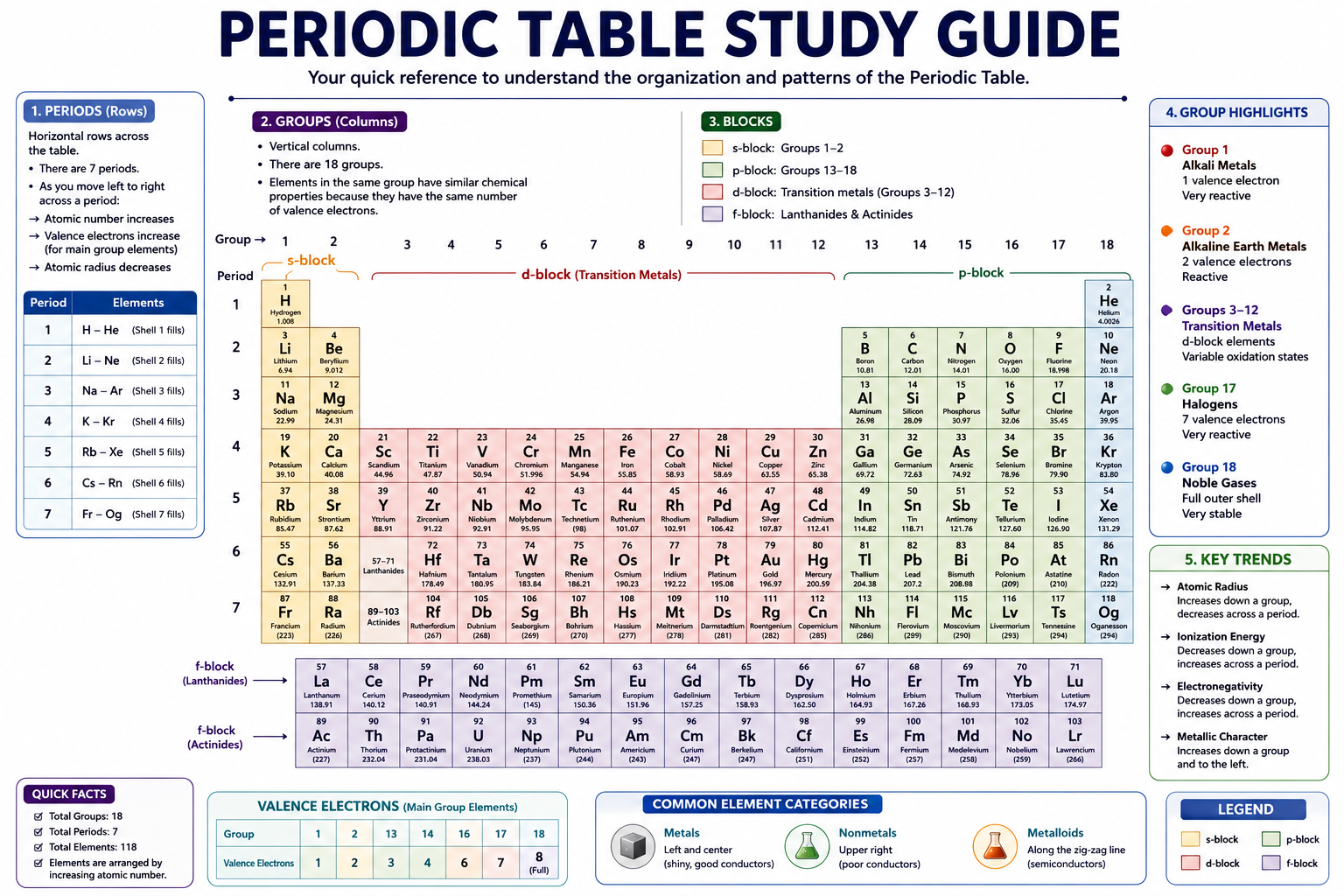
Hang a periodic table on a chemistry classroom wall and it looks, at first glance, like an intimidating grid of symbols and numbers. Ask a chemistry teacher what it really is, and you’ll get a different answer: it’s one of the most powerful organizational tools in all of science. Everything you need to know about how an element behaves — how reactive it is, what kind of bonds it forms, whether it’s a gas or a solid at room temperature, how many electrons are in its outer shell — can be inferred from its position on that table.
That’s not an exaggeration. The periodic table’s genius is that it reveals patterns in nature that aren’t obvious from simply studying one element at a time. When Dmitri Mendeleev arranged the elements known in his time by atomic mass, he noticed that properties repeated at regular intervals — periodically. He was confident enough in the pattern to leave gaps for elements he predicted hadn’t been discovered yet. Within his lifetime, several of those gaps were filled by newly discovered elements whose properties matched his predictions almost exactly.
This Periodic Table Study Guide is designed to give you a thorough, exam-ready understanding of everything connected to the periodic table — from its history and structure to the trends that make it so predictive, the properties of major element groups, how to read an element’s entry, and how electron configuration connects to position on the table. Every concept is explained with real examples, and the guide concludes with a full set of practice questions, memory tricks, and a revision checklist.
Whether you’re studying for GCSE, A-Level, AP Chemistry, IB, NEET, or any other chemistry qualification, this guide covers everything you need. Let’s build your understanding of the periodic table from the ground up.
Key Takeaways
Before You Dive In — Key Takeaways
- The periodic table organizes all 118 known elements by increasing atomic number, arranged so that elements with similar properties appear in the same vertical column (group).
- Horizontal rows are called periods; each period corresponds to a new electron shell being filled.
- Vertical columns are called groups; elements in the same group have the same number of valence electrons and similar chemical properties.
- The table is divided into four blocks (s, p, d, f) based on which subshell the outermost electrons occupy.
- Major element categories include metals, nonmetals, and metalloids, each with characteristic properties.
- Five key periodic trends — atomic radius, ionization energy, electron affinity, electronegativity, and metallic character — all follow predictable patterns explained by atomic structure.
- Important groups include alkali metals (Group 1), alkaline earth metals (Group 2), halogens (Group 17), and noble gases (Group 18).
- Transition metals (d-block), lanthanides, and actinides (f-block) complete the table with their own distinct properties.
- Valence electrons — the outermost electrons — directly determine an element’s chemical behavior and are readable from the group number.
What Is the Periodic Table?
The periodic table is a systematic arrangement of all known chemical elements, organized by increasing atomic number (the number of protons in an atom’s nucleus) and structured so that elements with similar chemical properties appear in the same vertical column. It currently contains 118 confirmed elements, ranging from hydrogen (atomic number 1) to oganesson (atomic number 118).
The word “periodic” is key. It means that as you move through the elements in order of atomic number, certain properties repeat at regular intervals. This periodicity is not a coincidence — it’s a direct consequence of electron configuration. Elements in the same group have the same number of electrons in their outermost shell (valence electrons), which is why they behave similarly in chemical reactions.
The periodic table isn’t just a reference chart — it’s a predictive tool. Knowing where an element sits on the table tells you roughly how large its atoms are, how easily it loses or gains electrons, whether it forms metallic bonds or covalent bonds, what charge its ions carry, and what kind of compounds it typically forms.
Important Fact: Of the 118 known elements, 94 occur naturally on Earth. The remaining 24 are synthetic — created in laboratories through nuclear reactions. All elements heavier than uranium (atomic number 92) are synthetic. The heaviest stable element is lead (Pb, atomic number 82); all elements above lead have at least one radioactive isotope.
Why the Periodic Table Is Important
For a chemistry student, the periodic table is indispensable. It consolidates an enormous amount of chemical information into a single organized framework. Rather than memorizing separate facts about each of 118 elements individually, you can use the table’s patterns to predict and reason about element behavior.
Beyond student use, the periodic table guides research across chemistry, materials science, pharmacology, geology, and nuclear physics. When chemists develop new drugs, they use periodic trends to predict how different elements will bond and react. When materials scientists seek elements with specific conductivity or strength properties, the table guides their search. When geologists analyze rock samples, they use element properties to identify minerals.
On a deeper level, the periodic table reflects the quantum mechanical structure of the atom. Its organization is not arbitrary — it maps directly onto electron shells and subshells. Understanding the periodic table means understanding something fundamental about how matter is constructed at the atomic level.
History of the Periodic Table
Timeline of the Periodic Table
Early Classification of Elements
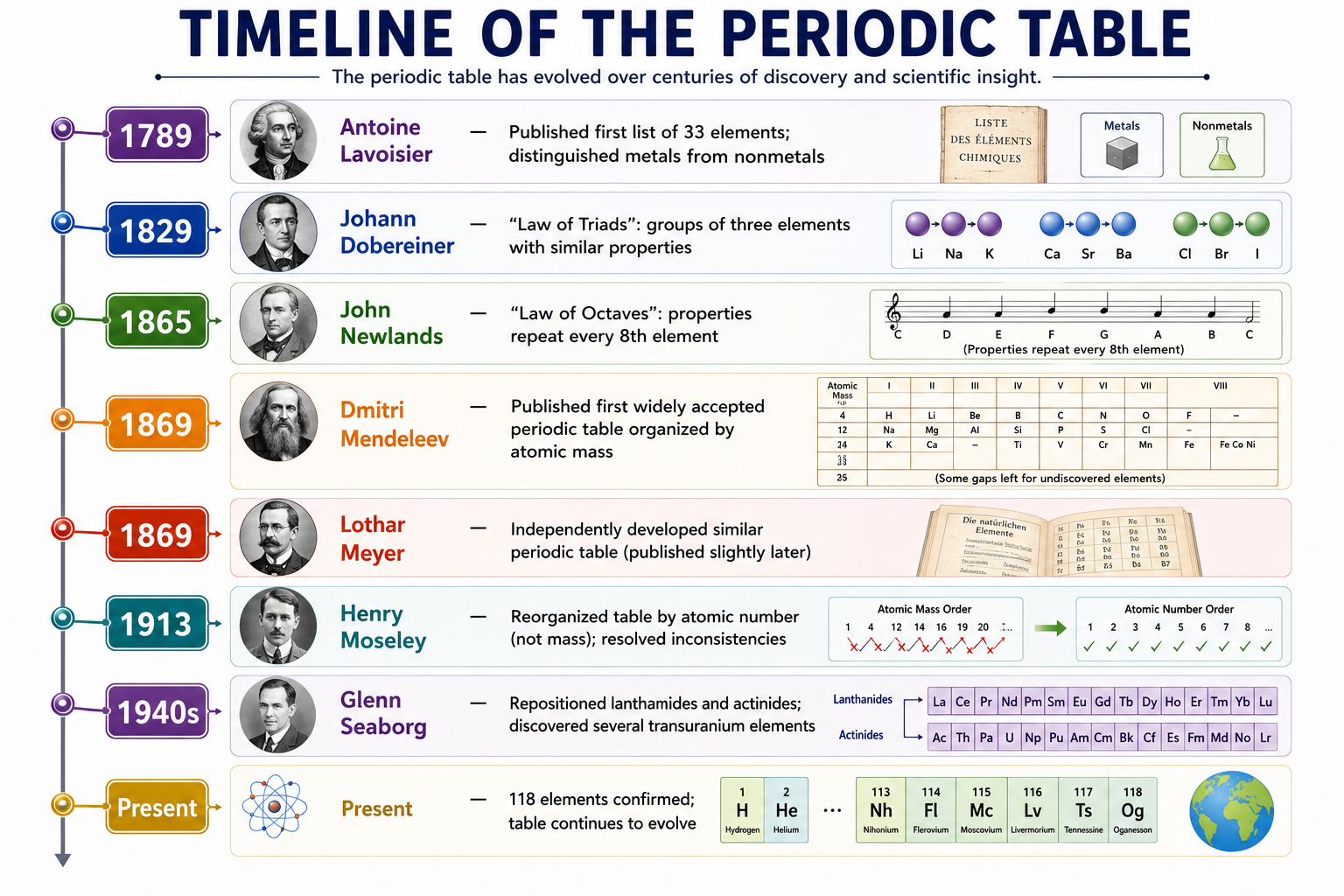
The quest to organize chemical elements predates Mendeleev by several decades. In 1789, Antoine Lavoisier published a list of 33 substances he considered elements, making an early distinction between metals and nonmetals. In 1829, German chemist Johann Dobereiner noticed that certain elements could be grouped into triads — sets of three elements with similar properties, where the middle element had properties approximately intermediate between the other two. Calcium, strontium, and barium were one such triad.
In 1865, English chemist John Newlands proposed the Law of Octaves, observing that when elements were arranged by increasing atomic mass, every eighth element had similar properties to the first — analogous to the octave in music. His idea was met with ridicule by the Chemical Society of London (one member sarcastically asked whether he had tried arranging elements alphabetically), but Newlands was essentially correct about the periodicity, even if his model was too simple for the heavier elements.
Dmitri Mendeleev’s Periodic Table
In 1869, Russian chemist Dmitri Mendeleev published his periodic table — arguably one of the most consequential scientific achievements of the 19th century. Mendeleev arranged the 63 elements known at the time in order of increasing atomic mass, but crucially, he prioritized chemical properties over strict mass ordering when the two conflicted.
What made Mendeleev’s contribution extraordinary wasn’t just the table itself — it was his confidence in the pattern. Where no element existed to fill a position, he left gaps and predicted the properties of the missing elements in remarkable detail. He predicted an element he called “eka-aluminum” (later discovered as gallium in 1875), “eka-boron” (scandium, discovered 1879), and “eka-silicon” (germanium, discovered 1886). The properties of these discovered elements matched his predictions so closely that the scientific community was convinced: the periodicity was real.
Mendeleev’s table had limitations — a few elements seemed out of place when ordered strictly by atomic mass — but his framework was fundamentally correct. For his work, he is justifiably called the father of the periodic table.
Henry Moseley’s Modern Periodic Table
The final problem with ordering by atomic mass was resolved by English physicist Henry Moseley in 1913. Using X-ray spectroscopy, Moseley discovered that each element produces a characteristic X-ray frequency that corresponds directly to its nuclear charge (the number of protons). He proposed that elements should be ordered by atomic number (proton count) rather than atomic mass.
This change resolved every anomaly in Mendeleev’s table. Tellurium and iodine, for example, appeared in the wrong order when arranged by mass but were in the correct positions when arranged by atomic number. Moseley’s reformulation is the basis of the modern periodic table.
Tragically, Moseley was killed in action at Gallipoli in 1915 at age 27 — many historians consider it one of the greatest losses to science from World War I. He had already accomplished enough to likely have earned a Nobel Prize.
Structure of the Periodic Table
Periods
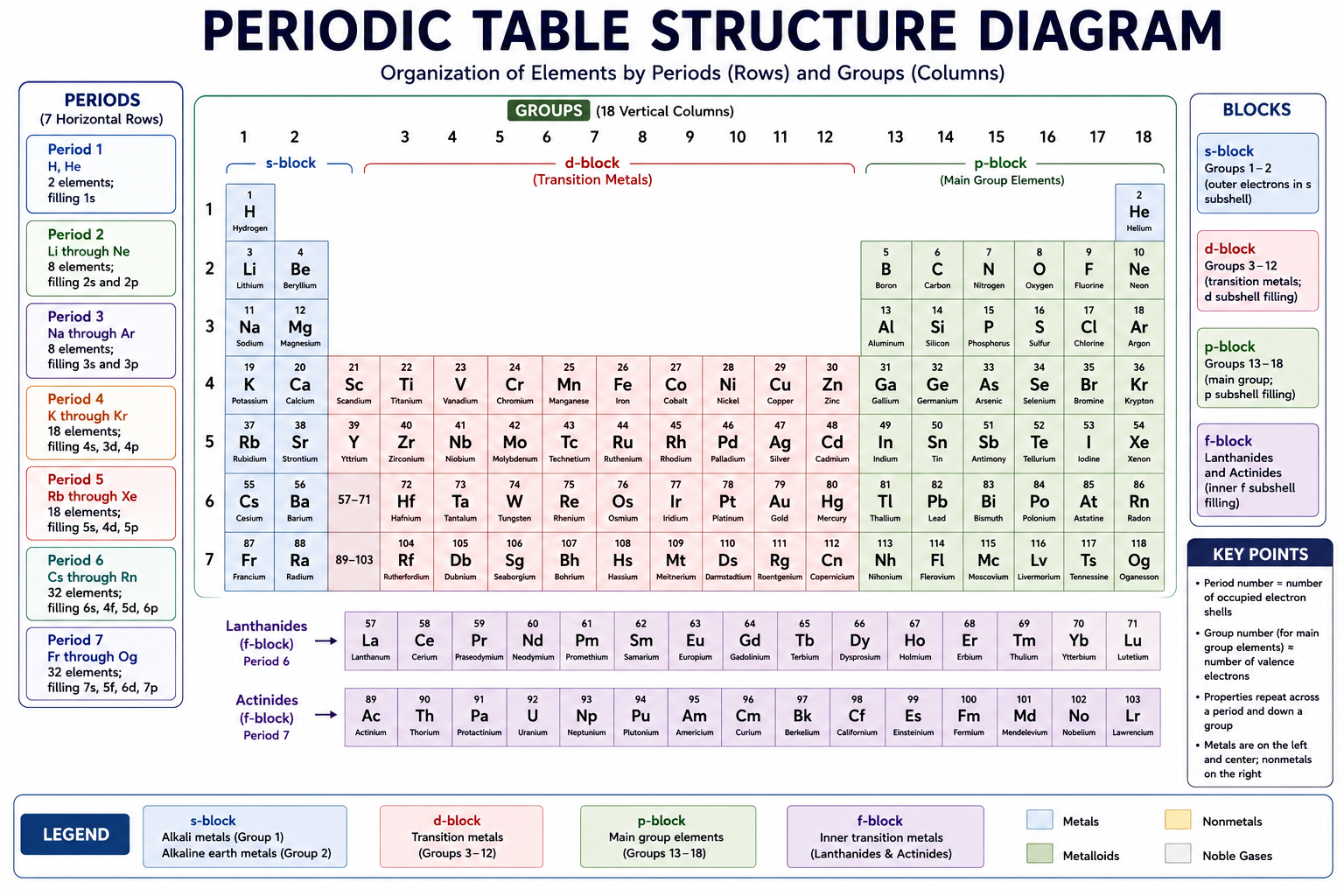
Periods are the horizontal rows of the periodic table, numbered 1 through 7. Each period represents a new principal energy level (electron shell) being filled with electrons. Period 1 contains only hydrogen and helium, whose electrons occupy the first shell. Period 2 contains 8 elements from lithium to neon, filling the 2s and 2p subshells. Period 4 and 5 contain 18 elements each because the d-block (transition metals) begins there. Periods 6 and 7 each contain 32 elements when lanthanides and actinides are counted.
Moving across a period from left to right, the atomic number increases by 1 with each element, and the additional electron enters the same principal energy level (though different subshells). This increasing nuclear charge while maintaining the same outer shell produces the trend patterns that make the periodic table so predictive.
Groups
Groups are the vertical columns of the periodic table, numbered 1 through 18. Elements in the same group have identical numbers of valence electrons (outer shell electrons) and therefore exhibit closely similar chemical behavior. This is the periodic table’s most powerful feature: group membership predicts chemical behavior with remarkable reliability.
For main group elements (Groups 1, 2, and 13–18), the group number directly indicates the number of valence electrons:
| Group | Valence Electrons | Common Ion Formed |
|---|---|---|
| 1 | 1 | 1+ cation |
| 2 | 2 | 2+ cation |
| 13 | 3 | 3+ cation |
| 14 | 4 | Varies (forms covalent bonds) |
| 15 | 5 | 3- anion (or covalent) |
| 16 | 6 | 2- anion |
| 17 | 7 | 1- anion |
| 18 | 8 | Does not typically form ions |
Blocks (s, p, d, and f)
The periodic table is divided into four blocks based on which subshell contains the highest-energy (outermost) electrons:
- s-block: Groups 1 and 2 (plus helium). Outermost electrons are in s orbitals. Includes the most reactive metals and the noble gas helium.
- p-block: Groups 13–18. Outermost electrons are in p orbitals. Contains the greatest diversity: metals, nonmetals, metalloids, and noble gases.
- d-block: Groups 3–12 (transition metals). The d subshell is being filled. Known for variable oxidation states, catalytic activity, and colored compounds.
- f-block: Lanthanides (Period 6) and Actinides (Period 7). The f subshell is being filled. Placed separately below the main table for practical layout reasons; lanthanides and actinides have very similar properties within each series.
Classification of Elements
Metals vs Nonmetals vs Metalloids (Comparison Table)
| Property | Metals | Nonmetals | Metalloids |
|---|---|---|---|
| Position on Table | Left and center | Upper right | Along staircase boundary |
| Physical State at Room Temp | Usually solid (except Hg) | Solid, liquid, or gas | Solid |
| Appearance | Shiny/lustrous | Dull (usually) | Semi-lustrous |
| Electrical Conductivity | Good conductors | Poor conductors (insulators) | Semiconductors |
| Thermal Conductivity | Good | Poor | Intermediate |
| Malleability/Ductility | Malleable and ductile | Brittle if solid | Brittle |
| Ionization Tendency | Lose electrons (form cations) | Gain electrons (form anions) | Both or neither |
| Electronegativity | Low | High | Intermediate |
| Examples | Iron, copper, sodium, gold | Oxygen, chlorine, sulfur | Silicon, germanium, arsenic |
Metals
Metals occupy the left side and center of the periodic table. About 80% of all elements are metals. Their characteristic properties — conductivity, luster, malleability, ductility — arise from their metallic bonding: a lattice of positive ions surrounded by a “sea” of delocalized electrons that flow freely, conducting heat and electricity and allowing layers of atoms to slide without fracturing.
Nonmetals
Nonmetals occupy the upper-right region of the periodic table. They are a relatively small group — only about 17 elements — but their importance is enormous. Oxygen, carbon, nitrogen, hydrogen, and phosphorus are all nonmetals, and they make up the majority of living matter. Nonmetals have high electronegativity and tend to gain electrons or share them in covalent bonds.
Metalloids
Metalloids (boron, silicon, germanium, arsenic, antimony, tellurium, and sometimes polonium and astatine) sit along the staircase boundary between metals and nonmetals. Their intermediate properties make them invaluable: silicon’s semiconductor behavior is the foundation of all modern electronics and solar cell technology. Germanium was used in the first transistors. Arsenic and antimony are used in specialized semiconductors.
Important Groups in the Periodic Table
Alkali Metals (Group 1)
Elements: Lithium (Li), Sodium (Na), Potassium (K), Rubidium (Rb), Cesium (Cs), Francium (Fr)
Alkali metals are the most reactive metals. They all have a single valence electron, which they lose very readily to form 1+ cations. This makes them highly reactive — especially with water, producing metal hydroxide and hydrogen gas. The reaction becomes progressively more vigorous going down the group:
- Lithium reacts steadily with water
- Sodium reacts vigorously, and the hydrogen produced may ignite
- Potassium reacts explosively, igniting the hydrogen immediately
- Rubidium and cesium react violently enough to be dangerous
They are soft enough to cut with a knife, have low densities (lithium, sodium, and potassium actually float on water), and must be stored under oil to prevent reaction with atmospheric oxygen and moisture.
Practical importance: Sodium is essential to nerve function in the human body. Lithium powers the batteries in smartphones and electric vehicles. Sodium and potassium compounds are central to industrial chemistry and food preservation.
Alkaline Earth Metals (Group 2)
Elements: Beryllium (Be), Magnesium (Mg), Calcium (Ca), Strontium (Sr), Barium (Ba), Radium (Ra)
Alkaline earth metals have two valence electrons and form 2+ cations. They are reactive, but less so than Group 1 metals. Their compounds — particularly calcium and magnesium compounds — are among the most abundant minerals on Earth.
Calcium (in the form of calcium carbonate) makes up limestone, chalk, and marble. Calcium is also critical for bone and tooth structure in vertebrates. Magnesium is the central atom in chlorophyll — without it, plants couldn’t photosynthesize. Barium sulfate is used as a contrast agent in medical X-ray imaging of the digestive tract.
Transition Metals
Elements: Groups 3–12 (chromium, iron, copper, zinc, silver, gold, platinum, and many others)
Transition metals are the d-block elements. They are metals with characteristic properties distinct from the main group metals:
- They exhibit multiple oxidation states (variable valency) — iron can be Fe²⁺ or Fe³⁺; copper can be Cu⁺ or Cu²⁺
- Many form colored compounds (copper sulfate is blue; potassium dichromate is orange; potassium permanganate is purple)
- Many are excellent catalysts — iron catalyzes the Haber process (ammonia synthesis); platinum and palladium are used in catalytic converters
- They are generally harder, denser, and have higher melting points than the s-block metals
- Many are biologically essential in trace amounts — iron in hemoglobin, zinc in enzyme active sites, cobalt in vitamin B12, copper in electron transport proteins
Halogens (Group 17)
Elements: Fluorine (F), Chlorine (Cl), Bromine (Br), Iodine (I), Astatine (At), Tennessine (Ts)
Halogens are the most reactive nonmetals and among the most reactive of all elements. Each halogen atom has 7 valence electrons — just one electron short of a complete outer shell — which makes them extremely eager to gain one electron, forming X⁻ ions (halide ions) or sharing electrons in covalent bonds.
Physical states at room temperature vary interestingly: fluorine and chlorine are gases, bromine is the only nonmetal liquid at room temperature, and iodine is a solid. All halogens exist as diatomic molecules (F₂, Cl₂, Br₂, I₂) in their elemental form.
Reactivity decreases down the group — fluorine is so reactive it attacks glass and must be handled with extreme caution; iodine is much more docile and is safe enough to use as an antiseptic.
Practical importance: Chlorine is used to disinfect drinking water and swimming pools. Fluorine compounds strengthen tooth enamel (fluoride in toothpaste). Iodine is essential for thyroid hormone synthesis in humans. Bromine compounds were historically used as flame retardants.
Noble Gases (Group 18)
Elements: Helium (He), Neon (Ne), Argon (Ar), Krypton (Kr), Xenon (Xe), Radon (Rn), Oganesson (Og)
Noble gases have completely filled outer electron shells — helium has 2 electrons filling its first shell; all others have 8 valence electrons (a complete octet). This configuration is maximally stable, giving noble gases essentially zero tendency to gain, lose, or share electrons. They exist as monatomic gases and are chemically inert under normal conditions.
They are called “noble” by analogy to aristocracy — they don’t mix with common elements. A handful of compounds of the heavier noble gases (xenon difluoride, xenon tetrafluoride) have been prepared under extreme conditions, but these are curiosities rather than common chemistry.
Practical importance: Helium is used in balloons and airships (safer than hydrogen), as a coolant for superconducting MRI magnets, and in deep-sea diving gas mixtures. Neon produces the characteristic red-orange glow in neon signs. Argon provides an inert atmosphere in welding and in incandescent light bulbs. Xenon is used in high-intensity automotive headlights and in anesthetic applications.
Lanthanides
Elements: Cerium (Ce) through Lutetium (Lu), Period 6 (atomic numbers 58–71)
The lanthanides are the first row of the f-block, typically shown below the main table. Also called “rare earth elements” (despite being more abundant in Earth’s crust than many common metals), they have very similar chemical properties because the 4f electrons being filled are buried deep within the electron structure and don’t significantly affect the outermost electron configuration.
Lanthanides are increasingly critical to modern technology: neodymium magnets (in electric motors and speakers), europium and terbium in LED screens and energy-efficient lighting, cerium as a polishing agent for glass and as a catalytic converter component, lanthanum in camera and telescope lenses.
Actinides
Elements: Thorium (Th) through Lawrencium (Lr), Period 7 (atomic numbers 90–103)
The actinides form the second f-block row. All actinides are radioactive — they have unstable nuclei that decay over time. The best-known actinides are uranium and thorium (which occur naturally in the Earth’s crust) and plutonium (primarily synthetic). Uranium-235 and plutonium-239 are fissile — they sustain nuclear chain reactions and are the fuels used in nuclear reactors and nuclear weapons.
Periodic Trends Explained
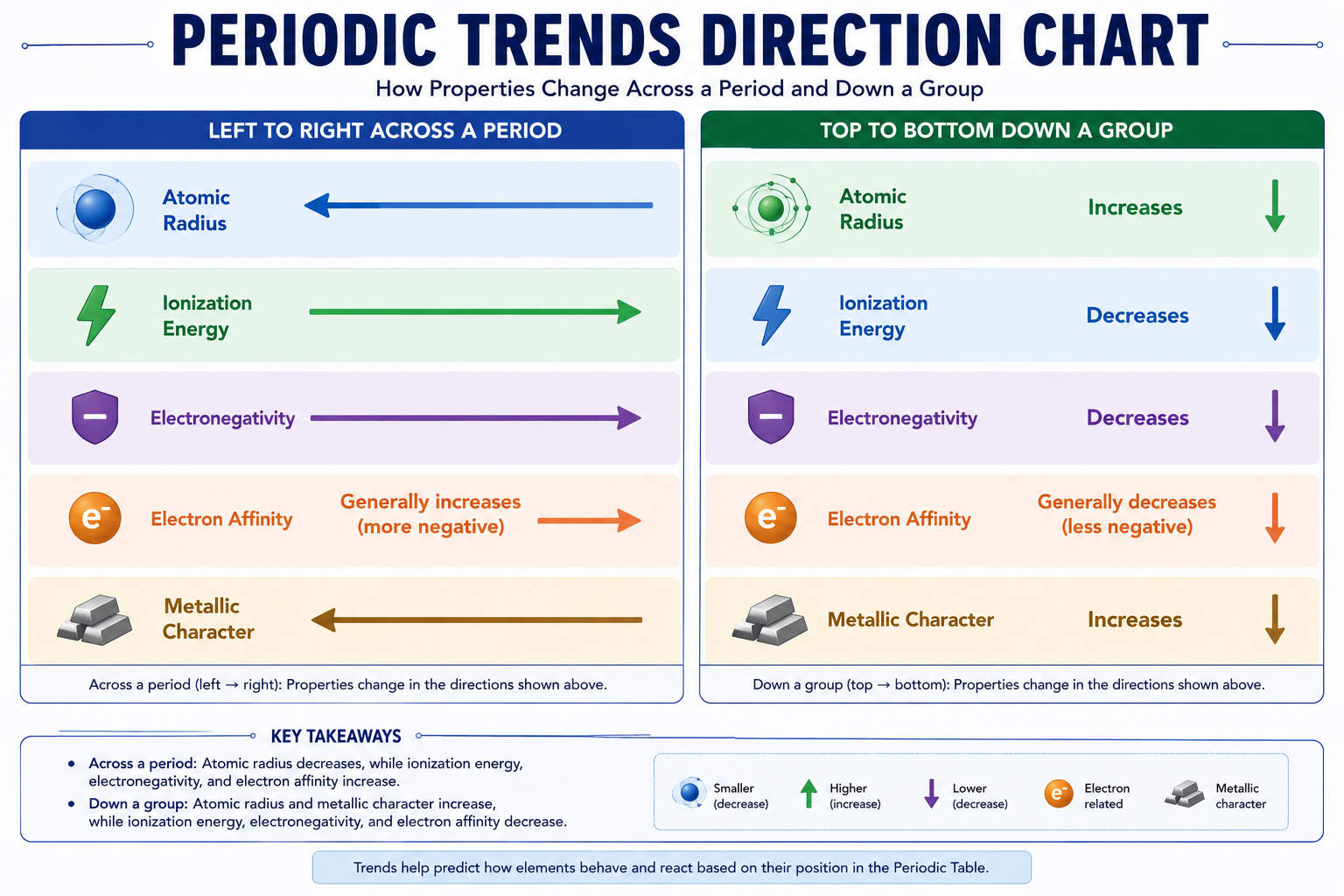
Periodic trends are the regular, predictable changes in element properties as you move across periods or down groups. All major trends are explained by two competing factors: nuclear charge (which attracts electrons inward) and shielding (inner electrons that partially cancel the nuclear charge experienced by outer electrons).
Atomic Radius
Definition: The atomic radius is approximately half the distance between two adjacent nuclei of the same element bonded together.
Trend across a period (left to right): Atomic radius decreases. As you move across a period, each successive element has one more proton. The additional proton increases the nuclear charge, pulling all electrons closer to the nucleus. The number of electron shells stays the same across a period, so the outermost electrons are held more tightly and the atom shrinks.
Trend down a group: Atomic radius increases. Each successive element down a group has one more electron shell, placing the outermost electrons farther from the nucleus. Even though nuclear charge also increases, the additional inner shells shield the outer electrons from the full nuclear attraction, and atomic size grows.
Practical example: Lithium (Period 2, Group 1) has an atomic radius of 152 pm. Sodium (Period 3, Group 1) is 186 pm. Potassium (Period 4, Group 1) is 227 pm — size increases clearly going down Group 1.
Ionization Energy
Definition: Ionization energy is the energy required to remove one electron from a gaseous neutral atom.
Trend across a period: Ionization energy generally increases from left to right. As nuclear charge increases across a period (with the same shell), electrons are held more tightly and require more energy to remove.
Trend down a group: Ionization energy decreases. Larger atoms have outer electrons farther from the nucleus and better shielded by inner electrons, so they’re easier to remove.
There are small but predictable exceptions within periods. The ionization energy of oxygen is slightly lower than nitrogen’s because oxygen’s first p electron must pair with another in an orbital, experiencing extra repulsion that makes it slightly easier to remove.
Why it matters: Elements with low first ionization energies readily form cations — this is why metals (left side of the table) lose electrons easily. Elements with high ionization energies resist losing electrons — this is why nonmetals (right side) tend to form anions or covalent bonds instead.
Electron Affinity
Definition: Electron affinity is the energy change when a gaseous neutral atom gains one electron to form a 1− ion. A more negative electron affinity means a greater tendency to gain an electron.
Trend across a period: Electron affinity generally becomes more negative (stronger) going left to right — nonmetals have a greater tendency to gain electrons.
Trend down a group: Electron affinity generally becomes less negative (weaker) going down — larger atoms with electrons farther from the nucleus attract an additional electron less strongly.
Halogens have the most negative electron affinities of any group — they are one electron short of a complete shell and gain electrons extremely readily. Fluorine’s electron affinity is slightly less negative than chlorine’s (an exception) because fluorine’s small size creates strong electron-electron repulsion in the very compact 2p shell.
Noble gases have approximately zero electron affinity — their filled shells have no room or desire for additional electrons.
Electronegativity
Definition: Electronegativity is a measure of an atom’s ability to attract the shared electrons in a covalent bond toward itself. The Pauling scale is the most commonly used, running from 0 to approximately 4.
Trend across a period: Electronegativity increases from left to right. Greater nuclear charge attracts bonding electrons more strongly.
Trend down a group: Electronegativity decreases going down. Larger atoms with more electron shielding attract shared electrons less effectively.
The most electronegative element is fluorine (Pauling value approximately 3.98). Cesium and francium are the least electronegative elements.
Electronegativity differences between bonded atoms determine bond type:
- Difference > 1.7: ionic bond (one atom strongly dominates the electrons)
- Difference 0.4–1.7: polar covalent bond (electrons shared unequally)
- Difference < 0.4: nonpolar covalent bond (electrons shared approximately equally)
Metallic Character
Definition: Metallic character refers to the tendency of an element to lose electrons and display typical metal properties (luster, conductivity, malleability).
Trend across a period: Metallic character decreases from left to right. Elements on the left readily lose electrons (metals); those on the right gain or share electrons (nonmetals).
Trend down a group: Metallic character increases going down. Larger atoms with lower ionization energies lose electrons more easily, becoming more metallic.
This explains why tin and lead (lower in Group 14) have more metallic character than carbon (at the top of Group 14) — carbon is an unambiguous nonmetal, while tin and lead are clearly metals.
Periodic Trends Summary Chart
Atomic Radius vs Ionic Radius (Comparison Table)
| Type | Definition | Size Relationship | Example |
|---|---|---|---|
| Atomic Radius | Half the distance between two bonded nuclei of the same element | Reference size | Na: 186 pm |
| Cationic Radius | Radius of a positive ion (atom has lost electrons) | Smaller than parent atom | Na⁺: 102 pm (much smaller — lost an entire shell) |
| Anionic Radius | Radius of a negative ion (atom has gained electrons) | Larger than parent atom | Cl⁻: 181 pm vs Cl: 99 pm |
| Isoelectronic Comparison | Ions with same electron count | Size decreases with increasing nuclear charge | Na⁺, Mg²⁺, Al³⁺ all have 10 electrons but decrease in size |
The logic behind ionic radius is straightforward: when an atom loses electrons to become a cation, it loses entire shells (like sodium losing its outer shell when forming Na⁺) or at minimum loses electron-electron repulsion, allowing the remaining electrons to be drawn closer to the nucleus. When an atom gains electrons to become an anion, the added electrons increase repulsion among all electrons, causing the electron cloud to expand.
How to Read the Periodic Table
Every element on the periodic table has an entry containing several pieces of information. Let’s use sodium as an example:
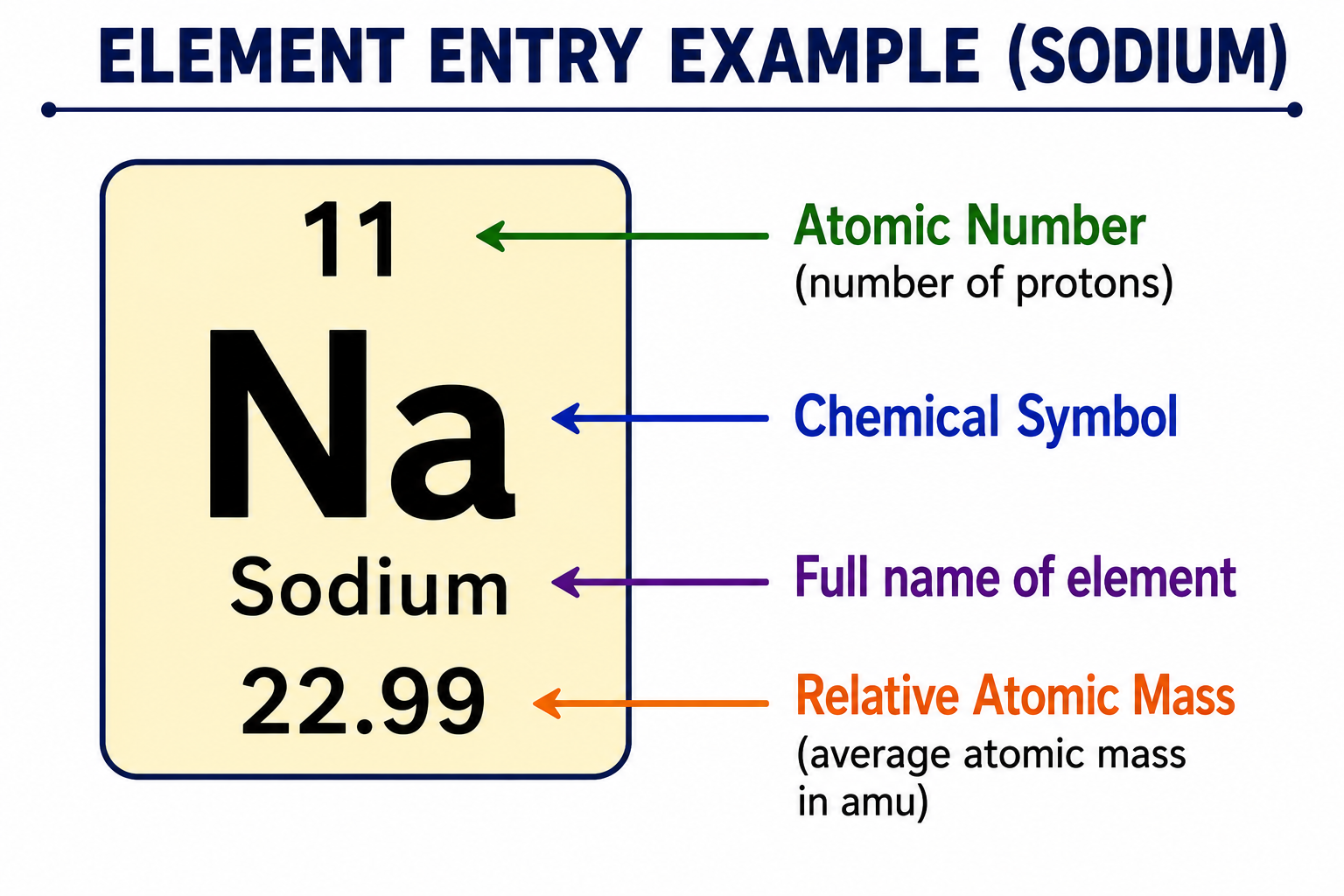
From just this information, you can determine:
- There are 11 protons in every sodium nucleus
- In a neutral sodium atom, there are also 11 electrons
- The most common sodium isotope has approximately 23 − 11 = 12 neutrons
- Sodium’s position (Period 3, Group 1) tells you it has 3 electron shells and 1 valence electron
- Group 1 position tells you it’s an alkali metal, highly reactive, and forms 1+ ions
Understanding Element Symbols
Each element has a one- or two-letter symbol. Most symbols are straightforward abbreviations of the English name (H for hydrogen, He for helium, C for carbon, O for oxygen). Some symbols derive from Latin, Greek, or German names:
| Symbol | Element | Origin of Symbol |
|---|---|---|
| Na | Sodium | Natrium (Latin) |
| K | Potassium | Kalium (Latin) |
| Fe | Iron | Ferrum (Latin) |
| Cu | Copper | Cuprum (Latin) |
| Pb | Lead | Plumbum (Latin) |
| Ag | Silver | Argentum (Latin) |
| Au | Gold | Aurum (Latin) |
| Hg | Mercury | Hydrargyrum (Greek: liquid silver) |
| W | Tungsten | Wolfram (German) |
| Sn | Tin | Stannum (Latin) |
The first letter of a symbol is always capitalized; the second letter (if present) is always lowercase. This distinction matters: Co is cobalt; CO is carbon monoxide.
Valence Electrons and the Periodic Table
Valence electrons are the electrons in an atom’s outermost principal energy level. They are the electrons involved in chemical bonding — the ones that atoms share, transfer, or receive when they interact with other atoms.
For main group elements, the number of valence electrons equals the group number (for Groups 1–2) or the group number minus 10 (for Groups 13–18):
- Group 1: 1 valence electron (e.g., Na: 2, 8, 1)
- Group 2: 2 valence electrons (e.g., Mg: 2, 8, 2)
- Group 13: 3 valence electrons (e.g., Al: 2, 8, 3)
- Group 14: 4 valence electrons (e.g., Si: 2, 8, 4)
- Group 15: 5 valence electrons (e.g., P: 2, 8, 5)
- Group 16: 6 valence electrons (e.g., S: 2, 8, 6)
- Group 17: 7 valence electrons (e.g., Cl: 2, 8, 7)
- Group 18: 8 valence electrons (e.g., Ar: 2, 8, 8)
Elements with 1–3 valence electrons tend to lose them in reactions (forming cations). Elements with 5–7 valence electrons tend to gain electrons (forming anions). Elements with 4 valence electrons or those in the transition d-block tend to form covalent bonds or display variable valency.
Electron Configuration and the Periodic Table
The periodic table’s layout is a direct visual map of electron configuration. Each period corresponds to filling a new principal energy level; each block corresponds to filling a type of subshell.
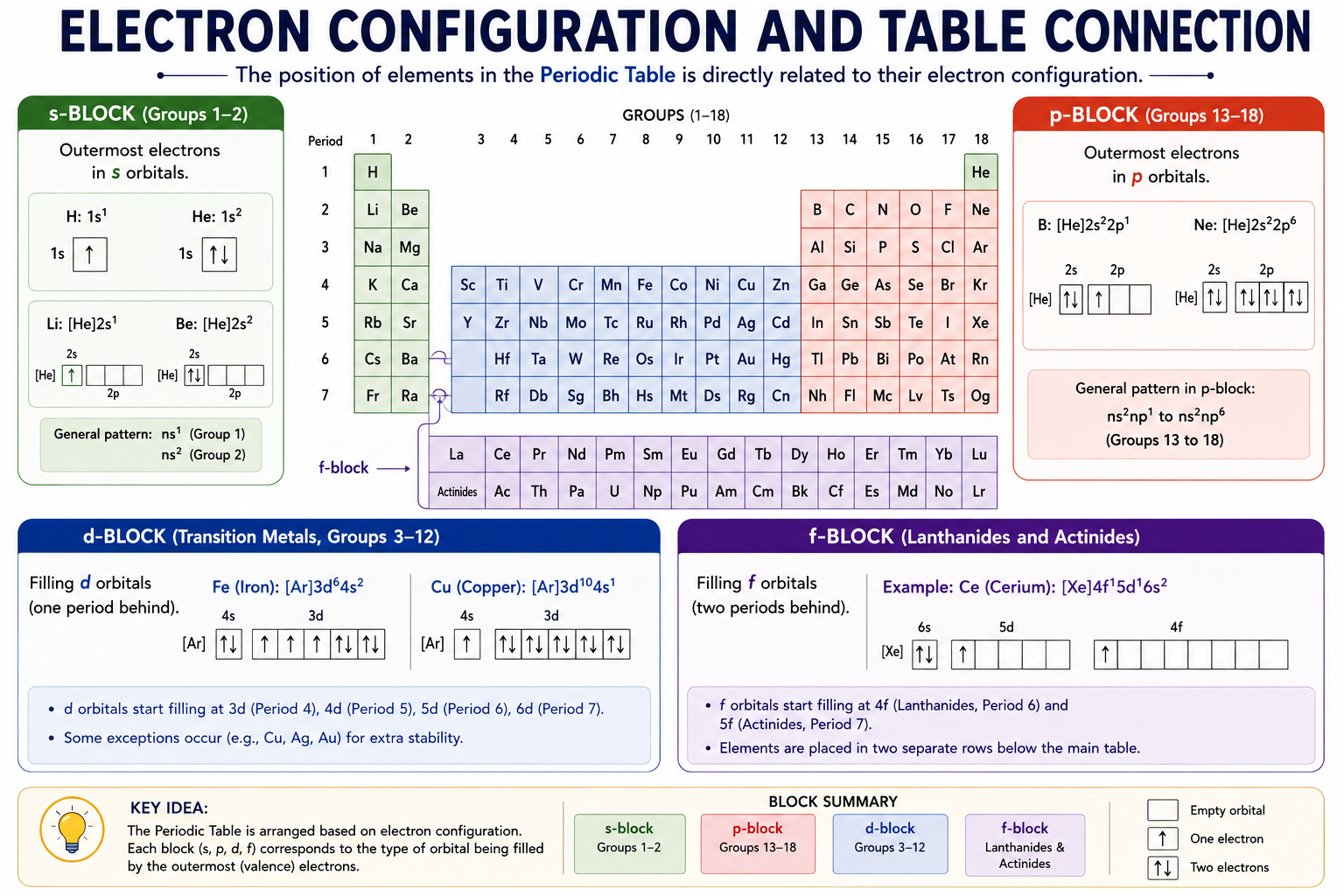
Two important exceptions to standard Aufbau filling should be noted: chromium (Cr) and copper (Cu) in Period 4 have configurations [Ar]3d⁵4s¹ and [Ar]3d¹⁰4s¹ respectively, rather than the expected [Ar]3d⁴4s² and [Ar]3d⁹4s². The half-filled d subshell (d⁵) and completely filled d subshell (d¹⁰) are particularly stable, providing extra stability that drives these exceptions. Similar exceptions occur in Period 5 with molybdenum and silver.
Applications of the Periodic Table
The periodic table isn’t just an academic tool — it has direct applications in nearly every field of science and technology:
Medicine and Pharmacy: Knowledge of element chemistry guides drug design. Platinum-based compounds (cisplatin) are used in cancer chemotherapy. Lithium carbonate treats bipolar disorder. Gadolinium compounds are used as contrast agents in MRI scanning. Radioactive isotopes of elements like iodine-131 (thyroid treatment) and technetium-99m (diagnostic imaging) depend on understanding nuclear properties readable from the table.
Materials Science and Engineering: Engineers use periodic trends to select materials with specific properties. Silicon and germanium semiconductors, titanium’s strength-to-weight ratio for aerospace alloys, tungsten’s extreme melting point for light bulb filaments and cutting tools, and the superconductive properties of niobium all flow from understanding periodic properties.
Agriculture: Nitrogen (Group 15) and phosphorus (Group 15) are two of the three primary plant nutrients — understanding their chemistry is fundamental to fertilizer development and soil science. Iron deficiency causes chlorosis in plants; the periodic table’s organization helps agricultural chemists understand why and how to address it.
Environmental Science: The behavior of pollutants in soil and water depends on periodic chemistry. Understanding why lead and mercury (heavy metals, lower in the table) are particularly toxic involves understanding their chemistry. The ozone layer’s destruction by chlorofluorocarbons relates to halogen chemistry.
Common Periodic Table Terms Every Student Should Know
| Term | Definition |
|---|---|
| Period | Horizontal row of the periodic table; corresponds to a principal energy level |
| Group | Vertical column of the periodic table; elements share similar chemical properties |
| Atomic Number | Number of protons in an atom’s nucleus; uniquely identifies the element |
| Atomic Mass | Weighted average mass of all naturally occurring isotopes of an element (in amu) |
| Valence Electrons | Electrons in the outermost principal energy level; determine chemical behavior |
| Electronegativity | Ability of an atom to attract bonding electrons toward itself |
| Ionization Energy | Energy needed to remove one electron from a gaseous neutral atom |
| Electron Affinity | Energy change when a gaseous atom gains one electron |
| Shielding Effect | Reduction in nuclear attraction felt by outer electrons due to inner electrons |
| Effective Nuclear Charge | Net positive charge experienced by an outer electron after shielding is accounted for |
| Metallic Character | Tendency of an element to lose electrons and exhibit metal properties |
| Isoelectronic | Having the same number of electrons (e.g., Na⁺ and Ne both have 10 electrons) |
| Periodic Law | Properties of elements are periodic functions of their atomic numbers |
| Alkali Metals | Group 1 elements; highly reactive metals with 1 valence electron |
| Halogens | Group 17 elements; highly reactive nonmetals with 7 valence electrons |
| Noble Gases | Group 18 elements; chemically inert with full outer electron shells |
| Transition Metals | d-block elements; exhibit variable oxidation states and form colored compounds |
| Lanthanides | f-block elements in Period 6; similar properties within the series |
| Actinides | f-block elements in Period 7; all radioactive |
| Metalloids | Elements with properties intermediate between metals and nonmetals |
Common Mistakes Students Make
These are the errors that appear most consistently on periodic table exam questions:
- Confusing atomic mass with atomic number. Atomic number is the number of protons (always a whole number, uniquely defines the element). Atomic mass is the weighted average mass of all isotopes (usually not a whole number, shown on the periodic table). Using one when asked for the other is a very common error.
- Getting periodic trends backwards. The most common flip: students say atomic radius increases across a period (it decreases) or that ionization energy increases down a group (it decreases). Use the following logic to check yourself: increasing nuclear charge across a period pulls electrons in (radius decreases, IE increases); adding shells down a group pushes electrons out (radius increases, IE decreases).
- Assuming all Group 18 noble gases are completely unreactive. The heavier noble gases (xenon in particular) can form compounds under certain conditions. XeF₂, XeF₄, and XeO₃ are real compounds. Examiners sometimes test whether students know this nuance.
- Confusing lanthanides and actinides. Lanthanides are Period 6 (f-block), atomic numbers 57–71. Actinides are Period 7 (f-block), atomic numbers 89–103. A quick memory check: lanthanides come before actinides alphabetically, and Period 6 comes before Period 7.
- Forgetting the cation/anion size rule. Cations are smaller than their parent atoms (they’ve lost electrons, sometimes entire shells). Anions are larger (they’ve gained electrons, increasing repulsion). Students frequently reverse this.
- Thinking the group number directly gives valence electrons for all groups. This works for Groups 1 and 2 directly (1 and 2 valence electrons). For Groups 13–18, valence electrons = group number − 10. And for transition metals, the d-block electrons complicate things considerably.
- Applying electronegativity to noble gases without qualification. Noble gases have essentially no defined electronegativity in the Pauling scale (because they don’t normally form bonds). Fluorine is the most electronegative element that actually forms bonds.
- Conflating “most reactive metal” with “most reactive element.” Cesium (or francium) is the most reactive metal, but fluorine is the most reactive element overall — it reacts with almost everything, including some noble gases and even gold under extreme conditions.
Best Tips to Study the Periodic Table
Exam Tips Box
- Learn the trends first, not the numbers. If you understand why atomic radius decreases across a period (increasing nuclear charge, same shell), you can reason about any element rather than memorizing 118 individual values.
- Focus on the key groups: Group 1 (alkali metals), Group 2 (alkaline earth metals), Group 17 (halogens), and Group 18 (noble gases). These four groups appear in the vast majority of periodic table exam questions. Know their properties cold.
- Practice identifying an element’s group, period, block, and number of valence electrons from its atomic number alone. This is the kind of quick reasoning that saves time in exams.
- For electron configuration, remember that d-block elements (transition metals) fill their d orbitals one period later than their principal quantum number — 3d fills in Period 4, 4d fills in Period 5. This confuses many students.
- Connect electronegativity differences to bond type in practice questions: large difference → ionic, moderate → polar covalent, small → nonpolar covalent. The periodic table tells you electronegativity trends, so you can make these judgments without a table of values.
- When asked about exceptions to trends (like the smaller-than-expected atomic radius of gold, or copper’s electron configuration), acknowledge that periodic trends are general patterns with specific exceptions, and explain the structural reason for the exception.
Memory Tricks for Learning the Periodic Table
For the first 20 elements in order:
“Happy Henry Likes Beer But Could Not Obtain Fresh Nectarines, Nancy Mgt Al Signaled Policeman Sergeant Clooney Arguing Kindly Calmly”
(H, He, Li, Be, B, C, N, O, F, Ne, Na, Mg, Al, Si, P, S, Cl, Ar, K, Ca)
For the alkali metals (Group 1):
“Little Nancy Kept Rbidly Collecting Frogs” — Li, Na, K, Rb, Cs, Fr
For the halogens (Group 17):
“Funny Clowns Bring Interesting Attractions” — F, Cl, Br, I, At
For periodic trends: A useful visual — imagine the periodic table as a hillside. Atomic radius gets smaller as you climb across (left to right on a period) and gets larger as you go down. Ionization energy is the reverse: it takes more energy to climb higher (move right), and less as you descend (move down the group).
For remembering which elements have Latin symbols: A helpful sentence for the most common ones: “Napkins Keep Feast Cups Pblaced Against Automatically” — Na (sodium), K (potassium), Fe (iron), Cu (copper), Pb (lead), Ag (silver), Au (gold)
For the blocks of the table: “Super Powerful Dynamic Force” — s-block (Groups 1-2), p-block (Groups 13-18), d-block (transition metals, Groups 3-12), f-block (lanthanides and actinides)
Periodic Table Practice Questions
30 Multiple Choice Questions (MCQs) with Answers
1. Who reorganized the periodic table by atomic number rather than atomic mass?
- A) Dmitri Mendeleev
- B) John Newlands
- C) Henry Moseley ✓
- D) Antoine Lavoisier
2. Elements in the same vertical column of the periodic table are called:
- A) Periods
- B) Groups ✓
- C) Blocks
- D) Series
3. The atomic radius generally does what across a period (left to right)?
- A) Decreases ✓
- B) Increases
- C) Stays the same
- D) First increases, then decreases
4. Which group contains the halogens?
- A) Group 1
- B) Group 2
- C) Group 17 ✓
- D) Group 18
5. How many valence electrons does a Group 16 element have?
- A) 2
- B) 4
- C) 6 ✓
- D) 8
6. Which of the following is a metalloid?
- A) Sodium
- B) Sulfur
- C) Silicon ✓
- D) Silver
7. The most electronegative element in the periodic table is:
- A) Fluorine ✓
- B) Oxygen
- C) Chlorine
- D) Nitrogen
8. Going down Group 1, the reactivity of alkali metals:
- A) Increases ✓
- B) Decreases
- C) Stays the same
- D) First increases, then decreases
9. Which element has the symbol Fe?
- A) Fluorine
- B) Francium
- C) Iron ✓
- D) Fermium
10. The d-block elements are also known as:
- A) Alkali metals
- B) Noble gases
- C) Transition metals ✓
- D) Halogens
11. Going down a group, ionization energy generally:
- A) Decreases ✓
- B) Increases
- C) Stays constant
- D) Increases then decreases
12. Which period corresponds to elements filling the third principal energy level?
- A) Period 1
- B) Period 2
- C) Period 3 ✓
- D) Period 4
13. Noble gases are chemically inert because they:
- A) Have very high atomic masses
- B) Have completely filled outer electron shells ✓
- C) Are radioactive
- D) Have no electrons at all
14. Which of the following elements is a liquid at room temperature AND a nonmetal?
- A) Mercury
- B) Bromine ✓
- C) Gallium
- D) Cesium
15. A sodium atom (Na) and a sodium ion (Na⁺) differ in their:
- A) Number of protons
- B) Atomic number
- C) Number of electrons ✓
- D) Mass number
16. The alkaline earth metals belong to which group?
- A) Group 1
- B) Group 2 ✓
- C) Group 3
- D) Group 17
17. Which of the following best explains why atomic radius decreases across a period?
- A) More electron shells are added
- B) Electron repulsion increases
- C) Increasing nuclear charge attracts electrons more strongly without adding shells ✓
- D) Neutron count increases
18. How many electrons does a chloride ion (Cl⁻) have? (Cl has atomic number 17)
- A) 16
- B) 17
- C) 18 ✓
- D) 19
19. Lanthanides are found in which period of the f-block?
- A) Period 6 ✓
- B) Period 4
- C) Period 5
- D) Period 7
20. Which block of the periodic table contains nonmetals, metalloids, and metals?
- A) s-block
- B) d-block
- C) p-block ✓
- D) f-block
21. The element with the symbol Au is:
- A) Silver
- B) Aluminum
- C) Gold ✓
- D) Argon
22. Electron affinity is MOST negative (strongest tendency to gain an electron) for elements in which group?
- A) Group 1
- B) Group 18
- C) Group 17 ✓
- D) Group 2
23. Which of the following elements is most metallic?
- A) Cesium ✓
- B) Lithium
- C) Carbon
- D) Fluorine
24. The number of periods in the modern periodic table is:
- A) 4
- B) 6
- C) 7 ✓
- D) 18
25. Which element is in Period 3, Group 17?
- A) Fluorine
- B) Chlorine ✓
- C) Bromine
- D) Argon
26. Isoelectronic species have the same:
- A) Number of protons
- B) Number of electrons ✓
- C) Mass number
- D) Number of neutrons
27. Which of the following correctly orders elements by increasing atomic radius?
- A) Na < Li < K
- B) Cl < S < P < Si
- C) F < Cl < Br ✓
- D) K < Na < Li
28. The transition metal copper (Cu) has the electron configuration [Ar]3d¹⁰4s¹ rather than the expected [Ar]3d⁹4s² because:
- A) The 4s orbital fills after 3d
- B) A completely filled 3d subshell provides extra stability ✓
- C) Copper has too many electrons for standard filling
- D) The Pauli exclusion principle requires this
29. Which statement about noble gases is TRUE?
- A) They never form any chemical compounds
- B) Their outer electron shells are completely filled, making them highly stable ✓
- C) They are all gases and monatomic at every temperature
- D) They always have 8 electrons regardless of period
30. The symbol Pb comes from the Latin word for lead. What is the Latin word?
- A) Ferrum
- B) Plumbum ✓
- C) Cuprum
- D) Stannum
15 Short Answer Questions
- Explain why Mendeleev left gaps in his periodic table. What happened when those gaps were filled by later discoveries?
- Describe the general trend in ionization energy across a period and down a group. Explain the atomic-level reason for each trend.
- Compare the properties of alkali metals and halogens. Why do these two groups react so readily with each other?
- What is the difference between a cation and an anion? Why are cations generally smaller than their parent atoms while anions are generally larger?
- Explain what electronegativity measures. Describe its trend across a period and down a group, and explain what a large electronegativity difference between two bonded atoms indicates.
- An element is in Period 4, Group 2. Without looking at a periodic table, determine: its number of electron shells, its number of valence electrons, the charge of its most common ion, and whether it is a metal or nonmetal.
- Describe the four blocks of the periodic table (s, p, d, f), stating which groups each block contains and what type of orbital the outermost electrons occupy in each block.
- Why do transition metals exhibit variable oxidation states? Give two examples of transition metals with two different oxidation states each.
- Explain the shielding effect. How does it explain why ionization energy decreases down a group even though nuclear charge is increasing?
- Describe three practical applications of noble gases, explaining why the properties of noble gases make them suitable for each application.
- What is the difference between atomic mass (the number on the periodic table) and mass number? Why is atomic mass usually not a whole number?
- Describe the trend in reactivity for halogens going down Group 17. Explain the structural reason for this trend.
- Explain why the periodic table is described as “periodic.” What property repeats, and at what structural level does this repetition arise?
- An element has the electron configuration [Ne]3s²3p⁵. Identify its period, group, block, number of valence electrons, and whether it is likely to form a cation or anion.
- Compare the physical and chemical properties of lanthanides and actinides. Why do elements within each series have such similar properties?
10 Long Answer Questions
- Trace the historical development of the periodic table from Dobereiner’s triads through Newlands’s octaves, Mendeleev’s periodic table, and Moseley’s modern arrangement. For each stage, explain what the scientist contributed, what evidence or reasoning supported their approach, and what limitation their model had.
- Explain all five major periodic trends (atomic radius, ionization energy, electron affinity, electronegativity, and metallic character) in detail. For each trend, state the direction across a period and down a group, explain the atomic-level reason using the concepts of nuclear charge and shielding, and give a specific numerical or practical example.
- Describe the structure of the modern periodic table in full, explaining the significance of periods, groups, and blocks. Connect each structural feature directly to electron configuration: explain what the period tells you about electron shells, what the group tells you about valence electrons, and what the block tells you about orbital types.
- Describe the properties of alkali metals (Group 1), alkaline earth metals (Group 2), halogens (Group 17), and noble gases (Group 18) in detail. For each group, address: number of valence electrons, physical state and appearance, reactivity trend within the group, typical ion formed, and at least two practical real-world applications.
- Explain the distinction between metals, nonmetals, and metalloids fully, addressing their positions on the periodic table, their physical properties (conductivity, state at room temperature, luster, malleability), and their chemical properties (tendency to form cations or anions, electronegativity, ionization energy). Give three examples of each category.
- Discuss the transition metals (d-block) as a group. Explain what makes them distinct from main group metals: variable oxidation states, colored compounds, catalytic activity, and complex ion formation. Give specific examples for each characteristic. Discuss the biological importance of at least three transition metals.
- Explain the concept of isoelectronic species using at least five examples. Describe the trend in ionic size among isoelectronic species. Connect this discussion to the broader concepts of effective nuclear charge and shielding.
- Describe the f-block elements (lanthanides and actinides) in detail. Explain why elements within each series have such similar chemical properties, discuss the industrial and technological importance of lanthanides, and address the significance of uranium and plutonium in the actinide series.
- Explain how the periodic table serves as a predictive tool in chemistry, materials science, and medicine. Give a specific example from each of these three fields where knowledge of periodic properties guided a significant discovery, application, or decision.
- Discuss exceptions to periodic trends in detail. Choose at least four specific exceptions (for example, the lower ionization energy of oxygen compared to nitrogen, the electron configuration exceptions of chromium and copper, the electron affinity of fluorine versus chlorine) and for each one, explain why the general trend breaks down at that point and what structural feature causes the exception.
Revision Checklist
Use this comprehensively before any periodic table examination:
- I can explain the contributions of Mendeleev and Moseley to the development of the modern periodic table
- I know what periods and groups are and can identify them on the table
- I understand the four blocks (s, p, d, f) and which groups each contains
- I can state the number of valence electrons for any main group element from its group number
- I know the five main periodic trends and their directions across periods and down groups
- I can explain why each trend occurs in terms of nuclear charge and shielding
- I know the properties, reactivity trends, and practical applications of alkali metals, alkaline earth metals, halogens, and noble gases
- I can describe transition metals’ distinctive properties (variable oxidation states, color, catalysis)
- I understand the difference between metals, nonmetals, and metalloids with examples
- I know the element symbols for the 20 most common elements by memory
- I know the Latin-derived symbols (Na, K, Fe, Cu, Pb, Ag, Au, Hg, W, Sn) and their origins
- I can explain why cations are smaller and anions are larger than their parent atoms
- I understand isoelectronic species and can order them by size
- I can connect an element’s position (period, group, block) to its electron configuration
- I know the main exceptions to periodic trends and why they occur
- I have completed all 30 MCQs and identified any areas of weakness
- I can write out the six key element groups from memory with their properties
Best Books for Learning the Periodic Table
These resources are consistently recommended by chemistry educators and students:
- “Chemistry: The Central Science” by Brown, LeMay, Bursten, Murphy, and Woodward — The most widely used introductory university chemistry textbook; its periodic table and periodic trends chapters are exceptionally clear, with excellent visual representations of trends and worked examples.
- “The Periodic Table: A Very Short Introduction” by Eric Scerri — A compact, beautifully written overview of the periodic table’s history, structure, and philosophical significance. Highly accessible and ideal for students who want context beyond equations and numbers.
- “The Disappearing Spoon” by Sam Kean — An entertaining narrative of the periodic table told through stories of the elements’ discoveries and applications. Not a textbook, but wonderfully effective at making the elements memorable and interesting.
- “Periodic Tales” by Hugh Aldersey-Williams — Explores the elements through culture, history, and science. Excellent for building genuine interest in the periodic table beyond examination requirements.
- “Chemistry” by Zumdahl and Zumdahl — A rigorous but accessible university text with particularly strong coverage of periodic trends and element group properties. Its periodic law chapters are among the clearest available.
Free Online Chemistry Resources
These freely accessible resources provide high-quality content on the periodic table:
- OpenStax Chemistry — Free, peer-reviewed chemistry textbooks with complete chapters on the periodic table, periodic trends, and element group properties, including visual trend diagrams and practice problems.
- Khan Academy Chemistry — Free video lessons and exercises on periodic trends, electron configuration, element groups, and how to read and use the periodic table. Excellent for visual learners.
- Chemistry LibreTexts — Comprehensive open-access library with detailed, academic-level content on every aspect of periodic table organization and trends. Includes interactive simulations of periodic trends.
- American Chemical Society (ACS) — Educational resources from the world’s largest scientific society, including periodic table tools, element information, and chemistry career resources.
- Royal Society of Chemistry (RSC) — Interactive periodic table resources, periodic trend visualizations, element data sheets, and curriculum-aligned teaching materials from the UK’s leading chemistry organization.
Related Articles on LearnMinto
These connected guides will extend your understanding from the periodic table into broader chemistry topics:
- Chemistry Study Guide — A comprehensive overview of all major chemistry topics including reactions, stoichiometry, and thermochemistry
- Atomic Structure Study Guide — A dedicated in-depth exploration of atomic models, electron configuration, and orbital theory that underpins all periodic table concepts
- Chemical Bonding Study Guide — Learn how periodic position and valence electrons determine bond types and molecular properties
- Mole Concept Study Guide — Master the quantitative relationships in chemistry that use atomic masses from the periodic table
- Acids and Bases Study Guide — Understand acid-base chemistry and how element position influences acidic and basic behavior
Frequently Asked Questions
Q1: What is the periodic table and why is it organized the way it is?
The periodic table is a systematic arrangement of all 118 known chemical elements ordered by increasing atomic number. It is structured so that elements with similar chemical properties appear in the same vertical column (group). This organization reflects underlying electron configuration — elements in the same group have the same number of valence electrons, which is why they exhibit similar behavior. The periodicity (repeating patterns) arises directly from the quantum mechanical filling of electron shells and subshells.
Q2: Who invented the periodic table?
The most significant credit goes to Russian chemist Dmitri Mendeleev, who in 1869 published a table of 63 elements arranged by atomic mass that revealed periodic patterns in their properties. He predicted the existence and properties of undiscovered elements with remarkable accuracy. German chemist Lothar Meyer independently developed a similar table around the same time. In 1913, English physicist Henry Moseley reorganized the table by atomic number rather than mass, producing the modern periodic table and resolving all previous anomalies.
Q3: What are groups and periods in the periodic table?
Groups are the 18 vertical columns of the periodic table. Elements in the same group have the same number of valence electrons and similar chemical properties. Periods are the 7 horizontal rows. Each period corresponds to a principal energy level being filled — Period 1 fills shell 1, Period 2 fills shell 2, and so on. An element’s period tells you how many electron shells it has; its group tells you how many valence electrons it has.
Q4: What are the main periodic trends?
The five main periodic trends are: atomic radius (decreases across a period, increases down a group), ionization energy (increases across a period, decreases down a group), electron affinity (generally becomes more negative across a period and less negative down a group), electronegativity (increases across a period, decreases down a group), and metallic character (decreases across a period, increases down a group). All five trends are explained by the interplay of increasing nuclear charge and increasing electron shielding.
Q5: Why do elements in the same group have similar properties?
Elements in the same group have the same number of valence electrons. Since chemical behavior is determined almost entirely by the valence electrons — the electrons involved in bonding and reactions — elements with identical valence electron counts behave similarly. Sodium and potassium both have 1 valence electron; lithium also has 1 valence electron. All three form 1+ ions, react vigorously with water, and form similar compounds.
Q6: What is the difference between metals, nonmetals, and metalloids?
Metals (left and center of the table) are shiny, conduct electricity and heat, are malleable and ductile, and tend to lose electrons forming cations. Nonmetals (upper right of the table) are generally poor conductors, brittle in solid form, and tend to gain electrons or share them in covalent bonds. Metalloids (along the staircase boundary between metals and nonmetals) have intermediate properties — they are semiconductors, meaning their conductivity is between metals and nonmetals and can be precisely controlled, which is why they’re central to electronics.
Q7: Why are noble gases unreactive?
Noble gases have completely filled outer electron shells — helium has 2 electrons filling its only shell, while all other noble gases have 8 valence electrons (a full octet). This is the most stable possible electron configuration. Since chemical reactions involve gaining, losing, or sharing electrons to achieve a more stable configuration, noble gases have no thermodynamic drive to react — they’re already in the most stable state. The heavier noble gases (especially xenon) can form a small number of compounds under extreme conditions.
Q8: What does the atomic number tell you about an element?
The atomic number is the number of protons in an element’s nucleus. It uniquely identifies the element — if you know the atomic number, you know which element it is. In a neutral atom, the atomic number also equals the number of electrons. Combined with position on the periodic table (period and group), the atomic number allows you to determine electron configuration, number of valence electrons, and predict chemical behavior.
Q9: How do you determine the number of valence electrons from the periodic table?
For main group elements, the number of valence electrons equals the group number for Groups 1 and 2, and the group number minus 10 for Groups 13–18. So Group 1 = 1 valence electron, Group 2 = 2, Group 13 = 3, Group 14 = 4, Group 15 = 5, Group 16 = 6, Group 17 = 7, Group 18 = 8. For transition metals (Groups 3–12), determining valence electrons is more complex because d electrons are involved.
Q10: Why do some elements have symbols that don’t match their English names?
Many element symbols come from Latin, Greek, or German names that predate or exist alongside their English names. Iron’s symbol Fe comes from the Latin ferrum; sodium’s Na comes from natrium; potassium’s K from kalium; gold’s Au from aurum; lead’s Pb from plumbum; silver’s Ag from argentum; mercury’s Hg from hydrargyrum (Greek for “water silver”). These elements were known since antiquity and named in various languages before international chemical nomenclature was standardized.
Q11: What are transition metals and why are they special?
Transition metals are the d-block elements in Groups 3–12. They are special because they exhibit multiple oxidation states (variable valency), form colored compounds, serve as excellent catalysts, and form complex ions with ligands. Their variable oxidation states arise because both the 3d and 4s electrons can participate in bonding. Many are biologically essential — iron in hemoglobin, zinc in enzymes, cobalt in vitamin B12. Industrially, transition metals and their compounds catalyze major chemical processes including the Haber process (iron) and catalytic converters (platinum, palladium, rhodium).
Q12: How does the periodic table connect to electron configuration?
The connection is direct. Each period corresponds to a principal quantum level being filled. Each block corresponds to a type of subshell: s-block (Groups 1-2) fills s orbitals, p-block (Groups 13-18) fills p orbitals, d-block (transition metals, Groups 3-12) fills d orbitals, and f-block (lanthanides and actinides) fills f orbitals. An element’s position on the table immediately tells you its electron configuration: period tells you the highest principal quantum number; block tells you which subshell is last filled; group tells you how many electrons are in the outermost subshell.
Summary
The periodic table is far more than a reference chart of chemical elements — it is a window into the quantum mechanical structure of matter, a predictive tool for chemical behavior, and one of the most elegant organizational frameworks in all of science.
Starting with Mendeleev’s inspired arrangement by atomic mass and his bold prediction of missing elements, through Moseley’s definitive reorganization by atomic number, the periodic table reached its modern form as a direct map of electron configuration. Seven periods correspond to seven principal energy levels; 18 groups unite elements with identical valence electron counts and similar properties; four blocks (s, p, d, f) reflect which orbital subshell the outermost electrons occupy.
Five major periodic trends — atomic radius, ionization energy, electron affinity, electronegativity, and metallic character — all emerge from the interplay of increasing nuclear charge across periods and increasing electron shielding down groups. Major element groups each have distinct, predictable characters: alkali metals are hyper-reactive with one valence electron; halogens are nearly as reactive in the opposite direction with seven; noble gases are entirely stable with full shells; transition metals display remarkable versatility in oxidation states and chemical behavior.
Reading the periodic table fluently means being able to extract electron configuration, valence electron count, likely ion formation, reactivity, and bond type from an element’s position — and that ability underpins success in virtually every subsequent topic in chemistry.
Final Thoughts
Students who struggle with chemistry often do so because they treat the periodic table as a collection of isolated facts to memorize. Students who excel typically discover something different: the periodic table is a system, and once you understand its logic — why periods correspond to shells, why groups share valence electrons, why trends run the way they do — the entire discipline of chemistry becomes more navigable.
This Periodic Table Study Guide has aimed to give you both the factual content and the logical framework to use the table confidently in any examination context. Work through the practice questions methodically, use the memory tricks to anchor key facts, and review the trends actively rather than passively — ask yourself why each trend runs in the direction it does before checking the answer.
The periodic table has been hanging on classroom walls for over 150 years because it works. Understanding why it works is what separates a confident chemistry student from one who’s simply memorizing.
Disclaimer
This article is intended for educational and informational purposes only. While LearnMinto strives to provide accurate and up-to-date information, readers should verify important academic concepts through official textbooks, educational institutions, examination boards, or trusted scientific resources before relying on this content for exams or academic purposes. LearnMinto is not affiliated with any specific school, university, research institution, or examination board.