
Introduction
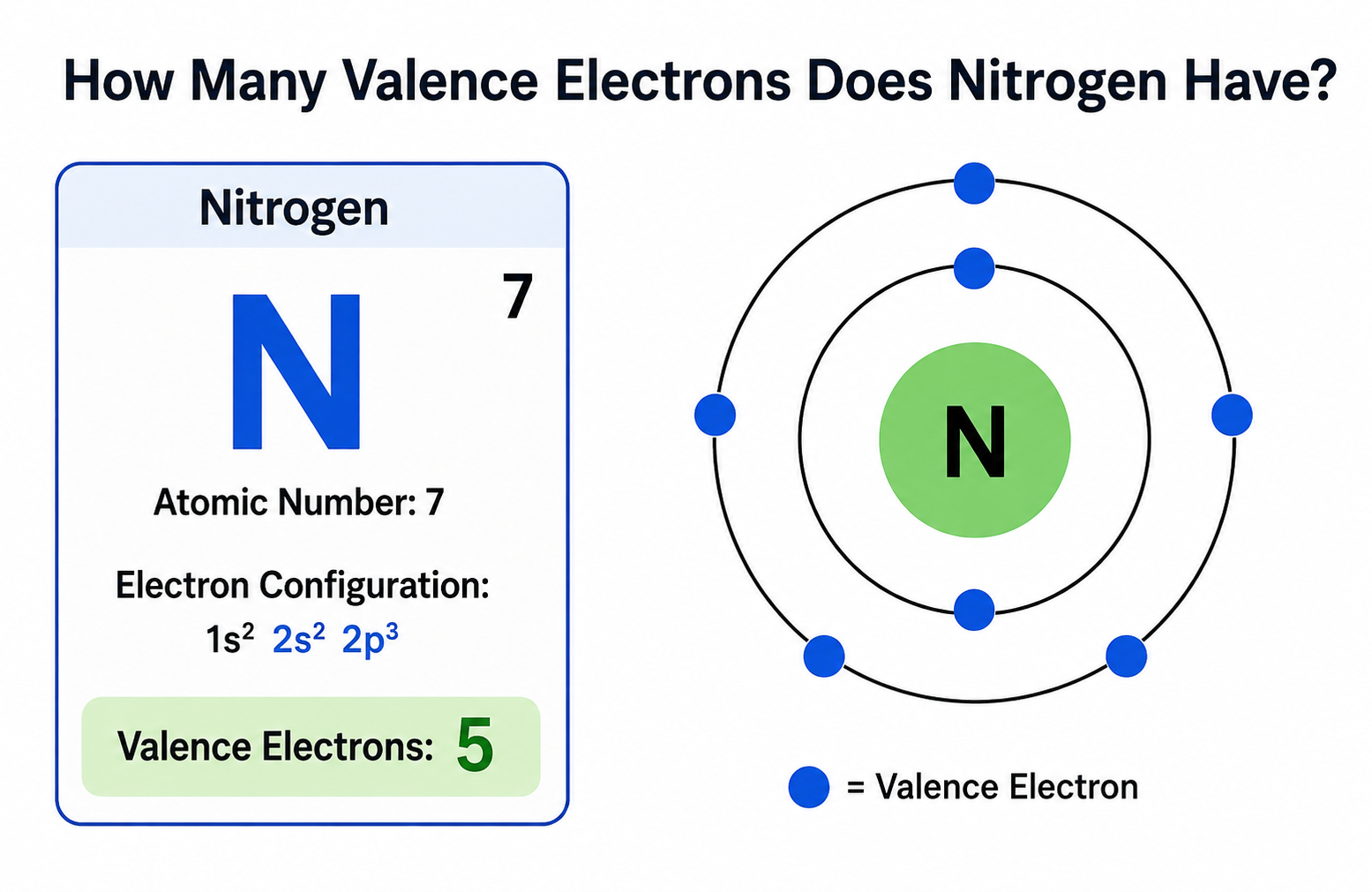
If you have been studying chemistry for even a short time, you have probably come across the word “valence electrons” more than once. These tiny particles play a massive role in determining how an atom behaves, what compounds it forms, and how it interacts with other elements. So when students ask, “how many valence electrons does nitrogen have?” the answer is straightforward: nitrogen has 5 valence electrons.
That single fact explains a great deal about nitrogen’s chemistry — why it forms three bonds in ammonia, why two nitrogen atoms share a triple bond in N₂, and why nitrogen appears in so many biological and industrial compounds. Whether you are preparing for GCSE, A-Level, NEET, MDCAT, ECAT, or simply trying to pass your next chemistry test, understanding nitrogen’s valence electrons is an essential foundation.
This guide walks you through everything — from basic definitions to electron configuration, Lewis dot structures, the Bohr model, chemical bonding, practice questions, and frequently asked questions. Everything is explained clearly, step by step, so that even someone encountering this topic for the first time will walk away with real understanding.
Key Takeaways
- Nitrogen is element number 7 on the periodic table, meaning it has 7 electrons in a neutral atom.
- The electron configuration of nitrogen is 1s² 2s² 2p³.
- Nitrogen has 5 valence electrons, all located in its second (outermost) shell.
- Nitrogen belongs to Group 15 and Period 2, and every element in Group 15 has 5 valence electrons.
- Nitrogen needs 3 more electrons to complete its octet of 8, which is why it commonly forms 3 covalent bonds.
- Valence electrons and valency are related but are not the same thing — nitrogen’s valency is typically 3, not 5.
- The 5 valence electrons of nitrogen are directly responsible for its ability to form compounds like NH₃, HNO₃, N₂, and NO₂.
What Are Valence Electrons?
Valence electrons are the electrons found in the outermost shell of an atom. The outermost shell is also called the valence shell. These electrons are the ones that participate in chemical reactions, bond formation, and interactions with other atoms.
To understand why this matters, think of an atom like a small solar system. The nucleus sits in the center, and electrons move around it in layers called shells or energy levels. The electrons closest to the nucleus are tightly bound and generally do not take part in chemical bonding. These are called inner-shell electrons or core electrons.
The electrons in the outermost shell, however, are loosely held and are the first ones to interact when two atoms meet. This makes valence electrons the key to understanding an element’s chemical behavior.
The difference between valence electrons and inner-shell electrons:
| Feature | Valence Electrons | Inner-Shell Electrons |
|---|---|---|
| Location | Outermost shell | Inner shells (closer to nucleus) |
| Involvement in bonding | Yes | No |
| Energy level | Higher | Lower |
| Stability | Less tightly held | More tightly held |
For most main-group elements, you can identify the number of valence electrons simply by looking at the group number on the periodic table.
How Many Valence Electrons Does Nitrogen Have?
Nitrogen has 5 valence electrons.
This is the direct answer, and it is consistent across every reputable chemistry textbook and examination board worldwide.
Here is how we arrive at that number:
- Nitrogen’s atomic number is 7, which means a neutral nitrogen atom has 7 electrons in total.
- These 7 electrons are arranged in two shells.
- The first shell holds 2 electrons.
- The second shell holds the remaining 5 electrons.
- Since the second shell is the outermost shell, those 5 electrons are the valence electrons.
This is not a coincidence. Nitrogen sits in Group 15 of the periodic table, and every element in Group 15 has 5 valence electrons. The group number directly tells you the number of valence electrons for main-group elements.
Why Does Nitrogen Have 5 Valence Electrons?
To understand why nitrogen has exactly 5 valence electrons, you need to look at its atomic structure from the ground up.
Step-by-step breakdown:
- Atomic number = 7 — This is the number of protons in nitrogen’s nucleus.
- Number of protons = 7 — Protons carry a positive charge and are fixed in the nucleus.
- Number of electrons in a neutral atom = 7 — In a neutral atom, the number of electrons equals the number of protons. Since nitrogen is not an ion in its natural state, it has 7 electrons.
- Electron configuration = 1s² 2s² 2p³ — Electrons fill orbitals in a specific order according to the Aufbau principle.
- First shell (n=1): holds 2 electrons (the 1s² electrons).
- Second shell (n=2): holds the remaining 5 electrons (2s² and 2p³).
- The second shell is the outermost shell for nitrogen, making it the valence shell.
- Therefore, nitrogen has 5 valence electrons — those 5 electrons in the second shell.
This reasoning is clean, logical, and consistent with how chemistry works. Once you understand this pattern, finding valence electrons for any main-group element becomes straightforward.
Nitrogen Electron Configuration Explained
Full Electron Configuration
The full electron configuration of nitrogen is written as:
1s² 2s² 2p³
This notation tells us exactly how nitrogen’s 7 electrons are distributed across its orbitals.
- 1s² — 2 electrons in the first s orbital (first shell)
- 2s² — 2 electrons in the second s orbital (second shell)
- 2p³ — 3 electrons spread across the three 2p orbitals (second shell)
According to Hund’s rule, the three 2p electrons each occupy a separate p orbital before any pairing occurs. This means nitrogen’s three 2p orbitals each contain one unpaired electron, which is why nitrogen can form three covalent bonds.
Shell Distribution
When we simplify the electron configuration into shells:
| Shell | Electrons | Notation |
|---|---|---|
| First Shell (n=1) | 2 | 1s² |
| Second Shell (n=2) | 5 | 2s² 2p³ |
| Total | 7 |
Valence Shell of Nitrogen
The second shell is nitrogen’s valence shell because it is the highest energy level that contains electrons in a neutral nitrogen atom. Any electron that is in the highest occupied shell is considered a valence electron. Since 5 electrons occupy nitrogen’s second shell, nitrogen has 5 valence electrons.
Nitrogen Bohr Model
The Bohr model is a simple but useful way to visualize how electrons are arranged around a nucleus. In this model, electrons orbit the nucleus in fixed circular paths called shells.
For nitrogen, the Bohr model looks like this:
- Nucleus: Contains 7 protons and 7 neutrons (for the most common isotope, nitrogen-14).
- First shell: 2 electrons orbit closest to the nucleus. This shell is full because the maximum it can hold is 2.
- Second shell: 5 electrons orbit in the outer ring. The second shell can hold a maximum of 8 electrons, so nitrogen’s second shell is not full — it has 3 spaces remaining.
When drawing this model, you place the symbol N in the center, draw a small inner circle with 2 electrons, and a larger outer circle with 5 electrons. This visual makes it immediately clear that nitrogen’s outermost ring has 5 electrons, confirming that it has 5 valence electrons.
The Bohr model is not perfectly accurate by modern standards, but it remains an excellent starting point for students learning atomic structure for the first time.
Nitrogen Lewis Dot Structure
The Lewis dot structure is a simple diagram that shows the valence electrons of an atom using dots placed around the element’s chemical symbol.
How to draw the Lewis dot structure of nitrogen:
- Write the chemical symbol: N
- Identify the number of valence electrons: 5
- Place dots around the symbol, one at a time, on each of the four sides (top, bottom, left, right), then pair them up.
Following this method:
- Place the first dot on the right.
- Place the second dot on the top.
- Place the third dot on the left.
- Place the fourth dot on the bottom.
- Place the fifth dot alongside one of the existing single dots (creating one pair).
The result is a nitrogen symbol surrounded by 5 dots — one lone pair and three unpaired dots. Those three unpaired dots represent the three electrons nitrogen typically uses to form covalent bonds.
This structure immediately shows you why nitrogen forms three bonds and has one lone pair of electrons in most of its compounds.
Nitrogen and the Periodic Table
Nitrogen holds the position of atomic number 7 on the periodic table. Here are the key facts about its placement:
- Symbol: N
- Atomic number: 7
- Group: 15 (also called Group VA in older notation)
- Period: 2
- Classification: Nonmetal
- Block: p-block
The relationship between group number and valence electrons is one of the most useful patterns in chemistry. For main-group elements (Groups 1, 2, and 13 through 18), the group number directly indicates the number of valence electrons. Since nitrogen is in Group 15, it has 5 valence electrons.
Nitrogen is classified as a nonmetal. It is a colorless, odorless, diatomic gas at room temperature (N₂) and makes up approximately 78% of Earth’s atmosphere. Its position in Period 2 means its valence electrons are in the second energy level.
Nitrogen Valence Electrons vs Other Group 15 Elements
All elements in Group 15 share the same number of valence electrons: 5. This is why they display similar chemical properties. The table below compares nitrogen with its Group 15 family members.
| Element | Atomic Number | Electron Configuration | Valence Electrons | Group | Period |
|---|---|---|---|---|---|
| Nitrogen (N) | 7 | 1s² 2s² 2p³ | 5 | 15 | 2 |
| Phosphorus (P) | 15 | [Ne] 3s² 3p³ | 5 | 15 | 3 |
| Arsenic (As) | 33 | [Ar] 3d¹⁰ 4s² 4p³ | 5 | 15 | 4 |
| Antimony (Sb) | 51 | [Kr] 4d¹⁰ 5s² 5p³ | 5 | 15 | 5 |
| Bismuth (Bi) | 83 | [Xe] 4f¹⁴ 5d¹⁰ 6s² 6p³ | 5 | 15 | 6 |
Notice that despite having different atomic numbers and more complex electron configurations, every Group 15 element ends with the same pattern in its outermost shell: s² p³, giving 5 valence electrons.
Nitrogen vs Other First 20 Elements
The table below provides valence electron counts for commonly studied elements, giving you useful context for understanding where nitrogen fits in.
| Element | Symbol | Atomic Number | Valence Electrons |
|---|---|---|---|
| Hydrogen | H | 1 | 1 |
| Helium | He | 2 | 2 |
| Lithium | Li | 3 | 1 |
| Beryllium | Be | 4 | 2 |
| Boron | B | 5 | 3 |
| Carbon | C | 6 | 4 |
| Nitrogen | N | 7 | 5 |
| Oxygen | O | 8 | 6 |
| Fluorine | F | 9 | 7 |
| Neon | Ne | 10 | 8 |
| Sodium | Na | 11 | 1 |
| Magnesium | Mg | 12 | 2 |
| Aluminum | Al | 13 | 3 |
| Silicon | Si | 14 | 4 |
| Phosphorus | P | 15 | 5 |
| Sulfur | S | 16 | 6 |
| Chlorine | Cl | 17 | 7 |
| Argon | Ar | 18 | 8 |
This table reveals a beautiful repeating pattern. As you move across each period, valence electrons increase from 1 to 8. When you start a new period, the count resets to 1 again.
Why Are Nitrogen’s 5 Valence Electrons Important?
Nitrogen’s 5 valence electrons are not just a number you memorize for an exam. They directly shape everything about how nitrogen behaves chemically.
Chemical bonding: With 5 valence electrons, nitrogen needs 3 more to reach the stable octet of 8. This drives nitrogen to form 3 covalent bonds in most situations, as seen in NH₃ (ammonia) and NCl₃.
Reactivity: Nitrogen is relatively unreactive in its elemental form (N₂) because the triple bond holding the two nitrogen atoms together is extremely strong. Yet, once nitrogen is activated (as in the Haber process), those 5 valence electrons allow it to form a remarkable variety of compounds.
Stability: Having a lone pair of electrons alongside three bond-forming electrons gives nitrogen its ability to act as a Lewis base — donating electrons to other species. This is essential for understanding how ammonia interacts with acids.
Electron sharing: Nitrogen participates in covalent bonding by sharing electrons with other atoms. The number of electrons shared depends on how many unpaired electrons are available — and with nitrogen’s 2p³ arrangement, three unpaired electrons are ready to share.
Formation of compounds: From proteins and DNA in biology to fertilizers and explosives in industry, nitrogen’s 5 valence electrons make it one of the most chemically versatile nonmetals.
Nitrogen and the Octet Rule
The octet rule states that atoms tend to gain, lose, or share electrons in order to achieve a full outer shell of 8 electrons, like the noble gases.
Nitrogen starts with 5 valence electrons. To reach 8, it needs 3 more. This is why nitrogen typically:
- Forms 3 covalent bonds by sharing one electron with each of three other atoms (as in NH₃).
- Gains 3 electrons to form the nitride ion (N³⁻) in ionic compounds with metals.
- Forms a triple bond with another nitrogen atom (as in N₂), sharing 3 pairs of electrons.
In each case, the goal is the same: fill the outer shell to reach a stable configuration of 8 electrons. Nitrogen is remarkably good at achieving this through multiple bonding pathways, which is part of what makes it so chemically interesting.
How Does Nitrogen Form Chemical Bonds?
Nitrogen in Covalent Bonds
Covalent bonds form when atoms share electrons. Nitrogen most commonly forms covalent bonds.
In ammonia (NH₃), nitrogen shares one electron with each of three hydrogen atoms, forming three single covalent bonds. After bonding, nitrogen’s outer shell has 8 electrons (3 shared pairs plus 1 lone pair), satisfying the octet rule.
In nitrogen trifluoride (NF₃), a similar pattern occurs, with nitrogen sharing electrons with three fluorine atoms.
Nitrogen in Ionic Compounds
When nitrogen reacts with highly electropositive metals (like lithium or magnesium), it can gain 3 electrons to form the nitride ion (N³⁻). For example, lithium nitride (Li₃N) contains the N³⁻ ion. This ionic behavior is less common than covalent bonding for nitrogen, but it does occur.
Nitrogen in Multiple Bonds
Perhaps the most famous example of nitrogen bonding is the triple bond in N₂. Two nitrogen atoms share three pairs of electrons (6 electrons total), forming an extraordinarily strong bond with a bond energy of approximately 945 kJ/mol. This triple bond is why nitrogen gas is so stable and relatively unreactive at ordinary temperatures.
Nitrogen also forms double bonds in compounds like NO₂ (nitrogen dioxide), where more complex bonding patterns are at work.
Nitrogen Valency vs Valence Electrons
Students frequently confuse these two terms. They are related, but they mean different things.
| Feature | Valence Electrons | Valency |
|---|---|---|
| Definition | Number of electrons in the outermost shell | Combining capacity of an atom |
| For Nitrogen | 5 | 3 (most common) |
| Fixed? | Yes, for a neutral atom | Can vary depending on the compound |
| Determined by | Electron configuration | Bonding behavior and oxidation state |
| Example | N has 5 valence electrons | N has valency 3 in NH₃, valency 5 in HNO₃ |
Nitrogen Valence Electrons vs Nitrogen Valency
Having 5 valence electrons does not mean nitrogen always has a valency of 5. Valency depends on how many bonds an atom actually forms in a given compound, and this is influenced by which electrons are available for bonding.
In its most common compounds, nitrogen uses its 3 unpaired 2p electrons to form 3 covalent bonds, giving a valency of 3 (as in NH₃, NCl₃, and N₂H₄).
However, nitrogen can also exhibit a valency of 4 when it forms a coordinate (dative) bond using its lone pair, as in the ammonium ion (NH₄⁺). In this ion, nitrogen forms four bonds by donating its lone pair to a proton.
In compounds like HNO₃ and N₂O₅, nitrogen displays oxidation states of +5, which corresponds to a kind of maximum valency of 5 — but this involves formal charges and is more complex than simple electron counting.
The key point: valence electrons are fixed at 5 for neutral nitrogen; valency is flexible and depends on the bonding situation.
Common Compounds Containing Nitrogen
Ammonia (NH₃): The most industrially important nitrogen compound in the world. Produced by the Haber process, ammonia is used in fertilizers, cleaning products, and chemical synthesis. Nitrogen forms three N–H single bonds and retains one lone pair.
Nitrogen gas (N₂): The most abundant gas in Earth’s atmosphere, making up about 78%. The two nitrogen atoms are held together by a triple bond, making N₂ very stable and relatively inert.
Nitric acid (HNO₃): A strong acid used in fertilizer production and chemical manufacturing. Nitrogen is in the +5 oxidation state in this compound.
Nitrogen dioxide (NO₂): A reddish-brown gas and a significant air pollutant produced by combustion engines. Nitrogen is in the +4 oxidation state.
Ammonium ion (NH₄⁺): Formed when ammonia picks up a proton (H⁺). Nitrogen forms four bonds in this ion using both its three unpaired electrons and its lone pair. The ammonium ion is present in many nitrogen-based fertilizers.
Common Mistakes Students Make
Knowing what can go wrong helps you avoid the same errors. Here are the most frequent mistakes students make regarding nitrogen’s valence electrons.
- Confusing atomic number with valence electrons: Nitrogen’s atomic number is 7, but its valence electrons are 5. These are different numbers.
- Thinking nitrogen has 7 valence electrons: 7 is the total number of electrons, not the number in the outermost shell. Only those in the second shell (5 electrons) count as valence electrons.
- Confusing valence electrons with total electrons: Total electrons = 7; valence electrons = 5. Never mix these up.
- Confusing valence electrons with valency: Nitrogen has 5 valence electrons but a typical valency of 3. These terms are not interchangeable.
- Forgetting that electron configuration determines the valence shell: Some students guess the valence shell without writing the electron configuration. Always verify by checking which shell is the outermost occupied one.
- Assuming all 5 valence electrons are available for bonding: One lone pair (2 electrons) tends to remain unbonded in many compounds, while 3 electrons participate in bonding.
How to Find Valence Electrons From the Periodic Table
This method works for all main-group elements (Groups 1, 2, and 13–18).
- Locate the element on the periodic table.
- Identify which group it belongs to.
- For Groups 1 and 2, the valence electrons equal the group number (1 or 2).
- For Groups 13–18, subtract 10 from the group number to get valence electrons.
Example using nitrogen:
- Nitrogen is in Group 15.
- 15 – 10 = 5
- Nitrogen has 5 valence electrons.
Alternatively, if you use the older group naming system (IA through VIIA), the Roman numeral directly tells you the number of valence electrons.
How to Find Valence Electrons From Electron Configuration
- Write out the full electron configuration of the element.
- Identify the highest principal quantum number (n) present.
- Count all electrons that have that highest n value.
- That total is the number of valence electrons.
Step-by-step using nitrogen:
- Electron configuration: 1s² 2s² 2p³
- The highest n value is n = 2 (the second shell).
- Electrons with n = 2: 2s² (2 electrons) + 2p³ (3 electrons) = 5 electrons
- Therefore, nitrogen has 5 valence electrons.
Practice Examples
Working through examples from different groups builds confidence. Here are 10 solved examples.
1. Carbon (C) — Atomic number 6
Electron configuration: 1s² 2s² 2p²
Outermost shell: n=2 → 2s² 2p² = 4 electrons
Valence electrons: 4
2. Oxygen (O) — Atomic number 8
Electron configuration: 1s² 2s² 2p⁴
Outermost shell: n=2 → 2s² 2p⁴ = 6 electrons
Valence electrons: 6
3. Sodium (Na) — Atomic number 11
Electron configuration: 1s² 2s² 2p⁶ 3s¹
Outermost shell: n=3 → 3s¹ = 1 electron
Valence electrons: 1
4. Magnesium (Mg) — Atomic number 12
Electron configuration: 1s² 2s² 2p⁶ 3s²
Outermost shell: n=3 → 3s² = 2 electrons
Valence electrons: 2
5. Chlorine (Cl) — Atomic number 17
Electron configuration: 1s² 2s² 2p⁶ 3s² 3p⁵
Outermost shell: n=3 → 3s² 3p⁵ = 7 electrons
Valence electrons: 7
6. Phosphorus (P) — Atomic number 15
Electron configuration: 1s² 2s² 2p⁶ 3s² 3p³
Outermost shell: n=3 → 3s² 3p³ = 5 electrons
Valence electrons: 5
7. Sulfur (S) — Atomic number 16
Electron configuration: 1s² 2s² 2p⁶ 3s² 3p⁴
Outermost shell: n=3 → 3s² 3p⁴ = 6 electrons
Valence electrons: 6
8. Fluorine (F) — Atomic number 9
Electron configuration: 1s² 2s² 2p⁵
Outermost shell: n=2 → 2s² 2p⁵ = 7 electrons
Valence electrons: 7
9. Aluminum (Al) — Atomic number 13
Electron configuration: 1s² 2s² 2p⁶ 3s² 3p¹
Outermost shell: n=3 → 3s² 3p¹ = 3 electrons
Valence electrons: 3
10. Potassium (K) — Atomic number 19
Electron configuration: 1s² 2s² 2p⁶ 3s² 3p⁶ 4s¹
Outermost shell: n=4 → 4s¹ = 1 electron
Valence electrons: 1
Nitrogen Valence Electrons Practice Questions
20 Multiple Choice Questions
1. How many valence electrons does nitrogen have?
a) 2 b) 5 c) 7 d) 3
Answer: b) 5 — Nitrogen has 5 electrons in its outermost (second) shell.
2. What is the atomic number of nitrogen?
a) 5 b) 14 c) 7 d) 6
Answer: c) 7 — Nitrogen has 7 protons, giving it an atomic number of 7.
3. What is the electron configuration of nitrogen?
a) 1s² 2s³ b) 1s² 2s² 2p⁴ c) 1s² 2s² 2p³ d) 1s² 2s¹ 2p⁴
Answer: c) 1s² 2s² 2p³ — This is the correct ground-state configuration.
4. Which group does nitrogen belong to?
a) Group 14 b) Group 16 c) Group 15 d) Group 17
Answer: c) Group 15 — Nitrogen is in Group 15, Period 2.
5. How many electrons does nitrogen need to complete its octet?
a) 1 b) 2 c) 3 d) 5
Answer: c) 3 — Nitrogen has 5 valence electrons and needs 3 more to reach 8.
6. What type of ion does nitrogen typically form in ionic compounds?
a) N⁻ b) N³⁻ c) N²⁺ d) N³⁺
Answer: b) N³⁻ — Nitrogen gains 3 electrons to form the nitride ion.
7. How many bonds does nitrogen form in ammonia (NH₃)?
a) 1 b) 2 c) 3 d) 4
Answer: c) 3 — Nitrogen shares 1 electron with each of 3 hydrogen atoms.
8. What is the valence shell of nitrogen?
a) First shell b) Second shell c) Third shell d) Fourth shell
Answer: b) Second shell — The second shell is nitrogen’s outermost occupied shell.
9. How many lone pairs of electrons does nitrogen have in NH₃?
a) 0 b) 1 c) 2 d) 3
Answer: b) 1 — After forming 3 bonds, nitrogen retains 1 lone pair.
10. What is the type of bond in N₂?
a) Single bond b) Double bond c) Triple bond d) Ionic bond
Answer: c) Triple bond — Two nitrogen atoms share 3 pairs of electrons.
11. How many total electrons does nitrogen have?
a) 5 b) 6 c) 7 d) 8
Answer: c) 7 — Nitrogen’s atomic number is 7, so it has 7 electrons.
12. Nitrogen is classified as which type of element?
a) Metal b) Metalloid c) Nonmetal d) Noble gas
Answer: c) Nonmetal — Nitrogen is a p-block nonmetal.
13. Which period is nitrogen in?
a) Period 1 b) Period 2 c) Period 3 d) Period 4
Answer: b) Period 2 — Nitrogen’s valence electrons are in the second energy level.
14. How many valence electrons does N³⁻ have?
a) 5 b) 6 c) 7 d) 8
Answer: d) 8 — The nitride ion gains 3 electrons, adding to its original 5 to give 8.
15. In the Bohr model, how many electrons does nitrogen have in its outer ring?
a) 2 b) 3 c) 5 d) 7
Answer: c) 5 — The outer ring (second shell) holds 5 electrons.
16. Which of the following has the same number of valence electrons as nitrogen?
a) Carbon b) Phosphorus c) Oxygen d) Sulfur
Answer: b) Phosphorus — Phosphorus is also in Group 15 with 5 valence electrons.
17. What is the most common valency of nitrogen?
a) 5 b) 2 c) 3 d) 1
Answer: c) 3 — Nitrogen most commonly forms 3 bonds.
18. How many unpaired electrons does nitrogen have in its ground state?
a) 1 b) 2 c) 3 d) 5
Answer: c) 3 — The three 2p electrons are unpaired according to Hund’s rule.
19. How many electrons does nitrogen have in its first shell?
a) 2 b) 5 c) 7 d) 3
Answer: a) 2 — The first shell holds 2 electrons (1s²).
20. What makes nitrogen’s triple bond in N₂ so strong?
a) The large atomic radius b) Three shared pairs of electrons c) Ionic character d) Low atomic mass
Answer: b) Three shared pairs of electrons — Sharing 6 electrons creates an exceptionally strong bond.
10 Short Answer Questions
Q1. How many valence electrons does nitrogen have, and how do you determine this?
Nitrogen has 5 valence electrons. This is determined from its electron configuration (1s² 2s² 2p³) by counting the electrons in the highest occupied shell (n=2): 2+3=5.
Q2. What is the electron configuration of nitrogen?
1s² 2s² 2p³
Q3. What does it mean that nitrogen is in Group 15?
It means nitrogen has 5 valence electrons and behaves similarly to other Group 15 elements like phosphorus and arsenic.
Q4. How many electrons does the N³⁻ ion have?
N³⁻ has 10 electrons — the original 7 plus 3 gained, giving a complete octet in the outer shell.
Q5. What is the difference between nitrogen’s valence electrons and its valency?
Valence electrons (5) are the electrons in nitrogen’s outermost shell. Valency (usually 3) is the number of bonds nitrogen actually forms in a compound. These are not the same number.
Q6. Why does nitrogen form a triple bond with another nitrogen atom in N₂?
Each nitrogen atom has 3 unpaired electrons available for bonding. Two nitrogen atoms share all 3 pairs, forming a triple bond and satisfying the octet rule for both atoms.
Q7. How many bonds does nitrogen form in the ammonium ion (NH₄⁺)?
Four bonds — three regular covalent bonds and one coordinate (dative) bond using nitrogen’s lone pair.
Q8. What is nitrogen’s position on the periodic table?
Nitrogen is in Period 2, Group 15. Its atomic number is 7.
Q9. How does nitrogen’s valence electron count relate to its reactivity?
Having 5 valence electrons means nitrogen is 3 electrons short of a full octet, making it moderately reactive. It seeks to form 3 bonds to achieve stability.
Q10. What block of the periodic table does nitrogen belong to?
Nitrogen belongs to the p-block because its outermost electrons are in p orbitals.
5 Exam-Style Questions
Q1. (a) State the number of valence electrons in nitrogen. (b) Write the full electron configuration of nitrogen. (c) Explain how you can use this configuration to determine the number of valence electrons.
Answer:
(a) 5 valence electrons.
(b) 1s² 2s² 2p³
(c) The highest principal quantum number present is n=2. The electrons in this level are 2s² (2 electrons) and 2p³ (3 electrons), totalling 5 valence electrons.
Q2. Explain why nitrogen typically forms three covalent bonds. Use its electron configuration in your answer.
Answer: Nitrogen’s electron configuration is 1s² 2s² 2p³. The three 2p electrons are each unpaired (by Hund’s rule). These three unpaired electrons are each available to share with one electron from another atom, forming three covalent bonds. After bonding, nitrogen has 8 electrons around it (3 bonding pairs + 1 lone pair), satisfying the octet rule.
Q3. Compare nitrogen’s valence electrons with those of phosphorus. What is similar and what is different?
Answer: Both nitrogen and phosphorus have 5 valence electrons because both are in Group 15. The similarity ends there. Nitrogen’s valence electrons are in the second shell (1s² 2s² 2p³), while phosphorus’s are in the third shell ([Ne] 3s² 3p³). Phosphorus has a larger atomic radius and can sometimes expand its octet, which nitrogen typically cannot do.
Q4. A student claims that nitrogen has 7 valence electrons. Explain the error and provide the correct answer.
Answer: The student has confused total electrons with valence electrons. Nitrogen’s atomic number is 7, giving it 7 electrons in total, but not all are valence electrons. The 2 electrons in the first shell are inner-shell electrons and do not participate in bonding. Only the 5 electrons in the second shell (the outermost shell) are valence electrons. Therefore, nitrogen has 5 valence electrons, not 7.
Q5. How many valence electrons does the nitride ion (N³⁻) have? Explain your reasoning.
Answer: The neutral nitrogen atom has 5 valence electrons. The N³⁻ ion has gained 3 extra electrons. These electrons are added to the valence shell. Therefore, N³⁻ has 5 + 3 = 8 valence electrons, which is a complete octet. This is why N³⁻ is stable.
Exam Tips
Preparing for an exam on this topic does not need to be stressful. These practical tips will help you retain the key information.
- Remember the Group 15 rule: Any element in Group 15 has exactly 5 valence electrons. Since nitrogen is Group 15, it has 5. Period.
- Write the electron configuration from memory: Practice writing 1s² 2s² 2p³ until it feels automatic. From that, you can always count valence electrons.
- Do not confuse 7 and 5: Nitrogen’s atomic number is 7 (total electrons). Its valence electrons are 5. Repeat this difference until it sticks.
- Visualize the Bohr model: A quick mental picture — 2 electrons on the inner ring, 5 on the outer ring — immediately tells you the valence electron count.
- Know your exceptions: Valency can change depending on the compound. NH₃ shows valency 3; NH₄⁺ shows valency 4. Understanding why prevents exam surprises.
- Practice Lewis dot structures: Draw the nitrogen dot structure repeatedly. Seeing those 5 dots visually helps them stick in memory.
Important Facts About Nitrogen
- Nitrogen’s chemical symbol is N.
- Atomic number: 7
- Atomic mass: approximately 14.007 u
- Electron configuration: 1s² 2s² 2p³
- Valence electrons: 5
- Group: 15 — Period: 2
- Classification: Nonmetal, p-block
- Nitrogen makes up roughly 78% of Earth’s atmosphere as N₂.
- The triple bond in N₂ (bond energy ~945 kJ/mol) is one of the strongest bonds in chemistry.
- Nitrogen is essential for life — it is a component of amino acids, proteins, and DNA.
- The Haber process uses nitrogen gas and hydrogen gas to produce ammonia at industrial scale.
- Nitrogen’s most common oxidation states are -3, 0, +2, +3, +4, and +5.
Frequently Asked Questions
1. How many valence electrons does nitrogen have?
Nitrogen has 5 valence electrons. These are the electrons in its outermost (second) shell.
2. Why does nitrogen have 5 valence electrons?
Nitrogen has atomic number 7 and electron configuration 1s² 2s² 2p³. Its second shell contains 5 electrons (2s² + 2p³), and since the second shell is the outermost shell, those 5 electrons are the valence electrons.
3. What is the electron configuration of nitrogen?
The electron configuration of nitrogen is 1s² 2s² 2p³.
4. What is nitrogen’s valence shell?
Nitrogen’s valence shell is the second shell (n=2), which contains 2s and 2p subshells.
5. What is nitrogen’s valency?
Nitrogen’s most common valency is 3, as seen in NH₃ and NF₃. It can also show a valency of 4 in NH₄⁺ and exhibits +5 oxidation behavior in compounds like HNO₃.
6. Does nitrogen gain or share electrons?
Nitrogen most commonly shares electrons through covalent bonding. In ionic compounds with highly electropositive metals, it can gain 3 electrons to form N³⁻.
7. How many valence electrons does N³⁻ have?
N³⁻ has 8 valence electrons — the original 5 plus the 3 gained, giving a complete octet.
8. How many valence electrons does nitrogen have in NH₃?
Nitrogen still has 5 valence electrons in NH₃. The valence electron count does not change when bonds form — it is a property of the neutral atom. In the molecule, nitrogen uses 3 of those electrons for bonding and retains 2 as a lone pair.
9. Is nitrogen a metal or nonmetal?
Nitrogen is a nonmetal. It is a gaseous, diatomic nonmetal at room temperature.
10. What group is nitrogen in?
Nitrogen is in Group 15 of the periodic table (also written as Group VA in older notation).
11. How many electrons does nitrogen need to complete its octet?
Nitrogen needs 3 more electrons to complete its octet (5 valence electrons + 3 = 8).
12. What is the Lewis dot structure of nitrogen?
The Lewis dot structure of nitrogen shows the letter N surrounded by 5 dots — representing its 5 valence electrons. One pair of dots (a lone pair) sits on one side, and three single dots are distributed on the remaining three sides, representing the three electrons available for bonding.
Revision Checklist
Use this checklist before your exam to make sure you have covered everything important about nitrogen’s valence electrons.
- I know that nitrogen has 5 valence electrons.
- I can write nitrogen’s electron configuration: 1s² 2s² 2p³.
- I know that nitrogen’s atomic number is 7 and it has 7 electrons in total.
- I understand that valence electrons are only those in the outermost shell.
- I can draw the Bohr model of nitrogen correctly (2 electrons in the first shell, 5 in the second).
- I can draw the Lewis dot structure of nitrogen with 5 dots.
- I know nitrogen is in Group 15, Period 2.
- I understand why nitrogen typically forms 3 covalent bonds.
- I can explain the difference between valence electrons and valency.
- I know that N³⁻ has 8 valence electrons.
- I can name and explain at least three compounds of nitrogen.
- I can explain the octet rule and how nitrogen satisfies it.
- I know the bond in N₂ is a triple bond and understand why it is so strong.
- I can avoid common mistakes such as confusing atomic number with valence electrons.
Summary
Nitrogen is element number 7, found in Group 15, Period 2 of the periodic table. A neutral nitrogen atom contains 7 electrons arranged in two shells: 2 electrons in the first shell and 5 in the second. Because the second shell is the outermost occupied shell, those 5 electrons are nitrogen’s valence electrons.
The electron configuration 1s² 2s² 2p³ confirms this. The three unpaired 2p electrons explain nitrogen’s tendency to form three covalent bonds in most compounds, following the octet rule by acquiring 3 additional electrons through sharing or, less commonly, by gaining them outright.
Valence electrons are not the same as valency. Nitrogen’s valency varies with the compound (usually 3, sometimes 4), while its valence electron count remains fixed at 5 for any neutral nitrogen atom. The nitride ion N³⁻ has 8 valence electrons after gaining 3 from a metal.
Understanding these 5 valence electrons unlocks nearly everything about nitrogen’s chemistry — from the simplicity of NH₃ to the strength of the N₂ triple bond and the complexity of HNO₃.
Final Thoughts
Mastering how many valence electrons nitrogen has is one of those foundational chemistry skills that pays dividends all the way through your studies. Once you truly understand that nitrogen has 5 valence electrons — and more importantly, why it has 5 — questions about electron configuration, bonding, Lewis structures, and compound formation become far easier to handle.
The answer to “how many valence electrons does nitrogen have?” is simply 5. But the deeper understanding of what those 5 electrons mean — how they drive nitrogen’s bonding behavior, its place in Group 15, its role in biological systems, and its chemistry in the real world — is what separates a student who merely memorizes from one who genuinely understands chemistry.
Keep practicing, draw those Lewis structures, and always link facts back to the underlying principles. That habit of thinking is what makes chemistry make sense.
For further reading, explore these related LearnMinto guides:
• Valence Electrons Explained — Learn more about valence electrons and their role in chemical bonding.
• Electron Shells Explained — Understand electron shells, energy levels, and how electrons are arranged around the nucleus.
• Atomic Structure Study Guide — Review the basic structure of atoms, including protons, neutrons, and electrons.
• Periodic Table Study Guide — Learn how elements are organized and how periodic trends relate to valence electrons.
• Chemical Bonding — Explore how valence electrons participate in ionic, covalent, and metallic bonding.
• What Are Isotopes? — Understand atoms of the same element that have different numbers of neutrons.
• What Are Isoelectronic Species? — Learn how atoms and ions can have the same number of electrons.
References
- OpenStax Chemistry — Atomic structure, electron configuration, and periodic trends.
- Chemistry LibreTexts — Detailed chemistry explanations covering atomic structure and valence electrons.
- Khan Academy Chemistry — Beginner-friendly lessons on atoms, electron configuration, and periodic table concepts.
- Royal Society of Chemistry (RSC) Education — Chemistry education resources, including atomic models, structure, bonding, and periodic chemistry.
- American Chemical Society (ACS) Education — Chemistry education resources for students and educators, including high-school chemistry and periodic-table resources.
Disclaimer
This article is intended purely for educational purposes. While every effort has been made to ensure accuracy, students are encouraged to verify all chemistry information with their class textbooks, school teachers, and official resources provided by their examination boards (including GCSE, A-Level, NEET, MDCAT, ECAT, or any other relevant board). The content here should serve as a study aid, not a replacement for formal instruction.