
Introduction
You score 3 out of 4 on a quiz. Your teacher asks for it as a decimal. What do you do?
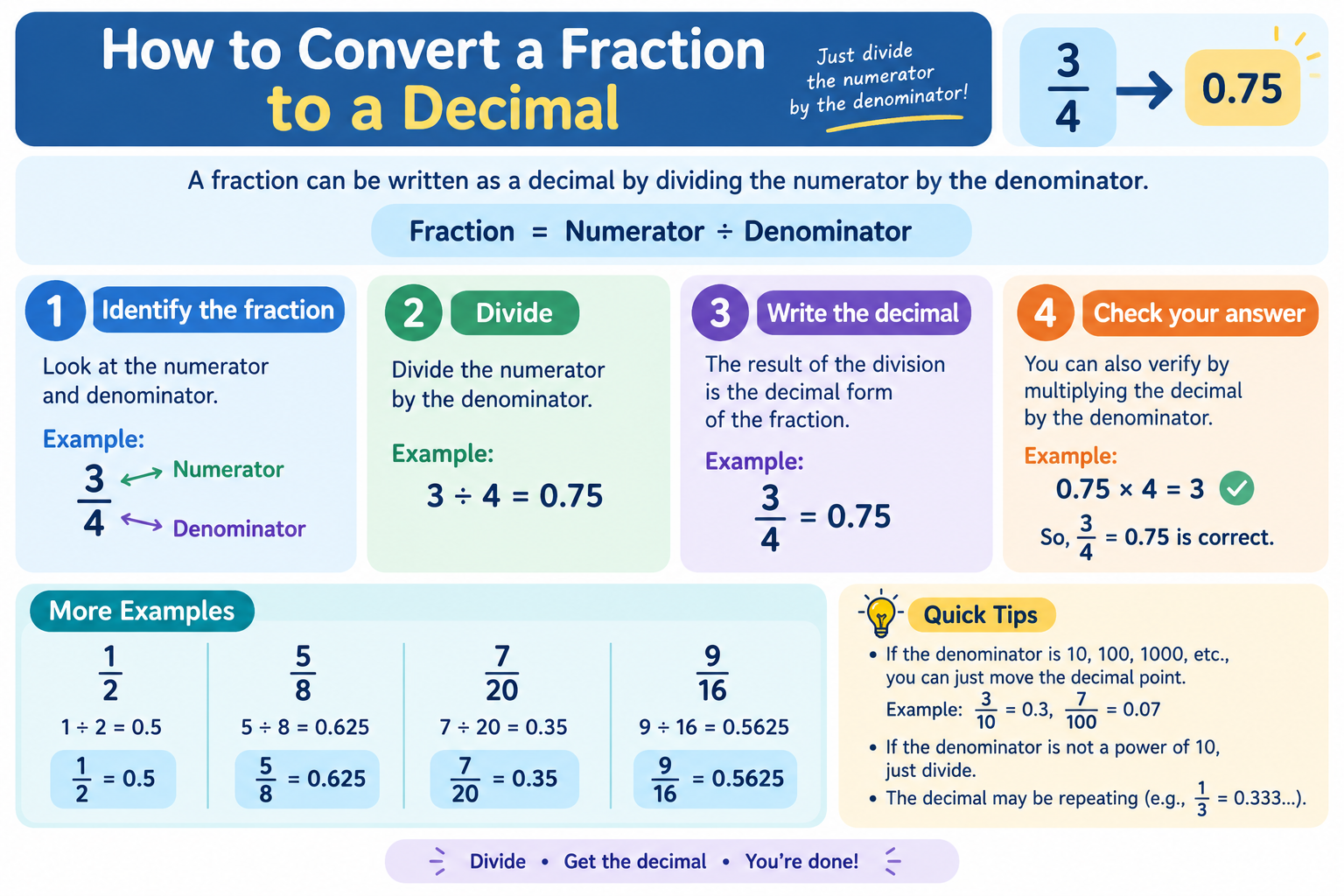
How to convert a fraction to a decimal comes down to one simple operation: divide the numerator (top number) by the denominator (bottom number). For 3/4, that means 3 ÷ 4 = 0.75.
That is the core idea. The method works for any fraction — simple, complex, mixed, or improper — and it is a skill that appears constantly in everyday mathematics. Whether you are working with measurements, money, test scores, or percentages, being able to move fluently between fractions and decimals makes a genuine difference.
Key Takeaways
-
To convert any fraction to a decimal, divide the numerator by the denominator.
-
Some fractions produce terminating decimals — decimals that end after a finite number of digits (e.g., 1/4 = 0.25).
-
Some fractions produce recurring decimals — decimals where one or more digits repeat indefinitely (e.g., 1/3 = 0.333…).
-
An alternative method uses equivalent fractions with denominators of 10, 100, or 1,000.
-
For mixed numbers, convert the fractional part to a decimal and add the whole number.
-
Improper fractions follow the same division method as proper fractions.
-
Memorising common fraction-to-decimal conversions saves significant time in tests.
What Is a Fraction?
A fraction represents a part of a whole. It is written as one number over another:
- The numerator (top number) tells you how many parts you have.
- The denominator (bottom number) tells you how many equal parts the whole is divided into.
In 3/4, you have 3 parts out of a whole divided into 4 equal parts.
For a complete introduction to how fractions work, see What Is a Fraction? on LearnMinto.
What Is a Decimal?
A decimal is another way of expressing a number that is not a whole number. The decimal point separates the whole-number part from the fractional part.
- 0.5 means five-tenths — halfway between 0 and 1.
- 0.25 means twenty-five hundredths — one-quarter of 1.
- 0.75 means seventy-five hundredths — three-quarters of 1.
Every digit to the right of the decimal point represents a fraction of 1, with each position being ten times smaller than the one to its left (tenths, hundredths, thousandths, and so on).
For a detailed explanation of how each position in a decimal works, see What Is Place Value in Math? on LearnMinto.
The Main Method: Divide the Numerator by the Denominator
The fundamental method for converting any fraction to a decimal is:
Fraction to Decimal = Numerator ÷ Denominator
Think of the fraction bar as a division sign. The fraction 3/4 is literally asking: what is 3 divided by 4?
1/2:
1 ÷ 2 = 0.5
3/4:
3 ÷ 4 = 0.75
1/5:
1 ÷ 5 = 0.2
2/5:
2 ÷ 5 = 0.4
7/10:
7 ÷ 10 = 0.7
The logic is always the same. Once you identify the numerator and denominator, you perform a single division. The result is the decimal equivalent of the fraction.
How to Convert a Fraction to a Decimal Step by Step
Here is a reusable method for any fraction:
Step 1: Identify the numerator (top) and the denominator (bottom).
Step 2: Divide the numerator by the denominator.
Step 3: Write the result. If the division ends neatly, you have a terminating decimal. If the digits start repeating, you have a recurring decimal.
Step 4: Check your answer by multiplying the decimal back by the denominator — you should recover the numerator.
Example 1: Convert 3/8 to a decimal.
- Numerator: 3. Denominator: 8.
- 3 ÷ 8 = 0.375
- Check: 0.375 × 8 = 3. Correct.
Example 2: Convert 5/8 to a decimal.
- 5 ÷ 8 = 0.625
- Check: 0.625 × 8 = 5. Correct.
Example 3: Convert 1/6 to a decimal.
- 1 ÷ 6 = 0.1666… (recurring)
- The digit 6 repeats indefinitely: written as 0.1̄6̄ or 0.16̄.
Example 4: Convert 4/5 to a decimal.
- 4 ÷ 5 = 0.8
Example 5: Convert 7/8 to a decimal.
- 7 ÷ 8 = 0.875
Method 2: Converting to an Equivalent Fraction With Denominator 10, 100, or 1,000
When a fraction’s denominator can be converted to 10, 100, or 1,000 by multiplying by a whole number, you can create an equivalent fraction and read off the decimal directly.
Why does this work?
Decimals are based on powers of ten. A fraction with denominator 10 reads directly as tenths; denominator 100 reads as hundredths; and so on.
1/2:
Multiply by 5/5: 1 × 5 = 5, 2 × 5 = 10 → 5/10 = 0.5
3/4:
Multiply by 25/25: 3 × 25 = 75, 4 × 25 = 100 → 75/100 = 0.75
1/5:
Multiply by 2/2: 1 × 2 = 2, 5 × 2 = 10 → 2/10 = 0.2
3/20:
Multiply by 5/5: 3 × 5 = 15, 20 × 5 = 100 → 15/100 = 0.15
7/25:
Multiply by 4/4: 7 × 4 = 28, 25 × 4 = 100 → 28/100 = 0.28
3/8:
Multiply by 125/125: 3 × 125 = 375, 8 × 125 = 1,000 → 375/1,000 = 0.375
This method works smoothly when the denominator’s only prime factors are 2 and 5. When the denominator contains other prime factors (such as 3, 7, or 11), this approach does not produce a clean power of ten, and the division method is more appropriate.
For a deeper look at equivalent fractions, see What Are Equivalent Fractions? on LearnMinto.
Terminating Decimals
A terminating decimal is one that ends — it has a finite number of digits after the decimal point.
Examples:
- 1/2 = 0.5
- 1/4 = 0.25
- 3/8 = 0.375
- 7/20 = 0.35
- 3/5 = 0.6
- 11/16 = 0.6875
Why do some fractions terminate?
When a fraction is in its simplest form, it produces a terminating decimal if and only if the denominator has no prime factors other than 2 and 5.
- 1/4 = 1/(2²) → terminates → 0.25
- 3/8 = 3/(2³) → terminates → 0.375
- 7/20 = 7/(2² × 5) → terminates → 0.35
- 3/7 → denominator 7 is a prime other than 2 or 5 → does not terminate
Understanding which numbers are prime and why they matter here is covered in What Is a Prime Number on LearnMinto.
Recurring (Repeating) Decimal
A recurring decimal is one where one or more digits repeat indefinitely after the decimal point.
The repeating part is shown with a dot above the first and last repeating digit, or with a bar (vinculum) above the repeating block.
Examples:
| Fraction | Decimal | Notation |
|---|---|---|
| 1/3 | 0.333… | 0.3̄ |
| 2/3 | 0.666… | 0.6̄ |
| 1/6 | 0.1666… | 0.16̄ |
| 1/7 | 0.142857142857… | 0.1̄4̄2̄8̄5̄7̄ |
| 1/9 | 0.111… | 0.1̄ |
| 5/6 | 0.8333… | 0.83̄ |
Why do some fractions recur?
When the denominator contains prime factors other than 2 or 5, the division never terminates cleanly. The remainders cycle, causing the decimal digits to repeat.
For example, dividing 1 by 3:
- 1.000… ÷ 3: 3 goes into 10 three times (remainder 1), then 3 goes into 10 again (remainder 1)…
- The remainder never becomes 0, so the 3 repeats forever: 0.333…
Terminating vs Recurring Decimals
| Fraction | Decimal | Type |
|---|---|---|
| 1/2 | 0.5 | Terminating |
| 1/3 | 0.333… | Recurring |
| 1/4 | 0.25 | Terminating |
| 1/5 | 0.2 | Terminating |
| 1/6 | 0.1666… | Recurring |
| 1/7 | 0.142857… | Recurring |
| 1/8 | 0.125 | Terminating |
| 1/9 | 0.111… | Recurring |
| 1/10 | 0.1 | Terminating |
| 2/3 | 0.666… | Recurring |
| 3/4 | 0.75 | Terminating |
| 3/8 | 0.375 | Terminating |
| 5/6 | 0.8333… | Recurring |
| 7/8 | 0.875 | Terminating |
| 4/9 | 0.444… | Recurring |
Converting Simple Fractions to Decimals
| Fraction | Decimal |
|---|---|
| 1/2 | 0.5 |
| 1/3 | 0.333… |
| 1/4 | 0.25 |
| 1/5 | 0.2 |
| 1/6 | 0.1666… |
| 1/7 | 0.142857… |
| 1/8 | 0.125 |
| 1/9 | 0.111… |
| 1/10 | 0.1 |
| 2/3 | 0.666… |
| 2/5 | 0.4 |
| 2/7 | 0.285714… |
| 3/4 | 0.75 |
| 3/5 | 0.6 |
| 3/7 | 0.428571… |
| 3/8 | 0.375 |
| 4/5 | 0.8 |
| 4/9 | 0.444… |
| 5/6 | 0.8333… |
| 5/8 | 0.625 |
| 7/8 | 0.875 |
| 7/10 | 0.7 |
| 9/10 | 0.9 |
Converting Mixed Numbers to Decimals
A mixed number combines a whole number and a fraction — for example, 1 and 3/4.
To convert a mixed number to a decimal:
- Keep the whole number as it is.
- Convert the fractional part to a decimal using division.
- Add the whole number and the decimal together.
1 1/2:
1/2 = 0.5 → 1 + 0.5 = 1.5
2 3/4:
3/4 = 0.75 → 2 + 0.75 = 2.75
3 1/3:
1/3 = 0.333… → 3 + 0.333… = 3.333…
5 2/5:
2/5 = 0.4 → 5 + 0.4 = 5.4
4 7/8:
7/8 = 0.875 → 4 + 0.875 = 4.875
6 1/6:
1/6 = 0.1666… → 6 + 0.1666… = 6.1666…
10 3/8:
3/8 = 0.375 → 10 + 0.375 = 10.375
2 5/6:
5/6 = 0.8333… → 2 + 0.8333… = 2.8333…
Converting Improper Fractions to Decimals
An improper fraction has a numerator larger than its denominator — for example, 5/4. The decimal result will be greater than 1.
The method is identical: divide numerator by denominator.
5/4:
5 ÷ 4 = 1.25
7/2:
7 ÷ 2 = 3.5
9/4:
9 ÷ 4 = 2.25
11/8:
11 ÷ 8 = 1.375
13/6:
13 ÷ 6 = 2.1666…
17/5:
17 ÷ 5 = 3.4
22/7:
22 ÷ 7 = 3.142857… (a well-known approximation of π)
15/4:
15 ÷ 4 = 3.75
How to Do the Long Division
When you do not have a calculator, long division is the reliable manual method.
Example: Convert 3/8 to a decimal.
You need to calculate 3 ÷ 8.
Since 3 is smaller than 8, write it as 3.000 and divide:
      0.375
    -------
8 | 3.000
    2 4       (8 × 3 = 24; write 0.3, remainder 6)
    ---
      60
      56       (8 × 7 = 56; write 0.37, remainder 4)
      --
       40
       40      (8 × 5 = 40; write 0.375, remainder 0)
       --
        0
3 ÷ 8 = 0.375 — a terminating decimal.
General long division steps:
- If the numerator is smaller than the denominator, write a 0 and a decimal point, then add zeros after the numerator (3.000).
- Divide as normal, treating the extended number as a whole number.
- Place the decimal point in the answer directly above the decimal point in the dividend.
- Continue until the remainder is 0 (terminating) or you recognise a repeating pattern (recurring).
Common Fraction to Decimal Conversions Students Should Memorise
| Fraction | Decimal |
|---|---|
| 1/2 | 0.5 |
| 1/4 | 0.25 |
| 3/4 | 0.75 |
| 1/5 | 0.2 |
| 2/5 | 0.4 |
| 3/5 | 0.6 |
| 4/5 | 0.8 |
| 1/8 | 0.125 |
| 3/8 | 0.375 |
| 5/8 | 0.625 |
| 7/8 | 0.875 |
| 1/3 | 0.333… |
| 2/3 | 0.666… |
| 1/10 | 0.1 |
| 1/100 | 0.01 |
Memorising these removes the need to calculate in time-pressured exams and allows you to recognise equivalent values immediately. These conversions also connect directly to percentage work — for instance, 1/4 = 0.25 = 25%, a fact covered in How to Find the Percentage of a Number on LearnMinto.
Fraction to Decimal Conversion — Easy Examples
| Fraction | Calculation | Decimal |
|---|---|---|
| 1/2 | 1 ÷ 2 | 0.5 |
| 1/4 | 1 ÷ 4 | 0.25 |
| 3/4 | 3 ÷ 4 | 0.75 |
| 1/5 | 1 ÷ 5 | 0.2 |
| 3/5 | 3 ÷ 5 | 0.6 |
| 4/5 | 4 ÷ 5 | 0.8 |
| 7/10 | 7 ÷ 10 | 0.7 |
| 9/10 | 9 ÷ 10 | 0.9 |
| 1/8 | 1 ÷ 8 | 0.125 |
| 5/8 | 5 ÷ 8 | 0.625 |
| 7/8 | 7 ÷ 8 | 0.875 |
| 2/5 | 2 ÷ 5 | 0.4 |
| 3/10 | 3 ÷ 10 | 0.3 |
| 1/20 | 1 ÷ 20 | 0.05 |
| 3/20 | 3 ÷ 20 | 0.15 |
Fraction to Decimal Conversion — Harder Examples
2/7:
2 ÷ 7 = 0.285714285714… (the six-digit block repeats)
5/6:
5 ÷ 6 = 0.8333… (3 repeats)
4/9:
4 ÷ 9 = 0.444… (4 repeats)
11/12:
11 ÷ 12 = 0.91666… (6 repeats)
7/11:
7 ÷ 11 = 0.636363… (63 repeats)
1 5/6 (mixed number):
5/6 = 0.8333… → 1 + 0.8333… = 1.8333…
17/8 (improper fraction):
17 ÷ 8 = 2.125
23/6 (improper fraction):
23 ÷ 6 = 3.8333…
9/7 (improper fraction):
9 ÷ 7 = 1.285714285714…
13/12:
13 ÷ 12 = 1.08333…
Real-Life Examples of Converting Fractions to Decimals
Test score:
A student scores 17 out of 20. 17/20 = 17 ÷ 20 = 0.85, which is also 85%.
Cooking:
A recipe uses 3/4 cup of oil. In decimal form: 3/4 = 0.75 cups — useful when using a digital measuring scale.
Money:
A bank charges a fee of 3/8 of one percent. 3/8 = 0.375% — a decimal is clearer for financial calculations.
Measurement:
A piece of wood is 7/8 of a metre long. 7/8 = 0.875 m — easier to input into a digital measuring tool.
Sports statistics:
A basketball player makes 5 out of 8 free throws. 5/8 = 0.625 — often expressed as a decimal in statistics.
Time:
A task takes 3/4 of an hour. 3/4 = 0.75 hours = 45 minutes.
Fraction to Decimal and Back — Converting Decimals to Fractions
Occasionally you need to reverse the process and convert a decimal back to a fraction.
0.5:
0.5 = 5/10 = 1/2
0.25:
0.25 = 25/100 = 1/4
0.75:
0.75 = 75/100 = 3/4
0.1:
0.1 = 1/10
0.333…:
This is the recurring decimal for 1/3.
0.625:
0.625 = 625/1,000 = 5/8
The general approach: write the decimal digits over the appropriate power of 10 (10, 100, 1,000), then simplify. For recurring decimals, the conversion requires a slightly different algebraic approach, which is a topic in its own right.
This connects naturally to the ideas of What Is a Rational Number? — all fractions of integers (with non-zero denominators) are rational numbers and can be expressed as either terminating or recurring decimals.
Common Mistakes Students Make
| Mistake | Incorrect | Correct |
|---|---|---|
| Dividing denominator by numerator | 3/4: 4 ÷ 3 = 1.333… | 3/4: 3 ÷ 4 = 0.75 |
| Stopping long division too early | 3/8 = 0.3 (stopped too soon) | 3/8 = 0.375 (complete the division) |
| Confusing terminating and recurring | 1/3 = 0.3 (not 0.333…) | 1/3 = 0.333… (recurring) |
| Forgetting to add whole number | 2 3/4 = 0.75 | 2 3/4 = 2.75 |
| Misplacing the decimal point | 3/4 = 7.5 | 3/4 = 0.75 |
| Treating all fractions as terminating | 2/3 = 0.6 | 2/3 = 0.666… |
| Not simplifying before converting | 4/8 → tedious long division | Simplify first: 4/8 = 1/2 = 0.5 |
The most damaging mistake is dividing in the wrong direction. Always divide the top number by the bottom number.
Worked Examples
Example 1
Given: Convert 1/2 to a decimal.
Step 1: Numerator = 1, denominator = 2.
Step 2: 1 ÷ 2 = 0.5.
Step 3: The division terminates.
Final Answer: 0.5
Short Explanation: 2 goes into 1.0 exactly 5 times (0.5). Terminating.
Example 2
Given: Convert 3/4 to a decimal.
Step 1: 3 ÷ 4.
Step 2: 4 into 3.00: 4 × 7 = 28 (remainder 2); 4 × 5 = 20 (remainder 0).
Step 3: 0.75. Terminates.
Final Answer: 0.75
Short Explanation: 3/4 = 75/100 = 0.75 — equivalent fraction method confirms it.
Example 3
Given: Convert 1/3 to a decimal.
Step 1: 1 ÷ 3.
Step 2: 3 into 1.000…: 3 × 3 = 9 (remainder 1) — repeats indefinitely.
Step 3: 0.333…
Final Answer: 0.3̄ (or 0.333…)
Short Explanation: Denominator 3 is not composed only of factors 2 and 5, so the decimal recurs.
Example 4
Given: Convert 5/8 to a decimal using long division.
Step 1: 5 ÷ 8.
Step 2: 8 into 5.000: 8×6=48 (rem 2); 8×2=16 (rem 4); 8×5=40 (rem 0).
Step 3: 0.625.
Final Answer: 0.625
Short Explanation: Terminating — denominator 8 = 2³.
Example 5
Given: Convert 2/3 to a decimal.
Step 1: 2 ÷ 3.
Step 2: 3 into 2.000…: 3×6=18 (rem 2) — repeats.
Final Answer: 0.6̄ (or 0.666…)
Short Explanation: Recurring because denominator 3 has prime factors other than 2 and 5.
Example 6
Given: Convert 7/20 using the equivalent fraction method.
Step 1: 20 × 5 = 100, so multiply by 5/5.
Step 2: 7 × 5 = 35, 20 × 5 = 100. → 35/100.
Final Answer: 0.35
Short Explanation: Denominator 20 = 4 × 5, so it converts cleanly to 100.
Example 7
Given: Convert mixed number 2 3/8 to a decimal.
Step 1: Whole number = 2.
Step 2: 3/8 = 3 ÷ 8 = 0.375.
Step 3: 2 + 0.375 = 2.375.
Final Answer: 2.375
Short Explanation: Convert the fraction, then add the whole number.
Example 8
Given: Convert improper fraction 11/4 to a decimal.
Step 1: 11 ÷ 4.
Step 2: 4 × 2 = 8 (remainder 3); 4 × 7 = 28 (remainder 2); 4 × 5 = 20 (remainder 0).
Step 3: 2.75.
Final Answer: 2.75
Short Explanation: Improper fractions follow the same division method. Result > 1.
Example 9
Given: Convert 1/6 to a decimal.
Step 1: 1 ÷ 6.
Step 2: 6 into 1.000…: 6×1=6 (rem 4); 6×6=36 (rem 4) — repeats.
Final Answer: 0.16̄ (0.1666…)
Short Explanation: 6 = 2 × 3. Factor of 3 causes the decimal to recur.
Example 10
Given: Convert 7/25 using the equivalent fraction method.
Step 1: 25 × 4 = 100. Multiply by 4/4.
Step 2: 7 × 4 = 28. → 28/100.
Final Answer: 0.28
Short Explanation: 25 = 5², so denominator converts cleanly to 100.
Example 11
Given: Convert 3/7 to a decimal.
Step 1: 3 ÷ 7.
Step 2: The six-digit block 428571 repeats.
Final Answer: 0.428571̄ (0.428571428571…)
Short Explanation: 7 is a prime not equal to 2 or 5 — produces a six-digit recurring block.
Example 12
Given: Convert mixed number 5 1/4 to a decimal.
Step 1: 1/4 = 0.25.
Step 2: 5 + 0.25 = 5.25.
Final Answer: 5.25
Short Explanation: Straightforward — 1/4 is a commonly memorised conversion.
Example 13
Given: Convert improper fraction 9/4 to a decimal.
Step 1: 9 ÷ 4.
Step 2: 4 × 2 = 8 (rem 1); 4 × 2 = 8 (rem 2); 4 × 5 = 20 (rem 0). Wait — let me redo carefully.
9 ÷ 4: 4 goes into 9 twice (8), remainder 1. 4 goes into 10 twice (8), remainder 2. 4 goes into 20 five times (20), remainder 0.
Step 3: 2.25.
Final Answer: 2.25
Short Explanation: 9/4 = 2 and 1/4 = 2.25.
Example 14
Given: Convert 11/8 to a decimal.
Step 1: 11 ÷ 8.
Step 2: 8 × 1 = 8 (rem 3); 8 × 3 = 24 (rem 6); 8 × 7 = 56 (rem 4); 8 × 5 = 40 (rem 0).
Final Answer: 1.375
Short Explanation: 8 = 2³ → terminating. 11/8 = 1 and 3/8 = 1.375.
Example 15
Given: Convert 4/9 to a decimal.
Step 1: 4 ÷ 9.
Step 2: 9 × 4 = 36 (rem 4) → repeats.
Final Answer: 0.4̄ (0.444…)
Short Explanation: Denominator 9 = 3² → recurring decimal.
Examples 16–20 (Summary format):
16. 13/5: 13 ÷ 5 = 2.6
17. 7/4: 7 ÷ 4 = 1.75
18. 5/12: 5 ÷ 12 = 0.41666… (0.416̄)
19. 3 2/5 (mixed): 2/5 = 0.4 → 3.4
20. 17/6 (improper): 17 ÷ 6 = 2.8333… (2.83̄)
Practice Questions
15 Basic Practice Questions
- Convert 1/4 to a decimal.
- Convert 3/5 to a decimal.
- Convert 7/10 to a decimal.
- Convert 5/8 to a decimal.
- Convert 2/3 to a decimal.
- Convert 1/6 to a decimal.
- Convert 9/4 to a decimal.
- Convert 4/5 to a decimal.
- Convert mixed number 3 1/2 to a decimal.
- Convert mixed number 1 3/4 to a decimal.
- Convert 11/8 to a decimal.
- Convert 7/9 to a decimal.
- Convert 3/8 to a decimal.
- Convert mixed number 4 2/5 to a decimal.
- Convert 17/4 to a decimal.
Answers:
- 0.25 (1 ÷ 4)
- 0.6 (3 ÷ 5)
- 0.7 (7 ÷ 10)
- 0.625 (5 ÷ 8)
- 0.666… (2 ÷ 3, recurring)
- 0.1666… (1 ÷ 6, recurring)
- 2.25 (9 ÷ 4)
- 0.8 (4 ÷ 5)
- 3.5 (1/2 = 0.5; 3 + 0.5)
- 1.75 (3/4 = 0.75; 1 + 0.75)
- 1.375 (11 ÷ 8)
- 0.777… (7 ÷ 9, recurring)
- 0.375 (3 ÷ 8)
- 4.4 (2/5 = 0.4; 4 + 0.4)
- 4.25 (17 ÷ 4)
10 Multiple Choice Questions
Question 1
What is 3/4 as a decimal?
A. 0.34
B. 0.7
C. 0.75
D. 3.4
Correct Answer: C
Short Explanation: 3 ÷ 4 = 0.75.
Question 2
What is 1/3 as a decimal?
A. 0.3
B. 0.33
C. 0.333…
D. 3.0
Correct Answer: C
Short Explanation: 1 ÷ 3 = 0.333…, a recurring decimal that continues indefinitely.
Question 3
Which of the following is a terminating decimal?
A. 1/3
B. 1/6
C. 1/7
D. 1/8
Correct Answer: D
Short Explanation: 1/8 = 0.125. The denominator 8 = 2³ has only the prime factor 2, so it terminates.
Question 4
What is the decimal equivalent of 5/4?
A. 0.54
B. 1.25
C. 1.4
D. 1.5
Correct Answer: B
Short Explanation: 5 ÷ 4 = 1.25.
Question 5
A student converts 2/5 to a decimal and gets 2.5. What mistake did they make?
A. They added instead of dividing.
B. They divided the denominator by the numerator.
C. They forgot to place the decimal point.
D. They converted correctly.
Correct Answer: B
Short Explanation: 2/5 means 2 ÷ 5 = 0.4. Doing 5 ÷ 2 = 2.5 is the reversed division error.
Question 6
What is mixed number 2 3/8 as a decimal?
A. 2.3
B. 2.38
C. 2.375
D. 23.8
Correct Answer: C
Short Explanation: 3/8 = 0.375. 2 + 0.375 = 2.375.
Question 7
Which fraction produces the recurring decimal 0.666…?
A. 2/5
B. 3/5
C. 2/3
D. 6/10
Correct Answer: C
Short Explanation: 2 ÷ 3 = 0.666… The digit 6 repeats indefinitely.
Question 8
What is 7/8 as a decimal?
A. 0.78
B. 0.85
C. 0.875
D. 0.87
Correct Answer: C
Short Explanation: 7 ÷ 8 = 0.875.
Question 9
Using the equivalent fraction method, what is 3/20 as a decimal?
A. 0.3
B. 0.32
C. 0.015
D. 0.15
Correct Answer: D
Short Explanation: 3/20 × 5/5 = 15/100 = 0.15.
Question 10
Why does 1/7 produce a recurring decimal?
A. Because 7 is an odd number.
B. Because 7 is a prime number whose only factors are 2 and 5.
C. Because 7 is a prime number with factors other than 2 and 5.
D. Because 1 is smaller than 7.
Correct Answer: C
Short Explanation: Fractions produce recurring decimals when the denominator (in simplest form) has prime factors other than 2 and 5. 7 is prime but not 2 or 5.
10 Mixed Practice Problems
Problem 1: Convert 5/6 to a decimal.
Solution: 5 ÷ 6 = 0.8333… (0.83̄). Recurring — denominator 6 = 2 × 3.
Problem 2: Convert mixed number 7 3/4 to a decimal.
Solution: 3/4 = 0.75. 7 + 0.75 = 7.75
Problem 3: Convert improper fraction 13/8 to a decimal.
Solution: 13 ÷ 8 = 1.625
Problem 4: Convert 4/11 to a decimal.
Solution: 4 ÷ 11 = 0.363636… (0.3̄6̄). The block “36” repeats.
Problem 5: Convert 9/16 to a decimal.
Solution: 9 ÷ 16 = 0.5625 (terminating — 16 = 2⁴)
Problem 6: Convert mixed number 3 5/6 to a decimal.
Solution: 5/6 = 0.8333… → 3 + 0.8333… = 3.8333…
Problem 7: Convert 21/4 (improper) to a decimal.
Solution: 21 ÷ 4 = 5.25
Problem 8: Convert 7/12 to a decimal.
Solution: 7 ÷ 12 = 0.58333… (0.583̄). Recurring — 12 = 4 × 3.
Problem 9: Convert 11/5 to a decimal.
Solution: 11 ÷ 5 = 2.2
Problem 10: Convert mixed number 6 7/8 to a decimal.
Solution: 7/8 = 0.875. 6 + 0.875 = 6.875
5 Challenge Questions
Challenge 1: Convert 1/7 to a decimal and identify the repeating block.
Solution:
1 ÷ 7 = 0.142857142857…
The repeating block is 142857 (six digits).
Answer: 0.1̄4̄2̄8̄5̄7̄
Challenge 2: A runner completes 5/12 of a race. Express this as a decimal correct to three decimal places.
Solution:
5 ÷ 12 = 0.41666…
Rounded to three decimal places: 0.417
(Using rounding rules covered in [What Is Rounding in Math?](What Is Rounding in Math?): the fourth decimal digit is 6 ≥ 5, so round up.)
Challenge 3: Convert 17/12 to a decimal.
Solution:
17 ÷ 12:
12 × 1 = 12 (rem 5). 12 × 4 = 48 (rem 2). 12 × 1 = 12 (rem 8). 12 × 6 = 72 (rem 8) — the 6 repeats.
Answer: 1.41666… (1.416̄)
Challenge 4: Without a calculator, use long division to show that 2/7 = 0.285714285714…
Solution:
2 ÷ 7:
- 7 into 20: 2 remainder 6
- 7 into 60: 8 remainder 4
- 7 into 40: 5 remainder 5
- 7 into 50: 7 remainder 1
- 7 into 10: 1 remainder 3
- 7 into 30: 4 remainder 2
Remainder 2 is the same as the start → the block 285714 repeats.
Answer: 0.285714̄
Challenge 5: A piece of ribbon measures 11/6 metres. Express this as a decimal correct to two decimal places.
Solution:
11 ÷ 6 = 1.8333…
Third decimal digit is 3 < 5, so round down.
Answer: 1.83 m
Exam Tips
- Always divide numerator by denominator — never the reverse. The fraction 3/4 means 3 ÷ 4, not 4 ÷ 3.
- Simplify first if possible. Converting 4/8 is easier after simplifying to 1/2.
- Recognise common conversions. Memorising 1/4 = 0.25, 3/4 = 0.75, 1/8 = 0.125, and similar pairs saves time.
- Write recurring decimals correctly. Show at least three repeating digits or use dot/bar notation above the repeating block.
- Check denominators to predict the decimal type. If the denominator (in simplest form) has only factors of 2 and 5, the decimal terminates.
- For mixed numbers, never forget the whole number. 2 3/4 = 2.75, not 0.75.
- Verify your answer. Multiply the decimal by the denominator to check you get the numerator.
- Show long division working neatly. In exams, showing each step of the division can earn method marks even if the final answer contains a small error.
Quick Revision Notes
- Main method: Divide the numerator by the denominator.
- Equivalent fraction method: Convert the denominator to 10, 100, or 1,000 — works when denominator has only factors 2 and/or 5.
- Terminating decimal: Ends after a finite number of digits. Occurs when denominator’s prime factors are only 2 and/or 5.
- Recurring decimal: Digits repeat indefinitely. Occurs when denominator has prime factors other than 2 and 5.
- Mixed numbers: Convert the fraction part, then add the whole number.
- Improper fractions: Same division method — result will be greater than 1.
- Key conversions to know: 1/2 = 0.5, 1/4 = 0.25, 3/4 = 0.75, 1/3 = 0.333…, 2/3 = 0.666…, 1/8 = 0.125, 3/8 = 0.375, 5/8 = 0.625, 7/8 = 0.875.
Fraction to Decimal Cheat Sheet
| Fraction | Decimal | Notes |
|---|---|---|
| 1/2 | 0.5 | Terminating |
| 1/3 | 0.333… | Recurring |
| 1/4 | 0.25 | Terminating |
| 1/5 | 0.2 | Terminating |
| 1/6 | 0.1666… | Recurring |
| 1/8 | 0.125 | Terminating |
| 1/10 | 0.1 | Terminating |
| 2/3 | 0.666… | Recurring |
| 3/4 | 0.75 | Terminating |
| 3/8 | 0.375 | Terminating |
| 5/8 | 0.625 | Terminating |
| 7/8 | 0.875 | Terminating |
| 4/5 | 0.8 | Terminating |
| 5/6 | 0.8333… | Recurring |
| 7/10 | 0.7 | Terminating |
Method reminder:
- Divide numerator ÷ denominator.
- Or: convert denominator to power of 10, read off digits.
- Check: decimal × denominator = numerator.
Frequently Asked Questions
1. How do you convert a fraction to a decimal?
Divide the numerator by the denominator. For example: 3/4 = 3 ÷ 4 = 0.75.
2. What is 1/2 as a decimal?
1/2 = 1 ÷ 2 = 0.5.
3. What is 1/4 as a decimal?
1/4 = 1 ÷ 4 = 0.25.
4. What is 3/4 as a decimal?
3/4 = 3 ÷ 4 = 0.75.
5. What is 1/3 as a decimal?
1/3 = 1 ÷ 3 = 0.333… — a recurring decimal where the digit 3 repeats indefinitely.
6. What is 2/3 as a decimal?
2/3 = 2 ÷ 3 = 0.666… — a recurring decimal where the digit 6 repeats indefinitely.
7. What is 1/8 as a decimal?
1/8 = 1 ÷ 8 = 0.125. This is a terminating decimal.
8. What is 3/8 as a decimal?
3/8 = 3 ÷ 8 = 0.375. This is a terminating decimal.
9. What is the difference between a terminating and a recurring decimal?
A terminating decimal ends after a finite number of digits (e.g., 0.25). A recurring decimal has one or more digits that repeat indefinitely (e.g., 0.333…).
10. How do you convert a mixed number to a decimal?
Convert the fractional part to a decimal using division, then add the whole number. For example: 2 3/4 → 3/4 = 0.75 → 2 + 0.75 = 2.75.
11. How do you convert an improper fraction to a decimal?
Use the same method: divide numerator by denominator. For 9/4: 9 ÷ 4 = 2.25.
12. Can every fraction be converted to a decimal?
Yes. Every fraction with a non-zero denominator converts to either a terminating or a recurring decimal.
13. Why does 1/3 produce a repeating decimal?
Because 3 has a prime factor (itself) that is neither 2 nor 5. The division never produces a remainder of 0, so the digits repeat.
14. How do you convert a decimal back to a fraction?
Write the decimal digits over the appropriate power of 10 and simplify. For example: 0.75 = 75/100 = 3/4.
15. How can students remember common fraction to decimal conversions?
Practise writing them out regularly, use a cheat sheet for revision, and notice patterns — for example, all fractions with denominator 8 are multiples of 0.125 (1/8 = 0.125, 3/8 = 0.375, 5/8 = 0.625, 7/8 = 0.875).
Summary
Converting a fraction to a decimal always comes back to a single operation: divide the numerator by the denominator.
For 3/4: 3 ÷ 4 = 0.75. For 1/3: 1 ÷ 3 = 0.333… For a mixed number like 2 3/8: convert 3/8 = 0.375, then 2 + 0.375 = 2.375.
When the denominator has only the prime factors 2 and 5, the decimal terminates. When it has other prime factors, the decimal recurs. The equivalent fraction method — converting the denominator to 10, 100, or 1,000 — offers a fast alternative for suitable fractions.
Knowing common conversions by memory removes calculation entirely for the most frequently tested fractions. For everything else, the division method is reliable and consistent.
Final Thoughts
Knowing how to convert a fraction to a decimal is one of those skills that quietly supports a huge range of other mathematics. When you understand percentages, you are using this conversion. When you measure something and express it as a decimal, you are applying it. When you compare fractions or order them on a number line, decimal form often makes it easier.
The method is simple and consistent — divide the top by the bottom. With practice, the common conversions become automatic, and the less familiar ones become straightforward using long division. Build the habit of checking your answer by multiplying back, and you will rarely make a careless error.
Once you are comfortable here, the transition to topics like [How to Find the Percentage of a Number](How to Find the Percentage of a Number) becomes much more natural, because percentages, decimals, and fractions are all expressions of the same underlying values — just written in different forms.
References
- Khan Academy — Fractions and Decimals: https://www.khanacademy.org
- OpenStax Prealgebra — Decimals and Fractions: https://openstax.org
- Mathematics LibreTexts — Converting Fractions to Decimals: https://math.libretexts.org
- National Council of Teachers of Mathematics (NCTM): https://www.nctm.org
- Encyclopaedia Britannica — Decimal: https://www.britannica.com
Helpful Resources
Khan Academy — Fractions and Decimals
Students can watch video lessons and complete interactive exercises on converting fractions to decimals, understanding terminating and recurring decimals, and related topics.
https://www.khanacademy.org
OpenStax Prealgebra
A free, peer-reviewed textbook covering fractions, decimals, and their conversions in clearly structured chapters suitable for students and self-learners.
https://openstax.org
Mathematics LibreTexts
Provides structured and readable coverage of fraction-to-decimal conversion, decimal notation, and number sense topics at multiple levels.
https://math.libretexts.org
National Council of Teachers of Mathematics (NCTM)
Offers teaching standards and classroom resources for building number sense, fraction fluency, and understanding of decimal representations.
https://www.nctm.org
Disclaimer:
This article is intended for educational and informational purposes only. While LearnMinto strives to provide accurate and up-to-date mathematics information, readers should verify important academic concepts through official textbooks, educational institutions, examination boards, or trusted educational resources before using this content for exams or academic purposes. LearnMinto is not affiliated with any specific school, university, research institution, or examination board.
About the Author
Saad Qureshi is a Senior Education & Technology Editor at LearnMinto. He focuses on creating and reviewing clear, accessible educational content across mathematics, physics, chemistry, biology, computer science, technology, AI tools, and personal finance.