
Introduction
Imagine you are baking a cake and the recipe calls for two and a half cups of flour. Or picture a carpenter measuring a plank of wood that is 3 and 3/4 inches long. In both cases, you are working with a quantity that is more than a whole number but not quite the next one. You are working with a mixed number — and you probably use them in everyday life far more often than you realise.
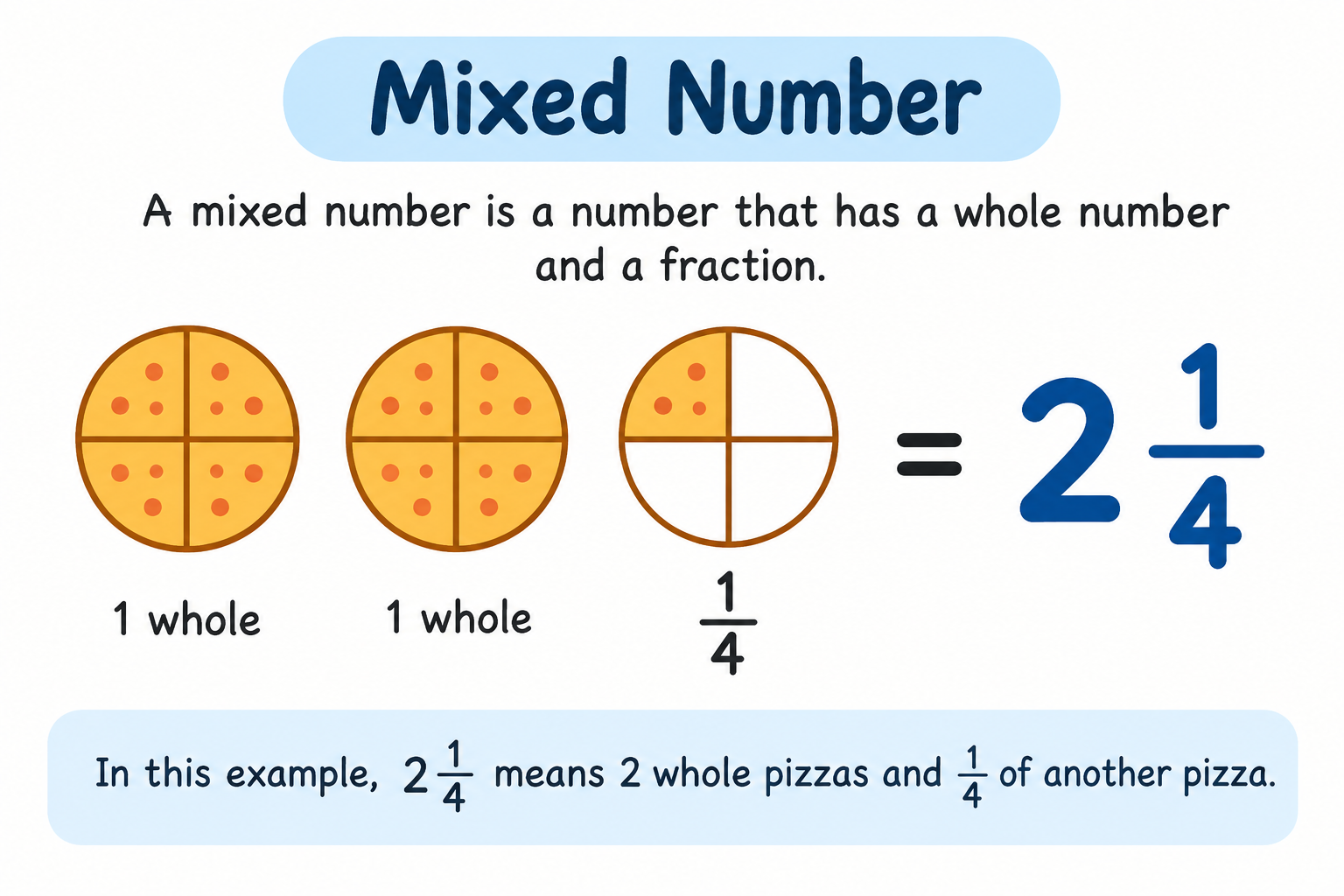
So what is a mixed number, exactly? A mixed number is a number that combines a whole number and a proper fraction into a single value. It is one of the most practical and commonly used number forms in mathematics, and understanding it opens the door to a wide range of real-world calculations.
This guide explains everything you need to know — from identifying and reading mixed numbers to converting, comparing, and performing all four operations with them.
Key Takeaways
-
A mixed number consists of a whole number part and a fractional part written together, such as 2 3/4.
-
The fractional part of a mixed number is always a proper fraction — its numerator is smaller than its denominator.
-
Every mixed number can be written as an improper fraction, and vice versa.
-
To convert a mixed number to an improper fraction, multiply the whole number by the denominator, add the numerator, and place the result over the denominator.
-
To convert an improper fraction to a mixed number, divide the numerator by the denominator and use the remainder as the new numerator.
-
Adding and subtracting mixed numbers requires a common denominator for the fractional parts.
-
Multiplying and dividing mixed numbers requires converting to improper fractions first.
What Is a Mixed Number?
A mixed number is a number that has two parts sitting side by side: a whole number and a proper fraction. Together, they represent a single value that is greater than the whole number alone.
Examples of mixed numbers:
- 2 1/2 (two and one half)
- 3 3/4 (three and three quarters)
- 5 2/3 (five and two thirds)
- 1 1/4 (one and one quarter)
- 7 5/8 (seven and five eighths)
The key rule is that the fractional part must always be a proper fraction — meaning the numerator is smaller than the denominator, so the fraction itself is less than 1. If the fractional part were equal to or greater than 1, it would simply become part of the whole number.
Mixed numbers are greater than 1 (or less than −1 for negative mixed numbers). They sit between two consecutive whole numbers on the number line.
If you are new to fractions altogether, the article What Is a Fraction? on LearnMinto is a helpful place to start before continuing here.
Parts of a Mixed Number
Every mixed number has three components. Take the example 3 2/5:
| Part | Value | Meaning |
|---|---|---|
| Whole number | 3 | There are 3 complete wholes |
| Numerator | 2 | 2 parts of the fraction are taken |
| Denominator | 5 | The whole is divided into 5 equal parts |
So 3 2/5 means: three complete wholes, plus two fifths of another whole.
You read it as “three and two fifths.” The word “and” connects the whole number to the fraction — and that small word is actually doing important mathematical work, telling you the two parts are being added together.
Mixed Numbers on a Number Line
Placing mixed numbers on a number line is one of the best ways to build an intuitive sense of their size. If you are not yet familiar with how number lines work, the article What Is a Number Line? gives a thorough and beginner-friendly introduction.
To place a mixed number on a number line:
- Identify the two consecutive whole numbers it sits between.
- Divide the interval between those whole numbers into equal parts based on the denominator.
- Count along by the numerator to find the exact position.
Examples:
- 1 1/2 sits between 1 and 2, exactly halfway along the interval.
- 2 3/4 sits between 2 and 3, three-quarters of the way from 2 towards 3.
- 3 1/3 sits between 3 and 4, one-third of the way from 3 towards 4.
- 4 5/6 sits between 4 and 5, five-sixths of the way from 4 towards 5 — very close to 5.
← 1 1¼ 1½ 1¾ 2 2¼ 2½ 2¾ 3 →This visual approach makes it easy to see that 2 3/4 is greater than 2 1/4, and that 1 3/4 is less than 2 1/4 — without doing any calculation at all.
Mixed Numbers vs Improper Fractions
A mixed number and an improper fraction are two different ways of writing the same value.
- A mixed number has a whole number part and a fractional part: 2 3/4
- An improper fraction has a numerator that is greater than or equal to its denominator: 11/4
Both of these represent exactly the same amount. Neither is more correct than the other — the appropriate form depends on context. Everyday language tends to use mixed numbers (“two and three quarter hours”), while mathematical calculations often use improper fractions because they are easier to work with.
| Mixed Number | Improper Fraction |
|---|---|
| 1 1/2 | 3/2 |
| 2 3/4 | 11/4 |
| 3 2/3 | 11/3 |
| 4 1/5 | 21/5 |
| 5 3/8 | 43/8 |
How to Convert a Mixed Number to an Improper Fraction
This is one of the most important skills connected to mixed numbers, and it underpins multiplication and division with mixed numbers.
The formula:
(Whole number × Denominator) + Numerator
―――――――――――――――――――――――――――
Denominator
Why does this work?
When you multiply the whole number by the denominator, you are expressing the whole number part as a fraction with the same denominator. For example, 2 expressed in quarters is 8/4. Adding the numerator (3) gives you 11/4. You have simply converted both parts to the same unit and combined them.
Step-by-step process:
- Multiply the whole number by the denominator.
- Add the numerator to that product.
- Write the result over the original denominator.
Example 1: Convert 2 3/4
(2 × 4) + 3 = 8 + 3 = 11
Answer: 11/4
Example 2: Convert 3 2/5
(3 × 5) + 2 = 15 + 2 = 17
Answer: 17/5
Example 3: Convert 5 1/3
(5 × 3) + 1 = 15 + 1 = 16
Answer: 16/3
Example 4: Convert 4 7/8
(4 × 8) + 7 = 32 + 7 = 39
Answer: 39/8
Example 5: Convert 6 2/9
(6 × 9) + 2 = 54 + 2 = 56
Answer: 56/9
How to Convert an Improper Fraction to a Mixed Number
The process runs in reverse. You are asking: how many whole groups fit into this fraction, and what is left over?
Step-by-step process:
- Divide the numerator by the denominator.
- The quotient (whole number result) becomes the whole number part.
- The remainder becomes the new numerator.
- The denominator stays the same.
Example 1: Convert 11/4
11 ÷ 4 = 2 remainder 3
Answer: 2 3/4
Example 2: Convert 17/5
17 ÷ 5 = 3 remainder 2
Answer: 3 2/5
Example 3: Convert 22/7
22 ÷ 7 = 3 remainder 1
Answer: 3 1/7
Example 4: Convert 43/8
43 ÷ 8 = 5 remainder 3
Answer: 5 3/8
Example 5: Convert 29/6
29 ÷ 6 = 4 remainder 5
Answer: 4 5/6
Simplifying Mixed Numbers
A mixed number is in its simplest form when the fractional part cannot be reduced any further. If the numerator and denominator of the fractional part share a common factor greater than 1, you should simplify.
Example 1: Simplify 2 4/8
4/8 simplifies to 1/2 (divide both by 4)
Answer: 2 1/2
Example 2: Simplify 5 6/9
6/9 simplifies to 2/3 (divide both by 3)
Answer: 5 2/3
Example 3: Simplify 3 10/15
10/15 simplifies to 2/3 (divide both by 5)
Answer: 3 2/3
Example 4: Simplify 7 4/6
4/6 simplifies to 2/3 (divide both by 2)
Answer: 7 2/3
Understanding equivalent fractions is essential for simplification. If you would like to revisit this concept, What Are Equivalent Fractions? explains it clearly with plenty of examples.
Finding the greatest common factor of the numerator and denominator makes simplification more efficient — a skill covered in What Is a Factor? if you need a refresher.
Comparing Mixed Numbers
Comparing mixed numbers follows a clear two-step process.
Step 1: Compare the whole number parts.
If the whole numbers are different, the mixed number with the larger whole number is greater. No further comparison is needed.
Example: 4 1/3 > 3 7/8 (because 4 > 3)
Step 2: If whole numbers are equal, compare the fractional parts.
Use a common denominator to compare the fractions fairly. For a detailed walkthrough of this process, How to Compare Fractions With Different Denominators covers every method step by step.
Example: Compare 5 2/3 and 5 3/4
Whole numbers are equal (both 5). Compare 2/3 and 3/4.
LCM of 3 and 4 = 12
2/3 = 8/12
3/4 = 9/12
8/12 < 9/12, so 2/3 < 3/4
Answer: 5 2/3 < 5 3/4
Example: Compare 2 5/6 and 2 7/9
LCM of 6 and 9 = 18
5/6 = 15/18
7/9 = 14/18
15/18 > 14/18
Answer: 2 5/6 > 2 7/9
Adding Mixed Numbers
There are two reliable methods for adding mixed numbers.
Method 1: Add Whole Numbers and Fractions Separately
Step 1: Add the whole number parts together.
Step 2: Add the fractional parts together (find a common denominator if needed).
Step 3: If the fractional sum is an improper fraction, convert it and carry the whole number.
Step 4: Combine and simplify.
Example 1: 2 1/4 + 3 2/4 (same denominators)
Whole numbers: 2 + 3 = 5
Fractions: 1/4 + 2/4 = 3/4
Answer: 5 3/4
Example 2: 1 1/2 + 2 1/3 (different denominators)
Whole numbers: 1 + 2 = 3
Fractions: 1/2 + 1/3 → LCM = 6 → 3/6 + 2/6 = 5/6
Answer: 3 5/6
Example 3: 3 3/4 + 2 2/4 (fraction sum exceeds 1)
Whole numbers: 3 + 2 = 5
Fractions: 3/4 + 2/4 = 5/4 = 1 1/4
Carry the 1: 5 + 1 = 6
Answer: 6 1/4
Method 2: Convert to Improper Fractions First
Example 4: 2 2/3 + 1 3/4
Convert: 2 2/3 = 8/3; 1 3/4 = 7/4
LCM of 3 and 4 = 12
8/3 = 32/12; 7/4 = 21/12
32/12 + 21/12 = 53/12
Convert back: 53 ÷ 12 = 4 remainder 5 → 4 5/12
For a deeper look at adding fractions with unlike denominators, How to Add Fractions With Different Denominators covers the process in full detail.
Subtracting Mixed Numbers
Simple Subtraction (Same Denominators)
Example 1: 5 3/4 − 2 1/4
Whole numbers: 5 − 2 = 3
Fractions: 3/4 − 1/4 = 2/4 = 1/2
Answer: 3 1/2
Subtraction With Different Denominators
Example 2: 4 5/6 − 1 1/4
LCM of 6 and 4 = 12
5/6 = 10/12; 1/4 = 3/12
Whole numbers: 4 − 1 = 3
Fractions: 10/12 − 3/12 = 7/12
Answer: 3 7/12
Borrowing (Regrouping) When the Fraction Being Subtracted Is Larger
Sometimes the fractional part of the first mixed number is smaller than the fractional part being subtracted. In this case, borrow 1 from the whole number and add it to the fraction.
Example 3: 5 1/4 − 2 3/4
1/4 < 3/4, so borrow 1 from the 5.
5 1/4 becomes 4 + 1 1/4 = 4 5/4
Now subtract: 4 5/4 − 2 3/4
Whole numbers: 4 − 2 = 2
Fractions: 5/4 − 3/4 = 2/4 = 1/2
Answer: 2 1/2
Example 4: 6 1/3 − 3 2/3
1/3 < 2/3, so borrow 1 from 6.
6 1/3 becomes 5 4/3
5 4/3 − 3 2/3:
Whole numbers: 5 − 3 = 2
Fractions: 4/3 − 2/3 = 2/3
Answer: 2 2/3
Multiplying Mixed Numbers
You cannot multiply mixed numbers directly. You must convert them to improper fractions first.
Steps:
- Convert each mixed number to an improper fraction.
- Multiply the numerators together.
- Multiply the denominators together.
- Simplify and convert back to a mixed number if needed.
Example 1: 2 1/2 × 1 1/3
Convert: 2 1/2 = 5/2; 1 1/3 = 4/3
Multiply: (5 × 4) / (2 × 3) = 20/6
Simplify: 20/6 = 10/3
Convert: 10 ÷ 3 = 3 remainder 1 → 3 1/3
Example 2: 3 1/4 × 2 2/5
Convert: 3 1/4 = 13/4; 2 2/5 = 12/5
Multiply: (13 × 12) / (4 × 5) = 156/20
Simplify: 156/20 = 39/5
Convert: 39 ÷ 5 = 7 remainder 4 → 7 4/5
Example 3: 1 1/2 × 4
Convert: 1 1/2 = 3/2; 4 = 4/1
Multiply: (3 × 4) / (2 × 1) = 12/2 = 6
Answer: 6
Dividing Mixed Numbers
Division follows a similar approach — convert to improper fractions, then multiply by the reciprocal of the divisor.
Steps:
- Convert each mixed number to an improper fraction.
- Flip the second fraction (the divisor) to find its reciprocal.
- Multiply the first fraction by the reciprocal.
- Simplify and convert back if needed.
Example 1: 3 1/2 ÷ 1 3/4
Convert: 3 1/2 = 7/2; 1 3/4 = 7/4
Reciprocal of 7/4 = 4/7
Multiply: (7/2) × (4/7) = 28/14 = 2
Answer: 2
Example 2: 4 1/2 ÷ 1 1/2
Convert: 4 1/2 = 9/2; 1 1/2 = 3/2
Reciprocal of 3/2 = 2/3
Multiply: (9/2) × (2/3) = 18/6 = 3
Answer: 3
Example 3: 2 2/3 ÷ 1 1/3
Convert: 2 2/3 = 8/3; 1 1/3 = 4/3
Reciprocal of 4/3 = 3/4
Multiply: (8/3) × (3/4) = 24/12 = 2
Answer: 2
Real-Life Examples of Mixed Numbers
Mixed numbers are not just classroom mathematics. They appear naturally in everyday situations.
Cooking: A cake recipe requires 2 1/2 cups of flour and 1 3/4 cups of sugar. Both measurements are mixed numbers — they are far more intuitive than saying 5/2 cups or 7/4 cups.
Measuring length: A carpenter cuts a shelf that must be 4 3/4 inches wide. Mixed numbers are the standard in carpentry and construction because they are easier to read on a ruler than improper fractions.
Time: A film lasts 1 3/4 hours. A study session runs for 2 1/2 hours. These are natural ways to express time that is more than one hour but less than the next full hour.
Distance: A runner completes 3 1/2 kilometres in a morning jog. Road signs occasionally give distances as mixed numbers to communicate partial kilometres clearly.
Shopping: A market stall sells fruit by weight. A customer buys 2 1/4 kg of apples. Mixed numbers communicate partial kilogram quantities naturally.
Sports: A high jumper clears a bar at 1 9/10 metres. A swimming pool is 1 1/4 lengths in a particular training exercise. Mixed numbers arise naturally wherever measurements fall between whole units.
Common Mistakes With Mixed Numbers
1. Forgetting to convert before multiplying or dividing
You cannot multiply 2 1/2 × 3 1/4 directly by multiplying the whole numbers and fractions separately. You must convert to improper fractions first (5/2 × 13/4). Skipping this step produces incorrect results.
2. Adding fractions with different denominators without finding a common denominator
When adding 1 1/2 + 2 1/3, you cannot simply add 1 + 1 = 2 for the fraction. You must convert to a common denominator (3/6 + 2/6 = 5/6) before combining.
3. Not simplifying the fractional part
Leaving an answer as 3 4/8 instead of simplifying to 3 1/2 is incomplete. Always check whether the fractional part can be reduced.
4. Confusing the format of the final answer
If a question asks for a mixed number and you leave the answer as an improper fraction (or vice versa), you may lose marks. Always check what format the question requires.
5. Forgetting to borrow during subtraction
When the fractional part of the first mixed number is smaller than the one being subtracted, students often attempt to subtract a larger fraction from a smaller one, producing a negative fractional part. Always borrow 1 from the whole number in this situation.
6. Borrowing incorrectly
When borrowing 1 from the whole number, that 1 must be converted to a fraction with the same denominator before being added to the existing fraction. Borrowing 1 from a number with denominator 5 gives 5/5, not 1/5.
Worked Examples
Example 1: Identify the mixed number from: 5/3, 2 1/4, 7, 0.5
A mixed number has a whole number and a fractional part.
Answer: 2 1/4
Example 2: Convert 4 3/7 to an improper fraction.
(4 × 7) + 3 = 28 + 3 = 31
Answer: 31/7
Example 3: Convert 19/5 to a mixed number.
19 ÷ 5 = 3 remainder 4
Answer: 3 4/5
Example 4: Place 2 2/3 on a number line.
2 2/3 sits between 2 and 3, two-thirds of the way from 2 towards 3.
Example 5: Compare 3 1/2 and 3 2/5.
Common denominator for 1/2 and 2/5: LCM = 10
1/2 = 5/10; 2/5 = 4/10
5/10 > 4/10
Answer: 3 1/2 > 3 2/5
Example 6: Add 1 2/5 + 3 1/5
Whole: 1 + 3 = 4; Fractions: 2/5 + 1/5 = 3/5
Answer: 4 3/5
Example 7: Add 2 3/4 + 1 2/3
LCM of 4 and 3 = 12
3/4 = 9/12; 2/3 = 8/12
Fractions: 9/12 + 8/12 = 17/12 = 1 5/12
Whole: 2 + 1 + 1 = 4
Answer: 4 5/12
Example 8: Subtract 5 7/8 − 2 3/8
Whole: 5 − 2 = 3; Fractions: 7/8 − 3/8 = 4/8 = 1/2
Answer: 3 1/2
Example 9: Subtract 4 1/6 − 1 5/6 (borrowing required)
1/6 < 5/6. Borrow 1 from 4 → 3 7/6
3 7/6 − 1 5/6:
Whole: 3 − 1 = 2; Fractions: 7/6 − 5/6 = 2/6 = 1/3
Answer: 2 1/3
Example 10: Multiply 2 1/2 × 1 4/5
5/2 × 9/5 = 45/10 = 9/2 = 4 1/2
Answer: 4 1/2
Example 11: Divide 5 1/4 ÷ 1 3/4
21/4 ÷ 7/4 = 21/4 × 4/7 = 84/28 = 3
Answer: 3
Example 12: Simplify 4 9/12
9/12 = 3/4 (divide by 3)
Answer: 4 3/4
Example 13: Word problem — A baker uses 2 1/4 kg of flour on Monday and 3 1/2 kg on Tuesday. How much flour did she use in total?
2 1/4 + 3 1/2:
LCM of 4 and 2 = 4
1/4 + 2/4 = 3/4
Whole: 2 + 3 = 5
Answer: 5 3/4 kg
Example 14: Word problem — A rope is 8 1/2 metres long. A piece of 3 2/3 metres is cut off. How much remains?
8 1/2 − 3 2/3:
LCM of 2 and 3 = 6
1/2 = 3/6; 2/3 = 4/6
3/6 < 4/6, so borrow: 8 1/2 = 7 9/6
7 9/6 − 3 4/6:
Whole: 7 − 3 = 4; Fractions: 9/6 − 4/6 = 5/6
Answer: 4 5/6 metres
Example 15: Word problem — A car travels 2 1/2 hours at a speed that covers 60 km per hour. How far does it travel?
Distance = speed × time = 60 × 2 1/2 = 60 × 5/2 = 300/2 = 150
Answer: 150 km
Practice Questions
Try these independently. Answers follow below.
Identify.
- Which of these is a mixed number? 7/3, 2 1/5, 4, 0.75
- Which of these is NOT a mixed number? 3 1/2, 9/4, 1 7/8, 5 2/9
Convert mixed number to improper fraction.
- 3 1/4
- 5 2/3
- 7 3/8
- 2 5/6
Convert improper fraction to mixed number.
- 13/4
- 23/5
- 31/7
- 17/3
Add.
- 2 1/3 + 1 1/3
- 3 1/4 + 2 1/2
- 4 2/3 + 1 3/4
Subtract.
- 5 3/4 − 2 1/4
- 6 1/5 − 2 3/5
- 7 1/3 − 4 5/6
Multiply.
- 2 1/2 × 2
- 1 1/3 × 3 3/4
Divide.
- 4 1/2 ÷ 1 1/2
- 3 3/4 ÷ 1 1/4
Simplify.
- 3 6/9
- 5 4/10
Compare.
- 4 2/3 ___ 4 3/5
- 2 7/8 ___ 3 1/4
Word problem.
- A plank is 5 3/4 feet long. Another plank is 3 5/8 feet long. What is the total length of both planks?
Answers:
- 2 1/5
- 9/4
- 13/4
- 17/3
- 59/8
- 17/6
- 3 1/4
- 4 3/5
- 4 3/7
- 5 2/3
- 3 2/3
- 5 3/4
- 6 5/12 (LCM=12: 8/12 + 9/12 = 17/12 = 1 5/12; 4+1+1=6)
- 3 1/2
- 3 3/5 (6 1/5 → borrow → 5 6/5; 5 6/5 − 2 3/5 = 3 3/5)
- 2 1/2 (LCM=6: 7 2/6 − 4 5/6 → borrow → 6 8/6 − 4 5/6 = 2 3/6 = 2 1/2)
- 5 (5/2 × 2/1 = 10/2 = 5)
- 5 (4/3 × 15/4 = 60/12 = 5)
- 3 (9/2 × 2/3 = 18/6 = 3)
- 3 (15/4 × 4/5 = 60/20 = 3)
- 3 2/3
- 5 2/5
- 4 2/3 > 4 3/5 (LCM=15: 10/15 > 9/15)
- 2 7/8 < 3 1/4 (whole numbers differ: 2 < 3)
- 5 3/4 + 3 5/8 = LCM 8: 6/8 + 5/8 = 11/8 = 1 3/8; whole 5+3+1=9; 9 3/8 feet
Multiple-Choice Questions
Question 1: Which of the following is a mixed number?
A) 7/3
B) 4
C) 3 2/5
D) 0.6
Correct Answer: C — 3 2/5
A mixed number has a whole number part and a fractional part. Only 3 2/5 satisfies this definition.
Question 2: What is 2 3/4 as an improper fraction?
A) 9/4
B) 11/4
C) 8/4
D) 10/4
Correct Answer: B — 11/4
(2 × 4) + 3 = 11; place over 4 → 11/4.
Question 3: What is 17/5 as a mixed number?
A) 3 1/5
B) 3 2/5
C) 2 3/5
D) 4 1/5
Correct Answer: B — 3 2/5
17 ÷ 5 = 3 remainder 2 → 3 2/5.
Question 4: Calculate 2 1/3 + 1 1/6.
A) 3 1/2
B) 3 1/3
C) 3 2/9
D) 3 5/6
Correct Answer: A — 3 1/2
LCM of 3 and 6 = 6. 1/3 = 2/6; 2/6 + 1/6 = 3/6 = 1/2. Whole: 2+1=3. Answer: 3 1/2.
Question 5: Which is greater: 4 2/5 or 4 3/7?
A) 4 3/7
B) 4 2/5
C) They are equal
D) Cannot be determined
Correct Answer: B — 4 2/5
LCM of 5 and 7 = 35. 2/5 = 14/35; 3/7 = 15/35. Wait — 14/35 < 15/35, so 4 2/5 < 4 3/7.
Correction: Correct Answer is A — 4 3/7.
3/7 = 15/35 > 2/5 = 14/35.
Question 6: What is 1 1/2 × 2 2/3?
A) 3
B) 4
C) 2 1/3
D) 3 1/3
Correct Answer: B — 4
3/2 × 8/3 = 24/6 = 4.
Question 7: What is 3 3/4 ÷ 1 1/4?
A) 2
B) 3
C) 4
D) 2 1/2
Correct Answer: B — 3
15/4 ÷ 5/4 = 15/4 × 4/5 = 60/20 = 3.
Question 8: Simplify 6 10/15.
A) 6 1/3
B) 6 2/5
C) 6 2/3
D) 6 5/8
Correct Answer: C — 6 2/3
10/15 = 2/3 (divide both by 5).
Question 9: A jug holds 1 3/4 litres. How much do 3 such jugs hold?
A) 4 1/4 litres
B) 5 1/4 litres
C) 5 3/4 litres
D) 3 3/4 litres
Correct Answer: B — 5 1/4 litres
1 3/4 × 3 = 7/4 × 3/1 = 21/4 = 5 1/4.
Question 10: Which of the following correctly shows borrowing to solve 4 1/5 − 1 4/5?
A) 3 3/5
B) 2 2/5
C) 3 2/5
D) 2 3/5
Correct Answer: C — 3 2/5
Borrow: 4 1/5 → 3 6/5. Then 3 6/5 − 1 4/5: whole 3−1=2… wait: 3−1=2, fractions 6/5−4/5=2/5. Answer: 2 2/5.
Correction: Correct Answer is B — 2 2/5.
3 6/5 − 1 4/5 = 2 2/5.
Challenge Questions
Challenge 1: Order the following mixed numbers from least to greatest: 3 2/3, 3 3/4, 3 5/8, 3 7/12
Find a common denominator. LCM of 3, 4, 8, 12 = 24
3 2/3 = 3 16/24
3 3/4 = 3 18/24
3 5/8 = 3 15/24
3 7/12 = 3 14/24
Order: 14/24 < 15/24 < 16/24 < 18/24
Answer: 3 7/12 < 3 5/8 < 3 2/3 < 3 3/4
Challenge 2: A gardener has a plot of land 8 1/4 metres long. She divides it into sections of 1 3/8 metres each. How many complete sections can she make?
8 1/4 ÷ 1 3/8
Convert: 8 1/4 = 33/4; 1 3/8 = 11/8
33/4 ÷ 11/8 = 33/4 × 8/11 = 264/44 = 6
Answer: 6 complete sections
Challenge 3: A runner jogs 2 3/4 km in the morning and 1 5/6 km in the evening for 3 days in a row. What is the total distance run over the 3 days?
Daily total: 2 3/4 + 1 5/6
LCM of 4 and 6 = 12
3/4 = 9/12; 5/6 = 10/12
Fractions: 9/12 + 10/12 = 19/12 = 1 7/12
Whole: 2 + 1 + 1 = 4
Daily total: 4 7/12 km
Over 3 days: 4 7/12 × 3 = 55/12 × 3 = 165/12 = 13 9/12 = 13 3/4
Answer: 13 3/4 km
Challenge 4: Is 2 1/2 × 1 1/2 equal to (2 × 1) + (1/2 × 1/2)? Explain the error if there is one and find the correct answer.
The suggested method incorrectly treats mixed number multiplication as if you can multiply the parts separately.
(2 × 1) + (1/2 × 1/2) = 2 + 1/4 = 2 1/4 — this is wrong.
Correct method:
2 1/2 = 5/2; 1 1/2 = 3/2
5/2 × 3/2 = 15/4 = 3 3/4
Correct Answer: 3 3/4
The error occurs because multiplication must be applied across the entire value, not just the individual parts independently.
Challenge 5: A tank holds 15 1/2 litres of water. Each bucket holds 2 3/4 litres. How many full buckets can be filled, and how much water is left over?
15 1/2 ÷ 2 3/4
Convert: 15 1/2 = 31/2; 2 3/4 = 11/4
31/2 ÷ 11/4 = 31/2 × 4/11 = 124/22 = 62/11 = 5 7/11
Number of full buckets: 5
Water used: 5 × 2 3/4 = 5 × 11/4 = 55/4 = 13 3/4 litres
Water remaining: 15 1/2 − 13 3/4
LCM = 4: 15 2/4 − 13 3/4 → borrow: 14 6/4 − 13 3/4 = 1 3/4
Answer: 5 full buckets, with 1 3/4 litres remaining
Quick Revision Notes
- A mixed number = whole number + proper fraction (e.g., 3 2/5).
- The fractional part is always less than 1.
- Mixed number → improper fraction: (whole × denominator + numerator) / denominator.
- Improper fraction → mixed number: divide numerator by denominator; quotient is whole number, remainder is new numerator.
- Always simplify the fractional part of the final answer.
- To compare: first compare whole numbers; if equal, compare fractional parts using a common denominator.
- To add/subtract: use a common denominator; borrow when needed in subtraction.
- To multiply/divide: always convert to improper fractions first.
- When dividing, flip the second fraction and multiply.
- Check the required format — mixed number or improper fraction — before writing your final answer.
Mixed Number Cheat Sheet
| Concept | Rule | Example |
|---|---|---|
| Identifying a mixed number | Whole number + proper fraction together | 4 3/5 ✓ — 9/4 ✗ |
| Convert to improper fraction | (W × D + N) / D | 2 3/4 = (8+3)/4 = 11/4 |
| Convert to mixed number | Numerator ÷ Denominator; use quotient and remainder | 11/4 → 2 r3 → 2 3/4 |
| Adding | Common denominator; add wholes and fractions separately | 1 1/3 + 2 1/6 = 3 1/2 |
| Subtracting | Common denominator; borrow if needed | 5 1/4 − 2 3/4 = 2 1/2 |
| Multiplying | Convert to improper fractions, multiply straight across | 2 1/2 × 1 1/3 = 5/2 × 4/3 = 10/3 = 3 1/3 |
| Dividing | Convert to improper fractions, flip divisor, multiply | 3 1/2 ÷ 1 3/4 = 7/2 × 4/7 = 2 |
| Simplifying | Reduce the fractional part to lowest terms | 4 6/9 = 4 2/3 |
Exam Tips
- Always read the question carefully to see whether the answer is required as a mixed number or an improper fraction. Giving the wrong form can cost marks even if the calculation is correct.
- Before multiplying or dividing, convert mixed numbers to improper fractions first — every time, without exception.
- When adding or subtracting fractions with different denominators, find the LCM before proceeding. Knowing your multiples well makes this significantly faster. A review of What Is a Multiple? can strengthen this skill.
- When borrowing during subtraction, convert the borrowed 1 into a fraction using the current denominator before adding it to the existing fractional part.
- After any calculation, check whether the fractional part of your answer can be simplified. Examiners expect fully simplified answers.
- If the fractional part of your answer is an improper fraction (e.g., 7/4), convert and carry — your answer is not complete until the fractional part is a proper fraction.
- For comparison questions, only compare fractional parts when the whole numbers are identical. If whole numbers differ, stop there.
- Double-check every conversion between mixed numbers and improper fractions before using the values in a calculation.
Frequently Asked Questions
1. What is a mixed number?
A mixed number is a number that combines a whole number and a proper fraction. For example, 3 2/5 means three complete wholes plus two fifths of another. Mixed numbers represent values greater than 1 that fall between two consecutive whole numbers.
2. What is the difference between a mixed number and an improper fraction?
A mixed number has a separate whole number part and fractional part, such as 2 3/4. An improper fraction has a numerator larger than its denominator, such as 11/4. Both forms represent the same value and can be converted freely between each other.
3. How do you convert a mixed number to an improper fraction?
Multiply the whole number by the denominator, add the numerator, and place the result over the original denominator. For example, 2 3/4: (2 × 4) + 3 = 11, so the answer is 11/4.
4. How do you convert an improper fraction to a mixed number?
Divide the numerator by the denominator. The quotient becomes the whole number, the remainder becomes the new numerator, and the denominator stays the same. For example, 11/4: 11 ÷ 4 = 2 remainder 3, giving 2 3/4.
5. How do you add mixed numbers?
Add the whole number parts and the fractional parts separately. If the fractions have different denominators, find a common denominator first. If the fractional parts add up to more than 1, carry the extra whole number across.
6. How do you subtract mixed numbers with different denominators?
Find a common denominator for the fractional parts, convert each fraction, then subtract. If the first fraction is smaller than the one being subtracted, borrow 1 from the whole number, convert it to the appropriate fraction, and add it to the existing fractional part before subtracting.
7. How do you multiply mixed numbers?
Convert both mixed numbers to improper fractions first, then multiply the numerators together and the denominators together. Simplify the result and convert back to a mixed number if required.
8. How do you divide mixed numbers?
Convert both mixed numbers to improper fractions. Flip the second fraction to find its reciprocal, then multiply. Simplify and convert back to a mixed number if required.
9. Can a mixed number be negative?
Yes. A negative mixed number has a negative sign in front, such as −2 3/4. It represents a value less than −2 but greater than −3. Negative mixed numbers appear on the left side of zero on a number line.
10. How do you simplify a mixed number?
Simplify the fractional part by dividing the numerator and denominator by their greatest common factor. The whole number part is not affected. For example, 3 6/8 simplifies to 3 3/4.
11. What is 5/2 as a mixed number?
5 ÷ 2 = 2 remainder 1, so 5/2 = 2 1/2.
12. What is 3 1/2 as an improper fraction?
(3 × 2) + 1 = 7, so 3 1/2 = 7/2.
13. How do you compare two mixed numbers?
Compare the whole number parts first. The larger whole number means the larger mixed number. If the whole numbers are the same, compare the fractional parts using a common denominator.
14. Where do mixed numbers appear in real life?
Mixed numbers appear in cooking measurements, carpentry, time (hours and fractions of an hour), distance, shopping weights, and many other everyday contexts where a quantity falls between two whole units.
15. Is 1 a mixed number?
No. The number 1 is a whole number. A mixed number must have both a whole number part and a fractional part. The smallest possible mixed number is something like 1 1/2, where the fractional part is greater than zero.
Summary
A mixed number is one of the most practical number forms in mathematics. It combines a whole number and a proper fraction into a single, readable value — the kind of number you encounter every day in kitchens, workshops, classrooms, and sports fields.
The core skills to master are:
- Identifying a mixed number by its structure: whole number + proper fraction.
- Converting between mixed numbers and improper fractions confidently in both directions.
- Simplifying the fractional part so the answer is always in its lowest terms.
- Comparing mixed numbers by working from the whole number part inward.
- Adding and subtracting by finding common denominators and borrowing when necessary.
- Multiplying and dividing by converting to improper fractions first — always.
Understanding mixed numbers does not just help with one topic. It connects to fractions, equivalent fractions, common denominators, factors, and multiples, and it prepares students for more advanced work in algebra and ratio. Building confidence with mixed numbers now creates a strong foundation for everything that follows.
Final Thoughts
Mixed numbers are one of those topics where the concept itself is intuitive — most students understand “two and a half” long before they encounter it formally in a classroom. The challenge is learning to manipulate them precisely and consistently, especially when performing multiplication, division, or subtraction with borrowing.
The single most important habit to build is automatic, accurate conversion between mixed numbers and improper fractions. If you can do that reliably, every other operation with mixed numbers becomes a manageable sequence of familiar steps. Practice this conversion until it feels completely natural — it is the key that unlocks everything else.
Work through the practice questions in this guide section by section. Do not rush to the answers. Try each one independently, then check. When you make an error, go back to the relevant method, read through the steps again, and try a similar question. That cycle of attempt, check, and revisit is how mathematical understanding genuinely develops.
With consistent practice, mixed numbers will feel less like a rule to memorise and more like a natural way of seeing and expressing the world around you.
Helpful Resources
- Khan Academy — Mixed Numbers
Clear video lessons and interactive exercises covering mixed numbers, improper fractions, and all four operations with step-by-step guidance.
https://www.khanacademy.org/math/arithmetic/fraction-arithmetic - OpenStax Prealgebra — Fractions and Mixed Numbers
A free, peer-reviewed prealgebra textbook with dedicated chapters on mixed numbers, conversion, and operations, including worked examples and practice problems.
https://openstax.org/books/prealgebra-2e/pages/1-introduction - Mathematics LibreTexts — Mixed Numbers and Improper Fractions
A detailed open-access resource explaining mixed numbers, conversion methods, and arithmetic operations with thorough examples.
https://math.libretexts.org - National Council of Teachers of Mathematics (NCTM)
The leading professional body for mathematics education, providing standards, resources, and research-based guidance for teaching fractions and mixed numbers effectively.
https://www.nctm.org
Disclaimer:
This article is intended for educational and informational purposes only. While LearnMinto strives to provide accurate and up-to-date mathematics information, readers should verify important academic concepts through official textbooks, educational institutions, examination boards, or trusted educational resources before using this content for exams or academic purposes. LearnMinto is not affiliated with any specific school, university, research institution, or examination board.