
Introduction
Imagine you order a pizza and it is cut into two equal slices. You eat one slice — that is 1/2 of the pizza. Now imagine the same pizza cut into four equal slices instead. You eat two of them — that is 2/4. Did you eat the same amount? Yes, exactly the same. The numbers look different, but the quantity is identical.
That is the core idea behind equivalent fractions: fractions that look different but represent the same value.
Understanding equivalent fractions is one of the most important steps in learning mathematics. Without this concept, you cannot add fractions with different denominators, compare fractions meaningfully, or simplify fractions to their neatest form. It is a skill that underpins a large part of fraction work — and once it clicks, it makes everything else much easier.
Key Takeaways
-
Equivalent fractions have different numerators and denominators but represent exactly the same value.
-
To create an equivalent fraction, multiply both the numerator and denominator by the same non-zero number.
-
You can also find equivalent fractions by dividing both parts by the same common factor — this is called simplifying.
-
There are infinitely many equivalent fractions for any given fraction.
-
Cross multiplication is a reliable way to check whether two fractions are equivalent.
-
Equivalent fractions are essential for adding, subtracting, comparing, and simplifying fractions.
What Are Equivalent Fractions?
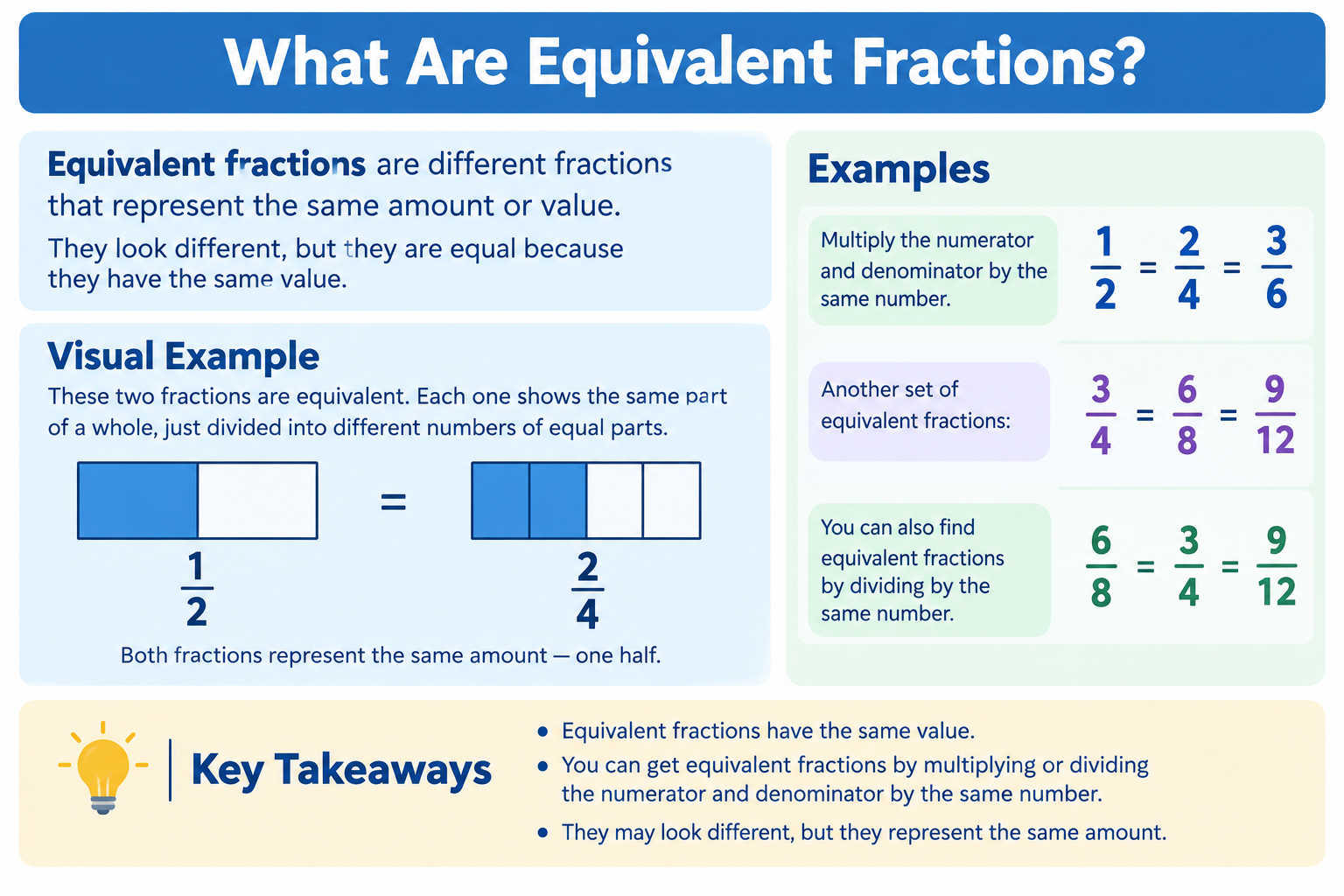
Equivalent fractions are fractions that have different numerators and denominators but are equal in value.
The most familiar example is:
1/2 = 2/4 = 3/6 = 4/8
All four of these fractions describe the same portion of a whole. The reason they are equivalent is that each one has been created by multiplying both the top and bottom of 1/2 by the same number — and multiplying any number by 1 does not change its value.
For a beginner, the simplest way to think about it: two fractions are equivalent if they describe the same-sized piece of the same-sized whole.
Understanding Numerator and Denominator
Before going further, it is worth being clear about these two terms.
A fraction is written as one number over another:
- The numerator is the top number. It tells you how many parts you have.
- The denominator is the bottom number. It tells you how many equal parts the whole has been divided into.
In the fraction 3/4:
- 3 is the numerator → you have 3 parts
- 4 is the denominator → the whole is divided into 4 equal parts
For a complete introduction to fractions, see What Is a Fraction? on LearnMinto.
The relationship between numerator and denominator determines the value of a fraction. When you change both by the same factor, the relationship — and therefore the value — stays exactly the same.
Equivalent Fractions Explained With a Visual Idea
Thinking about food makes this concept very concrete.
Imagine a chocolate bar divided into 2 equal pieces. You take 1 piece — that is 1/2.
Now imagine the same bar divided into 4 equal pieces. You take 2 pieces — that is 2/4.
Now imagine the bar divided into 8 equal pieces. You take 4 pieces — that is 4/8.
In every case, you have taken exactly half of the bar. The number of pieces changed, but the amount did not.
This is what equivalent fractions mean in practice: the whole has been divided differently, but the proportion taken remains the same.
| Fraction | Parts Taken | Total Parts | Amount |
|---|---|---|---|
| 1/2 | 1 | 2 | Half |
| 2/4 | 2 | 4 | Half |
| 4/8 | 4 | 8 | Half |
| 3/6 | 3 | 6 | Half |
How Do Equivalent Fractions Work?
The mathematical principle is elegant and simple.
When you multiply both the numerator and the denominator of a fraction by the same non-zero number, the value of the fraction does not change. This is because you are effectively multiplying the fraction by 1 (since any number divided by itself equals 1).
Example starting with 1/2:
- 1/2 × 2/2 = 2/4
- 1/2 × 3/3 = 3/6
- 1/2 × 4/4 = 4/8
- 1/2 × 10/10 = 10/20
Each result is equivalent to 1/2. The key is that both the numerator and denominator were multiplied by the same number each time.
If you only multiplied the numerator, or only the denominator, the value would change — and you would no longer have an equivalent fraction.
The Main Rule for Finding Equivalent Fractions
The rule can be written as:
a/b = (a × n) / (b × n)
where n is any non-zero whole number.
Examples:
| Original Fraction | Multiply by | Equivalent Fraction |
|---|---|---|
| 1/3 | ×2 | 2/6 |
| 2/5 | ×3 | 6/15 |
| 3/4 | ×4 | 12/16 |
| 5/6 | ×5 | 25/30 |
| 1/7 | ×10 | 10/70 |
Every one of these pairs represents exactly the same value — just expressed with different numbers.
Examples of Equivalent Fractions
| Fraction | Equivalent Fractions |
|---|---|
| 1/2 | 2/4, 3/6, 4/8, 5/10 |
| 1/3 | 2/6, 3/9, 4/12, 5/15 |
| 2/3 | 4/6, 6/9, 8/12, 10/15 |
| 3/4 | 6/8, 9/12, 12/16, 15/20 |
| 2/5 | 4/10, 6/15, 8/20, 10/25 |
| 3/5 | 6/10, 9/15, 12/20, 15/25 |
| 4/7 | 8/14, 12/21, 16/28, 20/35 |
Let us look at two of these in detail.
2/3 = 4/6:
Multiply 2 by 2 to get 4. Multiply 3 by 2 to get 6. Same multiplier (2) used for both → equivalent.
3/4 = 9/12:
Multiply 3 by 3 to get 9. Multiply 4 by 3 to get 12. Same multiplier (3) → equivalent.
How to Find Equivalent Fractions Step by Step
Step 1: Start with the original fraction (e.g., 2/5).
Step 2: Choose a multiplication number (e.g., 3).
Step 3: Multiply the numerator by that number: 2 × 3 = 6.
Step 4: Multiply the denominator by the same number: 5 × 3 = 15.
Step 5: Write the new fraction: 6/15.
Step 6: Check — does 6/15 simplify back to 2/5? Yes: divide both by 3 → 2/5. Correct.
Another example using 3/7:
- Choose multiplier 4.
- 3 × 4 = 12
- 7 × 4 = 28
- Equivalent fraction: 12/28
- Check: 12 ÷ 4 = 3, 28 ÷ 4 = 7 → 3/7. Correct.
How to Find 2, 3, or More Equivalent Fractions
Because the multiplier can be any non-zero number, there is no limit to how many equivalent fractions you can create.
Starting with 3/4:
| Multiplier | Equivalent Fraction |
|---|---|
| ×2 | 6/8 |
| ×3 | 9/12 |
| ×4 | 12/16 |
| ×5 | 15/20 |
| ×10 | 30/40 |
Every single one of these equals 3/4. This means every fraction belongs to an infinite family of equivalent fractions, all expressing the same value.
Equivalent Fractions Using Multiplication
The multiplication method is the most commonly taught approach, and it is reliable for generating equivalent fractions quickly.
Starting with 1/5:
- ×2 → 2/10
- ×3 → 3/15
- ×4 → 4/20
- ×10 → 10/50
Starting with 5/8:
- ×2 → 10/16
- ×3 → 15/24
- ×5 → 25/40
The numbers get larger as the multiplier increases, but the value of the fraction never changes.
Can You Find Equivalent Fractions by Division?
Yes — and this is actually the same principle working in reverse. Instead of multiplying both parts by a number, you divide both parts by a common factor.
Example: 8/12
Both 8 and 12 can be divided by 4 (a factor they share):
8 ÷ 4 = 2
12 ÷ 4 = 3
8/12 = 2/3
Example: 10/15
Both 10 and 15 can be divided by 5:
10 ÷ 5 = 2
15 ÷ 5 = 3
10/15 = 2/3
This process of dividing is what we call simplifying or reducing a fraction. It is finding an equivalent fraction with smaller numbers.
To do this well, you need to identify the common factors of the numerator and denominator — a skill covered thoroughly in What Is a Factor? on LearnMinto.
Equivalent Fractions and Simplifying Fractions
Creating an equivalent fraction (by multiplying) and simplifying a fraction (by dividing) are two sides of the same idea.
Consider the fraction family:
2/3 = 4/6 = 6/9 = 8/12 = 10/15
All of these are equivalent. If someone gives you 8/12, you can simplify it by dividing both parts by 4 to get 2/3 — and you have simply moved from one member of the family to another (simpler) one.
The simplest form — where no further division is possible — is called the fraction in its lowest terms. This is what you aim for when the question asks you to simplify.
How to Tell if Two Fractions Are Equivalent
Method 1: Simplify Both Fractions
Reduce each fraction to its simplest form. If they produce the same result, they are equivalent.
Are 4/8 and 3/6 equivalent?
4/8 → divide by 4 → 1/2
3/6 → divide by 3 → 1/2
Same result → Yes, they are equivalent.
Method 2: Multiply to Match
Check whether multiplying both parts of one fraction by the same number produces the other fraction.
Are 2/3 and 8/12 equivalent?
2 × 4 = 8 and 3 × 4 = 12 — same multiplier used → Yes.
Method 3: Cross Multiplication
For fractions a/b and c/d, calculate:
- a × d
- b × c
If both products are equal, the fractions are equivalent.
Are 2/3 and 4/6 equivalent?
2 × 6 = 12
3 × 4 = 12
Equal → Yes, equivalent.
Are 3/5 and 4/7 equivalent?
3 × 7 = 21
5 × 4 = 20
Not equal → Not equivalent.
Cross multiplication is especially useful when the fractions involve larger numbers and simplifying would take more steps.
Equivalent Fractions With Different Numbers
It can surprise students to discover how many fractions share the same value.
All of the following equal 1/2:
| Fraction | Simplified Form |
|---|---|
| 1/2 | 1/2 |
| 5/10 | 1/2 |
| 10/20 | 1/2 |
| 25/50 | 1/2 |
| 50/100 | 1/2 |
The numbers grow considerably, but each fraction represents exactly the same thing: one half of a whole. This is why you cannot judge the size of a fraction by its numerator or denominator alone. You need to consider both together.
Equivalent Fractions on a Number Line
A number line is another useful way to understand equivalence. If you mark 1/2 on a number line between 0 and 1, and then divide the same line into 4 equal sections and mark 2/4, both marks land on exactly the same point.
The same happens for 3/6 and 4/8 — each one lands on the same point, even though the number of divisions changes each time.
This reinforces the key idea: equivalent fractions are genuinely the same value. They are not approximately the same or almost the same — they are identical in value, sitting at exactly the same place on a number line. This connects to the broader understanding of how numbers are structured, which is explained in What Is Place Value in Math? on LearnMinto.
Equivalent Fractions vs Non-Equivalent Fractions
| Equivalent Fractions | Non-Equivalent Fractions |
|---|---|
| 1/2 and 2/4 | 1/2 and 2/5 |
| 3/4 and 6/8 | 3/4 and 3/5 |
| 2/3 and 4/6 | 2/3 and 3/5 |
| 5/10 and 1/2 | 5/10 and 5/9 |
| 4/8 and 3/6 | 4/8 and 4/7 |
To check: simplify both fractions or use cross multiplication. If they reduce to the same value or their cross products match, they are equivalent. If not, they are not.
Common Mistakes Students Make
1. Multiplying only the numerator.
1/3 → multiplying just the top by 2 → 2/3. Wrong. 2/3 ≠ 1/3.
Correct: multiply both → 2/6.
2. Multiplying only the denominator.
1/3 → multiplying just the bottom by 2 → 1/6. Wrong.
Correct: 2/6.
3. Using different multipliers for each part.
1/4 → top × 2, bottom × 3 → 2/12. Wrong.
Correct: use the same multiplier for both parts.
4. Thinking bigger numbers always mean a bigger fraction.
8/16 looks larger than 1/2, but they are identical in value.
5. Confusing equivalent fractions with equal-looking fractions.
2/4 and 2/5 both have 2 as the numerator — but they are not equivalent. The denominator changes the value.
6. Arithmetic errors when simplifying.
Students sometimes divide incorrectly. Always double-check by multiplying back.
7. Forgetting that zero cannot be a denominator.
The denominator must never be zero. A fraction like 1/0 is undefined.
Worked Examples
1. Find an equivalent fraction for 1/2.
Multiply by 5/5: 1 × 5 = 5, 2 × 5 = 10. Answer: 5/10
2. Find three equivalent fractions for 2/3.
×2 → 4/6. ×3 → 6/9. ×4 → 8/12. Answers: 4/6, 6/9, 8/12
3. Find an equivalent fraction for 3/5.
×4 → 3 × 4 = 12, 5 × 4 = 20. Answer: 12/20
4. Are 2/4 and 1/2 equivalent?
2/4 → divide by 2 → 1/2. Same. Yes.
5. Are 3/8 and 6/16 equivalent?
3 × 16 = 48. 8 × 6 = 48. Equal. Yes.
6. Simplify 6/12.
GCF of 6 and 12 is 6. 6 ÷ 6 = 1, 12 ÷ 6 = 2. Answer: 1/2
7. Simplify 15/20.
GCF of 15 and 20 is 5. 15 ÷ 5 = 3, 20 ÷ 5 = 4. Answer: 3/4
8. Find the missing numerator: 1/3 = ?/9
3 × 3 = 9, so 1 × 3 = 3. Answer: 3/9
9. Find the missing denominator: 2/5 = 6/?
2 × 3 = 6, so 5 × 3 = 15. Answer: 6/15
10. Find the missing number: 4/7 = 12/?
4 × 3 = 12, so 7 × 3 = 21. Answer: 12/21
11. Are 4/6 and 6/9 equivalent?
4/6 → divide by 2 → 2/3. 6/9 → divide by 3 → 2/3. Yes.
12. Find an equivalent fraction with denominator 20 for 3/4.
4 × 5 = 20, so 3 × 5 = 15. Answer: 15/20
13. Find an equivalent fraction with denominator 30 for 2/5.
5 × 6 = 30, so 2 × 6 = 12. Answer: 12/30
14. Use cross multiplication: Are 5/8 and 15/24 equivalent?
5 × 24 = 120. 8 × 15 = 120. Equal. Yes.
15. Real-world example: You have 4 out of 8 pieces of a chocolate bar. Your friend says they ate 1/2. Did you eat the same amount?
4/8 → divide by 4 → 1/2. Yes, equivalent.
16. Find an equivalent fraction for 7/10 with denominator 50.
10 × 5 = 50, so 7 × 5 = 35. Answer: 35/50
17. Are 9/12 and 3/4 equivalent?
9/12 → divide by 3 → 3/4. Yes.
18. Simplify 18/24.
GCF of 18 and 24 is 6. 18 ÷ 6 = 3, 24 ÷ 6 = 4. Answer: 3/4
19. Find the missing numerator: 5/6 = ?/18.
6 × 3 = 18, so 5 × 3 = 15. Answer: 15/18
20. Are 2/7 and 6/21 equivalent?
2 × 21 = 42. 7 × 6 = 42. Equal. Yes.
Finding the Missing Number in Equivalent Fractions
This type of question asks you to complete the equivalent fraction. The key is to identify what number was used to multiply (or divide) the given part, then apply the same number to the other part.
Method:
- Look at the part you know on both sides.
- Find what was multiplied or divided.
- Apply the same operation to the unknown part.
Examples:
- 1/2 = ?/8 → 2 × 4 = 8, so 1 × 4 = 4 → 4/8
- 3/4 = 12/? → 3 × 4 = 12, so 4 × 4 = 16 → 12/16
- 2/5 = ?/20 → 5 × 4 = 20, so 2 × 4 = 8 → 8/20
- 5/9 = 15/? → 5 × 3 = 15, so 9 × 3 = 27 → 15/27
- ?/6 = 4/12 → 6 × 2 = 12, so ? × 2 = 4 → ? = 2 → 2/6
- 7/8 = ?/40 → 8 × 5 = 40, so 7 × 5 = 35 → 35/40
- 3/? = 9/15 → 3 × 3 = 9, so ? × 3 = 15 → ? = 5 → 3/5
- 1/4 = ?/100 → 4 × 25 = 100, so 1 × 25 = 25 → 25/100
- ?/10 = 6/30 → 10 × 3 = 30, so ? × 3 = 6 → ? = 2 → 2/10
- 4/5 = 20/? → 4 × 5 = 20, so 5 × 5 = 25 → 20/25
Equivalent Fractions in Real Life
Equivalent fractions are not just a classroom concept — they appear constantly in everyday life.
Cooking: A recipe calls for 3/4 cup of flour. You want to double it, so you need 6/8 cup — or more conveniently, simply 1 and 1/2 cups. These are equivalent representations of the same quantity.
Pizza: One person eats 2 slices from an 8-slice pizza (2/8). Another eats 1 slice from a 4-slice pizza (1/4). They ate the same proportion of their respective pizzas.
Time: 30 minutes is 30/60 of an hour, which equals 1/2. Both describe the same amount of time.
Money: 50 pence is 50/100 of a pound, which equals 1/2. Half a pound in two different notations.
Measuring ingredients: 2/4 teaspoon and 1/2 teaspoon are the same amount. Cooks move between these representations naturally.
Classroom: Sharing 4 sweets equally among 8 students (4/8) gives the same amount per person as sharing 1 sweet among 2 students (1/2) — the ratio is identical.
Why Are Equivalent Fractions Important?
Equivalent fractions sit at the centre of many fraction skills.
- Comparing fractions: To compare 1/3 and 1/4, you convert both to equivalent fractions with the same denominator (12): 4/12 and 3/12. Now comparison is straightforward.
- Adding fractions: You cannot add 1/2 and 1/3 directly. Convert to 3/6 and 2/6 first.
- Subtracting fractions: The same logic applies.
- Simplifying fractions: Simplifying is finding the simplest equivalent fraction.
- Ratios and proportions: Equivalent fractions express the same ratio in different terms.
- Decimals and percentages: 1/2, 0.5, and 50% are all equivalent representations of the same value.
Understanding multiples — covered in What Is a Multiple? on LearnMinto — is directly useful here, because finding a common denominator means finding a common multiple of the denominators.
Equivalent Fractions and Common Denominators
One of the most practical uses of equivalent fractions is creating common denominators for addition and subtraction.
Example: 1/2 + 1/4
These have different denominators. Before adding, convert 1/2 to an equivalent fraction with denominator 4:
1/2 × 2/2 = 2/4
Now add:
2/4 + 1/4 = 3/4
Without equivalent fractions, this addition would not be possible in a straightforward way. The same principle applies whenever two fractions have different denominators — you find the least common multiple of the denominators (see What Is a Multiple?, convert each fraction, and then add.
Practice Questions
Find equivalent fractions:
- Find two equivalent fractions for 1/4.
- Find three equivalent fractions for 2/5.
- Find an equivalent fraction for 5/6 with denominator 18.
- Find an equivalent fraction for 3/7 with denominator 21.
- Simplify 12/18.
Complete the missing number:
6. 2/3 = ?/12
7. 5/8 = 15/?
8. 1/6 = ?/30
9. ?/9 = 4/36
10. 7/10 = 35/?
Are these equivalent? (Yes or No)
11. 4/10 and 2/5
12. 3/7 and 6/15
13. 5/6 and 10/12
14. 8/12 and 2/3
15. 3/8 and 9/32
Answers:
- 2/8 and 3/12
- 4/10, 6/15, 8/20
- 15/18
- 9/21
- 2/3
- 8/12
- 15/24
- 5/30
- 1/9
- 35/50
- Yes
- No (3/7 = 6/14, not 6/15)
- Yes
- Yes
- No (3/8 = 12/32, not 9/32)
Multiple-Choice Questions
Question 1
Which fraction is equivalent to 1/2?
A. 2/3
B. 3/5
C. 4/8
D. 3/8
Correct Answer: C
Explanation: 1 × 4 = 4, 2 × 4 = 8. So 4/8 = 1/2.
Question 2
Which fraction is equivalent to 3/4?
A. 6/9
B. 9/12
C. 4/6
D. 8/10
Correct Answer: B
Explanation: 3 × 3 = 9, 4 × 3 = 12. So 9/12 = 3/4.
Question 3
Are 5/10 and 1/2 equivalent?
A. No, they have different numerators.
B. No, 5 is not a factor of 2.
C. Yes, 5/10 simplifies to 1/2.
D. Yes, but only when the denominator is 10.
Correct Answer: C
Explanation: 5/10 ÷ 5/5 = 1/2. They are equivalent.
Question 4
What is the missing numerator? 1/5 = ?/20
A. 2
B. 3
C. 4
D. 5
Correct Answer: C
Explanation: 5 × 4 = 20, so 1 × 4 = 4.
Question 5
A student creates an equivalent fraction for 2/3 by doing this: 2+1/3+1 = 3/4. Is this correct?
A. Yes, adding the same number works too.
B. No, you must multiply, not add.
C. Yes, as long as the same number is added.
D. Yes, if the fraction is proper.
Correct Answer: B
Explanation: Only multiplication (or division) by the same non-zero number preserves equivalence. Adding does not work.
Question 6
Which pair of fractions is NOT equivalent?
A. 1/3 and 2/6
B. 4/5 and 8/10
C. 2/7 and 4/13
D. 3/4 and 6/8
Correct Answer: C
Explanation: 2/7: cross multiply → 2 × 13 = 26, 7 × 4 = 28. Not equal → not equivalent.
Question 7
How many equivalent fractions does 1/3 have?
A. Exactly 3
B. Exactly 10
C. None
D. Infinitely many
Correct Answer: D
Explanation: You can multiply by any non-zero whole number, so there are infinitely many.
Question 8
What is 8/12 in its simplest form?
A. 4/6
B. 2/3
C. 3/4
D. 1/2
Correct Answer: B
Explanation: GCF of 8 and 12 is 4. 8 ÷ 4 = 2, 12 ÷ 4 = 3. Simplest form is 2/3.
Question 9
Using cross multiplication, are 3/5 and 6/10 equivalent?
A. No — 3 × 10 ≠ 5 × 6
B. Yes — 3 × 10 = 30 and 5 × 6 = 30
C. No — the denominators are different
D. It cannot be determined
Correct Answer: B
Explanation: 3 × 10 = 30 and 5 × 6 = 30. Cross products are equal, so the fractions are equivalent.
Question 10
What is the missing denominator? 4/5 = 16/?
A. 10
B. 15
C. 20
D. 25
Correct Answer: C
Explanation: 4 × 4 = 16, so 5 × 4 = 20.
Challenge Questions
Challenge 1: Find an equivalent fraction for 7/11 with a denominator of 77.
11 × 7 = 77, so 7 × 7 = 49. Answer: 49/77
Challenge 2: A fraction has numerator 24 and is equivalent to 3/8. What is the denominator?
3 × 8 = 24, so 8 × 8 = 64. Answer: 24/64
Challenge 3: Are 14/21 and 2/3 equivalent? Use cross multiplication.
14 × 3 = 42. 21 × 2 = 42. Equal. Yes, they are equivalent.
Challenge 4: A student writes: 5/8 = 10/20. Are they correct?
Cross multiply: 5 × 20 = 100. 8 × 10 = 80. Not equal. No. The correct equivalent is 10/16.
Challenge 5: Simplify 36/48 to lowest terms.
GCF of 36 and 48 is 12. 36 ÷ 12 = 3, 48 ÷ 12 = 4. Answer: 3/4
Quick Revision Notes
- Definition: Equivalent fractions look different but represent the same value.
- Main rule: Multiply or divide both numerator and denominator by the same non-zero number.
- Multiplication method: a/b = (a × n)/(b × n) for any non-zero n.
- Division method: Divide both parts by a common factor to simplify.
- Simplifying: Finding the equivalent fraction with the smallest possible numerator and denominator.
- Cross multiplication check: a/b = c/d if a × d = b × c.
- Common mistakes: Only changing one part, using different multipliers for top and bottom, assuming bigger numbers mean bigger fractions.
Equivalent Fractions Cheat Sheet
| Concept | Rule | Example |
|---|---|---|
| Creating equivalent fractions | Multiply top and bottom by the same number | 1/3 × 2/2 = 2/6 |
| Simplifying | Divide top and bottom by the GCF | 6/8 ÷ 2 = 3/4 |
| Checking equivalence | Cross multiply and compare | 2/3 and 4/6: 2×6=12, 3×4=12 ✓ |
| Missing numerator | Find multiplier from denominators, apply to numerator | 1/4 = ?/12: ×3 → 3/12 |
| Missing denominator | Find multiplier from numerators, apply to denominator | 2/5 = 6/?: ×3 → 6/15 |
Exam Tips for Students
- Always apply the same operation to both parts. Whether you multiply or divide, the numerator and denominator must be treated identically.
- Use cross multiplication to check. When you are not sure whether two fractions are equivalent, cross multiply — it is fast and reliable.
- Look for common factors when simplifying. Spotting the GCF saves time and steps.
- Do not be misled by large numbers. A fraction with large numbers can be equivalent to a fraction with very small numbers.
- Show your working. In exams, showing how you found a common multiplier or simplified demonstrates understanding.
- Double-check by simplifying your answer. After finding an equivalent fraction, simplify it and confirm it matches the original.
Frequently Asked Questions
What are equivalent fractions?
Equivalent fractions are fractions that have different numerators and denominators but represent exactly the same value. For example, 1/2, 2/4, and 4/8 are all equivalent.
How do you find equivalent fractions?
Multiply both the numerator and denominator by the same non-zero number. For example, 1/3 × 2/2 = 2/6. Or divide both by a common factor to simplify.
What is an example of an equivalent fraction?
2/3 = 4/6 = 6/9. All three fractions have the same value.
Is 1/2 equivalent to 2/4?
Yes. Multiply 1 × 2 = 2 and 2 × 2 = 4. So 1/2 and 2/4 are equivalent.
How do you know if two fractions are equivalent?
Simplify both to lowest terms and compare, or use cross multiplication. If a × d = b × c, the fractions a/b and c/d are equivalent.
Can equivalent fractions have different denominators?
Yes — that is the whole point. Equivalent fractions look different but have the same value. The denominators are typically different.
Can you make equivalent fractions by dividing?
Yes. Dividing both parts by a shared factor produces a simpler equivalent fraction. This is called simplifying or reducing.
Why do we need equivalent fractions?
They are essential for comparing fractions, adding or subtracting fractions with different denominators, simplifying fractions, and understanding ratios and proportions.
How do equivalent fractions help with addition?
To add fractions with different denominators, you first convert them to equivalent fractions with the same denominator. Then you can add the numerators directly.
What is the difference between equivalent fractions and equal fractions?
In practice, they mean the same thing — fractions that represent the same value. “Equivalent” simply emphasises that the fractions look different even though their values are equal.
How do you find an equivalent fraction with a certain denominator?
Divide the target denominator by the original denominator to find the multiplier, then apply it to the numerator. For 2/5 with denominator 20: 20 ÷ 5 = 4, so 2 × 4 = 8. Answer: 8/20.
Can a fraction have more than one equivalent fraction?
Yes — every fraction has infinitely many equivalent fractions, because the multiplier can be any non-zero whole number.
Are 3/4 and 6/8 equivalent?
Yes. 3 × 2 = 6 and 4 × 2 = 8. Same multiplier used for both parts. Equivalent.
How do you find equivalent fractions without a calculator?
Use simple multiplication or division. List the multiples of the denominator to find a target, then multiply the numerator by the same factor.
Summary
Equivalent fractions are one of the most useful ideas in all of fraction mathematics. They are fractions that look different but represent exactly the same value.
The key principle is simple: multiplying or dividing both the numerator and denominator by the same non-zero number produces an equivalent fraction. That one rule gives you the ability to create equivalent fractions, simplify fractions, compare fractions, and add or subtract unlike fractions.
Take any fraction — say, 1/2 — and you can express it as:
1/2 = 2/4 = 3/6 = 4/8 = 5/10 = 50/100
They all mean the same thing. Choosing which form to use depends on what the problem needs.
Final Thoughts
If there is one concept worth really taking time to understand in elementary fraction work, equivalent fractions is it. Almost every other fraction skill — simplifying, comparing, adding, subtracting — relies on this foundation.
The good news is that the rule is consistent every time: same operation applied to both numerator and denominator. Practice with small numbers first, then try larger denominators and missing-number problems. The more comfortable you become recognising equivalent fractions, the more natural all fraction work will feel.
Work through the practice questions in this article, check your answers carefully, and revisit the cross multiplication check whenever you are unsure. With a little practice, identifying and creating equivalent fractions becomes second nature.
References
- Khan Academy — Equivalent Fractions: https://www.khanacademy.org
- OpenStax Prealgebra — Fractions: https://openstax.org
- Mathematics LibreTexts — Equivalent Fractions and Simplifying: https://math.libretexts.org
- National Council of Teachers of Mathematics (NCTM): https://www.nctm.org
- Encyclopaedia Britannica — Fraction: https://www.britannica.com
Helpful Resources
Khan Academy — Fractions
Students can watch video lessons and complete interactive practice exercises on equivalent fractions, simplifying fractions, and fraction operations.
https://www.khanacademy.org
OpenStax Prealgebra
A free, peer-reviewed textbook with clear chapters on fractions, equivalent fractions, and fraction arithmetic — suitable for students and self-learners.
https://openstax.org
Mathematics LibreTexts
Provides structured, accessible explanations of equivalent fractions, simplification, and related fraction concepts with worked examples.
https://math.libretexts.org
National Council of Teachers of Mathematics (NCTM)
Offers teaching standards and classroom resources for building fraction sense, including equivalent fractions and comparing fractions.
https://www.nctm.org
Disclaimer:
This article is intended for educational and informational purposes only. While LearnMinto strives to provide accurate and up-to-date mathematics information, readers should verify important academic concepts through official textbooks, educational institutions, examination boards, or trusted educational resources before using this content for exams or academic purposes. LearnMinto is not affiliated with any specific school, university, research institution, or examination board.
About the Author
Saad Qureshi is a Senior Education & Technology Editor at LearnMinto. He focuses on creating and reviewing clear, accessible educational content across mathematics, physics, chemistry, biology, computer science, technology, AI tools, and personal finance.