
Introduction
Imagine you and three friends order a pizza and decide to share it equally. The pizza is cut into 4 equal slices, and each person gets 1 slice. Your share of the pizza is 1 out of 4 equal parts — and that is exactly what a fraction describes.
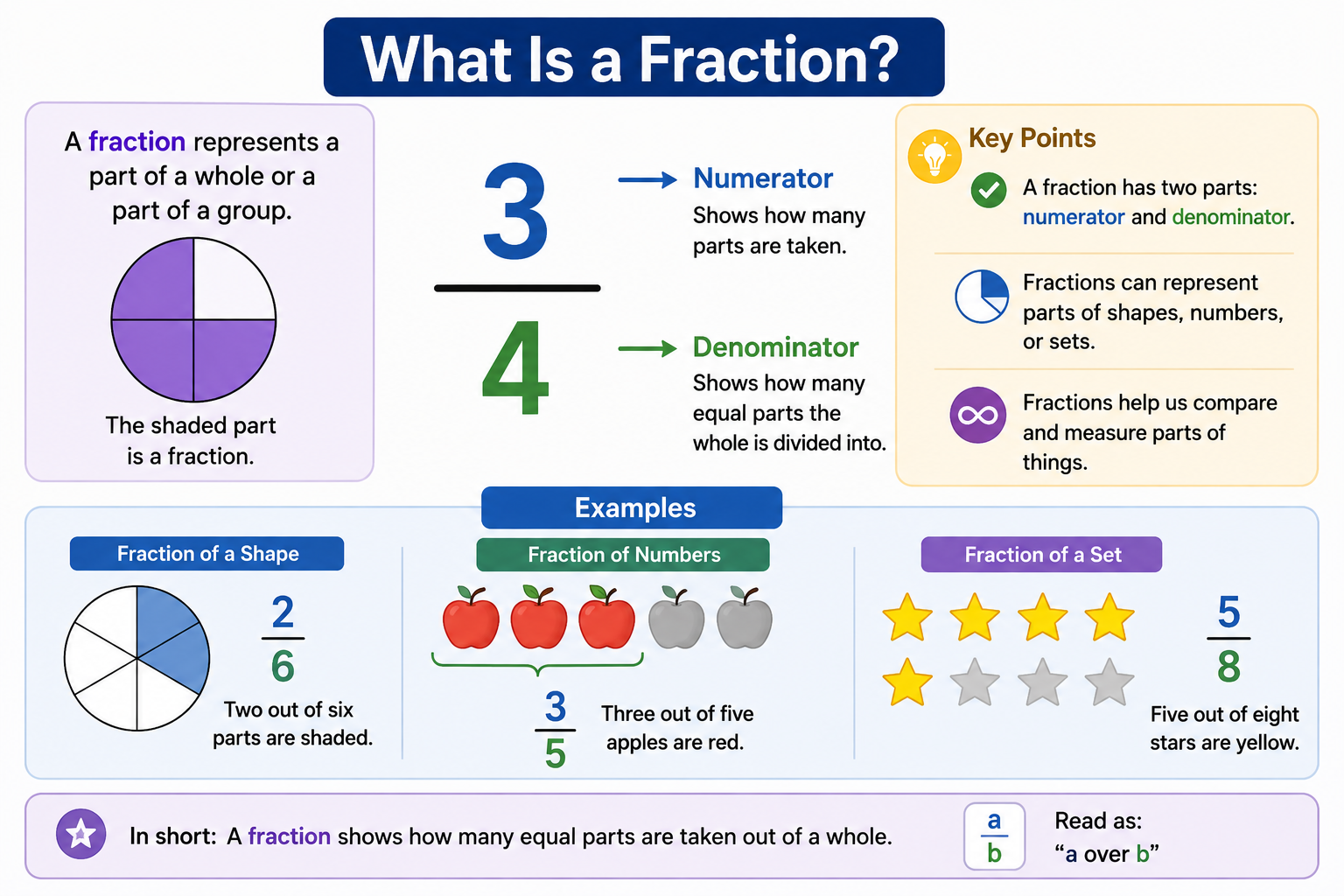
So, what is a fraction? A fraction is a way of representing a part of a whole or a number of equal parts of something. It is written as one number over another, separated by a horizontal line called the fraction bar.
For example, in the fraction 3/4, the number 3 on top is the numerator, and the number 4 on the bottom is the denominator. The denominator tells you how many equal parts the whole has been divided into, and the numerator tells you how many of those parts you are considering.
Fractions are one of the most important and widely used ideas in all of mathematics. They appear in everyday life, science, cooking, finance, measurement, and beyond.
Key Takeaways
-
A fraction represents a part of a whole, written as numerator over denominator.
-
The numerator shows how many parts are being taken; the denominator shows the total number of equal parts.
-
The denominator can never be zero.
-
Fractions come in several types: proper, improper, mixed, unit, like, unlike, and equivalent.
-
Fractions can be added, subtracted, multiplied, and divided using specific rules.
-
Every fraction with an integer numerator and nonzero integer denominator is a rational number.
-
Fractions can be converted to decimals, percentages, and mixed numbers.
What Is a Fraction?
A fraction is a mathematical expression that represents a part of a whole or a ratio of two numbers. It is written in the form a/b, where a is the numerator and b is the denominator, and b must not equal zero.
Consider the fraction 3/5. This means a whole has been divided into 5 equal parts, and you are looking at 3 of them. If you think about a chocolate bar broken into 5 equal pieces, 3/5 represents having 3 of those 5 pieces.
Consider another example: 2/7. Here, the whole has been split into 7 equal parts, and 2 of those parts are being counted.
Why can the denominator never be zero?
Division by zero is undefined in mathematics. If you tried to write 5/0, you would be asking: “How many times does 0 go into 5?” There is no meaningful answer to that question. It is not infinity or any real number — it is simply undefined. This is why the denominator in any fraction must always be a nonzero number.
Parts of a Fraction
Every fraction has three essential components.
| Part | Meaning | Example (using 3/4) |
|---|---|---|
| Numerator | The top number; shows how many parts are taken | 3 |
| Denominator | The bottom number; shows the total number of equal parts | 4 |
| Fraction bar | The line separating the numerator from the denominator; also represents division | — in 3/4 |
The fraction bar is not merely decorative. It directly represents division, so 3/4 can also be read as “3 divided by 4,” which equals 0.75.
How Do Fractions Work?
A fraction communicates information about how a whole is divided. The denominator sets up the equal parts, and the numerator counts them.
- 1/2 means the whole is divided into 2 equal parts and you have 1 of them. Half of anything.
- 1/3 means the whole is divided into 3 equal parts and you have 1. One-third of anything.
- 3/4 means the whole is divided into 4 equal parts and you have 3 of them. Three-quarters.
- 5/8 means the whole is divided into 8 equal parts and you have 5.
It helps to think about fractions visually. If you draw a rectangle and shade 3 out of 4 equal sections, the shaded area shows 3/4. The more sections you shade relative to the total, the larger the fraction.
Types of Fractions
Proper Fractions
A proper fraction has a numerator that is smaller than its denominator. Its value is always between 0 and 1.
Examples: 1/2, 3/5, 7/10, 4/9
These fractions represent less than one whole.
Improper Fractions
An improper fraction has a numerator that is greater than or equal to its denominator. Its value is always 1 or greater.
Examples: 5/3, 9/4, 7/7, 11/6
These fractions represent one whole or more.
Mixed Numbers
A mixed number combines a whole number and a proper fraction.
Examples: 2 1/3 (two and one-third), 3 3/4 (three and three-quarters), 1 5/8
Mixed numbers are simply another way of writing improper fractions. For example, 7/3 = 2 1/3.
Unit Fractions
A unit fraction has a numerator of exactly 1.
Examples: 1/2, 1/3, 1/5, 1/10, 1/100
Unit fractions are the building blocks of all other fractions, since any fraction can be thought of as a multiple of a unit fraction.
Like Fractions
Like fractions have the same denominator.
Examples: 1/5, 2/5, 3/5, 4/5 — all have a denominator of 5.
Like fractions are easy to add and subtract because the denominator does not need to change.
Unlike Fractions
Unlike fractions have different denominators.
Examples: 1/3 and 1/4, or 2/5 and 3/7.
To add or subtract unlike fractions, you must first find a common denominator.
Equivalent Fractions
Equivalent fractions are fractions that look different but represent the same value.
Examples: 1/2 = 2/4 = 4/8 = 50/100
All of these fractions equal exactly one-half.
Proper Fractions vs Improper Fractions vs Mixed Numbers
| Type | Definition | Example | Value |
|---|---|---|---|
| Proper fraction | Numerator is smaller than denominator | 3/5 | Less than 1 |
| Improper fraction | Numerator is greater than or equal to denominator | 7/4 | 1 or greater |
| Mixed number | A whole number combined with a proper fraction | 1 3/4 | Greater than 1 |
Improper fractions and mixed numbers are two different ways of expressing the same value. 7/4 and 1 3/4 mean exactly the same thing.
What Are Equivalent Fractions?
Equivalent fractions represent the same portion of a whole, even though they use different numbers.
The key rule is: multiplying or dividing both the numerator and denominator by the same nonzero number produces an equivalent fraction.
Multiplying to find equivalents:
1/3 × 2/2 = 2/6
1/3 × 3/3 = 3/9
1/3 × 4/4 = 4/12
All of the results — 2/6, 3/9, and 4/12 — are equivalent to 1/3.
Dividing to simplify:
12/16 ÷ 4/4 = 3/4
Dividing both numbers by 4 gives an equivalent but simpler fraction.
Equivalent fractions are essential when comparing, adding, and subtracting fractions with different denominators.
How to Simplify a Fraction
Simplifying (or reducing) a fraction means writing it in its simplest form, where the numerator and denominator share no common factor other than 1.
Step-by-step method:
- Find the Greatest Common Factor (GCF) of the numerator and denominator.
- Divide both the numerator and the denominator by the GCF.
- The result is the simplified fraction.
Example 1: Simplify 8/12.
Factors of 8: 1, 2, 4, 8
Factors of 12: 1, 2, 3, 4, 6, 12
GCF = 4
8 ÷ 4 = 2
12 ÷ 4 = 3
8/12 = 2/3
Example 2: Simplify 15/25.
GCF(15, 25) = 5
15 ÷ 5 = 3
25 ÷ 5 = 5
15/25 = 3/5
Understanding factors is essential for simplifying fractions efficiently. For a complete explanation of factors and how to find them, see our article [What Is a Factor?]
Finding the GCF becomes easier when you know how to identify prime factors. Working with prime factorization — a skill closely tied to understanding [What Is a Prime Number?] — can make simplification of larger fractions much more straightforward.
How to Find Equivalent Fractions
To find equivalent fractions, multiply or divide both numerator and denominator by the same nonzero number.
Examples:
2/3 = 4/6 (multiply by 2/2)
2/3 = 6/9 (multiply by 3/3)
2/3 = 10/15 (multiply by 5/5)
2/3 = 20/30 (multiply by 10/10)
18/24 = 3/4 (divide by 6/6)
The value of the fraction stays the same because you are effectively multiplying or dividing by 1, which does not change any number.
How to Compare Fractions
Knowing which fraction is larger or smaller is a skill that comes up frequently in mathematics.
Same denominators:
Simply compare the numerators. 5/9 is greater than 3/9 because 5 > 3.
Same numerators:
Compare the denominators. A larger denominator means the parts are smaller. 1/4 is less than 1/3 because fourths are smaller than thirds.
Different denominators:
Convert to a common denominator, then compare numerators.
Compare 2/3 and 3/5:
Common denominator = 15
2/3 = 10/15
3/5 = 9/15
Since 10 > 9, we conclude that 2/3 > 3/5.
Cross multiplication:
Multiply the numerator of each fraction by the denominator of the other.
Compare 3/7 and 4/9:
3 × 9 = 27
4 × 7 = 28
Since 27 < 28, we conclude that 3/7 < 4/9.
Decimal conversion:
Convert each fraction to a decimal and compare.
3/7 ≈ 0.4286
4/9 ≈ 0.4444
Confirming that 3/7 < 4/9.
How to Order Fractions
To arrange fractions in order, convert all fractions to equivalent fractions with a common denominator, then sort by numerator.
Example: Order 1/2, 2/3, 1/4, 5/6 from smallest to largest.
Find the LCM of 2, 3, 4, and 6 = 12.
1/2 = 6/12
2/3 = 8/12
1/4 = 3/12
5/6 = 10/12
Order: 3/12, 6/12, 8/12, 10/12
Final answer: 1/4 < 1/2 < 2/3 < 5/6
Largest to smallest: 5/6 > 2/3 > 1/2 > 1/4
Adding Fractions
Adding Fractions With the Same Denominator
When fractions share a denominator, add the numerators and keep the denominator.
1/7 + 3/7 = (1 + 3)/7 = 4/7
3/8 + 2/8 = 5/8
5/9 + 1/9 = 6/9 = 2/3 (simplified)
Adding Fractions With Different Denominators
When denominators differ, you must find a common denominator first — typically the Least Common Multiple of the two denominators.
Example: 1/4 + 1/6
The LCM of 4 and 6 is 12.
1/4 = 3/12
1/6 = 2/12
3/12 + 2/12 = 5/12
Answer: 5/12
Finding the LCM of denominators is a key step in this process. For a thorough explanation of how multiples and the LCM work, see our article [What Is a Multiple?]
Another example: 2/5 + 1/3
LCM of 5 and 3 = 15.
2/5 = 6/15
1/3 = 5/15
6/15 + 5/15 = 11/15
Subtracting Fractions
The method for subtraction mirrors addition exactly.
Same Denominators
Subtract the numerators and keep the denominator.
7/9 − 2/9 = 5/9
5/6 − 1/6 = 4/6 = 2/3
Different Denominators
Find a common denominator first, then subtract.
3/4 − 1/3:
LCM of 4 and 3 = 12.
3/4 = 9/12
1/3 = 4/12
9/12 − 4/12 = 5/12
Subtracting Mixed Numbers
Subtract the whole numbers separately, then subtract the fractions. If the fraction part of the first mixed number is smaller than the fraction part of the second, borrow 1 from the whole number.
Example: 3 1/4 − 1 3/4
Since 1/4 < 3/4, borrow 1 from 3:
3 1/4 = 2 5/4
2 5/4 − 1 3/4 = (2 − 1) + (5/4 − 3/4) = 1 + 2/4 = 1 1/2
Multiplying Fractions
Multiplying fractions is the most straightforward of all fraction operations.
Rule: Multiply numerator by numerator and denominator by denominator.
a/b × c/d = (a × c)/(b × d)
Examples:
2/3 × 4/5 = (2 × 4)/(3 × 5) = 8/15
1/2 × 3/4 = 3/8
3/7 × 7/9 = 21/63 = 1/3 (simplified by dividing by 21)
Tip: You can simplify before multiplying by cancelling common factors across numerators and denominators. This is called cross-cancellation and keeps the numbers smaller.
2/3 × 3/8 = (2 × 3)/(3 × 8)
Cancel the 3s: 2/8 = 1/4
Dividing Fractions
To divide by a fraction, multiply by its reciprocal. The reciprocal of a fraction is found by swapping the numerator and denominator.
Rule: a/b ÷ c/d = a/b × d/c
The phrase “keep, change, flip” is a popular memory aid: keep the first fraction, change division to multiplication, flip the second fraction.
Example: 2/3 ÷ 4/5
Reciprocal of 4/5 is 5/4.
2/3 ÷ 4/5 = 2/3 × 5/4 = (2 × 5)/(3 × 4) = 10/12 = 5/6
Why does this work?
Dividing by a number is equivalent to multiplying by its inverse. The reciprocal of any fraction is its multiplicative inverse — multiplying a fraction by its reciprocal always gives 1. This is the mathematical justification for the rule.
Another example: 3/4 ÷ 3/8
3/4 × 8/3 = (3 × 8)/(4 × 3) = 24/12 = 2
Fractions and Whole Numbers
To multiply a fraction by a whole number, write the whole number as a fraction with denominator 1, then multiply.
3 × 2/5 = 3/1 × 2/5 = 6/5 = 1 1/5
To divide a fraction by a whole number, write the whole number as a fraction with denominator 1, then apply the division rule.
2/3 ÷ 4 = 2/3 ÷ 4/1 = 2/3 × 1/4 = 2/12 = 1/6
Converting Improper Fractions to Mixed Numbers
To convert an improper fraction to a mixed number:
- Divide the numerator by the denominator.
- The quotient becomes the whole number.
- The remainder becomes the new numerator.
- The denominator stays the same.
Example 1: Convert 7/3.
7 ÷ 3 = 2 remainder 1
Answer: 2 1/3
Example 2: Convert 11/4.
11 ÷ 4 = 2 remainder 3
Answer: 2 3/4
Example 3: Convert 17/5.
17 ÷ 5 = 3 remainder 2
Answer: 3 2/5
Converting Mixed Numbers to Improper Fractions
To convert a mixed number to an improper fraction:
- Multiply the whole number by the denominator.
- Add the numerator to the result.
- Place the total over the original denominator.
Example 1: Convert 2 1/3.
(2 × 3) + 1 = 7
Answer: 7/3
Example 2: Convert 3 2/5.
(3 × 5) + 2 = 17
Answer: 17/5
Example 3: Convert 4 3/7.
(4 × 7) + 3 = 31
Answer: 31/7
Converting Fractions to Decimals
To convert a fraction to a decimal, divide the numerator by the denominator.
1/2 = 1 ÷ 2 = 0.5
3/4 = 3 ÷ 4 = 0.75
1/5 = 1 ÷ 5 = 0.2
7/8 = 7 ÷ 8 = 0.875
Repeating decimals:
Some fractions produce decimals that repeat indefinitely.
1/3 = 0.333… = 0.3̄
2/3 = 0.666… = 0.6̄
1/7 = 0.142857142857… = 0.142857̄
These are still rational numbers because they arise from dividing one integer by another.
Converting Decimals to Fractions
To convert a terminating decimal to a fraction:
- Write the decimal as a fraction over the appropriate power of 10.
- Simplify.
0.5 = 5/10 = 1/2
0.75 = 75/100 = 3/4
0.25 = 25/100 = 1/4
0.4 = 4/10 = 2/5
0.125 = 125/1000 = 1/8
Converting Fractions to Percentages
A percentage is a fraction with a denominator of 100. To convert a fraction to a percentage, multiply by 100.
1/2 × 100 = 50%
3/4 × 100 = 75%
1/5 × 100 = 20%
3/8 × 100 = 37.5%
Alternatively, convert to a decimal first, then multiply by 100:
3/8 = 0.375 → 0.375 × 100 = 37.5%
Fractions, Rational Numbers, and Real Numbers
Every fraction in which the numerator and denominator are integers (with a nonzero denominator) is a rational number. This is precisely the definition of a rational number — a number expressible in the form p/q where p and q are integers and q ≠ 0.
For a complete explanation of rational numbers and how they relate to fractions and integers, see our article [What Is a Rational Number?]
Rational numbers themselves are part of the broader real number system, which also includes irrational numbers such as √2 and π. Fractions with integer numerators and denominators are always rational, but not every real number can be expressed as such a fraction.
For a comprehensive overview of the real number system and how rational numbers fit within it, see our article [What Is a Real Number?]
Fractions and Factors
Factors play a central role in working with fractions, particularly when simplifying. Finding the Greatest Common Factor of the numerator and denominator allows you to reduce a fraction to its simplest form in the most efficient way possible.
Without a solid understanding of factors, simplification becomes a slow process of trial and error. With it, you can identify the GCF immediately and reduce the fraction in a single step.
For a thorough grounding in factors, factor pairs, and how to find them, see our article [What Is a Factor?]
Fractions and Multiples
Multiples are equally important when performing fraction operations. Whenever you add or subtract fractions with different denominators, you need to find a common denominator — and that common denominator is always a common multiple of the original denominators.
Knowing how to find the Least Common Multiple quickly means you can always identify the most efficient common denominator without working with unnecessarily large numbers.
For a detailed explanation of multiples and the Least Common Multiple, see our article [What Is a Multiple?]
Fractions on a Number Line
Fractions can be plotted on a number line just like whole numbers. The number line shows clearly how fractions relate to each other and to whole numbers.
To place 1/4, 1/2, and 3/4 on a number line between 0 and 1, divide the segment into 4 equal parts:
0 —- 1/4 —- 1/2 —- 3/4 —- 1
For improper fractions such as 5/4, the position falls beyond 1:
0 —- 1/4 —- 1/2 —- 3/4 —- 1 —- 5/4
The number line representation helps students understand that fractions are real numbers with specific positions and values, not just written expressions.
Fractions Greater Than 1
When the numerator is larger than the denominator, the fraction is greater than 1. These are improper fractions, and they can also be written as mixed numbers.
5/4 = 1 1/4 (one and one-quarter)
7/3 = 2 1/3 (two and one-third)
9/2 = 4 1/2 (four and one-half)
11/5 = 2 1/5 (two and one-fifth)
Improper fractions are not “wrong” or incorrect — they are perfectly valid mathematical expressions and are often more convenient in calculations than mixed numbers.
Fractions Less Than 1
Proper fractions always represent values between 0 and 1. The numerator is always smaller than the denominator, meaning you are describing less than one complete whole.
Examples: 1/4, 2/5, 7/10, 11/20
These fractions appear in everyday situations whenever you are talking about a portion: half a cup, three-quarters of a metre, one-fifth of a price.
Negative Fractions
A fraction can be negative. A negative fraction simply means the value falls below zero on the number line.
−1/2 lies halfway between 0 and −1.
−3/4 lies three-quarters of the way between 0 and −1.
−5/2 = −2 1/2, which lies to the left of −2.
The negative sign can be placed in front of the fraction, in the numerator, or in the denominator:
−3/4 = (−3)/4 = 3/(−4)
All three represent the same value. In standard notation, the negative sign is placed in front of the entire fraction.
Fractions in Everyday Life
Fractions are everywhere in daily life, even when people do not realize they are using them.
- Cooking: Recipes call for 1/2 teaspoon of salt, 3/4 cup of flour, or 2/3 of a cup of sugar. Every measurement in a recipe is a fraction.
- Shopping: A 25% discount is the same as 1/4 off the original price.
- Time: Half an hour is 1/2 of 60 minutes = 30 minutes. A quarter of an hour is 1/4 × 60 = 15 minutes.
- Money: 50 pence is 1/2 of £1. 25 pence is 1/4 of £1.
- Measurements: Carpenters use fractions of inches or centimetres constantly when cutting materials to precise lengths.
- Sharing: Splitting a cost equally among 5 people means each person pays 1/5 of the total.
- Sports statistics: A batsman’s average, a player’s shooting percentage, or a team’s win ratio are all fractions at heart.
- Construction: Architects and engineers use fractional measurements to specify dimensions and tolerances.
Fractions in Physics
Fractions appear regularly in physics whenever quantities are divided, measured in parts of a unit, or expressed as ratios.
A simple example involves speed. If a car travels 3/4 of a kilometre in a certain time period, or if a reaction takes 1/2 of a second, those measurements are fractions of standard units. Dividing distance by time to find speed often produces fractional values rather than whole numbers.
For an introduction to how speed is defined and calculated in physics, see our article [What Is Speed in Physics?] The relationship between distance, time, and speed is a practical setting where fractional arithmetic arises naturally in every calculation.
Fractions in Algebra
Fractions appear throughout algebra whenever variables are placed in numerators or denominators.
Simple algebraic fractions include:
- x/2 — the variable x divided by 2.
- 3x/4 — three times x, divided by 4.
- (x + 2)/5 — the expression (x + 2), divided by 5.
These are handled using the same principles as numerical fractions. To add x/3 + x/4, for example, you still need a common denominator of 12:
x/3 + x/4 = 4x/12 + 3x/12 = 7x/12
Algebraic fractions are an important topic in higher-level secondary mathematics and build directly on a solid understanding of numerical fraction operations.
Common Fraction Mistakes
Mistake 1: The denominator can be zero.
It cannot. Division by zero is undefined in mathematics. A fraction with a zero denominator has no valid meaning.
Mistake 2: A larger denominator always means a larger fraction.
The opposite is often true. 1/10 is much smaller than 1/2, even though 10 > 2. A larger denominator means the whole is divided into more parts, so each part is smaller.
Mistake 3: You can add numerators and denominators directly.
You cannot. 1/2 + 1/3 does not equal 2/5. You must find a common denominator first: 1/2 + 1/3 = 3/6 + 2/6 = 5/6.
Mistake 4: 1/2 is larger than 3/4.
It is not. 3/4 = 0.75 and 1/2 = 0.5. So 3/4 > 1/2.
Mistake 5: Improper fractions are incorrect or invalid.
Improper fractions are perfectly correct mathematical expressions. They are used extensively in algebra and calculation.
Mistake 6: Mixed numbers and improper fractions represent different values.
They represent exactly the same value, just written in different forms.
Mistake 7: Every decimal is a fraction.
Irrational numbers such as π and √2 are decimals that never terminate or repeat, and they cannot be written as exact fractions with integer numerator and denominator.
Mistake 8: Every fraction is an integer.
Most fractions are not integers. Only fractions where the numerator is exactly divisible by the denominator (such as 6/2 = 3) produce integers.
Mistake 9: Fractions and rational numbers are unrelated.
All fractions with integer numerators and nonzero integer denominators are rational numbers, by definition.
Mistake 10: A fraction cannot be negative.
Fractions can be negative. Any negative numerator or negative denominator (not both) produces a negative fraction.
Fraction Rules Cheat Sheet
| Operation | Rule | Example |
|---|---|---|
| Addition (same denominator) | Add numerators; keep denominator | 3/8 + 2/8 = 5/8 |
| Addition (different denominators) | Find LCM; convert; add numerators | 1/4 + 1/6 = 3/12 + 2/12 = 5/12 |
| Subtraction (same denominator) | Subtract numerators; keep denominator | 5/7 − 2/7 = 3/7 |
| Subtraction (different denominators) | Find LCM; convert; subtract numerators | 3/4 − 1/3 = 9/12 − 4/12 = 5/12 |
| Multiplication | Multiply numerator × numerator; denominator × denominator | 2/3 × 3/5 = 6/15 = 2/5 |
| Division | Multiply by the reciprocal of the second fraction | 2/3 ÷ 4/5 = 2/3 × 5/4 = 10/12 = 5/6 |
| Simplification | Divide both parts by their GCF | 8/12 ÷ 4 = 2/3 |
| Fraction to decimal | Divide numerator by denominator | 3/4 = 0.75 |
| Decimal to fraction | Write over power of 10; simplify | 0.6 = 6/10 = 3/5 |
| Fraction to percentage | Multiply by 100 | 3/5 × 100 = 60% |
Worked Fraction Examples
Example 1: Identify the numerator and denominator of 7/11.
Given: 7/11
Numerator = 7, Denominator = 11
Answer: Numerator is 7; denominator is 11.
Example 2: Simplify 18/24.
GCF(18, 24) = 6
18 ÷ 6 = 3; 24 ÷ 6 = 4
Answer: 3/4
Example 3: Find an equivalent fraction for 3/5 with denominator 20.
3/5 × 4/4 = 12/20
Answer: 12/20
Example 4: Compare 4/7 and 5/9.
Cross multiply: 4 × 9 = 36; 5 × 7 = 35
Since 36 > 35: 4/7 > 5/9
Answer: 4/7 is greater.
Example 5: Order 1/3, 3/4, 1/6, 2/3 from smallest to largest.
LCM of 3, 4, 6 = 12
1/3 = 4/12; 3/4 = 9/12; 1/6 = 2/12; 2/3 = 8/12
Order: 2/12, 4/12, 8/12, 9/12
Answer: 1/6 < 1/3 < 2/3 < 3/4
Example 6: Add 2/5 + 3/10.
LCM of 5 and 10 = 10
2/5 = 4/10
4/10 + 3/10 = 7/10
Answer: 7/10
Example 7: Subtract 5/6 − 1/4.
LCM of 6 and 4 = 12
5/6 = 10/12; 1/4 = 3/12
10/12 − 3/12 = 7/12
Answer: 7/12
Example 8: Multiply 3/4 × 8/9.
Cross-cancel: 3 and 9 share factor 3; 8 and 4 share factor 4.
(3/4 × 8/9) → (1/1 × 2/3) = 2/3
Answer: 2/3
Example 9: Divide 5/6 ÷ 5/12.
5/6 × 12/5 = (5 × 12)/(6 × 5) = 60/30 = 2
Answer: 2
Example 10: Convert 13/4 to a mixed number.
13 ÷ 4 = 3 remainder 1
Answer: 3 1/4
Example 11: Convert 2 4/5 to an improper fraction.
(2 × 5) + 4 = 14
Answer: 14/5
Example 12: Convert 5/8 to a decimal.
5 ÷ 8 = 0.625
Answer: 0.625
Example 13: Convert 0.35 to a fraction.
0.35 = 35/100 = 7/20 (GCF = 5)
Answer: 7/20
Example 14: Convert 7/20 to a percentage.
7/20 × 100 = 35
Answer: 35%
Example 15: Find 3/4 of 60.
3/4 × 60 = (3 × 60)/4 = 180/4 = 45
Answer: 45
Fraction Practice Questions
20 Multiple Choice Questions
Question 1: Which of the following is a proper fraction?
A) 7/3 B) 5/5 C) 3/7 D) 9/4
Correct Answer: C
Explanation: A proper fraction has a numerator smaller than its denominator. 3 < 7, so 3/7 is proper.
Question 2: What is the simplified form of 20/36?
A) 10/18 B) 4/9 C) 5/9 D) 2/4
Correct Answer: C
Explanation: GCF(20, 36) = 4. 20 ÷ 4 = 5; 36 ÷ 4 = 9. Simplified form = 5/9.
Question 3: Which fraction is equivalent to 3/4?
A) 6/10 B) 9/12 C) 3/8 D) 12/20
Correct Answer: B
Explanation: 3/4 × 3/3 = 9/12. Confirmed: 9 ÷ 12 = 0.75 = 3/4.
Question 4: What is 2/3 + 3/4?
A) 5/7 B) 17/12 C) 5/12 D) 1
Correct Answer: B
Explanation: LCM(3,4) = 12. 2/3 = 8/12; 3/4 = 9/12. Sum = 17/12.
Question 5: What is 5/6 − 1/4?
A) 4/2 B) 7/12 C) 4/6 D) 1/2
Correct Answer: B
Explanation: LCM(6,4) = 12. 5/6 = 10/12; 1/4 = 3/12. Difference = 7/12.
Question 6: What is 3/5 × 10/9?
A) 30/45 B) 2/3 C) 6/9 D) 1/3
Correct Answer: B
Explanation: 3/5 × 10/9 = 30/45 = 2/3 (simplify by dividing by 15).
Question 7: What is 4/7 ÷ 2/3?
A) 8/21 B) 6/7 C) 12/14 D) 2/7
Correct Answer: B
Explanation: 4/7 × 3/2 = 12/14 = 6/7.
Question 8: Convert 19/6 to a mixed number.
A) 3 1/6 B) 3 2/6 C) 2 7/6 D) 3 1/3
Correct Answer: A
Explanation: 19 ÷ 6 = 3 remainder 1. Answer: 3 1/6.
Question 9: Convert 4 3/8 to an improper fraction.
A) 35/8 B) 32/8 C) 43/8 D) 19/4
Correct Answer: A
Explanation: (4 × 8) + 3 = 35. Answer: 35/8.
Question 10: What is 3/4 as a percentage?
A) 34% B) 70% C) 75% D) 80%
Correct Answer: C
Explanation: 3/4 × 100 = 75%.
Question 11: Which fraction is the largest?
A) 3/8 B) 1/2 C) 5/12 D) 7/24
Correct Answer: B
Explanation: Convert to 24ths: 3/8 = 9/24; 1/2 = 12/24; 5/12 = 10/24; 7/24. Largest is 12/24 = 1/2.
Question 12: What is 0.625 as a fraction in simplest form?
A) 6/10 B) 5/8 C) 625/100 D) 3/4
Correct Answer: B
Explanation: 0.625 = 625/1000. GCF = 125. 625/1000 = 5/8.
Question 13: Which of these fractions is equivalent to 2/7?
A) 4/14 B) 6/21 C) 8/28 D) All of the above
Correct Answer: D
Explanation: 2/7 × 2/2 = 4/14; × 3/3 = 6/21; × 4/4 = 8/28. All are equivalent.
Question 14: What is 1/3 of 90?
A) 45 B) 30 C) 60 D) 3
Correct Answer: B
Explanation: 1/3 × 90 = 90/3 = 30.
Question 15: Which fraction is between 1/3 and 1/2?
A) 1/4 B) 2/5 C) 3/7 D) Both B and C
Correct Answer: D
Explanation: 1/3 ≈ 0.333; 2/5 = 0.4; 3/7 ≈ 0.429; 1/2 = 0.5. Both 2/5 and 3/7 lie between 1/3 and 1/2.
Question 16: What is 7/8 as a decimal?
A) 0.78 B) 0.875 C) 0.87 D) 0.088
Correct Answer: B
Explanation: 7 ÷ 8 = 0.875.
Question 17: Which pair represents equivalent fractions?
A) 3/5 and 4/7 B) 2/3 and 6/9 C) 5/8 and 10/18 D) 4/9 and 8/15
Correct Answer: B
Explanation: 2/3 × 3/3 = 6/9. These are equivalent.
Question 18: What is the denominator in the fraction 5/12?
A) 5 B) 17 C) 12 D) 60
Correct Answer: C
Explanation: The denominator is the bottom number, which is 12.
Question 19: A recipe requires 2/3 cup of milk. If you want to make 3 times the recipe, how much milk do you need?
A) 2 cups B) 1 cup C) 6/9 cups D) 2/3 cups
Correct Answer: A
Explanation: 2/3 × 3 = 6/3 = 2 cups.
Question 20: Which statement about improper fractions is true?
A) They are always greater than 2 B) They are mathematically incorrect C) Their numerator is greater than or equal to the denominator D) They cannot be converted to mixed numbers
Correct Answer: C
Explanation: An improper fraction has a numerator ≥ denominator. It is valid and can be converted to a mixed number.
10 Short Answer Questions
Q1: What is the numerator of the fraction 9/13?
Answer: 9
Q2: Simplify 24/36.
Answer: GCF(24, 36) = 12. 24 ÷ 12 = 2; 36 ÷ 12 = 3. Answer: 2/3.
Q3: Write two fractions equivalent to 5/6.
Answer: 10/12 (multiply by 2/2) and 15/18 (multiply by 3/3).
Q4: Convert 0.4 to a fraction.
Answer: 0.4 = 4/10 = 2/5.
Q5: What is 3/8 as a percentage?
Answer: 3/8 × 100 = 37.5%.
Q6: Convert 3 5/9 to an improper fraction.
Answer: (3 × 9) + 5 = 32. Answer: 32/9.
Q7: Is 5/5 a proper fraction, improper fraction, or mixed number?
Answer: Improper fraction (numerator equals denominator; value = 1).
Q8: What is 1/4 + 3/8?
Answer: LCM(4, 8) = 8. 1/4 = 2/8. 2/8 + 3/8 = 5/8.
Q9: Compare 5/9 and 7/12. Which is larger?
Answer: LCM(9, 12) = 36. 5/9 = 20/36; 7/12 = 21/36. Since 21 > 20, 7/12 is larger.
Q10: What is 2/3 ÷ 1/6?
Answer: 2/3 × 6/1 = 12/3 = 4.
10 Fraction Simplification Questions
1. 6/18
GCF = 6. 6/18 = 1/3
2. 14/21
GCF = 7. 14/21 = 2/3
3. 20/30
GCF = 10. 20/30 = 2/3
4. 16/40
GCF = 8. 16/40 = 2/5
5. 45/60
GCF = 15. 45/60 = 3/4
6. 36/48
GCF = 12. 36/48 = 3/4
7. 25/75
GCF = 25. 25/75 = 1/3
8. 56/70
GCF = 14. 56/70 = 4/5
9. 18/54
GCF = 18. 18/54 = 1/3
10. 42/56
GCF = 14. 42/56 = 3/4
10 Fraction Operation Problems
1. 1/3 + 2/9
LCM = 9. 1/3 = 3/9. 3/9 + 2/9 = 5/9
2. 7/10 − 2/5
LCM = 10. 2/5 = 4/10. 7/10 − 4/10 = 3/10
3. 4/5 × 3/8
4/5 × 3/8 = 12/40 = 3/10
4. 9/10 ÷ 3/5
9/10 × 5/3 = 45/30 = 3/2 or 1 1/2
5. 2 1/4 + 1 3/4
= 9/4 + 7/4 = 16/4 = 4
6. 3 1/2 − 1 2/3
Convert: 7/2 − 5/3. LCM = 6. 21/6 − 10/6 = 11/6 = 1 5/6
7. 5/6 × 12/25
Cross-cancel: 5 and 25 → 1 and 5; 12 and 6 → 2 and 1.
1/1 × 2/5 = 2/5
8. 3/7 ÷ 9/14
3/7 × 14/9 = 42/63 = 2/3
9. 1/4 + 2/3 + 1/6
LCM = 12. 3/12 + 8/12 + 2/12 = 13/12 = 1 1/12
10. 4 − 2/5
4 = 20/5. 20/5 − 2/5 = 18/5 = 3 3/5
5 Word Problems
Problem 1 (Food):
A cake is cut into 8 equal slices. Anna eats 3 slices and Ben eats 2 slices. What fraction of the cake is left?
Total eaten: 3/8 + 2/8 = 5/8
Remaining: 1 − 5/8 = 3/8
Answer: 3/8 of the cake is left.
Problem 2 (Money):
A jacket costs £120. It is on sale at 1/4 off the original price. How much does it cost after the discount?
Discount: 1/4 × 120 = £30
Sale price: 120 − 30 = £90
Problem 3 (Measurements):
A piece of rope is 7/8 of a metre long. A second piece is 3/4 of a metre. What is their total length?
LCM(8, 4) = 8
3/4 = 6/8
7/8 + 6/8 = 13/8 = 1 5/8 metres
Problem 4 (Time):
Sarah spent 3/4 of an hour on mathematics homework and 1/3 of an hour on English. How much total time did she spend?
LCM(4, 3) = 12
3/4 = 9/12; 1/3 = 4/12
9/12 + 4/12 = 13/12 hours = 1 1/12 hours = 1 hour and 5 minutes
Problem 5 (Sharing):
A bag contains 60 sweets. James takes 2/5 of the bag and his sister takes 1/4 of the bag. How many sweets are left?
James: 2/5 × 60 = 24
Sister: 1/4 × 60 = 15
Taken: 24 + 15 = 39
Remaining: 60 − 39 = 21 sweets
Exam Tips
- Always check the denominator before doing anything. If denominators match, the calculation is straightforward. If they do not, find the common denominator before adding or subtracting.
- Simplify your final answer. Examiners expect fractions in their simplest form unless told otherwise.
- Convert mixed numbers to improper fractions before multiplying or dividing. Working with improper fractions avoids errors.
- Use your knowledge of factors when simplifying. Finding the GCF immediately means you only need one step, not several.
- Use your knowledge of multiples when finding common denominators. The LCM of the two denominators gives the most efficient common denominator.
- Cross-cancel before multiplying. This keeps numbers smaller and reduces the need to simplify at the end.
- Always check whether your answer looks reasonable. If you added two positive proper fractions and got more than 2, something went wrong.
- When dividing fractions, flip the second fraction only. Never flip the first fraction.
Quick Revision Notes
- Fraction: A number expressed as numerator over denominator, representing parts of a whole.
- Numerator: The top number; counts the parts being considered.
- Denominator: The bottom number; shows how many equal parts make the whole. Cannot be zero.
- Types: Proper (less than 1), improper (1 or more), mixed (whole + fraction), unit (numerator = 1), like (same denominator), unlike (different denominators), equivalent (same value).
- Equivalent fractions: Multiply or divide both parts by the same nonzero number.
- Simplifying: Divide both parts by their GCF.
- Comparing: Convert to a common denominator or use cross multiplication.
- Adding/subtracting: Needs a common denominator. Add/subtract numerators only.
- Multiplying: Numerator × numerator; denominator × denominator.
- Dividing: Multiply by the reciprocal of the second fraction.
- Decimal conversion: Divide numerator by denominator.
- Percentage conversion: Multiply the fraction by 100.
- Number line: Fractions have fixed positions between and beyond whole numbers.
Fraction Cheat Sheet
| Concept | Definition | Example |
|---|---|---|
| Proper fraction | Numerator is less than denominator | 3/5 |
| Improper fraction | Numerator is greater than or equal to denominator | 7/4 |
| Mixed number | A whole number combined with a proper fraction | 1 3/4 |
| Equivalent fraction | A fraction equal in value to another | 1/2 = 2/4 |
| Like fractions | Fractions with the same denominator | 2/7 and 5/7 |
| Unlike fractions | Fractions with different denominators | 1/3 and 1/4 |
| Unit fraction | A fraction with numerator 1 | 1/5 |
| Numerator | Top number of a fraction | 3 in 3/7 |
| Denominator | Bottom number of a fraction; never zero | 7 in 3/7 |
Frequently Asked Questions
1. What is a fraction?
A fraction represents a part of a whole or a ratio of two numbers. It is written as a numerator over a denominator, such as 3/4.
2. What are the parts of a fraction?
A fraction has three parts: the numerator (top number), the denominator (bottom number), and the fraction bar separating them.
3. What is a numerator?
The numerator is the top number in a fraction. It tells you how many equal parts are being counted.
4. What is a denominator?
The denominator is the bottom number in a fraction. It tells you how many equal parts the whole has been divided into. It cannot equal zero.
5. What are the different types of fractions?
The main types are proper fractions, improper fractions, mixed numbers, unit fractions, like fractions, unlike fractions, and equivalent fractions.
6. What is a proper fraction?
A proper fraction has a numerator smaller than its denominator, so its value is between 0 and 1. Examples: 2/5, 7/10.
7. What is an improper fraction?
An improper fraction has a numerator greater than or equal to its denominator. Its value is 1 or greater. Examples: 9/4, 5/5.
8. What is a mixed number?
A mixed number is a combination of a whole number and a proper fraction. Example: 2 3/4.
9. How do you simplify a fraction?
Find the Greatest Common Factor of the numerator and denominator, then divide both by it. For example, 12/16 → GCF = 4 → 3/4.
10. How do you find equivalent fractions?
Multiply or divide both the numerator and the denominator by the same nonzero number. For example, 2/3 = 4/6 = 8/12.
11. How do you add fractions?
If denominators are the same, add the numerators. If different, find the LCM of the denominators, convert each fraction, then add the numerators.
12. How do you multiply fractions?
Multiply numerator by numerator and denominator by denominator. Simplify if possible.
13. How do you divide fractions?
Multiply the first fraction by the reciprocal of the second. For example, 2/3 ÷ 4/5 = 2/3 × 5/4 = 10/12 = 5/6.
14. Are fractions rational numbers?
Yes. Every fraction with an integer numerator and a nonzero integer denominator is a rational number by definition.
15. Can a fraction have zero as its denominator?
No. Division by zero is undefined in mathematics, so a fraction with a zero denominator has no valid meaning.
Summary
A fraction is a fundamental mathematical concept that represents a part of a whole. Every fraction has a numerator, which counts the parts being considered, and a denominator, which tells you how many equal parts make up the whole. The denominator can never be zero.
Fractions come in several types — proper, improper, mixed, unit, like, unlike, and equivalent — each serving a different purpose. They can be simplified using common factors, compared using common denominators, and combined through the operations of addition, subtraction, multiplication, and division. They connect directly to decimals, percentages, rational numbers, and algebra.
Final Thoughts
What is a fraction? It is one of the most useful and practical ideas in all of mathematics. Fractions let you describe parts of things, compare quantities, share resources equally, and perform calculations with precision that whole numbers alone cannot provide.
From the simplest real-life situations — splitting a pizza, reading a recipe, or calculating a discount — to more complex work with algebra, physics, and advanced mathematics, fractions are absolutely indispensable. Mastering them thoroughly means understanding their types, knowing how to perform every operation accurately, and recognizing how they connect to other fundamental concepts. Build that understanding now, and fractions will serve you confidently across every stage of your mathematical education.
References
- Khan Academy — Fractions: https://www.khanacademy.org
- Wolfram MathWorld — Fraction: https://mathworld.wolfram.com/Fraction.html
- OpenStax — Prealgebra, Fractions: https://openstax.org
- Mathematics LibreTexts — Fractions and Operations: https://math.libretexts.org
- Encyclopaedia Britannica — Fraction: https://www.britannica.com
Disclaimer:
This article is intended for educational and informational purposes only. While LearnMinto strives to provide accurate and up-to-date mathematics information, readers should verify important academic concepts through official textbooks, educational institutions, examination boards, or trusted educational resources before using this content for exams or academic purposes. LearnMinto is not affiliated with any specific school, university, research institution, or examination board.