
Introduction
Look at the number 4,582. It has four digits: 4, 5, 8, and 2. But here is the important question — are all of these digits worth the same amount? Not at all. The digit 4 is worth four thousand, while the digit 2 is only worth two. Why? Because of where each digit sits inside the number.
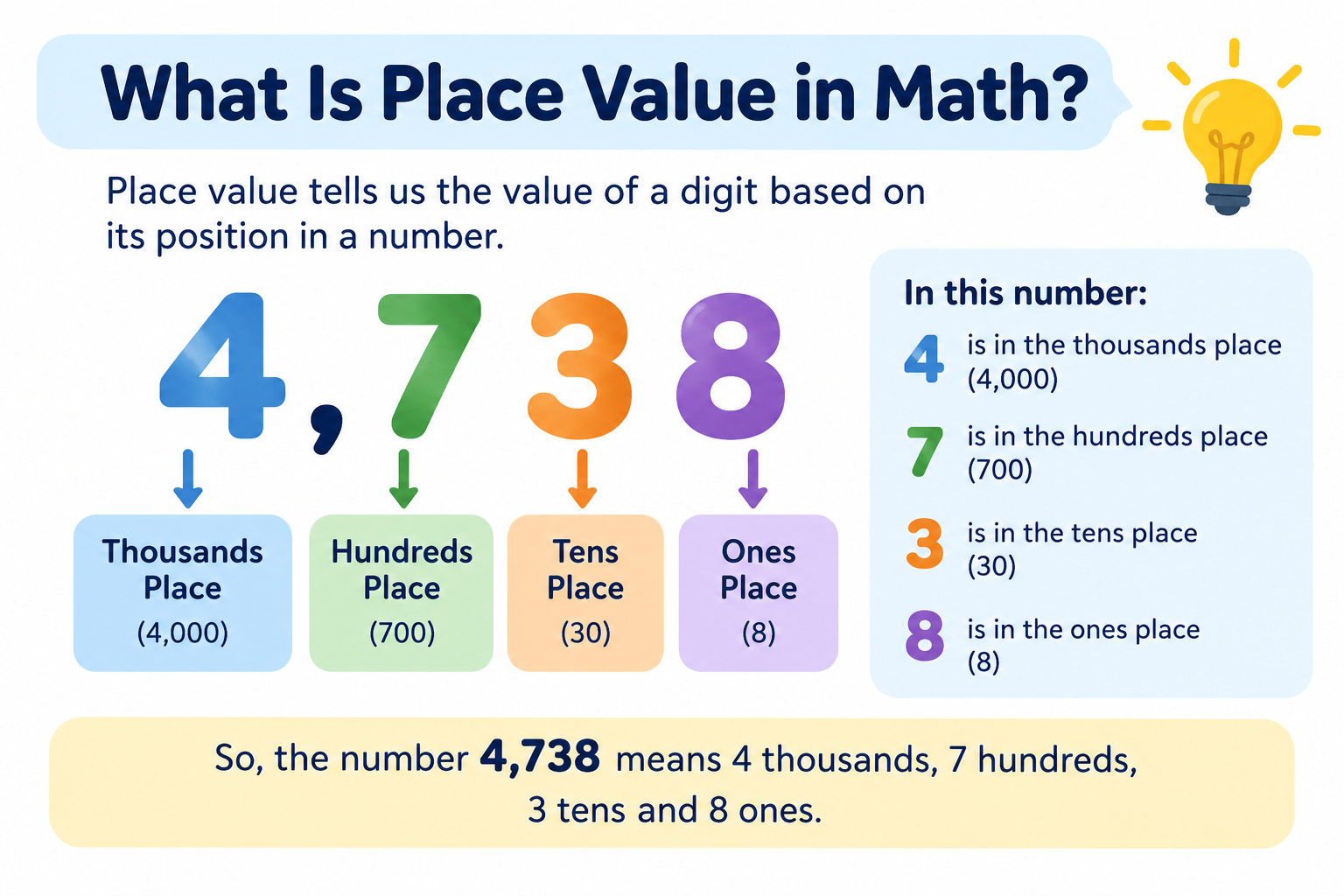
What is place value in math? Place value is the value that a digit has based on its position in a number. It tells us exactly how much each digit is worth — not just what the digit looks like, but where it stands.
Place value is one of the most foundational ideas in mathematics. Once you understand it, reading large numbers, writing numbers in different forms, comparing values, rounding, and working with decimals all become much easier. Every major area of arithmetic builds on this concept.
Key Takeaways
-
Place value tells you the value of a digit based on its position in a number.
-
The same digit can have completely different values depending on where it appears.
-
Digits to the left represent larger values; digits to the right represent smaller values.
-
Zero acts as a placeholder and is essential for keeping other digits in their correct positions.
-
Decimal place value extends to the right of the decimal point into tenths, hundredths, thousandths, and beyond.
-
Expanded form uses place value to break a number into the sum of its parts.
-
Place value is used in comparing, ordering, rounding, adding, subtracting, multiplying, and dividing numbers.
What Is Place Value in Math?
Before diving into examples, it helps to understand a few key terms clearly.
Digit: A digit is any single symbol from 0 to 9. There are exactly ten digits in our number system: 0, 1, 2, 3, 4, 5, 6, 7, 8, and 9.
Number: A number is made up of one or more digits. For example, 25 is a number made from the digits 2 and 5.
Place: A place is the position a digit occupies within a number, such as the ones place, tens place, or hundreds place.
Place value: The place value of a digit is the actual value it represents because of its position. In the number 5,246:
- The digit 5 is in the thousands place. Its place value is 5,000.
- The digit 2 is in the hundreds place. Its place value is 200.
- The digit 4 is in the tens place. Its place value is 40.
- The digit 6 is in the ones place. Its place value is 6.
The total: 5,000 + 200 + 40 + 6 = 5,246. Place value allows us to understand exactly what each digit contributes to the whole number.
Place Value Chart
A place value chart is a simple tool that organises digit positions from right to left, starting at the ones place and moving to larger values.
| Place | Millions | Hundred Thousands | Ten Thousands | Thousands | Hundreds | Tens | Ones |
|---|---|---|---|---|---|---|---|
| Example Number | 3 | 7 | 2 | 5 | 4 | 1 | 8 |
Using the number 3,725,418:
| Digit | Place | Place Value |
|---|---|---|
| 3 | Millions | 3,000,000 |
| 7 | Hundred Thousands | 700,000 |
| 2 | Ten Thousands | 20,000 |
| 5 | Thousands | 5,000 |
| 4 | Hundreds | 400 |
| 1 | Tens | 10 |
| 8 | Ones | 8 |
Each position is exactly ten times larger than the position to its right. That is why moving one place to the left multiplies the value by 10.
Place Value Examples
Here are examples using a range of numbers to show how place value works.
25
- 2 is in the tens place → value is 20
- 5 is in the ones place → value is 5
407
- 4 is in the hundreds place → value is 400
- 0 is in the tens place → value is 0
- 7 is in the ones place → value is 7
1,234
- 1 is in the thousands place → value is 1,000
- 2 is in the hundreds place → value is 200
- 3 is in the tens place → value is 30
- 4 is in the ones place → value is 4
5,678
- 5 → thousands → 5,000
- 6 → hundreds → 600
- 7 → tens → 70
- 8 → ones → 8
10,205
- 1 → ten thousands → 10,000
- 0 → thousands → 0
- 2 → hundreds → 200
- 0 → tens → 0
- 5 → ones → 5
45,321
- 4 → ten thousands → 40,000
- 5 → thousands → 5,000
- 3 → hundreds → 300
- 2 → tens → 20
- 1 → ones → 1
100,500
- 1 → hundred thousands → 100,000
- 0 → ten thousands → 0
- 0 → thousands → 0
- 5 → hundreds → 500
- 0 → tens → 0
- 0 → ones → 0
725,416
- 7 → hundred thousands → 700,000
- 2 → ten thousands → 20,000
- 5 → thousands → 5,000
- 4 → hundreds → 400
- 1 → tens → 10
- 6 → ones → 6
1,000,001
- 1 → millions → 1,000,000
- 0 → hundred thousands → 0
- 0 → ten thousands → 0
- 0 → thousands → 0
- 0 → hundreds → 0
- 0 → tens → 0
- 1 → ones → 1
Additional quick examples:
- In 63, the digit 6 has a place value of 60.
- In 900, the digit 9 has a place value of 900.
- In 4,050, the digit 4 has a place value of 4,000.
- In 82,700, the digit 8 has a place value of 80,000.
- In 500,000, the digit 5 has a place value of 500,000.
- In 999, each 9 has a different place value: 900, 90, and 9.
Face Value vs Place Value
Students sometimes confuse these two terms, so it is worth being clear.
Face value is simply the digit itself — what it looks like, regardless of position.
Place value is what that digit is actually worth in a specific number, based on its position.
In the number 5,432:
- The face value of 5 is simply 5.
- The place value of 5 is 5,000 (because it sits in the thousands place).
| Digit | Number | Face Value | Place Value |
|---|---|---|---|
| 5 | 5,432 | 5 | 5,000 |
| 4 | 5,432 | 4 | 400 |
| 3 | 5,432 | 3 | 30 |
| 2 | 5,432 | 2 | 2 |
| 7 | 7,205 | 7 | 7,000 |
| 2 | 7,205 | 2 | 200 |
| 0 | 7,205 | 0 | 0 |
| 5 | 7,205 | 5 | 5 |
The face value of a digit never changes. The place value depends entirely on position.
Place Value of Digits in Whole Numbers
To find the place value of any digit in a whole number, follow these steps:
- Write out the number.
- Start from the rightmost digit — that is always the ones place.
- Move left: tens, hundreds, thousands, and so on.
- Multiply the digit by its place.
Example: 3,847
- 7 → ones → 7 × 1 = 7
- 4 → tens → 4 × 10 = 40
- 8 → hundreds → 8 × 100 = 800
- 3 → thousands → 3 × 1,000 = 3,000
Example: 62,109
- 9 → ones → 9
- 0 → tens → 0
- 1 → hundreds → 100
- 2 → thousands → 2,000
- 6 → ten thousands → 60,000
Ones, Tens, Hundreds, and Thousands
Ones Place
The ones place is the rightmost position in a whole number. It holds a value from 0 to 9.
In the number 7, the digit 7 is in the ones place. Its value is simply 7.
In the number 34, the digit 4 is in the ones place with a value of 4.
Tens Place
The tens place is one position to the left of the ones place. A digit here is multiplied by 10.
In 56, the digit 5 is in the tens place. Its value is 5 × 10 = 50.
In 83, the digit 8 has a value of 8 × 10 = 80.
Hundreds Place
The hundreds place is two positions from the right. A digit here is multiplied by 100.
In 347, the digit 3 is in the hundreds place. Its value is 3 × 100 = 300.
Thousands Place
The thousands place is three positions from the right. A digit here is multiplied by 1,000.
In 2,500, the digit 2 is in the thousands place. Its value is 2 × 1,000 = 2,000.
Place Value With Larger Numbers
As numbers get bigger, new place positions appear to the left.
| Place | Value |
|---|---|
| Ones | 1 |
| Tens | 10 |
| Hundreds | 100 |
| Thousands | 1,000 |
| Ten Thousands | 10,000 |
| Hundred Thousands | 100,000 |
| Millions | 1,000,000 |
| Ten Millions | 10,000,000 |
| Hundred Millions | 100,000,000 |
Example: 47,836,290
| Digit | Place | Place Value |
|---|---|---|
| 4 | Ten Millions | 40,000,000 |
| 7 | Millions | 7,000,000 |
| 8 | Hundred Thousands | 800,000 |
| 3 | Ten Thousands | 30,000 |
| 6 | Thousands | 6,000 |
| 2 | Hundreds | 200 |
| 9 | Tens | 90 |
| 0 | Ones | 0 |
Place Value With Zeros
Zero is often called a placeholder. It keeps other digits in their correct positions without adding any value of its own.
Compare these numbers:
| Number | What zero does |
|---|---|
| 305 | Zero holds the tens place; without it, 35 would mean something very different. |
| 3,005 | Zero holds both the hundreds and tens places. |
| 30,005 | Zero holds the thousands and hundreds places. |
| 300,005 | Zero holds the ten thousands, thousands, and hundreds places. |
If you removed the zero from 305 and wrote 35, the value drops from three hundred and five to thirty-five. The zero is doing important work even though its own place value is 0.
Place Value in Decimals
Place value extends to the right of the decimal point as well. As you move right, each position becomes ten times smaller.
| Place | Value |
|---|---|
| Ones | 1 |
| Tenths | 1/10 = 0.1 |
| Hundredths | 1/100 = 0.01 |
| Thousandths | 1/1,000 = 0.001 |
| Ten-thousandths | 1/10,000 = 0.0001 |
Example: 0.5
- 5 is in the tenths place → value is 0.5
Example: 0.25
- 2 is in the tenths place → value is 0.2
- 5 is in the hundredths place → value is 0.05
Example: 3.407
- 3 is in the ones place → value is 3
- 4 is in the tenths place → value is 0.4
- 0 is in the hundredths place → value is 0
- 7 is in the thousandths place → value is 0.007
Example: 12.056
- 1 is in the tens place → value is 10
- 2 is in the ones place → value is 2
- 0 is in the tenths place → value is 0
- 5 is in the hundredths place → value is 0.05
- 6 is in the thousandths place → value is 0.006
Understanding decimal place value is essential when working with What Is a Fraction? and later with percentages and ratios.
Whole Number Place Value vs Decimal Place Value
The decimal point acts as the dividing line between whole number places and decimal places.
| Whole Number Side | Decimal Point | Decimal Side |
|---|---|---|
| Ones | . | Tenths |
| Tens | . | Hundredths |
| Hundreds | . | Thousandths |
| Thousands | . | Ten-thousandths |
Notice the pattern: ones and tenths sit closest to the decimal point on each side. There is no “oneths” — the decimal side starts immediately with tenths.
| Place | Direction from Decimal Point | Example Value |
|---|---|---|
| Ones | 1 left | 1 |
| Tens | 2 left | 10 |
| Hundreds | 3 left | 100 |
| Tenths | 1 right | 0.1 |
| Hundredths | 2 right | 0.01 |
| Thousandths | 3 right | 0.001 |
Expanded Form and Place Value
Expanded form means writing a number as a sum of the place values of all its digits. It is a direct application of place value.
4,582 = 4,000 + 500 + 80 + 2
More examples:
- 25 = 20 + 5
- 307 = 300 + 0 + 7 = 300 + 7
- 1,234 = 1,000 + 200 + 30 + 4
- 5,060 = 5,000 + 0 + 60 + 0 = 5,000 + 60
- 45,321 = 40,000 + 5,000 + 300 + 20 + 1
- 100,500 = 100,000 + 0 + 0 + 500 + 0 + 0 = 100,000 + 500
- 3.407 = 3 + 0.4 + 0 + 0.007 = 3 + 0.4 + 0.007
- 12.056 = 10 + 2 + 0 + 0.05 + 0.006 = 10 + 2 + 0.05 + 0.006
Expanded form is closely connected to What Is an Algebraic Expression? because it teaches students to break expressions into their parts.
Standard Form and Place Value
Standard form is simply the normal way of writing a number — as a single value without the expanded breakdown.
To go from expanded form back to standard form, add the parts together:
- 3,000 + 400 + 20 + 5 = 3,425
- 50,000 + 6,000 + 0 + 0 + 9 = 56,009
- 200,000 + 30,000 + 100 + 40 + 2 = 230,142
- 10 + 2 + 0.05 + 0.006 = 12.056
Note: In some countries, particularly at higher levels, “standard form” also refers to scientific notation (e.g., 3.5 × 10⁴). At elementary and middle school level, standard form typically means the regular numeric form of a number.
Word Form and Place Value
Place value helps students write numbers in words correctly, since each group of digits corresponds to a named period (ones, thousands, millions).
| Number | Word Form |
|---|---|
| 2,405 | Two thousand, four hundred and five |
| 15,320 | Fifteen thousand, three hundred and twenty |
| 100,006 | One hundred thousand and six |
| 3,000,000 | Three million |
| 45,010 | Forty-five thousand and ten |
Getting word form right requires knowing exactly which place each digit occupies.
Comparing Numbers Using Place Value
To compare two numbers, line up the digits from left to right and compare each place one at a time.
Compare 4,582 and 4,528
| Place | 4,582 | 4,528 |
|---|---|---|
| Thousands | 4 | 4 |
| Hundreds | 5 | 5 |
| Tens | 8 | 2 |
| Ones | 2 | 8 |
The thousands and hundreds digits are the same. Moving to the tens place: 8 > 2. So 4,582 > 4,528.
You stop comparing as soon as you find a difference. The number with the larger digit at that position is the greater number.
Ordering Numbers Using Place Value
To order a set of numbers, compare them the same way — place by place from left to right.
Order from smallest to largest: 3,412 | 3,142 | 3,421 | 3,214
All start with 3 in the thousands place. Compare hundreds:
- 3,142 → hundreds digit: 1
- 3,214 → hundreds digit: 2
- 3,412 → hundreds digit: 4
- 3,421 → hundreds digit: 4
Smallest to largest so far: 3,142 | 3,214 | then compare 3,412 and 3,421.
Tens: 3,412 has 1 in tens; 3,421 has 2 in tens.
Final order (smallest to largest): 3,142 | 3,214 | 3,412 | 3,421
Rounding Numbers Using Place Value
Rounding uses place value to simplify a number to a nearby “round” value.
General rule:
- Look at the digit immediately to the right of the place you are rounding to.
- If it is 5 or more, round up (add 1 to the digit in the rounding place).
- If it is 4 or less, round down (keep the digit in the rounding place the same).
- Replace all digits to the right of the rounding place with zeros.
Rounding to the nearest ten:
- 47 → look at ones digit (7). Since 7 ≥ 5, round up → 50
- 63 → look at ones digit (3). Since 3 < 5, round down → 60
Rounding to the nearest hundred:
- 382 → look at tens digit (8). Since 8 ≥ 5, round up → 400
- 724 → look at tens digit (2). Since 2 < 5, round down → 700
Rounding to the nearest thousand:
- 4,682 → look at hundreds digit (6). Since 6 ≥ 5, round up → 5,000
- 3,249 → look at hundreds digit (2). Since 2 < 5, round down → 3,000
Place Value in Addition and Subtraction
When you add or subtract numbers, place values must be aligned correctly. Ones go under ones, tens under tens, hundreds under hundreds, and so on.
Example: 4,582 + 1,316
  4,582
+ 1,316
-------
  5,898
Adding column by column from right to left ensures each digit is combined with its equivalent place.
If place values are misaligned, the result will be wrong. For instance, adding 4,582 and 316 without alignment would be:
  4,582
+   316   ← ones aligned with ones, tens with tens, hundreds with hundreds
-------
  4,898
This same alignment principle applies when learning What Is a Linear Equation? and working with expressions on both sides.
Place Value in Multiplication and Division
When you multiply a number by 10, every digit shifts one place to the left, making the number ten times larger.
- 45 × 10 = 450 (the 4 moves from tens to hundreds; the 5 moves from ones to tens)
- 45 × 100 = 4,500 (shift two places left)
When you divide by 10, every digit shifts one place to the right.
- 450 ÷ 10 = 45
- 4,500 ÷ 100 = 45
This understanding is critical for What Is a Factor? and What Is a Multiple? where students explore how numbers relate multiplicatively.
Common Place Value Mistakes
| Mistake | Incorrect | Correct |
|---|---|---|
| Confusing face value with place value | Place value of 6 in 6,543 is 6 | Place value of 6 in 6,543 is 6,000 |
| Ignoring zeros as placeholders | 305 written as 35 | 305 (zero must be included) |
| Misreading decimal places | 0.3 and 0.03 are the same | 0.3 = three tenths; 0.03 = three hundredths |
| Confusing tens with tenths | Tens place = 0.1 | Tens place = 10; tenths place = 0.1 |
| Confusing hundreds with hundredths | Same value | Hundreds = 100; hundredths = 0.01 |
| Wrong expanded form | 4,582 = 4,000 + 58 + 2 | 4,582 = 4,000 + 500 + 80 + 2 |
| Rounding based on wrong digit | To round 4,682 to nearest thousand, look at ones digit | Look at hundreds digit (6), then round up to 5,000 |
| Misplacing the decimal point | 12.56 read as 1,256 | 12.56 is twelve and fifty-six hundredths |
Worked Examples
Example 1 — Identifying the place of a digit
Given: What place is the digit 7 in the number 47,382?
Step 1: Write the number and label from right: 2 (ones), 8 (tens), 3 (hundreds), 7 (thousands), 4 (ten thousands).
Step 2: The digit 7 is in the fourth position from the right.
Explanation: The fourth place from the right is the thousands place.
Final Answer: 7 is in the thousands place.
Example 2 — Finding the place value
Given: What is the place value of 9 in 93,450?
Step 1: Label places from right: 0 (ones), 5 (tens), 4 (hundreds), 3 (thousands), 9 (ten thousands).
Step 2: 9 is in the ten thousands place. 9 × 10,000 = 90,000.
Final Answer: The place value of 9 is 90,000.
Example 3 — Finding a digit in a specific place
Given: In 52,749, which digit is in the hundreds place?
Step 1: Label from right: 9 (ones), 4 (tens), 7 (hundreds), 2 (thousands), 5 (ten thousands).
Step 2: The hundreds place holds the digit 7.
Final Answer: The digit in the hundreds place is 7.
Example 4 — Expanded form
Given: Write 6,304 in expanded form.
Step 1: Identify each place: 6 (thousands), 3 (hundreds), 0 (tens), 4 (ones).
Step 2: 6 × 1,000 = 6,000; 3 × 100 = 300; 0 × 10 = 0; 4 × 1 = 4.
Final Answer: 6,304 = 6,000 + 300 + 4
Example 5 — Standard form from expanded form
Given: Write in standard form: 40,000 + 7,000 + 500 + 60 + 3
Step 1: Add each component: 40,000 + 7,000 = 47,000; 47,000 + 500 = 47,500; 47,500 + 60 = 47,560; 47,560 + 3 = 47,563.
Final Answer: 47,563
Example 6 — Word form
Given: Write 3,056 in words.
Step 1: 3 is in thousands → three thousand; 0 is in hundreds → zero hundreds; 5 is in tens → fifty; 6 is in ones → six.
Final Answer: Three thousand and fifty-six
Example 7 — Comparing numbers
Given: Which is greater, 8,472 or 8,427?
Step 1: Compare thousands: both are 8 — equal.
Step 2: Compare hundreds: both are 4 — equal.
Step 3: Compare tens: 7 vs 2. Since 7 > 2, stop here.
Final Answer: 8,472 > 8,427
Example 8 — Ordering numbers (smallest to largest)
Given: Order 2,310 | 2,031 | 2,301 | 2,130
Step 1: All have 2 in thousands. Compare hundreds: 0, 1, 3, 3.
Step 2: Smallest hundreds digit is 0 → 2,031 is first. Next is 1 → 2,130. Then 3 in both 2,301 and 2,310.
Step 3: Compare tens in 2,301 and 2,310: 0 vs 1. So 2,301 < 2,310.
Final Answer: 2,031 | 2,130 | 2,301 | 2,310
Example 9 — Rounding to nearest ten
Given: Round 786 to the nearest ten.
Step 1: Look at the ones digit: 6. Since 6 ≥ 5, round up.
Step 2: Tens digit 8 becomes 9. Ones digit becomes 0.
Final Answer: 790
Example 10 — Rounding to nearest hundred
Given: Round 3,542 to the nearest hundred.
Step 1: Look at the tens digit: 4. Since 4 < 5, round down.
Step 2: Hundreds digit stays as 5. Tens and ones become 0.
Final Answer: 3,500
Example 11 — Rounding to nearest thousand
Given: Round 7,813 to the nearest thousand.
Step 1: Look at the hundreds digit: 8. Since 8 ≥ 5, round up.
Step 2: Thousands digit 7 becomes 8. Remaining digits become 0.
Final Answer: 8,000
Example 12 — Decimal place value
Given: What is the place value of 6 in 5.364?
Step 1: 5 is in the ones place. Moving right past the decimal: 3 (tenths), 6 (hundredths), 4 (thousandths).
Step 2: 6 is in the hundredths place. 6 × 0.01 = 0.06.
Final Answer: The place value of 6 is 0.06.
Example 13 — Number with zeros, expanded form
Given: Write 50,307 in expanded form.
Step 1: 5 (ten thousands) = 50,000; 0 (thousands) = 0; 3 (hundreds) = 300; 0 (tens) = 0; 7 (ones) = 7.
Final Answer: 50,307 = 50,000 + 300 + 7
Example 14 — Face value vs place value
Given: In 3,841, find the face value and place value of 8.
Step 1: Face value of 8 is simply 8.
Step 2: 8 is in the hundreds place. Place value = 8 × 100 = 800.
Final Answer: Face value = 8; Place value = 800
Example 15 — Decimal expanded form
Given: Write 7.305 in expanded form.
Step 1: 7 (ones) = 7; 3 (tenths) = 0.3; 0 (hundredths) = 0; 5 (thousandths) = 0.005.
Final Answer: 7.305 = 7 + 0.3 + 0.005
Practice Questions
15 Place Value Questions
- What is the place value of 4 in 4,712?
- What is the place value of 6 in 56,390?
- In 8,205, which digit is in the hundreds place?
- Write 9,047 in expanded form.
- Write 30,000 + 400 + 50 + 8 in standard form.
- Write 15,320 in words.
- What is the place value of 3 in 0.03?
- Which is greater: 7,654 or 7,645?
- Order from smallest to largest: 5,102 | 5,012 | 5,210 | 5,120
- Round 2,748 to the nearest hundred.
- Round 63 to the nearest ten.
- What is the face value and place value of 9 in 9,312?
- Write 4.062 in expanded form.
- What is the place value of 1 in 12.75?
- In 300,050, what is the place value of 3?
Answers:
- 4,000
- 6,000
- 2
- 9,000 + 40 + 7
- 30,458
- Fifteen thousand, three hundred and twenty
- 0.03 (three hundredths)
- 7,654
- 5,012 | 5,102 | 5,120 | 5,210
- 2,700
- 60
- Face value = 9; Place value = 9,000
- 4 + 0.06 + 0.002
- 10
- 300,000
10 Multiple Choice Questions
Question 1
What is the place value of 5 in 5,839?
A. 5
B. 500
C. 5,000
D. 50,000
Correct Answer: C
Short Explanation: 5 is in the thousands place, so its value is 5 × 1,000 = 5,000.
Question 2
What is the face value of 7 in 37,214?
A. 7,000
B. 70
C. 700
D. 7
Correct Answer: D
Short Explanation: Face value is the digit itself, regardless of position. The face value of 7 is always 7.
Question 3
Which digit is in the tens place in 6,452?
A. 6
B. 4
C. 5
D. 2
Correct Answer: C
Short Explanation: Counting from the right: 2 (ones), 5 (tens). The tens digit is 5.
Question 4
What is 20,000 + 600 + 3 in standard form?
A. 2,063
B. 20,603
C. 26,003
D. 20,063
Correct Answer: B
Short Explanation: 20,000 + 600 + 3 = 20,603. The zero fills the thousands and tens places.
Question 5
What is the place value of 0 in 305?
A. 0
B. 10
C. 100
D. 1
Correct Answer: A
Short Explanation: Zero always has a place value of 0. It is a placeholder that gives the other digits their correct positions.
Question 6
Which number is greater: 9,341 or 9,431?
A. 9,341
B. 9,431
C. They are equal
D. Cannot be determined
Correct Answer: B
Short Explanation: Thousands are equal (9). Hundreds: 3 vs 4. Since 4 > 3, the number 9,431 is greater.
Question 7
What is 4,582 in expanded form?
A. 4,000 + 582
B. 4,000 + 500 + 8 + 2
C. 4,000 + 500 + 80 + 2
D. 400 + 500 + 80 + 2
Correct Answer: C
Short Explanation: 4 (thousands) = 4,000; 5 (hundreds) = 500; 8 (tens) = 80; 2 (ones) = 2.
Question 8
What is the place value of 7 in 0.07?
A. 7
B. 0.7
C. 0.07
D. 0.007
Correct Answer: C
Short Explanation: Moving right from the decimal point: tenths (0), hundredths (7). So 7 × 0.01 = 0.07.
Question 9
Round 4,450 to the nearest thousand.
A. 4,000
B. 5,000
C. 4,500
D. 4,400
Correct Answer: A
Short Explanation: Look at the hundreds digit: 4. Since 4 < 5, round down. The thousands digit stays as 4, giving 4,000.
Question 10
Which list is ordered from smallest to largest?
A. 1,342 | 1,432 | 1,234 | 1,243
B. 1,234 | 1,243 | 1,342 | 1,432
C. 1,432 | 1,342 | 1,243 | 1,234
D. 1,243 | 1,234 | 1,342 | 1,432
Correct Answer: B
Short Explanation: Comparing hundreds: 2 < 2 (tie), 3 < 4. Then comparing 1,234 and 1,243 at tens place: 3 < 4. Correct ascending order is B.
10 Mixed Practice Problems
Problem 1: What is the place value of 8 in 18,436?
Solution: 8 is in the thousands place. 8 × 1,000 = 8,000
Problem 2: Write 205,030 in expanded form.
Solution: 200,000 + 5,000 + 30 = 200,000 + 5,000 + 30
Problem 3: Write 70,000 + 3,000 + 200 + 1 in standard form.
Solution: 73,201
Problem 4: What is the place value of 9 in 3.09?
Solution: 9 is in the hundredths place. 9 × 0.01 = 0.09
Problem 5: Round 5,672 to the nearest ten.
Solution: Ones digit is 2 (< 5), round down → 5,670
Problem 6: Which is smaller: 6.305 or 6.350?
Solution: Tenths are equal (3). Hundredths: 0 vs 5. Since 0 < 5, 6.305 < 6.350
Problem 7: Write 0.408 in expanded form.
Solution: 0.4 + 0.008
Problem 8: In 900,070, what is the place value of 7?
Solution: 7 is in the tens place. 7 × 10 = 70
Problem 9: Round 29.47 to the nearest whole number.
Solution: Look at tenths digit: 4. Since 4 < 5, round down → 29
Problem 10: Order from largest to smallest: 0.3, 0.03, 0.33, 0.303
Solution: 0.33 > 0.303 > 0.3 > 0.03 → 0.33 | 0.303 | 0.3 | 0.03
Exam Tips
- Start from the decimal point. When working with decimals, locate the decimal point first and count outward from there.
- Move left for larger values. Each step to the left multiplies the place by 10.
- Move right for smaller values. Each step to the right of the decimal point divides by 10.
- Do not confuse face value with place value. The question may ask for either one — read carefully.
- Pay close attention to zeros. A zero holds a position open and changes the meaning of the whole number.
- Identify what the question is actually asking. Some questions ask for the digit, others ask for the value. These are different answers.
- Align place values when calculating. When adding or subtracting, ensure ones are under ones, tens under tens, and so on.
- Double-check rounding. Identify the correct place to round to, then look one place to the right to decide whether to round up or down.
- Write out expanded form carefully. Do not skip zeros — include or exclude them correctly.
- Read large numbers in groups of three (from right to left: ones, thousands, millions). This makes it easier to identify places accurately.
Quick Revision Notes
- Place value: The value a digit holds because of its position in a number.
- Digit: A single symbol from 0 to 9 used to form numbers.
- Face value: The digit itself, unchanged by position. The face value of 6 is always 6.
- Ones: The rightmost position in a whole number. Value = digit × 1.
- Tens: Second from the right. Value = digit × 10.
- Hundreds: Third from the right. Value = digit × 100.
- Thousands: Fourth from the right. Value = digit × 1,000.
- Decimal places: Positions to the right of the decimal point — tenths (÷10), hundredths (÷100), thousandths (÷1,000).
- Expanded form: A number written as the sum of the place values of each digit.
- Standard form: The normal way of writing a number (e.g., 4,582).
- Comparing numbers: Compare digit by digit from left to right; stop at the first difference.
- Rounding: Look at the digit to the right of the target place. If it is 5 or more, round up; if it is 4 or less, round down.
Place Value Cheat Sheet
| Place | Example Digit | Value |
|---|---|---|
| Hundred Millions | 3 | 300,000,000 |
| Ten Millions | 4 | 40,000,000 |
| Millions | 7 | 7,000,000 |
| Hundred Thousands | 2 | 200,000 |
| Ten Thousands | 5 | 50,000 |
| Thousands | 9 | 9,000 |
| Hundreds | 6 | 600 |
| Tens | 1 | 10 |
| Ones | 8 | 8 |
| Decimal Point | . | — |
| Tenths | 3 | 0.3 |
| Hundredths | 5 | 0.05 |
| Thousandths | 2 | 0.002 |
| Ten-thousandths | 7 | 0.0007 |
Frequently Asked Questions
1. What is place value in math?
Place value is the value a digit represents based on its position in a number. In 6,432, the digit 6 has a place value of 6,000 because it sits in the thousands place.
2. What is an example of place value?
In 7,053, the digit 7 is in the thousands place, so its place value is 7,000. The digit 5 is in the tens place, so its place value is 50.
3. What is the difference between face value and place value?
Face value is the digit itself, regardless of position. Place value depends on where the digit sits. In 3,819, the face value of 8 is 8, but its place value is 800.
4. What is the place value of a digit?
It is the value the digit contributes to the number based on its position. You find it by multiplying the digit by the value of its place.
5. What is the place value of 5 in 5,432?
5 is in the thousands place. Its place value is 5 × 1,000 = 5,000.
6. What is the place value of 7 in 7,205?
7 is in the thousands place. Its place value is 7 × 1,000 = 7,000.
7. What is the place value of zero?
Zero always has a place value of 0. However, it is essential as a placeholder. In 305, the zero holds the tens place, ensuring the 3 stays in the hundreds position.
8. What is decimal place value?
Decimal place value refers to positions to the right of the decimal point: tenths, hundredths, thousandths, and so on. Each position is ten times smaller than the one to its left.
9. What is the tenths place?
The tenths place is the first position to the right of the decimal point. In 0.7, the digit 7 is in the tenths place and has a value of 0.7 (or 7/10).
10. What is the hundredths place?
The hundredths place is the second position to the right of the decimal point. In 0.04, the digit 4 is in the hundredths place and has a value of 0.04 (or 4/100).
11. How does place value help with rounding?
Rounding requires identifying the place you are rounding to and then checking the digit one place to its right. That right-hand digit tells you whether to round up or keep the same value.
12. What is expanded form?
Expanded form is a way of writing a number as the sum of the place values of all its digits. For example, 5,346 = 5,000 + 300 + 40 + 6.
13. How do you compare numbers using place value?
Start at the leftmost digit and compare the same place in both numbers. Move right until you find a difference. The number with the larger digit at that position is the greater number.
14. Why is place value important?
Place value is the foundation of our number system. Without it, we could not read, write, compare, round, or calculate with numbers correctly. It also underpins decimals, fractions, and algebra.
15. How can students learn place value easily?
Using a place value chart is one of the most reliable methods. Writing numbers in expanded form regularly helps reinforce which digit belongs to which place. Practising with a variety of numbers — including those with zeros — builds confidence quickly.
Summary
Place value is the idea that a digit’s value depends on where it appears in a number, not just what it looks like. The same digit 5 can mean 5, 50, 500, 5,000, or 0.05 — entirely depending on its position.
Place value works in both directions from the decimal point. Moving left, values get larger by a factor of ten. Moving right (past the decimal), values get smaller by a factor of ten. This elegant pattern is the foundation of our entire decimal number system.
Key skills built on place value include:
- Reading and writing numbers in standard, expanded, and word forms
- Comparing and ordering whole numbers and decimals
- Rounding to any specified place
- Performing accurate addition, subtraction, multiplication, and division
Understanding place value also helps when studying What Is a Real Number?
Final Thoughts
Place value is not just a topic to get through in early arithmetic — it is genuinely one of the most important ideas in all of mathematics. Every time you read a price tag, measure something, look at a spreadsheet, or round a number in everyday life, you are using place value without even thinking about it.
For students who find mathematics challenging, building a solid understanding of place value makes a real difference. Once you can see clearly that 4,000 and 40 and 0.04 all involve the same digit but in entirely different roles, reading and working with numbers becomes far less intimidating.
Take the time to practise with a place value chart, work through expanded form for different numbers, and test yourself with both whole numbers and decimals. That investment in understanding will pay off throughout your entire mathematical journey — from basic arithmetic right through to more advanced topics.
References
- Khan Academy — Place Value: https://www.khanacademy.org
- National Council of Teachers of Mathematics (NCTM): https://www.nctm.org
- Mathematics LibreTexts — Whole Numbers and Place Value: https://math.libretexts.org
- Encyclopaedia Britannica — Number Systems: https://www.britannica.com
- OpenStax Prealgebra — Whole Numbers: https://openstax.org
Helpful Resources
Khan Academy — Numbers and Place Value
Students can watch video lessons, work through interactive exercises, and track their understanding of place value from whole numbers through to decimals.
https://www.khanacademy.org
Mathematics LibreTexts — Elementary Mathematics
Offers clear, structured reading on whole numbers, decimal place value, and related arithmetic topics, suitable for students and self-learners.
https://math.libretexts.org
NCTM — National Council of Teachers of Mathematics
Provides educator-reviewed resources and guidance on teaching number sense and place value effectively.
https://www.nctm.org
OpenStax Prealgebra
A free, peer-reviewed textbook covering place value, whole numbers, fractions, and decimals in depth, ideal for students at elementary through to early secondary level.
https://openstax.org
Disclaimer:
This article is intended for educational and informational purposes only. While LearnMinto strives to provide accurate and up-to-date mathematics information, readers should verify important academic concepts through official textbooks, educational institutions, examination boards, or trusted educational resources before using this content for exams or academic purposes. LearnMinto is not affiliated with any specific school, university, research institution, or examination board.
About the Author
Saad Qureshi is a Senior Education & Technology Editor at LearnMinto. He focuses on creating and reviewing clear, accessible educational content across mathematics, physics, chemistry, biology, computer science, technology, AI tools, and personal finance.