
Introduction
Here is a question you have probably seen in real life: “What is 20% of 150?”
Maybe a jacket is on sale at 20% off. Maybe your test score is expressed as a percentage. Maybe a recipe needs 25% less sugar. These situations come up constantly — in shops, at school, in the kitchen, and at work.
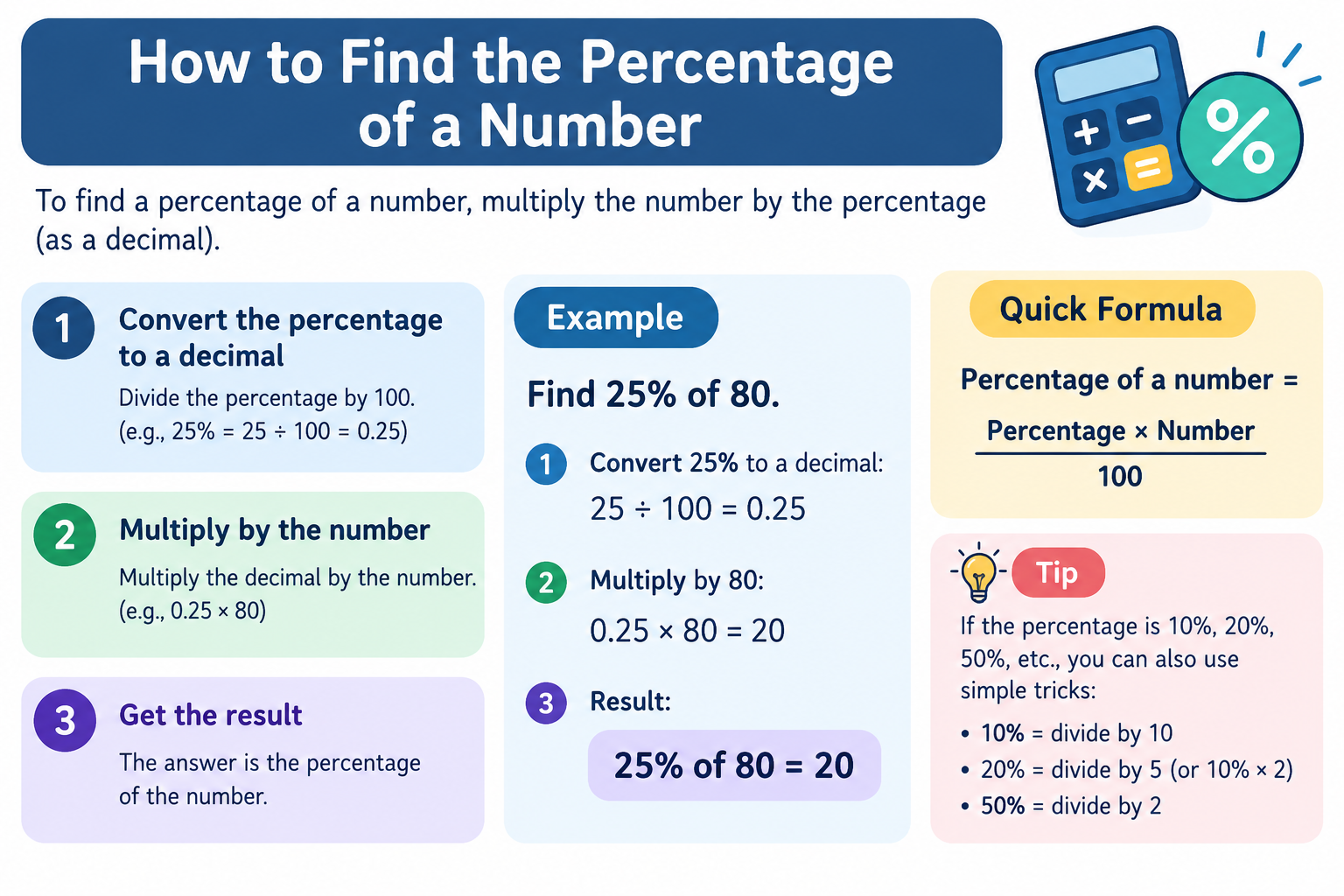
How do you find the percentage of a number? The answer is straightforward: divide the percentage by 100 to convert it to a decimal, then multiply by the number. For 20% of 150: (20 ÷ 100) × 150 = 0.20 × 150 = 30.
That is the core method, and this article walks through it clearly — with multiple approaches, worked examples, real-life applications, and plenty of practice.
Key Takeaways
-
“Percent” means per hundred. Any percentage can be written as a fraction or decimal.
-
The main formula is: Percentage of a Number = (Percentage ÷ 100) × Number.
-
The decimal method is the most reliable: convert the percentage to a decimal, then multiply.
-
Common percentages like 10%, 25%, and 50% have simple fraction equivalents that make mental calculation faster.
-
The same formula works for whole numbers, large numbers, decimal numbers, and real-life problems.
-
Percentages greater than 100% give answers larger than the original number — that is perfectly correct.
-
Always check your answer by estimating whether it seems reasonable.
What Is a Percentage?
The word percent comes from the Latin per centum, meaning per hundred. A percentage is simply a way of expressing a number as a fraction of 100.
- 50% means 50 out of every 100 → 50/100 → 0.5
- 25% means 25 out of every 100 → 25/100 → 0.25
- 10% means 10 out of every 100 → 10/100 → 0.1
- 1% means 1 out of every 100 → 1/100 → 0.01
- 100% means all of something → 100/100 → 1
Percentages, fractions, and decimals are three different ways of expressing the same value. For example, 75% = 3/4 = 0.75. They all mean the same thing — three-quarters of a whole.
The Main Formula for Finding the Percentage of a Number
The formula is:
Percentage of a Number = (Percentage ÷ 100) × Number
This can also be written as:
Percentage of a Number = (Percentage / 100) × Number
Example: What is 20% of 50?
- Percentage = 20
- Number = 50
- Calculation: (20 ÷ 100) × 50 = 0.20 × 50 = 10
Let us break down why this works.
Dividing by 100 converts the percentage into a decimal — essentially expressing it as a fraction of 1 rather than a fraction of 100. Multiplying by the number then finds that proportion of the whole. The logic is the same as finding a fraction of a number: 20% of 50 is the same as 1/5 of 50, which is 10.
Method 1: Using Decimal Conversion
This is the most widely used method and works reliably for any percentage.
Step 1: Divide the percentage by 100.
Step 2: Multiply the result by the number.
25% of 80:
- 25 ÷ 100 = 0.25
- 0.25 × 80 = 20
30% of 200:
- 30 ÷ 100 = 0.30
- 0.30 × 200 = 60
15% of 60:
- 15 ÷ 100 = 0.15
- 0.15 × 60 = 9
5% of 400:
- 5 ÷ 100 = 0.05
- 0.05 × 400 = 20
The decimal method works for any percentage — whole number, decimal, or even a percentage greater than 100. It is also the easiest method to apply consistently without memorising anything.
Method 2: Using Fraction Form
Some percentages convert neatly into simple fractions, making mental calculation very fast.
| Percentage | Fraction |
|---|---|
| 50% | 1/2 |
| 25% | 1/4 |
| 75% | 3/4 |
| 10% | 1/10 |
| 20% | 1/5 |
| 33.33% | 1/3 |
| 40% | 2/5 |
| 60% | 3/5 |
Examples:
50% of 80:
50% = 1/2, so 1/2 × 80 = 40
25% of 200:
25% = 1/4, so 1/4 × 200 = 50
10% of 150:
10% = 1/10, so 1/10 × 150 = 15
20% of 350:
20% = 1/5, so 1/5 × 350 = 70
75% of 120:
75% = 3/4, so 3/4 × 120 = 90
33.33% of 90:
33.33% ≈ 1/3, so 1/3 × 90 = 30
40% of 250:
40% = 2/5, so 2/5 × 250 = 100
60% of 150:
60% = 3/5, so 3/5 × 150 = 90
For a deeper understanding of how fractions and their equivalents work, see What Are Equivalent Fractions? on LearnMinto.
Method 3: The Proportion Method
This method sets up the problem as a proportion, which some students find very logical.
The proportion relationship is:
Part / Whole = Percentage / 100
Rearranged to find the part:
Part = (Percentage × Whole) / 100
Example: What is 35% of 140?
Part = (35 × 140) / 100 = 4,900 / 100 = 49
Example: What is 60% of 75?
Part = (60 × 75) / 100 = 4,500 / 100 = 45
Example: What is 12% of 300?
Part = (12 × 300) / 100 = 3,600 / 100 = 36
This method is essentially the same as the decimal method but written differently. The multiplication happens before the division by 100, rather than after. The result is always the same.
Quick Percentage Tricks
For mental arithmetic and estimation, these shortcuts are invaluable.
Finding 10%: Move the decimal point one place to the left.
- 10% of 80 = 8
- 10% of 250 = 25
- 10% of 4,000 = 400
Finding 1%: Move the decimal point two places to the left.
- 1% of 500 = 5
- 1% of 1,200 = 12
- 1% of 75 = 0.75
Finding 50%: Halve the number.
- 50% of 90 = 45
- 50% of 340 = 170
Finding 25%: Halve the number, then halve again.
- 25% of 80: 80 ÷ 2 = 40 ÷ 2 = 20
- 25% of 200: 200 ÷ 2 = 100 ÷ 2 = 50
Finding 20%: Find 10% first, then double it.
- 20% of 150: 10% = 15, so 20% = 30
- 20% of 430: 10% = 43, so 20% = 86
Building any percentage from 1%:
- 7% of 300: 1% = 3, so 7% = 3 × 7 = 21
- 13% of 400: 1% = 4, so 13% = 4 × 13 = 52
How to Find the Percentage of a Number Step by Step
Here is a single clean method that works every time.
Step 1: Write down the percentage and the number clearly.
Step 2: Divide the percentage by 100 to get the decimal equivalent.
Step 3: Multiply the decimal by the number.
Step 4: Write the final answer with appropriate units if needed.
Example 1: Find 45% of 200.
- Step 1: 45%, number = 200
- Step 2: 45 ÷ 100 = 0.45
- Step 3: 0.45 × 200 = 90
- Step 4: Answer = 90
Example 2: Find 8% of 350.
- Step 2: 8 ÷ 100 = 0.08
- Step 3: 0.08 × 350 = 28
Example 3: Find 62% of 50.
- Step 2: 62 ÷ 100 = 0.62
- Step 3: 0.62 × 50 = 31
Example 4: Find 3% of 900.
- Step 2: 3 ÷ 100 = 0.03
- Step 3: 0.03 × 900 = 27
Example 5: Find 150% of 80.
- Step 2: 150 ÷ 100 = 1.50
- Step 3: 1.50 × 80 = 120
- Note: 150% gives a number larger than the original — that is correct.
Finding Common Percentages
| Percentage | Fraction | Decimal | Example: of 200 |
|---|---|---|---|
| 1% | 1/100 | 0.01 | 2 |
| 5% | 1/20 | 0.05 | 10 |
| 10% | 1/10 | 0.1 | 20 |
| 20% | 1/5 | 0.2 | 40 |
| 25% | 1/4 | 0.25 | 50 |
| 33.33% | 1/3 | 0.333… | 66.67 |
| 50% | 1/2 | 0.5 | 100 |
| 75% | 3/4 | 0.75 | 150 |
| 100% | 1/1 | 1 | 200 |
| 125% | 5/4 | 1.25 | 250 |
This table is worth spending a few minutes memorising. Recognising that 25% = 1/4 instantly, or that 10% means dividing by 10, removes a lot of calculation time in exams.
Finding the Percentage of a Number — Easy Examples
| Question | Working | Answer |
|---|---|---|
| 10% of 70 | 0.1 × 70 | 7 |
| 20% of 150 | 0.2 × 150 | 30 |
| 25% of 200 | 0.25 × 200 | 50 |
| 50% of 90 | 0.5 × 90 | 45 |
| 5% of 60 | 0.05 × 60 | 3 |
| 75% of 80 | 0.75 × 80 | 60 |
| 30% of 500 | 0.3 × 500 | 150 |
| 15% of 40 | 0.15 × 40 | 6 |
| 1% of 300 | 0.01 × 300 | 3 |
| 40% of 250 | 0.4 × 250 | 100 |
| 60% of 45 | 0.6 × 45 | 27 |
| 80% of 125 | 0.8 × 125 | 100 |
Finding the Percentage of Larger Numbers
The method stays exactly the same for larger numbers.
35% of 1,200:
0.35 × 1,200 = 420
18% of 2,500:
0.18 × 2,500 = 450
7% of 4,800:
0.07 × 4,800 = 336
12.5% of 640:
0.125 × 640 = 80
45% of 3,000:
0.45 × 3,000 = 1,350
For larger calculations like these, it can help to round first to estimate — a skill covered thoroughly in What Is Rounding in Math? on LearnMinto — and then calculate precisely to verify.
Finding the Percentage of Decimal Numbers
The formula works just as well when the number itself contains a decimal.
20% of 4.5:
0.20 × 4.5 = 0.9
15% of 12.8:
0.15 × 12.8 = 1.92
50% of 7.4:
0.5 × 7.4 = 3.7
25% of 6.4:
0.25 × 6.4 = 1.6
10% of 9.3:
0.1 × 9.3 = 0.93
No special steps are needed — the decimal method handles these naturally.
Percentage of a Number in Real Life
Shopping discount:
A pair of trainers costs £80. They are on sale at 25% off. Discount = 0.25 × 80 = £20. Sale price = £80 − £20 = £60.
Test score:
A student scores 72 out of 80. To express as a percentage: (72 / 80) × 100 = 90%.
Sales tax:
An item costs $120 before a 8% tax. Tax = 0.08 × 120 = $9.60. Total = $120 + $9.60 = $129.60.
Restaurant tip:
A meal costs £45. You want to leave a 15% tip. Tip = 0.15 × 45 = £6.75.
Salary increase:
An employee earns £28,000 per year and receives a 5% raise. Increase = 0.05 × 28,000 = £1,400. New salary = £29,400.
Savings goal:
You want to save 20% of your monthly income of £1,500. Savings = 0.20 × 1,500 = £300 per month.
Fuel efficiency:
A car uses 12% less fuel after a service. Original fuel use was 50 litres per week. Saving = 0.12 × 50 = 6 litres per week.
Common Mistakes Students Make
| Mistake | Incorrect | Correct |
|---|---|---|
| Using the percentage directly without dividing by 100 | 20% of 50 = 20 × 50 = 1,000 | 20% of 50 = 0.20 × 50 = 10 |
| Forgetting to convert to a decimal | 15 × 60 = 900 | 0.15 × 60 = 9 |
| Decimal point error | 0.5% of 200 = 0.5 × 200 = 100 | 0.5% of 200 = 0.005 × 200 = 1 |
| Confusing percentage of a number with percentage increase | 20% of 50 = 60 | 20% of 50 = 10; if increasing by 20%: 50 + 10 = 60 |
| Reversing the proportion formula | Part = 100 / (Percentage × Whole) | Part = (Percentage × Whole) / 100 |
| Rounding too early | 0.333 × 90 = 29.97, written as 29 | Recognise 1/3 × 90 = exactly 30 |
How to Check Your Answer
Method 1: Work backwards.
If 20% of 150 = 30, check: 30 ÷ 150 × 100 = 20%. Correct.
Method 2: Use a different method.
If you used decimals, try the fraction method. Both should give the same answer.
Method 3: Estimate first.
Before calculating 23% of 480, estimate: roughly 20% of 500 = 100. Your answer should be in that range. The exact answer is 0.23 × 480 = 110.4 — close to 100. Reasonable.
If your answer seems wildly different from your estimate, go back and check the calculation.
Worked Examples
Example 1
Given: Find 10% of 340.
Step 1: 10 ÷ 100 = 0.10.
Step 2: 0.10 × 340 = 34.
Final Answer: 34
Short Explanation: 10% means one-tenth, so dividing by 10 gives the same result.
Example 2
Given: Find 25% of 160.
Step 1: 25 ÷ 100 = 0.25.
Step 2: 0.25 × 160 = 40.
Final Answer: 40
Short Explanation: 25% = 1/4, so 160 ÷ 4 = 40. Both methods agree.
Example 3
Given: Find 50% of 94.
Step 1: 50 ÷ 100 = 0.5.
Step 2: 0.5 × 94 = 47.
Final Answer: 47
Short Explanation: 50% is always half the number.
Example 4
Given: Find 15% of 80.
Step 1: 15 ÷ 100 = 0.15.
Step 2: 0.15 × 80 = 12.
Final Answer: 12
Short Explanation: Alternatively: 10% of 80 = 8; 5% of 80 = 4; 8 + 4 = 12.
Example 5
Given: Find 5% of 260.
Step 1: 5 ÷ 100 = 0.05.
Step 2: 0.05 × 260 = 13.
Final Answer: 13
Short Explanation: 5% = half of 10%. 10% of 260 = 26; 26 ÷ 2 = 13.
Example 6
Given: Find 35% of 400.
Step 1: 35 ÷ 100 = 0.35.
Step 2: 0.35 × 400 = 140.
Final Answer: 140
Short Explanation: 30% of 400 = 120; 5% of 400 = 20; 120 + 20 = 140.
Example 7
Given: Find 75% of 240.
Step 1: 75 ÷ 100 = 0.75.
Step 2: 0.75 × 240 = 180.
Final Answer: 180
Short Explanation: 75% = 3/4. 240 ÷ 4 = 60; 60 × 3 = 180.
Example 8
Given: Find 2% of 750.
Step 1: 2 ÷ 100 = 0.02.
Step 2: 0.02 × 750 = 15.
Final Answer: 15
Short Explanation: 1% of 750 = 7.5; 2% = 7.5 × 2 = 15.
Example 9
Given: Find 0.5% of 600.
Step 1: 0.5 ÷ 100 = 0.005.
Step 2: 0.005 × 600 = 3.
Final Answer: 3
Short Explanation: Less than 1% gives a very small result. 1% of 600 = 6; 0.5% = 3.
Example 10
Given: Find 120% of 50.
Step 1: 120 ÷ 100 = 1.20.
Step 2: 1.20 × 50 = 60.
Final Answer: 60
Short Explanation: More than 100% gives an answer larger than the original number.
Example 11
Given: Find 18% of 2,500.
Step 1: 18 ÷ 100 = 0.18.
Step 2: 0.18 × 2,500 = 450.
Final Answer: 450
Short Explanation: Larger numbers follow the same process — just multiply the decimal by the number.
Example 12
Given: Find 12.5% of 640.
Step 1: 12.5 ÷ 100 = 0.125.
Step 2: 0.125 × 640 = 80.
Final Answer: 80
Short Explanation: 12.5% = 1/8. 640 ÷ 8 = 80. Fraction method confirms the answer.
Example 13
Given: Find 20% of 4.5.
Step 1: 20 ÷ 100 = 0.20.
Step 2: 0.20 × 4.5 = 0.9.
Final Answer: 0.9
Short Explanation: The same formula works when the number is a decimal.
Example 14
Given: A jacket costs £95 and has a 30% discount. Find the discount amount.
Step 1: 30 ÷ 100 = 0.30.
Step 2: 0.30 × 95 = 28.50.
Final Answer: £28.50 discount
Short Explanation: Sale price = £95 − £28.50 = £66.50.
Example 15
Given: A student scores 68 out of 80. What is the percentage score?
Step 1: (68 ÷ 80) × 100 = 0.85 × 100.
Final Answer: 85%
Short Explanation: Divide the score by the total, then multiply by 100.
Example 16
Given: Find 7% of 4,800.
Step 1: 7 ÷ 100 = 0.07.
Step 2: 0.07 × 4,800 = 336.
Final Answer: 336
Short Explanation: 1% of 4,800 = 48; 7% = 48 × 7 = 336.
Example 17
Given: Find 45% of 3,000.
Step 1: 45 ÷ 100 = 0.45.
Step 2: 0.45 × 3,000 = 1,350.
Final Answer: 1,350
Short Explanation: 50% of 3,000 = 1,500; 5% = 150; 50% − 5% = 45% → 1,500 − 150 = 1,350.
Example 18
Given: Find 1% of 8,450.
Step 1: 1 ÷ 100 = 0.01.
Step 2: 0.01 × 8,450 = 84.50.
Final Answer: 84.50
Short Explanation: 1% always means divide by 100.
Example 19
Given: Find 60% of 45.
Step 1: 60 ÷ 100 = 0.60.
Step 2: 0.60 × 45 = 27.
Final Answer: 27
Short Explanation: 60% = 3/5. 45 ÷ 5 = 9; 9 × 3 = 27.
Example 20
Given: An employee earning £32,000 receives a 4% pay rise. What is the increase?
Step 1: 4 ÷ 100 = 0.04.
Step 2: 0.04 × 32,000 = 1,280.
Final Answer: £1,280 increase. New salary = £33,280.
Short Explanation: Real-world percentage calculations follow exactly the same steps.
Practice Questions
15 Basic Practice Questions
- Find 10% of 90.
- Find 25% of 120.
- Find 50% of 74.
- Find 20% of 85.
- Find 5% of 140.
- Find 30% of 600.
- Find 75% of 200.
- Find 15% of 60.
- Find 1% of 2,500.
- Find 40% of 350.
- Find 8% of 450.
- Find 12% of 250.
- Find 60% of 90.
- Find 35% of 80.
- Find 100% of 673.
Answers:
- 9 (0.1 × 90)
- 30 (0.25 × 120)
- 37 (0.5 × 74)
- 17 (0.2 × 85)
- 7 (0.05 × 140)
- 180 (0.3 × 600)
- 150 (0.75 × 200)
- 9 (0.15 × 60)
- 25 (0.01 × 2,500)
- 140 (0.4 × 350)
- 36 (0.08 × 450)
- 30 (0.12 × 250)
- 54 (0.6 × 90)
- 28 (0.35 × 80)
- 673 (1 × 673 — 100% of any number is the number itself)
10 Multiple Choice Questions
Question 1
What is 20% of 250?
A. 25
B. 50
C. 20
D. 40
Correct Answer: B
Short Explanation: 0.20 × 250 = 50.
Question 2
What is the correct formula for finding the percentage of a number?
A. Percentage × Number
B. (Percentage ÷ 10) × Number
C. (Percentage ÷ 100) × Number
D. Number ÷ Percentage
Correct Answer: C
Short Explanation: You must divide the percentage by 100 to convert it to a decimal before multiplying.
Question 3
What is 10% of 470?
A. 4.7
B. 47
C. 470
D. 4,700
Correct Answer: B
Short Explanation: 10% means dividing by 10: 470 ÷ 10 = 47.
Question 4
A bag originally costs £60. It is on sale at 15% off. What is the discount?
A. £6
B. £15
C. £9
D. £12
Correct Answer: C
Short Explanation: 0.15 × 60 = 9. The discount is £9.
Question 5
What is 1% of 5,000?
A. 5
B. 50
C. 500
D. 0.5
Correct Answer: B
Short Explanation: 1% = divide by 100. 5,000 ÷ 100 = 50.
Question 6
A student scored 45 out of 50. What is the percentage score?
A. 45%
B. 85%
C. 90%
D. 95%
Correct Answer: C
Short Explanation: (45 ÷ 50) × 100 = 0.9 × 100 = 90%.
Question 7
What is 150% of 40?
A. 40
B. 60
C. 80
D. 15
Correct Answer: B
Short Explanation: 1.50 × 40 = 60. A percentage above 100% gives an answer larger than the original number.
Question 8
Which calculation correctly finds 5% of 300?
A. 5 × 300 = 1,500
B. 5/10 × 300 = 150
C. 0.05 × 300 = 15
D. 300/5 = 60
Correct Answer: C
Short Explanation: 5 ÷ 100 = 0.05. 0.05 × 300 = 15.
Question 9
What is 25% of 360?
A. 72
B. 80
C. 90
D. 100
Correct Answer: C
Short Explanation: 25% = 1/4. 360 ÷ 4 = 90.
Question 10
A shop has 200 items. 35% of them are on sale. How many items are on sale?
A. 35
B. 60
C. 70
D. 75
Correct Answer: C
Short Explanation: 0.35 × 200 = 70 items.
10 Mixed Practice Problems
Problem 1: A restaurant bill is £55. What is a 12% tip?
Solution: 0.12 × 55 = £6.60. Tip: £6.60
Problem 2: Find 45% of 180.
Solution: 0.45 × 180 = 81
Problem 3: A school has 850 students. 60% take the bus. How many students take the bus?
Solution: 0.60 × 850 = 510 students
Problem 4: Find 0.5% of 4,000.
Solution: 0.005 × 4,000 = 20
Problem 5: A laptop costs £750 before a 20% discount. What is the sale price?
Solution: Discount = 0.20 × 750 = £150. Sale price = £750 − £150 = £600
Problem 6: Find 33.33% of 270.
Solution: 1/3 × 270 = 90
Problem 7: A runner completes 70% of a 42 km marathon. How far have they run?
Solution: 0.70 × 42 = 29.4 km
Problem 8: Find 7.5% of 800.
Solution: 0.075 × 800 = 60
Problem 9: A bank offers 3% annual interest on £5,000. How much interest is earned in one year?
Solution: 0.03 × 5,000 = £150
Problem 10: Find 110% of 200.
Solution: 1.10 × 200 = 220
5 Challenge Questions
Challenge 1: A jacket costs £144 after a 20% discount has already been applied. What was the original price?
Solution:
After 20% off, the remaining price is 80% of the original.
80% of original = £144
Original = 144 ÷ 0.80 = £180
Challenge 2: Find 17.5% of 640.
Solution:
0.175 × 640 = 112
(Check: 10% = 64; 5% = 32; 2.5% = 16. Total = 64 + 32 + 16 = 112. Confirmed.)
Challenge 3: A shop increases its prices by 15%, then offers a 15% discount on the new price. Is the final price the same as the original?
Solution:
Let original price = £100.
After 15% increase: 100 × 1.15 = £115.
After 15% discount on £115: 115 × 0.85 = £97.75.
No — the final price (£97.75) is lower than the original (£100). The percentage changes do not cancel out because they apply to different values.
Challenge 4: 35% of a class passed an exam. If 63 students passed, how many students are in the class?
Solution:
35% of total = 63
Total = 63 ÷ 0.35 = 180 students
Challenge 5: A savings account grows by 4% per year. If £2,500 is deposited, what is the total after two years (compound growth)?
Solution:
Year 1: 2,500 × 1.04 = £2,600
Year 2: 2,600 × 1.04 = £2,704
Total after two years: £2,704
Exam Tips for Percentages
- Always divide the percentage by 100 first. This is the most commonly forgotten step.
- Know your common equivalents. Memorising that 25% = 0.25 = 1/4 saves time and reduces errors.
- Estimate before calculating. A quick mental estimate tells you whether your final answer is in the right range.
- Build from 10% or 1%. For awkward percentages, find 10% or 1% first, then scale up or down.
- Read the question carefully. Check whether it asks for the percentage amount, the total after a change, or the original value.
- Show your working. In exams, showing the conversion step (e.g., 15% = 0.15) demonstrates understanding and may earn partial credit.
- Check by working backwards. Divide your answer by the original number and multiply by 100 to confirm the percentage is correct.
Quick Revision Notes
- Percentage: A number expressed out of 100. 45% = 45 per hundred.
- Main formula: (Percentage ÷ 100) × Number.
- Decimal method: Divide by 100 to get the decimal, then multiply by the number.
- Fraction method: Use common fraction equivalents (e.g., 25% = 1/4) for quick mental calculation.
- Proportion method: Part = (Percentage × Whole) ÷ 100.
- Common equivalents:
- 10% = 0.1 = 1/10
- 25% = 0.25 = 1/4
- 50% = 0.5 = 1/2
- 75% = 0.75 = 3/4
- Checking the answer: Divide the answer by the original number, multiply by 100, and confirm you get back the original percentage.
Percentage Cheat Sheet
| Task | Method | Example |
|---|---|---|
| Find percentage of a number | (Percentage ÷ 100) × Number | 30% of 200 = 0.3 × 200 = 60 |
| Convert percentage to decimal | Divide by 100 | 45% = 0.45 |
| Convert percentage to fraction | Write over 100, simplify | 25% = 25/100 = 1/4 |
| Find 10% quickly | Divide the number by 10 | 10% of 350 = 35 |
| Find 1% quickly | Divide the number by 100 | 1% of 800 = 8 |
| Build other percentages from 1% | Multiply 1% by the required percentage | 7% of 500: 1% = 5, so 7% = 35 |
| Find 50% | Divide by 2 | 50% of 124 = 62 |
| Find 25% | Divide by 4 | 25% of 240 = 60 |
| Find 20% | Find 10%, then double | 20% of 150: 10% = 15, × 2 = 30 |
Frequently Asked Questions
1. How do you find the percentage of a number?
Divide the percentage by 100 to get the decimal, then multiply by the number. For example: 30% of 90 = 0.30 × 90 = 27.
2. What is the formula for finding the percentage of a number?
The formula is: (Percentage ÷ 100) × Number. This works for any percentage and any number.
3. How do you find 20% of a number?
Divide the percentage by 100 (20 ÷ 100 = 0.20), then multiply by the number. A quicker shortcut: find 10% (divide by 10) and double it.
4. How do you find 10% of a number?
Divide the number by 10, or move the decimal point one place to the left. For example: 10% of 380 = 38.
5. How do you find 15% of a number?
Find 10% of the number, then find 5% (half of 10%), and add them together. For example: 15% of 80 → 10% = 8; 5% = 4; 15% = 12.
6. How do you find 25% of a number?
Divide the number by 4. For example: 25% of 200 = 200 ÷ 4 = 50.
7. How do you find 5% of a number?
Find 10% and halve it. For example: 5% of 140 → 10% = 14; 5% = 7.
8. How do you find 1% of a number?
Divide the number by 100, or move the decimal point two places to the left. For example: 1% of 4,500 = 45.
9. How do you find the percentage of a large number?
Use exactly the same formula. Convert the percentage to a decimal and multiply. The size of the number does not change the method.
10. What does percent mean?
Percent means “per hundred.” 40% means 40 out of every 100.
11. How do you convert a percentage to a decimal?
Divide by 100. For example: 73% ÷ 100 = 0.73.
12. How do you find the percentage of a number without a calculator?
Use mental math tricks: find 10% by dividing by 10, find 1% by dividing by 100, and build other percentages from these. Common fractions (25% = 1/4, 50% = 1/2) are also very useful.
13. What is 50% of a number?
50% is always half the number. Divide by 2.
14. How is percentage used in real life?
Percentages appear in discounts, tax, interest rates, exam scores, nutrition labels, salary changes, statistics, and many more everyday situations.
15. What is the easiest way to find the percentage of a number?
For most students, the decimal method is most reliable: divide the percentage by 100, then multiply by the number. For common percentages, fraction shortcuts are faster with practice.
Summary
Finding the percentage of a number always comes back to the same core idea: convert the percentage to a decimal by dividing by 100, then multiply by the number.
Formula: (Percentage ÷ 100) × Number
Whether you are finding 5% of 60, 35% of 1,200, or 150% of 80, the steps are identical. The decimal method works every time. Fraction shortcuts speed things up for common values like 25%, 50%, and 75%. The proportion method offers another route that many students find logical.
Understanding place value is helpful when converting percentages to decimals — particularly for values like 0.5% or 12.5% where careful decimal placement matters. For that, What Is Place Value in Math? provides a clear foundation.
Final Thoughts
Mastering how to find the percentage of a number is genuinely one of the most useful mathematical skills you will ever learn. It underpins a huge range of practical calculations — from working out discounts and tips to understanding tax rates, interest, and statistics.
The formula is simple and consistent. Once you are comfortable with the decimal method, practise the mental math shortcuts — knowing that 10% means dividing by 10, and that 25% means dividing by 4, will save you significant time in exams and daily life.
Work through the practice questions in this article, check your answers carefully, and build confidence gradually from simple examples to more complex ones.
As your understanding of percentages grows, you will find that fractions, decimals, and ratios — topics covered in What Is a Fraction? on LearnMinto — all start to connect into a coherent picture of how numbers relate to one another.
References
- Khan Academy — Percentages: https://www.khanacademy.org
- OpenStax Prealgebra — Percents: https://openstax.org
- Mathematics LibreTexts — Percent and Percentage: https://math.libretexts.org
- National Council of Teachers of Mathematics (NCTM): https://www.nctm.org
- Encyclopaedia Britannica — Percentage: https://www.britannica.com
Helpful Resources
Khan Academy — Percentages
Students can watch video lessons and complete interactive exercises on finding percentages, percentage change, and real-life percentage applications.
https://www.khanacademy.org
OpenStax Prealgebra
A free, peer-reviewed textbook with well-structured chapters on percentages, decimals, and fractions — ideal for students and self-learners.
https://openstax.org
Mathematics LibreTexts
Offers clear, accessible mathematics content covering percentages, ratios, and related topics with worked examples at multiple levels.
https://math.libretexts.org
National Council of Teachers of Mathematics (NCTM)
Provides teaching resources and standards-based guidance for developing number sense, including percentage reasoning and proportional thinking.
https://www.nctm.org
Disclaimer:
This article is intended for educational and informational purposes only. While LearnMinto strives to provide accurate and up-to-date mathematics information, readers should verify important academic concepts through official textbooks, educational institutions, examination boards, or trusted educational resources before using this content for exams or academic purposes. LearnMinto is not affiliated with any specific school, university, research institution, or examination board.
About the Author
Saad Qureshi is a Senior Education & Technology Editor at LearnMinto. He focuses on creating and reviewing clear, accessible educational content across mathematics, physics, chemistry, biology, computer science, technology, AI tools, and personal finance.