
Introduction
Think about the numbers you use every day. When you split a pizza into two equal slices, each slice is 1/2. When a recipe calls for 3/4 of a cup of sugar, that is a fraction. When a shop offers a discount of 5/2 pounds off a price, that is a rational number too.
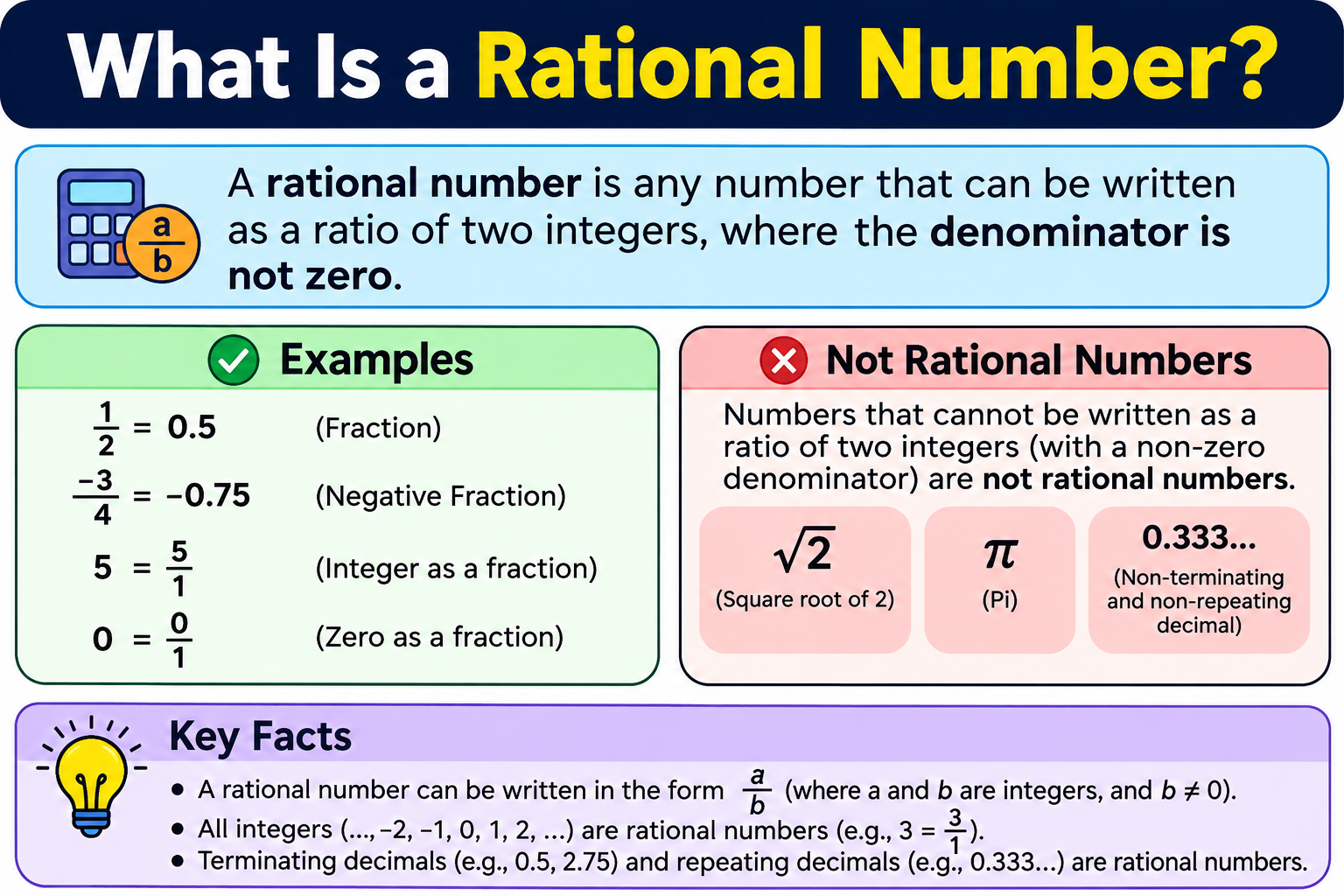
A rational number is any number that can be written in the form a/b, where a and b are integers and b is not zero.
That definition covers far more numbers than most students initially expect. It includes simple fractions like 1/2 and 3/4, negative numbers like -7/3, whole numbers like 5, the number 0, and even decimal numbers like 0.25 and 0.333…
Understanding rational numbers means understanding fractions, integers, and decimals — and how they all connect within the real number system. This article explains every aspect of rational numbers in clear, step-by-step terms, with worked examples, practice questions, and everything you need to feel confident in your exams.
Key Takeaways
-
A rational number is any number expressible as a/b, where a and b are integers and b is not zero.
-
Every integer is a rational number because any integer can be written with a denominator of 1.
-
Zero is a rational number because it can be written as 0/1.
-
Terminating decimals and repeating decimals are both rational numbers.
-
Irrational numbers such as √2 and π cannot be expressed as a ratio of two integers.
-
Rational numbers are closed under addition, subtraction, and multiplication, and under division as long as the divisor is not zero.
-
Rational numbers form a subset of the real number system.
What Is a Rational Number?
A rational number is any number that can be expressed in the form a/b, where:
- a is an integer (a whole number, which can be positive, negative, or zero)
- b is a nonzero integer (a whole number that is not zero)
The word “rational” comes from the word “ratio.” A rational number is simply a number that can be expressed as a ratio of two integers.
The denominator cannot be zero. Division by zero is undefined in mathematics, so b = 0 is never permitted.
Examples of rational numbers:
- 1/2 — numerator 1, denominator 2, both integers
- -7/3 — numerator -7, denominator 3, both integers
- 5 — can be written as 5/1
- 0 — can be written as 0/1
- 0.25 — equal to 1/4
Non-examples (numbers that are not rational):
- √2 — cannot be expressed as a fraction of two integers
- π — its decimal expansion is infinite and non-repeating
- √5 — irrational
The key test is always the same: can the number be written as a fraction with integer numerator and nonzero integer denominator? If yes, it is rational.
Rational Number Examples
Here are common examples with explanations of why each qualifies as rational.
1/2 — A simple fraction. Numerator 1 and denominator 2 are both integers. Rational.
3/4 — Numerator 3 and denominator 4 are both integers. Rational.
5 — A whole number. Written as 5/1. Both integers. Rational.
-2 — A negative integer. Written as -2/1. Rational.
-7/3 — Negative fraction. Numerator -7 and denominator 3 are both integers. Rational.
0 — Written as 0/1. Rational.
12/5 — An improper fraction with integer numerator and denominator. Rational.
0.25 — A terminating decimal. Equals 1/4. Rational.
0.333… — A repeating decimal. Equals 1/3. Rational.
√2 — Approximately 1.41421356… The decimal never ends and never repeats. Cannot be written as a/b. Not rational.
Why Is Every Integer a Rational Number?
An integer is any whole number: …, -3, -2, -1, 0, 1, 2, 3, …
Every integer qualifies as a rational number because any integer can be written with a denominator of 1, and 1 is a nonzero integer.
| Integer | Written as a Fraction | Rational? |
|---|---|---|
| 5 | 5/1 | Yes |
| -3 | -3/1 | Yes |
| 0 | 0/1 | Yes |
| 100 | 100/1 | Yes |
| -47 | -47/1 | Yes |
This means the set of integers is entirely contained within the set of rational numbers. Every integer is rational, but not every rational number is an integer — for example, 1/2 is rational but not an integer.
Is Zero a Rational Number?
Yes. Zero is a rational number.
Zero can be written as 0/1, which satisfies the definition: numerator 0 is an integer, and denominator 1 is a nonzero integer.
In fact, zero can also be written as 0/2, 0/5, or 0 divided by any nonzero integer. All of these equal zero, and all satisfy the rational number definition.
One important point to clarify: although zero can be a numerator in a rational number, zero can never be the denominator. Division by zero is undefined. An expression like 5/0 does not represent any number — rational or otherwise.
Is Every Fraction a Rational Number?
Any fraction where both the numerator and the denominator are integers, and the denominator is nonzero, is a rational number.
This covers several types of fractions:
Proper fractions (numerator smaller than denominator): 1/2, 3/4, 7/10
Improper fractions (numerator greater than or equal to denominator): 7/4, 11/3, 5/5
Negative fractions: -3/7, -5/2, -1/3
Whole numbers written as fractions: 6/1, 12/4 (which equals 3), 15/5 (which equals 3)
All of these qualify as rational numbers because they meet the a/b definition with integer numerator and nonzero integer denominator.
Rational Numbers vs Irrational Numbers
An irrational number is a real number that cannot be expressed as a ratio of two integers. Its decimal expansion is infinite and non-repeating.
| Feature | Rational Numbers | Irrational Numbers |
|---|---|---|
| Definition | Can be written as a/b (b ≠ 0) | Cannot be written as a/b |
| Fraction form | Always possible | Never possible |
| Decimal form | Terminates or repeats | Infinite, non-repeating |
| Examples | 1/2, -3, 0, 0.75 | √2, √3, π |
| Decimal terminates? | Sometimes | Never |
| Decimal repeats? | Yes (when non-terminating) | Never |
| Part of real numbers? | Yes | Yes |
Common irrational numbers:
- √2 ≈ 1.41421356… (never repeats)
- √3 ≈ 1.73205080… (never repeats)
- π ≈ 3.14159265… (never repeats)
These cannot be written as exact fractions, which is what makes them irrational. Every real number is either rational or irrational — never both.
Rational Numbers vs Integers
| Feature | Rational Numbers | Integers |
|---|---|---|
| Definition | Any number of the form a/b (b ≠ 0) | Whole numbers: …, -2, -1, 0, 1, 2, … |
| Includes fractions? | Yes | No |
| Includes negatives? | Yes | Yes |
| Includes zero? | Yes | Yes |
| Examples | 1/2, -3/4, 5, -7 | -3, -1, 0, 2, 7 |
Every integer is a rational number, but not every rational number is an integer. The number 2/3 is rational but not an integer.
Rational Numbers vs Whole Numbers
Whole numbers are the non-negative integers: 0, 1, 2, 3, 4, and so on.
Rational numbers include all whole numbers, but they also include fractions, negative numbers, and repeating and terminating decimals.
For example, 1/2 is rational but not a whole number. -5 is rational but not a whole number. Every whole number is rational, but most rational numbers are not whole numbers.
Rational Numbers vs Natural Numbers
Natural numbers are the positive counting numbers: 1, 2, 3, 4, 5, … Some textbooks include 0 in the natural numbers, while others do not. This varies by curriculum, so always check your specific textbook or exam board.
Every natural number is a rational number because each can be written as n/1. However, rational numbers also include negative numbers, fractions, and zero — none of which are natural numbers in most definitions.
Rational Numbers on a Number Line
Rational numbers can be placed on a number line just like integers. The number line extends infinitely in both directions, with positive rational numbers to the right of zero and negative rational numbers to the left.
Examples:
- 1/2 is halfway between 0 and 1
- 3/4 is three-quarters of the way between 0 and 1
- -1/2 is halfway between 0 and -1
- -3/2 is halfway between -1 and -2
One important property of rational numbers on the number line: between any two rational numbers, there is always another rational number. This is called the density property. For example, between 1/3 and 1/2, you can find 5/12.
How to Identify a Rational Number
Follow these steps to determine whether any number is rational.
Step 1: Ask whether the number can be expressed as a fraction.
Step 2: Check that the numerator is an integer (whole number, positive, negative, or zero).
Step 3: Check that the denominator is a nonzero integer.
Step 4: If both conditions are satisfied, the number is rational.
Examples:
- 0.75: Can this be written as a fraction? Yes — 3/4. Rational.
- -5: Can this be written as -5/1? Yes. Rational.
- √7: The decimal never terminates or repeats. Cannot be written as a fraction. Not rational.
- 0.121212…: This repeats the pattern “12” indefinitely. It equals 12/99 = 4/33. Rational.
Terminating Decimals as Rational Numbers
A terminating decimal is a decimal that ends after a finite number of digits. All terminating decimals are rational numbers because they can always be converted to fractions.
How to convert a terminating decimal to a fraction:
Count the number of decimal places. Write the decimal digits as the numerator and a power of 10 (10, 100, 1000, etc.) as the denominator. Then simplify.
Examples:
- 0.5 = 5/10 = 1/2
- 0.25 = 25/100 = 1/4
- 1.75 = 175/100 = 7/4
- 0.125 = 125/1000 = 1/8
Every terminating decimal can be expressed in a/b form with integer numerator and nonzero integer denominator. Therefore, every terminating decimal is rational.
Repeating Decimals as Rational Numbers
A repeating decimal is a decimal where one or more digits repeat infinitely in a fixed pattern. Repeating decimals are also rational numbers.
Examples:
- 0.333… = 1/3
- 0.666… = 2/3
- 0.272727… = 3/11
Why are repeating decimals rational?
Because they can always be converted to fractions using a simple algebraic method. The repeating pattern guarantees that the decimal can be expressed as a ratio of two integers.
For example, to show that 0.333… = 1/3:
Let x = 0.333…
Then 10x = 3.333…
Subtract: 10x – x = 3.333… – 0.333…
9x = 3
x = 3/9 = 1/3
The result is a fraction with integer numerator and nonzero integer denominator — exactly the definition of a rational number.
Non-Terminating Non-Repeating Decimals
Irrational numbers have decimal expansions that continue forever without settling into any repeating pattern.
For example:
- π = 3.14159265358979…
- √2 = 1.41421356237…
- √3 = 1.73205080757…
These decimals never terminate and never repeat. That is precisely why they cannot be written as fractions. There is no pair of integers a and b where a/b equals exactly π or √2.
The contrast with rational numbers is clear: rational decimals either stop (terminating) or cycle through a repeating block of digits (repeating). Irrational decimals do neither.
How to Convert a Decimal to a Rational Number
For terminating decimals:
- Write the decimal without the decimal point as the numerator.
- Write a power of 10 with as many zeros as there are decimal places as the denominator.
- Simplify the fraction.
Example: Convert 0.36 to a fraction.
0.36 = 36/100 = 9/25
For repeating decimals:
- Let x equal the repeating decimal.
- Multiply both sides by a power of 10 that shifts one full repeating block to the left of the decimal point.
- Subtract the original equation.
- Solve for x and simplify.
Example: Convert 0.454545… to a fraction.
Let x = 0.454545…
100x = 45.4545…
100x – x = 45
99x = 45
x = 45/99 = 5/11
How to Convert a Fraction to a Decimal
Divide the numerator by the denominator using long division or a calculator.
Examples:
| Fraction | Division | Decimal | Type |
|---|---|---|---|
| 1/2 | 1 ÷ 2 | 0.5 | Terminating |
| 3/4 | 3 ÷ 4 | 0.75 | Terminating |
| 2/5 | 2 ÷ 5 | 0.4 | Terminating |
| 1/3 | 1 ÷ 3 | 0.333… | Repeating |
| 2/7 | 2 ÷ 7 | 0.285714… | Repeating |
When the division ends with a remainder of zero, the decimal terminates. When the remainder repeats a cycle, the decimal repeats.
Simplifying Rational Numbers
Simplifying a fraction means writing it in its lowest terms — where the numerator and denominator share no common factors other than 1.
Steps:
- Find the Greatest Common Factor (GCF) of the numerator and denominator.
- Divide both by the GCF.
Examples:
- 8/12: GCF of 8 and 12 is 4. So 8 ÷ 4 = 2 and 12 ÷ 4 = 3. Simplified: 2/3.
- 15/25: GCF of 15 and 25 is 5. So 15 ÷ 5 = 3 and 25 ÷ 5 = 5. Simplified: 3/5.
- 18/24: GCF of 18 and 24 is 6. So 18 ÷ 6 = 3 and 24 ÷ 6 = 4. Simplified: 3/4.
A fraction is fully simplified when the numerator and denominator have no common factors greater than 1.
Comparing Rational Numbers
To compare two rational numbers, several methods are available.
Method 1: Common denominators
Convert both fractions to the same denominator, then compare numerators.
Compare 3/4 and 5/6:
LCM of 4 and 6 is 12.
3/4 = 9/12 and 5/6 = 10/12.
Since 9 < 10, we have 3/4 < 5/6.
Method 2: Cross multiplication
Multiply the numerator of each fraction by the denominator of the other.
Compare 2/3 and 3/5:
2 × 5 = 10 and 3 × 3 = 9.
Since 10 > 9, we have 2/3 > 3/5.
Method 3: Decimal conversion
Convert each fraction to a decimal and compare.
1/4 = 0.25 and 1/3 = 0.333…, so 1/4 < 1/3.
Method 4: Number line
Plot both numbers on a number line. The number further to the right is greater.
Ordering Rational Numbers
To arrange rational numbers from smallest to largest, convert them to a common form — either common denominators or decimals — then compare.
Example 1: Order 1/2, 1/3, and 2/3 from smallest to largest.
Convert: 1/2 = 0.5, 1/3 = 0.333…, 2/3 = 0.666…
Order: 1/3 < 1/2 < 2/3
Example 2: Order -1/2, -1/4, and -3/4 from smallest to largest.
Convert: -1/2 = -0.5, -1/4 = -0.25, -3/4 = -0.75
Order: -3/4 < -1/2 < -1/4
(Remember: for negative numbers, the larger the absolute value, the smaller the number.)
Example 3: Order 5/6, 3/4, and 7/8 from smallest to largest.
Common denominator 24: 5/6 = 20/24, 3/4 = 18/24, 7/8 = 21/24.
Order: 3/4 < 5/6 < 7/8
Adding Rational Numbers
Same denominators:
Add the numerators and keep the denominator.
1/5 + 2/5 = 3/5
Different denominators:
Find the Least Common Denominator (LCD), convert, then add.
1/3 + 1/4: LCD = 12.
1/3 = 4/12 and 1/4 = 3/12.
4/12 + 3/12 = 7/12.
Positive and negative rational numbers:
Apply the same rules, keeping track of signs.
1/2 + (-3/4): LCD = 4.
2/4 + (-3/4) = -1/4.
Subtracting Rational Numbers
Subtract rational numbers the same way as addition, but change the sign of the second fraction.
Same denominators:
5/7 – 2/7 = 3/7
Different denominators:
3/4 – 1/3: LCD = 12.
9/12 – 4/12 = 5/12.
Including negatives:
1/2 – (-1/3) = 1/2 + 1/3.
LCD = 6: 3/6 + 2/6 = 5/6.
Subtracting a negative number is the same as adding a positive number.
Multiplying Rational Numbers
To multiply rational numbers, multiply the numerators together and multiply the denominators together.
(a/b) × (c/d) = (a × c)/(b × d)
Examples:
- 2/3 × 3/4 = 6/12 = 1/2
- -1/2 × 4/5 = -4/10 = -2/5
- 3/7 × 7/9 = 21/63 = 1/3
For mixed numbers, convert to improper fractions first.
2½ × 1⅓ = 5/2 × 4/3 = 20/6 = 10/3
Dividing Rational Numbers
To divide by a rational number, multiply by its reciprocal.
The reciprocal of a/b is b/a.
(a/b) ÷ (c/d) = (a/b) × (d/c)
Important: Division by zero is undefined. If the divisor is zero, the operation cannot be performed.
Examples:
- 3/4 ÷ 1/2 = 3/4 × 2/1 = 6/4 = 3/2
- 5/6 ÷ 5/3 = 5/6 × 3/5 = 15/30 = 1/2
- -2/3 ÷ 4/9 = -2/3 × 9/4 = -18/12 = -3/2
Properties of Rational Numbers
Rational numbers follow several important mathematical properties.
Closure property:
The result of adding, subtracting, or multiplying two rational numbers is always a rational number. Division is also closed, except when dividing by zero.
Commutative property:
- Addition: a/b + c/d = c/d + a/b
- Multiplication: a/b × c/d = c/d × a/b
- Subtraction and division are NOT commutative.
Associative property:
- Addition: (a/b + c/d) + e/f = a/b + (c/d + e/f)
- Multiplication: (a/b × c/d) × e/f = a/b × (c/d × e/f)
Distributive property:
a/b × (c/d + e/f) = (a/b × c/d) + (a/b × e/f)
Identity property:
- Additive identity: a/b + 0 = a/b
- Multiplicative identity: a/b × 1 = a/b
Inverse property:
- Additive inverse: a/b + (-a/b) = 0
- Multiplicative inverse: a/b × b/a = 1 (provided a and b are both nonzero)
Are Rational Numbers Closed Under All Operations?
Rational numbers are closed under addition, subtraction, and multiplication. This means the result is always another rational number.
For division, rational numbers are closed as long as the divisor is not zero. Division by zero is undefined and breaks the closure property.
| Operation | Closed? | Condition |
|---|---|---|
| Addition | Yes | Always |
| Subtraction | Yes | Always |
| Multiplication | Yes | Always |
| Division | Yes | Only when divisor ≠ 0 |
Rational Numbers and Real Numbers
All rational numbers are real numbers, but not all real numbers are rational.
The real number system includes both rational numbers and irrational numbers. Here is how different number sets relate to one another:
| Set | Description | Examples |
|---|---|---|
| Natural Numbers | Positive counting numbers | 1, 2, 3, 4 |
| Whole Numbers | Natural numbers plus zero | 0, 1, 2, 3 |
| Integers | Whole numbers and their negatives | -3, -1, 0, 2, 5 |
| Rational Numbers | Numbers expressible as a/b | 1/2, -3, 0.75 |
| Irrational Numbers | Cannot be expressed as a/b | √2, π |
| Real Numbers | Rational and irrational combined | All of the above |
Each set in this hierarchy contains the one before it. Natural numbers are inside whole numbers, whole numbers are inside integers, and integers are inside rational numbers. Rational numbers and irrational numbers together make up the real numbers.
Rational Numbers in Everyday Life
Rational numbers appear constantly in ordinary situations.
Money: Prices, change, and discounts all involve decimals and fractions. A price of £2.50 is the rational number 5/2.
Measurements: A ruler measuring 3.5 centimetres records the rational number 7/2.
Recipes: A recipe requiring 2/3 of a cup of flour uses a rational number directly.
Discounts: A 25% discount is the rational number 1/4 of the original price.
Time: Half an hour is 1/2, quarter past is 1/4 — both rational numbers.
Ratios: Mixing paint in a 3:2 ratio involves the rational number 3/2.
Financial calculations: Interest rates, exchange rates, and tax calculations all rely on rational numbers.
Rational numbers are not abstract — they are the numbers people use to measure, calculate, and compare things in real life every day.
Rational Numbers in Physics
Physics relies heavily on rational numbers. Most measured quantities — speed, velocity, force, acceleration, and energy — are expressed as ratios, fractions, or decimals, all of which fall within the rational number system.
When studying [What Is Speed in Physics?], students learn that speed equals distance divided by time. This division produces a rational number whenever both distance and time are measurable whole or fractional values. For example, travelling 60 kilometres in 2 hours gives a speed of 30 km/h, which is the rational number 30/1.
Similarly, [What Is Velocity?] involves a ratio of displacement to time. When a displacement of 45 metres occurs over 3 seconds, the velocity is 15 m/s — a rational number.
[What Is Acceleration?] is defined as the change in velocity divided by time. If velocity increases by 12 m/s over 4 seconds, the acceleration is 3 m/s² — again a rational number.
When calculating [What Is Force in Physics?](What Is Force in Physics?) using Newton’s second law (F = ma), multiplying a rational mass value by a rational acceleration always produces a rational result.
These examples show that rational numbers are not merely a school topic — they are the numerical foundation of physical measurement and scientific calculation.
Rational Numbers in Science and Mathematics
Algebra: Rational coefficients appear in equations and expressions constantly. Solving linear and quadratic equations frequently produces rational solutions.
Geometry: Perimeters, areas, and ratios of sides often involve rational numbers. The ratio of circumference to diameter, however, is π — an irrational number.
Physics: As described above, physical formulas produce rational values from rational inputs.
Chemistry: Concentration ratios, molar masses, and stoichiometric calculations involve rational numbers.
Statistics: Means, proportions, and probabilities are often rational numbers. For example, a probability of 3/10 is rational.
Engineering: Dimensions, tolerances, and material ratios are typically expressed as rational numbers in practical applications.
Common Misconceptions About Rational Numbers
Misconception 1: Every fraction is irrational.
False. Fractions of the form a/b where both are integers and b ≠ 0 are by definition rational.
Misconception 2: Rational numbers must be positive.
False. Negative fractions such as -3/7 and -5/2 are fully rational.
Misconception 3: Rational numbers must be whole numbers.
False. Numbers like 1/2 and 3/4 are rational but not whole numbers.
Misconception 4: Decimal numbers cannot be rational.
False. Terminating and repeating decimals are always rational.
Misconception 5: Repeating decimals are irrational.
False. A repeating decimal can always be converted to a fraction, making it rational.
Misconception 6: 0 is not rational.
False. 0 = 0/1, which satisfies the definition perfectly.
Misconception 7: Negative fractions are not rational.
False. Negativity does not affect rationality. -7/3 is rational.
Misconception 8: Every real number is rational.
False. Irrational numbers such as √2 and π are real but not rational.
Misconception 9: Irrational numbers cannot be written as decimals.
False. Irrational numbers have decimal representations — they just never terminate or repeat.
Misconception 10: The denominator of a rational number can be zero.
False. Division by zero is undefined. The denominator must always be a nonzero integer.
How to Solve Rational Number Problems
Use this eight-step approach when working with rational numbers in any problem.
- Identify what type of rational number or operation is involved.
- Simplify any fractions to their lowest terms before starting calculations.
- Convert decimals to fractions or fractions to decimals when it makes the problem easier.
- Find common denominators when adding or subtracting fractions.
- Use the reciprocal when dividing rational numbers.
- Track signs carefully — negative numbers change the sign of results.
- Simplify the final answer and confirm it is in lowest terms.
- Verify that no denominator in your working is zero at any point.
Rational Number Worked Examples
Example 1: Identify the rational number
Given: 0.6
Method: Convert to fraction. 0.6 = 6/10 = 3/5.
Both 3 and 5 are integers; 5 ≠ 0.
Final Answer: 0.6 is rational. It equals 3/5.
Example 2: Convert decimal to fraction
Given: 0.125
Method: 0.125 = 125/1000. GCF of 125 and 1000 is 125.
Calculation: 125 ÷ 125 = 1 and 1000 ÷ 125 = 8.
Final Answer: 0.125 = 1/8
Example 3: Convert fraction to decimal
Given: 7/8
Method: 7 ÷ 8 using long division.
Calculation: 7 ÷ 8 = 0.875
Final Answer: 0.875 (terminating decimal, rational)
Example 4: Simplify a fraction
Given: 24/36
Method: GCF of 24 and 36 is 12.
Calculation: 24 ÷ 12 = 2 and 36 ÷ 12 = 3.
Final Answer: 2/3
Example 5: Compare rational numbers
Given: Which is larger — 5/6 or 7/9?
Method: LCD of 6 and 9 is 18. Convert: 5/6 = 15/18 and 7/9 = 14/18.
Calculation: 15 > 14.
Final Answer: 5/6 > 7/9
Example 6: Add rational numbers
Given: 3/8 + 5/12
Method: LCD of 8 and 12 is 24. Convert: 3/8 = 9/24 and 5/12 = 10/24.
Calculation: 9/24 + 10/24 = 19/24.
Final Answer: 19/24
Example 7: Subtract rational numbers
Given: 7/10 – 2/5
Method: LCD of 10 and 5 is 10. Convert: 2/5 = 4/10.
Calculation: 7/10 – 4/10 = 3/10.
Final Answer: 3/10
Example 8: Multiply rational numbers
Given: 4/9 × 3/8
Method: Multiply numerators and denominators.
Calculation: (4 × 3)/(9 × 8) = 12/72 = 1/6.
Final Answer: 1/6
Example 9: Divide rational numbers
Given: 5/6 ÷ 10/3
Method: Multiply by the reciprocal of 10/3, which is 3/10.
Calculation: 5/6 × 3/10 = 15/60 = 1/4.
Final Answer: 1/4
Example 10: Order rational numbers
Given: Order -2/3, 1/4, -1/2, and 3/4 from smallest to largest.
Method: Convert to decimals. -2/3 ≈ -0.667, 1/4 = 0.25, -1/2 = -0.5, 3/4 = 0.75.
Final Answer: -2/3 < -1/2 < 1/4 < 3/4
Important Rational Number Rules
| Rule | Explanation | Example |
|---|---|---|
| Rational number definition | Any number expressible as a/b with b ≠ 0 | 3/4, -5/2, 7/1 |
| Denominator restriction | Denominator must never be zero | 5/0 is undefined |
| Integer as rational | Every integer is rational (denominator = 1) | 6 = 6/1 |
| Terminating decimal | Always rational; convert using powers of 10 | 0.25 = 1/4 |
| Repeating decimal | Always rational; convert using algebra | 0.333… = 1/3 |
| Addition | Find LCD, then add numerators | 1/3 + 1/6 = 1/2 |
| Subtraction | Find LCD, then subtract numerators | 3/4 – 1/4 = 1/2 |
| Multiplication | Multiply numerators; multiply denominators | 2/3 × 3/4 = 1/2 |
| Division | Multiply by reciprocal of divisor | 2/3 ÷ 4/3 = 1/2 |
Rational Number Practice Questions
20 Multiple Choice Questions
Question 1: Which of the following is the correct definition of a rational number?
- A) Any number that is positive
- B) Any number that can be expressed as a/b where b ≠ 0
- C) Any number that terminates as a decimal
- D) Any number greater than zero
Correct Answer: B
Explanation: A rational number is defined as any number expressible in the form a/b where a and b are integers and b is not zero.
Question 2: Which of the following is a rational number?
- A) √5
- B) π
- C) -4/7
- D) √11
Correct Answer: C
Explanation: -4/7 has an integer numerator and nonzero integer denominator, so it is rational. The others are irrational.
Question 3: Is 0 a rational number?
- A) No, because zero cannot be a numerator
- B) Yes, because 0 = 0/1
- C) No, because rational numbers must be positive
- D) No, because 0 has no denominator
Correct Answer: B
Explanation: 0 = 0/1. Numerator 0 is an integer; denominator 1 is a nonzero integer. Therefore 0 is rational.
Question 4: Which decimal is rational?
- A) 3.14159265… (π)
- B) 1.41421356…
- C) 0.454545…
- D) 1.73205080…
Correct Answer: C
Explanation: 0.454545… is a repeating decimal. It equals 5/11, making it rational.
Question 5: What is the rational form of 0.75?
- A) 7/5
- B) 3/4
- C) 75/10
- D) 7/4
Correct Answer: B
Explanation: 0.75 = 75/100 = 3/4.
Question 6: Which number is NOT rational?
- A) 1/3
- B) -5
- C) √9
- D) √7
Correct Answer: D
Explanation: √7 ≈ 2.6457… — non-terminating and non-repeating. Note: √9 = 3, which is rational.
Question 7: Every integer is a rational number because:
- A) Integers are always even
- B) Every integer can be written as n/1
- C) Integers have no fractions
- D) Integers are all positive
Correct Answer: B
Explanation: Writing any integer n as n/1 satisfies the a/b definition with a nonzero denominator.
Question 8: What is 3/5 ÷ 9/10?
- A) 27/50
- B) 2/3
- C) 3/2
- D) 6/5
Correct Answer: B
Explanation: 3/5 ÷ 9/10 = 3/5 × 10/9 = 30/45 = 2/3.
Question 9: Which property states that a/b + c/d = c/d + a/b?
- A) Associative property
- B) Distributive property
- C) Commutative property
- D) Identity property
Correct Answer: C
Explanation: The commutative property states that the order of addition does not change the result.
Question 10: Which is greater — 3/7 or 5/12?
- A) 3/7
- B) 5/12
- C) They are equal
- D) Cannot be determined
Correct Answer: A
Explanation: LCD = 84. 3/7 = 36/84 and 5/12 = 35/84. Since 36 > 35, then 3/7 > 5/12.
Question 11: What is the additive inverse of 5/8?
- A) 8/5
- B) -5/8
- C) 5/8
- D) 1/8
Correct Answer: B
Explanation: The additive inverse of a number is the value that gives zero when added. 5/8 + (-5/8) = 0.
Question 12: What type of decimal is 7/11?
- A) Terminating
- B) Integer
- C) Irrational
- D) Repeating
Correct Answer: D
Explanation: 7 ÷ 11 = 0.636363… which is a repeating decimal.
Question 13: What is 2/3 + 3/4?
- A) 5/7
- B) 5/12
- C) 17/12
- D) 6/7
Correct Answer: C
Explanation: LCD = 12. 2/3 = 8/12 and 3/4 = 9/12. Sum = 17/12.
Question 14: Which set contains rational numbers as a subset?
- A) Natural numbers
- B) Integers
- C) Real numbers
- D) Irrational numbers
Correct Answer: C
Explanation: Real numbers include both rational and irrational numbers. Rational numbers are a subset of real numbers.
Question 15: What is the simplified form of 36/48?
- A) 4/6
- B) 3/4
- C) 2/3
- D) 6/8
Correct Answer: B
Explanation: GCF of 36 and 48 is 12. 36 ÷ 12 = 3 and 48 ÷ 12 = 4. Simplified: 3/4.
Question 16: Which of the following is the reciprocal of -3/7?
- A) 3/7
- B) 7/3
- C) -7/3
- D) -3/7
Correct Answer: C
Explanation: The reciprocal of -3/7 is -7/3. The sign is retained.
Question 17: What is 5/6 × 12/25?
- A) 2/5
- B) 5/12
- C) 60/150
- D) 1/2
Correct Answer: A
Explanation: (5 × 12)/(6 × 25) = 60/150 = 2/5.
Question 18: Which of these numbers is rational but not an integer?
- A) -4
- B) 0
- C) 7/3
- D) 5
Correct Answer: C
Explanation: 7/3 is rational but not a whole number or integer. The others are all integers.
Question 19: Why is division by zero not allowed in rational numbers?
- A) Because zero has no factors
- B) Because division by zero is undefined
- C) Because zero is irrational
- D) Because zero cannot be a numerator
Correct Answer: B
Explanation: Division by zero is undefined in mathematics. No number multiplied by zero produces a nonzero result.
Question 20: Which number is both rational and a perfect square?
- A) 2
- B) 3
- C) 9
- D) 7
Correct Answer: C
Explanation: 9 = 3² and it equals 9/1, which is rational. 2, 3, and 7 are not perfect squares.
10 Short Answer Questions
Q1: Write -9 as a rational number in a/b form.
Answer: -9/1
Q2: Convert 0.6 to a fraction in simplest form.
Answer: 0.6 = 6/10 = 3/5
Q3: Is 0.272727… rational? Explain.
Answer: Yes. It is a repeating decimal. 0.272727… = 3/11.
Q4: What is the sum of 1/4 and 2/3?
Answer: LCD = 12. 3/12 + 8/12 = 11/12.
Q5: Simplify 45/60.
Answer: GCF of 45 and 60 is 15. 45/15 = 3 and 60/15 = 4. Simplified: 3/4.
Q6: What is the difference between a terminating decimal and a repeating decimal?
Answer: A terminating decimal ends after a finite number of digits (e.g., 0.25). A repeating decimal has one or more digits that repeat infinitely (e.g., 0.333…). Both are rational.
Q7: Calculate 4/5 ÷ 2/15.
Answer: 4/5 × 15/2 = 60/10 = 6.
Q8: Write three rational numbers between 1/3 and 1/2.
Answer: Possible answers include 5/12, 7/18, 4/10 (= 2/5). Many correct answers exist.
Q9: Is every rational number a real number?
Answer: Yes. The real number system includes all rational and irrational numbers. Rational numbers are a subset of real numbers.
Q10: Why is √4 rational but √5 is not?
Answer: √4 = 2, which is an integer and therefore rational (2/1). √5 ≈ 2.2360679… — its decimal is non-terminating and non-repeating, so it cannot be expressed as a/b.
10 Identification Questions
1. Is 7/2 rational or irrational?
Rational. Numerator 7 and denominator 2 are both integers. 7/2 = 3.5, a terminating decimal.
2. Is √16 rational or irrational?
Rational. √16 = 4, which is an integer (4/1).
3. Is π rational or irrational?
Irrational. π = 3.14159… — non-terminating and non-repeating; cannot be expressed as a/b.
4. Is -11 rational or irrational?
Rational. -11 = -11/1. Both numerator and denominator are integers.
5. Is 0.1010010001… rational or irrational?
Irrational. The pattern does not strictly repeat in a fixed block — the decimal is non-terminating and non-repeating.
6. Is 5/0 rational?
Neither rational nor any valid number. Division by zero is undefined.
7. Is 2.75 rational or irrational?
Rational. 2.75 = 11/4. A terminating decimal.
8. Is √2 rational or irrational?
Irrational. √2 = 1.41421356… — non-terminating and non-repeating.
9. Is -3/8 rational or irrational?
Rational. Both -3 and 8 are integers and 8 ≠ 0.
10. Is 0.999… rational or irrational?
Rational. 0.999… is a repeating decimal and equals exactly 1, which is the rational number 1/1.
5 Calculation Problems
Problem 1: Add 5/9 and 7/12.
Step 1: LCD of 9 and 12 is 36.
Step 2: 5/9 = 20/36 and 7/12 = 21/36.
Step 3: 20/36 + 21/36 = 41/36.
Answer: 41/36
Problem 2: Subtract 3/10 from 7/15.
Step 1: LCD of 10 and 15 is 30.
Step 2: 7/15 = 14/30 and 3/10 = 9/30.
Step 3: 14/30 – 9/30 = 5/30 = 1/6.
Answer: 1/6
Problem 3: Multiply -4/5 by 15/8.
Step 1: Multiply numerators: -4 × 15 = -60.
Step 2: Multiply denominators: 5 × 8 = 40.
Step 3: -60/40 = -3/2.
Answer: -3/2
Problem 4: Convert 0.545454… to a fraction.
Step 1: Let x = 0.545454…
Step 2: 100x = 54.5454…
Step 3: 100x – x = 54. So 99x = 54.
Step 4: x = 54/99 = 6/11.
Answer: 6/11
Problem 5: Order -5/6, 2/3, -1/4, and 5/8 from smallest to largest.
Step 1: Convert to decimals.
-5/6 ≈ -0.8333, 2/3 ≈ 0.6667, -1/4 = -0.25, 5/8 = 0.625.
Step 2: Order: -0.8333 < -0.25 < 0.625 < 0.6667.
Answer: -5/6 < -1/4 < 5/8 < 2/3
Exam Tips
Learn the definition precisely. A rational number is a number expressible as a/b where a and b are integers and b is not zero. Memorise this form exactly.
Remember that integers are rational. If you see a whole number or negative integer in a question about rational numbers, it qualifies. Write it as n/1 if needed.
Terminating decimals are rational. If a decimal ends, it can be written as a fraction. Full stop.
Repeating decimals are rational. This surprises many students. If a decimal has a fixed repeating block, it is rational.
The denominator can never be zero. Any expression with a zero denominator is undefined, not a rational number. This is a common exam trap.
Irrational numbers include most square roots and π. Unless a square root gives a whole number (like √9 = 3), it is almost certainly irrational.
Converting between forms is often the key. Many rational number exam questions become much simpler once you convert a decimal to a fraction or find a common denominator.
Watch the signs. Negative rational numbers follow the same rules as positive ones, but sign errors are among the most common mistakes in fraction calculations.
Quick Revision Notes
Definition: A rational number is any number of the form a/b where a and b are integers and b ≠ 0.
Examples: 1/2, -3/4, 5, -7, 0, 0.25, 0.333…
Non-examples: √2, √3, π (irrational numbers)
Decimal forms: Terminating decimals (0.5, 0.75) and repeating decimals (0.333…, 0.272727…) are both rational.
Rational vs irrational: Rational decimals terminate or repeat. Irrational decimals never terminate or repeat.
Rational vs integer: Every integer is rational. Not every rational number is an integer.
Number line: Rational numbers are densely packed on the number line. Between any two rational numbers, there is always another.
Arithmetic: All four operations apply to rational numbers. Division by zero is never permitted.
Properties: Closure, commutative, associative, distributive, identity, and inverse properties all apply.
Real numbers: Rational numbers are a subset of real numbers. Real numbers = rational + irrational.
Rational Number Cheat Sheet
| Concept | Definition | Example |
|---|---|---|
| Rational number | Any number expressible as a/b (b ≠ 0) | 3/4, -2/5, 7 |
| Integer | Whole number including negatives and zero | -3, 0, 5, 12 |
| Whole number | Non-negative integers starting from zero | 0, 1, 2, 3 |
| Irrational number | Real number that cannot be written as a/b | √2, π, √5 |
| Terminating decimal | Decimal that ends after a finite number of digits | 0.5, 1.25, 3.75 |
| Repeating decimal | Decimal with one or more digits repeating infinitely | 0.333…, 0.181818… |
| Real number | All rational and irrational numbers combined | 3/4, π, -7, √2 |
Frequently Asked Questions
1. What is a rational number?
A rational number is any number that can be expressed in the form a/b, where a and b are integers and b is not zero. Examples include 1/2, -3, 0.75, and 0.
2. What is the definition of a rational number?
The formal definition is: a number q is rational if it can be written as q = a/b where a and b are integers and b ≠ 0.
3. Is 0 a rational number?
Yes. Zero is rational because it can be written as 0/1. The denominator is 1, which is a nonzero integer.
4. Is every integer a rational number?
Yes. Every integer n can be written as n/1, which satisfies the definition of a rational number.
5. Is every fraction a rational number?
Any fraction with an integer numerator and a nonzero integer denominator is rational. Fractions with irrational numerators or denominators are not necessarily rational.
6. Is 1/2 a rational number?
Yes. 1 and 2 are both integers, and 2 ≠ 0. So 1/2 is rational.
7. Is 0.5 a rational number?
Yes. 0.5 is a terminating decimal equal to 1/2, which is rational.
8. Is 0.333… a rational number?
Yes. 0.333… is a repeating decimal equal to 1/3. Because it can be expressed as a fraction of two integers, it is rational.
9. What is the difference between rational and irrational numbers?
Rational numbers can be expressed as a/b with integer numerator and nonzero integer denominator. Irrational numbers cannot. Rational decimals terminate or repeat; irrational decimals are infinite and non-repeating.
10. Can a rational number be negative?
Yes. Negative fractions such as -3/4, -7/2, and -5 are all rational numbers.
11. Can a rational number be a whole number?
Yes. All whole numbers (0, 1, 2, 3, …) are rational numbers because they can be written with a denominator of 1.
12. Why can’t the denominator of a rational number be zero?
Because division by zero is undefined. No number exists that satisfies the equation x × 0 = 5, for example. The denominator must always be a nonzero integer.
13. How do you convert a decimal into a rational number?
For terminating decimals, write the decimal digits as the numerator and a power of 10 as the denominator, then simplify. For repeating decimals, use algebra — set x equal to the decimal, multiply by a power of 10, subtract, and solve.
14. Are rational numbers real numbers?
Yes. All rational numbers are real numbers. The real number system is made up of rational and irrational numbers together.
15. What are examples of rational numbers?
1/2, -3/4, 5, -7, 0, 0.25, 0.333…, 12/5, and -11 are all rational numbers.
Summary
A rational number is any number that can be expressed as a/b where a and b are integers and b is not zero. This definition covers a wide range of numbers: positive and negative fractions, all integers, zero, terminating decimals, and repeating decimals.
The number 0 is rational. Every integer is rational. Numbers like 1/2, 3/4, -5/3, and 0.75 are rational. Even recurring decimals like 0.333… are rational because they equal exact fractions.
Irrational numbers — such as √2, √3, and π — do not fit the a/b definition because their decimal expansions are infinite and never repeat.
Rational numbers follow well-defined properties including closure, commutativity, associativity, and distributivity. They can be added, subtracted, multiplied, and divided (except by zero). They sit within the broader real number system, forming a subset that also contains the integers, whole numbers, and natural numbers.
Final Thoughts
Understanding what a rational number is goes well beyond simply recognising fractions. Rational numbers are numbers that can be written as a ratio of two integers with a nonzero denominator — and that single definition unifies fractions, integers, terminating decimals, and repeating decimals into one coherent category.
They form a critical part of the real number system, and they appear in virtually every area of mathematics, from basic arithmetic to algebra, geometry, and beyond. Whether you are solving equations, analysing data, measuring physical quantities, or working with probabilities, rational numbers are the numbers you will use most often.
Mastering rational numbers — their definition, their forms, their arithmetic, and their properties — gives you a solid foundation for every mathematical topic that follows. Take the time to understand them fully, and you will find that most of the numbers you encounter throughout your education fit neatly and logically within this category.
References
- Khan Academy — Rational Numbers: https://www.khanacademy.org/math/cc-sixth-grade-math/cc-6th-factors-and-multiples/cc-6th-rational-numbers/a/rational-numbers-review
- Wolfram MathWorld — Rational Number: https://mathworld.wolfram.com/RationalNumber.html
- Encyclopaedia Britannica — Rational Number: https://www.britannica.com/science/rational-number
- OpenStax — Prealgebra: The Real Numbers: https://openstax.org/books/prealgebra-2e/pages/7-1-rational-and-irrational-numbers
- Wolfram MathWorld — Irrational Number: https://mathworld.wolfram.com/IrrationalNumber.html
Disclaimer:
This article is intended for educational and informational purposes only. While LearnMinto strives to provide accurate and up-to-date mathematics information, readers should verify important academic concepts through official textbooks, educational institutions, examination boards, or trusted educational resources before using this content for exams or academic purposes. LearnMinto is not affiliated with any specific school, university, research institution, or examination board.