
Introduction
You are working through a fraction problem and your answer comes out as 2 3/4. But the question asks for an improper fraction. Or perhaps you need to multiply two mixed numbers together and know you have to convert them first. Either way, you need to know how to convert a mixed number to an improper fraction — and you need to be able to do it quickly and accurately.
This is one of those foundational skills in mathematics that comes up constantly. Once you learn it properly, it feels almost automatic. The method is straightforward, the formula is easy to remember, and with a little practice, the conversion takes only a few seconds.
This guide explains the concept clearly, walks through the method step by step, and provides plenty of worked examples so you can build genuine confidence rather than simply memorising a rule.
Key Takeaways
-
A mixed number combines a whole number and a proper fraction, such as 3 2/5.
-
An improper fraction has a numerator that is greater than or equal to its denominator, such as 17/5.
-
Every mixed number can be written as an improper fraction representing exactly the same value.
-
The conversion formula is: (Whole number × Denominator) + Numerator, placed over the original denominator.
-
The denominator never changes during conversion.
-
Understanding why the formula works makes it easier to remember and apply correctly.
-
This conversion is essential for multiplying and dividing mixed numbers.
What Is a Mixed Number?
A mixed number is a number that has two parts: a whole number and a proper fraction written side by side. The whole number tells you how many complete wholes there are, and the fraction tells you what part of an additional whole is included.
Examples of mixed numbers:
- 2 3/4 — two whole units and three quarters of another
- 5 1/3 — five whole units and one third of another
- 1 7/8 — one whole unit and seven eighths of another
- 10 2/5 — ten whole units and two fifths of another
The fractional part of a mixed number is always a proper fraction — its numerator is smaller than its denominator, meaning it represents a value less than 1. If the fractional part were equal to or greater than 1, it would simply be absorbed into the whole number.
For a broader introduction to what fractions are and how they work, the article What Is a Fraction? on LearnMinto is a helpful starting point.
What Is an Improper Fraction?
An improper fraction is a fraction whose numerator is greater than or equal to its denominator. This means it represents a value equal to or greater than 1.
Examples of improper fractions:
- 11/4 — eleven quarters (greater than 1)
- 17/5 — seventeen fifths (greater than 1)
- 15/8 — fifteen eighths (greater than 1)
- 7/7 — seven sevenths (equal to 1)
- 22/3 — twenty-two thirds (greater than 1)
Improper fractions and mixed numbers are two different ways of expressing the same value. Neither is more mathematically correct than the other — the choice of form depends on context and what you need to do with the number next.
Why Convert a Mixed Number to an Improper Fraction?
There are several situations in mathematics where working with improper fractions is simpler and more reliable than working with mixed numbers directly.
Multiplication: When multiplying two mixed numbers, you cannot simply multiply the whole parts and then the fractional parts separately. You must first convert each mixed number to an improper fraction. For example, 2 1/2 × 1 1/3 is solved by converting to 5/2 × 4/3 = 20/6 = 3 1/3.
Division: Dividing mixed numbers also requires conversion to improper fractions before you can apply the reciprocal method.
Consistency in calculations: When a calculation involves a mix of improper fractions and mixed numbers, converting everything to improper fractions creates a consistent format that is easier to manage.
Following instructions: Some exam questions or textbook exercises specifically ask for answers in improper fraction form. Others require you to convert before calculating.
In short, understanding how to convert a mixed number to an improper fraction is not optional — it is a prerequisite for working fluently with mixed numbers across all four operations.
The Conversion Formula Explained
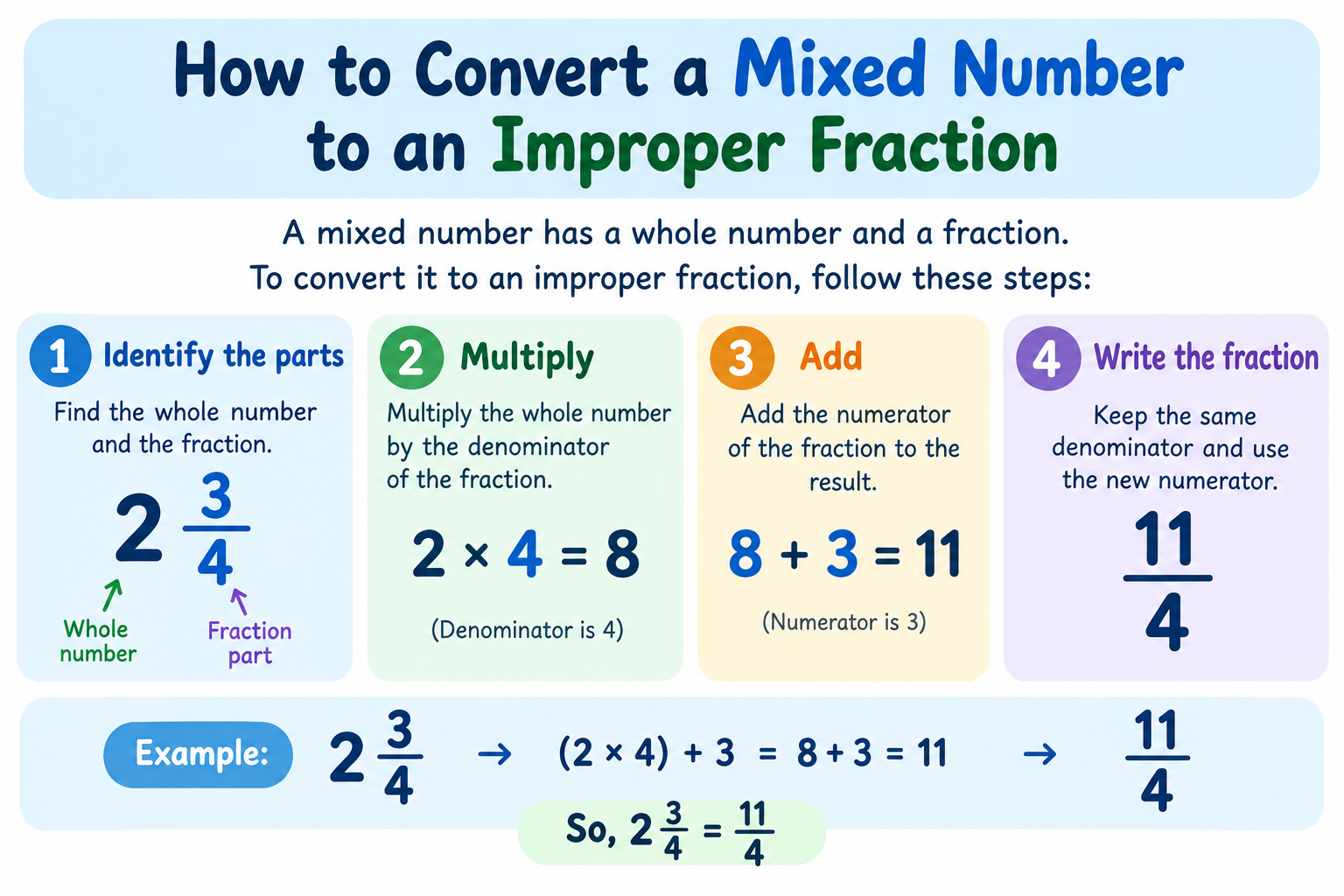
The formula for converting a mixed number to an improper fraction is:
For a mixed number W n/d:
Improper fraction = (W × d) + n / d
Where:
- W = the whole number part
- n = the numerator of the fractional part
- d = the denominator of the fractional part
In words:
- Multiply the whole number by the denominator.
- Add the numerator to that product.
- Place the result over the original denominator.
Example:
Convert 2 3/4:
(2 × 4) + 3 = 8 + 3 = 11
Place over 4: 11/4
The denominator stays exactly the same. Only the numerator changes.
Why Does the Formula Work?
Understanding the reasoning behind the formula makes it much easier to remember and apply correctly.
A mixed number such as 2 3/4 means:
2 + 3/4
The whole number 2 can be written as a fraction with the same denominator as the fractional part. Since the denominator is 4:
2 = 8/4
Now you can add the two fractions with the same denominator:
8/4 + 3/4 = 11/4
The formula simply automates this process. When you multiply the whole number (2) by the denominator (4), you are finding how many quarters are in 2 whole units (8 quarters). Adding the existing numerator (3) gives you the total number of quarters (11). The denominator stays as 4 because you are still counting quarters throughout.
This is not a trick or a shortcut — it is a direct application of what fractions mean.
How to Convert a Mixed Number to an Improper Fraction — Step by Step
Step 1: Identify the three parts
Write down the whole number (W), the numerator (n), and the denominator (d) separately.
Step 2: Multiply the whole number by the denominator
Calculate W × d. This tells you how many fractional parts are in the whole number portion.
Step 3: Add the numerator
Add n to the result from Step 2. This gives you the total number of fractional parts.
Step 4: Write the result over the original denominator
Place the sum from Step 3 above the denominator d.
Step 5: Check whether the fraction can be simplified
In most cases the result will not simplify, but always check. If the numerator and denominator share a common factor, divide both by it.
Worked Examples
Example 1: Convert 3 1/2 to an improper fraction.
- W = 3, n = 1, d = 2
- Step 2: 3 × 2 = 6
- Step 3: 6 + 1 = 7
- Step 4: 7/2
Answer: 7/2
Check: 7 ÷ 2 = 3 remainder 1 → 3 1/2 ✓
Example 2: Convert 4 2/3 to an improper fraction.
- W = 4, n = 2, d = 3
- Step 2: 4 × 3 = 12
- Step 3: 12 + 2 = 14
- Step 4: 14/3
Answer: 14/3
Check: 14 ÷ 3 = 4 remainder 2 → 4 2/3 ✓
Example 3: Convert 5 3/4 to an improper fraction.
- W = 5, n = 3, d = 4
- Step 2: 5 × 4 = 20
- Step 3: 20 + 3 = 23
- Step 4: 23/4
Answer: 23/4
Check: 23 ÷ 4 = 5 remainder 3 → 5 3/4 ✓
Example 4: Convert 2 5/6 to an improper fraction.
- W = 2, n = 5, d = 6
- Step 2: 2 × 6 = 12
- Step 3: 12 + 5 = 17
- Step 4: 17/6
Answer: 17/6
Check: 17 ÷ 6 = 2 remainder 5 → 2 5/6 ✓
Example 5: Convert 7 3/8 to an improper fraction.
- W = 7, n = 3, d = 8
- Step 2: 7 × 8 = 56
- Step 3: 56 + 3 = 59
- Step 4: 59/8
Answer: 59/8
Check: 59 ÷ 8 = 7 remainder 3 → 7 3/8 ✓
Example 6: Convert 6 1/5 to an improper fraction.
- W = 6, n = 1, d = 5
- Step 2: 6 × 5 = 30
- Step 3: 30 + 1 = 31
- Step 4: 31/5
Answer: 31/5
Example 7: Convert 9 4/7 to an improper fraction.
- W = 9, n = 4, d = 7
- Step 2: 9 × 7 = 63
- Step 3: 63 + 4 = 67
- Step 4: 67/7
Answer: 67/7
Example 8: Convert 3 5/9 to an improper fraction.
- W = 3, n = 5, d = 9
- Step 2: 3 × 9 = 27
- Step 3: 27 + 5 = 32
- Step 4: 32/9
Answer: 32/9
Example 9: Convert 8 7/10 to an improper fraction.
- W = 8, n = 7, d = 10
- Step 2: 8 × 10 = 80
- Step 3: 80 + 7 = 87
- Step 4: 87/10
Answer: 87/10
Example 10: Convert 12 3/5 to an improper fraction.
- W = 12, n = 3, d = 5
- Step 2: 12 × 5 = 60
- Step 3: 60 + 3 = 63
- Step 4: 63/5
Answer: 63/5
Example 11: Convert 1 11/12 to an improper fraction.
- W = 1, n = 11, d = 12
- Step 2: 1 × 12 = 12
- Step 3: 12 + 11 = 23
- Step 4: 23/12
Answer: 23/12
Example 12: Convert 5 7/8 to an improper fraction.
- W = 5, n = 7, d = 8
- Step 2: 5 × 8 = 40
- Step 3: 40 + 7 = 47
- Step 4: 47/8
Answer: 47/8
Example 13: Convert 10 1/3 to an improper fraction.
- W = 10, n = 1, d = 3
- Step 2: 10 × 3 = 30
- Step 3: 30 + 1 = 31
- Step 4: 31/3
Answer: 31/3
Example 14: Convert 4 9/11 to an improper fraction.
- W = 4, n = 9, d = 11
- Step 2: 4 × 11 = 44
- Step 3: 44 + 9 = 53
- Step 4: 53/11
Answer: 53/11
Example 15: Convert 6 5/12 to an improper fraction.
- W = 6, n = 5, d = 12
- Step 2: 6 × 12 = 72
- Step 3: 72 + 5 = 77
- Step 4: 77/12
Answer: 77/12
Converting Mixed Numbers With Large Numbers
The process is identical regardless of how large the numbers become. The only extra care needed is accuracy in multiplication.
Example 1: Convert 25 7/9 to an improper fraction.
- W = 25, n = 7, d = 9
- 25 × 9 = 225
- 225 + 7 = 232
Answer: 232/9
Example 2: Convert 100 3/4 to an improper fraction.
- W = 100, n = 3, d = 4
- 100 × 4 = 400
- 400 + 3 = 403
Answer: 403/4
Example 3: Convert 50 11/12 to an improper fraction.
- W = 50, n = 11, d = 12
- 50 × 12 = 600
- 600 + 11 = 611
Answer: 611/12
With larger whole numbers, taking an extra moment to verify the multiplication step prevents errors. Writing out the working clearly is always worthwhile.
Converting Mixed Numbers With Whole Number Parts of 1
When the whole number is 1, the calculation is particularly simple — but students sometimes rush and make errors here.
Example 1: Convert 1 3/4 to an improper fraction.
- 1 × 4 = 4
- 4 + 3 = 7
Answer: 7/4
Example 2: Convert 1 5/8 to an improper fraction.
- 1 × 8 = 8
- 8 + 5 = 13
Answer: 13/8
Example 3: Convert 1 2/3 to an improper fraction.
- 1 × 3 = 3
- 3 + 2 = 5
Answer: 5/3
Example 4: Convert 1 9/10 to an improper fraction.
- 1 × 10 = 10
- 10 + 9 = 19
Answer: 19/10
Notice that when the whole number is 1, you simply add the denominator and the numerator to get the new numerator. This makes sense: 1 whole unit expressed in the same denominator equals one lot of the denominator, and adding the numerator gives the total count.
Converting Negative Mixed Numbers
Negative mixed numbers follow exactly the same conversion process. The negative sign applies to the entire mixed number, so you convert the magnitude first and then reattach the negative sign.
Example 1: Convert −2 3/4 to an improper fraction.
Convert 2 3/4 first:
(2 × 4) + 3 = 11 → 11/4
Reattach the negative sign:
Answer: −11/4
Example 2: Convert −5 1/3 to an improper fraction.
(5 × 3) + 1 = 16 → 16/3
Answer: −16/3
Example 3: Convert −1 7/8 to an improper fraction.
(1 × 8) + 7 = 15 → 15/8
Answer: −15/8
The key point is that the negative sign belongs to the whole expression. A common mistake is placing the negative sign only on the whole number and then treating the fraction as positive — this produces an incorrect result.
Common Mistakes and How to Avoid Them
Mistake 1: Adding the whole number and numerator without multiplying first
Some students write 2 3/4 as (2 + 3)/4 = 5/4. This ignores the fact that the whole number must first be expressed as quarters. Always multiply the whole number by the denominator before adding the numerator.
How to avoid it: Always follow the order: multiply first, then add.
Mistake 2: Changing the denominator
The denominator stays exactly the same throughout the conversion. Writing 2 3/4 as 11/8 (doubling the denominator) is a frequent error.
How to avoid it: Write the denominator down at the start and do not touch it again.
Mistake 3: Adding the whole number to the denominator instead of multiplying
A confused student might write (2 + 4) + 3 = 9 → 9/4 instead of the correct 11/4. This misapplies the formula entirely.
How to avoid it: Write the formula explicitly — W × d + n — and substitute the values carefully.
Mistake 4: Forgetting to add the numerator
After multiplying, some students forget the second step and write W × d directly over the denominator. For 2 3/4, this gives 8/4 instead of 11/4.
How to avoid it: Double-check by counting the steps. The process has two arithmetic operations: multiply, then add.
Mistake 5: Misidentifying the parts of the mixed number
Confusing the numerator and denominator leads to multiplying by the wrong number. In 3 2/5, the denominator is 5 (not 2) and the numerator is 2 (not 5).
How to avoid it: Label W, n, and d explicitly before calculating, especially in assessments.
Mistake 6: Dropping the negative sign
When converting a negative mixed number, students sometimes write the answer as a positive improper fraction, losing the negative entirely.
How to avoid it: Note the sign at the start and reapply it at the end.
Mistake 7: Not simplifying when required
Occasionally the resulting improper fraction can be simplified. For example, if a calculation produces 12/8, this should be simplified to 3/2. Always check.
How to avoid it: After converting, check whether the numerator and denominator share a common factor.
Checking Your Answer
The quickest way to check a conversion is to reverse it. Convert your improper fraction back to a mixed number and verify it matches the original.
To convert an improper fraction back to a mixed number:
Divide the numerator by the denominator. The quotient is the whole number, the remainder is the new numerator, and the denominator stays the same.
Example: Check that 2 3/4 = 11/4
11 ÷ 4 = 2 remainder 3 → 2 3/4 ✓
Example: Check that 5 2/3 = 17/3
17 ÷ 3 = 5 remainder 2 → 5 2/3 ✓
This reverse check takes only a few seconds and immediately confirms whether your conversion is correct. Developing the habit of checking in both directions builds accuracy and confidence over time.
You can also verify using decimals. Convert both the mixed number and the improper fraction to decimals and confirm they match:
2 3/4 = 2.75 and 11/4 = 11 ÷ 4 = 2.75 ✓
Real-Life Applications
Understanding why this conversion matters in real life helps it feel relevant rather than abstract.
Cooking and baking: A recipe requires 2 1/2 cups of flour multiplied by three (to triple the recipe). To calculate 2 1/2 × 3, convert to 5/2 × 3 = 15/2 = 7 1/2 cups.
Construction and carpentry: A carpenter needs to divide a plank of 5 3/4 metres into equal pieces of 3/4 metres each. The calculation 5 3/4 ÷ 3/4 requires converting 5 3/4 to 23/4 first: 23/4 ÷ 3/4 = 23/3 ≈ 7 pieces.
Science and measurement: Laboratory calculations often involve multiplying measured quantities that are expressed as mixed numbers. Converting to improper fractions before calculating prevents errors in multi-step problems.
Time calculations: Multiplying 1 1/2 hours by an hourly rate requires converting 1 1/2 to 3/2 first. This is a routine calculation in pay, scheduling, and project planning.
Distance and speed: If a car travels at a speed that covers 12 1/2 km every quarter hour, converting to 25/2 makes further calculations with fractions much cleaner.
In each case, the conversion step is not the end goal — it is the preparation that makes the real calculation possible.
How This Skill Connects to Other Topics
Converting mixed numbers to improper fractions does not sit in isolation. It connects directly to several other areas of mathematics.
Multiplying mixed numbers: You cannot multiply mixed numbers reliably without first converting them. This is the most common reason students need this skill. For the complete guide to operations with mixed numbers, the article What Is a Mixed Number? covers all four operations in detail.
Dividing mixed numbers: The same applies to division. Both mixed numbers must become improper fractions before you apply the reciprocal method.
Comparing fractions: When comparing a mixed number to an improper fraction, converting the mixed number allows a direct comparison. The article How to Compare Fractions With Different Denominators explains the comparison process in full.
Adding and subtracting fractions: While you can add and subtract mixed numbers without converting, some students find it easier to convert to improper fractions first. A solid understanding of How to Add Fractions With Different Denominators complements this skill well.
Equivalent fractions: Understanding that a whole number can be written as a fraction (2 = 8/4) is an application of equivalent fraction thinking. The concept of What Are Equivalent Fractions? underpins the logic of the conversion formula.
Place value and number sense: Working fluently with mixed numbers and improper fractions strengthens overall number sense and prepares students for rational number work in algebra.
Practice Questions
Work through each question independently. Answers are provided below.
Convert each mixed number to an improper fraction.
- 1 1/2
- 2 2/3
- 3 3/4
- 4 1/5
- 5 2/7
- 6 3/8
- 7 4/9
- 8 5/6
- 9 1/4
- 10 7/10
Convert and simplify where possible.
- 2 2/4
- 3 3/6
- 4 4/8
- 5 6/9
- 6 4/10
Convert negative mixed numbers.
- −1 1/3
- −3 2/5
- −4 3/7
Word problems.
- A plank of wood is 4 3/8 metres long. Write this length as an improper fraction.
- A recipe uses 2 3/4 cups of sugar. Write this as an improper fraction.
- A car travels 6 1/2 km. Express this distance as an improper fraction.
- A bag of rice weighs 3 5/6 kg. Write this weight as an improper fraction.
- A film lasts 2 1/4 hours. Write the duration as an improper fraction.
True or False.
- 3 2/5 converted to an improper fraction is 17/5. (True / False)
- The denominator changes when converting a mixed number to an improper fraction. (True / False)
Answers:
- 3/2
- 8/3
- 15/4
- 21/5
- 37/7
- 51/8
- 67/9
- 53/6
- 37/4
- 107/10
- 10/4 = 5/2
- 21/6 = 7/2
- 36/8 = 9/2
- 51/9 = 17/3
- 64/10 = 32/5
- −4/3
- −17/5
- −31/7
- 35/8
- 11/4
- 13/2
- 23/6
- 9/4
- True — (3 × 5) + 2 = 17 → 17/5
- False — the denominator stays the same
Multiple-Choice Questions
Question 1: What is 3 2/5 as an improper fraction?
A) 5/5
B) 11/5
C) 17/5
D) 13/5
Correct Answer: C — 17/5
(3 × 5) + 2 = 15 + 2 = 17. Place over 5 → 17/5.
Question 2: Which step comes first when converting a mixed number to an improper fraction?
A) Add the numerator to the denominator
B) Multiply the whole number by the numerator
C) Multiply the whole number by the denominator
D) Divide the numerator by the denominator
Correct Answer: C — Multiply the whole number by the denominator
The first step is always to multiply W × d, which gives the number of fractional parts in the whole number portion.
Question 3: What is 1 7/8 as an improper fraction?
A) 15/8
B) 17/8
C) 8/8
D) 9/8
Correct Answer: A — 15/8
(1 × 8) + 7 = 8 + 7 = 15 → 15/8.
Question 4: A student converts 4 3/7 and gets 19/7. Is this correct?
A) Yes — the answer is correct
B) No — the correct answer is 31/7
C) No — the correct answer is 28/7
D) No — the correct answer is 15/7
Correct Answer: B — No, the correct answer is 31/7
(4 × 7) + 3 = 28 + 3 = 31 → 31/7. The student likely added 4 + 3 + 7 + 5 in some incorrect way.
Question 5: What is 10 1/2 as an improper fraction?
A) 11/2
B) 20/2
C) 21/2
D) 10/2
Correct Answer: C — 21/2
(10 × 2) + 1 = 20 + 1 = 21 → 21/2.
Question 6: The denominator of the resulting improper fraction is always:
A) The original numerator
B) The original whole number
C) The original denominator
D) The product of the whole number and numerator
Correct Answer: C — The original denominator
The denominator never changes during this conversion. You are simply expressing more parts using the same unit.
Question 7: What is −2 3/4 as an improper fraction?
A) 11/4
B) −5/4
C) −11/4
D) −9/4
Correct Answer: C — −11/4
(2 × 4) + 3 = 11 → 11/4. Reattach the negative sign → −11/4.
Question 8: Which of the following mixed numbers converts to 29/6?
A) 4 5/6
B) 5 1/6
C) 4 4/6
D) 3 5/6
Correct Answer: A — 4 5/6
(4 × 6) + 5 = 24 + 5 = 29 → 29/6.
Question 9: A baker uses 3 1/4 cups of flour. Which improper fraction represents this?
A) 12/4
B) 13/4
C) 14/4
D) 10/4
Correct Answer: B — 13/4
(3 × 4) + 1 = 12 + 1 = 13 → 13/4.
Question 10: What is 7 2/3 as an improper fraction?
A) 21/3
B) 22/3
C) 23/3
D) 20/3
Correct Answer: C — 23/3
(7 × 3) + 2 = 21 + 2 = 23 → 23/3.
Challenge Questions
Challenge 1: A student says that to convert 5 4/9 to an improper fraction, you just multiply 5 × 4 and put it over 9, giving 20/9. Identify every error in this reasoning and provide the correct answer.
There are two errors:
- Error 1: The student multiplied the whole number (5) by the numerator (4) instead of the whole number by the denominator (9).
- Error 2: The student forgot to add the original numerator after multiplying.
Correct working:
(5 × 9) + 4 = 45 + 4 = 49
Correct answer: 49/9
Challenge 2: Convert 8 11/12 to an improper fraction, then verify your answer by converting it back.
(8 × 12) + 11 = 96 + 11 = 107
Improper fraction: 107/12
Verification: 107 ÷ 12 = 8 remainder 11 → 8 11/12 ✓
Challenge 3: A recipe calls for 3 2/3 cups of milk. The cook wants to triple the recipe. Convert 3 2/3 to an improper fraction, multiply by 3, and express the final answer as a mixed number.
Convert: (3 × 3) + 2 = 11 → 11/3
Multiply by 3: 11/3 × 3/1 = 33/3 = 11
Answer: 11 cups
Challenge 4: Place the following mixed numbers in order from least to greatest by converting each to an improper fraction: 3 5/6, 3 7/9, 3 4/7.
Convert each:
3 5/6 = (18 + 5)/6 = 23/6
3 7/9 = (27 + 7)/9 = 34/9
3 4/7 = (21 + 4)/7 = 25/7
Find common denominator for 6, 9, 7: LCM = 126
23/6 = 483/126
34/9 = 476/126
25/7 = 450/126
Order: 450/126 < 476/126 < 483/126
Answer: 3 4/7 < 3 7/9 < 3 5/6
Challenge 5: A length of rope measures 12 3/8 metres. It is cut into pieces of 3/8 metre each. How many pieces are produced? Use the conversion to an improper fraction in your solution.
Convert 12 3/8:
(12 × 8) + 3 = 96 + 3 = 99/8
Divide: 99/8 ÷ 3/8 = 99/8 × 8/3 = 792/24 = 33
Answer: 33 pieces
Quick Revision Notes
- A mixed number has a whole number part and a proper fractional part: W n/d.
- An improper fraction has a numerator ≥ denominator.
- Conversion formula: (W × d) + n placed over d.
- The denominator never changes.
- Step 1: Multiply whole number × denominator.
- Step 2: Add the numerator.
- Step 3: Place the result over the original denominator.
- Check your answer by dividing the improper fraction back into a mixed number.
- For negative mixed numbers, convert the magnitude and then reattach the negative sign.
- Simplify the improper fraction if the numerator and denominator share a common factor.
Conversion Cheat Sheet
| Mixed Number | W × d | + n | Improper Fraction |
|---|---|---|---|
| 1 1/2 | 1 × 2 = 2 | 2 + 1 = 3 | 3/2 |
| 2 3/4 | 2 × 4 = 8 | 8 + 3 = 11 | 11/4 |
| 3 2/5 | 3 × 5 = 15 | 15 + 2 = 17 | 17/5 |
| 4 1/3 | 4 × 3 = 12 | 12 + 1 = 13 | 13/3 |
| 5 3/8 | 5 × 8 = 40 | 40 + 3 = 43 | 43/8 |
| 6 5/9 | 6 × 9 = 54 | 54 + 5 = 59 | 59/9 |
| 7 2/7 | 7 × 7 = 49 | 49 + 2 = 51 | 51/7 |
| 10 3/4 | 10 × 4 = 40 | 40 + 3 = 43 | 43/4 |
Quick reminder: Multiply → Add → Same denominator.
Exam Tips
- Before converting, label W, n, and d clearly — especially if the numbers are large or the question is multi-step. This one habit eliminates most conversion errors.
- Always multiply W × d first. The multiplication step must come before the addition step, every time.
- Never change the denominator. Write it at the start and remind yourself it stays fixed.
- After writing your improper fraction, spend five seconds checking it by dividing back. This single check catches the vast majority of errors before you submit your answer.
- For negative mixed numbers, convert as normal and add the negative sign at the very end. Do not let the negative sign distract you mid-calculation.
- Check whether the resulting improper fraction can be simplified. If the question requires the simplest form, an unsimplified answer may not receive full marks.
- In multi-step questions — such as multiplying two mixed numbers — convert both fractions before doing anything else. Attempting to calculate with unconverted mixed numbers is a guaranteed source of error.
- If you are unsure whether your answer is right, verify using decimals: convert both the original mixed number and your improper fraction to decimals and confirm they match.
Frequently Asked Questions
1. What is the formula for converting a mixed number to an improper fraction?
The formula is (W × d) + n, placed over d. Multiply the whole number by the denominator, add the numerator, and write the result over the original denominator. The denominator does not change.
2. Why does the denominator stay the same when converting?
The denominator represents the size of each part — for example, quarters or eighths. Throughout the conversion, you are expressing everything in terms of those same parts. Only the count of parts (the numerator) changes; the size of each part (the denominator) stays fixed.
3. Why do you multiply the whole number by the denominator?
Multiplying the whole number by the denominator converts the whole units into the same fractional parts as the fraction. For example, 2 whole units expressed in quarters is 8 quarters (2 × 4 = 8). This allows you to combine the whole and fractional parts into a single fraction.
4. Can you convert a mixed number without using the formula?
Yes. You can express the whole number as a fraction with the same denominator and then add the two fractions. For example, 2 3/4 = 8/4 + 3/4 = 11/4. The formula simply automates this process in one step.
5. Does the resulting improper fraction always need simplifying?
Not always. Most conversions produce an improper fraction that is already in its simplest form. However, you should always check whether the numerator and denominator share a common factor, especially after performing operations.
6. How do you convert a negative mixed number?
Convert the magnitude (ignoring the negative sign) using the standard formula, and then reattach the negative sign to the resulting improper fraction. For example, −3 1/4 → 13/4 → −13/4.
7. What is 2 1/2 as an improper fraction?
(2 × 2) + 1 = 5. The answer is 5/2.
8. What is 5 3/4 as an improper fraction?
(5 × 4) + 3 = 23. The answer is 23/4.
9. How do you check whether your conversion is correct?
Divide the numerator of your improper fraction by the denominator. If the quotient and remainder match the whole number and numerator of the original mixed number, the conversion is correct.
10. Why is this conversion important for multiplying mixed numbers?
You cannot multiply mixed numbers by treating the whole and fractional parts separately. Converting to improper fractions first gives you a single unified fraction that can be multiplied directly across numerators and denominators.
11. What is 1 1/4 as an improper fraction?
(1 × 4) + 1 = 5. The answer is 5/4.
12. Is it possible for a mixed number to convert to a fraction that simplifies to a whole number?
Yes, if the numerator of the resulting improper fraction is exactly divisible by the denominator. For example, 2 2/4 → 10/4 → 5/2. But something like 3 1/3 → 10/3, which does not simplify to a whole number. A case that does: 1 1/2 × 2 → first convert 1 1/2 = 3/2; then 3/2 × 2 = 6/2 = 3.
13. Can this method be used for fractions with large denominators?
Absolutely. The method works for any denominator. For example, 3 17/100 → (3 × 100) + 17 = 317/100. The arithmetic requires more care with larger numbers, but the method is identical.
14. What happens if the fractional part of a mixed number is already an improper fraction?
By definition, the fractional part of a correctly written mixed number is always a proper fraction. If you encounter something like 3 5/4, the fractional part 5/4 is improper and should first be simplified: 5/4 = 1 1/4, so 3 5/4 = 3 + 1 1/4 = 4 1/4. Then convert: (4 × 4) + 1 = 17/4.
15. How is this skill connected to equivalent fractions?
The conversion relies on the concept that a whole number can be expressed as an equivalent fraction. For instance, 3 = 15/5 when working with fifths. Understanding What Is a Number Line? can also reinforce this, as you can see visually that 3 whole units equal 15 fifths when the interval is divided into fifths.
Summary
Converting a mixed number to an improper fraction is a compact, reliable three-step process:
- Multiply the whole number by the denominator.
- Add the numerator to that product.
- Place the result over the original denominator — which never changes.
The formula works because it expresses the whole number part as fractional units (the same size as the denominator), then combines those units with the existing fractional part into a single count.
This skill is not an end in itself — it is a gateway. Every time you multiply or divide mixed numbers, you need this conversion. Every time a problem presents a mixed number but requires calculation in fractional form, this is the step that makes it possible.
The most important habits to develop are: always multiply before adding, never change the denominator, and always verify your answer by reversing the conversion. With these habits in place, the process becomes second nature.
Final Thoughts
There is something satisfying about a mathematical skill that is both simple in principle and genuinely useful in practice. Converting a mixed number to an improper fraction is exactly that. The method is short, the reasoning is clear, and once you have practised it enough times, it becomes completely automatic.
If you find yourself hesitating or making errors, go back to the reasoning rather than just the rule. Ask yourself: what am I actually doing here? You are rewriting the whole number as an equivalent fraction so that you can add it to the fractional part. That understanding is far more durable than a formula memorised without context.
Work through the practice questions in this guide, use the cheat sheet as a reference while you are still building fluency, and use the check method every time until you no longer need it. Before long, you will be converting mixed numbers to improper fractions instinctively — and every calculation involving mixed numbers will feel more manageable as a result.
Helpful Resources
- Khan Academy — Rewriting Mixed Numbers as Improper Fractions
Clear video lessons and interactive practice exercises on converting mixed numbers to improper fractions, with immediate feedback on answers.
https://www.khanacademy.org/math/arithmetic/fraction-arithmetic - OpenStax Prealgebra — Fractions and Mixed Numbers
A free, peer-reviewed prealgebra textbook covering mixed numbers, improper fractions, and conversion methods with fully worked examples and practice problems.
https://openstax.org/books/prealgebra-2e/pages/1-introduction - Mathematics LibreTexts — Mixed Numbers and Improper Fractions
A detailed open-access mathematics resource explaining the relationship between mixed numbers and improper fractions, including conversion in both directions.
https://math.libretexts.org - National Council of Teachers of Mathematics (NCTM)
The leading professional body for mathematics education, providing standards and research-based guidance on teaching fractions and number sense effectively.
https://www.nctm.org
Disclaimer:
This article is intended for educational and informational purposes only. While LearnMinto strives to provide accurate and up-to-date mathematics information, readers should verify important academic concepts through official textbooks, educational institutions, examination boards, or trusted educational resources before using this content for exams or academic purposes. LearnMinto is not affiliated with any specific school, university, research institution, or examination board.