
Introduction
Walk into any chemistry classroom and ask students what isotopes are, and you will get a variety of answers — some close, some way off, and a few that confuse isotopes with ions or isobars. It is one of those topics that sounds simple on the surface but contains a surprising amount of depth once you start exploring it properly.
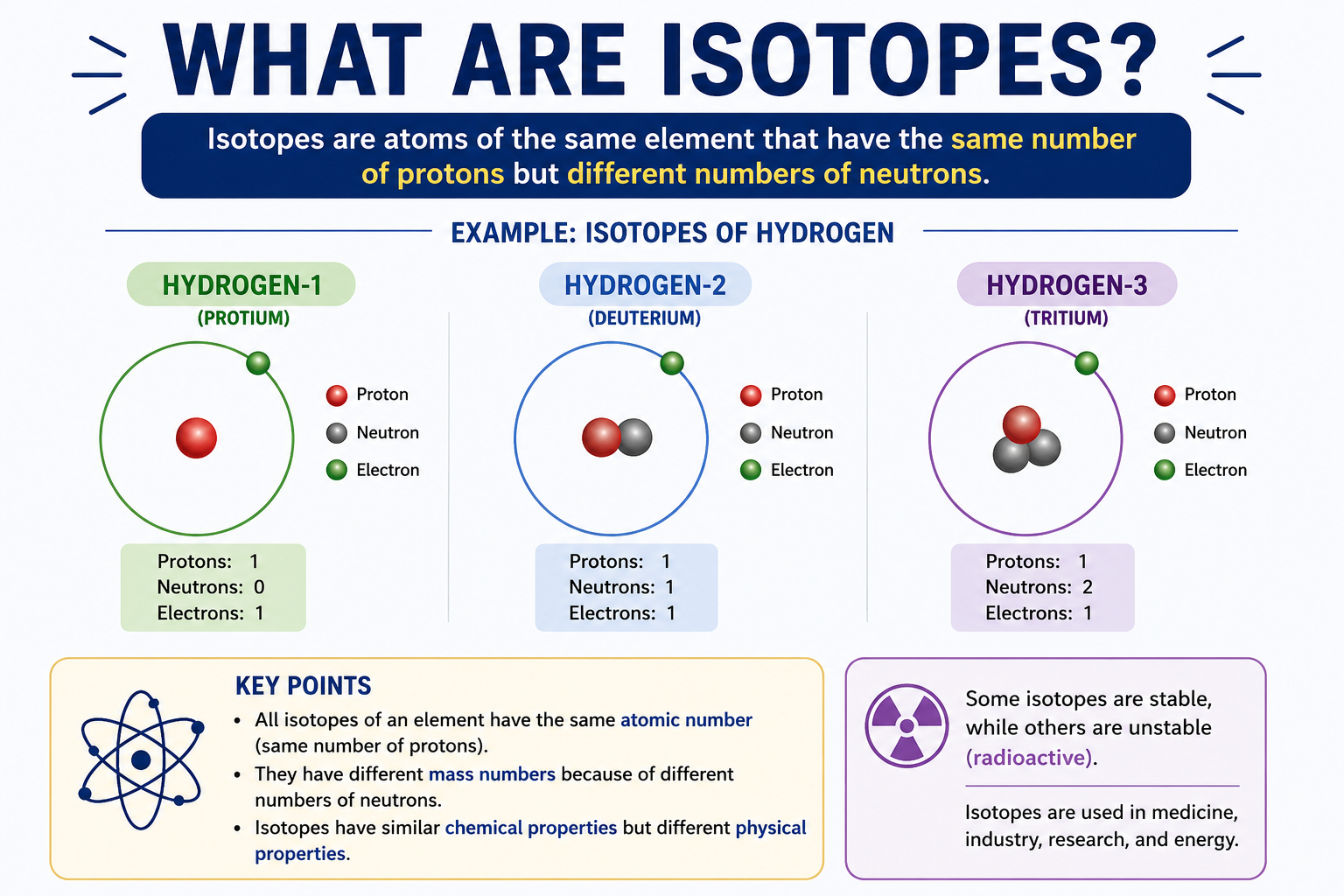
So, what are isotopes? In the most straightforward terms, isotopes are atoms of the same element that have different numbers of neutrons in their nuclei. They share the same atomic number — meaning the same number of protons — but their mass numbers differ because of those extra or fewer neutrons. That one difference might seem minor, but it has enormous consequences, from the stability of the atom to how it behaves in a nuclear reactor or inside the human body during a medical scan.
Isotopes are not exotic laboratory curiosities. They are found everywhere in nature. The carbon in your body exists as a mixture of isotopes. The hydrogen in water has isotopic forms. The uranium used in nuclear power plants is a specific isotope selected for its unique nuclear properties. Even the technique used to date ancient artifacts — radiocarbon dating — depends entirely on the behavior of a single isotope of carbon.
For students preparing for NEET, MDCAT, ECAT, SAT Chemistry, GCSE, or A-Level examinations, isotopes appear in questions about atomic structure, nuclear chemistry, periodic table trends, and quantitative calculations. Understanding this topic well does not just help you answer one question — it strengthens your grasp of a wide range of related concepts.
This guide covers everything you need to know about isotopes: their definition, discovery, structure, types, examples, differences from ions and isobars, real-world applications, solved numerical problems, and a complete set of exam-focused practice questions.
Key Takeaways
These points summarize the most important ideas in this guide. Keep them in mind as you work through each section.
- Isotopes are atoms of the same element with the same number of protons but different numbers of neutrons.
- Because isotopes have the same number of protons, they belong to the same element and have identical chemical properties.
- Isotopes differ in their mass numbers and, as a result, their physical properties and nuclear stability.
- Some isotopes are stable and exist indefinitely. Others are radioactive and decay over time, releasing energy.
- The atomic mass shown on the periodic table is the weighted average of all naturally occurring isotopes of an element.
- Isotopes have critical applications in medicine, agriculture, archaeology, nuclear energy, and scientific research.
- Carbon-14, a radioactive isotope of carbon, is the basis of radiocarbon dating — a method used to determine the age of organic materials up to about 50,000 years old.
- Hydrogen is unique because its three isotopes — protium, deuterium, and tritium — have been given individual names due to their significant differences in properties.
What Are Isotopes?
Definition
Isotopes are defined as atoms of the same element that have the same atomic number (same number of protons) but different mass numbers (different numbers of neutrons). Because they have the same number of protons, they are chemically identical — they form the same types of bonds, react in the same ways, and occupy the same position on the periodic table. But because they have different numbers of neutrons, they have different masses and different nuclear properties.
The word “isotope” comes from the Greek words “isos” (meaning equal) and “topos” (meaning place), which together mean “same place.” This refers to the fact that isotopes of an element occupy the same place on the periodic table.
Simple Explanation
Imagine a family of triplets who all look alike, have the same personality, and behave the same way in social situations — but one weighs 60 kg, another weighs 65 kg, and the third weighs 70 kg. They are essentially the same person in terms of identity, but they carry different amounts of mass. Isotopes work in a similar way. Same element, same chemical behavior, but different masses because of the varying number of neutrons in the nucleus.
The key rule to remember is this: change the number of protons, and you change the element. Change the number of neutrons, and you create a different isotope of the same element.
Why Are Isotopes Important?
Isotopes matter for reasons that go far beyond chemistry textbooks. Their practical importance touches medicine, energy, environment, and history.
In medicine, radioactive isotopes are used to image internal organs, diagnose diseases, and deliver targeted radiation therapy to cancer cells. In archaeology, the radioactive decay of Carbon-14 allows scientists to calculate how long ago an organism lived. In nuclear power plants, the fission of Uranium-235 releases the energy that generates electricity for millions of homes.
From a purely academic perspective, understanding isotopes is essential for making sense of why atomic mass is a decimal number on the periodic table, why elements have naturally occurring mixtures rather than uniform atoms, and how nuclear reactions differ from ordinary chemical reactions.
Isotopes also help explain why the periodic table is organized the way it is, and they are the foundation of an entire branch of chemistry called nuclear chemistry or radiochemistry.
History of Isotopes
Discovery of Isotopes
The concept of isotopes emerged in the early twentieth century as scientists began probing the internal structure of atoms. Before this period, chemists noticed something puzzling: certain elements from radioactive decay series seemed chemically identical to known elements but had slightly different atomic masses. This was a paradox that the existing understanding of atomic structure could not explain.
The breakthrough came when scientists realized that atoms of the same element could exist with different masses — not because of any error in measurement, but because the nucleus could contain varying numbers of a neutral particle (the neutron, though it was not formally discovered until 1932).
Frederick Soddy’s Contribution
The term “isotope” was coined by British chemist Frederick Soddy in 1913. After extensive work on radioactive elements and their decay products, Soddy recognized that multiple forms of the same element could exist with different atomic masses. He proposed that these atoms occupied the same position on the periodic table and introduced the word “isotope” to describe them.
Frederick Soddy was awarded the Nobel Prize in Chemistry in 1921 for his work on radioactive substances, including the discovery and naming of isotopes. His work fundamentally changed how chemists thought about the relationship between atomic identity and atomic mass.
The discovery of the neutron by James Chadwick in 1932 provided the final piece of the puzzle, explaining exactly why atoms of the same element could have different masses — they simply contained different numbers of neutrons.
How Are Isotopes Formed?
Isotopes arise naturally through several processes, and they can also be produced artificially in laboratories and nuclear reactors.
Natural formation occurs through:
- Primordial nucleosynthesis — the formation of light elements in the early universe, producing multiple isotopes of hydrogen and helium.
- Stellar nucleosynthesis — nuclear fusion inside stars, which creates heavier elements in their various isotopic forms.
- Cosmic ray bombardment — high-energy particles from space collide with atoms in Earth’s atmosphere, sometimes transforming one isotope into another. This is how Carbon-14 is continuously produced from Nitrogen-14 in the upper atmosphere.
- Radioactive decay chains — when one radioactive isotope decays, it often produces a different isotope, either of the same element or a different one.
Artificial formation occurs through:
- Neutron bombardment in nuclear reactors, where stable atoms absorb extra neutrons and become radioactive isotopes.
- Particle accelerators, where high-energy collisions produce short-lived isotopes for research and medical use.
- Nuclear fission and fusion reactions, which generate a wide range of isotopes as byproducts.
Structure of an Isotope
To understand isotopes at a structural level, you need to revisit the three fundamental subatomic particles: protons, neutrons, and electrons.
Protons
Protons are positively charged particles located in the nucleus of an atom. The number of protons in an atom is its atomic number (Z), and this number determines which element the atom is. Every atom of carbon has exactly 6 protons. Every atom of oxygen has exactly 8. Change the proton count and you have a different element entirely.
In isotopes, the number of protons never changes. All isotopes of the same element have the same number of protons. This is why they share the same chemical identity.
Neutrons
Neutrons are neutral particles (no charge) also found in the nucleus alongside protons. They contribute to the mass of the atom but do not affect its chemical behavior directly. The number of neutrons is what varies between isotopes of the same element.
For example:
- Carbon-12 has 6 protons and 6 neutrons (mass number = 12)
- Carbon-13 has 6 protons and 7 neutrons (mass number = 13)
- Carbon-14 has 6 protons and 8 neutrons (mass number = 14)
All three are carbon, but each has a different number of neutrons and therefore a different mass number.
Electrons
Electrons are negatively charged particles that orbit the nucleus in shells or energy levels. In a neutral atom, the number of electrons equals the number of protons. Since isotopes of the same element have the same number of protons, they also have the same number of electrons in their neutral state.
This is precisely why isotopes have identical chemical properties — chemical behavior is determined by electron configuration, and isotopes have the same electron configuration. Their nuclear differences do not affect how they form bonds or participate in chemical reactions.
Atomic Number vs Mass Number vs Atomic Mass (Comparison Table)
| Feature | Atomic Number (Z) | Mass Number (A) | Atomic Mass (Ar) |
|---|---|---|---|
| Definition | Number of protons in the nucleus | Total protons plus neutrons | Weighted average mass of all naturally occurring isotopes |
| Type of Value | Whole number | Whole number | Decimal number |
| Unit | No unit | No unit | Atomic mass units (amu) |
| Same for All Isotopes | Yes | No | Yes (it is a fixed average) |
| Found on Periodic Table | Yes | No | Yes |
| Determines Element Identity | Yes | No | No |
| Example for Carbon | 6 | 12, 13, or 14 (by isotope) | 12.011 amu |
| Example for Chlorine | 17 | 35 or 37 (by isotope) | 35.45 amu |
Characteristics of Isotopes
Understanding the general properties of isotopes will help you answer both conceptual and numerical exam questions confidently.
- Isotopes of the same element have the same atomic number but different mass numbers.
- They have the same number of protons and electrons (in neutral form) but different numbers of neutrons.
- Their chemical properties are essentially identical because chemical behavior is governed by electron configuration, which is the same for all isotopes of an element.
- Their physical properties differ slightly. For example, deuterium oxide (heavy water, D₂O) has a slightly higher boiling point and density than ordinary water (H₂O).
- Some isotopes are stable and do not decay. Others are unstable (radioactive) and emit radiation over time.
- The ratio of protons to neutrons in the nucleus is an important factor in determining whether an isotope is stable or radioactive.
- Isotopes of the same element occupy the same position on the periodic table.
- The natural abundance of each isotope is fixed for a given element as found on Earth, though it can vary slightly depending on location and geological history.
Types of Isotopes
Stable Isotopes
Stable isotopes are atoms that do not undergo radioactive decay. Their nuclei are in a state of balance, meaning the ratio of protons to neutrons is within an acceptable range for nuclear stability. Stable isotopes remain unchanged indefinitely under normal conditions.
Most elements found in nature have at least one stable isotope. Some elements, like tin, have as many as ten stable isotopes. Stable isotopes are used extensively in scientific research as tracers because they can be detected by mass spectrometry without the complications of radioactive emissions.
Examples of stable isotopes include:
- Carbon-12 and Carbon-13
- Nitrogen-14 and Nitrogen-15
- Oxygen-16, Oxygen-17, and Oxygen-18
- Hydrogen-1 (protium) and Hydrogen-2 (deuterium)
Radioactive Isotopes
Radioactive isotopes, also called radioisotopes or unstable isotopes, have nuclei that are not in a stable configuration. Over time, these atoms spontaneously emit radiation in the form of alpha particles, beta particles, or gamma rays as the nucleus rearranges itself into a more stable form. This process is called radioactive decay.
Each radioactive isotope decays at a characteristic rate, described by its half-life — the time it takes for half of a given sample to decay. Half-lives range from fractions of a second to billions of years.
Examples of radioactive isotopes include:
- Carbon-14 (half-life approximately 5,730 years)
- Uranium-235 (half-life approximately 703.8 million years)
- Iodine-131 (half-life approximately 8 days)
- Tritium or Hydrogen-3 (half-life approximately 12.3 years)
| Feature | Stable Isotopes | Radioactive Isotopes |
|---|---|---|
| Nuclear Stability | Stable, do not decay | Unstable, undergo radioactive decay |
| Radiation Emitted | None | Alpha, beta, or gamma radiation |
| Half-Life | Not applicable | Ranges from milliseconds to billions of years |
| Natural Occurrence | Common in nature | Some occur naturally, others are man-made |
| Uses | Tracers in research, NMR spectroscopy | Medicine, dating, nuclear energy |
| Examples | C-12, N-14, O-16 | C-14, U-235, I-131, Tc-99m |
Common Examples of Isotopes
Hydrogen Isotopes
Hydrogen is the only element whose isotopes have been given unique names, which reflects how dramatically different they are from one another despite sharing the same atomic number of 1. Most elements’ isotopes behave so similarly that naming each one would be impractical, but hydrogen’s isotopes have significant enough differences in their physical properties and practical applications to warrant individual names.
Protium
Protium (Hydrogen-1) is the most common form of hydrogen, making up approximately 99.98% of all naturally occurring hydrogen. Its nucleus contains just one proton and no neutrons. It is perfectly stable and is the hydrogen found in ordinary water (H₂O), in organic molecules, and in the air we breathe as part of water vapor.
- Symbol: ¹H
- Protons: 1
- Neutrons: 0
- Mass Number: 1
- Abundance: ~99.98%
Deuterium
Deuterium (Hydrogen-2) has one proton and one neutron in its nucleus, giving it a mass number of 2. It is stable and makes up about 0.02% of naturally occurring hydrogen. Water made with deuterium instead of regular hydrogen is called heavy water (D₂O), which has a density slightly higher than ordinary water and a boiling point of 101.4°C instead of 100°C.
Heavy water is used in certain nuclear reactors as a moderator — a substance that slows down neutrons to sustain a controlled chain reaction.
- Symbol: ²H or D
- Protons: 1
- Neutrons: 1
- Mass Number: 2
- Abundance: ~0.02%
Tritium
Tritium (Hydrogen-3) has one proton and two neutrons. It is radioactive, with a half-life of approximately 12.3 years, and it decays by emitting a beta particle. It occurs in trace amounts in nature (produced by cosmic ray bombardment of atmospheric nitrogen) and is also produced artificially.
Tritium is used in nuclear fusion research, in self-luminous watch dials and exit signs, and in thermonuclear weapons.
- Symbol: ³H or T
- Protons: 1
- Neutrons: 2
- Mass Number: 3
- Natural State: Radioactive
| Isotope | Name | Protons | Neutrons | Mass Number | Stable or Radioactive | Natural Abundance |
|---|---|---|---|---|---|---|
| ¹H | Protium | 1 | 0 | 1 | Stable | ~99.98% |
| ²H | Deuterium | 1 | 1 | 2 | Stable | ~0.02% |
| ³H | Tritium | 1 | 2 | 3 | Radioactive | Trace |
Carbon Isotopes
Carbon is arguably the most important element in chemistry and biology, and its isotopes play central roles in both living systems and scientific techniques.
Carbon-12
Carbon-12 is the most abundant isotope of carbon, making up approximately 98.89% of all carbon found in nature. Its nucleus contains 6 protons and 6 neutrons. It is stable and serves as the international standard for the atomic mass unit — by definition, one atomic mass unit (amu) is exactly one-twelfth of the mass of a Carbon-12 atom.
- Protons: 6, Neutrons: 6, Mass Number: 12, Abundance: 98.89%, Status: Stable
Carbon-13
Carbon-13 makes up approximately 1.11% of natural carbon. It has 6 protons and 7 neutrons. It is stable and is extensively used in Nuclear Magnetic Resonance (NMR) spectroscopy — a powerful tool chemists use to determine the structure of organic molecules. When you hear about MRI (Magnetic Resonance Imaging) in medicine, the underlying physics is related to the same principle as NMR.
- Protons: 6, Neutrons: 7, Mass Number: 13, Abundance: 1.11%, Status: Stable
Carbon-14
Carbon-14 is a radioactive isotope with 6 protons and 8 neutrons. It is produced naturally in the upper atmosphere when cosmic ray neutrons strike Nitrogen-14 atoms. It has a half-life of approximately 5,730 years and decays back into Nitrogen-14 by emitting a beta particle.
Because living organisms continuously incorporate carbon from the atmosphere, they maintain a roughly constant level of Carbon-14 in their bodies. When an organism dies, it stops taking in new carbon, and the Carbon-14 it contains begins to decay. By measuring the ratio of Carbon-14 to Carbon-12 in a sample, scientists can calculate how long ago the organism died. This technique is called radiocarbon dating and is used widely in archaeology, geology, and environmental science.
- Protons: 6, Neutrons: 8, Mass Number: 14, Abundance: Trace, Status: Radioactive (half-life ~5,730 years)
| Isotope | Protons | Neutrons | Mass Number | Stable or Radioactive | Abundance | Key Use |
|---|---|---|---|---|---|---|
| Carbon-12 | 6 | 6 | 12 | Stable | 98.89% | Standard for amu |
| Carbon-13 | 6 | 7 | 13 | Stable | 1.11% | NMR spectroscopy |
| Carbon-14 | 6 | 8 | 14 | Radioactive | Trace | Radiocarbon dating |
Chlorine Isotopes
Chlorine exists as two naturally occurring stable isotopes: Chlorine-35 and Chlorine-37. Chlorine-35 has 17 protons and 18 neutrons, with a natural abundance of approximately 75.77%. Chlorine-37 has 17 protons and 20 neutrons, with an abundance of approximately 24.23%. The weighted average of these two isotopes gives chlorine its well-known atomic mass of approximately 35.45 amu on the periodic table.
Uranium Isotopes
Uranium has several naturally occurring isotopes, of which Uranium-235 and Uranium-238 are the most significant.
- Uranium-235 (U-235): 92 protons, 143 neutrons. It makes up about 0.72% of natural uranium. It is fissile — meaning it can sustain a chain reaction when bombarded with slow neutrons — making it the primary fuel in many nuclear reactors and the material used in nuclear weapons.
- Uranium-238 (U-238): 92 protons, 146 neutrons. It makes up about 99.27% of natural uranium. It is not fissile under normal conditions but can be converted into Plutonium-239 in a nuclear reactor, which is also a fissile material.
Isotopes vs Ions (Comparison Table)
Students regularly confuse isotopes with ions, and it is easy to see why — both involve a change from the standard atom. But they are completely different concepts.
| Feature | Isotopes | Ions |
|---|---|---|
| What Changes | Number of neutrons | Number of electrons |
| What Stays the Same | Protons and electrons | Protons and neutrons |
| Effect on Element Identity | No change (same element) | No change (same element) |
| Effect on Mass | Yes, mass number changes | Negligible (electrons have tiny mass) |
| Effect on Charge | No change (still neutral) | Yes, charge changes (positive or negative) |
| Effect on Chemical Properties | No significant change | Significant change in reactivity |
| Example | Carbon-12, Carbon-13, Carbon-14 | Na (neutral) vs Na⁺ (ion) |
Isotopes vs Isobars (Comparison Table)
Isobars are atoms that have the same mass number but different atomic numbers — meaning they are different elements. This is the opposite of isotopes in a sense: same mass, different identity.
| Feature | Isotopes | Isobars |
|---|---|---|
| Same Element | Yes | No |
| Same Atomic Number | Yes | No |
| Same Mass Number | No | Yes |
| Same Number of Protons | Yes | No |
| Same Number of Neutrons | No | Not necessarily |
| Position on Periodic Table | Same position | Different positions |
| Example | C-12 and C-14 | C-14 (Z=6) and N-14 (Z=7) |
Isotopes vs Isotones (Comparison Table)
Isotones are atoms that have the same number of neutrons but different numbers of protons — meaning they are different elements with the same neutron count.
| Feature | Isotopes | Isotones |
|---|---|---|
| Same Element | Yes | No |
| Same Number of Protons | Yes | No |
| Same Number of Neutrons | No | Yes |
| Same Mass Number | No | No |
| Same Atomic Number | Yes | No |
| Example | C-12 (6p, 6n) and C-13 (6p, 7n) | C-14 (6p, 8n) and N-15 (7p, 8n) |
How Is Average Atomic Mass Calculated?
The atomic mass shown on the periodic table is not the mass of any single atom. It is the weighted average mass of all naturally occurring isotopes of an element, calculated by taking into account both the mass of each isotope and the proportion in which it occurs in nature.
Weighted Average Formula
Average Atomic Mass = (m₁ × f₁) + (m₂ × f₂) + (m₃ × f₃) + …
Where:
- m₁, m₂, m₃ = mass of each isotope in amu
- f₁, f₂, f₃ = fractional abundance of each isotope (percentage divided by 100)
- The sum of all fractional abundances must equal 1
Step-by-Step Numerical Example
Problem: Calculate the average atomic mass of chlorine given the following data:
- Chlorine-35: Mass = 34.969 amu, Natural Abundance = 75.77%
- Chlorine-37: Mass = 36.966 amu, Natural Abundance = 24.23%
Step 1: Convert percentage abundances to fractional abundances.
- Cl-35: 75.77 ÷ 100 = 0.7577
- Cl-37: 24.23 ÷ 100 = 0.2423
Step 2: Verify that fractional abundances sum to 1.
- 0.7577 + 0.2423 = 1.0000 (confirmed)
Step 3: Multiply each isotope’s mass by its fractional abundance.
- Cl-35 contribution: 34.969 × 0.7577 = 26.496 amu
- Cl-37 contribution: 36.966 × 0.2423 = 8.957 amu
Step 4: Add the contributions.
- Average Atomic Mass = 26.496 + 8.957 = 35.453 amu
This matches the value shown on the periodic table for chlorine (approximately 35.45 amu), confirming the calculation is correct. Notice that the value is closer to 35 than to 37, which makes sense because Cl-35 is about three times more abundant than Cl-37.
Uses of Isotopes
Medicine
The medical applications of isotopes are among the most impactful uses of nuclear science in everyday life.
- Diagnostic imaging: Technetium-99m (Tc-99m) is the most widely used radioactive isotope in medical imaging. It has a short half-life of about 6 hours, limiting radiation exposure to patients, and it emits gamma radiation that can be detected by imaging equipment to create pictures of bones, organs, and blood flow.
- Cancer treatment: Iodine-131 is used to treat thyroid cancer because the thyroid gland naturally absorbs iodine. When a patient ingests I-131, it concentrates in the thyroid, and its radioactive emissions destroy cancerous cells.
- Positron emission tomography (PET scans): Fluorine-18 (F-18), a radioactive isotope, is attached to glucose molecules and injected into the body. Cancer cells absorb glucose rapidly, making them visible on a PET scan.
- Sterilization: Cobalt-60 gamma radiation is used to sterilize medical equipment and food without raising temperatures.
Agriculture
- Radioactive isotopes are used to study nutrient uptake in plants, helping scientists understand how crops absorb phosphorus, nitrogen, and other essential elements from soil.
- Gamma radiation from isotopes like Cobalt-60 is used to irradiate seeds and plants to induce mutations, some of which lead to more productive or disease-resistant crop varieties.
- Radiation is also used to control insect populations by sterilizing male insects, a technique called the Sterile Insect Technique (SIT), which has been used successfully against fruit flies and other agricultural pests.
Industry
- Radioactive isotopes are used in thickness gauges to measure and control the thickness of materials like steel, paper, and plastic during manufacturing.
- Gamma radiography uses isotopes like Iridium-192 to inspect welds and structural components for hidden defects — a form of non-destructive testing used in aerospace, construction, and oil pipelines.
- Radioactive tracers help identify leaks in pipelines and underground systems by releasing isotopes into the flow and detecting where radiation escapes.
Scientific Research
- Stable isotopes such as Carbon-13, Nitrogen-15, and Oxygen-18 are used as tracers in biological and chemical research. Because they are distinguishable from the more common isotopes by mass spectrometry, scientists can follow their path through chemical reactions and biological systems.
- Deuterium is used extensively in chemistry research, particularly in studies where scientists need to track specific hydrogen atoms in a molecule. Replacing hydrogen with deuterium (deuterium labeling) changes the molecule’s mass without significantly changing its chemistry.
Archaeology (Carbon Dating)
Radiocarbon dating is one of the most powerful tools in archaeology and paleontology. The technique relies on the steady decay of Carbon-14 in organic materials after death.
While an organism is alive, it continuously exchanges carbon with the environment — breathing in CO₂, eating food, and incorporating carbon into its tissues. The ratio of Carbon-14 to Carbon-12 in a living organism is the same as the ratio in the atmosphere. When the organism dies, this exchange stops, and the Carbon-14 in its body begins to decay at a known rate (half-life of ~5,730 years).
By measuring the current ratio of C-14 to C-12 in a sample and comparing it to the expected ratio in a living organism, scientists can calculate how long ago the organism died. This technique has been used to date ancient wood, seeds, cloth, bones, and even cave paintings, with reliable results for materials up to approximately 50,000 years old.
Nuclear Energy
Uranium-235 is the primary fuel for nuclear power plants. When a U-235 nucleus absorbs a slow-moving neutron, it splits (undergoes fission) into two smaller nuclei and releases a large amount of energy, along with additional neutrons that can trigger further fission reactions. This chain reaction, when controlled, produces the heat used to generate steam, which drives turbines to produce electricity.
Plutonium-239, produced from Uranium-238 in nuclear reactors, is also used as reactor fuel and in nuclear weapons. Nuclear fusion research, which aims to produce energy by combining hydrogen isotopes (deuterium and tritium), holds the promise of virtually limitless clean energy in the future.
Radioactive Decay Basics
Radioactive decay is the process by which an unstable atomic nucleus loses energy by emitting radiation. There are three primary types of radioactive decay:
Alpha Decay: The nucleus emits an alpha particle, which consists of 2 protons and 2 neutrons (essentially a helium-4 nucleus). This reduces the atomic number by 2 and the mass number by 4.
Beta Decay: A neutron in the nucleus converts into a proton, emitting a beta particle (an electron) and an antineutrino. This increases the atomic number by 1 but does not change the mass number. Carbon-14 decays by this process into Nitrogen-14.
Gamma Emission: The nucleus releases energy in the form of high-energy electromagnetic radiation (gamma rays) without changing its proton or neutron count. Gamma emission often accompanies alpha or beta decay.
Half-Life: This is the time required for half of a given radioactive sample to decay. It is a fixed property of each radioisotope. After one half-life, 50% of the original sample remains. After two half-lives, 25% remains. After three half-lives, 12.5% remains, and so on.
Understanding half-life is essential for medical applications (to ensure patients are not exposed to radiation for too long), archaeological dating (to calculate the age of materials), and nuclear waste management (to determine how long radioactive waste must be stored safely).
Real-Life Applications of Isotopes
Beyond the categories already covered, isotopes appear in several everyday contexts that students and curious readers might not immediately associate with nuclear science.
Smoke Detectors: Most household ionization smoke detectors contain a tiny amount of Americium-241, a radioactive isotope. It ionizes the air between two electrically charged plates, creating a small current. When smoke particles enter, they disrupt the current and trigger the alarm.
Food Irradiation: Gamma radiation from isotopes like Cobalt-60 is used to extend the shelf life of foods by killing bacteria, molds, and parasites. The food itself does not become radioactive.
Geology and Age Dating: Uranium-235 decays to Lead-207 with a half-life of 703.8 million years, while Uranium-238 decays to Lead-206 with a half-life of 4.468 billion years. By measuring the ratio of uranium to lead in rock samples, geologists can determine the age of rocks and geological formations with remarkable precision.
Oceanography: Scientists use stable isotopes of oxygen and carbon found in ocean sediments and ice cores to reconstruct ancient climate conditions, helping us understand past climate change and predict future trends.
Common Mistakes Students Make
These errors appear regularly in exams at every level, from high school to university entrance tests. Being aware of them can help you avoid losing marks on questions you actually understand.
- Confusing isotopes with ions: Isotopes have different neutron counts. Ions have different electron counts. They are completely separate concepts.
- Thinking isotopes have different chemical properties: Because chemical behavior is governed by electrons, and isotopes have the same electron configuration, they have essentially the same chemical properties.
- Using atomic mass instead of mass number to find neutrons: To find neutrons, you subtract atomic number from mass number. Using the decimal atomic mass gives a meaningless result.
- Forgetting to convert percentages to fractions in atomic mass calculations: Multiplying isotope masses by percentages (e.g., 75.77) instead of fractional abundances (0.7577) gives an answer 100 times too large.
- Assuming all elements have only two isotopes: Many elements have three, four, or more naturally occurring isotopes. Tin has ten. Oxygen has three.
- Confusing isotopes with isobars: Isotopes are the same element with different mass numbers. Isobars are different elements with the same mass number.
- Thinking that heavier isotopes are always radioactive: This is not always true. For example, Carbon-13 is heavier than Carbon-12 but perfectly stable.
Best Tips to Study Isotopes
These strategies are drawn from experience in the classroom and from understanding how this topic is tested in competitive examinations.
- Start by memorizing the key definition: same protons, different neutrons. Everything else follows from this.
- Learn the hydrogen isotopes (protium, deuterium, tritium) and carbon isotopes (C-12, C-13, C-14) in detail, as they appear in more exam questions than any other element’s isotopes.
- Practice the weighted average calculation with several different examples until the steps feel automatic. This is a common question type in SAT Chemistry, NEET, GCSE, and A-Level exams.
- Draw out the nuclear structure of specific isotopes to reinforce the relationship between protons, neutrons, and mass numbers.
- Create a comparison table of isotopes, isobars, isotones, and ions so you have all four concepts side by side. This visual comparison is one of the most effective study tools for avoiding mix-ups.
- Understand the concept of half-life conceptually rather than just memorizing the formula. Being able to reason through decay problems without relying entirely on a formula will serve you better in complex exam questions.
- Connect the topic to real-life applications. Understanding why Carbon-14 is used in dating, or why Tc-99m is used in hospitals, makes the information far more memorable than rote learning alone.
- After studying, attempt the practice questions in this guide without looking at the answers first. Then check and review any you got wrong.
Common Terms Every Student Should Know
- Isotope: Atoms of the same element with the same number of protons but different numbers of neutrons.
- Stable isotope: An isotope that does not undergo radioactive decay.
- Radioactive isotope (radioisotope): An isotope with an unstable nucleus that decays by emitting radiation.
- Half-life: The time required for half of a radioactive sample to decay.
- Atomic number (Z): The number of protons in an atom, which defines the element.
- Mass number (A): The total number of protons and neutrons in the nucleus of a specific atom.
- Atomic mass unit (amu): The unit used to express atomic masses; defined as 1/12 the mass of a Carbon-12 atom.
- Average atomic mass: The weighted average mass of all naturally occurring isotopes of an element.
- Natural abundance: The percentage of a particular isotope found naturally in a sample of the element on Earth.
- Nuclide: A specific atomic species defined by its number of protons and neutrons.
- Isobar: Atoms of different elements with the same mass number.
- Isotone: Atoms of different elements with the same number of neutrons.
- Radioactive decay: The spontaneous emission of radiation from an unstable nucleus.
- Alpha particle: A particle consisting of 2 protons and 2 neutrons, emitted during alpha decay.
- Beta particle: An electron emitted from the nucleus during beta decay.
- Gamma radiation: High-energy electromagnetic radiation emitted from a nucleus during certain types of decay.
- Carbon dating (radiocarbon dating): A method of estimating the age of organic materials using the known decay rate of Carbon-14.
- Mass spectrometer: An instrument that separates atoms and molecules by mass, used to determine isotope abundances.
- Fission: The splitting of a heavy atomic nucleus into smaller fragments, releasing large amounts of energy.
- Fusion: The combining of light atomic nuclei to form a heavier nucleus, also releasing energy.
Isotopes Practice Questions
30 Multiple Choice Questions (MCQs) with Answers
- Which of the following best defines isotopes?
a) Atoms of different elements with the same mass number
b) Atoms of the same element with the same number of neutrons
c) Atoms of the same element with different numbers of neutrons
d) Atoms with the same number of electrons but different protons
Answer: c - How many neutrons does Carbon-14 contain?
a) 6
b) 7
c) 8
d) 14
Answer: c - What is the name given to the hydrogen isotope with mass number 2?
a) Protium
b) Tritium
c) Neutrium
d) Deuterium
Answer: d - Isotopes of the same element have identical:
a) Mass numbers
b) Numbers of neutrons
c) Chemical properties
d) Atomic masses
Answer: c - The half-life of Carbon-14 is approximately:
a) 730 years
b) 5,730 years
c) 57,300 years
d) 573,000 years
Answer: b - Which isotope is used as the standard for the atomic mass unit?
a) Hydrogen-1
b) Carbon-12
c) Carbon-13
d) Oxygen-16
Answer: b - What are atoms of different elements with the same mass number called?
a) Isotopes
b) Isotones
c) Isobars
d) Isomers
Answer: c - Uranium-235 undergoes nuclear fission. This means it:
a) Combines with other nuclei to release energy
b) Splits into smaller nuclei when struck by a neutron
c) Emits alpha particles without splitting
d) Absorbs gamma radiation
Answer: b - The radioactive isotope Iodine-131 is used in medicine primarily to treat:
a) Bone cancer
b) Leukemia
c) Thyroid cancer
d) Liver disease
Answer: c - Which of the following is a radioactive isotope of hydrogen?
a) Protium
b) Deuterium
c) Helium-3
d) Tritium
Answer: d - The atomic mass of an element shown on the periodic table represents:
a) The mass of the most stable isotope
b) The mass of the most abundant isotope
c) The weighted average mass of all naturally occurring isotopes
d) The mass number of the element
Answer: c - What instrument is used to measure the natural abundance of isotopes?
a) Spectrometer
b) Microscope
c) Mass spectrometer
d) Geiger counter
Answer: c - Carbon-13 and Nitrogen-14 have the same number of neutrons. What are these atoms called?
a) Isotopes
b) Isobars
c) Isotones
d) Isomers
Answer: c - How many neutrons does Chlorine-37 have if its atomic number is 17?
a) 17
b) 37
c) 20
d) 18
Answer: c - Which property of an atom changes when it becomes an ion but NOT when it becomes an isotope?
a) Mass number
b) Number of neutrons
c) Number of electrons
d) Number of protons
Answer: c - Which of the following pairs are isotopes of the same element?
a) C-12 and N-12
b) C-13 and C-14
c) O-16 and N-16
d) H-1 and He-2
Answer: b - In radiocarbon dating, scientists measure the ratio of:
a) C-12 to C-13
b) C-14 to N-14
c) C-14 to C-12
d) C-12 to O-16
Answer: c - What type of radiation does Carbon-14 emit during decay?
a) Alpha particles
b) Beta particles
c) Gamma rays
d) Neutrons
Answer: b - Technetium-99m is widely used in medical imaging because it:
a) Has a very long half-life, providing sustained imaging
b) Is the heaviest available isotope
c) Has a short half-life and emits gamma radiation
d) Emits alpha particles that penetrate tissue
Answer: c - The mass number of an atom is always:
a) A decimal number
b) Equal to the atomic mass
c) A whole number
d) Less than the atomic number
Answer: c - An atom has 35 protons and 44 neutrons. What is its mass number?
a) 35
b) 44
c) 79
d) 9
Answer: c - Which of the following correctly describes deuterium?
a) A radioactive isotope of helium
b) A stable isotope of hydrogen with one proton and one neutron
c) A stable isotope of hydrogen with one proton and two neutrons
d) A radioactive isotope of hydrogen with no neutrons
Answer: b - After two half-lives, what fraction of the original radioactive sample remains?
a) 1/2
b) 1/3
c) 1/4
d) 1/8
Answer: c - Uranium-235 and Uranium-238 are isotopes. How do they differ?
a) Number of protons
b) Number of electrons
c) Number of neutrons
d) Chemical properties
Answer: c - The term “isotope” was coined by:
a) Marie Curie
b) Ernest Rutherford
c) Frederick Soddy
d) James Chadwick
Answer: c - Which element is unique in having isotopes with individual names?
a) Carbon
b) Chlorine
c) Uranium
d) Hydrogen
Answer: d - What does the term “half-life” mean?
a) The time for a nucleus to emit half its radiation
b) The time for half of a radioactive sample to decay
c) The time for an atom to lose half its electrons
d) The time for an element to lose half its mass
Answer: b - Which isotope of uranium is most commonly used as nuclear reactor fuel?
a) Uranium-234
b) Uranium-235
c) Uranium-238
d) Uranium-239
Answer: b - Americium-241 is used in smoke detectors. What type of isotope is it?
a) Stable isotope used as a chemical tracer
b) Radioactive isotope that ionizes air
c) Stable isotope used for imaging
d) Radioactive isotope used in cancer treatment
Answer: b - If an element has two isotopes with abundances of 30% and 70%, and you double the sample size, what happens to their percentage abundances?
a) Both increase proportionally
b) The more abundant one increases
c) They remain the same
d) They switch values
Answer: c
15 Short Answer Questions
- Define the term “isotope” and explain how isotopes differ from regular atoms of the same element.
- Why do isotopes of the same element have the same chemical properties even though they have different masses?
- What is the difference between a stable isotope and a radioactive isotope? Give one example of each.
- Explain the principle behind radiocarbon dating. Why can it only be used on organic materials?
- How is average atomic mass different from mass number? Why is atomic mass usually a decimal?
- What contribution did Frederick Soddy make to our understanding of isotopes?
- Name the three isotopes of hydrogen and give one distinguishing fact about each.
- Why is the natural abundance of isotopes important when calculating average atomic mass?
- Explain the difference between isobars and isotones, using examples of each.
- What is a half-life? If a sample of a radioactive isotope has a half-life of 10 years, how much of a 100-gram sample will remain after 30 years?
- Why is Technetium-99m preferred over other radioactive isotopes for medical diagnostic imaging?
- How does nuclear fission differ from radioactive decay?
- What is heavy water, and which isotope of hydrogen does it contain? Name one practical application of heavy water.
- Explain why Carbon-12 was chosen as the reference standard for the atomic mass unit.
- Describe two agricultural applications of radioactive isotopes.
10 Numerical Problems with Step-by-Step Solutions
Problem 1: An atom has 17 protons and 20 neutrons. Identify the element and isotope.
Solution:
- Atomic number (protons) = 17, which corresponds to chlorine
- Mass number = 17 + 20 = 37
- This is Chlorine-37 (Cl-37)
Problem 2: Boron has two isotopes: B-10 (mass 10.013 amu, abundance 19.9%) and B-11 (mass 11.009 amu, abundance 80.1%). Calculate the average atomic mass of boron.
Solution:
- Fractional abundances: B-10 = 0.199, B-11 = 0.801
- Contributions: (10.013 × 0.199) + (11.009 × 0.801)
- = 1.9926 + 8.8182
- Average Atomic Mass = 10.811 amu
Problem 3: A radioactive sample has a half-life of 5,730 years. If you start with 80 grams of Carbon-14, how much remains after 17,190 years?
Solution:
- Number of half-lives = 17,190 ÷ 5,730 = 3 half-lives
- After 1 half-life: 80 × (1/2) = 40 g
- After 2 half-lives: 40 × (1/2) = 20 g
- After 3 half-lives: 20 × (1/2) = 10 grams remain
Problem 4: Magnesium has three isotopes: Mg-24 (78.99%, 23.985 amu), Mg-25 (10.00%, 24.986 amu), and Mg-26 (11.01%, 25.983 amu). Calculate its average atomic mass.
Solution:
- (23.985 × 0.7899) + (24.986 × 0.1000) + (25.983 × 0.1101)
- = 18.947 + 2.499 + 2.861
- Average Atomic Mass = 24.307 amu
Problem 5: How many neutrons does Uranium-238 have? (Atomic number of uranium = 92)
Solution:
- Neutrons = Mass Number – Atomic Number = 238 – 92 = 146 neutrons
Problem 6: Lithium has two isotopes: Li-6 (7.5%, 6.015 amu) and Li-7 (92.5%, 7.016 amu). Calculate the average atomic mass.
Solution:
- (6.015 × 0.075) + (7.016 × 0.925)
- = 0.451 + 6.490
- Average Atomic Mass = 6.941 amu
Problem 7: A sample contains 120 grams of a radioactive isotope with a half-life of 3 years. How much will remain after 12 years?
Solution:
- Number of half-lives = 12 ÷ 3 = 4 half-lives
- Amount remaining = 120 × (1/2)⁴ = 120 × (1/16) = 7.5 grams
Problem 8: Silicon has three isotopes. Si-28 (92.23%, 27.977 amu), Si-29 (4.67%, 28.976 amu), and Si-30 (3.10%, 29.974 amu). Calculate silicon’s average atomic mass.
Solution:
- (27.977 × 0.9223) + (28.976 × 0.0467) + (29.974 × 0.0310)
- = 25.801 + 1.353 + 0.929
- Average Atomic Mass = 28.083 amu
Problem 9: An element X has two isotopes. X-63 has a mass of 62.930 amu and an abundance of 69.17%. X-65 has a mass of 64.928 amu and an abundance of 30.83%. Identify the element by calculating its atomic mass.
Solution:
- (62.930 × 0.6917) + (64.928 × 0.3083)
- = 43.518 + 20.017
- Average Atomic Mass = 63.535 amu
- This matches copper (Cu), which has an accepted atomic mass of approximately 63.55 amu.
Problem 10: Bromine has two isotopes: Br-79 (50.69%, 78.918 amu) and Br-81 (49.31%, 80.916 amu). Calculate its average atomic mass and explain why the result is close to a whole number despite having two isotopes.
Solution:
- (78.918 × 0.5069) + (80.916 × 0.4931)
- = 40.007 + 39.900
- Average Atomic Mass = 79.907 amu
- The result is close to 80 because the two isotopes have nearly equal abundances (~50% each), pulling the weighted average almost exactly halfway between 79 and 81.
Revision Checklist
Work through this checklist honestly before your exam. If any point feels unclear, revisit that section of this guide before moving on.
- I can define isotopes accurately without looking at my notes.
- I can explain why isotopes have the same chemical properties but different physical properties.
- I can name and describe the three isotopes of hydrogen with their proton, neutron, and mass number details.
- I can describe the three isotopes of carbon and state the specific use of each one.
- I understand the difference between stable and radioactive isotopes.
- I can distinguish between isotopes, isobars, isotones, and ions using definitions and examples.
- I can write and apply the weighted average formula to calculate average atomic mass.
- I understand why atomic mass on the periodic table is a decimal number.
- I can explain what half-life means and solve problems involving half-life calculations.
- I understand how radiocarbon dating works and can explain its limitations.
- I can name at least three uses of isotopes in medicine, industry, or research.
- I know who coined the term “isotope” and when.
- I understand the difference between nuclear fission and radioactive decay.
- I have completed at least five numerical practice problems without looking at the solutions first.
- I feel confident distinguishing between atomic number, mass number, and atomic mass.
Best Books for Learning Isotopes
These resources are highly regarded for their clarity, depth, and reliability at the high school and introductory university level.
- Chemistry: The Central Science by Brown, LeMay, Bursten, and Murphy — an excellent university-level textbook with thorough coverage of atomic structure and isotopes.
- Atkins’ Physical Chemistry — for students who want to explore the physical chemistry aspects of isotopes and nuclear chemistry at a deeper level.
- Chemistry by Zumdahl and DeCoste — widely used in AP and college preparatory chemistry courses, with clear explanations and strong problem sets on atomic structure.
- NCERT Chemistry (Class 11 and 12) — the standard reference for NEET and Indian board examinations, with reliable coverage of atomic structure and isotopes.
- Cambridge International AS and A Level Chemistry by Lawrie Ryan — an excellent resource for GCSE and A-Level students, with isotope content integrated well into atomic structure chapters.
Free Online Chemistry Resources
These trusted educational platforms offer free, high-quality content on isotopes and related topics.
- OpenStax Chemistry (openstax.org) — A free, peer-reviewed university chemistry textbook that covers isotopes, atomic structure, and nuclear chemistry comprehensively.
- Khan Academy (khanacademy.org) — Offers video lessons, articles, and practice exercises on isotopes, atomic mass, radioactive decay, and carbon dating. Excellent for visual learners.
- Chemistry LibreTexts (chem.libretexts.org) — An open-access chemistry reference covering everything from basic isotope definitions to advanced nuclear chemistry, with solved examples throughout.
- American Chemical Society (acs.org) — Provides educational resources, lesson plans, and articles on isotopes and their applications for students and teachers.
- Royal Society of Chemistry (rsc.org) — Offers chemistry education materials, including topic explainers and resources on nuclear chemistry and isotope applications.
For additional study guides on related topics, explore these LearnMinto resources: our Atomic Structure Study Guide provides a comprehensive overview of protons, neutrons, and electrons. The Difference Between Atomic Mass and Mass Number guide explains the distinction in detail with worked examples. The Periodic Table Study Guide covers how atomic mass and atomic number are displayed and used. Our Electron Configuration Explained article connects atomic structure to chemical behavior, and the Chemistry Study Guide serves as a broad introduction to all foundational chemistry topics.
Frequently Asked Questions
1. What is the simplest definition of an isotope?
Isotopes are atoms of the same element that have the same number of protons but different numbers of neutrons. Because they have the same proton count, they are the same element, but because they have different neutrons, they have different mass numbers and different nuclear properties.
2. Do isotopes have the same chemical properties?
Yes. Chemical properties are determined by the number and arrangement of electrons, and isotopes of the same element have the same number of electrons. Therefore, they participate in chemical reactions in essentially the same way. There can be very slight differences in reaction rates — called isotope effects — but these are generally small and are only significant in sensitive experiments.
3. Why is Carbon-14 radioactive but Carbon-12 is not?
The stability of a nucleus depends on the ratio of protons to neutrons. Carbon-12 has 6 protons and 6 neutrons — a balanced, stable ratio. Carbon-14 has 6 protons and 8 neutrons — the extra neutrons create an unstable nucleus that eventually releases energy to reach a more stable configuration. This process of releasing energy is radioactive decay.
4. Can two different elements have isotopes with the same mass number?
Yes. Atoms of different elements with the same mass number are called isobars. For example, Carbon-14 (6 protons) and Nitrogen-14 (7 protons) both have a mass number of 14 but are different elements.
5. How long can radiocarbon dating reliably date materials?
Radiocarbon dating is generally reliable for organic materials up to about 50,000 years old. Beyond this age, the amount of Carbon-14 remaining in a sample becomes so small that it is difficult to measure accurately with current technology.
6. Why does hydrogen have special names for its isotopes when other elements do not?
Hydrogen’s three isotopes differ dramatically in relative mass. Deuterium is twice as heavy as protium, and tritium is three times as heavy. This difference is large enough to cause significant differences in physical properties (such as the boiling point of heavy water versus ordinary water), making distinct names practically useful. For heavier elements, the mass difference between isotopes is proportionally much smaller and causes negligible differences in properties.
7. What is heavy water, and is it dangerous?
Heavy water (D₂O) is water in which the hydrogen atoms are replaced by deuterium. It looks and behaves almost exactly like ordinary water in most respects, though it is slightly denser and has a slightly higher boiling point. It is not radioactive and is not significantly toxic in small amounts, but consuming large quantities can interfere with certain biological processes because deuterium behaves slightly differently from protium in biochemical reactions.
8. How are artificial radioactive isotopes produced?
Artificial radioisotopes are typically produced by bombarding stable atoms with neutrons in a nuclear reactor or by accelerating charged particles in a cyclotron or linear accelerator. When a stable nucleus absorbs an extra neutron, it often becomes unstable and radioactive. Many of the isotopes used in medicine are produced this way.
9. What is the difference between fission and fusion?
Fission is the splitting of a heavy atomic nucleus (like Uranium-235) into two or more smaller nuclei, releasing large amounts of energy. Fusion is the combining of light nuclei (like deuterium and tritium) to form a heavier nucleus, also releasing energy. Fission is used in current nuclear power plants. Fusion is the energy source of the sun and is the subject of ongoing research as a potential future energy source.
10. Why do some elements have more isotopes than others?
The number of stable isotopes an element can have is related to nuclear physics principles, particularly the relationship between proton and neutron numbers and the nuclear shell model. Elements with certain “magic numbers” of protons or neutrons are particularly stable and tend to have more stable isotopes. Tin (50 protons) has the most stable isotopes of any element (ten), while many lighter and heavier elements have far fewer.
11. Are isotopes used in everyday life?
Absolutely. Isotopes are present in nearly every aspect of modern life, even if most people are unaware of it. Smoke detectors contain Americium-241. Medical scans use Technetium-99m. The food in your refrigerator may have been irradiated using Cobalt-60. The electricity from nuclear power plants comes from Uranium-235. And every time scientists date an archaeological artifact, they rely on Carbon-14.
12. What is the difference between a nuclide and an isotope?
A nuclide is any specific type of atom, defined by both its number of protons and its number of neutrons. An isotope is a nuclide considered in relation to other nuclides of the same element. So “Carbon-12” and “Carbon-14” are both nuclides, and they are isotopes of each other because they share the same element (carbon) but differ in neutron number.
Summary
Isotopes are one of the most fundamental and far-reaching concepts in all of chemistry. They explain why atomic masses are decimal numbers, why the periodic table shows averages rather than exact values, and why elements behave consistently in chemical reactions even though their atoms are not all identical.
The core definition is simple: isotopes are atoms of the same element with the same number of protons but different numbers of neutrons. This single difference in neutron count has no effect on chemical behavior — which is governed by electrons — but it profoundly affects nuclear stability, mass, and physical properties.
Isotopes come in two broad categories. Stable isotopes persist indefinitely without changing. Radioactive isotopes decay over time, emitting radiation and transforming into different atoms. The rate of this decay is described by the half-life, a fixed characteristic of each radioisotope.
The applications of isotopes are vast and genuinely life-changing. Radiocarbon dating has revolutionized our understanding of human history and prehistory. Medical imaging and cancer treatment using radioactive isotopes save countless lives every year. Nuclear energy from Uranium-235 powers millions of homes. Heavy water (deuterium oxide) plays a role in nuclear reactor design and chemical research. Stable isotope tracers help scientists understand biological processes at the molecular level.
Calculating average atomic mass using the weighted average of all naturally occurring isotopes is a standard skill in chemistry at every level. Understanding why chlorine’s atomic mass is 35.45 — a number that no single chlorine atom actually has — requires a solid grasp of isotopes and their natural abundances.
For exam preparation, the most important elements to know thoroughly are hydrogen (protium, deuterium, tritium), carbon (C-12, C-13, C-14), chlorine (Cl-35, Cl-37), and uranium (U-235, U-238). These isotopes appear across virtually every major examination curriculum.
Final Thoughts
Isotopes are one of those topics that, once you truly understand them, make a whole range of other chemistry concepts click into place. The decimal values on the periodic table suddenly make sense. Nuclear chemistry becomes approachable. The applications in medicine and archaeology feel intuitive rather than mysterious.
The most important thing is to connect the concept to something real. Every time you drink a glass of water, a tiny fraction of those water molecules contain deuterium instead of protium. Every living organism carries a measurable amount of Carbon-14. The smoke detector on your ceiling works because of radioactive isotopes. Isotopes are not abstract — they are woven into the fabric of the natural world.
Take the time to work through the practice questions in this guide. Attempt each one independently before checking the answer. Revisit any concept that feels uncertain. Use the revision checklist to identify gaps in your understanding before an exam.
If you want to continue building your chemistry foundation, explore the following related guides on LearnMinto:
Difference Between Atomic Mass and Mass Number,
Disclaimer
This article is intended for educational and informational purposes only. While LearnMinto strives to provide accurate and up-to-date information, readers should verify important academic concepts through official textbooks, educational institutions, examination boards, or trusted scientific resources before relying on this content for exams or academic purposes. LearnMinto is not affiliated with any specific school, university, research institution, or examination board.