
Introduction
Which is greater: 2/3 or 3/5?
If your first instinct is to look at the top numbers and say “3 is bigger, so 3/5 must be greater,” you are not alone. Most beginners make exactly that assumption — and it leads to the wrong answer.
The reason this comparison is tricky comes down to what the denominator actually represents. The denominator tells you how many equal parts the whole has been divided into. When two fractions have different denominators, their parts are different sizes, so you cannot simply line up the numerators and compare them directly.
This is why knowing how to compare fractions with different denominators is such an important skill. Once you understand a few reliable methods, these comparisons become straightforward — and you will never have to guess again.
In this guide, we will walk through every major method step by step, using clear examples and plain language.
Key Takeaways
-
Different denominators mean different-sized parts, so you cannot compare numerators directly.
-
Finding a common denominator allows you to rewrite both fractions so they can be compared fairly.
-
Equivalent fractions are the foundation of the common denominator method.
-
Cross multiplication is a quick shortcut for comparing two fractions without converting them.
-
Converting fractions to decimals is useful when you need a quick numerical comparison.
-
A number line provides a visual way to see which fraction is larger or smaller.
-
Practice with multiple methods builds a much stronger understanding of fraction value.
What Does It Mean to Compare Fractions?
In mathematics, to compare means to determine whether one value is greater than, less than, or equal to another. We use three symbols to express this:
- > means “greater than”
- < means “less than”
- = means “equal to”
When fractions share the same denominator, comparison is simple:
- 3/4 > 1/4 (three quarters is greater than one quarter)
- 1/5 < 3/5 (one fifth is less than three fifths)
- 2/6 = 1/3 (these fractions represent the same value)
The challenge begins when the denominators are different.
Why Is Comparing Fractions With Different Denominators Hard?
Consider 2/3 and 3/5. Looking at the numerators alone, 3 is greater than 2 — but that does not mean 3/5 is greater than 2/3.
Think of it this way. Imagine two chocolate bars of the same size. You cut the first into 3 equal pieces and take 2 of them. You cut the second into 5 equal pieces and take 3 of them. Which amount of chocolate is larger?
The pieces from the first bar are bigger (because fewer cuts were made), so even though you took fewer pieces, you actually have more chocolate.
This is exactly why you cannot just compare numerators when denominators are different. The denominator controls the size of each piece. Before making a fair comparison, you need to put both fractions on equal footing.
Understanding Numerators and Denominators
Before going further, let us be clear about what each part of a fraction means.
Take the fraction 3/4:
- The denominator (bottom number) is 4. It tells you the whole has been divided into 4 equal parts.
- The numerator (top number) is 3. It tells you that 3 of those parts are being considered.
If you need a solid foundation before continuing, the article What Is a Fraction? at LearnMinto explains this concept in detail.
First Method: Find a Common Denominator
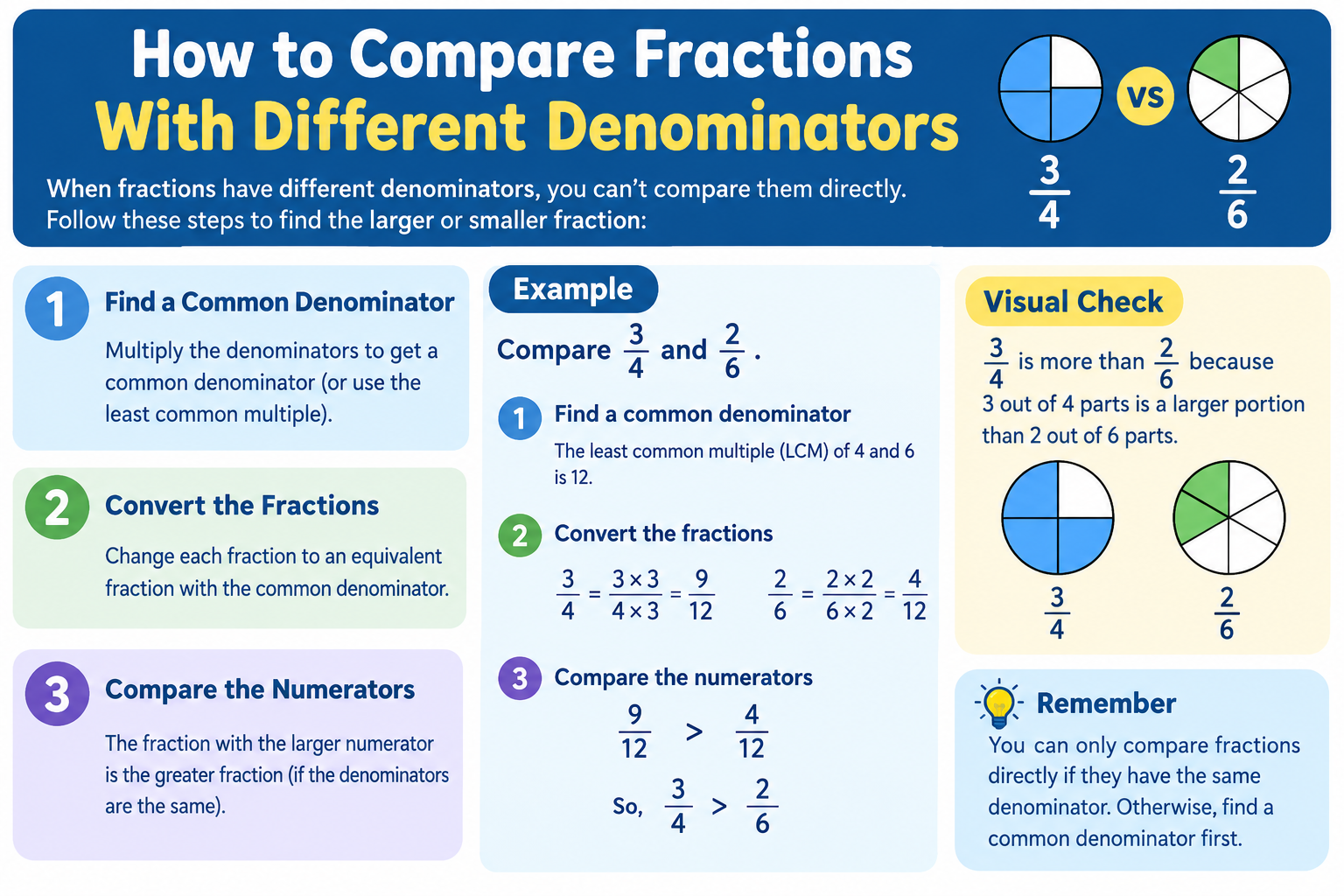
This is the most reliable method for beginners, and it is built on a simple idea: if both fractions have the same denominator, you can compare the numerators directly.
Example: Compare 2/3 and 3/5
Step 1: Find the least common multiple (LCM) of the denominators.
LCM of 3 and 5 = 15
Step 2: Convert each fraction to an equivalent fraction with denominator 15.
2/3 = (2 × 5)/(3 × 5) = 10/15
3/5 = (3 × 3)/(5 × 3) = 9/15
Step 3: Compare the numerators.
10/15 > 9/15
Conclusion: 2/3 > 3/5
The reason this works is that both fractions now describe parts of the same-sized whole, so comparing the numerators is entirely fair.
Step-by-Step Method for Comparing Fractions
Step 1: Look at the denominators
Check whether the denominators are the same or different. If they are the same, go straight to comparing numerators. If they are different, continue to Step 2.
Step 2: Find a common denominator
Find the least common multiple (LCM) of both denominators. This is your least common denominator (LCD). Understanding factors and multiples is useful here — you can review What Is a Multiple? for a refresher.
Step 3: Convert each fraction
Multiply the numerator and denominator of each fraction by the number needed to reach the common denominator. This creates equivalent fractions.
Step 4: Compare the numerators
Once both fractions share the same denominator, the one with the larger numerator is the greater fraction.
Step 5: Write the comparison symbol
Write > , < , or = between the original fractions.
Example 1: Compare 1/4 and 2/5
LCM of 4 and 5 = 20
1/4 = 5/20
2/5 = 8/20
5/20 < 8/20
Answer: 1/4 < 2/5
Example 2: Compare 3/4 and 5/6
LCM of 4 and 6 = 12
3/4 = 9/12
5/6 = 10/12
9/12 < 10/12
Answer: 3/4 < 5/6
Example 3: Compare 5/6 and 7/9
LCM of 6 and 9 = 18
5/6 = 15/18
7/9 = 14/18
15/18 > 14/18
Answer: 5/6 > 7/9
What Are Equivalent Fractions?
Equivalent fractions are different fractions that represent the same value.
For example: 1/2 = 2/4 = 3/6 = 4/8
All of these fractions describe exactly half of a whole. The numbers look different, but the amount they represent is identical.
The reason equivalent fractions matter here is that you use them to rewrite fractions with a common denominator before comparing. To explore this concept more deeply, see What Are Equivalent Fractions? on LearnMinto.
Comparing Fractions Using Equivalent Fractions
Example 1: Compare 1/2 and 3/4
Convert 1/2 to an equivalent fraction with denominator 4:
1/2 = 2/4
Now compare: 2/4 < 3/4
Answer: 1/2 < 3/4
Example 2: Compare 2/3 and 5/8
LCM of 3 and 8 = 24
2/3 = 16/24
5/8 = 15/24
16/24 > 15/24
Answer: 2/3 > 5/8
Example 3: Compare 3/5 and 4/7
LCM of 5 and 7 = 35
3/5 = 21/35
4/7 = 20/35
21/35 > 20/35
Answer: 3/5 > 4/7
Example 4: Compare 4/9 and 5/12
LCM of 9 and 12 = 36
4/9 = 16/36
5/12 = 15/36
16/36 > 15/36
Answer: 4/9 > 5/12
Example 5: Compare 5/6 and 11/12
LCM of 6 and 12 = 12
5/6 = 10/12
11/12 = 11/12
10/12 < 11/12
Answer: 5/6 < 11/12
Second Method: Cross Multiplication
Cross multiplication is a faster method for comparing two fractions when you want to skip finding a common denominator.
How it works:
To compare a/b and c/d:
- Multiply a × d (numerator of first × denominator of second)
- Multiply c × b (numerator of second × denominator of first)
- Compare the two products
If a × d > c × b, then a/b > c/d
If a × d < c × b, then a/b < c/d
If a × d = c × b, then a/b = c/d
Why does this work?
Cross multiplication is essentially a shortcut for finding a common denominator. When you give both fractions the same denominator (b × d), the numerators become a × d and c × b — which is exactly what you are comparing. You are looking at the scaled-up numerators without writing the denominator explicitly.
Example 1: Compare 2/3 and 3/5
2 × 5 = 10
3 × 3 = 9
10 > 9, so 2/3 > 3/5
Example 2: Compare 4/7 and 3/5
4 × 5 = 20
3 × 7 = 21
20 < 21, so 4/7 < 3/5
Example 3: Compare 5/8 and 7/12
5 × 12 = 60
7 × 8 = 56
60 > 56, so 5/8 > 7/12
Example 4: Compare 3/11 and 2/7
3 × 7 = 21
2 × 11 = 22
21 < 22, so 3/11 < 2/7
Example 5: Compare 6/10 and 3/5
6 × 5 = 30
3 × 10 = 30
30 = 30, so 6/10 = 3/5
When Is Cross Multiplication Useful?
Cross multiplication is most useful when:
- You are comparing exactly two fractions and want a quick result.
- The denominators do not share an obvious common multiple.
- You are under time pressure, such as during an exam.
However, it has some limitations:
- It is less visual than the common denominator method, so beginners may find it harder to understand intuitively at first.
- When comparing three or more fractions, cross multiplication becomes cumbersome because you need multiple separate comparisons.
- It is easy to mix up which numbers to multiply if you are not careful.
Students should always understand the common denominator approach first, and then use cross multiplication as a convenient shortcut once they are comfortable.
Third Method: Convert Fractions to Decimals
Every fraction can be converted to a decimal by dividing the numerator by the denominator. Once both fractions are in decimal form, comparing them is straightforward.
Example 1: Compare 1/2 and 3/4
1 ÷ 2 = 0.5
3 ÷ 4 = 0.75
0.5 < 0.75
Answer: 1/2 < 3/4
Example 2: Compare 2/3 and 3/5
2 ÷ 3 ≈ 0.667
3 ÷ 5 = 0.6
0.667 > 0.6
Answer: 2/3 > 3/5
A note of caution: Some fractions produce repeating decimals, such as 1/3 = 0.333… and 2/3 = 0.666… When this happens, be careful about rounding. Always carry enough decimal places to make a reliable comparison. If you would like to know more about rounding numbers safely, the article What Is Rounding in Math? is a helpful read.
For a complete guide on converting fractions to decimals, see How to Convert a Fraction to a Decimal on LearnMinto.
Fourth Method: Use a Number Line
A number line gives you a visual picture of where fractions sit relative to each other. Fractions farther to the right are greater; fractions farther to the left are smaller.
Example: Place 1/4, 1/2, and 3/4 on a number line.
Imagine a number line from 0 to 1. Divide it into four equal sections:
0 — 1/4 — 2/4 (=1/2) — 3/4 — 1
Reading left to right: 1/4 < 1/2 < 3/4
This method is especially useful for beginners because it makes abstract numbers feel concrete. Drawing your own number line and marking fractions on it is a great learning exercise.
Comparing Fractions With the Same Numerator
Here is a useful shortcut. When two fractions have the same numerator, the one with the smaller denominator is actually the greater fraction.
Why? When the same whole is divided into fewer equal parts, each part is larger.
Examples:
- 1/3 > 1/5 (thirds are bigger pieces than fifths)
- 2/4 > 2/7 (the parts are larger when divided into 4 than into 7)
- 3/8 < 3/5 (eighths are smaller than fifths)
- 5/9 < 5/6 (ninths are smaller than sixths)
Comparing Fractions With the Same Denominator
When denominators are the same, simply compare the numerators. The larger numerator means the larger fraction.
Examples:
- 3/8 < 5/8 (three eighths is less than five eighths)
- 7/10 > 4/10 (seven tenths is greater than four tenths)
- 6/11 > 3/11
- 9/15 = 3/5 (after simplifying 9/15, both equal the same value)
Comparing Fractions With Different Numerators and Denominators
This is the core skill. Let us work through several examples using different methods.
Example 1: Compare 2/3 and 3/5
Common denominator method:
LCM of 3 and 5 = 15
2/3 = 10/15
3/5 = 9/15
10/15 > 9/15 → 2/3 > 3/5
Example 2: Compare 3/7 and 4/9
Cross multiplication:
3 × 9 = 27
4 × 7 = 28
27 < 28 → 3/7 < 4/9
Example 3: Compare 5/8 and 7/12
LCM of 8 and 12 = 24
5/8 = 15/24
7/12 = 14/24
15/24 > 14/24 → 5/8 > 7/12
Example 4: Compare 4/5 and 7/10
LCM of 5 and 10 = 10
4/5 = 8/10
7/10 = 7/10
8/10 > 7/10 → 4/5 > 7/10
Comparing Fractions Using Visual Models
Fraction bars (also called fraction strips) and fraction circles are excellent tools for visualizing comparisons.
Imagine two identical rectangles representing one whole each.
- Divide the first rectangle into 3 equal parts and shade 2 → this represents 2/3.
- Divide the second rectangle into 5 equal parts and shade 3 → this represents 3/5.
Looking at the shaded areas side by side, you can see that 2/3 covers slightly more of the rectangle than 3/5 does.
Visual models are particularly helpful for younger learners and anyone who finds abstract numbers difficult to interpret. Drawing fraction bars by hand can be one of the most effective practice activities for building number sense.
How to Compare More Than Two Fractions
When comparing three or more fractions, the common denominator method works best.
Example: Compare 1/2, 2/3, and 3/4
LCM of 2, 3, and 4 = 12
1/2 = 6/12
2/3 = 8/12
3/4 = 9/12
Comparing: 6/12 < 8/12 < 9/12
Answer: 1/2 < 2/3 < 3/4
Example: Compare 1/3, 3/8, 5/12, and 7/24
LCM of 3, 8, 12, and 24 = 24
1/3 = 8/24
3/8 = 9/24
5/12 = 10/24
7/24 = 7/24
Ordering: 7/24 < 8/24 < 9/24 < 10/24
Answer: 7/24 < 1/3 < 3/8 < 5/12
How to Order Fractions From Least to Greatest
Example: Order 1/2, 2/5, 3/4, and 5/8 from least to greatest.
Step 1: Find the LCM of 2, 5, 4, and 8.
LCM = 40
Step 2: Convert each fraction.
1/2 = 20/40
2/5 = 16/40
3/4 = 30/40
5/8 = 25/40
Step 3: Arrange from smallest to largest.
16/40 < 20/40 < 25/40 < 30/40
Answer: 2/5 < 1/2 < 5/8 < 3/4
How to Order Fractions From Greatest to Least
Using the same fractions from above, simply reverse the order.
Answer: 3/4 > 5/8 > 1/2 > 2/5
The comparison process is identical. The only difference is that you arrange the results from largest to smallest instead.
Comparing Fractions Greater Than 1
Improper fractions (where the numerator is larger than the denominator) can be compared using the same methods.
Example 1: Compare 5/4 and 6/5
LCM of 4 and 5 = 20
5/4 = 25/20
6/5 = 24/20
25/20 > 24/20 → 5/4 > 6/5
Example 2: Compare 7/3 and 9/4
Cross multiplication:
7 × 4 = 28
9 × 3 = 27
28 > 27 → 7/3 > 9/4
You can also convert improper fractions to mixed numbers first, which can make the comparison more intuitive.
Comparing Mixed Numbers
When comparing mixed numbers, start by looking at the whole-number part.
If the whole numbers are different:
The mixed number with the larger whole number is greater.
Example: 3 1/2 > 2 7/8 (because 3 > 2)
If the whole numbers are equal:
Compare only the fractional parts.
Example: Compare 2 1/3 and 2 3/8
Whole numbers are equal (both are 2), so compare 1/3 and 3/8.
LCM of 3 and 8 = 24
1/3 = 8/24
3/8 = 9/24
8/24 < 9/24
Answer: 2 1/3 < 2 3/8
Common Mistakes When Comparing Fractions
1. Comparing only the numerators
Seeing 3/5 and 2/3, a student might say 3/5 is bigger because 3 > 2. This ignores what the denominators represent.
2. Assuming a larger denominator means a larger fraction
1/10 is actually smaller than 1/2, even though 10 is larger than 2.
3. Comparing denominators alone
The denominator alone never tells you which fraction is larger. Both the numerator and denominator matter together.
4. Forgetting to convert both fractions
When finding a common denominator, both fractions must be converted — not just one of them.
5. Using different multipliers for the numerator and denominator
If you multiply the denominator by 3 to reach the common denominator, you must also multiply the numerator by 3. Failing to do this changes the value of the fraction.
6. Cross-multiplication errors
Students sometimes multiply the wrong pairs of numbers. Always multiply the numerator of the first fraction by the denominator of the second, and vice versa.
7. Rounding decimals too aggressively
When using the decimal method with repeating decimals, rounding too early can produce an incorrect comparison. Carry at least three decimal places before deciding.
8. Using the wrong comparison symbol
After correctly determining which fraction is larger, some students still write the symbol the wrong way around. Remember: the open end of > or < always points to the larger value.
Worked Examples
Below is a comprehensive set of worked examples covering every scenario.
Example 1 — Same denominators:
7/10 vs 3/10 → 7/10 > 3/10
Example 2 — Same numerators:
4/5 vs 4/9 → 4/5 > 4/9 (fifths are larger parts than ninths)
Example 3 — Common denominator method:
5/6 vs 3/4
LCM of 6 and 4 = 12
5/6 = 10/12
3/4 = 9/12
10/12 > 9/12 → 5/6 > 3/4
Example 4 — Equivalent fractions:
2/5 vs 3/8
LCM of 5 and 8 = 40
2/5 = 16/40
3/8 = 15/40
16/40 > 15/40 → 2/5 > 3/8
Example 5 — Cross multiplication:
5/9 vs 4/7
5 × 7 = 35
4 × 9 = 36
35 < 36 → 5/9 < 4/7
Example 6 — Decimal conversion:
3/8 vs 2/5
3 ÷ 8 = 0.375
2 ÷ 5 = 0.4
0.375 < 0.4 → 3/8 < 2/5
Example 7 — Number line:
Place 1/3 and 1/2 on a number line between 0 and 1.
1/3 ≈ 0.333
1/2 = 0.5
1/3 is to the left of 1/2 → 1/3 < 1/2
Example 8 — Three fractions:
Compare 1/4, 1/3, 2/5
LCM of 4, 3, 5 = 60
1/4 = 15/60
1/3 = 20/60
2/5 = 24/60
15/60 < 20/60 < 24/60 → 1/4 < 1/3 < 2/5
Example 9 — Ordering four fractions:
Order 2/3, 3/5, 5/6, 7/10 from least to greatest.
LCM of 3, 5, 6, 10 = 30
2/3 = 20/30
3/5 = 18/30
5/6 = 25/30
7/10 = 21/30
18/30 < 20/30 < 21/30 < 25/30 → 3/5 < 2/3 < 7/10 < 5/6
Example 10 — Improper fractions:
Compare 9/4 and 11/5
LCM of 4 and 5 = 20
9/4 = 45/20
11/5 = 44/20
45/20 > 44/20 → 9/4 > 11/5
Example 11 — Mixed numbers with different wholes:
3 2/5 vs 2 7/8
3 > 2 → 3 2/5 > 2 7/8
Example 12 — Mixed numbers with equal wholes:
4 3/5 vs 4 5/7
LCM of 5 and 7 = 35
3/5 = 21/35
5/7 = 25/35
21/35 < 25/35 → 4 3/5 < 4 5/7
Example 13 — Equal fractions:
4/6 vs 2/3
4/6 simplifies to 2/3 → 4/6 = 2/3
Example 14 — Cross multiplication with large numbers:
Compare 7/11 and 9/14
7 × 14 = 98
9 × 11 = 99
98 < 99 → 7/11 < 9/14
Example 15 — Fractions very close in value:
Compare 5/7 and 8/11
5 × 11 = 55
8 × 7 = 56
55 < 56 → 5/7 < 8/11
Comparison Practice Questions
Try these questions on your own. Answers are provided in the section below.
Fill in >, <, or =
- 1/3 ___ 1/4
- 2/5 ___ 3/7
- 4/6 ___ 2/3
- 5/8 ___ 3/5
- 7/12 ___ 5/9
- 3/4 ___ 7/9
- 6/7 ___ 8/9
- 2/9 ___ 3/14
- 11/15 ___ 4/5
- 5/6 ___ 9/10
Compare the two fractions and write the comparison.
- Which is greater: 3/8 or 2/5?
- Which is smaller: 7/10 or 4/6?
Order from least to greatest.
- 1/2, 1/3, 1/4, 1/6
- 2/3, 3/4, 5/6, 7/12
Order from greatest to least.
- 3/5, 5/8, 7/10, 2/3
Find equivalent fractions and compare.
- Write two fractions equivalent to 3/4 and use one to compare it with 5/6.
- Convert 4/5 to a fraction with denominator 20, then compare with 14/20.
Challenge questions (in the Challenge section below)
- Compare 2 3/4 and 2 5/7.
- Order 5/9, 7/12, 2/3, and 11/18 from least to greatest.
- Which is greater: 13/20 or 7/11?
Practice Question Answers:
- 1/3 > 1/4
- 2/5 < 3/7 (14/35 < 15/35)
- 4/6 = 2/3
- 5/8 > 3/5 (25/40 > 24/40)
- 7/12 > 5/9 (21/36 > 20/36)
- 3/4 < 7/9 (27/36 < 28/36)
- 6/7 < 8/9 (54/63 < 56/63)
- 2/9 < 3/14 (28/126 < 27/126? — let us recalculate: 2×14=28, 3×9=27; 28>27, so 2/9 > 3/14)
- 11/15 < 4/5 (11/15 < 12/15)
- 5/6 < 9/10 (25/30 < 27/30)
- 3/8 < 2/5 (15/40 < 16/40)
- 7/10 < 4/6: 4/6 = 2/3 = 20/30; 7/10 = 21/30; 7/10 > 4/6
- 1/6 < 1/4 < 1/3 < 1/2
- 7/12 < 2/3 < 3/4 < 5/6 (LCM=12: 7/12, 8/12, 9/12, 10/12)
- 7/10 > 2/3 > 5/8 > 3/5 (LCM=120: 84/120 > 80/120 > 75/120 > 72/120)
- 3/4 = 6/8 = 9/12; using 9/12 vs 10/12 (5/6): 3/4 < 5/6
- 4/5 = 16/20; 16/20 < 14/20? No: 16 > 14, so 4/5 > 14/20
- (See Challenge Questions section)
- (See Challenge Questions section)
- 13 × 11 = 143; 7 × 20 = 140; 143 > 140; so 13/20 > 7/11
Multiple-Choice Questions
Question 1: Which fraction is greater: 3/5 or 4/7?
A) 3/5
B) 4/7
C) They are equal
D) Cannot be determined
Correct Answer: A — 3/5
Explanation: Cross multiply: 3 × 7 = 21; 4 × 5 = 20. Since 21 > 20, 3/5 > 4/7.
Question 2: What is the least common denominator of 1/4 and 2/6?
A) 10
B) 12
C) 24
D) 6
Correct Answer: B — 12
Explanation: LCM of 4 and 6 is 12.
Question 3: Which symbol correctly completes 5/9 ___ 7/13?
A) >
B) <
C) =
D) ≠
Correct Answer: A — >
Explanation: 5 × 13 = 65; 7 × 9 = 63. Since 65 > 63, 5/9 > 7/13.
Question 4: Which fraction is smallest?
A) 1/2
B) 2/5
C) 3/8
D) 1/4
Correct Answer: D — 1/4
Explanation: LCM = 40. 1/4=10/40, 3/8=15/40, 2/5=16/40, 1/2=20/40. Smallest is 10/40 = 1/4.
Question 5: 2/3 converted to a decimal is approximately:
A) 0.5
B) 0.6
C) 0.667
D) 0.75
Correct Answer: C — 0.667
Explanation: 2 ÷ 3 = 0.6666… ≈ 0.667.
Question 6: When comparing fractions with the same numerator, which statement is true?
A) The larger denominator means a larger fraction.
B) The smaller denominator means a larger fraction.
C) The denominators do not matter.
D) Both fractions are always equal.
Correct Answer: B — The smaller denominator means a larger fraction.
Explanation: When numerators are equal, fewer equal parts means each part is larger.
Question 7: Which method is generally most visual for beginners?
A) Cross multiplication
B) Decimal conversion
C) Common denominator with fraction bars
D) Algebraic simplification
Correct Answer: C — Common denominator with fraction bars
Explanation: Fraction bars provide a concrete, visual model that helps beginners understand fraction size.
Question 8: Compare 8/3 and 11/4.
A) 8/3 > 11/4
B) 8/3 < 11/4
C) 8/3 = 11/4
D) Cannot be compared
Correct Answer: A — 8/3 > 11/4
Explanation: 8 × 4 = 32; 11 × 3 = 33. Wait — 32 < 33, so 8/3 < 11/4. Correct Answer is B.
(Correction: The answer is B — 8/3 < 11/4. Cross multiply: 8 × 4 = 32, 11 × 3 = 33. Since 32 < 33, 8/3 < 11/4.)
Question 9: Order these from least to greatest: 1/2, 2/3, 3/5.
A) 1/2, 3/5, 2/3
B) 2/3, 3/5, 1/2
C) 3/5, 1/2, 2/3
D) 1/2, 2/3, 3/5
Correct Answer: A — 1/2, 3/5, 2/3
Explanation: LCM = 30. 1/2=15/30, 3/5=18/30, 2/3=20/30. Order: 15 < 18 < 20.
Question 10: Which pair of fractions is equal?
A) 2/3 and 4/5
B) 3/4 and 9/12
C) 5/6 and 6/7
D) 7/8 and 8/9
Correct Answer: B — 3/4 and 9/12
Explanation: 9/12 simplifies to 3/4. They are equivalent fractions.
Challenge Questions
Challenge 1: Compare 2 3/4 and 2 5/7.
Whole numbers are equal (both 2). Compare 3/4 and 5/7.
LCM of 4 and 7 = 28
3/4 = 21/28
5/7 = 20/28
21/28 > 20/28 → 2 3/4 > 2 5/7
Challenge 2: Order 5/9, 7/12, 2/3, and 11/18 from least to greatest.
LCM of 9, 12, 3, 18 = 36
5/9 = 20/36
7/12 = 21/36
2/3 = 24/36
11/18 = 22/36
Ordering: 20 < 21 < 22 < 24
Answer: 5/9 < 7/12 < 11/18 < 2/3
Challenge 3: Compare 15/19 and 16/21.
Cross multiply:
15 × 21 = 315
16 × 19 = 304
315 > 304 → 15/19 > 16/21
Challenge 4: Which is greater — 3 7/9 or 3 11/14?
Whole numbers equal. Compare 7/9 and 11/14.
LCM of 9 and 14 = 126
7/9 = 98/126
11/14 = 99/126
98/126 < 99/126 → 3 7/9 < 3 11/14
Challenge 5: A student says that 5/8 > 7/11 because “8 is closer to 11 than 5 is to 7.” Is this reasoning correct? What is the right answer?
The reasoning is incorrect. Proximity of numbers is not a valid comparison method.
Cross multiply:
5 × 11 = 55
7 × 8 = 56
55 < 56 → 5/8 < 7/11
The correct answer is 5/8 < 7/11.
Real-Life Examples of Comparing Fractions
Pizza portions: You ate 2/3 of a small pizza and your friend ate 3/5 of an identical pizza. You ate more, because 2/3 > 3/5.
Recipe measurements: A recipe calls for 3/4 cup of flour, but another version uses 5/6 cup. The second version uses more flour because 5/6 > 3/4.
Distances: You have walked 3/5 of a trail while your companion has walked 5/8 of the same trail. You have walked further, because 3/5 = 24/40 and 5/8 = 25/40, so actually 3/5 < 5/8 — your companion has walked slightly more.
Study time: You spent 2/3 of an hour studying and your classmate spent 3/5 of an hour. You studied for longer, since 2/3 > 3/5.
Project completion: Team A has completed 7/10 of a project; Team B has completed 4/6. Simplifying: 4/6 = 2/3. Comparing 7/10 and 2/3: LCM = 30. 7/10 = 21/30 and 2/3 = 20/30. Team A is slightly ahead.
Measurements in cooking: A container holds 5/8 of a litre of juice and another holds 7/12 of a litre. 5/8 = 15/24 and 7/12 = 14/24. The first container holds more.
Why Equivalent Fractions Matter When Comparing Fractions
Equivalent fractions are what make the common denominator method work. When you rewrite 2/3 as 10/15 and 3/5 as 9/15, you have not changed the value of either fraction — you have simply expressed them using the same unit of measurement.
Think of it like unit conversion. You cannot directly compare 2 kilometres and 3000 metres without converting to the same unit. Equivalent fractions do exactly the same job for fraction comparison.
This concept also becomes essential when you move on to adding and subtracting fractions, where a common denominator is required for every calculation. Building a solid understanding of equivalent fractions now will make those future topics much more manageable.
How Comparing Fractions Connects to Other Math Skills
Fraction comparison does not exist in isolation. It draws on and leads to a wide range of related skills:
- Equivalent fractions — the foundation of the common denominator method.
- Factors — finding the LCM requires knowing the factors of each denominator. See What Is a Factor? for a helpful review.
- Multiples — the LCM is built from multiples.
- Decimals — fraction-to-decimal conversion connects fraction comparison directly to the decimal number system.
- Adding and subtracting fractions — both operations require a common denominator, just as comparison does. A complete guide is available at How to Add Fractions With Different Denominators.
- Ratios and proportions — comparing fractions underpins ratio reasoning and proportional thinking across science, finance, and everyday life.
Quick Revision Notes
- Same denominators → compare numerators directly. Larger numerator = larger fraction.
- Same numerators → smaller denominator = larger fraction (for positive proper fractions).
- Different denominators → find a common denominator, use cross multiplication, or convert to decimals.
- Equivalent fractions help create common denominators without changing the value of the original fractions.
- > means greater than.
- < means less than.
- = means the fractions are equal.
- Always double-check your comparison symbol after completing the calculation.
Fraction Comparison Cheat Sheet
| Method | How It Works | Best Used For | Example |
|---|---|---|---|
| Common denominator | Find LCM, convert both fractions, compare numerators | Any comparison; best for beginners | 2/3 vs 3/5 → 10/15 vs 9/15 → 2/3 > 3/5 |
| Equivalent fractions | Rewrite one or both fractions to match denominators | When one denominator divides into the other easily | 1/2 vs 3/4 → 2/4 vs 3/4 → 1/2 < 3/4 |
| Cross multiplication | Multiply across, compare products | Quick comparison of exactly two fractions | 2/3 vs 3/5 → 10 vs 9 → 2/3 > 3/5 |
| Decimal conversion | Divide numerator by denominator, compare results | When a calculator is available or decimals are intuitive | 3/4=0.75, 1/2=0.5 → 3/4 > 1/2 |
| Number line | Place fractions on a number line, read position | Visual learners; understanding relative size | 1/4 is left of 1/2 → 1/4 < 1/2 |
Exam Tips
- Before doing anything else, check whether the denominators are already the same. If they are, just compare the numerators.
- Look for an easy common denominator before going straight for the LCM — sometimes one denominator is already a multiple of the other.
- When converting to equivalent fractions, always multiply both the numerator and the denominator by the same number.
- Never compare numerators alone when denominators are different.
- After finding your answer, re-read the question to make sure you are writing the correct comparison symbol.
- Use cross multiplication as a quick check, especially when time is limited.
- For repeating decimals, keep at least three decimal places before comparing.
- If you are ordering more than two fractions, use the common denominator method rather than repeated cross multiplication.
- Write your final answer clearly, using the original fractions rather than the converted ones.
Frequently Asked Questions
1. How do you compare fractions with different denominators?
Find a common denominator (usually the LCM of both denominators), convert each fraction into an equivalent fraction with that denominator, and then compare the numerators. The fraction with the larger numerator is the greater fraction.
2. What is the easiest way to compare fractions?
For most beginners, the common denominator method is easiest because it is clear and visual. Cross multiplication is quicker once you understand why it works, but it can feel abstract at first.
3. Can you compare fractions without finding a common denominator?
Yes. Cross multiplication and decimal conversion are both valid methods that avoid finding a common denominator. However, understanding common denominators gives you a deeper insight into fraction values.
4. How does cross multiplication compare fractions?
To compare a/b and c/d, multiply a × d and c × b. If a × d is larger, then a/b is the greater fraction. This works because it is equivalent to comparing the fractions after scaling them to the same denominator (b × d).
5. Why do we need equivalent fractions?
Equivalent fractions allow us to express two different fractions using the same denominator, which makes direct comparison possible. Without equivalent fractions, comparing fractions with different denominators would be much more difficult.
6. How do you compare fractions with the same numerator?
When numerators are identical, the fraction with the smaller denominator is larger. For example, 1/3 > 1/5 because thirds are bigger pieces than fifths.
7. How do you compare fractions with the same denominator?
Simply compare the numerators. The fraction with the larger numerator is greater. For example, 5/8 > 3/8.
8. How do you order fractions from least to greatest?
Find a common denominator for all fractions, convert each one, compare the resulting numerators, and arrange the original fractions in order from the smallest converted numerator to the largest.
9. How do you compare three fractions?
Find a common denominator for all three fractions, convert each one to an equivalent fraction, and then compare all three numerators. This gives you a clear ordering of all three fractions.
10. Can you compare fractions using decimals?
Yes. Divide each numerator by its denominator to get a decimal, then compare the decimals. Be careful with repeating decimals — carry enough decimal places to make an accurate comparison.
11. How do you compare improper fractions?
Use the same methods as for proper fractions: common denominators, cross multiplication, or decimal conversion. Alternatively, convert to mixed numbers and compare the whole-number parts first.
12. How do you compare mixed numbers?
First compare the whole-number parts. If they differ, the larger whole number wins. If the whole numbers are equal, compare the fractional parts using any standard method.
13. Which is greater, 2/3 or 3/5?
2/3 is greater. Using a common denominator of 15: 2/3 = 10/15 and 3/5 = 9/15. Since 10 > 9, we have 2/3 > 3/5.
14. What mistakes should students avoid when comparing fractions?
The most common mistakes are comparing only numerators, assuming a larger denominator always means a larger fraction, and using different multipliers for the numerator and denominator when converting. Always apply each step carefully and check your comparison symbol at the end.
15. How do you know if two fractions are equal?
Two fractions are equal if they simplify to the same value or if their cross products are equal (a × d = c × b). For example, 4/6 = 2/3 because both simplify to the same fraction, and 4 × 3 = 6 × 2 = 12.
Summary
Comparing fractions with different denominators requires a little more work than comparing fractions with the same denominator, but the underlying idea is simple: make the denominators the same, and the comparison becomes straightforward.
The most important methods to know are:
- Common denominator method — find the LCM, convert both fractions, and compare numerators.
- Equivalent fractions — rewrite fractions to share a denominator without changing their value.
- Cross multiplication — a quick shortcut for comparing exactly two fractions.
- Decimal conversion — divide numerator by denominator and compare the results.
- Number line — a visual approach that reinforces understanding of fraction magnitude.
Always remember that a fraction represents a value, not just a pair of numbers. When you look at 2/3 and 3/5, the goal is to understand how much of the whole each fraction represents — and the comparison methods above are simply tools to help you see that clearly.
To confirm: 2/3 > 3/5, because 2/3 = 10/15 and 3/5 = 9/15, and 10/15 > 9/15.
Final Thoughts
Comparing fractions is one of those topics where getting the method right from the start makes everything easier later on. Once you are comfortable using common denominators and equivalent fractions, skills like adding fractions, subtracting fractions, ordering numbers, and working with ratios all feel much more natural.
If you are just starting out, begin with the common denominator method. It is transparent, it shows you exactly what is happening, and it builds genuine number sense. Once that feels solid, practice cross multiplication as a quicker alternative. Try both methods on the same pair of fractions and confirm that they give the same result — that kind of verification builds mathematical confidence.
The practice questions and examples in this guide cover every major scenario. Work through them at your own pace, and do not worry if one method feels more natural than another. Different students find different approaches easier, and knowing multiple methods means you will always have a strategy that works.
Helpful Resources
- Khan Academy — Comparing Fractions
A comprehensive series of video lessons and practice exercises covering all major fraction comparison methods.
https://www.khanacademy.org/math/arithmetic/fraction-arithmetic - Mathematics LibreTexts — Fractions
A detailed open-access mathematics resource covering fractions, equivalent fractions, and comparison at an introductory level.
https://math.libretexts.org - OpenStax Prealgebra — Fractions
A free, peer-reviewed prealgebra textbook with thorough coverage of fraction concepts including comparison, equivalence, and ordering.
https://openstax.org/books/prealgebra-2e/pages/1-introduction - National Council of Teachers of Mathematics (NCTM)
The leading professional body for mathematics education, offering standards, resources, and guidance for teaching fractions effectively.
https://www.nctm.org
Disclaimer:
This article is intended for educational and informational purposes only. While LearnMinto strives to provide accurate and up-to-date mathematics information, readers should verify important academic concepts through official textbooks, educational institutions, examination boards, or trusted educational resources before using this content for exams or academic purposes. LearnMinto is not affiliated with any specific school, university, research institution, or examination board.
Author: Saad Qureshi
Author Role: Senior Education & Technology Editor at LearnMinto
Saad Qureshi is a Senior Education & Technology Editor at LearnMinto. He focuses on creating and reviewing clear, accessible educational content across mathematics, physics, chemistry, biology, computer science, technology, AI tools, and personal finance.