
Introduction
Take the problem 1/2 + 1/3. Your first instinct might be to add across — top plus top, bottom plus bottom — giving 2/5. That answer is wrong, and understanding why it is wrong is the key to learning this topic.
How do you add fractions with different denominators? You first convert both fractions into equivalent fractions that share the same denominator. Once the denominators match, you simply add the numerators and simplify if needed.
This skill comes up constantly — in cooking measurements, dividing time, working with lengths, and later in algebra. Getting comfortable with it now makes a whole range of mathematics much more manageable.
Key Takeaways
-
Fractions with different denominators represent parts of different sizes and cannot be added directly.
-
The essential first step is to find a common denominator — a shared bottom number for both fractions.
-
The least common denominator (LCD) is the smallest number that both denominators divide into evenly.
-
Convert each fraction into an equivalent fraction using the common denominator.
-
Once denominators match, add the numerators and keep the denominator.
-
Simplify the final answer by dividing numerator and denominator by their greatest common factor.
-
The same process applies when adding three or more fractions, or when adding mixed numbers.
What Does It Mean to Add Fractions With Different Denominators?
Before working through the method, it is worth being clear about what fractions actually represent.
A fraction describes part of a whole. It is written as one number over another:
- The numerator (top number) tells you how many parts you have.
- The denominator (bottom number) tells you how many equal parts the whole is divided into.
In 1/2, the whole is divided into 2 equal parts and you have 1 of them.
In 1/3, the whole is divided into 3 equal parts and you have 1 of them.
When the denominators are different — as in 1/2 and 1/3 — the parts being described are different sizes. One-half is a larger piece than one-third. Because the pieces are not the same size, you cannot simply count them together any more than you could add centimetres to inches without converting first.
The same issue applies to other unlike fractions:
- 3/4 + 1/5 — fourths and fifths are different-sized pieces.
- 2/3 + 1/4 — thirds and quarters are different-sized pieces.
In every case, you need to convert both fractions so they describe pieces of the same size before you can add them.
For a full introduction to what fractions are and how they work, see What Is a Fraction? on LearnMinto.
Why Can’t You Just Add the Numerators and Denominators?
This is the most common mistake students make, and it is worth taking a moment to understand why it does not work.
Incorrect approach:
1/2 + 1/3 = 2/5
This is wrong. Here is a quick way to see that clearly.
If you have half a pizza and you add one-third of a pizza, you have more than half a pizza. The answer 2/5 is less than one-half, so it cannot possibly be correct.
The correct answer is 5/6, which is indeed more than one-half. That makes sense.
The reason the “add across” method fails is that the denominator tells you the size of each piece. If you add the denominators, you are changing the size of the pieces while also changing the count — which produces a meaningless result.
Think of it this way: if you have 1 slice from a pizza cut into 2 pieces, and someone else has 1 slice from a pizza cut into 3 pieces, you do not have 2 slices from a pizza cut into 5 pieces. You have different-sized slices that cannot be combined until you agree on a standard piece size.
Important Fraction Vocabulary
| Term | Meaning | Example |
|---|---|---|
| Numerator | The top number in a fraction; shows how many parts you have | In 3/4, the numerator is 3 |
| Denominator | The bottom number in a fraction; shows how many equal parts make the whole | In 3/4, the denominator is 4 |
| Equivalent fraction | A fraction that represents the same value as another, written differently | 1/2 = 2/4 = 3/6 |
| Common denominator | A shared denominator for two or more fractions | For 1/2 and 1/3, a common denominator is 6 |
| Least common denominator (LCD) | The smallest common denominator possible | For 1/4 and 1/6, the LCD is 12 |
| Simplest form | A fraction where the numerator and denominator share no common factor other than 1 | 2/4 in simplest form is 1/2 |
The Main Rule for Adding Fractions With Different Denominators
The rule is straightforward:
You cannot add fractions until their denominators are the same.
Once you make the denominators equal — by converting both fractions into equivalent fractions — you add the numerators and leave the denominator unchanged.
For any two fractions a/b and c/d where b ≠ d, you must first find a common denominator, rewrite both fractions using that denominator, and then add. The denominator is not added — it is the shared unit that makes addition possible.
How to Add Fractions With Different Denominators Step by Step
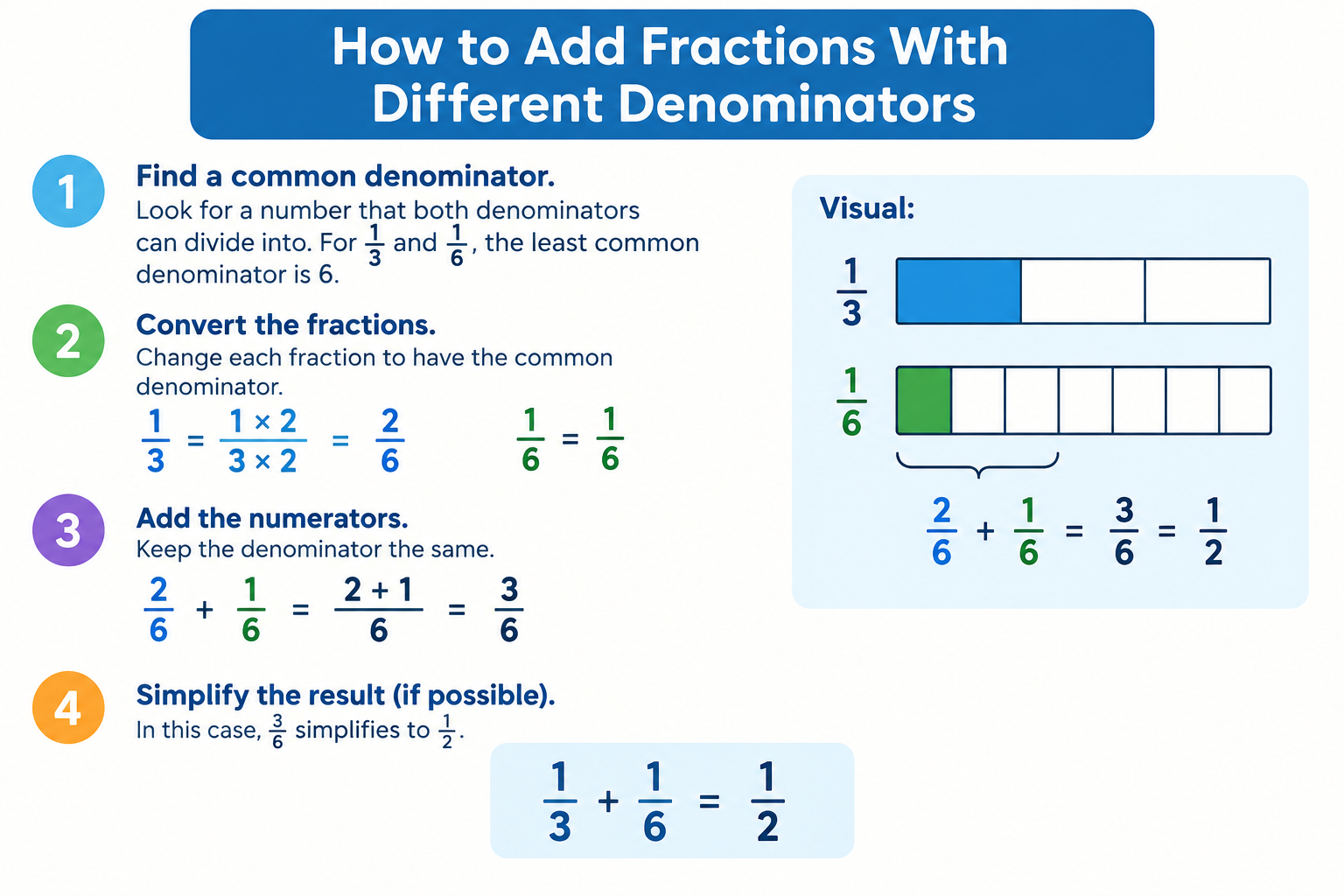
Here is the complete method, demonstrated with 1/2 + 1/3.
Step 1: Look at the denominators — they are 2 and 3. They are different, so you cannot add yet.
Step 2: Find a common denominator. The smallest number that both 2 and 3 divide into is 6.
Step 3: Convert each fraction into an equivalent fraction with denominator 6.
- 1/2 → multiply top and bottom by 3 → 3/6
- 1/3 → multiply top and bottom by 2 → 2/6
Step 4: Add the numerators.
3/6 + 2/6 = 5/6
Step 5: Check whether the answer can be simplified. The fraction 5/6 is already in simplest form because 5 and 6 share no common factor other than 1.
Final answer: 5/6
Step 1: Find a Common Denominator
A common denominator is any number that both denominators divide into evenly. You find one by looking at the multiples of each denominator.
For denominators 2 and 3:
- Multiples of 2: 2, 4, 6, 8, 10, 12…
- Multiples of 3: 3, 6, 9, 12…
The first number that appears in both lists is 6. That makes 6 the least common denominator (LCD) — the smallest common denominator available.
You could also use 12, 18, or any other common multiple, but the LCD makes the numbers smaller and easier to work with. Finding the LCD is closely linked to the idea of common multiples — which is covered in detail in What Is a Multiple? on LearnMinto.
Step 2: Convert Fractions Into Equivalent Fractions
An equivalent fraction has the same value as the original but is written with a different numerator and denominator. You create one by multiplying both the numerator and denominator by the same nonzero number.
Multiplying both parts of a fraction by the same number is like multiplying by 1 — it does not change the value.
For 1/2, multiply by 3/3:
1/2 × 3/3 = 3/6
For 1/3, multiply by 2/2:
1/3 × 2/2 = 2/6
Both fractions now have denominator 6. The pieces are now the same size, and you can count them together.
Step 3: Add the Numerators
With matching denominators, addition becomes straightforward:
3/6 + 2/6 = 5/6
Add the numerators (3 + 2 = 5) and keep the denominator (6). Do not add the denominators — they are not being counted, they are describing the size of each piece.
Step 4: Simplify the Answer
After adding, check whether the result can be written in a simpler form.
A fraction is in simplest form when the only number that divides into both the numerator and denominator is 1.
Example where simplification is needed:
2/4 + 2/4 = 4/8
Both 4 and 8 can be divided by 4. So: 4/8 = 1/2
To simplify, find the greatest common factor (GCF) of the numerator and denominator — the largest number that divides into both — and divide both by it.
For a deeper look at factors and how to find them, see What Is a Factor? on LearnMinto.
Easy Examples
1. 1/2 + 1/3
Common Denominator: 6
Equivalent Fractions: 3/6 + 2/6
Addition: 5/6
Simplified Answer: 5/6
2. 1/4 + 1/2
Common Denominator: 4
Equivalent Fractions: 1/4 + 2/4
Addition: 3/4
Simplified Answer: 3/4
3. 1/3 + 1/6
Common Denominator: 6
Equivalent Fractions: 2/6 + 1/6
Addition: 3/6
Simplified Answer: 1/2
4. 2/3 + 1/4
Common Denominator: 12
Equivalent Fractions: 8/12 + 3/12
Addition: 11/12
Simplified Answer: 11/12
5. 1/5 + 2/5
Common Denominator: 5 (already the same)
Equivalent Fractions: 1/5 + 2/5
Addition: 3/5
Simplified Answer: 3/5
6. 2/7 + 1/3
Common Denominator: 21
Equivalent Fractions: 6/21 + 7/21
Addition: 13/21
Simplified Answer: 13/21
7. 3/4 + 1/6
Common Denominator: 12
Equivalent Fractions: 9/12 + 2/12
Addition: 11/12
Simplified Answer: 11/12
8. 2/5 + 1/10
Common Denominator: 10
Equivalent Fractions: 4/10 + 1/10
Addition: 5/10
Simplified Answer: 1/2
9. 1/8 + 1/4
Common Denominator: 8
Equivalent Fractions: 1/8 + 2/8
Addition: 3/8
Simplified Answer: 3/8
10. 3/10 + 1/6
Common Denominator: 30
Equivalent Fractions: 9/30 + 5/30
Addition: 14/30
Simplified Answer: 7/15
Adding Fractions With Small Different Denominators
When denominators are small, listing multiples is quick and straightforward.
| Denominators | LCD | Example | Answer |
|---|---|---|---|
| 2 and 3 | 6 | 1/2 + 1/3 | 5/6 |
| 3 and 4 | 12 | 1/3 + 1/4 | 7/12 |
| 4 and 5 | 20 | 1/4 + 1/5 | 9/20 |
| 3 and 6 | 6 | 1/3 + 1/6 | 1/2 |
| 5 and 10 | 10 | 3/5 + 1/10 | 7/10 |
| 4 and 8 | 8 | 1/4 + 3/8 | 5/8 |
Adding Fractions When One Denominator Is a Multiple of the Other
When one denominator divides evenly into the other, the larger denominator is already a valid common denominator. You only need to convert one of the fractions.
1/4 + 1/8:
8 is a multiple of 4. Convert 1/4 into eighths: 1/4 = 2/8.
2/8 + 1/8 = 3/8
1/3 + 1/6:
6 is a multiple of 3. Convert 1/3 into sixths: 1/3 = 2/6.
2/6 + 1/6 = 3/6 = 1/2
2/5 + 1/10:
10 is a multiple of 5. Convert 2/5 into tenths: 2/5 = 4/10.
4/10 + 1/10 = 5/10 = 1/2
3/4 + 1/8:
8 is a multiple of 4. Convert 3/4 into eighths: 3/4 = 6/8.
6/8 + 1/8 = 7/8
This shortcut saves time whenever one denominator is already a multiple of the other.
Adding Fractions When Neither Denominator Is a Multiple of the Other
When neither denominator is a multiple of the other, you need to find the LCD by listing multiples of both.
1/3 + 1/4:
- Multiples of 3: 3, 6, 9, 12, 15…
- Multiples of 4: 4, 8, 12, 16…
- LCD = 12
- 1/3 = 4/12 and 1/4 = 3/12
- 4/12 + 3/12 = 7/12
2/5 + 1/7:
- Multiples of 5: 5, 10, 15, 20, 25, 30, 35…
- Multiples of 7: 7, 14, 21, 28, 35…
- LCD = 35
- 2/5 = 14/35 and 1/7 = 5/35
- 14/35 + 5/35 = 19/35
3/8 + 1/6:
- Multiples of 8: 8, 16, 24, 32…
- Multiples of 6: 6, 12, 18, 24…
- LCD = 24
- 3/8 = 9/24 and 1/6 = 4/24
- 9/24 + 4/24 = 13/24
Final answer: 13/24
Using the Least Common Denominator
The LCD is the smallest number that all the denominators in a problem divide into evenly. Using it keeps the numbers as small as possible throughout the calculation, which reduces the chance of arithmetic errors and usually makes simplification easier at the end.
Finding the LCD by listing multiples:
For 1/4 + 1/6:
- Multiples of 4: 4, 8, 12, 16…
- Multiples of 6: 6, 12, 18…
- LCD = 12
Finding the LCD using prime factorization (for slightly larger denominators):
For 1/12 + 1/18:
- 12 = 2² × 3
- 18 = 2 × 3²
- LCD = 2² × 3² = 4 × 9 = 36
- 1/12 = 3/36 and 1/18 = 2/36
- 3/36 + 2/36 = 5/36
Prime factorization for finding the LCD connects to the ideas covered in What Is a Prime Number? on LearnMinto.
More examples using the LCD:
| Problem | LCD | Equivalent Fractions | Answer |
|---|---|---|---|
| 1/4 + 1/6 | 12 | 3/12 + 2/12 | 5/12 |
| 2/3 + 3/5 | 15 | 10/15 + 9/15 | 19/15 |
| 5/6 + 1/4 | 12 | 10/12 + 3/12 | 13/12 |
| 3/8 + 5/12 | 24 | 9/24 + 10/24 | 19/24 |
| 1/6 + 1/9 | 18 | 3/18 + 2/18 | 5/18 |
| 2/7 + 3/14 | 14 | 4/14 + 3/14 | 7/14 = 1/2 |
| 1/10 + 3/8 | 40 | 4/40 + 15/40 | 19/40 |
| 5/9 + 1/6 | 18 | 10/18 + 3/18 | 13/18 |
Adding More Than Two Fractions
The same process applies when adding three or more fractions — you just need one common denominator for all of them.
Example: 1/2 + 1/3 + 1/4
- Multiples of 2: 2, 4, 12…
- Multiples of 3: 3, 6, 9, 12…
- Multiples of 4: 4, 8, 12…
- LCD = 12
Convert each fraction:
- 1/2 = 6/12
- 1/3 = 4/12
- 1/4 = 3/12
Add: 6/12 + 4/12 + 3/12 = 13/12
This is an improper fraction (numerator greater than denominator). Convert: 13/12 = 1 and 1/12.
More examples:
- 1/2 + 1/4 + 1/8: LCD = 8. 4/8 + 2/8 + 1/8 = 7/8
- 1/3 + 1/4 + 1/6: LCD = 12. 4/12 + 3/12 + 2/12 = 9/12 = 3/4
- 1/2 + 2/3 + 1/6: LCD = 6. 3/6 + 4/6 + 1/6 = 8/6 = 1 and 1/3
- 1/4 + 1/6 + 1/12: LCD = 12. 3/12 + 2/12 + 1/12 = 6/12 = 1/2
- 2/3 + 1/4 + 1/6: LCD = 12. 8/12 + 3/12 + 2/12 = 13/12 = 1 and 1/12
Adding Fractions With the Same Denominator
When denominators are already equal, the process is much simpler. Just add the numerators and keep the denominator.
2/7 + 3/7 = 5/7
There is no need to find a common denominator because the denominators are already the same. The pieces are already the same size — you simply count how many you have in total.
This is exactly why getting the denominators to match when they are different is so important: once they do, fraction addition becomes easy counting.
Adding Fractions With Whole Numbers
A whole number can be thought of as a fraction with denominator 1. For example, 3 = 3/1.
1 + 1/2:
Write 1 as 2/2. Then: 2/2 + 1/2 = 3/2 = 1 and 1/2
2 + 2/3:
Write 2 as 6/3. Then: 6/3 + 2/3 = 8/3 = 2 and 2/3
In practice, adding a whole number to a fraction simply means the whole number becomes the whole-number part of a mixed number.
Adding Mixed Numbers With Different Denominators
A mixed number combines a whole number and a fraction — like 1 and 1/2 or 2 and 2/3.
To add mixed numbers:
- Add the whole-number parts.
- Add the fractional parts (using a common denominator).
- Simplify if needed.
- Combine the whole number and the fraction.
Example: 1 1/2 + 2 1/3
Step 1: Add whole numbers: 1 + 2 = 3
Step 2: Add fractions: 1/2 + 1/3. LCD = 6. → 3/6 + 2/6 = 5/6
Step 3: No simplification needed.
Step 4: Combine: 3 and 5/6
More examples:
- 2 1/4 + 1 1/2: Whole numbers: 3. Fractions: 1/4 + 2/4 = 3/4. Answer: 3 and 3/4
- 3 1/3 + 2 1/6: Whole numbers: 5. Fractions: 2/6 + 1/6 = 3/6 = 1/2. Answer: 5 and 1/2
- 4 2/5 + 1 1/10: Whole numbers: 5. Fractions: 4/10 + 1/10 = 5/10 = 1/2. Answer: 5 and 1/2
- 1 3/8 + 2 1/4: Whole numbers: 3. Fractions: 3/8 + 2/8 = 5/8. Answer: 3 and 5/8
- 5 1/6 + 2 1/4: Whole numbers: 7. Fractions: 2/12 + 3/12 = 5/12. Answer: 7 and 5/12
Adding Mixed Numbers When the Fractional Part Creates an Extra Whole
Sometimes, when you add the fractional parts, the result is an improper fraction — a fraction where the numerator is greater than the denominator. In that case, you need to convert it.
Example: 1 3/4 + 2 2/3
Step 1: Add whole numbers: 1 + 2 = 3
Step 2: Add fractions: 3/4 + 2/3. LCD = 12.
- 3/4 = 9/12
- 2/3 = 8/12
- 9/12 + 8/12 = 17/12
Step 3: 17/12 is an improper fraction. Convert: 17/12 = 1 and 5/12.
Step 4: Add the extra 1 to the whole-number part: 3 + 1 = 4.
Step 5: Combine: 4 and 5/12
Another example: 2 5/6 + 1 3/4
Whole numbers: 3.
Fractions: 5/6 + 3/4. LCD = 12. → 10/12 + 9/12 = 19/12 = 1 and 7/12.
Extra whole: 3 + 1 = 4.
Answer: 4 and 7/12
Adding Fractions With Unlike Denominators Using Cross Multiplication
The cross-multiplication method is a quick way to find equivalent fractions when adding two fractions. Rather than finding the LCD first, you multiply each numerator by the other fraction’s denominator.
Example: 1/3 + 1/4
- Multiply the numerator of the first fraction by the denominator of the second: 1 × 4 = 4 → gives 4/12
- Multiply the numerator of the second fraction by the denominator of the first: 1 × 3 = 3 → gives 3/12
- The common denominator is 3 × 4 = 12
4/12 + 3/12 = 7/12. Answer: 7/12
Example: 2/5 + 3/7
- 2 × 7 = 14 → 14/35
- 3 × 5 = 15 → 15/35
- 14/35 + 15/35 = 29/35
This method always works, but it can produce larger numbers than using the LCD when the denominators share a common factor. For example, with 1/4 + 1/6, cross multiplication gives a denominator of 24, while the LCD is 12. Both approaches give correct answers, but using the LCD means smaller numbers and less simplification at the end.
Cross multiplication is simply one tool for creating equivalent fractions — it is not a different type of addition. The logic is exactly the same.
Common Mistakes Students Make
| Mistake | Incorrect | Correct |
|---|---|---|
| Adding numerators and denominators | 1/2 + 1/3 = 2/5 | 1/2 + 1/3 = 5/6 |
| Changing the denominator but not the numerator | 1/2 → 6 (just changing the bottom) | 1/2 → 3/6 (multiply top and bottom by 3) |
| Using different denominators in the final step | 3/6 + 2/9 (different — cannot add yet) | Convert both to a common denominator first |
| Choosing an incorrect common denominator | Using 5 for denominators 2 and 3 (5 is not a multiple of 2 or 3) | Use 6 (the correct LCD for 2 and 3) |
| Forgetting to simplify | Leaving answer as 6/12 | 6/12 = 1/2 |
| Simplifying before the final addition | Simplifying equivalent fractions mid-calculation incorrectly | Complete the addition first, then simplify |
| Arithmetic errors when multiplying | 1/3 × 4/4 = 4/7 | 1/3 × 4/4 = 4/12 |
| Forgetting to convert mixed numbers properly | Adding 1 3/4 without separating the whole and fraction | Add whole numbers separately from fractions |
| Not converting an improper fraction after adding | Leaving 17/12 as-is | Convert to 1 and 5/12, then add to the whole-number part |
Worked Examples
Example 1 — Two fractions, LCD method
Given: 1/3 + 1/4
Step 1: Denominators are 3 and 4. LCD = 12.
Step 2: 1/3 = 4/12. 1/4 = 3/12.
Step 3: 4/12 + 3/12 = 7/12.
Step 4: 7 and 12 share no common factor other than 1. Already in simplest form.
Final Answer: 7/12
Short Explanation: Neither 3 nor 4 is a multiple of the other, so use 12 as the LCD.
Example 2 — One denominator is a multiple of the other
Given: 1/4 + 3/8
Step 1: 8 is a multiple of 4. LCD = 8.
Step 2: 1/4 = 2/8. 3/8 = 3/8.
Step 3: 2/8 + 3/8 = 5/8.
Step 4: Already in simplest form.
Final Answer: 5/8
Short Explanation: Only one fraction needed converting, which keeps the numbers small.
Example 3 — Requires simplification
Given: 1/4 + 1/12
Step 1: LCD = 12.
Step 2: 1/4 = 3/12. 1/12 = 1/12.
Step 3: 3/12 + 1/12 = 4/12.
Step 4: GCF of 4 and 12 is 4. 4/12 ÷ 4/4 = 1/3.
Final Answer: 1/3
Short Explanation: The answer simplifies significantly — always check.
Example 4 — Improper fraction result
Given: 3/4 + 5/6
Step 1: LCD = 12.
Step 2: 3/4 = 9/12. 5/6 = 10/12.
Step 3: 9/12 + 10/12 = 19/12.
Step 4: 19/12 is improper. Convert: 19 ÷ 12 = 1 remainder 7 → 1 and 7/12.
Final Answer: 1 and 7/12
Short Explanation: When the numerator exceeds the denominator, convert to a mixed number.
Example 5 — Three fractions
Given: 1/2 + 1/4 + 1/8
Step 1: LCD = 8.
Step 2: 1/2 = 4/8. 1/4 = 2/8. 1/8 = 1/8.
Step 3: 4/8 + 2/8 + 1/8 = 7/8.
Step 4: Already in simplest form.
Final Answer: 7/8
Short Explanation: The LCD covers all three denominators at once.
Example 6 — Mixed numbers, no carry
Given: 1 1/2 + 3 1/4
Step 1: Whole numbers: 1 + 3 = 4.
Step 2: Fractions: 1/2 + 1/4. LCD = 4. 2/4 + 1/4 = 3/4.
Step 3: No simplification needed.
Step 4: Combine: 4 and 3/4.
Final Answer: 4 and 3/4
Short Explanation: Straightforward mixed-number addition — no carrying required.
Example 7 — Mixed numbers with carry
Given: 2 3/4 + 1 2/3
Step 1: Whole numbers: 2 + 1 = 3.
Step 2: Fractions: 3/4 + 2/3. LCD = 12. 9/12 + 8/12 = 17/12 = 1 and 5/12.
Step 3: Add the extra 1: 3 + 1 = 4.
Step 4: Combine: 4 and 5/12.
Final Answer: 4 and 5/12
Short Explanation: The fractional parts sum to more than 1, so carry the extra whole number.
Example 8 — Cross-multiplication method
Given: 2/5 + 1/4
Step 1: Multiply numerator of first by denominator of second: 2 × 4 = 8.
Step 2: Multiply numerator of second by denominator of first: 1 × 5 = 5.
Step 3: Common denominator: 5 × 4 = 20. So: 8/20 + 5/20 = 13/20.
Step 4: Already in simplest form.
Final Answer: 13/20
Short Explanation: Cross multiplication produces equivalent fractions directly.
Example 9 — Large denominators using LCD
Given: 5/12 + 7/18
Step 1: 12 = 2² × 3. 18 = 2 × 3². LCD = 2² × 3² = 36.
Step 2: 5/12 = 15/36. 7/18 = 14/36.
Step 3: 15/36 + 14/36 = 29/36.
Step 4: GCF of 29 and 36 is 1. Already in simplest form.
Final Answer: 29/36
Short Explanation: Prime factorization helps find the LCD efficiently for larger denominators.
Example 10 — Three fractions with different denominators
Given: 1/3 + 1/4 + 1/6
Step 1: LCD of 3, 4, and 6 = 12.
Step 2: 1/3 = 4/12. 1/4 = 3/12. 1/6 = 2/12.
Step 3: 4/12 + 3/12 + 2/12 = 9/12.
Step 4: GCF of 9 and 12 is 3. 9/12 = 3/4.
Final Answer: 3/4
Short Explanation: Always simplify the final answer.
Example 11 — Whole number and fraction
Given: 3 + 2/5
Step 1: Write 3 as 15/5.
Step 2: 15/5 + 2/5 = 17/5.
Step 3: Or simply: whole number is 3, fraction is 2/5. Combine: 3 and 2/5.
Final Answer: 3 and 2/5
Short Explanation: Adding a whole number to a fraction gives a mixed number.
Example 12 — Two fractions, simplification needed
Given: 3/10 + 2/15
Step 1: LCD = 30.
Step 2: 3/10 = 9/30. 2/15 = 4/30.
Step 3: 9/30 + 4/30 = 13/30.
Step 4: GCF of 13 and 30 is 1. Already in simplest form.
Final Answer: 13/30
Short Explanation: 13 is prime, so no simplification is possible.
Example 13 — Mixed number with large fractional sum
Given: 3 5/6 + 2 3/4
Step 1: Whole numbers: 3 + 2 = 5.
Step 2: 5/6 + 3/4. LCD = 12. 10/12 + 9/12 = 19/12 = 1 and 7/12.
Step 3: 5 + 1 = 6. Combine: 6 and 7/12.
Final Answer: 6 and 7/12
Short Explanation: The fractional sum exceeded 1, requiring a carry.
Example 14 — Fractions with denominators 7 and 3
Given: 2/7 + 2/3
Step 1: LCD = 21.
Step 2: 2/7 = 6/21. 2/3 = 14/21.
Step 3: 6/21 + 14/21 = 20/21.
Step 4: GCF of 20 and 21 is 1. Already in simplest form.
Final Answer: 20/21
Short Explanation: 7 and 3 share no common factor, so the LCD is their product, 21.
Example 15 — Answer is a whole number
Given: 1/3 + 2/3
Step 1: Denominators are already the same.
Step 2: 1/3 + 2/3 = 3/3.
Step 3: 3/3 = 1. A fraction equal to 1 means the parts make a whole.
Final Answer: 1
Short Explanation: When the numerator equals the denominator, the fraction equals 1.
Examples 16–20 (Summary format):
16. 4/9 + 1/3: LCD = 9. 4/9 + 3/9 = 7/9. Answer: 7/9
17. 3/5 + 1/4: LCD = 20. 12/20 + 5/20 = 17/20. Answer: 17/20
18. 5/8 + 1/6: LCD = 24. 15/24 + 4/24 = 19/24. Answer: 19/24
19. 2 1/3 + 1 1/2: Whole: 3. Fractions: 2/6 + 3/6 = 5/6. Answer: 3 and 5/6
20. 1/2 + 1/3 + 1/6: LCD = 6. 3/6 + 2/6 + 1/6 = 6/6 = 1
Real-Life Examples of Adding Fractions
Cooking: A recipe calls for 2/3 cup of flour and 1/4 cup of cornmeal. The total dry ingredient is 2/3 + 1/4 = 8/12 + 3/12 = 11/12 cup.
Measuring length: A shelf has one board measuring 3/4 m and another measuring 1/3 m. Total length: 3/4 + 1/3 = 9/12 + 4/12 = 13/12 m = 1 and 1/12 m.
Time: You spend 1/2 hour on mathematics homework and 1/3 hour on reading. Total study time: 1/2 + 1/3 = 3/6 + 2/6 = 5/6 of an hour.
Sharing: One person eats 3/8 of a pizza and another eats 1/4. Together they eat: 3/8 + 2/8 = 5/8 of the pizza.
Construction: A plank is cut so that one piece is 2/5 m long and another is 1/3 m long. Combined: 2/5 + 1/3 = 6/15 + 5/15 = 11/15 m.
School project: Two students each complete part of a project. One finishes 3/10 of the work and the other finishes 2/5. Together: 3/10 + 4/10 = 7/10 of the project is complete.
Practice Questions
15 Basic Practice Questions
- 1/2 + 1/4
- 1/3 + 1/5
- 2/3 + 1/6
- 3/4 + 1/8
- 1/2 + 1/6
- 3/5 + 1/10
- 1/3 + 1/4
- 2/7 + 1/7
- 3/8 + 1/4
- 1/6 + 1/9
- 2/5 + 1/4
- 1 1/2 + 2 1/3
- 3/4 + 2/3
- 5/6 + 1/4
- 2 3/4 + 1 1/6
Answers:
- 3/4 (LCD 4: 2/4 + 1/4 = 3/4)
- 8/15 (LCD 15: 5/15 + 3/15 = 8/15)
- 5/6 (LCD 6: 4/6 + 1/6 = 5/6)
- 7/8 (LCD 8: 6/8 + 1/8 = 7/8)
- 2/3 (LCD 6: 3/6 + 1/6 = 4/6 = 2/3)
- 7/10 (LCD 10: 6/10 + 1/10 = 7/10)
- 7/12 (LCD 12: 4/12 + 3/12 = 7/12)
- 3/7 (same denominator: 2/7 + 1/7 = 3/7)
- 5/8 (LCD 8: 3/8 + 2/8 = 5/8)
- 5/18 (LCD 18: 3/18 + 2/18 = 5/18)
- 13/20 (LCD 20: 8/20 + 5/20 = 13/20)
- 3 and 5/6 (whole: 3; fractions: 3/6 + 2/6 = 5/6)
- 1 and 5/12 (LCD 12: 9/12 + 8/12 = 17/12 = 1 and 5/12)
- 1 and 1/12 (LCD 12: 10/12 + 3/12 = 13/12 = 1 and 1/12)
- 3 and 11/12 (whole: 3; fractions: 9/12 + 2/12 = 11/12)
10 Multiple Choice Questions
Question 1
What is 1/2 + 1/4?
A. 2/6
B. 1/4
C. 3/4
D. 2/8
Correct Answer: C
Short Explanation: LCD = 4. 2/4 + 1/4 = 3/4.
Question 2
What is the LCD for 1/3 and 1/5?
A. 8
B. 10
C. 15
D. 3
Correct Answer: C
Short Explanation: The smallest number both 3 and 5 divide into is 15.
Question 3
What is 2/3 + 1/4?
A. 3/7
B. 8/12
C. 11/12
D. 3/12
Correct Answer: C
Short Explanation: LCD = 12. 8/12 + 3/12 = 11/12.
Question 4
A student calculates 1/3 + 1/4 = 2/7. What mistake did they make?
A. They chose the wrong LCD.
B. They added the numerators and denominators.
C. They forgot to simplify.
D. They used the wrong numerator.
Correct Answer: B
Short Explanation: Adding across gives 2/7, which is the classic mistake of treating unlike fractions as if they were like fractions.
Question 5
What is 3/5 + 1/10 in simplest form?
A. 4/15
B. 7/10
C. 4/10
D. 3/10
Correct Answer: B
Short Explanation: LCD = 10. 6/10 + 1/10 = 7/10. Already in simplest form.
Question 6
What is 1 1/3 + 2 1/6?
A. 3 1/6
B. 3 1/2
C. 3 2/9
D. 2 1/2
Correct Answer: B
Short Explanation: Whole: 1 + 2 = 3. Fractions: 2/6 + 1/6 = 3/6 = 1/2. Answer: 3 and 1/2.
Question 7
Which of these is an equivalent fraction for 1/4 with denominator 12?
A. 4/12
B. 3/12
C. 2/12
D. 1/12
Correct Answer: B
Short Explanation: 1/4 × 3/3 = 3/12.
Question 8
What is 3/8 + 1/6?
A. 4/14
B. 13/24
C. 4/24
D. 11/24
Correct Answer: B
Short Explanation: LCD = 24. 9/24 + 4/24 = 13/24.
Question 9
What is 5/6 + 1/4 in simplest form?
A. 6/10
B. 3/5
C. 13/12
D. 7/12
Correct Answer: C
Short Explanation: LCD = 12. 10/12 + 3/12 = 13/12. This is already in simplest form as an improper fraction.
Question 10
What is 1/2 + 1/3 + 1/6?
A. 3/11
B. 1
C. 5/6
D. 2/3
Correct Answer: B
Short Explanation: LCD = 6. 3/6 + 2/6 + 1/6 = 6/6 = 1.
10 Mixed Practice Problems
Problem 1: 1/5 + 1/10
Solution: LCD = 10. 2/10 + 1/10 = 3/10. Answer: 3/10
Problem 2: 2/3 + 3/4
Solution: LCD = 12. 8/12 + 9/12 = 17/12 = 1 and 5/12
Problem 3: 1/4 + 1/6 + 1/12
Solution: LCD = 12. 3/12 + 2/12 + 1/12 = 6/12 = 1/2
Problem 4: 3 2/5 + 1 1/2
Solution: Whole: 4. Fractions: 4/10 + 5/10 = 9/10. Answer: 4 and 9/10
Problem 5: 4/9 + 2/3
Solution: LCD = 9. 4/9 + 6/9 = 10/9 = 1 and 1/9
Problem 6: 2 3/8 + 1 3/4
Solution: Whole: 3. Fractions: 3/8 + 6/8 = 9/8 = 1 and 1/8. Total: 3 + 1 = 4. Answer: 4 and 1/8
Problem 7: 1/2 + 2/7
Solution: LCD = 14. 7/14 + 4/14 = 11/14. Answer: 11/14
Problem 8: 5/12 + 1/4
Solution: LCD = 12. 5/12 + 3/12 = 8/12 = 2/3
Problem 9: 3/7 + 2/7 + 1/7
Solution: Same denominator. 3/7 + 2/7 + 1/7 = 6/7. Answer: 6/7
Problem 10: 1 5/6 + 2 5/6
Solution: Whole: 3. Fractions: 5/6 + 5/6 = 10/6 = 1 and 4/6 = 1 and 2/3. Total: 3 + 1 = 4. Answer: 4 and 2/3
5 Challenge Questions
Challenge 1: 7/12 + 5/18 + 1/9
Solution:
LCD of 12, 18, and 9:
- 12 = 2² × 3
- 18 = 2 × 3²
- 9 = 3²
- LCD = 2² × 3² = 36
7/12 = 21/36. 5/18 = 10/36. 1/9 = 4/36.
21/36 + 10/36 + 4/36 = 35/36. GCF of 35 and 36 is 1.
Answer: 35/36
Challenge 2: 4 5/8 + 3 7/12
Solution:
Whole: 4 + 3 = 7.
LCD of 8 and 12:
- 8 = 2³
- 12 = 2² × 3
- LCD = 2³ × 3 = 24
5/8 = 15/24. 7/12 = 14/24.
15/24 + 14/24 = 29/24 = 1 and 5/24.
7 + 1 = 8.
Answer: 8 and 5/24
Challenge 3: 2/3 + 3/5 + 7/15
Solution:
LCD = 15.
2/3 = 10/15. 3/5 = 9/15. 7/15 = 7/15.
10/15 + 9/15 + 7/15 = 26/15 = 1 and 11/15.
Answer: 1 and 11/15
Challenge 4: 5 11/12 + 4 7/8
Solution:
Whole: 5 + 4 = 9.
LCD of 12 and 8:
- 12 = 2² × 3
- 8 = 2³
- LCD = 24
11/12 = 22/24. 7/8 = 21/24.
22/24 + 21/24 = 43/24 = 1 and 19/24.
9 + 1 = 10.
Answer: 10 and 19/24
Challenge 5: A recipe uses 2/3 cup of milk, 1/4 cup of cream, and 1/6 cup of butter. What is the total amount of liquid and fat?
Solution:
2/3 + 1/4 + 1/6. LCD = 12.
8/12 + 3/12 + 2/12 = 13/12 = 1 and 1/12 cups.
Answer: 1 and 1/12 cups
Exam Tips
- Check the denominators first. Before doing anything else, look at whether the denominators are the same or different.
- Find the common denominator before adding. Never attempt to add until both fractions have the same denominator.
- Multiply numerator and denominator by the same number. When converting to an equivalent fraction, both the top and bottom must be multiplied by the same value.
- Only add numerators — never add denominators. Once you have a common denominator, add the numerators and leave the denominator unchanged.
- Simplify the final answer. Look for common factors in the numerator and denominator. Divide both by their GCF.
- Check whether the answer makes sense. Adding two positive fractions should always give a result greater than either original fraction.
- With mixed numbers, handle whole numbers and fractions separately. Add the whole-number parts first, then deal with the fractions. Watch for cases where the fractional total exceeds 1.
- Re-read the question before writing the final answer. Make sure you have rounded, simplified, or converted as the question requires.
Quick Revision Notes
- Numerator: The top number of a fraction — how many parts you have.
- Denominator: The bottom number — how many equal parts make the whole.
- Equivalent fraction: A fraction with the same value, written differently (e.g., 1/2 = 3/6).
- Common denominator: A shared denominator for two or more fractions.
- LCD: The least (smallest) common denominator — the smallest number all denominators divide into.
- Adding unlike fractions: Find the LCD → convert both fractions → add numerators → keep denominator → simplify.
- Simplifying fractions: Divide numerator and denominator by their GCF.
- Mixed numbers: Add whole parts separately from fractional parts. If fractional sum exceeds 1, carry the extra whole number.
Fraction Addition Cheat Sheet
| Step | What to Do |
|---|---|
| 1 | Look at the denominators — are they the same or different? |
| 2 | If different, find a common denominator (use the LCD for simpler numbers) |
| 3 | Convert each fraction into an equivalent fraction with the common denominator |
| 4 | Add the numerators |
| 5 | Keep the common denominator (do not add it) |
| 6 | Simplify the answer if numerator and denominator share a common factor |
Frequently Asked Questions
1. How do you add fractions with different denominators?
Find a common denominator, convert each fraction into an equivalent fraction using that denominator, add the numerators, keep the denominator, and simplify if needed.
2. Why can’t you add the denominators?
The denominator describes the size of each part. Adding denominators would change the size of the parts rather than counting them, producing a meaningless result.
3. What is a common denominator?
A common denominator is any number that all the denominators in a problem divide into evenly. For 1/3 and 1/4, a common denominator is 12.
4. What is the least common denominator?
The LCD is the smallest common denominator available. For 1/3 and 1/4, the LCD is 12 — it is smaller than other common denominators like 24 or 36.
5. How do you find a common denominator?
List the multiples of each denominator and find the first number that appears in all lists. That is the LCD. For larger numbers, prime factorization can help.
6. How do you add 1/2 and 1/3?
LCD = 6. Convert: 1/2 = 3/6 and 1/3 = 2/6. Add: 3/6 + 2/6 = 5/6.
7. How do you add fractions with different denominators and simplify?
Complete the addition first, then find the GCF of the numerator and denominator of the result. Divide both by the GCF to get the simplest form.
8. Can you add three fractions with different denominators?
Yes. Find a common denominator that all three denominators divide into. Convert each fraction and then add all three numerators together.
9. How do you add mixed numbers with different denominators?
Add the whole-number parts separately. Add the fractional parts using a common denominator. If the fractional total is greater than 1, convert it and add the extra whole number to the total.
10. What happens when one denominator is a multiple of another?
The larger denominator is already a valid common denominator. Only the fraction with the smaller denominator needs to be converted.
11. Can cross multiplication be used to add fractions?
Yes. Multiply each numerator by the other fraction’s denominator to create equivalent fractions, then use the product of the denominators as the common denominator. This always works but may produce larger numbers than using the LCD.
12. What is the easiest way to add unlike fractions?
Find the LCD by listing multiples, convert each fraction, and add numerators. Using the LCD keeps the numbers as small as possible.
13. How do you add fractions with large denominators?
Use prime factorization to find the LCD efficiently, then convert and add as normal.
14. Why do equivalent fractions help with addition?
Equivalent fractions let you rewrite unlike fractions using the same denominator. Once the denominators match, the pieces are the same size and the numerators can be added directly.
15. What are the most common mistakes when adding fractions?
Adding denominators, changing the denominator without adjusting the numerator, using the wrong LCD, and forgetting to simplify the final answer.
Summary
Adding fractions with different denominators always comes down to one central idea: you cannot combine pieces of different sizes until you convert them into pieces of the same size.
The steps are consistent every time. Find a common denominator — ideally the LCD. Rewrite each fraction as an equivalent fraction using that denominator. Add the numerators. Keep the denominator. Simplify the result if possible.
The same logic extends to three or more fractions and to mixed numbers. When adding mixed numbers, handle the whole-number parts separately from the fractional parts, and remember to carry any extra whole number if the fractional sum exceeds 1.
Understanding how this works — not just memorising the steps — makes the process much more reliable. The reason you find a common denominator is that you need equally-sized pieces before you can count them together. Once that reasoning is clear, the method makes complete sense.
This topic also connects naturally to equivalent fractions, factors, and multiples — concepts covered in What Is a Factor? and What Is a Multiple? on LearnMinto — as well as to the broader ideas of number structure covered in What Is Place Value in Math.
Final Thoughts
Learning how to add fractions with different denominators is genuinely one of the more important milestones in early mathematics. It requires understanding what fractions represent, not just following steps mechanically.
Once this skill is solid, students are well-prepared for subtracting unlike fractions, working confidently with mixed numbers, and moving into topics like ratios, proportions, and algebraic expressions — where fractions appear constantly. It also supports the kind of mathematical thinking needed in [What Is a Linear Equation?](What Is a Linear Equation?) and beyond, where combining terms often involves fractions with different denominators.
The more you practice with a variety of problems — small denominators, large denominators, mixed numbers, three-fraction additions — the more natural the process becomes. Start with examples where one denominator is a multiple of the other, then progress to cases where you need to find the LCD from scratch. Build gradually, check your work by adding back to the original values where you can, and simplify every answer.
References
- Khan Academy — Adding Fractions with Different Denominators: https://www.khanacademy.org
- OpenStax Prealgebra — Fractions and Operations: https://openstax.org
- Mathematics LibreTexts — Adding and Subtracting Fractions: https://math.libretexts.org
- National Council of Teachers of Mathematics (NCTM): https://www.nctm.org
- Encyclopaedia Britannica — Fraction: https://www.britannica.com
Helpful Resources
Khan Academy — Fractions
Students can watch video lessons and complete interactive exercises on equivalent fractions, common denominators, adding unlike fractions, and simplifying fractions.
https://www.khanacademy.org
OpenStax Prealgebra
A free, peer-reviewed textbook with clear chapters on fractions, equivalent fractions, addition of unlike fractions, and mixed numbers.
https://openstax.org
Mathematics LibreTexts — Elementary Mathematics
Provides structured, readable explanations of fraction operations, including adding fractions with different denominators and simplifying results.
https://math.libretexts.org
National Council of Teachers of Mathematics (NCTM)
Offers teaching resources and standards-based guidance for developing fraction sense and fluency in fraction operations.
https://www.nctm.org
Disclaimer:
This article is intended for educational and informational purposes only. While LearnMinto strives to provide accurate and up-to-date mathematics information, readers should verify important academic concepts through official textbooks, educational institutions, examination boards, or trusted educational resources before using this content for exams or academic purposes. LearnMinto is not affiliated with any specific school, university, research institution, or examination board.
About the Author
Saad Qureshi is a Senior Education & Technology Editor at LearnMinto. He focuses on creating and reviewing clear, accessible educational content across mathematics, physics, chemistry, biology, computer science, technology, AI tools, and personal finance.