
Introduction
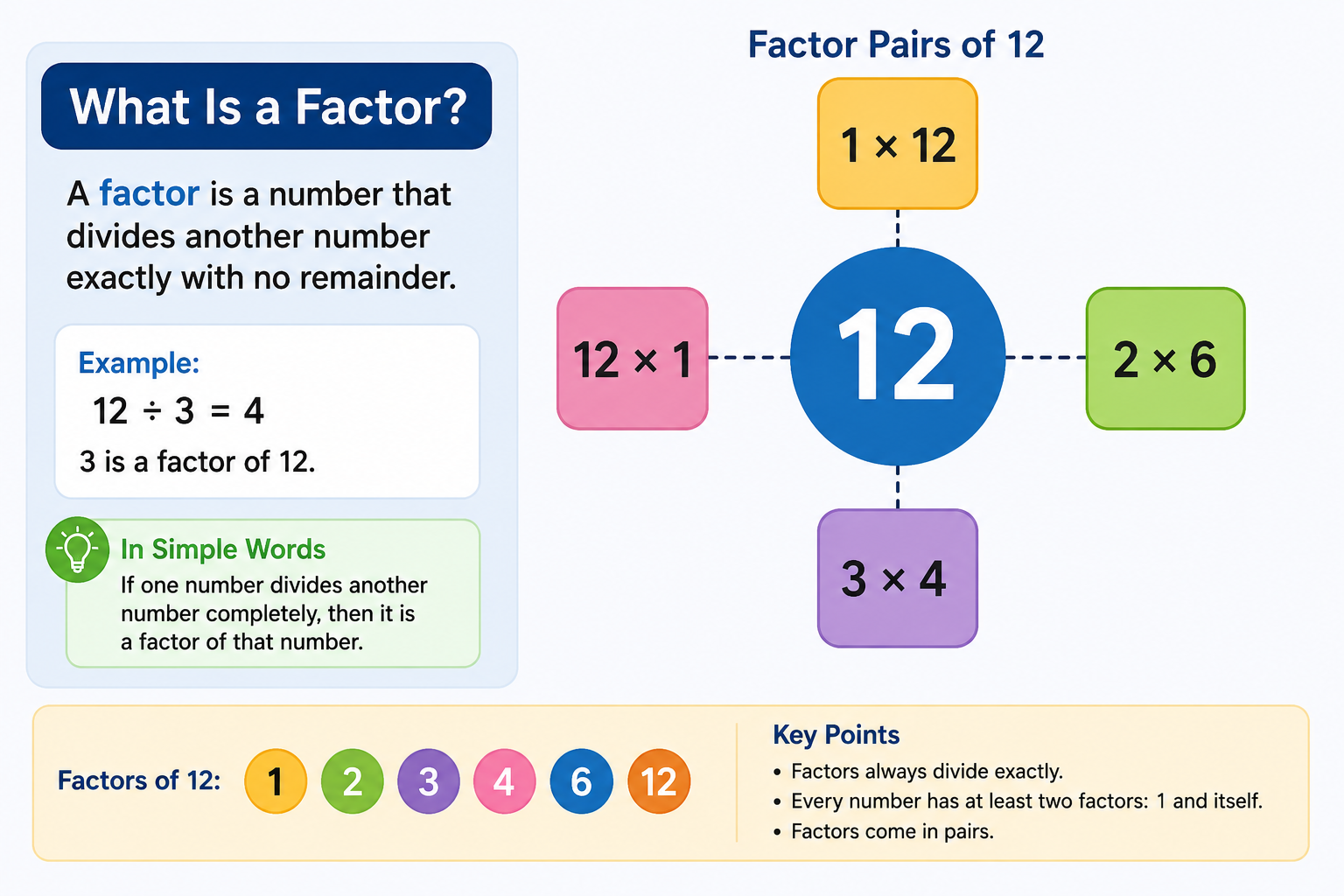
Think about the number 12. You can write 12 as a product in several different ways:
12 = 1 × 12
12 = 2 × 6
12 = 3 × 4
Every number used in those multiplications — 1, 2, 3, 4, 6, and 12 — divides into 12 exactly, leaving no remainder. Those numbers are the factors of 12.
So, what is a factor? A factor is a whole number that divides another number exactly without leaving a remainder. In other words, when you divide a number by one of its factors, the answer is always a whole number and the remainder is zero.
Factors appear throughout mathematics. They are essential when you simplify fractions, find greatest common factors, work with prime factorization, or solve algebraic expressions. If you understand factors well, a large part of school mathematics becomes much easier to handle.
Key Takeaways
-
A factor is a whole number that divides another number exactly, leaving no remainder.
-
Every positive integer has at least two factors: 1 and itself.
-
Factors always come in pairs called factor pairs.
-
Prime numbers have exactly two positive factors: 1 and the number itself.
-
Composite numbers have more than two positive factors.
-
1 is a factor of every positive whole number.
-
Factors are finite for any given positive integer, while multiples continue without end.
What Is a Factor?
A factor of a number is any whole number that divides that number exactly, meaning the division produces no remainder.
For example, when you divide 20 by 4, you get exactly 5 with nothing left over. That means 4 is a factor of 20. When you divide 20 by 3, you get 6 remainder 2, so 3 is not a factor of 20.
There are a few key ideas connected to this definition:
- Division: A factor divides the original number cleanly.
- Multiplication: Because 4 × 5 = 20, both 4 and 5 are factors of 20.
- Exact division: The result must be a whole number.
- No remainder: If there is any remainder at all, the divisor is not a factor.
Here is a simple way to test whether a number is a factor:
If A ÷ B = whole number with remainder zero, then B is a factor of A.
Some more examples:
- 18 ÷ 6 = 3 exactly, so 6 is a factor of 18.
- 18 ÷ 4 = 4 remainder 2, so 4 is not a factor of 18.
- 30 ÷ 5 = 6 exactly, so 5 is a factor of 30.
- 30 ÷ 7 = 4 remainder 2, so 7 is not a factor of 30.
Factor Examples
Let us look at several numbers and list all of their positive factors.
Factors of 6:
Test each whole number from 1 upward:
6 ÷ 1 = 6, 6 ÷ 2 = 3, 6 ÷ 3 = 2, 6 ÷ 6 = 1
Factors of 6: 1, 2, 3, 6
Factors of 10:
10 ÷ 1 = 10, 10 ÷ 2 = 5, 10 ÷ 5 = 2, 10 ÷ 10 = 1
Factors of 10: 1, 2, 5, 10
Factors of 24:
24 ÷ 1 = 24, 24 ÷ 2 = 12, 24 ÷ 3 = 8, 24 ÷ 4 = 6, 24 ÷ 6 = 4, 24 ÷ 8 = 3, 24 ÷ 12 = 2, 24 ÷ 24 = 1
Factors of 24: 1, 2, 3, 4, 6, 8, 12, 24
Each of those numbers divides 24 without leaving any remainder. Every one of them is a genuine factor.
How Do Factors Work?
Factors and multiplication are two sides of the same coin. Every multiplication fact gives you a pair of factors automatically.
Because 3 × 4 = 12, both 3 and 4 are factors of 12.
Because 2 × 6 = 12, both 2 and 6 are factors of 12.
Because 1 × 12 = 12, both 1 and 12 are factors of 12.
This is why factors always appear in pairs. If you know that one number divides another exactly, you automatically know the other half of the pair as well.
Think of factors as the numbers that “fit perfectly” into another number. Arranging 12 chairs into equal rows of 3 gives you exactly 4 rows — because 3 and 4 are both factors of 12. You could not do this with 5 chairs per row, because 5 is not a factor of 12.
How to Find the Factors of a Number
Here is a reliable step-by-step method that works for any positive whole number.
- Start with 1. Every number is divisible by 1.
- Divide the number by 1 and record both 1 and the result as a factor pair.
- Try dividing by 2. If the division is exact, record 2 and the quotient.
- Continue trying each whole number in order: 3, 4, 5, 6, and so on.
- Each time the division is exact, record the divisor and the quotient as a factor pair.
- Stop when the two numbers in your current pair meet or cross over each other.
Let us apply this method to a few numbers.
Factors of 12:
1 × 12, 2 × 6, 3 × 4
Factors: 1, 2, 3, 4, 6, 12
Factors of 18:
1 × 18, 2 × 9, 3 × 6
Factors: 1, 2, 3, 6, 9, 18
Factors of 20:
1 × 20, 2 × 10, 4 × 5
Factors: 1, 2, 4, 5, 10, 20
Factors of 30:
1 × 30, 2 × 15, 3 × 10, 5 × 6
Factors: 1, 2, 3, 5, 6, 10, 15, 30
Factor Pairs
A factor pair is a set of two whole numbers that multiply together to give the original number. Every factor pairs up with exactly one partner.
Factor pairs of 24:
| Factor Pair | Multiplication |
|---|---|
| 1 and 24 | 1 × 24 = 24 |
| 2 and 12 | 2 × 12 = 24 |
| 3 and 8 | 3 × 8 = 24 |
| 4 and 6 | 4 × 6 = 24 |
When a number is a perfect square, one factor pairs with itself. For example, the factor pairs of 36 include 6 × 6, so 6 appears only once in the factor list even though it forms a pair with itself.
Factor pairs are useful because finding one factor immediately tells you another. If you discover that 4 divides 24, you instantly know that 6 is also a factor of 24.
Factors vs Multiples
Many students mix up factors and multiples. They are related ideas, but they work in opposite directions.
| Feature | Factors | Multiples |
|---|---|---|
| Definition | Numbers that divide the original number exactly | Numbers obtained by multiplying the original number by any whole number |
| How they are found | By dividing the number | By multiplying the number |
| Example (based on 6) | 1, 2, 3, 6 | 6, 12, 18, 24, 30, … |
| Are they finite or infinite? | Finite (limited set) | Infinite (go on forever) |
| Relationship to original number | Always less than or equal to it | Always greater than or equal to it |
| Direction | Going smaller (division) | Going larger (multiplication) |
A helpful way to remember: factors are smaller than or equal to the number, while multiples are larger than or equal to the number (for positive integers greater than 1).
Factors vs Prime Numbers
A prime number is a whole number greater than 1 that has exactly two positive factors: 1 and itself. If you would like a full explanation of prime numbers, read our article [What Is a Prime Number?]
Knowing the difference between factors and prime numbers matters because prime numbers are a special category of numbers defined entirely by how many factors they have. Every prime number has exactly two factors. Any number with more than two factors is composite.
For example:
- 7 has factors 1 and 7 only. It is prime.
- 9 has factors 1, 3, and 9. It is not prime; it is composite.
What Is a Prime Factor?
A prime factor is a factor of a number that is itself a prime number.
For example, the factors of 12 are 1, 2, 3, 4, 6, and 12. Among those, 2 and 3 are prime numbers. So the prime factors of 12 are 2 and 3.
When you write 12 as a product of prime factors:
12 = 2 × 2 × 3 = 2² × 3
The prime factors are 2 and 3. The number 4 is also a factor of 12, but it is not a prime factor because 4 is not prime.
The distinction matters: a factor can be any whole number that divides exactly, while a prime factor must also be a prime number.
Prime Factorization
Prime factorization means expressing a number as a product of its prime factors. Every whole number greater than 1 has exactly one unique prime factorization.
Here are several clear examples:
Prime factorization of 12:
12 = 2 × 6 = 2 × 2 × 3 = 2² × 3
Prime factorization of 18:
18 = 2 × 9 = 2 × 3 × 3 = 2 × 3²
Prime factorization of 24:
24 = 2 × 12 = 2 × 2 × 6 = 2 × 2 × 2 × 3 = 2³ × 3
Prime factorization of 36:
36 = 4 × 9 = 2 × 2 × 3 × 3 = 2² × 3²
Prime factorization of 60:
60 = 4 × 15 = 2 × 2 × 3 × 5 = 2² × 3 × 5
Prime factorization of 100:
100 = 4 × 25 = 2 × 2 × 5 × 5 = 2² × 5²
Prime factorization is a cornerstone of number theory and is directly connected to the ideas covered in [What Is a Prime Number?]
Factors of Prime Numbers
Because a prime number cannot be divided by anything other than 1 and itself, it has exactly two positive factors.
| Prime Number | Positive Factors |
|---|---|
| 2 | 1, 2 |
| 3 | 1, 3 |
| 5 | 1, 5 |
| 7 | 1, 7 |
| 11 | 1, 11 |
| 13 | 1, 13 |
This is actually the definition of a prime number — having exactly two factors. If a number has only one factor (like 1) or more than two factors (like 6), it is not prime.
Factors of Composite Numbers
A composite number is any whole number greater than 1 that is not prime. Composite numbers have more than two positive factors because they can be divided by at least one number other than 1 and themselves.
| Composite Number | Positive Factors |
|---|---|
| 4 | 1, 2, 4 |
| 6 | 1, 2, 3, 6 |
| 8 | 1, 2, 4, 8 |
| 9 | 1, 3, 9 |
| 12 | 1, 2, 3, 4, 6, 12 |
| 15 | 1, 3, 5, 15 |
| 20 | 1, 2, 4, 5, 10, 20 |
Every composite number can be expressed as a product of prime factors, which is why prime factorization is so powerful.
Is 1 a Factor of Every Number?
Yes, absolutely. The number 1 divides every positive whole number exactly, because any number divided by 1 equals itself.
Examples:
- 5 ÷ 1 = 5 (no remainder)
- 100 ÷ 1 = 100 (no remainder)
- 237 ÷ 1 = 237 (no remainder)
This is why 1 always appears at the beginning of every factor list. It is the universal factor that every positive integer shares.
Is Every Number a Factor of Itself?
Yes. Every nonzero integer is a factor of itself because dividing any number by itself gives exactly 1 with no remainder.
Examples:
- 5 ÷ 5 = 1 exactly
- 20 ÷ 20 = 1 exactly
- 84 ÷ 84 = 1 exactly
This is why the number itself always appears at the end of its own factor list. Every positive integer has at least two factors: 1 and itself.
What Are Common Factors?
Common factors are numbers that are factors of two or more different numbers at the same time.
Example: Find the common factors of 12 and 18.
Factors of 12: 1, 2, 3, 4, 6, 12
Factors of 18: 1, 2, 3, 6, 9, 18
The numbers that appear in both lists are: 1, 2, 3, and 6
These are the common factors of 12 and 18. Common factors are particularly useful when simplifying fractions and finding the Greatest Common Factor.
Greatest Common Factor
The Greatest Common Factor (GCF), also called the Greatest Common Divisor (GCD), is the largest factor that two or more numbers share.
Using the example above, the common factors of 12 and 18 are 1, 2, 3, and 6. The greatest among these is 6, so the GCF of 12 and 18 is 6.
Method 1: Listing Factors
Find all factors of each number. Identify the common ones. Pick the largest.
GCF(12, 18):
Factors of 12: 1, 2, 3, 4, 6, 12
Factors of 18: 1, 2, 3, 6, 9, 18
GCF = 6
Method 2: Prime Factorization
Write each number as a product of prime factors. Multiply the prime factors they share.
12 = 2² × 3
18 = 2 × 3²
Shared prime factors: 2¹ × 3¹ = 6
GCF(12, 18) = 6
Prime factorization is particularly efficient for finding the GCF of larger numbers.
Factors and Least Common Multiple
The Least Common Multiple (LCM) is the smallest positive number that is a multiple of two or more given numbers. While LCM and factors might seem unrelated, prime factorization connects them directly.
To find the LCM of 12 and 18:
12 = 2² × 3
18 = 2 × 3²
Take the highest power of each prime factor that appears: 2² × 3² = 4 × 9 = 36
LCM(12, 18) = 36
Understanding prime factors makes both GCF and LCM calculations straightforward.
Factors of 0
Zero is a special case that deserves careful thought. In elementary mathematics, every nonzero integer divides zero exactly, because:
0 ÷ 1 = 0, 0 ÷ 2 = 0, 0 ÷ 3 = 0, and so on.
This means zero has infinitely many integer divisors. Because of this, we usually do not talk about the “factors of 0” in the same way we talk about factors of positive integers. The concept simply behaves differently for zero.
In most school mathematics, factor questions focus on positive integers, so this situation rarely arises in practice.
Factors of 1
The number 1 has exactly one positive factor: 1 itself.
1 ÷ 1 = 1 exactly.
No other positive integer divides 1 without leaving a remainder.
This is important because it means 1 is neither prime nor composite. It does not have two distinct positive factors (so it is not prime), and it is not built from smaller factors (so it is not composite either). It stands as its own unique category.
Positive and Negative Factors
Strictly speaking in mathematics, factors can be negative as well as positive. If 3 is a factor of 12, then −3 is also a factor of 12 because (−3) × (−4) = 12.
The full set of integer factors of 6, for instance, includes:
±1, ±2, ±3, ±6
However, in elementary and secondary school mathematics, factor lists almost always refer to positive factors only, unless a question specifically mentions negative factors. Unless your examination or textbook asks for negative factors, you can safely list positive factors only.
Factors and Divisibility
Divisibility rules are shortcuts that help you decide whether one number is a factor of another without performing the full division. Here are the most useful rules for everyday factor-finding:
| Divisor | Divisibility Rule | Example |
|---|---|---|
| 2 | The number is even (ends in 0, 2, 4, 6, or 8) | 48 is divisible by 2 |
| 3 | The sum of the digits is divisible by 3 | 123: 1+2+3 = 6, divisible by 3 |
| 5 | The number ends in 0 or 5 | 75 is divisible by 5 |
| 10 | The number ends in 0 | 130 is divisible by 10 |
These rules let you identify factors very quickly, especially in timed exam situations.
Factors of Even Numbers
Every positive even number is divisible by 2, which means 2 is always a factor of any even number.
Examples:
- Factors of 8: 1, 2, 4, 8
- Factors of 14: 1, 2, 7, 14
- Factors of 20: 1, 2, 4, 5, 10, 20
Because they share the factor 2, any two even numbers will always have at least 1 and 2 as common factors.
Factors of Odd Numbers
Odd numbers are not divisible by 2, which means 2 is never a factor of an odd number. However, odd numbers can still have many factors.
Examples:
- Factors of 9: 1, 3, 9
- Factors of 15: 1, 3, 5, 15
- Factors of 21: 1, 3, 7, 21
- Factors of 45: 1, 3, 5, 9, 15, 45
It is a common mistake to assume every odd number is prime. The number 9 is odd, but it has three factors, so it is composite, not prime.
Factors of a Number Using a Factor Tree
A factor tree is a visual method for finding the prime factorization of a number. You start with the number and repeatedly split it into smaller factor pairs until all branches end with prime numbers.
Factor tree for 24:
        24
       /  \
      4    6
     / \  / \
    2   2 2   3
24 = 2 × 2 × 2 × 3 = 2³ × 3
Factor tree for 36:
        36
       /  \
      4    9
     / \  / \
    2   2 3   3
36 = 2 × 2 × 3 × 3 = 2² × 3²
Factor tree for 60:
        60
       /  \
      6    10
     / \  /  \
    2   3 2    5
60 = 2 × 3 × 2 × 5 = 2² × 3 × 5
No matter which factor pair you choose to start with, the final set of prime factors at the ends of the branches will always be the same.
How Factors Help With Fractions
Factors are essential when simplifying fractions. To simplify a fraction, you divide the numerator and denominator by their common factors. The most efficient approach is to divide by the Greatest Common Factor.
Example 1:
Simplify 8/12
Factors of 8: 1, 2, 4, 8
Factors of 12: 1, 2, 3, 4, 6, 12
GCF = 4
8 ÷ 4 = 2
12 ÷ 4 = 3
8/12 = 2/3
Example 2:
Simplify 15/25
GCF of 15 and 25 = 5
15 ÷ 5 = 3
25 ÷ 5 = 5
15/25 = 3/5
This connection between factors and fractions also relates to the broader category of rational numbers. For a deeper look at rational numbers and how fractions fit into the number system, see our article [What Is a Rational Number?]
Factors in Algebra
The concept of factors extends naturally from numbers into algebra. In algebra, factoring an expression means writing it as a product of simpler expressions.
For example:
x² + 5x + 6 = (x + 2)(x + 3)
Here, (x + 2) and (x + 3) are the factors of the algebraic expression x² + 5x + 6. You can verify this by expanding: (x + 2)(x + 3) = x² + 3x + 2x + 6 = x² + 5x + 6.
Another simple example:
6x = 2 × 3 × x
The factors of 6x are 2, 3, and x (along with their combinations).
The basic idea is the same as with numbers: factors multiply together to produce the original expression.
What Is Factoring?
Factoring is the process of finding what multiplied together produces a given number or expression.
For numbers:
- Factoring 30 means finding: 2 × 3 × 5 = 30 (prime factorization)
For algebraic expressions:
- Factoring x² − 9 means finding: (x + 3)(x − 3)
In both cases, you are breaking something down into its component multipliers. Factoring in algebra is one of the most important skills in secondary and higher-level mathematics, and it builds directly on the understanding of numerical factors that you develop in primary school.
Factors and Real Numbers
The elementary idea of factors applies most directly to integers and whole numbers. When we talk about factors in school mathematics, we are almost always talking about positive integers dividing other positive integers.
The broader category of real numbers — which includes all rational and irrational numbers — is discussed in our article [What Is a Real Number?] Real numbers include integers, but the familiar factor concept works most cleanly within the world of integers.
Factors and Irrational Numbers
Irrational numbers, such as √2 or π, cannot be expressed as exact fractions and do not have a meaningful factor list in the same way that integers do. When we ask “what are the factors of a number?” in school mathematics, we are nearly always referring to whole numbers or integers.
For a full explanation of irrational numbers and how they differ from rational numbers, see our article [What Are Irrational Numbers?] Understanding this distinction helps you know exactly when factor concepts apply and when different mathematical tools are needed.
Factors in Physics
Numerical factors appear in physics whenever you work with formulas and physical quantities. For example, when calculating force, you multiply mass by acceleration: F = m × a. The numbers involved in such calculations often require factorization or simplification in the same way that arithmetic factors work.
For a detailed explanation of how force works in physics, see our article [What Is Force in Physics?] Recognizing how multiplication and numerical relationships underpin physical formulas shows that the mathematics of factors is genuinely useful beyond the classroom.
Factors in Everyday Life
You use factors in real life far more often than you might realize.
- Arranging objects into equal groups: If you have 24 books to place equally on shelves, the factors of 24 (1, 2, 3, 4, 6, 8, 12, 24) tell you exactly how many shelves you could use with equal numbers on each.
- Sharing equally: Dividing 30 sweets equally among friends is only possible with numbers that are factors of 30.
- Packaging: A factory packing items into boxes of equal size must use quantities that are factors of the total.
- Seating arrangements: Organizing 36 people into equal rows requires row sizes that are factors of 36.
- Timetabling: Scheduling equal time slots relies on dividing total time by factor amounts.
- Measurements: Cutting a 60 cm piece of material into equal lengths requires lengths that are factors of 60.
- Budgeting: Dividing a total cost equally among a group requires the number of people to be a factor of the total.
In each case, the question “does this number divide that number exactly?” is precisely the factor question.
How to Find Factors Quickly
Here are practical techniques for finding factors efficiently, especially in exam conditions.
- Always start with 1: 1 is always a factor, and so is the number itself.
- Use divisibility rules: Check 2, 3, 5, and 10 first using the simple rules above.
- Work in factor pairs: Finding one factor immediately gives you its partner.
- Use the square-root method: You only need to test divisors up to the square root of the number. Any factor larger than the square root will already have been found as the partner of a smaller factor. For example, to find the factors of 36, you only need to test up to √36 = 6. This cuts the work roughly in half.
- Check whether the number is prime: If no number from 2 up to the square root divides it exactly, the number is prime and has exactly two factors.
How Many Factors Does a Number Have?
If you know the prime factorization of a number, you can calculate the total count of its positive factors using a straightforward formula.
If:
n = p₁ᵃ × p₂ᵇ × p₃ᶜ × …
Then the number of positive factors of n is:
(a + 1)(b + 1)(c + 1)…
Example: How many positive factors does 12 have?
12 = 2² × 3¹
Number of positive factors = (2 + 1)(1 + 1) = 3 × 2 = 6
The six factors of 12 are: 1, 2, 3, 4, 6, 12. That confirms the answer.
Example: How many positive factors does 60 have?
60 = 2² × 3¹ × 5¹
Number of positive factors = (2 + 1)(1 + 1)(1 + 1) = 3 × 2 × 2 = 12
The twelve factors of 60 are: 1, 2, 3, 4, 5, 6, 10, 12, 15, 20, 30, 60.
Worked Examples: Finding Factors
Factors of 8:
Factor pairs: 1 × 8, 2 × 4
Factors: 1, 2, 4, 8
Factors of 12:
Factor pairs: 1 × 12, 2 × 6, 3 × 4
Factors: 1, 2, 3, 4, 6, 12
Factors of 15:
Factor pairs: 1 × 15, 3 × 5
Factors: 1, 3, 5, 15
Factors of 18:
Factor pairs: 1 × 18, 2 × 9, 3 × 6
Factors: 1, 2, 3, 6, 9, 18
Factors of 24:
Factor pairs: 1 × 24, 2 × 12, 3 × 8, 4 × 6
Factors: 1, 2, 3, 4, 6, 8, 12, 24
Factors of 30:
Factor pairs: 1 × 30, 2 × 15, 3 × 10, 5 × 6
Factors: 1, 2, 3, 5, 6, 10, 15, 30
Factors of 36:
Factor pairs: 1 × 36, 2 × 18, 3 × 12, 4 × 9, 6 × 6
Factors: 1, 2, 3, 4, 6, 9, 12, 18, 36
Factors of 48:
Factor pairs: 1 × 48, 2 × 24, 3 × 16, 4 × 12, 6 × 8
Factors: 1, 2, 3, 4, 6, 8, 12, 16, 24, 48
Factors of 60:
Factor pairs: 1 × 60, 2 × 30, 3 × 20, 4 × 15, 5 × 12, 6 × 10
Factors: 1, 2, 3, 4, 5, 6, 10, 12, 15, 20, 30, 60
Factors of 100:
Factor pairs: 1 × 100, 2 × 50, 4 × 25, 5 × 20, 10 × 10
Factors: 1, 2, 4, 5, 10, 20, 25, 50, 100
Common Mistakes About Factors
Learning what factors are not is just as valuable as knowing what they are. Here are the most frequent misconceptions and the corrections.
Mistake 1: A factor can be larger than the original positive number.
A positive factor of a number is always less than or equal to the number itself. Nothing larger than 12 divides 12 exactly (in positive integers).
Mistake 2: Every odd number is prime.
Many odd numbers are composite. For example, 9, 15, 21, and 25 are all odd but not prime.
Mistake 3: 1 is a prime number.
1 is not prime. A prime number must have exactly two distinct positive factors. The number 1 has only one positive factor (itself), so it does not qualify as prime.
Mistake 4: Factors and multiples are the same thing.
Factors divide the number; multiples are created by multiplying the number. They work in opposite directions.
Mistake 5: A factor must always be even.
Factors can be odd or even. The factors of 9, for example, are 1, 3, and 9 — all odd.
Mistake 6: Every number has the same number of factors.
Different numbers can have very different numbers of factors. The number 7 has 2 factors; the number 60 has 12 factors.
Mistake 7: 0 has only one factor.
In fact, every nonzero integer divides 0, so 0 has infinitely many integer divisors.
Mistake 8: A number can be divided by a factor and leave a remainder.
By definition, a factor always divides a number exactly, leaving no remainder. If there is a remainder, it is not a factor.
Mistake 9: Prime numbers have only one factor.
Prime numbers have exactly two positive factors: 1 and themselves. They do not have just one factor.
Mistake 10: Negative factors are always included in elementary factor lists.
In most school contexts, factor lists include positive factors only unless negative factors are specifically requested.
Factors and Prime Factorization: Quick Comparison
| Term | Definition | Example |
|---|---|---|
| Factor | A whole number that divides another exactly | 3 is a factor of 12 |
| Prime Factor | A factor that is also a prime number | 2 and 3 are prime factors of 12 |
| Factor Pair | Two numbers that multiply to give the original number | 3 × 4 is a factor pair of 12 |
| Multiple | The result of multiplying a number by a whole number | 24 is a multiple of 12 |
| GCF | The largest factor shared by two or more numbers | GCF(12, 18) = 6 |
Factor Practice Questions
20 Multiple Choice Questions
Question 1: Which of the following is a factor of 18?
A) 4 B) 6 C) 8 D) 11
Correct Answer: B
Explanation: 18 ÷ 6 = 3 exactly. 18 ÷ 4, ÷ 8, and ÷ 11 all leave remainders.
Question 2: How many positive factors does the number 7 have?
A) 1 B) 2 C) 3 D) 7
Correct Answer: B
Explanation: 7 is prime, so it has exactly two positive factors: 1 and 7.
Question 3: What are the factors of 10?
A) 1, 5, 10 B) 1, 2, 5, 10 C) 2, 5 D) 1, 2, 4, 10
Correct Answer: B
Explanation: 10 ÷ 1 = 10, 10 ÷ 2 = 5, 10 ÷ 5 = 2, 10 ÷ 10 = 1. All are exact.
Question 4: Which number is NOT a factor of 24?
A) 6 B) 8 C) 9 D) 12
Correct Answer: C
Explanation: 24 ÷ 9 = 2 remainder 6. So 9 is not a factor of 24.
Question 5: What is the greatest common factor of 12 and 20?
A) 2 B) 4 C) 6 D) 12
Correct Answer: B
Explanation: Factors of 12: 1, 2, 3, 4, 6, 12. Factors of 20: 1, 2, 4, 5, 10, 20. GCF = 4.
Question 6: Which of the following is a prime factor of 30?
A) 6 B) 10 C) 5 D) 15
Correct Answer: C
Explanation: The prime factors of 30 are 2, 3, and 5. Among the options, only 5 is prime.
Question 7: How many positive factors does 16 have?
A) 3 B) 4 C) 5 D) 8
Correct Answer: C
Explanation: Factors of 16: 1, 2, 4, 8, 16. That is 5 factors.
Question 8: What is the prime factorization of 36?
A) 4 × 9 B) 2 × 18 C) 2² × 3² D) 6²
Correct Answer: C
Explanation: 36 = 4 × 9 = 2 × 2 × 3 × 3 = 2² × 3². Options A, B, and D are not fully prime factorized.
Question 9: Is 1 a factor of every positive integer?
A) No, only of some numbers B) Yes, always C) Only of even numbers D) Only of prime numbers
Correct Answer: B
Explanation: Every positive integer divided by 1 gives itself with no remainder.
Question 10: What is the smallest factor (other than 1) of any even number?
A) 3 B) 4 C) 2 D) 5
Correct Answer: C
Explanation: Every even number is divisible by 2 by definition.
Question 11: Which of these numbers is a factor of both 15 and 25?
A) 3 B) 5 C) 15 D) 25
Correct Answer: B
Explanation: 15 ÷ 5 = 3 and 25 ÷ 5 = 5. So 5 is a common factor of both.
Question 12: What is the GCF of 18 and 24?
A) 3 B) 6 C) 9 D) 12
Correct Answer: B
Explanation: Factors of 18: 1, 2, 3, 6, 9, 18. Factors of 24: 1, 2, 3, 4, 6, 8, 12, 24. Largest common = 6.
Question 13: How many factors does a prime number always have?
A) 1 B) 2 C) 3 D) More than 3
Correct Answer: B
Explanation: By definition, a prime number has exactly two positive factors.
Question 14: What factor pair describes 36 using 9?
A) 9 × 3 B) 9 × 4 C) 9 × 9 D) 9 × 6
Correct Answer: B
Explanation: 9 × 4 = 36. So 9 and 4 form a factor pair of 36.
Question 15: Which number has exactly 3 positive factors?
A) 4 B) 6 C) 8 D) 12
Correct Answer: A
Explanation: Factors of 4 are 1, 2, and 4. That is exactly 3 factors. Numbers with exactly 3 factors are squares of primes.
Question 16: What is 60 expressed as a product of prime factors?
A) 6 × 10 B) 2 × 30 C) 2² × 3 × 5 D) 4 × 15
Correct Answer: C
Explanation: 60 = 2 × 2 × 3 × 5 = 2² × 3 × 5.
Question 17: If 5 is a factor of a number, what else must also be a factor of that number?
A) 10 B) 25 C) 1 D) 2
Correct Answer: C
Explanation: 1 is a factor of every positive integer, so it is definitely a factor of any number that has 5 as a factor.
Question 18: Which of the following is a composite number?
A) 13 B) 17 C) 21 D) 23
Correct Answer: C
Explanation: 21 = 3 × 7, so it has more than two factors and is composite.
Question 19: How many factors does 100 have?
A) 6 B) 8 C) 9 D) 12
Correct Answer: C
Explanation: 100 = 2² × 5². Number of factors = (2+1)(2+1) = 9. Factors: 1, 2, 4, 5, 10, 20, 25, 50, 100.
Question 20: Which statement about factors is correct?
A) Factors of a number are always smaller than the number
B) Every factor of a number is also a multiple of that number
C) A factor divides the number exactly with no remainder
D) Factors continue infinitely like multiples do
Correct Answer: C
Explanation: By definition, a factor divides the number exactly without leaving a remainder. Option A is nearly true for positive factors but not when the factor equals the number itself.
10 Short Answer Questions
Q1: List all positive factors of 20.
Answer: 1, 2, 4, 5, 10, 20
Q2: What is the GCF of 16 and 24?
Answer: 8 (Factors of 16: 1, 2, 4, 8, 16; Factors of 24: 1, 2, 3, 4, 6, 8, 12, 24; GCF = 8)
Q3: Write the prime factorization of 48.
Answer: 48 = 2⁴ × 3
Q4: Is 7 a factor of 49? Explain.
Answer: Yes. 49 ÷ 7 = 7 exactly, with no remainder.
Q5: How many positive factors does 25 have? List them.
Answer: 3 factors: 1, 5, 25
Q6: What are the common factors of 8 and 12?
Answer: Factors of 8: 1, 2, 4, 8. Factors of 12: 1, 2, 3, 4, 6, 12. Common factors: 1, 2, 4.
Q7: Is 9 a prime number? How do you know?
Answer: No. 9 has three factors (1, 3, 9), so it is composite.
Q8: What factor pair multiplies to give 42 using the number 6?
Answer: 6 × 7 = 42, so 6 and 7 are a factor pair of 42.
Q9: Can the number 4 be a factor of an odd number? Explain.
Answer: No. An odd number is not divisible by 2. Since 4 = 2 × 2, any number divisible by 4 must also be divisible by 2, making it even.
Q10: Simplify the fraction 18/24 using the GCF.
Answer: GCF(18, 24) = 6. 18 ÷ 6 = 3, 24 ÷ 6 = 4. Simplified fraction = 3/4.
10 Factor-Finding Questions
List all positive factors for each number:
1. Factors of 9:
1 × 9, 3 × 3
Factors: 1, 3, 9
2. Factors of 16:
1 × 16, 2 × 8, 4 × 4
Factors: 1, 2, 4, 8, 16
3. Factors of 28:
1 × 28, 2 × 14, 4 × 7
Factors: 1, 2, 4, 7, 14, 28
4. Factors of 32:
1 × 32, 2 × 16, 4 × 8
Factors: 1, 2, 4, 8, 16, 32
5. Factors of 45:
1 × 45, 3 × 15, 5 × 9
Factors: 1, 3, 5, 9, 15, 45
6. Factors of 50:
1 × 50, 2 × 25, 5 × 10
Factors: 1, 2, 5, 10, 25, 50
7. Factors of 72:
1 × 72, 2 × 36, 3 × 24, 4 × 18, 6 × 12, 8 × 9
Factors: 1, 2, 3, 4, 6, 8, 9, 12, 18, 24, 36, 72
8. Factors of 81:
1 × 81, 3 × 27, 9 × 9
Factors: 1, 3, 9, 27, 81
9. Factors of 90:
1 × 90, 2 × 45, 3 × 30, 5 × 18, 6 × 15, 9 × 10
Factors: 1, 2, 3, 5, 6, 9, 10, 15, 18, 30, 45, 90
10. Factors of 120:
1 × 120, 2 × 60, 3 × 40, 4 × 30, 5 × 24, 6 × 20, 8 × 15, 10 × 12
Factors: 1, 2, 3, 4, 5, 6, 8, 10, 12, 15, 20, 24, 30, 40, 60, 120
5 Prime Factorization Problems
Problem 1: Prime factorization of 45
Step 1: Is 45 divisible by 2? No (it is odd).
Step 2: Is 45 divisible by 3? Yes. 45 ÷ 3 = 15.
Step 3: Is 15 divisible by 3? Yes. 15 ÷ 3 = 5.
Step 4: Is 5 prime? Yes.
45 = 3² × 5
Problem 2: Prime factorization of 84
Step 1: 84 ÷ 2 = 42
Step 2: 42 ÷ 2 = 21
Step 3: 21 ÷ 3 = 7
Step 4: 7 is prime.
84 = 2² × 3 × 7
Problem 3: Prime factorization of 120
Step 1: 120 ÷ 2 = 60
Step 2: 60 ÷ 2 = 30
Step 3: 30 ÷ 2 = 15
Step 4: 15 ÷ 3 = 5
Step 5: 5 is prime.
120 = 2³ × 3 × 5
Problem 4: Prime factorization of 144
Step 1: 144 ÷ 2 = 72
Step 2: 72 ÷ 2 = 36
Step 3: 36 ÷ 2 = 18
Step 4: 18 ÷ 2 = 9
Step 5: 9 ÷ 3 = 3
Step 6: 3 is prime.
144 = 2⁴ × 3²
Problem 5: Prime factorization of 200
Step 1: 200 ÷ 2 = 100
Step 2: 100 ÷ 2 = 50
Step 3: 50 ÷ 2 = 25
Step 4: 25 ÷ 5 = 5
Step 5: 5 is prime.
200 = 2³ × 5²
Exam Tips
- Always begin with 1 and the number itself. These are guaranteed factors and anchor your factor list.
- Work in factor pairs. Finding one factor automatically gives you another. You cut your work in half.
- Apply divisibility rules early. Check whether the number is divisible by 2, 3, 5, and 10 before doing any long division.
- Use the square-root method. For larger numbers, only test divisors up to the square root. Every factor beyond the square root will already appear as the partner of a smaller factor.
- Check prime numbers carefully. Remember that prime numbers have exactly two factors. Do not list extra factors for them.
- Never confuse factors with multiples. In the exam, read the question carefully. Factors divide the number; multiples are created by multiplying the number.
- Verify your factor list. Once you have all factor pairs, write out the factors in ascending order and count them against the formula (a+1)(b+1)… to check you have found them all.
Quick Revision Notes
- Factor: A whole number that divides another number exactly, leaving no remainder.
- Factor pairs: Two numbers that multiply together to produce the original number.
- Prime factors: Factors that are also prime numbers.
- Composite numbers: Numbers with more than two positive factors.
- Common factors: Factors shared by two or more numbers.
- GCF: The greatest (largest) factor common to two or more numbers.
- Prime factorization: Expressing a number as a product of prime factors.
- Divisibility rules: Shortcuts for checking whether 2, 3, 5, or 10 is a factor.
- Factors vs multiples: Factors are finite; multiples are infinite. Factors divide; multiples multiply.
- Factor trees: Visual tools for breaking a number into its prime factors step by step.
Factor Cheat Sheet
| Concept | Definition | Example |
|---|---|---|
| Factor | A whole number that divides another exactly | 4 is a factor of 12 |
| Factor pair | Two numbers that multiply to give the number | 3 × 4 = 12 |
| Prime factor | A factor that is also a prime number | 2 and 3 are prime factors of 12 |
| Composite number | A whole number with more than two positive factors | 12 is composite |
| Common factor | A factor shared by two or more numbers | 6 is a common factor of 12 and 18 |
| GCF | The largest common factor of two or more numbers | GCF(12, 18) = 6 |
| Multiple | The result of multiplying a number by a whole number | 24 is a multiple of 12 |
| Prime factorization | Writing a number as a product of prime factors | 12 = 2² × 3 |
Frequently Asked Questions
1. What is a factor?
A factor is a whole number that divides another number exactly, producing no remainder. For example, 3 is a factor of 12 because 12 ÷ 3 = 4 exactly.
2. What is the definition of a factor in math?
In mathematics, a factor of a number n is any integer that divides n exactly. In elementary mathematics, this usually refers to positive whole number divisors.
3. How do you find the factors of a number?
Start at 1 and test each whole number in order. Every time a number divides your original number exactly, record it and its partner as a factor pair. Continue until your pair values meet or cross. You can stop testing at the square root of the number.
4. What are factor pairs?
A factor pair is a set of two numbers that multiply together to give the original number. For example, the factor pairs of 24 are (1, 24), (2, 12), (3, 8), and (4, 6).
5. What is the difference between factors and multiples?
Factors divide the number exactly. Multiples are obtained by multiplying the number. For example, the factors of 6 are 1, 2, 3, and 6, while the multiples of 6 are 6, 12, 18, 24, and so on.
6. What are prime factors?
Prime factors are factors that are also prime numbers. The prime factors of 12 are 2 and 3.
7. What are the factors of 12?
The positive factors of 12 are 1, 2, 3, 4, 6, and 12.
8. What are the factors of 24?
The positive factors of 24 are 1, 2, 3, 4, 6, 8, 12, and 24.
9. Is 1 a factor of every number?
Yes. 1 divides every positive whole number exactly, so 1 is always a factor of any positive integer.
10. Is every number a factor of itself?
Yes. Any positive nonzero integer divided by itself equals 1 with no remainder, so every number is a factor of itself.
11. What is a common factor?
A common factor is a number that is a factor of two or more numbers at the same time. For example, 3 is a common factor of both 12 and 18.
12. What is the greatest common factor?
The Greatest Common Factor (GCF) is the largest factor that two or more numbers share. The GCF of 12 and 18 is 6.
13. What is prime factorization?
Prime factorization is the process of writing a number as a product of its prime factors. For example, the prime factorization of 24 is 2³ × 3.
14. How many factors does a prime number have?
Exactly two: 1 and the prime number itself.
15. Can factors be negative?
Technically yes, in formal integer mathematics. However, in most school and examination contexts, factor lists include only positive factors unless negative factors are specifically required.
Summary
A factor is any whole number that divides another number exactly, leaving no remainder. Factors always appear in pairs that multiply together to produce the original number. Every positive integer has 1 and itself as factors, and any integer with more than two factors is composite. Prime numbers have exactly two factors.
The key skills connected to factors are finding factor pairs, identifying prime factors, performing prime factorization, finding common factors, and calculating the Greatest Common Factor. These skills connect directly to simplifying fractions, working with multiples, and understanding algebraic expressions.
Factors are not just abstract mathematical objects. They appear in everyday situations whenever you need to divide quantities equally or arrange items into equal groups. Mastering factors gives you a solid foundation for nearly every other area of school mathematics.
Final Thoughts
What is a factor? It is simply a number that divides another number exactly. That straightforward idea connects to virtually every area of school mathematics. When you simplify a fraction, you use common factors. When you find the GCF or LCM, you work with factors. When you build a factor tree, you are finding prime factors. When you solve an algebraic equation by factoring, you are using the same fundamental concept you learn when you first list the factors of 12.
Understanding factors deeply — not just memorizing the definition, but truly grasping what it means for one number to divide another exactly — will make multiplication, division, fractions, prime factorization, and algebra significantly more manageable. Build that understanding now, and it will pay dividends throughout your entire mathematical education.
References
- Khan Academy — Factors and Multiples: https://www.khanacademy.org
- Wolfram MathWorld — Divisor: https://mathworld.wolfram.com/Divisor.html
- OpenStax — Prealgebra, Factors and Multiples: https://openstax.org
- Mathematics LibreTexts — Factors and Factorization: https://math.libretexts.org
- Encyclopaedia Britannica — Prime Factorization: https://www.britannica.com
Disclaimer:
This article is intended for educational and informational purposes only. While LearnMinto strives to provide accurate and up-to-date mathematics information, readers should verify important academic concepts through official textbooks, educational institutions, examination boards, or trusted educational resources before using this content for exams or academic purposes. LearnMinto is not affiliated with any specific school, university, research institution, or examination board.