
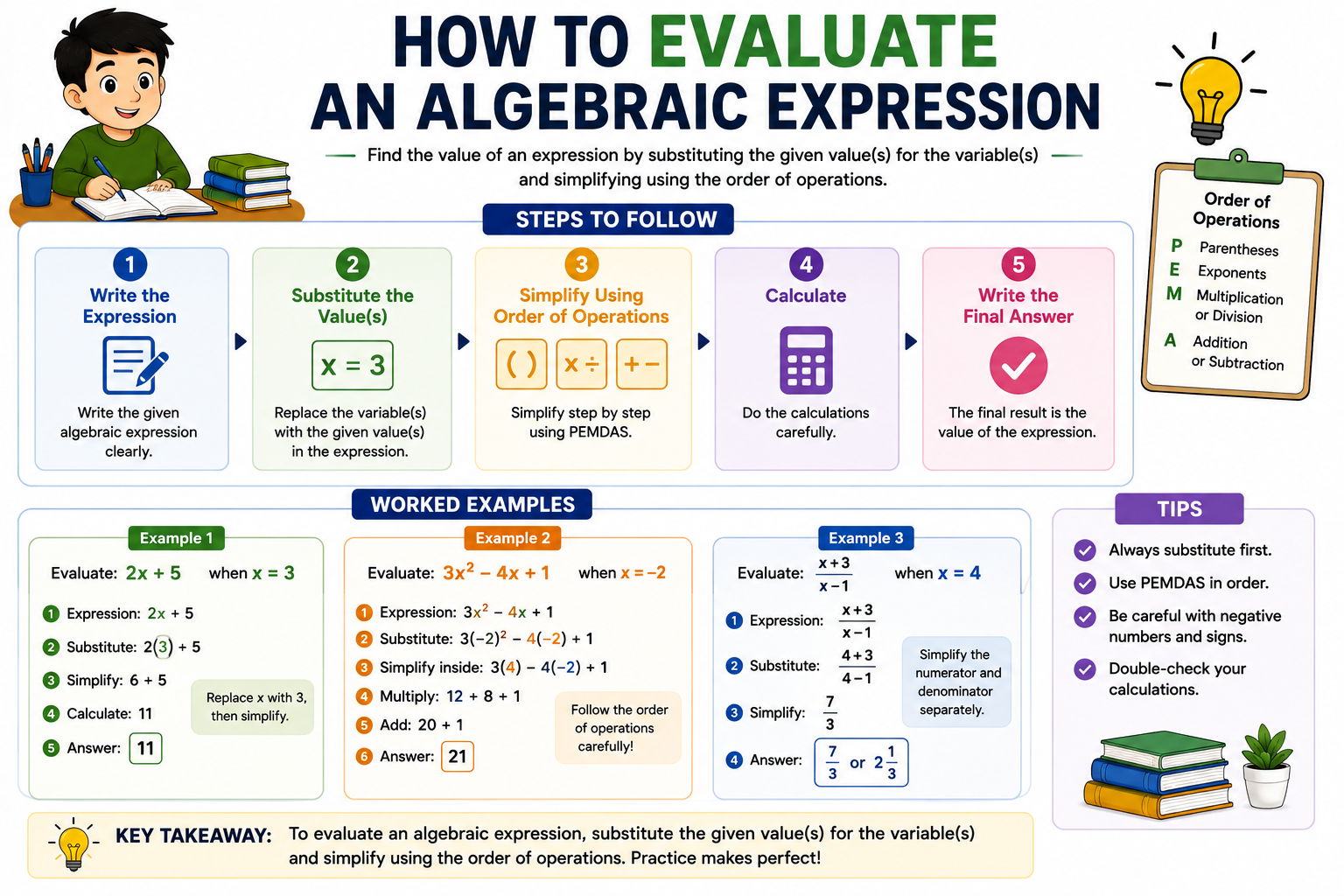
Introduction
Take a simple expression: 2x + 3 when x = 4.
To evaluate this, you replace x with 4 and calculate: 2(4) + 3 = 8 + 3 = 11.
That process is exactly what evaluating an algebraic expression means. You substitute a given numerical value in place of the variable and then simplify the result using the correct order of operations.
Knowing how to evaluate an algebraic expression is one of the most important foundational skills in algebra. It helps you simplify expressions, check solutions to equations, apply formulas, and build confidence for more advanced topics in mathematics and science.
Key Takeaways
-
Evaluating an algebraic expression means substituting a given value for the variable and calculating the result.
-
Substitution is the core process: you replace every variable with its given number.
-
Always use brackets around the substituted value to avoid sign errors.
-
After substituting, simplify the expression using the correct order of operations (PEMDAS or BODMAS).
-
Expressions with exponents require extra care: evaluate powers before multiplication.
-
Negative substitution values must always be placed inside brackets.
-
Always check your final answer by re-substituting the value into the original expression.
What Does It Mean to Evaluate an Algebraic Expression?
To evaluate an algebraic expression means to find its numerical value by replacing each variable with a given number and then calculating the result step by step.
Think of it this way: the expression holds a placeholder (the variable) where a real number will go. When you are told what that number is, you slot it in and work out the answer.
Example:
Evaluate 4x + 2 when x = 3.
Step 1: Replace x with 3.
4(3) + 2
Step 2: Multiply first (order of operations).
12 + 2
Step 3: Add.
14
The value of the expression when x = 3 is 14.
Every part of that process matters. The coefficient 4 is multiplied by the substituted value 3. Then the constant 2 is added. The order in which you perform these operations is not optional — it is governed by a strict set of rules.
What Is an Algebraic Expression?
An algebraic expression is a mathematical phrase that contains variables, coefficients, constants, and arithmetic operations. Unlike an equation, it does not have an equals sign.
Examples of algebraic expressions:
- 3x + 5
- 2a – 7
- 4x² + 3x – 1
- 6mn + 2m – 9
Each of these expressions has terms separated by addition or subtraction. Some terms contain variables, some contain exponents, and some are just numbers (constants).
What Are Variables and Coefficients?
A variable is a letter that represents an unknown or changing value. Common variable letters include x, y, a, b, m, and n.
A coefficient is the number that is multiplied by the variable in a term.
Example:
In the term 5x:
- The variable is x.
- The coefficient is 5.
In the term -3y²:
- The variable is y.
- The coefficient is -3.
- The exponent is 2.
When you evaluate an expression, you replace the variable with the given number. The coefficient stays and gets multiplied by that number.
Example:
Evaluate 5x when x = 7.
5(7) = 35
The coefficient 5 is multiplied by 7 to give 35.
What Is Substitution?
Substitution is the process of replacing a variable with a specific numerical value.
It is the most important step in evaluating any algebraic expression.
Example:
If x = 6, then 3x becomes:
3(6) = 18
You are simply placing 6 where x was and then calculating.
The values you substitute can be any type of number. As explained in [What Is a Real Number?], real numbers include positive integers, negative integers, fractions, decimals, and zero. All of these can appear as substitution values in algebra.
Important rule: Always place the substituted value inside brackets, especially when working with negative numbers or exponents. This prevents calculation errors.
The Order of Operations
After you substitute the given values, you must simplify the expression in the correct order. Skipping this step or doing operations in the wrong order will give you the wrong answer.
The order of operations is remembered using two acronyms:
PEMDAS (used widely in the United States):
- P — Parentheses
- E — Exponents
- M — Multiplication
- D — Division
- A — Addition
- S — Subtraction
BODMAS (used widely in the United Kingdom):
- B — Brackets
- O — Orders (powers and roots)
- D — Division
- M — Multiplication
- A — Addition
- S — Subtraction
Multiplication and division are performed from left to right. Addition and subtraction are also performed from left to right.
Example:
Evaluate 3x² + 2x – 1 when x = 2.
Substitute: 3(2)² + 2(2) – 1
Exponent first: 3(4) + 2(2) – 1
Multiply: 12 + 4 – 1
Add and subtract left to right: 15
As noted in the guide on [What Is a Rational Number?], rational numbers such as fractions and decimals are commonly used as substitution values, and the order of operations applies to them in exactly the same way.
How to Evaluate an Algebraic Expression Step by Step
Follow these eight steps every time you need to evaluate an algebraic expression:
- Read the expression carefully.
- Identify all the variables in the expression.
- Note the given value for each variable.
- Substitute each variable with its given value.
- Place the substituted value inside brackets.
- Simplify using the order of operations.
- Write the final numerical answer clearly.
- Check the result by re-substituting.
These steps apply to every expression, whether it is simple or complex. Let us work through a complete example using all eight steps.
Step 1: Read the Expression and Identify the Variables
Expression: 5x – 3 when x = 4
Variable: x
Given value: 4
Step 2: Substitute the Given Value
Replace x with 4, using brackets:
5(4) – 3
Using brackets here is important. If the value were negative, say x = -4, writing 5-4 – 3 would be confusing and incorrect. Writing 5(-4) – 3 keeps everything clear.
Step 3: Simplify Using the Order of Operations
5(4) – 3
Multiply first:
20 – 3
Subtract:
17
Step 4: Check the Answer
Re-substitute x = 4 into the original expression:
5(4) – 3 = 20 – 3 = 17
The answer is confirmed: 17.
Evaluating Expressions With One Variable
Here are ten worked examples with a single variable. Each one shows the substitution and full calculation.
1. 3x + 1 when x = 2
= 3(2) + 1
= 6 + 1
= 7
2. 7a – 4 when a = 3
= 7(3) – 4
= 21 – 4
= 17
3. 2m + 9 when m = 5
= 2(5) + 9
= 10 + 9
= 19
4. 10 – 3y when y = 2
= 10 – 3(2)
= 10 – 6
= 4
5. 6t when t = 4
= 6(4)
= 24
6. 4p – 7 when p = 8
= 4(8) – 7
= 32 – 7
= 25
7. 9 – 2n when n = 3
= 9 – 2(3)
= 9 – 6
= 3
8. 5k + 12 when k = 0
= 5(0) + 12
= 0 + 12
= 12
9. 8w – 3 when w = 1
= 8(1) – 3
= 8 – 3
= 5
10. 11 + 4q when q = 2
= 11 + 4(2)
= 11 + 8
= 19
Evaluating Expressions With Two Variables
When an expression has two variables, substitute both values carefully.
Example 1: Evaluate 3x + 2y when x = 4 and y = 5.
Substitute:
= 3(4) + 2(5)
= 12 + 10
= 22
Example 2: Evaluate a² + b when a = 3 and b = 7.
Substitute:
= (3)² + 7
= 9 + 7
= 16
Example 3: Evaluate 4x – 3y + 2 when x = 5 and y = 3.
Substitute:
= 4(5) – 3(3) + 2
= 20 – 9 + 2
= 13
Example 4: Evaluate 2p + 5q – pq when p = 2 and q = 3.
Substitute:
= 2(2) + 5(3) – (2)(3)
= 4 + 15 – 6
= 13
Evaluating Expressions With Exponents
Exponents must be handled carefully. Always evaluate the power before multiplying by the coefficient.
Example 1: Evaluate x² + 3 when x = 4.
Substitute:
= (4)² + 3
= 16 + 3
= 19
Example 2: Evaluate 2a³ – 1 when a = 2.
Substitute:
= 2(2)³ – 1
= 2(8) – 1
= 16 – 1
= 15
Example 3: Evaluate 5m² + 2m when m = 3.
Substitute:
= 5(3)² + 2(3)
= 5(9) + 6
= 45 + 6
= 51
A common mistake is squaring the entire term 5m² as (5m)². Remember: only m is squared, not the coefficient 5.
Quadratic expressions such as x² + 5x + 6 are among the most frequently evaluated expressions in school algebra. To understand quadratic expressions more fully, read [What Is a Quadratic Equation?]
Evaluating Expressions With Negative Numbers
Negative substitution values require extra care. Always place negative values inside brackets to avoid sign errors.
Example 1: Evaluate 3x + 7 when x = -2.
= 3(-2) + 7
= -6 + 7
= 1
Example 2: Evaluate 2a – 5 when a = -3.
= 2(-3) – 5
= -6 – 5
= -11
Example 3: Evaluate -4m + 9 when m = -1.
= -4(-1) + 9
= 4 + 9
= 13
Example 4: Evaluate x² – 2x when x = -3.
= (-3)² – 2(-3)
= 9 + 6
= 15
Note: (-3)² = 9, not -9. Squaring a negative number gives a positive result.
Example 5: Evaluate 5y + 3 when y = -4.
= 5(-4) + 3
= -20 + 3
= -17
Example 6: Evaluate a² + 3a – 2 when a = -2.
= (-2)² + 3(-2) – 2
= 4 – 6 – 2
= -4
Example 7: Evaluate 6 – 2t when t = -5.
= 6 – 2(-5)
= 6 + 10
= 16
Example 8: Evaluate 3x² – 4x + 1 when x = -1.
= 3(-1)² – 4(-1) + 1
= 3(1) + 4 + 1
= 3 + 4 + 1
= 8
Evaluating Expressions With Fractions
Fractional substitution values follow the same process. Substitute carefully and simplify the arithmetic step by step.
To review fractions before working through these examples, visit [What Is a Fraction?]
Example 1: Evaluate 4x + 2 when x = 1/2.
= 4(1/2) + 2
= 2 + 2
= 4
Example 2: Evaluate 3a – 1 when a = 2/3.
= 3(2/3) – 1
= 2 – 1
= 1
Example 3: Evaluate 6m + 4 when m = 1/3.
= 6(1/3) + 4
= 2 + 4
= 6
Example 4: Evaluate 8y – 3 when y = 3/4.
= 8(3/4) – 3
= 6 – 3
= 3
Evaluating Expressions With Decimal Values
Decimal substitution values are handled in exactly the same way as whole numbers.
Example 1: Evaluate 2x + 1.5 when x = 2.5.
= 2(2.5) + 1.5
= 5 + 1.5
= 6.5
Example 2: Evaluate 3a – 0.5 when a = 1.5.
= 3(1.5) – 0.5
= 4.5 – 0.5
= 4
Example 3: Evaluate 4t + 0.75 when t = 1.25.
= 4(1.25) + 0.75
= 5 + 0.75
= 5.75
Example 4: Evaluate 5m – 2.5 when m = 0.5.
= 5(0.5) – 2.5
= 2.5 – 2.5
= 0
Example 5: Evaluate 6n + 3.2 when n = 0.8.
= 6(0.8) + 3.2
= 4.8 + 3.2
= 8
Evaluating Expressions With Multiple Variables and Exponents
Example 1: Evaluate 2x² + 3y – 4 when x = 2 and y = 5.
= 2(2)² + 3(5) – 4
= 2(4) + 15 – 4
= 8 + 15 – 4
= 19
Example 2: Evaluate a²b + 2ab when a = 3 and b = 2.
= (3)²(2) + 2(3)(2)
= 9(2) + 12
= 18 + 12
= 30
Example 3: Evaluate 3x²y – 2xy² when x = 2 and y = 1.
= 3(2)²(1) – 2(2)(1)²
= 3(4)(1) – 2(2)(1)
= 12 – 4
= 8
Evaluating Expressions With Parentheses
When an expression contains parentheses, substitute the values and then apply the order of operations.
Example 1: Evaluate 3(x + 2) when x = 4.
= 3(4 + 2)
= 3(6)
= 18
Example 2: Evaluate 2(a – 3) + 5a when a = 3.
= 2(3 – 3) + 5(3)
= 2(0) + 15
= 0 + 15
= 15
Example 3: Evaluate 4(2x – 1) + 3 when x = 2.
= 4(2(2) – 1) + 3
= 4(4 – 1) + 3
= 4(3) + 3
= 12 + 3
= 15
Evaluating Linear Expressions
A linear expression contains variables raised only to the first power. There are no squared or cubed terms.
For a deeper understanding of linear algebra, read What Is a Linear Equation?
Example 1: Evaluate 4x + 7 when x = 3.
= 4(3) + 7
= 12 + 7
= 19
Example 2: Evaluate 2a – 9 when a = 6.
= 2(6) – 9
= 12 – 9
= 3
Example 3: Evaluate 7m + 3n – 5 when m = 2 and n = 4.
= 7(2) + 3(4) – 5
= 14 + 12 – 5
= 21
Evaluating Quadratic Expressions
Quadratic expressions contain a squared variable as their highest power.
Example 1: Evaluate x² + 5x + 6 when x = 2.
= (2)² + 5(2) + 6
= 4 + 10 + 6
= 20
Example 2: Evaluate 3a² – 2a + 1 when a = 4.
= 3(4)² – 2(4) + 1
= 3(16) – 8 + 1
= 48 – 8 + 1
= 41
Example 3: Evaluate 2x² – 3x – 5 when x = 3.
= 2(3)² – 3(3) – 5
= 2(9) – 9 – 5
= 18 – 9 – 5
= 4
After simplifying expressions by combining variable terms, as covered in What Are Like Terms in Algebra?, evaluating the result becomes much more straightforward.
Evaluating Expressions Involving Factors
Some expressions are written in factored form. You still substitute the given value and then calculate.
To understand factors more thoroughly, visit What Is a Factor?
Example 1: Evaluate (x + 2)(x – 3) when x = 5.
= (5 + 2)(5 – 3)
= (7)(2)
= 14
Example 2: Evaluate (2a + 1)(a – 4) when a = 6.
= (2(6) + 1)(6 – 4)
= (12 + 1)(2)
= (13)(2)
= 26
Example 3: Evaluate (x – 1)(x + 3) when x = -2.
= (-2 – 1)(-2 + 3)
= (-3)(1)
= -3
Evaluating Expressions With Rational Number Coefficients
When coefficients are fractions, substitute the variable value and simplify carefully.
As explained in What Is a Rational Number?, a rational number is any number that can be written as a fraction where both numerator and denominator are integers.
Example 1: Evaluate (1/2)x + 3 when x = 6.
= (1/2)(6) + 3
= 3 + 3
= 6
Example 2: Evaluate (3/4)a – 1 when a = 8.
= (3/4)(8) – 1
= 6 – 1
= 5
Example 3: Evaluate (2/3)m + (1/6)m when m = 12.
= (2/3)(12) + (1/6)(12)
= 8 + 2
= 10
Evaluating Expressions in Real-World Contexts
Algebraic expressions are not just abstract mathematics. They are used constantly in real life to calculate costs, distances, temperatures, areas, and much more.
Example 1: Shopping Cost
Cost = 5n + 10, where n = number of items purchased.
Find the cost when n = 7.
= 5(7) + 10
= 35 + 10
= £45
Example 2: Distance Travelled
Distance = 60t, where t = time in hours.
Find the distance when t = 3.5.
= 60(3.5)
= 210 miles
Example 3: Area of a Rectangle
Area = lw, where l = length and w = width.
Find the area when l = 8 and w = 5.
= 8 × 5
= 40 square units
Example 4: Temperature Conversion
Fahrenheit = (9/5)C + 32, where C = temperature in Celsius.
Find Fahrenheit when C = 25.
= (9/5)(25) + 32
= 45 + 32
= 77°F
Evaluating Expressions in Physics Formulas
Algebraic expressions appear throughout physics. Evaluating them requires the same substitution and order-of-operations skills you have been practising in mathematics.
Example: Newton’s Second Law of Motion
Force = mass × acceleration
F = ma
Find F when m = 10 kg and a = 3 m/s².
= 10 × 3
= 30 Newtons
To explore this topic further, visit What Is Force in Physics?
Being able to substitute values into formulas like F = ma, v = u + at, and E = mc² is a direct application of knowing how to evaluate an algebraic expression.
Worked Examples
The following twenty examples progress from simple to advanced. Each one shows the full working.
Example 1: Single variable, simple linear expression
Expression: 6x + 4 when x = 3
Substitution: 6(3) + 4
Order of operations: 18 + 4
Final Answer: 22
Quick Check: 6(3) + 4 = 18 + 4 = 22 Correct.
Example 2: Single variable with exponent
Expression: x² + 5 when x = 6
Substitution: (6)² + 5
Order of operations: 36 + 5
Final Answer: 41
Quick Check: (6)² + 5 = 36 + 5 = 41 Correct.
Example 3: Two variables, linear expression
Expression: 4x + 3y when x = 2 and y = 5
Substitution: 4(2) + 3(5)
Order of operations: 8 + 15
Final Answer: 23
Quick Check: 4(2) + 3(5) = 8 + 15 = 23 Correct.
Example 4: Two variables, one with exponent
Expression: a² + 4b when a = 3 and b = 2
Substitution: (3)² + 4(2)
Order of operations: 9 + 8
Final Answer: 17
Quick Check: (3)² + 4(2) = 9 + 8 = 17 Correct.
Example 5: Negative substitution value
Expression: 2x – 3 when x = -4
Substitution: 2(-4) – 3
Order of operations: -8 – 3
Final Answer: -11
Quick Check: 2(-4) – 3 = -8 – 3 = -11 Correct.
Example 6: Fractional substitution value
Expression: 8x + 1 when x = 1/4
Substitution: 8(1/4) + 1
Order of operations: 2 + 1
Final Answer: 3
Quick Check: 8(1/4) + 1 = 2 + 1 = 3 Correct.
Example 7: Decimal substitution value
Expression: 5x – 1 when x = 1.4
Substitution: 5(1.4) – 1
Order of operations: 7 – 1
Final Answer: 6
Quick Check: 5(1.4) – 1 = 7 – 1 = 6 Correct.
Example 8: Expression with parentheses
Expression: 3(x – 5) + 2x when x = 7
Substitution: 3(7 – 5) + 2(7)
Order of operations: 3(2) + 14 = 6 + 14
Final Answer: 20
Quick Check: 3(2) + 14 = 20 Correct.
Example 9: Quadratic expression
Expression: x² + 6x – 4 when x = 3
Substitution: (3)² + 6(3) – 4
Order of operations: 9 + 18 – 4
Final Answer: 23
Quick Check: 9 + 18 – 4 = 23 Correct.
Example 10: Cubic expression
Expression: 2x³ – 3x + 1 when x = 2
Substitution: 2(2)³ – 3(2) + 1
Order of operations: 2(8) – 6 + 1 = 16 – 6 + 1
Final Answer: 11
Quick Check: 16 – 6 + 1 = 11 Correct.
Example 11: Multiple variables and exponents
Expression: 3x² + 2y² when x = 2 and y = 3
Substitution: 3(2)² + 2(3)²
Order of operations: 3(4) + 2(9) = 12 + 18
Final Answer: 30
Quick Check: 12 + 18 = 30 Correct.
Example 12: Factored expression
Expression: (x + 4)(x – 2) when x = 3
Substitution: (3 + 4)(3 – 2)
Order of operations: (7)(1)
Final Answer: 7
Quick Check: 7 × 1 = 7 Correct.
Example 13: Rational coefficients
Expression: (3/5)x + 2 when x = 10
Substitution: (3/5)(10) + 2
Order of operations: 6 + 2
Final Answer: 8
Quick Check: 6 + 2 = 8 Correct.
Example 14: Real-world application
Expression: 12h + 50, where h = hours worked
Find value when h = 8.
Substitution: 12(8) + 50
Order of operations: 96 + 50
Final Answer: £146
Quick Check: 96 + 50 = 146 Correct.
Example 15: Zero substitution value
Expression: 5x² + 3x + 7 when x = 0
Substitution: 5(0)² + 3(0) + 7
Order of operations: 0 + 0 + 7
Final Answer: 7
Quick Check: 0 + 0 + 7 = 7 Correct.
Example 16: Negative coefficient
Expression: -6x + 4 when x = 3
Substitution: -6(3) + 4
Order of operations: -18 + 4
Final Answer: -14
Quick Check: -18 + 4 = -14 Correct.
Example 17: Three variables
Expression: 2x + 3y – z when x = 4, y = 2, z = 5
Substitution: 2(4) + 3(2) – (5)
Order of operations: 8 + 6 – 5
Final Answer: 9
Quick Check: 8 + 6 – 5 = 9 Correct.
Example 18: Positive and negative substitution values
Expression: 3a – 2b when a = 5 and b = -3
Substitution: 3(5) – 2(-3)
Order of operations: 15 + 6
Final Answer: 21
Quick Check: 15 + 6 = 21 Correct.
Example 19: Advanced multi-term expression
Expression: 4x³ – 2x² + 5x – 8 when x = 2
Substitution: 4(2)³ – 2(2)² + 5(2) – 8
Order of operations: 4(8) – 2(4) + 10 – 8 = 32 – 8 + 10 – 8
Final Answer: 26
Quick Check: 32 – 8 + 10 – 8 = 26 Correct.
Example 20: Checking and verifying
Expression: 2x² – 3x + 4 when x = 3
Substitution: 2(3)² – 3(3) + 4
Order of operations: 2(9) – 9 + 4 = 18 – 9 + 4
Final Answer: 13
Quick Check: Substitute x = 3 again: 2(9) – 9 + 4 = 13 Confirmed.
Common Mistakes Students Make
Knowing where errors happen helps you avoid them. Here are the most common mistakes, each with an explanation and a correction.
| Incorrect | Correct | Explanation |
|---|---|---|
| 3x² when x = 2 calculated as (3x)² = (6)² = 36 | 3(2)² = 3(4) = 12 | Only x is squared, not the coefficient |
| 5 + (-3) written as 5 + 3 = 8 | 5 + (-3) = 5 – 3 = 2 | Negative sign must be kept |
| (-2)² written as -4 | (-2)² = 4 | Squaring a negative gives a positive |
| 2x + 3y evaluated as one combined term | Keep 2x and 3y separate until values are substituted | Different variables cannot be merged |
| Order of operations ignored: 3 + 4 × 2 = 14 | 3 + 4 × 2 = 3 + 8 = 11 | Multiply before adding |
| Forgetting to substitute every variable | Replace all variables before calculating | Missing a variable gives a wrong answer |
| 1/2 × 6 calculated as 1/(2×6) = 1/12 | 1/2 × 6 = 3 | Multiply the fraction by the number correctly |
| Skipping the check step | Always re-substitute to verify | The check step catches arithmetic errors |
| Writing -3x when x = -2 as -3-2 = -5 | -3(-2) = 6 | Use brackets: the variable replaces the full value |
| Treating x and x² as the same | x = 3 gives x² = 9, not 3 | Exponents change the value significantly |
Evaluating Algebraic Expressions Rules Cheat Sheet
| Rule | Example | Result |
|---|---|---|
| Replace every variable with its given value | x = 5 in 3x | 3(5) |
| Use brackets around the substituted value | x = -4 in 2x | 2(-4) |
| Follow PEMDAS / BODMAS | 3 + 2 × 4 | 3 + 8 = 11 |
| Evaluate exponents before multiplying by coefficient | 3x² when x = 4 | 3(16) = 48 |
| Handle negative values carefully with brackets | x = -3 in x² | (-3)² = 9 |
| Simplify step by step, one operation at a time | 2(3)² – 5 | 2(9) – 5 = 13 |
| Always check by re-substituting | Verify final answer | Confirms accuracy |
Evaluating vs Simplifying an Algebraic Expression
These two processes are different and are often confused by students.
Evaluating means substituting a specific value for the variable and calculating a numerical result.
Example: Evaluate 4x + 3 when x = 2.
= 4(2) + 3 = 8 + 3 = 11
The result is a number.
Simplifying means reducing an expression by combining like terms or applying algebraic rules, without substituting a specific value.
Example: Simplify 4x + 3x.
= 7x
The result is still an expression with a variable, not a number.
Both skills are important, and in many problems you will simplify first and then evaluate.
Evaluating vs Solving an Equation
Students sometimes confuse evaluating an expression with solving an equation. They are different processes.
Evaluating: You are given the value of the variable and you find the numerical result.
Example: Evaluate 3x + 2 when x = 5.
= 3(5) + 2 = 15 + 2 = 17
Solving: You are given the result and you find the value of the variable.
Example: Solve 3x + 2 = 17.
3x = 15
x = 5
Evaluating starts with the variable value and ends with a number. Solving starts with the number and works backwards to find the variable.
Practice Questions
20 Multiple Choice Questions
Question 1: Evaluate 3x + 5 when x = 4.
A) 12
B) 17
C) 15
D) 20
Correct Answer: B
3(4) + 5 = 12 + 5 = 17
Question 2: Evaluate 2a – 7 when a = 6.
A) 5
B) 7
C) 4
D) 9
Correct Answer: A
2(6) – 7 = 12 – 7 = 5
Question 3: Evaluate x² + 4 when x = 3.
A) 10
B) 12
C) 13
D) 7
Correct Answer: C
(3)² + 4 = 9 + 4 = 13
Question 4: Evaluate 5x – 3 when x = -2.
A) -13
B) 7
C) -7
D) 13
Correct Answer: A
5(-2) – 3 = -10 – 3 = -13
Question 5: Evaluate 4m + 2n when m = 3 and n = 5.
A) 18
B) 22
C) 28
D) 24
Correct Answer: B
4(3) + 2(5) = 12 + 10 = 22
Question 6: Evaluate (1/2)x + 4 when x = 6.
A) 6
B) 7
C) 8
D) 5
Correct Answer: B
(1/2)(6) + 4 = 3 + 4 = 7
Question 7: Evaluate 2x² – 3 when x = 4.
A) 29
B) 32
C) 28
D) 35
Correct Answer: A
2(4)² – 3 = 2(16) – 3 = 32 – 3 = 29
Question 8: Evaluate -3x + 10 when x = 3.
A) 1
B) 2
C) -1
D) 4
Correct Answer: A
-3(3) + 10 = -9 + 10 = 1
Question 9: Evaluate 3(x + 4) when x = 2.
A) 18
B) 14
C) 10
D) 22
Correct Answer: A
3(2 + 4) = 3(6) = 18
Question 10: Evaluate a² + b² when a = 3 and b = 4.
A) 14
B) 24
C) 25
D) 20
Correct Answer: C
(3)² + (4)² = 9 + 16 = 25
Question 11: Evaluate 5x + 0 when x = 7.
A) 0
B) 35
C) 12
D) 7
Correct Answer: B
5(7) + 0 = 35
Question 12: Evaluate 2x + 1.5 when x = 2.5.
A) 5.5
B) 6.5
C) 7
D) 4.5
Correct Answer: B
2(2.5) + 1.5 = 5 + 1.5 = 6.5
Question 13: Evaluate x³ – 1 when x = 2.
A) 7
B) 6
C) 9
D) 8
Correct Answer: A
(2)³ – 1 = 8 – 1 = 7
Question 14: Evaluate (x – 3)(x + 2) when x = 5.
A) 12
B) 14
C) 16
D) 10
Correct Answer: B
(5 – 3)(5 + 2) = (2)(7) = 14
Question 15: Evaluate 6y – 2 when y = 0.
A) 2
B) 0
C) -2
D) 6
Correct Answer: C
6(0) – 2 = 0 – 2 = -2
Question 16: Evaluate 4x² + 3x when x = -1.
A) 7
B) 1
C) -1
D) 4
Correct Answer: B
4(-1)² + 3(-1) = 4(1) – 3 = 4 – 3 = 1
Question 17: Evaluate 10 – 2x when x = 4.
A) 2
B) -2
C) 8
D) 4
Correct Answer: A
10 – 2(4) = 10 – 8 = 2
Question 18: Evaluate 3a + 2b – ab when a = 4 and b = 3.
A) 9
B) 12
C) 6
D) 10
Correct Answer: C
3(4) + 2(3) – (4)(3) = 12 + 6 – 12 = 6
Question 19: Evaluate (3/4)x – 2 when x = 8.
A) 4
B) 6
C) 3
D) 5
Correct Answer: A
(3/4)(8) – 2 = 6 – 2 = 4
Question 20: Evaluate 2x² – x + 5 when x = 3.
A) 18
B) 20
C) 22
D) 17
Correct Answer: B
2(3)² – 3 + 5 = 2(9) – 3 + 5 = 18 – 3 + 5 = 20
15 Evaluate-the-Expression Problems
1. Evaluate 7x – 2 when x = 3.
= 7(3) – 2 = 21 – 2 = 19
2. Evaluate 4a + 9 when a = 5.
= 4(5) + 9 = 20 + 9 = 29
3. Evaluate 3x² + 1 when x = 4.
= 3(16) + 1 = 48 + 1 = 49
4. Evaluate 2m – n when m = 7 and n = 3.
= 2(7) – 3 = 14 – 3 = 11
5. Evaluate x³ + 2x when x = 3.
= 27 + 6 = 33
6. Evaluate 5(x – 4) when x = 6.
= 5(2) = 10
7. Evaluate -2x + 8 when x = -3.
= -2(-3) + 8 = 6 + 8 = 14
8. Evaluate (1/3)x + 5 when x = 9.
= 3 + 5 = 8
9. Evaluate 4x – 3y + 2 when x = 3 and y = 2.
= 12 – 6 + 2 = 8
10. Evaluate 2.5x + 1 when x = 4.
= 10 + 1 = 11
11. Evaluate a²b – 3 when a = 2 and b = 5.
= (4)(5) – 3 = 20 – 3 = 17
12. Evaluate (x + 1)(x – 2) when x = 4.
= (5)(2) = 10
13. Evaluate 6x² – 2x + 3 when x = -2.
= 6(4) – 2(-2) + 3 = 24 + 4 + 3 = 31
14. Evaluate (2/5)x + 6 when x = 10.
= 4 + 6 = 10
15. Evaluate 3x³ – 4x² + x when x = 2.
= 3(8) – 4(4) + 2 = 24 – 16 + 2 = 10
10 Identify and Substitute Questions
1. Expression: 4x + 3
Variables: x
If x = 2: 4(2) + 3 = 11
2. Expression: 5a – 2b
Variables: a, b
If a = 4 and b = 3: 5(4) – 2(3) = 20 – 6 = 14
3. Expression: 3m²
Variables: m
If m = 3: 3(3)² = 3(9) = 27
4. Expression: 2x + y – 1
Variables: x, y
If x = 5 and y = 2: 2(5) + 2 – 1 = 11
5. Expression: 7t – 4
Variables: t
If t = -2: 7(-2) – 4 = -14 – 4 = -18
6. Expression: ab + 2a
Variables: a, b
If a = 3 and b = 4: (3)(4) + 2(3) = 12 + 6 = 18
7. Expression: 6x²
Variables: x
If x = -2: 6(-2)² = 6(4) = 24
8. Expression: 2p + 3q – pq
Variables: p, q
If p = 5 and q = 2: 10 + 6 – 10 = 6
9. Expression: (1/4)n + 3
Variables: n
If n = 8: 2 + 3 = 5
10. Expression: x² + y² + z
Variables: x, y, z
If x = 2, y = 3, z = 1: 4 + 9 + 1 = 14
5 Challenge Problems
Challenge 1: Evaluate 3x³ – 2x² + 4x – 7 when x = -2.
= 3(-2)³ – 2(-2)² + 4(-2) – 7
= 3(-8) – 2(4) + (-8) – 7
= -24 – 8 – 8 – 7
= -47
Challenge 2: Evaluate (2/3)a² – (1/4)b + 5 when a = 3 and b = 8.
= (2/3)(9) – (1/4)(8) + 5
= 6 – 2 + 5
= 9
Challenge 3: Evaluate (x – y)(x² + xy + y²) when x = 3 and y = 1.
= (3 – 1)(9 + 3 + 1)
= (2)(13)
= 26
Challenge 4: Evaluate 5x² – 3xy + 2y² – 4 when x = -1 and y = 2.
= 5(-1)² – 3(-1)(2) + 2(2)² – 4
= 5(1) + 6 + 2(4) – 4
= 5 + 6 + 8 – 4
= 15
Challenge 5: Evaluate (3a – 2b)² – 4ab when a = 2 and b = -1.
= (3(2) – 2(-1))² – 4(2)(-1)
= (6 + 2)² – (-8)
= (8)² + 8
= 64 + 8
= 72
Exam Tips
Follow these practical tips to evaluate algebraic expressions quickly and accurately during exams:
- Always substitute before you calculate. Do not try to rearrange mentally.
- Place every substituted value inside brackets, regardless of whether it is positive or negative.
- Write PEMDAS or BODMAS at the top of your working as a reminder.
- Handle negative numbers with particular care. A missed negative sign is the most common exam error.
- Do not skip steps when under pressure. Writing each step clearly helps you spot mistakes.
- After finishing, re-substitute the value into the original expression to verify your answer.
- Work through multi-term expressions one term at a time rather than trying to do everything at once.
- Pay close attention to exponents. Evaluate the power first, then multiply by the coefficient.
- For expressions with fractions, simplify the fraction multiplication before adding or subtracting.
- If an expression has parentheses, deal with what is inside the parentheses before moving outward.
Quick Revision Notes
What is an algebraic expression?
A combination of variables, coefficients, constants, and operations, without an equals sign.
What does evaluate mean?
To find the numerical value of an expression by substituting given values.
What is substitution?
Replacing a variable with a specific number.
How to identify variables:
Look for letters such as x, y, a, b, m, n in the expression.
How to substitute values:
Replace each variable with its given number, using brackets.
Order of operations:
PEMDAS / BODMAS — Brackets, Exponents, Multiplication/Division, Addition/Subtraction.
Negative values:
Always placed inside brackets to avoid sign errors.
Exponents:
Evaluate the power before multiplying by the coefficient.
Fractions and decimals:
Substitute and calculate using normal fraction and decimal arithmetic.
Multiple variables:
Replace each variable with its own given value separately.
Common mistakes:
Ignoring brackets, wrong order of operations, sign errors, squaring coefficients instead of variables.
Evaluating Algebraic Expressions Cheat Sheet
| Concept | Rule | Example |
|---|---|---|
| Substitution | Replace each variable with its given value | x = 3 in 5x → 5(3) = 15 |
| Brackets | Use brackets around every substituted value | x = -2 in 4x → 4(-2) = -8 |
| Order of operations | PEMDAS / BODMAS strictly | 3 + 2 × 4 = 3 + 8 = 11 |
| Exponents | Evaluate power before multiplying by coefficient | 3x² where x = 4 → 3(16) = 48 |
| Negative numbers | Bracket the negative value before squaring | (-3)² = 9, not -9 |
| Two variables | Substitute both values separately | 2x + 3y where x=2, y=3 → 4 + 9 = 13 |
| Fractions | Multiply fraction by the substituted value | (1/2)(8) = 4 |
| Check step | Re-substitute to verify | Confirm result matches original |
Frequently Asked Questions
1. What does it mean to evaluate an algebraic expression?
It means substituting a given numerical value in place of the variable and calculating the result using the order of operations.
2. How do you evaluate an algebraic expression?
Identify the variable, substitute the given value using brackets, and then simplify step by step using PEMDAS or BODMAS.
3. What is substitution in algebra?
Substitution is the process of replacing a variable with a specific number. For example, if x = 5, then 3x becomes 3(5) = 15.
4. What is the order of operations when evaluating expressions?
PEMDAS or BODMAS: Parentheses/Brackets, Exponents/Orders, Multiplication and Division, Addition and Subtraction.
5. How do you evaluate an expression with two variables?
Substitute both values separately using brackets and then simplify using the order of operations.
6. How do you evaluate an expression with exponents?
Substitute the value in brackets, apply the exponent first, then multiply by the coefficient, and finally complete any addition or subtraction.
7. How do you evaluate an expression with negative numbers?
Always place the negative value inside brackets before performing any operation. For example, if x = -3, write (-3)² not -3².
8. How do you evaluate an expression with fractions?
Substitute the fractional value in brackets and carry out the multiplication and addition or subtraction carefully using fraction arithmetic.
9. What is the difference between evaluating and simplifying?
Evaluating substitutes a specific value and produces a number. Simplifying combines like terms or reduces an expression without substituting a value.
10. What is the difference between evaluating an expression and solving an equation?
Evaluating starts with a known variable value and calculates the expression’s numerical result. Solving an equation starts with a known result and finds the unknown variable value.
11. Can you evaluate an expression without a given value?
No. To evaluate an expression, you must be given a specific value for each variable. Without values, you can only simplify.
12. Why do you use brackets when substituting negative numbers?
Brackets keep the negative sign attached to the number and prevent errors, especially when squaring or multiplying. Without brackets, -3² would be read as -(3²) = -9, which is different from (-3)² = 9.
13. What is PEMDAS and why does it matter when evaluating expressions?
PEMDAS stands for Parentheses, Exponents, Multiplication, Division, Addition, Subtraction. It is the rule that governs the order in which operations are performed. Ignoring it gives the wrong answer.
14. How do you check your answer after evaluating?
Re-substitute the given value into the original expression and recalculate. If you get the same result, your answer is correct.
15. How is evaluating algebraic expressions used in real life?
It is used in calculating costs, distances, areas, temperatures, and in science formulas such as F = ma for force, and v = u + at for velocity.
Summary
Evaluating an algebraic expression involves three core steps: substitute the given value for the variable, apply the order of operations, and write the final numerical answer.
Key rules to remember:
- Use brackets around every substituted value.
- Follow PEMDAS or BODMAS without skipping steps.
- Square only the variable, not the coefficient.
- Handle negative numbers with particular care.
- Substitute all variables when an expression has more than one.
- Always verify your answer by checking.
Whether the expression is a simple linear term like 3x + 1, a quadratic like x² + 5x + 6, or a complex multi-variable expression, the same process applies every time.
Final Thoughts
Knowing how to evaluate an algebraic expression is a foundational skill that underpins everything else you will study in algebra and beyond. Every time you solve an equation, use a formula in physics, work with functions, or analyse a quadratic, you are drawing on this exact skill.
Students who practise substitution and the order of operations confidently find that more advanced topics become significantly easier to handle. The method itself never changes: substitute, simplify, and check.
Start with simple one-variable expressions, build up to expressions with exponents and multiple variables, and soon this process will feel completely natural.
References
- Khan Academy. Evaluating Expressions. Available at: https://www.khanacademy.org
- OpenStax. Elementary Algebra. Available at: https://openstax.org
- Mathematics LibreTexts. Evaluating Algebraic Expressions. Available at: https://math.libretexts.org
- Wolfram MathWorld. Algebraic Expression. Available at: https://mathworld.wolfram.com
- Encyclopaedia Britannica. Algebra. Available at: https://www.britannica.com
Disclaimer:
This article is intended for educational and informational purposes only. While LearnMinto strives to provide accurate and up-to-date mathematics information, readers should verify important academic concepts through official textbooks, educational institutions, examination boards, or trusted educational resources before using this content for exams or academic purposes. LearnMinto is not affiliated with any specific school, university, research institution, or examination board.