
Introduction
Look at this simple equation: x + 3 = 7
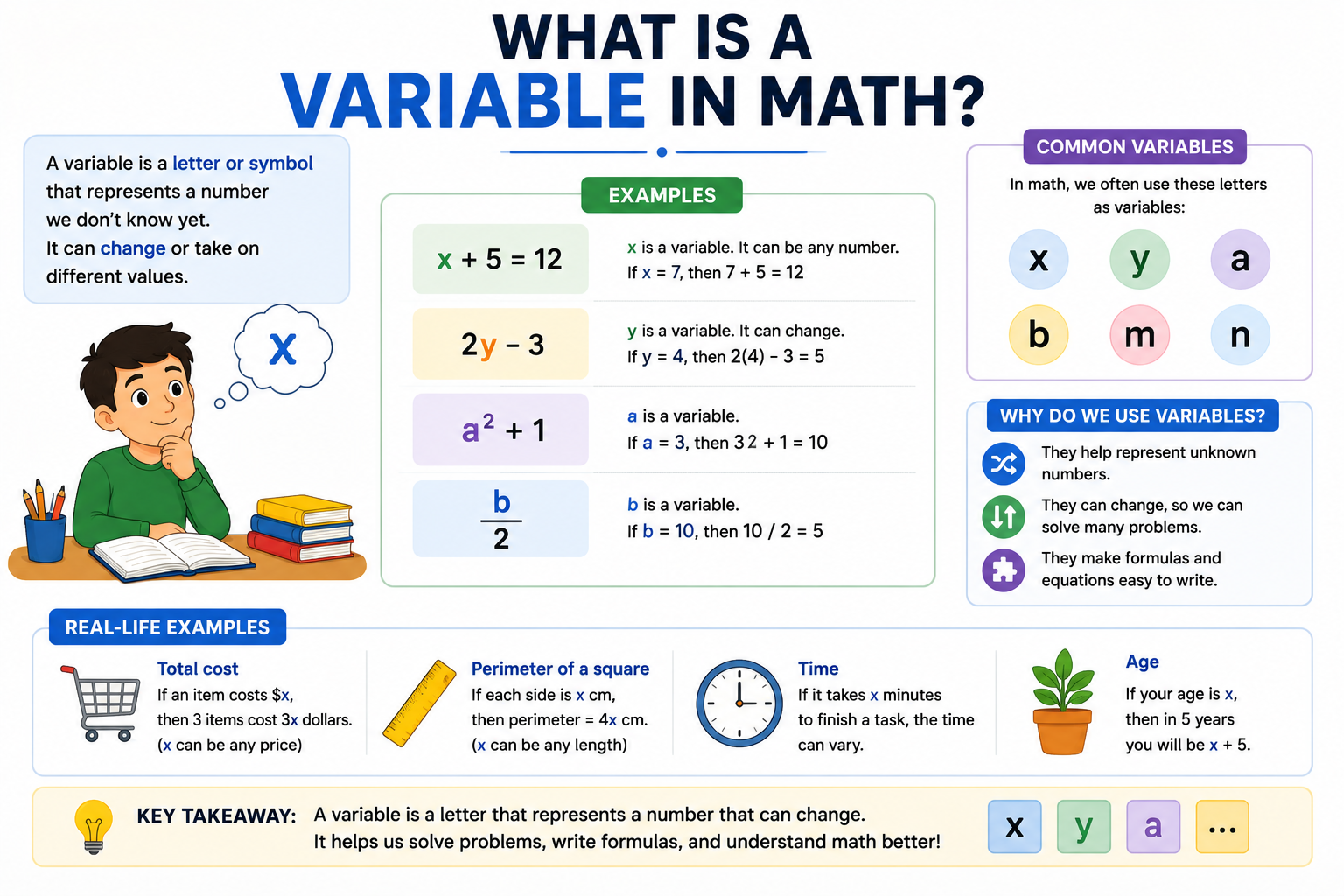
The letter x is holding the place of a number you do not yet know. Once you solve the equation, you find that x = 4. But before solving, x could have been anything. That letter, representing an unknown or changing value, is called a variable.
So, what is a variable in math? A variable is a symbol, almost always a letter, that represents a value that is either unknown or can change depending on the situation. Variables are used in algebraic expressions, equations, formulas, functions, and graphs. They are one of the most important and widely used ideas in all of mathematics.
Without variables, algebra would not exist. They allow mathematicians and students alike to write general rules, solve unknown quantities, and model the real world using mathematical language.
Key Takeaways
-
A variable is a letter or symbol that represents an unknown or changing value.
-
The word “variable” comes from “vary,” meaning to change.
-
Variables appear in expressions, equations, formulas, functions, and graphs.
-
Any letter can be a variable, though x, y, and n are the most common choices.
-
A variable is different from a coefficient (the number multiplying it) and a constant (a fixed standalone number).
-
Variables can be positive, negative, zero, fractional, or any real number.
-
Understanding variables is the foundation of all algebraic thinking.
What Is a Variable in Math?
A variable in mathematics is a letter or symbol that represents a value that is unknown or can change. The word comes from the Latin root meaning “to vary,” which is exactly what a variable does: its value can vary depending on the context.
Variables serve two slightly different purposes depending on where they appear:
1. Representing a fixed unknown value (in equations):
In the equation x + 5 = 12, the variable x has one specific value that makes the equation true. That value is x = 7. Here, x represents a fixed unknown that you need to find.
2. Representing a changing quantity (in formulas and functions):
In the formula A = lw, both l and w can be any positive numbers. If the length is 5 and the width is 3, the area is 15. If the length is 10 and the width is 2, the area is 20. The variables l and w can take many different values.
More examples:
- x + 5 = 12 — x is the unknown to be found
- y = 2x + 1 — x and y can both take many different values
- A = lw — l and w represent measurements that vary with different rectangles
The key idea is simple: wherever you see a letter in a mathematical expression or equation, that letter is almost certainly a variable.
Why Are Variables Used in Mathematics?
You might wonder why mathematics uses letters at all. The answer is that variables make mathematics far more powerful and flexible than working only with specific numbers.
Here are the main reasons variables are used:
To represent unknown quantities that need to be found
If you do not know a number but need to work with it, you give it a name. Calling it x allows you to write an equation and solve for it. Without variables, every problem would require guessing.
To write general formulas that work for any values
The formula for the area of a triangle is A = (1/2)bh. This works for any triangle, whatever its base and height. If we had to write a separate formula for every possible triangle, mathematics would be impossible.
To describe patterns and relationships
When two quantities are related, a variable lets you express that relationship precisely. For example, if a car travels at 60 km/h, the distance d after t hours is d = 60t. This formula captures the relationship for any time t.
To model real-world situations
Scientists, engineers, economists, and planners all use variables to represent quantities in the real world. Temperature, cost, distance, time, and population are all modelled using variables.
To make calculations flexible and reusable
A formula written with variables can be used again and again with different values. Once you have A = lw, you can find the area of any rectangle, not just one specific rectangle.
Common Variable Symbols Used in Math
Any letter can serve as a variable. However, certain letters are used far more often than others because of convention and tradition.
| Variable | Common Use |
|---|---|
| x | Most common unknown in algebra |
| y | Second variable; represents the vertical axis in graphs |
| n | Natural numbers and counting problems |
| a, b, c | General unknowns or constants in multiple-variable problems |
| t | Time in physics and motion problems |
| r | Radius in geometry and growth rate in finance |
| h | Height in geometry |
| v | Velocity or value |
| p, q | Probabilities or general unknowns |
| k | Constant of proportionality |
The letter you choose does not affect how the variable works mathematically. x + 5 = 12 and n + 5 = 12 are identical equations with the same solution. The letter is just a label for the unknown.
In more advanced mathematics, Greek letters such as θ (theta) for angles and π (pi) for the ratio of a circle’s circumference to its diameter are also used as variables or mathematical constants.
Variable vs Constant
A variable changes or represents an unknown. A constant is a fixed number that never changes. These two concepts appear together constantly in algebra, and distinguishing them is essential.
| Feature | Variable | Constant |
|---|---|---|
| Value | Can change or is unknown | Always fixed |
| Written as | A letter (x, y, n) | A number (3, -5, 1/2) |
| Example in 3x + 7 | x | 7 |
| Can it change? | Yes | No |
| Role in expression | Represents the unknown quantity | Adds a fixed amount |
In the expression 3x + 7:
- x is the variable. Its value changes depending on the situation.
- 7 is the constant. It is always 7, no matter what x equals.
In A = lw + 5:
- l and w are variables. They change for different rectangles.
- 5 is a constant. It always adds exactly 5 to the area calculation.
The article [What Is a Constant in Algebra?] provides a complete explanation of constants, including positive, negative, fractional, and decimal constants, and how to identify them in any algebraic expression.
Variable vs Coefficient
A coefficient is the number that directly multiplies a variable in an algebraic term. The variable and its coefficient work together within a single term, but they are distinct components.
In the term 5x:
- 5 is the coefficient. It is the numerical part.
- x is the variable. It is the letter part.
- Together, 5 × x = 5x forms one complete term.
| Feature | Variable | Coefficient |
|---|---|---|
| Nature | A letter | A number |
| Position | The letter in the term | Directly in front of the variable |
| Example in 7y | y | 7 |
| Can it change? | Yes (it is unknown) | Fixed within the term |
One important rule: when no number is written in front of a variable, the coefficient is 1. The term x is the same as 1x. Similarly, -x is the same as -1x.
The article [What Is a Coefficient in Algebra?] gives a thorough explanation of coefficients, including how to identify them in any expression and how to handle negative, fractional, and decimal coefficients.
Variable vs Term
A term is a complete unit within an algebraic expression. A variable is one component inside a term, not the entire term.
In 4x + 7:
- 4x is the first term. It consists of the coefficient 4 and the variable x.
- 7 is the second term. It is a constant term (no variable).
- x is the variable that appears inside the first term.
A term can contain a variable, a coefficient, and an exponent all at once. For example, in the term 3x², the coefficient is 3, the variable is x, and the exponent is 2.
The article [What Is an Algebraic Expression?] explains the complete structure of algebraic expressions, including how terms, variables, coefficients, constants, and exponents all fit together.
Variable vs Factor
A factor is any quantity that is multiplied with another to produce a term. A variable can be a factor within a term.
In the term 6x:
- 6 and x are both factors of 6x because 6 × x = 6x.
- x is the variable factor (it represents the unknown).
- 6 is the numerical factor, also called the coefficient.
The distinction matters in factoring and simplification. When you factor an expression such as 6x + 12, you are identifying common factors across terms. Understanding that x is itself a factor becomes important at that stage.
The article [What Is a Factor?] explains factors in full, covering both numerical and algebraic factors and how they relate to terms and expressions.
Types of Variables in Math
Variables are used in different ways depending on the context. Understanding the type of variable in a problem helps you know how to work with it.
Independent Variable
An independent variable is the variable whose value is chosen or controlled freely. It does not depend on any other variable in the relationship.
In the equation y = 2x + 1:
- x is the independent variable. You can choose any value of x you like.
- When x = 0, y = 1. When x = 3, y = 7. You set x, and y follows.
In experiments, the independent variable is what the experimenter changes or controls.
Dependent Variable
A dependent variable is the variable whose value is determined by the independent variable. It depends on what the independent variable is.
In y = 2x + 1:
- y is the dependent variable. Its value changes in response to x.
- You cannot choose y freely. Once x is chosen, y is fixed.
In graphs, the independent variable is plotted on the x-axis and the dependent variable on the y-axis.
Unknown Variable
In equations, a variable represents a specific unknown value that you need to find by solving the equation.
In 3x + 5 = 17:
- x has one specific value that makes the equation true.
- Solving gives x = 4.
- Here, x is not free to vary. It has one fixed answer.
General Variable
In formulas and algebraic identities, variables represent any permissible value. There is no single answer to find.
In A = lw:
- l and w can be any positive numbers.
- The formula works for every possible rectangle.
| Type | Description | Example |
|---|---|---|
| Independent | Freely chosen; controls the relationship | x in y = 3x – 2 |
| Dependent | Determined by the independent variable | y in y = 3x – 2 |
| Unknown | Has one specific value to be found | x in 2x + 4 = 10 |
| General | Can be any permissible value | l, w in A = lw |
How to Identify a Variable in an Expression or Equation
Follow these six steps:
- Look at every symbol in the expression or equation.
- Identify all the letters. Every letter is almost certainly a variable.
- Confirm each letter represents an unknown or changing value. (Established constants like π are exceptions.)
- Those letters are the variables.
- Note any numbers attached to the variables — those are coefficients.
- Note any standalone numbers — those are constants.
Eight worked examples:
Expression 1: 3x + 5
Variable: x. Coefficient of x: 3. Constant: 5.
Expression 2: 7y – 2
Variable: y. Coefficient of y: 7. Constant: -2.
Expression 3: 4a + 3b
Variables: a and b. Coefficient of a: 4. Coefficient of b: 3. No constant.
Expression 4: x² + 5x – 6
Variable: x. Coefficients: 1 (for x²) and 5 (for x). Constant: -6.
Expression 5: 2p – q + 8
Variables: p and q. Coefficients: 2 and -1. Constant: 8.
Equation 1: 3x + 7 = 19
Variable: x. Coefficient: 3. Constants: 7 and 19.
Equation 2: 2x + 3y = 12
Variables: x and y. Coefficients: 2 and 3. Constant: 12.
Formula: A = (1/2)bh
Variables: A, b, h. All three are variables. No standalone constant.
Variables in Algebraic Expressions
A variable appears in an algebraic expression as the unknown quantity around which the expression is built. An expression contains variables and numbers connected by operations, but has no equals sign.
Examples:
- x + 5 (one variable, one constant)
- 3x – 2 (one variable with a coefficient, one constant)
- 4x + 7y – 3 (two variables with coefficients, one constant)
In each case, the variable represents a quantity whose value is not yet fixed. You can evaluate the expression for any chosen value of the variable.
Variables in Linear Equations
In a linear equation, the variable appears with an exponent of exactly 1. The goal is to find the specific value of the variable that makes the equation true.
Examples:
- x + 5 = 10 → x = 5
- 3x – 4 = 11 → x = 5
- 2x + y = 8 → many possible (x, y) pairs satisfy this
Solving a linear equation means isolating the variable on one side using inverse operations. The variable’s value is what you are working to uncover.
The article [What Is a Linear Equation?] covers linear equations in full, including standard form, solving methods, and how the variable behaves throughout the process.
Variables in Quadratic Equations
In a quadratic equation, the variable is raised to the power of 2. The squared variable term is what makes the equation quadratic.
Examples:
- x² + 5x + 6 = 0 (variable is x, appearing as x² and x)
- 2x² – 3x + 1 = 0 (variable is x in three different terms)
In x², the variable x is multiplied by itself. The exponent 2 tells you how many times x is used as a factor. The variable is still x. The 2 is the exponent, not the variable.
A quadratic equation can have up to two real solutions for the variable.
The article [What Is a Quadratic Equation?] provides a complete explanation of quadratic equations, including how to identify the variable in each term and how to solve for it using different methods.
Variables in Formulas
Formulas are one of the most common places where variables appear. Every letter in a formula is a variable representing a specific measurable quantity.
| Formula | Variables | What They Represent |
|---|---|---|
| A = lw | A, l, w | Area, length, width |
| P = 2l + 2w | P, l, w | Perimeter, length, width |
| v = d/t | v, d, t | Speed, distance, time |
| I = PRT | I, P, R, T | Interest, principal, rate, time |
| E = mc² | E, m, c | Energy, mass, speed of light |
When you use a formula, you substitute known values for most variables and solve for the remaining unknown variable.
Variables and Like Terms
Variables are the key to identifying like terms in an algebraic expression. Two terms are like terms if they contain exactly the same variable raised to exactly the same power.
Example:
3x + 5x
Both terms contain x to the power of 1. They are like terms. You combine their coefficients:
3 + 5 = 8, giving 8x.
If the variables differ, the terms cannot be combined:
3x + 5y — the variables are different (x and y), so these are unlike terms.
The article [What Are Like Terms in Algebra?] explains in full how to identify like terms, why their variable parts must match, and how to combine them correctly.
Variables and Unlike Terms
When two terms contain different variables or the same variable raised to different powers, they are unlike terms and cannot be combined.
Example:
3x + 5y — x and y are different variables. Unlike terms.
Example:
4x + 4x² — same variable but different exponents (1 and 2). Unlike terms.
The variables in each term determine whether terms are like or unlike. Coefficients play no role in this classification.
The article [What Are Unlike Terms in Algebra?] covers every type of unlike term situation, including different variables, different exponents, and different variable combinations.
Variables in Real-World Contexts
Variables are not just an abstract classroom concept. They represent real quantities in everyday situations.
Shopping: If the price of one item is £p and you buy q items, the total cost is C = pq. Both p and q are variables that change depending on what you buy and how many.
Distance: A car travelling at speed v for time t covers a distance d = vt. All three letters are variables that can take many different values.
Age problems: If someone is x years old today, they will be x + 5 years old in five years. x is the variable representing their current age.
Wages: If a worker earns £r per hour and works for h hours, their total wage is W = rh. Both r and h can vary.
Temperature: The formula C = (5/9)(F – 32) converts a temperature in Fahrenheit (F) to Celsius (C). Both F and C are variables that change depending on the temperature being measured.
In each case, the variable represents a real-world quantity that can take different values in different situations. This is exactly what makes algebra so powerful.
Variables and Fractions
Variables can appear inside fractions in many ways. They can be in the numerator, the denominator, or both.
Examples:
- x/2 — the variable x is the numerator; 2 is the denominator
- 3/x — 3 is the numerator; the variable x is the denominator
- (x + 1)/4 — the entire expression (x + 1) is the numerator
One important rule: the denominator of a fraction cannot equal zero. If the variable x appears in the denominator, then x = 0 is not a permissible value for that expression.
The article [What Is a Fraction?] explains how fractions work in detail, which provides essential background for working with algebraic expressions that involve fractional terms.
Variables and Rational Numbers
When you solve an equation, the value of the variable does not always turn out to be a whole number. Many equations produce rational number solutions.
Example:
2x = 3
x = 3/2
The variable x equals 3/2, which is a rational number.
Example:
5x = 7
x = 7/5
Again, the solution is a fraction. This is a completely valid answer. Variables can take any numerical value, including fractions and decimals.
The article [What Is a Rational Number?] explains what rational numbers are and why they are valid solutions to algebraic equations, which is directly useful when evaluating the results of solving equations.
Can a Variable Equal Zero?
Yes. Zero is a completely valid value for a variable. It simply means that the unknown quantity turned out to be nothing.
Example:
x + 5 = 5
x = 5 – 5
x = 0
The solution is x = 0. This is correct and meaningful. Zero being the answer simply means the variable represents a quantity of nothing in that specific situation.
Zero also appears as a solution in quadratic equations:
x(x – 3) = 0
x = 0 or x = 3
Both solutions are valid, including x = 0.
Can a Variable Be Negative?
Yes. Variables can take negative values when those values satisfy the equation.
Example:
x + 8 = 3
x = 3 – 8
x = -5
The solution x = -5 is perfectly valid. A negative value for a variable simply means the unknown quantity is less than zero.
Example:
3x = -12
x = -4
Negative solutions arise naturally in algebra and should always be accepted unless the context of a problem makes them impossible (for example, you cannot have a negative length in a geometry problem).
Variables With Exponents
A variable can be raised to any power using an exponent. The exponent tells you how many times the variable is multiplied by itself.
- x² means x × x (x squared)
- x³ means x × x × x (x cubed)
- x⁴ means x × x × x × x
- x⁰ = 1 for any non-zero value of x
The exponent changes the form of the variable but not its identity. In x², the variable is still x. The 2 is the exponent, which is a separate component of the term.
This distinction is important. In the term 3x², the coefficient is 3, the variable is x, and the exponent is 2. Students who confuse the exponent with the coefficient often make errors in identifying and combining terms.
How Variables Are Used in Graphs
When a relationship between two variables is graphed on a coordinate plane, the variables determine the positions of the points.
- The x-axis (horizontal axis) represents the independent variable.
- The y-axis (vertical axis) represents the dependent variable.
- Each point on the graph represents one specific pair of values (x, y) that satisfies the equation.
Example: y = x + 2
| x | y = x + 2 |
|---|---|
| 0 | 2 |
| 1 | 3 |
| 2 | 4 |
| -1 | 1 |
Each row gives one point: (0, 2), (1, 3), (2, 4), (-1, 1). When these points are plotted and connected, they form a straight line. Every point on that line represents a valid pair of values for the two variables x and y.
Common Mistakes Students Make
| Mistake | Incorrect | Correct |
|---|---|---|
| Thinking the variable always has one fixed meaning | “x always equals 5” | x can equal any value depending on the equation |
| Confusing coefficient with variable | In 7x, the variable is 7 | In 7x, the variable is x; 7 is the coefficient |
| Confusing exponent with variable | In x², the variable is 2 | In x², the variable is x; 2 is the exponent |
| Thinking variables must always be x | Only x can be a variable | Any letter can be a variable |
| Ignoring the variable when identifying terms | In 4x + 3, both numbers are terms | 4x is one term (with variable x); 3 is a constant term |
| Thinking negatives are not valid | x cannot equal -3 | x = -3 is a perfectly valid solution |
| Confusing a variable with a constant | In y = 5, y is a variable | When y = 5 is a solution, y was the variable; 5 is the value it equals |
Variable Rules Cheat Sheet
| Rule | Example | Explanation |
|---|---|---|
| A variable is a letter | x, y, n | Represents unknown or changing value |
| Coefficient multiplies the variable | 5x → coefficient is 5 | 5 is the number; x is the variable |
| Variables can be positive or negative | x = -3 | Negative solutions are perfectly valid |
| Variables can equal zero | x = 0 | Zero is a valid solution |
| Exponent shows the power | x² | x is still the variable; 2 is the exponent |
| Different variables = unlike terms | 3x and 5y | Cannot be combined by addition |
| Same variable = may be like terms | 3x and 5x | Can be combined: 8x |
| No number in front = coefficient of 1 | x = 1x | The coefficient 1 is always there, even if not written |
| Negative sign only = coefficient of -1 | -x = -1x | The coefficient -1 is present even without a written number |
Worked Examples
Example 1: Identifying a Variable in a Simple Expression
Given: 4x + 9
Variable: x
Role: x represents the unknown quantity. 4 is its coefficient and 9 is the constant.
Conclusion: Variable = x
Example 2: Identifying a Variable in an Equation
Given: 2x – 3 = 11
Variable: x
Role: x is the unknown. Solving gives 2x = 14, so x = 7.
Conclusion: Variable = x, solution = 7
Example 3: Variable vs Coefficient
Given: 8y
Variable: y
Coefficient: 8
Conclusion: 8 is the coefficient; y is the variable. 8 multiplies y.
Example 4: Variable vs Constant
Given: 5a + 12
Variable: a
Constant: 12
Conclusion: a is the variable; 12 is the fixed constant.
Example 5: Variable vs Exponent
Given: 6x³
Variable: x
Coefficient: 6
Exponent: 3
Conclusion: x is the variable; 6 is the coefficient; 3 is the exponent.
Example 6: Variables in a Linear Equation
Given: 4x + 2 = 18
Variable: x
Solving: 4x = 16, x = 4
Conclusion: The variable x has the value 4 in this equation.
Example 7: Variables in a Quadratic Equation
Given: x² – 4x + 3 = 0
Variable: x (appearing as x² and x)
Solving: (x – 1)(x – 3) = 0, so x = 1 or x = 3
Conclusion: The variable x has two valid values.
Example 8: Variable in a Formula
Given: P = 2l + 2w; find P when l = 8 and w = 5
Variables: P, l, w
Calculation: P = 2(8) + 2(5) = 16 + 10 = 26
Conclusion: All three letters are variables; substituting gives P = 26.
Example 9: Variable With Negative Value
Given: x + 10 = 4
Solving: x = 4 – 10 = -6
Conclusion: The variable x equals -6. Negative values are valid.
Example 10: Variable Equal to Zero
Given: 3x = 0
Solving: x = 0 ÷ 3 = 0
Conclusion: The variable x equals 0. Zero is a valid solution.
Example 11: Variable With Fractional Value
Given: 4x = 7
Solving: x = 7/4
Conclusion: The variable x equals 7/4, a rational number.
Example 12: Two-Variable Expression
Given: 3x + 5y
Variables: x and y
Conclusion: Two variables are present. Their terms are unlike and cannot be combined.
Example 13: Real-World Variable
Given: A worker earns £12 per hour. Write an expression for the earnings after h hours.
Variable: h (number of hours)
Expression: 12h
Conclusion: h is the variable representing the number of hours worked.
Example 14: Variable With Exponent
Given: x² + 3x – 10
Variable: x (appearing as x² and x)
Exponents: 2 (on the first term) and 1 (implied on the second term)
Conclusion: x is the variable throughout. The exponents are 2 and 1.
Example 15: Independent and Dependent Variables
Given: y = 4x – 3
Independent variable: x (you choose its value freely)
Dependent variable: y (its value is determined by x)
Conclusion: x = 2 gives y = 5. x = 0 gives y = -3.
Example 16: Variable on a Graph
Given: y = 2x + 1; find y when x = 3
Substitution: y = 2(3) + 1 = 6 + 1 = 7
Point: (3, 7) lies on the graph.
Conclusion: The variable pair (x, y) = (3, 7) satisfies the equation.
Example 17: Variables in Like Terms
Given: 6x + 4x
Variable in both terms: x
Combining: 6 + 4 = 10, result = 10x
Conclusion: Same variable means like terms. They combine to 10x.
Example 18: Variables in Unlike Terms
Given: 6x + 4y
Variables: x in the first term; y in the second term
Conclusion: Different variables mean unlike terms. Cannot be combined.
Example 19: Finding a Variable Value by Substitution
Given: Evaluate 3x – 7 when x = 5
Substitution: 3(5) – 7 = 15 – 7 = 8
Conclusion: When x = 5, the expression equals 8.
Example 20: Multi-Variable Expression
Given: 2x + 3y – z + 4
Variables: x, y, z
Coefficients: 2, 3, -1
Constant: 4
Conclusion: Three variables are present. All three terms are unlike each other.
Practice Questions
20 Multiple Choice Questions
Question 1: What is the variable in the expression 7x + 3?
A) 7 B) 3 C) x D) 7x
Correct Answer: C
Explanation: x is the letter representing the unknown. 7 is the coefficient and 3 is the constant.
Question 2: In the term 9y², what is the variable?
A) 9 B) 2 C) 9y D) y
Correct Answer: D
Explanation: y is the letter (variable). 9 is the coefficient and 2 is the exponent.
Question 3: Which of the following is a variable?
A) 5 B) -3 C) 1/2 D) x
Correct Answer: D
Explanation: x is a letter representing an unknown. All the others are fixed numbers (constants).
Question 4: In 4a – 6, what is the coefficient of a?
A) a B) 4 C) -6 D) 6
Correct Answer: B
Explanation: 4 directly multiplies the variable a, making it the coefficient.
Question 5: What is the variable in the equation 3x + 5 = 20?
A) 3 B) 5 C) 20 D) x
Correct Answer: D
Explanation: x is the unknown to be found. All numbers are constants or coefficients.
Question 6: In y = 3x – 2, which is the dependent variable?
A) 3 B) x C) y D) 2
Correct Answer: C
Explanation: y depends on the value of x. x is chosen freely; y is determined by x.
Question 7: What is the variable in the term -5m?
A) -5 B) 5 C) m D) -5m
Correct Answer: C
Explanation: m is the letter (variable). -5 is the coefficient, including its negative sign.
Question 8: Can a variable equal a negative number?
A) No, variables are always positive B) Only if the equation says so C) Yes, negative values are valid D) Only for y
Correct Answer: C
Explanation: Variables can take any real value, including negative numbers.
Question 9: In the expression 2x + 5y + 3, how many variables are there?
A) 1 B) 2 C) 3 D) 5
Correct Answer: B
Explanation: The variables are x and y. The numbers 2, 5, and 3 are the coefficient, coefficient, and constant.
Question 10: What is the exponent in the term 4x³?
A) 4 B) x C) 3 D) 4x
Correct Answer: C
Explanation: The exponent is 3. It shows x is multiplied by itself three times.
Question 11: In A = lw, what type of variables are l and w?
A) Dependent B) Unknown C) General D) Independent only
Correct Answer: C
Explanation: In a formula, l and w can be any permissible positive values. They are general variables.
Question 12: Solve for the variable: x + 9 = 9. What does x equal?
A) 9 B) 18 C) 1 D) 0
Correct Answer: D
Explanation: x = 9 – 9 = 0. Zero is a valid solution.
Question 13: Which of the following is an independent variable in y = 5x + 2?
A) y B) 5 C) x D) 2
Correct Answer: C
Explanation: x is the independent variable. Its value is chosen freely; y depends on it.
Question 14: In 6x + 3y – 8, how many constants are there?
A) 0 B) 1 C) 2 D) 3
Correct Answer: B
Explanation: Only -8 is a standalone number with no variable. 6 and 3 are coefficients, not constants.
Question 15: If 3x = 7, what is the value of x?
A) 7/3 B) 3/7 C) 21 D) 4
Correct Answer: A
Explanation: x = 7 ÷ 3 = 7/3. A fractional value is perfectly valid.
Question 16: In x², what is the variable?
A) 2 B) x² C) x D) 1
Correct Answer: C
Explanation: x is the variable. The exponent 2 tells you x is squared.
Question 17: Which pair of terms contains the same variable?
A) 3x and 5y B) 4a and 4b C) 7m and -3m D) 2x and 2x²
Correct Answer: C
Explanation: 7m and -3m both contain the variable m with the same exponent. They are like terms.
Question 18: What does the variable t typically represent in physics formulas?
A) Temperature B) Terms C) Time D) Total
Correct Answer: C
Explanation: By convention, t is most commonly used to represent time in physics and motion problems.
Question 19: Can there be more than one variable in an equation?
A) No, equations only have one variable B) Yes, two or more variables are possible C) Only in advanced mathematics D) Only if both are x and y
Correct Answer: B
Explanation: Many equations contain two or more variables, such as 2x + 3y = 12.
Question 20: Which of the following is NOT a variable?
A) x B) n C) 8 D) a
Correct Answer: C
Explanation: 8 is a fixed number (a constant). All the letters are variables.
15 Identify the Variable Questions
Q1: 5x + 2
Answer: Variable = x. Coefficient of x = 5. Constant = 2.
Q2: -3y + 8
Answer: Variable = y. Coefficient of y = -3. Constant = 8.
Q3: 4a – 9b
Answer: Variables = a and b. Coefficient of a = 4. Coefficient of b = -9. No constant.
Q4: 7m² + 3m – 1
Answer: Variable = m. Coefficients: 7 (for m²) and 3 (for m). Constant = -1.
Q5: 2x + 3y + z – 5
Answer: Variables = x, y, z. Coefficients: 2, 3, 1. Constant = -5.
Q6: p/4 + 6
Answer: Variable = p. Coefficient = 1/4 (since p/4 = (1/4)p). Constant = 6.
Q7: 9k³ – k
Answer: Variable = k. Coefficients: 9 (for k³) and -1 (for k). No constant.
Q8: -n + 7
Answer: Variable = n. Coefficient of n = -1. Constant = 7.
Q9: 3x² + 0x + 5
Answer: Variable = x. Coefficients: 3 and 0. Constant = 5.
Q10: 2ab – 4a + b
Answer: Variable parts: ab, a, b. Coefficients: 2, -4, 1. No constant.
Q11: x + y = 10
Answer: Variables = x and y. Coefficients: 1 and 1. Constant = 10.
Q12: v = d/t
Answer: Variables = v, d, t. All three are variables. No coefficient other than 1. No constant.
Q13: A = πr²
Answer: Variables = A and r. π is a mathematical constant (approximately 3.14159).
Q14: 5 – 2x
Answer: Variable = x. Coefficient of x = -2. Constant = 5.
Q15: 4x³ – 2x² + x – 6
Answer: Variable = x. Coefficients: 4, -2, 1. Constant = -6.
10 Short Answer Questions
Q1: What is a variable in math?
Answer: A variable is a letter or symbol that represents an unknown or changing value in a mathematical expression or equation.
Q2: Why do mathematicians use letters for variables?
Answer: Letters allow mathematicians to write general formulas and equations that work for any values, not just specific numbers.
Q3: What is the difference between a variable and a constant?
Answer: A variable can change or represents an unknown; a constant is a fixed number that never changes.
Q4: In the expression 8x + 3, identify the variable, coefficient, and constant.
Answer: Variable = x. Coefficient = 8. Constant = 3.
Q5: In y = 3x + 7, which is the independent variable and which is the dependent variable?
Answer: x is the independent variable (freely chosen). y is the dependent variable (determined by x).
Q6: Can a variable equal a fraction? Give an example.
Answer: Yes. In 2x = 5, solving gives x = 5/2, which is a fraction.
Q7: What is the coefficient of x in the term -x?
Answer: The coefficient is -1. The term -x means -1 × x.
Q8: Write a real-world example where a variable is used.
Answer: If cinema tickets cost £t each and you buy 4 of them, the total cost is 4t. The variable t represents the ticket price.
Q9: In x² + 3x + 2, how many times does the variable x appear?
Answer: x appears in two terms: x² and 3x. The variable is x, appearing with different exponents.
Q10: What is the difference between x and x²?
Answer: Both have the same variable x, but different exponents. x has exponent 1 (usually not written); x² has exponent 2, meaning x is multiplied by itself.
5 Challenge Questions
Challenge 1: In the formula S = n/2 (a + l), identify all variables.
Answer: S, n, a, and l are all variables. S = sum, n = number of terms, a = first term, l = last term.
Challenge 2: A triangle has sides of length x, 2x – 1, and x + 5. Write an expression for the perimeter.
Variable: x
Expression: x + (2x – 1) + (x + 5) = 4x + 4
Answer: Perimeter = 4x + 4
Challenge 3: The cost of printing n pages is given by C = 0.05n + 2.50. What does each variable represent? What is the cost when n = 100?
Answer: C = total cost (variable). n = number of pages (variable). 0.05 = cost per page (coefficient). 2.50 = fixed setup cost (constant).
When n = 100: C = 0.05(100) + 2.50 = 5 + 2.50 = £7.50
Challenge 4: In 3x²y – 4xy² + 2xy, identify every variable and state whether any terms are like terms.
Answer: Variables: x and y in every term. Term 1: 3x²y. Term 2: -4xy². Term 3: 2xy. All three are unlike terms (different variable combinations) so none can be combined.
Challenge 5: A car travels at (v + 10) km/h for t hours. Write an expression for the distance, then find it when v = 50 and t = 3.
Variables: v and t
Expression: distance = (v + 10)t
When v = 50, t = 3: distance = (50 + 10)(3) = 60 × 3 = 180 km
Exam Tips
- Look for letters first. Every letter in an expression or equation is almost certainly a variable. Start by circling all letters.
- Do not confuse the exponent with the variable. In 3x², the variable is x and the exponent is 2. The 3 is the coefficient.
- Do not confuse the coefficient with the variable. In 7y, the variable is y. The 7 is the coefficient.
- Remember that variables can be negative or zero. If solving gives x = -4 or x = 0, both are perfectly valid answers.
- Identify every variable before attempting to solve. Knowing all the letters in an equation prevents confusion during the solution process.
- In formulas, every letter is a variable unless it is a known mathematical constant like π.
- In graphs, x is always on the horizontal axis and y is on the vertical axis. The independent variable goes on the x-axis.
- No number written in front of a variable means the coefficient is 1. x = 1x and -x = -1x.
Quick Revision Notes
Definition: A variable is a letter or symbol representing an unknown or changing value.
Why used: To represent unknowns, write general formulas, describe patterns, and model real-world situations.
Common symbols: x, y, n, a, b, c, t, r, h, v, k.
Variable vs constant: A variable can change; a constant is fixed. In 4x + 9, x is the variable and 9 is the constant.
Variable vs coefficient: A coefficient multiplies the variable. In 4x, 4 is the coefficient and x is the variable.
Variable vs exponent: The exponent shows the power of the variable. In x², x is the variable and 2 is the exponent.
Types: Independent (freely chosen), dependent (determined by another variable), unknown (specific value to find), general (any permissible value).
In expressions: x + 5, 3x – 2. No equals sign.
In equations: 3x + 5 = 14. Has an equals sign. Can be solved.
In formulas: A = lw. Works for any permissible values of the variables.
In graphs: x is plotted horizontally (independent); y is plotted vertically (dependent).
Common mistakes: Confusing coefficient with variable; confusing exponent with variable; thinking variables cannot be negative or zero.
Variable Cheat Sheet
| Concept | Definition | Example |
|---|---|---|
| Variable | Letter representing unknown or changing value | x in 3x + 5 |
| Coefficient | Number multiplying the variable | 3 in 3x |
| Constant | Fixed standalone number | 5 in 3x + 5 |
| Exponent | Power of the variable | 2 in x² |
| Independent variable | Freely chosen variable | x in y = 2x + 1 |
| Dependent variable | Variable that depends on another | y in y = 2x + 1 |
| Like terms | Same variable, same exponent | 3x and 5x → 8x |
| Unlike terms | Different variables or exponents | 3x and 5y (cannot combine) |
| Hidden coefficient 1 | No number written means coefficient = 1 | x = 1x |
| Hidden coefficient -1 | Negative sign only means coefficient = -1 | -x = -1x |
Frequently Asked Questions
1. What is a variable in math?
A variable is a letter or symbol that represents an unknown or changing value in a mathematical expression, equation, or formula.
2. What does a variable represent?
A variable can represent a specific unknown value to be found (in equations) or a quantity that can take many different values (in formulas and functions).
3. Why do we use letters for variables?
Letters allow us to write general rules and formulas that apply to any value, not just one specific number. They make algebra flexible and powerful.
4. What is the most common variable in algebra?
The letter x is the most common variable in algebra. However, y, n, a, b, t, and many others are used frequently depending on the context.
5. Can a variable be any letter?
Yes. Any letter can serve as a variable. The choice of letter is a convention and does not change how the variable works mathematically.
6. What is the difference between a variable and a constant?
A variable can change or represents an unknown. A constant is a fixed number that never changes. In 4x + 9, x is the variable and 9 is the constant.
7. What is the difference between a variable and a coefficient?
A coefficient is the number multiplying the variable within a term. In 7x, x is the variable and 7 is the coefficient.
8. Can a variable equal zero?
Yes. Zero is a perfectly valid value for a variable. For example, x + 5 = 5 gives x = 0.
9. Can a variable be negative?
Yes. Variables can take any real value, including negative numbers. For example, x + 8 = 3 gives x = -5.
10. What is an independent variable?
An independent variable is the variable whose value is chosen freely. It controls the value of the dependent variable.
11. What is a dependent variable?
A dependent variable is the variable whose value is determined by the independent variable. In y = 2x + 1, y is dependent on x.
12. How do you identify a variable in an expression?
Look for letters. Every letter in an algebraic expression is a variable, unless it is an established mathematical constant like π.
13. Can there be more than one variable in an equation?
Yes. Many equations contain two or more variables, such as 2x + 3y = 12 or A = lw.
14. What is the difference between a variable and an exponent?
A variable is the letter (x in x²). The exponent is the power (2 in x²). The exponent tells you how many times the variable is multiplied by itself.
15. How are variables used in real life?
Variables represent real-world quantities such as time, distance, cost, speed, temperature, and age. They allow mathematical formulas to model and solve real problems.
Summary
A variable in math is a letter or symbol that stands for an unknown or changing value. It is the most fundamental building block of algebra. Variables appear in expressions like 3x + 5, in equations like 2x + 7 = 15, in formulas like A = lw, and on graphs where x and y represent pairs of values.
Variables differ from constants (which are fixed numbers), coefficients (which multiply variables), and exponents (which raise variables to powers). They can be positive, negative, zero, or fractional. Any letter can be a variable, though x and y are the most commonly used choices.
Understanding variables means understanding that mathematics does not always work with specific known numbers. Sometimes a quantity is unknown, and sometimes it changes. Variables give mathematics a language for handling both of these situations clearly and precisely.
Final Thoughts
What is a variable in math? It is a letter that opens the door to all of algebra. The moment you understand that a letter can represent a number you do not yet know, or a quantity that can change, algebra becomes a tool rather than a mystery.
Variables appear at every level of mathematics. They are in the simplest expressions students write on their first day of algebra, and they are in the most advanced equations used by scientists, engineers, and mathematicians. Every formula you use, every graph you draw, and every equation you solve depends on understanding what a variable is and how it behaves.
Build that understanding well. Work through the examples in this article, complete the practice questions, and make the distinction between variables, coefficients, constants, and exponents completely clear in your mind. Once those foundations are solid, every topic in algebra that follows becomes significantly easier to understand and apply.
References
- OpenStax – Elementary Algebra and Prealgebra textbooks covering variables, expressions, equations, and formulas.
https://openstax.org - Khan Academy – Free algebra lessons covering variables, expressions, and equations for all levels.
https://www.khanacademy.org - Mathematics LibreTexts – Open-access mathematics library with detailed explanations of variables, algebraic terms, and expressions.
https://math.libretexts.org - Wolfram MathWorld – Comprehensive mathematical reference covering variables, algebraic expressions, and equation types.
https://mathworld.wolfram.com - Encyclopaedia Britannica – Reference articles on algebra, variables, and the history of algebraic notation.
https://www.britannica.com
Disclaimer:
This article is intended for educational and informational purposes only. While LearnMinto strives to provide accurate and up-to-date mathematics information, readers should verify important academic concepts through official textbooks, educational institutions, examination boards, or trusted educational resources before using this content for exams or academic purposes. LearnMinto is not affiliated with any specific school, university, research institution, or examination board.