
Introduction
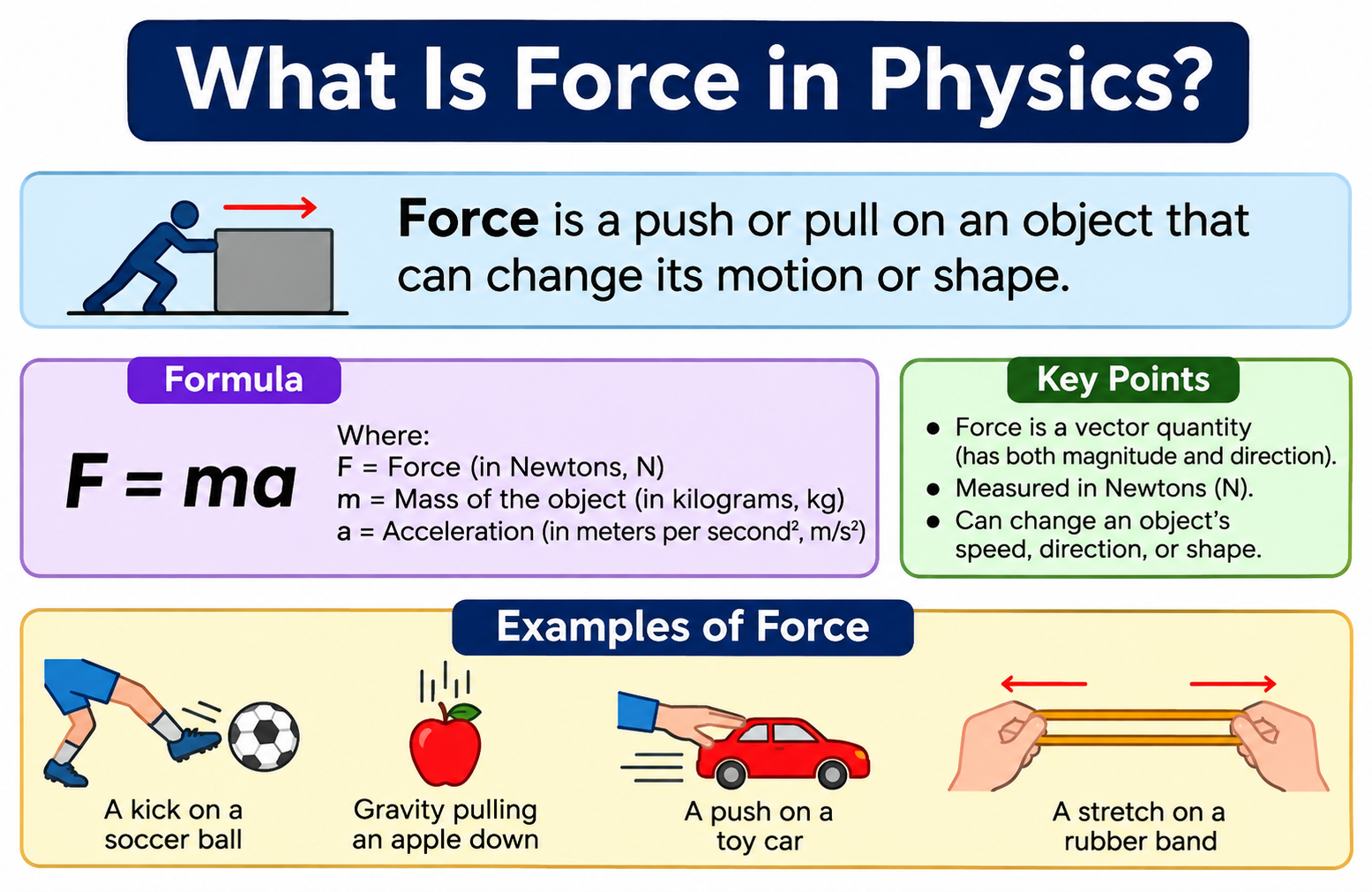
Force is one of the most fundamental ideas in physics, and understanding it opens the door to understanding almost everything else in the subject. In simple terms, force is a push or pull acting on an object. It can change an object’s speed, alter its direction of movement, or even change its shape. Whether you are kicking a football, pulling open a heavy door, or simply sitting in a chair, forces are constantly at work around you.
Force is a vector quantity, which means it has both magnitude (how strong it is) and direction (which way it acts). This distinction matters enormously in physics, because a force acting to the left and a force acting to the right are very different things, even if they have the same strength.
In this article, you will find a thorough, beginner-friendly guide to force in physics, covering its definition, formula, types, laws of motion, real-life examples, calculations, practice questions, and much more.
Key Takeaways
-
Force is a push or pull that can change an object’s motion, direction, or shape.
-
Force is a vector quantity because it has both magnitude and direction.
-
The SI unit of force is the newton (N).
-
The formula for force is F = ma, derived from Newton’s Second Law of Motion.
-
Forces can be classified as contact forces (such as friction and tension) or non-contact forces (such as gravity and magnetic force).
-
When forces on an object are balanced, the net force is zero and the object does not accelerate.
-
When forces are unbalanced, the object accelerates in the direction of the net force.
What Is Force in Physics?
Force is a push or pull that acts on an object as a result of its interaction with another object or field. When a force acts on an object, one or more of the following can happen:
- The object can start moving if it was at rest.
- The object can stop moving if it was in motion.
- The object can change its speed.
- The object can change its direction.
- The object can change its shape.
Think about pushing a shopping cart. When you push it, you apply a force that makes it move. When you push harder, it accelerates faster. When two people push from opposite sides, the cart might not move at all. Each of these situations involves force behaving in a different way.
Force always involves an interaction between two objects. You cannot have a force without something causing it and something receiving it. For example, when a bat hits a ball, the bat exerts a force on the ball, and the ball exerts an equal and opposite force on the bat.
Because force has both magnitude and direction, it is described mathematically as a vector. If someone tells you that a force of 10 N acts on an object but does not mention the direction, the description is incomplete for solving a physics problem.
What Is the Formula for Force?
The most important formula in the study of force comes from Newton’s Second Law of Motion:
F = ma
Where:
- F = Force (measured in newtons, N)
- m = Mass of the object (measured in kilograms, kg)
- a = Acceleration produced (measured in metres per second squared, m/s²)
This formula tells you that the force acting on an object equals the mass of the object multiplied by the acceleration it experiences. A heavier object requires more force to achieve the same acceleration as a lighter one.
Simple Example:
A toy car has a mass of 2 kg. A force causes it to accelerate at 3 m/s². What is the force?
F = ma
F = 2 × 3
F = 6 N
The formula works equally well in reverse. If you know the force and mass, you can find the acceleration:
a = F / m
Or if you know the force and acceleration, you can find the mass:
m = F / a
What Is One Newton of Force?
One newton (1 N) is defined as the amount of force needed to give a 1 kg mass an acceleration of 1 m/s².
In everyday terms, holding a small apple in your hand requires roughly 1 N of force to support it against gravity. It is not a very large force, but it is the standard unit physicists use to measure all forces, from the tiny force between atoms to the massive thrust of a rocket engine.
The relationship can be written as:
1 N = 1 kg × 1 m/s²
This means one newton is equivalent to one kilogram-metre per second squared. When you see force measured in newtons in a physics problem, you know it connects directly to mass (in kg) and acceleration (in m/s²).
Is Force a Scalar or Vector Quantity?
Force is a vector quantity. This is one of the most important facts about force, and it has practical consequences whenever you solve a physics problem.
A scalar quantity has only magnitude. Speed, mass, and temperature are scalar quantities. You describe them with a number and a unit alone.
A vector quantity has both magnitude and direction. Force, velocity, acceleration, and displacement are vector quantities. You need both a number and a direction to describe them fully.
Why does direction matter?
Imagine two people pushing a box. Person A pushes with 20 N to the right. Person B pushes with 20 N to the left. Although both forces have the same magnitude, they act in opposite directions, so they cancel each other out. The box does not move. If both people push to the right with 20 N each, the total force is 40 N to the right, and the box accelerates.
Without knowing the direction of each force, it would be impossible to determine what happens to the object. This is why treating force as a vector is essential in physics.
Types of Force in Physics
Forces can be broadly divided into two categories: contact forces and non-contact forces. The table below summarises the main types.
| Force | Definition | Contact or Non-Contact | Example |
|---|---|---|---|
| Gravitational Force | Attractive force between masses | Non-contact | Earth pulling objects downward |
| Frictional Force | Force opposing relative motion between surfaces | Contact | Brakes slowing a bicycle |
| Normal Force | Perpendicular support force from a surface | Contact | Table supporting a book |
| Tension Force | Pulling force transmitted through a rope or cable | Contact | Rope pulling a load |
| Applied Force | Force applied by a person or object | Contact | Pushing a door open |
| Air Resistance / Drag | Force opposing motion through air | Contact | Wind slowing a falling leaf |
| Elastic Force | Restoring force in a stretched or compressed material | Contact | Stretched rubber band snapping back |
| Magnetic Force | Force between magnets or moving charges | Non-contact | Magnet attracting iron filings |
| Electric Force | Force between electric charges | Non-contact | Charged balloon attracting paper |
Contact Forces
Contact forces require physical contact between two objects to act. The force cannot be transmitted across empty space.
Frictional Force
Friction is the force that opposes the relative motion between two surfaces in contact. It acts parallel to the surface and in the opposite direction to motion or attempted motion.
There are three main types of friction:
- Static friction: Acts when an object is stationary and a force is trying to move it. It prevents the object from sliding. For example, a heavy box on the floor does not slide unless the applied force exceeds the static friction.
- Kinetic friction: Acts when two surfaces are already sliding past each other. It is generally smaller than static friction. For example, the friction acting on a sliding book across a desk.
- Rolling friction: Acts when an object rolls over a surface. It is much smaller than both static and kinetic friction, which is why wheels and ball bearings are so useful.
Friction is not always harmful. Without friction between your shoes and the ground, you could not walk. Without friction between tyres and road, vehicles could not steer or brake. However, friction in machine parts causes wear and energy loss, which engineers work hard to reduce.
To learn more about how friction behaves in different situations, see the LearnMinto guide on What Is Friction?
Normal Force
The normal force is the force that a surface exerts on an object resting on it. It acts perpendicular (at right angles) to the surface.
Consider a book resting on a table. Gravity pulls the book downward. The table pushes back upward with an equal and opposite normal force. These two forces balance each other, so the book remains stationary.
If the surface is inclined, the normal force still acts perpendicular to the surface, not vertically. This distinction becomes very important in problems involving ramps and slopes.
Tension Force
Tension is the force transmitted through a rope, cable, wire, or string when it is pulled from both ends. It pulls the objects at each end toward each other.
A classic example is a hanging object. If a block hangs from a rope attached to the ceiling, the rope experiences tension equal to the weight of the block. The rope pulls the block upward and pulls the ceiling attachment point downward.
Tension always acts along the direction of the rope or string, away from the object being pulled.
Applied Force
An applied force is simply a force that a person, machine, or another object exerts on a given object. When you push a door, the force your hand exerts on the door is an applied force. When a horse pulls a cart, the horse applies a force to the cart through the harness.
Applied force can act in any direction depending on the situation.
Air Resistance
Air resistance, also called drag, is the force that opposes the motion of an object moving through air. It acts in the direction opposite to the motion.
The magnitude of air resistance depends on the speed of the object, its shape, its size, and the density of the air. A streamlined car experiences less air resistance than a flat-fronted truck travelling at the same speed. At high speeds, air resistance becomes very significant, which is why aerodynamics matter in vehicle and aircraft design.
Non-Contact Forces
Non-contact forces can act across empty space without any physical contact between the objects.
Gravitational Force
Gravity is the attractive force that exists between any two objects that have mass. On Earth, gravity pulls all objects toward the centre of the planet. This is why objects fall when you drop them and why you feel your own weight.
The strength of gravitational force depends on the masses of the objects and the distance between them. The greater the mass and the closer the objects, the stronger the gravitational pull.
Near the Earth’s surface, gravitational acceleration is approximately 9.8 m/s², often rounded to 10 m/s² in school-level problems.
Magnetic Force
Magnetic force is the attractive or repulsive force between magnets, or between a magnet and a magnetic material such as iron or nickel. Like poles (north-north or south-south) repel each other, while opposite poles (north-south) attract.
Magnetic forces also act on moving electric charges and current-carrying conductors, which is the principle behind electric motors and generators.
Electric Force
Electric force is the force between electrically charged objects. Like charges repel each other, while unlike charges attract. This is described mathematically by Coulomb’s Law.
A simple everyday example is rubbing a balloon on your hair. The balloon becomes negatively charged, and it can then attract small pieces of paper or make your hair stand on end. The force causing this is the electric force acting at a short range.
Balanced and Unbalanced Forces
Understanding whether forces on an object are balanced or unbalanced is the key to predicting how the object will behave.
Balanced Forces
Forces are balanced when all the forces acting on an object cancel each other out, leaving a net force of zero. When the net force is zero, the object does not accelerate. It either remains at rest or continues moving at a constant velocity.
Examples of balanced forces:
- A book sitting on a table (gravity down, normal force up).
- A car travelling at a steady speed on a motorway (driving force forward, air resistance and friction backward).
- A tug-of-war where both teams pull with equal force.
Unbalanced Forces
Forces are unbalanced when the forces on an object do not cancel each other out, producing a nonzero net force. An unbalanced force causes the object to accelerate in the direction of the net force.
Examples of unbalanced forces:
- A car accelerating when the engine force exceeds friction and air resistance.
- A ball falling through air when gravity is greater than air resistance.
- A rocket launching when engine thrust exceeds the rocket’s weight.
What Is Net Force?
The net force is the single overall force that results from combining all the individual forces acting on an object. It is sometimes called the resultant force.
To find the net force, you add together all the forces, paying careful attention to their directions.
Forces acting in the same direction are added:
If a 10 N force and a 5 N force both act to the right on an object:
Net force = 10 + 5 = 15 N to the right
Forces acting in opposite directions are subtracted:
If a 10 N force acts to the right and a 4 N force acts to the left:
Net force = 10 − 4 = 6 N to the right
If the two forces are equal in magnitude but opposite in direction, the net force is zero, and the object does not accelerate.
Understanding net force connects directly to Newton’s Second Law. The acceleration of an object depends on the net force acting on it, not on individual forces in isolation.
Newton’s Laws of Motion and Force
Isaac Newton formulated three fundamental laws that describe the relationship between force and motion. These laws remain the foundation of classical mechanics.
Newton’s First Law
An object at rest stays at rest, and an object in motion stays in motion at constant velocity, unless acted upon by a net external force.
This law introduces the concept of inertia, which is the tendency of objects to resist changes in their state of motion. If no net force acts on an object, its velocity does not change. This means that an object does not need a continuous force to keep moving. It only needs a force to change its motion.
Newton’s Second Law
The acceleration of an object is directly proportional to the net force acting on it and inversely proportional to its mass.
This is expressed as:
F = ma
If you apply a larger force to the same object, it accelerates faster. If you apply the same force to a heavier object, it accelerates more slowly. This law allows you to calculate exactly how an object will accelerate in response to any combination of forces.
Newton’s Third Law
For every action, there is an equal and opposite reaction.
This means that forces always come in pairs. When object A exerts a force on object B, object B exerts an equal and opposite force back on object A. Crucially, these two forces act on different objects, not the same one.
Everyday examples:
- Walking: Your foot pushes backward on the ground (action). The ground pushes your foot forward (reaction), propelling you forward.
- Swimming: Your hand pushes backward through the water (action). The water pushes your hand forward (reaction), moving you forward.
- Jumping: Your legs push down on the floor (action). The floor pushes upward on your body (reaction), launching you into the air.
- Rocket propulsion: Burning gases are expelled downward from the rocket engine (action). The rocket is pushed upward (reaction).
Newton’s Third Law is often misunderstood. Students sometimes wonder why the reaction force does not cancel the action force. The answer is that they act on different objects, so they cannot cancel each other out. Only forces acting on the same object can balance or add together.
Force and Motion
Force is the cause of changes in motion. Without a net force, the motion of an object does not change. This idea is so important that it underpins all of classical mechanics.
Force can affect motion in the following ways:
- A force can make a stationary object start moving.
- A force can make a moving object stop.
- A force can increase the speed of a moving object.
- A force can decrease the speed of a moving object.
- A force can change the direction of a moving object without changing its speed.
For example, when a tennis player hits a ball with a racket, the force from the racket changes both the speed and direction of the ball. The ball, which was moving toward the player, now moves away in a different direction and at a different speed.
For more on the relationship between force and motion, the LearnMinto article on What Is Acceleration? is a useful companion resource.
Force and Acceleration
Newton’s Second Law establishes a clear relationship between force, mass, and acceleration:
F = ma means:
- If the force increases and mass stays constant, the acceleration increases proportionally.
- If the mass increases and force stays constant, the acceleration decreases.
Example:
A force of 20 N acts on a 4 kg object. What is the acceleration?
a = F / m
a = 20 / 4
a = 5 m/s²
Now suppose the same force acts on an 8 kg object:
a = 20 / 8
a = 2.5 m/s²
Doubling the mass halved the acceleration. This inverse relationship between mass and acceleration is one of the most practical aspects of Newton’s Second Law.
Force and Mass
Mass and force are related but are fundamentally different quantities. Students frequently confuse the two, especially when dealing with weight.
| Property | Force | Mass |
|---|---|---|
| Definition | Push or pull on an object | Amount of matter in an object |
| SI Unit | Newton (N) | Kilogram (kg) |
| Vector or Scalar | Vector | Scalar |
| Changes with location | Yes (weight changes) | No |
| Formula | F = ma | m = F / a |
Mass is a measure of how much matter an object contains. It does not change regardless of where the object is in the universe. Force, on the other hand, depends on both mass and acceleration. Two objects with the same mass can experience very different forces if their accelerations differ.
For a detailed treatment of mass, see the LearnMinto article on What Is Velocity?
Force and Weight
Weight is a specific type of force. It is the gravitational force that acts on an object due to its mass.
Weight = mg
Where:
- m = mass of the object (kg)
- g = gravitational acceleration (approximately 9.8 m/s² on Earth’s surface)
- Weight is measured in newtons (N)
A person with a mass of 60 kg has a weight of:
Weight = 60 × 9.8 = 588 N
Mass is measured in kilograms and does not change with location. Weight is measured in newtons and changes depending on the gravitational field. An astronaut on the Moon weighs about one-sixth of their Earth weight because the Moon’s gravitational acceleration is much smaller, even though their mass remains exactly the same.
Force vs Pressure
Force and pressure are closely related but they are not the same quantity.
Pressure = Force / Area
Or: P = F / A
Where:
- P = pressure (measured in pascals, Pa)
- F = force (measured in newtons, N)
- A = area over which the force acts (measured in m²)
The same force can produce very different pressures depending on the area over which it is applied. A sharp nail exerts far more pressure than a flat-headed nail when the same force is applied, because the sharp nail has a much smaller area. This is why sharp knives cut more easily than blunt ones.
Pressure is a scalar quantity, while force is a vector. One pascal equals one newton per square metre (1 Pa = 1 N/m²).
Force vs Work
Force and work are connected, but they are not the same concept.
Work occurs when a force causes an object to move in the direction of the force. Applying a force alone does not constitute work if there is no displacement.
Work = Force × Displacement
Or: W = Fd
Where work (W) is measured in joules (J), force in newtons (N), and displacement in metres (m).
If you push against a brick wall with all your strength but the wall does not move, you have applied a force but done no mechanical work on the wall. Work requires both force and displacement.
Force vs Energy
Force and energy are related but fundamentally different concepts. Force is an interaction between objects that can change their motion. Energy is the capacity to do work.
A key difference is that energy is a scalar quantity (it has magnitude but no direction), while force is a vector quantity. Energy can be stored (as potential energy) or transferred (as kinetic energy or heat). Force cannot be stored. It only exists as an active interaction.
When a force does work on an object, energy is transferred to or from that object. For example, pushing a box across the floor transfers energy from you to the box (and ultimately to heat via friction). The force is the mechanism; energy is what is transferred.
To explore this further, the LearnMinto guides on What Is Kinetic Energy?
Real-Life Examples of Force
Forces are present in virtually every physical situation you encounter. Here are some clear everyday examples:
- Pushing a shopping cart: You apply an applied force that makes the cart accelerate. Friction between the wheels and the floor opposes the motion.
- Kicking a football: Your foot applies a contact force to the ball, changing its shape momentarily and sending it flying.
- Opening a door: You apply a force at the handle. The door rotates about its hinges.
- Riding a bicycle: Your legs apply a downward force on the pedals. The chain transmits this force to the rear wheel, which pushes backward on the road. The road pushes the bicycle forward.
- Braking a car: The brakes apply a frictional force to the wheels, slowing them and the car.
- Stretching a rubber band: You apply a tension force. The elastic force in the rubber band resists stretching and tries to return to its original shape.
- Dropping an object: Gravity (a non-contact force) pulls it downward. Air resistance pushes upward against it.
- Using a magnet: The magnetic force attracts or repels without any physical contact.
- Walking: You push backward on the ground. The ground pushes you forward (Newton’s Third Law in action).
How to Calculate Force
Example 1: Basic F = ma
A 5 kg object accelerates at 4 m/s². Calculate the net force.
F = ma
F = 5 × 4
F = 20 N
Example 2: Finding Acceleration
A force of 30 N acts on a 6 kg object. What acceleration does it produce?
a = F / m
a = 30 / 6
a = 5 m/s²
Example 3: Finding Mass
A force of 50 N causes an acceleration of 2.5 m/s². What is the mass of the object?
m = F / a
m = 50 / 2.5
m = 20 kg
Example 4: Calculating Weight
A student has a mass of 70 kg. What is their weight on Earth? (g = 9.8 m/s²)
Weight = mg
Weight = 70 × 9.8
Weight = 686 N
Example 5: Net Force with Opposite Forces
Two forces act on a box. Force A = 25 N to the right. Force B = 10 N to the left. What is the net force and in which direction?
Net force = 25 − 10
Net force = 15 N to the right
The box accelerates to the right.
Common Mistakes Students Make About Force
Many students share similar misconceptions about force. Recognising these early will save you a great deal of confusion.
- Thinking force and motion are the same thing. Force causes changes in motion. An object can move without any force if no net force acts on it (Newton’s First Law).
- Believing an object needs a continuous force to keep moving. This is incorrect. An object moving at constant velocity in a straight line has a net force of zero acting on it.
- Confusing mass with weight. Mass (kg) is the amount of matter. Weight (N) is the gravitational force acting on that mass. They are different quantities with different units.
- Forgetting that force has direction. Force is a vector. Always include direction in your answers.
- Confusing balanced forces with no forces. Balanced forces means the net force is zero, but individual forces are still present.
- Assuming action and reaction forces act on the same object. They always act on different objects. This is why they do not cancel each other out.
- Confusing force with pressure. Force is the total push or pull. Pressure depends on both force and the area over which it acts.
- Using incorrect SI units. Force is measured in newtons (N), not kilograms (kg) or joules (J).
How to Identify Forces in a Physics Problem
When you approach a force problem, follow this structured method:
- Identify the object you are analysing. Be specific. Are you looking at the box, the rope, or the person?
- Identify all forces acting on that object. Consider gravity, normal force, friction, applied forces, tension, and any other relevant forces.
- Determine the direction of each force. Draw arrows if it helps.
- Calculate the net force by adding forces in the same direction and subtracting forces in opposite directions.
- Apply the appropriate formula. Use F = ma, Weight = mg, or whichever formula fits the situation.
- Check your units and direction. Make sure force is in newtons, mass in kilograms, and acceleration in m/s². Make sure you state the direction of the net force.
Free-Body Diagrams
A free-body diagram is a simple drawing that shows all the forces acting on a single object. Each force is represented by an arrow pointing in the direction the force acts. The length of the arrow can indicate the magnitude of the force.
Example 1: Book on a table
Arrows: Weight (W) pointing downward, Normal force (N) pointing upward. These are equal in magnitude, so the book is in equilibrium.
Example 2: Hanging object
Arrows: Weight (W) pointing downward, Tension (T) pointing upward through the rope. If the object is stationary, T = W.
Example 3: Object being pushed
Arrows: Applied force pointing to the right, friction pointing to the left, weight pointing downward, normal force pointing upward.
Example 4: Object moving on a rough surface
Arrows: Applied force to the right (larger arrow), friction to the left (smaller arrow), weight downward, normal force upward. The net force is to the right, so the object accelerates.
Free-body diagrams are an extremely useful tool. Physics teachers and examiners frequently ask students to draw them, and they help you think clearly about which forces are present before doing any calculations.
Force in Different Areas of Physics
Force is not limited to one corner of physics. It appears throughout the entire subject:
- Mechanics: Force drives the study of motion, equilibrium, machines, and structures.
- Gravity: Gravitational force governs the motion of planets, satellites, and falling objects.
- Electricity: Electric force governs the interaction of charges, underpinning circuits and electronics.
- Magnetism: Magnetic force acts on magnets and moving charges, forming the basis of motors, generators, and transformers.
- Fluid mechanics: Pressure forces act on objects submerged in liquids or gases, explaining buoyancy and fluid flow.
- Circular motion: A centripetal force acts toward the centre of a circular path, keeping objects moving in circles.
- Engineering: Structural engineers calculate forces in beams, bridges, and buildings to ensure they remain safe under load.
Why Is Force Important in Physics?
Force is important because it is the cause of all changes in motion. Without understanding force, you cannot understand why objects move, accelerate, slow down, change direction, or stay still. Every branch of classical physics builds on the concept of force in some way.
Understanding force also has enormous practical value. Engineers design machines and structures by calculating forces. Doctors understand how forces act on bones and muscles. Pilots and astronauts navigate using their knowledge of gravitational and thrust forces. Athletes improve their performance by understanding how forces act on their bodies.
For anyone studying physics, force is the logical starting point for almost everything else.
Important Force Formulas
| Formula | Meaning | Variables | SI Unit of Result |
|---|---|---|---|
| F = ma | Newton’s Second Law | F = force, m = mass, a = acceleration | Newton (N) |
| Weight = mg | Gravitational force on an object | m = mass, g = gravitational acceleration | Newton (N) |
| f = μN | Friction force | μ = coefficient of friction, N = normal force | Newton (N) |
| P = F / A | Pressure from a force on a surface | F = force, A = area | Pascal (Pa) |
| W = Fd | Work done by a force | F = force, d = displacement | Joule (J) |
| a = F / m | Acceleration due to net force | F = net force, m = mass | m/s² |
Force Practice Questions
20 Multiple Choice Questions
Question 1: What is the SI unit of force?
- A) Kilogram
- B) Joule
- C) Newton
- D) Pascal
Correct Answer: C) Newton
Explanation: The newton (N) is the SI unit of force, defined as 1 kg·m/s².
Question 2: A 10 kg object accelerates at 3 m/s². What is the net force acting on it?
- A) 3.3 N
- B) 13 N
- C) 30 N
- D) 300 N
Correct Answer: C) 30 N
Explanation: F = ma = 10 × 3 = 30 N.
Question 3: Force is which type of physical quantity?
- A) Scalar
- B) Vector
- C) Neither
- D) Both scalar and vector
Correct Answer: B) Vector
Explanation: Force has both magnitude and direction, so it is a vector quantity.
Question 4: Which of the following is a non-contact force?
- A) Friction
- B) Normal force
- C) Tension
- D) Gravitational force
Correct Answer: D) Gravitational force
Explanation: Gravity acts across space without physical contact between objects.
Question 5: When the net force acting on an object is zero, the object:
- A) Must be at rest
- B) Must be accelerating
- C) Does not accelerate
- D) Slows down
Correct Answer: C) Does not accelerate
Explanation: Zero net force means no acceleration. The object can be at rest or moving at constant velocity.
Question 6: Which law of motion is expressed by F = ma?
- A) Newton’s First Law
- B) Newton’s Second Law
- C) Newton’s Third Law
- D) Hooke’s Law
Correct Answer: B) Newton’s Second Law
Explanation: F = ma directly expresses Newton’s Second Law of Motion.
Question 7: What is the weight of a 5 kg object on Earth? (g = 10 m/s²)
- A) 0.5 N
- B) 5 N
- C) 50 N
- D) 500 N
Correct Answer: C) 50 N
Explanation: Weight = mg = 5 × 10 = 50 N.
Question 8: Two forces of 8 N and 5 N act in the same direction. What is the net force?
- A) 3 N
- B) 5 N
- C) 8 N
- D) 13 N
Correct Answer: D) 13 N
Explanation: Forces in the same direction add together: 8 + 5 = 13 N.
Question 9: According to Newton’s Third Law, action and reaction forces:
- A) Act on the same object
- B) Are unequal in magnitude
- C) Act on different objects
- D) Always cause acceleration
Correct Answer: C) Act on different objects
Explanation: Action and reaction forces are equal, opposite, and act on different objects.
Question 10: Which type of friction acts when an object is sliding?
- A) Static friction
- B) Rolling friction
- C) Kinetic friction
- D) Air resistance
Correct Answer: C) Kinetic friction
Explanation: Kinetic friction acts when two surfaces are sliding against each other.
Question 11: What happens when an unbalanced force acts on an object?
- A) The object remains stationary
- B) The object moves at constant velocity
- C) The object accelerates
- D) The force disappears
Correct Answer: C) The object accelerates
Explanation: An unbalanced force (net force ≠ 0) causes acceleration.
Question 12: A force of 40 N acts on an object with a mass of 8 kg. What is the acceleration?
- A) 0.2 m/s²
- B) 5 m/s²
- C) 32 m/s²
- D) 320 m/s²
Correct Answer: B) 5 m/s²
Explanation: a = F/m = 40/8 = 5 m/s².
Question 13: The normal force on an object resting on a flat surface acts in which direction?
- A) Downward
- B) Horizontally
- C) Perpendicular to the surface, upward
- D) Parallel to the surface
Correct Answer: C) Perpendicular to the surface, upward
Explanation: The normal force acts perpendicular to the contact surface.
Question 14: Which formula is used to calculate pressure?
- A) P = ma
- B) P = mg
- C) P = F / A
- D) P = W / d
Correct Answer: C) P = F / A
Explanation: Pressure equals force divided by the area over which it acts.
Question 15: An object has a mass of 12 kg and experiences an acceleration of 2.5 m/s². What is the net force?
- A) 4.8 N
- B) 14.5 N
- C) 30 N
- D) 48 N
Correct Answer: C) 30 N
Explanation: F = ma = 12 × 2.5 = 30 N.
Question 16: Which of the following correctly describes a balanced force situation?
- A) A car accelerating from rest
- B) A ball falling under gravity alone
- C) A book lying still on a desk
- D) A rocket lifting off
Correct Answer: C) A book lying still on a desk
Explanation: The weight and normal force balance each other, resulting in zero net force.
Question 17: What is one newton equivalent to?
- A) 1 kg/s
- B) 1 kg·m/s²
- C) 1 kg·m/s
- D) 1 J/m²
Correct Answer: B) 1 kg·m/s²
Explanation: 1 N = 1 kg × 1 m/s², by definition.
Question 18: If you double the force applied to an object while keeping its mass constant, the acceleration:
- A) Stays the same
- B) Halves
- C) Doubles
- D) Quadruples
Correct Answer: C) Doubles
Explanation: Acceleration is directly proportional to force: a = F/m.
Question 19: Which of these is a contact force?
- A) Magnetic force
- B) Gravitational force
- C) Electric force
- D) Frictional force
Correct Answer: D) Frictional force
Explanation: Friction requires physical contact between two surfaces.
Question 20: What does inertia describe?
- A) The speed of an object
- B) The force needed to stop an object
- C) The tendency of an object to resist changes in its motion
- D) The weight of an object
Correct Answer: C) The tendency of an object to resist changes in its motion
Explanation: Inertia, related to Newton’s First Law, describes how objects resist changes in their state of motion.
10 Short Answer Questions
Q1: Define force in physics.
Force is a push or pull acting on an object that can change its motion, direction, or shape. It is measured in newtons (N) and is a vector quantity.
Q2: What is the SI unit of force and what does it equal?
The SI unit of force is the newton (N). One newton equals the force needed to give a 1 kg mass an acceleration of 1 m/s².
Q3: State Newton’s Second Law of Motion.
The net force acting on an object equals its mass multiplied by its acceleration: F = ma.
Q4: What is the difference between balanced and unbalanced forces?
Balanced forces produce a net force of zero, so the object does not accelerate. Unbalanced forces produce a nonzero net force, causing the object to accelerate.
Q5: Give two examples of non-contact forces.
Gravitational force and magnetic force are both non-contact forces because they act across space without physical contact.
Q6: What is the difference between mass and weight?
Mass is the amount of matter in an object, measured in kilograms. Weight is the gravitational force on that mass, measured in newtons. Mass does not change with location; weight does.
Q7: What is kinetic friction?
Kinetic friction is the frictional force that opposes the motion of two surfaces that are already sliding against each other.
Q8: Why is force described as a vector quantity?
Because force has both magnitude (size) and direction, which are both needed to fully describe it and predict its effect.
Q9: A 3 kg object accelerates at 6 m/s². What is the force acting on it?
F = ma = 3 × 6 = 18 N.
Q10: State Newton’s Third Law of Motion.
For every action force, there is an equal and opposite reaction force, acting on a different object.
5 Numerical Problems
Problem 1:
A car of mass 1,200 kg accelerates at 2 m/s². Calculate the net force acting on it.
Solution:
F = ma
F = 1,200 × 2
F = 2,400 N
Problem 2:
A force of 90 N acts on a 15 kg object. Calculate the acceleration.
Solution:
a = F / m
a = 90 / 15
a = 6 m/s²
Problem 3:
A student weighs 490 N on Earth. What is their mass? (g = 9.8 m/s²)
Solution:
m = Weight / g
m = 490 / 9.8
m = 50 kg
Problem 4:
Two forces act on a box. Force 1 = 35 N to the right. Force 2 = 15 N to the left. Find the net force and the acceleration if the box has a mass of 5 kg.
Solution:
Net force = 35 − 15 = 20 N to the right
a = F / m = 20 / 5
a = 4 m/s² to the right
Problem 5:
A block of mass 8 kg rests on a surface. The coefficient of friction is 0.4. What is the frictional force? (g = 10 m/s²)
Solution:
Normal force N = mg = 8 × 10 = 80 N
Friction = μN = 0.4 × 80
Friction = 32 N
5 Exam-Style Questions
Question 1:
Explain, using Newton’s Second Law, why a heavier lorry requires a greater braking force than a smaller car to stop in the same distance.
Answer: Newton’s Second Law states F = ma. To produce the same deceleration (a) in the same distance, the lorry needs a greater force (F) because it has a much greater mass (m). Since deceleration is the same but mass is greater, the required braking force is proportionally larger.
Question 2:
A person stands still on the floor. Identify and describe the forces acting on them, and explain whether these forces are balanced or unbalanced.
Answer: Two forces act on the person. Gravity (their weight) pulls them downward toward the centre of Earth. The normal force from the floor pushes them upward. Since the person is stationary and not accelerating, these two forces must be equal in magnitude and opposite in direction. The forces are balanced, giving a net force of zero.
Question 3:
Describe the difference between static friction and kinetic friction. Give one example of each.
Answer: Static friction acts when an object is stationary and a force tries to move it. It prevents motion from beginning. Example: a parked car on a slope. Kinetic friction acts when two surfaces are already sliding past each other. It opposes the sliding motion. Example: a sliding book slowing down on a table. Static friction is generally greater than kinetic friction.
Question 4:
Using Newton’s Third Law, explain what happens when a swimmer pushes backward against the water with their hands.
Answer: When the swimmer pushes backward against the water (action force), the water exerts an equal and opposite force forward on the swimmer’s hands (reaction force). These forces act on different objects: the action is on the water, and the reaction is on the swimmer. The forward reaction force propels the swimmer through the water.
Question 5:
A 2 kg ball falls freely under gravity. Calculate its weight and the net force acting on it as it falls. (g = 9.8 m/s²). Ignore air resistance.
Answer:
Weight = mg = 2 × 9.8 = 19.6 N downward.
Since air resistance is ignored, the only force is gravity, so net force = 19.6 N downward.
This causes the ball to accelerate at 9.8 m/s² downward.
Exam Tips
- Remember the force definition clearly: Force is a push or pull. It can change motion, speed, direction, or shape. Always state its direction in exam answers.
- Know the newton precisely: 1 N = 1 kg·m/s². If an exam asks you to define the newton, use this definition.
- Write F = ma and know all three rearrangements: F = ma, a = F/m, m = F/a. You will use all three during exams.
- Force is a vector: In exam answers, always include the direction of force, especially when calculating net force. Marks are often awarded specifically for correct direction.
- Learn the types of forces: Distinguish clearly between contact forces (friction, tension, normal, applied) and non-contact forces (gravity, magnetic, electric).
- Balanced forces = no acceleration, not no forces: This is a common source of exam errors. Balanced forces mean net force is zero. Individual forces are still present.
- Newton’s Third Law: forces act on different objects. If you are asked to identify action-reaction pairs, always state which object each force acts on.
- Weight uses g = 9.8 m/s² unless told otherwise. Some problems use g = 10 m/s² for simplicity. Use whichever the question specifies.
Quick Revision Notes
- Force is a push or pull with magnitude and direction (vector).
- SI unit of force: newton (N).
- 1 N = force that accelerates 1 kg at 1 m/s².
- Formula: F = ma (Newton’s Second Law).
- Weight = mg (weight is a force, not mass).
- Contact forces require physical contact. Non-contact forces do not.
- Main types: gravity, friction, normal, tension, applied, air resistance, elastic, magnetic, electric.
- Balanced forces: net force = 0, no acceleration.
- Unbalanced forces: net force ≠ 0, object accelerates.
- Net force = sum of all forces with direction considered.
- Newton’s First Law: no net force = no change in motion.
- Newton’s Second Law: F = ma.
- Newton’s Third Law: equal and opposite forces on different objects.
- Free-body diagrams use arrows to show all forces on one object.
Force Cheat Sheet
| Concept | Definition | Formula | Unit | Example |
|---|---|---|---|---|
| Force | Push or pull on an object | F = ma | Newton (N) | Kicking a ball |
| Weight | Gravitational force on an object | W = mg | Newton (N) | A person on a scale |
| Net Force | Resultant of all forces on an object | F_net = ΣF | Newton (N) | Forces on a sliding box |
| Friction | Force opposing relative motion between surfaces | f = μN | Newton (N) | Car braking |
| Pressure | Force per unit area | P = F / A | Pascal (Pa) | Nail pressing into wood |
| Work | Energy transferred by a force over displacement | W = Fd | Joule (J) | Pushing a box across the floor |
| Newton (unit) | Unit of force | 1 N = 1 kg·m/s² | N | Apple held against gravity |
Frequently Asked Questions
1. What is force in physics?
Force is a push or pull that acts on an object, potentially changing its motion, speed, direction, or shape. It is a vector quantity measured in newtons.
2. What is the SI unit of force?
The SI unit of force is the newton (N), defined as 1 kg·m/s².
3. What is the formula for force?
The fundamental formula for force is F = ma, where F is force in newtons, m is mass in kilograms, and a is acceleration in m/s².
4. Is force a scalar or vector quantity?
Force is a vector quantity because it has both magnitude and direction.
5. What are the main types of force?
The main types include gravitational, frictional, normal, tension, applied, air resistance, elastic, magnetic, and electric force.
6. What is net force?
Net force is the overall resultant force on an object after combining all individual forces, taking direction into account.
7. What is a balanced force?
Balanced forces are forces that cancel each other out, resulting in a net force of zero and no acceleration of the object.
8. What is an unbalanced force?
Unbalanced forces produce a nonzero net force, causing the object to accelerate in the direction of the net force.
9. What is the difference between force and pressure?
Force is a push or pull measured in newtons. Pressure is force per unit area, measured in pascals. The same force produces more pressure over a smaller area.
10. What is the difference between force and energy?
Force is a vector that describes an interaction between objects. Energy is a scalar that describes the capacity to do work. Force is the mechanism; energy is what gets transferred when force acts over a displacement.
11. What is the difference between mass and force?
Mass is the amount of matter in an object, measured in kilograms. It is a scalar and does not change with location. Force depends on mass and acceleration, is measured in newtons, and is a vector.
12. What is the difference between mass and weight?
Mass (kg) is the amount of matter in an object and does not vary with location. Weight (N) is the gravitational force acting on that mass and varies with the local gravitational field.
13. How does force affect acceleration?
According to Newton’s Second Law (F = ma), acceleration is directly proportional to net force and inversely proportional to mass.
14. What is 1 newton?
One newton is the force required to give a 1 kg mass an acceleration of 1 m/s². It equals 1 kg·m/s².
15. What are Newton’s three laws of motion?
First Law: An object remains in its state of rest or uniform motion unless acted upon by a net external force. Second Law: F = ma. Third Law: For every action, there is an equal and opposite reaction on a different object.
Summary
Force is one of the most foundational ideas in all of physics. It is a push or pull that acts on an object and can change its speed, direction, or shape. Because force has both magnitude and direction, it is a vector quantity, and direction must always be considered when solving problems.
The SI unit of force is the newton (N). The key formula relating force to motion is Newton’s Second Law: F = ma. Forces fall into two broad categories, contact forces and non-contact forces, with types including gravity, friction, tension, normal force, magnetic force, and electric force.
When the net force on an object is zero, forces are balanced and the object does not accelerate. When the net force is nonzero, forces are unbalanced and the object accelerates. Newton’s three laws of motion describe how objects respond to forces and how forces interact between objects.
Force connects to virtually every other topic in physics, from motion and energy to pressure, work, and momentum. Mastering force gives you the tools to understand the physical world with clarity and confidence.
Final Thoughts
Understanding what force is in physics is about far more than memorising F = ma. It is about developing an intuitive sense of why objects behave the way they do in the world around you. Every time you ride a bicycle, throw a ball, or push open a door, forces are at work shaping what happens next.
Take time to observe the forces acting in everyday situations. Draw free-body diagrams for simple scenarios. Work through numerical problems until calculating net force feels natural. Most importantly, link each concept back to a real-world example you can picture clearly.
Physics becomes far more enjoyable, and far more manageable, when you stop seeing formulas as things to memorise and start seeing them as tools for explaining experiences you already have every day.
References
- OpenStax. University Physics Volume 1 – Chapter 5: Newton’s Laws of Motion. OpenStax, Rice University. Available at: https://openstax.org/books/university-physics-volume-1/pages/5-introduction
- Physics LibreTexts. Newton’s Laws of Motion. LibreTexts Physics. Available at: https://phys.libretexts.org/Bookshelves/University_Physics/Book%3A_University_Physics_(OpenStax)/Book%3A_University_Physics_I_-Mechanics_Sound_Oscillations_and_Waves(OpenStax)/05%3A_Newton’s_Laws_of_Motion
- Khan Academy. Forces and Newton’s Laws of Motion. Khan Academy Physics. Available at: https://www.khanacademy.org/science/physics/forces-newtons-laws
- Encyclopaedia Britannica. Force – Physics. Britannica. Available at: https://www.britannica.com/science/force-physics
- National Institute of Standards and Technology (NIST). SI Units – Newton. NIST. Available at: https://www.nist.gov/pml/owm/metric-si/si-units
- The Physics Classroom. Newton’s Laws. The Physics Classroom. Available at: https://www.physicsclassroom.com/class/newtlaws
Disclaimer
This article is intended for educational and informational purposes only. While LearnMinto strives to provide accurate and up-to-date information, readers should verify important academic concepts through official textbooks, educational institutions, examination boards, or trusted scientific resources before relying on this content for exams or academic purposes. LearnMinto is not affiliated with any specific school, university, research institution, or examination board.