
Introduction
Consider this simple equation: 2x + 5 = 15
You are probably wondering what x stands for and how to find its value. This is a classic example of a linear equation, and solving it is one of the most essential skills in algebra.
So, what is a linear equation? A linear equation is an algebraic equation in which the highest power of the variable is exactly 1. There are no squared terms, no cubed terms, and no roots. The variable simply appears as itself, multiplied by a number or standing alone.
Linear equations appear everywhere, from calculating how much money you will have left after shopping, to working out how long a journey will take at a given speed. They are one of the first tools mathematics gives you to solve real problems involving unknown quantities.
This article explains everything you need to know about linear equations, from their definition and parts to solving methods, graphing, and worked examples.
Key Takeaways
-
A linear equation is an equation where the variable has a maximum exponent of 1.
-
The standard form of a one-variable linear equation is ax + b = 0.
-
Linear equations can involve one variable or two variables.
-
Solving a linear equation means finding the value of the variable that makes the equation true.
-
A linear equation in two variables, such as y = 2x + 1, produces a straight line when graphed.
-
Solutions to linear equations can be integers, fractions, decimals, or any real number.
-
Linear equations are used in everyday life for budgeting, distance problems, age problems, and many other situations.
What Is a Linear Equation?
A linear equation is an equation that contains one or more variables, where each variable is raised to the power of exactly 1. The word “linear” comes from the Latin word for line, which makes sense because when you graph a linear equation with two variables, it always forms a straight line.
Let us break down the key terms:
- Linear means that the highest exponent of any variable in the equation is 1.
- Equation means that two expressions are set equal to each other using an equals sign.
- Variable is a letter, usually x or y, that represents an unknown value.
- Constant is a fixed number that does not change.
- Coefficient is the number multiplied by a variable.
Here are three simple examples of linear equations:
- x + 5 = 10
- 2x + 3 = 11
- 3x – 7 = 8
In every one of these examples, the variable x appears only to the power of 1. There are no x² or x³ terms. That is what makes each one linear.
Standard Form of a Linear Equation
The standard form of a one-variable linear equation is:
ax + b = 0
Where:
- a is the coefficient of x (a cannot be zero, otherwise there is no variable term)
- b is the constant
- x is the variable
For example, in 3x – 9 = 0:
- a = 3
- b = -9
- x is the variable to be found
When you work with two variables, the standard form becomes:
ax + by = c
Where:
- a and b are the coefficients of x and y respectively
- c is a constant
- x and y are the two variables
For example, 2x + 3y = 12 fits this form with a = 2, b = 3, and c = 12.
Parts of a Linear Equation
| Part | Meaning | Example (in 4x – 7 = 9) |
|---|---|---|
| Variable | The unknown letter to be found | x |
| Coefficient | The number multiplied by the variable | 4 |
| Constant | A fixed number with no variable | -7 and 9 |
| Equals sign | Shows that both sides are equal | = |
| Terms | Individual parts separated by + or – | 4x, -7 (left side); 9 (right side) |
Examples of Linear Equations
Here are fifteen examples of linear equations, each with a brief explanation of why it qualifies:
| Equation | Why It Is Linear |
|---|---|
| x + 3 = 8 | Variable x has exponent 1 |
| 2x = 10 | One variable term with coefficient 2 |
| 3x – 4 = 11 | Two terms on the left, constant on the right |
| 5x + 2 = 17 | Standard two-step linear equation |
| x – 9 = 0 | One variable, one constant |
| 4x = -20 | Negative solution possible |
| x/3 = 7 | Division form, still linear |
| 2x + 3y = 12 | Two-variable linear equation |
| 4x – y = 7 | Two-variable with subtraction |
| 3x + 1 = 3x – 5 | Variables on both sides (no solution) |
| 7x = 0 | Variable equals zero |
| -2x + 4 = 10 | Negative coefficient |
| x/2 + 3 = 8 | Linear equation with fraction |
| 5 – x = 3 | Constant before the variable |
| 3x + 2y – z = 6 | Three-variable linear equation |
Each of these equations has variables with a maximum exponent of 1, which is the defining feature of a linear equation.
What Is Not a Linear Equation?
Some equations may look similar to linear equations but are not linear because they contain variables raised to powers other than 1, or variables in denominators or under roots.
Here are examples of non-linear equations:
- x² + 3 = 7 — Contains x², so this is quadratic, not linear.
- xy = 10 — The product of two variables makes this non-linear.
- 1/x = 4 — The variable x is in the denominator, making this non-linear.
- y = √x — Contains a square root of a variable, making this non-linear.
| Feature | Linear Equation | Non-Linear Equation |
|---|---|---|
| Variable exponent | Always 1 | Greater than 1, or fractional |
| Graph shape | Straight line | Curve or other shape |
| Variable in denominator | Never | Sometimes |
| Variable under a root | Never | Sometimes |
| Product of two variables | Never | Sometimes |
| Example | 2x + 5 = 15 | x² + 3x = 10 |
Linear Equation vs Algebraic Expression
Students frequently mix these two up. The distinction is simple but important.
An algebraic expression is a mathematical phrase that contains variables, numbers, and operations, but has no equals sign. For example, 3x + 5 is an expression. It represents a value but does not make a claim about equality.
A linear equation contains an equals sign and states that two quantities are equal. For example, 3x + 5 = 14 is an equation. You can solve it to find x.
In short:
- Expression: 3x + 5 — represents a value, cannot be solved.
- Equation: 3x + 5 = 14 — can be solved to find x = 3.
If you would like to understand algebraic expressions in more depth before continuing, read the article [What Is an Algebraic Expression?], which covers variables, constants, coefficients, terms, and expression types in detail.
Linear Equation vs Linear Expression
A linear expression is an algebraic expression where the variable has an exponent of 1, such as 2x + 7. It has no equals sign.
A linear equation takes two expressions and states they are equal, such as 2x + 7 = 13.
The equation gives you something to solve. The expression only gives you something to evaluate or simplify.
Linear Equation vs Quadratic Equation
Both are types of algebraic equations, but they are different in a fundamental way.
| Feature | Linear Equation | Quadratic Equation |
|---|---|---|
| Highest variable power | 1 | 2 |
| General form | ax + b = 0 | ax² + bx + c = 0 |
| Graph | Straight line | Parabola (U-shaped curve) |
| Number of solutions | At most 1 | Up to 2 |
| Example | 2x + 5 = 11 | x² + 5x + 6 = 0 |
In 2x + 5 = 11, the variable x appears to the power of 1. This is linear.
In x² + 5x + 6 = 0, the variable x appears to the power of 2. This is quadratic.
Quadratic equations require different solving methods, such as factoring, completing the square, or using the quadratic formula.
How to Solve a Linear Equation
The goal when solving a linear equation is to isolate the variable on one side of the equals sign. Follow these steps:
- Simplify both sides if necessary. Expand any brackets and combine like terms.
- Move variable terms to one side using inverse operations.
- Move constant terms to the other side using inverse operations.
- Divide both sides by the coefficient of the variable.
- Check the solution by substituting it back into the original equation.
The golden rule throughout every step is: whatever you do to one side, you must do to the other side.
Solving One-Step Linear Equations
These equations require only one operation to solve.
Addition: x + 7 = 12
Subtract 7 from both sides:
x = 12 – 7 = 5
Subtraction: x – 4 = 9
Add 4 to both sides:
x = 9 + 4 = 13
Multiplication: 3x = 18
Divide both sides by 3:
x = 18 ÷ 3 = 6
Division: x/5 = 4
Multiply both sides by 5:
x = 4 × 5 = 20
Each of these requires just one step because only one operation separates the variable from its value.
Solving Two-Step Linear Equations
These equations require two operations: one to move the constant and one to divide by the coefficient.
Example 1: 2x + 5 = 15
Step 1: Subtract 5 from both sides:
2x = 10
Step 2: Divide both sides by 2:
x = 5
Example 2: 3x – 7 = 11
Step 1: Add 7 to both sides:
3x = 18
Step 2: Divide both sides by 3:
x = 6
Solving Linear Equations With Variables on Both Sides
When a variable appears on both sides of the equation, move all variable terms to one side first.
Example: 3x + 5 = x + 13
Step 1: Subtract x from both sides:
2x + 5 = 13
Step 2: Subtract 5 from both sides:
2x = 8
Step 3: Divide both sides by 2:
x = 4
Check: 3(4) + 5 = 17 and 4 + 13 = 17. Both sides are equal, so x = 4 is correct.
Solving Linear Equations With Parentheses
When parentheses appear, use the distributive property to expand them first.
Example: 2(x + 3) = 14
Step 1: Expand the bracket using the distributive property:
2x + 6 = 14
Step 2: Subtract 6 from both sides:
2x = 8
Step 3: Divide both sides by 2:
x = 4
Check: 2(4 + 3) = 2(7) = 14. Correct.
Remember: every term inside the bracket must be multiplied by the number outside.
Solving Linear Equations With Fractions
Fractions in linear equations can be eliminated by multiplying every term in the equation by the lowest common denominator (LCD).
Example 1: x/3 + 2 = 6
Step 1: Subtract 2 from both sides:
x/3 = 4
Step 2: Multiply both sides by 3:
x = 12
Example 2: x/2 + x/4 = 6
Step 1: The LCD of 2 and 4 is 4. Multiply every term by 4:
2x + x = 24
Step 2: Combine like terms:
3x = 24
Step 3: Divide by 3:
x = 8
Working with fractions becomes much easier when you are confident with fraction arithmetic. The article [What Is a Fraction?] provides a solid foundation for understanding how fractions work, which is directly relevant to solving these types of equations.
Solving Linear Equations With Decimals
Decimal coefficients or constants can be handled in two ways: work with the decimals directly, or multiply through by a power of 10 to convert them to whole numbers.
Example: 0.5x + 2 = 6
Method 1 — Work directly with the decimal:
Step 1: Subtract 2 from both sides:
0.5x = 4
Step 2: Divide both sides by 0.5:
x = 4 ÷ 0.5 = 8
Method 2 — Multiply through by 10:
0.5x + 2 = 6 becomes 5x + 20 = 60
5x = 40
x = 8
Both methods give the same answer. Choose whichever you find more reliable.
Checking a Solution
Checking your answer is a simple and important habit. Substitute your answer back into the original equation and verify that both sides are equal.
Example: 2x + 5 = 15, solution x = 5
Left side: 2(5) + 5 = 10 + 5 = 15
Right side: 15
Both sides equal 15, so x = 5 is correct.
If the two sides do not match after substitution, you have made an error somewhere in the working. Go back and check each step.
Linear Equations in Two Variables
A linear equation in two variables contains two unknowns, typically x and y. For example:
- x + y = 10
- 2x + 3y = 12
Unlike one-variable equations, which have a single solution, two-variable linear equations have infinitely many solutions. Each solution is an ordered pair (x, y) that satisfies the equation.
For x + y = 10, some solutions include:
- (0, 10) because 0 + 10 = 10
- (3, 7) because 3 + 7 = 10
- (6, 4) because 6 + 4 = 10
Each of these ordered pairs lies on the straight line that the equation represents when graphed.
Graphing a Linear Equation
A linear equation in two variables produces a straight line when plotted on a coordinate plane.
Example: y = 2x + 1
To graph this, find a few ordered pairs (x, y) that satisfy the equation:
| x | y = 2x + 1 | Point |
|---|---|---|
| 0 | 1 | (0, 1) |
| 1 | 3 | (1, 3) |
| 2 | 5 | (2, 5) |
| -1 | -1 | (-1, -1) |
Plot these points on a coordinate plane and connect them. The result is a straight line.
Key graphing concepts:
- x-axis is the horizontal axis.
- y-axis is the vertical axis.
- Slope describes how steeply the line rises or falls.
- y-intercept is the point where the line crosses the y-axis.
In y = 2x + 1, the y-intercept is 1 (the line crosses the y-axis at the point (0, 1)), and the slope is 2 (for every 1 unit moved right along the x-axis, the line moves up 2 units).
Every point on the line is an exact solution to the equation.
Slope and Linear Equations
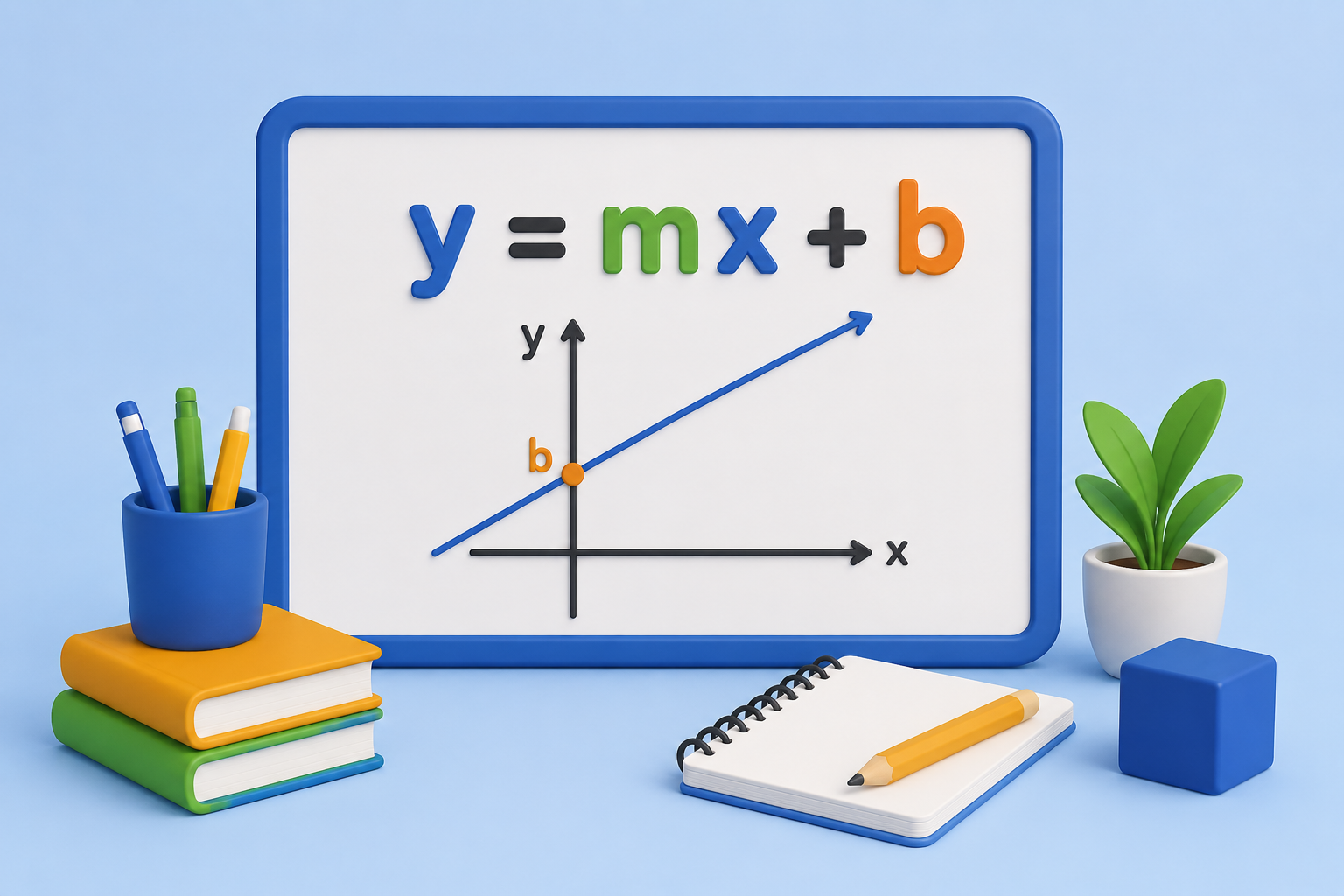
The slope of a line tells you how much y changes for every one-unit increase in x. In slope-intercept form, a linear equation is written as:
y = mx + b
Where:
- m is the slope (the rate of change)
- b is the y-intercept (where the line crosses the y-axis)
Example: y = 3x – 2
- Slope = 3 (the line rises 3 units for every 1 unit moved right)
- y-intercept = -2 (the line crosses the y-axis at (0, -2))
A positive slope means the line goes upward from left to right. A negative slope means the line goes downward from left to right. A slope of zero means the line is perfectly horizontal.
Linear Equations and Real Numbers
The solution to a linear equation can be any type of real number. Depending on the coefficients and constants involved, the answer might be a whole number, a negative number, a fraction, or a decimal.
For example:
- 2x = 8 gives x = 4 (a whole number)
- 3x = 7 gives x = 7/3 (a fraction)
- 4x = -5 gives x = -5/4 (a negative fraction)
Real numbers include all of these cases. Understanding the full range of real numbers helps you accept any type of solution without confusion. The article [What Is a Real Number?] explains the complete real number system in a clear and accessible way.
Linear Equations and Rational Numbers
Many solutions to linear equations turn out to be rational numbers. A rational number is any number that can be expressed as a fraction p/q where q is not zero.
For example:
- 3x = 5 gives x = 5/3, which is a rational number.
- 4x + 1 = 3 gives x = 1/2, which is also rational.
This is worth knowing because students sometimes worry when the answer is not a whole number. A fractional answer is completely normal and valid. The article [What Is a Rational Number?] covers this in more detail and explains what makes a number rational.
Linear Equations and Factors
Factors can appear in the process of simplifying or rearranging equations. For instance, when you factorise the left-hand side of an equation to isolate a variable, or when you find a common factor to simplify terms before solving, understanding factors makes the process more efficient.
For example, in 6x + 12 = 0, you can first recognise that the left side has a common factor of 6:
6(x + 2) = 0, so x = -2.
The article [What Is a Factor?] provides a thorough explanation of factors in mathematics, which supports your ability to work with and simplify equations.
Linear Equations and Multiples
Multiples play a practical role when solving linear equations that contain fractions. To eliminate fractions, you multiply through by a common multiple of all the denominators. This converts the equation into one with whole-number terms, which is easier to work with.
For example, in x/3 + x/6 = 4, the lowest common multiple of 3 and 6 is 6. Multiplying every term by 6 gives:
2x + x = 24
3x = 24
x = 8
Understanding how multiples work is an important supporting skill in algebra. For a clear explanation, visit the article [What Is a Multiple?].
Linear Equations in Everyday Life
Linear equations are not just textbook problems. They model real situations involving unknown quantities every single day.
Shopping: If each item costs £4 and you spend a total of £28, the equation 4x = 28 tells you that you bought x = 7 items.
Budgeting: If you earn £a per week and spend £200, your savings after w weeks are represented by aw – 200.
Distance and travel: If a car travels at 60 kilometres per hour and covers a distance of d kilometres, the time taken is d/60 hours. Setting this equal to a fixed time gives a linear equation.
Age problems: If Maria is twice as old as her brother, and their combined age is 36, then x + 2x = 36 gives x = 12, meaning her brother is 12 and Maria is 24.
Wages: If a worker earns a fixed weekly wage of £w plus £12 for every extra hour worked, and earns £200 in a week with h extra hours, the equation is w + 12h = 200.
Temperature conversion: The formula C = (5/9)(F – 32) is a linear equation relating Celsius to Fahrenheit.
Measurements: If the perimeter of a rectangle is 48 cm and the length is twice the width, then 2(2w + w) = 48 gives w = 8 cm.
Linear Equations in Physics
Physics relies heavily on linear equations to describe relationships between measurable quantities.
One well-known example is Newton’s Second Law of Motion:
F = ma
This states that Force equals mass multiplied by acceleration. If you know two of these three quantities, you can write a linear equation to find the third. For instance, if the mass is 5 kg and the force is 20 N, then 20 = 5a, and solving gives a = 4 m/s².
To understand the concept of force in more detail and see how it relates to algebra, read the article [What Is Force in Physics?].
Other linear equations in physics include Ohm’s Law (V = IR) and equations of motion such as v = u + at.
Linear Equations in Geometry
Linear equations arise naturally in geometry whenever unknown lengths, widths, or angles need to be found.
Perimeter of a rectangle: If the perimeter is 40 cm and the length is l and the width is w, then:
2l + 2w = 40
If you also know that l = 2w, substitute to get:
2(2w) + 2w = 40
6w = 40
w = 40/6 ≈ 6.67 cm
Unknown angles: If two angles in a triangle add up to 110° and one angle is x while the other is x + 20, then:
x + (x + 20) = 110
2x + 20 = 110
2x = 90
x = 45°
Coordinate geometry: Equations of straight lines, such as y = 3x – 2, are linear equations that describe the precise relationship between x and y coordinates on a graph.
Systems of Linear Equations
A system of linear equations is a set of two or more linear equations that share the same variables. The goal is to find the values of the variables that satisfy all equations simultaneously.
Example:
x + y = 10
x – y = 2
Adding the two equations eliminates y:
2x = 12
x = 6
Substituting x = 6 into the first equation:
6 + y = 10
y = 4
The solution is x = 6 and y = 4. Both equations are satisfied because 6 + 4 = 10 and 6 – 4 = 2.
Systems of linear equations are used in more advanced algebra and have applications in science, engineering, economics, and computer programming.
Types of Linear Equations
| Type | Description | Example |
|---|---|---|
| One-variable linear equation | Contains one unknown | 3x + 7 = 16 |
| Two-variable linear equation | Contains two unknowns | 2x + y = 9 |
| Linear equation in standard form | Written as ax + b = 0 or ax + by = c | 4x – 8 = 0 |
| Linear equation in slope-intercept form | Written as y = mx + b | y = 3x – 5 |
| Linear equation in point-slope form | Written as y – y₁ = m(x – x₁) | y – 2 = 3(x – 1) |
Linear Equation Forms
Standard Form
Ax + By = C
This form is useful when working with systems of equations and when coefficients are whole numbers.
Example: 3x + 4y = 12
Slope-Intercept Form
y = mx + b
This is the most useful form for graphing. The slope m and y-intercept b can be read directly from the equation.
Example: y = 2x + 5 (slope = 2, y-intercept = 5)
Point-Slope Form
y – y₁ = m(x – x₁)
This form is most useful when you know the slope of a line and one specific point on it.
Example: y – 3 = 2(x – 1)
This describes a line with slope 2 that passes through the point (1, 3).
All three forms represent the same straight line. The form you choose depends on what information you are given and what you need to find.
Common Mistakes Students Make
1. Not performing the same operation on both sides
If you add 5 to the left side, you must add 5 to the right side too. Failing to keep the equation balanced leads to wrong answers.
2. Changing signs incorrectly
When moving a term across the equals sign, its sign changes. Moving +3 from the left gives -3 on the right. Many students forget this.
3. Distributing incorrectly
In 3(x + 4), you must multiply 3 by both x and 4. Writing only 3x + 4 instead of 3x + 12 is a very common error.
4. Combining unlike terms
You cannot combine 3x and 5 into 8x. They are unlike terms.
5. Dividing by the wrong coefficient
In 5x = 20, divide by 5, not by 20. Always divide by the coefficient of the variable.
6. Forgetting to check the answer
A quick substitution check takes only a few seconds and prevents careless errors from going unnoticed.
7. Confusing an expression with an equation
You cannot solve 3x + 5 because it is an expression, not an equation. An equation requires an equals sign.
8. Assuming every equation containing x is linear
x² + 2 = 11 is not linear. Always check the highest power of the variable.
9. Mishandling fractions
Not multiplying every term by the LCD is a common mistake. Make sure you apply the multiplication to both sides of the equation completely.
10. Mishandling negative numbers
Subtracting a negative is the same as adding. -x – (-3) = -x + 3. Take extra care with sign rules.
Linear Equation Rules Cheat Sheet
| Rule | Explanation | Example |
|---|---|---|
| Same operation on both sides | Keep the equation balanced | If 2x = 10, divide both sides by 2 |
| Combine like terms | Simplify before isolating | 3x + 2x = 5x |
| Use the distributive property correctly | Multiply into every term in brackets | 3(x + 4) = 3x + 12 |
| Isolate the variable | Move all other terms to the opposite side | 2x + 7 = 15 → 2x = 8 |
| Check the final answer | Substitute back into the original equation | 2(4) + 7 = 15 |
| A linear variable has exponent 1 | No x² or higher powers allowed | x + 5 = 9 is linear; x² + 5 = 9 is not |
Worked Examples
Example 1: One-Step Equation (Addition)
Given: x + 9 = 14
Method: Subtract 9 from both sides.
Steps: x = 14 – 9 = 5
Final Answer: x = 5
Quick Check: 5 + 9 = 14. Correct.
Example 2: One-Step Equation (Multiplication)
Given: 7x = 35
Method: Divide both sides by 7.
Steps: x = 35 ÷ 7 = 5
Final Answer: x = 5
Quick Check: 7(5) = 35. Correct.
Example 3: Two-Step Equation
Given: 4x + 3 = 19
Method: Subtract 3, then divide by 4.
Steps: 4x = 16, x = 4
Final Answer: x = 4
Quick Check: 4(4) + 3 = 19. Correct.
Example 4: Two-Step Equation (Negative Coefficient)
Given: -3x + 6 = 15
Method: Subtract 6 from both sides, then divide by -3.
Steps: -3x = 9, x = -3
Final Answer: x = -3
Quick Check: -3(-3) + 6 = 9 + 6 = 15. Correct.
Example 5: Variables on Both Sides
Given: 5x – 3 = 2x + 9
Method: Move variable terms to one side.
Steps: 3x – 3 = 9, 3x = 12, x = 4
Final Answer: x = 4
Quick Check: 5(4) – 3 = 17 and 2(4) + 9 = 17. Correct.
Example 6: Parentheses
Given: 3(2x – 5) = 9
Method: Expand, then solve.
Steps: 6x – 15 = 9, 6x = 24, x = 4
Final Answer: x = 4
Quick Check: 3(2(4) – 5) = 3(3) = 9. Correct.
Example 7: Fractions
Given: x/4 + 3 = 7
Method: Subtract 3, then multiply by 4.
Steps: x/4 = 4, x = 16
Final Answer: x = 16
Quick Check: 16/4 + 3 = 4 + 3 = 7. Correct.
Example 8: Fractions With Two Variable Terms
Given: x/2 + x/3 = 10
Method: LCD = 6. Multiply every term by 6.
Steps: 3x + 2x = 60, 5x = 60, x = 12
Final Answer: x = 12
Quick Check: 12/2 + 12/3 = 6 + 4 = 10. Correct.
Example 9: Decimals
Given: 0.4x – 1 = 3
Method: Add 1, then divide by 0.4.
Steps: 0.4x = 4, x = 10
Final Answer: x = 10
Quick Check: 0.4(10) – 1 = 4 – 1 = 3. Correct.
Example 10: Checking a Solution
Given: Is x = 3 a solution to 5x – 4 = 11?
Method: Substitute x = 3 into the equation.
Steps: 5(3) – 4 = 15 – 4 = 11. Right side = 11.
Final Answer: Yes, x = 3 is a valid solution.
Example 11: Graphing a Linear Equation
Given: y = x + 2
Method: Create an ordered pair table.
Steps:
| x | y = x + 2 |
|---|---|
| 0 | 2 |
| 1 | 3 |
| 2 | 4 |
| -1 | 1 |
Plot these four points and draw a straight line through them.
Final Answer: A straight line with slope 1 and y-intercept 2.
Example 12: Slope-Intercept Form
Given: Write 4x – 2y = 8 in slope-intercept form.
Method: Solve for y.
Steps: -2y = -4x + 8, y = 2x – 4
Final Answer: y = 2x – 4 (slope = 2, y-intercept = -4)
Example 13: Standard Form
Given: Write y = -3x + 5 in standard form.
Method: Move the x term to the left side.
Steps: 3x + y = 5
Final Answer: 3x + y = 5
Example 14: Point-Slope Form
Given: Write the equation of a line with slope 4 passing through the point (2, 3).
Method: Use y – y₁ = m(x – x₁).
Steps: y – 3 = 4(x – 2)
Final Answer: y – 3 = 4(x – 2), which expands to y = 4x – 5
Example 15: Simple System of Linear Equations
Given: x + y = 8 and x – y = 2
Method: Add the equations to eliminate y.
Steps: 2x = 10, x = 5. Substitute: 5 + y = 8, y = 3.
Final Answer: x = 5, y = 3
Quick Check: 5 + 3 = 8 and 5 – 3 = 2. Correct.
Linear Equation Word Problems
Problem 1: Age Problem
A father is 4 times as old as his son. Their combined age is 50 years. How old is each?
Variable: Let the son’s age = x. Father’s age = 4x.
Equation: x + 4x = 50
Solution: 5x = 50, x = 10
Answer: The son is 10 years old and the father is 40 years old.
Problem 2: Shopping Problem
A student buys pens at £2 each. After buying some pens, she has £6 left from £20. How many pens did she buy?
Variable: Let the number of pens = x.
Equation: 20 – 2x = 6
Solution: 2x = 14, x = 7
Answer: She bought 7 pens.
Problem 3: Distance Problem
A cyclist travels at 15 km/h. How long does it take to travel 90 km?
Variable: Let time = t hours.
Equation: 15t = 90
Solution: t = 6
Answer: It takes 6 hours.
Problem 4: Money Problem
Two friends share £84. One receives £12 more than the other. How much does each receive?
Variable: Let the smaller share = x. Larger share = x + 12.
Equation: x + (x + 12) = 84
Solution: 2x + 12 = 84, 2x = 72, x = 36
Answer: One friend receives £36 and the other receives £48.
Problem 5: Work Problem
A plumber charges a £25 call-out fee plus £40 per hour. A customer receives a bill for £185. How many hours did the plumber work?
Variable: Let the number of hours = h.
Equation: 25 + 40h = 185
Solution: 40h = 160, h = 4
Answer: The plumber worked for 4 hours.
Problem 6: Speed Problem
Two trains leave the same station at the same time, travelling in opposite directions. One travels at 60 km/h and the other at 80 km/h. After how many hours will they be 420 km apart?
Variable: Let time = t hours.
Equation: 60t + 80t = 420
Solution: 140t = 420, t = 3
Answer: They will be 420 km apart after 3 hours.
Problem 7: Perimeter Problem
The perimeter of a rectangle is 56 cm. The length is 8 cm more than the width. Find both dimensions.
Variable: Let width = w. Length = w + 8.
Equation: 2(w + 8) + 2w = 56
Solution: 2w + 16 + 2w = 56, 4w = 40, w = 10
Answer: Width = 10 cm, Length = 18 cm.
Problem 8: Temperature Problem
A temperature in Fahrenheit is 95°F. Use C = (5/9)(F – 32) to convert to Celsius.
Variable: C is the unknown.
Equation: C = (5/9)(95 – 32) = (5/9)(63)
Solution: C = 315/9 = 35
Answer: 95°F is equal to 35°C.
Practice Questions
20 Multiple Choice Questions
Question 1: Which of the following is a linear equation?
A) x² + 5 = 14
B) 3x + 7 = 22
C) xy = 8
D) √x = 3
Correct Answer: B
Explanation: 3x + 7 = 22 contains a variable with exponent 1. All others are non-linear.
Question 2: What is the solution to x + 9 = 15?
A) 4
B) 24
C) 6
D) 5
Correct Answer: C
Explanation: x = 15 – 9 = 6.
Question 3: Solve 4x = 28.
A) x = 6
B) x = 7
C) x = 8
D) x = 112
Correct Answer: B
Explanation: 28 ÷ 4 = 7.
Question 4: What is the slope in y = 5x – 3?
A) -3
B) 5x
C) 5
D) -3x
Correct Answer: C
Explanation: In y = mx + b, m is the slope. Here m = 5.
Question 5: Solve 3x – 4 = 11.
A) x = 3
B) x = 5
C) x = 7
D) x = 4
Correct Answer: B
Explanation: 3x = 15, x = 5.
Question 6: Which equation is NOT linear?
A) 2x + 3 = 9
B) x – 6 = 0
C) x² = 16
D) 4x = 20
Correct Answer: C
Explanation: x² = 16 contains x to the power of 2, making it quadratic.
Question 7: What is the y-intercept of y = 3x + 7?
A) 3
B) 7x
C) 3x
D) 7
Correct Answer: D
Explanation: In y = mx + b, b is the y-intercept. Here b = 7.
Question 8: Solve 2x + 6 = 18.
A) x = 12
B) x = 6
C) x = 4
D) x = 7
Correct Answer: B
Explanation: 2x = 12, x = 6.
Question 9: What is the standard form of a linear equation in one variable?
A) y = mx + b
B) ax + by = c
C) ax + b = 0
D) ax² + bx + c = 0
Correct Answer: C
Explanation: The standard form for a one-variable linear equation is ax + b = 0.
Question 10: Solve 5x – 3 = 2x + 9.
A) x = 2
B) x = 4
C) x = 6
D) x = 3
Correct Answer: B
Explanation: 3x = 12, x = 4.
Question 11: Solve x/4 = 5.
A) x = 1.25
B) x = 9
C) x = 20
D) x = 15
Correct Answer: C
Explanation: Multiply both sides by 4. x = 20.
Question 12: What does the graph of a linear equation look like?
A) A parabola
B) A curve
C) A circle
D) A straight line
Correct Answer: D
Explanation: Linear equations in two variables always produce straight lines when graphed.
Question 13: Solve 3(x – 2) = 12.
A) x = 6
B) x = 2
C) x = 4
D) x = 10
Correct Answer: A
Explanation: 3x – 6 = 12, 3x = 18, x = 6.
Question 14: Which is the slope-intercept form of a linear equation?
A) ax + b = 0
B) y – y₁ = m(x – x₁)
C) y = mx + b
D) Ax + By = C
Correct Answer: C
Explanation: y = mx + b is the slope-intercept form.
Question 15: Solve x/2 + x/6 = 8.
A) x = 12
B) x = 6
C) x = 16
D) x = 9
Correct Answer: A
Explanation: LCD = 6. 3x + x = 48, 4x = 48, x = 12.
Question 16: If 7x + 3 = 38, what is x?
A) 4
B) 5
C) 6
D) 7
Correct Answer: B
Explanation: 7x = 35, x = 5.
Question 17: What is the solution to -4x = 20?
A) x = 5
B) x = -80
C) x = -5
D) x = 80
Correct Answer: C
Explanation: x = 20 ÷ (-4) = -5.
Question 18: How many solutions does a one-variable linear equation typically have?
A) None
B) Two
C) Infinitely many
D) Exactly one
Correct Answer: D
Explanation: A one-variable linear equation (where the variable does not cancel) has exactly one solution.
Question 19: Translate into an equation: “Five more than three times a number is 20.”
A) 3x – 5 = 20
B) 5x + 3 = 20
C) 3x + 5 = 20
D) 3 + 5x = 20
Correct Answer: C
Explanation: Three times a number is 3x. Five more than that is 3x + 5. Set equal to 20.
Question 20: Solve 0.2x + 4 = 6.
A) x = 5
B) x = 10
C) x = 2
D) x = 50
Correct Answer: B
Explanation: 0.2x = 2, x = 2 ÷ 0.2 = 10.
10 Short Answer Questions
Q1: What is the highest power of the variable in a linear equation?
Answer: 1
Q2: Write the standard form of a two-variable linear equation.
Answer: ax + by = c
Q3: Is x² + 3x – 5 = 0 a linear equation? Explain.
Answer: No. It contains x², which gives the variable a power of 2. This is a quadratic equation.
Q4: Solve 6x – 12 = 0.
Answer: 6x = 12, x = 2
Q5: Write y = 4x – 1 in standard form.
Answer: 4x – y = 1
Q6: What is the y-intercept of the equation y = -2x + 9?
Answer: 9. The line crosses the y-axis at the point (0, 9).
Q7: Solve 2x + 3y = 18 when y = 4.
Answer: 2x + 12 = 18, 2x = 6, x = 3
Q8: What are the three common forms of a linear equation?
Answer: Standard form (ax + b = 0 or ax + by = c), slope-intercept form (y = mx + b), and point-slope form (y – y₁ = m(x – x₁)).
Q9: Solve 5(2x + 1) = 35.
Answer: 10x + 5 = 35, 10x = 30, x = 3
Q10: Write the equation of a line with slope -2 and y-intercept 7.
Answer: y = -2x + 7
10 Solve-the-Equation Problems
Problem 1: x + 14 = 21
Solution: x = 21 – 14 = 7
Problem 2: 9x = 63
Solution: x = 63 ÷ 9 = 7
Problem 3: 3x + 8 = 29
Solution: 3x = 21, x = 7
Problem 4: 5x – 4 = 2x + 11
Solution: 3x = 15, x = 5
Problem 5: 4(x – 3) = 20
Solution: 4x – 12 = 20, 4x = 32, x = 8
Problem 6: x/5 + 3 = 7
Solution: x/5 = 4, x = 20
Problem 7: 2x/3 = 8
Solution: 2x = 24, x = 12
Problem 8: 0.3x – 1.5 = 4.5
Solution: 0.3x = 6, x = 20
Problem 9: -6x + 10 = -14
Solution: -6x = -24, x = 4
Problem 10: 3x + 2y = 16 when y = 2
Solution: 3x + 4 = 16, 3x = 12, x = 4
5 Word Problems
Problem 1: A number is tripled and then 5 is added. The result is 29. Find the number.
Variable: Let the number = x.
Equation: 3x + 5 = 29
Solution: 3x = 24, x = 8
Answer: The number is 8.
Problem 2: A train ticket costs £t. Three tickets and a £5 booking fee total £44. Find the cost of one ticket.
Variable: Let ticket price = t.
Equation: 3t + 5 = 44
Solution: 3t = 39, t = 13
Answer: One ticket costs £13.
Problem 3: A rectangle has a perimeter of 60 cm. Its length is 5 cm more than its width. Find the dimensions.
Variable: Width = w, Length = w + 5.
Equation: 2(w + 5) + 2w = 60
Solution: 4w + 10 = 60, 4w = 50, w = 12.5 cm, length = 17.5 cm
Answer: Width = 12.5 cm, Length = 17.5 cm.
Problem 4: A mobile data plan charges £10 per month plus £0.05 per MB used. A customer’s bill is £17.50. How many MB were used?
Variable: Let MB used = m.
Equation: 10 + 0.05m = 17.50
Solution: 0.05m = 7.50, m = 150
Answer: 150 MB were used.
Problem 5: Two numbers have a sum of 48. The larger number is three times the smaller. Find both numbers.
Variable: Let smaller number = x. Larger = 3x.
Equation: x + 3x = 48
Solution: 4x = 48, x = 12
Answer: The smaller number is 12 and the larger number is 36.
Exam Tips
- Simplify first. Before attempting to solve, look for any brackets to expand or like terms to combine.
- Keep both sides balanced. Every operation performed on one side must be applied to the other side equally.
- Watch negative signs. Sign errors are the most frequent cause of incorrect answers. Double-check every sign change.
- Use inverse operations. To undo addition, subtract. To undo multiplication, divide.
- Check your solution. Always substitute your answer back into the original equation. If both sides are equal, your answer is correct.
- Write every step clearly. Skipping steps increases the chance of errors and makes it harder to find mistakes.
- Identify whether the equation is linear. Check that the highest power of every variable is 1 before applying linear-equation methods.
- Eliminate fractions early. Multiply through by the LCD at the beginning to make the arithmetic simpler.
- State your answer clearly. In word problems, write a sentence stating what your answer means in context.
- Practise regularly. Linear equations follow consistent patterns. The more you practise, the faster and more accurate you become.
Quick Revision Notes
Definition: A linear equation is an algebraic equation where the highest power of every variable is 1.
Parts: Variable (x or y), coefficient (number in front of variable), constant (fixed number), equals sign, terms.
Standard form: ax + b = 0 (one variable) or ax + by = c (two variables).
Slope-intercept form: y = mx + b, where m = slope and b = y-intercept.
Types:
- One-variable: 3x + 7 = 16
- Two-variable: 2x + 3y = 12
Solving methods:
- One-step: one inverse operation
- Two-step: remove constant first, then divide by coefficient
- Variables on both sides: collect variable terms on one side
- Brackets: expand first, then solve
- Fractions: multiply through by LCD first
- Decimals: multiply through by power of 10, or work directly
Graphing: A two-variable linear equation produces a straight line. Use at least two points to draw the line.
Word problems: Define the variable, write the equation, solve, check, and state the answer in words.
Common mistakes: Sign errors, incorrect distribution, combining unlike terms, forgetting to check the answer.
Linear Equation Cheat Sheet
| Concept | Formula or Rule | Example |
|---|---|---|
| Linear equation (one variable) | ax + b = 0 | 3x – 6 = 0 |
| Linear equation (two variables) | ax + by = c | 2x + 5y = 20 |
| Slope-intercept form | y = mx + b | y = 4x – 2 |
| Point-slope form | y – y₁ = m(x – x₁) | y – 3 = 2(x – 1) |
| One-step equation | One inverse operation | x + 8 = 13 → x = 5 |
| Two-step equation | Remove constant, then divide | 2x + 5 = 13 → x = 4 |
| Variables on both sides | Collect variable terms first | 4x = 2x + 10 → x = 5 |
| Fractions | Multiply through by LCD | x/3 + 2 = 5 → x = 9 |
| Checking the answer | Substitute back and verify | x = 4 in 2x + 5 = 13: 2(4) + 5 = 13 |
Frequently Asked Questions
1. What is a linear equation?
A linear equation is an algebraic equation in which the highest power of any variable is 1. It always represents a straight line when graphed in two dimensions.
2. What is the definition of a linear equation?
A linear equation is an equation of the form ax + b = 0 (one variable) or ax + by = c (two variables), where a, b, and c are constants and x and y are variables with exponent 1.
3. How do you identify a linear equation?
Check that every variable in the equation has an exponent of exactly 1. There must be no products of variables, no variables in denominators, and no roots of variables.
4. How do you solve a linear equation?
Simplify both sides, move variable terms to one side and constant terms to the other, divide by the coefficient of the variable, and check the answer by substitution.
5. What is a one-variable linear equation?
A one-variable linear equation contains only one unknown, such as x. Example: 3x + 7 = 16. It has exactly one solution.
6. What is a two-variable linear equation?
A two-variable linear equation contains two unknowns, such as x and y. Example: 2x + y = 9. It has infinitely many solutions represented by ordered pairs.
7. What is the standard form of a linear equation?
For one variable: ax + b = 0. For two variables: ax + by = c, where a, b, and c are constants.
8. What is slope-intercept form?
Slope-intercept form is y = mx + b, where m is the slope and b is the y-intercept. It is the most useful form for graphing a linear equation.
9. What is the difference between a linear equation and an expression?
An expression has no equals sign and cannot be solved. An equation has an equals sign and can be solved to find the value of the variable.
10. What is the difference between linear and quadratic equations?
A linear equation has variables with a maximum exponent of 1 and graphs as a straight line. A quadratic equation has a variable raised to the power of 2 and graphs as a parabola.
11. Can a linear equation have a fraction as its solution?
Yes. For example, 3x = 7 gives x = 7/3, which is a fraction. Fractional solutions are completely valid.
12. How do you graph a linear equation?
Write the equation in slope-intercept form (y = mx + b), identify the y-intercept, plot it, use the slope to find additional points, and draw a straight line through those points.
13. What makes an equation linear?
An equation is linear if every variable in it has an exponent of exactly 1, no two variables are multiplied together, and no variable appears in a denominator or under a root.
14. Can a linear equation have two variables?
Yes. A linear equation in two variables, such as x + y = 10, has infinitely many solutions and represents a straight line on a coordinate plane.
15. Where are linear equations used in real life?
Linear equations are used in budgeting, calculating wages, solving distance and speed problems, working out ages, finding measurements, converting temperatures, and many other everyday situations.
Summary
A linear equation is an equation in which every variable appears with an exponent of exactly 1. It can involve one variable or two variables, and it can appear in different forms including standard form, slope-intercept form, and point-slope form.
Solving a linear equation means isolating the variable using inverse operations while keeping both sides of the equation balanced at all times. The solution can be an integer, a fraction, a decimal, or any other real number depending on the values involved.
When a two-variable linear equation is graphed, it always produces a straight line. The slope tells you how steeply the line rises or falls, and the y-intercept tells you where it crosses the y-axis.
Linear equations are used in a huge variety of real-world situations, from calculating costs and distances to describing physical relationships in science and geometry.
Final Thoughts
Understanding what is a linear equation is one of the most important steps you will take in learning algebra. Linear equations are the foundation on which almost everything else in mathematics is built.
Once you can solve a linear equation confidently, you have the skills to tackle word problems, understand graphs, work with formulas, explore coordinate geometry, study systems of equations, and move into more advanced topics such as quadratics, functions, and calculus.
Take the time to practise solving different types of linear equations: one-step, two-step, those with fractions, those with brackets, and those with variables on both sides. Each type strengthens a slightly different skill, and together they give you a complete toolkit for algebraic problem-solving.
The worked examples, practice questions, and revision notes in this article are designed to give you everything you need to build that confidence step by step.
References
- OpenStax – Prealgebra and Elementary Algebra textbooks covering linear equations, solving methods, and graphing.
https://openstax.org - Khan Academy – Free lessons and exercises on linear equations, slope, graphing, and word problems.
https://www.khanacademy.org - Mathematics LibreTexts – Open-access mathematics library covering linear equations in one and two variables, standard form, and slope-intercept form.
https://math.libretexts.org - Encyclopaedia Britannica – Reference articles on algebra, linear equations, and coordinate geometry.
https://www.britannica.com - Wolfram MathWorld – Comprehensive mathematical reference covering linear equations, slope, and graphing.
https://mathworld.wolfram.com
Disclaimer:
This article is intended for educational and informational purposes only. While LearnMinto strives to provide accurate and up-to-date mathematics information, readers should verify important academic concepts through official textbooks, educational institutions, examination boards, or trusted educational resources before using this content for exams or academic purposes. LearnMinto is not affiliated with any specific school, university, research institution, or examination board.