
Introduction
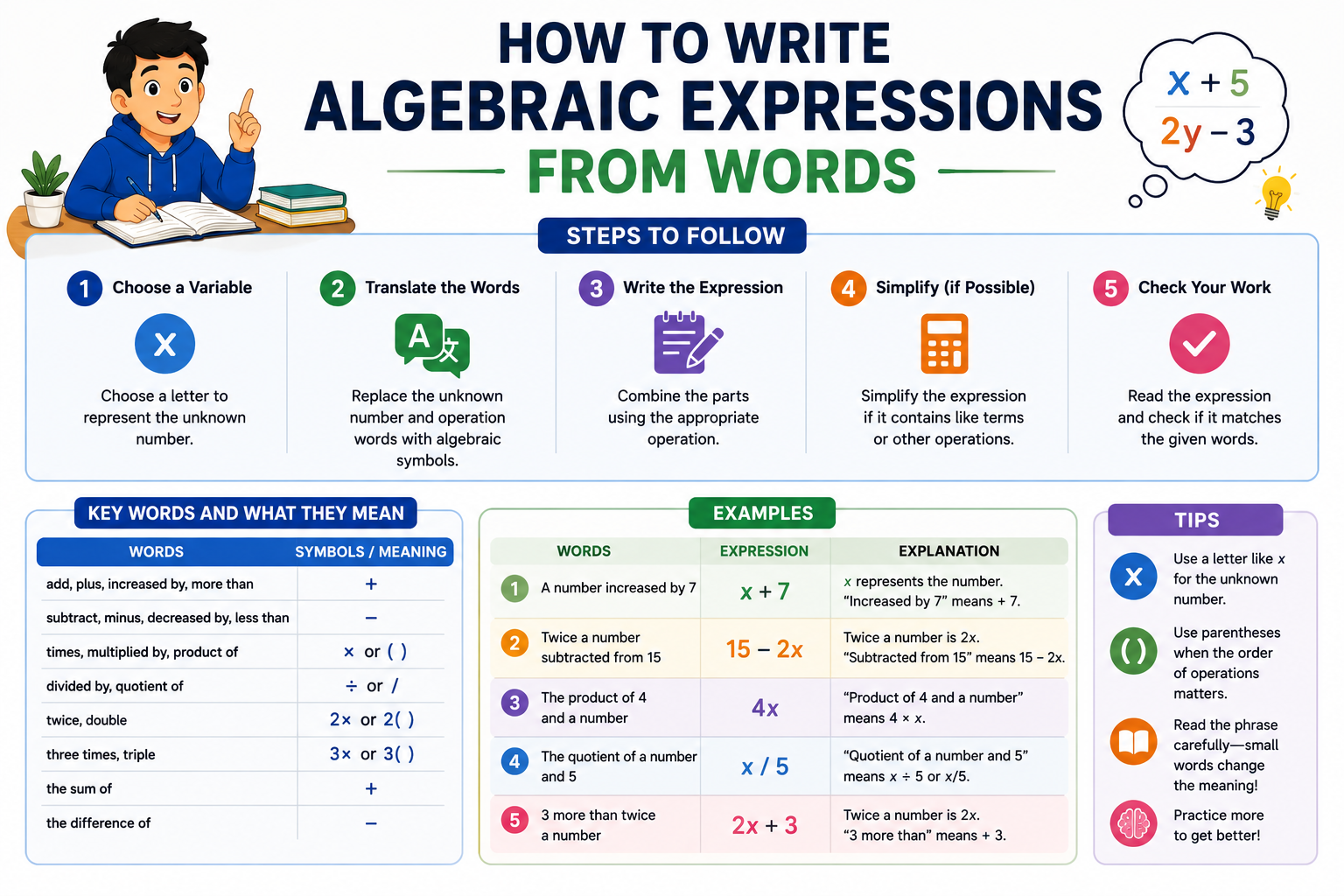
One of the most important skills you will develop in algebra is learning how to write algebraic expressions from words. This means taking a sentence or phrase written in plain English and turning it into a mathematical expression using numbers, variables, and operation symbols.
For example, the phrase “a number plus five” translates directly into the algebraic expression x + 5.
That is the core idea. You identify the unknown quantity, choose a variable to represent it, spot the mathematical operation hidden in the words, and write everything out using algebraic notation.
This skill underpins almost everything in algebra. You need it to write equations from word problems, build mathematical models, and eventually solve real-world problems using algebra. Once you know the key words and understand the process, translating words into algebraic expressions becomes straightforward.
Key Takeaways
-
Writing algebraic expressions from words means translating English phrases into mathematical notation.
-
Certain key words signal specific operations: sum and plus indicate addition, difference and less than indicate subtraction, product and times indicate multiplication, and quotient and divided by indicate division.
-
The unknown quantity in a phrase is always replaced by a variable such as x, y, n, or a.
-
Word order matters, especially with subtraction. “Four less than x” means x – 4, not 4 – x.
-
Some phrases require brackets to group part of the expression before applying an operation.
-
Constants and coefficients both appear in algebraic expressions translated from words.
-
Checking your expression by reading it back in words confirms whether the translation is correct.
What Is an Algebraic Expression?
An algebraic expression is a mathematical phrase that combines numbers, variables, and operations such as addition, subtraction, multiplication, and division. It does not contain an equals sign.
Simple examples of algebraic expressions:
- x + 5
- 3x – 2
- 4x + 7y
- 2a² – 5a + 3
The article [What Is an Algebraic Expression?] provides a complete explanation of expressions, including their parts, types, and how they differ from equations. Reading it alongside this article will give you a strong foundation in algebraic notation.
An expression is different from an equation. An equation has an equals sign and states that two expressions are equal. An expression simply represents a value and can be simplified or evaluated, but not solved for a specific answer the way an equation can.
What Is a Variable?
A variable is a letter that stands in for an unknown number. In algebra, when a word phrase mentions “a number” or “some quantity” without telling you what it is, you replace that unknown with a variable.
Common choices are:
- “A number” → x
- “Some quantity” → n
- “An unknown value” → a
- “A certain amount” → k
You can use any letter. The most common choices in school algebra are x, y, n, and a. What matters is that you are consistent. Once you assign a variable, use the same letter throughout the entire expression.
Key Mathematical Words and Their Operations
Certain English words and phrases are direct signals for mathematical operations. Learning these key words is the foundation of translating word phrases into algebraic expressions.
Addition Words
| Word or Phrase | Algebraic Meaning | Example |
|---|---|---|
| Sum | + | Sum of x and 4 → x + 4 |
| Plus | + | x plus 6 → x + 6 |
| More than | + | 5 more than x → x + 5 |
| Increased by | + | x increased by 3 → x + 3 |
| Added to | + | 7 added to x → x + 7 |
| Total | + | Total of x and 9 → x + 9 |
| Greater than | + | 4 greater than x → x + 4 |
Subtraction Words
| Word or Phrase | Algebraic Meaning | Example |
|---|---|---|
| Difference | – | Difference of x and 3 → x – 3 |
| Minus | – | x minus 5 → x – 5 |
| Less than | – | 4 less than x → x – 4 |
| Decreased by | – | x decreased by 7 → x – 7 |
| Subtracted from | – | 3 subtracted from x → x – 3 |
| Reduced by | – | x reduced by 2 → x – 2 |
| Fewer than | – | 6 fewer than x → x – 6 |
Multiplication Words
| Word or Phrase | Algebraic Meaning | Example |
|---|---|---|
| Product | × | Product of 5 and x → 5x |
| Times | × | 3 times x → 3x |
| Multiplied by | × | x multiplied by 4 → 4x |
| Twice | × 2 | Twice a number → 2x |
| Double | × 2 | Double of x → 2x |
| Triple | × 3 | Triple a number → 3x |
| Of | × | Half of x → x/2 |
Division Words
| Word or Phrase | Algebraic Meaning | Example |
|---|---|---|
| Quotient | ÷ | Quotient of x and 4 → x/4 |
| Divided by | ÷ | x divided by 6 → x/6 |
| Half | ÷ 2 | Half of x → x/2 |
| Per | ÷ | x per 5 → x/5 |
| Ratio | ÷ | Ratio of x to 3 → x/3 |
Once you recognise which operation a phrase is describing, the rest of the translation follows naturally. These tables are worth memorising because they appear in almost every algebra topic you will encounter.
Step-by-Step Method: How to Write Algebraic Expressions From Words
Every time you need to translate a word phrase, follow these six steps:
- Read the word phrase carefully. Read it more than once if needed.
- Identify the unknown quantity and assign it a variable (x, n, a, etc.).
- Identify the mathematical operation by spotting the key words.
- Identify any numbers or constants mentioned in the phrase.
- Write the algebraic expression using the variable, operation symbol, and numbers.
- Check your expression by reading it back in words.
Worked step-by-step example:
Word phrase: “Seven more than a number”
- Step 2: The unknown is “a number” → let it be x
- Step 3: “More than” → addition
- Step 4: The number involved is 7
- Step 5: Expression → x + 7
- Step 6: Read back: “x plus 7” or “7 more than x” — correct.
This six-step process works for every phrase, from the simplest one-operation expressions to complex multi-step ones.
Simple One-Operation Expressions
Addition Expressions
| Word Phrase | Algebraic Expression |
|---|---|
| A number plus 3 | x + 3 |
| The sum of a number and 9 | x + 9 |
| Eight more than a number | x + 8 |
| A number increased by 12 | x + 12 |
| Six added to a number | x + 6 |
Subtraction Expressions
| Word Phrase | Algebraic Expression |
|---|---|
| A number minus 4 | x – 4 |
| Seven less than a number | x – 7 |
| A number decreased by 10 | x – 10 |
| Three subtracted from a number | x – 3 |
| A number reduced by 5 | x – 5 |
Multiplication Expressions
| Word Phrase | Algebraic Expression |
|---|---|
| Three times a number | 3x |
| The product of 8 and a number | 8x |
| Twice a number | 2x |
| A number multiplied by 6 | 6x |
| Triple a number | 3x |
Division Expressions
| Word Phrase | Algebraic Expression |
|---|---|
| A number divided by 4 | x/4 |
| The quotient of a number and 7 | x/7 |
| Half of a number | x/2 |
| A number divided by 9 | x/9 |
| One-third of a number | x/3 |
These single-operation phrases are the building blocks. Once you are confident with them, translating more complex phrases becomes much easier.
Two-Operation Expressions
Many word phrases involve two separate operations. You need to identify both, apply them in the correct order, and write the full expression.
| Word Phrase | Unknown | Operations | Expression |
|---|---|---|---|
| Three times a number plus five | x | × then + | 3x + 5 |
| Twice a number minus seven | x | × then – | 2x – 7 |
| A number divided by four plus two | x | ÷ then + | x/4 + 2 |
| The sum of a number and six, multiplied by three | x | + then × | 3(x + 6) |
| Five less than twice a number | x | × then – | 2x – 5 |
| Four more than the product of two and a number | x | × then + | 2x + 4 |
| Seven decreased by three times a number | x | × then – | 7 – 3x |
| The quotient of a number and five, increased by one | x | ÷ then + | x/5 + 1 |
| Eight added to four times a number | x | × then + | 4x + 8 |
| Ten minus the product of two and a number | x | × then – | 10 – 2x |
| A number multiplied by three, minus nine | x | × then – | 3x – 9 |
| Twice the sum of a number and four | x | + then × | 2(x + 4) |
| The difference of a number and two, multiplied by six | x | – then × | 6(x – 2) |
| A number divided by three, decreased by five | x | ÷ then – | x/3 – 5 |
| Nine more than five times a number | x | × then + | 5x + 9 |
For each of these, always ask yourself: which operation comes first and does any part of the expression need to be grouped inside brackets before applying the second operation?
Important Word Order Rules
Word order has significant consequences in algebra, particularly with subtraction and division. Getting the order wrong flips the meaning of the expression entirely.
“Less Than” vs “Subtracted From”
This is the most common source of errors when translating into algebraic expressions.
“Four less than a number”
This means you take a number and subtract four from it.
Expression: x – 4
It does NOT mean 4 – x.
“A number less than four”
Here, the number is being compared to four, and it is smaller.
Expression: 4 – x
The position of the phrase in the sentence determines which comes first. When you see “less than,” the number that comes before the phrase goes on the right side of the subtraction.
More examples:
- “Six less than a number” → x – 6
- “A number less than ten” → 10 – x
- “Three subtracted from a number” → x – 3
“Divided by” vs “Divided into”
These two phrases produce the same result but can confuse students when the order of words changes.
- “A number divided by 3” → x/3 (x is the numerator)
- “3 divided into a number” → x/3 (same result; 3 goes into x)
Both mean x divided by 3. However, “a number divided by 3” is more common in school-level problems.
“More Than” vs “Greater Than”
Both phrases signal addition. They produce the same type of expression.
- “5 more than a number” → x + 5
- “5 greater than a number” → x + 5
The key thing to remember is that the stated number is added to the variable. Do not reverse the order.
Expressions With Two Variables
Some word phrases describe relationships between two separate unknowns. In these cases, you need two different variables.
| Word Phrase | Expression |
|---|---|
| The sum of two numbers | x + y |
| The difference between two numbers | x – y |
| Three times the first number plus twice the second | 3x + 2y |
| The product of two numbers | xy |
| The first number divided by the second | x/y |
When an expression contains two different variables such as x and y, those two variable terms are unlike terms and cannot be combined into a single term. For example, 3x + 2y cannot be simplified further.
Writing Expressions With Constants
A constant is a fixed number in an expression that does not change regardless of the value of the variable. When a word phrase mentions a specific number that is added to, subtracted from, or otherwise combined with the variable expression, that number becomes the constant.
Examples:
- “Five more than a number” → x + 5 (the constant is 5)
- “A number minus three” → x – 3 (the constant is -3)
- “Twice a number plus eight” → 2x + 8 (the constant is 8)
- “A number decreased by twelve” → x – 12 (the constant is -12)
The article What Is a Constant in Algebra? provides a full explanation of constants, including positive, negative, fractional, and decimal constants, and how to distinguish them from coefficients and other parts of an expression.
Identifying the constant in a word phrase is straightforward once you have translated the variable part. Whatever fixed number remains is the constant term.
Writing Expressions With Coefficients
When a word phrase involves multiplying a variable by a number, that number becomes the coefficient of the variable in the expression. The coefficient appears directly in front of the variable in the written expression.
Examples:
- “Five times a number” → 5x (5 is the coefficient)
- “Negative three times a number” → -3x (-3 is the coefficient)
- “The product of seven and a number” → 7x (7 is the coefficient)
- “Twice a number” → 2x (2 is the coefficient)
The article What Is a Coefficient in Algebra? explains coefficients in full detail, including how to identify them in any algebraic term, handle negative coefficients, and work with fractional and decimal coefficients. Understanding the coefficient is essential for writing multiplication-based expressions correctly.
Expressions Involving Fractions
Division phrases in word problems produce fractional algebraic expressions. The key words that signal division are: divided by, quotient, half, per, one-third, and ratio.
Examples:
- “A number divided by four” → x/4
- “Half of a number” → x/2
- “One-third of a number plus five” → x/3 + 5
- “The quotient of a number and six” → x/6
- “A number per eight” → x/8
The article [What Is a Fraction?] explains how fractions work mathematically, including how to add, subtract, and compare them.
This background is important when working with fractional algebraic expressions, particularly when combining terms or simplifying expressions that contain fractions.
When “of” appears alongside a fraction word such as “half,” it signals multiplication. “Half of a number” means 1/2 × x, which is written as x/2.
Expressions With Parentheses
Some word phrases require brackets because one part of the expression must be grouped and evaluated first before another operation is applied to it.
The signal words that indicate grouping are phrases like:
- “The sum of… multiplied by…”
- “Twice the difference of…”
- “The product of… and the sum of…”
Examples:
“Three times the sum of a number and four”
- The sum of a number and four: x + 4
- Three times that sum: 3(x + 4)
- Expression: 3(x + 4)
“Twice the difference of a number and six”
- The difference of a number and six: x – 6
- Twice that difference: 2(x – 6)
- Expression: 2(x – 6)
“The product of five and the sum of x and two”
- The sum of x and two: x + 2
- Five times that sum: 5(x + 2)
- Expression: 5(x + 2)
Why do brackets matter here? Compare 3(x + 4) and 3x + 4. If x = 2:
- 3(x + 4) = 3(6) = 18
- 3x + 4 = 6 + 4 = 10
The brackets change the result entirely. Always include them when the phrase groups part of the expression before applying another operation.
When factored expressions like these appear in more advanced work, understanding how factors relate to the bracketed form becomes important.
The article [What Is a Factor?] explains factors clearly, which helps you understand why 3(x + 4) represents a product of the factor 3 and the factor (x + 4).
Writing Expressions From Longer Word Problems
Real word problems require you to read carefully, extract the unknown, and translate the mathematical relationship into an expression.
Problem 1: “A student earns £8 per hour. Write an expression for the amount earned in h hours.”
- Unknown: number of hours → h
- Operation: multiplication (£8 per hour)
- Expression: 8h
Problem 2: “A number is tripled and then reduced by four.”
- Unknown: the number → x
- Operations: multiply by 3, then subtract 4
- Expression: 3x – 4
Problem 3: “The total cost of n items at £5 each plus a £3 delivery charge.”
- Unknown: number of items → n
- Operations: multiply n by 5, then add 3
- Expression: 5n + 3
Problem 4: “Maria is 7 years older than her brother, who is x years old.”
- Unknown: brother’s age → x
- Operation: Maria’s age is x plus 7
- Expression: x + 7
Problem 5: “A car travels at 60 km/h for t hours.”
- Unknown: time in hours → t
- Operation: distance = speed × time
- Expression: 60t
Problem 6: “A rectangle has a length that is twice its width w.”
- Unknown: width → w
- Operation: length = 2 × width
- Expression: 2w
Problem 7: “A shopkeeper sells apples for 40p each. Write an expression for the cost of a apples.”
- Unknown: number of apples → a
- Operation: multiplication
- Expression: 40a
Problem 8: “A number is halved and then increased by nine.”
- Unknown: the number → x
- Operations: divide by 2, then add 9
- Expression: x/2 + 9
Problem 9: “The perimeter of a square with side length s.”
- Unknown: side length → s
- Operation: perimeter = 4 × side
- Expression: 4s
Problem 10: “The total of three consecutive numbers starting from n.”
- Unknown: first number → n
- Second number: n + 1, third number: n + 2
- Expression: n + (n + 1) + (n + 2) which simplifies to 3n + 3
Common Mistakes Students Make
| Mistake | Incorrect | Correct |
|---|---|---|
| Reversing subtraction for “less than” | “4 less than x” → 4 – x | x – 4 |
| Forgetting brackets when grouping is needed | “Twice the sum of x and 3” → 2x + 3 | 2(x + 3) |
| Using the wrong operation | “Product of x and 5” → x + 5 | 5x |
| Assigning the variable to the number | “A number plus 7” → 7 as variable | x + 7 (x is the variable) |
| Combining unlike terms in final expression | “Sum of x and y” → 2xy | x + y |
| Forgetting coefficient when multiplication implied | “Twice a number minus one” → x – 1 | 2x – 1 |
| Treating “of” as addition | “Half of a number” → x + 1/2 | x/2 |
| Misreading “less than” direction | “x less than 4” → x – 4 | 4 – x |
Each of these errors has a clear correction. The most important habit to build is reading the phrase twice and checking the word order before writing any expression.
When you simplify expressions that result from translation, remember that unlike terms cannot be merged.
The article [How to Combine Like Terms] explains exactly which terms can be combined and shows the process step by step, which helps you avoid incorrectly simplifying a final expression.
Quick Reference: Key Algebra Words
| Operation | Key Words | Expression Example |
|---|---|---|
| Addition | sum, plus, more than, increased by, added to, total, greater than | x + 6 |
| Subtraction | difference, minus, less than, decreased by, reduced by, subtracted from, fewer than | x – 4 |
| Multiplication | product, times, multiplied by, twice, double, triple, of | 3x |
| Division | quotient, divided by, half, per, ratio, one-third of | x/5 |
Print or copy this table and keep it with your algebra notes. It is the fastest reference tool for any translation problem.
Worked Examples Section
Example 1: Simple Addition
Phrase: “A number plus eleven”
Unknown: x
Operation: addition
Expression: x + 11
Example 2: Simple Subtraction
Phrase: “A number minus nine”
Unknown: x
Operation: subtraction
Expression: x – 9
Example 3: Simple Multiplication
Phrase: “The product of six and a number”
Unknown: x
Operation: multiplication
Expression: 6x
Example 4: Simple Division
Phrase: “A number divided by five”
Unknown: x
Operation: division
Expression: x/5
Example 5: Two Operations — Multiplication then Addition
Phrase: “Four times a number plus three”
Unknown: x
Operations: × then +
Expression: 4x + 3
Example 6: Two Operations — Multiplication then Subtraction
Phrase: “Six times a number minus eight”
Unknown: x
Operations: × then –
Expression: 6x – 8
Example 7: Division then Addition
Phrase: “A number divided by two plus seven”
Unknown: x
Operations: ÷ then +
Expression: x/2 + 7
Example 8: Brackets Required
Phrase: “Three times the sum of a number and five”
Unknown: x
Operation 1: add 5 to the number
Operation 2: multiply the result by 3
Expression: 3(x + 5)
Example 9: Brackets — Difference
Phrase: “Twice the difference of a number and four”
Unknown: x
Expression: 2(x – 4)
Example 10: Two Variables
Phrase: “The sum of twice the first number and three times the second”
Unknowns: x and y
Expression: 2x + 3y
Example 11: Fraction Expression
Phrase: “One-quarter of a number increased by six”
Unknown: x
Operations: ÷ 4 then + 6
Expression: x/4 + 6
Example 12: Decimal Coefficient
Phrase: “Zero point five times a number”
Unknown: x
Expression: 0.5x
Example 13: Negative Coefficient
Phrase: “Negative four times a number plus two”
Unknown: x
Expression: -4x + 2
Example 14: Subtraction With Word Order
Phrase: “Ten less than a number”
Unknown: x
Expression: x – 10 (NOT 10 – x)
Example 15: Product of Two Variables
Phrase: “The product of two numbers”
Unknowns: x and y
Expression: xy
Example 16: Word Problem Sentence
Phrase: “A worker earns £12 per hour for h hours.”
Unknown: h (hours)
Expression: 12h
Example 17: Real-World Example
Phrase: “The cost of c cinema tickets at £9 each plus a £2 booking fee”
Unknown: c
Expression: 9c + 2
Example 18: Three Operations
Phrase: “Five times a number, plus three, divided by two”
Unknown: x
Expression: (5x + 3)/2
Example 19: Subtraction in the Opposite Direction
Phrase: “Fifteen decreased by twice a number”
Unknown: x
Expression: 15 – 2x
Example 20: Age Problem
Phrase: “A father is three times as old as his son, who is s years old, minus five years”
Unknown: s
Expression: 3s – 5
Practice Questions
20 Multiple Choice Questions
Question 1: What is the algebraic expression for “a number plus eight”?
A) 8x B) x – 8 C) x + 8 D) 8 – x
Correct Answer: C
Explanation: “Plus” signals addition. The number (variable) plus 8 gives x + 8.
Question 2: Which expression represents “six less than a number”?
A) 6 – x B) x + 6 C) 6x D) x – 6
Correct Answer: D
Explanation: “Less than” means subtract from the variable. Six less than x gives x – 6, not 6 – x.
Question 3: What does “three times a number” translate to?
A) x + 3 B) x/3 C) 3x D) x – 3
Correct Answer: C
Explanation: “Times” signals multiplication. Three times x = 3x.
Question 4: What is “the quotient of a number and four”?
A) 4x B) x – 4 C) x + 4 D) x/4
Correct Answer: D
Explanation: “Quotient” signals division. The quotient of x and 4 = x/4.
Question 5: What is “twice a number minus five”?
A) 2x + 5 B) 2x – 5 C) 2(x – 5) D) x – 10
Correct Answer: B
Explanation: “Twice” = 2x. “Minus five” subtracts 5. Result: 2x – 5.
Question 6: Which expression represents “three times the sum of a number and two”?
A) 3x + 2 B) 3x + 6 C) 3(x + 2) D) x + 6
Correct Answer: C
Explanation: “The sum of a number and two” is grouped first: x + 2. Then multiplied by 3: 3(x + 2).
Question 7: What is “a number increased by seven”?
A) 7x B) x – 7 C) x/7 D) x + 7
Correct Answer: D
Explanation: “Increased by” signals addition. x increased by 7 = x + 7.
Question 8: What does “the product of five and a number” become?
A) x + 5 B) x/5 C) 5x D) x – 5
Correct Answer: C
Explanation: “Product” signals multiplication. Product of 5 and x = 5x.
Question 9: Which expression represents “half of a number plus three”?
A) x/2 – 3 B) 2x + 3 C) x/3 + 2 D) x/2 + 3
Correct Answer: D
Explanation: “Half of a number” = x/2. “Plus three” adds 3. Result: x/2 + 3.
Question 10: What is “the sum of two numbers”?
A) 2x B) x² C) x + y D) xy
Correct Answer: C
Explanation: Two different unknown numbers require two variables: x + y.
Question 11: What does “five more than twice a number” translate to?
A) 5 + x B) 2x + 5 C) 2(x + 5) D) 5x + 2
Correct Answer: B
Explanation: “Twice a number” = 2x. “Five more than” adds 5. Result: 2x + 5.
Question 12: Which phrase matches the expression 4 – x?
A) Four less than a number B) A number less than four C) Four times a number D) A number minus four
Correct Answer: B
Explanation: “A number less than four” means the number is smaller than four, giving 4 – x.
Question 13: What is “a number divided by three, decreased by two”?
A) x/3 + 2 B) 3/x – 2 C) x/3 – 2 D) 3x – 2
Correct Answer: C
Explanation: “Divided by three” = x/3. “Decreased by two” subtracts 2. Result: x/3 – 2.
Question 14: What does “the product of two numbers” become?
A) x + y B) x – y C) 2x D) xy
Correct Answer: D
Explanation: “Product” signals multiplication. Two unknown numbers multiplied = xy.
Question 15: Which expression represents “twice the difference of a number and six”?
A) 2x – 6 B) 2(x – 6) C) 2x + 6 D) 2(6 – x)
Correct Answer: B
Explanation: “Difference of a number and six” = x – 6. “Twice” that difference = 2(x – 6).
Question 16: What is “eight reduced by three times a number”?
A) 8x – 3 B) 3x – 8 C) 8 – 3x D) 3 – 8x
Correct Answer: C
Explanation: “Three times a number” = 3x. “Eight reduced by” that = 8 – 3x.
Question 17: What is “the total of n tickets at £6 each plus a £4 booking fee”?
A) 6 + 4n B) 6n – 4 C) 4n + 6 D) 6n + 4
Correct Answer: D
Explanation: Cost of n tickets at £6 each = 6n. Plus the £4 booking fee = 6n + 4.
Question 18: What does “one-third of a number” mean?
A) 3x B) x – 3 C) x/3 D) x + 3
Correct Answer: C
Explanation: “One-third of” means divide by 3 (or multiply by 1/3). Result: x/3.
Question 19: Which expression represents “the sum of a number and four, multiplied by seven”?
A) 7x + 4 B) 7(x + 4) C) x + 28 D) 7x + 28
Correct Answer: B
Explanation: First group x + 4. Then multiply by 7: 7(x + 4). Note: 7x + 28 is the expanded form, but the expression with brackets is the direct translation.
Question 20: What is “negative two times a number plus nine”?
A) 2x + 9 B) -2x – 9 C) 9 – 2x D) -2x + 9
Correct Answer: D
Explanation: “Negative two times a number” = -2x. “Plus nine” adds 9. Result: -2x + 9.
15 Translate the Phrase Questions
Q1: “A number plus fifteen”
Answer: x + 15
Q2: “Nine less than a number”
Answer: x – 9
Q3: “The product of seven and a number”
Answer: 7x
Q4: “A number divided by twelve”
Answer: x/12
Q5: “Three times a number plus four”
Answer: 3x + 4
Q6: “Twice a number minus eleven”
Answer: 2x – 11
Q7: “Four times the sum of a number and three”
Answer: 4(x + 3)
Q8: “The difference of two numbers”
Answer: x – y
Q9: “A number increased by one-half”
Answer: x + 1/2
Q10: “Six times a number, divided by five”
Answer: 6x/5
Q11: “Ten more than the product of three and a number”
Answer: 3x + 10
Q12: “A number less than twenty”
Answer: 20 – x
Q13: “Five times the difference of a number and two”
Answer: 5(x – 2)
Q14: “The sum of three times the first number and twice the second”
Answer: 3x + 2y
Q15: “Half of the sum of a number and eight”
Answer: (x + 8)/2
10 Word Problem Expressions
Problem 1: “A painter charges £15 per hour. Write an expression for the total charge after h hours.”
Variable: h = number of hours
Expression: 15h
Problem 2: “A box contains b biscuits. Someone eats 4 of them. Write an expression for the number remaining.”
Variable: b = original number of biscuits
Expression: b – 4
Problem 3: “Tickets cost £t each. A group buys 5 tickets and pays a £2 booking fee.”
Variable: t = ticket price
Expression: 5t + 2
Problem 4: “Tom is twice as old as his sister. His sister is s years old.”
Variable: s = sister’s age
Expression: 2s
Problem 5: “A runner completes k laps, each of 400 metres. Write an expression for the total distance in metres.”
Variable: k = number of laps
Expression: 400k
Problem 6: “A shop has p pencils and divides them equally among 6 children.”
Variable: p = number of pencils
Expression: p/6
Problem 7: “A number of apples a is tripled and then six more are added.”
Variable: a = original number of apples
Expression: 3a + 6
Problem 8: “A journey takes t hours at 50 km/h. Write an expression for the distance covered.”
Variable: t = time in hours
Expression: 50t
Problem 9: “A rectangle has width w metres. Its length is 5 metres longer than twice its width.”
Variable: w = width
Expression: 2w + 5
Problem 10: “A savings account starts with £200 and receives d pounds each month for m months.”
Variables: d = monthly deposit, m = number of months
Expression: 200 + dm
5 Challenge Questions
Challenge 1: “The product of three and the sum of twice a number and four”
Step 1: Twice a number = 2x
Step 2: Sum of 2x and four = 2x + 4
Step 3: Product of 3 and that sum = 3(2x + 4)
Answer: 3(2x + 4)
Challenge 2: “Five times the difference of three times a number and seven”
Step 1: Three times a number = 3x
Step 2: Difference of 3x and 7 = 3x – 7
Step 3: Five times that = 5(3x – 7)
Answer: 5(3x – 7)
Challenge 3: “The sum of one-third of the first number and one-quarter of the second number”
Variables: x and y
Answer: x/3 + y/4
Challenge 4: “The total of twice the first number, three times the second number, and four times the third number, decreased by ten”
Variables: x, y, z
Answer: 2x + 3y + 4z – 10
Challenge 5: “Half the sum of a number and six, multiplied by the difference of that number and two”
Step 1: Sum of x and 6 = x + 6
Step 2: Half of that = (x + 6)/2
Step 3: Difference of x and 2 = x – 2
Step 4: Multiply: [(x + 6)/2] × (x – 2)
Answer: [(x + 6)/2](x – 2)
Exam Tips
Use these strategies in any algebra exam that requires you to write expressions from words:
- Read the phrase twice before writing anything. Many errors come from rushing straight to the expression.
- Underline or circle key operation words such as sum, product, less than, and quotient. Marking them helps you spot the operation immediately.
- Always define what your variable represents. Write “let x = the unknown number” before writing the expression. This earns method marks and keeps your working clear.
- Watch word order in subtraction carefully. The phrase “4 less than x” means x – 4. The number after “less than” goes on the right.
- Check whether brackets are needed. If a phrase says “the sum of… multiplied by…” or “twice the difference of…,” you need to group the first operation inside brackets.
- Read the final expression back in words. If it matches the original phrase, the translation is correct.
- Do not combine unlike terms in the final expression. If you have 3x + 2y, leave it as it is. These are unlike terms.
Quick Revision Notes
Algebraic expression: A combination of numbers, variables, and operations without an equals sign.
Variable: A letter representing an unknown quantity (x, y, n, a).
Constant: A fixed number in the expression with no variable (e.g., the 5 in 3x + 5).
Coefficient: The number multiplying a variable (e.g., the 3 in 3x).
Addition key words: sum, plus, more than, increased by, added to, total, greater than.
Subtraction key words: difference, minus, less than, decreased by, reduced by, subtracted from, fewer than.
Multiplication key words: product, times, multiplied by, twice, double, triple, of.
Division key words: quotient, divided by, half, per, ratio.
Word order rule: “4 less than x” = x – 4. The stated number comes after the variable in subtraction.
Brackets: Required when one operation must be completed before another is applied to the result.
Two-variable expressions: Use x and y when two separate unknowns are described.
Common mistakes: Reversing subtraction, omitting brackets, treating “of” as addition, combining unlike terms.
Summary
Learning how to write algebraic expressions from words is one of the most transferable skills in mathematics. The process is always the same: identify the unknown and give it a variable, spot the key operation words, note any constants or coefficients, and write the expression in the correct order.
The key operation words are your most important tool. Addition comes from sum, plus, more than, and increased by. Subtraction comes from difference, minus, less than, and decreased by. Multiplication comes from product, times, twice, and triple. Division comes from quotient, divided by, half, and per.
Always check your final expression by reading it back in words. If it matches the original phrase, the translation is correct.
Once you can translate word phrases confidently into algebraic expressions, you are fully prepared to move into solving equations, modelling real-world problems, and working with more advanced algebra.
Final Thoughts
Writing algebraic expressions from words is the bridge between everyday language and the mathematical notation that algebra uses. Every word problem you encounter in school mathematics, from simple number puzzles to complex geometry and physics problems, begins with this translation step.
The skill also prepares you directly for the next stage: turning an algebraic expression into an equation by adding an equals sign and a known value, then solving for the variable.
The article [What Is a Linear Equation?] shows how this process works, and you will find that the translation skills you have built here carry directly into equation-writing and solving.
Keep practising with a wide variety of phrases. Work through the examples in this article, complete the practice questions, and always read your final expression back in words to check it. With consistent practice, this skill becomes quick and natural, and it strengthens every area of algebra you study from this point forward.
References
- OpenStax – Elementary Algebra covering translating word phrases into algebraic expressions and writing equations from words.
https://openstax.org - Khan Academy – Free lessons and exercises on writing algebraic expressions, translating verbal expressions, and algebra foundations.
https://www.khanacademy.org - Mathematics LibreTexts – Open-access library with detailed coverage of verbal expressions, algebraic notation, and expression writing.
https://math.libretexts.org - Wolfram MathWorld – Comprehensive mathematical reference covering algebraic expressions and notation.
https://mathworld.wolfram.com - Encyclopaedia Britannica – Reference articles on algebra, variables, expressions, and mathematical language.
https://www.britannica.com
Disclaimer:
This article is intended for educational and informational purposes only. While LearnMinto strives to provide accurate and up-to-date mathematics information, readers should verify important academic concepts through official textbooks, educational institutions, examination boards, or trusted educational resources before using this content for exams or academic purposes. LearnMinto is not affiliated with any specific school, university, research institution, or examination board.