
Introduction
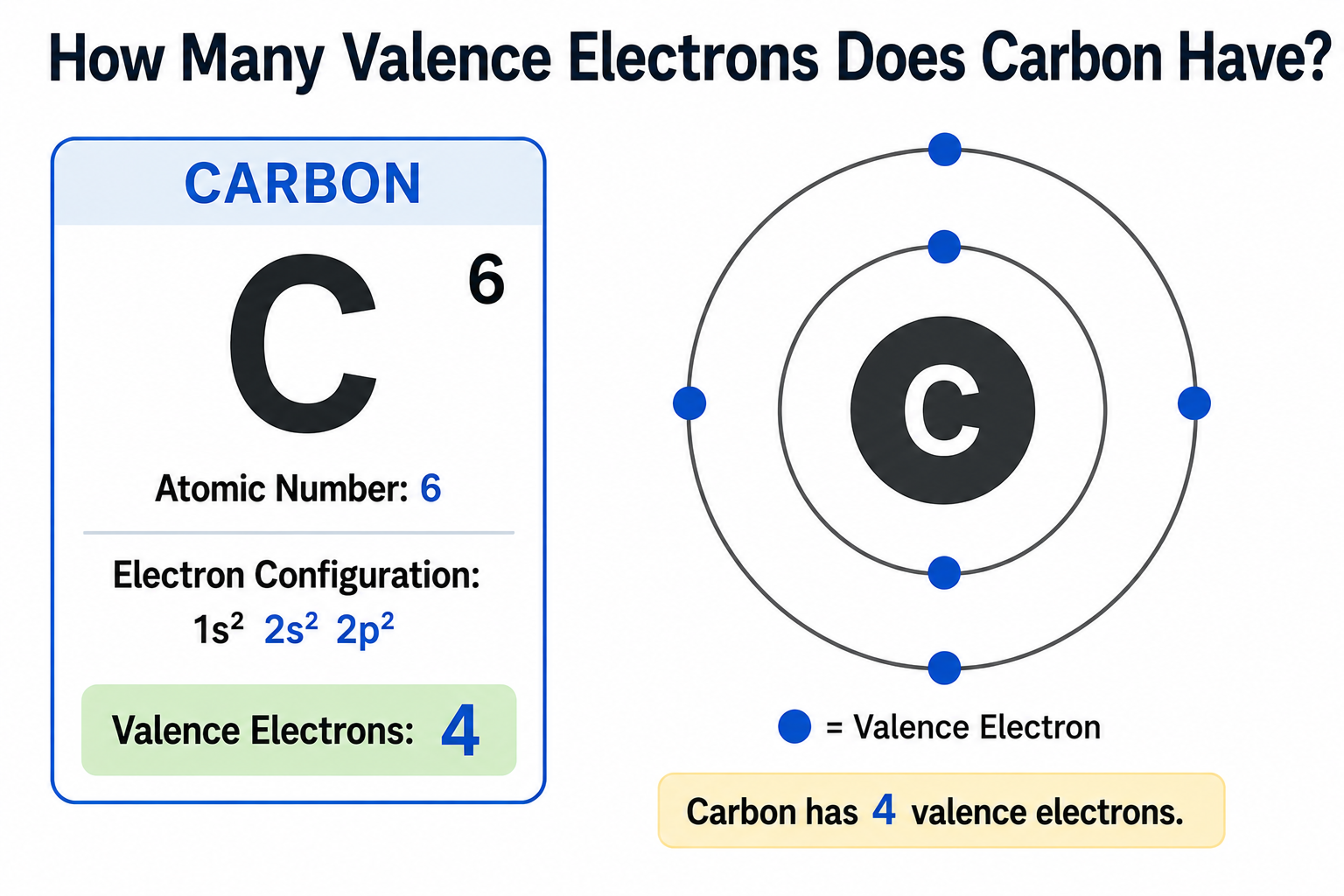
If you are studying chemistry and wondering how many valence electrons does carbon have, here is your direct answer: a neutral carbon atom has 4 valence electrons. These four electrons sit in carbon’s outermost shell — the second energy level — and they are the reason carbon is one of the most chemically versatile elements in the entire periodic table.
Carbon has an atomic number of 6, which means a neutral carbon atom contains exactly 6 electrons. Its electron configuration is 1s² 2s² 2p². The first shell holds 2 electrons, and the second shell holds the remaining 4. Since the second shell is the outermost occupied shell, those 4 electrons are the valence electrons.
Four might seem like an unremarkable number, but it is actually extraordinary. Carbon’s 4 valence electrons allow it to form four strong covalent bonds simultaneously — with other carbon atoms, with hydrogen, with oxygen, with nitrogen, and with many other elements. This bonding flexibility is why carbon forms the backbone of every living organism, every plastic, every fuel, and every medicine. Without those 4 valence electrons doing their work, organic chemistry simply would not exist.
This guide covers everything you need — electron configuration, the Bohr model, Lewis dot structures, bonding behavior, practice questions, FAQs, and exam tips — all written clearly enough for anyone encountering this topic for the first time.
Key Takeaways
- A neutral carbon atom has 4 valence electrons, located in its second shell.
- Carbon’s atomic number is 6, and its electron configuration is 1s² 2s² 2p².
- Carbon belongs to Group 14 and Period 2 of the periodic table. All Group 14 elements have 4 valence electrons.
- Because 4 is exactly half of 8, carbon neither simply gains nor loses electrons to satisfy the octet rule — it almost always shares electrons through covalent bonds.
- Carbon typically forms 4 covalent bonds in compounds, which is consistent with its valency of 4.
- Carbon’s ability to bond with itself and other elements in chains, rings, and branched structures is the entire foundation of organic chemistry.
- The 4 valence electrons of carbon are scientifically fixed for a neutral carbon atom, regardless of which compound it appears in.
What Are Valence Electrons?
Valence electrons are the electrons in an atom’s outermost energy shell — the one farthest from the nucleus. This outermost shell is called the valence shell, and the electrons within it are the ones that determine how an atom behaves chemically.
To understand this properly, picture an atom as having several layers. The electrons in the innermost layers — called core electrons — are held tightly by the nucleus and generally play no role in bonding or chemical reactions. They simply stay where they are, close to the nucleus, undisturbed.
The electrons in the outermost layer are a different matter entirely. These valence electrons are held less firmly, sit farther from the nucleus, and are the first to interact when atoms come close to one another. When a chemical bond forms between two atoms, it is always the valence electrons that are involved — either shared between atoms (covalent bonding) or transferred from one atom to another (ionic bonding).
Valence electrons versus core electrons at a glance:
| Feature | Valence Electrons | Core Electrons |
|---|---|---|
| Location | Outermost shell | Inner shells |
| Role in bonding | Directly involved | Not involved |
| Energy level | Higher | Lower |
| Held by nucleus | Less tightly | More tightly |
| Determine reactivity | Yes | No |
For main-group elements, the number of valence electrons corresponds directly to the group number on the periodic table, making identification straightforward once you understand the pattern.
How Many Valence Electrons Does Carbon Have?
Carbon has 4 valence electrons.
This is the definitive answer, supported by carbon’s atomic structure and its position on the periodic table.
Here is the complete reasoning:
- Carbon’s atomic number is 6, which means a neutral carbon atom has 6 electrons in total.
- Those 6 electrons fill two shells: 2 electrons in the first shell and 4 electrons in the second shell.
- The second shell is carbon’s outermost occupied shell — its valence shell.
- The 4 electrons in the second shell are therefore carbon’s valence electrons.
Carbon sits in Group 14 of the periodic table. For main-group elements, there is a reliable shortcut: the group number minus 10 gives the valence electrons for groups 13 through 18. Group 14 minus 10 equals 4. Carbon has 4 valence electrons — exactly as predicted by its group position.
No matter which carbon compound you examine, the neutral carbon atom always contributes 4 valence electrons to the discussion. This number is a fixed property of neutral carbon.
Why Does Carbon Have 4 Valence Electrons?
The answer lies in carbon’s atomic structure. Let us build the explanation step by step.
- Atomic number = 6 — Carbon has 6 protons in its nucleus. This is what defines carbon as carbon.
- Number of protons = 6 — The proton count is permanent; changing it would create a different element entirely.
- Number of electrons in a neutral carbon atom = 6 — In any neutral atom, the number of electrons exactly equals the number of protons. Carbon is neutral, so it has 6 electrons.
- Electron configuration = 1s² 2s² 2p² — Electrons fill the lowest available energy levels first (Aufbau principle).
- First shell (n=1): 2 electrons fill the 1s orbital completely. The first shell is full.
- Second shell (n=2): The remaining 4 electrons occupy the second shell — 2 in the 2s orbital and 2 in the 2p orbitals.
- The second shell is the outermost occupied shell — making it the valence shell.
- Conclusion: Carbon has 4 valence electrons — all four are in the second shell.
This logic is clean and consistent. As long as carbon remains a neutral atom, it will always have 4 valence electrons, no matter the physical state or temperature.
Carbon Electron Configuration Explained
Full Electron Configuration
The complete electron configuration of a neutral carbon atom is:
1s² 2s² 2p²
Each part of this notation tells us something specific:
- 1s² — 2 electrons occupy the first s orbital in shell number 1. This fills the first shell completely.
- 2s² — 2 electrons occupy the second s orbital in shell number 2.
- 2p² — 2 electrons occupy the three 2p orbitals in shell number 2.
For those 2p² electrons specifically: according to Hund’s rule, electrons fill separate orbitals before pairing begins. Carbon has three 2p orbitals available (px, py, pz) and only 2 electrons to place in them. Each electron goes into a separate orbital, leaving both electrons unpaired. This means carbon has 2 unpaired electrons in its ground state.
Those 2 unpaired electrons might seem to suggest carbon forms only 2 bonds — but in reality, carbon forms 4 bonds. The explanation involves the concept of hybridization (sp³, sp², or sp), where carbon’s 2s and 2p orbitals combine to produce four equivalent hybrid orbitals. Every one of those four orbitals contributes one electron to bonding. This is why carbon universally forms 4 bonds in stable compounds.
Shell Distribution
| Shell | Subshell | Electrons | Total in Shell |
|---|---|---|---|
| First shell (n=1) | 1s | 2 | 2 |
| Second shell (n=2) | 2s | 2 | 4 |
| Second shell (n=2) | 2p | 2 | (included above) |
| Total | 6 |
Valence Shell of Carbon
The second shell is carbon’s valence shell because it is the highest principal energy level occupied by electrons in the neutral atom. All four electrons in the second shell — the 2s² and 2p² electrons — qualify as valence electrons. When carbon forms bonds or participates in chemical reactions, it is always these four electrons that are involved.
Carbon Bohr Model
The Bohr model offers a simple, visual way to understand how electrons are arranged in an atom. In this model, electrons travel in fixed circular orbits around the nucleus, with each orbit representing a different energy shell.
For carbon, the Bohr model is arranged as follows:
- Nucleus: Contains 6 protons and typically 6 neutrons (for the most abundant isotope, carbon-12).
- First shell: 2 electrons orbit close to the nucleus. This shell holds a maximum of 2 electrons and is completely filled.
- Second shell: 4 electrons orbit in the larger outer ring. The second shell can hold up to 8 electrons, so carbon’s outer ring has 4 electrons and 4 empty spaces.
When drawing the Bohr model, place the symbol C in the center, draw a small inner circle labeled with 2 electrons, then draw a larger outer circle labeled with 4 electrons. The outer ring immediately shows the 4-electron gap — carbon needs 4 more electrons to complete the second shell, which is why it forms exactly 4 bonds in stable covalent compounds.
The Bohr model is a simplification of quantum mechanics, but it remains the clearest introductory tool for visualizing electron distribution in atoms.
Carbon Lewis Dot Structure
The Lewis dot structure represents an atom’s valence electrons using dots arranged around the element’s chemical symbol. For carbon, you place 4 dots around the letter C.
Step-by-step method for drawing carbon’s Lewis dot structure:
- Write the chemical symbol: C
- Identify the number of valence electrons: 4
- Place one dot on each of the four sides of the symbol — top, bottom, left, right — one dot per side.
- Since there are exactly 4 dots and 4 available positions, each side gets exactly one dot.
The result: the letter C with one dot on each of its four sides. This is important — all four dots are unpaired in the Lewis dot structure of an isolated carbon atom. This reflects carbon’s readiness to form four bonds, one at each position.
Contrast this with oxygen’s Lewis dot structure, which has 2 lone pairs and 2 unpaired dots. Carbon has no lone pairs in its dot structure — every dot is unpaired and available for bonding. This is part of what makes carbon so extraordinarily capable as a bonding partner.
Carbon and the Periodic Table
Carbon’s position on the periodic table is not incidental — it directly determines its chemical identity.
| Property | Value |
|---|---|
| Symbol | C |
| Atomic number | 6 |
| Group | 14 |
| Period | 2 |
| Block | p-block |
| Classification | Nonmetal |
| Standard state | Solid |
Carbon sits in Group 14, which is sometimes called the carbon group or tetrels. Every element in Group 14 has exactly 4 valence electrons. The pattern: Group 14 – 10 = 4 valence electrons.
Being in Period 2 means carbon’s valence electrons are in the second energy level. The p-block designation arises because the outermost electrons being added are placed in p orbitals (specifically the 2p subshell).
Carbon is classified as a nonmetal, though its allotropes (such as graphite) can conduct electricity, which makes it somewhat unusual among nonmetals. Its chemical behavior, however, is firmly that of a covalent nonmetal — it shares electrons rather than donating or accepting them outright.
Carbon Valence Electrons and the Octet Rule
The octet rule states that atoms seek to achieve 8 electrons in their outer shell through bonding — matching the stable configuration of noble gases.
Carbon starts with 4 valence electrons and needs 4 more to complete its octet. This situation is unique among common elements because 4 is exactly half of 8. Think about what this means:
- If carbon were to gain 4 electrons, it would become C⁴⁻ — a highly charged ion that would be extraordinarily difficult to stabilize under ordinary conditions because packing four extra negative charges onto one small atom creates enormous electrostatic repulsion.
- If carbon were to lose 4 electrons, it would become C⁴⁺ — requiring the removal of 4 electrons from an atom that holds them with moderate nuclear pull. This also takes an impractical amount of energy under typical conditions.
The solution nature found is elegant: carbon shares all four of its valence electrons through covalent bonds. By sharing, it gains access to 4 additional electrons (one from each bonding partner) without actually transferring electrons at all. The result is a full octet for carbon with zero net charge. This is why carbon is overwhelmingly a covalent element.
How Does Carbon Form Chemical Bonds?
Carbon and Covalent Bonding
Carbon’s 4 valence electrons make it perfectly suited for covalent bonding. In a covalent bond, two atoms each contribute one electron to a shared pair. Carbon can do this four times simultaneously, forming four bonds at once.
Methane (CH₄): Carbon shares one electron with each of 4 hydrogen atoms, forming four single C–H bonds. Every atom in the molecule achieves a full outer shell. Carbon gets 8 electrons (4 shared pairs), and each hydrogen gets 2 electrons (1 shared pair, which fills the first shell).
Carbon dioxide (CO₂): Carbon forms a double bond with each of 2 oxygen atoms. Each double bond consists of 2 shared pairs of electrons. Carbon uses all 4 of its valence electrons in these two double bonds and ends up with 8 electrons around it.
Ethane (C₂H₆): Each carbon atom forms one C–C single bond and three C–H single bonds, using all 4 valence electrons and reaching a full octet.
Carbon-Carbon Bonding
One of the most remarkable aspects of carbon chemistry is its ability to bond with itself, forming the long chains and rings that define organic molecules.
Single bonds (ethane, C₂H₆): Two carbon atoms each share 1 electron, forming a single C–C bond. Each carbon also forms three C–H bonds. The molecule is fully saturated.
Double bonds (ethene, C₂H₄): Two carbon atoms share 2 pairs of electrons, forming a C=C double bond. Each carbon forms 2 additional C–H single bonds. The double bond makes the molecule unsaturated and more reactive.
Triple bonds (ethyne, C₂H₂): Two carbon atoms share 3 pairs of electrons, forming a C≡C triple bond. Each carbon forms only 1 additional C–H bond. The triple bond is very strong and makes the molecule highly reactive in certain addition reactions.
Carbon Valency vs Valence Electrons
These two terms are related but distinctly different, and mixing them up is one of the most common mistakes in introductory chemistry.
| Feature | Valence Electrons | Valency |
|---|---|---|
| Definition | Electrons in the outermost shell | Combining capacity — number of bonds formed |
| For carbon | 4 | 4 (consistent across most compounds) |
| Fixed or variable? | Fixed for neutral atom | Mostly fixed at 4, but varies in some contexts |
| Determined by | Electron configuration | Actual bonding behavior |
| Example | C has 4 valence electrons | C forms 4 bonds in CH₄, CO₂, and C₂H₄ |
Carbon is somewhat unusual in that its valence electrons and its valency happen to be the same number — both are 4. This is because carbon uses all 4 of its valence electrons for bonding in virtually every stable compound it forms. There are no lone pairs sitting unused on carbon in a typical stable molecule.
The oxidation state of carbon is a separate concept again. In methane (CH₄), carbon’s oxidation state is -4. In carbon dioxide (CO₂), it is +4. In methanol (CH₃OH), it is -2. Oxidation state varies with the compound and does not equal the number of valence electrons.
Carbon vs Other Period 2 Elements
The table below shows how valence electrons progress across Period 2, placing carbon in context.
| Element | Atomic Number | Group | Electron Configuration | Valence Electrons |
|---|---|---|---|---|
| Lithium (Li) | 3 | 1 | 1s² 2s¹ | 1 |
| Beryllium (Be) | 4 | 2 | 1s² 2s² | 2 |
| Boron (B) | 5 | 13 | 1s² 2s² 2p¹ | 3 |
| Carbon (C) | 6 | 14 | 1s² 2s² 2p² | 4 |
| Nitrogen (N) | 7 | 15 | 1s² 2s² 2p³ | 5 |
| Oxygen (O) | 8 | 16 | 1s² 2s² 2p⁴ | 6 |
| Fluorine (F) | 9 | 17 | 1s² 2s² 2p⁵ | 7 |
| Neon (Ne) | 10 | 18 | 1s² 2s² 2p⁶ | 8 |
The pattern is clear: as you move left to right across Period 2, valence electrons increase steadily from 1 to 8. Carbon sits exactly in the middle of this sequence — 4 valence electrons, halfway to the noble gas configuration of neon. This central position reinforces carbon’s tendency to share electrons rather than gain or lose them.
Carbon vs Other Group 14 Elements
Every element in Group 14 has exactly 4 valence electrons. The table below compares carbon with its group family members.
| Element | Atomic Number | Period | Valence Electrons | Classification |
|---|---|---|---|---|
| Carbon (C) | 6 | 2 | 4 | Nonmetal |
| Silicon (Si) | 14 | 3 | 4 | Metalloid |
| Germanium (Ge) | 32 | 4 | 4 | Metalloid |
| Tin (Sn) | 50 | 5 | 4 | Metal |
| Lead (Pb) | 82 | 6 | 4 | Metal |
All five elements share the same number of valence electrons, but their broader properties diverge considerably. Carbon is the only one that is a typical nonmetal. Silicon and germanium are metalloids — semiconductors that play essential roles in electronics. Tin and lead are metals with increasingly metallic character as you move down the group.
This demonstrates a key principle: sharing the same number of valence electrons gives elements similar chemical tendencies (particularly a preference for forming 4 bonds), but atomic size, nuclear charge, and the presence of inner d-electrons cause their broader behaviors to differ.
How Many Valence Electrons Does C⁴⁻ Have?
This question requires a careful answer.
A neutral carbon atom has 4 valence electrons. If carbon were to gain 4 electrons to form a C⁴⁻ ion, those 4 extra electrons would enter the valence shell, bringing the outer-shell electron count to 8 — a complete octet.
| Species | Total Electrons | Outer-Shell Electrons |
|---|---|---|
| Neutral carbon (C) | 6 | 4 |
| Carbide ion (C⁴⁻) | 10 | 8 |
However, it is important to be clear: C⁴⁻ is not a common, stable species under ordinary chemical conditions. The concept of a carbon atom carrying four extra negative charges is largely theoretical in this simple ionic sense. In reality, carbon achieves its octet almost exclusively through electron sharing (covalent bonding), not through gaining electrons outright.
There are carbide compounds — such as calcium carbide (CaC₂) and aluminum carbide (Al₄C₃) — where carbon atoms exist in ionic-like environments, but these involve more complex bonding situations than a simple C⁴⁻ ion implies. When your exam asks about C⁴⁻, the electron-counting exercise is valid and instructive: neutral carbon (4 valence electrons) gains 4 electrons to give 8 outer-shell electrons. But do not conclude that simple C⁴⁻ ions form easily in nature.
Carbon Valence Electrons in Common Compounds
Understanding how carbon’s 4 valence electrons are used in bonding brings the abstract idea into practical focus.
Methane (CH₄): Carbon forms four single bonds — one with each hydrogen atom. All 4 valence electrons of carbon participate in bonding. Carbon achieves an octet; each hydrogen achieves a duet.
Carbon dioxide (CO₂): Carbon forms two double bonds — one with each oxygen atom. Each double bond uses 2 of carbon’s valence electrons. All 4 valence electrons are used, and carbon achieves an octet.
Methanol (CH₃OH): Carbon forms three C–H bonds and one C–O bond, using all 4 valence electrons. Carbon achieves a full octet and carries no lone pairs.
Ethane (C₂H₆): Each carbon forms one C–C bond and three C–H bonds. The C–C bond uses one valence electron from each carbon. All 4 valence electrons of each carbon are used.
Ethene (C₂H₄): Each carbon forms one C=C double bond (using 2 valence electrons) and two C–H bonds (using 2 more valence electrons). All 4 valence electrons are fully employed.
Ethyne (C₂H₂): Each carbon forms one C≡C triple bond (using 3 valence electrons) and one C–H bond (using 1 more). Again, all 4 valence electrons participate in bonding.
The pattern is unmistakable: carbon always uses all 4 of its valence electrons in stable compounds. There are no lone pairs sitting unused on carbon in any of these structures.
Carbon and the Octet Rule
Carbon’s relationship with the octet rule is particularly satisfying because the math works out so cleanly.
In methane (CH₄), count the electrons around carbon:
- 4 bonds × 2 electrons per bond = 8 electrons around carbon
- Octet achieved. Carbon is stable.
In carbon dioxide (CO₂), count the electrons around carbon:
- 2 double bonds × 4 electrons per bond = 8 electrons around carbon
- Octet achieved. Carbon is stable.
In ethene (C₂H₄), each carbon:
- 1 double bond (4 electrons shared) + 2 single bonds (2 × 2 electrons) = 8 electrons
- Octet achieved. Carbon is stable.
In every stable carbon compound, carbon always ends up with 8 electrons surrounding it — its octet is always satisfied. This is not coincidence; it is a direct consequence of carbon having 4 valence electrons and consistently forming exactly 4 bonds.
Why Are Carbon’s Valence Electrons Important?
Carbon’s 4 valence electrons are the chemical foundation of an almost unimaginably large number of molecules. Here is why they matter so profoundly.
Chemical bonding: Carbon can form four simultaneous covalent bonds. This makes it a central atom in countless compounds, from the simplest (methane, CH₄) to the most complex (DNA, proteins, medicines).
Organic chemistry: The entire field of organic chemistry exists because of carbon’s bonding behavior. Carbon chains, rings, and branched structures — all made possible by its 4 valence electrons — form the backbone of millions of known organic compounds.
Molecular structure: The geometry of carbon-containing molecules is determined by those 4 bonds. In CH₄, the tetrahedral arrangement arises directly from 4 bond pairs. In CO₂, the linear arrangement comes from 2 double bonds. Structure determines function, and structure starts with valence electrons.
Formation of carbon chains: Carbon atoms bond to each other through C–C single, double, and triple bonds, creating chains of any length. No other element does this as extensively as carbon — a property called catenation. The ability to chain together depends entirely on the 4 valence electrons.
Biological molecules: Carbohydrates, fats, proteins, nucleic acids — every major class of biomolecule is built on carbon frameworks. The 4 valence electrons that allow carbon to form stable bonds with hydrogen, oxygen, nitrogen, and sulfur are what make biological diversity possible.
Chemical reactions: Understanding carbon’s valence electrons allows you to predict what reactions it will undergo, what products will form, and how reactive a particular carbon compound will be.
Why Is Carbon So Important in Organic Chemistry?
The short answer is that carbon’s 4 valence electrons give it bonding capabilities that no other element matches in range and diversity.
Carbon forms stable, strong covalent bonds with:
- Carbon — allowing chains, rings, and branching structures of any complexity
- Hydrogen — the most abundant bond in organic chemistry (C–H bonds)
- Oxygen — producing alcohols, aldehydes, ketones, carboxylic acids, esters, and ethers
- Nitrogen — producing amines, amides, and nitrogen-containing rings like those in DNA bases
- Sulfur — producing thiols and other sulfur-containing organic compounds
- Halogens — producing halogenated compounds important in synthesis and medicine
The bond energies of C–C, C–H, C–O, and C–N bonds are all in a range that makes them stable enough to persist but reactive enough to participate in chemical reactions under reasonable conditions. This stability-reactivity balance is almost unique to carbon.
Furthermore, carbon’s ability to form single, double, and triple bonds with itself and other elements generates an almost unlimited variety of molecular architectures. Chains of 2, 10, 100, or even thousands of carbon atoms are chemically feasible. Rings of 3, 5, 6, or more carbon atoms are stable. These structural possibilities — all rooted in those 4 valence electrons — explain why there are millions of known organic compounds, far outnumbering the compounds of any other element.
Common Mistakes Students Make
Even students who work hard sometimes fall into predictable traps with this topic. Being aware of these errors helps you avoid them.
- Thinking carbon has 6 valence electrons: Carbon has 6 total electrons, but only 4 are valence electrons. The 2 electrons in the first shell are core electrons and do not count.
- Confusing total electrons with valence electrons: Always distinguish between total electrons (= atomic number = 6) and valence electrons (= electrons in outermost shell = 4).
- Confusing valence electrons with valency: Carbon’s valence electrons are 4 and its valency is also 4 in this case — but these are different concepts that happen to share the same number for carbon. Do not assume this coincidence applies to all elements.
- Forgetting carbon is in Group 14: Knowing the group number is the fastest route to the valence electron count. Group 14 minus 10 = 4 valence electrons.
- Incorrectly drawing carbon’s Lewis dot structure: A common error is drawing some dots as pairs. In an isolated carbon atom, all 4 dots are unpaired — one on each side of the symbol.
- Assuming carbon normally forms four ionic bonds: Carbon is overwhelmingly a covalent element. It almost never forms simple ions under ordinary conditions.
- Confusing electron configuration with shell distribution: The configuration 1s² 2s² 2p² tells you the subshell distribution. The shell distribution (shell 1 = 2, shell 2 = 4) is derived from it but is not the same notation.
How to Find Carbon’s Valence Electrons From the Periodic Table
This method works for all main-group elements and takes only seconds.
Step-by-step:
- Locate carbon on the periodic table.
- Identify its group number: Group 14.
- For Groups 13 through 18, subtract 10 from the group number.
- 14 – 10 = 4
- Carbon has 4 valence electrons.
For Groups 1 and 2, the group number directly equals the valence electrons (Group 1 = 1 valence electron, Group 2 = 2 valence electrons). For carbon and all other p-block main-group elements, the subtraction method gives the answer instantly.
How to Find Carbon’s Valence Electrons From Electron Configuration
When you have the electron configuration, finding valence electrons is a systematic process.
Step-by-step using carbon:
- Write the full electron configuration: 1s² 2s² 2p²
- Identify the highest principal quantum number (n) present. For carbon, the highest n is 2.
- Collect all electrons associated with this highest n value:
- 2s² = 2 electrons
- 2p² = 2 electrons
- Total = 4 electrons
- These 4 electrons are carbon’s valence electrons.
This method is universally applicable to main-group elements. For any element you encounter, write the configuration, find the highest n, add up all electrons at that level, and you have your valence electron count.
Carbon Lewis Structure Examples
Methane (CH₄)
Carbon (4 valence electrons) bonds with 4 hydrogen atoms (1 valence electron each). Carbon forms 4 single bonds, using all 4 valence electrons. Each hydrogen achieves a duet; carbon achieves an octet. The Lewis structure shows C in the center with 4 H atoms around it, each connected by a single line representing a shared pair of electrons. There are no lone pairs on carbon.
Carbon Dioxide (CO₂)
Carbon (4 valence electrons) bonds with 2 oxygen atoms (6 valence electrons each). Carbon forms a double bond with each oxygen. Each double bond is represented by two lines between the atoms. Each oxygen retains 2 lone pairs. Carbon has no lone pairs and achieves an octet through the two double bonds. The structure is linear: O=C=O.
Ethene (C₂H₄)
Two carbon atoms share a double bond (C=C). Each carbon also bonds to 2 hydrogen atoms with single bonds. Each carbon uses all 4 valence electrons: 2 for the double bond with the other carbon and 1 each for the two C–H bonds. The result is a planar molecule where all atoms lie in the same plane due to the geometry of the double bond.
Ethyne (C₂H₂)
Two carbon atoms share a triple bond (C≡C). Each carbon bonds to 1 hydrogen with a single bond. Each carbon uses 3 valence electrons for the triple bond and 1 for the C–H bond — all 4 valence electrons accounted for. Ethyne is a linear molecule.
Real-Life Importance of Carbon
Carbon’s significance extends far beyond the chemistry classroom.
Living organisms: Every cell in every living organism is built on carbon compounds. Glucose (C₆H₁₂O₆), DNA, proteins, and fats are all carbon-based. Life as we know it is fundamentally carbon chemistry — and that chemistry exists because of 4 valence electrons.
Fuels: Fossil fuels — coal, oil, and natural gas — are carbon-containing compounds. When they combust, carbon reacts with oxygen to release energy. The chemistry of combustion is entirely governed by carbon’s bonding behavior.
Plastics: Virtually every plastic is a synthetic polymer — long chains of repeating carbon-based units. Polyethylene, polypropylene, PVC, and nylon are all built on carbon backbones that exist because carbon can bond to itself indefinitely.
Medicines: Pharmaceutical compounds are overwhelmingly organic molecules built on carbon frameworks. Aspirin, antibiotics, antivirals, and most medicines contain carbon chains or rings.
Food molecules: Carbohydrates, fats, and proteins — the three main energy-containing nutrients — are all carbon compounds. The nutritional chemistry of food is carbon chemistry.
Graphite: A form of carbon where each atom bonds to 3 other carbon atoms in flat sheets. The loose electrons between sheets conduct electricity, making graphite useful in batteries and as a lubricant.
Diamond: Another form of carbon where each atom bonds to 4 other carbon atoms in a rigid 3D network. The result is the hardest natural substance known — entirely because of carbon’s 4 valence electrons forming a complete, interlocking covalent lattice.
Carbon-based materials: Graphene (a single layer of graphite), carbon nanotubes, and fullerenes are modern carbon-based materials with remarkable mechanical and electrical properties, all arising from carbon’s remarkable bonding versatility.
Important Facts About Carbon
| Property | Detail |
|---|---|
| Symbol | C |
| Atomic number | 6 |
| Atomic mass | 12.011 u |
| Group | 14 |
| Period | 2 |
| Block | p-block |
| Electron configuration | 1s² 2s² 2p² |
| Valence electrons | 4 |
| Valence shell | Second shell (n=2) |
| Classification | Nonmetal |
| Common bonding behavior | Forms 4 covalent bonds |
| Common allotropes | Diamond, graphite, graphene |
| Most common isotope | Carbon-12 (¹²C) |
Carbon Valence Electrons Practice Questions
20 Multiple Choice Questions
1. How many valence electrons does a neutral carbon atom have?
a) 2 b) 4 c) 6 d) 8
Answer: b) 4 — Carbon has 4 electrons in its outermost (second) shell.
2. What is the atomic number of carbon?
a) 4 b) 6 c) 8 d) 12
Answer: b) 6 — Carbon has 6 protons in its nucleus.
3. What is the correct electron configuration of carbon?
a) 1s² 2s² 2p⁴ b) 1s² 2s² 2p¹ c) 1s² 2s² 2p² d) 1s² 2s⁴
Answer: c) 1s² 2s² 2p² — This is the correct ground-state configuration.
4. Which group does carbon belong to?
a) Group 12 b) Group 13 c) Group 14 d) Group 16
Answer: c) Group 14 — Carbon is the first element of Group 14.
5. How many electrons does carbon need to complete its octet?
a) 2 b) 3 c) 4 d) 6
Answer: c) 4 — Carbon has 4 valence electrons and needs 4 more to reach 8.
6. What period is carbon in?
a) Period 1 b) Period 2 c) Period 3 d) Period 4
Answer: b) Period 2 — Carbon’s outermost electrons are in the second energy level.
7. How many covalent bonds does carbon typically form?
a) 1 b) 2 c) 3 d) 4
Answer: d) 4 — Carbon forms 4 covalent bonds in stable compounds.
8. What type of element is carbon?
a) Metal b) Metalloid c) Nonmetal d) Noble gas
Answer: c) Nonmetal — Carbon is a p-block nonmetal.
9. How many total electrons does a neutral carbon atom have?
a) 4 b) 6 c) 8 d) 12
Answer: b) 6 — Matching its atomic number.
10. What is the bond type in CO₂?
a) Two single bonds b) Two double bonds c) One triple bond and one single bond d) Ionic bonds
Answer: b) Two double bonds — Carbon forms C=O double bonds with each oxygen in CO₂.
11. What is carbon’s valence shell?
a) First shell b) Second shell c) Third shell d) Fourth shell
Answer: b) Second shell — Carbon’s outermost occupied shell is the second shell.
12. Which element has the same number of valence electrons as carbon?
a) Oxygen b) Silicon c) Nitrogen d) Sulfur
Answer: b) Silicon — Silicon is also in Group 14 with 4 valence electrons.
13. How many bonds does carbon form in methane (CH₄)?
a) 1 b) 2 c) 3 d) 4
Answer: d) 4 — Carbon forms four C–H single bonds in methane.
14. What is carbon’s most common valency?
a) 2 b) 3 c) 4 d) 6
Answer: c) 4 — Carbon consistently forms 4 bonds in stable compounds.
15. In the Lewis dot structure of an isolated carbon atom, how many unpaired dots are there?
a) 2 b) 3 c) 4 d) 0
Answer: c) 4 — All 4 valence electrons are unpaired in isolated carbon.
16. Which allotrope of carbon has each carbon atom bonded to 4 other carbon atoms?
a) Graphite b) Fullerene c) Diamond d) Graphene
Answer: c) Diamond — Diamond has a tetrahedral network where each C bonds to 4 others.
17. How many electrons does carbon have in its first shell?
a) 4 b) 3 c) 2 d) 1
Answer: c) 2 — The first shell holds 2 electrons (1s²).
18. What type of bond is found in ethyne (C₂H₂) between the two carbon atoms?
a) Single bond b) Double bond c) Triple bond d) Ionic bond
Answer: c) Triple bond — Carbon atoms in ethyne share 3 pairs of electrons.
19. Carbon belongs to which block of the periodic table?
a) s-block b) p-block c) d-block d) f-block
Answer: b) p-block — Carbon’s outermost electrons fill p orbitals.
20. Which of the following best explains why carbon forms covalent bonds rather than ionic bonds?
a) Carbon has too many protons b) Carbon is a metal c) It would require too much energy to gain or lose 4 electrons d) Carbon has no valence electrons
Answer: c) It would require too much energy to gain or lose 4 electrons — Sharing electrons is energetically far more favorable for carbon.
10 Short Answer Questions
Q1. State the number of valence electrons in carbon and explain how you determine this.
Carbon has 4 valence electrons. Its electron configuration is 1s² 2s² 2p². The highest occupied shell is n=2, which contains 2+2 = 4 electrons — these are the valence electrons.
Q2. Write the full electron configuration of carbon.
1s² 2s² 2p²
Q3. What is the difference between total electrons and valence electrons of carbon?
Carbon has 6 total electrons (equal to its atomic number). Of these, 2 are in the first shell (core electrons) and 4 are in the second shell (valence electrons). Only the 4 outer-shell electrons are valence electrons.
Q4. Why does carbon form covalent bonds instead of ionic bonds?
Gaining or losing 4 electrons to form an ion would require an enormous amount of energy that is not available under ordinary conditions. Sharing 4 electrons through covalent bonds achieves a full octet at a much lower energy cost.
Q5. How many bonds does carbon form in CO₂, and what types are they?
Carbon forms 2 double bonds in CO₂ — one with each oxygen atom. Each double bond uses 2 of carbon’s valence electrons, and all 4 are accounted for.
Q6. What does 2p² in carbon’s electron configuration tell us?
It tells us there are 2 electrons in the 2p subshell of the second energy level. Because there are 3 available p orbitals and only 2 electrons, both electrons are unpaired (one per orbital), following Hund’s rule.
Q7. Explain catenation and why carbon exhibits it.
Catenation is the ability of an element to bond with itself to form chains. Carbon exhibits catenation because C–C bonds are strong and stable, and carbon’s 4 valence electrons allow it to form multiple C–C bonds while still bonding to other atoms simultaneously.
Q8. What is the shape of CH₄, and why?
CH₄ is tetrahedral. Carbon forms 4 equivalent bonds with 4 hydrogen atoms. The four bond pairs repel each other equally, arranging themselves at the corners of a tetrahedron with bond angles of approximately 109.5°.
Q9. What is the significance of carbon being in Group 14 with exactly 4 valence electrons?
Having exactly 4 valence electrons places carbon at the midpoint of the octet. It can form 4 bonds by sharing, achieving a complete octet without the large energy penalty of gaining or losing electrons. This makes it uniquely versatile as a bonding partner.
Q10. Name three allotropes of carbon and briefly describe their bonding.
Diamond: each carbon bonds to 4 others in a tetrahedral network. Graphite: each carbon bonds to 3 others in flat sheets, with one delocalized electron per atom. Graphene: a single layer of the graphite structure, with each carbon bonded to 3 others in a flat hexagonal arrangement.
5 Exam-Style Questions
Q1. (a) State the number of valence electrons in carbon. (b) Write its full electron configuration. (c) Explain how the configuration confirms the valence electron count.
Answer:
(a) Carbon has 4 valence electrons.
(b) 1s² 2s² 2p²
(c) The highest principal quantum number in the configuration is n=2. Electrons at n=2 are: 2s² (2 electrons) + 2p² (2 electrons) = 4 electrons. These 4 electrons in the outermost shell are the valence electrons.
Q2. Explain why carbon consistently forms 4 covalent bonds in stable compounds. Use its electron configuration and the octet rule in your answer.
Answer: Carbon’s electron configuration is 1s² 2s² 2p². It has 4 valence electrons and needs 4 more to achieve a stable octet of 8. Gaining or losing 4 electrons to form an ion would require too much energy under ordinary conditions. Instead, carbon shares all 4 valence electrons by forming 4 covalent bonds simultaneously. Each bond contributes 2 electrons to carbon’s outer shell, and with 4 bonds, carbon has 8 electrons around it — a complete octet.
Q3. Compare the bonding in methane (CH₄) and diamond. What is similar and what is different?
Answer: In both methane and diamond, each carbon atom forms 4 single covalent bonds using all 4 valence electrons, and each carbon achieves a full octet. The key difference is the bonding partner: in methane, carbon bonds to 4 hydrogen atoms, producing a discrete molecular compound. In diamond, carbon bonds to 4 other carbon atoms, producing a continuous 3D covalent network lattice. This network extends throughout the entire crystal, making diamond one of the hardest substances known.
Q4. A student claims carbon has 6 valence electrons because its atomic number is 6. Identify the error and provide the correct answer with reasoning.
Answer: The student has confused the atomic number (total electron count) with the valence electron count. Carbon’s atomic number is 6, meaning it has 6 electrons in total. However, not all electrons are valence electrons. The 2 electrons in the first shell (1s²) are core electrons and do not participate in bonding. Only the 4 electrons in the second shell (2s² 2p²) are valence electrons. Therefore, carbon has 4 valence electrons, not 6.
Q5. Carbon and silicon are both in Group 14 and both have 4 valence electrons. Give one similarity and two differences in their chemistry.
Answer: Similarity — both carbon and silicon form 4 covalent bonds and adopt tetrahedral geometries in compounds like CH₄ (methane) and SiH₄ (silane). Difference 1 — carbon forms strong, stable multiple bonds (double and triple bonds) extensively, which is the basis of organic chemistry. Silicon rarely forms stable multiple bonds under ordinary conditions due to its larger atomic radius and weaker p-orbital overlap. Difference 2 — carbon exhibits extensive catenation (C–C bonding in chains and rings), supporting millions of organic compounds. Silicon–silicon catenation is far more limited, producing far fewer stable Si–Si chain compounds.
Exam Tips
Practical strategies make a real difference in exam performance. Here are the most effective tips for this topic.
- Lock in the group number: Carbon is in Group 14. The calculation is 14 – 10 = 4 valence electrons. Practice recalling this instantly.
- Write 1s² 2s² 2p² from memory: Configuration questions appear regularly in exams. Write it out correctly ten times and it will stay with you.
- Separate 6 from 4: Carbon’s atomic number is 6; its valence electrons are 4. Write both numbers side by side during revision and make sure you know which is which.
- Visualize the Bohr model: Two electrons on the inner ring, four on the outer ring. The outer ring image helps you quickly state the valence electron count under pressure.
- Remember the 4-bond rule: In nearly every question involving carbon chemistry, carbon forms exactly 4 bonds. Use this to check Lewis structures and molecular formulas.
- Know the Lewis dot structure: One dot on each side of C, all four unpaired. Drawing it correctly takes 5 seconds and earns marks.
- For the octet rule: Carbon achieves 8 electrons by forming 4 bonds (4 bonding pairs × 2 electrons each = 8). Confirm this calculation for every carbon-containing Lewis structure you draw.
Revision Checklist
Use this checklist before your exam to confirm you are fully prepared.
- I know that carbon has 4 valence electrons.
- I can write carbon’s electron configuration: 1s² 2s² 2p².
- I know carbon’s atomic number is 6 and it has 6 total electrons.
- I understand that the 2 electrons in the first shell are core electrons, not valence electrons.
- I can draw the Bohr model of carbon correctly: 2 electrons in the first shell, 4 in the second.
- I can draw the Lewis dot structure of carbon with 4 unpaired dots.
- I know carbon is in Group 14, Period 2, and the p-block.
- I understand why carbon forms 4 covalent bonds rather than ionic bonds.
- I can draw and explain Lewis structures for CH₄, CO₂, C₂H₄, and C₂H₂.
- I can distinguish between single, double, and triple carbon bonds.
- I can explain the difference between valence electrons and valency for carbon.
- I know that all Group 14 elements have 4 valence electrons.
- I can explain what catenation means and why carbon displays it.
- I can avoid common mistakes such as stating carbon has 6 valence electrons.
Frequently Asked Questions
1. How many valence electrons does carbon have?
A neutral carbon atom has 4 valence electrons — the 4 electrons in its outermost (second) shell.
2. Why does carbon have 4 valence electrons?
Carbon has atomic number 6 and electron configuration 1s² 2s² 2p². Its outermost shell (n=2) contains 2+2 = 4 electrons, which are the valence electrons.
3. What is carbon’s electron configuration?
The electron configuration of carbon is 1s² 2s² 2p².
4. What is carbon’s valence shell?
Carbon’s valence shell is the second shell (principal quantum number n=2), containing the 2s and 2p subshells.
5. What group is carbon in?
Carbon is in Group 14 of the periodic table — the carbon group.
6. What is carbon’s valency?
Carbon’s valency is most commonly 4. Carbon forms 4 covalent bonds in virtually all of its stable compounds.
7. How many electrons does carbon need to complete its octet?
Carbon needs 4 more electrons to complete its octet. It achieves this by forming 4 covalent bonds.
8. What is carbon’s Lewis dot structure?
The Lewis dot structure of carbon shows the letter C with 4 unpaired dots — one on each of its four sides, with no lone pairs.
9. Why does carbon form four covalent bonds?
Carbon has 4 valence electrons and needs 4 more to complete its octet. Sharing 4 electrons through 4 covalent bonds is energetically favorable and allows both carbon and its bonding partners to achieve stable electron configurations.
10. How many total electrons does neutral carbon have?
A neutral carbon atom has 6 electrons in total, matching its atomic number of 6.
11. Is carbon a metal or nonmetal?
Carbon is a nonmetal. While some allotropes (like graphite) can conduct electricity, carbon’s chemical behavior is firmly that of a covalent nonmetal.
12. How many valence electrons does carbon have in a carbon compound?
Carbon always contributes 4 valence electrons in any compound. The neutral carbon atom’s valence electron count does not change between compounds — only how those electrons are used (shared in different types of bonds) varies.
Summary
Carbon is element number 6, placed in Group 14 and Period 2 of the periodic table. A neutral carbon atom has 6 electrons in total, distributed across two shells: 2 in the first shell and 4 in the second. The second shell is the outermost occupied shell, making it the valence shell. The 4 electrons in that shell are carbon’s valence electrons.
The electron configuration 1s² 2s² 2p² confirms this precisely. Carbon has 4 valence electrons, needs 4 more to complete its octet, and achieves this through forming 4 covalent bonds — never by simple ionic gain or loss of 4 electrons. Carbon’s valency is 4, which in this case matches its valence electron count, though these are still distinct concepts.
Every element in Group 14 shares 4 valence electrons, and carbon is the most important member of this group by a wide margin. Its ability to form four simultaneous covalent bonds with itself and other elements — creating chains, rings, and complex molecular architectures — is the entire foundation of organic chemistry and, by extension, of all life on Earth.
Final Thoughts
The answer to how many valence electrons does carbon have is simply 4 — but the significance of those 4 electrons stretches from the simplest molecule of methane to the double helix of DNA, from a lump of coal to the most advanced carbon nanotube. Four valence electrons allow carbon to bond in four directions at once, chain with itself indefinitely, form single, double, and triple bonds with precision, and build the molecular complexity that underpins chemistry, biology, materials science, and medicine.
Once you understand why carbon has 4 valence electrons and what those electrons do, you have grasped one of the most important concepts in all of chemistry. Every organic reaction, every polymer, every biological molecule becomes more understandable — because it all starts with those 4 outer electrons on a single carbon atom.
Keep practicing your configurations, draw your Lewis structures carefully, and always trace the behavior of a molecule back to the valence electrons that created it. That habit of thinking is what chemistry is really about.
For further study, explore these related LearnMinto guides:
- Valence Electrons Explained — Learn the basics of valence electrons and their role in chemical bonding.
- How Many Valence Electrons Does Nitrogen Have? — Compare carbon and nitrogen and understand their valence-electron patterns.
- How Many Valence Electrons Does Oxygen Have? — Explore the valence electrons of another important Period 2 element.
- Electron Shells Explained — Learn how electrons are arranged in shells and energy levels.
- Atomic Structure Study Guide — Review protons, neutrons, electrons, and the basic structure of an atom.
- Chemical Bonding — Understand how carbon’s valence electrons contribute to covalent bonding.
- Periodic Table — Learn how carbon’s Group 14 position relates to its electron structure.
- What Are Isoelectronic Species? — Learn about atoms and ions that have the same number of electrons.
References
- OpenStax Chemistry — Atomic structure, electron configuration, periodic trends, and chemical bonding.
- Chemistry LibreTexts — Chemistry resources covering atomic structure, electron configuration, and bonding.
- Khan Academy Chemistry — Beginner-friendly lessons on atoms, electron configuration, and chemical bonding.
- Royal Society of Chemistry Education — Chemistry education resources and periodic-table information.
- American Chemical Society Education — Chemistry education resources for students and educators.
Disclaimer
This article is intended for educational and informational purposes only. While LearnMinto strives to provide accurate and up-to-date information, readers should verify important academic concepts through official textbooks, educational institutions, examination boards, or trusted scientific resources before relying on this content for exams or academic purposes. LearnMinto is not affiliated with any specific school, university, research institution, or examination board.