
Introduction
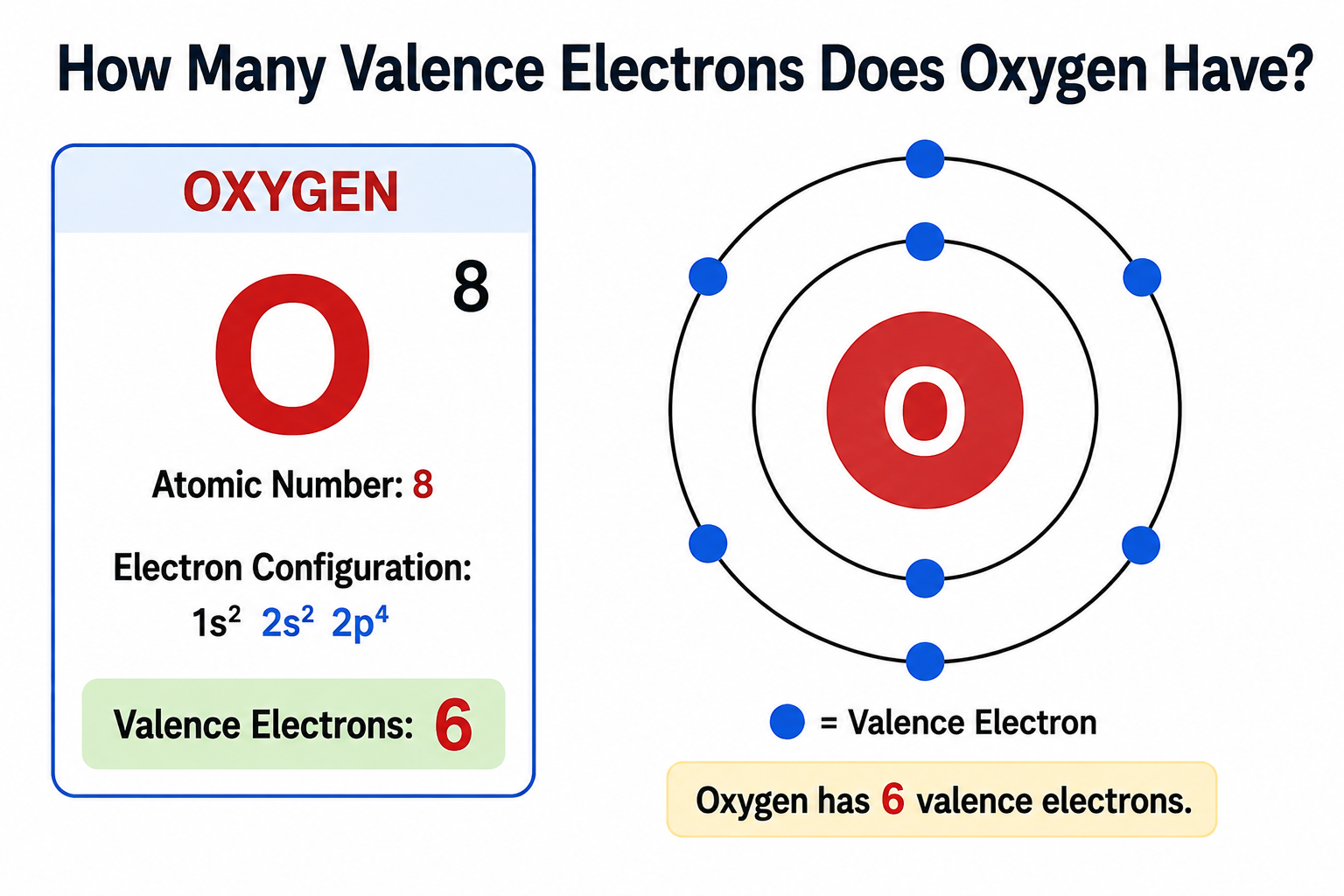
If you are studying chemistry and wondering how many valence electrons does oxygen have, here is the direct answer: a neutral oxygen atom has 6 valence electrons. These six electrons occupy oxygen’s outermost shell — the second energy level — and they are responsible for nearly everything interesting about oxygen’s chemistry.
Oxygen has an atomic number of 8, meaning a neutral oxygen atom contains 8 electrons in total. Its electron configuration is 1s² 2s² 2p⁴. The first shell holds 2 electrons, and the second shell holds the remaining 6. Since the second shell is the outermost occupied shell, those 6 electrons are oxygen’s valence electrons.
This single fact — that oxygen has 6 valence electrons — explains why water has the formula H₂O and not H₃O, why oxygen forms the oxide ion O²⁻ in ionic compounds, and why oxygen gas exists as a diatomic molecule O₂. Understanding those 6 electrons is the key to understanding oxygen’s chemistry at every level, from GCSE to university.
This guide covers everything you need to know, including oxygen’s electron configuration, Bohr model, Lewis dot structure, bonding behavior, practice questions, and detailed FAQs — all explained in clear, straightforward language.
Key Takeaways
- A neutral oxygen atom has 6 valence electrons, located in its second shell.
- Oxygen’s electron configuration is 1s² 2s² 2p⁴, with 2 electrons in the first shell and 6 in the second.
- Oxygen belongs to Group 16 and Period 2 of the periodic table. Every Group 16 element has 6 valence electrons.
- Oxygen needs 2 more electrons to complete its octet of 8, which drives it to form 2 covalent bonds or gain 2 electrons to form O²⁻.
- The oxide ion O²⁻ has 8 outer-shell electrons — a complete and stable octet.
- Valence electrons and valency are not the same thing. Oxygen’s valence electrons number 6, but its common valency is 2.
- Oxygen’s 6 valence electrons make it one of the most reactive and important nonmetals in chemistry and biology.
What Are Valence Electrons?
Valence electrons are the electrons that live in an atom’s outermost shell. That outermost shell is called the valence shell, and the electrons within it are the ones that interact with other atoms during chemical reactions and bond formation.
To picture this clearly, think of an atom as having multiple layers. The innermost layers are tightly packed with electrons that stay close to the nucleus and rarely participate in any chemical activity. These are called core electrons or inner-shell electrons. They are held firmly by the positive charge of the nucleus and are not available for bonding.
The outermost layer, the valence shell, is a different story. The electrons there are farther from the nucleus, held less tightly, and ready to interact. When two atoms approach each other, it is their valence electrons that meet first and determine whether a bond forms, what kind of bond it will be, and how stable the resulting compound will turn out to be.
Key distinctions:
| Feature | Valence Electrons | Core Electrons |
|---|---|---|
| Location | Outermost shell | Inner shells |
| Involvement in bonding | Yes — directly involved | No — remain with nucleus |
| Energy | Higher energy | Lower energy |
| Held by nucleus | Less tightly | More tightly |
| Affect chemical properties | Yes | Minimal |
For main-group elements like oxygen, the number of valence electrons can be read directly from the group number on the periodic table. This makes identifying valence electrons much faster once you know where to look.
How Many Valence Electrons Does Oxygen Have?
Oxygen has 6 valence electrons.
This answer is consistent across all chemistry textbooks and examination standards worldwide, from GCSE and A-Level to NEET and university-level courses.
Here is the reasoning laid out clearly:
- Oxygen’s atomic number is 8, which tells us a neutral oxygen atom has 8 electrons in total.
- Those 8 electrons fill oxygen’s two shells: 2 electrons in the first shell and 6 electrons in the second shell.
- The second shell is the outermost occupied shell, so it is the valence shell.
- The 6 electrons in the second shell are therefore the valence electrons.
Oxygen sits in Group 16 of the periodic table. For main-group elements, the group number provides a direct shortcut: elements in Group 16 have 6 valence electrons. Oxygen is the first and lightest member of Group 16, and it follows this rule perfectly.
Why Does Oxygen Have 6 Valence Electrons?
The reason comes down to atomic structure. Let us work through it step by step.
- Atomic number = 8 — This is the number of protons inside oxygen’s nucleus.
- Number of protons = 8 — Fixed and unchanging for any neutral oxygen atom.
- Number of electrons in a neutral oxygen atom = 8 — In a neutral atom, electrons equal protons. No charge means no gain or loss of electrons.
- Electron configuration = 1s² 2s² 2p⁴ — Electrons fill orbitals from the lowest energy level upward, following the Aufbau principle.
- First shell (n=1): Contains 2 electrons in the 1s orbital. This shell is completely full.
- Second shell (n=2): Contains the remaining 6 electrons — 2 in the 2s orbital and 4 in the 2p orbitals.
- The second shell is the outermost occupied shell for oxygen, making it the valence shell.
- Conclusion: Oxygen has 6 valence electrons — all six are in the second shell.
There is no ambiguity here. Oxygen will always have 6 valence electrons in its neutral state, regardless of temperature, pressure, or physical form. The only time this changes is when oxygen gains or loses electrons to form ions.
Oxygen Electron Configuration Explained
Full Electron Configuration
The full electron configuration of a neutral oxygen atom is:
1s² 2s² 2p⁴
Breaking this down:
- 1s² — 2 electrons in the first s orbital. This fills the first shell entirely.
- 2s² — 2 electrons in the second s orbital. Part of the second shell.
- 2p⁴ — 4 electrons distributed across the three 2p orbitals (px, py, pz).
Regarding those 4 electrons in the 2p subshell: according to Hund’s rule, electrons occupy separate orbitals before pairing begins. Since there are three 2p orbitals and four 2p electrons, two orbitals each hold one unpaired electron, and one orbital holds a pair.
This arrangement means oxygen has 2 unpaired electrons available for covalent bonding, which is why it most often forms exactly 2 bonds — as seen in H₂O and CO₂.
Shell Distribution
| Shell | Subshell | Electrons | Total in Shell |
|---|---|---|---|
| First shell (n=1) | 1s | 2 | 2 |
| Second shell (n=2) | 2s | 2 | 6 |
| Second shell (n=2) | 2p | 4 | (included above) |
| Total | 8 |
Valence Shell of Oxygen
The second shell is oxygen’s valence shell because it is the highest principal energy level that contains electrons in the neutral atom. All 6 electrons in the second shell — those in both 2s and 2p — count as valence electrons. When oxygen forms bonds or gains electrons to become O²⁻, it is always these outer electrons that are involved.
Oxygen Bohr Model
In the Bohr model, electrons are pictured as orbiting the nucleus in fixed circular paths at set distances. Each path represents an energy shell.
For oxygen, the Bohr model is arranged as follows:
- Nucleus: Contains 8 protons and 8 neutrons (for the most common isotope, oxygen-16).
- First shell: 2 electrons orbit close to the nucleus. This shell is completely filled — it can hold a maximum of 2 electrons.
- Second shell: 6 electrons orbit in the larger outer ring. The second shell can hold up to 8 electrons, so oxygen’s outer ring has 6 electrons and 2 empty spaces.
When drawing the Bohr model for oxygen, place the element symbol O in the center, draw a small inner circle and mark 2 electrons on it, then draw a larger outer circle and mark 6 electrons on it. This visualization clearly shows that oxygen’s outermost ring is not full — it has room for 2 more electrons — which is exactly why oxygen is reactive and tends to seek 2 additional electrons through bonding.
The Bohr model is a simplification of the real quantum mechanical picture, but it remains one of the clearest ways for students to visualize electron distribution in an atom.
Oxygen Lewis Dot Structure
The Lewis dot structure represents an atom’s valence electrons using dots placed around the element’s chemical symbol. For oxygen, that means placing 6 dots around the letter O.
How to draw the Lewis dot structure of oxygen step by step:
- Write the chemical symbol: O
- Identify the valence electrons: 6
- Place one dot on each side first (top, bottom, left, right) — that accounts for 4 dots.
- Add the remaining 2 dots to any two sides, creating lone pairs on those sides.
The standard result:
- Two lone pairs (4 electrons) and two unpaired dots (2 electrons) surround the O symbol.
- The two unpaired dots represent the electrons that oxygen uses to form covalent bonds.
- The two lone pairs represent electrons that do not typically participate in bonding under normal conditions.
This structure immediately communicates a great deal of information: oxygen has 2 bonding electrons and 2 lone pairs, which explains why it forms exactly 2 covalent bonds in most of its common compounds.
Oxygen and the Periodic Table
Oxygen’s position on the periodic table is not an accident — it is directly tied to its electron configuration and chemical behavior.
Key periodic table facts for oxygen:
| Property | Value |
|---|---|
| Symbol | O |
| Atomic number | 8 |
| Group | 16 |
| Period | 2 |
| Block | p-block |
| Classification | Nonmetal |
| Standard state | Gas (diatomic, O₂) |
Oxygen sits in Group 16, which is sometimes called the chalcogens. The rule for main-group elements is that the group number indicates the number of valence electrons. Group 16 elements have 16 – 10 = 6 valence electrons (when using the modern numbering system). Oxygen, as the top element in Group 16, follows this rule: it has 6 valence electrons.
Being in Period 2 means that oxygen’s valence electrons are in the second energy level. The p-block designation reflects the fact that the outermost electrons being filled are in 2p orbitals.
Oxygen is classified as a nonmetal. It is highly electronegative — the second most electronegative element on the periodic table after fluorine — which is a direct consequence of its 6 valence electrons and small atomic size.
Oxygen Valence Electrons and the Octet Rule
The octet rule is a foundational principle in chemistry. It states that atoms tend to gain, lose, or share electrons until they have 8 electrons in their outer shell, matching the electron configuration of a noble gas.
Oxygen begins with 6 valence electrons. To reach 8, it needs 2 more electrons. This drives oxygen’s entire bonding behavior:
- In covalent compounds, oxygen shares 2 electrons with other atoms, each shared pair contributing to filling its outer shell.
- In ionic compounds, oxygen gains 2 electrons outright to form the oxide ion O²⁻, which has a complete octet.
This 2-electron deficit is precise and consistent. It explains why:
- Water is H₂O (oxygen shares one electron with each of 2 hydrogen atoms).
- Carbon dioxide is CO₂ (oxygen forms a double bond with carbon, receiving 2 electrons per bond through sharing).
- Magnesium oxide is MgO (magnesium gives 2 electrons to oxygen, which accepts them to form O²⁻).
Oxygen is very effective at achieving its octet because it is highly electronegative. It pulls electron density toward itself strongly in covalent bonds, and it accepts electrons readily in ionic reactions.
How Oxygen Forms Chemical Bonds
Oxygen in Covalent Bonds
Covalent bonds form when atoms share electrons. Oxygen forms 2 covalent bonds in most of its common compounds, using its 2 unpaired electrons.
Water (H₂O): Oxygen shares one electron with each of 2 hydrogen atoms, forming two O–H single bonds. After bonding, oxygen has 8 electrons around it: 4 from 2 lone pairs plus 4 shared electrons (2 from each bond). Its octet is satisfied.
Oxygen gas (O₂): Two oxygen atoms each contribute 2 electrons to form a double bond. Each oxygen ends up with 8 electrons around it, satisfying the octet rule for both atoms simultaneously.
Carbon dioxide (CO₂): Oxygen forms a double bond with the carbon atom. Each oxygen atom shares 2 electrons with carbon, receiving 2 in return, and retains 2 lone pairs. Both oxygen atoms reach a full octet.
Oxygen in Ionic Compounds
When oxygen reacts with reactive metals, it gains 2 electrons rather than sharing them, forming the oxide ion O²⁻.
Magnesium oxide (MgO): Magnesium (a metal) gives up 2 electrons, which oxygen accepts. Oxygen becomes O²⁻ with 10 total electrons and 8 in its outer shell — a stable octet. The resulting compound is held together by the electrostatic attraction between Mg²⁺ and O²⁻.
Calcium oxide (CaO): The same pattern applies. Calcium donates 2 electrons, oxygen accepts them to form O²⁻, and the ionic lattice forms.
How Many Valence Electrons Does O²⁻ Have?
This is a question many students find confusing, so it deserves careful attention.
A neutral oxygen atom has 6 valence electrons.
The oxide ion, O²⁻, forms when a neutral oxygen atom gains 2 additional electrons. These electrons are added to the valence shell — the second shell — because that is where there is room.
| Species | Total Electrons | Outer-Shell Electrons |
|---|---|---|
| Neutral oxygen atom (O) | 8 | 6 |
| Oxide ion (O²⁻) | 10 | 8 |
After gaining 2 electrons, O²⁻ has 10 electrons in total and 8 electrons in its outer shell, completing the octet. This is why O²⁻ is stable — it now has the same electron configuration as neon (1s² 2s² 2p⁶), a noble gas.
It is worth noting that when chemists refer to valence electrons of an ion, the term is sometimes used loosely to mean the outer-shell electrons. For O²⁻, those outer-shell electrons number 8.
Oxygen Valence Electrons vs Oxygen Valency
Students sometimes treat valence electrons and valency as if they are interchangeable. They are not.
| Feature | Valence Electrons | Valency |
|---|---|---|
| Definition | Electrons in the outermost shell | Combining capacity — number of bonds formed |
| For oxygen (neutral) | 6 | 2 (most common) |
| Fixed or variable? | Fixed for neutral atom | Can vary |
| Determined by | Electron configuration | Bonding behavior in a specific compound |
| Example | O has 6 valence electrons | O has valency 2 in H₂O; formal valency can differ in peroxides |
Oxygen’s most common valency is 2, which corresponds to the 2 covalent bonds it typically forms. This comes from its 2 unpaired electrons, not from its total of 6 valence electrons.
The oxidation state is a third related but distinct concept. In H₂O, oxygen’s oxidation state is -2. In hydrogen peroxide (H₂O₂), it is -1. In OF₂, it is +2. Oxidation state can vary significantly depending on the compound, whereas valence electrons remain fixed at 6 for a neutral oxygen atom.
Oxygen vs Other Group 16 Elements
All elements in Group 16 have 6 valence electrons, but they differ in atomic size, reactivity, and metallic character.
| Element | Atomic Number | Group | Period | Valence Electrons | Classification |
|---|---|---|---|---|---|
| Oxygen (O) | 8 | 16 | 2 | 6 | Nonmetal |
| Sulfur (S) | 16 | 16 | 3 | 6 | Nonmetal |
| Selenium (Se) | 34 | 16 | 4 | 6 | Nonmetal/Metalloid |
| Tellurium (Te) | 52 | 16 | 5 | 6 | Metalloid |
| Polonium (Po) | 84 | 16 | 6 | 6 | Metal (Post-transition) |
Despite sharing the same number of valence electrons, these elements behave quite differently. Oxygen is the most electronegative and reactive of the group. As you move down, the elements become less electronegative and increasingly metallic in character.
Oxygen vs Other Common Elements
| Element | Atomic Number | Electron Configuration | Valence Electrons | Group |
|---|---|---|---|---|
| Hydrogen (H) | 1 | 1s¹ | 1 | 1 |
| Carbon (C) | 6 | 1s² 2s² 2p² | 4 | 14 |
| Nitrogen (N) | 7 | 1s² 2s² 2p³ | 5 | 15 |
| Oxygen (O) | 8 | 1s² 2s² 2p⁴ | 6 | 16 |
| Fluorine (F) | 9 | 1s² 2s² 2p⁵ | 7 | 17 |
| Neon (Ne) | 10 | 1s² 2s² 2p⁶ | 8 | 18 |
This table beautifully illustrates the repeating pattern across Period 2. As atomic number increases from 1 to 10, valence electrons increase from 1 to 8, then reset with the next period. Oxygen sits in the middle of this progression with 6 valence electrons — reactive enough to form stable compounds with almost every element, yet selective enough to almost always form exactly 2 bonds.
How to Find Valence Electrons From the Periodic Table
This method works for all main-group elements (Groups 1–2 and Groups 13–18).
Step-by-step method:
- Find the element on the periodic table.
- Identify its group number.
- For Groups 1 and 2, the valence electrons equal the group number directly.
- For Groups 13 through 18, subtract 10 from the group number.
Applying this to oxygen:
- Oxygen is in Group 16.
- 16 – 10 = 6
- Oxygen has 6 valence electrons.
This method is fast, reliable, and works for all the elements you will encounter in high school and early college chemistry.
How to Find Valence Electrons From Electron Configuration
When you have the electron configuration, finding valence electrons is a systematic process.
Step-by-step using oxygen:
- Write the full electron configuration: 1s² 2s² 2p⁴
- Identify the highest principal quantum number present. For oxygen, the highest n is 2.
- Collect all electrons that have this highest n value:
- 2s² = 2 electrons
- 2p⁴ = 4 electrons
- Total = 6 electrons
- These 6 electrons are the valence electrons.
This method works for any element. For transition metals, the rule becomes slightly more complex (d-electrons can also be valence electrons in certain contexts), but for all main-group elements — including oxygen — this approach is completely reliable.
Oxygen Lewis Structure Examples
O₂ (Oxygen Gas)
Each oxygen atom has 6 valence electrons and 2 unpaired electrons available for bonding. Two oxygen atoms share 2 pairs of electrons, forming a double bond. Each oxygen retains 2 lone pairs. The result is a stable molecule where both oxygens have a full octet: 4 electrons from lone pairs plus 4 electrons from the shared double bond.
H₂O (Water)
Oxygen forms 2 single bonds with 2 hydrogen atoms. Each bond uses 1 of oxygen’s unpaired electrons and 1 from the hydrogen. Oxygen retains its 2 lone pairs. In total, oxygen has 8 electrons around it: 4 bonding electrons (from 2 bonds) and 4 lone-pair electrons. The molecule has a bent shape because the 2 lone pairs push the bonded hydrogen atoms downward.
CO₂ (Carbon Dioxide)
Carbon has 4 valence electrons and needs to form 4 bonds to satisfy the octet rule. Oxygen has 6 valence electrons and needs to form 2 bonds. In CO₂, each oxygen forms a double bond with the central carbon atom. Each oxygen has 2 lone pairs and shares 4 electrons with carbon. Both oxygen atoms have a full octet, and so does the carbon atom.
Why Are Oxygen’s Valence Electrons Important?
Oxygen’s 6 valence electrons are not just a number you memorize — they drive everything that makes oxygen chemically significant.
Chemical bonding: The 2 unpaired valence electrons allow oxygen to form 2 covalent bonds in most compounds. This determines the molecular formulas of nearly every oxygen-containing compound you will encounter.
Reactivity: With 6 valence electrons and a high electronegativity, oxygen pulls electron density strongly toward itself in any bond it forms. This makes oxygen a powerful oxidizing agent — it readily accepts electrons from other substances.
Formation of compounds: Oxygen forms compounds with almost every element in the periodic table. Its ability to form both covalent and ionic bonds makes it extraordinarily versatile.
Electron sharing: In covalent bonds, oxygen’s valence electrons are shared in a way that gives oxygen partial negative charge (as in polar molecules like water), making those molecules highly interactive with other polar substances.
Formation of oxide ions: In ionic chemistry, oxygen’s ability to gain 2 electrons and form O²⁻ is central to the chemistry of metal oxides, which are among the most common compounds in Earth’s crust.
Biological molecules: Oxygen’s valence electrons are critical in biological chemistry. Oxygen appears in water, carbohydrates, proteins, fats, and DNA. The hydrogen bonds that hold water molecules together — and that stabilize protein structure — exist precisely because of oxygen’s lone pairs and its high electronegativity, both direct consequences of having 6 valence electrons.
Common Mistakes Students Make
Even students who understand chemistry well sometimes slip up on oxygen’s valence electrons. Here are the most common errors.
- Thinking oxygen has 8 valence electrons: Oxygen has 8 total electrons, but only 6 are valence electrons. The 2 electrons in the first shell are inner-shell electrons and do not count.
- Confusing total electrons with valence electrons: Total electrons = 8. Valence electrons = 6. These are different numbers.
- Confusing atomic number with valence electrons: The atomic number (8) tells you the total number of protons and electrons. It does not directly tell you the valence electron count.
- Forgetting oxygen is in Group 16: Some students mix up oxygen with neighboring elements. Group 16 gives 6 valence electrons — always check the group.
- Confusing valence electrons with valency: Valence electrons = 6. Valency = 2 (typically). Never write them as equal.
- Incorrectly drawing oxygen’s Lewis dot structure: A common error is placing all 6 dots as pairs or all as singles. The correct structure has 2 lone pairs (4 electrons) and 2 unpaired dots.
- Forgetting that O²⁻ has a complete octet: Students sometimes write O²⁻ as still having 6 outer electrons. After gaining 2, it has 8 outer electrons — a full octet.
Real-Life Importance of Oxygen
Understanding oxygen in the classroom is useful, but seeing how those 6 valence electrons translate into real-world significance gives chemistry genuine meaning.
Respiration: Every cell in the human body uses oxygen to extract energy from glucose. Oxygen accepts electrons at the end of the electron transport chain in cellular respiration, making it indispensable to aerobic life. Its high electronegativity — a direct result of its 6 valence electrons — is what makes it such an effective electron acceptor.
Combustion: When fuels burn, they react with oxygen. The 6 valence electrons of oxygen, particularly its 2 unpaired bonding electrons and high electronegativity, make it an aggressive oxidizing agent in combustion reactions. The energy released during combustion powers engines, heats homes, and generates electricity.
Water: The entire chemistry of water — its high boiling point, surface tension, solvent properties, and hydrogen bonding — arises from oxygen’s 6 valence electrons, 2 lone pairs, and strong electronegativity. Without those 6 outer electrons, water as we know it would not exist.
Oxides: Most of Earth’s crust is composed of oxide compounds. Silicon dioxide (SiO₂) forms quartz and sand; aluminum oxide (Al₂O₃) forms rubies and sapphires; iron oxides form rust. In every case, oxygen’s 6 valence electrons are at the heart of the chemistry.
Medical oxygen: Supplemental oxygen is used in hospitals for patients with respiratory conditions. The chemistry of hemoglobin — the protein that carries oxygen in blood — depends on oxygen’s ability to coordinate with iron atoms through its lone pairs.
Environmental chemistry: Ozone (O₃), an allotrope of oxygen, forms a protective layer in the stratosphere that filters ultraviolet radiation. The formation and breakdown of ozone involves the reactivity of oxygen atoms and molecules, all driven by those 6 valence electrons.
Important Facts About Oxygen
| Property | Detail |
|---|---|
| Symbol | O |
| Atomic number | 8 |
| Atomic mass | 15.999 u |
| Group | 16 |
| Period | 2 |
| Block | p-block |
| Electron configuration | 1s² 2s² 2p⁴ |
| Valence electrons | 6 |
| Valence shell | Second shell (n=2) |
| Common ion | O²⁻ (oxide ion) |
| Classification | Nonmetal |
| Electronegativity | 3.44 (Pauling scale) |
| Standard state | Gas (as O₂) |
| Most common isotope | Oxygen-16 (¹⁶O) |
Practice Questions
20 Multiple Choice Questions
1. How many valence electrons does a neutral oxygen atom have?
a) 2 b) 4 c) 6 d) 8
Answer: c) 6 — Oxygen has 6 electrons in its outermost (second) shell.
2. What is the atomic number of oxygen?
a) 6 b) 7 c) 8 d) 16
Answer: c) 8 — Oxygen has 8 protons in its nucleus.
3. What is the correct electron configuration of oxygen?
a) 1s² 2s² 2p² b) 1s² 2s² 2p⁴ c) 1s² 2s⁴ 2p² d) 1s² 2s² 2p⁶
Answer: b) 1s² 2s² 2p⁴ — This is oxygen’s ground-state configuration.
4. Which group does oxygen belong to?
a) Group 14 b) Group 15 c) Group 16 d) Group 17
Answer: c) Group 16 — Oxygen is the first element in Group 16.
5. How many electrons does oxygen need to complete its octet?
a) 1 b) 2 c) 3 d) 6
Answer: b) 2 — Oxygen has 6 valence electrons and needs 2 more to reach 8.
6. How many total electrons does a neutral oxygen atom have?
a) 6 b) 7 c) 8 d) 10
Answer: c) 8 — Oxygen’s atomic number is 8, so it has 8 electrons.
7. How many valence electrons does the oxide ion O²⁻ have?
a) 6 b) 7 c) 8 d) 10
Answer: c) 8 — After gaining 2 electrons, O²⁻ has 8 outer-shell electrons.
8. What period is oxygen in?
a) Period 1 b) Period 2 c) Period 3 d) Period 4
Answer: b) Period 2 — Oxygen’s outermost electrons are in the second energy level.
9. How many covalent bonds does oxygen typically form?
a) 1 b) 2 c) 3 d) 4
Answer: b) 2 — Oxygen has 2 unpaired electrons and typically forms 2 covalent bonds.
10. What type of bond exists in O₂?
a) Single bond b) Double bond c) Triple bond d) Ionic bond
Answer: b) Double bond — Two oxygen atoms share 2 pairs of electrons.
11. What is oxygen’s valence shell?
a) First shell b) Second shell c) Third shell d) Fourth shell
Answer: b) Second shell — The second shell is oxygen’s outermost occupied shell.
12. Which element has the same number of valence electrons as oxygen?
a) Nitrogen b) Sulfur c) Carbon d) Chlorine
Answer: b) Sulfur — Sulfur is also in Group 16 and has 6 valence electrons.
13. How many lone pairs of electrons does oxygen have in a water molecule?
a) 0 b) 1 c) 2 d) 3
Answer: c) 2 — After forming 2 bonds, oxygen retains 2 lone pairs in H₂O.
14. What is oxygen’s most common valency?
a) 6 b) 4 c) 3 d) 2
Answer: d) 2 — Oxygen typically forms 2 bonds in most compounds.
15. What ion does oxygen form in ionic compounds?
a) O⁻ b) O²⁻ c) O²⁺ d) O⁺
Answer: b) O²⁻ — Oxygen gains 2 electrons to form the oxide ion.
16. Which of these is NOT a compound of oxygen?
a) H₂O b) CO₂ c) NaCl d) MgO
Answer: c) NaCl — Sodium chloride contains no oxygen.
17. How many electrons does oxygen have in its first shell?
a) 6 b) 4 c) 3 d) 2
Answer: d) 2 — The first shell holds 2 electrons (1s²).
18. Oxygen is classified as which type of element?
a) Metal b) Metalloid c) Nonmetal d) Noble gas
Answer: c) Nonmetal — Oxygen is a p-block nonmetal.
19. How many unpaired electrons does oxygen have in its ground state?
a) 4 b) 3 c) 2 d) 1
Answer: c) 2 — The 2p⁴ arrangement leaves 2 electrons unpaired.
20. What is the shape of the water molecule (H₂O)?
a) Linear b) Trigonal planar c) Bent d) Tetrahedral
Answer: c) Bent — The 2 lone pairs on oxygen push the H atoms, creating a bent shape.
10 Short Answer Questions
Q1. State the number of valence electrons in oxygen and explain how you determine this.
Oxygen has 6 valence electrons. Its electron configuration is 1s² 2s² 2p⁴. The outermost shell (n=2) contains 2+4 = 6 electrons, so there are 6 valence electrons.
Q2. Write the full electron configuration of oxygen.
1s² 2s² 2p⁴
Q3. What is the difference between the total electrons and the valence electrons of oxygen?
Oxygen has 8 total electrons (matching its atomic number). Of these, only 6 are valence electrons — the 2 electrons in the first shell are core electrons and do not participate in bonding.
Q4. How many valence electrons does O²⁻ have?
O²⁻ has 8 outer-shell electrons. It gained 2 electrons (added to the second shell), increasing from 6 to 8 and completing the octet.
Q5. Explain the octet rule in the context of oxygen.
Oxygen has 6 valence electrons and needs 2 more to reach a stable octet of 8. It achieves this by forming 2 covalent bonds (sharing electrons) or gaining 2 electrons to form O²⁻.
Q6. Why does oxygen form a double bond in O₂?
Each oxygen atom has 2 unpaired electrons. When two oxygen atoms bond, they each contribute both unpaired electrons to form 2 shared pairs — a double bond — giving each atom a full octet.
Q7. What is the shape of the water molecule, and how does oxygen’s electron structure explain it?
Water is bent. Oxygen forms 2 bonds with hydrogen and retains 2 lone pairs. The 4 electron groups (2 bonds + 2 lone pairs) arrange tetrahedrally, but the lone pairs push the bonded hydrogens downward, producing the bent shape.
Q8. Name three common compounds containing oxygen and state oxygen’s role in each.
Water (H₂O) — oxygen forms 2 single bonds with hydrogen atoms. Carbon dioxide (CO₂) — oxygen forms a double bond with carbon. Magnesium oxide (MgO) — oxygen gains 2 electrons from magnesium to form O²⁻.
Q9. Why is oxygen highly electronegative?
Oxygen has 6 valence electrons, a small atomic radius, and a relatively high nuclear charge (8 protons). This combination means oxygen strongly attracts shared electrons toward itself, making it the second most electronegative element after fluorine.
Q10. Which block of the periodic table does oxygen belong to, and why?
Oxygen belongs to the p-block because its highest-energy valence electrons occupy p orbitals (specifically the 2p subshell).
5 Exam-Style Questions
Q1. (a) State the number of valence electrons in oxygen. (b) Write its full electron configuration. (c) Using the electron configuration, explain how you identify the valence electrons.
Answer:
(a) Oxygen has 6 valence electrons.
(b) 1s² 2s² 2p⁴
(c) The highest principal quantum number in the configuration is n=2. Collecting all electrons with n=2: 2s² (2 electrons) + 2p⁴ (4 electrons) = 6 valence electrons.
Q2. Explain why oxygen typically forms 2 covalent bonds. Use its electron configuration in your answer.
Answer: Oxygen’s configuration is 1s² 2s² 2p⁴. In the 2p subshell, there are 3 orbitals holding 4 electrons. According to Hund’s rule, the fourth electron pairs with one of the first three, leaving 2 orbitals with 1 unpaired electron each. These 2 unpaired electrons are available for covalent bonding — one per bond — explaining why oxygen typically forms 2 covalent bonds.
Q3. A student states that the oxide ion O²⁻ has 6 valence electrons. Is this correct? Justify your answer.
Answer: This is incorrect. A neutral oxygen atom has 6 valence electrons. The oxide ion O²⁻ forms when oxygen gains 2 additional electrons. These extra electrons enter the valence shell, increasing its outer-shell electron count from 6 to 8. O²⁻ therefore has 8 outer-shell electrons, not 6, which constitutes a complete and stable octet.
Q4. Compare the bonding in H₂O and MgO. Explain why oxygen forms different types of bonds in these two compounds.
Answer: In H₂O, oxygen forms 2 covalent bonds with hydrogen atoms. Hydrogen is a nonmetal, so both atoms share electrons rather than transferring them outright. Oxygen provides 1 unpaired electron per bond, and each hydrogen provides 1. In MgO, magnesium is a metal with 2 valence electrons that it readily gives away. Oxygen accepts both electrons, becoming O²⁻, and magnesium becomes Mg²⁺. The strong electrostatic attraction between these oppositely charged ions forms an ionic bond. The nature of bonding thus depends on the type of partner element.
Q5. Oxygen and sulfur are both in Group 16. Compare their valence electrons and explain one way their chemistry differs despite having the same number of valence electrons.
Answer: Both oxygen and sulfur have 6 valence electrons, as both are in Group 16. However, sulfur’s valence electrons are in the third shell (n=3), while oxygen’s are in the second shell (n=2). One key chemical difference is that sulfur can expand its octet — it can hold more than 8 electrons around it in some compounds (such as SF₆) because it has access to empty 3d orbitals. Oxygen cannot do this; its second shell has no d subshell, so it strictly follows the octet rule and cannot accommodate more than 8 electrons.
Exam Tips
These practical strategies will help you remember oxygen’s valence electrons clearly under exam conditions.
- Anchor on the group number: Oxygen is in Group 16. For p-block elements, subtract 10: 16 – 10 = 6 valence electrons. Once this is automatic, you will never forget it.
- Write the configuration from memory: Practice writing 1s² 2s² 2p⁴ repeatedly until it feels natural. From there, you can always extract the valence electron count.
- Do not confuse 8 and 6: Oxygen’s atomic number is 8 (total electrons); its valence electrons are 6. Keep these distinct by always asking yourself: “outermost shell only.”
- Visualize the Bohr model: Two electrons on the inner ring, six on the outer ring. That outer ring is the valence shell.
- Know the ion: O²⁻ has 8 outer electrons. If asked about the oxide ion, add the 2 gained electrons to the 6 valence electrons.
- Draw Lewis structures by habit: Placing 6 dots around an O symbol, then pairing them correctly (2 lone pairs + 2 single dots), reinforces everything — valence electrons, bonding capacity, and the resulting molecular shape.
Revision Checklist
Work through this checklist before your exam. If you can confidently tick every item, you are well prepared.
- I know that oxygen has 6 valence electrons.
- I can write oxygen’s electron configuration: 1s² 2s² 2p⁴.
- I know that oxygen’s atomic number is 8 and it has 8 total electrons.
- I understand that the 2 electrons in the first shell are core electrons, not valence electrons.
- I can draw the Bohr model of oxygen: 2 electrons in the first shell, 6 in the second.
- I can draw the Lewis dot structure of oxygen with 6 dots (2 lone pairs + 2 unpaired).
- I know oxygen is in Group 16, Period 2, and belongs to the p-block.
- I understand that oxygen needs 2 more electrons to complete its octet.
- I can explain why oxygen typically forms 2 covalent bonds.
- I know that O²⁻ has 8 outer-shell electrons.
- I can distinguish between valence electrons (6) and valency (2) for oxygen.
- I can name and explain bonding in H₂O, O₂, CO₂, and MgO.
- I understand why oxygen’s high electronegativity matters.
- I can avoid common mistakes such as writing 8 instead of 6 for oxygen’s valence electrons.
Frequently Asked Questions
1. How many valence electrons does oxygen have?
A neutral oxygen atom has 6 valence electrons — the 6 electrons in its second (outermost) shell.
2. Why does oxygen have 6 valence electrons?
Oxygen has atomic number 8 and electron configuration 1s² 2s² 2p⁴. Its outermost shell (n=2) contains 2+4 = 6 electrons, which are the valence electrons.
3. What is oxygen’s electron configuration?
The electron configuration of oxygen is 1s² 2s² 2p⁴.
4. What is oxygen’s valence shell?
Oxygen’s valence shell is the second shell (principal quantum number n=2), which contains the 2s and 2p subshells.
5. What group is oxygen in?
Oxygen is in Group 16 (also called the chalcogens) of the periodic table.
6. How many electrons does oxygen need to complete its octet?
Oxygen needs 2 more electrons to complete its octet. It has 6 valence electrons and needs 8 for a full outer shell.
7. How many valence electrons does O²⁻ have?
The oxide ion O²⁻ has 8 outer-shell electrons — the original 6 valence electrons plus 2 gained electrons, completing the octet.
8. What is oxygen’s Lewis dot structure?
The Lewis dot structure of oxygen shows the letter O surrounded by 6 dots: 2 lone pairs (4 electrons) and 2 unpaired dots representing the electrons available for bonding.
9. What is oxygen’s valency?
Oxygen’s most common valency is 2, reflecting the 2 covalent bonds it typically forms. In rare cases (such as in some compounds with fluorine), oxygen can exhibit other valencies.
10. Is oxygen a metal or nonmetal?
Oxygen is a nonmetal. It is a colorless, odorless diatomic gas at room temperature and one of the most reactive nonmetals on the periodic table.
11. How many total electrons does neutral oxygen have?
A neutral oxygen atom has 8 electrons in total, matching its atomic number of 8.
12. Does oxygen gain or share electrons?
Oxygen does both, depending on the situation. It shares electrons in covalent bonds (as in H₂O, O₂, and CO₂) and gains 2 electrons to form the oxide ion O²⁻ in ionic compounds (as in MgO and CaO).
Summary
Oxygen is element 8 on the periodic table, sitting in Group 16 and Period 2. A neutral oxygen atom has 8 electrons in total, distributed across two shells: 2 in the first shell and 6 in the second. The second shell is the outermost occupied shell, making it the valence shell. The 6 electrons in that shell are oxygen’s valence electrons.
The electron configuration 1s² 2s² 2p⁴ confirms this. The 2p⁴ arrangement leaves 2 electrons unpaired, which is why oxygen typically forms exactly 2 covalent bonds. Oxygen satisfies the octet rule by gaining these 2 additional electrons through sharing (in covalent bonds) or by accepting them outright (in ionic bonds, forming O²⁻).
Valence electrons and valency are not the same. Oxygen has 6 valence electrons but a common valency of 2. The oxide ion O²⁻ has 8 outer-shell electrons — a complete octet — after gaining 2 electrons.
Every element in Group 16 shares the same number of valence electrons as oxygen, though their broader chemistry differs due to atomic size and other factors. Oxygen’s 6 valence electrons and high electronegativity make it one of the most chemically active and biologically essential elements known.
Final Thoughts
If there is one thing to take away from this guide, it is this: oxygen has 6 valence electrons, and those 6 electrons explain almost everything about oxygen’s behavior in chemistry. They explain why water is H₂O, why oxygen forms double bonds in CO₂ and O₂, why oxygen becomes O²⁻ in ionic compounds, and why oxygen is so reactive and essential to life.
Understanding how many valence electrons oxygen has is not just a fact to memorize — it is a window into the logic of chemistry itself. Once you understand why oxygen has 6 valence electrons and what those electrons do, you start to see patterns everywhere in the periodic table, in bonding, and in the molecules that make up the world around you.
Keep practicing your electron configurations, draw your Lewis structures, and always ask why — not just what. That habit is what turns chemistry from a collection of facts into a genuinely fascinating subject.
For further study, explore these related LearnMinto guides:
- Valence Electrons Explained — Build a strong foundation in valence electrons and their role in chemical reactions.
- How Many Valence Electrons Does Nitrogen Have? — Compare oxygen with another Period 2 element and understand their valence-electron patterns.
- Electron Shells Explained — Learn more about electron shells, energy levels, and electron arrangement.
- Atomic Structure Study Guide — Review the roles of protons, neutrons, and electrons in an atom.
- Chemical Bonding — Understand how valence electrons influence ionic, covalent, and other types of chemical bonds.
- Periodic Table — Explore periodic trends and how an element’s position relates to its electron structure.
- What Are Isoelectronic Species? — Learn how different atoms and ions can have the same electron configuration.
References
- OpenStax Chemistry — Atomic structure, electron configuration, and periodic trends.
- Chemistry LibreTexts — Chemistry lessons covering atoms, electrons, and periodic properties.
- Khan Academy Chemistry — Beginner-friendly resources on atomic structure and electron configuration.
- Royal Society of Chemistry (RSC) Education — Chemistry education resources and periodic-table information.
- American Chemical Society (ACS) Education — Chemistry education resources for students and teachers.
Disclaimer
This article is intended for educational and informational purposes only. While LearnMinto strives to provide accurate and up-to-date information, readers should verify important academic concepts through official textbooks, educational institutions, examination boards, or trusted scientific resources before relying on this content for exams or academic purposes. LearnMinto is not affiliated with any specific school, university, research institution, or examination board.