
Introduction
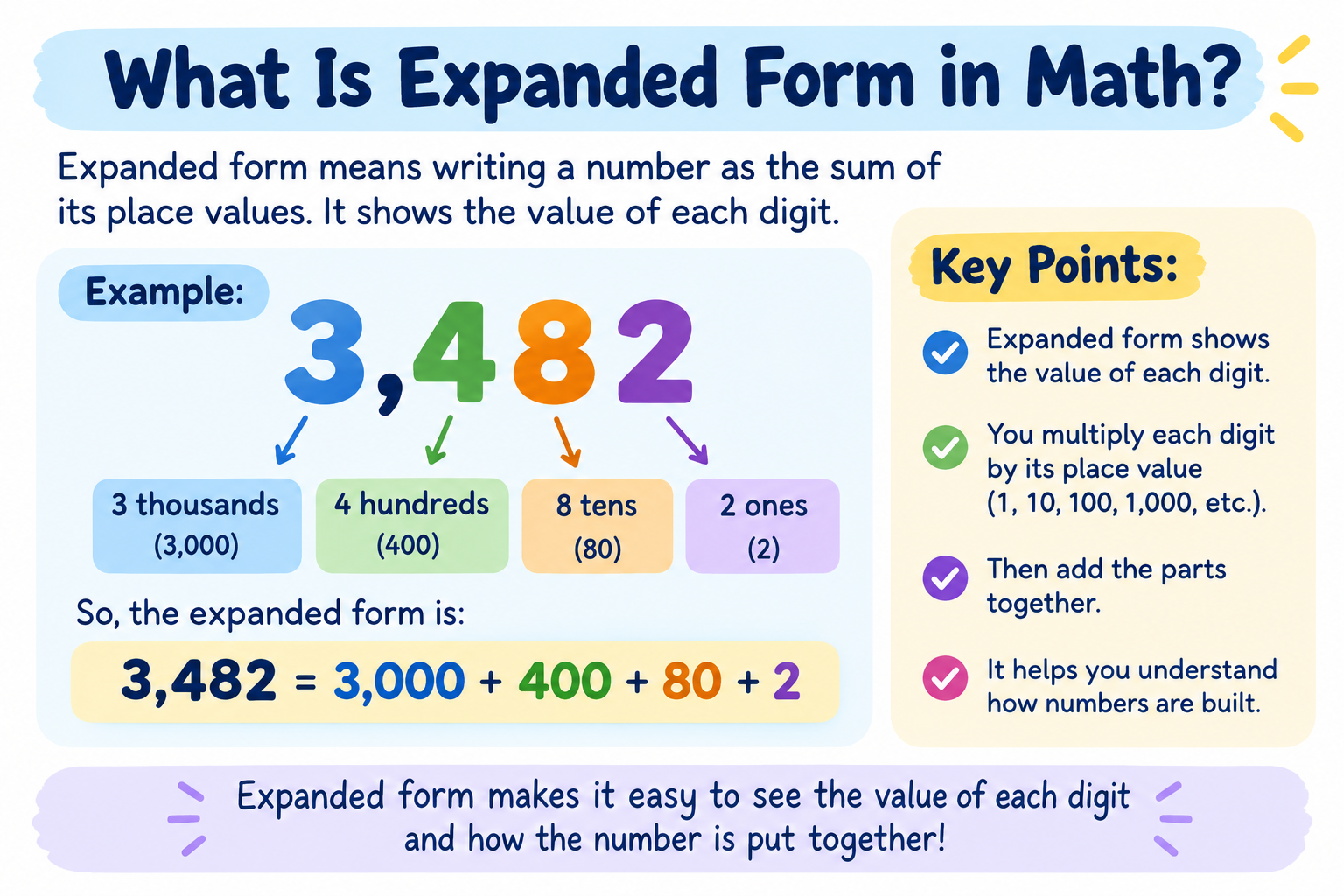
Take the number 4,582. At first glance, it looks like a single piece of information. But if you look closer, each digit inside that number actually carries its own value:
4,582 = 4,000 + 500 + 80 + 2
That is expanded form in action.
What is expanded form in math? Expanded form is a way of writing a number that shows the value of each digit separately, based on its position. Instead of writing 4,582 as one number, you break it apart into the sum of its place values.
This might sound simple, but it is a genuinely useful skill. Expanded form helps you understand how numbers are built, makes addition and subtraction easier to visualise, supports rounding, and lays a strong foundation for working with decimals and larger numbers.
Key Takeaways
-
Expanded form breaks a number into the sum of the values of each of its digits.
-
Each digit’s value depends on its position — that is the concept of place value.
-
Zeros do not add value, so they are usually left out of expanded form.
-
Decimal numbers can also be written in expanded form using tenths, hundredths, and thousandths.
-
Expanded form can be converted back to standard form by simply adding the parts together.
-
Understanding expanded form makes addition, subtraction, comparing numbers, and rounding much easier to follow.
-
Expanded form is closely connected to word form and standard form — three different ways of representing the same number.
What Is Expanded Form in Math?
Expanded form is a method of writing a number by showing the value of each digit individually. Each digit is multiplied by the value of its position, and the results are written as an addition statement.
Example:
352 = 300 + 50 + 2
Here is what is happening:
- 3 is in the hundreds place → 3 × 100 = 300
- 5 is in the tens place → 5 × 10 = 50
- 2 is in the ones place → 2 × 1 = 2
Another example:
7,406 = 7,000 + 400 + 6
You might notice that the zero in the tens place does not appear as a separate term (“+0”). That is perfectly correct. Since 0 × 10 = 0, adding zero does not change the value, so it is typically left out. Some teachers may include it for teaching purposes, but standard expanded form omits zero-value terms.
The key idea is always the same: expanded form shows what each digit is actually worth inside the number.
Expanded Form Examples
| Number | Expanded Form | Explanation |
|---|---|---|
| 25 | 20 + 5 | 2 tens and 5 ones |
| 407 | 400 + 7 | 4 hundreds, 0 tens (omitted), 7 ones |
| 582 | 500 + 80 + 2 | 5 hundreds, 8 tens, 2 ones |
| 1,234 | 1,000 + 200 + 30 + 4 | 1 thousand, 2 hundreds, 3 tens, 4 ones |
| 2,506 | 2,000 + 500 + 6 | 2 thousands, 5 hundreds, 0 tens (omitted), 6 ones |
| 4,820 | 4,000 + 800 + 20 | 4 thousands, 8 hundreds, 2 tens, 0 ones (omitted) |
| 10,305 | 10,000 + 300 + 5 | 1 ten thousand, 0 thousands (omitted), 3 hundreds, 0 tens (omitted), 5 ones |
| 25,641 | 20,000 + 5,000 + 600 + 40 + 1 | 2 ten thousands, 5 thousands, 6 hundreds, 4 tens, 1 one |
| 100,205 | 100,000 + 200 + 5 | 1 hundred thousand, 0 ten thousands (omitted), 0 thousands (omitted), 2 hundreds, 0 tens (omitted), 5 ones |
| 405,010 | 400,000 + 5,000 + 10 | 4 hundred thousands, 0 ten thousands (omitted), 5 thousands, 0 hundreds (omitted), 1 ten, 0 ones (omitted) |
| 1,000,001 | 1,000,000 + 1 | 1 million and 1 one; all middle zeros omitted |
| 63 | 60 + 3 | 6 tens, 3 ones |
| 900 | 900 | Only one non-zero digit; 9 hundreds |
| 8,070 | 8,000 + 70 | 8 thousands, 0 hundreds (omitted), 7 tens, 0 ones (omitted) |
| 50,400 | 50,000 + 400 | 5 ten thousands, 0 thousands (omitted), 4 hundreds, 0 tens (omitted), 0 ones (omitted) |
Expanded Form and Place Value
Expanded form and place value are directly linked. To write a number in expanded form, you must first understand the value of each digit’s position.
For a full explanation of how place value works, see What Is Place Value in Math? on LearnMinto.
Take 5,432:
| Digit | Place | Value |
|---|---|---|
| 5 | Thousands | 5,000 |
| 4 | Hundreds | 400 |
| 3 | Tens | 30 |
| 2 | Ones | 2 |
Expanded form: 5,432 = 5,000 + 400 + 30 + 2
Each term in the expanded form comes directly from multiplying the digit by the value of its place. This is why understanding place value first makes expanded form much easier to write correctly.
How to Write a Number in Expanded Form
Follow these steps for any number:
- Write down the number.
- Identify the place value of every digit, starting from the rightmost digit (ones).
- Multiply each digit by its place value to find its actual value.
- Write the values in order from largest to smallest, separated by plus signs.
- Leave out any terms where the digit is zero.
Worked Examples:
Example 1: 73
- 7 is in the tens place → 70
- 3 is in the ones place → 3
- 73 = 70 + 3
Example 2: 504
- 5 is in the hundreds place → 500
- 0 is in the tens place → 0 (omit)
- 4 is in the ones place → 4
- 504 = 500 + 4
Example 3: 3,819
- 3 → thousands → 3,000
- 8 → hundreds → 800
- 1 → tens → 10
- 9 → ones → 9
- 3,819 = 3,000 + 800 + 10 + 9
Example 4: 12,050
- 1 → ten thousands → 10,000
- 2 → thousands → 2,000
- 0 → hundreds → omit
- 5 → tens → 50
- 0 → ones → omit
- 12,050 = 10,000 + 2,000 + 50
Example 5: 6.4
- 6 → ones → 6
- 4 → tenths → 0.4
- 6.4 = 6 + 0.4
Example 6: 250,300
- 2 → hundred thousands → 200,000
- 5 → ten thousands → 50,000
- 0 → thousands → omit
- 3 → hundreds → 300
- 0 → tens → omit
- 0 → ones → omit
- 250,300 = 200,000 + 50,000 + 300
Example 7: 0.75
- 0 → ones → omit (or write 0)
- 7 → tenths → 0.7
- 5 → hundredths → 0.05
- 0.75 = 0.7 + 0.05
Example 8: 4,003
- 4 → thousands → 4,000
- 0 → hundreds → omit
- 0 → tens → omit
- 3 → ones → 3
- 4,003 = 4,000 + 3
Expanded Form of Whole Numbers
Two-digit numbers:
- 47 = 40 + 7
- 90 = 90 (only one non-zero digit)
Three-digit numbers:
- 632 = 600 + 30 + 2
- 805 = 800 + 5
Four-digit numbers:
- 1,234 = 1,000 + 200 + 30 + 4
- 9,007 = 9,000 + 7
Five-digit numbers:
- 34,512 = 30,000 + 4,000 + 500 + 10 + 2
- 60,030 = 60,000 + 30
Six-digit numbers:
- 472,819 = 400,000 + 70,000 + 2,000 + 800 + 10 + 9
- 500,040 = 500,000 + 40
Larger whole numbers:
- 3,250,000 = 3,000,000 + 200,000 + 50,000
- 12,000,500 = 10,000,000 + 2,000,000 + 500
Each time a new place is added to the left, its value is ten times larger than the one before it.
Expanded Form With Zeros
Zeros appear in numbers all the time, and students often make mistakes with them in expanded form. The rule is simple: since any digit multiplied by zero gives zero, zero-value terms are typically omitted.
| Number | Expanded Form | Note |
|---|---|---|
| 305 | 300 + 5 | Tens place is zero — omitted |
| 4,006 | 4,000 + 6 | Hundreds and tens are zero — both omitted |
| 20,040 | 20,000 + 40 | Thousands and ones are zero — both omitted |
| 300,005 | 300,000 + 5 | All middle places are zero — all omitted |
| 7,080 | 7,000 + 80 | Hundreds and ones are zero — both omitted |
It is worth noting that some teachers explicitly include zero terms when first teaching place value — writing 305 = 300 + 00 + 5 — to show students that a place exists but holds no value. Both approaches are used in classrooms, but the standard mathematical convention is to leave zero-value terms out.
Expanded Form With Large Numbers
As numbers grow larger, the same approach still applies. The place value chart simply extends further to the left.
| Place | Value |
|---|---|
| Ones | 1 |
| Tens | 10 |
| Hundreds | 100 |
| Thousands | 1,000 |
| Ten Thousands | 10,000 |
| Hundred Thousands | 100,000 |
| Millions | 1,000,000 |
| Ten Millions | 10,000,000 |
| Hundred Millions | 100,000,000 |
Examples:
- 745,382 = 700,000 + 40,000 + 5,000 + 300 + 80 + 2
- 3,060,500 = 3,000,000 + 60,000 + 500
- 12,500,040 = 10,000,000 + 2,000,000 + 500,000 + 40
- 400,000,009 = 400,000,000 + 9
The process never changes — identify each digit’s place, find its value, and write the non-zero values as a sum.
Expanded Form With Decimals
Expanded form works equally well with decimal numbers. The decimal point separates whole-number places from decimal places. Moving to the right of the decimal point, each position is ten times smaller.
Examples:
4.5
- 4 → ones → 4
- 5 → tenths → 0.5
- 4.5 = 4 + 0.5
3.27
- 3 → ones → 3
- 2 → tenths → 0.2
- 7 → hundredths → 0.07
- 3.27 = 3 + 0.2 + 0.07
12.405
- 1 → tens → 10
- 2 → ones → 2
- 4 → tenths → 0.4
- 0 → hundredths → omit
- 5 → thousandths → 0.005
- 12.405 = 10 + 2 + 0.4 + 0.005
0.308
- 0 → ones → omit
- 3 → tenths → 0.3
- 0 → hundredths → omit
- 8 → thousandths → 0.008
- 0.308 = 0.3 + 0.008
Decimal expanded form is especially useful when studying What Is a Fraction?, because decimal values like 0.7 and fractions like 7/10 represent the same idea.
Decimal Place Value Chart
| Place | Value | Example Digit | Value of That Digit |
|---|---|---|---|
| Thousands | 1,000 | 3 | 3,000 |
| Hundreds | 100 | 5 | 500 |
| Tens | 10 | 2 | 20 |
| Ones | 1 | 7 | 7 |
| Decimal Point | . | — | — |
| Tenths | 0.1 | 4 | 0.4 |
| Hundredths | 0.01 | 6 | 0.06 |
| Thousandths | 0.001 | 9 | 0.009 |
Using this chart with the number 3,527.469:
3,527.469 = 3,000 + 500 + 20 + 7 + 0.4 + 0.06 + 0.009
Expanded Form vs Standard Form
Standard form is simply the ordinary way of writing a number. Expanded form shows the same number broken into place values.
| Feature | Standard Form | Expanded Form |
|---|---|---|
| Definition | The normal written number | The number shown as a sum of place values |
| Example | 5,482 | 5,000 + 400 + 80 + 2 |
| Includes zeros? | Yes, as placeholders | No — zero-value terms are omitted |
| Easier for reading? | Yes | Not always — but more informative |
| Easier for understanding place value? | Not directly | Yes — each digit’s value is visible |
| Used in calculations? | Commonly | Useful for addition and subtraction |
Both forms represent exactly the same value. They are just different ways of displaying it.
Expanded Form vs Word Form
Word form is when you write a number completely in words. There are three ways to represent the same number:
Number: 3,205
| Form | Representation |
|---|---|
| Standard Form | 3,205 |
| Expanded Form | 3,000 + 200 + 5 |
| Word Form | Three thousand, two hundred and five |
Number: 47,080
| Form | Representation |
|---|---|
| Standard Form | 47,080 |
| Expanded Form | 40,000 + 7,000 + 80 |
| Word Form | Forty-seven thousand and eighty |
Each form has its uses. Standard form is the most compact. Word form appears in formal writing. Expanded form is most useful for understanding the internal structure of a number.
How to Convert Expanded Form to Standard Form
To convert expanded form back to standard form, simply add all the values together. Make sure every place is accounted for — including those that hold zero.
Examples:
- 3,000 + 500 + 20 + 4 = 3,524
- 7,000 + 80 + 6 = 7,086
- 400 + 9 = 409
- 50,000 + 3,000 + 200 + 1 = 53,201
- 600,000 + 40,000 + 7 = 640,007
- 10,000 + 500 + 30 = 10,530
- 2,000,000 + 50,000 + 400 = 2,050,400
- 80 + 5 = 85
- 9,000 + 900 + 90 + 9 = 9,999
- 300,000 + 60,000 + 2,000 + 500 + 70 + 8 = 362,578
Notice in example 2 that 7,000 + 80 + 6 = 7,086 — the hundreds place is missing from the expanded form, which means it holds zero. When you write the standard form, you must include that zero as a placeholder.
How to Convert Standard Form to Expanded Form
Follow this process:
- Write the number.
- Label each digit with its place value from right to left.
- Write the value of each non-zero digit.
- Arrange from largest to smallest, separated by plus signs.
10 Examples:
- 46 = 40 + 6
- 803 = 800 + 3
- 5,271 = 5,000 + 200 + 70 + 1
- 9,040 = 9,000 + 40
- 12,305 = 10,000 + 2,000 + 300 + 5
- 70,008 = 70,000 + 8
- 431,560 = 400,000 + 30,000 + 1,000 + 500 + 60
- 1,000,050 = 1,000,000 + 50
- 25.7 = 20 + 5 + 0.7
- 6.035 = 6 + 0.03 + 0.005
Expanded Form With Addition
One practical use of expanded form is making addition easier to understand. When you break both numbers into their place values, you can add ones with ones, tens with tens, and so on.
Example: 342 + 125
Break each number into expanded form:
342 = 300 + 40 + 2
125 = 100 + 20 + 5
Add corresponding place values:
Hundreds: 300 + 100 = 400
Tens:      40 + 20  = 60
Ones:       2 + 5   = 7
Result: 400 + 60 + 7 = 467
Example: 1,432 + 2,253
1,432 = 1,000 + 400 + 30 + 2
2,253 = 2,000 + 200 + 50 + 3Thousands: 1,000 + 2,000 = 3,000
Hundreds: 400 + 200 = 600
Tens: 30 + 50 = 80
Ones: 2 + 3 = 5Result: 3,000 + 600 + 80 + 5 = 3,685
This approach connects well with the ideas behind What Is a Multiple? because students begin to see how place positions are multiples of ten.
Expanded Form With Subtraction
The same place-value thinking applies to subtraction.
Example: 587 − 243
587 = 500 + 80 + 7
243 = 200 + 40 + 3
Subtract corresponding place values:
Hundreds: 500 − 200 = 300
Tens:      80 − 40  = 40
Ones:       7 − 3   = 4
Result: 300 + 40 + 4 = 344
Example: 976 − 532
Hundreds: 900 − 500 = 400
Tens:      70 − 30  = 40
Ones:       6 − 2   = 4
Result: 400 + 40 + 4 = 444
Note that this column-by-column method works cleanly when each digit in the first number is greater than or equal to the corresponding digit in the second. For cases that require borrowing, the standard subtraction algorithm is typically easier.
Expanded Form and Comparing Numbers
Writing numbers in expanded form can make it much clearer why one number is greater than another.
Compare 4,582 and 4,528
4,582 = 4,000 + 500 + 80 + 2
4,528 = 4,000 + 500 + 20 + 8
Looking at the expanded forms side by side:
- Thousands: 4,000 = 4,000 (equal)
- Hundreds: 500 = 500 (equal)
- Tens: 80 vs 20 → 80 > 20
Since the tens value of 4,582 is greater, 4,582 > 4,528.
Expanded form makes this comparison visible at a glance — you can see exactly where the numbers differ and by how much.
Expanded Form and Rounding
Place value, and by extension expanded form, is the key to understanding rounding. When you round a number, you are deciding which place value term to keep or adjust and which to set to zero.
Example: Round 4,582 to the nearest hundred
Expanded form: 4,582 = 4,000 + 500 + 80 + 2
To round to the nearest hundred, look at the tens digit: 8. Since 8 ≥ 5, round the hundreds up.
- 500 becomes 600
- Tens and ones become 0
Rounded result: 4,600
Example: Round 3,249 to the nearest thousand
Expanded form: 3,249 = 3,000 + 200 + 40 + 9
Look at the hundreds digit: 2. Since 2 < 5, round down — thousands stay as 3,000.
Rounded result: 3,000
Seeing numbers in expanded form helps students understand which digit they are examining when deciding to round up or down.
Common Mistakes Students Make
| Mistake | Incorrect | Correct |
|---|---|---|
| Forgetting a place value | 4,582 = 4,000 + 80 + 2 | 4,582 = 4,000 + 500 + 80 + 2 |
| Using the digit instead of its value | 5,432 = 5 + 4 + 3 + 2 | 5,432 = 5,000 + 400 + 30 + 2 |
| Including zeros incorrectly | 305 = 300 + 00 + 5 (shown as a value) | 305 = 300 + 5 |
| Ignoring zeros in standard form conversion | 7,000 + 80 + 6 = 786 | 7,000 + 80 + 6 = 7,086 |
| Confusing tens with tenths | 3.5 = 3 + 50 | 3.5 = 3 + 0.5 |
| Writing decimal expanded form incorrectly | 0.47 = 4 + 7 | 0.47 = 0.4 + 0.07 |
| Changing digit order | 5,321 = 1 + 20 + 300 + 5,000 | 5,321 = 5,000 + 300 + 20 + 1 |
| Adding terms wrongly when converting back | 5,000 + 400 + 80 + 2 = 5,402 | 5,000 + 400 + 80 + 2 = 5,482 |
The most common error is using the digit itself rather than its actual value. Always ask: what is this digit worth based on where it sits?
Worked Examples
Example 1 — Two-digit number
Given: Write 73 in expanded form.
Step 1: 7 is in the tens place → 70.
Step 2: 3 is in the ones place → 3.
Explanation: Two non-zero digits, both included.
Final Answer: 73 = 70 + 3
Example 2 — Three-digit number
Given: Write 529 in expanded form.
Step 1: 5 → hundreds → 500.
Step 2: 2 → tens → 20.
Step 3: 9 → ones → 9.
Final Answer: 529 = 500 + 20 + 9
Example 3 — Four-digit number
Given: Write 3,406 in expanded form.
Step 1: 3 → thousands → 3,000.
Step 2: 4 → hundreds → 400.
Step 3: 0 → tens → 0 (omit).
Step 4: 6 → ones → 6.
Explanation: The zero in the tens place is not included as a separate term.
Final Answer: 3,406 = 3,000 + 400 + 6
Example 4 — Five-digit number
Given: Write 52,814 in expanded form.
Step 1: 5 → ten thousands → 50,000.
Step 2: 2 → thousands → 2,000.
Step 3: 8 → hundreds → 800.
Step 4: 1 → tens → 10.
Step 5: 4 → ones → 4.
Final Answer: 52,814 = 50,000 + 2,000 + 800 + 10 + 4
Example 5 — Number with multiple zeros
Given: Write 400,060 in expanded form.
Step 1: 4 → hundred thousands → 400,000.
Step 2: 0 → ten thousands → omit.
Step 3: 0 → thousands → omit.
Step 4: 0 → hundreds → omit.
Step 5: 6 → tens → 60.
Step 6: 0 → ones → omit.
Final Answer: 400,060 = 400,000 + 60
Example 6 — Large number
Given: Write 2,750,308 in expanded form.
Step 1: 2 → millions → 2,000,000.
Step 2: 7 → hundred thousands → 700,000.
Step 3: 5 → ten thousands → 50,000.
Step 4: 0 → thousands → omit.
Step 5: 3 → hundreds → 300.
Step 6: 0 → tens → omit.
Step 7: 8 → ones → 8.
Final Answer: 2,750,308 = 2,000,000 + 700,000 + 50,000 + 300 + 8
Example 7 — Decimal number
Given: Write 8.52 in expanded form.
Step 1: 8 → ones → 8.
Step 2: 5 → tenths → 0.5.
Step 3: 2 → hundredths → 0.02.
Final Answer: 8.52 = 8 + 0.5 + 0.02
Example 8 — Decimal with zero
Given: Write 5.304 in expanded form.
Step 1: 5 → ones → 5.
Step 2: 3 → tenths → 0.3.
Step 3: 0 → hundredths → omit.
Step 4: 4 → thousandths → 0.004.
Final Answer: 5.304 = 5 + 0.3 + 0.004
Example 9 — Convert expanded form to standard form
Given: Write 60,000 + 3,000 + 400 + 5 in standard form.
Step 1: Identify missing places. Tens and ones are missing → they are zero.
Step 2: Add: 60,000 + 3,000 = 63,000 + 400 = 63,400 + 5 = 63,405.
Final Answer: 63,405
Example 10 — Convert expanded form to standard form with gap
Given: Write 8,000 + 70 + 4 in standard form.
Step 1: Hundreds place is missing → 0 hundreds.
Step 2: 8,000 + 0 + 70 + 4 = 8,074.
Final Answer: 8,074
Example 11 — Convert standard form to expanded form
Given: Write 307,025 in expanded form.
Step 1: 3 → hundred thousands → 300,000.
Step 2: 0 → ten thousands → omit.
Step 3: 7 → thousands → 7,000.
Step 4: 0 → hundreds → omit.
Step 5: 2 → tens → 20.
Step 6: 5 → ones → 5.
Final Answer: 307,025 = 300,000 + 7,000 + 20 + 5
Example 12 — Expanded form with addition
Given: Find 213 + 154 using expanded form.
Step 1: 213 = 200 + 10 + 3. 154 = 100 + 50 + 4.
Step 2: Hundreds: 200 + 100 = 300. Tens: 10 + 50 = 60. Ones: 3 + 4 = 7.
Final Answer: 300 + 60 + 7 = 367
Example 13 — Expanded form with subtraction
Given: Find 895 − 342 using expanded form.
Step 1: 895 = 800 + 90 + 5. 342 = 300 + 40 + 2.
Step 2: Hundreds: 800 − 300 = 500. Tens: 90 − 40 = 50. Ones: 5 − 2 = 3.
Final Answer: 500 + 50 + 3 = 553
Example 14 — Comparing numbers
Given: Compare 6,840 and 6,480 using expanded form.
Step 1: 6,840 = 6,000 + 800 + 40. 6,480 = 6,000 + 400 + 80.
Step 2: Thousands: equal. Hundreds: 800 vs 400 → 800 > 400.
Final Answer: 6,840 > 6,480
Example 15 — Rounding using expanded form
Given: Round 7,364 to the nearest hundred.
Step 1: 7,364 = 7,000 + 300 + 60 + 4.
Step 2: Look at tens digit: 6. Since 6 ≥ 5, round hundreds up: 300 → 400.
Step 3: Tens and ones become 0.
Final Answer: 7,400
Example 16 — Six-digit number
Given: Write 836,209 in expanded form.
Step 1: 8 → hundred thousands → 800,000. 3 → ten thousands → 30,000. 6 → thousands → 6,000. 2 → hundreds → 200. 0 → tens → omit. 9 → ones → 9.
Final Answer: 836,209 = 800,000 + 30,000 + 6,000 + 200 + 9
Example 17 — Decimal with tenths only
Given: Write 14.6 in expanded form.
Step 1: 1 → tens → 10. 4 → ones → 4. 6 → tenths → 0.6.
Final Answer: 14.6 = 10 + 4 + 0.6
Example 18 — Word form to expanded form
Given: Write “forty-five thousand and nine” in expanded form.
Step 1: The number is 45,009.
Step 2: 4 → ten thousands → 40,000. 5 → thousands → 5,000. 0 → hundreds → omit. 0 → tens → omit. 9 → ones → 9.
Final Answer: 45,009 = 40,000 + 5,000 + 9
Example 19 — Identifying a missing place
Given: 20,000 + 400 + 3 in standard form.
Step 1: Thousands, hundreds → present. Ten thousands = 20,000. Thousands → missing → 0. Hundreds = 400. Tens → missing → 0. Ones = 3.
Final Answer: 20,403
Example 20 — Decimal number to expanded form
Given: Write 100.05 in expanded form.
Step 1: 1 → hundreds → 100. 0 → tens → omit. 0 → ones → omit. 0 → tenths → omit. 5 → hundredths → 0.05.
Final Answer: 100.05 = 100 + 0.05
Practice Questions
15 Expanded Form Questions
- Write 68 in expanded form.
- Write 403 in expanded form.
- Write 7,251 in expanded form.
- Write 30,080 in expanded form.
- Write 125,600 in expanded form.
- Write 4,000,305 in expanded form.
- Write 9.3 in expanded form.
- Write 0.47 in expanded form.
- Write 15.203 in expanded form.
- Convert 5,000 + 700 + 20 + 9 to standard form.
- Convert 80,000 + 600 + 4 to standard form.
- Convert 2,000,000 + 30,000 + 7 to standard form.
- Which is greater: 3,720 or 3,270? Show using expanded form.
- Write the expanded form of the number two hundred and six thousand and forty-five.
- Round 8,547 to the nearest hundred. Use place value/expanded form thinking to explain.
Answers:
- 68 = 60 + 8
Explanation: 6 is in the tens place (60), 8 is in the ones place (8). - 403 = 400 + 3
Explanation: 4 hundreds, 0 tens (omitted), 3 ones. - 7,251 = 7,000 + 200 + 50 + 1
Explanation: Each digit converted to its place value. - 30,080 = 30,000 + 80
Explanation: 3 ten thousands, 0 thousands (omit), 0 hundreds (omit), 8 tens, 0 ones (omit). - 125,600 = 100,000 + 20,000 + 5,000 + 600
Explanation: 1 hundred thousand, 2 ten thousands, 5 thousands, 6 hundreds, 0 tens (omit), 0 ones (omit). - 4,000,305 = 4,000,000 + 300 + 5
Explanation: All middle zeros omitted. - 9.3 = 9 + 0.3
Explanation: 9 ones and 3 tenths. - 0.47 = 0.4 + 0.07
Explanation: 4 tenths and 7 hundredths; ones digit is 0 and omitted. - 15.203 = 10 + 5 + 0.2 + 0.003
Explanation: 1 ten, 5 ones, 2 tenths, 0 hundredths (omit), 3 thousandths. - 5,729
Explanation: 5,000 + 700 + 20 + 9 = 5,729. - 80,604
Explanation: 80,000 + 600 + 4; thousands and ones missing → zeros placed in those positions. - 2,030,007
Explanation: 2,000,000 + 30,000 + 7; all other places are zero. - 3,720 = 3,000 + 700 + 20. 3,270 = 3,000 + 200 + 70. Thousands equal. Hundreds: 700 > 200. 3,720 > 3,270.
- 206,045 = 200,000 + 6,000 + 40 + 5
- Expanded form: 8,547 = 8,000 + 500 + 40 + 7. Tens digit is 4 (< 5), so round down. Rounded answer: 8,500.
10 Multiple Choice Questions
Question 1
What is the expanded form of 4,309?
A. 4,000 + 300 + 9
B. 4,000 + 300 + 90
C. 4,000 + 30 + 9
D. 400 + 300 + 9
Correct Answer: A
Short Explanation: 4 → thousands → 4,000; 3 → hundreds → 300; 0 → tens → omit; 9 → ones → 9.
Question 2
What is the standard form of 50,000 + 6,000 + 400 + 3?
A. 56,430
B. 56,043
C. 56,403
D. 56,004
Correct Answer: C
Short Explanation: 50,000 + 6,000 = 56,000; + 400 = 56,400; + 3 = 56,403. The tens place is zero.
Question 3
In the expanded form 200 + 70 + 3, what is the original number?
A. 237
B. 273
C. 327
D. 372
Correct Answer: B
Short Explanation: 200 + 70 + 3 = 273.
Question 4
Which answer correctly shows the expanded form of 80,005?
A. 80,000 + 5
B. 8,000 + 500
C. 80,000 + 50
D. 800 + 5
Correct Answer: A
Short Explanation: 8 is in the ten-thousands place (80,000); zeros hold all middle places; 5 is in the ones place.
Question 5
What is the expanded form of 0.36?
A. 3 + 6
B. 0.3 + 6
C. 0.3 + 0.06
D. 0.03 + 0.06
Correct Answer: C
Short Explanation: 3 is in the tenths place (0.3); 6 is in the hundredths place (0.06).
Question 6
A student writes 3,056 = 3,000 + 500 + 6. What is wrong?
A. Nothing is wrong.
B. The thousands value is incorrect.
C. The hundreds value should be 50, not 500.
D. The ones value should be 60.
Correct Answer: C
Short Explanation: In 3,056, the digit 5 is in the tens place, not the hundreds place. The correct expanded form is 3,000 + 50 + 6.
Question 7
Which of the following represents the expanded form of one million and forty-two?
A. 1,000,000 + 400 + 2
B. 1,000,000 + 42
C. 1,000,000 + 40 + 2
D. 100,000 + 40 + 2
Correct Answer: C
Short Explanation: One million and forty-two = 1,000,042. Expanded: 1,000,000 + 40 + 2.
Question 8
What is the expanded form of 9.07?
A. 9 + 0.7
B. 9 + 0.07
C. 9 + 7
D. 0.9 + 0.07
Correct Answer: B
Short Explanation: 9 is in the ones place; 0 is in the tenths place (omit); 7 is in the hundredths place (0.07).
Question 9
Which standard number matches this expanded form? 700,000 + 30,000 + 600 + 50 + 1
A. 730,651
B. 730,561
C. 703,651
D. 736,501
Correct Answer: A
Short Explanation: 700,000 + 30,000 = 730,000; + 600 = 730,600; + 50 = 730,650; + 1 = 730,651.
Question 10
A student writes 6.5 = 6 + 5. What mistake did they make?
A. They wrote the digit instead of the decimal place value.
B. They added the digits instead of the number.
C. They forgot the decimal point.
D. Both A and B.
Correct Answer: D
Short Explanation: The digit 5 is in the tenths place, so its value is 0.5 — not 5. The student wrote the face value of 5 rather than its decimal place value.
10 Mixed Practice Problems
Problem 1: Write 56,302 in expanded form.
Solution: 5 → ten thousands → 50,000; 6 → thousands → 6,000; 3 → hundreds → 300; 0 → tens → omit; 2 → ones → 2. 56,302 = 50,000 + 6,000 + 300 + 2
Problem 2: What is the value of the digit 4 in the number 4,781?
Solution: 4 is in the thousands place. 4 × 1,000 = 4,000
Problem 3: Convert to standard form: 400,000 + 5,000 + 80 + 9
Solution: Missing places are ten thousands, hundreds. 405,089
Problem 4: Which expanded form is incorrect?
(a) 520 = 500 + 20
(b) 2,400 = 2,000 + 40
(c) 834 = 800 + 30 + 4
Solution: (b) is incorrect. 2,400 = 2,000 + 400, not 2,000 + 40. The digit 4 is in the hundreds place, not the tens place.
Problem 5: Write 3.608 in expanded form.
Solution: 3 → ones → 3; 6 → tenths → 0.6; 0 → hundredths → omit; 8 → thousandths → 0.008. 3.608 = 3 + 0.6 + 0.008
Problem 6: Which is greater: 25,480 or 25,840? Use expanded form.
Solution:
25,480 = 20,000 + 5,000 + 400 + 80
25,840 = 20,000 + 5,000 + 800 + 40
Hundreds: 400 vs 800 → 800 > 400. 25,840 > 25,480
Problem 7: Convert 8,000,000 + 200,000 + 50 + 3 to standard form.
Solution: Missing: hundred thousands, ten thousands, thousands, hundreds. 8,200,053
Problem 8: Write the number “three hundred and four thousand and twelve” in expanded form.
Solution: 304,012 = 300,000 + 4,000 + 10 + 2
Problem 9: Find the expanded form of 0.509.
Solution: 0 → ones → omit; 5 → tenths → 0.5; 0 → hundredths → omit; 9 → thousandths → 0.009. 0.509 = 0.5 + 0.009
Problem 10: A student says 7,000 + 500 + 60 + 2 = 7,562. Are they correct?
Solution: 7,000 + 500 = 7,500; + 60 = 7,560; + 2 = 7,562. Yes, the student is correct.
5 Challenge Questions
Challenge 1: Write 12,030,405 in expanded form.
Solution:
- 1 → ten millions → 10,000,000
- 2 → millions → 2,000,000
- 0 → hundred thousands → omit
- 3 → ten thousands → 30,000
- 0 → thousands → omit
- 4 → hundreds → 400
- 0 → tens → omit
- 5 → ones → 5
12,030,405 = 10,000,000 + 2,000,000 + 30,000 + 400 + 5
Challenge 2: Convert to standard form: 5,000,000 + 40,000 + 700 + 0.08
Solution:
- Millions: 5,000,000
- Hundred thousands, ten thousands: missing → 040,000
- Thousands: missing → 0
- Hundreds: 700
- Tens, ones: missing → 00
- Decimal: 0.08
Combine: 5,040,700.08
Final Answer: 5,040,700.08
Challenge 3: A number in expanded form is: 300,000 + 70,000 + 200 + 0.5 + 0.009
What is the number in standard form?
Solution:
- 300,000 + 70,000 = 370,000
- 200 = 370,200
- Thousands, tens, ones = 000
- 370,200.509
Final Answer: 370,200.509
Challenge 4: Two numbers are:
Number A: 600,000 + 50,000 + 400 + 0.07
Number B: 600,000 + 50,000 + 300 + 90 + 0.7
Which is greater?
Solution:
Number A = 650,400.07
Number B = 650,390.7
Compare hundreds: 400 vs 300. Since 400 > 300, Number A is greater.
Challenge 5: Round 4,856,329 to the nearest hundred thousand. Use expanded form thinking.
Solution:
4,856,329 = 4,000,000 + 800,000 + 50,000 + 6,000 + 300 + 20 + 9
Rounding to the nearest hundred thousand: look at the ten-thousands digit → 5. Since 5 ≥ 5, round up the hundred thousands digit: 800,000 → 900,000.
Final Answer: 4,900,000
Exam Tips
- Identify every digit’s place first. Before writing anything, label each digit from right to left: ones, tens, hundreds, and so on.
- Write the value, not the digit. The most common mistake is writing the digit (e.g., 5) instead of its place value (e.g., 500). Always multiply the digit by the value of its position.
- Pay close attention to zeros. Zeros are placeholders. They should generally be omitted from expanded form, but you must account for them when converting back to standard form.
- Do not confuse tenths with tens. Tens = 10. Tenths = 0.1. Always check which side of the decimal point you are working on.
- Check the decimal point carefully. When writing decimal expanded form, locate the decimal point first and count outward from there.
- Add the expanded values to verify. After writing expanded form, add your terms together to confirm they equal the original number.
- Keep digits in the correct order when converting back. When going from expanded form to standard form, write the largest place value first and fill in zeros for any missing places.
- Check that your answer has the right number of digits. A five-digit number cannot become a four-digit number unless leading zeros have been removed.
Quick Revision Notes
- Expanded form: Writing a number as the sum of the values of each of its digits.
- Place value: The value a digit holds because of its position. Each place is ten times larger than the one to its right.
- Standard form: The ordinary way of writing a number (e.g., 4,582).
- Word form: Writing a number fully in words (e.g., four thousand, five hundred and eighty-two).
- Expanded form with zeros: Zero-value terms are typically omitted. However, zeros must still be included as placeholders when writing standard form.
- Expanded form with decimals: Extend to the right of the decimal point — tenths (0.1), hundredths (0.01), thousandths (0.001).
- Converting standard to expanded form: Identify each digit’s place and write its value. Leave out zeros.
- Converting expanded to standard form: Add all the terms. Write zeros in any place not represented in the expanded form.
Expanded Form Cheat Sheet
| Number | Expanded Form |
|---|---|
| 84 | 80 + 4 |
| 306 | 300 + 6 |
| 750 | 700 + 50 |
| 4,921 | 4,000 + 900 + 20 + 1 |
| 8,005 | 8,000 + 5 |
| 23,410 | 20,000 + 3,000 + 400 + 10 |
| 100,507 | 100,000 + 500 + 7 |
| 3,000,040 | 3,000,000 + 40 |
| 5.6 | 5 + 0.6 |
| 2.83 | 2 + 0.8 + 0.03 |
| 10.405 | 10 + 0.4 + 0.005 |
| 0.072 | 0.07 + 0.002 |
Frequently Asked Questions
1. What is expanded form in math?
Expanded form is a way of writing a number that shows the value of each digit separately, based on its place. For example, 5,382 = 5,000 + 300 + 80 + 2.
2. What is an example of expanded form?
The number 7,406 written in expanded form is 7,000 + 400 + 6. The zero in the tens place is not included because it adds no value.
3. How do you write a number in expanded form?
Identify the place value of each digit, multiply each digit by its place value, and write the non-zero results as an addition statement from largest to smallest.
4. What is the expanded form of 456?
456 = 400 + 50 + 6. Each digit represents hundreds, tens, and ones respectively.
5. What is the expanded form of 1,234?
1,234 = 1,000 + 200 + 30 + 4.
6. What is the expanded form of 5,006?
5,006 = 5,000 + 6. The hundreds and tens places are zero and are omitted.
7. How do zeros work in expanded form?
Zeros hold a place position but contribute no value. In expanded form, zero-value terms are left out. In standard form, zeros must still appear as placeholders.
8. What is decimal expanded form?
Decimal expanded form extends place values to the right of the decimal point. For example, 3.25 = 3 + 0.2 + 0.05, where 0.2 represents two tenths and 0.05 represents five hundredths.
9. What is the difference between expanded form and standard form?
Standard form is the ordinary numeric way of writing a number (e.g., 3,281). Expanded form breaks the same number into the sum of its place values (e.g., 3,000 + 200 + 80 + 1).
10. What is the difference between expanded form and word form?
Expanded form uses numbers and plus signs (e.g., 3,000 + 200 + 5). Word form writes the number entirely in words (e.g., three thousand, two hundred and five).
11. How do you convert expanded form to standard form?
Add all the values together. For any place not represented in the expanded form, write a zero in that position.
12. Why is expanded form important?
Expanded form makes it clear exactly what each digit contributes to a number. This understanding supports place value, addition, subtraction, comparing, rounding, and future mathematical topics.
13. Can decimals be written in expanded form?
Yes. Decimal digits are written using their decimal place values. For example, 4.75 = 4 + 0.7 + 0.05.
14. How does place value help with expanded form?
Place value tells you the value of each digit’s position. Without knowing that 7 in the thousands place equals 7,000, you cannot write the expanded form correctly. The two concepts are inseparable.
15. What is the easiest way to learn expanded form?
Start with small two-digit and three-digit numbers. Write them in a place value chart, then convert each digit to its value. Practice regularly with numbers that include zeros and decimals to build full confidence.
Summary
Expanded form is simply a way of making the inside of a number visible. Instead of reading 4,582 as a single block, you see it as four separate values — 4,000, 500, 80, and 2 — each digit showing exactly what it contributes.
The process always works the same way: find each digit’s place, calculate its value, and write those values as a sum. Zeros are omitted because they add nothing, but they must be reinstated as placeholders when you convert back to standard form.
Expanded form works equally well for two-digit numbers, six-digit numbers, decimals, and everything in between. It connects directly to place value, comparing and ordering numbers, rounding, and arithmetic — making it one of the most practical foundational skills in mathematics.
Final Thoughts
Learning expanded form well is an investment that pays off throughout a student’s mathematical education. When you understand why 4,582 is really 4,000 + 500 + 80 + 2, numbers stop being mysterious and start making complete sense.
That clarity carries forward. Rounding, comparing large numbers, adding and subtracting with confidence, and working with decimals all become much more manageable once you can see each digit’s true value. Even in more advanced topics — such as What Is a Rational Number? or What Is a Real Number? — a confident grasp of place value and expanded form provides the grounding that makes new concepts easier to absorb.
Take the time to practise with different types of numbers. Write a few in expanded form every day. Check your work by adding the parts back together. That simple habit will build both accuracy and confidence faster than almost anything else.
References
- Khan Academy — Place Value and Number Systems: https://www.khanacademy.org
- OpenStax Prealgebra — Whole Numbers and Place Value: https://openstax.org
- Mathematics LibreTexts — Place Value and Expanded Notation: https://math.libretexts.org
- National Council of Teachers of Mathematics (NCTM): https://www.nctm.org
- Encyclopaedia Britannica — Number and Numeral Systems: https://www.britannica.com
Helpful Resources
Khan Academy — Place Value and Expanded Form
Students can watch structured video lessons and complete interactive practice exercises on place value, expanded form, and decimal numbers.
https://www.khanacademy.org
OpenStax Prealgebra
A free, peer-reviewed textbook covering whole numbers, expanded form, decimals, and number sense in clear, well-organised chapters.
https://openstax.org
Mathematics LibreTexts
An open-access library of mathematics texts covering elementary through university-level topics, including detailed explanations of place value and number representation.
https://math.libretexts.org
National Council of Teachers of Mathematics (NCTM)
Provides standards-based guidance and classroom resources for teaching number sense, place value, and expanded form at all grade levels.
https://www.nctm.org
Disclaimer:
This article is intended for educational and informational purposes only. While LearnMinto strives to provide accurate and up-to-date mathematics information, readers should verify important academic concepts through official textbooks, educational institutions, examination boards, or trusted educational resources before using this content for exams or academic purposes. LearnMinto is not affiliated with any specific school, university, research institution, or examination board.
About the Author
Saad Qureshi is a Senior Education & Technology Editor at LearnMinto. He focuses on creating and reviewing clear, accessible educational content across mathematics, physics, chemistry, biology, computer science, technology, AI tools, and personal finance.