
Introduction
Look at this simple algebraic term: 5x
The number 5 is sitting right in front of the variable x. It is being multiplied by x. That number is called the coefficient.
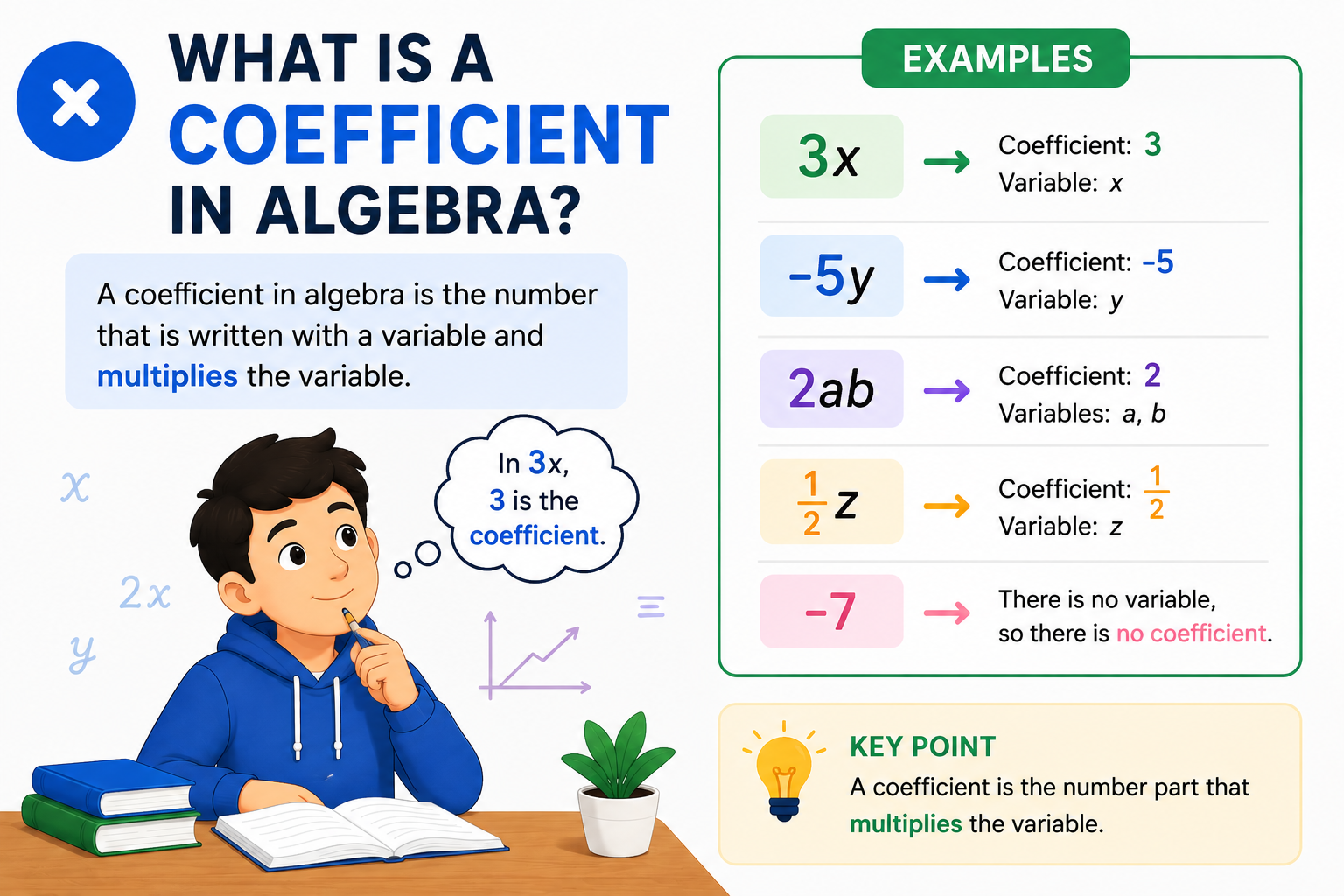
So, what is a coefficient in algebra? A coefficient is the numerical factor that multiplies a variable or algebraic term. In the term 5x, the coefficient is 5. In -3y, the coefficient is -3. In 12a², the coefficient is 12.
The coefficient is always the number part of a term. The sign attached to it, whether positive or negative, is included as part of the coefficient.
Understanding coefficients is essential across all of algebra. You need them to simplify expressions, solve linear and quadratic equations, factor polynomials, graph straight lines, and make sense of more advanced mathematics. Once you understand what a coefficient is and how to find it, many algebraic processes become much clearer.
Key Takeaways
-
A coefficient is the numerical factor that multiplies a variable in an algebraic term.
-
The sign of the coefficient matters. In -5x, the coefficient is -5, not 5.
-
When no number is written in front of a variable, the coefficient is 1. For example, x means 1x.
-
When a negative sign appears with no number, the coefficient is -1. For example, -x means -1x.
-
Coefficients can be integers, fractions, or decimals.
-
A coefficient is not the same as a constant, an exponent, or a variable.
-
Coefficients play a central role in combining like terms, solving equations, and factoring expressions.
What Is a Coefficient in Algebra?
A coefficient in algebra is the numerical part of an algebraic term that multiplies the variable or group of variables in that term.
In any term such as 7x, the number 7 and the variable x are multiplied together. The number 7 is the coefficient. The letter x is the variable.
More examples:
- 5x → coefficient is 5
- -3y → coefficient is -3
- 12a² → coefficient is 12
- 1/2m → coefficient is 1/2
- 0.4p → coefficient is 0.4
The sign immediately in front of the number is always considered part of the coefficient. This means that in the term -3y, the coefficient is not 3 but -3. Leaving out the negative sign leads to calculation errors.
Coefficient Examples
| Algebraic Term | Coefficient | Variable Part |
|---|---|---|
| 4x | 4 | x |
| -7y | -7 | y |
| 10a | 10 | a |
| 1/2x | 1/2 | x |
| 0.5m | 0.5 | m |
| -3x² | -3 | x² |
| 8ab | 8 | ab |
| -9x³ | -9 | x³ |
| y | 1 | y |
| -x | -1 | x |
| 2xy | 2 | xy |
| -4a²b | -4 | a²b |
| 6p³ | 6 | p³ |
| -1/3y² | -1/3 | y² |
| 3.5k | 3.5 | k |
The coefficient is always the number that multiplies the variable part. When no number appears in front of a variable, the coefficient is 1 (or -1 if a negative sign is present).
What Is a Numerical Coefficient?
A numerical coefficient is simply another name for the coefficient of a term. It emphasises that the coefficient is a number, as distinct from the variable letters.
Here are ten clear examples:
| Term | Numerical Coefficient |
|---|---|
| 7x | 7 |
| -5a | -5 |
| 3x² | 3 |
| 11y | 11 |
| -8m³ | -8 |
| 1/4z | 1/4 |
| 2.5p | 2.5 |
| -n | -1 |
| k | 1 |
| -6ab | -6 |
The word “numerical” simply reinforces that the coefficient is the number component of the term. In school mathematics, the terms “coefficient” and “numerical coefficient” are generally used interchangeably.
What Is a Constant?
A constant is a term in an algebraic expression that contains no variable. It is a fixed number that does not change regardless of the value of any variable.
In the expression 5x + 7:
- 5 is the coefficient of x.
- 7 is the constant. It has no variable attached to it.
In the expression 3a² – 4a + 9:
- 3 is the coefficient of a².
- -4 is the coefficient of a.
- 9 is the constant.
It is important not to confuse a coefficient with a constant. A coefficient multiplies a variable. A constant stands alone with no variable.
For a complete explanation of how constants, variables, coefficients, and terms all fit together within algebraic expressions, the article [What Is an Algebraic Expression?] covers every part of an algebraic expression in detail.
Coefficient of a Variable
When an expression contains more than one variable, each variable has its own coefficient.
Example 1: 4x + 3y
- Coefficient of x = 4
- Coefficient of y = 3
Example 2: 6a – 5b + 2c
- Coefficient of a = 6
- Coefficient of b = -5
- Coefficient of c = 2
Example 3: 2p + 8q – q
- Coefficient of p = 2
- The q terms combine: 8q – q = 7q, so the coefficient of q = 7
Example 4: 9x² + 3x – 7
- Coefficient of x² = 9
- Coefficient of x = 3
- -7 is the constant
When asked to find the coefficient of a specific variable, always look for the number multiplying that variable in its current term.
What Is an Algebraic Term?
A term is a single unit in an algebraic expression, consisting of a coefficient and a variable part (or just a constant by itself). Terms are separated from each other by addition or subtraction signs.
In the expression 4x + 3y – 7:
- 4x is the first term. Its coefficient is 4.
- 3y is the second term. Its coefficient is 3.
- -7 is the third term. It is a constant.
Understanding what a term is makes it easier to identify the coefficient, because you always look at one term at a time.
Coefficients also play a central role in identifying and combining like terms. The article [What Are Like Terms in Algebra?] explains how like terms share the same variable parts and how their coefficients are added or subtracted when simplifying expressions.
Coefficient of x
The variable x is the most common variable in algebra. Finding its coefficient is straightforward, but there are a few important cases to know.
| Term | Coefficient of x |
|---|---|
| 6x | 6 |
| -2x | -2 |
| x | 1 |
| -x | -1 |
| 0x | 0 |
| 15x | 15 |
| -x/3 | -1/3 |
The most important rule here applies to the last two cases in the examples above:
- When the term is simply x with no number written, the coefficient is 1, not zero. The 1 is invisible but always present.
- When the term is -x with a negative sign but no number, the coefficient is -1. The 1 is still there, hidden behind the negative sign.
This rule catches many students off guard. Always remember: if you see just x, read it as 1x.
Coefficient of x²
The coefficient of x² is found in exactly the same way as the coefficient of x. Identify the number multiplying x².
| Term | Coefficient of x² |
|---|---|
| 7x² | 7 |
| -3x² | -3 |
| x² | 1 |
| -x² | -1 |
| 1/2x² | 1/2 |
| 0.4x² | 0.4 |
Notice that the exponent 2 is not the coefficient. The exponent tells you the power to which x is raised. The coefficient is the number being multiplied by x².
In 7x², the coefficient is 7 and the exponent is 2. These are completely different parts of the term.
Coefficient of x³ and Higher Powers
The same principle extends to any power of x.
| Term | Coefficient |
|---|---|
| 5x³ | 5 |
| -2x⁴ | -2 |
| x⁵ | 1 |
| -x⁶ | -1 |
| 4x³ | 4 |
| -8x⁷ | -8 |
No matter how high the power, the coefficient is always the number in front. The exponent, whatever it may be, never becomes the coefficient.
Coefficients With Multiple Variables
When a term contains more than one variable, the coefficient is still simply the numerical part at the front.
Examples:
- 3xy → coefficient is 3, variable part is xy
- 5x²y → coefficient is 5, variable part is x²y
- -7ab² → coefficient is -7, variable part is ab²
- 2m²n³ → coefficient is 2, variable part is m²n³
- -pq → coefficient is -1, variable part is pq
As always, the coefficient is everything numerical at the front, including the sign. The variable part is everything that involves letters and exponents.
Coefficient of a Term With Fractions
Fractional coefficients are completely valid in algebra. They follow exactly the same rules as whole-number coefficients.
Examples:
- 1/2x → coefficient is 1/2
- 3/4y² → coefficient is 3/4
- -5/6ab → coefficient is -5/6
- 2/3m³ → coefficient is 2/3
- -7/8p → coefficient is -7/8
When you see a fraction in front of a variable, that fraction is the coefficient. The fraction arithmetic used to combine such terms follows standard rules.
If you need a refresher on how fractions work before tackling fractional coefficients, the article [What Is a Fraction?] provides a thorough and clear explanation.
Coefficients With Decimals
Decimal numbers can also be coefficients. They behave in exactly the same way as integer or fractional coefficients.
Examples:
- 0.5x → coefficient is 0.5
- 2.75a → coefficient is 2.75
- -1.25y² → coefficient is -1.25
- 3.14r → coefficient is 3.14
- -0.01k → coefficient is -0.01
Working with decimal coefficients is straightforward. Simply apply the same arithmetic rules, paying attention to decimal place values when adding or subtracting.
Negative Coefficients
A negative coefficient means the term is negative. The minus sign is an essential part of the coefficient and must never be ignored or detached.
Examples:
| Term | Coefficient | Common Error to Avoid |
|---|---|---|
| -5x | -5 | Not 5 |
| -3a² | -3 | Not 3 |
| -y | -1 | Not 1 or 0 |
| -8mn | -8 | Not 8 |
| -2/3x | -2/3 | Not 2/3 |
| -0.7p | -0.7 | Not 0.7 |
| -4x³ | -4 | Not 4 |
| -ab | -1 | Not 1 |
When combining like terms, using the wrong sign for a coefficient leads to completely incorrect answers. Always carry the negative sign with the number.
Coefficient of a Constant
A constant is a standalone number with no variable part, such as 7, -3, or 1/2. Constants are not usually described as having a coefficient in the traditional sense, because there is no variable being multiplied.
Some textbooks describe the constant as having a coefficient of itself (for example, in the expression 5, the coefficient could be considered 5 with the variable x⁰ = 1 implied). However, at school level, it is simpler and more accurate to say that constants are constants, not coefficients.
The distinction matters: 3x + 7 has one coefficient (3, for the variable x) and one constant (7).
Coefficient vs Constant
| Feature | Coefficient | Constant |
|---|---|---|
| Meaning | Number multiplying a variable | Fixed number with no variable |
| Is a variable present? | Yes | No |
| Example | 5 in 5x | 7 in 5x + 7 |
| Changes when the variable changes? | Scales the variable’s effect | No change; always fixed |
| Role in an expression | Multiplies the variable part | Adds a fixed amount to the expression |
In 3x + 9, the coefficient is 3 and the constant is 9. They look similar (both are numbers), but they play very different roles.
Coefficient vs Variable
The coefficient and the variable are two distinct parts of a single algebraic term.
| Feature | Coefficient | Variable |
|---|---|---|
| Nature | A number | A letter representing an unknown |
| Example in 7x | 7 | x |
| Example in -4a² | -4 | a |
| Can it change? | Fixed within the term | Can take different values |
| What it does | Multiplies the variable | Represents an unknown quantity |
In 7x, the coefficient 7 tells you how many x values you have. The variable x is the unknown quantity. They multiply together to give the value of the term.
Coefficient vs Factor
A coefficient is always a factor of its term, but the two words are not the same thing.
In 6x:
- 6 is the coefficient.
- x is the variable.
- Both 6 and x are factors of the term 6x, because 6 × x = 6x.
So the coefficient is the numerical factor of the term. The word “factor” is a broader concept that includes both the numerical part and the variable part as separate multipliers.
The article [What Is a Factor?] explains factors in full detail, covering numerical factors, algebraic factors, and how factoring works in algebraic expressions.
Coefficient vs Term
A term is the entire unit, including the coefficient, the variable, and the exponent.
In 3x²:
- 3x² is the term.
- 3 is the coefficient.
- x is the variable.
- 2 is the exponent.
The coefficient is just one part of the term. The term is the whole unit.
In the expression 4x + 7y – 5:
- There are three terms: 4x, 7y, and -5.
- The coefficient of the first term is 4.
- The coefficient of the second term is 7.
- -5 is a constant, not a coefficient.
Coefficient vs Exponent
Students frequently mix up the coefficient and the exponent. They are entirely different components of a term.
| Feature | Coefficient | Exponent |
|---|---|---|
| What it is | The number multiplying the variable | The power to which the variable is raised |
| Position | In front of the variable | Above and to the right of the variable |
| Example in 5x² | 5 | 2 |
| Example in -3a⁴ | -3 | 4 |
| Effect on the term | Scales the term | Raises the variable to a power |
In 5x², the 5 is the coefficient and the 2 is the exponent. They are in completely different positions and have completely different mathematical roles.
Coefficients and Like Terms
Coefficients play a central role when combining like terms. When two terms are like (same variable, same exponent), their coefficients are added or subtracted.
Example 1: 3x + 5x
Coefficients: 3 and 5. Both terms have variable x.
Add coefficients: 3 + 5 = 8
Result: 8x
Example 2: 7a² – 2a²
Coefficients: 7 and -2. Both terms have variable a².
7 + (-2) = 5
Result: 5a²
Example 3: -4mn + 9mn
Coefficients: -4 and 9. Both have variable mn.
-4 + 9 = 5
Result: 5mn
When terms are unlike, their coefficients cannot be merged because the variable parts differ. For a thorough explanation of when terms cannot be combined, see the article [What Are Unlike Terms in Algebra?], which covers all the cases where terms must remain separate.
For the step-by-step process of combining coefficients when simplifying expressions, the article [How to Combine Like Terms] provides detailed worked examples for every type of situation.
How to Find the Coefficient of a Term
Follow these five steps:
- Identify the variable or variable part in the term (the letter or letters).
- Look at the number placed directly in front of the variable.
- Include the negative sign if one is present.
- If no number is written, the coefficient is 1. If only a negative sign is written, the coefficient is -1.
- Ignore the exponent completely when identifying the coefficient.
Ten worked examples:
| Term | Step | Coefficient |
|---|---|---|
| 9x | Number in front of x is 9 | 9 |
| -6y | Number in front of y is 6, with negative sign | -6 |
| x | No number written; default is 1 | 1 |
| -x | No number, but negative sign present; default is -1 | -1 |
| 4x² | Number in front of x² is 4 | 4 |
| -5a³ | Number in front of a³ is 5, with negative sign | -5 |
| 2/3m | Fraction in front of m is 2/3 | 2/3 |
| 0.8k | Decimal in front of k is 0.8 | 0.8 |
| 7xy | Number in front of xy is 7 | 7 |
| -3a²b | Number in front of a²b is 3, with negative sign | -3 |
How to Find the Coefficient in an Algebraic Expression
When an expression has multiple terms, identify the coefficient of each variable term separately.
Example 1: 4x + 7y – 3
- Term 1: 4x → coefficient of x = 4
- Term 2: 7y → coefficient of y = 7
- Term 3: -3 → constant (no coefficient)
Example 2: 5x² – 2x + 9
- Term 1: 5x² → coefficient of x² = 5
- Term 2: -2x → coefficient of x = -2
- Term 3: 9 → constant
Example 3: 3a³ – a² + 4a – 6
- Coefficient of a³ = 3
- Coefficient of a² = -1 (from -a²)
- Coefficient of a = 4
- Constant = -6
Always work through the expression term by term. Keep the sign of each term attached to its coefficient.
How to Find a Missing Coefficient
Sometimes you are given an equation or expression where a coefficient is unknown, and you need to find it.
Example 1: □x + 5 = 12
Solve for the coefficient:
12 – 5 = 7
So □x = 7x
The missing coefficient is 7.
Example 2: 3x + □x = 8x
Both terms have variable x. Add the coefficients:
3 + □ = 8
□ = 8 – 3 = 5
The missing coefficient is 5.
Example 3: □y – 4y = 3y
□ – 4 = 3
□ = 7
The missing coefficient is 7.
These types of problems appear frequently in algebra and can always be solved by treating the missing coefficient as the unknown value.
Coefficients in Linear Equations
In a linear equation, the coefficient of the variable directly affects how you solve the equation. Specifically, it is the number you divide by in the final step.
The article [What Is a Linear Equation?] covers linear equations in full, including standard form, solving methods, and the role of each component.
Example: 3x + 5 = 14
- Coefficient of x = 3
- Constant on the left side = 5
- Constant on the right side = 14
Solving:
3x = 14 – 5 = 9
x = 9 ÷ 3 = 3
The coefficient 3 is divided into the result to isolate x. If the coefficient were 9 instead, you would divide by 9. The coefficient controls how the variable is scaled.
Coefficients in Quadratic Equations
In the standard form of a quadratic equation:
ax² + bx + c = 0
The letters a, b, and c are the coefficients of the different terms:
- a is the coefficient of x² (must not equal zero)
- b is the coefficient of x
- c is the constant term
Example: 2x² + 5x – 3 = 0
- a = 2
- b = 5
- c = -3
These coefficients are used directly in the quadratic formula and in the discriminant b² – 4ac.
The article [What Is a Quadratic Equation?] covers the standard form, the quadratic formula, and how a, b, and c are identified and used to find solutions.
Coefficients in Polynomials
A polynomial can have many terms, each with its own coefficient.
Example: 4x³ – 2x² + 7x – 5
| Term | Coefficient | Variable Part |
|---|---|---|
| 4x³ | 4 | x³ |
| -2x² | -2 | x² |
| 7x | 7 | x |
| -5 | Constant | — |
The degree of each term is determined by its exponent, while the coefficient determines the size and direction of the term’s contribution to the polynomial’s value.
In a monic polynomial, the leading coefficient (the coefficient of the highest-power term) equals 1. For example, in x³ + 3x – 2, the coefficient of x³ is 1.
Coefficients in Factoring
When factoring an algebraic expression, coefficients are central to the process. The goal is to find a common numerical factor (and possibly a common variable factor) that can be placed outside a bracket.
Example 1: 6x + 9
The GCF of 6 and 9 is 3.
6x + 9 = 3(2x + 3)
Example 2: 10a² – 15a
The GCF of 10 and 15 is 5. Both terms share a.
10a² – 15a = 5a(2a – 3)
Example 3: 4x² + 8x
The GCF is 4x.
4x² + 8x = 4x(x + 2)
Recognising the coefficients and their common factors is the first step in every factoring problem. The article [What Is a Factor?] explains how to find common factors of numerical terms and how this skill supports algebraic factoring.
Coefficients in Real-World Mathematics
Coefficients represent real numerical relationships in mathematical models.
Shopping: If apples cost £2 each and you buy x apples, the total cost is 2x. The coefficient 2 represents the price per apple.
Speed: If a car travels at 60 km per hour for t hours, the distance is 60t. The coefficient 60 is the speed.
Wages: If a worker earns £15 per hour for h hours, the pay is 15h. The coefficient 15 is the hourly rate.
Area: If tiles are placed in rows of 5, the number of tiles in n rows is 5n. The coefficient 5 is the number of tiles per row.
In each case, the coefficient carries a specific real-world meaning. It quantifies how much of the variable is involved.
Coefficients in Physics Formulas
Algebraic expressions and equations in physics always involve numerical factors that are effectively coefficients of physical quantities.
Consider Newton’s Second Law:
F = ma
Here, m is the coefficient of a. The mass m multiplies the acceleration a to give the force F.
In the kinetic energy formula:
KE = 1/2 mv²
The fraction 1/2 is a coefficient that applies to the product mv².
Understanding how numerical factors work in algebraic expressions directly transfers to reading and using physics formulas. The article [What Is Force in Physics?] provides a clear explanation of how force, mass, and acceleration are related algebraically, which is an excellent context for seeing coefficients in a real scientific application.
Worked Examples
Example 1: Positive Coefficient
Given: 8x
Identify the term: 8x is a single term.
Find the coefficient: The number in front of x is 8.
Explanation: 8 multiplies x.
Final Answer: Coefficient = 8
Example 2: Negative Coefficient
Given: -6y
Identify the term: -6y is a single term.
Find the coefficient: The number in front of y is 6, with a negative sign.
Explanation: The sign is part of the coefficient.
Final Answer: Coefficient = -6
Example 3: Coefficient of x
Given: x
Identify the term: x stands alone.
Find the coefficient: No number is written. Default is 1.
Explanation: x means 1 × x.
Final Answer: Coefficient = 1
Example 4: Coefficient of -x
Given: -x
Identify the term: -x stands alone with a negative sign.
Find the coefficient: No number, but negative sign present. Default is -1.
Explanation: -x means -1 × x.
Final Answer: Coefficient = -1
Example 5: Coefficient of x²
Given: 9x²
Identify the term: 9x²
Find the coefficient: The number in front of x² is 9.
Explanation: 9 multiplies x². The exponent 2 is separate.
Final Answer: Coefficient = 9
Example 6: Coefficient of x³
Given: -4x³
Identify the term: -4x³
Find the coefficient: -4 is in front of x³.
Final Answer: Coefficient = -4
Example 7: Coefficients With Multiple Variables
Given: 7ab
Identify the term: 7ab (one term, two variables)
Find the coefficient: 7 is in front of ab.
Final Answer: Coefficient = 7
Example 8: Fractional Coefficient
Given: 3/4y²
Identify the term: 3/4y²
Find the coefficient: The fraction 3/4 is in front of y².
Final Answer: Coefficient = 3/4
Example 9: Decimal Coefficient
Given: 2.5k
Identify the term: 2.5k
Find the coefficient: 2.5 is in front of k.
Final Answer: Coefficient = 2.5
Example 10: Hidden Coefficient 1
Given: m²
Identify the term: m²
Find the coefficient: No number written. Default is 1.
Final Answer: Coefficient = 1
Example 11: Hidden Coefficient -1
Given: -p³
Identify the term: -p³
Find the coefficient: Negative sign only. Default is -1.
Final Answer: Coefficient = -1
Example 12: Multiple Terms in an Expression
Given: 5x² – 3x + 8
Find each coefficient:
- Coefficient of x² = 5
- Coefficient of x = -3
- 8 is the constant
Final Answer: Coefficients are 5 and -3; constant is 8
Example 13: Polynomial Coefficients
Given: 2x³ – x² + 4x – 7
Find each coefficient:
- Coefficient of x³ = 2
- Coefficient of x² = -1
- Coefficient of x = 4
- Constant = -7
Final Answer: 2, -1, 4 are coefficients; -7 is constant
Example 14: Linear Equation
Given: 7x – 4 = 17
Find the coefficient of x: 7
Explanation: 7 multiplies x. -4 and 17 are constants.
Final Answer: Coefficient of x = 7
Example 15: Quadratic Equation
Given: 3x² – x + 2 = 0
Identify a, b, c:
- a = 3 (coefficient of x²)
- b = -1 (coefficient of x, from -x)
- c = 2 (constant)
Final Answer: a = 3, b = -1, c = 2
Example 16: Missing Coefficient
Given: □x + 3x = 10x
Find the missing coefficient:
□ + 3 = 10
□ = 7
Final Answer: Missing coefficient = 7
Example 17: Coefficients in Factoring
Given: 12x + 18
Find GCF of coefficients: GCF(12, 18) = 6
Factor: 6(2x + 3)
Final Answer: Factored form is 6(2x + 3); coefficients are 2 and 3 inside the brackets.
Example 18: Word Problem
Given: A baker makes p packs of biscuits with 8 biscuits in each pack.
Expression: 8p
Coefficient: 8 represents the number of biscuits per pack.
Final Answer: Coefficient = 8
Example 19: Distinguishing Coefficient From Exponent
Given: 6x⁵
Identify the coefficient: 6 (in front of x)
Identify the exponent: 5 (above and to the right of x)
Final Answer: Coefficient = 6, Exponent = 5
Example 20: Distinguishing Coefficient From Constant
Given: 4a + 11
Coefficient of a: 4 (number multiplying a)
Constant: 11 (standalone number, no variable)
Final Answer: Coefficient = 4, Constant = 11
Common Mistakes Students Make
| Mistake | Incorrect | Correct |
|---|---|---|
| Thinking the exponent is the coefficient | In 3x², coefficient = 2 | Coefficient = 3; 2 is the exponent |
| Ignoring the negative sign | In -5x, coefficient = 5 | Coefficient = -5 |
| Thinking x has coefficient 0 | Coefficient of x in “x” is 0 | Coefficient is 1 |
| Forgetting the hidden 1 in x | x has no coefficient | x = 1x; coefficient = 1 |
| Forgetting -1 in -x | -x has no coefficient | -x = -1x; coefficient = -1 |
| Confusing coefficient with constant | In 4x + 7, coefficient = 7 | 4 is the coefficient; 7 is the constant |
| Confusing coefficient with factor | Coefficient means the same as factor | Coefficient is a numerical factor; factor is a broader term |
| Assuming coefficients are always positive | Coefficients cannot be negative | Coefficients can be any number, including negative |
| Ignoring fractional coefficients | 1/3x has no coefficient | Coefficient is 1/3 |
| Ignoring decimal coefficients | 0.5x has no coefficient | Coefficient is 0.5 |
Coefficient Rules Cheat Sheet
| Rule | Example | Coefficient |
|---|---|---|
| Positive integer coefficient | 5x | 5 |
| Negative integer coefficient | -5x | -5 |
| Hidden coefficient 1 | x | 1 |
| Hidden coefficient -1 | -x | -1 |
| Fractional coefficient | 1/2x | 1/2 |
| Decimal coefficient | 0.5x | 0.5 |
| Coefficient of x² | 7x² | 7 |
| Coefficient of x³ | -3x³ | -3 |
| Multi-variable term | 3xy | 3 |
| Coefficient of a²b | -2a²b | -2 |
Coefficient vs Exponent vs Variable vs Constant
Using the expression 5x² + 3:
| Component | Value | What It Is | Position |
|---|---|---|---|
| Coefficient | 5 | Number multiplying the variable | In front of x² |
| Variable | x | Unknown letter | The letter in the term |
| Exponent | 2 | Power of the variable | Above and to the right of x |
| Constant | 3 | Fixed standalone number | At the end, no variable |
Each component has a distinct role. The coefficient scales the variable. The variable represents the unknown. The exponent raises the variable to a power. The constant adds a fixed amount.
Practice Questions
20 Multiple Choice Questions
Question 1: What is the coefficient of x in the term 9x?
A) x
B) 1
C) 9
D) 9x
Correct Answer: C
Explanation: The number directly multiplying x is 9. That is the coefficient.
Question 2: What is the coefficient of y in the term -4y?
A) 4
B) -y
C) -4
D) y
Correct Answer: C
Explanation: The negative sign is part of the coefficient. Coefficient = -4.
Question 3: What is the coefficient of x in the expression x?
A) 0
B) x
C) -1
D) 1
Correct Answer: D
Explanation: When no number is written, the coefficient is understood to be 1.
Question 4: What is the coefficient of x in -x?
A) 1
B) 0
C) -x
D) -1
Correct Answer: D
Explanation: -x means -1 × x. The coefficient is -1.
Question 5: In the term 3x², what is the exponent?
A) 3
B) x
C) 2
D) 6
Correct Answer: C
Explanation: The exponent is 2 (the power of x). The coefficient is 3.
Question 6: In 6x + 5, what is the constant?
A) 6
B) x
C) 5
D) 6x
Correct Answer: C
Explanation: 5 is the standalone number with no variable. It is the constant. 6 is the coefficient.
Question 7: What is the coefficient of a² in the term -8a²?
A) a²
B) -8
C) 8
D) 2
Correct Answer: B
Explanation: -8 is directly in front of a². The negative sign is included. Coefficient = -8.
Question 8: What is the coefficient of xy in the term 5xy?
A) x
B) y
C) 5
D) xy
Correct Answer: C
Explanation: 5 is the numerical part. The variable part is xy. Coefficient = 5.
Question 9: What is the coefficient of x in 1/3x?
A) 1
B) 3
C) 1/3
D) x
Correct Answer: C
Explanation: The fraction 1/3 is directly in front of x. Coefficient = 1/3.
Question 10: In 2x² + 5x – 3 = 0, what is a?
A) 5
B) -3
C) x
D) 2
Correct Answer: D
Explanation: In the standard quadratic form ax² + bx + c = 0, a is the coefficient of x². Here a = 2.
Question 11: What is the coefficient of m in 0.7m?
A) 7
B) 0.07
C) 0.7
D) m
Correct Answer: C
Explanation: The decimal 0.7 is the coefficient of m.
Question 12: In the expression 4p³ – 2p + 7, what is the coefficient of p?
A) 4
B) 3
C) -2
D) 7
Correct Answer: C
Explanation: The coefficient of p (not p³) is -2. The negative sign is part of it.
Question 13: Which of the following is a constant in 5x² – 3x + 8?
A) 5
B) -3
C) x
D) 8
Correct Answer: D
Explanation: 8 is the standalone number with no variable. It is the constant.
Question 14: In the term -a²b, what is the coefficient?
A) a
B) 1
C) -1
D) b
Correct Answer: C
Explanation: -a²b means -1 × a²b. The coefficient is -1.
Question 15: Can a coefficient be a fraction?
A) No, coefficients must be whole numbers
B) Yes, fractions are valid coefficients
C) Only if the variable is x
D) Only in polynomials
Correct Answer: B
Explanation: Coefficients can be integers, fractions, or decimals.
Question 16: What is the coefficient of x² in the expression x² + 4x – 7?
A) 4
B) -7
C) 2
D) 1
Correct Answer: D
Explanation: x² has no written number in front of it, so the coefficient defaults to 1.
Question 17: In 3(x + 2), after expanding, what is the coefficient of x?
A) 2
B) 6
C) 3
D) 1
Correct Answer: C
Explanation: Expanding: 3x + 6. The coefficient of x is 3.
Question 18: What is b in the quadratic equation 4x² – x + 6 = 0?
A) 4
B) -1
C) 6
D) 1
Correct Answer: B
Explanation: b is the coefficient of x. The term -x means -1x, so b = -1.
Question 19: In the polynomial 7x³ – 2x + 5, what is the coefficient of x³?
A) 3
B) 7
C) -2
D) 5
Correct Answer: B
Explanation: The number directly multiplying x³ is 7.
Question 20: Which of the following correctly identifies the coefficient of y in -3/4y?
A) 3
B) -3
C) 3/4
D) -3/4
Correct Answer: D
Explanation: The fraction -3/4 is in front of y, including the negative sign. Coefficient = -3/4.
15 Find the Coefficient Questions
Q1: Find the coefficient of x in 11x.
Answer: 11
Q2: Find the coefficient of a in -9a.
Answer: -9
Q3: Find the coefficient of y in y.
Answer: 1
Q4: Find the coefficient of p in -p.
Answer: -1
Q5: Find the coefficient of m² in 6m².
Answer: 6
Q6: Find the coefficient of x² in -x².
Answer: -1
Q7: Find the coefficient of ab in 4ab.
Answer: 4
Q8: Find the coefficient of x in 1/5x.
Answer: 1/5
Q9: Find the coefficient of y³ in -2.5y³.
Answer: -2.5
Q10: In 3x + 7y – 2, find the coefficient of y.
Answer: 7
Q11: In 5x² – 4x + 1, find the coefficient of x.
Answer: -4
Q12: In -2a³ + a² – 8, find the coefficient of a².
Answer: 1
Q13: Find the coefficient of mn² in -7mn².
Answer: -7
Q14: In 2x² – 3x + 5 = 0, identify b (the coefficient of x).
Answer: b = -3
Q15: Find the coefficient of x in 0.4x + 0.6.
Answer: 0.4
10 Mixed Practice Problems
Problem 1: In the term 4x³, identify the coefficient, variable, and exponent.
Answer: Coefficient = 4, Variable = x, Exponent = 3
Problem 2: In the expression 7y + 2, identify the coefficient and constant.
Answer: Coefficient of y = 7, Constant = 2
Problem 3: In -3x² + x – 5, identify all coefficients and the constant.
Answer: Coefficient of x² = -3, Coefficient of x = 1, Constant = -5
Problem 4: In the term -a²b, identify the coefficient and variable part.
Answer: Coefficient = -1, Variable part = a²b
Problem 5: In 2x³ – 4x² + x, list all the coefficients.
Answer: 2 (for x³), -4 (for x²), 1 (for x)
Problem 6: In the quadratic 5x² + 0x – 9 = 0, identify a, b, and c.
Answer: a = 5, b = 0, c = -9
Problem 7: In 1/2m + 3/4n – 2, identify coefficients and constant.
Answer: Coefficient of m = 1/2, Coefficient of n = 3/4, Constant = -2
Problem 8: In -2.5p² + 0.5p, identify all coefficients.
Answer: Coefficient of p² = -2.5, Coefficient of p = 0.5
Problem 9: In the expression 8, is there a coefficient? Explain.
Answer: 8 is a constant. There is no variable, so there is no coefficient in the traditional sense.
Problem 10: In 6x + 3y + 4z – 1, list all coefficients and the constant.
Answer: Coefficient of x = 6, Coefficient of y = 3, Coefficient of z = 4, Constant = -1
5 Challenge Questions
Challenge 1: In the expression (3/5)x² – (2/3)x + 7/10, identify all coefficients and the constant.
Answer: Coefficient of x² = 3/5, Coefficient of x = -2/3, Constant = 7/10
Challenge 2: If the coefficient of x in □x² + 5x – 3 is 5, what is the coefficient of x²?
Answer: The coefficient of x is already given as 5. The coefficient of x² is the box (□), which is a separate, unrelated value. If the expression is as written, the coefficient of x² is □ (unknown unless specified). If the question intends the coefficient of x² to be found when the expression equals a given value, additional information is needed.
Challenge 3: In ax² + bx + c = 0, if a = 2, b = -6, and the equation has a solution x = 3, find c.
Answer: Substitute: 2(9) + (-6)(3) + c = 0 → 18 – 18 + c = 0 → c = 0
Challenge 4: Find the coefficient of x²y in the expression 4x²y – 3xy² + x²y.
Answer: 4x²y + x²y = 5x²y. The coefficient is 5.
Challenge 5: In the expression 0.5x³ – 1.5x² + 2.5x – 3.5, find the sum of all coefficients.
Answer: 0.5 + (-1.5) + 2.5 = 1.5. (The -3.5 is a constant, not a coefficient.) Sum = 1.5
Exam Tips
- Look for the number directly multiplying the variable. That number, including its sign, is the coefficient.
- Keep the negative sign. In -5x, the coefficient is -5. Writing 5 instead is a common and costly error.
- Remember that x has coefficient 1. The 1 is not written but is always there.
- Remember that -x has coefficient -1. The -1 is hidden but must be acknowledged.
- Do not confuse the exponent with the coefficient. In 3x², 3 is the coefficient and 2 is the exponent. They are in different positions and play different roles.
- Do not confuse constants with coefficients. A constant has no variable. A coefficient multiplies a variable.
- In a quadratic ax² + bx + c = 0, always check the sign of b carefully. A negative b is easily missed.
- Check each variable separately. In an expression with multiple variables, find the coefficient of each variable individually.
- When fractions or decimals appear, treat them as valid coefficients and apply standard arithmetic rules.
Quick Revision Notes
Definition: A coefficient is the numerical factor that multiplies a variable in an algebraic term.
Numerical coefficient: The number part of a term. Same meaning as coefficient in most school contexts.
Negative coefficient: A coefficient with a negative sign. Always keep the sign attached. Example: -7x → coefficient = -7.
Fraction coefficient: A fraction in front of a variable. Example: 1/3x → coefficient = 1/3.
Decimal coefficient: A decimal in front of a variable. Example: 0.5m → coefficient = 0.5.
Hidden coefficient 1: When no number is written before a variable, the coefficient is 1. Example: x = 1x.
Hidden coefficient -1: When only a negative sign precedes a variable, the coefficient is -1. Example: -x = -1x.
Coefficient vs constant: A coefficient multiplies a variable. A constant is a standalone number.
Coefficient vs variable: A coefficient is a number. A variable is a letter.
Coefficient vs exponent: A coefficient is in front of the variable. An exponent is above and to the right of the variable.
Coefficient vs factor: The coefficient is the numerical factor of a term. A factor is any quantity that is multiplied (could be numerical or algebraic).
Coefficients in equations: In ax + b = 0, a is the coefficient. In ax² + bx + c = 0, a and b are coefficients.
Coefficients in polynomials: Every variable term in a polynomial has a coefficient. Identify each one by reading the number in front of each variable part.
Coefficient Cheat Sheet
| Term | Coefficient | Variable | Exponent |
|---|---|---|---|
| 4x | 4 | x | 1 |
| -7y | -7 | y | 1 |
| 3x² | 3 | x | 2 |
| -5a³ | -5 | a | 3 |
| x | 1 | x | 1 |
| -x | -1 | x | 1 |
| 1/2m | 1/2 | m | 1 |
| 0.5k | 0.5 | k | 1 |
| -3x²y | -3 | x²y | 2 on x, 1 on y |
| 8ab | 8 | ab | 1 on a, 1 on b |
Frequently Asked Questions
1. What is a coefficient in algebra?
A coefficient is the numerical factor that multiplies a variable or group of variables in an algebraic term. In 5x, the coefficient is 5.
2. What is a coefficient with an example?
In the term 8a², the coefficient is 8. It multiplies the variable part a².
3. How do you find the coefficient of a term?
Identify the variable part, then look at the number directly in front of it. Include the negative sign if present. If no number is written, the coefficient is 1 (or -1 if a negative sign is present).
4. What is the coefficient of x?
In the term x alone (no number written), the coefficient is 1. In 7x, the coefficient is 7.
5. What is the coefficient of -x?
The coefficient is -1. The term -x is the same as -1 × x.
6. What is the coefficient of x²?
In x² alone, the coefficient is 1. In 4x², the coefficient is 4.
7. Can a coefficient be negative?
Yes. In -3y, the coefficient is -3. Negative coefficients are perfectly valid.
8. Can a coefficient be a fraction?
Yes. In 1/4x, the coefficient is 1/4. Fractional coefficients are valid and common in algebra.
9. Can a coefficient be a decimal?
Yes. In 2.5m, the coefficient is 2.5.
10. What is the difference between a coefficient and a constant?
A coefficient multiplies a variable. A constant is a standalone number with no variable. In 4x + 9, 4 is the coefficient and 9 is the constant.
11. What is the difference between a coefficient and an exponent?
The coefficient is the number in front of the variable. The exponent is the power to which the variable is raised. In 3x², 3 is the coefficient and 2 is the exponent.
12. What is the coefficient of 3xy?
The coefficient is 3. The variable part is xy.
13. What is the coefficient of a polynomial term?
It is the number directly in front of the variable part of that term. In 5x³ – 2x + 1, the coefficients are 5 and -2.
14. What happens when no coefficient is written?
The coefficient is understood to be 1 (or -1 if a negative sign is present but no number). This is a standard algebraic convention.
15. Why are coefficients important in algebra?
Coefficients determine the size and direction of each term. They are used to combine like terms, solve equations, factor expressions, and apply the quadratic formula. Without understanding coefficients, many algebraic processes cannot be carried out correctly.
Summary
A coefficient in algebra is the numerical factor that multiplies a variable or group of variables in a term. It tells you how many of the variable unit you have.
Coefficients can be positive, negative, fractional, or decimal. When no number is written in front of a variable, the coefficient is 1. When only a negative sign is written, the coefficient is -1.
A coefficient is different from a constant (which has no variable), an exponent (which is the power of the variable), and a variable (which is the letter itself). Understanding these distinctions clearly is essential for working accurately with algebraic expressions and equations.
Coefficients appear in every part of algebra: in like terms, linear equations, quadratic equations, polynomials, and factoring. Every time you simplify, solve, or factor an algebraic expression, you are working with coefficients.
Final Thoughts
What is a coefficient in algebra? It is the number in front of a variable, the numerical part that scales the term, and one of the most fundamental components of any algebraic expression.
Mastering coefficients gives you the foundation you need for everything else in algebra. Combining like terms relies on adding and subtracting coefficients. Solving linear equations requires dividing by the coefficient. The quadratic formula uses the coefficients a, b, and c directly. Factoring involves finding common numerical coefficients across terms.
Every time you encounter an algebraic expression, take a moment to identify the coefficient of each term. Keep the signs, include the fractions and decimals, and remember the invisible 1s and -1s. These small details make all the difference between a correct and an incorrect answer.
References
- OpenStax – Elementary Algebra and Intermediate Algebra textbooks covering coefficients, variables, algebraic terms, and polynomial expressions.
https://openstax.org - Khan Academy – Free lessons on coefficients, algebraic terms, linear equations, and quadratic equations.
https://www.khanacademy.org - Mathematics LibreTexts – Open-access mathematics library with detailed coverage of algebraic expressions, coefficients, and polynomial functions.
https://math.libretexts.org - Encyclopaedia Britannica – Reference articles on algebra, coefficients, variables, and the structure of algebraic expressions.
https://www.britannica.com - Wolfram MathWorld – Comprehensive mathematical reference covering coefficients in polynomials, algebraic expressions, and equations.
https://mathworld.wolfram.com
Disclaimer:
This article is intended for educational and informational purposes only. While LearnMinto strives to provide accurate and up-to-date mathematics information, readers should verify important academic concepts through official textbooks, educational institutions, examination boards, or trusted educational resources before using this content for exams or academic purposes. LearnMinto is not affiliated with any specific school, university, research institution, or examination board.