
Introduction
If you have ever stared at the periodic table and wondered why carbon has a mass of 12.011 instead of a clean, round number like 12, you are not alone. This confusion comes up in almost every chemistry classroom, and it usually traces back to one fundamental misunderstanding — the difference between atomic mass and mass number.
These two terms sound almost identical, and many students use them interchangeably. In reality, they describe two very different things about an atom. One is a simple count of particles inside the nucleus. The other is an actual measured quantity that accounts for the natural variation found in every element on Earth. Getting this distinction right is not just important for passing exams — it changes how you read the periodic table, how you understand isotopes, and how you think about the physical world at the atomic level.
Whether you are preparing for NEET, MDCAT, ECAT, SAT Chemistry, GCSE, or A-Level exams, this is one of those foundational concepts you simply cannot afford to get wrong. Teachers who have spent years in the classroom know that students who truly understand the difference between atomic mass and mass number almost always find the rest of atomic chemistry far easier to grasp.
In this comprehensive guide, you will find clear definitions, step-by-step calculation methods, real-life examples, solved numerical problems, isotope explanations, common mistakes to avoid, and a complete set of practice questions. By the time you finish reading, this topic will feel like second nature.
Key Takeaways
Before diving into the full explanation, here are the most important points to keep in mind as you read through this guide.
- Mass number is always a whole number because it counts the protons and neutrons in the nucleus of a specific atom.
- Atomic mass is expressed as a decimal because it represents the weighted average mass of all naturally occurring isotopes of an element.
- These two values are often close to each other but are never exactly the same for most elements.
- The atomic mass listed on the periodic table is not the mass of a single atom — it is an average calculated from the masses and abundances of all isotopes.
- Mass number applies to a specific isotope, while atomic mass applies to the element as a whole.
- Electrons contribute so little to an atom’s mass that they are largely ignored in most atomic mass calculations.
- Understanding isotopes is the key to understanding why atomic mass is a decimal number.
What Is Atomic Mass?
Definition
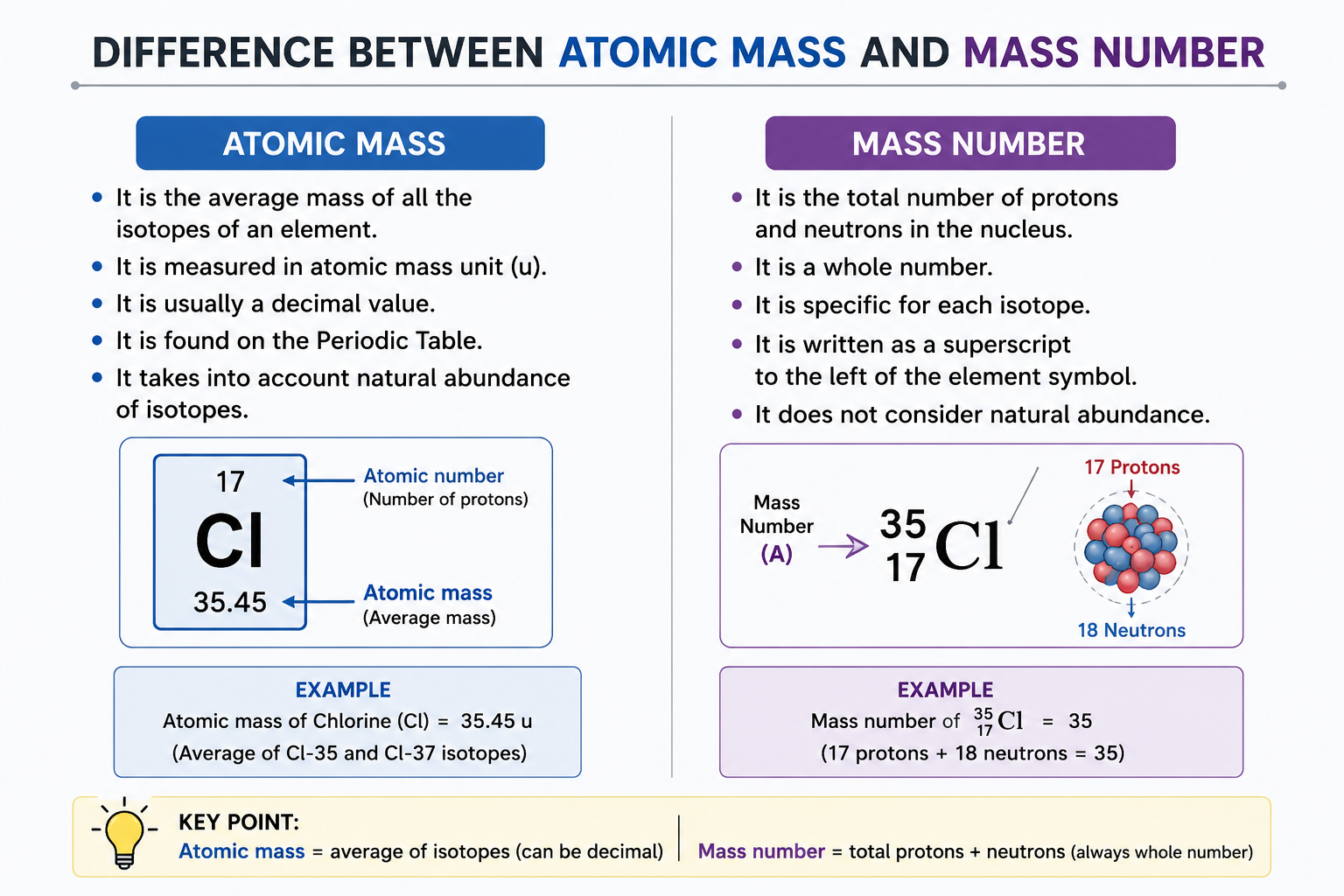
Atomic mass refers to the mass of an atom of a given element, expressed in atomic mass units (amu or u). More specifically, when chemists talk about the atomic mass of an element as shown on the periodic table, they mean the weighted average mass of all the naturally occurring isotopes of that element, taking into account how abundant each isotope is in nature.
Think of it this way. If you wanted to find the “average height” of students in a class, you would not just pick two students and average them. You would account for how many students fall at each height. Atomic mass works the same way — it averages the masses of all isotopes, but gives more importance to the ones that are more common in nature.
This is why the atomic mass of chlorine is 35.45 amu, even though no single chlorine atom has a mass of 35.45. Some chlorine atoms have a mass number of 35, and others have a mass number of 37. The weighted average of those two isotopes, based on their natural abundances, gives 35.45.
Formula
The atomic mass of an element is calculated using the weighted average formula:
Atomic Mass = (Mass of Isotope 1 × Fractional Abundance of Isotope 1) + (Mass of Isotope 2 × Fractional Abundance of Isotope 2) + …
This formula can be extended for as many isotopes as the element has naturally occurring forms.
SI Unit
Atomic mass is measured in atomic mass units, abbreviated as amu or u. One atomic mass unit is defined as exactly one-twelfth of the mass of a carbon-12 atom. In SI terms, 1 amu equals approximately 1.66054 × 10⁻²⁷ kilograms.
Why Atomic Mass Is Important
Atomic mass is the value you use in virtually all quantitative chemistry calculations. When you calculate molar mass, prepare solutions, balance chemical equations involving mass, or determine the number of moles in a sample, you rely on atomic mass. It connects the microscopic world of atoms to the macroscopic world of grams and laboratory measurements. Without it, practical chemistry would be nearly impossible.
What Is Mass Number?
Definition
Mass number is a simple count of the number of protons and neutrons in the nucleus of a specific atom. It is always a whole number because you are literally counting particles — and you cannot have half a proton or half a neutron.
Unlike atomic mass, mass number refers to one specific atom or one specific isotope. Carbon-12 has a mass number of 12. Carbon-14 has a mass number of 14. Both are carbon atoms, but they are different isotopes with different mass numbers.
Formula
Mass Number (A) = Number of Protons (Z) + Number of Neutrons (N)
This is one of the simplest and most useful formulas in all of chemistry. If you know any two of these three values, you can always find the third.
You can rearrange the formula to find the number of neutrons:
Number of Neutrons = Mass Number – Atomic Number
Why Mass Number Is Important
Mass number helps you identify specific isotopes, calculate the number of neutrons in an atom, and understand nuclear reactions. In nuclear chemistry, mass numbers must balance on both sides of a nuclear equation, just as charges do. Mass number is also the number you see written after an element’s name — for example, Carbon-12 or Uranium-235.
Difference Between Atomic Mass and Mass Number (Detailed Comparison Table)
Understanding the distinction between these two concepts becomes much clearer when you lay them side by side in a structured way.
| Feature | Atomic Mass | Mass Number |
|---|---|---|
| Definition | Weighted average mass of all naturally occurring isotopes | Total count of protons and neutrons in one nucleus |
| Type of Value | Decimal number | Always a whole number |
| Unit | Atomic mass units (amu or u) | No unit (dimensionless count) |
| Symbol | Commonly written as Ar or just atomic mass | Written as A |
| Applies To | The element as a whole (all isotopes) | A specific atom or isotope |
| Found on Periodic Table | Yes, shown below the element symbol | No |
| Includes Electrons | Technically yes, but their mass is negligible | No |
| Calculation Method | Weighted average of isotope masses | Simple addition of protons and neutrons |
| Example for Carbon | 12.011 amu | 12 (for Carbon-12), 13 (for Carbon-13), 14 (for Carbon-14) |
| Varies by Isotope | No (it is a fixed average for the element) | Yes (each isotope has its own mass number) |
Atomic Mass vs Atomic Number vs Mass Number (Comparison Table)
Many students also confuse atomic number with both atomic mass and mass number. This three-way comparison helps clarify all three concepts at once.
| Feature | Atomic Number (Z) | Mass Number (A) | Atomic Mass (Ar) |
|---|---|---|---|
| What It Counts/Measures | Number of protons only | Protons plus neutrons | Weighted average mass of all isotopes |
| Type of Value | Whole number | Whole number | Decimal number |
| Unit | No unit | No unit | amu (u) |
| Changes Between Isotopes | No | Yes | No |
| Determines Element Identity | Yes | No | No |
| Found on Periodic Table | Yes (above element symbol) | No | Yes (below element symbol) |
| Example for Chlorine | 17 | 35 or 37 (depending on isotope) | 35.45 amu |
| Example for Oxygen | 8 | 16 (most common isotope) | 15.999 amu |
Formula for Atomic Mass
The general formula for calculating average atomic mass is based on the weighted average principle:
Atomic Mass = Sum of (Isotope Mass × Fractional Abundance)
Fractional abundance is the percentage abundance divided by 100. For example, if an isotope has a natural abundance of 75.77%, its fractional abundance is 0.7577.
For an element with two isotopes, the formula looks like this:
Atomic Mass = (m₁ × f₁) + (m₂ × f₂)
Where m₁ and m₂ are the masses of each isotope, and f₁ and f₂ are their respective fractional abundances. The sum of all fractional abundances must always equal 1.
Formula for Mass Number
The formula for mass number is straightforward:
A = Z + N
Where:
- A = Mass Number
- Z = Atomic Number (number of protons)
- N = Number of neutrons
To find the number of neutrons when you know the mass number and atomic number:
N = A – Z
This rearranged formula is used constantly in problems involving isotopes and nuclear chemistry.
How to Calculate Atomic Mass
Weighted Average Method
The weighted average method accounts for the fact that different isotopes exist in nature in different proportions. An isotope that makes up 90% of all atoms of an element will have a much greater influence on the atomic mass than an isotope that makes up only 10%.
The steps involved are simple once you understand what each value represents.
Step-by-Step Example
Let us calculate the atomic mass of chlorine using its two naturally occurring isotopes.
Given Information:
- Chlorine-35: Mass = 34.969 amu, Natural Abundance = 75.77%
- Chlorine-37: Mass = 36.966 amu, Natural Abundance = 24.23%
Step 1: Convert percentages to fractional abundances.
- Cl-35 fractional abundance = 75.77 ÷ 100 = 0.7577
- Cl-37 fractional abundance = 24.23 ÷ 100 = 0.2423
Step 2: Multiply each isotope mass by its fractional abundance.
- Cl-35 contribution = 34.969 × 0.7577 = 26.496 amu
- Cl-37 contribution = 36.966 × 0.2423 = 8.957 amu
Step 3: Add the contributions together.
- Atomic Mass of Chlorine = 26.496 + 8.957 = 35.453 amu
This matches the value shown on the periodic table (approximately 35.45 amu), which confirms the calculation is correct.
How to Calculate Mass Number
Step-by-Step Example
Calculating mass number is much simpler. You just need to know the number of protons and the number of neutrons.
Example: Find the mass number of an iron atom that has 26 protons and 30 neutrons.
Step 1: Identify the number of protons = 26
Step 2: Identify the number of neutrons = 30
Step 3: Apply the formula.
- Mass Number = 26 + 30 = 56
This isotope is written as Iron-56 or Fe-56. If you needed to find the number of neutrons from the mass number instead, you would subtract the atomic number from the mass number: 56 – 26 = 30 neutrons.
Relationship Between Atomic Number, Mass Number, and Atomic Mass
These three values are deeply connected, and understanding how they relate to one another will make atomic chemistry much more intuitive.
The atomic number defines what element you are dealing with. Every atom of oxygen has exactly 8 protons — if it had 9, it would be fluorine. The atomic number never changes for a given element.
The mass number tells you which specific isotope of that element you are looking at. Two oxygen atoms with different mass numbers are still oxygen, but they have different numbers of neutrons in their nuclei.
The atomic mass is the practical value that represents the element as it actually exists in nature — a mixture of isotopes in specific natural proportions. It is what you use in the laboratory and in calculations.
The relationship between them can be summarized this way: atomic number defines the element, mass number identifies the isotope, and atomic mass describes the element’s average behavior across all its naturally occurring isotopes.
What Are Isotopes?
Isotopes are atoms of the same element that have the same number of protons but different numbers of neutrons. Because they have the same number of protons, they are the same element and have the same chemical properties. But because they have different numbers of neutrons, they have different mass numbers and slightly different physical properties.
Isotopes are the reason atomic mass is a decimal number rather than a whole number. Every element in nature exists as a mixture of its isotopes, and the atomic mass reflects this mixture.
Examples of Isotopes
Carbon Isotopes
Carbon is one of the most well-known examples of isotopes in chemistry and biology.
| Isotope | Protons | Neutrons | Mass Number | Abundance |
|---|---|---|---|---|
| Carbon-12 (C-12) | 6 | 6 | 12 | 98.89% |
| Carbon-13 (C-13) | 6 | 7 | 13 | 1.11% |
| Carbon-14 (C-14) | 6 | 8 | 14 | Trace (radioactive) |
Carbon-12 is used as the standard reference for atomic mass units. Carbon-14 is famously used in radiocarbon dating to determine the age of ancient materials.
Chlorine Isotopes
Chlorine has two stable isotopes that together produce its well-known atomic mass of approximately 35.45 amu.
| Isotope | Protons | Neutrons | Mass Number | Abundance |
|---|---|---|---|---|
| Chlorine-35 (Cl-35) | 17 | 18 | 35 | 75.77% |
| Chlorine-37 (Cl-37) | 17 | 20 | 37 | 24.23% |
The fact that chlorine-35 is about three times more abundant than chlorine-37 is why the average atomic mass of chlorine (35.45) is closer to 35 than to 37.
Hydrogen Isotopes
Hydrogen has three well-known isotopes, and they even have unique names due to their significant differences in mass.
| Isotope | Common Name | Protons | Neutrons | Mass Number | Abundance |
|---|---|---|---|---|---|
| Hydrogen-1 | Protium | 1 | 0 | 1 | 99.98% |
| Hydrogen-2 | Deuterium | 1 | 1 | 2 | 0.02% |
| Hydrogen-3 | Tritium | 1 | 2 | 3 | Trace (radioactive) |
Deuterium is used in heavy water (D₂O), which plays an important role in certain nuclear reactors. Tritium is radioactive and is used in nuclear fusion research.
Why Atomic Mass Is Usually a Decimal Number
This is one of the most common questions students ask, and the answer ties directly back to isotopes. The atomic mass shown on the periodic table is not the mass of any single atom. It is the weighted average of all the naturally occurring isotopes of that element.
Because isotopes occur in nature in specific proportions that are almost never exactly 50/50, the weighted average almost never works out to a clean whole number. Chlorine, for example, is about 75.77% Cl-35 and 24.23% Cl-37. The weighted average of those two values gives 35.45 — a decimal that falls between the two mass numbers.
Even for elements like fluorine, which has only one naturally occurring isotope (F-19), the atomic mass listed is 18.998 rather than exactly 19. This slight deviation comes from the fact that the actual mass of a fluorine-19 nucleus is not exactly 19 times the mass of one amu, due to the nuclear binding energy that holds the nucleus together.
Why Mass Number Is Always a Whole Number
Mass number is a count, plain and simple. You are counting the number of protons and the number of neutrons in the nucleus of a particular atom. Since you cannot have half a proton or half a neutron, the result is always an integer.
This is the clearest conceptual difference between mass number and atomic mass. One is a count; the other is a measurement. A count gives a whole number. A measurement — especially one that averages across multiple isotopes — gives a decimal value.
Atomic Mass on the Periodic Table
If you look at the periodic table, each element’s box contains two numbers. The smaller whole number is the atomic number (Z), which tells you how many protons are in the nucleus. The larger decimal number is the atomic mass (Ar), which gives you the weighted average mass of that element’s naturally occurring isotopes.
For example, in the box for sodium (Na):
- Atomic Number = 11 (11 protons)
- Atomic Mass = 22.990 amu
For carbon (C):
- Atomic Number = 6
- Atomic Mass = 12.011 amu
The atomic mass of 12.011 tells you that carbon exists mostly as Carbon-12 (which has an atomic mass of exactly 12.000 amu by definition), with a small proportion of Carbon-13 pulling the average slightly above 12.
Atomic Mass and Isotopes Explained
The connection between atomic mass and isotopes is not just a technical detail — it is the heart of the concept. Every time you look up the atomic mass of an element, you are looking at a number that reflects the natural distribution of isotopes found on Earth.
Scientists have measured the natural abundances of isotopes with great precision using instruments called mass spectrometers. These machines separate isotopes based on their mass-to-charge ratio, allowing chemists to determine exactly what proportion of each isotope is present in a natural sample.
The International Union of Pure and Applied Chemistry (IUPAC) periodically updates atomic mass values as measurement techniques improve. This is why some periodic tables from different years may show slightly different values for the same element.
Solved Numerical Examples
Example 1
Problem: Boron has two naturally occurring isotopes. Boron-10 has a mass of 10.013 amu and a natural abundance of 19.9%. Boron-11 has a mass of 11.009 amu and a natural abundance of 80.1%. Calculate the atomic mass of boron.
Solution:
Step 1: Convert percentages to fractions.
- B-10: 19.9 ÷ 100 = 0.199
- B-11: 80.1 ÷ 100 = 0.801
Step 2: Multiply mass by fractional abundance.
- B-10 contribution = 10.013 × 0.199 = 1.9926 amu
- B-11 contribution = 11.009 × 0.801 = 8.8182 amu
Step 3: Add the contributions.
- Atomic Mass = 1.9926 + 8.8182 = 10.811 amu
This matches the value shown on the periodic table for boron, confirming the calculation.
Example 2
Problem: An atom of sulfur has 16 protons and 16 neutrons. What is its mass number? How many neutrons would a sulfur-34 atom have?
Solution:
For the first part:
- Mass Number = Protons + Neutrons = 16 + 16 = 32
- This is Sulfur-32 (S-32), the most common isotope of sulfur.
For the second part:
- Number of Neutrons = Mass Number – Atomic Number
- Number of Neutrons = 34 – 16 = 18 neutrons
Example 3
Problem: Magnesium has three naturally occurring isotopes with the following data:
- Mg-24: Mass = 23.985 amu, Abundance = 78.99%
- Mg-25: Mass = 24.986 amu, Abundance = 10.00%
- Mg-26: Mass = 25.983 amu, Abundance = 11.01%
Calculate the average atomic mass of magnesium.
Solution:
Step 1: Convert abundances to fractions.
- Mg-24: 0.7899
- Mg-25: 0.1000
- Mg-26: 0.1101
Step 2: Multiply each mass by its fractional abundance.
- Mg-24: 23.985 × 0.7899 = 18.946 amu
- Mg-25: 24.986 × 0.1000 = 2.499 amu
- Mg-26: 25.983 × 0.1101 = 2.861 amu
Step 3: Sum all contributions.
- Atomic Mass = 18.946 + 2.499 + 2.861 = 24.306 amu
The periodic table lists magnesium’s atomic mass as approximately 24.305 amu, confirming the result.
Common Mistakes Students Make
Over the years, certain errors come up again and again in classroom exams and competitive tests. Being aware of these can save you from losing marks on questions you actually understand.
- Confusing atomic mass with mass number: This is the most frequent mistake. Remember, mass number is always a whole number for a specific isotope. Atomic mass is a decimal representing an average across all isotopes.
- Using atomic mass instead of mass number to find neutrons: To find the number of neutrons, you must subtract the atomic number from the mass number, not from the atomic mass. Using the decimal atomic mass will give you a nonsensical answer.
- Forgetting to convert percentage to fractional abundance: In weighted average calculations, students sometimes multiply by the percentage directly (for example, 75.77) instead of converting it to a decimal first (0.7577). This gives an answer that is 100 times too large.
- Thinking atomic mass applies to one specific atom: It does not. The atomic mass on the periodic table is an average value for the element. No single atom of chlorine has a mass of exactly 35.45 amu.
- Assuming all isotopes of an element have the same mass number: By definition, isotopes have different mass numbers. If two atoms of the same element had the same mass number, they would be identical atoms, not isotopes.
- Ignoring the role of natural abundance: Students sometimes average isotope masses without weighting them by abundance. This only works if all isotopes are equally common, which is almost never the case.
Exam Tips
These practical suggestions are based on how this topic is actually tested in NEET, MDCAT, ECAT, SAT Chemistry, GCSE, and A-Level examinations.
- Always read the question carefully to determine whether it is asking for atomic mass or mass number. They are not interchangeable.
- In any problem asking you to find the number of neutrons, use the formula: Neutrons = Mass Number – Atomic Number.
- When calculating average atomic mass, always check that your fractional abundances add up to 1.00 (or that percentages add up to 100%). If they do not, you have made an error somewhere.
- On multiple choice questions, mass number answers will always be whole numbers. If the answer choices include both whole numbers and decimals, the whole numbers are candidates for mass number questions.
- Learn the isotopes of hydrogen, carbon, and chlorine thoroughly — they appear in exam questions far more often than isotopes of other elements.
- On the periodic table in exams, the decimal value below the element symbol is always the atomic mass, not the mass number.
- If you are given the atomic mass from the periodic table and asked to approximate mass number, simply round to the nearest whole number. This gives the mass number of the most abundant isotope in most cases.
Real-Life Applications
Nuclear Medicine
In nuclear medicine, specific isotopes are used to diagnose and treat diseases. Doctors use Iodine-131 (mass number 131) to treat thyroid cancer, while Technetium-99m (mass number 99) is widely used in diagnostic imaging. The specific mass number matters enormously here because it determines the atom’s nuclear properties, including whether it is radioactive and what type of radiation it emits.
Chemistry Laboratories
Every time a chemist prepares a solution or measures out a substance by mass, they rely on the atomic mass of the elements involved to calculate molar quantities. Without accurate atomic mass values, no calculation involving mass, moles, or concentration would be possible.
Radioisotopes
Radioactive isotopes (radioisotopes) have specific mass numbers that identify them. Carbon-14, with a mass number of 14, is used in radiocarbon dating to determine the age of organic materials. The difference in mass number between Carbon-12 (stable) and Carbon-14 (radioactive) — just two extra neutrons — results in fundamentally different nuclear stability.
Scientific Research
Stable isotope tracers are used extensively in biological and environmental research. Researchers may feed an organism nutrients labeled with a specific isotope (such as Nitrogen-15 instead of the common Nitrogen-14) and then track where those atoms end up in the body. The different mass numbers allow scientists to distinguish labeled atoms from naturally occurring ones using a mass spectrometer.
Common Terms Every Student Should Know
Having a solid vocabulary makes reading chemistry questions and textbooks much easier. Here are the key terms related to this topic.
- Proton: A positively charged subatomic particle found in the nucleus. The number of protons determines the element.
- Neutron: A neutral subatomic particle found in the nucleus alongside protons. Neutrons contribute to the mass of an atom.
- Electron: A negatively charged subatomic particle found outside the nucleus in energy levels or orbitals. Electrons have negligible mass.
- Nucleus: The dense, positively charged center of an atom containing protons and neutrons.
- Isotope: Atoms of the same element with the same number of protons but different numbers of neutrons.
- Nuclide: A specific type of atom characterized by its number of protons and neutrons.
- Atomic Number (Z): The number of protons in an atom. This defines which element the atom belongs to.
- Mass Number (A): The total number of protons and neutrons in the nucleus of a specific atom.
- Atomic Mass (Ar): The weighted average mass of all naturally occurring isotopes of an element, expressed in amu.
- Atomic Mass Unit (amu or u): The unit used to express atomic and molecular masses. One amu is defined as 1/12 the mass of a Carbon-12 atom.
- Natural Abundance: The percentage of a particular isotope that occurs naturally in a sample of the element found on Earth.
- Weighted Average: A type of average that accounts for the relative importance (or frequency) of each value.
- Mass Spectrometer: An instrument used to measure the mass-to-charge ratio of isotopes, used to determine natural abundances.
- Relative Atomic Mass: Another term for atomic mass, emphasizing that it is measured relative to the Carbon-12 standard.
Practice Questions
25 Multiple Choice Questions (MCQs)
- Which of the following is always a whole number?
a) Atomic mass
b) Mass number
c) Relative atomic mass
d) Average atomic mass - The atomic mass of chlorine (35.45 amu) is best described as:
a) The mass of a single chlorine atom
b) The mass of the most abundant isotope
c) The weighted average mass of all naturally occurring isotopes
d) The mass of a chlorine molecule - How many neutrons does Carbon-14 have?
a) 6
b) 7
c) 8
d) 14 - What is the mass number of an atom with 15 protons and 16 neutrons?
a) 16
b) 15
c) 31
d) 30 - The atomic number of an element tells you:
a) The number of neutrons
b) The number of protons
c) The atomic mass
d) The mass number - Which of the following isotopes is used in radiocarbon dating?
a) Carbon-12
b) Carbon-11
c) Carbon-13
d) Carbon-14 - Two isotopes of the same element always have the same:
a) Mass number
b) Number of neutrons
c) Number of protons
d) Atomic mass - What does the symbol “A” represent in nuclear notation?
a) Atomic number
b) Mass number
c) Atomic mass
d) Number of electrons - The number of neutrons in Chlorine-37 is:
a) 17
b) 20
c) 37
d) 18 - Atomic mass is expressed in which unit?
a) Grams
b) Kilograms
c) amu
d) Joules - Which element has isotopes named protium, deuterium, and tritium?
a) Helium
b) Carbon
c) Hydrogen
d) Oxygen - The mass number of the most common isotope of oxygen is:
a) 8
b) 16
c) 17
d) 18 - If an element has atomic number 11 and mass number 23, how many neutrons does it have?
a) 23
b) 11
c) 12
d) 34 - What is the fractional abundance of an isotope with 60% natural abundance?
a) 60
b) 6.0
c) 0.60
d) 0.06 - Carbon-12 is the standard reference for:
a) Atomic number
b) The atomic mass unit
c) Mass number
d) Electron configuration - Which value would you find printed below the element symbol on the periodic table?
a) Mass number
b) Atomic number
c) Atomic mass
d) Number of neutrons - An element has two isotopes: X-6 (7.5%) and X-7 (92.5%). What is the approximate atomic mass?
a) 6
b) 7
c) 6.9
d) 6.5 - How many protons does a uranium-235 atom have?
a) 235
b) 143
c) 92
d) 90 - Isotopes of the same element have different:
a) Atomic numbers
b) Chemical properties
c) Number of neutrons
d) Number of protons - The atomic mass of fluorine is 18.998 amu. This value is not exactly 19 because of:
a) Measurement error
b) Nuclear binding energy effects
c) The presence of multiple isotopes
d) The mass of electrons - Technetium-99m used in medical imaging has a mass number of:
a) 43
b) 99
c) 100
d) 98 - The sum of fractional abundances of all isotopes of an element must equal:
a) 100
b) 10
c) 1
d) 0 - Mass number is also sometimes called:
a) Atomic mass number
b) Nucleon number
c) Proton number
d) Neutron number - Which of the following correctly relates mass number, atomic number, and neutrons?
a) N = A + Z
b) N = A – Z
c) N = Z – A
d) N = A × Z - The atomic mass listed on the periodic table for most elements is a decimal because:
a) Atoms have fractional protons
b) Electrons add fractional mass
c) It represents a weighted average of isotope masses
d) Neutrons have non-integer masses
15 Short Answer Questions
- Define mass number and explain why it is always a whole number.
- What is the difference between atomic mass and relative atomic mass?
- Explain why the atomic mass of chlorine is approximately 35.45 and not 35 or 37.
- What information does the atomic number of an element provide?
- How do you find the number of neutrons in an atom if you know its mass number and atomic number?
- Define isotopes and give two examples from nature.
- Why does the periodic table show atomic mass rather than mass number?
- How is the fractional abundance of an isotope different from its percentage abundance?
- Why are electron masses usually ignored when calculating atomic mass?
- What instrument do scientists use to measure the natural abundance of isotopes?
- Explain why Carbon-14 is useful in determining the age of ancient organic materials.
- What would happen to the atomic mass of an element if a new, heavier isotope were discovered with very high natural abundance?
- Why do isotopes of the same element have the same chemical properties?
- Describe the difference between how atomic number and mass number are used to identify an atom.
- If an element has only one naturally occurring isotope, would its atomic mass be a decimal or a whole number? Explain your answer.
10 Numerical Problems with Solutions
Problem 1: An atom has 17 protons and 18 neutrons. Find its mass number and identify the element.
Solution: Mass Number = 17 + 18 = 35. The element with 17 protons is chlorine. This is Chlorine-35.
Problem 2: Silicon has three isotopes. Si-28 (mass 27.977 amu, abundance 92.23%), Si-29 (mass 28.976 amu, abundance 4.67%), and Si-30 (mass 29.974 amu, abundance 3.10%). Calculate the atomic mass of silicon.
Solution: (27.977 × 0.9223) + (28.976 × 0.0467) + (29.974 × 0.0310) = 25.801 + 1.353 + 0.929 = 28.083 amu
Problem 3: Potassium-39 has 19 protons. How many neutrons does it have?
Solution: Neutrons = 39 – 19 = 20 neutrons
Problem 4: An element has an atomic mass of approximately 6.941 amu and two isotopes: Li-6 (mass 6.015 amu) and Li-7 (mass 7.016 amu). If the abundance of Li-7 is 92.5%, what is the abundance of Li-6, and verify the atomic mass.
Solution: Abundance of Li-6 = 100 – 92.5 = 7.5%, so fractional abundance = 0.075. Atomic Mass = (6.015 × 0.075) + (7.016 × 0.925) = 0.451 + 6.490 = 6.941 amu (confirmed)
Problem 5: How many neutrons are in Uranium-238, which has an atomic number of 92?
Solution: Neutrons = 238 – 92 = 146 neutrons
Problem 6: An unknown element has isotopes with masses 63.929 amu (69.15% abundant) and 65.926 amu (30.85% abundant). Calculate the atomic mass.
Solution: (63.929 × 0.6915) + (65.926 × 0.3085) = 44.207 + 20.338 = 64.545 amu (This is copper, Cu)
Problem 7: Neon has three isotopes: Ne-20 (90.48%), Ne-21 (0.27%), and Ne-22 (9.25%). Using approximate whole-number masses, estimate the atomic mass of neon.
Solution: (20 × 0.9048) + (21 × 0.0027) + (22 × 0.0925) = 18.096 + 0.057 + 2.035 = 20.188 amu
Problem 8: A phosphorus atom (atomic number 15) has 16 neutrons. What is its mass number?
Solution: Mass Number = 15 + 16 = 31
Problem 9: Bromine has two naturally occurring isotopes: Br-79 (mass 78.918 amu, abundance 50.69%) and Br-81 (mass 80.916 amu, abundance 49.31%). Calculate the atomic mass of bromine.
Solution: (78.918 × 0.5069) + (80.916 × 0.4931) = 40.007 + 39.900 = 79.907 amu
Problem 10: If an element’s atomic mass is 40.078 amu and its most common isotope has a mass number of 40, how many protons and neutrons does the most common isotope have if the atomic number is 20?
Solution: Protons = atomic number = 20. Neutrons = mass number – atomic number = 40 – 20 = 20 neutrons. This element is calcium.
Revision Checklist
Use this checklist to confirm your understanding before an exam. Work through each point honestly and revisit any area where you feel uncertain.
- I can define atomic mass in my own words without looking at notes.
- I can define mass number and explain why it is always a whole number.
- I can write the formula for mass number and rearrange it to find the number of neutrons.
- I can write and apply the weighted average formula to calculate atomic mass.
- I can explain why atomic mass is a decimal number and not a whole number for most elements.
- I understand what isotopes are and can give at least three examples with specific details.
- I can identify the atomic number and atomic mass from a standard periodic table entry.
- I understand the difference between atomic number, mass number, and atomic mass.
- I can solve a three-isotope weighted average problem correctly.
- I know why the fractional abundances of all isotopes of an element must sum to 1.
- I can explain the practical difference between atomic mass and mass number when solving neutron-counting problems.
- I know which value to use in mole calculations and laboratory measurements.
- I understand why the atomic mass of Carbon-12 is defined as exactly 12 amu.
- I can describe at least two real-life applications where the distinction between isotopes (and mass numbers) matters.
- I have practiced at least five numerical problems on atomic mass calculation without using a calculator first.
Frequently Asked Questions
1. What is the simplest way to remember the difference between atomic mass and mass number?
Think of it this way: mass number is a count (always a whole number), while atomic mass is a measurement (usually a decimal). Mass number counts protons plus neutrons in one specific atom. Atomic mass measures the average weight across all isotopes of an element.
2. Why does chlorine have an atomic mass of 35.45 if no chlorine atom actually weighs 35.45 amu?
Because 35.45 is a weighted average. About 75.77% of chlorine atoms in nature are Cl-35, and about 24.23% are Cl-37. When you average these two values, accounting for how often each occurs, you get 35.45. No individual atom weighs this amount, but it represents the element as a whole.
3. Can two different elements have the same mass number?
Yes, they can. Atoms of different elements with the same mass number are called isobars. For example, Carbon-14 and Nitrogen-14 are both isobars — they have the same mass number (14) but different atomic numbers (6 and 7 respectively).
4. Do electrons contribute to atomic mass?
Technically yes, but their contribution is so small it is almost always ignored. Each electron has a mass of about 0.000549 amu, which is roughly 1/1836 of a proton’s mass. For most purposes in chemistry, electron masses are considered negligible.
5. Is mass number the same as nucleon number?
Yes. Mass number and nucleon number refer to the same thing — the total number of nucleons (protons and neutrons) in the nucleus of an atom. Both terms are used in different textbooks and curricula.
6. How do scientists determine natural abundance of isotopes?
Scientists use an instrument called a mass spectrometer. It ionizes atoms, accelerates them through a magnetic field, and separates them based on their mass-to-charge ratio. By measuring how many atoms fall into each mass category, scientists can determine the natural abundance of each isotope with great precision.
7. Why is Carbon-12 used as the reference for atomic mass units?
Carbon-12 was chosen as the international reference standard in 1961 because it was easy to produce in pure form, stable, and provided a consistent reference point. One atomic mass unit (amu) is defined as exactly one-twelfth of the mass of a single Carbon-12 atom.
8. Does atomic mass change in a nuclear reaction?
The atomic mass of an element as listed on the periodic table does not change in a chemical reaction, but in nuclear reactions, individual nuclei can gain or lose protons and neutrons, changing both the identity and mass of the atom. Nuclear reactions can also convert mass to energy according to Einstein’s equation E = mc².
9. If I know the mass number and atomic number, how do I find the number of neutrons?
Use the formula: Neutrons = Mass Number – Atomic Number (N = A – Z). For example, if an atom has a mass number of 56 and an atomic number of 26 (iron), it has 56 – 26 = 30 neutrons.
10. Why do some elements have atomic masses that are very close to whole numbers while others are not?
Elements whose most abundant isotope completely dominates the natural mixture have atomic masses very close to whole numbers. For example, fluorine exists almost entirely as F-19, so its atomic mass (18.998) is very close to 19. Elements like chlorine, which exist as a significant mixture of two isotopes, have atomic masses that fall more noticeably between two whole numbers.
11. What is the difference between atomic mass and molar mass?
Atomic mass is the mass of a single atom expressed in atomic mass units (amu). Molar mass is the mass of one mole (6.022 × 10²³ atoms) of an element, expressed in grams per mole (g/mol). Numerically, they have the same value but different units. Carbon’s atomic mass is 12.011 amu, and its molar mass is 12.011 g/mol.
12. Is the atomic mass on the periodic table the same in every country?
Yes. Atomic mass values are standardized internationally by IUPAC (International Union of Pure and Applied Chemistry). The values are based on precise measurements of natural isotope abundances on Earth and are the same regardless of where you are in the world, though very small periodic updates are made as measurement precision improves.
Summary
The difference between atomic mass and mass number is one of those foundational distinctions that every chemistry student must understand clearly before moving on to more advanced topics. These two terms are frequently confused because they sound similar and their values are often close to each other, but they describe fundamentally different things about an atom.
Mass number is a simple count of protons and neutrons in the nucleus of one specific atom or isotope. It is always a whole number, it carries no unit, and it applies to a specific isotope rather than to an element as a whole. You use it to identify isotopes, count neutrons, and work with nuclear equations.
Atomic mass, on the other hand, is the weighted average mass of all naturally occurring isotopes of an element, expressed in atomic mass units. It is almost always a decimal number, it is what you find printed on the periodic table, and it is the value you use in practical laboratory calculations involving moles and mass measurements.
The reason atomic mass is a decimal comes down to isotopes — atoms of the same element with different numbers of neutrons. Because most elements exist in nature as a mixture of isotopes with varying abundances, the weighted average of their masses rarely works out to a perfect whole number. The more dominant one isotope is, the closer the atomic mass will be to a whole number.
Understanding this distinction allows you to correctly identify isotopes, calculate neutron numbers, perform weighted average problems, read the periodic table accurately, and apply these concepts to real-world situations in nuclear medicine, laboratory chemistry, environmental science, and research.
Final Thoughts
Chemistry has a reputation for being filled with confusing terminology, but this particular concept is one that becomes completely clear once you connect the ideas together. The periodic table is not showing you the mass of any single atom — it is showing you a weighted average that reflects the natural world, with all its isotopic diversity included.
Once you understand that atomic mass is really just nature’s way of telling you “here is what a typical sample of this element actually looks like,” the decimal numbers start to make perfect sense. And once you understand that mass number is simply a count of particles in one specific nucleus, you will never confuse the two again.
For students preparing for competitive exams, this topic is virtually guaranteed to appear. The questions are usually straightforward once the concepts are clear, and the calculations are manageable with practice. Work through the numerical examples in this guide, attempt all the practice questions, and use the revision checklist to confirm your understanding.
For teachers and curriculum developers, this topic serves as an excellent gateway to deeper discussions about atomic structure, isotopic notation, nuclear chemistry, and the historical development of the atomic model. The confusion students experience between atomic mass and mass number is often a sign that isotopes have not been introduced clearly enough, and addressing that gap early saves a great deal of confusion later.
If you would like to continue building your understanding of atomic structure, explore related topics on LearnMinto, including our Atomic Structure Study Guide, Periodic Table Study Guide, Electron Configuration Explained, and the dedicated guide on What Are Isotopes.
For additional trusted reference material, the following resources are highly recommended:
- OpenStax Chemistry (openstax.org) — a free, peer-reviewed university-level chemistry textbook
- Khan Academy Chemistry (khanacademy.org) — free video lessons and practice exercises on atomic structure
- Chemistry LibreTexts (chem.libretexts.org) — comprehensive open-access chemistry content for all levels
- American Chemical Society (acs.org) — educational resources and the latest developments in chemistry
- Royal Society of Chemistry (rsc.org) — resources, publications, and educational materials from one of the world’s leading chemistry organizations
Disclaimer
This article is intended for educational and informational purposes only. While LearnMinto strives to provide accurate and up-to-date information, readers should verify important academic concepts through official textbooks, educational institutions, examination boards, or trusted scientific resources before relying on this content for exams or academic purposes. LearnMinto is not affiliated with any specific school, university, research institution, or examination board.