
Introduction
Imagine a store item costs $19.97. When someone asks how much it cost, you would probably say “about $20” rather than reading out every digit. That is rounding in everyday life — replacing an exact number with one that is easier to say, remember, or work with.
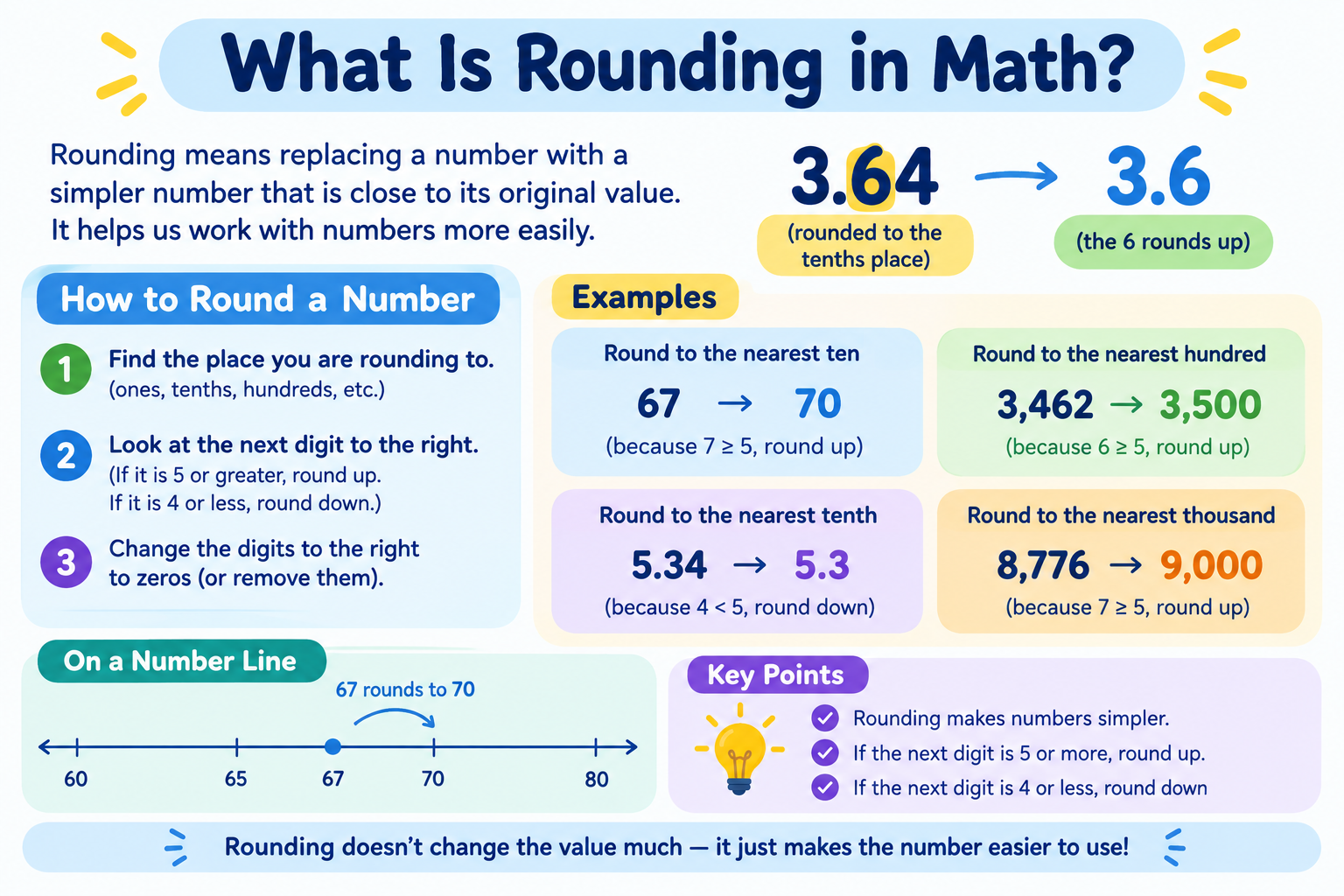
What is rounding in math? Rounding is the process of replacing a number with a nearby value that is simpler, while keeping it as close to the original as possible. The rounded number is not exact, but it is close enough to be useful.
Rounding appears constantly in real life — in shopping, measurements, population figures, distances, and everyday calculations. It also plays a major role in mathematics, especially in estimation, checking answers, and working with decimals.
Key Takeaways
-
Rounding replaces a number with a nearby, simpler value.
-
The core rule: if the digit to the right of the rounding place is 5 or more, round up; if it is 4 or less, round down.
-
When rounding whole numbers, replace all digits to the right of the rounding place with zeros.
-
When rounding decimals, drop all digits to the right of the rounding place.
-
A digit of exactly 5 in the deciding position rounds up under the standard rule taught in most schools.
-
The rounded number should always be close to the original — rounding does not change a number dramatically.
-
Rounding is different from truncation, which simply cuts off digits without considering their value.
What Is Rounding in Math?
Rounding is a way of simplifying a number by replacing it with a value that is close to the original but easier to work with. You are not changing what the number represents completely — you are just finding the nearest “tidy” value at a given place.
For example:
- 47 → 50 (rounded to the nearest ten)
- 43 → 40 (rounded to the nearest ten)
Why do these round differently? Because 47 is closer to 50 than it is to 40, while 43 is closer to 40 than it is to 50. The digit immediately to the right of the rounding place makes that decision.
Rounding always involves a trade-off: you gain simplicity but lose a small amount of precision. The goal is to keep that loss as small as possible, which is why the rounded number should always remain reasonably close to the original.
Understanding rounding well requires a solid grasp of place value. If you want to review how digit positions work, What Is Place Value in Math? on LearnMinto covers it clearly.
How Does Rounding Work?
The process is always the same, regardless of whether you are rounding to the nearest ten, hundred, or decimal place.
The general rounding rule:
- Decide which place you are rounding to (e.g., tens, hundreds, tenths).
- Find the digit in that position.
- Look at the digit immediately to its right.
- If that digit is 0, 1, 2, 3, or 4 — keep the rounding digit unchanged (round down).
- If that digit is 5, 6, 7, 8, or 9 — increase the rounding digit by 1 (round up).
- For whole numbers, replace all digits to the right of the rounding place with zeros.
- For decimals, drop all digits to the right of the rounding place.
The key point is that only one digit determines the rounding decision — the digit immediately to the right. Students sometimes look further along and get confused. You only ever need to look one digit to the right.
The Basic Rounding Rule: 5 or More, Increase
A popular classroom phrase for remembering the rule is:
“5 or more, round up. 4 or less, keep the same.”
Example 1: Round 63 to the nearest ten.
- The tens digit is 6.
- The digit to its right is 3.
- Since 3 < 5, keep the tens digit the same.
- Replace the ones digit with zero.
- Answer: 60
Example 2: Round 67 to the nearest ten.
- The tens digit is 6.
- The digit to its right is 7.
- Since 7 ≥ 5, increase the tens digit by 1: 6 becomes 7.
- Replace the ones digit with zero.
- Answer: 70
The rule is the same every time. Only the position changes.
Rounding to the Nearest Ten
To round to the nearest ten, look at the ones digit. If it is 5 or more, round the tens digit up. If it is 4 or less, keep the tens digit the same. Replace the ones digit with zero.
| Original Number | Tens Digit | Ones Digit (Deciding) | Rounded to Nearest Ten |
|---|---|---|---|
| 21 | 2 | 1 | 20 |
| 24 | 2 | 4 | 20 |
| 25 | 2 | 5 | 30 |
| 31 | 3 | 1 | 30 |
| 46 | 4 | 6 | 50 |
| 54 | 5 | 4 | 50 |
| 65 | 6 | 5 | 70 |
| 72 | 7 | 2 | 70 |
| 89 | 8 | 9 | 90 |
| 95 | 9 | 5 | 100 |
Notice the last example: 95 rounded to the nearest ten gives 100, because increasing the tens digit 9 by 1 carries over into the hundreds place.
Rounding to the Nearest Hundred
To round to the nearest hundred, look at the tens digit. Use the same 5-or-more rule. Replace the tens and ones digits with zeros.
| Original Number | Hundreds Digit | Tens Digit (Deciding) | Rounded to Nearest Hundred |
|---|---|---|---|
| 149 | 1 | 4 | 100 |
| 150 | 1 | 5 | 200 |
| 234 | 2 | 3 | 200 |
| 349 | 3 | 4 | 300 |
| 350 | 3 | 5 | 400 |
| 451 | 4 | 5 | 500 |
| 575 | 5 | 7 | 600 |
| 620 | 6 | 2 | 600 |
| 749 | 7 | 4 | 700 |
| 850 | 8 | 5 | 900 |
The halfway examples here — 150, 350, 451, 850 — all round up because the deciding digit is 5 or more. This is the standard rule applied in most schools.
Rounding to the Nearest Thousand
To round to the nearest thousand, look at the hundreds digit. Apply the same rule. Replace the hundreds, tens, and ones digits with zeros.
| Original Number | Deciding Digit (Hundreds) | Rounded to Nearest Thousand |
|---|---|---|
| 1,249 | 2 | 1,000 |
| 1,500 | 5 | 2,000 |
| 2,349 | 3 | 2,000 |
| 3,650 | 6 | 4,000 |
| 5,499 | 4 | 5,000 |
| 5,500 | 5 | 6,000 |
| 7,825 | 8 | 8,000 |
| 12,450 | 4 | 12,000 |
| 25,600 | 6 | 26,000 |
| 99,500 | 5 | 100,000 |
Again, 99,500 is a useful example — rounding up 99 thousands by 1 gives 100 thousands, which is 100,000.
Rounding to the Nearest Ten Thousand
To round to the nearest ten thousand, look at the thousands digit.
| Original Number | Deciding Digit (Thousands) | Rounded to Nearest Ten Thousand |
|---|---|---|
| 13,200 | 3 | 10,000 |
| 15,000 | 5 | 20,000 |
| 27,499 | 7 | 30,000 |
| 34,500 | 4 | 30,000 |
| 48,750 | 8 | 50,000 |
| 55,000 | 5 | 60,000 |
| 71,350 | 1 | 70,000 |
| 86,499 | 6 | 90,000 |
Notice that 34,500 rounds to 30,000 — the thousands digit is 4, which is less than 5, so the ten-thousands digit stays the same.
Rounding to the Nearest Hundred Thousand
To round to the nearest hundred thousand, look at the ten-thousands digit.
| Original Number | Deciding Digit (Ten Thousands) | Rounded to Nearest Hundred Thousand |
|---|---|---|
| 125,000 | 2 | 100,000 |
| 149,999 | 4 | 100,000 |
| 150,000 | 5 | 200,000 |
| 249,500 | 4 | 200,000 |
| 650,000 | 5 | 700,000 |
| 875,000 | 7 | 900,000 |
Rounding Whole Numbers
This table shows how the same number can be rounded to different places, producing different results each time.
| Original Number | Nearest 10 | Nearest 100 | Nearest 1,000 |
|---|---|---|---|
| 3,456 | 3,460 | 3,500 | 3,000 |
| 7,849 | 7,850 | 7,800 | 8,000 |
| 12,350 | 12,350 | 12,400 | 12,000 |
| 5,072 | 5,070 | 5,100 | 5,000 |
| 24,951 | 24,950 | 25,000 | 25,000 |
Each rounding operation uses a different deciding digit. The result depends on which place you are targeting.
Rounding Decimals
Rounding decimals follows exactly the same logic as rounding whole numbers. The only difference is what happens to the digits on the right: instead of replacing them with zeros, you simply drop them.
This connects naturally to ideas in What Is Expanded Form in Math?, where each decimal digit represents a specific fractional place value.
Nearest whole number: Look at the tenths digit.
Nearest tenth: Look at the hundredths digit.
Nearest hundredth: Look at the thousandths digit.
Nearest thousandth: Look at the ten-thousandths digit.
Rounding to the Nearest Whole Number
| Original Number | Deciding Digit (Tenths) | Rounded to Nearest Whole Number |
|---|---|---|
| 2.1 | 1 | 2 |
| 2.5 | 5 | 3 |
| 4.3 | 3 | 4 |
| 4.7 | 7 | 5 |
| 7.8 | 8 | 8 |
| 9.49 | 4 | 9 |
| 9.51 | 5 | 10 |
| 13.49 | 4 | 13 |
| 13.51 | 5 | 14 |
| 19.95 | 9 | 20 |
The deciding digit for rounding to the nearest whole number is always the tenths digit — the first digit after the decimal point.
Rounding to the Nearest Tenth
To round to the nearest tenth, look at the hundredths digit (the second digit after the decimal point).
| Original Number | Hundredths Digit | Rounded to Nearest Tenth |
|---|---|---|
| 5.25 | 5 | 5.3 |
| 5.24 | 4 | 5.2 |
| 6.74 | 4 | 6.7 |
| 6.78 | 8 | 6.8 |
| 8.456 | 5 | 8.5 |
| 8.432 | 3 | 8.4 |
| 12.678 | 7 | 12.7 |
| 19.995 | 9 | 20.0 |
| 3.050 | 5 | 3.1 |
| 14.341 | 4 | 14.3 |
The last answer — 19.995 rounded to the nearest tenth — gives 20.0. Rounding the tenths digit 9 up by 1 carries forward through the ones and tens.
Rounding to the Nearest Hundredth
To round to the nearest hundredth, look at the thousandths digit (the third digit after the decimal point).
| Original Number | Thousandths Digit | Rounded to Nearest Hundredth |
|---|---|---|
| 3.141 | 1 | 3.14 |
| 5.678 | 8 | 5.68 |
| 9.995 | 5 | 10.00 |
| 12.345 | 5 | 12.35 |
| 18.764 | 4 | 18.76 |
| 7.3329 | 2 | 7.33 |
| 4.509 | 9 | 4.51 |
| 2.716 | 6 | 2.72 |
Notice that 9.995 rounded to the nearest hundredth becomes 10.00 — rounding up the hundredths digit 9 causes a chain of carrying that pushes the result to 10.
Rounding to the Nearest Thousandth
To round to the nearest thousandth, look at the ten-thousandths digit (the fourth digit after the decimal point).
| Original Number | Ten-Thousandths Digit | Rounded to Nearest Thousandth |
|---|---|---|
| 3.14159 | 5 | 3.142 |
| 2.71828 | 2 | 2.718 |
| 6.7891 | 1 | 6.789 |
| 1.4145 | 5 | 1.415 |
| 8.3333 | 3 | 8.333 |
| 0.00049 | 4 | 0.000 |
| 5.6789 | 9 | 5.679 |
| 9.9994 | 4 | 9.999 |
Rounding to the thousandths place is particularly common in scientific measurements and calculations involving What Is a Fraction? converted to decimals.
Rounding Numbers With Zeros
Zeros within a number require care. The zero itself holds a place but the rounding rule still applies in exactly the same way.
1,005 rounded to the nearest hundred:
- Hundreds digit: 0. Tens digit (deciding): 0. Since 0 < 5, round down.
- Answer: 1,000
4,050 rounded to the nearest hundred:
- Hundreds digit: 0. Tens digit (deciding): 5. Since 5 ≥ 5, round up.
- 0 in the hundreds place increases to 1.
- Answer: 4,100
10,049 rounded to the nearest thousand:
- Thousands digit: 0. Hundreds digit (deciding): 0. Since 0 < 5, round down.
- Answer: 10,000
20,500 rounded to the nearest thousand:
- Thousands digit: 0. Hundreds digit (deciding): 5. Since 5 ≥ 5, round up.
- Answer: 21,000
100,005 rounded to the nearest hundred:
- Hundreds digit: 0. Tens digit (deciding): 0. Since 0 < 5, round down.
- Answer: 100,000
Zeros can appear in the deciding position, which usually means rounding down — a detail students sometimes overlook.
Rounding Numbers With a 5
When the deciding digit is exactly 5, the standard rule taught in most classrooms is to round up.
25 rounded to the nearest ten:
- Ones digit is 5. Round up.
- Answer: 30
145 rounded to the nearest ten:
- Ones digit is 5. Round up.
- Answer: 150
145 rounded to the nearest hundred:
- Tens digit is 4. Since 4 < 5, round down.
- Answer: 100
This is an important distinction. The same number can round differently depending on which place you are targeting. When rounding 145 to the nearest ten, the deciding digit is 5 (round up to 150). When rounding 145 to the nearest hundred, the deciding digit is 4 (round down to 100).
Always identify the target place first, then look exactly one digit to the right. Do not let the other digits distract you.
Rounding Up vs Rounding Down
“Rounding up” means increasing the digit in the rounding place by 1. “Rounding down” means keeping the digit in the rounding place exactly as it is.
Neither term refers to the overall number always increasing or decreasing in a dramatic way. Rounding down still gives you a number very close to the original — it simply keeps the rounding digit unchanged.
| Situation | Action | Example |
|---|---|---|
| Deciding digit is 0–4 | Round down (keep rounding digit) | 342 → 300 (nearest hundred) |
| Deciding digit is 5–9 | Round up (increase rounding digit by 1) | 378 → 400 (nearest hundred) |
Both produce a result close to the original number. The difference is simply which nearby rounded value is closer.
Rounding vs Truncation
Truncation means cutting off digits after a certain place, regardless of the value of the digit being removed. It always makes the number smaller in absolute value.
Rounding considers the value of the next digit and either rounds up or down to give the closest result.
| Feature | Rounding | Truncation |
|---|---|---|
| Definition | Replaces with nearest value | Cuts off remaining digits |
| Considers next digit? | Yes | No |
| Always rounds down? | No | Yes (for positive numbers) |
| Example: 3.789 to tenths | 3.8 | 3.7 |
| Example: 5.999 to ones | 6 | 5 |
| More accurate? | Generally yes | Not necessarily |
For most school mathematics, rounding is the appropriate method. Truncation appears more often in computing and certain technical contexts.
Rounding vs Estimation
Rounding and estimation are related but not identical.
Rounding follows a specific rule — look at the digit to the right, apply the 5-or-more rule, and produce a precise rounded result.
Estimation is a broader process of finding an approximate answer using any convenient method, which may or may not involve formal rounding.
For example, to estimate 48 × 21, you might round to 50 × 20 = 1,000. That is estimation using rounding as a tool. But you could also estimate by saying “roughly 48 times 20 is about 960” without strict rounding.
In practice, rounding is the most common technique used inside estimation. Understanding What Is a Multiple? helps students appreciate why rounding to the nearest ten or hundred is so naturally linked to multiples of 10.
Why Is Rounding Important?
Rounding appears in almost every area of daily life.
- Shopping: “$19.97 is about $20” — easier to add up in your head.
- Budgeting: Rounding expenses to the nearest pound or dollar helps with mental arithmetic.
- Measurements: A length of 4.983 m might be recorded as approximately 5 m.
- Population figures: A city’s population of 3,847,219 is commonly reported as about 3.8 million.
- Distances: A journey of 247 km might be described as roughly 250 km.
- Time: A task that takes 58 minutes is often described as “about an hour.”
- Statistics: Data is frequently rounded before being presented in reports or graphs.
- Quick mental calculations: Rounding helps you check whether a calculation result is in the right range.
- Checking answers: If you calculate 49 × 19 and get 2,000, rounding suggests the real answer should be around 50 × 20 = 1,000, flagging that something went wrong.
Common Rounding Mistakes
| Mistake | Incorrect Example | Correct Example |
|---|---|---|
| Looking at the wrong digit | Rounding 3,456 to nearest hundred by looking at ones (6) | Look at tens digit (5) → round up → 3,500 |
| Rounding the wrong place | Rounding 4,782 to nearest hundred gives 4,780 | 4,780 is the nearest ten; nearest hundred is 4,800 |
| Forgetting to replace digits with zeros | 3,678 rounded to nearest hundred = 3,700 written as 3,7 | Must write 3,700 |
| Treating 5 as “round down” | 25 rounded to nearest ten = 20 | 25 → 30 (5 rounds up) |
| Changing digits that should stay the same | 4,321 rounded to nearest hundred → 4,421 | Only the hundreds digit and rightward digits change → 4,300 |
| Confusing rounding with truncation | 5.678 to nearest tenth = 5.6 (by just cutting off) | 5.678 → 5.7 (7 in hundredths rounds up) |
| Dropping decimal zeros incorrectly | 19.995 to nearest tenth = 19.9 | 19.995 → 20.0 (carrying applies) |
| Rounding several digits at once | Rounding 3,456 to nearest ten: changing thousands and hundreds | Only change the tens digit; everything to its right becomes zero |
How to Round a Number Step by Step
Here is a simple method that works for any rounding question:
Step 1: Identify the place you need to round to (tens, hundreds, tenths, etc.).
Step 2: Find the digit in that place.
Step 3: Look at the digit immediately to its right — only this one digit matters for the decision.
Step 4: If that digit is 5 or more, increase the rounding digit by 1. If it is 4 or less, keep the rounding digit unchanged.
Step 5: For whole numbers, replace all digits to the right of the rounding place with zeros. For decimals, drop all digits to the right of the rounding place.
Step 6: Check that your rounded number is close to the original. If it seems very different, re-check your steps.
Example using this method: Round 7,843 to the nearest hundred.
- Step 1: Round to the nearest hundred.
- Step 2: Hundreds digit is 8.
- Step 3: Digit to the right is 4.
- Step 4: 4 < 5 → keep the hundreds digit as 8.
- Step 5: Replace tens and ones with zeros → 7,800.
- Step 6: 7,800 is very close to 7,843. Correct.
Worked Examples
Example 1
Given: Round 38 to the nearest ten.
Rounding to: Nearest ten.
Step 1: Tens digit is 3.
Step 2: Ones digit is 8. Since 8 ≥ 5, round up.
Step 3: 3 + 1 = 4. Replace ones with zero.
Final Answer: 40
Short Explanation: 38 is closer to 40 than to 30.
Example 2
Given: Round 412 to the nearest hundred.
Rounding to: Nearest hundred.
Step 1: Hundreds digit is 4.
Step 2: Tens digit is 1. Since 1 < 5, round down.
Step 3: Keep hundreds digit as 4. Replace tens and ones with zeros.
Final Answer: 400
Short Explanation: 412 is closer to 400 than to 500.
Example 3
Given: Round 6,749 to the nearest thousand.
Rounding to: Nearest thousand.
Step 1: Thousands digit is 6.
Step 2: Hundreds digit is 7. Since 7 ≥ 5, round up.
Step 3: 6 + 1 = 7. Replace hundreds, tens, ones with zeros.
Final Answer: 7,000
Short Explanation: 6,749 is closer to 7,000 than to 6,000.
Example 4
Given: Round 23,450 to the nearest ten thousand.
Rounding to: Nearest ten thousand.
Step 1: Ten-thousands digit is 2.
Step 2: Thousands digit is 3. Since 3 < 5, round down.
Step 3: Keep ten-thousands digit as 2. Replace thousands, hundreds, tens, ones with zeros.
Final Answer: 20,000
Short Explanation: 23,450 is closer to 20,000 than to 30,000.
Example 5
Given: Round 4.3 to the nearest whole number.
Rounding to: Nearest whole number.
Step 1: Ones digit is 4.
Step 2: Tenths digit is 3. Since 3 < 5, round down.
Step 3: Keep ones digit as 4. Drop the decimal part.
Final Answer: 4
Short Explanation: 4.3 is closer to 4 than to 5.
Example 6
Given: Round 4.7 to the nearest whole number.
Rounding to: Nearest whole number.
Step 1: Ones digit is 4.
Step 2: Tenths digit is 7. Since 7 ≥ 5, round up.
Step 3: 4 + 1 = 5. Drop the decimal part.
Final Answer: 5
Short Explanation: 4.7 is closer to 5 than to 4.
Example 7
Given: Round 8.456 to the nearest tenth.
Rounding to: Nearest tenth.
Step 1: Tenths digit is 4.
Step 2: Hundredths digit is 5. Since 5 ≥ 5, round up.
Step 3: 4 + 1 = 5. Drop hundredths and thousandths.
Final Answer: 8.5
Short Explanation: The hundredths digit is 5, so the tenths digit rounds up.
Example 8
Given: Round 12.678 to the nearest tenth.
Rounding to: Nearest tenth.
Step 1: Tenths digit is 6.
Step 2: Hundredths digit is 7. Since 7 ≥ 5, round up.
Step 3: 6 + 1 = 7. Drop remaining digits.
Final Answer: 12.7
Short Explanation: 12.678 is closer to 12.7 than to 12.6.
Example 9
Given: Round 3.141 to the nearest hundredth.
Rounding to: Nearest hundredth.
Step 1: Hundredths digit is 4.
Step 2: Thousandths digit is 1. Since 1 < 5, round down.
Step 3: Keep hundredths digit as 4. Drop the thousandths.
Final Answer: 3.14
Short Explanation: 3.141 is closer to 3.14 than to 3.15.
Example 10
Given: Round 9.995 to the nearest hundredth.
Rounding to: Nearest hundredth.
Step 1: Hundredths digit is 9.
Step 2: Thousandths digit is 5. Since 5 ≥ 5, round up.
Step 3: 9 + 1 = 10 in the hundredths — carry 1 to tenths: 9 + 1 = 10 — carry again to ones: 9 + 1 = 10. Result: 10.00.
Final Answer: 10.00
Short Explanation: Carrying cascades from hundredths through tenths to ones.
Example 11
Given: Round 25 to the nearest ten.
Rounding to: Nearest ten.
Step 1: Tens digit is 2.
Step 2: Ones digit is 5. Since 5 ≥ 5, round up.
Step 3: 2 + 1 = 3. Replace ones with zero.
Final Answer: 30
Short Explanation: When the deciding digit is exactly 5, the standard rule rounds up.
Example 12
Given: Round 145 to the nearest hundred.
Rounding to: Nearest hundred.
Step 1: Hundreds digit is 1.
Step 2: Tens digit is 4. Since 4 < 5, round down.
Step 3: Keep hundreds digit as 1. Replace tens and ones with zeros.
Final Answer: 100
Short Explanation: Even though the ones digit is 5, only the tens digit (4) determines rounding to the nearest hundred.
Example 13
Given: Round 4,050 to the nearest hundred.
Rounding to: Nearest hundred.
Step 1: Hundreds digit is 0.
Step 2: Tens digit is 5. Since 5 ≥ 5, round up.
Step 3: 0 + 1 = 1. Replace tens and ones with zeros.
Final Answer: 4,100
Short Explanation: The zero in the hundreds place rounds up to 1 because the tens digit is 5.
Example 14
Given: Round 99,500 to the nearest thousand.
Rounding to: Nearest thousand.
Step 1: Thousands digit is 9.
Step 2: Hundreds digit is 5. Since 5 ≥ 5, round up.
Step 3: 9 + 1 = 10 — carry 1 to ten thousands: 9 + 1 = 10 — carry 1 to hundred thousands: gives 100,000.
Final Answer: 100,000
Short Explanation: The carrying chain pushes the result all the way to 100,000.
Example 15
Given: Round 875,000 to the nearest hundred thousand.
Rounding to: Nearest hundred thousand.
Step 1: Hundred-thousands digit is 8.
Step 2: Ten-thousands digit is 7. Since 7 ≥ 5, round up.
Step 3: 8 + 1 = 9. Replace remaining places with zeros.
Final Answer: 900,000
Short Explanation: 875,000 is closer to 900,000 than to 800,000.
Example 16
Given: Round 2.71828 to the nearest thousandth.
Rounding to: Nearest thousandth.
Step 1: Thousandths digit is 8.
Step 2: Ten-thousandths digit is 2. Since 2 < 5, round down.
Step 3: Keep thousandths digit as 8. Drop remaining digits.
Final Answer: 2.718
Short Explanation: The ten-thousandths digit (2) means the thousandths digit stays unchanged.
Example 17
Given: Round 0.00049 to the nearest thousandth.
Rounding to: Nearest thousandth.
Step 1: Thousandths digit is 0.
Step 2: Ten-thousandths digit is 4. Since 4 < 5, round down.
Step 3: Keep thousandths digit as 0. Drop remaining digits.
Final Answer: 0.000
Short Explanation: The ten-thousandths digit (4) means the thousandths digit stays as 0.
Example 18
Given: Round 10,049 to the nearest thousand.
Rounding to: Nearest thousand.
Step 1: Thousands digit is 0.
Step 2: Hundreds digit is 0. Since 0 < 5, round down.
Step 3: Keep thousands digit as 0. Replace hundreds, tens, ones with zeros.
Final Answer: 10,000
Short Explanation: Both the thousands and hundreds digits are zero; the hundreds digit (0) means round down.
Example 19
Given: Round 19.995 to the nearest tenth.
Rounding to: Nearest tenth.
Step 1: Tenths digit is 9.
Step 2: Hundredths digit is 9. Since 9 ≥ 5, round up.
Step 3: 9 + 1 = 10 in the tenths — carry 1 to ones: 9 + 1 = 10 — carry 1 to tens: 1 + 1 = 2. Result: 20.0.
Final Answer: 20.0
Short Explanation: Repeated carrying turns 19.995 into 20.0 when rounded to the nearest tenth.
Example 20
Given: Round 34,500 to the nearest ten thousand.
Rounding to: Nearest ten thousand.
Step 1: Ten-thousands digit is 3.
Step 2: Thousands digit is 4. Since 4 < 5, round down.
Step 3: Keep ten-thousands digit as 3. Replace remaining digits with zeros.
Final Answer: 30,000
Short Explanation: The thousands digit is 4, which means the ten-thousands digit stays unchanged.
Practice Questions
15 Rounding Questions
- Round 78 to the nearest ten.
- Round 543 to the nearest hundred.
- Round 3,275 to the nearest thousand.
- Round 48,620 to the nearest ten thousand.
- Round 235,000 to the nearest hundred thousand.
- Round 6.4 to the nearest whole number.
- Round 6.5 to the nearest whole number.
- Round 9.72 to the nearest tenth.
- Round 4.836 to the nearest hundredth.
- Round 2.7182 to the nearest thousandth.
- Round 305 to the nearest hundred.
- Round 7,500 to the nearest thousand.
- Round 19.995 to the nearest hundredth.
- Round 450 to the nearest hundred.
- Round 99,999 to the nearest thousand.
Answers:
- 80
Explanation: Ones digit is 8. Since 8 ≥ 5, round up. 70 + 10 = 80. - 500
Explanation: Tens digit is 4. Since 4 < 5, round down. Hundreds digit stays as 5, giving 500. - 3,000
Explanation: Hundreds digit is 2. Since 2 < 5, round down. Thousands digit stays as 3. - 50,000
Explanation: Thousands digit is 8. Since 8 ≥ 5, round up. Ten-thousands digit 4 becomes 5. - 200,000
Explanation: Ten-thousands digit is 3. Since 3 < 5, round down. Hundred-thousands digit stays as 2. - 6
Explanation: Tenths digit is 4. Since 4 < 5, round down. Ones digit stays as 6. - 7
Explanation: Tenths digit is 5. Since 5 ≥ 5, round up. 6 + 1 = 7. - 9.7
Explanation: Hundredths digit is 2. Since 2 < 5, round down. Tenths digit stays as 7. - 4.84
Explanation: Thousandths digit is 6. Since 6 ≥ 5, round up. 3 + 1 = 4 in the hundredths place. - 2.718
Explanation: Ten-thousandths digit is 2. Since 2 < 5, round down. Thousandths digit stays as 8. - 300
Explanation: Tens digit is 0. Since 0 < 5, round down. Hundreds digit stays as 3. - 8,000
Explanation: Hundreds digit is 5. Since 5 ≥ 5, round up. Thousands digit 7 becomes 8. - 20.00
Explanation: Thousandths digit is 5. Round up hundredths: 9 + 1 = 10. Carry into tenths: 9 + 1 = 10. Carry into ones: 9 + 1 = 10. Carry into tens: 1 + 1 = 2. Result: 20.00. - 500
Explanation: Tens digit is 5. Since 5 ≥ 5, round up. Hundreds digit 4 becomes 5. - 100,000
Explanation: Hundreds digit is 9. Since 9 ≥ 5, round up. Thousands digit 9 + 1 = 10 — carry through all places. Result: 100,000.
10 Multiple Choice Questions
Question 1
Round 763 to the nearest hundred.
A. 700
B. 760
C. 800
D. 750
Correct Answer: C
Short Explanation: The tens digit is 6. Since 6 ≥ 5, the hundreds digit rounds up: 7 + 1 = 8. Result: 800.
Question 2
Which is the correct rounding of 4.85 to the nearest tenth?
A. 4.8
B. 4.9
C. 5.0
D. 4.85
Correct Answer: B
Short Explanation: The hundredths digit is 5. Since 5 ≥ 5, the tenths digit rounds up: 8 + 1 = 9. Result: 4.9.
Question 3
Round 5,499 to the nearest thousand.
A. 5,000
B. 5,500
C. 6,000
D. 4,000
Correct Answer: A
Short Explanation: The hundreds digit is 4. Since 4 < 5, round down. Thousands digit stays as 5. Result: 5,000.
Question 4
What is 35 rounded to the nearest ten?
A. 30
B. 35
C. 40
D. 45
Correct Answer: C
Short Explanation: The ones digit is 5. Since 5 ≥ 5, round up. 3 + 1 = 4 in the tens place. Result: 40.
Question 5
Which number correctly rounds 12.345 to the nearest hundredth?
A. 12.3
B. 12.34
C. 12.35
D. 12.4
Correct Answer: C
Short Explanation: The thousandths digit is 5. Since 5 ≥ 5, the hundredths digit rounds up: 4 + 1 = 5. Result: 12.35.
Question 6
A student rounds 4,050 to the nearest thousand and gets 4,000. Are they correct?
A. Yes, because 0 in the hundreds place means round down.
B. No, the answer is 5,000.
C. No, the answer is 4,100.
D. Yes, because 50 is less than 500.
Correct Answer: A
Short Explanation: The hundreds digit is 0. Since 0 < 5, round down. Thousands digit stays as 4. Result: 4,000.
Question 7
Round 149,999 to the nearest hundred thousand.
A. 100,000
B. 149,000
C. 150,000
D. 200,000
Correct Answer: A
Short Explanation: The ten-thousands digit is 4. Since 4 < 5, the hundred-thousands digit stays as 1. Result: 100,000.
Question 8
What is 9.996 rounded to the nearest hundredth?
A. 9.99
B. 10.00
C. 9.90
D. 10.01
Correct Answer: B
Short Explanation: Thousandths digit is 6. Round up hundredths: 9 + 1 = 10. Carry into tenths: 9 + 1 = 10. Carry into ones: 9 + 1 = 10. Result: 10.00.
Question 9
Which of the following shows correct rounding to the nearest ten?
A. 85 → 80
B. 94 → 100
C. 72 → 70
D. 65 → 60
Correct Answer: C
Short Explanation: For 72, the ones digit is 2. Since 2 < 5, round down. Result: 70. (A is wrong because 85 → 90; B is wrong because 94 → 90; D is wrong because 65 → 70.)
Question 10
A student says 3.141 rounded to the nearest tenth is 3.2. Are they correct?
A. Yes.
B. No — the answer is 3.1.
C. No — the answer is 3.0.
D. No — the answer is 3.14.
Correct Answer: B
Short Explanation: The hundredths digit is 4. Since 4 < 5, the tenths digit (1) stays unchanged. Result: 3.1.
10 Mixed Practice Problems
Problem 1: Round 257 to the nearest ten.
Solution: Ones digit is 7. Since 7 ≥ 5, round up. Tens digit 5 + 1 = 6. Answer: 260
Problem 2: Round 6,350 to the nearest hundred.
Solution: Tens digit is 5. Since 5 ≥ 5, round up. Hundreds digit 3 + 1 = 4. Answer: 6,400
Problem 3: Round 0.473 to the nearest hundredth.
Solution: Thousandths digit is 3. Since 3 < 5, round down. Hundredths digit stays as 7. Answer: 0.47
Problem 4: Round 88,500 to the nearest thousand.
Solution: Hundreds digit is 5. Since 5 ≥ 5, round up. Thousands digit 8 + 1 = 9. Answer: 89,000
Problem 5: Round 3.055 to the nearest tenth.
Solution: Hundredths digit is 5. Since 5 ≥ 5, round up. Tenths digit 0 + 1 = 1. Answer: 3.1
Problem 6: Round 1,004 to the nearest hundred.
Solution: Tens digit is 0. Since 0 < 5, round down. Hundreds digit stays as 0. Answer: 1,000
Problem 7: Round 7.995 to the nearest tenth.
Solution: Hundredths digit is 9. Since 9 ≥ 5, round up. Tenths digit 9 + 1 = 10 — carry to ones: 7 + 1 = 8. Answer: 8.0
Problem 8: Round 54,321 to the nearest ten thousand.
Solution: Thousands digit is 4. Since 4 < 5, round down. Ten-thousands digit stays as 5. Answer: 50,000
Problem 9: Round 12.348 to the nearest hundredth.
Solution: Thousandths digit is 8. Since 8 ≥ 5, round up. Hundredths digit 4 + 1 = 5. Answer: 12.35
Problem 10: Round 999,501 to the nearest thousand.
Solution: Hundreds digit is 5. Since 5 ≥ 5, round up. Thousands digit 9 + 1 = 10 — carry to ten-thousands: 9 + 1 = 10 — carry to hundred-thousands: 9 + 1 = 10 — carry to millions: 0 + 1 = 1. Answer: 1,000,000
5 Challenge Questions
Challenge 1: A number rounded to the nearest hundred is 4,600. What could the original number be? Give three possibilities.
Solution:
The original number must have its tens digit ≥ 5 (if it was 4,551 or above, it rounds to 4,600) or tens digit < 5 and hundreds digit already 6 (from 4,550 to 4,649).
More precisely, any number from 4,550 to 4,649 rounds to 4,600.
Three possibilities: 4,550 | 4,600 | 4,631
Challenge 2: Round 4,999,500 to the nearest million.
Solution:
Millions digit: 4. Hundred-thousands digit (deciding): 9. Since 9 ≥ 5, round up. 4 + 1 = 5.
Answer: 5,000,000
Challenge 3: A decimal number rounded to the nearest hundredth is 7.35. What is the smallest possible original number?
Solution:
For rounding to give 7.35, the thousandths digit must be 5 or more, and the hundredths digit is 5 (or the hundredths digit is 4 and rounds up to 5).
The smallest possible original number before rounding up to 7.35 would be where the hundredths digit is 4 and thousandths is 5: that would give 7.34something → rounds to 7.35 only if hundredths rounds up… Let’s reconsider.
For a number to round to 7.35 at the nearest hundredth:
- The hundredths digit must be 5 and the thousandths digit can be anything 0–4 (stay at 7.35), OR
- The hundredths digit is 4 and thousandths digit ≥ 5 (round up to 7.35).
Smallest possibility: 7.345 (thousandths digit is 5, rounds hundredths 4 up to 5, giving 7.35).
Answer: 7.345
Challenge 4: A distance is measured as 24.675 km. Round this to (a) the nearest kilometre, (b) the nearest tenth of a kilometre, and (c) the nearest hundredth of a kilometre.
Solution:
(a) Nearest kilometre: tenths digit is 6. Since 6 ≥ 5, round up. 25 km
(b) Nearest tenth: hundredths digit is 7. Since 7 ≥ 5, round up. 24.7 km
(c) Nearest hundredth: thousandths digit is 5. Since 5 ≥ 5, round up. 24.68 km
Challenge 5: A student estimates the total cost of 38 items at $19.95 each. Round each value to the nearest ten and use the rounded values to estimate the total.
Solution:
Round 38 to the nearest ten: 40
Round $19.95 to the nearest ten: $20
Estimated total: 40 × $20 = $800
(Exact total for comparison: 38 × $19.95 = $758.10 — so the estimate gives a reasonable approximation, though rounding both numbers up makes it slightly high.)
Exam Tips for Rounding
- Read the question carefully first. Identify exactly which place you are rounding to — this is the most common source of errors.
- Find the right digit, then look one to the right. Never look further than one place to the right of the rounding position.
- Apply the 0–4 and 5–9 rule. Digits 0, 1, 2, 3, 4 → keep the rounding digit the same. Digits 5, 6, 7, 8, 9 → increase the rounding digit by 1.
- Replace whole-number digits with zeros. After rounding, digits to the right of the rounding place become zeros — do not drop them.
- Drop decimal digits correctly. When rounding decimals, remove digits to the right of the rounding place entirely — do not replace them with zeros.
- Watch out for carrying. If rounding up a digit 9, you will need to carry — work through this carefully.
- Re-read the question before writing your final answer. Check that you rounded to the correct place and that your answer looks reasonable.
- Check your answer is close to the original. If your rounded answer looks very different from the original number, reconsider your steps.
Quick Revision Notes
- Rounding: Replacing a number with a nearby, simpler value based on the digit immediately to its right.
- Core rule: Digit to the right is 5 or more → round up. Digit to the right is 4 or less → round down.
- Nearest ten: Look at the ones digit.
- Nearest hundred: Look at the tens digit.
- Nearest thousand: Look at the hundreds digit.
- Decimal rounding: Same rule applies — look one place to the right of the target place.
- Rounding to whole numbers: Look at the tenths digit.
- Rounding to tenths: Look at the hundredths digit.
- Rounding to hundredths: Look at the thousandths digit.
- Rounding to thousandths: Look at the ten-thousandths digit.
- Common mistakes: Looking at the wrong digit, forgetting to write zeros, treating 5 as “round down,” confusing rounding with truncation.
Rounding Cheat Sheet
| Rounding To | Look At | What Happens |
|---|---|---|
| Nearest 10 | Ones digit | If ≥ 5, add 10 and make ones = 0. If < 5, make ones = 0 and keep tens. |
| Nearest 100 | Tens digit | If ≥ 5, add 100 and make tens and ones = 0. If < 5, make tens and ones = 0. |
| Nearest 1,000 | Hundreds digit | If ≥ 5, add 1,000 and make hundreds, tens, ones = 0. If < 5, make those places = 0. |
| Nearest whole number | Tenths digit | If ≥ 5, add 1 to the ones. Drop the decimal. |
| Nearest tenth | Hundredths digit | If ≥ 5, add 0.1 to the tenths. Drop remaining decimals. |
| Nearest hundredth | Thousandths digit | If ≥ 5, add 0.01 to the hundredths. Drop remaining decimals. |
| Nearest thousandth | Ten-thousandths digit | If ≥ 5, add 0.001 to the thousandths. Drop remaining decimals. |
Frequently Asked Questions
1. What is rounding in math?
Rounding is the process of replacing a number with a nearby value that is simpler, based on the digit immediately to the right of the place being rounded.
2. What are the basic rules of rounding?
If the deciding digit (one place to the right of the rounding position) is 5 or more, round up. If it is 4 or less, round down.
3. What does “5 or more, round up” mean?
It means that when the digit immediately to the right of the rounding position is 5, 6, 7, 8, or 9, you increase the rounding digit by 1.
4. What does “4 or less” mean in rounding?
It means that when the deciding digit is 0, 1, 2, 3, or 4, you keep the rounding digit exactly as it is.
5. How do you round to the nearest ten?
Look at the ones digit. If it is 5 or more, add 10 and replace the ones digit with zero. If it is 4 or less, simply replace the ones digit with zero.
6. How do you round to the nearest hundred?
Look at the tens digit. If it is 5 or more, increase the hundreds digit by 1. Replace the tens and ones digits with zeros.
7. How do you round to the nearest thousand?
Look at the hundreds digit. If it is 5 or more, increase the thousands digit by 1. Replace the hundreds, tens, and ones digits with zeros.
8. How do you round decimals?
Use the same rule. Identify the target place, look one digit to the right, apply the 5-or-more rule, and drop all digits to the right of the target place.
9. How do you round to the nearest tenth?
Look at the hundredths digit. If it is 5 or more, increase the tenths digit by 1. Drop all digits to the right.
10. How do you round to the nearest hundredth?
Look at the thousandths digit. If it is 5 or more, increase the hundredths digit by 1. Drop all digits to the right.
11. What happens when the deciding digit is exactly 5?
Under the standard rule taught in most schools, a deciding digit of 5 rounds up. For example, 25 rounded to the nearest ten gives 30.
12. Why do we use rounding in math?
Rounding makes numbers easier to work with. It is used in estimation, measurements, financial calculations, statistics, and checking whether answers are reasonable.
13. What is the difference between rounding and estimation?
Rounding follows a specific rule to produce a precise rounded value. Estimation is a broader process of finding an approximate answer, which may use rounding as one of its tools.
14. What is the difference between rounding and truncation?
Rounding considers the value of the next digit and rounds to the nearest value. Truncation simply cuts off digits without considering them, always producing a result that is less than or equal to the original (for positive numbers).
15. How can students remember rounding rules?
The phrase “5 or more, round up; 4 or less, keep the same” is widely used. Practising with a range of numbers — including those with zeros and those ending in 5 — builds reliable habit and confidence.
Summary
Rounding is a straightforward but genuinely important mathematical skill. The idea is simple: when you need a number that is easier to work with, you replace it with the nearest clean value at the place you choose.
The rule never changes. Look at the digit immediately to the right of the place you are rounding to. If it is 5 or more, increase the rounding digit by 1. If it is 4 or less, leave the rounding digit alone. For whole numbers, fill the remaining positions with zeros. For decimals, drop the remaining digits.
Zeros need particular attention — they can appear in the deciding position (which usually means round down) or in the rounding position itself (which still rounds up when the deciding digit says so). Numbers ending in 5 always round up under the standard rule.
Rounding connects directly to place value — something covered in detail in What Is Place Value in Math? — and to the way numbers are structured, which you can explore further through What Is Expanded Form in Math?. Understanding these ideas together gives students a much stronger foundation for arithmetic and beyond.
Final Thoughts
Rounding is one of those mathematical skills that quietly shows up everywhere — from reading a price tag to interpreting a statistics report. Learning to round confidently means you can make quick estimates, check whether your answers are in the right ballpark, and handle measurements without being overwhelmed by unnecessary precision.
The rules are few and consistent. Once you understand why they work — because you are always choosing the closest rounded value — they stop being something to memorise and start being something you naturally understand. That is when rounding becomes genuinely useful rather than just another exam topic.
Practise with a variety of numbers, pay attention to zeros, and always double-check which digit you are looking at. Those habits alone will prevent the vast majority of rounding errors students commonly make.
References
- Khan Academy — Rounding Whole Numbers and Decimals: https://www.khanacademy.org
- OpenStax Prealgebra — Rounding and Estimation: https://openstax.org
- Mathematics LibreTexts — Rounding Numbers: https://math.libretexts.org
- National Council of Teachers of Mathematics (NCTM): https://www.nctm.org
- Encyclopaedia Britannica — Rounding: https://www.britannica.com
Helpful Resources
Khan Academy — Rounding Whole Numbers and Decimals
Students can watch video lessons and complete interactive practice exercises on rounding whole numbers, rounding decimals, and estimation.
https://www.khanacademy.org
OpenStax Prealgebra
A free, peer-reviewed textbook with clear explanations of rounding, place value, and estimation for students at elementary through early secondary level.
https://openstax.org
Mathematics LibreTexts — Elementary Mathematics
Provides structured, readable coverage of rounding rules, decimal place value, and number sense, suitable for students and self-learners.
https://math.libretexts.org
National Council of Teachers of Mathematics (NCTM)
Offers educator-reviewed teaching standards and classroom resources for building number sense, rounding skills, and estimation strategies.
https://www.nctm.org
Disclaimer:
This article is intended for educational and informational purposes only. While LearnMinto strives to provide accurate and up-to-date mathematics information, readers should verify important academic concepts through official textbooks, educational institutions, examination boards, or trusted educational resources before using this content for exams or academic purposes. LearnMinto is not affiliated with any specific school, university, research institution, or examination board.
About the Author
Saad Qureshi is a Senior Education & Technology Editor at LearnMinto. He focuses on creating and reviewing clear, accessible educational content across mathematics, physics, chemistry, biology, computer science, technology, AI tools, and personal finance.