
Introduction
When students first encounter atomic structure in chemistry, the terms isotopes, isobars, and isotones tend to blur together. Isotopes are usually introduced first and get the most attention. Isobars follow. But isotones? They often get the least coverage, even though they are just as important for building a complete understanding of nuclear species and atomic composition.
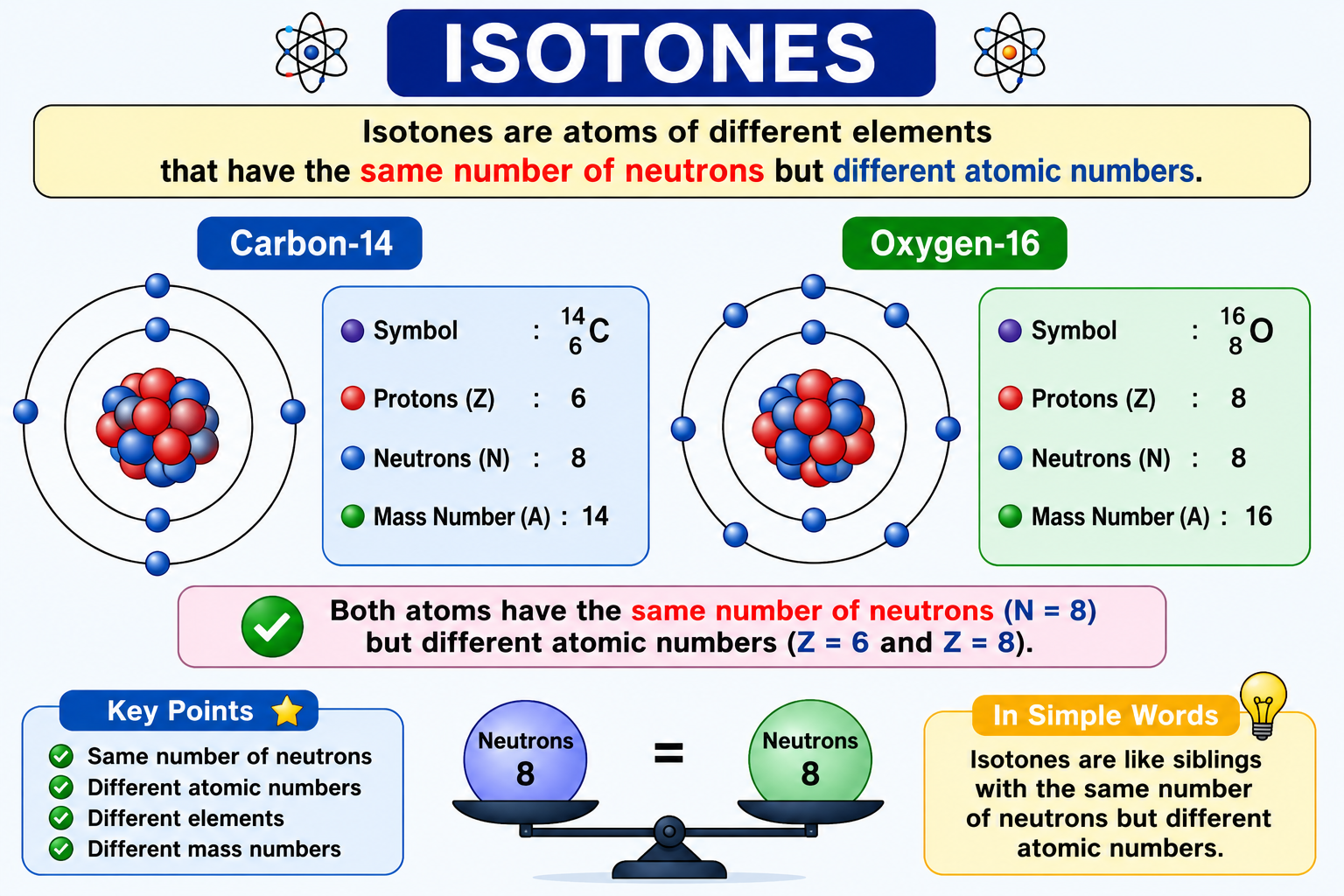
So, what are isotones? In straightforward terms, isotones are atoms of different elements that have the same number of neutrons but different atomic numbers and different mass numbers. The word “isotone” sounds a lot like “isotope,” which is part of why students mix them up — but they are based on entirely different ideas.
This guide was written specifically for students preparing for NEET, MDCAT, ECAT, GCSE, A-Level chemistry, and general academic study. Whether you are encountering isotones for the first time or reviewing the concept before a major exam, this article covers everything you need: clear definitions, worked examples, comparison tables, practice questions, and real-life applications.
Understanding isotones also strengthens your grasp of nuclear chemistry and atomic structure as a whole. The neutron number — which is what isotones have in common — plays a critical role in nuclear stability, binding energy, and radioactive decay patterns. So while isotones might seem like a niche concept at first, they connect to some very important ideas in both chemistry and physics.
We will build this topic step by step, starting with the definition and working our way through to exam-ready practice questions. Let us get into it.
Key Takeaways
Before we go into the full detail, here is a quick overview of the most important points this article covers:
- Isotones are atoms of different elements that have the same number of neutrons but different atomic numbers and different mass numbers.
- They are defined entirely by their neutron count — the one thing they share.
- Since they have different atomic numbers, isotones belong to completely different elements.
- They have different chemical properties because chemical behavior is governed by electron configuration, which depends on proton count.
- Classic isotone examples include Carbon-14 and Nitrogen-15, Oxygen-16 and Fluorine-17, and Silicon-30 and Phosphorus-31.
- Isotones differ from isotopes (same atomic number, different mass number) and isobars (same mass number, different atomic number).
- Isotones are regularly tested in NEET, MDCAT, ECAT, GCSE, and A-Level examinations.
- The concept of isotones is relevant in nuclear physics research, nuclear stability studies, and comparative nuclear structure analysis.
What Are Isotones?
Definition
Isotones are defined as atoms of two or more different elements that have the same number of neutrons but different atomic numbers and different mass numbers. The neutron number is represented by the symbol N, and for two atoms to qualify as isotones, their value of N must be identical while both their atomic number (Z) and mass number (A) must differ.
More formally:
For two atoms X and Y to be isotones: Neutron number of X = Neutron number of Y, but Atomic number of X is not equal to Atomic number of Y, and Mass number of X is not equal to Mass number of Y.
Since neutrons = mass number minus atomic number, the condition can also be written as:
A1 – Z1 = A2 – Z2 = N (constant, the shared neutron number)
Simple Explanation
Here is a way to think about it without the formulas. Picture two different people who both own exactly 8 books each. They own the same number of books, but everything else about them — their names, where they live, what they do — is completely different. Isotones are similar. Two atoms can have exactly the same count of neutrons in their nuclei, but still be entirely different elements because they have different numbers of protons.
The number of protons determines what element an atom is. Change the proton count, and you change the element entirely. So even though isotones share their neutron number, they are not versions of the same element. They sit at different addresses on the periodic table, have different chemical behaviors, and look nothing alike in terms of their atomic properties — aside from that one shared neutron count.
Why Are Isotones Important?
At first glance, isotones might seem like a purely academic concept — just another item on a list of atomic classification terms. But they actually matter in some meaningful ways, particularly in nuclear science.
Nuclear stability is strongly influenced by the neutron-to-proton ratio in a nucleus. When studying groups of isotones, scientists can compare nuclides that share the same neutron count but have different proton counts. This allows researchers to isolate the effect of adding protons while keeping neutrons constant — which gives insight into how protons affect nuclear binding energy and stability.
In nuclear shell theory, certain neutron numbers (known as magic numbers) are associated with especially stable nuclei. Isotones that share one of these magic neutron numbers — such as N = 8, 20, 28, 50, or 82 — all tend to show enhanced nuclear stability. Understanding isotones helps nuclear physicists identify and study these patterns.
For students, the importance of isotones is simpler and more immediate: they appear on exams. The ability to quickly identify isotones, distinguish them from isotopes and isobars, and calculate neutron numbers correctly is a testable skill at virtually every level of chemistry and physics education.
History of Isotones
The concept of isotones developed alongside the broader classification of nuclear species in the early twentieth century. Before the neutron was discovered, scientists could only classify atomic species by their mass and charge. The discovery of the neutron by James Chadwick in 1932 was the event that made isotone classification possible, because isotones are defined entirely by neutron count — and you cannot count neutrons if you do not know they exist.
Following Chadwick’s discovery, scientists began systematically categorizing nuclides by their proton count (isotopes), their mass number (isobars), and their neutron count (isotones). The term “isotone” itself was coined to complement “isotope” and “isobar” in the growing vocabulary of nuclear science.
The significance of isotones became more apparent as nuclear shell theory developed through the 1940s and 1950s. Physicists Maria Goeppert Mayer and J. Hans D. Jensen, who shared the Nobel Prize in Physics in 1963, developed the nuclear shell model. Their work revealed that nuclei with specific proton or neutron numbers — the magic numbers — were especially stable. The concept of isotones was central to identifying neutron-based magic numbers, since all the nuclei with a given magic neutron number form an isotone group.
Characteristics of Isotones
Knowing the key characteristics of isotones is essential for answering exam questions accurately and confidently. Here is what defines them:
- Same neutron number (N): The defining feature. Both atoms contain exactly the same number of neutrons in their nuclei.
- Different atomic numbers (Z): Each isotone belongs to a different element and occupies a different position on the periodic table.
- Different mass numbers (A): Since A = Z + N, and both Z and N are different between isotones (with N being the same), the mass numbers must differ.
- Different numbers of protons: Directly linked to different atomic numbers. Different proton counts mean different elements.
- Different numbers of electrons (in neutral atoms): Since electron count equals proton count in a neutral atom, different atomic numbers mean different electron counts.
- Different chemical properties: Chemical behavior is governed by electron configuration. Since isotones have different numbers of electrons, they react differently, form different compounds, and have different valence characteristics.
- Different physical properties: Melting points, boiling points, densities, and other physical characteristics all differ between isotones.
- Potential relevance to nuclear stability studies: Isotones that share a magic neutron number all tend to be more stable than their neighbors, making them useful for studying nuclear shell structure.
How to Identify Isotones
The process of identifying isotones is straightforward once you understand what to look for. Everything comes down to comparing neutron numbers.
Atomic Number
The atomic number (Z) identifies the element and tells you the number of protons. For two atoms to be isotones, their atomic numbers must be different. If the atomic numbers are the same, you are looking at isotopes, not isotones.
Mass Number
The mass number (A) is the sum of protons and neutrons. For isotones, the mass numbers must also be different. This distinguishes isotones from isobars, where the mass numbers are the same.
Number of Protons
Since the atomic number equals the number of protons, isotones always have a different number of protons. The proton count changes the element identity completely.
Number of Neutrons
This is the heart of the isotone definition. The number of neutrons must be identical for two atoms to be isotones. Calculate the neutron number using:
Number of Neutrons (N) = Mass Number (A) – Atomic Number (Z)
If the neutron counts match and everything else differs, you have found isotones.
Number of Electrons
In a neutral atom, electrons equal protons. Since isotones have different proton counts, they also have different numbers of electrons. This explains why their chemical properties are so different despite sharing the same neutron number.
Formula Related to Isotones
Neutron Number Formula
The most fundamental formula for working with isotones is:
N = A – Z
Where:
- N = Number of neutrons
- A = Mass number (total protons + neutrons)
- Z = Atomic number (number of protons)
For two atoms to be isotones, their N values must be equal:
A1 – Z1 = A2 – Z2
This equation is the mathematical test for isotone relationships.
Mass Number Formula
Since A = Z + N, and isotones share N while having different Z values, their mass numbers will always differ. The difference in mass numbers between two isotones equals the difference in their atomic numbers:
A2 – A1 = Z2 – Z1
This relationship is useful in exam questions where you need to find the mass number of one isotone given information about another. If you know the neutron number and the atomic number of a given element, you can immediately calculate the mass number of any isotone by adding that same neutron number to the new element’s atomic number.
Common Examples of Isotones
Let us walk through the most important and most exam-relevant isotone pairs in detail.
Carbon-14 and Nitrogen-15
This is one of the most commonly cited isotone pairs in textbooks and exams.
- Carbon-14 (C-14): Atomic number = 6, Mass number = 14, Neutrons = 14 – 6 = 8
- Nitrogen-15 (N-15): Atomic number = 7, Mass number = 15, Neutrons = 15 – 7 = 8
Both atoms contain exactly 8 neutrons. Their atomic numbers (6 and 7) are different, and their mass numbers (14 and 15) are different. They are isotones with N = 8.
This pair is particularly interesting because Carbon-14 is also well-known as a radioactive isotope used in radiocarbon dating. Its isotone, Nitrogen-15, is a stable, naturally occurring isotope of nitrogen. Despite sharing the same neutron count, their chemical behaviors are worlds apart — carbon forms organic compounds that form the backbone of life, while nitrogen is a diatomic gas that makes up about 78% of Earth’s atmosphere.
Oxygen-16 and Fluorine-17
- Oxygen-16 (O-16): Atomic number = 8, Mass number = 16, Neutrons = 16 – 8 = 8
- Fluorine-17 (F-17): Atomic number = 9, Mass number = 17, Neutrons = 17 – 9 = 8
Again, both have 8 neutrons, making them isotones. Their atomic numbers (8 and 9) differ, and their mass numbers (16 and 17) differ. Interestingly, Carbon-14, Nitrogen-15, Oxygen-16, and Fluorine-17 all share N = 8, making them a group of four isotones with the same neutron number. N = 8 happens to be a nuclear magic number, which is why all of these nuclides are relatively stable.
Silicon-30 and Phosphorus-31
- Silicon-30 (Si-30): Atomic number = 14, Mass number = 30, Neutrons = 30 – 14 = 16
- Phosphorus-31 (P-31): Atomic number = 15, Mass number = 31, Neutrons = 31 – 15 = 16
Both contain 16 neutrons. Atomic numbers are 14 and 15 (different), and mass numbers are 30 and 31 (different). These are isotones with N = 16. Silicon is a semiconductor fundamental to electronics, while phosphorus is an essential element in biological molecules like DNA. Same neutron count, completely different roles in science and biology.
Common Isotones Examples Table:
| Isotone Group | Element 1 | Z1 | A1 | Element 2 | Z2 | A2 | Shared Neutron Number (N) |
|---|---|---|---|---|---|---|---|
| N = 8 | Carbon-14 | 6 | 14 | Nitrogen-15 | 7 | 15 | 8 |
| N = 8 | Oxygen-16 | 8 | 16 | Fluorine-17 | 9 | 17 | 8 |
| N = 16 | Silicon-30 | 14 | 30 | Phosphorus-31 | 15 | 31 | 16 |
| N = 20 | Calcium-40 | 20 | 40 | Potassium-39 | 19 | 39 | 20 |
| N = 20 | Argon-38 | 18 | 38 | Calcium-40 | 20 | 40 | 20 |
| N = 50 | Zr-90 | 40 | 90 | Mo-92 | 42 | 92 | 50 |
Isotones vs Isotopes (Comparison Table)
The confusion between isotones and isotopes is extremely common among students. This table makes the distinction very clear.
| Property | Isotones | Isotopes |
|---|---|---|
| Definition | Same neutron number, different atomic and mass numbers | Same atomic number, different mass numbers |
| Same Element? | No — different elements | Yes — same element |
| Neutron Number (N) | Same | Different |
| Atomic Number (Z) | Different | Same |
| Mass Number (A) | Different | Different |
| Number of Protons | Different | Same |
| Number of Electrons (neutral) | Different | Same |
| Chemical Properties | Different | Nearly identical |
| Physical Properties | Different | Slightly different |
| Defined By | Equal N, different Z and A | Equal Z, different A |
| Example | C-14 and N-15 (both N = 8) | C-12, C-13, C-14 (all Z = 6) |
The simplest memory trick: isotopes share the same element (same protons); isotones share the same neutron count.
Isotones vs Isobars (Comparison Table)
| Property | Isotones | Isobars |
|---|---|---|
| Definition | Same neutron number, different atomic and mass numbers | Same mass number, different atomic numbers |
| Same Mass Number (A) | No — mass numbers differ | Yes — mass numbers are the same |
| Neutron Number (N) | Same | Different |
| Atomic Number (Z) | Different | Different |
| Same Element? | No | No |
| Number of Protons | Different | Different |
| Number of Electrons (neutral) | Different | Different |
| Chemical Properties | Different | Different |
| Defined By | Equal N | Equal A |
| Example | C-14 and N-15 | C-14 and N-14 |
Notice how the pair C-14 and N-14 are isobars (same mass number 14), while C-14 and N-15 are isotones (same neutron number 8). This is a great example to memorize because it uses the same elements in both comparisons.
Isotones vs Isoelectronic Species (Comparison Table)
| Property | Isotones | Isoelectronic Species |
|---|---|---|
| Definition | Same number of neutrons, different atomic and mass numbers | Same number of electrons |
| Basis of Similarity | Neutron count | Electron count |
| Same Element? | No | Not necessarily |
| Includes Ions? | Generally discusses neutral nuclides | Yes — commonly includes ions |
| Nuclear Properties Similar? | Neutron count is shared | Not necessarily |
| Chemical Properties | Different | Can be similar in some ways |
| Example | C-14 and N-15 (N = 8 each) | Na+ and Ne (10 electrons each) |
Isoelectronic species are usually discussed in the context of chemical bonding and electron configuration, while isotones are a nuclear physics concept rooted in neutron count. They operate in completely different domains of chemistry.
Isotones vs Isotopes vs Isobars (Detailed Comparison Table)
| Feature | Isotones | Isotopes | Isobars |
|---|---|---|---|
| Same Neutron Number (N) | Yes | No | No |
| Same Atomic Number (Z) | No | Yes | No |
| Same Mass Number (A) | No | No | Yes |
| Same Element | No | Yes | No |
| Same Proton Count | No | Yes | No |
| Same Electron Count (neutral) | No | Yes | No |
| Same Chemical Properties | No | Nearly yes | No |
| Different Mass Numbers | Yes | Yes | No |
| Defined By | Equal N | Equal Z | Equal A |
| Classic Example | C-14 and N-15 | C-12, C-13, C-14 | C-14 and N-14 |
If you can reproduce this table from memory in an exam, you will handle virtually any question that asks you to compare these three types of nuclear species.
Relationship Between Atomic Number, Mass Number, and Neutron Number
These three quantities are interconnected through a simple but powerful equation:
A = Z + N
This means:
- Mass number = Atomic number + Neutron number
- Neutron number = Mass number – Atomic number
- Atomic number = Mass number – Neutron number
For isotones, the neutron number N is fixed. As the atomic number Z increases by one, the mass number A must also increase by one. This is why isotones always have consecutive or otherwise predictably spaced mass numbers when compared across neighboring elements.
For example, the isotone group with N = 8 includes:
- Carbon-14: Z = 6, A = 14
- Nitrogen-15: Z = 7, A = 15
- Oxygen-16: Z = 8, A = 16
- Fluorine-17: Z = 9, A = 17
Notice that as Z increases by 1 each time, A also increases by 1. The neutron number stays fixed at 8 throughout. This predictable pattern makes isotone identification fairly systematic once you understand the underlying relationship.
The concept of magic numbers adds another layer of interest here. Magic neutron numbers (N = 2, 8, 20, 28, 50, 82, 126) correspond to complete nuclear shells, analogous to the complete electron shells seen in noble gases. Isotone groups built around these magic numbers tend to be the most stable, and this is one reason nuclear physicists pay particular attention to certain isotone families.
How to Solve Isotone Questions
Step-by-Step Example 1
Question: Carbon-14 has atomic number 6 and mass number 14. Is it an isotone with Nitrogen-15 (atomic number 7, mass number 15)?
Solution:
Step 1: Calculate the neutron number for Carbon-14.
- N(C-14) = A – Z = 14 – 6 = 8
Step 2: Calculate the neutron number for Nitrogen-15.
- N(N-15) = A – Z = 15 – 7 = 8
Step 3: Compare neutron numbers.
- Both have N = 8. Neutron numbers are equal.
Step 4: Check atomic numbers.
- Z(C) = 6, Z(N) = 7. Atomic numbers are different.
Step 5: Check mass numbers.
- A(C-14) = 14, A(N-15) = 15. Mass numbers are different.
Step 6: Conclusion.
- Same neutron number, different atomic and mass numbers, different elements.
Answer: Yes, Carbon-14 and Nitrogen-15 are isotones.
Step-by-Step Example 2
Question: An atom X has 14 protons and 16 neutrons. An atom Y has 15 protons and 16 neutrons. Are they isotones? Identify the elements.
Solution:
Step 1: Identify neutron numbers.
- N(X) = 16
- N(Y) = 16
Step 2: Compare neutron numbers.
- Both N = 16. Neutron numbers are equal.
Step 3: Check atomic numbers.
- Z(X) = 14 (Silicon), Z(Y) = 15 (Phosphorus). Different.
Step 4: Calculate mass numbers.
- A(X) = 14 + 16 = 30 (Silicon-30)
- A(Y) = 15 + 16 = 31 (Phosphorus-31)
Step 5: Mass numbers differ (30 vs 31).
Step 6: Conclusion.
- Same neutron number (N = 16), different atomic numbers and mass numbers.
Answer: Yes, Silicon-30 and Phosphorus-31 are isotones.
Step-by-Step Example 3
Question: Atom P has 18 protons and 22 neutrons. Atom Q has 19 protons and 20 neutrons. Are P and Q isotones?
Solution:
Step 1: Identify neutron numbers.
- N(P) = 22
- N(Q) = 20
Step 2: Compare neutron numbers.
- 22 is not equal to 20. Neutron numbers differ.
Step 3: Conclusion.
- Since neutron numbers are not equal, P and Q are not isotones.
Step 4: Check if they are isobars.
- A(P) = 18 + 22 = 40
- A(Q) = 19 + 20 = 39
- Mass numbers are different, so they are not isobars either.
Answer: No, Atom P (Argon-40) and Atom Q (Potassium-39) are not isotones. They are neither isotones nor isobars.
Note: If the question had asked about Potassium-39 (Z = 19, N = 20) and Calcium-40 (Z = 20, A = 40, N = 20), those two would be isotones because both have N = 20.
Uses of Isotones in Science
Nuclear Chemistry
In nuclear chemistry, isotones are examined when studying how neutron count affects the stability and reactivity of different nuclei. By comparing isotone groups — nuclei sharing the same neutron count across different elements — chemists and physicists can determine how varying the proton count while keeping neutrons fixed changes nuclear properties. This is especially valuable in understanding nuclear binding energies and decay modes.
Nuclear Physics
Nuclear physicists use isotone analysis extensively when testing and refining nuclear models. The nuclear shell model, for instance, predicts that nuclei with magic neutron numbers should be particularly stable. By studying isotone groups around these magic numbers, physicists can compare experimental data with theoretical predictions and refine our understanding of nuclear forces.
Isotone groups are also studied in the context of nuclear level schemes — diagrams that show the energy levels within a nucleus. Comparing level schemes across isotones (same N, different Z) helps physicists understand how the nuclear structure changes as protons are added.
Scientific Research
In broader scientific research, isotones appear when scientists study the systematic trends across the nuclear chart — the full map of all known nuclides organized by proton number and neutron number. Isotone chains (vertical lines on the nuclear chart, since N is constant) provide one axis of comparison, complementing isotope chains (horizontal lines) and isobar chains (diagonal lines).
Radioactive Studies
When studying radioactive decay, isotones sometimes provide useful reference points. If a radioactive nuclide decays by emitting a proton (proton emission), the daughter nucleus has the same neutron count as the parent but one fewer proton and one lower mass number — making the parent and daughter isotones. This specific decay mode is rare but studied in nuclear physics research on proton-rich nuclei.
Real-Life Applications of Isotones
While isotones are more of a theoretical classification than a practical tool in everyday science, their applications are real and relevant:
- Nuclear Shell Model Validation: The existence of especially stable isotone groups at magic neutron numbers (N = 8, 20, 28, 50, 82) provides experimental evidence that supports the nuclear shell model. The stability of oxygen-16, calcium-40, and lead-208 — all of which have magic neutron numbers — is studied through their isotone relationships.
- Nuclear Medicine Research: When developing radioactive tracers for medical imaging, researchers compare nuclides across isotone groups to understand how nuclear structure influences decay behavior. Selecting the right radioactive nuclide for a medical application sometimes involves comparing isotones with different proton counts but the same neutron count.
- Astrophysics and Stellar Nucleosynthesis: In the study of how elements are formed inside stars, nuclear physicists track the pathways through which lighter nuclei combine or transform into heavier ones. Isotone chains form part of the network of nuclear reactions that scientists use to model stellar nucleosynthesis — the process by which stars forge the elements of the periodic table.
- Nuclear Waste Management: Understanding which nuclides are stable and which are radioactive — including the isotone families they belong to — helps engineers and scientists predict how long different radioactive materials in nuclear waste will remain active and how they will eventually decay to stable forms.
- Fundamental Physics Research: At particle accelerators and nuclear research facilities around the world, physicists create exotic isotones — nuclides at the edges of nuclear stability — to probe the limits of nuclear structure theory. Comparing properties across isotone groups guides this research.
Common Mistakes Students Make
After years of teaching this topic, certain errors appear with predictable regularity. Here are the most common ones and how to avoid them:
- Confusing isotones with isotopes: This is by far the most common error. Isotopes share the same element (same atomic number). Isotones share the same neutron number. If you are not sure which is which, go back to the definitions and commit them to memory before your exam.
- Thinking isotones have the same mass number: They do not. Since both the atomic number and the neutron number contribute to the mass number, and isotones differ in atomic number, their mass numbers will always be different.
- Assuming isotones have similar chemical properties: They do not. Chemical behavior depends on electron configuration, which is determined by the number of protons. Different atomic numbers mean completely different chemistry, regardless of the shared neutron count.
- Forgetting to check both conditions: Some students check that neutron numbers are equal but forget to confirm that atomic numbers are different. If two atoms have the same neutron number AND the same atomic number, they are the same nuclide — not isotones.
- Calculation errors with the neutron formula: Always use N = A – Z. Make sure you subtract atomic number from mass number, not the other way around. A careless arithmetic mistake here can send you in completely the wrong direction.
- Confusing isotones with isoelectronic species: These are completely different. Isoelectronic species share the same electron count (often among ions). Isotones share the same neutron count among neutral nuclei. The domain of comparison is entirely different.
Best Tips to Study Isotones
Here are some genuinely useful strategies for mastering isotones before your exam:
- Learn all three together. Study isotopes, isobars, and isotones side by side. Understanding how they differ from each other is more effective than studying each in isolation.
- Use the master comparison table. The four-column comparison table in this article (isotones vs isotopes vs isobars) is one of the most useful revision tools you can have. Write it out by hand until you can reproduce it from memory.
- Practice neutron calculations. Get comfortable and fast with N = A – Z. Run through 10 to 15 random elements and calculate their neutron numbers. Speed and accuracy with this formula will save you time in exams.
- Memorize a few key isotone pairs. You do not need to memorize every isotone pair in existence, but knowing C-14/N-15, O-16/F-17, and Si-30/P-31 cold will serve you well in most exam contexts.
- Connect isotones to magic numbers. Knowing that N = 8 is a magic number, and that C-14, N-15, O-16, and F-17 all share N = 8, gives you a memorable hook that connects isotones to nuclear stability theory.
- Create your own practice questions. Pick two neighboring elements from the periodic table, calculate their neutron numbers for specific isotopes, and check if they form isotone pairs. Self-generated practice is highly effective.
- Draw nuclear composition diagrams. For each example pair, sketch the nucleus showing protons and neutrons. Visually seeing that the neutron count is the same — even as proton counts differ — reinforces the concept at a deeper level.
Common Terms Every Student Should Know
Having the right vocabulary makes atomic structure topics far easier to navigate in exams and reading. Here are the essential terms:
| Term | Definition |
|---|---|
| Atom | The fundamental unit of an element that retains chemical properties |
| Nucleus | The dense central region of an atom containing protons and neutrons |
| Proton | Positively charged particle in the nucleus; determines element identity |
| Neutron | Electrically neutral particle in the nucleus; contributes to mass number |
| Electron | Negatively charged particle orbiting the nucleus |
| Atomic Number (Z) | Number of protons in the nucleus of an atom |
| Mass Number (A) | Total number of protons and neutrons in the nucleus |
| Neutron Number (N) | Number of neutrons in the nucleus; calculated as A – Z |
| Nuclide | A specific atomic species defined by its proton and neutron numbers |
| Isotone | Atoms with the same neutron number but different atomic and mass numbers |
| Isotope | Atoms of the same element with different mass numbers |
| Isobar | Atoms with the same mass number but different atomic numbers |
| Isoelectronic | Atoms or ions with the same number of electrons |
| Magic Numbers | Specific proton or neutron numbers (2, 8, 20, 28, 50, 82, 126) associated with exceptional nuclear stability |
| Nuclear Shell Model | A model describing how protons and neutrons fill energy levels within a nucleus |
| Nuclear Stability | The tendency of a nucleus to remain intact without undergoing radioactive decay |
| Radioactive Decay | Spontaneous breakdown of an unstable nucleus, releasing energy and particles |
| Binding Energy | The energy required to completely separate a nucleus into individual protons and neutrons |
Isotones Practice Questions
30 Multiple Choice Questions (MCQs) with Answers
1. Which of the following is the defining characteristic of isotones?
- A) Same mass number
- B) Same atomic number
- C) Same neutron number
- D) Same number of electrons
Answer: C
2. Carbon-14 and Nitrogen-15 are isotones. What do they share?
- A) Same number of protons
- B) Same mass number
- C) Same number of neutrons
- D) Same chemical properties
Answer: C
3. How many neutrons does Carbon-14 have? (Atomic number of C = 6)
- A) 6
- B) 8
- C) 14
- D) 20
Answer: B
4. How many neutrons does Nitrogen-15 have? (Atomic number of N = 7)
- A) 7
- B) 8
- C) 15
- D) 22
Answer: B
5. If two atoms have the same atomic number and the same neutron number, they are:
- A) Isotones
- B) Isobars
- C) The same nuclide
- D) Isoelectronic
Answer: C
6. Isotones always have:
- A) The same chemical properties
- B) Different elements
- C) The same mass number
- D) The same number of protons
Answer: B
7. Which pair represents isotones?
- A) C-12 and C-14
- B) C-14 and N-14
- C) C-14 and N-15
- D) O-16 and O-18
Answer: C
8. The neutron number is calculated using which formula?
- A) N = A + Z
- B) N = Z – A
- C) N = A – Z
- D) N = A x Z
Answer: C
9. Oxygen-16 (Z = 8) and Fluorine-17 (Z = 9) are isotones. What is their shared neutron number?
- A) 8
- B) 9
- C) 16
- D) 17
Answer: A
10. Which of the following statements about isotones is FALSE?
- A) They have the same neutron number
- B) They belong to different elements
- C) They have the same mass number
- D) They have different atomic numbers
Answer: C
11. An atom has 14 protons and 16 neutrons. Which atom would be its isotone?
- A) An atom with 14 protons and 17 neutrons
- B) An atom with 15 protons and 16 neutrons
- C) An atom with 16 protons and 14 neutrons
- D) An atom with 14 protons and 16 neutrons
Answer: B
12. Which neutron number is a nuclear magic number?
- A) 10
- B) 15
- C) 20
- D) 25
Answer: C
13. Isotones differ from isobars in that:
- A) Isotones have the same neutron number; isobars have the same mass number
- B) Isotones have the same mass number; isobars have the same neutron number
- C) Both isotones and isobars have the same atomic number
- D) Isotones and isobars are the same concept
Answer: A
14. Silicon-30 and Phosphorus-31 are isotones. How many neutrons does Silicon-30 have? (Z of Si = 14)
- A) 14
- B) 16
- C) 30
- D) 44
Answer: B
15. How many neutrons does Phosphorus-31 have? (Z of P = 15)
- A) 15
- B) 31
- C) 16
- D) 46
Answer: C
16. Calcium-40 (Z = 20) and Potassium-39 (Z = 19) — are they isotones?
- A) Yes — both have N = 20
- B) No — they have the same mass number
- C) Yes — they have different atomic numbers
- D) No — they have different neutron numbers
Answer: D (Ca-40: N = 20; K-39: N = 20. Wait — let us recalculate. K-39: N = 39 – 19 = 20. Ca-40: N = 40 – 20 = 20. Both have N = 20. They ARE isotones.)
Correction — Answer: A
17. Which of the following best defines an isotone?
- A) Atoms of the same element with different mass numbers
- B) Atoms with the same mass number but different atomic numbers
- C) Atoms with the same number of neutrons but different atomic numbers
- D) Atoms with the same number of electrons
Answer: C
18. Why do isotones have different chemical properties?
- A) They have different mass numbers
- B) They have different numbers of electrons
- C) They have the same neutron number
- D) They are in the same period of the periodic table
Answer: B
19. An element has Z = 8 and N = 8. What is its mass number?
- A) 8
- B) 16
- C) 0
- D) 64
Answer: B
20. Which isotone group includes Oxygen-16, Fluorine-17, Carbon-14, and Nitrogen-15?
- A) N = 6
- B) N = 7
- C) N = 8
- D) N = 9
Answer: C
21. The discovery of which subatomic particle made the concept of isotones possible?
- A) Electron
- B) Proton
- C) Neutron
- D) Positron
Answer: C
22. Which scientist discovered the neutron in 1932, enabling the formal classification of isotones?
- A) Ernest Rutherford
- B) Niels Bohr
- C) James Chadwick
- D) Marie Curie
Answer: C
23. If Atom A has Z = 17 and N = 18, and Atom B has Z = 18 and N = 18, are they isotones?
- A) Yes — same neutron number, different atomic numbers
- B) No — they have the same neutron number but are the same element
- C) No — they have different neutron numbers
- D) Yes — they have the same mass number
Answer: A
24. What are the mass numbers of Atom A (Z = 17, N = 18) and Atom B (Z = 18, N = 18)?
- A) Both have A = 35
- B) A has A = 35, B has A = 36
- C) Both have A = 36
- D) A has A = 36, B has A = 35
Answer: B
25. In the nuclear shell model, isotones with magic neutron numbers are:
- A) More radioactive than other isotones
- B) Especially unstable
- C) Especially stable
- D) Chemically identical
Answer: C
26. Which of the following pairs are NOT isotones?
- A) C-14 and N-15
- B) O-16 and F-17
- C) C-14 and N-14
- D) Si-30 and P-31
Answer: C (C-14 and N-14 are isobars, not isotones)
27. If two atoms are isotones with N = 20, and one is Potassium-39 (Z = 19), what would be the mass number of an isotone with Z = 20?
- A) 39
- B) 40
- C) 20
- D) 41
Answer: B
28. How do mass numbers differ between two neighboring isotones (those from consecutive elements)?
- A) The mass numbers are the same
- B) The mass numbers differ by 2
- C) The mass numbers differ by 1
- D) The mass numbers differ by the neutron number
Answer: C
29. Which of the following correctly describes the relationship A2 – A1 = Z2 – Z1 for isotones?
- A) It shows that mass numbers and atomic numbers increase by the same amount between isotones
- B) It shows that isotones have the same mass number
- C) It shows that isotones have the same atomic number
- D) It shows that the neutron number changes between isotones
Answer: A
30. Which statement correctly distinguishes isotones from isotopes?
- A) Isotones have the same atomic number; isotopes have the same neutron number
- B) Isotones have the same neutron number; isotopes have the same atomic number
- C) Both isotones and isotopes have the same mass number
- D) Both isotones and isotopes involve different elements
Answer: B
15 Short Answer Questions
1. Define isotones in your own words.
Sample Answer: Isotones are atoms of different elements that have the same number of neutrons in their nuclei but different atomic numbers and different mass numbers. They belong to completely different elements despite sharing the same neutron count.
2. Give two examples of isotone pairs.
Sample Answer: Carbon-14 and Nitrogen-15 (both have N = 8); Silicon-30 and Phosphorus-31 (both have N = 16).
3. Why do isotones belong to different elements?
Sample Answer: Because they have different atomic numbers, and the atomic number — which represents the number of protons — is what defines which element an atom belongs to.
4. How does the mass number differ between two isotones?
Sample Answer: The mass numbers of isotones are always different. Since A = Z + N, and isotones share the same N but have different Z values, their mass numbers must differ. Specifically, if two isotones come from consecutive elements (Z differs by 1), their mass numbers also differ by 1.
5. Distinguish between isotones and isotopes.
Sample Answer: Isotopes are atoms of the same element (same atomic number) with different mass numbers. Isotones are atoms of different elements (different atomic numbers) with the same neutron number. Isotopes share proton count; isotones share neutron count.
6. Can two isotones have the same chemical properties? Explain.
Sample Answer: No. Chemical properties are determined by the number and arrangement of electrons, which depends on the number of protons. Isotones have different atomic numbers (and therefore different proton and electron counts), so their chemical properties are completely different.
7. What is the formula for calculating the neutron number?
Sample Answer: N = A – Z, where N is the neutron number, A is the mass number, and Z is the atomic number.
8. What are magic neutron numbers, and how do they relate to isotones?
Sample Answer: Magic neutron numbers (2, 8, 20, 28, 50, 82, 126) are specific neutron counts associated with exceptional nuclear stability, analogous to complete electron shells. Isotone groups that share a magic neutron number tend to be particularly stable. For example, the isotone group with N = 8 includes Carbon-14, Nitrogen-15, Oxygen-16, and Fluorine-17 — all of which are stable or semi-stable nuclides.
9. How are isotones related to the nuclear shell model?
Sample Answer: The nuclear shell model predicts that nuclei with magic neutron numbers are especially stable. By studying isotone groups — which share the same neutron number — nuclear physicists can test these predictions and compare nuclear stability across different elements that all have the same neutron shell filling.
10. An atom has 16 protons and 20 neutrons. Identify an isotone for this atom.
Sample Answer: The given atom is Sulfur-36 (Z = 16, N = 20, A = 36). An isotone would be any atom with N = 20 but a different atomic number. For example, Chlorine-37 (Z = 17, A = 37, N = 20) is an isotone.
11. Are isotones and isoelectronic species the same? Explain.
Sample Answer: No. Isotones share the same neutron number among atoms of different elements. Isoelectronic species share the same number of electrons, which often involves ions of different elements. They are fundamentally different classifications based on different properties.
12. How can you quickly test whether two atoms are isotones?
Sample Answer: Calculate N = A – Z for each atom. If the neutron numbers are equal and the atomic numbers are different, the atoms are isotones.
13. Why is the concept of isotones useful in nuclear physics research?
Sample Answer: Isotones allow physicists to compare nuclei that differ in proton count but share the same neutron structure. This helps isolate the effect of adding protons on nuclear properties like binding energy, stability, and energy levels, which in turn tests and refines nuclear models.
14. Name four nuclides that form an isotone group with N = 8.
Sample Answer: Carbon-14 (Z = 6), Nitrogen-15 (Z = 7), Oxygen-16 (Z = 8), and Fluorine-17 (Z = 9) all have N = 8 and form an isotone group.
15. What is the significance of the relationship A2 – A1 = Z2 – Z1 for isotones?
Sample Answer: This relationship shows that the difference in mass numbers between two isotones is exactly equal to the difference in their atomic numbers. Since the neutron number is constant, any increase in atomic number is directly reflected as an equal increase in mass number. This allows you to calculate the mass number of one isotone if you know the mass number and atomic number of another, along with the atomic number of the second element.
10 Numerical Problems with Step-by-Step Solutions
Problem 1: Atom X has atomic number 6 and mass number 14. Atom Y has atomic number 7 and mass number 15. Are they isotones?
Solution:
- N(X) = 14 – 6 = 8
- N(Y) = 15 – 7 = 8
- Neutron numbers are equal. Atomic numbers differ (6 and 7).
- Answer: Yes, Carbon-14 and Nitrogen-15 are isotones with N = 8.
Problem 2: Atom P has 18 protons and 20 neutrons. Atom Q has 19 protons and 20 neutrons. Are they isotones? Find their mass numbers.
Solution:
- N(P) = 20, N(Q) = 20. Equal neutron numbers.
- A(P) = 18 + 20 = 38 (Argon-38)
- A(Q) = 19 + 20 = 39 (Potassium-39)
- Atomic numbers differ (18 and 19). Mass numbers differ (38 and 39).
- Answer: Yes, Ar-38 and K-39 are isotones with N = 20.
Problem 3: Fluorine-17 has atomic number 9 and mass number 17. Oxygen-16 has atomic number 8 and mass number 16. Are they isotones?
Solution:
- N(F-17) = 17 – 9 = 8
- N(O-16) = 16 – 8 = 8
- Both have N = 8. Atomic numbers differ (9 and 8). Mass numbers differ (17 and 16).
- Answer: Yes, Fluorine-17 and Oxygen-16 are isotones with N = 8.
Problem 4: An atom has 20 protons and 20 neutrons. Find an isotone for this atom among atoms with 19 protons.
Solution:
- Given atom (Ca-40): Z = 20, N = 20, A = 40
- Isotone with Z = 19 must also have N = 20.
- A = Z + N = 19 + 20 = 39
- Answer: Potassium-39 (Z = 19, A = 39, N = 20) is an isotone of Calcium-40.
Problem 5: Atom M has Z = 14 and A = 30. Atom N has Z = 15 and A = 31. Verify they are isotones and calculate neutron numbers.
Solution:
- N(M) = 30 – 14 = 16 (Silicon-30)
- N(N) = 31 – 15 = 16 (Phosphorus-31)
- Both have N = 16. Atomic numbers differ. Mass numbers differ.
- Answer: Yes, Si-30 and P-31 are isotones with N = 16.
Problem 6: An atom has 17 protons and 18 neutrons. Is it an isotone with an atom that has 18 protons and 18 neutrons?
Solution:
- N(Atom 1) = 18 (Chlorine: Z = 17, A = 35)
- N(Atom 2) = 18 (Argon: Z = 18, A = 36)
- Both have N = 18. Atomic numbers differ (17 and 18). Mass numbers differ (35 and 36).
- Answer: Yes, Chlorine-35 and Argon-36 are isotones with N = 18.
Problem 7: Atom X has A = 90 and Z = 40. Atom Y has A = 92 and Z = 42. Are they isotones?
Solution:
- N(X) = 90 – 40 = 50 (Zirconium-90)
- N(Y) = 92 – 42 = 50 (Molybdenum-92)
- Both have N = 50. Atomic numbers differ (40 and 42). Mass numbers differ (90 and 92).
- N = 50 is a magic number.
- Answer: Yes, Zr-90 and Mo-92 are isotones with magic neutron number N = 50.
Problem 8: Atom A has 8 protons and 8 neutrons. Atom B has 9 protons and 8 neutrons. Atom C has 10 protons and 8 neutrons. Are all three isotones?
Solution:
- N(A) = 8 (Oxygen-16)
- N(B) = 8 (Fluorine-17)
- N(C) = 8 (Neon-18)
- All three have N = 8. All have different atomic numbers (8, 9, 10). All have different mass numbers (16, 17, 18).
- Answer: Yes, Oxygen-16, Fluorine-17, and Neon-18 are all isotones with N = 8. Isotones can form groups of three or more.
Problem 9: Atom X has Z = 16 and N = 20. Find the mass number of X and identify an isotone with Z = 17.
Solution:
- A(X) = Z + N = 16 + 20 = 36 (Sulfur-36)
- Isotone with Z = 17 and N = 20: A = 17 + 20 = 37 (Chlorine-37)
- Answer: X is Sulfur-36. Its isotone with Z = 17 is Chlorine-37.
Problem 10: An unknown atom has 26 protons and 30 neutrons. Another unknown atom has 28 protons and 30 neutrons. Are they isotones? Calculate the mass number of each.
Solution:
- Atom 1: Z = 26, N = 30, A = 26 + 30 = 56 (Iron-56)
- Atom 2: Z = 28, N = 30, A = 28 + 30 = 58 (Nickel-58)
- Both have N = 30. Atomic numbers differ (26 and 28). Mass numbers differ (56 and 58).
- Answer: Yes, Iron-56 and Nickel-58 are isotones with N = 30.
Revision Checklist
Use this checklist in the days leading up to your exam to confirm you have a solid command of the topic:
- I can define isotones clearly: atoms of different elements with the same neutron number but different atomic numbers and mass numbers.
- I know the formula N = A – Z and can apply it quickly and accurately.
- I can identify isotone pairs from given atomic data.
- I understand why isotones have different chemical properties despite sharing the same neutron count.
- I can distinguish between isotones, isotopes, and isobars using a comparison table.
- I know the classic isotone examples: C-14/N-15, O-16/F-17, Si-30/P-31, K-39/Ca-40.
- I understand that isotones have different mass numbers, while isobars have the same mass number.
- I know what magic neutron numbers are and why they matter for isotone stability.
- I have worked through at least 10 numerical problems involving neutron number calculations.
- I can explain the relationship A2 – A1 = Z2 – Z1 for neighboring isotone pairs.
- I have reviewed the full comparison tables for isotones vs isotopes vs isobars.
- I am comfortable identifying groups of three or more isotones with a shared neutron number.
- I understand the significance of isotones in nuclear physics and nuclear stability research.
- I have practiced MCQs and short answer questions related to isotones.
Best Books for Learning Atomic Structure
If you want to go beyond this guide and explore atomic structure and nuclear chemistry in greater depth, these resources are worth your time:
- Chemistry: The Central Science by Brown, LeMay, Bursten, and Murphy — A widely used and well-written university chemistry textbook with thorough coverage of atomic structure and nuclear chemistry concepts.
- Atkins’ Physical Chemistry by Peter Atkins and Julio de Paula — For students ready to go deeper into quantum mechanics and nuclear structure. The sections on atomic theory and nuclear chemistry are excellent.
- Nuclear and Radiochemistry by Gerhart Friedlander, Joseph Kennedy, and Julian Malcolm Miller — A more specialized text for students interested in the nuclear chemistry side of isotones, isobars, and nuclear classification.
- NCERT Chemistry Textbooks (Class 11 and 12) — Essential for NEET and competitive exam students in South Asia. These books explain atomic structure, isotopes, isobars, and isotones clearly and concisely.
- A-Level Chemistry by Andrew Hunt — A reliable resource for GCSE and A-Level students covering atomic structure and related nuclear concepts in a student-friendly format.
Free Online Chemistry Resources
These trusted platforms provide free, high-quality chemistry content:
- OpenStax Chemistry (openstax.org) — Free, peer-reviewed, university-level chemistry textbooks available online. The atomic structure and nuclear chemistry chapters are particularly well written and directly relevant to understanding isotones.
- Khan Academy (khanacademy.org) — Offers clear video explanations, articles, and practice exercises on atomic structure, protons, neutrons, and related nuclear concepts. A strong resource for visual learners.
- Chemistry LibreTexts (chem.libretexts.org) — A comprehensive open-access library with detailed articles on nuclides, nuclear classification, isotones, isotopes, isobars, and nuclear stability. Particularly useful for cross-referencing definitions and examples.
- American Chemical Society (ACS) (acs.org) — Provides educational resources, professional content, and access to chemistry research that covers nuclear and physical chemistry topics in depth.
- Royal Society of Chemistry (RSC) (rsc.org) — Offers educational materials, interactive tools, and chemistry databases suitable for students at all levels, with coverage of atomic structure and nuclear chemistry topics.
Related LearnMinto Articles Worth Reading:
- Chemistry Study Guide
- Atomic Structure Study Guide
- What Are Isotopes?
- What Are Isobars?
- What Are Isoelectronic Species?
- Difference Between Atomic Mass and Mass Number
- Bohr Model vs Modern Atomic Model
Frequently Asked Questions
1. What are isotones in chemistry?
Isotones are atoms of different elements that have the same number of neutrons but different atomic numbers and different mass numbers. The neutron number is the single property they share. Since their atomic numbers differ, they belong to completely different elements with different chemical properties.
2. What is the best example of isotones?
The most commonly cited example is Carbon-14 (Z = 6, N = 8) and Nitrogen-15 (Z = 7, N = 8). Both contain exactly 8 neutrons, but carbon has 6 protons and nitrogen has 7. Their mass numbers are 14 and 15 respectively. Another well-known pair is Oxygen-16 and Fluorine-17, both also with N = 8.
3. Do isotones have the same mass number?
No. Isotones always have different mass numbers. Since mass number equals the sum of protons and neutrons, and isotones have the same neutron count but different proton counts, their mass numbers must be different. This is one of the key differences between isotones and isobars.
4. What is the difference between isotones and isotopes?
Isotopes are atoms of the same element with the same atomic number but different mass numbers — they differ in neutron count. Isotones are atoms of different elements with different atomic numbers and mass numbers — they share the same neutron count. In short: isotopes share proton number, isotones share neutron number.
5. What is the difference between isotones and isobars?
Isobars share the same mass number but have different atomic numbers and neutron numbers. Isotones share the same neutron number but have different atomic numbers and mass numbers. A quick way to remember: isobars = same “bar” (weight/mass); isotones = same “tone” (neutron count).
6. How do you calculate the neutron number?
Use the formula: N = A – Z, where N is the neutron number, A is the mass number (total protons + neutrons), and Z is the atomic number (number of protons). This is the most fundamental formula for identifying and working with isotones.
7. Can three or more atoms be isotones of each other?
Yes, absolutely. Multiple nuclides can share the same neutron number. For example, Carbon-14, Nitrogen-15, Oxygen-16, Fluorine-17, and Neon-18 all have N = 8, making them a group of five isotones. Larger isotone groups are particularly common around magic neutron numbers.
8. Why are isotones with magic neutron numbers especially important?
Magic neutron numbers (2, 8, 20, 28, 50, 82, 126) correspond to filled nuclear shells, which makes those nuclei exceptionally stable. Isotone groups sharing a magic neutron number are studied extensively in nuclear physics to test and refine the nuclear shell model.
9. Do isotones have similar chemical properties?
No. Chemical properties depend entirely on electron configuration, which is determined by the number of protons (atomic number). Since isotones have different atomic numbers, they have different electron configurations and therefore completely different chemical properties.
10. How are isotones relevant in nuclear physics research?
Nuclear physicists study isotone chains — groups of nuclides with the same neutron number — to understand how nuclear properties change as protons are added while keeping neutrons constant. This reveals information about nuclear binding energy, shell structure, and stability patterns that are important for refining nuclear models.
11. Are isotones related to radioactive decay?
Isotones appear in certain types of radioactive decay. In proton emission (a rare decay mode seen in proton-rich nuclei), the daughter nucleus loses a proton but retains the same neutron count as the parent — making the parent and daughter isotones. Isotone relationships also appear in the broader study of nuclear stability and decay pathways.
12. How do isotones appear in exam questions?
Exam questions typically ask you to identify whether two given atoms are isotones, calculate neutron numbers, distinguish between isotones and isotopes or isobars, or find the missing atom in an isotone pair given the neutron number and a new atomic number. Practicing the N = A – Z formula and the comparison tables in this guide will prepare you well for all of these question types.
Summary
Let us bring this all together. Isotones are atoms of different elements that share the same number of neutrons but have different atomic numbers and different mass numbers. The neutron number — calculated as mass number minus atomic number — is the one property that defines an isotone relationship.
The classic isotone pairs to know include Carbon-14 and Nitrogen-15 (N = 8), Oxygen-16 and Fluorine-17 (N = 8), Silicon-30 and Phosphorus-31 (N = 16), and Potassium-39 and Calcium-40 (N = 20). Groups of three or more isotones are also possible, and isotone groups around magic neutron numbers are particularly significant in nuclear stability research.
Isotones are fundamentally different from isotopes (which share the same atomic number and therefore the same element) and from isobars (which share the same mass number but differ in atomic number and neutron count). The master comparison table in this guide — covering all three types side by side — is one of the most effective revision tools for exams.
The connection between isotones and nuclear shell theory adds scientific depth to the concept. Magic neutron numbers create isotone groups of exceptional stability, and studying these groups has helped physicists validate and refine the nuclear shell model — one of the cornerstones of modern nuclear science.
For exam purposes, mastering isotones means being fast and accurate with the N = A – Z formula, knowing the key examples cold, and being able to clearly explain how isotones differ from isotopes and isobars. This guide has provided everything you need to reach that level.
Final Thoughts
What are isotones? They are a concept that rewards careful, patient study. On the surface, the definition is simple: same neutron number, different elements. But the deeper you go — into magic numbers, nuclear shell theory, and comparative nuclear stability — the richer and more interesting the topic becomes.
For exam students, the priority is clear. Know the definition, master the formula, memorize a few key examples, and internalize the comparison tables. With those tools in hand, isotone questions become among the more manageable questions you will face in any chemistry or physics examination.
For those with a genuine curiosity about nuclear science, isotones open a window into a fascinating world where the precise count of neutral particles in a tiny nucleus determines whether an atom is stable or radioactive, whether it exists abundantly in nature or for only a fraction of a second in a particle accelerator. That is the kind of science that reminds us why chemistry and physics are worth studying in depth.
Good luck with your studies. Work through the practice questions, review the comparison tables, and come back to this guide whenever you need a refresher.
Disclaimer
This article is intended for educational and informational purposes only. While LearnMinto strives to provide accurate and up-to-date information, readers should verify important academic concepts through official textbooks, educational institutions, examination boards, or trusted scientific resources before relying on this content for exams or academic purposes. LearnMinto is not affiliated with any specific school, university, research institution, or examination board.