
Introduction
Chemistry deals with substances at two very different scales simultaneously. On one hand, chemists measure things in grams and liters — quantities you can weigh and pour in a laboratory. On the other hand, all chemical reactions happen at the level of individual atoms and molecules, which are far too small to count one by one. A single grain of salt contains something like 10 quintillion atoms. If you tried to count them at one atom per second, it would take longer than the current age of the universe.
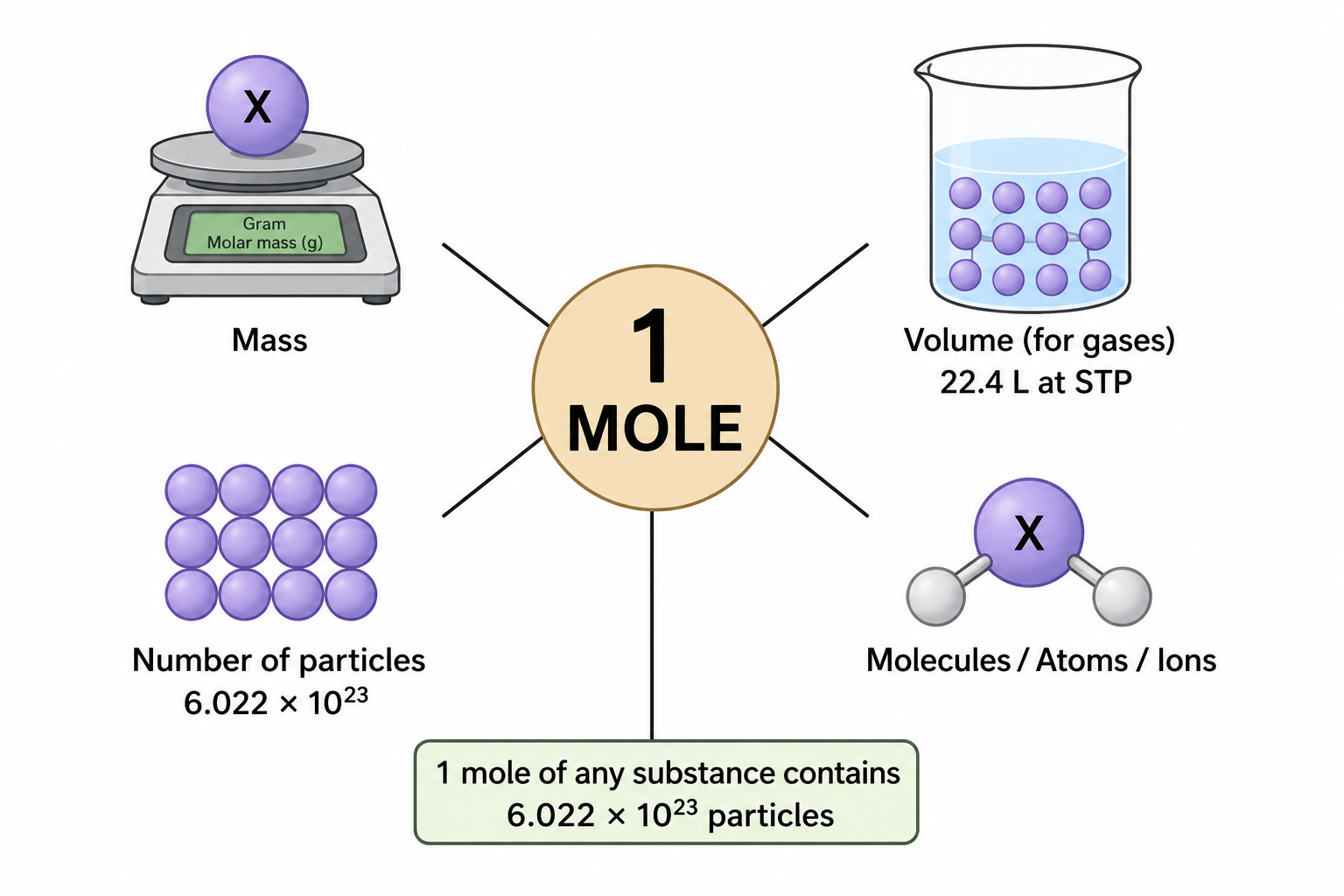
This is precisely the problem the mole concept solves. The mole is chemistry’s bridge between the invisible world of atoms and the tangible world of laboratory measurements. It’s a counting unit — like a “dozen” (12) or a “gross” (144) — but instead of 12 or 144, a mole represents approximately 6.022 × 10²³ particles. That specific number, Avogadro’s number, was chosen deliberately so that the molar mass of any element in grams per mole equals its relative atomic mass — making it the most practical number imaginable for connecting mass measurements to particle counts.
This Mole Concept Study Guide covers everything you need to understand and apply the mole concept confidently in any chemistry examination. We’ll work through Avogadro’s number, molar mass, molecular mass, formula mass, mole-to-mass conversions, mole-to-particle conversions, molar gas volumes, stoichiometry basics, limiting reagents, percentage composition, empirical formulas, and molecular formulas — with multiple solved numerical examples at each stage.
Whether you’re studying for GCSE, A-Level, AP Chemistry, IB Chemistry, NEET, or any other qualification, the mole concept will appear extensively in your examination. Once you genuinely understand it — not just the formulas, but the logic — every calculation becomes a puzzle you can confidently solve.
Let’s work through it from the very beginning.
Key Takeaways
Before You Dive In — Key Takeaways
- The mole is a counting unit: 1 mole = 6.022 × 10²³ particles (atoms, molecules, ions, or formula units).
- Avogadro’s number (Nₐ) = 6.022 × 10²³ mol⁻¹.
- The molar mass of a substance (in g/mol) numerically equals its relative atomic or molecular mass.
- The three core mole formulas are: n = m/M (moles from mass), n = N/Nₐ (moles from particles), and V = n × 22.4 L (moles to gas volume at STP).
- At STP (0°C, 1 atm), one mole of any ideal gas occupies 22.4 liters.
- Stoichiometry uses molar ratios from balanced equations to calculate reactant and product amounts.
- The limiting reactant determines how much product can be formed; the excess reactant remains unconsumed.
- Percentage composition, empirical formulas, and molecular formulas all use mole ratios to connect experimental data to chemical formulas.
- Setting up units carefully using dimensional analysis prevents the vast majority of mole calculation errors.
What Is the Mole Concept?
The mole concept is the central quantitative framework of chemistry. It establishes a fixed, defined relationship between the number of atoms or molecules in a sample and its measurable mass. Without this framework, writing a balanced chemical equation would be meaningless in practical terms — you could say “one molecule of hydrogen reacts with half a molecule of oxygen to form water,” but you couldn’t say anything useful about how many grams of hydrogen you need in a flask.
The word “mole” comes from the German word Mol, short for Molekül (molecule). It was introduced as a chemical unit in the early 20th century and has since become one of the seven SI base units — the unit of amount of substance, symbol mol.
The mole concept rests on one elegant insight: if you take the atomic mass of any element (the number listed on the periodic table, in atomic mass units) and change the unit from amu to grams, you have the mass of exactly one mole of that element’s atoms. Carbon has an atomic mass of 12 amu — so 12 grams of carbon contains exactly one mole of carbon atoms. Oxygen has an atomic mass of 16 amu — so 16 grams of oxygen contains one mole of oxygen atoms.
This isn’t a coincidence — it’s a deliberate consequence of how the atomic mass unit was defined. And it makes everything that follows in chemistry calculation beautifully consistent.
Why the Mole Concept Is Important
The mole concept is the single most important quantitative tool in chemistry. Here’s why:
- It connects mass to particle count. Without the mole, we couldn’t connect the grams on a balance to the number of reacting atoms and molecules.
- It makes stoichiometry possible. Balanced chemical equations give ratios of moles — not grams, not kilograms, not liters. Without the mole concept, those ratios would be meaningless in the laboratory.
- It appears in every quantitative chemistry topic. Concentration calculations (molarity = moles/liter), gas law calculations, titration, thermochemistry, electrochemistry, equilibrium — every quantitative topic in chemistry uses the mole as its foundation.
- It’s tested on every major chemistry exam. Mole calculations appear in GCSE, A-Level, AP, IB, NEET, JEE, and virtually every other chemistry examination worldwide.
Important Fact: The mole is one of the seven SI base units alongside the kilogram (mass), meter (length), second (time), ampere (electric current), kelvin (temperature), and candela (luminous intensity). It was redefined in 2019 by fixing Avogadro’s number at exactly 6.02214076 × 10²³ mol⁻¹, rather than leaving it as an experimentally measured quantity.
History of the Mole Concept
Understanding where the mole came from helps make it feel less arbitrary.
1811 — Avogadro’s hypothesis: Italian scientist Amedeo Avogadro proposed that equal volumes of gases at the same temperature and pressure contain equal numbers of molecules. This was a radical idea at the time, but it laid the conceptual foundation for everything that followed.
1860s — Cannizzaro’s contribution: Italian chemist Stanislao Cannizzaro used Avogadro’s hypothesis to establish consistent atomic masses for elements, resolving a long-standing confusion in chemistry. His work made it possible to define molar mass in a consistent way.
Late 1800s — “Mole” introduced: The word Mol was first used by German chemist Wilhelm Ostwald around 1893–1900 to describe the gram-molecular weight of a substance.
1909 — Perrin measures Avogadro’s number: French physicist Jean Perrin measured the actual number of molecules in a mole experimentally (through observations of Brownian motion in colloidal suspensions), confirming Avogadro’s hypothesis and earning him the Nobel Prize in Physics in 1926.
2019 — Redefinition of the mole: The International Bureau of Weights and Measures redefined the mole by fixing Avogadro’s constant at exactly 6.02214076 × 10²³ mol⁻¹, making it an exact value rather than an experimentally determined one. For examination purposes, 6.022 × 10²³ or simply 6.02 × 10²³ is used.
Avogadro’s Number Explained
Avogadro’s number (Nₐ) = 6.022 × 10²³ mol⁻¹
This number tells you how many particles are in one mole of any substance. The particles can be atoms, molecules, ions, electrons, formula units — whatever the relevant particle is for the substance in question.
To give you a sense of how enormous this number is:
- If you stacked 6.022 × 10²³ sheets of standard paper, the stack would stretch approximately 65 light-years into space.
- If 6.022 × 10²³ grains of rice were spread across Earth’s surface, the rice would cover the entire planet’s land area to a depth of several meters.
- If 6.022 × 10²³ seconds had passed since the Big Bang, the universe would be roughly 100 times older than it currently is.
Yet despite being astronomically large as a number, it’s the right size for chemistry — because atoms are astronomically small. The two extremes cancel each other out to give laboratory-scale masses, which is exactly the point.
Avogadro’s number is named in honor of Amedeo Avogadro, though he never calculated it himself — he simply proposed the hypothesis that made its calculation possible.
What Is a Mole?
A mole is the amount of substance that contains as many elementary entities (atoms, molecules, ions, or other specified particles) as there are atoms in exactly 12 grams of carbon-12.
In practice: 1 mole = 6.022 × 10²³ particles
Think of it as a chemist’s version of a “dozen.” A dozen eggs = 12 eggs, regardless of whether the eggs are large or small. Similarly, a mole of any substance = 6.022 × 10²³ particles, regardless of what that substance is.
Practical examples of “one mole”:
- 1 mole of water (H₂O) = 6.022 × 10²³ water molecules = 18.015 grams
- 1 mole of carbon (C) = 6.022 × 10²³ carbon atoms = 12.011 grams
- 1 mole of sodium chloride (NaCl) = 6.022 × 10²³ formula units of NaCl = 58.44 grams
- 1 mole of hydrogen gas (H₂) = 6.022 × 10²³ H₂ molecules = 2.016 grams = 22.4 liters at STP
The beauty is that you can have one mole of anything — electrons, ions, photons, people — and the quantity is always 6.022 × 10²³ of those things.
Molar Mass Explained
Molar mass is the mass of one mole of a substance, expressed in grams per mole (g/mol). It is numerically equal to the relative atomic mass (for elements) or the relative molecular mass (for compounds) in atomic mass units (amu).
How to find molar mass:
- For elements: Look up the atomic mass on the periodic table. The molar mass of carbon (C) is 12.011 g/mol; oxygen (O) is 15.999 g/mol; sodium (Na) is 22.990 g/mol.
- For compounds: Add up the atomic masses of all atoms in one formula unit, accounting for the number of each type of atom.
Molar Mass Calculation Examples Table
| Substance | Formula | Calculation | Molar Mass |
|---|---|---|---|
| Water | H₂O | 2(1.008) + 15.999 | 18.015 g/mol |
| Carbon Dioxide | CO₂ | 12.011 + 2(15.999) | 44.009 g/mol |
| Sodium Chloride | NaCl | 22.990 + 35.453 | 58.443 g/mol |
| Sulfuric Acid | H₂SO₄ | 2(1.008) + 32.065 + 4(15.999) | 98.079 g/mol |
| Glucose | C₆H₁₂O₆ | 6(12.011) + 12(1.008) + 6(15.999) | 180.156 g/mol |
| Ammonia | NH₃ | 14.007 + 3(1.008) | 17.031 g/mol |
| Calcium Carbonate | CaCO₃ | 40.078 + 12.011 + 3(15.999) | 100.086 g/mol |
| Iron(III) Oxide | Fe₂O₃ | 2(55.845) + 3(15.999) | 159.687 g/mol |
Molecular Mass vs Molar Mass (Comparison Table)
| Feature | Molecular Mass | Molar Mass |
|---|---|---|
| Definition | Mass of one molecule of a substance | Mass of one mole (6.022 × 10²³ molecules) of a substance |
| Units | Atomic mass units (amu or u) | Grams per mole (g/mol) |
| Scale | Single molecule scale | Macroscopic (laboratory) scale |
| Numerical value | Same number as molar mass | Same number as molecular mass |
| Example (H₂O) | 18.015 amu | 18.015 g/mol |
| Calculated from | Atomic masses from periodic table | Atomic masses from periodic table |
| Used for | Describing individual molecules | Performing laboratory calculations |
The key insight: the numerical value is identical for molecular mass and molar mass — only the units differ. This is intentional and enormously convenient.
Atomic Mass and Relative Atomic Mass
The atomic mass (also called atomic weight) of an element is the average mass of one atom of that element, taking into account the natural abundances of all its isotopes. It is measured in atomic mass units (amu), where 1 amu = 1/12 the mass of a carbon-12 atom.
The relative atomic mass (Ar) is a dimensionless number equal to the atomic mass expressed in amu. For carbon, Ar = 12.011. For chlorine, Ar = 35.453 (reflecting the mixture of Cl-35 and Cl-37 in nature).
The values on the periodic table are relative atomic masses — weighted averages accounting for natural isotope distributions. This is why most atomic masses are not whole numbers.
Example: Chlorine has two naturally occurring isotopes:
- Cl-35: mass = 34.969 amu, natural abundance = 75.77%
- Cl-37: mass = 36.966 amu, natural abundance = 24.23%
Average atomic mass = (34.969 × 0.7577) + (36.966 × 0.2423) = 26.496 + 8.957 = 35.453 amu
This is why the periodic table shows 35.453 for chlorine — it’s the weighted average across all naturally occurring chlorine atoms.
Formula Mass Explained
The formula mass is the sum of the atomic masses of all atoms in one formula unit of a compound, regardless of whether the compound is ionic or molecular. It’s expressed in atomic mass units (amu).
For molecular compounds, formula mass is identical to molecular mass. For ionic compounds (which don’t have discrete molecules), “formula mass” is the preferred term because you’re working with formula units, not individual molecules.
Example: Formula mass of NaCl
Na: 22.990 amu
Cl: 35.453 amu
Formula mass of NaCl = 22.990 + 35.453 = 58.443 amu
Example: Formula mass of CaCl₂
Ca: 40.078 amu
Cl × 2: 35.453 × 2 = 70.906 amu
Formula mass of CaCl₂ = 40.078 + 70.906 = 110.984 amu
The formula mass (in amu) has the same numerical value as the molar mass (in g/mol).
Converting Moles to Particles
To convert from moles to the number of particles, multiply by Avogadro’s number:
Number of particles (N) = n × Nₐ
N = n × 6.022 × 10²³
Example: How many molecules are in 2.5 moles of CO₂?
N = 2.5 mol × 6.022 × 10²³ mol⁻¹ = 1.506 × 10²⁴ molecules
Example: How many atoms of oxygen are in 2.5 moles of CO₂?
Each CO₂ molecule contains 2 oxygen atoms.
Number of O atoms = 1.506 × 10²⁴ × 2 = 3.011 × 10²⁴ atoms of oxygen
Converting Particles to Moles
To convert from number of particles to moles, divide by Avogadro’s number:
n = N / Nₐ
n = N / (6.022 × 10²³)
Example: How many moles is 1.806 × 10²⁴ water molecules?
n = 1.806 × 10²⁴ / 6.022 × 10²³ = 3.0 moles of H₂O
Example: A sample contains 3.011 × 10²³ atoms of iron. How many moles is this?
n = 3.011 × 10²³ / 6.022 × 10²³ = 0.5 moles of iron
Converting Moles to Mass
To convert from moles to mass, multiply by molar mass:
m = n × M
Where m = mass (grams), n = moles, M = molar mass (g/mol)
Example: What is the mass of 3 moles of water?
Molar mass of H₂O = 18.015 g/mol
m = 3 mol × 18.015 g/mol = 54.045 g
Example: What is the mass of 0.25 moles of NaCl?
Molar mass of NaCl = 58.443 g/mol
m = 0.25 mol × 58.443 g/mol = 14.61 g
Converting Mass to Moles
To convert from mass to moles, divide by molar mass:
n = m / M
Example: How many moles are in 44 grams of CO₂?
Molar mass of CO₂ = 44.009 g/mol
n = 44 g / 44.009 g/mol ≈ 1.0 mol
Example: How many moles are in 117 grams of NaCl?
Molar mass of NaCl = 58.443 g/mol
n = 117 g / 58.443 g/mol = 2.0 mol
Converting Moles to Volume of Gases
At Standard Temperature and Pressure (STP) — defined as 0°C (273.15 K) and 1 atmosphere (101.325 kPa) — one mole of any ideal gas occupies 22.4 liters (22.4 L/mol). This is called the molar volume of a gas at STP.
V = n × 22.4 L/mol (at STP)
n = V / 22.4 (at STP)
Note: Some examinations and textbooks use Standard Ambient Temperature and Pressure (SATP) at 25°C and 100 kPa, where the molar volume is 24.8 L/mol. Always check which standard conditions your examination uses.
Example: What volume does 2 moles of oxygen gas occupy at STP?
V = 2 mol × 22.4 L/mol = 44.8 L
Example: How many moles of nitrogen gas are in 11.2 liters at STP?
n = 11.2 L / 22.4 L/mol = 0.5 mol
Example: What is the mass of 5.6 liters of CO₂ at STP?
Step 1: n = 5.6 L / 22.4 L/mol = 0.25 mol
Step 2: m = 0.25 mol × 44.009 g/mol = 11.0 g
Mole Calculations Step by Step
The most effective way to approach any mole calculation is to use dimensional analysis (the factor-label method), where you set up the calculation so that all unwanted units cancel, leaving only the desired unit.
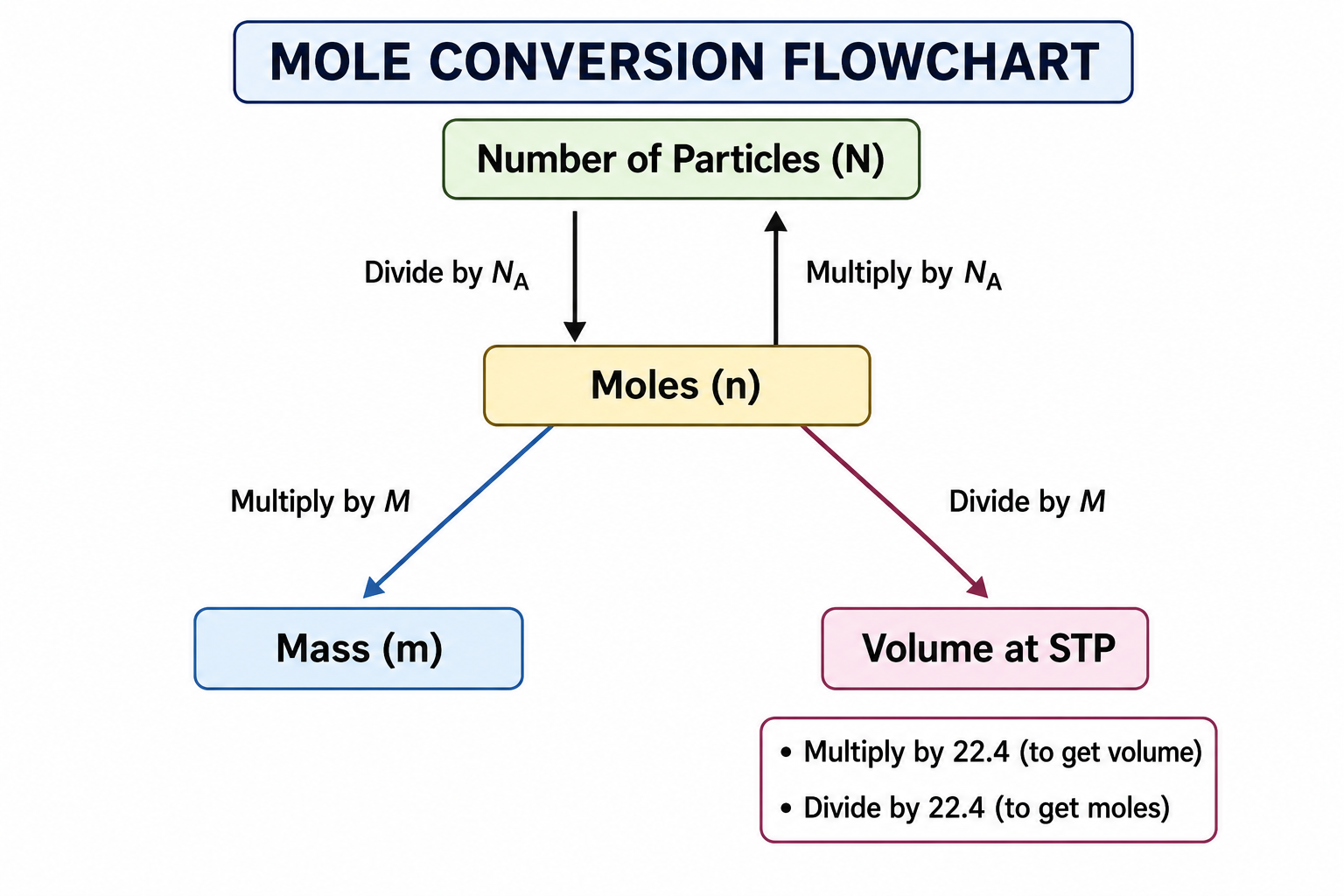
Three-step approach for any mole calculation:
- Identify what you’re given (mass? volume? number of particles?)
- Identify what you want to find
- Choose the appropriate conversion factor and apply it
This flowchart captures all the standard conversions. Memorize the relationships between each pair, and any mole calculation becomes a matter of choosing the right path.
Mole Concept Formulas
Number of Moles Formula
n = m / M
- n = number of moles (mol)
- m = mass of substance (g)
- M = molar mass of substance (g/mol)
Rearrangements:
- m = n × M (mass from moles and molar mass)
- M = m / n (molar mass from mass and moles)
Mass Formula
m = n × M
Where m is in grams when M is in g/mol and n is in moles.
Particle Formula
N = n × Nₐ
- N = number of particles
- n = moles
- Nₐ = Avogadro’s number = 6.022 × 10²³ mol⁻¹
Rearrangement:
- n = N / Nₐ
Gas Volume Formula
V = n × 22.4 L/mol (at STP)
Rearrangement:
- n = V / 22.4
Complete Mole Formula Chart
| What You Want | What You Have | Formula |
|---|---|---|
| Moles (n) | Mass (m) and Molar Mass (M) | n = m / M |
| Mass (m) | Moles (n) and Molar Mass (M) | m = n × M |
| Molar Mass (M) | Mass (m) and Moles (n) | M = m / n |
| Moles (n) | Number of particles (N) | n = N / Nₐ |
| Number of particles (N) | Moles (n) | N = n × Nₐ |
| Volume at STP (V) | Moles (n) | V = n × 22.4 |
| Moles (n) | Volume at STP (V) | n = V / 22.4 |
| Mass (m) | Number of particles (N) | m = (N / Nₐ) × M |
| Number of particles (N) | Mass (m) | N = (m / M) × Nₐ |
Mole Concept in Chemical Reactions
When a balanced chemical equation is written, the coefficients tell you the molar ratios of reactants and products. This is the foundation of stoichiometry.
Example: The synthesis of water
2H₂ + O₂ → 2H₂O
This equation tells you:
- 2 moles of H₂ react with 1 mole of O₂ to produce 2 moles of H₂O
- In any proportional amount: 0.5 mol H₂ reacts with 0.25 mol O₂ to give 0.5 mol H₂O
- In mass terms: 4 g H₂ + 32 g O₂ → 36 g H₂O (demonstrating conservation of mass)
The mole ratios from the balanced equation are the conversion factors you use in stoichiometry problems.
Introduction to Stoichiometry
Stoichiometry is the quantitative calculation of reactants and products in chemical reactions, using the molar ratios from balanced equations.
General approach:
- Write and balance the chemical equation
- Convert the given quantity (grams, liters, particles) into moles
- Use the molar ratio from the balanced equation to find the moles of the desired substance
- Convert the moles found into the required units (grams, liters, particles)
Example: How many grams of water are produced when 4 grams of hydrogen react completely with excess oxygen?
Balanced equation: 2H₂ + O₂ → 2H₂O
Step 1: Convert H₂ mass to moles:
n(H₂) = 4 g / 2.016 g/mol = 1.98 mol H₂
Step 2: Use molar ratio (2 mol H₂ : 2 mol H₂O → ratio is 1:1):
n(H₂O) = 1.98 mol
Step 3: Convert moles of H₂O to mass:
m(H₂O) = 1.98 mol × 18.015 g/mol = 35.67 g
So 4 grams of hydrogen produce approximately 35.7 grams of water.
Limiting Reactant Basics
In real chemical reactions, reactants are rarely in exactly the stoichiometric ratio. One reactant runs out first — this is the limiting reactant (or limiting reagent), and it determines the maximum amount of product that can be formed. The other reactant (present in excess) is called the excess reactant.
How to identify the limiting reactant:
- Convert all reactant masses to moles
- Divide each by its coefficient in the balanced equation
- The reactant with the smallest result is the limiting reactant
Example: 5 g of H₂ and 35 g of O₂ are mixed. Which is the limiting reactant?
Balanced equation: 2H₂ + O₂ → 2H₂O
Moles of H₂ = 5 / 2.016 = 2.48 mol; divided by coefficient 2 → 1.24
Moles of O₂ = 35 / 32.00 = 1.09 mol; divided by coefficient 1 → 1.09
O₂ gives the smaller quotient (1.09 < 1.24), so oxygen is the limiting reactant.
Maximum moles of H₂O = 1.09 mol O₂ × (2 mol H₂O / 1 mol O₂) = 2.18 mol H₂O
Mass of H₂O = 2.18 mol × 18.015 g/mol = 39.3 g
Moles of H₂ consumed = 1.09 mol O₂ × (2 mol H₂ / 1 mol O₂) = 2.18 mol H₂
H₂ remaining = 2.48 − 2.18 = 0.30 mol H₂ (excess)
Percentage Composition
The percentage composition of a compound is the mass percentage of each element in the compound. It’s calculated from the formula:
% element = (mass of element in one mole / molar mass of compound) × 100%
Example: Calculate the percentage composition of water (H₂O).
Molar mass of H₂O = 18.015 g/mol
Mass of H in one mole = 2 × 1.008 = 2.016 g
Mass of O in one mole = 1 × 15.999 = 15.999 g
%H = (2.016 / 18.015) × 100% = 11.19%
%O = (15.999 / 18.015) × 100% = 88.81%
Check: 11.19% + 88.81% = 100% (correct)
Example: Calculate the percentage of iron in iron(III) oxide (Fe₂O₃).
Molar mass of Fe₂O₃ = 2(55.845) + 3(15.999) = 111.69 + 47.997 = 159.687 g/mol
%Fe = (111.69 / 159.687) × 100% = 69.94%
%O = (47.997 / 159.687) × 100% = 30.06%
This is practically important — knowing the iron content of an ore tells miners and metallurgists how much iron they can extract per ton of ore.
Empirical Formula
The empirical formula gives the simplest whole-number ratio of atoms of each element in a compound. It is found from percentage composition data.
Steps to find empirical formula from percentage composition:
- Assume a 100 g sample (so percentages become grams directly)
- Convert grams to moles using molar masses
- Divide all mole values by the smallest mole value
- Round to the nearest whole number (if very close) or multiply through by a factor to get whole numbers
Example: A compound contains 40.0% carbon, 6.72% hydrogen, and 53.3% oxygen by mass. Find its empirical formula.
Step 1: In 100 g sample: C = 40.0 g, H = 6.72 g, O = 53.3 g
Step 2: Convert to moles:
C: 40.0 / 12.011 = 3.33 mol
H: 6.72 / 1.008 = 6.67 mol
O: 53.3 / 15.999 = 3.33 mol
Step 3: Divide by smallest (3.33):
C: 3.33/3.33 = 1.00
H: 6.67/3.33 = 2.00
O: 3.33/3.33 = 1.00
Step 4: Ratio is C:H:O = 1:2:1, so empirical formula = CH₂O
(Note: CH₂O is the empirical formula for several compounds including formaldehyde, acetic acid, and glucose — the molecular formula reveals which one it actually is.)
Molecular Formula
The molecular formula gives the actual number of atoms of each element in one molecule of a compound. It is a whole-number multiple of the empirical formula.
Finding the molecular formula:
- Determine the empirical formula mass
- Divide the actual molar mass by the empirical formula mass to find the multiplier (n)
- Multiply each subscript in the empirical formula by n
Example: Using the empirical formula CH₂O from above, if the actual molar mass is 180 g/mol, what is the molecular formula?
Empirical formula mass of CH₂O = 12.011 + 2(1.008) + 15.999 = 30.026 g/mol
Multiplier n = 180 / 30.026 ≈ 6
Molecular formula = (CH₂O)₆ = C₆H₁₂O₆ (glucose)
Another example: A compound has the empirical formula NO₂ and a molar mass of 92 g/mol. What is its molecular formula?
Empirical formula mass = 14.007 + 2(15.999) = 46.005 g/mol
Multiplier n = 92 / 46.005 ≈ 2
Molecular formula = (NO₂)₂ = N₂O₄ (dinitrogen tetroxide)
Solved Numerical Examples
Let’s work through a range of problems that covers the full variety of mole calculations:
Problem 1: Simple moles to mass
Calculate the mass of 0.5 moles of calcium carbonate (CaCO₃).
Molar mass of CaCO₃ = 40.078 + 12.011 + 3(15.999) = 100.086 g/mol
m = n × M = 0.5 mol × 100.086 g/mol = 50.043 g
Problem 2: Mass to moles to particles
How many molecules are in 9 grams of water?
Step 1: n = m/M = 9 g / 18.015 g/mol = 0.4996 mol ≈ 0.5 mol
Step 2: N = n × Nₐ = 0.5 × 6.022 × 10²³ = 3.011 × 10²³ molecules
Problem 3: Gas volume at STP
What volume does 11 grams of CO₂ occupy at STP?
Step 1: n = 11 g / 44.009 g/mol = 0.2499 mol ≈ 0.25 mol
Step 2: V = 0.25 mol × 22.4 L/mol = 5.6 L
Problem 4: Particles to moles to mass
Calculate the mass of 3.011 × 10²⁴ atoms of aluminum (Al).
Step 1: n = N/Nₐ = 3.011 × 10²⁴ / 6.022 × 10²³ = 5 mol
Step 2: m = n × M = 5 mol × 26.982 g/mol = 134.91 g
Problem 5: Multi-step stoichiometry
How many grams of CO₂ are produced when 24 grams of carbon burn completely in excess oxygen?
Balanced equation: C + O₂ → CO₂
Step 1: n(C) = 24 g / 12.011 g/mol = 1.998 mol ≈ 2 mol
Step 2: Mole ratio C:CO₂ = 1:1, so n(CO₂) = 2 mol
Step 3: m(CO₂) = 2 mol × 44.009 g/mol = 88.018 g ≈ 88.0 g
Problem 6: Percentage composition from formula
Calculate the percentage of nitrogen in ammonia (NH₃).
Molar mass of NH₃ = 14.007 + 3(1.008) = 17.031 g/mol
%N = (14.007 / 17.031) × 100% = 82.25%
Problem 7: Empirical formula
A compound contains 75% carbon and 25% hydrogen by mass. Find the empirical formula.
Assume 100 g: C = 75 g, H = 25 g
Moles: C = 75/12.011 = 6.244 mol; H = 25/1.008 = 24.80 mol
Divide by smallest (6.244): C = 1.00, H = 3.97 ≈ 4
Empirical formula: CH₄ (methane)
Problem 8: Limiting reagent with yield calculation
3 mol N₂ and 6 mol H₂ react to form NH₃: N₂ + 3H₂ → 2NH₃. Which is the limiting reagent? How many moles of NH₃ are produced?
Divide by coefficients:
N₂: 3/1 = 3.0
H₂: 6/3 = 2.0
H₂ gives the smaller quotient → H₂ is the limiting reagent
Moles of NH₃ = 6 mol H₂ × (2 mol NH₃ / 3 mol H₂) = 4 mol NH₃
Mass of NH₃ = 4 × 17.031 = 68.12 g
Common Mole Concept Terms Every Student Should Know
| Term | Definition |
|---|---|
| Mole (mol) | SI unit of amount; 6.022 × 10²³ particles |
| Avogadro’s Number (Nₐ) | 6.022 × 10²³ mol⁻¹; number of particles per mole |
| Molar Mass (M) | Mass of one mole of a substance; in g/mol |
| Atomic Mass Unit (amu) | Unit of mass for atoms; 1/12 the mass of C-12 |
| Relative Atomic Mass (Ar) | Average mass of atoms of an element relative to 1/12 of C-12 |
| Formula Mass | Sum of atomic masses in one formula unit; in amu |
| Molecular Mass | Mass of one molecule; in amu |
| STP | Standard Temperature and Pressure: 0°C (273.15 K) and 1 atm |
| Molar Volume | Volume of one mole of gas at STP: 22.4 L/mol |
| Stoichiometry | Calculation of reactant/product quantities from balanced equations |
| Molar Ratio | Ratio of moles of different substances in a balanced equation |
| Limiting Reactant | Reactant that is completely consumed first; determines maximum product |
| Excess Reactant | Reactant that remains after limiting reactant is consumed |
| Percentage Composition | Mass percentage of each element in a compound |
| Empirical Formula | Simplest whole-number ratio of atoms in a compound |
| Molecular Formula | Actual number of atoms of each element in one molecule |
| Theoretical Yield | Maximum mass of product calculated from stoichiometry |
| Actual Yield | Mass of product actually obtained in an experiment |
| Percent Yield | (Actual yield / Theoretical yield) × 100% |
| Dimensional Analysis | Method of unit conversion by multiplying by conversion factors |
Common Mistakes Students Make
Awareness of these common errors will help you avoid them on examinations:
- Using atomic mass instead of molar mass in calculations. The molar mass of Cl₂ is not 35.453 g/mol — it’s 2 × 35.453 = 70.906 g/mol. Always use the molar mass of the actual substance you’re working with, including its formula.
- Forgetting to balance the equation before doing stoichiometry. Mole ratios come from the balanced equation’s coefficients. Using an unbalanced equation gives wrong ratios and wrong answers every time.
- Confusing empirical formula mass with molecular formula mass. The multiplier n = (molar mass of compound) / (empirical formula mass). Students sometimes divide incorrectly or use the wrong mass in the numerator or denominator.
- Assuming every mixture has a limiting reactant determined by smaller mass. The limiting reactant is determined by mole ratios relative to stoichiometric coefficients — not by which reactant has less mass. A reactant with a very small mass but small coefficient might not be limiting; a reactant with large mass but large coefficient might be.
- Rounding intermediate calculations too aggressively. Keep at least four significant figures in intermediate steps; round only the final answer. Early rounding compounds errors.
- Applying the 22.4 L/mol molar volume to conditions other than STP. This value applies only at STP (0°C and 1 atm). At different conditions, use the ideal gas law (PV = nRT) instead.
- Confusing atoms and molecules in particle counts. If a question asks for the number of atoms of hydrogen in 1 mole of water, the answer is 2 × Nₐ (because each H₂O has 2 hydrogen atoms), not 1 × Nₐ.
- Not writing units throughout the calculation. Unit tracking catches errors before they become wrong answers. If your units don’t cancel to give the desired unit, something in your setup is wrong.
Best Tips to Study the Mole Concept
Exam Tips Box
- Memorize Avogadro’s number (6.022 × 10²³ mol⁻¹) and the molar volume at STP (22.4 L/mol). These two constants appear in virtually every mole calculation.
- Practice calculating molar masses from scratch until you’re fast and accurate. Use a periodic table; don’t memorize individual molar masses. But practice the addition enough that you can do it quickly without errors.
- Always write out units explicitly in every calculation step. If you write “n = 22 / 18” you don’t know what you’ve done. If you write “n = 22 g / 18.015 g/mol = 1.22 mol,” you can check every step.
- Draw the mole conversion flowchart from memory and post it where you study. It shows every possible conversion path and prevents you from forgetting which operation to use.
- When doing stoichiometry problems, always convert to moles first, apply the mole ratio from the balanced equation, then convert to the requested unit last. Never try to go directly from grams of one substance to grams of another without passing through moles.
- For empirical formula problems, set up a table with columns for element, mass (g), molar mass, moles, and simplified ratio. A systematic table approach eliminates organizational errors.
- Check your stoichiometry answers using conservation of mass: the total mass of products should equal the total mass of reactants consumed.
Mole Concept Practice Questions
30 Multiple Choice Questions (MCQs) with Answers
1. How many particles are in 1 mole of any substance?
- A) 6.022 × 10²⁰
- B) 6.022 × 10²³ ✓
- C) 6.022 × 10²⁶
- D) 6.022 × 10¹⁰
2. What is the molar mass of CO₂?
- A) 28 g/mol
- B) 16 g/mol
- C) 44 g/mol ✓
- D) 32 g/mol
3. How many moles are in 36 grams of water (H₂O)?
- A) 1 mol
- B) 2 mol ✓
- C) 0.5 mol
- D) 18 mol
4. What volume does 0.5 moles of oxygen gas occupy at STP?
- A) 44.8 L
- B) 22.4 L
- C) 11.2 L ✓
- D) 5.6 L
5. The molar volume of an ideal gas at STP is:
- A) 22.4 mL/mol
- B) 22.4 L/mol ✓
- C) 24.8 L/mol
- D) 18 L/mol
6. Which formula is used to calculate the number of moles from mass?
- A) n = M / m
- B) n = m / M ✓
- C) n = m × M
- D) n = N × Nₐ
7. How many molecules are in 2 moles of NH₃?
- A) 6.022 × 10²³
- B) 1.204 × 10²⁴ ✓
- C) 3.011 × 10²³
- D) 12.044 × 10²³
8. What is the mass of 3 moles of NaCl? (Molar mass = 58.5 g/mol)
- A) 19.5 g
- B) 175.5 g ✓
- C) 58.5 g
- D) 117 g
9. The empirical formula gives:
- A) The actual number of atoms in one molecule
- B) The percentage of each element
- C) The simplest whole-number ratio of atoms ✓
- D) The number of moles in a compound
10. If a compound has empirical formula CH₂ and molar mass 56 g/mol, what is the molecular formula? (Empirical formula mass CH₂ = 14 g/mol)
- A) CH₂
- B) C₂H₄
- C) C₃H₆
- D) C₄H₈ ✓
11. Which is the limiting reactant if 2 mol H₂ and 2 mol O₂ react according to 2H₂ + O₂ → 2H₂O?
- A) H₂ ✓
- B) O₂
- C) Both are limiting
- D) Neither is limiting
12. 6.022 × 10²³ is called:
- A) Boltzmann’s constant
- B) Avogadro’s number ✓
- C) Faraday’s constant
- D) Planck’s number
13. What is the percentage of oxygen in water (H₂O)?
- A) 11.2%
- B) 75%
- C) 88.8% ✓
- D) 50%
14. The number of moles in 3.011 × 10²³ molecules of CO₂ is:
- A) 2
- B) 0.5 ✓
- C) 3.011
- D) 1
15. What is the molar mass of glucose (C₆H₁₂O₆)?
- A) 60 g/mol
- B) 120 g/mol
- C) 180 g/mol ✓
- D) 144 g/mol
16. How many grams of CO₂ are produced when 1 mole of carbon burns completely?
- A) 12 g
- B) 32 g
- C) 44 g ✓
- D) 56 g
17. What volume does 44 g of CO₂ occupy at STP?
- A) 11.2 L
- B) 22.4 L ✓
- C) 44.8 L
- D) 5.6 L
18. If a compound has 40% C, 6.7% H, and 53.3% O, the empirical formula mole ratios simplify to:
- A) CH₂O ✓
- B) CHO
- C) C₂H₄O₂
- D) CH₃OH
19. How many atoms are in 0.5 moles of iron (Fe)?
- A) 3.011 × 10²³ ✓
- B) 6.022 × 10²³
- C) 1.204 × 10²⁴
- D) 27.9 × 10²³
20. The actual yield is 15 g and the theoretical yield is 20 g. What is the percent yield?
- A) 75.0% — Wait, let me recalculate: 15/20 × 100 = 75%
- Answer: 75% ✓
21. What is the molar mass of H₂SO₄?
- A) 49 g/mol
- B) 64 g/mol
- C) 98 g/mol ✓
- D) 80 g/mol
22. How many moles of atoms are in 40.8 g of sulfur (S)? (Molar mass S = 32.065 g/mol)
- A) 0.5 mol
- B) 1.27 mol ✓
- C) 2 mol
- D) 0.78 mol
23. Which of these contains the most molecules?
- A) 1 mol CH₄
- B) 0.5 mol O₂
- C) 0.8 mol H₂O
- D) 1 mol CH₄ ✓ (all 1 mol options: 1 mol > 0.8 mol > 0.5 mol)
24. How many hydrogen atoms are in 1 mole of ammonia (NH₃)?
- A) 6.022 × 10²³
- B) 6.022 × 10²²
- C) 1.807 × 10²⁴ ✓ (3 × 6.022 × 10²³)
- D) 3.011 × 10²³
25. The mole is defined as:
- A) The mass in grams of one atom
- B) The amount of substance containing 6.022 × 10²³ particles ✓
- C) The volume occupied by one gram of a substance
- D) The number of protons in one gram of hydrogen
26. 11.2 liters of a gas at STP contains how many moles?
- A) 1 mol
- B) 0.5 mol ✓
- C) 2 mol
- D) 22.4 mol
27. The percent yield formula is:
- A) (Theoretical / Actual) × 100%
- B) (Actual / Theoretical) × 100% ✓
- C) Actual − Theoretical
- D) Actual × Theoretical
28. What is the formula mass of CaCl₂? (Ca = 40.08, Cl = 35.45)
- A) 75.53 amu
- B) 110.98 amu ✓
- C) 146.43 amu
- D) 40.08 amu
29. A gas occupies 33.6 L at STP. How many moles is this?
- A) 1 mol
- B) 1.5 mol ✓
- C) 2 mol
- D) 0.75 mol
30. The compound with empirical formula NO₂ and molar mass 92 g/mol has the molecular formula:
- A) NO₂
- B) N₂O₄ ✓
- C) N₃O₆
- D) N₄O₈
15 Short Answer Questions
- Define the mole and explain why chemists use it rather than simply working with masses or individual atoms.
- State Avogadro’s number and explain what it represents. Describe how Jean Perrin first measured it experimentally.
- Explain the difference between molecular mass and molar mass. Why do they have the same numerical value but different units?
- How is the molar mass of a compound calculated? Calculate the molar mass of calcium carbonate (CaCO₃).
- Explain what STP stands for and state the molar volume of an ideal gas at STP. Why does every ideal gas have the same molar volume at STP?
- What is the empirical formula of a compound? How does it differ from the molecular formula? Give an example where the two are different.
- How do you determine the limiting reactant in a reaction where two reactants are given in specific amounts? Explain the method clearly.
- What is percentage composition? Calculate the percentage of each element in sulfuric acid (H₂SO₄).
- Define percent yield and explain why actual yield is often less than theoretical yield in real experiments.
- A compound is found to have 38.7% carbon, 9.7% hydrogen, and 51.6% oxygen by mass. Determine its empirical formula.
- How many moles of atoms are present in 117 g of NaCl? How many total ions does this represent?
- Explain how Avogadro’s hypothesis (equal volumes of gases at the same conditions contain equal numbers of molecules) relates to the molar volume concept.
- The relative atomic mass of chlorine is 35.453, not 35 or 37. Explain why, and explain how the natural isotope abundances are used to calculate this value.
- Describe three real-world applications where mole calculations are practically important (outside of the classroom).
- Starting from Avogadro’s number, explain step by step how you would calculate the mass of a single molecule of water.
10 Numerical Problems with Step-by-Step Solutions
Problem 1: Calculate the number of moles in 98 g of H₂SO₄.
Solution:
Molar mass of H₂SO₄ = 2(1.008) + 32.065 + 4(15.999) = 2.016 + 32.065 + 63.996 = 98.077 g/mol
n = m/M = 98 g / 98.077 g/mol = 0.9992 mol ≈ 1.0 mol
Problem 2: Calculate the mass of 3.011 × 10²³ molecules of glucose (C₆H₁₂O₆).
Solution:
Step 1: n = N/Nₐ = 3.011 × 10²³ / 6.022 × 10²³ = 0.5 mol
Step 2: Molar mass of C₆H₁₂O₆ = 6(12.011) + 12(1.008) + 6(15.999) = 72.066 + 12.096 + 95.994 = 180.156 g/mol
Step 3: m = n × M = 0.5 mol × 180.156 g/mol = 90.078 g ≈ 90.1 g
Problem 3: What volume does 8 g of oxygen gas (O₂) occupy at STP?
Solution:
Step 1: Molar mass of O₂ = 2 × 15.999 = 31.998 g/mol
Step 2: n = 8 g / 31.998 g/mol = 0.250 mol
Step 3: V = n × 22.4 L/mol = 0.250 × 22.4 = 5.6 L
Problem 4: How many atoms of hydrogen are present in 36 g of water?
Solution:
Step 1: Molar mass of H₂O = 18.015 g/mol
Step 2: n = 36 / 18.015 = 1.999 mol ≈ 2 mol
Step 3: Each H₂O has 2 H atoms, so moles of H = 2 × 2 = 4 mol
Step 4: N(H) = 4 × 6.022 × 10²³ = 2.409 × 10²⁴ atoms of hydrogen
Problem 5: In the reaction N₂ + 3H₂ → 2NH₃, how many grams of NH₃ are produced from 14 g of N₂ with excess H₂?
Solution:
Step 1: n(N₂) = 14 / 28.014 = 0.4998 mol ≈ 0.5 mol
Step 2: Mole ratio N₂:NH₃ = 1:2, so n(NH₃) = 0.5 × 2 = 1.0 mol
Step 3: Molar mass NH₃ = 14.007 + 3(1.008) = 17.031 g/mol
Step 4: m(NH₃) = 1.0 × 17.031 = 17.031 g ≈ 17.0 g
Problem 6: Find the empirical formula of a compound containing 52.17% C, 13.04% H, and 34.78% O.
Solution:
Assume 100 g: C = 52.17 g, H = 13.04 g, O = 34.78 g
Moles: C = 52.17/12.011 = 4.343; H = 13.04/1.008 = 12.937; O = 34.78/15.999 = 2.174
Divide by smallest (2.174): C = 1.997 ≈ 2; H = 5.951 ≈ 6; O = 1.000
Empirical formula: C₂H₆O (ethanol)
Problem 7: If 10 g of calcium reacts with excess water, how many liters of H₂ gas are produced at STP?
Reaction: Ca + 2H₂O → Ca(OH)₂ + H₂
Solution:
Step 1: n(Ca) = 10 / 40.078 = 0.2495 mol
Step 2: Mole ratio Ca:H₂ = 1:1, so n(H₂) = 0.2495 mol
Step 3: V(H₂) = 0.2495 × 22.4 = 5.59 L ≈ 5.6 L
Problem 8: Calculate the percentage composition of ammonium nitrate (NH₄NO₃).
Solution:
Molar mass = 2(14.007) + 4(1.008) + 3(15.999) = 28.014 + 4.032 + 47.997 = 80.043 g/mol
%N = 28.014/80.043 × 100 = 35.00%
%H = 4.032/80.043 × 100 = 5.04%
%O = 47.997/80.043 × 100 = 59.97%
Check: 35.00 + 5.04 + 59.97 = 100.01% ≈ 100% (rounding)
Problem 9: Determine the molecular formula of a compound with empirical formula CH with molar mass 78 g/mol.
Solution:
Empirical formula mass of CH = 12.011 + 1.008 = 13.019 g/mol
n = 78 / 13.019 = 5.99 ≈ 6
Molecular formula = C₆H₆ (benzene)
Problem 10: 4 g of H₂ and 32 g of O₂ react according to 2H₂ + O₂ → 2H₂O. Find the limiting reagent and the mass of water produced.
Solution:
Moles of H₂ = 4 / 2.016 = 1.984 mol; divide by coefficient 2 → 0.992
Moles of O₂ = 32 / 31.998 = 1.000 mol; divide by coefficient 1 → 1.000
H₂ gives smaller quotient (0.992) → H₂ is the limiting reagent
n(H₂O) = 1.984 mol H₂ × (2 mol H₂O / 2 mol H₂) = 1.984 mol H₂O
m(H₂O) = 1.984 × 18.015 = 35.74 g ≈ 35.7 g
Revision Checklist
Use this before any examination on the mole concept:
- I can define the mole and state Avogadro’s number from memory
- I can calculate molar mass from a chemical formula using atomic masses from the periodic table
- I can convert mass to moles using n = m/M
- I can convert moles to mass using m = n × M
- I can convert moles to number of particles using N = n × Nₐ
- I can convert number of particles to moles using n = N/Nₐ
- I can calculate gas volume from moles at STP using V = n × 22.4
- I can convert gas volume at STP to moles using n = V/22.4
- I know when to use 22.4 L/mol (STP only) versus the ideal gas law (other conditions)
- I can distinguish between molecular mass (amu) and molar mass (g/mol)
- I understand what relative atomic mass is and why it’s a weighted average
- I can perform stoichiometry calculations using mole ratios from balanced equations
- I can identify the limiting reactant from the amounts of two or more reactants
- I can calculate percentage composition of a compound from its formula
- I can determine an empirical formula from percentage composition data
- I can determine a molecular formula from an empirical formula and molar mass
- I can calculate percent yield from actual and theoretical yields
- I always write units throughout my calculations and check that they cancel correctly
- I have completed all 30 MCQs and reviewed any incorrect answers
- I have worked through all 10 numerical problems and understand each step
Best Books for Learning the Mole Concept
These textbooks are consistently recommended by chemistry educators for mastering quantitative chemistry:
- “Chemistry: The Central Science” by Brown, LeMay, Bursten, Murphy, and Woodward — The most widely used general chemistry text at university level. Its chapters on stoichiometry, the mole concept, and limiting reagents are exceptionally clear and thorough, with abundant worked examples at varying difficulty levels.
- “Chemistry” by Zumdahl and Zumdahl — Particularly strong on the conceptual explanation of why the mole concept works the way it does, alongside excellent quantitative practice problems and a thoughtful treatment of limiting reagents and percent yield.
- “General Chemistry” by Petrucci, Herring, Madura, and Bissonnette — Very thorough treatment of stoichiometry and mole calculations, with a strong emphasis on problem-solving strategies and dimensional analysis.
- “Calculations in AS/A Level Chemistry” by Jim Clark — For students specifically preparing for UK A-Level and AS-Level examinations; extraordinarily clear worked examples for every type of mole calculation likely to appear on those examinations.
- “Atkins’ Physical Chemistry” by Atkins and de Paula — For students wanting to go deeper into the theoretical foundations of the mole concept, including statistical mechanics and the kinetic theory of gases.
Free Online Chemistry Resources
- OpenStax Chemistry — Free, peer-reviewed university chemistry textbooks with complete stoichiometry and mole concept chapters, including worked examples, interactive exercises, and clear diagrams of mole conversions.
- Khan Academy Chemistry — Free video lessons covering Avogadro’s number, molar mass, mole calculations, stoichiometry, limiting reagents, and empirical formulas, with immediate-feedback practice exercises.
- Chemistry LibreTexts — Comprehensive open-access library with academic-level content on every aspect of the mole concept, including derivations, advanced worked examples, and connections to thermochemistry and gas laws.
- American Chemical Society (ACS) — Educational resources from the world’s largest chemistry society, including curriculum support materials, interactive stoichiometry tools, and connections between the mole concept and real-world chemistry.
- Royal Society of Chemistry (RSC) — Resources from the UK’s leading chemistry organization, including curriculum-aligned mole calculation worksheets, interactive activities, and exam preparation materials.
Related Articles on LearnMinto
These connected guides will help you build on the mole concept across the full chemistry curriculum:
- Chemistry Study Guide — Comprehensive overview of all major chemistry topics for exam success
- Atomic Structure Study Guide — Understanding atomic mass, isotopes, and the foundations of molar mass calculations
- Periodic Table Study Guide — Mastering relative atomic masses and how to read them from the periodic table
- Chemical Bonding Study Guide — Understanding molecular formulas and compound composition that mole calculations use
- Acids and Bases Study Guide — Applying mole calculations to molarity, titration, and acid-base stoichiometry
Frequently Asked Questions
Q1: What is the mole concept in chemistry?
The mole concept is the framework that connects the microscopic world of atoms and molecules to the macroscopic world of laboratory measurements. One mole of any substance contains 6.022 × 10²³ particles (Avogadro’s number) and has a mass in grams numerically equal to its relative atomic or molecular mass. This allows chemists to count atoms and molecules indirectly by weighing samples.
Q2: What is Avogadro’s number and why is it used?
Avogadro’s number is 6.022 × 10²³ mol⁻¹ — the number of particles in one mole of any substance. This specific number was chosen so that the molar mass of any element in grams per mole equals its relative atomic mass. It connects the atomic mass scale (based on carbon-12) to laboratory-measurable masses. It was determined by Jean Perrin through careful experiments on Brownian motion in the early 1900s.
Q3: How do you calculate the number of moles?
There are three main ways to calculate moles, depending on what information you have:
- From mass: n = m / M (mass divided by molar mass)
- From number of particles: n = N / Nₐ (number of particles divided by Avogadro’s number)
- From gas volume at STP: n = V / 22.4 (volume in liters divided by 22.4)
Q4: What is molar mass and how is it calculated?
Molar mass is the mass of one mole of a substance, expressed in g/mol. For elements, it’s the atomic mass from the periodic table (in g/mol instead of amu). For compounds, add the atomic masses of all atoms in the formula, multiplying each by the number of atoms of that element. For example, H₂O: 2(1.008) + 15.999 = 18.015 g/mol.
Q5: Why does one mole of gas occupy 22.4 liters at STP?
At STP (0°C and 1 atm), the ideal gas law (PV = nRT) gives V/n = RT/P = (8.314 J/mol·K × 273.15 K) / 101325 Pa = 0.02241 m³/mol = 22.41 L/mol for any ideal gas. Since ideal gas molecules (at these conditions) have negligible volume compared to the space between them, all ideal gases occupy the same volume per mole at the same T and P.
Q6: What is the difference between empirical and molecular formula?
The empirical formula gives the simplest whole-number ratio of atoms in a compound — it may or may not represent one actual molecule. The molecular formula gives the actual number of atoms of each element in one molecule. The molecular formula is always a whole-number multiple of the empirical formula. Glucose (C₆H₁₂O₆) has the empirical formula CH₂O; the molecular formula is 6 times the empirical formula.
Q7: How do you identify the limiting reagent?
To identify the limiting reagent: convert the given mass of each reactant to moles, divide each mole value by that reactant’s coefficient in the balanced equation, and identify the reactant with the smallest quotient. That is the limiting reagent. All stoichiometry calculations for the maximum product yield must be based on the limiting reagent.
Q8: What is percentage composition and how is it used?
Percentage composition is the mass percentage of each element in a compound. It’s calculated as: %element = (mass of that element per mole of compound / molar mass of compound) × 100%. Percentage composition is used to verify the formula of a compound and to calculate empirical formulas from experimental combustion or elemental analysis data.
Q9: What is percent yield and why is it less than 100% in practice?
Percent yield = (actual yield / theoretical yield) × 100%. Actual yield is almost always less than theoretical yield because real reactions are often reversible, side reactions consume some reactants, mechanical losses occur during transfer and filtration, and some products may be lost during purification. A percent yield of 80–90% is considered good for many reactions; 95%+ is excellent.
Q10: How do you convert between grams and number of atoms?
A two-step process: First convert grams to moles (n = m/M); then convert moles to atoms (N = n × Nₐ). To go the other direction: divide by Nₐ to get moles, then multiply by M to get grams. Always go through moles as an intermediate step — there is no direct formula connecting grams to atoms without passing through moles.
Q11: What is the molar volume and when can it be used?
The molar volume of an ideal gas is 22.4 L/mol at STP (0°C, 1 atm). It can only be used at STP. For different temperatures and pressures, the ideal gas law PV = nRT must be used instead, where R = 8.314 J/(mol·K) or 0.08206 L·atm/(mol·K), and temperature must be in Kelvin.
Q12: How does the mole concept connect to balanced chemical equations?
The coefficients in a balanced chemical equation represent molar ratios of reactants and products. For example, 2H₂ + O₂ → 2H₂O means 2 moles of H₂ react with 1 mole of O₂ to produce 2 moles of H₂O. These ratios are the conversion factors used in stoichiometry: if you know the moles of any one substance involved, you can calculate the moles of any other substance using the appropriate ratio from the balanced equation.
Summary
The mole concept is the quantitative foundation of chemistry — the tool that makes it possible to connect the invisible world of atoms and molecules to the tangible world of laboratory measurements.
One mole of any substance contains 6.022 × 10²³ particles (Avogadro’s number) and has a mass in grams equal to its molar mass (numerically identical to its relative atomic or molecular mass in amu). The molar volume of any ideal gas at STP is 22.4 L/mol. These three facts, combined with the three core formulas — n = m/M, n = N/Nₐ, and V = n × 22.4 — allow conversion between mass, number of particles, moles, and gas volume for any substance.
Stoichiometry extends the mole concept to chemical reactions: balanced equation coefficients give molar ratios that allow calculation of how much of any reactant is needed or any product is formed. The limiting reactant determines the maximum possible yield. Percentage composition connects a compound’s formula to elemental analysis data. Empirical formulas express the simplest atomic ratios; molecular formulas express the actual composition of one molecule.
Throughout all of these calculations, careful unit tracking through dimensional analysis is the most reliable approach — and it prevents the vast majority of errors that students make.
Final Thoughts
The mole concept is one of those topics where genuine understanding makes everything click. Students who understand why Avogadro’s number has the value it does, and why molar mass in g/mol has the same numerical value as relative atomic mass in amu, find stoichiometry straightforward — it follows naturally from the logic. Students who treat mole calculations as a collection of formulas to memorize without context struggle to apply them correctly in unfamiliar situations.
This Mole Concept Study Guide has aimed to give you both the understanding and the practice you need to approach any mole calculation with confidence. Work through the numerical problems systematically, use dimensional analysis on every problem, and build the habit of checking your answers through unit verification and conservation of mass.
The numbers may seem large — Avogadro’s number certainly is — but the logic of the mole concept is elegant, and once you genuinely understand it, it stays with you for the rest of your chemistry career.
Disclaimer
This article is intended for educational and informational purposes only. While LearnMinto strives to provide accurate and up-to-date information, readers should verify important academic concepts through official textbooks, educational institutions, examination boards, or trusted scientific resources before relying on this content for exams or academic purposes. LearnMinto is not affiliated with any specific school, university, research institution, or examination board.