
Introduction
You might have noticed something unusual when you type √2 into a calculator. Instead of a neat, tidy decimal, you get something like 1.41421356237… and it just keeps going. That never-ending decimal without any repeating pattern is the clearest sign that you are looking at an irrational number.
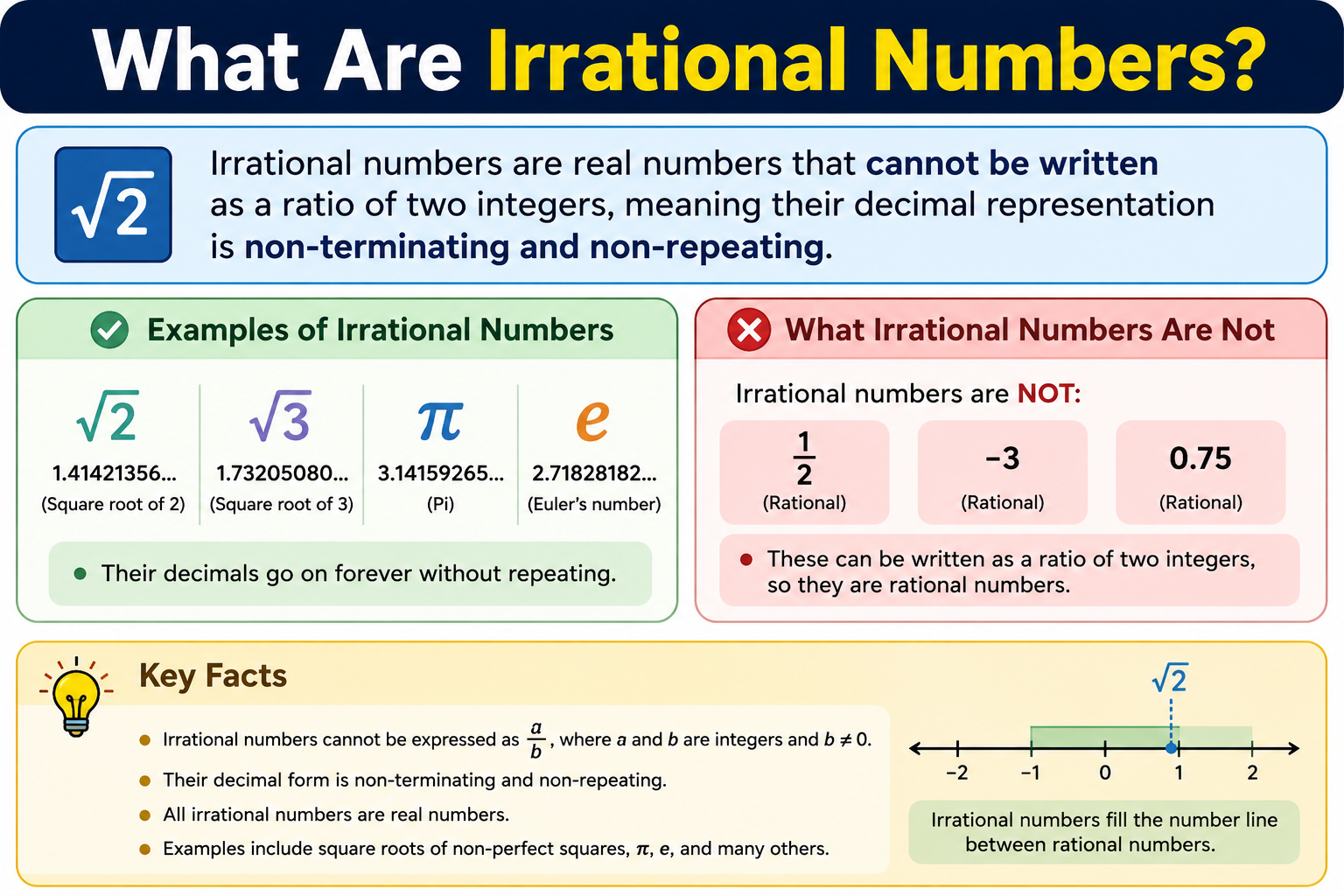
An irrational number is a real number that cannot be expressed as a ratio of two integers, where the denominator is nonzero. In other words, it cannot be written in the form a/b where a and b are integers and b ≠ 0.
What makes irrational numbers distinctive is their decimal behaviour. Their decimal expansions continue indefinitely and never settle into a repeating pattern. Numbers like √2, √3, and π are among the most well-known examples, and they appear far more often in mathematics, geometry, and science than most students initially expect.
This article explains everything you need to know about irrational numbers — from the definition and examples to properties, geometry applications, common misconceptions, and practice questions.
Key Takeaways
-
An irrational number is a real number that cannot be written as a/b where a and b are integers and b ≠ 0.
-
Irrational numbers have decimal expansions that are non-terminating and non-repeating.
-
Common examples include √2, √3, π, e, and the golden ratio φ.
-
Square roots of positive integers that are not perfect squares are irrational.
-
Every irrational number is a real number, but not every real number is irrational.
-
Decimal approximations of irrational numbers, such as √2 ≈ 1.414, are not exact values.
-
Rational and irrational numbers together form the complete set of real numbers.
What Are Irrational Numbers?
An irrational number is a real number that cannot be expressed in the form a/b, where a and b are integers and b ≠ 0.
Let us unpack that definition carefully.
Real numbers include every number on the number line — positive, negative, fractions, decimals, and more. The real numbers are divided into two distinct groups: rational numbers and irrational numbers. Every real number belongs to exactly one of these groups.
Rational numbers are those that can be written as a fraction of two integers with a nonzero denominator. Numbers like 1/2, -3/4, 5, and 0.75 are all rational.
Irrational numbers are everything else in the real numbers — numbers that simply cannot be expressed as an exact fraction of two integers, no matter how hard you try.
The key characteristic of irrational numbers in decimal form is this: their decimal expansion is non-terminating (it never ends) and non-repeating (it never settles into a fixed repeating pattern of digits).
For example, √2 = 1.41421356237309504… continues forever without any cycle repeating. No matter how many decimal places you write, there is always more, and no block of digits ever repeats in a regular pattern.
This is the mathematical signature of an irrational number.
Irrational Number Examples
Here are the most commonly encountered irrational numbers with explanations of why each one qualifies.
√2 — Approximately 1.41421356… The square root of 2 cannot be written as a fraction of two integers. Its decimal expansion is infinite and non-repeating. Irrational.
√3 — Approximately 1.73205080… Again, non-terminating and non-repeating. Cannot be expressed as a ratio of integers. Irrational.
√5 — Approximately 2.23606797… The number 5 is not a perfect square. Its square root is irrational.
√7 — Approximately 2.64575131… Same reasoning applies. 7 is not a perfect square. Irrational.
π (pi) — Approximately 3.14159265358979… The ratio of a circle’s circumference to its diameter. Its decimal expansion has been calculated to trillions of digits without finding any repeating pattern. Irrational.
e (Euler’s number) — Approximately 2.71828182845904… The base of natural logarithms. Like π, its decimal expansion is infinite and non-repeating. Irrational.
Each of these numbers has an exact mathematical meaning, but none can be captured exactly by a fraction with integer numerator and denominator.
Why Is √2 an Irrational Number?
The proof that √2 is irrational is one of the oldest results in mathematics, attributed to ancient Greek mathematicians. It uses a technique called proof by contradiction — you assume the opposite of what you want to prove and show that this assumption leads to an impossible conclusion.
Here is the proof in straightforward steps.
Step 1: Assume the opposite.
Suppose √2 is rational. Then it can be written as a/b where a and b are integers with no common factors (the fraction is in its simplest form) and b ≠ 0.
Step 2: Square both sides.
If √2 = a/b, then 2 = a²/b², which means a² = 2b².
Step 3: Conclude that a² is even.
Since a² = 2b², the number a² is even (it equals 2 multiplied by something). If a² is even, then a itself must be even. (An odd number squared is always odd.)
Step 4: Write a as 2k.
Since a is even, write a = 2k for some integer k. Then a² = 4k².
Step 5: Substitute back.
From Step 2, a² = 2b², so 4k² = 2b², which gives b² = 2k². This means b² is even, so b is also even.
Step 6: Contradiction.
Both a and b are even, which means they share a common factor of 2. But in Step 1, we assumed the fraction a/b was fully simplified with no common factors. This is a contradiction.
Conclusion: The assumption that √2 is rational must be false. Therefore, √2 is irrational.
This elegant proof demonstrates something important: irrational numbers are not just numbers that look complicated — they are numbers that are provably impossible to write as exact fractions.
Is Pi an Irrational Number?
Yes. π is irrational.
π is defined as the ratio of the circumference of any circle to its diameter. That ratio is always the same constant, approximately 3.14159265358979…
The decimal expansion of π never terminates and never repeats. Mathematicians have computed π to trillions of decimal places, and no repeating pattern has ever been found — because none exists.
π was proved irrational in 1761 by the mathematician Johann Heinrich Lambert. The proof is more advanced than the proof for √2 and is beyond the scope of a beginner article, but the conclusion is firmly established.
One important clarification: 22/7 is not equal to π. The fraction 22/7 ≈ 3.142857142857… is only an approximation of π, and a very rough one. Writing 22/7 makes calculation easier in some situations, but it is not the exact value. π is irrational precisely because no such fraction can ever represent it exactly.
Irrational Numbers in Decimal Form
The decimal form of a number reveals immediately whether it is rational or irrational.
- Terminating decimals end after a finite number of digits. Example: 0.5, 0.75. Always rational.
- Repeating decimals have one or more digits that cycle forever. Example: 0.333… = 1/3, 0.121212… = 4/33. Always rational.
- Non-terminating, non-repeating decimals continue forever without any repeating block. Always irrational.
Here is a comparison:
| Number | Decimal Form | Type |
|---|---|---|
| 0.5 | 0.5 | Rational (terminating) |
| 0.75 | 0.75 | Rational (terminating) |
| 0.333… | 0.333… | Rational (repeating) |
| √2 | 1.41421356… | Irrational (non-repeating) |
| π | 3.14159265… | Irrational (non-repeating) |
The non-repeating, never-ending decimal is the hallmark of every irrational number.
Rational vs Irrational Numbers
Understanding the distinction between rational and irrational numbers is fundamental to number theory. For a thorough explanation of rational numbers and how they work, see the LearnMinto article [What Is a Rational Number?]
| Feature | Rational Numbers | Irrational Numbers |
|---|---|---|
| Definition | Can be written as a/b (b ≠ 0) | Cannot be written as a/b |
| Fraction form | Always possible | Never possible |
| Decimal form | Terminates or repeats | Non-terminating, non-repeating |
| Examples | 1/2, -3, 0, 0.75, 0.333… | √2, √3, π, e, φ |
| On the number line | Located at exact positions | Located at exact positions |
| Subset of real numbers | Yes | Yes |
| Together they form | Real numbers | Real numbers |
Every real number is either rational or irrational — never both and never neither.
Irrational Numbers vs Integers
Integers are the whole numbers and their negatives: …, -3, -2, -1, 0, 1, 2, 3, …
Every integer is a rational number because any integer n can be written as n/1. Since all integers are rational, no integer can be irrational — those two categories are mutually exclusive.
For example:
- 5 = 5/1. Rational. Not irrational.
- -7 = -7/1. Rational. Not irrational.
- 0 = 0/1. Rational. Not irrational.
No integer has a non-terminating, non-repeating decimal expansion. Every integer is a whole number that terminates immediately after the decimal point.
Irrational Numbers vs Whole Numbers
Whole numbers are 0, 1, 2, 3, 4, and so on — the non-negative integers.
Since every whole number is an integer, and every integer is rational, every whole number is rational. No whole number is irrational.
Irrational numbers like √2 (approximately 1.414) may sit between whole numbers on the number line, but they are never equal to a whole number.
Irrational Numbers vs Natural Numbers
Natural numbers are the positive counting numbers: 1, 2, 3, 4, 5, …
Some textbooks include 0 in the natural numbers while others do not. Regardless of that variation, the key point remains the same: every natural number is a rational number and therefore cannot be irrational.
Natural numbers, whole numbers, and integers are all subsets of the rational numbers. None of them overlap with the irrational numbers.
Irrational Numbers on the Number Line
Although irrational numbers cannot be expressed as exact fractions, they still occupy precise, definite positions on the number line. They are not vague or approximate — they are exact values with specific locations.
Example: √2 on the number line
Since 1² = 1 and 2² = 4, the value of √2 must lie between 1 and 2. More precisely, since 1.4² = 1.96 and 1.5² = 2.25, the value of √2 is between 1.4 and 1.5.
You can narrow it further: 1.41² = 1.9881 and 1.42² = 2.0164, so √2 is between 1.41 and 1.42. This process can be continued indefinitely, but √2 always has one exact, fixed position on the number line.
Similarly, π sits at a precise point just past 3.14 on the number line. The fact that its decimal expansion continues infinitely does not make its position vague — it is an exact value.
How to Identify an Irrational Number
Use this systematic approach to determine whether a number is irrational.
Step 1: Ask whether the number can be written as a fraction a/b where a and b are integers and b ≠ 0.
Step 2: If yes, it is rational — not irrational. Stop here.
Step 3: Examine the decimal representation. Does it terminate or repeat? If yes, it is rational.
Step 4: If the decimal is non-terminating and non-repeating, the number is irrational.
Step 5: For square roots, check whether the number under the root sign is a perfect square. If it is not a perfect square, the square root is irrational.
Examples:
- 0.6: Terminates. Equal to 3/5. Rational.
- 0.272727…: Repeating. Equal to 3/11. Rational.
- √9: Equal to 3. An integer. Rational.
- √11: 11 is not a perfect square. √11 ≈ 3.3166… Non-repeating. Irrational.
- π: Famous irrational constant. Non-terminating, non-repeating decimal. Irrational.
Perfect Squares and Irrational Square Roots
A perfect square is a whole number that is the square of another whole number.
| Perfect Square | Square Root | Rational? |
|---|---|---|
| 1 | √1 = 1 | Yes |
| 4 | √4 = 2 | Yes |
| 9 | √9 = 3 | Yes |
| 16 | √16 = 4 | Yes |
| 25 | √25 = 5 | Yes |
When a number is a perfect square, its square root is a whole number — and whole numbers are rational.
When a number is not a perfect square, its square root is irrational.
| Number | Square Root | Rational? |
|---|---|---|
| 2 | √2 ≈ 1.41421… | No — irrational |
| 3 | √3 ≈ 1.73205… | No — irrational |
| 5 | √5 ≈ 2.23606… | No — irrational |
| 6 | √6 ≈ 2.44948… | No — irrational |
| 7 | √7 ≈ 2.64575… | No — irrational |
The rule is reliable: if the integer under the square root sign is not a perfect square, the result is irrational.
Are All Square Roots Irrational?
No. This is one of the most common misconceptions students have about irrational numbers.
Square roots of perfect squares are rational:
- √1 = 1 (rational)
- √4 = 2 (rational)
- √9 = 3 (rational)
- √16 = 4 (rational)
- √100 = 10 (rational)
Square roots of non-perfect-square positive integers are irrational:
- √2, √3, √5, √6, √7 are all irrational
So the answer is clear: most square roots of positive integers are irrational, but those that land on perfect squares are rational. Always check whether the number under the square root is a perfect square before drawing a conclusion.
Terminating vs Repeating vs Non-Repeating Decimals
| Decimal Type | Example | Rational or Irrational | Reason |
|---|---|---|---|
| Terminating | 0.5 | Rational | Equals 1/2; ends after one digit |
| Terminating | 0.25 | Rational | Equals 1/4; ends after two digits |
| Repeating | 0.333… | Rational | Equals 1/3; fixed repeating block |
| Repeating | 0.121212… | Rational | Equals 4/33; fixed repeating block |
| Non-terminating, non-repeating | √2 = 1.41421… | Irrational | Never ends; no repeating pattern |
| Non-terminating, non-repeating | π = 3.14159… | Irrational | Never ends; no repeating pattern |
The type of decimal expansion is the clearest indicator of whether a number is rational or irrational. A non-terminating, non-repeating decimal is always irrational. A terminating or repeating decimal is always rational.
Can an Irrational Number Be Written as a Fraction?
No. By definition, an irrational number cannot be expressed as an exact ratio of two integers.
Students sometimes confuse approximate decimal values with exact fractions. For example:
√2 ≈ 1.414
The number 1.414 is a decimal approximation, not the exact value of √2. If you write 1.414 as a fraction, you get 707/500 — but this is not equal to √2. It is only close.
Similarly, π ≈ 22/7 is a rough approximation often used in calculations. But 22/7 is itself a rational number (a fraction of two integers), and it is not equal to π. It is approximately 3.142857…, while π is approximately 3.14159265…
Approximation and exact value are not the same thing. Every decimal approximation of an irrational number is a rational number — but it is never exactly equal to the irrational number it approximates.
Can Irrational Numbers Be Negative?
Yes. Irrational numbers can be positive or negative.
The definition of an irrational number says nothing about sign — only about whether the number can be expressed as a ratio of integers. A negative irrational number satisfies the definition equally well.
Examples of negative irrational numbers:
- -√2 ≈ -1.41421356…
- -√3 ≈ -1.73205080…
- -π ≈ -3.14159265…
These numbers are located to the left of zero on the number line. They are irrational because their decimal expansions are non-terminating and non-repeating, and they cannot be written as a ratio of two integers.
Can Zero Be Irrational?
No. Zero is rational, not irrational.
Zero can be written as 0/1. Both 0 and 1 are integers, and the denominator is nonzero. This satisfies the definition of a rational number exactly.
Since rational and irrational are mutually exclusive categories, zero cannot be both. Because zero is rational, it is definitively not irrational.
Are Irrational Numbers Real Numbers?
Yes. Every irrational number is a real number.
The real number system is made up of two non-overlapping groups:
Real Numbers
├── Rational Numbers (fractions, integers, terminating and repeating decimals)
└── Irrational Numbers (non-terminating, non-repeating decimals)
Every number on the number line is a real number, and every real number is either rational or irrational. Irrational numbers occupy specific positions on the real number line — they are not imaginary or theoretical in the everyday sense of those words.
Numbers like √(-1), which involve the square root of a negative number, are called imaginary numbers and are a completely separate category. They are not real numbers at all, and they are not what we mean by “irrational.”
Properties of Irrational Numbers
Irrational numbers behave in some interesting and sometimes surprising ways when combined with other numbers through arithmetic.
Addition: Rational + Irrational = Irrational
Example: 3 + √2 = 3 + 1.41421… = 4.41421…
The result is irrational.
Subtraction: Rational − Irrational = Irrational
Example: 5 − √3 = 5 − 1.73205… = 3.26794…
The result is irrational.
Multiplication: Nonzero Rational × Irrational = Irrational
Example: 2 × √5 = 2 × 2.23606… = 4.47213…
The result is irrational.
Irrational + Irrational: Can Be Rational or Irrational
Example (irrational): √2 + √3 ≈ 3.14626… Irrational.
Example (rational): √2 + (-√2) = 0. Rational.
Irrational × Irrational: Can Be Rational or Irrational
Example (rational): √2 × √2 = 2. Rational.
Example (irrational): √2 × √3 = √6 ≈ 2.449… Irrational.
Division: Irrational ÷ Irrational: Can Be Rational or Irrational
Example (rational): √8 ÷ √2 = √4 = 2. Rational.
Example (irrational): π ÷ √2. Irrational.
The takeaway is that irrational numbers are not closed under addition, subtraction, multiplication, or division — the result can sometimes come out rational, depending on the specific numbers involved.
Irrational Number Examples in Algebra
Irrational numbers appear naturally in algebraic expressions, especially when square roots or the constant π are involved.
Example 1: The expression √2 · x represents a product where the coefficient is irrational. If x = 1, the result is √2 (irrational). If x = √2, the result is 2 (rational).
Example 2: The expression 3 + √5 is an irrational number because adding the rational number 3 to the irrational number √5 produces an irrational result.
Example 3: The area of a circle is given by A = πr². If the radius r is a rational number, the area involves π and is therefore irrational. For a circle of radius 3, A = 9π ≈ 28.274… — irrational.
Recognising when an algebraic expression involves an irrational value is an important skill in algebra and geometry.
Irrational Numbers in Geometry
Geometry is one of the most natural places to encounter irrational numbers.
Diagonal of a square: A unit square (side length 1) has a diagonal of length √2. This comes directly from the Pythagorean theorem: 1² + 1² = 2, so the diagonal is √2. Since √2 is irrational, the diagonal of a unit square cannot be expressed as an exact fraction.
Circle circumference: The circumference of a circle is C = 2πr. Since π is irrational, the circumference of any circle with a rational radius is irrational.
Circle area: A = πr². Again, π being irrational means that for any circle with a rational radius, the area is irrational.
Pythagorean theorem: Many right triangle problems produce irrational hypotenuse lengths. For example, a right triangle with legs of 2 and 3 has a hypotenuse of √13 ≈ 3.6055… which is irrational.
These are not exceptional cases — irrational values arise routinely in geometric measurement.
Irrational Numbers in Physics
Physics involves measurement, formulas, and calculations that frequently produce irrational values.
Many physical formulas involve square roots. For example, when studying [What Is Kinetic Energy?](What Is Kinetic Energy?), students encounter the formula KE = ½mv². If you need to find the velocity from a given kinetic energy and mass, you rearrange to v = √(2·KE/m). The result of that square root calculation will often be an irrational number — a non-terminating, non-repeating decimal that can only be stated to a desired level of precision.
Similarly, in problems involving [What Is Speed in Physics?], when calculating distances or times from derived quantities, the arithmetic can produce square roots or involve π — for instance, when dealing with circular motion or periodic phenomena.
In practice, physicists use decimal approximations to a suitable number of significant figures. But the underlying exact values are frequently irrational, and understanding that distinction helps students work more carefully between exact and approximate answers.
Irrational Numbers in Science and Engineering
Irrational numbers are not confined to pure mathematics. They appear regularly across scientific and technical disciplines.
Physics: Formulas involving wave motion, oscillation, and circular motion frequently introduce π. Square roots arise in mechanics, thermodynamics, and electromagnetism.
Engineering: Engineers calculate stresses, areas, volumes, and waveforms that routinely involve irrational values. Exact forms are used symbolically, while decimal approximations are used in numerical calculations.
Geometry and architecture: Designing circular structures, domes, or curved surfaces involves π. The Pythagorean theorem generates irrational lengths in structural calculations.
Astronomy: Orbital mechanics involves square roots and π in formulas for orbital periods, escape velocities, and gravitational calculations.
Computer modelling: Algorithms that simulate physical systems use floating-point approximations of irrational constants. Understanding the distinction between exact and approximate values is essential in computational accuracy.
Famous Irrational Numbers
| Number | Symbol | Approximate Value | Why It Is Important |
|---|---|---|---|
| Square root of 2 | √2 | 1.41421356… | First number proved irrational; appears in geometry of squares |
| Square root of 3 | √3 | 1.73205080… | Appears in equilateral triangle geometry |
| Pi | π | 3.14159265… | Ratio of circumference to diameter of any circle |
| Euler’s number | e | 2.71828182… | Base of natural logarithms; appears in growth and decay |
| Golden ratio | φ | 1.61803398… | Ratio found in geometric proportions and mathematical patterns |
Each of these constants has a precise mathematical definition and a provably non-repeating, non-terminating decimal expansion.
Irrational Numbers and the Golden Ratio
The golden ratio φ (phi) is defined as the positive solution to the equation x² = x + 1, giving:
φ = (1 + √5) / 2 ≈ 1.61803398874989…
Since √5 is irrational and dividing an irrational number by the rational number 2 gives an irrational result, φ is irrational.
The golden ratio appears in various geometric proportions. A rectangle where the ratio of the longer side to the shorter side equals φ is called a golden rectangle. Many geometric constructions with regular pentagons and pentagrams naturally produce the golden ratio.
In mathematics, φ has the interesting property that 1/φ = φ − 1, making it a unique constant with self-referential algebraic properties.
Irrational Numbers and the Pythagorean Theorem
The Pythagorean theorem states that in a right-angled triangle:
a² + b² = c²
where a and b are the lengths of the shorter sides (legs) and c is the hypotenuse.
Example with sides 1 and 1:
1² + 1² = c²
1 + 1 = c²
c² = 2
c = √2
The hypotenuse of a right-angled triangle with legs of length 1 is exactly √2 — an irrational number.
This was the context in which the ancient Greeks first encountered irrational numbers, and it reportedly caused considerable philosophical difficulty. The Pythagoreans believed that all numbers should be expressible as ratios of whole numbers, and √2 shattered that assumption permanently.
Any right triangle where the legs are rational numbers but their squares do not add to a perfect square will produce an irrational hypotenuse. For example, legs of 1 and 2 give a hypotenuse of √5. Legs of 2 and 3 give √13. Irrational results from the Pythagorean theorem are the norm, not the exception.
Irrational Numbers and Calculators
When you enter √2 into a calculator, you typically see something like:
1.41421356237
This display has a limited number of decimal places — usually 10 to 12 — because that is all the screen can show. The decimal does not actually stop there. The calculator is displaying a rounded approximation.
This is an important distinction:
- Exact form: √2 (this is the precise, complete value)
- Approximate decimal: 1.41421356… (this continues infinitely; the calculator shows a portion)
Rounding the decimal to 1.414 or 1.41421356 does not make √2 rational. Those rounded values are rational approximations, but they are not equal to √2 itself.
In mathematics, when a question asks for an exact answer, you should give √2, not a rounded decimal. When a question asks for an approximation to a certain number of decimal places, you use the decimal form with the appropriate rounding.
How to Convert an Irrational Number to a Decimal
An irrational number cannot be converted into an exact, finite decimal. However, it can be approximated to any desired number of decimal places.
√2 to various degrees of approximation:
- To 1 decimal place: √2 ≈ 1.4
- To 3 decimal places: √2 ≈ 1.414
- To 6 decimal places: √2 ≈ 1.414214
π to various degrees of approximation:
- To 2 decimal places: π ≈ 3.14
- To 4 decimal places: π ≈ 3.1416
- To 6 decimal places: π ≈ 3.141593
To find a decimal approximation of a square root without a calculator, use the method of finding which perfect squares the number lies between, then narrow down by testing decimal values.
For example, to approximate √7:
- 2² = 4 and 3² = 9, so √7 is between 2 and 3.
- 2.6² = 6.76 and 2.7² = 7.29, so √7 is between 2.6 and 2.7.
- 2.64² = 6.9696 and 2.65² = 7.0225, so √7 ≈ 2.646 to three decimal places.
Common Misconceptions About Irrational Numbers
Misconception 1: Every decimal is irrational.
False. Terminating decimals like 0.5 and repeating decimals like 0.333… are rational.
Misconception 2: Every non-terminating decimal is irrational.
False. A non-terminating decimal that repeats is rational. For example, 0.272727… = 3/11.
Misconception 3: Repeating decimals are irrational.
False. Repeating decimals can always be converted to fractions and are therefore rational.
Misconception 4: √4 is irrational.
False. √4 = 2, which is a whole number and therefore rational.
Misconception 5: π can be written exactly as 22/7.
False. 22/7 is only an approximation of π. The fraction 22/7 is itself rational; π is irrational. They are not equal.
Misconception 6: Irrational numbers are not real numbers.
False. Every irrational number is a real number. Rational and irrational numbers together make up the complete real number system.
Misconception 7: Irrational numbers cannot be placed on a number line.
False. Every irrational number has a precise, definite location on the number line.
Misconception 8: Irrational numbers are always positive.
False. Negative irrational numbers such as -√2 and -π exist.
Misconception 9: An approximation of an irrational number is its exact value.
False. Decimal approximations like √2 ≈ 1.414 are close but never exactly equal to the irrational value.
Misconception 10: All square roots are irrational.
False. Square roots of perfect squares — such as √1, √4, √9, √16 — are rational whole numbers.
How to Solve Irrational Number Problems
Follow this seven-step approach when working with irrational numbers in problems.
- Identify the type of number involved. Is it a square root, π, e, or something else?
- Check for perfect squares. If a square root is involved, determine whether the number under the root is a perfect square.
- Simplify square roots where possible before proceeding with calculations.
- Keep exact forms when the question asks for an exact answer. Write √2, not 1.414.
- Use decimal approximations only when the question explicitly asks for them, and round appropriately.
- Handle signs carefully. Remember that negative irrational numbers follow the same rules as positive ones.
- Check your final answer. Make sure you have not confused an approximation with an exact value.
Irrational Number Worked Examples
Example 1: Identify whether √49 is rational or irrational.
Given: √49
Method: Check whether 49 is a perfect square.
Calculation: 7² = 49, so √49 = 7.
Final Answer: √49 = 7. Rational.
Example 2: Identify whether √50 is rational or irrational.
Given: √50
Method: Check whether 50 is a perfect square. It is not. 7² = 49 and 8² = 64.
Calculation: √50 ≈ 7.071…
Final Answer: √50 is irrational.
Example 3: Simplify √50.
Given: √50
Method: Find the largest perfect square factor of 50. 50 = 25 × 2.
Calculation: √50 = √(25 × 2) = √25 × √2 = 5√2.
Final Answer: 5√2
Example 4: Compare √3 and 1.7.
Given: √3 vs 1.7
Method: Find the approximate value of √3.
Calculation: √3 ≈ 1.7320…
Final Answer: √3 > 1.7
Example 5: Order √2, √3, 2, and √5 from smallest to largest.
Given: √2, √3, 2, √5
Method: Convert to decimal approximations.
Calculation: √2 ≈ 1.414, √3 ≈ 1.732, 2 = 2.000, √5 ≈ 2.236.
Final Answer: √2 < √3 < 2 < √5
Example 6: Add 3 + √7.
Given: 3 + √7
Method: The sum of a rational and an irrational number is irrational.
Calculation: √7 ≈ 2.6457… so 3 + √7 ≈ 5.6457…
Final Answer: 3 + √7 is irrational. Exact form: 3 + √7.
Example 7: Multiply √3 × √3.
Given: √3 × √3
Method: Multiply the square roots.
Calculation: √3 × √3 = √(3 × 3) = √9 = 3.
Final Answer: 3. Rational.
Example 8: Find the hypotenuse of a right triangle with legs 3 and 4.
Given: a = 3, b = 4
Method: Apply the Pythagorean theorem: c = √(a² + b²).
Calculation: c = √(9 + 16) = √25 = 5.
Final Answer: c = 5. Rational (perfect square under root).
Example 9: Find the hypotenuse of a right triangle with legs 1 and 3.
Given: a = 1, b = 3
Method: c = √(1² + 3²) = √(1 + 9) = √10.
Calculation: √10 ≈ 3.1622…
Final Answer: √10. Irrational.
Example 10: Approximate √11 to two decimal places.
Given: √11
Method: Find perfect squares near 11. 3² = 9 and 4² = 16.
Calculation: 3.3² = 10.89, 3.32² = 11.0224, 3.31² = 10.9561.
Final Answer: √11 ≈ 3.32 (to two decimal places).
Simplifying Irrational Expressions
Simplifying square roots means writing them in their simplest form by factoring out perfect squares.
√8
Factor: 8 = 4 × 2
√8 = √4 × √2 = 2√2
√12
Factor: 12 = 4 × 3
√12 = √4 × √3 = 2√3
√18
Factor: 18 = 9 × 2
√18 = √9 × √2 = 3√2
√45
Factor: 45 = 9 × 5
√45 = √9 × √5 = 3√5
√75
Factor: 75 = 25 × 3
√75 = √25 × √3 = 5√3
The process is always the same: find the largest perfect square factor of the number under the root, take its square root outside the radical, and leave the remaining factor inside.
Rationalizing a Denominator
Rationalizing a denominator means rewriting a fraction so that there is no irrational number in the denominator. This is a standard technique in algebra.
Example: Rationalize 1/√2
The denominator is √2, which is irrational. Multiply both numerator and denominator by √2:
1/√2 × √2/√2 = √2/2
The result is √2/2. The denominator is now 2 — a rational number. The fraction has been rationalized.
Why is this useful?
In formal mathematics, expressions are usually written with rational denominators. Rationalizing makes fractions easier to compare and simplify, and it is a standard requirement in many examination questions.
Another example: Rationalize 5/√3
Multiply top and bottom by √3:
5/√3 × √3/√3 = 5√3/3
Final answer: 5√3/3
Comparing Irrational Numbers
To compare irrational numbers, use one of three approaches.
Method 1: Decimal approximation
Convert each number to a decimal approximation to the same number of places, then compare.
Example: Compare √5 and √6.
√5 ≈ 2.2360… and √6 ≈ 2.4494…
Since 2.4494 > 2.2360, we have √6 > √5.
Method 2: Squaring (for positive values)
If both numbers are positive, compare their squares. The larger square belongs to the larger number.
Example: Compare √7 and 2.5.
(√7)² = 7 and (2.5)² = 6.25.
Since 7 > 6.25, we have √7 > 2.5.
Method 3: Number line
Plot approximate values on a number line and read off the order visually.
Ordering Irrational Numbers
Ordering irrational numbers from smallest to largest follows the same logic as comparison — convert to decimal approximations, then arrange.
Example: Order √2, √5, √3, and 2 from smallest to largest.
Decimal values:
- √2 ≈ 1.414
- √3 ≈ 1.732
- 2 = 2.000
- √5 ≈ 2.236
Order from smallest to largest: √2 < √3 < 2 < √5
Example: Order -√3, -1, -√2, and -2 from smallest to largest.
Decimal values:
- -2 = -2.000
- -√3 ≈ -1.732
- -√2 ≈ -1.414
- -1 = -1.000
Order from smallest to largest: -2 < -√3 < -√2 < -1
(For negative numbers, remember: the further left on the number line, the smaller the value.)
Irrational Number Practice Questions
20 Multiple Choice Questions
Question 1: Which of the following is an irrational number?
- A) 1/3
- B) 0.25
- C) √7
- D) √9
Correct Answer: C
Explanation: √7 is irrational because 7 is not a perfect square. √9 = 3, which is rational.
Question 2: What type of decimal does an irrational number have?
- A) Terminating
- B) Repeating
- C) Non-terminating and non-repeating
- D) Terminating or repeating
Correct Answer: C
Explanation: Irrational numbers have decimal expansions that never end and never repeat a fixed pattern.
Question 3: Which of the following is rational?
- A) √2
- B) √5
- C) √16
- D) √11
Correct Answer: C
Explanation: √16 = 4, which is a whole number and therefore rational.
Question 4: Is π an irrational number?
- A) No, because π = 22/7
- B) Yes, because its decimal expansion is non-terminating and non-repeating
- C) No, because it is used in geometry
- D) Yes, because it is very large
Correct Answer: B
Explanation: π cannot be expressed as a ratio of two integers. 22/7 is only an approximation.
Question 5: Which of the following best describes an irrational number?
- A) A number that cannot be negative
- B) A number that cannot be expressed as a/b where b ≠ 0
- C) A number that is not on the number line
- D) A number greater than 1
Correct Answer: B
Explanation: By definition, an irrational number cannot be expressed in the form a/b with integer a and b where b ≠ 0.
Question 6: What is the simplified form of √18?
- A) 3√3
- B) 2√9
- C) 3√2
- D) 6√2
Correct Answer: C
Explanation: 18 = 9 × 2. √18 = √9 × √2 = 3√2.
Question 7: Which number is between √3 and √5?
- A) 1.5
- B) √4 = 2
- C) 1.2
- D) √7
Correct Answer: B
Explanation: √3 ≈ 1.732 and √5 ≈ 2.236. √4 = 2 lies between them.
Question 8: Is 0.454545… rational or irrational?
- A) Irrational, because it does not terminate
- B) Rational, because it repeats
- C) Irrational, because it contains digits 4 and 5
- D) Neither rational nor irrational
Correct Answer: B
Explanation: 0.454545… is a repeating decimal. It equals 5/11, which is rational.
Question 9: What is √2 × √2?
- A) √4
- B) 2
- C) 2√2
- D) 4
Correct Answer: B
Explanation: √2 × √2 = 2. Multiplying a square root by itself gives the number under the root.
Question 10: Which of these is an irrational number?
- A) -5
- B) 0
- C) 3/7
- D) -√3
Correct Answer: D
Explanation: -√3 is a negative irrational number. The others are all rational.
Question 11: Rationalize 1/√5. What is the result?
- A) √5/5
- B) 5/√5
- C) 1/5
- D) √5
Correct Answer: A
Explanation: Multiply by √5/√5: (1 × √5)/(√5 × √5) = √5/5.
Question 12: Which statement is correct?
- A) All irrational numbers are integers.
- B) All irrational numbers are real numbers.
- C) All real numbers are irrational.
- D) Irrational numbers cannot be negative.
Correct Answer: B
Explanation: Every irrational number is a real number. Real numbers include both rational and irrational numbers.
Question 13: Simplify √45.
- A) 5√3
- B) 3√5
- C) 9√5
- D) 15
Correct Answer: B
Explanation: 45 = 9 × 5. √45 = √9 × √5 = 3√5.
Question 14: Order the following from smallest to largest: √2, √5, √3, 2.
- A) 2 < √2 < √3 < √5
- B) √2 < √3 < 2 < √5
- C) √3 < √2 < 2 < √5
- D) √2 < 2 < √3 < √5
Correct Answer: B
Explanation: √2 ≈ 1.414, √3 ≈ 1.732, 2 = 2.000, √5 ≈ 2.236.
Question 15: What is the hypotenuse of a right triangle with legs of length 1 and 1?
- A) 1
- B) √3
- C) √2
- D) 2
Correct Answer: C
Explanation: c² = 1² + 1² = 2, so c = √2.
Question 16: Is e (Euler’s number) rational or irrational?
- A) Rational
- B) Irrational
- C) Neither
- D) It depends on how it is used
Correct Answer: B
Explanation: e ≈ 2.71828182… Its decimal expansion is non-terminating and non-repeating, and e cannot be expressed as a ratio of integers.
Question 17: Which of the following correctly describes the golden ratio φ?
- A) Rational, because it appears in geometry
- B) Irrational, because it equals (1 + √5)/2
- C) Rational, because it can be approximated as 1.618
- D) Neither rational nor irrational
Correct Answer: B
Explanation: φ = (1 + √5)/2. Since √5 is irrational, φ is irrational.
Question 18: A student says “0.333… is irrational because it does not terminate.” Is the student correct?
- A) Yes, because non-terminating decimals are always irrational
- B) No, because 0.333… = 1/3, which is rational
- C) Yes, because 0.333… cannot be simplified
- D) No, because all decimals are rational
Correct Answer: B
Explanation: 0.333… is a repeating decimal equal to 1/3. Repeating decimals are rational, not irrational.
Question 19: What is √2 + √2?
- A) 2
- B) √4
- C) 2√2
- D) 4
Correct Answer: C
Explanation: √2 + √2 = 2√2, just as x + x = 2x.
Question 20: Which of the following is NOT an example of an irrational number?
- A) √11
- B) π
- C) √25
- D) e
Correct Answer: C
Explanation: √25 = 5, which is rational. All others are irrational.
10 Short Answer Questions
Q1: Give two examples of irrational numbers.
Answer: Any two from: √2, √3, √5, √7, π, e, φ.
Q2: Explain in one sentence what makes a decimal irrational.
Answer: A decimal is irrational if it is non-terminating and non-repeating — it continues forever without any fixed repeating block of digits.
Q3: Is -π rational or irrational?
Answer: Irrational. Negative values of irrational numbers are still irrational.
Q4: Simplify √72.
Answer: 72 = 36 × 2. √72 = √36 × √2 = 6√2.
Q5: Why is 22/7 not equal to π?
Answer: 22/7 is a rational number (a fraction of two integers) equal to approximately 3.142857…, while π ≈ 3.14159265… They are not equal; 22/7 is only an approximation.
Q6: Is the sum of two irrational numbers always irrational?
Answer: Not always. For example, √2 + (-√2) = 0, which is rational.
Q7: Give an example where an irrational number multiplied by an irrational number gives a rational result.
Answer: √3 × √3 = 3, which is rational.
Q8: Rationalize 3/√5.
Answer: 3/√5 × √5/√5 = 3√5/5.
Q9: Is the number 1.010010001… rational or irrational?
Answer: Irrational. Although the pattern looks structured, the number of zeros between the 1s increases each time, so there is no fixed repeating block.
Q10: What is the hypotenuse of a right triangle with legs of 3 and 5?
Answer: c = √(9 + 25) = √34. Since 34 is not a perfect square, the hypotenuse is √34, which is irrational.
10 Identify Rational or Irrational Questions
1. Is √36 rational or irrational?
Rational. √36 = 6.
2. Is √14 rational or irrational?
Irrational. 14 is not a perfect square. √14 ≈ 3.7416…
3. Is 0.875 rational or irrational?
Rational. 0.875 = 7/8. Terminating decimal.
4. Is π/2 rational or irrational?
Irrational. Since π is irrational and 2 is rational and nonzero, π/2 is irrational.
5. Is √(1/4) rational or irrational?
Rational. √(1/4) = 1/2.
6. Is 3.141592653… rational or irrational?
Irrational (this is the beginning of π’s decimal expansion — non-terminating and non-repeating).
7. Is -√9 rational or irrational?
Rational. -√9 = -3, which is an integer.
8. Is e² rational or irrational?
Irrational. e is irrational, and e² ≈ 7.389056… which is also irrational.
9. Is 7/22 rational or irrational?
Rational. Both 7 and 22 are integers and 22 ≠ 0. This is a proper fraction.
10. Is √(2/3) rational or irrational?
Irrational. Neither 2 nor 3 is such that 2/3 is a perfect square ratio.
5 Calculation Problems
Problem 1: Simplify √(75) + √(48).
Step 1: Simplify each term.
√75 = √(25 × 3) = 5√3
√48 = √(16 × 3) = 4√3
Step 2: Add like terms.
5√3 + 4√3 = 9√3
Answer: 9√3
Problem 2: Find the area of a circle with radius 5. Leave your answer in terms of π.
A = πr² = π × 5² = 25π
Answer: 25π square units (irrational)
Problem 3: Rationalize the denominator of 6/√3.
Multiply by √3/√3:
6/√3 × √3/√3 = 6√3/3 = 2√3
Answer: 2√3
Problem 4: A right triangle has legs of length 2 and 7. Find the hypotenuse in simplified exact form.
c² = 2² + 7² = 4 + 49 = 53
c = √53
53 is not a perfect square and has no perfect square factors other than 1.
Answer: √53 (irrational, cannot be simplified further)
Problem 5: Order -√5, -√2, -1, and -√3 from smallest to largest.
Decimal values:
-√5 ≈ -2.236
-√3 ≈ -1.732
-√2 ≈ -1.414
-1 = -1.000
Answer: -√5 < -√3 < -√2 < -1
Exam Tips
Memorise the definition precisely. An irrational number is a real number that cannot be expressed as a/b where a and b are integers and b ≠ 0. Write this down at the start of any relevant exam question.
Check for perfect squares first. When you see a square root, always ask: is the number under the root a perfect square? If yes, the result is rational. If no, it is irrational.
Remember that repeating decimals are rational. This trips up many students. If a decimal repeats a fixed pattern, it is rational — not irrational.
Know the key irrational constants. √2, √3, π, and e should be immediately recognisable as irrational. These appear in exams regularly.
Distinguish exact values from approximations. If a question asks for an exact answer, give √2, not 1.414. If it asks for an approximation to a given number of decimal places, round carefully.
Do not accept 22/7 as π. These are not equal. In exam questions about π, use the symbol π in exact answers unless told to approximate.
Test the decimal form when unsure. If you cannot decide whether a number is rational or irrational, consider its decimal expansion. Terminating or repeating means rational; non-terminating and non-repeating means irrational.
Simplify square roots before comparing. When comparing expressions like √18 and 3, simplify first: √18 = 3√2 ≈ 4.24, which is greater than 3.
Quick Revision Notes
Definition: An irrational number is a real number that cannot be written as a/b (b ≠ 0) with integer a and b.
Examples: √2, √3, √5, √7, π, e, φ.
Decimal representation: Non-terminating and non-repeating.
Rational vs irrational: Rational decimals terminate or repeat. Irrational decimals do neither.
Real numbers: Rational + irrational = all real numbers. Every irrational number is a real number.
Square roots: Square roots of non-perfect-square integers are irrational. Square roots of perfect squares are rational.
π and e: Both are irrational. π ≈ 3.14159…, e ≈ 2.71828…
Properties: Rational ± irrational = irrational. Irrational × irrational can be rational or irrational.
Geometry: √2 appears as the diagonal of a unit square. π appears in all circle calculations.
Physics and science: Square roots and π arise naturally in physical formulas and measurements.
Irrational Numbers Cheat Sheet
| Concept | Definition | Example |
|---|---|---|
| Irrational number | Real number that cannot be expressed as a/b (b ≠ 0) | √2, π, √5 |
| Rational number | Number expressible as a/b with integer a, b and b ≠ 0 | 1/2, -3, 0.75 |
| Terminating decimal | Decimal that ends after a finite number of digits | 0.5, 1.25 |
| Repeating decimal | Decimal with an infinitely repeating fixed block of digits | 0.333…, 0.272727… |
| Non-terminating non-repeating decimal | Decimal that continues forever without any repeating pattern | √2 = 1.41421…, π = 3.14159… |
| Perfect square | Integer that is the square of another integer | 1, 4, 9, 16, 25 |
| Real number | Any rational or irrational number on the number line | 5, √2, -3/4, π |
Frequently Asked Questions
1. What are irrational numbers?
Irrational numbers are real numbers that cannot be expressed as a ratio of two integers with a nonzero denominator. Their decimal expansions are non-terminating and non-repeating.
2. What is the definition of an irrational number?
A number is irrational if it cannot be written in the form a/b where a and b are integers and b ≠ 0.
3. Is √2 irrational?
Yes. √2 ≈ 1.41421356… Its decimal expansion never ends and never repeats. It has been proven rigorously that √2 cannot be expressed as a fraction of two integers.
4. Is π irrational?
Yes. π ≈ 3.14159265… It is non-terminating and non-repeating. This was proved by Lambert in 1761.
5. Is 1/3 irrational?
No. 1/3 = 0.333…, which is a repeating decimal. It is rational because it can be written as a fraction of two integers.
6. Is 0.5 irrational?
No. 0.5 = 1/2. It is a terminating decimal and therefore rational.
7. Is 0.333… irrational?
No. 0.333… is a repeating decimal equal to 1/3. Repeating decimals are rational.
8. Is √4 irrational?
No. √4 = 2, which is a whole number and rational.
9. Are all square roots irrational?
No. Square roots of perfect squares are rational. For example, √9 = 3 and √16 = 4.
10. Can irrational numbers be negative?
Yes. For example, -√2 and -π are negative irrational numbers.
11. Are irrational numbers real numbers?
Yes. Every irrational number is a real number. Real numbers = rational numbers + irrational numbers.
12. Can irrational numbers be written as fractions?
No. By definition, irrational numbers cannot be expressed as an exact fraction of two integers. Decimal approximations are rational approximations, not exact equivalents.
13. What is the difference between rational and irrational numbers?
Rational numbers can be expressed as a/b with integers a and b. Their decimals terminate or repeat. Irrational numbers cannot be expressed this way, and their decimals are non-terminating and non-repeating.
14. How can you identify an irrational number?
Check whether the number can be written as a fraction of integers. If not, or if its decimal is non-terminating and non-repeating, it is irrational. For square roots, check whether the number under the root is a perfect square.
15. What are some common examples of irrational numbers?
√2, √3, √5, √7, π, e (Euler’s number), and the golden ratio φ are the most commonly encountered irrational numbers in school mathematics.
Summary
Irrational numbers are real numbers that cannot be expressed as a ratio of two integers with a nonzero denominator. Their defining characteristic in decimal form is that they are non-terminating and non-repeating — they continue forever without any fixed repeating pattern.
Common examples include √2, √3, √5, π, e, and the golden ratio φ. Square roots of integers that are not perfect squares are always irrational, while square roots of perfect squares are rational whole numbers.
Understanding the distinction between [What Is a Rational Number?](What Is a Rational Number?) and an irrational number is essential for number theory, algebra, and geometry. The classification of numbers — from natural numbers through integers and rational numbers to the full real number system — provides the foundation for all higher mathematics.
Irrational numbers appear in geometry (diagonals, circle calculations, the Pythagorean theorem), in physics formulas, and throughout algebra. Knowing when to use exact forms like √2 versus when to use decimal approximations is a key skill for examinations at every level.
Final Thoughts
Irrational numbers are not mathematical curiosities — they are an essential part of the real number system. Every time you calculate the diagonal of a square, the circumference of a circle, or the hypotenuse of a right triangle, you encounter them directly.
What makes irrational numbers genuinely fascinating is their combination of precision and complexity. A number like √2 has a perfectly exact value — it is the length of the diagonal of a unit square — but it cannot be captured by any finite or repeating decimal, and it cannot be written as an exact fraction. That combination of exactness and inexhaustibility is what sets irrational numbers apart.
For students at GCSE, IGCSE, A-Level, and beyond, a solid understanding of irrational numbers — their definition, their decimal behaviour, their appearance in square roots and geometry, and their distinction from rational numbers — is a foundation you will return to again and again throughout your mathematical education.
Mastering these ideas now will pay dividends every time you encounter algebra, geometry, physics, engineering, or any field where precise mathematical thinking is required.
References
- Khan Academy — Irrational Numbers: https://www.khanacademy.org/math/algebra/x2f8bb11595b61c86:irrational-numbers
- Wolfram MathWorld — Irrational Number: https://mathworld.wolfram.com/IrrationalNumber.html
- Encyclopaedia Britannica — Irrational Number: https://www.britannica.com/science/irrational-number
- OpenStax — Prealgebra 2e: Rational and Irrational Numbers: https://openstax.org/books/prealgebra-2e/pages/7-1-rational-and-irrational-numbers
- Mathematics LibreTexts — Irrational Numbers: https://math.libretexts.org/
Disclaimer:
This article is intended for educational and informational purposes only. While LearnMinto strives to provide accurate and up-to-date mathematics information, readers should verify important academic concepts through official textbooks, educational institutions, examination boards, or trusted educational resources before using this content for exams or academic purposes. LearnMinto is not affiliated with any specific school, university, research institution, or examination board.