
Introduction
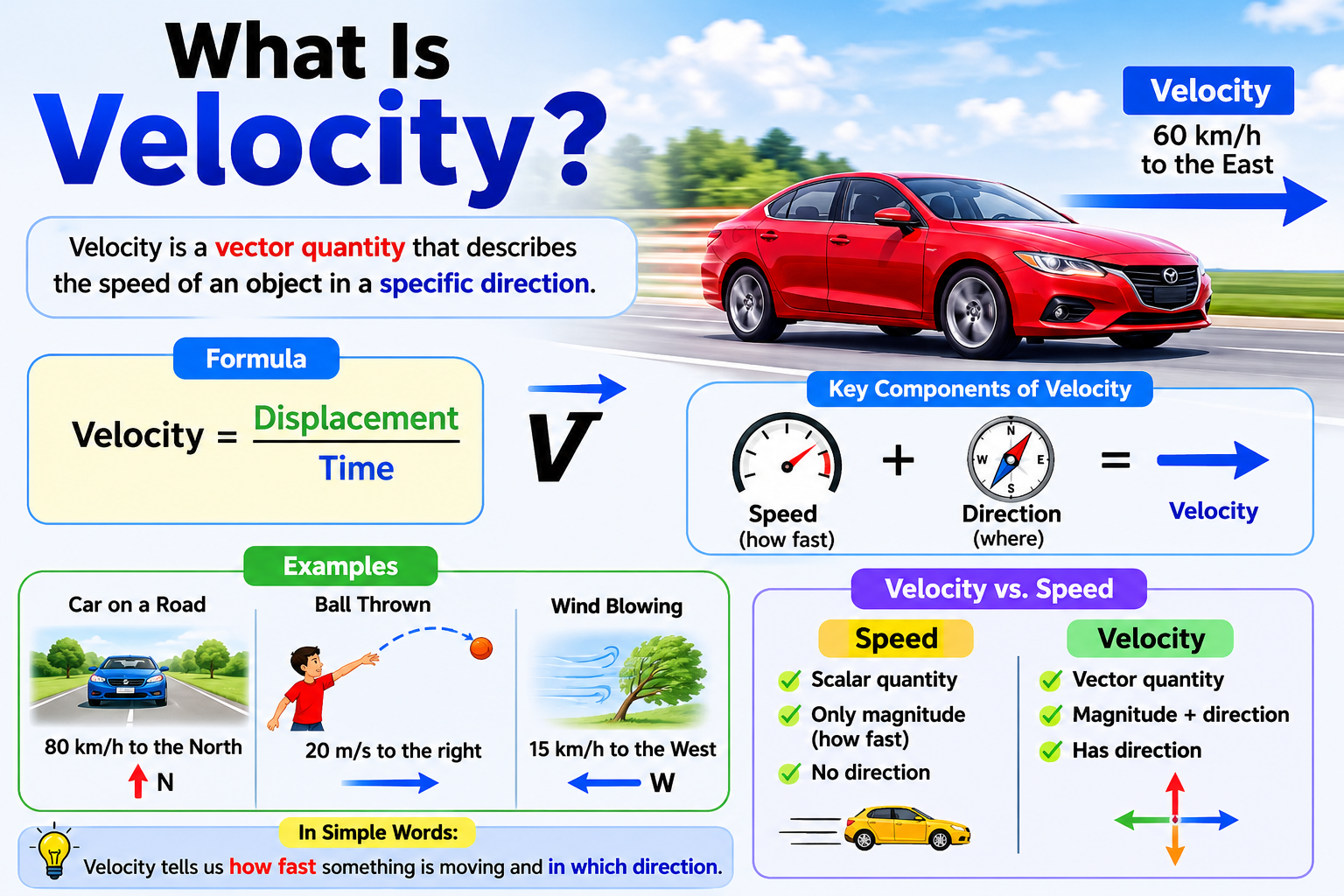
Imagine two cars leaving the same car park at exactly the same moment. Both travel at 60 km/h, but one heads north toward the motorway while the other heads south toward the town centre. Their speeds are identical, yet they are doing completely different things physically. This is precisely where the concept of velocity becomes essential. Velocity is the rate of change of displacement with respect to time. It tells you both how fast an object is moving and the direction in which it is moving.
This makes velocity fundamentally different from speed. Speed only tells you how fast. Velocity tells you how fast and in which direction. That additional piece of information, direction, changes everything when you are solving real physics problems.
In this article, you will find a complete, beginner-friendly guide to velocity in physics, covering its definition, formula, types, graphs, real-life examples, worked calculations, practice questions, and much more.
Key Takeaways
-
Velocity is the rate of change of displacement with respect to time, not distance.
-
Velocity is a vector quantity, meaning it has both magnitude and direction.
-
The SI unit of velocity is metres per second (m/s).
-
The formula for velocity is v = Δx / Δt.
-
Velocity can be positive, negative, or zero depending on the chosen coordinate direction.
-
An object can have constant speed but changing velocity if its direction changes.
-
Average velocity uses total displacement divided by total time, not total distance.
-
Acceleration is the rate of change of velocity, not speed.
What Is Velocity in Physics?
Velocity is defined as the rate of change of displacement with respect to time. It describes how quickly an object’s position is changing and in which direction that change is happening.
This definition has two key components:
- Magnitude: How fast the object is moving, expressed in metres per second (m/s).
- Direction: Which way the object is heading, such as north, upward, to the right, or at a specified angle.
Both components are essential. If you leave out the direction, you are describing speed, not velocity.
Here are some important points about velocity:
- Velocity is based on displacement, not distance. Displacement is the straight-line change in position from start to finish, including direction.
- An object moving in a straight line at constant speed has constant velocity.
- An object moving in a curve, even at constant speed, does not have constant velocity because its direction is continuously changing.
- Velocity can be positive, negative, or zero, depending on the coordinate system you choose.
A simple everyday example: a train travelling at 80 m/s toward London has a specific velocity. Another train moving at 80 m/s away from London has the same speed but an entirely different velocity.
What Is the Formula for Velocity?
The standard formula for velocity is:
v = Δx / Δt
Where:
- v = velocity (metres per second, m/s)
- Δx = displacement (metres, m)
- Δt = change in time (seconds, s)
The Greek letter delta (Δ) means “change in,” so Δx means the change in position and Δt means the change in time.
Simple Example:
A person walks 50 metres east in 10 seconds. Calculate their velocity.
v = Δx / Δt
v = 50 / 10
v = 5 m/s east
Notice that the answer includes both a numerical value (5) and a direction (east). Without the direction, the answer would describe speed, not velocity.
The formula can be rearranged to find displacement or time:
- Displacement: Δx = v × Δt
- Time: Δt = Δx / v
What Is Displacement?
Before using velocity in calculations, it is important to understand displacement clearly, because many students confuse it with distance.
Displacement is the straight-line change in an object’s position from its starting point to its finishing point, measured in a specific direction.
Key points about displacement:
- It is a vector quantity, so it has both magnitude and direction.
- It measures only the straight-line change in position, not the total path length.
- Displacement can be positive, negative, or zero.
- If an object starts and ends at the same position, its displacement is zero, even if it travelled a long distance in between.
Example:
A runner completes one full lap of a 400-metre circular track and returns to the starting point. The distance they have run is 400 metres. However, their displacement is zero, because their final position is the same as their starting position.
Is Velocity a Scalar or Vector Quantity?
Velocity is a vector quantity. This means it requires both magnitude and direction to be fully described.
Compare these two statements:
- “The car moves at 20 m/s.” This describes speed, a scalar quantity.
- “The car moves at 20 m/s east.” This describes velocity, a vector quantity.
The number 20 m/s east and 20 m/s west are not the same velocity. They have the same magnitude but opposite directions. In a physics problem, treating them as equivalent would produce completely wrong results.
This is why direction is never optional when describing velocity. A sign convention is commonly used in one-dimensional problems: motion in one direction (for example, right or upward) is defined as positive, and motion in the opposite direction is defined as negative.
Understanding vector quantities is a key step in developing proper physics reasoning. Almost every important quantity in mechanics, including force, acceleration, and momentum, is a vector, and velocity is often the first one that students encounter in detail.
Velocity vs Speed
The difference between velocity and speed is one of the most commonly tested concepts in introductory physics. The table below makes the distinction clear.
| Feature | Velocity | Speed |
|---|---|---|
| Definition | Rate of change of displacement | Rate of change of distance |
| Scalar or Vector | Vector | Scalar |
| Includes direction | Yes | No |
| Formula | v = Δx / Δt | v = d / t |
| SI unit | m/s | m/s |
| Can it be negative? | Yes | No |
| Can it be zero when object has moved? | Yes (if displacement is zero) | No (if object has moved, distance is positive) |
| Example | 15 m/s north | 15 m/s |
A runner who completes a full lap of a circular track has a nonzero average speed (because they covered distance), but their average velocity is zero (because their displacement is zero, they returned to the start).
For a complete guide to speed, including its formula, types, and worked examples, the LearnMinto article on What Is Speed in Physics? is an excellent companion to this one.
Types of Velocity
Just as with speed, there are several types of velocity that describe different physical situations.
Uniform Velocity
An object has uniform velocity when it moves in a straight line at constant speed. Both the magnitude and the direction of velocity remain unchanged.
This is an idealized situation that is rarely maintained for long in the real world, but it is a valuable simplification in physics problems.
Examples of uniform velocity:
- A car travelling in a straight line at a steady speed on a motorway with no hills or bends.
- A hockey puck sliding across frictionless ice in a straight line.
An important clarification: an object moving at constant speed but turning a corner does not have uniform velocity. If the direction changes, the velocity changes, even if the magnitude of velocity (the speed) stays the same.
Non-Uniform Velocity
An object has non-uniform velocity when its velocity changes over time. This can happen because:
- The speed changes (the object accelerates or decelerates).
- The direction changes (the object turns, even at constant speed).
- Both speed and direction change simultaneously.
Examples of non-uniform velocity:
- A car in city traffic that speeds up, slows down, and changes direction.
- A ball thrown upward (its speed changes as it rises and falls, and its direction reverses at the peak).
- A runner going around a curved track (direction changes continuously).
Most real-world motion is non-uniform because objects are rarely able to maintain a perfectly constant speed in a perfectly straight line for any significant period.
Average Velocity
When an object’s velocity changes throughout a journey, physicists use average velocity to describe the overall motion.
Average velocity = Total displacement / Total time
This is not the same as average speed. Average speed uses total distance, while average velocity uses total displacement.
Example 1:
A cyclist rides 200 metres north in 40 seconds, then 100 metres north in 20 seconds.
Total displacement = 200 + 100 = 300 m north
Total time = 40 + 20 = 60 seconds
Average velocity = 300 / 60 = 5 m/s north
Example 2:
A person walks 300 metres east in 60 seconds and then 300 metres west in 60 seconds, returning to the start.
Total displacement = 0 m (they returned to the starting point)
Total time = 120 seconds
Average velocity = 0 / 120 = 0 m/s
Even though the person was moving the entire time, their average velocity is zero because their displacement is zero.
Instantaneous Velocity
Instantaneous velocity is the velocity of an object at one specific moment in time. It tells you how fast the object is moving and in which direction at that precise instant.
A car’s speedometer shows instantaneous speed. If you also know the direction the car is facing at that instant, you have its instantaneous velocity.
In mathematics, instantaneous velocity is found by taking the derivative of position with respect to time, but at the introductory level, it is most intuitively understood as the velocity at one specific moment rather than across a time interval.
Uniform Velocity vs Non-Uniform Velocity
| Feature | Uniform Velocity | Non-Uniform Velocity |
|---|---|---|
| Definition | Constant speed in a constant direction | Changing speed, direction, or both |
| Speed | Constant | Variable |
| Direction | Constant | Changing |
| Acceleration | Zero | Nonzero |
| Example | Car on a straight motorway at steady speed | Car braking at a roundabout |
| Motion pattern | Straight line at constant rate | Curved or uneven path |
Average Velocity vs Instantaneous Velocity
| Feature | Average Velocity | Instantaneous Velocity |
|---|---|---|
| Definition | Total displacement divided by total time | Velocity at one specific moment |
| Time span | Over a complete journey or time interval | At a single instant |
| Formula | v_avg = Δx_total / Δt_total | Rate of change of position at one point |
| Practical example | Overall velocity for a road trip | Car speedometer reading with direction |
| Can it be zero? | Yes (if displacement is zero) | Yes (momentarily at rest) |
| Usefulness | Summarises a whole journey | Describes motion at a precise moment |
Can Velocity Be Negative?
Yes, velocity can be negative. A negative velocity does not mean anything has gone wrong with the physics. It simply means the object is moving in the direction defined as negative in the chosen coordinate system.
In a typical one-dimensional problem, one direction is defined as positive and the opposite direction is defined as negative. For example:
- If rightward is positive, then an object moving leftward has negative velocity.
- If upward is positive, then a falling object has negative velocity.
- If northward is positive, then a car heading south has negative velocity.
Example:
A ball is thrown upward. We define upward as positive. As the ball rises, its velocity is positive. At the peak, its velocity is zero. As it falls back down, its velocity becomes negative, because it is now moving in the downward (negative) direction.
This is perfectly normal physics. Negative velocity simply indicates direction, nothing more.
Can Velocity Be Zero?
Yes, velocity can be zero in several distinct situations:
- An object at rest: If an object is completely stationary, its displacement is not changing, so its velocity is zero.
- A ball at the highest point of a vertical throw: At the very peak of its flight, the ball’s instantaneous velocity is zero. It has stopped moving upward but has not yet started moving downward. At that precise instant, velocity is zero.
- An object completing a round trip: If an object returns exactly to its starting point, its total displacement is zero, making its average velocity zero regardless of how far it travelled.
An important subtlety: just because velocity is zero at a particular instant does not mean acceleration is also zero. A ball at the peak of its throw has zero instantaneous velocity but still experiences gravitational acceleration of 9.8 m/s² downward. Velocity and acceleration are independent quantities.
Can Velocity Change Without Speed Changing?
Yes. This is one of the most important and frequently misunderstood ideas in introductory physics.
Velocity is a vector. It changes whenever either its magnitude (speed) or its direction changes. Therefore, if an object changes direction while maintaining the same speed, its velocity has changed even though the numerical speed value is the same.
The clearest example is circular motion. A car navigating a circular roundabout at a constant 30 km/h has the same speed at every point around the circle. However, its direction of motion is constantly changing, which means its velocity is constantly changing. This continuous change in velocity means there is a continuous acceleration, even though the speed is constant.
This is why acceleration is connected to changes in velocity rather than changes in speed. The LearnMinto article on What Is Acceleration? explains this relationship in detail, including how centripetal acceleration works in circular motion.
Velocity and Acceleration
Velocity and acceleration are closely related. Acceleration is defined as the rate of change of velocity with respect to time:
a = Δv / Δt
Where:
- a = acceleration (m/s²)
- Δv = change in velocity (m/s)
- Δt = time interval (s)
The relationship between velocity and acceleration works in three main ways:
- Increasing velocity: If acceleration is in the same direction as velocity, the object speeds up. A car pressing the accelerator pedal on a straight road.
- Decreasing velocity: If acceleration is opposite to velocity, the object slows down. A car applying its brakes.
- Changing direction of velocity: If acceleration is perpendicular to velocity, the speed stays constant but the direction changes. This is centripetal acceleration in circular motion.
Understanding this connection between velocity and acceleration is fundamental to solving kinematics problems and understanding Newton’s laws.
Velocity and Force
A net force acting on an object changes its acceleration, which in turn changes its velocity. This is captured by Newton’s Second Law:
F_net = ma
The chain of relationships works as follows:
Force → Acceleration → Change in Velocity
A net force in the forward direction accelerates an object forward, increasing its forward velocity. A net force opposite to the direction of motion decelerates the object, reducing its velocity.
If the net force is zero, the object’s velocity does not change. It either stays at rest or continues moving at constant velocity in a straight line. This is Newton’s First Law of Motion.
For a thorough explanation of how force connects to motion and velocity, the LearnMinto article on What Is Force in Physics? provides clear explanations and worked examples covering all three of Newton’s laws.
Velocity and Friction
Friction is a force that opposes motion between two surfaces in contact. When friction acts on a moving object, it reduces the net force acting on the object, producing a negative acceleration that decreases the object’s velocity.
A simple example: a wooden box sliding across a rough concrete floor. Initially, the box has a positive velocity in the forward direction. Friction acts backward (opposing the motion). This frictional force causes a negative acceleration, reducing the box’s velocity over time until the box comes to rest.
Without friction (for example, on a perfectly smooth surface), the net force would be zero, and the box would continue sliding indefinitely at the same velocity. In the real world, friction always acts, which is why moving objects eventually slow to a stop unless driven by a continued force.
The LearnMinto article on What Is Friction? explores the different types of friction, how it is calculated, and how it affects the motion of objects in a variety of situations.
Velocity and Gravity
Gravity affects velocity in a direct and important way. Near Earth’s surface, the gravitational acceleration is approximately 9.8 m/s² directed downward. This means that any object moving vertically has its velocity changed at a rate of 9.8 m/s every second due to gravity.
Here is how gravity affects velocity in different scenarios:
- Falling object (dropped from rest): Initial velocity is zero. Gravity accelerates it downward, so downward velocity increases at 9.8 m/s every second.
- Object thrown upward: Initial velocity is upward (positive). Gravity acts downward (negative), reducing the upward velocity by 9.8 m/s every second. The object slows, stops momentarily at the peak, and then accelerates downward.
- Projectile motion: Horizontal velocity is unaffected by gravity (ignoring air resistance). Vertical velocity changes continuously due to gravitational acceleration.
Understanding how gravity changes velocity is fundamental to analysing all types of projectile and free-fall problems.
Velocity in Circular Motion
When an object moves in a circle, its velocity is called tangential velocity. It is always directed along the tangent to the circular path at the object’s current position, meaning it is perpendicular to the radius at that point.
Even if the object maintains a constant speed around the circle, its velocity is constantly changing because its direction is constantly changing. At every point on the circle, the tangential velocity points in a different direction.
This continuous change in velocity requires a continuous acceleration, known as centripetal acceleration, which always points toward the centre of the circle. A net centripetal force is required to maintain this acceleration and keep the object moving in a circular path.
This concept beautifully illustrates why velocity and speed are different. You can have constant speed but continuously changing velocity in circular motion, and this changing velocity is the source of the centripetal acceleration.
Velocity-Time Graph
A velocity-time graph plots velocity (vertical axis) against time (horizontal axis). It is one of the most useful tools for visualising motion in physics.
Here is what different features of the graph indicate:
- Positive velocity (line above zero): The object is moving in the positive direction.
- Negative velocity (line below zero): The object is moving in the negative direction.
- Zero velocity (line on the time axis): The object is momentarily at rest.
- Constant velocity (horizontal line): The object moves at steady velocity with zero acceleration.
- Changing velocity (sloping line): The velocity is increasing or decreasing. The slope represents acceleration.
- Steeper positive slope: Greater positive acceleration.
- Steeper negative slope: Greater negative acceleration (deceleration).
For one-dimensional motion, the slope of a velocity-time graph gives the acceleration:
a = Δv / Δt = slope of velocity-time graph
The area under a velocity-time graph gives the displacement of the object during that time interval.
Position-Time Graph and Velocity
A position-time graph (also called a displacement-time graph) plots the position (or displacement) of an object against time.
For one-dimensional motion, the slope of a position-time graph gives the velocity:
v = Δx / Δt = slope of position-time graph
Different features of the graph indicate different motion:
- Horizontal line: Position is not changing. The object is stationary. Velocity = 0.
- Straight line with positive slope: Position increases steadily. The object moves at constant positive velocity.
- Straight line with negative slope: Position decreases steadily. The object moves at constant negative velocity (backward or in the negative direction).
- Steeper line: Greater velocity. More displacement is covered per unit time.
- Curved line: Velocity is changing (the object is accelerating or decelerating).
Reading position-time and velocity-time graphs accurately is a core skill for GCSE, IGCSE, and A-Level physics examinations.
Velocity as the Slope of a Graph
The slope of a position-time graph is calculated as:
v = Δx / Δt
This is simply the rise (change in position) divided by the run (change in time).
Example:
A position-time graph shows a straight line from position x = 10 m at t = 2 s to position x = 40 m at t = 8 s.
Δx = 40 − 10 = 30 m
Δt = 8 − 2 = 6 s
v = 30 / 6 = 5 m/s in the positive direction
This approach allows you to extract velocity information directly from a graph without being given the velocity explicitly. It is a valuable skill in both problem-solving and data analysis.
Distance, Displacement, Speed, Velocity and Acceleration
These five quantities form the core of kinematics. Understanding how they relate to each other, and how they differ, is essential for every physics student.
| Quantity | Definition | Scalar or Vector | SI Unit | Basic Relationship |
|---|---|---|---|---|
| Distance | Total length of path covered | Scalar | m | Related to total path traveled |
| Displacement | Straight-line change in position | Vector | m | Δx = x_f − x_i |
| Speed | Rate of change of distance | Scalar | m/s | v = d/t |
| Velocity | Rate of change of displacement | Vector | m/s | v = Δx/Δt |
| Acceleration | Rate of change of velocity | Vector | m/s² | a = Δv/Δt |
Velocity and Motion
Velocity is one of the most complete descriptions of motion because it captures both the rate of movement and its direction. It helps describe:
- Direction of motion: A velocity of 10 m/s west tells you exactly where the object is heading.
- Rate of change of position: The magnitude of velocity tells you how quickly the object’s position is changing.
- Straight-line motion: An object moving in a straight line at constant velocity experiences no net force (Newton’s First Law).
- Circular motion: Velocity changes continuously in direction even when speed is constant.
- Changing motion: Any change in velocity, whether in magnitude or direction, indicates the presence of acceleration.
Velocity is the bridge between position (where something is) and acceleration (how its motion is changing). Mastering velocity makes it much easier to understand the rest of classical mechanics.
Velocity in Different Real-Life Situations
Velocity is present in every situation involving motion. Here are some examples that always include direction, as a proper velocity description requires:
- Car: A car travelling at 25 m/s north on a motorway has a clearly defined velocity.
- Train: A high-speed train moving at 80 m/s east toward the capital city has a specific velocity.
- Airplane: A commercial aircraft cruising at 250 m/s at a bearing of 270 degrees (due west) has both speed and direction fully specified.
- Bicycle: A cyclist moving at 6 m/s toward a junction has a velocity that will change if they turn.
- Runner: A sprinter moving at 10 m/s along a straight 100-metre track in the eastward direction.
- Boat: A rowing boat moving at 3 m/s upstream against a river current.
- Elevator: An elevator moving at 2 m/s upward has a positive velocity (if up is defined as positive).
- Falling object: A ball falling at 15 m/s downward has a specific downward velocity.
- Rocket: A rocket accelerating at 500 m/s upward away from the launch pad.
In each of these examples, leaving out the direction would reduce the description from velocity to speed.
How to Calculate Velocity
Example 1: Basic velocity
A cyclist travels 120 metres east in 24 seconds. Calculate the velocity.
v = Δx / Δt
v = 120 / 24
v = 5 m/s east
Example 2: Positive velocity
A ball rolls 30 metres in the forward direction in 6 seconds. Calculate the velocity.
v = Δx / Δt
v = 30 / 6
v = 5 m/s forward (positive)
Example 3: Negative velocity
A car reverses 20 metres in 5 seconds. We define forward as positive.
Δx = −20 m (backward, negative direction)
Δt = 5 s
v = Δx / Δt
v = −20 / 5
v = −4 m/s (4 m/s backward)
Example 4: Average velocity
A person walks 400 metres north in 80 seconds, then 100 metres north in 20 seconds.
Total displacement = 400 + 100 = 500 m north
Total time = 80 + 20 = 100 seconds
Average velocity = 500 / 100
Average velocity = 5 m/s north
Example 5: Average velocity with displacement back
A runner jogs 600 metres east in 120 seconds, then 200 metres west in 40 seconds.
Total displacement = 600 − 200 = 400 m east
Total time = 120 + 40 = 160 seconds
Average velocity = 400 / 160
Average velocity = 2.5 m/s east
Unit Conversions for Velocity
The same conversion rules that apply to speed apply to velocity. The magnitude of velocity converts between units in the same way; the direction remains unchanged.
From km/h to m/s (divide by 3.6):
Example: Convert a velocity of 90 km/h north to m/s.
90 ÷ 3.6 = 25 m/s north
Example: Convert 36 km/h south to m/s.
36 ÷ 3.6 = 10 m/s south
From m/s to km/h (multiply by 3.6):
Example: Convert 15 m/s east to km/h.
15 × 3.6 = 54 km/h east
Example: Convert 8 m/s upward to km/h.
8 × 3.6 = 28.8 km/h upward
Always remember to include the direction in your converted answer, because velocity requires direction to be a complete description.
Velocity and Constant Acceleration
When an object undergoes constant acceleration, there is a direct relationship between its initial velocity, final velocity, acceleration, and time:
v_f = v_i + at
Where:
- v_f = final velocity (m/s)
- v_i = initial velocity (m/s)
- a = acceleration (m/s²)
- t = time (s)
This equation applies only when acceleration is constant throughout the motion. If acceleration varies, this equation will not give correct results.
Example:
A car starts from rest (v_i = 0) and accelerates at 3 m/s² for 8 seconds. What is its final velocity?
v_f = v_i + at
v_f = 0 + (3 × 8)
v_f = 24
v_f = 24 m/s in the direction of acceleration
This formula is one of the most frequently used in mechanics and appears regularly in GCSE, A-Level, and NEET physics examinations.
Common Misconceptions About Velocity
Clearing up misconceptions early saves a great deal of confusion later. Here are the most common errors students make about velocity:
- Thinking velocity and speed are the same. They are not. Velocity includes direction; speed does not. This distinction matters in every vector calculation.
- Forgetting that velocity has direction. Always include direction in a velocity answer. A numerical value without direction describes speed, not velocity.
- Confusing distance with displacement. The velocity formula uses displacement (Δx), not distance (d). Using the wrong quantity will give an incorrect velocity.
- Thinking negative velocity means negative speed. Speed cannot be negative. Negative velocity simply means the object is moving in the negative direction as defined by the coordinate system.
- Assuming constant speed means constant velocity. Not true. An object moving at constant speed in a curve has changing velocity because its direction changes.
- Thinking an object cannot have zero velocity while accelerating. A ball at the peak of a vertical throw has zero instantaneous velocity but is still accelerating at 9.8 m/s² downward due to gravity.
- Confusing average velocity with average speed. Average velocity uses total displacement. Average speed uses total distance. For a round trip, average velocity is zero, but average speed is not.
- Forgetting to include units. An answer of “5” is incomplete. Always write “5 m/s north” or whichever unit and direction are appropriate.
- Using distance instead of displacement when calculating velocity. If the object changes direction during the journey, distance and displacement will differ, leading to incorrect velocity calculations.
How to Solve Velocity Problems
Use this structured approach to solve velocity problems accurately:
- Identify the initial and final positions. Determine where the object starts and where it finishes.
- Determine the displacement. Calculate Δx = x_f − x_i. Remember to include direction.
- Identify the time interval. Find the duration of the motion in seconds.
- Choose the correct velocity formula. Decide whether you need v = Δx/Δt, average velocity, or v_f = v_i + at.
- Convert units if necessary. Make sure displacement is in metres and time is in seconds for the result in m/s.
- Substitute the values. Insert the numbers carefully into the formula.
- Calculate the result. Work through the arithmetic step by step.
- Include the correct unit. Write m/s or km/h as appropriate.
- State the direction. Always indicate the direction of velocity in your final answer.
- Check whether the answer is reasonable. Does the direction make sense physically? Is the magnitude sensible for the situation described?
Velocity and Free Fall
Free fall is the motion of an object that accelerates under gravity alone, with no air resistance. Understanding how velocity changes during free fall is one of the most important applications of velocity in physics.
For an object falling from rest:
- Initial velocity: v_i = 0
- Acceleration: a = g = 9.8 m/s² downward
- After 1 second: v = 9.8 m/s downward
- After 2 seconds: v = 19.6 m/s downward
- After 3 seconds: v = 29.4 m/s downward
For an object thrown upward:
- Initial velocity is upward (positive if upward is positive).
- Gravity decelerates the object at 9.8 m/s² downward.
- At the peak of the throw, instantaneous velocity = 0.
- After the peak, velocity becomes negative (downward), increasing in magnitude as the object falls.
Using v_f = v_i + at makes these calculations straightforward once you clearly define the positive direction and the sign of the acceleration.
Important Velocity Formulas
| Formula | Meaning | Variables | SI Unit of Result | When to Use |
|---|---|---|---|---|
| v = Δx / Δt | Basic definition of velocity | v = velocity, Δx = displacement, Δt = time | m/s | Any motion with known displacement and time |
| Average v = Δx_total / Δt_total | Average velocity over a complete journey | Total displacement and total time | m/s | Journey with varying velocity |
| v_f = v_i + at | Final velocity under constant acceleration | v_f = final, v_i = initial, a = acceleration, t = time | m/s | When acceleration is constant and time is known |
Velocity Practice Questions
20 Multiple Choice Questions
Question 1: What is velocity in physics?
- A) The total distance covered per unit time
- B) The rate of change of displacement with respect to time
- C) The total force acting on an object
- D) The change in speed per unit time
Correct Answer: B) The rate of change of displacement with respect to time
Explanation: Velocity measures how quickly displacement changes, and it includes direction.
Question 2: What is the SI unit of velocity?
- A) km/h
- B) m/s²
- C) m/s
- D) N
Correct Answer: C) m/s
Explanation: Metres per second (m/s) is the standard SI unit of velocity.
Question 3: A car moves 80 metres north in 10 seconds. What is its velocity?
- A) 8 m/s
- B) 80 m/s north
- C) 8 m/s north
- D) 0.125 m/s north
Correct Answer: C) 8 m/s north
Explanation: v = Δx/Δt = 80/10 = 8 m/s north.
Question 4: Which of the following is a vector quantity?
- A) Speed
- B) Distance
- C) Velocity
- D) Temperature
Correct Answer: C) Velocity
Explanation: Velocity has both magnitude and direction, making it a vector quantity.
Question 5: A runner completes one full lap of a circular track and returns to the start. What is the runner’s average velocity?
- A) Depends on the speed
- B) Equal to the average speed
- C) Zero
- D) Equal to the circumference divided by time
Correct Answer: C) Zero
Explanation: Total displacement is zero (start and finish are the same point), so average velocity = 0.
Question 6: Which of the following correctly describes non-uniform velocity?
- A) Constant speed in a straight line
- B) Zero acceleration throughout
- C) A change in speed, direction, or both
- D) Equal displacement in equal time intervals
Correct Answer: C) A change in speed, direction, or both
Explanation: Non-uniform velocity occurs whenever either speed or direction changes.
Question 7: A ball is thrown upward. What is its velocity at the highest point?
- A) Maximum upward velocity
- B) 9.8 m/s upward
- C) Zero
- D) 9.8 m/s downward
Correct Answer: C) Zero
Explanation: At the peak, the ball momentarily stops moving upward before beginning to fall, so its instantaneous velocity is zero.
Question 8: What is the slope of a position-time graph equal to?
- A) Acceleration
- B) Force
- C) Distance
- D) Velocity
Correct Answer: D) Velocity
Explanation: The gradient of a position-time graph gives the velocity of the object.
Question 9: An object moves at 12 m/s east. We define west as positive. What is the velocity?
- A) +12 m/s
- B) −12 m/s
- C) Zero
- D) +24 m/s
Correct Answer: B) −12 m/s
Explanation: The object moves east, which is opposite to the chosen positive direction (west), so the velocity is −12 m/s.
Question 10: A car travels at constant speed around a circular track. Which statement is correct?
- A) The car has constant velocity
- B) The car has constant acceleration
- C) The car has changing velocity but constant speed
- D) The car has zero acceleration
Correct Answer: C) The car has changing velocity but constant speed
Explanation: Direction changes continuously in circular motion, so velocity changes even though speed remains constant.
Question 11: Which formula gives the final velocity under constant acceleration?
- A) v_f = v_i × at
- B) v_f = v_i − at
- C) v_f = v_i + at
- D) v_f = v_i / at
Correct Answer: C) v_f = v_i + at
Explanation: This is the standard kinematic equation for final velocity under constant acceleration.
Question 12: A person walks 500 m east then 500 m west in 200 seconds total. What is their average velocity?
- A) 5 m/s east
- B) 5 m/s west
- C) Zero
- D) 10 m/s east
Correct Answer: C) Zero
Explanation: Total displacement = 0 (they returned to start), so average velocity = 0/200 = 0 m/s.
Question 13: What does the area under a velocity-time graph represent?
- A) Acceleration
- B) Force
- C) Displacement
- D) Speed
Correct Answer: C) Displacement
Explanation: The area under a velocity-time graph gives the displacement of the object.
Question 14: Convert 54 km/h north to m/s.
- A) 54 m/s north
- B) 194.4 m/s north
- C) 15 m/s north
- D) 5 m/s north
Correct Answer: C) 15 m/s north
Explanation: 54 ÷ 3.6 = 15 m/s. Direction remains north.
Question 15: How does velocity differ from speed?
- A) Velocity uses distance; speed uses displacement
- B) Velocity includes direction; speed does not
- C) Speed is a vector; velocity is a scalar
- D) They are identical quantities
Correct Answer: B) Velocity includes direction; speed does not
Explanation: Velocity is a vector (magnitude + direction); speed is a scalar (magnitude only).
Question 16: A car starts from rest and reaches 20 m/s in 5 seconds with constant acceleration. What is the acceleration?
- A) 4 m/s²
- B) 100 m/s²
- C) 25 m/s²
- D) 0.25 m/s²
Correct Answer: A) 4 m/s²
Explanation: a = Δv/Δt = (20 − 0)/5 = 4 m/s².
Question 17: Which of the following has zero velocity but nonzero acceleration?
- A) A parked car
- B) A car at constant speed
- C) A ball at the peak of its vertical throw
- D) A stationary satellite
Correct Answer: C) A ball at the peak of its vertical throw
Explanation: At the peak, instantaneous velocity is zero, but gravity still provides 9.8 m/s² downward acceleration.
Question 18: A horizontal line on a velocity-time graph indicates:
- A) Constant acceleration
- B) Increasing displacement
- C) Constant velocity
- D) Zero velocity
Correct Answer: C) Constant velocity
Explanation: A horizontal line means velocity is not changing over time.
Question 19: A train moves 900 m north in 60 seconds. What is its velocity?
- A) 54,000 m/s north
- B) 15 m/s north
- C) 840 m/s north
- D) 0.067 m/s north
Correct Answer: B) 15 m/s north
Explanation: v = 900/60 = 15 m/s north.
Question 20: Which of the following correctly describes uniform velocity?
- A) Constant speed in a changing direction
- B) Constant speed and constant direction
- C) Constant acceleration
- D) Changing speed in a constant direction
Correct Answer: B) Constant speed and constant direction
Explanation: Uniform velocity requires both the speed and the direction to remain constant simultaneously.
10 Short Answer Questions
Q1: Define velocity in physics.
Velocity is the rate of change of displacement with respect to time. It is a vector quantity measured in metres per second (m/s) that describes both the speed and direction of an object’s motion.
Q2: What is the formula for velocity? Define all variables.
v = Δx/Δt, where v is velocity in m/s, Δx is displacement in metres, and Δt is the change in time in seconds.
Q3: How does velocity differ from speed?
Velocity is a vector quantity that includes direction. Speed is a scalar quantity that has magnitude only. Velocity uses displacement; speed uses distance.
Q4: A cyclist travels 180 m south in 30 seconds. Calculate the velocity.
v = Δx/Δt = 180/30 = 6 m/s south.
Q5: What is average velocity, and how is it calculated?
Average velocity is the total displacement divided by the total time taken. It describes the overall rate of change of position across a complete journey.
Q6: Can velocity be negative? Explain with an example.
Yes. Velocity is negative when an object moves in the direction defined as negative in the coordinate system. For example, if rightward is positive, a car moving leftward at 10 m/s has a velocity of −10 m/s.
Q7: A car accelerates from 5 m/s to 25 m/s in 4 seconds. Calculate the acceleration.
a = Δv/Δt = (25 − 5)/4 = 20/4 = 5 m/s².
Q8: Explain why an object in circular motion at constant speed has changing velocity.
Because velocity is a vector that includes direction. In circular motion, the direction of the object’s motion changes continuously. Since the direction component of velocity changes, the velocity itself changes, even though the speed remains constant.
Q9: What does a negative slope on a velocity-time graph indicate?
A negative slope indicates negative acceleration. If the object was moving in the positive direction, a negative slope means the object is decelerating (slowing down).
Q10: An object starts from rest and reaches 30 m/s north under constant acceleration of 5 m/s². How long does this take?
Using v_f = v_i + at: 30 = 0 + 5t, so t = 30/5 = 6 seconds.
5 Numerical Problems
Problem 1:
A runner moves 400 metres north in 80 seconds and then 200 metres south in 40 seconds. Calculate the average velocity.
Solution:
Total displacement = 400 − 200 = 200 m north
Total time = 80 + 40 = 120 seconds
Average velocity = 200 / 120 = 1.67 m/s north
Problem 2:
A car starts from rest and accelerates uniformly at 4 m/s² for 12 seconds. Calculate the final velocity.
Solution:
v_f = v_i + at
v_f = 0 + (4 × 12)
v_f = 48 m/s in the direction of acceleration
Problem 3:
A ball is thrown upward at 20 m/s. Using g = 10 m/s², calculate the velocity after 3 seconds.
Solution:
Taking upward as positive, a = −10 m/s²
v_f = v_i + at
v_f = 20 + (−10 × 3)
v_f = 20 − 30
v_f = −10 m/s (10 m/s downward)
The negative sign indicates the ball is now moving downward.
Problem 4:
A cyclist rides 2 km east in 8 minutes. Convert the velocity to m/s.
Solution:
Δx = 2,000 m, Δt = 8 × 60 = 480 seconds
v = 2,000 / 480 = 4.17 m/s east
Problem 5:
A train moves 540 km north in 3 hours. Calculate the velocity in m/s.
Solution:
Δx = 540 km = 540,000 m
Δt = 3 × 3,600 = 10,800 seconds
v = 540,000 / 10,800 = 50 m/s north
5 Exam-Style Questions
Question 1:
A student claims that “velocity and speed are the same quantity, just measured differently.” Identify the error in this statement and explain the correct distinction between velocity and speed.
Answer: The student is incorrect. Speed and velocity are not the same quantity. Speed is a scalar quantity that describes only how fast an object is moving, using total distance divided by time. Velocity is a vector quantity that describes both how fast and in which direction an object is moving, using displacement divided by time. A key practical difference is that a runner who completes a full lap of a track has nonzero average speed but zero average velocity, because displacement is zero. Leaving out direction makes the description a speed, not a velocity.
Question 2:
A car travels 60 km east in 1 hour, then 40 km west in 30 minutes. Calculate the average velocity in m/s for the whole journey.
Answer:
Total displacement = 60 − 40 = 20 km east = 20,000 m east
Total time = 1 hour + 0.5 hours = 1.5 hours = 5,400 seconds
Average velocity = 20,000 / 5,400 ≈ 3.70 m/s east
Question 3:
Explain, using the definition of velocity, why an object moving in a circle at constant speed is still changing its velocity.
Answer: Velocity is a vector quantity defined as the rate of change of displacement, and it includes both magnitude and direction. When an object moves in a circle at constant speed, the magnitude of its velocity (the speed) stays the same at every point. However, the direction of motion changes continuously as the object moves around the circle. Since velocity includes direction, any change in direction is a change in velocity. Therefore, the velocity changes continuously throughout circular motion, even though the speed remains constant. This changing velocity means the object is accelerating, and the acceleration is centripetal, pointing toward the centre of the circle.
Question 4:
A ball is thrown vertically upward at 15 m/s from the ground. Taking upward as positive and g = 10 m/s², calculate the velocity of the ball after 2 seconds and after 4 seconds. Explain what each answer tells you about the ball’s motion.
Answer:
After 2 seconds:
v_f = v_i + at = 15 + (−10 × 2) = 15 − 20 = −5 m/s
The negative sign shows the ball is now moving downward (it has passed the peak and is falling back).
After 4 seconds:
v_f = 15 + (−10 × 4) = 15 − 40 = −25 m/s
The ball is now moving downward at 25 m/s. It has been falling for some time past its peak.
Question 5:
Describe what a velocity-time graph looks like for an object that starts with a positive velocity, decelerates uniformly to zero, remains at rest briefly, and then accelerates in the negative direction. Describe what each section of the graph represents.
Answer: The graph would have three distinct sections. In the first section, the graph shows a straight line with a negative slope starting above zero, representing constant deceleration. The line reaches zero velocity at the moment the object stops. In the second section, the graph shows a horizontal line along the zero axis, representing the period when the object is at rest with zero velocity. In the third section, the graph shows a straight line with a negative slope below zero, representing the object accelerating in the negative direction. The slope of each section indicates the magnitude of the acceleration, and the area under (or below) each section gives the displacement.
Exam Tips
- Define velocity precisely: It is the rate of change of displacement with respect to time. Displacement, not distance.
- Always include direction in velocity answers. A velocity answer without direction is incomplete. This is one of the easiest marks to lose in an exam.
- Remember the formula: v = Δx/Δt. Know how to rearrange it for displacement or time.
- Velocity is a vector; speed is a scalar. This is a frequently tested distinction. Be ready to explain it clearly.
- Average velocity uses displacement. Do not use total distance when calculating average velocity.
- Negative velocity is just a direction. It does not mean the object is slowing down. It means the object is moving in the negative direction.
- Know the SI unit: m/s. If the question gives speed in km/h, convert to m/s by dividing by 3.6 before substituting into any formula requiring m/s.
- Velocity-time graph: The slope gives acceleration. The area gives displacement. Know both.
- Position-time graph: The slope gives velocity. A horizontal line means zero velocity.
- Learn v_f = v_i + at. This equation is used constantly in kinematics problems involving constant acceleration.
Quick Revision Notes
- Velocity = rate of change of displacement = Δx/Δt.
- SI unit: metres per second (m/s).
- Vector quantity: needs both magnitude and direction.
- Types: uniform, non-uniform, average, instantaneous.
- Uniform velocity: constant speed in constant direction, zero acceleration.
- Non-uniform velocity: changing speed, direction, or both.
- Average velocity = total displacement / total time.
- Instantaneous velocity: velocity at one specific moment.
- Velocity can be positive, negative, or zero.
- Negative velocity = motion in negative direction, not “bad.”
- Zero velocity: object at rest, or at peak of vertical throw, or after round trip.
- Circular motion: constant speed but changing velocity (direction changes).
- v_f = v_i + at: final velocity under constant acceleration.
- Position-time graph: slope = velocity.
- Velocity-time graph: slope = acceleration, area = displacement.
- Velocity ≠ speed: velocity uses displacement, speed uses distance.
Velocity Cheat Sheet
| Concept | Definition | Formula | Unit | Example |
|---|---|---|---|---|
| Velocity | Rate of change of displacement | v = Δx/Δt | m/s | 15 m/s north |
| Average Velocity | Total displacement over total time | v_avg = Δx_total/Δt_total | m/s | 5 m/s east over 2-hour drive |
| Instantaneous Velocity | Velocity at one specific moment | Rate of change at a point | m/s | Car moving at 20 m/s north at 3:00 pm |
| Uniform Velocity | Constant speed and direction | v = constant | m/s | Car on straight motorway at fixed speed |
| Non-Uniform Velocity | Changing speed or direction | v changes over time | m/s | Car in city traffic |
| Final Velocity | Velocity after constant acceleration | v_f = v_i + at | m/s | After accelerating from rest for 5 s |
| Negative Velocity | Motion in the negative direction | Δx is negative | m/s | Object falling (if upward is positive) |
| km/h to m/s | Unit conversion | Divide by 3.6 | m/s | 72 km/h = 20 m/s |
| m/s to km/h | Unit conversion | Multiply by 3.6 | km/h | 20 m/s = 72 km/h |
Frequently Asked Questions
1. What is velocity in physics?
Velocity is the rate of change of displacement with respect to time. It is a vector quantity that describes both the speed and direction of an object’s motion, measured in metres per second (m/s).
2. What is the formula for velocity?
The basic formula is v = Δx/Δt, where Δx is displacement in metres and Δt is time in seconds. For constant acceleration, v_f = v_i + at.
3. What is the SI unit of velocity?
The SI unit of velocity is metres per second (m/s).
4. Is velocity a scalar or vector quantity?
Velocity is a vector quantity. It has both magnitude and direction.
5. What is the difference between speed and velocity?
Speed is a scalar quantity that uses distance. Velocity is a vector quantity that uses displacement. Velocity includes direction; speed does not.
6. What is average velocity?
Average velocity is the total displacement divided by the total time taken for a journey. It can be zero even if the object was moving the entire time, if the final position equals the starting position.
7. What is instantaneous velocity?
Instantaneous velocity is the velocity of an object at one specific moment in time. It includes both the instantaneous speed and the direction of motion at that instant.
8. Can velocity be negative?
Yes. Negative velocity simply means the object is moving in the direction defined as negative in the chosen coordinate system.
9. Can velocity be zero?
Yes. An object at rest has zero velocity. An object at the peak of a vertical throw has zero instantaneous velocity. An object that returns to its starting point has zero average velocity.
10. Can velocity change while speed remains constant?
Yes. In circular motion, direction changes continuously while speed stays constant. Since velocity includes direction, velocity changes even when speed does not.
11. What is the difference between velocity and acceleration?
Velocity is the rate of change of displacement. Acceleration is the rate of change of velocity. Velocity tells you how fast and in which direction. Acceleration tells you how quickly that velocity is changing.
12. How do you calculate velocity?
Use v = Δx/Δt. Determine the displacement (final position minus initial position), divide by the time taken, and include the direction.
13. What is uniform velocity?
Uniform velocity means constant speed in a constant direction. The magnitude and direction of velocity both remain unchanged. There is zero acceleration.
14. What is non-uniform velocity?
Non-uniform velocity means either speed, direction, or both are changing. Non-uniform velocity implies nonzero acceleration.
15. How is velocity shown on a graph?
On a position-time graph, the slope (gradient) of the line represents velocity. On a velocity-time graph, the position of the line above, below, or on the time axis shows whether velocity is positive, negative, or zero.
Summary
Velocity is the rate of change of displacement with respect to time. Unlike speed, which is a scalar, velocity is a vector quantity that includes both magnitude and direction. Its SI unit is metres per second (m/s), and its fundamental formula is v = Δx/Δt.
There are four main types of velocity: uniform (constant speed and direction), non-uniform (changing speed or direction), average (total displacement over total time), and instantaneous (velocity at one precise moment).
Velocity can be positive, negative, or zero, depending on the direction of motion relative to the chosen coordinate system. Negative velocity is not a problem. It simply indicates motion in the opposite direction to the positive convention.
An object can have changing velocity even at constant speed, as happens in circular motion where direction changes continuously. Velocity is closely connected to acceleration (the rate of change of velocity) and to force through Newton’s Second Law.
Mastering velocity is a crucial step toward understanding motion, mechanics, and the physical laws that govern how objects move and interact.
Final Thoughts
Velocity is not just a formula to memorise. It is a way of thinking about motion that is both richer and more precise than simply asking “how fast?” When you ask “what is velocity?”, you are asking a question that demands both a speed and a direction in response.
This matters enormously in physics. Without direction, you cannot predict where an object will end up. You cannot determine whether forces are adding to or subtracting from an object’s motion. You cannot calculate momentum, analyse circular motion, or fully apply Newton’s laws.
Take time to understand velocity intuitively, not just mathematically. Draw graphs, work through problems, and always ask yourself: in which direction is this object moving, and how quickly is that changing? With that habit of thought in place, the rest of kinematics and dynamics will become much more accessible.
References
- OpenStax. University Physics Volume 1 – Chapter 3: Motion Along a Straight Line. OpenStax, Rice University. Available at: https://openstax.org/books/university-physics-volume-1/pages/3-introduction
- Physics LibreTexts. Velocity and Speed. LibreTexts Physics. Available at: https://phys.libretexts.org/Bookshelves/University_Physics/Book%3A_University_Physics_(OpenStax)/Book%3A_University_Physics_I_-Mechanics_Sound_Oscillations_and_Waves(OpenStax)/03%3A_Motion_Along_a_Straight_Line/3.02%3A_Instantaneous_Velocity_and_Speed
- Khan Academy. Displacement, Velocity, and Time. Khan Academy Physics. Available at: https://www.khanacademy.org/science/physics/one-dimensional-motion/displacement-velocity-time/a/what-are-velocity-vs-time-graphs
- Encyclopaedia Britannica. Velocity – Physics. Britannica. Available at: https://www.britannica.com/science/velocity
- The Physics Classroom. Vectors and Direction – Velocity. The Physics Classroom. Available at: https://www.physicsclassroom.com/class/1DKin/Lesson-1/Speed-and-Velocity
- National Institute of Standards and Technology (NIST). SI Units. NIST. Available at: https://www.nist.gov/pml/owm/metric-si/si-units
Disclaimer
This article is intended for educational and informational purposes only. While LearnMinto strives to provide accurate and up-to-date information, readers should verify important academic concepts through official textbooks, educational institutions, examination boards, or trusted scientific resources before relying on this content for exams or academic purposes. LearnMinto is not affiliated with any specific school, university, research institution, or examination board.