
Introduction
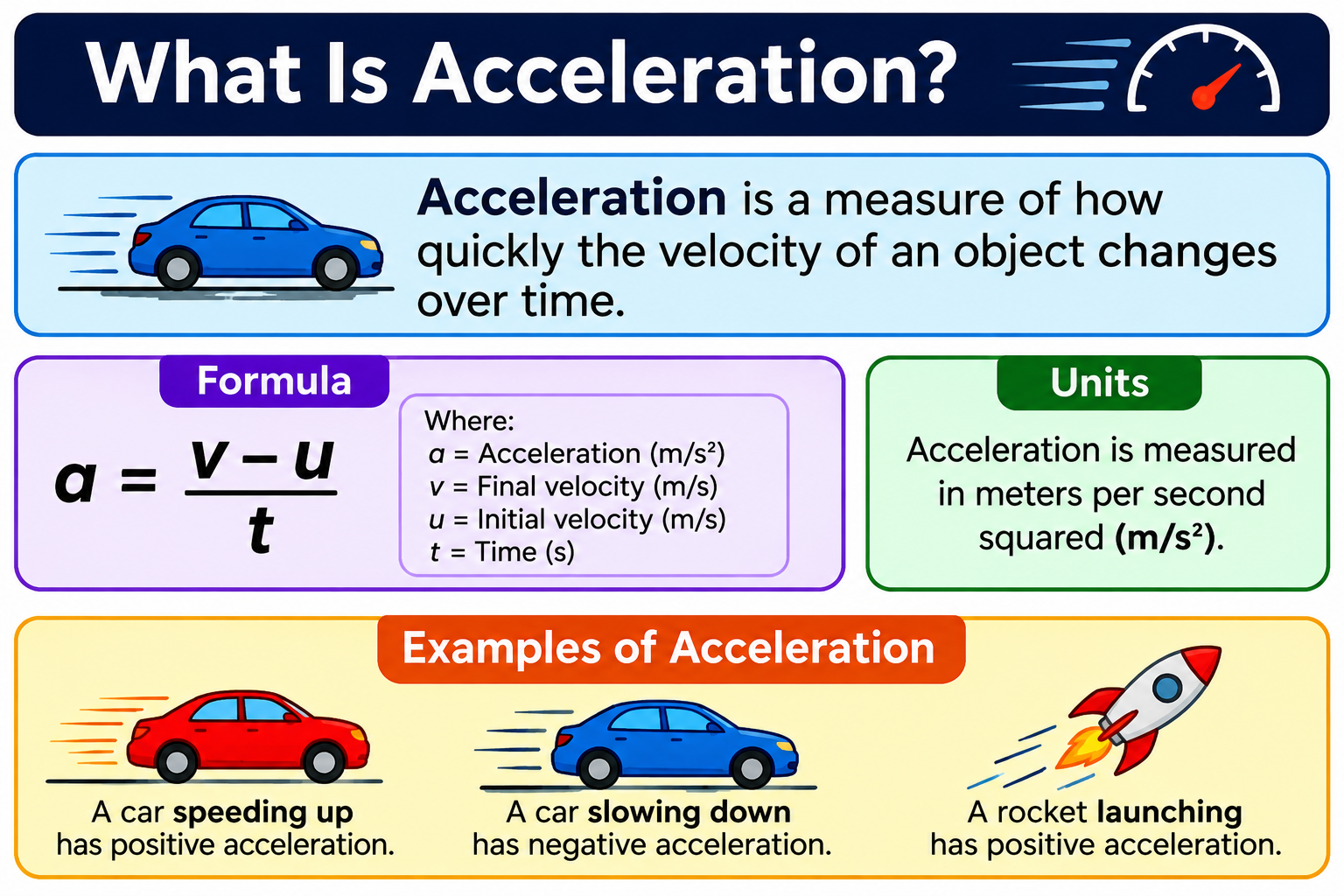
Think about the moment a car pulls away from traffic lights. In just a few seconds, it goes from being completely still to moving at 50 km/h. Or consider a bicycle rider squeezing the brakes as they approach a junction, slowing from a comfortable speed down to a stop. Both of these situations involve acceleration. So what exactly is acceleration? Acceleration is the rate at which an object’s velocity changes with time.
This definition is broader than many students first expect. Acceleration does not only mean speeding up. An object accelerates whenever its velocity changes, and that includes slowing down, changing direction, or both at the same time. Because velocity is a vector quantity that includes both speed and direction, any change in either of those components counts as acceleration.
The SI unit of acceleration is metres per second squared (m/s²), and the standard formula is a = Δv / Δt. In this article, you will find everything you need to understand acceleration fully, from its definition and formula to types, real-life examples, worked calculations, practice questions, and much more.
Key Takeaways
- Acceleration is the rate of change of velocity with respect to time.
- Acceleration is a vector quantity, meaning it has both magnitude and direction.
- The SI unit of acceleration is metres per second squared (m/s²).
- The formula for acceleration is a = Δv / Δt, where Δv = v_f − v_i.
- Acceleration can mean speeding up, slowing down, or changing direction.
- An object can accelerate even when its speed stays constant, if its direction changes (for example, circular motion).
- Acceleration is caused by a net force acting on an object, as described by Newton’s Second Law: F_net = ma.
- Gravitational acceleration near Earth’s surface is approximately 9.8 m/s².
What Is Acceleration in Physics?
Acceleration is defined as the rate of change of velocity with respect to time. In plain language, it tells you how quickly the velocity of an object is changing.
This is a definition that catches many students by surprise. Most people associate acceleration with speeding up, and while that is certainly one form of acceleration, it is not the complete picture. Here is a fuller breakdown:
- Changing speed: A car increasing from 20 m/s to 40 m/s is accelerating. A car braking from 40 m/s to 20 m/s is also accelerating, just in the opposite direction.
- Changing direction: A ball swinging in a circle changes its direction of motion continuously. Even if its speed stays the same, its velocity changes at every moment, so it is constantly accelerating.
- Changing both speed and direction: A car turning into a side road while slowing down is experiencing a combination of both types of change.
Acceleration is a vector quantity, which means it has both magnitude and direction. The direction of acceleration can be in the same direction as motion, opposite to motion, or even perpendicular to motion. Each case produces a different physical effect.
An important point: acceleration is related to velocity, not speed. Since velocity includes direction and speed does not, a change in direction counts as acceleration even if the numerical speed value remains unchanged.
What Is the Formula for Acceleration?
The standard formula for acceleration is:
a = Δv / Δt
Where:
- a = acceleration (metres per second squared, m/s²)
- Δv = change in velocity (metres per second, m/s)
- Δt = change in time (seconds, s)
The change in velocity is calculated as:
Δv = v_f − v_i
Where:
- v_f = final velocity (m/s)
- v_i = initial velocity (m/s)
So the full formula can be written as:
a = (v_f − v_i) / Δt
Simple Example:
A car’s velocity increases from 10 m/s to 30 m/s in 4 seconds. Calculate the acceleration.
a = (v_f − v_i) / Δt
a = (30 − 10) / 4
a = 20 / 4
a = 5 m/s²
The car accelerates at 5 m/s². This means its velocity increases by 5 metres per second for every second the acceleration continues.
What Does m/s² Mean?
The unit m/s² (metres per second squared) can seem confusing at first. Here is a straightforward way to think about it.
If an object has an acceleration of 3 m/s², it means that every second, its velocity increases by 3 m/s (assuming the acceleration is constant and in a consistent direction).
- After 1 second: velocity has increased by 3 m/s.
- After 2 seconds: velocity has increased by 6 m/s in total.
- After 3 seconds: velocity has increased by 9 m/s in total.
This does not mean the object travels 3 metres every second. Distance and acceleration describe different aspects of motion. Acceleration tells you how quickly velocity is changing, not how far the object has moved.
The unit m/s² comes directly from the formula: acceleration = velocity / time = (m/s) / s = m/s². It is mathematically and physically consistent.
Is Acceleration a Scalar or Vector Quantity?
Acceleration is a vector quantity. This means it must be described with both a magnitude and a direction to be fully meaningful.
Consider a car decelerating as it approaches a red light. If we define the forward direction as positive, then the deceleration produces a negative acceleration value. The magnitude of the acceleration tells you how quickly the velocity is changing, and the direction tells you whether that change is increasing or decreasing the forward velocity.
Direction matters because:
- Acceleration in the same direction as motion increases speed.
- Acceleration opposite to motion decreases speed.
- Acceleration perpendicular to motion changes direction without immediately changing speed.
Without specifying direction, you cannot fully predict how an object will move in response to an acceleration.
Acceleration vs Speed
Speed and acceleration are related to motion but describe very different things.
Speed tells you how fast an object is moving at any given moment. It is a scalar quantity with no direction.
Acceleration tells you how quickly the velocity is changing. It is a vector quantity with both magnitude and direction.
Here are a few scenarios that illustrate the difference:
- Increasing speed: A car going from 10 m/s to 20 m/s has positive acceleration. Speed is increasing.
- Constant speed in a straight line: Acceleration is zero. Speed is not changing.
- Decreasing speed: A car braking from 20 m/s to 0 m/s has negative acceleration (in the direction of motion). Speed is decreasing.
- Constant speed in a curve: Speed is constant, but acceleration is nonzero because the direction of velocity is changing.
The last point is one of the most important and most misunderstood ideas in introductory physics. For a thorough grounding in speed itself, the LearnMinto article on What Is Speed in Physics? provides clear definitions and worked examples that complement this discussion.
Acceleration vs Velocity
Velocity and acceleration are closely connected but describe different aspects of motion.
| Feature | Acceleration | Velocity |
|---|---|---|
| Definition | Rate of change of velocity | Rate of change of displacement |
| Quantity type | Vector | Vector |
| SI unit | m/s² | m/s |
| Direction | Yes, must be specified | Yes, must be specified |
| Formula | a = Δv / Δt | v = Δx / Δt |
| Can it be zero? | Yes (constant velocity) | Yes (object at rest) |
| Example | Car gaining 5 m/s each second | Car moving at 20 m/s north |
| Can it exist while the other is zero? | Yes (momentarily zero velocity at peak of throw, but nonzero acceleration) | Yes (zero velocity, zero acceleration when at rest) |
Velocity tells you where an object is heading and how fast. Acceleration tells you how quickly that velocity is changing. The two are related but never the same quantity.
Types of Acceleration
Acceleration is not a single uniform idea. Different situations produce different types of acceleration, and recognising which type applies to a given problem is an important skill.
Positive Acceleration
Positive acceleration occurs when an object’s velocity increases in the chosen positive direction. If we define rightward as the positive direction, a car speeding up to the right has positive acceleration.
Examples:
- A sprinter accelerating out of the starting blocks.
- A rocket increasing speed during launch.
- A ball rolling down a slope and picking up speed.
Negative Acceleration
Negative acceleration occurs when the acceleration vector points in the direction opposite to the chosen positive direction. It is often called deceleration in everyday speech, but physicists prefer to call it negative acceleration to keep the directional mathematics consistent.
Critically, negative acceleration does not always mean an object is slowing down. If an object is already moving in the negative direction and experiences a negative acceleration, it actually speeds up in that direction.
Examples:
- A car braking while moving forward (slowing down).
- A ball thrown upward (gravity acts downward, decelerating the ball as it rises).
- A train decelerating as it approaches a station.
Uniform Acceleration
Uniform acceleration (also called constant acceleration) means the acceleration value does not change over time. The velocity changes by the same amount every second.
This is a very commonly used idealization in introductory physics. It allows the use of the constant-acceleration equations, which makes many problems much easier to solve.
Examples:
- A ball in free fall near Earth’s surface (ignoring air resistance).
- A car accelerating steadily on a flat, straight road.
Non-Uniform Acceleration
Non-uniform acceleration means the acceleration is changing over time. The velocity does not change at a constant rate.
Most real-world motion involves non-uniform acceleration because forces change as objects move, surfaces vary, and conditions shift.
Examples:
- A car in city traffic, constantly adjusting speed.
- A rocket burning fuel (as fuel is consumed, mass decreases, so acceleration increases even if thrust is constant).
- A swimmer adjusting their stroke rate during a race.
Centripetal Acceleration
Centripetal acceleration occurs when an object moves in a circular path at constant speed. Even though the speed is constant, the direction of velocity changes continuously. This means the velocity vector is always changing, and so there is always acceleration.
Centripetal acceleration always points toward the centre of the circular path. Its magnitude is given by:
a_c = v² / r
Where v is the speed and r is the radius of the circular path.
Examples:
- A car turning a corner at steady speed.
- A satellite orbiting the Earth.
- A ball on a string being swung in a circle.
What Causes Acceleration?
Acceleration is caused by a net force acting on an object. This is one of the central ideas in classical physics, stated formally by Newton’s Second Law of Motion:
F_net = ma
Where:
- F_net = net force (newtons, N)
- m = mass of the object (kilograms, kg)
- a = acceleration (m/s²)
If there is no net force on an object, the object does not accelerate. It either remains at rest or continues moving at constant velocity. As soon as a net force is applied, the object accelerates in the direction of that net force.
The greater the net force, the greater the acceleration produced (for a given mass). The greater the mass of the object, the smaller the acceleration produced by the same net force.
For a full explanation of force and how it relates to motion, the LearnMinto article on What Is Force in Physics? is an ideal starting point.
Newton’s Second Law and Acceleration
Newton’s Second Law is the direct mathematical connection between force and acceleration:
F_net = ma
Rearranging this to find acceleration:
a = F_net / m
This tells you that acceleration depends on two things: the net force applied and the mass of the object.
Example 1:
A net force of 24 N acts on a 6 kg object. Calculate the acceleration.
a = F_net / m
a = 24 / 6
a = 4 m/s²
Example 2:
The same 24 N net force acts on a 12 kg object. Calculate the new acceleration.
a = 24 / 12
a = 2 m/s²
Doubling the mass halved the acceleration, which is exactly what the formula predicts. Greater mass means greater resistance to changes in velocity, a property called inertia.
Acceleration and Friction
Friction is a force that opposes the relative motion of two surfaces in contact. When friction acts on a moving object, it reduces the net force and therefore reduces the acceleration.
Consider a box being pushed across a rough floor with an applied force of 30 N. If friction exerts a force of 10 N in the opposite direction, the net force is only 20 N.
If the box has a mass of 5 kg:
a = F_net / m
a = 20 / 5
a = 4 m/s²
Without friction, the acceleration would have been 30/5 = 6 m/s². Friction reduced the net force and therefore reduced the acceleration.
Friction can also bring a moving object to rest if no applied force opposes it. Understanding how friction affects acceleration is essential for solving many real-world physics problems. The LearnMinto article on What Is Friction? provides a thorough treatment of this important force.
Acceleration Due to Gravity
One of the most important examples of acceleration in everyday life is the acceleration due to gravity. Near the surface of the Earth, any freely falling object accelerates downward at approximately:
g ≈ 9.8 m/s²
This value is the gravitational acceleration at Earth’s surface. It means that for every second an object falls freely (ignoring air resistance), its downward velocity increases by approximately 9.8 m/s.
Some important points about this value:
- It applies near Earth’s surface. At higher altitudes, gravitational acceleration decreases slightly.
- It varies slightly across the surface of the Earth due to differences in altitude and Earth’s slightly non-spherical shape.
- On the Moon, the gravitational acceleration is approximately 1.62 m/s², roughly one-sixth of Earth’s value.
- For many school-level problems, g is rounded to 10 m/s² for simpler calculations.
The value g = 9.8 m/s² applies to all objects regardless of their mass, in the idealized case where air resistance is ignored. A feather and a bowling ball released simultaneously in a vacuum would both accelerate at the same rate.
Free-Fall Acceleration
Free fall describes the motion of an object that is accelerating under gravity alone, with no air resistance. In this idealized situation:
- The only force acting on the object is gravity.
- The acceleration is constant at g ≈ 9.8 m/s² directed downward.
- The object accelerates at the same rate regardless of its mass.
For an object dropped from rest:
- Initial velocity v_i = 0
- Acceleration a = g = 9.8 m/s² downward
After 1 second, velocity = 9.8 m/s downward.
After 2 seconds, velocity = 19.6 m/s downward.
After 3 seconds, velocity = 29.4 m/s downward.
For an object thrown upward:
- The upward velocity decreases at 9.8 m/s every second.
- At the peak of the throw, the instantaneous velocity is zero.
- After the peak, the object accelerates downward and gains speed.
It is important not to confuse the force of gravity with acceleration. Gravity is the force causing the acceleration. The acceleration itself is the physical response to that force.
Acceleration in Different Directions
Acceleration can point in different directions relative to the motion of an object, and the effect depends on which direction it acts:
- Same direction as velocity: The object speeds up. Example: a car accelerating forward on a straight road.
- Opposite to velocity: The object slows down. Example: brakes applied to a moving car.
- Perpendicular to velocity: The object’s direction changes but its speed does not change instantaneously. This is what happens in circular motion. The centripetal acceleration always points toward the centre of the circle, perpendicular to the velocity at any given moment.
Understanding the direction of acceleration relative to the direction of motion is crucial for correctly analysing any motion problem, particularly in two-dimensional situations.
Can an Object Have Constant Speed but Still Accelerate?
Yes, absolutely. This is one of the most important conceptual points in introductory physics.
An object moving in a circle at constant speed is a perfect example. The speed does not change, but the direction of motion changes continuously. Since velocity is a vector quantity that includes direction, the velocity is changing at every moment. A changing velocity means there is acceleration.
This centripetal acceleration points toward the centre of the circular path and keeps the object moving in a curve rather than travelling in a straight line.
Another example: a satellite in a circular orbit moves at approximately constant speed but is continuously accelerated toward the Earth by gravity. Without this acceleration, it would travel in a straight line and fly off into space.
Can an Object Have Zero Speed but Nonzero Acceleration?
Yes. This confuses many students, but it becomes clear with the right example.
When you throw a ball straight up into the air, it slows down as it rises. At the very top of its path, its instantaneous velocity is zero. However, gravity is still acting on it at that instant, causing a downward acceleration of 9.8 m/s².
The moment after the peak, the ball begins to move downward, confirming that the acceleration was still present even when the velocity was zero.
This tells us that velocity and acceleration are independent quantities. An object can have any combination of zero or nonzero values for each.
Distance, Displacement, Speed, Velocity and Acceleration
These five quantities are the building blocks of kinematics. Understanding how they differ from each other is essential for solving motion problems correctly.
| Quantity | Meaning | Scalar or Vector | SI Unit | Basic Relationship |
|---|---|---|---|---|
| Distance | Total length of path covered | Scalar | m | Related to total path, no direction |
| Displacement | Change in position from start to finish | Vector | m | Δx = x_f − x_i |
| Speed | Rate of change of distance | Scalar | m/s | v = d/t |
| Velocity | Rate of change of displacement | Vector | m/s | v = Δx/Δt |
| Acceleration | Rate of change of velocity | Vector | m/s² | a = Δv/Δt |
Acceleration-Time Graph
An acceleration-time graph plots acceleration (vertical axis) against time (horizontal axis). It provides a visual representation of how acceleration changes over a period of time.
Here is what different features of the graph tell you:
- Horizontal line above zero: The object has constant positive acceleration. Velocity is increasing at a steady rate.
- Horizontal line at zero: The acceleration is zero. The object moves at constant velocity.
- Horizontal line below zero: The object has constant negative acceleration. Velocity is decreasing (if the object was moving in the positive direction) or increasing in the negative direction.
- Sloping line: The acceleration is changing over time. This represents non-uniform acceleration.
The area under an acceleration-time graph represents the change in velocity over that time period. This is a useful tool in advanced problem-solving.
Velocity-Time Graph and Acceleration
A velocity-time graph plots velocity (vertical axis) against time (horizontal axis). For one-dimensional motion, the slope (gradient) of the velocity-time graph represents acceleration.
- Positive slope (rising line): Positive acceleration. Velocity is increasing.
- Zero slope (horizontal line): Zero acceleration. Velocity is constant.
- Negative slope (falling line): Negative acceleration. Velocity is decreasing (or the object is speeding up in the negative direction).
- Curved line: Non-uniform acceleration. The gradient changes over time.
Example:
A velocity-time graph shows a straight line from v = 5 m/s at t = 0 s to v = 25 m/s at t = 4 s.
Slope = Δv / Δt = (25 − 5) / 4 = 20 / 4 = 5 m/s²
The object has a constant acceleration of 5 m/s².
Also, the area under a velocity-time graph represents the displacement of the object during that time interval.
Position, Velocity and Acceleration
These three quantities form a chain of relationships in kinematics:
- Position describes where an object is located.
- Velocity describes how quickly the position is changing. It is the rate of change of position.
- Acceleration describes how quickly the velocity is changing. It is the rate of change of velocity.
Mathematically, each quantity is one step further along in how quickly it describes change:
Position → (change over time) → Velocity → (change over time) → Acceleration
This chain means that if you know an object’s acceleration, you can work backward (with appropriate information about initial conditions) to determine how its velocity and position change over time. This is precisely what the constant-acceleration equations allow you to do.
Important Acceleration Equations
Under conditions of constant acceleration, a set of kinematic equations allows you to relate position, velocity, acceleration, and time. These are among the most frequently used equations in introductory physics.
Equation 1:
v_f = v_i + at
This equation connects final velocity, initial velocity, acceleration, and time. Use it when you know three of these four quantities and want to find the fourth.
Equation 2:
Δx = v_i t + ½ at²
This equation gives the displacement when initial velocity, acceleration, and time are known.
Equation 3:
v_f² = v_i² + 2aΔx
This equation is useful when time is not given or not needed. It connects final velocity, initial velocity, acceleration, and displacement.
Where:
- v_f = final velocity (m/s)
- v_i = initial velocity (m/s)
- a = acceleration (m/s²)
- t = time (s)
- Δx = displacement (m)
Critical note: These equations apply only when acceleration is constant throughout the motion. If acceleration is changing, these equations will give incorrect results, and more advanced methods are required.
How to Calculate Acceleration
Example 1: Basic acceleration
A motorcycle increases its velocity from 8 m/s to 28 m/s in 5 seconds. Find the acceleration.
a = (v_f − v_i) / Δt
a = (28 − 8) / 5
a = 20 / 5
a = 4 m/s²
Example 2: Positive acceleration
A train starts from rest and reaches a velocity of 36 m/s in 12 seconds. Calculate the acceleration.
v_i = 0 m/s, v_f = 36 m/s, Δt = 12 s
a = (36 − 0) / 12
a = 36 / 12
a = 3 m/s²
Example 3: Negative acceleration (deceleration)
A car travelling at 20 m/s brakes and stops in 4 seconds. What is the acceleration?
v_i = 20 m/s, v_f = 0 m/s, Δt = 4 s
a = (0 − 20) / 4
a = −20 / 4
a = −5 m/s²
The negative sign indicates that the acceleration opposes the direction of motion. The car is slowing down.
Example 4: Acceleration from force and mass
A net force of 45 N acts on a 9 kg trolley. Calculate the acceleration.
a = F_net / m
a = 45 / 9
a = 5 m/s²
Example 5: Acceleration due to gravity
A ball is dropped from rest. What is its velocity after 3 seconds, assuming g = 9.8 m/s² and no air resistance?
v_f = v_i + at
v_f = 0 + (9.8 × 3)
v_f = 29.4
v_f = 29.4 m/s downward
Real-Life Examples of Acceleration
Acceleration is far from an abstract concept. It shows up in virtually every situation involving motion:
- Cars: A car speeding up on a motorway on-ramp experiences positive acceleration. Braking at traffic lights involves negative acceleration.
- Bicycles: A cyclist pushing harder on the pedals accelerates forward. Applying the brakes decelerates the bicycle.
- Trains: High-speed trains accelerate smoothly from stations. The gentle change in acceleration is deliberately designed for passenger comfort.
- Airplanes: During takeoff, a commercial aircraft experiences significant acceleration along the runway before reaching takeoff speed.
- Rockets: A rocket accelerating off the launch pad experiences enormous upward acceleration due to the thrust of its engines.
- Roller coasters: Riders experience rapid changes in speed and direction throughout a ride, making roller coasters an excellent real-world example of varying acceleration.
- Falling objects: A ball dropped from a height accelerates downward at g ≈ 9.8 m/s² (ignoring air resistance).
- Athletes: A sprinter explodes off the starting blocks with high acceleration. A long-distance runner maintains a more gradual pace change.
- Circular motion: A car driving around a roundabout at constant speed is still accelerating because its direction changes continuously.
Acceleration in Sports
Sports provide some of the most vivid real-world examples of acceleration:
- Sprinting: The initial burst from the starting position requires very high acceleration. Top sprinters can reach near-maximum speed within about 6 seconds of starting.
- Football: A striker accelerating past a defender changes speed rapidly over a very short distance.
- Basketball: Players accelerating from a standing start toward the basket, and then decelerating sharply as they reach the key, experience large accelerations and decelerations.
- Cycling: A track cyclist accelerates hard from the start line, reaching speeds of over 70 km/h in a velodrome sprint.
- Swimming: A swimmer launches off the starting block with high initial acceleration and then manages their acceleration through arm strokes and kick technique.
In sports science, measuring and improving an athlete’s acceleration is a key part of performance training.
Acceleration in Transportation
Transportation systems are designed with acceleration (and passenger comfort) in mind:
- Cars: Engine power, gear ratios, and road surface all influence how quickly a car can accelerate. Safety regulations specify minimum braking capabilities, which directly relate to deceleration.
- Trains: High-speed trains are designed to provide smooth, gradual acceleration so passengers are not thrown forward or backward by sudden changes in velocity.
- Airplanes: Takeoff requires sustained acceleration along the runway. Aircraft are engineered so that this acceleration is sufficient to reach the required takeoff speed within the available runway length.
- Elevators: The brief sensation of being slightly heavier or lighter when an elevator starts or stops is caused by the acceleration and deceleration of the elevator. The design of elevators limits maximum acceleration to maintain passenger comfort and safety.
Common Misconceptions About Acceleration
Several widespread misconceptions about acceleration regularly cause problems for students:
- Acceleration always means speeding up. This is false. Acceleration also includes slowing down (negative acceleration) and changing direction.
- Negative acceleration always means slowing down. This depends on the direction of the velocity. If an object moves in the negative direction and has negative acceleration, it is speeding up, not slowing down.
- Acceleration and velocity are the same. They are not. Velocity describes how fast and in what direction an object moves. Acceleration describes how quickly velocity is changing.
- Constant speed means zero acceleration in every situation. This is false for circular motion. An object moving at constant speed in a circle is still accelerating because its direction changes.
- Acceleration is not a vector. Acceleration is definitely a vector. Direction is essential to correctly describing and calculating acceleration.
- Acceleration is the same as force. Force causes acceleration, but they are not the same thing. Force is measured in newtons, acceleration in m/s².
- Heavier objects fall faster. In ideal free fall with no air resistance, all objects fall with the same gravitational acceleration, regardless of mass. This was famously demonstrated by Galileo and later confirmed in vacuum experiments.
- Constant-acceleration formulas work for any motion. These equations only apply when acceleration is constant. Using them for changing acceleration will give incorrect results.
How to Solve Acceleration Problems
Follow these steps every time you encounter an acceleration problem:
- Identify the initial velocity (v_i). Read the problem carefully to find the starting velocity.
- Identify the final velocity (v_f). Find the velocity at the end of the time interval.
- Identify the time interval (Δt). Find how long the change in velocity takes.
- Convert units if necessary. Make sure velocity is in m/s and time is in seconds before substituting into the formula.
- Choose the appropriate formula. Use a = Δv/Δt for basic problems, or one of the constant-acceleration equations if you are dealing with displacement as well.
- Substitute the values. Carefully put the numbers into the formula.
- Calculate the result. Work through the arithmetic step by step.
- Include the correct unit. Your answer must have the unit m/s².
- Check the direction and sign. A negative answer means the acceleration opposes the positive direction. Make sure this makes physical sense for the situation described.
Free-Body Diagrams and Acceleration
A free-body diagram is a simple drawing that shows all the forces acting on an object, represented by arrows indicating direction and relative magnitude. Drawing a free-body diagram is often the first step toward finding the net force and then calculating acceleration.
Example: A box being pushed across a rough floor
Forces acting on the box:
- Applied force (to the right)
- Friction force (to the left)
- Weight (downward)
- Normal force (upward)
The vertical forces balance each other (if the surface is horizontal and there is no vertical motion). The net horizontal force is:
F_net = Applied force − Friction force
Once you have F_net, you can find acceleration using a = F_net / m.
Free-body diagrams are particularly valuable for complex situations with multiple forces, such as objects on slopes or systems connected by ropes. They make it much easier to identify the correct net force before applying Newton’s Second Law.
Acceleration and Net Force
Newton’s Second Law states:
F_net = ma
This relationship tells you that acceleration is directly proportional to net force and inversely proportional to mass.
Example involving multiple forces:
A 10 kg box is pushed to the right with a force of 50 N. Friction opposes the motion with a force of 20 N. What is the acceleration?
F_net = 50 − 20 = 30 N
a = F_net / m = 30 / 10
a = 3 m/s² to the right
Balanced forces produce zero net force and zero acceleration. Unbalanced forces produce a nonzero net force and therefore nonzero acceleration.
Understanding the connection between force and acceleration is fundamental to mechanics. The LearnMinto article on What Is Force in Physics? explores this relationship in depth, covering Newton’s three laws and how they connect to everyday motion.
Acceleration and Mass
Mass is a measure of the amount of matter in an object and also of its resistance to changes in motion (inertia). From Newton’s Second Law:
a = F_net / m
For a constant net force:
- Doubling the mass halves the acceleration.
- Tripling the mass reduces the acceleration to one-third.
This inverse relationship between mass and acceleration is one of the most practically important ideas in physics. Engineers designing vehicles, aircraft, and spacecraft must carefully consider the mass of their designs because it directly affects how quickly those vehicles can accelerate.
| Net Force (N) | Mass (kg) | Acceleration (m/s²) |
|---|---|---|
| 20 | 2 | 10 |
| 20 | 4 | 5 |
| 20 | 5 | 4 |
| 20 | 10 | 2 |
Acceleration and Energy
When a net force accelerates an object, work is done on that object, and its kinetic energy changes.
Kinetic energy is the energy an object possesses due to its motion:
KE = ½ mv²
When an object accelerates from rest, its velocity increases and so does its kinetic energy. The work done by the net force goes into increasing the object’s kinetic energy.
This connection between force, acceleration, and energy is one of the threads that ties together the different areas of classical mechanics. As velocity increases through acceleration, kinetic energy increases as the square of velocity. This is why doubling your speed requires four times the kinetic energy, not just twice as much.
For a full treatment of kinetic energy and how it relates to motion, the LearnMinto article on What Is Kinetic Energy? provides clear explanations and worked examples.
Important Acceleration Formulas
| Formula | Meaning | Variables | SI Unit of Result | When to Use |
|---|---|---|---|---|
| a = Δv / Δt | Basic definition of acceleration | a = acceleration, Δv = change in velocity, Δt = time interval | m/s² | Any situation involving change in velocity |
| v_f = v_i + at | Final velocity under constant acceleration | v_f = final velocity, v_i = initial velocity, a = acceleration, t = time | m/s | When finding final or initial velocity |
| Δx = v_i t + ½ at² | Displacement under constant acceleration | Δx = displacement, v_i = initial velocity, a = acceleration, t = time | m | When finding displacement with time known |
| v_f² = v_i² + 2aΔx | Velocity-displacement relation | v_f = final velocity, v_i = initial velocity, a = acceleration, Δx = displacement | m²/s² (solve for m/s) | When time is not given |
| a = F_net / m | Acceleration from Newton’s Second Law | a = acceleration, F_net = net force, m = mass | m/s² | When force and mass are known |
Acceleration Practice Questions
20 Multiple Choice Questions
Question 1: What is acceleration?
- A) The speed of an object
- B) The distance covered by an object per second
- C) The rate of change of velocity with time
- D) The force acting on an object
Correct Answer: C) The rate of change of velocity with time
Explanation: Acceleration is specifically defined as how quickly velocity changes over time.
Question 2: What is the SI unit of acceleration?
- A) m/s
- B) N
- C) kg·m/s
- D) m/s²
Correct Answer: D) m/s²
Explanation: Metres per second squared (m/s²) is the standard SI unit of acceleration.
Question 3: A car increases its velocity from 10 m/s to 30 m/s in 5 seconds. What is its acceleration?
- A) 2 m/s²
- B) 4 m/s²
- C) 6 m/s²
- D) 8 m/s²
Correct Answer: B) 4 m/s²
Explanation: a = (30 − 10)/5 = 20/5 = 4 m/s².
Question 4: Which of the following best describes negative acceleration?
- A) An object moving in the negative direction only
- B) An object whose acceleration vector points opposite to the chosen positive direction
- C) An object at rest
- D) An object with zero velocity
Correct Answer: B) An object whose acceleration vector points opposite to the chosen positive direction
Explanation: Negative acceleration refers to the direction of the acceleration vector, not necessarily whether the object is slowing down.
Question 5: Is acceleration a scalar or vector quantity?
- A) Scalar
- B) Vector
- C) Neither
- D) Both scalar and vector
Correct Answer: B) Vector
Explanation: Acceleration has both magnitude and direction, making it a vector quantity.
Question 6: An object moves in a circle at constant speed. Which statement is correct?
- A) The object has zero acceleration
- B) The object has constant velocity
- C) The object is accelerating
- D) The object has no net force acting on it
Correct Answer: C) The object is accelerating
Explanation: The direction of velocity changes continuously in circular motion, so the object accelerates even though its speed is constant.
Question 7: A net force of 60 N acts on a 12 kg object. What is the acceleration?
- A) 2 m/s²
- B) 5 m/s²
- C) 720 m/s²
- D) 48 m/s²
Correct Answer: B) 5 m/s²
Explanation: a = F/m = 60/12 = 5 m/s².
Question 8: What is gravitational acceleration near Earth’s surface?
- A) 8.9 m/s²
- B) 9.8 m/s²
- C) 10.8 m/s²
- D) 6.7 m/s²
Correct Answer: B) 9.8 m/s²
Explanation: The standard value of gravitational acceleration near Earth’s surface is approximately 9.8 m/s².
Question 9: A ball is thrown upward. At the very peak of its flight, what is its acceleration?
- A) Zero
- B) 9.8 m/s² upward
- C) 9.8 m/s² downward
- D) Depends on the mass of the ball
Correct Answer: C) 9.8 m/s² downward
Explanation: Gravity always acts downward at 9.8 m/s², even when the instantaneous velocity is zero at the peak.
Question 10: Which formula correctly gives the displacement under constant acceleration?
- A) Δx = v_f t − ½ at²
- B) Δx = v_i t + ½ at²
- C) Δx = v_i t − at²
- D) Δx = v_f t + at²
Correct Answer: B) Δx = v_i t + ½ at²
Explanation: This is the standard constant-acceleration kinematic equation for displacement.
Question 11: A car decelerates from 20 m/s to rest in 8 seconds. What is the acceleration?
- A) −2.5 m/s²
- B) 2.5 m/s²
- C) −160 m/s²
- D) 160 m/s²
Correct Answer: A) −2.5 m/s²
Explanation: a = (0 − 20)/8 = −20/8 = −2.5 m/s². Negative because the car is decelerating.
Question 12: When both the velocity and acceleration of an object point in the same direction, the object is:
- A) Decelerating
- B) Moving in a circle
- C) Speeding up
- D) Stationary
Correct Answer: C) Speeding up
Explanation: When acceleration and velocity have the same direction, the speed of the object increases.
Question 13: What does the slope of a velocity-time graph represent?
- A) Speed
- B) Distance
- C) Acceleration
- D) Displacement
Correct Answer: C) Acceleration
Explanation: The gradient of a velocity-time graph represents the acceleration of the object.
Question 14: Which of the following is the correct formula for acceleration using Newton’s Second Law?
- A) a = F × m
- B) a = m / F
- C) a = F / m
- D) a = F + m
Correct Answer: C) a = F / m
Explanation: From F = ma, rearranging gives a = F/m.
Question 15: An object starts from rest and accelerates at 4 m/s² for 6 seconds. What is its final velocity?
- A) 10 m/s
- B) 24 m/s
- C) 1.5 m/s
- D) 48 m/s
Correct Answer: B) 24 m/s
Explanation: v_f = v_i + at = 0 + (4 × 6) = 24 m/s.
Question 16: Which of the following changes would cause the greatest increase in acceleration for a given net force?
- A) Doubling the mass
- B) Halving the mass
- C) Doubling the time
- D) Halving the velocity
Correct Answer: B) Halving the mass
Explanation: Since a = F/m, halving the mass doubles the acceleration for the same net force.
Question 17: A car object has uniform acceleration. What does this mean?
- A) Velocity is constant
- B) Speed is zero
- C) Acceleration stays the same value over time
- D) The car is not moving
Correct Answer: C) Acceleration stays the same value over time
Explanation: Uniform acceleration means constant acceleration throughout the motion.
Question 18: Which of the following is true about an object in free fall? (Ignore air resistance.)
- A) Heavier objects fall faster
- B) All objects fall with the same acceleration
- C) Acceleration decreases as the object speeds up
- D) Acceleration depends on the size of the object
Correct Answer: B) All objects fall with the same acceleration
Explanation: In ideal free fall, all objects experience the same gravitational acceleration regardless of mass.
Question 19: A velocity-time graph shows a horizontal straight line. What does this indicate?
- A) Constant acceleration
- B) Increasing speed
- C) Zero acceleration
- D) Decreasing speed
Correct Answer: C) Zero acceleration
Explanation: A horizontal line on a velocity-time graph means velocity is not changing, so acceleration is zero.
Question 20: An object has a velocity of −10 m/s and an acceleration of −3 m/s². What is happening?
- A) The object is slowing down
- B) The object is stationary
- C) The object is speeding up in the negative direction
- D) The object is reversing direction
Correct Answer: C) The object is speeding up in the negative direction
Explanation: Both velocity and acceleration point in the negative direction, so the object is moving faster in that direction.
10 Short Answer Questions
Q1: Define acceleration in physics.
Acceleration is the rate of change of velocity with respect to time. It tells you how quickly an object’s velocity is changing. It is measured in m/s² and is a vector quantity.
Q2: What is the formula for acceleration? Define all variables.
a = Δv/Δt = (v_f − v_i)/Δt, where a is acceleration in m/s², v_f is final velocity in m/s, v_i is initial velocity in m/s, and Δt is the time interval in seconds.
Q3: A cyclist increases velocity from 4 m/s to 16 m/s in 6 seconds. Calculate the acceleration.
a = (16 − 4)/6 = 12/6 = 2 m/s²
Q4: What is the significance of the direction of acceleration relative to velocity?
If acceleration is in the same direction as velocity, the object speeds up. If acceleration is opposite to velocity, the object slows down. If acceleration is perpendicular to velocity, the direction of motion changes.
Q5: Why is an object in circular motion at constant speed considered to be accelerating?
Because velocity is a vector that includes direction, and the direction of motion changes continuously in circular motion. Any change in velocity, whether in magnitude or direction, means acceleration is present.
Q6: What does g = 9.8 m/s² represent?
It represents the acceleration due to gravity near Earth’s surface. Any freely falling object (ignoring air resistance) accelerates downward at approximately 9.8 m/s².
Q7: A force of 80 N acts on a 16 kg object. Calculate the acceleration.
a = F/m = 80/16 = 5 m/s²
Q8: What is the difference between uniform and non-uniform acceleration?
Uniform acceleration means the acceleration is constant over time. Non-uniform acceleration means the acceleration changes over time.
Q9: An object has zero velocity but nonzero acceleration. Give an example.
A ball thrown straight up reaches zero velocity at the peak of its flight, but gravity still causes a downward acceleration of 9.8 m/s² at that instant.
Q10: What is the slope of a velocity-time graph?
The slope (gradient) of a velocity-time graph represents acceleration. A steeper positive slope means greater positive acceleration. A negative slope means negative acceleration.
5 Numerical Problems
Problem 1:
A train starts from rest and reaches 45 m/s in 15 seconds. Calculate the acceleration.
Solution:
v_i = 0, v_f = 45 m/s, Δt = 15 s
a = (v_f − v_i)/Δt = (45 − 0)/15
a = 3 m/s²
Problem 2:
A car travelling at 25 m/s applies its brakes and stops in 10 seconds. What is the acceleration?
Solution:
v_i = 25 m/s, v_f = 0 m/s, Δt = 10 s
a = (0 − 25)/10 = −25/10
a = −2.5 m/s²
The negative sign indicates the acceleration opposes the direction of motion (deceleration).
Problem 3:
An object accelerates from rest at 5 m/s² for 8 seconds. How far does it travel?
Solution:
v_i = 0, a = 5 m/s², t = 8 s
Δx = v_i t + ½ at²
Δx = 0 + ½ × 5 × 64
Δx = ½ × 320
Δx = 160 m
Problem 4:
A ball is dropped from rest and falls freely under gravity (g = 9.8 m/s²). What is its velocity after 5 seconds?
Solution:
v_i = 0, a = 9.8 m/s², t = 5 s
v_f = v_i + at = 0 + (9.8 × 5)
v_f = 49 m/s downward
Problem 5:
A car starts from rest and reaches 30 m/s over a distance of 90 m. What is the acceleration?
Solution:
v_i = 0, v_f = 30 m/s, Δx = 90 m
v_f² = v_i² + 2aΔx
900 = 0 + 2 × a × 90
900 = 180a
a = 900/180
a = 5 m/s²
5 Exam-Style Questions
Question 1:
Explain, using the definition of acceleration, why a car navigating a roundabout at constant speed is still accelerating.
Answer: Acceleration is defined as the rate of change of velocity. Velocity is a vector quantity that includes both speed and direction. As the car moves around the roundabout, its speed remains constant but its direction of motion changes continuously. Since the direction component of velocity is changing at every moment, the velocity is changing, and therefore the car is accelerating even though its speed is constant. This centripetal acceleration always points toward the centre of the roundabout.
Question 2:
A ball is thrown vertically upward with an initial velocity of 20 m/s. Using g = 10 m/s², calculate how long it takes to reach the maximum height and the height reached.
Answer:
At maximum height, v_f = 0.
Time to reach maximum height:
v_f = v_i + at → 0 = 20 + (−10)t → t = 20/10 = 2 seconds
Height:
Δx = v_i t + ½ at²
Δx = 20(2) + ½(−10)(4)
Δx = 40 − 20
Δx = 20 m
Question 3:
A net force of 150 N acts on a 30 kg object initially at rest. Calculate the velocity of the object after 6 seconds.
Answer:
a = F/m = 150/30 = 5 m/s²
v_f = v_i + at = 0 + (5 × 6)
v_f = 30 m/s
Question 4:
Describe the difference between positive and negative acceleration and give one example of each.
Answer: Positive acceleration occurs when the acceleration vector points in the chosen positive direction. For example, a car speeding up while moving forward has positive acceleration. Negative acceleration occurs when the acceleration vector points opposite to the chosen positive direction. For example, a car applying its brakes while moving forward experiences negative acceleration because the braking force opposes the forward motion. Importantly, negative acceleration does not always mean the object is slowing down. If an object is moving in the negative direction and experiences negative acceleration, it is actually speeding up in that direction.
Question 5:
Using the concept of Newton’s Second Law, explain why a loaded lorry takes longer to stop than an empty lorry travelling at the same speed, given the same braking force.
Answer: Newton’s Second Law states that a = F_net/m. When the brakes are applied, the braking force is the same for both lorries. However, the loaded lorry has a much greater mass. Since acceleration (in this case deceleration) equals force divided by mass, the greater mass of the loaded lorry produces a smaller deceleration for the same braking force. A smaller deceleration means the lorry’s velocity decreases more slowly, so it takes longer to reach zero velocity and stop. This is why heavy vehicles require greater stopping distances than lighter ones.
Exam Tips
- Learn the definition precisely: Acceleration is the rate of change of velocity (not speed) with time. Many students lose marks by confusing velocity with speed in this definition.
- Memorise and rearrange the formula: a = Δv/Δt. Practice rearranging it to find v_f, v_i, or Δt as well.
- Remember the SI unit: m/s². If your exam asks for the unit of acceleration, write metres per second squared.
- Acceleration is a vector: Always consider direction. A negative sign in your answer has physical meaning and should be interpreted clearly.
- Positive and negative acceleration: Positive means acceleration in the positive direction; negative means opposite. Negative acceleration does not automatically mean slowing down.
- Know g = 9.8 m/s²: This is a frequently tested value. Some exam boards allow g = 10 m/s² for simplicity. Check which value your syllabus requires.
- Constant-acceleration equations: Know all three equations and the conditions under which they apply. They only work when acceleration is constant throughout the motion.
- Velocity-time graphs: The slope of the line gives the acceleration. The area under the line gives the displacement.
- Newton’s Second Law connects force and acceleration: a = F_net/m. Always use the net force, not just one of the individual forces.
Quick Revision Notes
- Acceleration = rate of change of velocity = (v_f − v_i) / Δt.
- SI unit: m/s² (metres per second squared).
- Vector quantity: has both magnitude and direction.
- Types: positive, negative, uniform, non-uniform, centripetal.
- Caused by a net force: a = F_net / m (Newton’s Second Law).
- Gravitational acceleration: g ≈ 9.8 m/s² downward near Earth’s surface.
- Free fall: constant acceleration g downward, mass does not matter.
- Constant speed in a circle = still accelerating (direction changes).
- Zero velocity can coexist with nonzero acceleration (e.g., ball at peak of throw).
- Velocity-time graph: slope = acceleration, area = displacement.
- Constant-acceleration equations: v_f = v_i + at; Δx = v_i t + ½ at²; v_f² = v_i² + 2aΔx.
- Only use constant-acceleration equations when acceleration is actually constant.
Acceleration Cheat Sheet
| Concept | Definition | Formula | Unit | Example |
|---|---|---|---|---|
| Acceleration | Rate of change of velocity | a = Δv/Δt | m/s² | Car speeding up from 10 to 30 m/s in 4 s |
| Positive Acceleration | Velocity increases in positive direction | a = (v_f − v_i)/t, positive result | m/s² | Car accelerating from rest |
| Negative Acceleration | Velocity decreases in positive direction | a = (v_f − v_i)/t, negative result | m/s² | Car braking to a stop |
| Uniform Acceleration | Constant acceleration over time | a = constant | m/s² | Ball in free fall |
| Centripetal Acceleration | Acceleration toward centre of circular path | a_c = v²/r | m/s² | Car on a roundabout |
| Gravitational Acceleration | Acceleration due to gravity near Earth | g ≈ 9.8 m/s² | m/s² | Falling object |
| Newton’s 2nd Law | Force causes acceleration | a = F_net/m | m/s² | Pushed box on floor |
| Final Velocity | Velocity after constant acceleration | v_f = v_i + at | m/s | Train after 10 seconds of acceleration |
| Displacement | Distance covered under constant acceleration | Δx = v_i t + ½ at² | m | Ball falling for 3 seconds |
Frequently Asked Questions
1. What is acceleration in physics?
Acceleration is the rate at which an object’s velocity changes with time. It includes changes in speed, direction, or both, and is measured in m/s².
2. What is the formula for acceleration?
a = Δv/Δt = (v_f − v_i)/Δt, where v_f is final velocity, v_i is initial velocity, and Δt is the time interval.
3. What is the SI unit of acceleration?
The SI unit of acceleration is metres per second squared (m/s²).
4. Is acceleration a scalar or vector?
Acceleration is a vector quantity. It has both magnitude and direction.
5. What causes acceleration?
Acceleration is caused by a net force acting on an object. This is described by Newton’s Second Law: F_net = ma.
6. What is positive acceleration?
Positive acceleration occurs when the acceleration vector points in the same direction as the chosen positive direction, resulting in an increase in velocity in that direction.
7. What is negative acceleration?
Negative acceleration occurs when the acceleration vector points opposite to the chosen positive direction. It may cause the object to slow down (if moving in the positive direction) or speed up (if moving in the negative direction).
8. What is uniform acceleration?
Uniform acceleration means the acceleration is constant over time. The velocity changes by the same amount every second.
9. What is non-uniform acceleration?
Non-uniform acceleration means the acceleration is changing over time. The velocity changes by different amounts in different time intervals.
10. Can an object accelerate at constant speed?
Yes. An object moving at constant speed in a circle is continuously accelerating because its direction changes. Speed stays constant, but velocity changes.
11. What is acceleration due to gravity?
Near Earth’s surface, all freely falling objects (ignoring air resistance) accelerate downward at approximately g = 9.8 m/s², regardless of their mass.
12. What is the difference between speed and acceleration?
Speed tells you how fast an object is moving. Acceleration tells you how quickly the velocity is changing. An object can have high speed with zero acceleration or low speed with high acceleration.
13. What is the difference between velocity and acceleration?
Velocity is the rate of change of displacement and tells you how fast and in what direction an object is moving. Acceleration is the rate of change of velocity and tells you how quickly that velocity is changing.
14. Can acceleration be zero?
Yes. An object at rest or moving at constant velocity in a straight line has zero acceleration.
15. How do you calculate acceleration?
Use a = (v_f − v_i)/Δt. Subtract the initial velocity from the final velocity and divide by the time taken. Make sure velocities are in m/s and time is in seconds for the result in m/s².
Summary
Acceleration is the rate of change of velocity with time, and it is one of the most fundamental concepts in physics. It is a vector quantity measured in metres per second squared (m/s²), calculated using a = Δv/Δt or a = F_net/m.
Acceleration includes speeding up, slowing down, and changing direction. An object can accelerate even when its speed remains constant if its direction changes, as happens in circular motion. Conversely, an object can have zero velocity but nonzero acceleration, as a ball experiences at the peak of a vertical throw.
Gravitational acceleration near Earth’s surface is approximately 9.8 m/s², acting downward on all objects regardless of mass in ideal free-fall conditions. The constant-acceleration equations allow calculation of displacement, velocity, and time for situations with steady acceleration.
Understanding acceleration is essential for studying Newton’s laws, force, momentum, energy, and virtually every other topic in classical mechanics.
Final Thoughts
Acceleration is about change. Any time something is getting faster, slowing down, or altering its direction of travel, acceleration is the quantity that captures and measures that change. What is acceleration? It is the bridge between force and motion, the concept that connects a push or a pull to the resulting change in how an object moves.
Mastering acceleration means understanding not just the formula, but the reasoning behind it. Work through the practice problems. Draw velocity-time graphs. Apply Newton’s Second Law to different scenarios. Connect the mathematics to real situations you can observe.
Once you are confident with acceleration, the rest of classical mechanics opens up naturally. Forces, energy, momentum, and circular motion all build directly on this foundation. Start here, understand it well, and the rest will follow.
References
- OpenStax. University Physics Volume 1 – Chapter 3: Motion Along a Straight Line. OpenStax, Rice University. Available at: https://openstax.org/books/university-physics-volume-1/pages/3-introduction
- Physics LibreTexts. Acceleration. LibreTexts Physics. Available at: https://phys.libretexts.org/Bookshelves/University_Physics/Book%3A_University_Physics_(OpenStax)/Book%3A_University_Physics_I_-Mechanics_Sound_Oscillations_and_Waves(OpenStax)/03%3A_Motion_Along_a_Straight_Line/3.03%3A_Average_and_Instantaneous_Acceleration
- Khan Academy. Acceleration. Khan Academy Physics. Available at: https://www.khanacademy.org/science/physics/one-dimensional-motion/acceleration-tutorial/a/what-is-acceleration
- Encyclopaedia Britannica. Acceleration – Physics. Britannica. Available at: https://www.britannica.com/science/acceleration
- The Physics Classroom. Acceleration. The Physics Classroom. Available at: https://www.physicsclassroom.com/class/1DKin/Lesson-1/Acceleration
- National Institute of Standards and Technology (NIST). SI Units. NIST. Available at: https://www.nist.gov/pml/owm/metric-si/si-units
Disclaimer
This article is intended for educational and informational purposes only. While LearnMinto strives to provide accurate and up-to-date information, readers should verify important academic concepts through official textbooks, educational institutions, examination boards, or trusted scientific resources before relying on this content for exams or academic purposes. LearnMinto is not affiliated with any specific school, university, research institution, or examination board.