
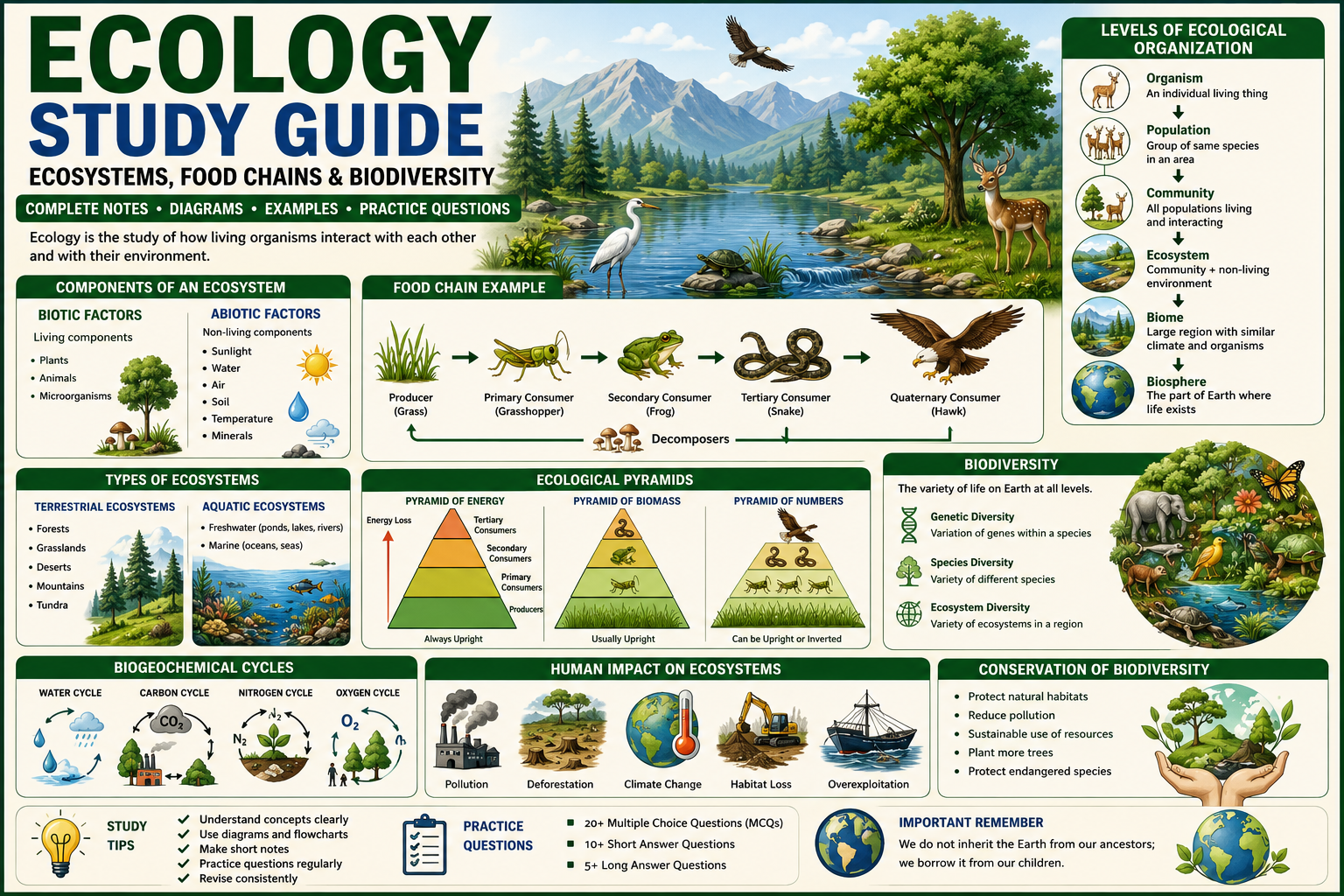
Step outside for a moment and look around. Every tree, insect, bird, patch of soil, gust of wind, and ray of sunlight is part of something much larger than itself. None of it exists in isolation. The tree pulls water from the soil through its roots and releases it through its leaves. The insect pollinates the flower that becomes the fruit a bird eats. The bird’s droppings fertilize the ground that grows the next tree. Everything is connected.
That connection—the web of relationships between living organisms and their physical environment—is what ecology is all about.
Ecology is one of the most relevant scientific disciplines you’ll study, because it explains the world you actually live in. It connects biology to chemistry, physics, geography, and environmental science. And it provides the scientific foundation for understanding some of the most urgent challenges humans face today: climate change, biodiversity loss, habitat destruction, pollution, and food security.
This ecology study guide is designed to give you everything you need in one well-organized place. Whether you’re preparing for AP Biology, IB Biology, GCSE, A-Level, or a college ecology exam, this guide covers every major concept—from food chains and energy pyramids to biogeochemical cycles and conservation biology—with clear explanations, comparison tables, diagrams to practice, and 35 exam-ready practice questions.
Let’s start from the ground up—literally.
Key Takeaways
- Ecology studies the relationships between organisms and their environments at multiple levels of organization.
- Ecosystems consist of biotic (living) and abiotic (non-living) components that interact continuously.
- Energy flows through ecosystems in one direction via food chains and food webs; only ~10% transfers between trophic levels.
- Biogeochemical cycles (water, carbon, nitrogen, oxygen) recycle matter continuously through ecosystems.
- Biodiversity exists at genetic, species, and ecosystem levels—and all three are currently threatened.
- Human activities including pollution, deforestation, climate change, and habitat loss are the primary drivers of biodiversity decline.
- Ecological succession describes how communities change over time following disturbances.
- This guide includes 35 practice questions across three levels for complete exam preparation.
What Is Ecology?
Ecology is the scientific study of the relationships between living organisms and their environment, and the interactions among organisms themselves. The word comes from the Greek oikos (house or dwelling place) and logos (study)—ecology is quite literally the study of organisms in their home.
More practically, ecology asks questions like:
- Why do certain organisms live where they do?
- What determines how many individuals of a species can survive in a given area?
- How does energy move through a community of organisms?
- What happens to an ecosystem when a key species disappears?
- How do human activities alter the natural systems that support all life?
Ecology operates across an enormous range of scales—from studying a single organism’s relationship with its immediate surroundings to analyzing global patterns of species distribution and climate.
What ecology is not:
It’s worth being clear that ecology is distinct from environmentalism (a social and political movement) even though the two intersect. Ecology is a rigorous scientific discipline. Its findings inform environmental policy, but the science itself is concerned with understanding how natural systems work, not advocating for particular policies.
Ecology’s connections to other sciences:
Ecology pulls from biology, chemistry, physics, geology, and geography. An ecologist studying nutrient cycling needs chemistry. One studying animal movement patterns needs physics and mathematics. One studying how climate affects species ranges needs geology and meteorology. This interdisciplinary nature is part of what makes ecology both challenging and fascinating.
Why Is Ecology Important?
Few scientific subjects have more direct relevance to the world you live in than ecology. Here’s why it matters at every level.
For the planet:
Every ecosystem service humans depend on—clean air, clean water, food production, pollination, climate regulation, disease control, flood protection, soil formation—is provided by functioning ecosystems. Ecology gives us the scientific understanding to protect and manage these services.
For conservation:
You cannot effectively conserve a species without understanding its ecological role, its food sources, its predators, its habitat requirements, and its relationships with other species. Ecology provides that knowledge.
For agriculture:
Modern agriculture depends on ecological principles. Understanding soil ecology, pollination ecology, pest-predator dynamics, and nutrient cycling allows farmers to grow food more sustainably and productively.
For public health:
Many diseases spread through ecological pathways. The emergence of COVID-19, Ebola, Lyme disease, and malaria are all connected to ecological dynamics—habitat destruction, wildlife trade, vector-host relationships. Understanding ecology helps predict and prevent disease emergence.
For climate science:
Ecosystems are major players in regulating Earth’s climate. Forests absorb carbon dioxide. Oceans regulate temperature and CO₂ levels. Wetlands store carbon. Understanding these roles—and what happens when ecosystems are disrupted—is fundamental to climate science.
For students:
Beyond its scientific importance, ecology is one of the most accessible and engaging areas of biology because it connects to visible, tangible phenomena in the real world. And it’s increasingly central to biology curricula at every level.
History of Ecology
Ecology as a formal science is relatively young, but observations about nature’s interconnections stretch back to ancient times.
| Period / Year | Figure / Event | Contribution |
|---|---|---|
| Ancient Greece | Aristotle (~350 BCE) | Observed and classified animals in relation to their habitats; noted environmental influences on behavior |
| Ancient Greece | Theophrastus (~300 BCE) | Described plant-environment relationships; considered a founder of botany and early ecology |
| 1749 | Carl Linnaeus | Developed taxonomic classification; established basis for studying species interactions |
| 1798 | Thomas Malthus | Essay on Population; argued population growth is limited by resources—influenced Darwin and later ecologists |
| 1859 | Charles Darwin | On the Origin of Species; natural selection as driven by environmental pressures—fundamentally ecological |
| 1866 | Ernst Haeckel | First coined the term “ecology” (Ökologie); defined it as the science of organism-environment relationships |
| 1887 | Stephen Forbes | Published “The Lake as a Microcosm”—an early systems approach to ecosystem thinking |
| 1920s–1930s | Charles Elton | Developed concepts of food chains, food webs, and ecological niches; pioneer of animal ecology |
| 1935 | Arthur Tansley | Coined the term “ecosystem”; emphasized physical and biological components as a single system |
| 1942 | Raymond Lindeman | Developed the trophic-dynamic concept; quantified energy flow and the 10% rule |
| 1953 | Eugene and Howard Odum | Published foundational ecosystem ecology textbooks; established modern ecosystem ecology |
| 1962 | Rachel Carson | Published Silent Spring; documented ecological effects of pesticides; launched modern environmental movement |
| 1970s–present | Various researchers | Development of conservation biology; biodiversity research; global ecology and climate change science |
The trajectory of ecology mirrors growing human awareness of our impact on natural systems—from purely observational science to a discipline urgently relevant to planetary sustainability.
Basic Ecology Terms Every Student Should Know
Before diving into specific concepts, you need a working ecological vocabulary. These terms appear across virtually every ecology question.
| Term | Definition |
|---|---|
| Ecology | Study of relationships between organisms and their environment |
| Organism | Any individual living thing |
| Population | All individuals of the same species in the same area at the same time |
| Community | All populations of different species living and interacting in the same area |
| Ecosystem | A community plus all its abiotic (non-living) environmental factors |
| Biome | A large geographic area characterized by specific climate and dominant vegetation |
| Biosphere | The global sum of all ecosystems; all life on Earth and its environments |
| Habitat | The physical location or environment where an organism lives |
| Niche | The ecological role of an organism—how it obtains food, avoids predators, reproduces |
| Producer (autotroph) | An organism that makes its own food using energy from sunlight or chemicals |
| Consumer (heterotroph) | An organism that obtains energy by eating other organisms |
| Decomposer | An organism that breaks down dead organic matter, recycling nutrients |
| Herbivore | An animal that eats only plants (primary consumer) |
| Carnivore | An animal that eats only other animals |
| Omnivore | An animal that eats both plants and animals |
| Predator | An organism that hunts and kills other organisms for food |
| Prey | An organism hunted and consumed by a predator |
| Symbiosis | A close, long-term relationship between two different species |
| Carrying capacity | The maximum population size an environment can sustainably support |
| Biodiversity | The variety of life in a given area, including species, genetic, and ecosystem diversity |
| Keystone species | A species that has a disproportionately large effect on its ecosystem relative to its abundance |
| Invasive species | A non-native species introduced to a new ecosystem where it causes harm |
| Succession | The process by which a community changes over time following a disturbance |
| Biomass | The total mass of living organisms in a given area |
Levels of Ecological Organization
Ecology studies life at six hierarchical levels, each building on the one below. Understanding these levels is the organizing framework for all of ecology.
Organism
The organism is the most fundamental level—any individual living thing. An organism occupies a specific habitat, fills a specific ecological niche, and interacts with other organisms and with its physical environment.
Each organism has specific tolerances for environmental factors like temperature, moisture, salinity, and light. Its distribution in nature is determined by whether environmental conditions fall within these tolerances.
Example: A polar bear is an organism. It lives in the Arctic (its habitat), feeds primarily on seals (its feeding niche), requires sea ice for hunting, and can tolerate extreme cold.
Population
A population is all the individuals of the same species living in the same area at the same time and capable of interbreeding.
Population characteristics:
- Population size — Total number of individuals
- Population density — Number of individuals per unit area (e.g., individuals per km²)
- Distribution pattern — How individuals are spatially arranged (random, uniform, or clumped—clumped is most common in nature)
- Age structure — The proportion of individuals in different age groups (young, reproductive, post-reproductive)
- Sex ratio — Proportion of males to females
- Birth rate (natality) — Rate at which new individuals are added
- Death rate (mortality) — Rate at which individuals die
- Immigration — Individuals moving into the population
- Emigration — Individuals moving out of the population
Population growth:
- Exponential growth — Occurs when resources are unlimited; produces a J-shaped growth curve. Population doubles at a constant rate. Rare in nature for extended periods.
- Logistic growth — More realistic; population grows rapidly when small, slows as it approaches the environment’s carrying capacity (K), producing an S-shaped (sigmoidal) curve.
Limiting factors prevent indefinite growth:
- Density-dependent factors — Effects increase as population density increases: food competition, disease, predation, waste accumulation
- Density-independent factors — Affect populations regardless of density: natural disasters, extreme weather events, seasonal temperature changes
Community
A community is all the populations of different species living and interacting in the same geographic area at the same time. A community includes plants, animals, fungi, bacteria, protists—every organism in that location.
Community ecology studies:
- Species richness — The number of different species in a community
- Species evenness — How evenly individuals are distributed among species
- Dominant species — Species that are most abundant or exert the greatest influence on the community
- Keystone species — Species that have disproportionately large effects relative to their abundance
Community interactions include predation, competition, symbiosis, and other relationships that shape the community’s structure and dynamics.
Ecosystem
An ecosystem includes the biotic community plus all the abiotic (non-living) environmental factors with which organisms interact. It’s the fundamental unit of ecology.
Ecosystems are defined by:
- The flow of energy through them (from producers to consumers to decomposers)
- The cycling of matter (nutrients cycle continuously)
- The interactions between living and non-living components
Ecosystems have no fixed size. A tide pool, a forest, a lake, a rotting log—all are ecosystems. What matters is that the community and its abiotic environment are studied as an integrated system.
Biome
A biome is a large-scale geographic region characterized by a particular climate pattern and the distinct communities that have evolved to live there. Biomes are determined primarily by temperature and precipitation.
Major terrestrial biomes:
| Biome | Climate | Dominant Vegetation | Examples |
|---|---|---|---|
| Tropical rainforest | Hot, very wet year-round | Tall, dense trees; high canopy | Amazon Basin, Congo Basin |
| Tropical savanna | Hot; distinct wet/dry seasons | Grasses, scattered trees | African savanna, Brazilian cerrado |
| Desert | Hot or cold; very low precipitation | Sparse; cacti, succulents, shrubs | Sahara, Atacama, Gobi |
| Temperate grassland | Moderate; seasonal; low rainfall | Grasses, few trees | American Great Plains, Eurasian steppe |
| Temperate deciduous forest | Moderate; four seasons | Deciduous trees (oak, maple, beech) | Eastern North America, Western Europe |
| Boreal forest (Taiga) | Cold; long winters; short summers | Conifers (spruce, fir, pine) | Northern Canada, Russia, Scandinavia |
| Tundra | Very cold; little precipitation; permafrost | Mosses, lichens, low shrubs | Arctic, Antarctic regions, high altitudes |
| Mediterranean (chaparral) | Mild, wet winters; hot, dry summers | Shrubs, drought-adapted plants | California, Mediterranean coast |
Major aquatic biomes:
- Freshwater (lakes, rivers, ponds, wetlands, streams)
- Marine (open ocean, coral reefs, estuaries, intertidal zones, deep sea)
Biosphere
The biosphere is the highest and most inclusive level of ecological organization. It encompasses all living organisms on Earth and all the environments they inhabit—from the deepest ocean trenches to the highest mountaintops, from polar ice to tropical rainforests.
The biosphere extends roughly 10 km above Earth’s surface (atmosphere), through the land surface and its soil, and down approximately 10 km into the ocean depths.
The biosphere concept reminds us that all life on Earth is interconnected—that atmospheric carbon dioxide levels, ocean temperatures, and biodiversity patterns are all linked in a single planetary system.
Ecosystems Explained
Terrestrial Ecosystems
Terrestrial ecosystems occur on land. They’re characterized by relatively low water availability compared to aquatic systems, and organisms have evolved diverse adaptations to survive.
Key terrestrial ecosystem examples:
Forest ecosystems:
The most species-rich terrestrial ecosystems. Tropical rainforests contain over 50% of the world’s species despite covering only ~7% of land surface. Forests provide carbon storage, water regulation, and habitat for millions of species.
Grassland ecosystems:
Characterized by dominant grasses and periodic disturbances (fire, drought, grazing) that prevent tree establishment. Support high populations of grazing mammals and are often highly productive. Much natural grassland has been converted to agriculture.
Desert ecosystems:
Despite harsh conditions, deserts support diverse specialized organisms. Many have behavioral adaptations (nocturnal activity), morphological adaptations (reduced leaves, water-storing tissues), and physiological adaptations (efficient water retention).
Wetland ecosystems:
Transitional zones between aquatic and terrestrial systems. Among the most productive and ecologically important on Earth. Provide flood control, water purification, carbon storage, and habitat for migratory birds. Among the most threatened ecosystems globally.
Aquatic Ecosystems
Aquatic ecosystems cover approximately 71% of Earth’s surface and contain the majority of Earth’s biodiversity.
Freshwater ecosystems:
- Lakes and ponds — Standing water; stratified by temperature (thermocline separates warm upper layer from cold deep water)
- Rivers and streams — Flowing water; organisms adapted to current
- Wetlands (freshwater) — Marshes, swamps, bogs; transition zones with exceptionally high productivity
Marine ecosystems:
- Open ocean (pelagic zone) — Vast, covers 70% of Earth; phytoplankton are primary producers; relatively low productivity per unit area but enormous total area
- Coastal ocean — Nutrient-rich from land runoff; highly productive; supports major fisheries
- Coral reefs — Among the most biodiverse ecosystems on Earth; built by coral organisms; threatened by warming and acidification
- Estuaries — Where rivers meet the sea; brackish water; extremely productive nursery habitats for many marine species
- Intertidal zones — Exposed at low tide, submerged at high tide; organisms adapted to dramatic daily changes
- Deep sea — Cold, dark, high pressure; chemosynthetic communities near hydrothermal vents
Natural Ecosystems
Natural ecosystems develop and sustain themselves through ecological processes without direct human design or management. They include old-growth forests, undisturbed grasslands, natural wetlands, and pristine marine systems. They tend to have higher biodiversity and ecological complexity than managed systems.
Artificial Ecosystems
Artificial (anthropogenic) ecosystems are created or significantly modified by humans.
Examples include:
- Agricultural fields (agroecosystems) — Dominated by crop monocultures; low biodiversity; require external inputs
- Urban ecosystems — Cities and suburbs; human-dominated; surprisingly complex in some contexts
- Aquaculture systems — Fish farms and aquaponic systems
- Managed forests — Tree plantations; lower biodiversity than natural forests
- Restoration ecosystems — Areas being actively restored to a more natural state
Understanding the differences between natural and artificial ecosystems is important for discussions of sustainability, conservation, and ecosystem services.
Components of an Ecosystem
Every ecosystem consists of two fundamental categories of components that interact continuously.
Biotic Factors
Biotic factors are all the living components of an ecosystem—every organism present and its biological activities.
Functional categories:
| Category | Description | Examples |
|---|---|---|
| Producers (autotrophs) | Make their own food from light or chemicals | Plants, algae, phytoplankton, cyanobacteria |
| Primary consumers | Eat producers | Herbivores: rabbits, caterpillars, zooplankton |
| Secondary consumers | Eat primary consumers | Small carnivores: foxes, frogs, small fish |
| Tertiary consumers | Eat secondary consumers | Larger carnivores: eagles, sharks, bears |
| Decomposers | Break down dead organic matter | Bacteria, fungi |
| Detritivores | Feed on dead organic matter directly | Earthworms, millipedes, dung beetles |
Biotic interactions include competition, predation, symbiosis, and herbivory—all of which shape the structure and dynamics of communities.
Abiotic Factors
Abiotic factors are all the non-living physical and chemical components of an ecosystem. They determine where organisms can live and how many can survive.
Key abiotic factors:
| Factor | Ecological Significance |
|---|---|
| Temperature | Affects metabolic rates; determines biome type; limits species ranges |
| Precipitation / Water availability | Primary determinant of terrestrial biome distribution |
| Sunlight | Energy source for photosynthesis; determines productivity |
| Soil type and composition | Affects nutrient availability and plant growth |
| pH | Affects enzyme activity, nutrient availability, and organism survival |
| Salinity | Determines freshwater vs. marine organism distribution |
| Wind | Affects evaporation, seed dispersal, temperature |
| Atmospheric gases | Oxygen for respiration; CO₂ for photosynthesis; nitrogen for fixation |
| Fire | Natural disturbance in grasslands and some forests; affects succession |
| Topography | Altitude, slope, and aspect affect temperature, moisture, and wind |
The law of the minimum (Liebig’s Law): The growth of an organism is controlled not by the total amount of resources available, but by the scarcest resource (the limiting factor). Even if all other factors are optimal, a single limiting factor restricts growth.
The law of tolerance (Shelford’s Law): Each organism has a range of tolerance for every environmental factor. The range includes a minimum, a maximum, and an optimal zone. Outside the tolerance range, organisms cannot survive.
Food Chains Explained
A food chain is a linear sequence showing the transfer of energy and matter from one organism to the next through feeding relationships.
Basic format:
Producer → Primary Consumer → Secondary Consumer → Tertiary Consumer
Example (terrestrial):
Grass → Grasshopper → Frog → Snake → Hawk
Example (marine):
Phytoplankton → Zooplankton → Small fish → Tuna → Shark
Reading a food chain:
- Arrows show the direction of energy flow (from eaten to eater)
- The arrow means “is eaten by” or “provides energy to”
- Always starts with a producer (autotroph)
Types of food chains:
Grazing food chain:
Begins with living green plants. The most familiar type. Energy flows from living vegetation through herbivores to carnivores.
Example: Grass → Rabbit → Fox → Wolf
Detritus food chain:
Begins with dead organic matter (detritus). Especially important in forest and aquatic ecosystems where decomposition drives much of the nutrient cycling.
Example: Dead leaves → Earthworm → Robin → Hawk
Limitations of food chains:
Real feeding relationships are far more complex than any single chain represents. Most organisms eat more than one type of food, and most organisms are eaten by more than one predator. This is why food webs are a more accurate representation.
Food Webs Explained
A food web is a network of interconnected food chains showing the complex feeding relationships in an ecosystem. It’s a more realistic representation of how energy and matter flow through natural communities.
Key characteristics of food webs:
- Most consumers feed at multiple trophic levels (omnivores)
- Most organisms have multiple predators
- Removing or adding one species can ripple through the entire web
- More complex webs are generally more stable (more redundancy)
Example of food web relationships in a grassland:
Grass is eaten by rabbits, mice, grasshoppers, and deer. Rabbits are eaten by foxes, hawks, and owls. Mice are eaten by foxes, owls, and snakes. Foxes are eaten by wolves. All dead organisms are broken down by decomposers. Each organism is connected to several others—remove one and the others are affected.
Keystone species and food webs:
A keystone species has effects far out of proportion to its abundance. Removing it causes dramatic cascades through the food web.
Classic example — Sea otters:
Sea otters eat sea urchins. Without otters, sea urchin populations explode and devastate kelp forests by consuming the holdfasts. Without kelp, hundreds of species that depend on kelp habitat disappear. One species removal restructures an entire ecosystem.
Classic example — Wolves in Yellowstone:
When wolves were reintroduced to Yellowstone in 1995 after a 70-year absence, their effect cascaded through the entire ecosystem—including changing river behavior through what ecologists call a trophic cascade. This is one of the most compelling demonstrations of food web dynamics ever documented.
Trophic Levels
A trophic level is the position an organism occupies in a food chain or food web—defined by the number of energy transfers between it and the base of the chain.
| Trophic Level | Name | Description | Examples |
|---|---|---|---|
| 1st | Producers | Make own food via photosynthesis or chemosynthesis | Plants, algae, phytoplankton |
| 2nd | Primary consumers | Eat producers directly | Rabbits, caterpillars, zooplankton |
| 3rd | Secondary consumers | Eat primary consumers | Frogs, small fish, foxes |
| 4th | Tertiary consumers | Eat secondary consumers | Eagles, sharks, wolves |
| 5th | Quaternary consumers | Eat tertiary consumers | Rare; large apex predators |
| — | Decomposers | Break down all levels | Bacteria, fungi |
Important notes:
- Organisms don’t always occupy a fixed trophic level. Omnivores (like bears or humans) feed at multiple levels simultaneously
- Apex predators sit at the top of the food web; they have no natural predators
- Decomposers are sometimes called saprotrophs and are considered a separate category from consumers because they break down organic matter extracellularly
Energy Flow in Ecosystems
Understanding how energy flows through ecosystems is one of the most important—and most tested—concepts in ecology.
Key principles:
- Energy enters most ecosystems from sunlight, captured by producers through photosynthesis
- Energy flows in one direction only through a food chain—it cannot be recycled like matter
- At each trophic level, significant energy is lost, primarily as heat through cellular respiration
The 10% Rule (Lindeman’s Efficiency):
On average, only about 10% of the energy at one trophic level is transferred to the next. The remaining ~90% is:
- Lost as heat during cellular respiration (metabolic processes)
- Used for movement, growth, reproduction, and other life processes
- Lost in excretion and waste
- Not consumed (dead organisms entering the detrital pathway)
Example calculation:
If producers contain 10,000 kJ of energy:
- Primary consumers receive → 1,000 kJ (10%)
- Secondary consumers receive → 100 kJ (10% of 10%)
- Tertiary consumers receive → 10 kJ (10% of 100)
This dramatic energy loss with each transfer explains:
- Why food chains rarely exceed 4–5 trophic levels (not enough energy remains to support higher levels)
- Why there are always far fewer apex predators than primary consumers
- Why plant-based diets are more energy-efficient than meat-based diets (eating at lower trophic levels retains more energy)
- Why ecosystems can support far more herbivores than carnivores
Gross Primary Production (GPP) vs. Net Primary Production (NPP):
- GPP — Total amount of energy fixed by producers through photosynthesis
- NPP — Energy available to consumers after producers use some for their own respiration
- NPP = GPP − Respiration
- NPP is the energy that enters the rest of the food web
Secondary production:
Energy available from consumers to the next trophic level, after subtracting what’s used for respiration and lost in waste.
Ecological Pyramids
Ecological pyramids are graphical representations showing the relative amounts of energy, biomass, or numbers at each trophic level. They’re almost always wider at the base and narrower at the top—reflecting the reduction that occurs as energy passes through trophic levels.
Pyramid of Energy
The pyramid of energy shows the amount of energy flowing through each trophic level per unit time (usually kJ/m²/year).
Key features:
- Always a true pyramid shape—never inverted
- Most accurately represents trophic dynamics
- Clearly demonstrates the 10% rule
- Decomposers are sometimes shown separately at the side
Example values:
| Trophic Level | Energy (kJ/m²/year) |
|---|---|
| Producers | 10,000 |
| Primary consumers | 1,000 |
| Secondary consumers | 100 |
| Tertiary consumers | 10 |
The energy pyramid is the most reliable of the three pyramids because energy flow follows clear physical laws. It always produces an upright pyramid shape.
Pyramid of Biomass
The pyramid of biomass shows the total dry mass (biomass) of organisms at each trophic level, typically expressed in g/m² or kg/m².
Usually upright:
In terrestrial ecosystems, producer biomass greatly exceeds consumer biomass. Example: the biomass of grass in a savanna vastly exceeds that of the zebras, which in turn exceeds that of the lions.
Can be inverted:
In some aquatic ecosystems—particularly open oceans—the pyramid can be inverted. Phytoplankton (producers) have very short generation times and reproduce quickly, so at any single moment the total biomass of zooplankton (primary consumers) may exceed that of the phytoplankton that produced them. This is possible because phytoplankton are being rapidly replaced even as they’re being consumed.
Pyramid of Numbers
The pyramid of numbers shows the actual number of individual organisms at each trophic level.
Usually upright:
In most ecosystems, there are more producers than herbivores than carnivores. Example: thousands of grass plants support hundreds of grasshoppers, which support dozens of frogs, which support a few snakes.
Can be inverted:
In some situations, the pyramid is inverted or irregular:
- A single large tree (one producer) can support thousands of insects (primary consumers), which support fewer birds (secondary consumers) → Base has fewer organisms than the next level
- Parasite-based chains: One host supports many parasites, which support even more hyperparasites
The pyramid of numbers is the least useful of the three pyramids because it doesn’t account for organism size (comparing a tree to a flea gives misleading information about relative importance to the ecosystem).
Ecological Relationships
Species in a community don’t just coexist—they interact in complex ways that shape population sizes, community structure, and ecosystem function. These interactions are called ecological relationships or symbiotic relationships (broadly defined).
Mutualism (+/+)
Mutualism is a relationship in which both species benefit. It’s one of the most important ecological relationships because it drives enormous amounts of ecosystem function.
Examples:
Pollination mutualisms:
Bees collect nectar (benefit: food) from flowers while inadvertently transferring pollen (benefit: plant reproduction). Without pollinators, most flowering plants couldn’t reproduce. About 75% of flowering plant species and roughly 35% of global food production depend on animal pollinators.
Mycorrhizal associations:
Fungi (mycorrhizae) colonize plant roots. The fungi get sugars from the plant; the plant gets dramatically improved mineral and water uptake through the fungi’s extensive hyphal networks. Over 90% of plant species have mycorrhizal associations—it’s one of the most widespread mutualisms on Earth.
Cleaner fish:
Cleaner wrasse fish remove parasites from larger fish (the “clients”). The cleaner fish get food; the client fish get parasite removal. Both benefit.
Nitrogen-fixing bacteria:
Rhizobium bacteria live in root nodules of leguminous plants. The bacteria convert atmospheric nitrogen to ammonia (available to the plant); the plant provides carbohydrates. This mutualism is critical to global nitrogen cycling.
Commensalism (+/0)
Commensalism is a relationship in which one species benefits while the other is neither helped nor harmed.
Examples:
Epiphytes on trees:
Orchids and bromeliads grow on tree branches, using them as a platform to access sunlight. The tree neither benefits nor is significantly harmed.
Barnacles on whales:
Barnacles attach to whale skin, gaining transportation to new feeding areas. The whale is unaffected.
Remora fish:
Attach to sharks and feed on their scraps. The shark doesn’t benefit or suffer.
Important caveat: True commensalism may be rarer than once thought. More careful study often reveals that relationships previously classified as commensal actually involve subtle costs or benefits to both parties.
Parasitism (+/-)
Parasitism is a relationship in which one species (the parasite) benefits at the expense of another (the host). Parasites typically don’t kill their hosts immediately—dead hosts provide no benefit. Instead, they exploit hosts over extended periods.
Examples:
Ticks and mammals:
Ticks feed on mammal blood (benefit: nutrition) while potentially transmitting diseases and causing irritation or anemia to the host.
Tapeworms:
Live in the digestive tracts of vertebrates, absorbing digested food. The host loses nutrients and may experience digestive problems.
Mistletoe:
A parasitic plant that taps into a host tree’s vascular system to steal water and nutrients. Can weaken or kill the host if infestation is severe.
Cuckoos (brood parasitism):
Cuckoos lay eggs in other birds’ nests. The host birds raise the cuckoo chick, often at the expense of their own chicks.
Ecological significance of parasitism:
Parasites play crucial roles in regulating host population sizes, influencing community structure, and driving evolution (host-parasite co-evolution). Ecologists increasingly recognize that parasites are an essential part of healthy ecosystems.
Predation (+/-)
Predation is a relationship in which one organism (the predator) kills and consumes another (the prey). Unlike parasitism, the interaction is relatively quick and direct.
Ecological effects:
- Regulates prey population sizes
- Drives natural selection for prey defenses (speed, camouflage, toxicity, shells)
- Drives natural selection for predator strategies (speed, stealth, venom)
- Can cause trophic cascades when predators are removed or added
Predator-prey population cycles:
Predator and prey populations often oscillate in cycles. As prey increases → predators increase (more food) → prey decreases (more predation) → predators decrease (less food) → prey recovers → cycle repeats.
Classic example: The oscillating population cycles of snowshoe hares and Canadian lynx, documented through Hudson’s Bay Company fur records spanning 90 years.
Defense strategies of prey:
- Cryptic coloration (camouflage)
- Warning coloration (aposematism) — bright colors signal toxicity
- Mimicry — resembling a dangerous or unpalatable species
- Behavioral defenses — fleeing, playing dead, group vigilance
- Physical defenses — shells, spines, thorns, toxins
Competition (-/-)
Competition occurs when two organisms or species compete for the same limited resource. Both are negatively affected because neither obtains as much of the resource as it would without the competitor.
Types of competition:
Intraspecific competition:
Between individuals of the same species for the same resources (food, mates, territory). Often intense because the competitors have identical niches. Drives population self-regulation.
Interspecific competition:
Between individuals of different species that use similar resources.
Competitive exclusion principle (Gause’s principle):
Two species competing for exactly the same limiting resource in the same space cannot coexist indefinitely. The superior competitor will eventually eliminate the other locally.
But species coexist! How?
Through niche differentiation (also called character displacement and resource partitioning). Species that appear to compete for the same resources actually use slightly different aspects of those resources—different sizes of food, different microhabitats, different activity times. This allows similar species to coexist by reducing overlap in their realized niches.
Example: Five species of warbler in New England forests all eat insects from spruce trees, but each species forages in a different part of the tree—top, middle, bottom, inner branches, outer branches. Niche differentiation allows coexistence.
Biodiversity Explained
Biodiversity (biological diversity) refers to the variety of life on Earth—the total range of organisms, genes, and ecosystems found on the planet.
Biodiversity matters for multiple reasons:
Ecological stability:
More biodiverse ecosystems are generally more stable and resilient. If one species is lost, others can partially fill its role. Biodiversity provides a buffer against disturbance.
Ecosystem services:
Biodiversity underpins the services ecosystems provide to humans—pollination, water purification, climate regulation, food production, medicine, flood control, soil formation. These services have been estimated to be worth tens of trillions of dollars per year globally.
Medicine:
Many of the world’s medicines originate from wild species. Aspirin was derived from willow bark. Penicillin from fungi. Taxol (cancer treatment) from Pacific yew trees. Losing species before they’re even studied means losing potential medical breakthroughs.
Intrinsic value:
Many argue that species have inherent value beyond their utility to humans—that biodiversity has ethical and aesthetic worth independent of human benefit.
Global biodiversity facts:
- Scientists have described approximately 8.7 million eukaryotic species
- The vast majority (~80%) are yet to be discovered and named
- Current extinction rates are estimated at 100–1,000 times the natural background rate
- Scientists refer to the current period as the sixth mass extinction event—the only one driven by a single species
Types of Biodiversity
Genetic Diversity
Genetic diversity refers to the variety of genetic information—alleles and gene sequences—within a species or population.
Why it matters:
- Populations with greater genetic diversity are better equipped to adapt to environmental changes
- Low genetic diversity (as in small, isolated populations) leads to inbreeding, which reduces fitness and increases susceptibility to disease
- Genetic diversity provides the raw material for evolution through natural selection
Example: Wild salmon populations show high genetic diversity across different river systems—different populations have adapted to local conditions. Farmed salmon bred from small populations have far lower genetic diversity and are more vulnerable to disease outbreaks.
Conservation implications: Maintaining genetic diversity within species is as important as maintaining species numbers. A population of 50 closely related individuals is far more vulnerable than a population of 50 genetically diverse individuals.
Species Diversity
Species diversity refers to the number and relative abundance of species in a given area. It has two components:
- Species richness — The total number of different species present
- Species evenness — How evenly individuals are distributed among species
A community with 10 species, each equally abundant, has higher diversity than a community with 10 species where 95% of individuals belong to just one species.
Measuring species diversity:
The most commonly used index is the Shannon diversity index (H’), which accounts for both richness and evenness.
Biodiversity hotspots:
Regions with exceptionally high species richness AND high levels of endemism (species found nowhere else) AND significant habitat threat. Conservation International recognizes 36 biodiversity hotspots globally. Although covering just 2.4% of Earth’s surface, they contain more than 50% of the world’s plant species and nearly 43% of birds, mammals, reptiles, and amphibians as endemics.
Ecosystem Diversity
Ecosystem diversity refers to the variety of different ecosystems, habitats, and ecological processes found in a given region.
A landscape containing tropical forest, mangroves, freshwater streams, coastal wetlands, and coral reefs has far higher ecosystem diversity than one dominated by a single vegetation type.
Why ecosystem diversity matters:
- Different ecosystems provide different ecological functions and services
- High ecosystem diversity means different species can find appropriate habitats
- Ecosystem diversity contributes to landscape-level resilience
Biogeochemical Cycles
Unlike energy, matter cycles through ecosystems. The same atoms of carbon, nitrogen, oxygen, and water have been recycled through living and non-living systems for billions of years. These cycles are called biogeochemical cycles because they involve biological, geological, and chemical processes.
Water Cycle (Hydrological Cycle)
Water is the universal solvent of life and cycles continuously between the atmosphere, land surface, and oceans.
Key processes:
- Evaporation — Liquid water converts to water vapor from oceans, lakes, and land surfaces when heated by the sun
- Transpiration — Water vapor released from plant leaves through stomata (evaporation + transpiration = evapotranspiration)
- Condensation — Water vapor cools and forms clouds (liquid droplets or ice crystals)
- Precipitation — Water falls from clouds as rain, snow, sleet, or hail
- Surface runoff — Water flows over land into streams and rivers
- Infiltration — Water soaks into soil and reaches groundwater
- Percolation — Water moves through soil layers to replenish aquifers
- Groundwater flow — Slow movement of groundwater toward the sea
Ecological importance:
- Water transports dissolved nutrients through ecosystems
- The water cycle regulates temperature on Earth’s surface
- Precipitation patterns determine biome distribution
- Forests significantly influence local water cycles through transpiration
Human impacts on the water cycle:
- Deforestation reduces transpiration and infiltration, increasing runoff and flooding
- Urban surfaces (pavement, buildings) increase runoff and reduce infiltration
- Agriculture withdraws enormous volumes from rivers and aquifers
- Climate change is altering precipitation patterns globally
Carbon Cycle
Carbon is the backbone of all organic molecules. It cycles between the atmosphere, living organisms, soil, oceans, and rock (fossil fuels).
Key processes:
Carbon fixation (atmosphere → biosphere):
- Photosynthesis by producers converts atmospheric CO₂ into glucose and other organic compounds
- Chemosynthesis by deep-sea bacteria fixes carbon without sunlight
Carbon release (biosphere → atmosphere):
- Cellular respiration by all living organisms releases CO₂
- Decomposition by bacteria and fungi releases CO₂ and methane
- Combustion (burning) releases carbon stored in organic matter or fossil fuels
- Volcanic activity releases geologically stored CO₂
Long-term carbon storage:
- Fossil fuels — Formed over millions of years from compressed organic matter
- Limestone and chalk — Marine organisms incorporate CO₂ into shells; accumulate on ocean floor
- Peat bogs and soil organic matter — Slow decomposition stores carbon in the ground
The carbon cycle and climate change:
Human combustion of fossil fuels and deforestation have added enormous amounts of CO₂ to the atmosphere—approximately 50% above pre-industrial levels. CO₂ and other greenhouse gases trap heat in the atmosphere (the greenhouse effect), driving global climate change.
Nitrogen Cycle
Nitrogen is an essential component of amino acids, proteins, and nucleic acids. Although the atmosphere is 78% nitrogen (N₂), most organisms can’t use it in this form—it must be converted to usable forms first.
Key processes:
Nitrogen fixation:
Conversion of atmospheric N₂ to ammonia (NH₃)—the first step making nitrogen available to living things.
- Biological fixation: Rhizobium bacteria in legume root nodules; cyanobacteria; free-living soil bacteria
- Industrial fixation: Haber-Bosch process (industrial fertilizer production—one of the most significant human impacts on the nitrogen cycle)
- Lightning fixation: Energy from lightning breaks N₂ bonds
Nitrification:
Conversion of ammonia (NH₃) → nitrite (NO₂⁻) → nitrate (NO₃⁻) by nitrifying bacteria (Nitrosomonas, Nitrobacter). Nitrates are the primary form absorbed by plant roots.
Assimilation:
Plants absorb nitrates (NO₃⁻) and use them to synthesize amino acids and proteins. Animals obtain nitrogen by eating plants or other animals.
Ammonification:
Decomposer bacteria and fungi break down nitrogen-containing organic compounds in dead organisms and waste, releasing ammonia (NH₃) back to the soil.
Denitrification:
Anaerobic bacteria convert nitrates (NO₃⁻) back to N₂ gas, returning nitrogen to the atmosphere. Occurs in waterlogged, oxygen-poor soils.
Human impacts on the nitrogen cycle:
- Industrial nitrogen fixation for fertilizers has roughly doubled the global rate of nitrogen fixation
- Excess nitrogen from agricultural runoff causes eutrophication in aquatic systems (nutrient overload → algal blooms → oxygen depletion → dead zones)
- The Gulf of Mexico dead zone, caused largely by nitrogen runoff from the Mississippi River basin, is one of the largest in the world
Oxygen Cycle
Oxygen cycles primarily through three reservoirs: the atmosphere (~21% O₂), water (dissolved O₂), and living organisms.
Key processes:
- Photosynthesis — Producers release O₂ as a byproduct of splitting water molecules during light reactions
- Cellular respiration — All living organisms consume O₂ and release CO₂
- Decomposition — Aerobic decomposers consume oxygen
- Combustion — Burning consumes oxygen and releases CO₂
The oxygen cycle is tightly linked to the carbon cycle:
Photosynthesis consumes CO₂ and releases O₂; cellular respiration consumes O₂ and releases CO₂. These two processes are essentially mirrors of each other, keeping atmospheric O₂ and CO₂ in balance.
The ozone layer:
High in the stratosphere, oxygen molecules (O₂) absorb UV radiation and form ozone (O₃). The ozone layer shields Earth’s surface from damaging UV-B radiation. Depletion of the ozone layer by CFCs (chlorofluorocarbons) was one of the first major global environmental crises addressed through international agreement (the Montreal Protocol, 1987).
Ecological Succession
Ecological succession is the process by which communities change and develop over time following a disturbance or the creation of new habitat. It’s a directional, predictable process that moves toward a more stable, mature community state called the climax community.
Key concepts:
- Pioneer species — First colonizers; tough, opportunistic organisms that can survive in harsh, resource-poor environments
- Seral stages (seres) — Intermediate stages of succession between bare ground and climax community
- Climax community — Relatively stable, self-sustaining community representing the endpoint of succession in a given climate; dominated by K-strategist species
- Facilitation — Early species modify the environment in ways that make it more suitable for later species (e.g., pioneer plants improve soil, providing conditions for later plants)
Primary Succession
Primary succession begins in an area with no previous biological community and no soil—bare rock, cooled lava, newly deposited sand, or glacial moraines after a glacier retreats.
The process:
Stage 1 — Pioneer species:
Lichens (symbiotic associations of fungi and algae or cyanobacteria) are classic pioneers on bare rock. They produce acids that weather the rock surface and begin building the first thin layer of organic material. Mosses follow.
Stage 2 — Small plants:
As a thin soil layer develops, small herbaceous plants (grasses, ferns, wildflowers) colonize. Their roots further break up rock. When they die, they add organic matter, building soil.
Stage 3 — Shrubs:
Deeper soil supports shrubs. They shade out the smaller plants, which decline.
Stage 4 — Pioneer trees:
Shade-tolerant fast-growing trees colonize (birch, aspen, alder). They further build soil and create conditions for later forest species.
Stage 5 — Climax forest:
Slow-growing, shade-tolerant trees (oak, beech, maple in temperate zones) eventually dominate. The climax community is relatively stable and self-replacing.
Timescale: Primary succession is an extremely slow process—hundreds to thousands of years for a full climax community to develop.
Classic example: The colonization of Surtsey Island (emerged from the ocean off Iceland in 1963) has been observed in real time as scientists monitor the stages of primary succession on virgin volcanic rock.
Secondary Succession
Secondary succession begins in an area that had a previous biological community but was disturbed—fire, flood, logging, agriculture abandonment, windthrow. Crucially, soil remains intact, greatly accelerating recovery.
The process:
Year 1–5:
Annual grasses, herbs, and opportunistic pioneer plants rapidly colonize. Many seeds lie dormant in the soil (the seed bank) and germinate immediately when disturbance opens up growing space.
Year 5–15:
Perennial grasses and small shrubs replace annuals. Soil microbiome begins recovering.
Year 15–30:
Pioneer trees (sun-loving, fast-growing species like birch, pine, alder) colonize.
Year 30–100:
Canopy trees develop. Understory species return. Forest structure becomes more complex.
Year 100+:
Eventually approaches a climax community resembling the original forest—if further disturbances don’t reset the process.
Timescale: Secondary succession is much faster than primary succession—decades to a few centuries rather than centuries to millennia.
Classic example: The recovery of forest after the 1988 Yellowstone fires. Within years, grasses, wildflowers, and eventually lodgepole pines had recolonized burned areas. Forty years later, large areas have substantially recovered.
Comparing Primary and Secondary Succession:
| Feature | Primary Succession | Secondary Succession |
|---|---|---|
| Starting point | Bare, sterile substrate; no soil | Previously vegetated; soil present |
| Cause | New substrate (volcano, glacier retreat) | Disturbance (fire, logging, farming) |
| Speed | Very slow (centuries to millennia) | Faster (decades to centuries) |
| Pioneer species | Lichens and mosses | Herbaceous plants, grasses |
| Seed bank | Absent | Often present |
| Examples | Lava fields, glacial moraines, sand dunes | Abandoned farmland, post-fire forest |
Human Impact on Ecosystems
Human activities are now the dominant force shaping Earth’s ecosystems—in many cases faster than natural processes can respond.
Pollution
Pollution is the introduction of harmful substances or energy into the environment, causing negative effects on organisms and ecosystems.
Types of pollution:
Air pollution:
- Particulate matter (PM2.5, PM10) from combustion — damages lungs; reduces visibility; deposits on vegetation
- Sulfur dioxide and nitrogen oxides from fossil fuel burning → acid rain (pH 4–5) — damages forests and aquatic ecosystems; leaches nutrients from soil; kills sensitive aquatic organisms
- Greenhouse gases (CO₂, CH₄, N₂O) — drive climate change
- Ground-level ozone — formed from NOₓ and VOCs in sunlight; damages plant tissue and human health
- CFCs — destroy stratospheric ozone layer
Water pollution:
- Agricultural runoff — nitrates, phosphates, pesticides
- Eutrophication — nutrient enrichment causes algal blooms → oxygen depletion → hypoxic dead zones → fish kills
- Industrial discharge — heavy metals, solvents, toxic chemicals
- Plastic pollution — microplastics in marine food chains; marine debris; entanglement
- Thermal pollution — warm water from power plants reduces dissolved oxygen levels
Soil pollution:
- Pesticide accumulation
- Heavy metals from mining and industrial activity
- Salinization from inappropriate irrigation
- Microplastic contamination
Bioaccumulation and biomagnification:
Fat-soluble toxins (like DDT, PCBs, mercury) accumulate in body fat and don’t break down easily. At each trophic level, organisms consume many individuals from the level below—concentrating the toxins further. By the time toxins reach apex predators, concentrations can be millions of times higher than environmental levels. This is biomagnification.
Deforestation
Deforestation is the large-scale removal of forest, primarily for agriculture, cattle ranching, logging, and urban expansion. It’s occurring at alarming rates, particularly in tropical regions.
Consequences:
- Biodiversity loss — Forests are the most species-rich terrestrial ecosystems; habitat destruction is the leading driver of species extinction
- Carbon release — Forests store vast quantities of carbon; destruction releases it as CO₂, accelerating climate change
- Disruption of water cycles — Reduced transpiration affects regional rainfall patterns
- Soil erosion — Tree roots anchor soil; their removal leads to erosion and soil degradation
- Loss of ecosystem services — Clean water, flood regulation, pollination, and medicine all depend on intact forests
Scale: The world lost approximately 4.7 million hectares of tropical primary forest in 2020 alone, according to Global Forest Watch. Tropical forests once covered 15% of Earth’s land surface; that has declined to approximately 7%.
Climate Change
Climate change refers to long-term shifts in global temperature and weather patterns. While natural climate variability exists, current climate change is driven primarily by human emissions of greenhouse gases.
Mechanism:
- Burning fossil fuels releases CO₂ stored over millions of years
- Deforestation removes carbon-absorbing forests and releases stored carbon
- Industrial agriculture releases methane (CH₄) and nitrous oxide (N₂O)
- These gases trap infrared radiation in the atmosphere (enhanced greenhouse effect)
- Global average temperature has risen approximately 1.1–1.2°C above pre-industrial levels
Ecological consequences:
- Species range shifts — Species moving poleward or to higher elevations as temperatures rise; some cannot move fast enough
- Phenological mismatches — Seasonal events (flowering, migration, insect emergence) occurring at different times; disrupting relationships between interdependent species
- Coral bleaching — Warmer waters cause corals to expel symbiotic algae → bleaching → death if conditions persist; ~50% of the Great Barrier Reef has bleached since 2016
- Sea level rise — From thermal expansion and glacial melt; threatens coastal and island ecosystems
- Increased extreme weather — More intense storms, droughts, floods, and wildfires
- Ocean acidification — CO₂ dissolves in oceans forming carbonic acid → lowers pH → threatens shellfish, coral, and marine food webs
Habitat Loss
Habitat loss is the primary driver of biodiversity decline worldwide. When habitat is destroyed, species either move (if they can), adapt (if there’s time), or go extinct.
Key concepts:
Habitat fragmentation:
Large, continuous habitats are broken into smaller, isolated patches by roads, agriculture, and development. Even if total habitat area remains similar, fragmentation has severe effects:
- Edge effects — Altered conditions at habitat boundaries (more light, wind, temperature fluctuations, invasive species)
- Reduced interior habitat for species requiring large, undisturbed areas
- Reduced connectivity — Species can’t disperse between patches; populations become isolated and inbreed
- Increased vulnerability to local extinction
Minimum viable population (MVP):
The smallest population size that has a reasonable chance of persisting in a given environment. Very small populations are vulnerable to extinction through random fluctuations (stochastic events) and inbreeding depression.
Island biogeography theory:
MacArthur and Wilson (1967) showed that larger islands and islands closer to mainland sources of colonization support more species. This theory has been applied to habitat fragments—large, connected habitat patches support more species than small, isolated ones. It provides a theoretical foundation for designing nature reserves.
Invasive Species
Invasive species are organisms introduced (accidentally or deliberately) to areas outside their native ranges, where they establish, spread, and cause ecological or economic harm.
Why invasive species are so damaging:
- Native species have no evolutionary history with them and may lack defenses
- They often have no natural predators in the new environment
- They can outcompete native species for food, space, or mates
- They can introduce novel diseases
- They can hybridize with native species, threatening genetic integrity
Examples:
- Brown tree snake in Guam: Accidentally introduced post-WWII; devastated native bird populations (12 of 12 native forest birds extirpated or extinct)
- Cane toad in Australia: Introduced to control beetle pests in sugarcane; toxins lethal to native predators like quolls and freshwater crocodiles
- Purple loosestrife in North American wetlands: Dense stands outcompete native vegetation; dramatically reduce habitat quality for wildlife
- Zebra mussels in the Great Lakes: Filter enormous amounts of phytoplankton, disrupting food webs; colonize and damage infrastructure
- Common carp in Australian rivers: Stir up sediment through feeding behavior; dramatically reduce water clarity and aquatic plant growth
Prevention is far more effective than control: Eradicating established invasive species is extraordinarily difficult and expensive. Biosecurity measures that prevent introduction are the most cost-effective strategy.
Conservation of Biodiversity
Conservation biology is the scientific discipline devoted to understanding and preserving Earth’s biodiversity.
Conservation strategies:
In-situ conservation (on-site):
Protecting species in their natural habitats. The most effective approach for most species.
- Protected areas — National parks, nature reserves, wildlife sanctuaries; currently cover ~15% of land and ~7% of marine areas; targets of 30% by 2030 (30×30 framework)
- Wildlife corridors — Strips of habitat connecting isolated fragments, allowing movement and gene flow between populations
- Habitat restoration — Actively restoring degraded habitats to functional ecosystems
- Keystone species protection — Focusing conservation on species whose removal would cause cascading ecosystem collapse
- Ecosystem-based management — Managing entire ecosystems rather than individual species
Ex-situ conservation (off-site):
Protecting species outside their natural habitats. Used as a backstop when in-situ conservation isn’t possible.
- Captive breeding programs — Breeding endangered species in controlled settings with the goal of reintroduction (e.g., California condor, black-footed ferret, Arabian oryx)
- Seed banks — Store seeds of plant species; the Svalbard Global Seed Vault stores over 1.3 million seed varieties
- Gene banks — Cryogenic storage of genetic material (gametes, embryos, DNA)
- Botanical gardens and zoos — Maintain living collections for research, education, and potential reintroduction
Policy and law:
- CITES (Convention on International Trade in Endangered Species) — International agreement regulating trade in endangered species
- Convention on Biological Diversity — International treaty setting global biodiversity targets
- IUCN Red List — Global assessment system for species extinction risk (Extinct, Critically Endangered, Endangered, Vulnerable, Near Threatened, Least Concern)
- National legislation (e.g., Endangered Species Act in the US; Wildlife and Countryside Act in the UK)
The role of local communities:
Conservation increasingly recognizes that local communities, particularly indigenous peoples, are the most effective long-term stewards of biodiversity. Approaches that integrate community rights, traditional ecological knowledge, and economic benefits are far more successful than exclusionary fortress conservation models.
Importance of Ecology in Everyday Life
Ecology isn’t something that only happens in nature documentaries and research journals—it shows up in your daily life in practical ways.
Food production:
The food on your plate depends on ecological systems. Soil ecology determines whether crops grow. Pollinator ecology determines whether fruits and vegetables form. Fish ecology determines what’s available in the ocean. Ecological disruption threatens global food security.
Water:
Your clean drinking water is filtered and purified by ecosystems—particularly wetlands, forests, and soil communities. Urban water managers increasingly use “natural infrastructure” (healthy watersheds) to supplement or replace expensive water treatment facilities.
Air quality:
Forests, grasslands, and marine phytoplankton produce oxygen and absorb CO₂. Urban trees reduce particulate matter, lower temperatures, and improve mental health. The quality of the air you breathe is an ecological product.
Disease:
Intact ecosystems limit disease spillover. When forest is cleared and wildlife is displaced, previously isolated pathogens encounter humans and livestock. Ebola, Nipah virus, SARS, and COVID-19 all originated in contexts of human-wildlife interface shaped by ecological disruption.
Mental health:
Exposure to natural environments reduces stress, improves attention, and supports mental wellbeing—a growing body of evidence supports what many people feel intuitively. The ecological concept of biophilia suggests humans have an innate connection to living systems.
Economy:
Ecosystem services—the benefits natural systems provide to people—are estimated to be worth $125–$145 trillion per year globally (more than the entire global GDP). When ecosystems degrade, these services are lost or must be replaced at enormous cost.
Common Ecology Terms for Exams
| Term | Exam-Ready Definition |
|---|---|
| Autotroph | Organism that produces its own food from inorganic sources using light or chemical energy |
| Heterotroph | Organism that obtains energy by consuming other organisms |
| Gross primary production (GPP) | Total energy fixed by producers through photosynthesis |
| Net primary production (NPP) | Energy available to consumers after producers use some for respiration; NPP = GPP − respiration |
| Trophic cascade | Indirect effects on lower trophic levels caused by changes at higher levels |
| Eutrophication | Nutrient enrichment of water bodies causing algal blooms and oxygen depletion |
| Biomagnification | Increasing concentration of a toxin at successive trophic levels |
| Bioaccumulation | Build-up of a substance in an organism’s body |
| Competitive exclusion | Principle stating two species competing for identical resources cannot coexist indefinitely |
| Niche differentiation | Process by which competing species evolve to use different resources, allowing coexistence |
| Aposematism | Warning coloration in prey species indicating toxicity or danger |
| Mimicry | Resemblance of one species to another for protection |
| Edge effect | Changes in ecological conditions at habitat boundaries |
| Indicator species | Species whose presence, absence, or abundance reflects environmental conditions |
| Endemic species | Species found only in a specific geographic location |
| Extinction | Permanent loss of a species; individuals no longer exist anywhere on Earth |
| Extirpation (local extinction) | Loss of a species from a specific geographic area, though it still exists elsewhere |
| Resilience | Capacity of an ecosystem to recover from disturbance |
| Resistance | Ability of an ecosystem to withstand disturbance without significant change |
| Detritivore | Organism that feeds directly on dead organic material |
| Saprotroph | Organism (bacterium or fungus) that digests organic material externally and absorbs nutrients |
Common Mistakes Students Make
Mistake 1: Reversing the arrows in food chains
The arrow in a food chain represents energy flow, not “who eats whom” from the eater’s perspective. The arrow points FROM the organism being eaten TO the organism eating it. “Grass → Rabbit” means grass provides energy to the rabbit. Students often draw these backward.
Mistake 2: Thinking matter cycles and energy cycles the same way
Energy flows in one direction—it enters as sunlight, moves through trophic levels, and is lost as heat. It cannot be recycled. Matter cycles—the same atoms of carbon, nitrogen, and water cycle continuously through living and non-living systems. Confusing these is a very common error.
Mistake 3: Applying the 10% rule too rigidly
The 10% rule is an average—actual efficiencies vary from about 5–20% depending on the ecosystem and organisms involved. Using 10% for calculations is appropriate in exams, but don’t present it as an exact biological law.
Mistake 4: Confusing food chains and food webs
A food chain is a linear sequence. A food web shows multiple interconnected chains representing actual complexity. Most real organisms eat several things and are eaten by several others. Food webs are more realistic.
Mistake 5: Confusing parasitism and predation
Both are +/- relationships, but they differ in mechanism and timescale. Predators kill their prey quickly; parasites typically live on or in their hosts for extended periods without killing them immediately. A parasite that killed its host immediately would lose its food source.
Mistake 6: Thinking the pyramid of biomass is always upright
Students often assume all ecological pyramids are always upright. The pyramid of biomass can be inverted in aquatic ecosystems (particularly open oceans) where phytoplankton reproduce so rapidly that consumer biomass exceeds producer biomass at any given snapshot in time.
Mistake 7: Confusing primary and secondary succession by starting conditions
Primary succession starts on lifeless substrate with no soil. Secondary succession starts in areas where soil remains after a disturbance. Soil presence is the key distinction.
Mistake 8: Assuming all introduced species are invasive
An introduced species only becomes “invasive” when it establishes, spreads, and causes ecological harm. Many introduced species fail to establish or cause minimal impact. The term “invasive” specifically implies harm.
Mistake 9: Confusing mutualism and commensalism
Both involve one species benefiting. In mutualism, both species benefit (+/+). In commensalism, one benefits and the other is unaffected (+/0). If the second species is harmed, it’s parasitism (+/-).
Mistake 10: Underestimating the complexity of real ecosystems
Ecology exam questions increasingly test understanding of system complexity—trophic cascades, feedback loops, multiple stressors, nonlinear responses. Linear thinking (“remove predator → prey increases”) is often oversimplified. Real systems have multiple feedback mechanisms.
Best Tips to Study Ecology
1. Learn the levels of organization as your primary framework
Every ecological concept fits within the hierarchy: organism → population → community → ecosystem → biome → biosphere. Organize your notes this way. When you encounter a new concept, ask: “Which level does this operate at?”
2. Draw and annotate all diagrams
Food webs, energy pyramids, biogeochemical cycles, succession sequences—draw them all from memory. Ecology is heavily visual. If you can draw the nitrogen cycle from memory with all processes labeled, you understand it. If you can’t, you’re memorizing rather than understanding.
3. Practice energy calculations
The 10% rule generates calculation questions in virtually every ecology exam. Practice starting from a given energy amount and calculating energy at each successive trophic level. Also practice working backward (e.g., “a hawk has 10 kJ—how much plant energy supported it?”).
4. Use real-world examples for every concept
Don’t learn mutualism as an abstract definition—know three specific examples. Don’t learn about invasive species generically—know five specific cases with their mechanisms and effects. Real examples transform abstract definitions into usable knowledge.
5. Connect all the cycles
The water, carbon, nitrogen, and oxygen cycles aren’t independent. Photosynthesis connects the carbon and oxygen cycles. Nitrogen fixation connects the nitrogen cycle to the production of proteins. Transpiration connects the water cycle to ecosystems. Understanding these connections helps you answer complex, multi-part questions.
6. Study human impacts alongside each ecosystem concept
After learning each ecosystem concept, immediately consider: what human activities affect this? This directly addresses a large proportion of ecology exam questions and makes the content more meaningful.
7. Use news and current events
Ecology is constantly in the news. Reading about actual deforestation events, coral bleaching reports, or invasive species outbreaks makes abstract concepts concrete and memorable. It also gives you real examples to use in exam essays.
8. Focus on mechanisms, not just descriptions
Don’t just learn that eutrophication is “nutrient enrichment of water bodies.” Learn the mechanism: excess nutrients → algal bloom → decomposers consume dead algae using aerobic respiration → oxygen depletion → hypoxic conditions → fish kill. Mechanistic understanding lets you answer any question about eutrophication, not just definitional ones.
Ecology Practice Questions
20 Multiple Choice Questions (MCQs)
1. Which of the following correctly represents energy flow in a food chain?
- A) Hawk → Snake → Frog → Insect → Plant B) Plant → Insect → Frog → Snake → Hawk C) Plant ← Insect ← Frog ← Snake ← Hawk D) Hawk → Plant → Insect → Frog → Snake
2. What percentage of energy is typically transferred from one trophic level to the next?
- A) 1% B) 5% C) 10% D) 20%
3. Which of the following is an abiotic factor in an ecosystem?
- A) Fungi B) Bacteria C) Temperature D) Decomposers
4. What term describes the maximum population size an environment can sustain?
- A) Population density B) Growth rate C) Carrying capacity D) Biotic potential
5. A relationship in which one species benefits and the other is unaffected is called:
- A) Commensalism B) Mutualism C) Parasitism D) Competition
6. Which ecological pyramid can sometimes be inverted in aquatic ecosystems?
- A) Pyramid of energy B) Pyramid of biomass C) Pyramid of numbers D) Both A and B
7. What is the first stage of primary succession on bare rock?
- A) Mosses B) Grasses C) Lichens D) Shrubs
8. Eutrophication in water bodies is primarily caused by:
- A) Heavy metal contamination B) Excess nutrient runoff C) Thermal pollution D) Acid rain
9. Which process converts atmospheric nitrogen (N₂) into ammonia (NH₃)?
- A) Nitrification B) Denitrification C) Nitrogen fixation D) Ammonification
10. What is a keystone species?
- A) The most abundant species in an ecosystem B) A species found only in one location C) A species with disproportionately large ecological effects relative to its abundance D) The largest species in an ecosystem
11. Which of the following correctly describes biomagnification?
- A) Toxins decrease in concentration at higher trophic levels B) Toxins increase in concentration at higher trophic levels C) Toxins are recycled through decomposition D) Toxins are neutralized by producers
12. What is the main source of energy for most ecosystems?
- A) Chemical energy in soil B) Solar energy (sunlight) C) Thermal energy from the Earth D) Wind energy
13. During secondary succession, which of the following is present from the beginning that distinguishes it from primary succession?
- A) Pioneer species B) Soil C) Climax community D) Seed dispersers
14. Which relationship describes clownfish living among sea anemone tentacles, where the fish is protected but the anemone is unaffected?
- A) Mutualism B) Commensalism C) Parasitism D) Predation
15. What is the term for the role an organism plays in its ecosystem—including what it eats, what eats it, and how it uses resources?
- A) Habitat B) Ecological niche C) Biome D) Territory
16. The process by which communities develop and change over time following a disturbance is called:
- A) Biogeography B) Speciation C) Ecological succession D) Ecosystem engineering
17. Net primary production (NPP) equals:
- A) Total photosynthesis B) Gross production plus respiration C) Gross primary production minus respiration D) Energy available to tertiary consumers
18. Which of the following best describes the competitive exclusion principle?
- A) Two species always coexist B) Two species competing for identical resources cannot coexist indefinitely C) Competition never occurs between different species D) Dominant species eliminate all competitors
19. Which gas cycle involves fixation by bacteria, nitrification, and denitrification?
- A) Water cycle B) Carbon cycle C) Nitrogen cycle D) Oxygen cycle
20. What term describes a species introduced to a new area where it causes ecological harm?
- A) Endemic species B) Indicator species C) Invasive species D) Keystone species
10 Short Answer Questions
1. Explain the 10% rule of energy transfer in ecosystems. If producers in a grassland contain 50,000 kJ of energy, calculate the energy available to primary, secondary, and tertiary consumers. Explain what happens to the remaining 90% at each level.
2. Describe the difference between primary and secondary succession. Include the starting conditions, typical pioneer species, and the timescale for each. Give one real-world example of each type.
3. Explain the process of eutrophication. Describe the sequence of events from nutrient input to the creation of a hypoxic dead zone, naming the organisms involved at each stage.
4. Compare and contrast mutualism, commensalism, and parasitism. For each, state the effect on both species (+/- notation), give a specific example, and explain the ecological significance of that relationship.
5. Describe the nitrogen cycle. Include the processes of nitrogen fixation, nitrification, assimilation, ammonification, and denitrification, and name the organisms responsible for each process.
6. A population of rabbits follows logistic growth. Explain what happens to the population growth rate as the population approaches carrying capacity. Draw and describe the shape of the growth curve, and explain what factors might act as density-dependent limiting factors for this population.
7. Explain what a keystone species is and why its removal can cause a trophic cascade. Use a specific example—such as wolves in Yellowstone or sea otters in kelp forests—to illustrate the concept.
8. Explain why food webs are considered more accurate representations of feeding relationships than food chains. Discuss what happens to a food web when a species is removed at different trophic levels (producer, intermediate consumer, apex predator).
9. Describe three specific ways in which human activities have altered the carbon cycle. For each, explain the mechanism by which carbon is released and the ecological consequence of increased atmospheric CO₂.
10. Compare the three types of ecological pyramids (energy, biomass, and numbers). Explain which type is considered most useful and why. Describe a specific scenario in which the pyramid of numbers would be inverted.
5 Long Answer Questions
1. Describe the flow of energy through an ecosystem, from its initial capture by producers to its dissipation at the highest trophic levels. Include the role of photosynthesis, the 10% rule, gross and net primary production, and the role of decomposers. Explain why food chains rarely exceed four or five trophic levels and discuss the ecological and practical implications of humans eating at lower versus higher trophic levels. (15 marks)
2. Explain the concept of biodiversity, including all three levels (genetic, species, and ecosystem diversity). Describe the current state of global biodiversity and the primary drivers of biodiversity loss. For each driver (pollution, habitat loss, climate change, invasive species, overexploitation), explain the mechanism by which biodiversity is reduced. Evaluate two specific conservation strategies and assess their effectiveness. (15 marks)
3. Describe the water cycle and the nitrogen cycle in detail, including all major processes and the organisms involved in each. Explain how human activities have disrupted both cycles and discuss the ecological consequences of these disruptions, using specific examples such as agricultural runoff and deforestation. (15 marks)
4. Describe the major ecological relationships (mutualism, commensalism, parasitism, predation, and competition) and explain how each shapes community structure. Use specific examples for each relationship. Discuss the concept of niche differentiation and explain how it allows competing species to coexist. Extend your answer to discuss how removing a top predator affects other ecological relationships in the community through trophic cascade dynamics. (15 marks)
5. Evaluate the human impact on ecosystems through the lens of two specific case studies of your choice (e.g., the deforestation of the Amazon, the decline of coral reefs, the introduction of cane toads to Australia, or the creation of the Gulf of Mexico dead zone). For each case study, describe the ecological context, the specific human impact, the mechanisms of ecosystem disruption, the consequences for biodiversity, and the conservation responses that have been or should be implemented. Assess the challenges and limitations of these conservation approaches. (15 marks)
Ecology Revision Checklist
Work through each item honestly. Only check it off when you can explain or demonstrate it—not just when you’ve read it.
Foundations
- Define ecology and explain its relationship to other sciences
- Describe all six levels of ecological organization with examples
- Distinguish between habitat and niche
- Define all 24 basic ecology vocabulary terms from memory
Ecosystems
- Name and describe at least five terrestrial biomes with their climate, vegetation, and examples
- Describe at least four aquatic ecosystem types
- Distinguish between natural and artificial ecosystems
- Explain the difference between biotic and abiotic factors with five examples of each
Energy Flow
- Draw a food chain with five levels and label trophic levels
- Explain why arrows in food chains point in the direction they do
- Apply the 10% rule to calculate energy at each trophic level
- Distinguish between gross and net primary production
- Explain why food chains rarely exceed 4–5 levels
- Draw and interpret all three types of ecological pyramids
- Explain when the pyramid of biomass can be inverted and why
Food Webs
- Draw a food web for a named ecosystem with at least 8 organisms
- Explain the consequences of removing a species at different trophic levels
- Define keystone species and give two examples with their ecological effects
- Explain trophic cascades with a specific example
Ecological Relationships
- Define and compare mutualism, commensalism, and parasitism
- Give two examples of each type of symbiosis with both species named
- Explain predator-prey population cycles with a specific example
- Explain the competitive exclusion principle
- Explain niche differentiation with an example
Biodiversity
- Define biodiversity at all three levels (genetic, species, ecosystem)
- Explain why biodiversity matters (ecological, medical, economic, ethical)
- Name and describe the major drivers of biodiversity loss
- Distinguish between extinction and extirpation
- Explain biomagnification with a specific example
Biogeochemical Cycles
- Draw and annotate the water cycle with all major processes
- Draw and annotate the carbon cycle with all major processes
- Draw and annotate the nitrogen cycle with all five processes and organisms responsible
- Explain the oxygen cycle and its relationship to the carbon cycle
- Describe human impacts on each cycle with specific examples
Ecological Succession
- Compare primary and secondary succession in a table
- Describe the stages of primary succession from bare rock to climax community
- Describe the stages of secondary succession after a forest fire
- Define pioneer species, seral stages, and climax community
- Give one real-world example of each type of succession
Human Impact and Conservation
- Describe five specific human impacts on ecosystems with mechanisms and consequences
- Explain eutrophication step by step
- Explain habitat fragmentation and its consequences for biodiversity
- Distinguish between in-situ and ex-situ conservation with examples
- Describe at least three specific conservation strategies with their effectiveness
Best Books for Ecology
| Book | Best For | Level |
|---|---|---|
| Ecology by William D. Bowman et al. | Comprehensive university-level ecology | University |
| Ecology: Concepts and Applications by Manuel Molles | Accessible introductory ecology textbook | College introductory |
| Campbell Biology – Urry et al. | Strong ecology chapters within broader biology | AP / College |
| The Economy of Nature – Robert Ricklefs | Classic and thorough ecology text | University |
| Ecology of a Changing Planet – Mark Bush | Focuses on ecology in the context of environmental change | University |
| Silent Spring – Rachel Carson | Foundational environmental ecology; readable and powerful | General / Advanced |
| The Sixth Extinction – Elizabeth Kolbert | Biodiversity loss in engaging narrative | General / Advanced |
| Oxford IB Biology Course Companion | IB-specific ecology content | IB |
| CGP GCSE Biology | UK GCSE ecology revision | GCSE |
| Cracking the AP Biology Exam – Princeton Review | AP-focused ecology review | AP |
Free Online Ecology Resources
1. Khan Academy — Ecology Unit
khanacademy.org — Free videos and exercises covering ecosystems, food webs, population ecology, biogeochemical cycles, and community ecology. Clear explanations aligned with AP Biology curriculum.
2. HHMI BioInteractive — Ecology Resources
biointeractive.org — Outstanding animations and case studies on food webs, trophic cascades, biodiversity, and climate change. Includes the famous “Trophic Cascades” film and Serengeti ecosystem resources. Widely used by AP Biology teachers.
3. National Geographic Education — Ecology
education.nationalgeographic.org — High-quality articles, videos, and educational resources on ecosystems, biodiversity, and conservation. Excellent for building real-world understanding.
4. IUCN Red List
iucnredlist.org — The world’s most comprehensive inventory of species conservation status. Invaluable for understanding biodiversity and extinction risk; provides real data for ecology assignments and research.
5. OpenStax Biology — Ecology Chapters (Free Textbook)
openstax.org — Free, peer-reviewed college-level biology textbook with comprehensive ecology chapters available to read online or download as a PDF.
Frequently Asked Questions
1. What is the difference between a food chain and a food web?
A food chain is a simple, linear sequence showing how energy passes from one organism to the next through feeding—for example, grass → rabbit → fox → eagle. A food web shows the complex, interconnected network of many overlapping food chains in an ecosystem. Food webs are more realistic because most organisms eat multiple things and are eaten by multiple predators. Removing a species from a food web sends ripple effects through multiple chains simultaneously.
2. What is the 10% rule and why does it matter?
The 10% rule states that, on average, only about 10% of the energy at one trophic level is transferred to the next. The remaining 90% is lost primarily as heat through cellular respiration, used for life processes, or lost in waste. It matters because it explains why food chains are short (not enough energy reaches higher levels), why there are always fewer apex predators than herbivores, and why plant-based diets are more energy-efficient than meat-based diets for feeding large human populations.
3. What is the difference between primary and secondary succession?
Primary succession begins on lifeless substrate with no soil—such as bare rock after a volcanic eruption or a glacial moraine. It starts with pioneer species like lichens and proceeds over centuries to a climax community. Secondary succession occurs in areas that previously had a community but were disturbed—like a forest after a fire. Because soil remains, recovery is much faster—decades rather than centuries. The pioneer species differ (grasses and herbs in secondary succession vs. lichens in primary), and the seed bank in soil greatly accelerates recovery.
4. What is biodiversity and why is it important?
Biodiversity is the variety of life in a given area, including genetic diversity within species, species diversity within communities, and ecosystem diversity across landscapes. It’s important because biodiverse ecosystems are more stable and resilient to disturbance, provide essential ecosystem services (clean water, air, food, medicine, climate regulation), and have intrinsic ethical value. Current biodiversity loss rates are 100–1,000 times higher than background extinction rates, representing the sixth mass extinction event in Earth’s history.
5. What is a keystone species?
A keystone species is one whose removal causes disproportionately large effects on the ecosystem relative to its abundance. They often control other species through predation or create/maintain habitat. Classic examples include wolves in Yellowstone (whose absence allowed elk to overgraze, degrading vegetation and even changing river courses) and sea otters in Pacific kelp forests (whose absence allows sea urchin populations to explode and destroy kelp). The concept shows that preserving biodiversity isn’t just about numbers—some species are far more critical than others.
6. What is ecological succession and what causes it?
Ecological succession is the process by which communities change and develop over time following a disturbance or colonization of new habitat. It’s caused by organisms modifying their environment in ways that make it less favorable for themselves but more favorable for other species—a process called facilitation. For example, pioneer lichens weather rock and build soil, creating conditions for plants that then shade out the lichens. Each community paves the way for the next, progressing toward a more complex, stable climax community.
7. What is eutrophication and how does it happen?
Eutrophication is the process by which excess nutrients (particularly nitrogen and phosphorus) enter a water body, typically from agricultural runoff or sewage discharge. The nutrients stimulate explosive algal growth (algal bloom). When the algae die, aerobic bacteria decompose them, consuming enormous quantities of dissolved oxygen. This creates hypoxic (oxygen-depleted) conditions that kill fish and other aerobic organisms, creating a “dead zone.” The Gulf of Mexico dead zone is one of the world’s largest examples.
8. How do biogeochemical cycles differ from energy flow?
Energy flows through ecosystems in one direction—from sunlight through producers to consumers, being lost as heat at each step. It cannot be recycled. Matter, by contrast, cycles continuously through living and non-living systems. The same carbon atoms in your body may have previously been part of a dinosaur, a coral reef, atmospheric CO₂, or a piece of coal. Biogeochemical cycles (water, carbon, nitrogen, oxygen) describe these pathways through biological, geological, and chemical processes.
9. What makes a species “invasive” and why are they so damaging?
An invasive species is one introduced outside its native range that establishes, spreads, and causes ecological harm. They’re damaging because native species have no evolutionary history with them and lack appropriate defenses or behavioral responses. With no natural predators in the new environment, invasive populations can explode. They outcompete natives for resources, introduce novel diseases, alter habitat structure, and in some cases directly prey on native species that have no escape behaviors. Prevention through biosecurity is far more effective than control after establishment.
10. What are ecosystem services and why do they matter economically?
Ecosystem services are the benefits that functioning ecosystems provide to people—clean water (purified by wetlands and forests), clean air (produced by vegetation), food (dependent on pollinators, soil ecology, and fish populations), climate regulation (by carbon-storing forests and oceans), flood control (by wetlands and intact forest), disease regulation, and cultural and recreational values. These services have been estimated at $125–$145 trillion per year globally. When ecosystems are degraded, these services must be replaced artificially—at enormous cost—or are simply lost.
11. What is a trophic cascade?
A trophic cascade is an indirect ecological effect that occurs when a change at one trophic level ripples down (or up) through the food web, affecting organisms at multiple lower levels. The classic downward cascade: remove the apex predator → intermediate predators or herbivores increase → their prey or food plants decrease. The Yellowstone wolf example is the most celebrated: wolf removal → elk population explosion → overgrazing of riparian vegetation → riverbank erosion → changed river geomorphology. Wolves returned in 1995 and triggered recovery of vegetation, beavers, songbirds, and fish populations.
12. How does climate change affect biodiversity?
Climate change affects biodiversity through multiple mechanisms. Rising temperatures force species to shift their ranges poleward or to higher elevations—but many cannot move fast enough or face barriers (roads, cities, agriculture). Phenological mismatches disrupt timing between interdependent species (e.g., flowering plants and their pollinators). Ocean warming and acidification (from CO₂ dissolution) devastate coral reefs. More frequent extreme weather events—wildfires, droughts, floods—destroy habitat. Sea level rise eliminates coastal and island habitats. Together, these effects are expected to drive 20–50% of species toward extinction risk if warming exceeds 2°C above pre-industrial levels.
Summary
Ecology is the science of connections—between organisms and their environments, between species in communities, between energy and matter flowing through ecosystems, and between human activity and the natural systems that sustain all life.
This guide has built a comprehensive understanding across every major ecological concept:
- Levels of organization provide the framework for all ecological thinking, from individual organisms to the global biosphere.
- Ecosystems consist of biotic communities interacting with abiotic environments in complex, dynamic ways.
- Food chains and food webs show how energy and matter move through communities—with the 10% rule explaining dramatic energy losses between trophic levels.
- Ecological pyramids visualize energy, biomass, or numbers across trophic levels—revealing the energetic constraints that shape ecosystem structure.
- Ecological relationships—mutualism, commensalism, parasitism, predation, and competition—shape community structure and drive evolution.
- Biodiversity at genetic, species, and ecosystem levels underpins ecosystem stability, resilience, and the services that sustain human civilization.
- Biogeochemical cycles continuously recycle matter through living and non-living systems—and human disruption of these cycles is causing global ecological change.
- Ecological succession describes predictable community development over time, from bare rock to climax community.
- Human impacts—pollution, deforestation, climate change, habitat loss, and invasive species—represent the most significant drivers of ecosystem degradation in Earth’s history.
- Conservation strategies, both in-situ and ex-situ, provide tools for protecting and restoring biodiversity.
Final Thoughts
Ecology might be the most important scientific subject you study—not because exam scores depend on it, but because the future of life on Earth depends on how well humanity understands and applies its principles.
Every food chain you learn represents a real web of relationships that sustains life. Every biogeochemical cycle you study represents a planetary life-support system. Every endangered species in a conservation case study represents a real loss—not just of numbers, but of evolutionary history, ecological function, and potential.
This ecology study guide is designed to be your foundation—both for passing your exams and for developing the ecological literacy that will matter for the rest of your life. Use the revision checklist to assess yourself honestly. Work through the practice questions under exam conditions. Draw the cycles and food webs from memory until they flow naturally.
Ecology is how you understand the world you live in. And that understanding starts here.
Article Disclaimer
This article is intended for educational and informational purposes only. While LearnMinto strives to provide accurate, well-researched, and up-to-date information, ecology and environmental science are continuously evolving fields, and educational standards may vary by institution or examination board. Readers should verify important academic concepts through official textbooks, educational institutions, examination boards, or trusted scientific resources before relying on this content for exams or academic purposes. LearnMinto is not affiliated with any specific school, university, government agency, or examination board, and this content should not be considered professional environmental or scientific advice.