
Introduction
Every time you blink, think, walk, digest food, or even sit quietly reading this sentence, your cells are using energy. That energy does not come directly from the sandwich you ate or the rice you had for lunch. First, your cells must break food molecules down and convert their stored chemical energy into ATP—the usable energy currency of life. That process is called cellular respiration.
This cellular respiration study guide is designed to help you understand the topic clearly, step by step. If you have ever mixed up glycolysis, the Krebs cycle, and the electron transport chain, you are not alone. Cellular respiration can feel like a maze of molecules, arrows, enzymes, and ATP counts. But once you see the logic behind the process, it becomes much easier.
Think of cellular respiration like a controlled energy release system. Burning glucose in a flame releases energy all at once as heat and light. Cells cannot afford that kind of chaos. Instead, they break glucose down gradually, capturing energy in small, useful packets of ATP.
In this guide, we will cover the cellular respiration equation, where each stage occurs, how ATP is produced, the difference between aerobic and anaerobic respiration, and why fermentation matters during exercise. You will also find comparison tables, step-by-step flowcharts, exam tips, revision notes, and practice questions with answers.
Whether you are preparing for high school biology, AP Biology, college cell biology, medical entrance exams, or simply reviewing biology notes on your own, this guide will give you a complete and practical understanding of cellular respiration.
Let’s begin with the big question: what exactly is cellular respiration?
Key Takeaways
By the end of this guide, you should be able to:
- Define cellular respiration in simple and scientific terms
- Write the word equation and balanced chemical equation for cellular respiration
- Explain where glycolysis, pyruvate oxidation, the Krebs cycle, and the electron transport chain occur
- Compare aerobic respiration, anaerobic respiration, and fermentation
- Describe how mitochondria produce ATP using oxidative phosphorylation
- Calculate the approximate ATP yield from one glucose molecule
- Compare cellular respiration with photosynthesis
- Explain how respiration changes during exercise and muscle fatigue
- Avoid common exam mistakes related to ATP production and respiration stages
- Practice confidently using MCQs, short answers, and long-answer questions
What Is Cellular Respiration? A Cellular Respiration Study Guide Definition
Cellular respiration is the process by which cells break down glucose and other food molecules to release energy in the form of ATP. ATP stands for adenosine triphosphate, and it is the main energy-carrying molecule used by cells.
In simple words:
Cellular respiration is how cells turn food into usable energy.
Most of the time, when biology students talk about cellular respiration, they mean aerobic respiration, which uses oxygen to completely break down glucose into carbon dioxide and water. This process produces a large amount of ATP.
Cellular respiration happens in almost all living organisms, including:
- Animals
- Plants
- Fungi
- Protists
- Many bacteria
Even plants, which make glucose through photosynthesis, still need cellular respiration. A plant cell cannot use glucose directly for most cell work. It must convert glucose energy into ATP, just like animal cells do.
A useful way to think about it:
- Glucose is like a large banknote.
- ATP is like small change your cells can spend immediately.
Cells use ATP for tasks such as:
- Moving substances across membranes
- Building proteins
- Contracting muscles
- Sending nerve impulses
- Dividing during cell reproduction
- Repairing damaged structures
Cellular respiration is part of cell metabolism, the total set of chemical reactions that keep cells alive. Without it, cells would quickly run out of usable energy.
Why Is Cellular Respiration Important?
Cellular respiration is important because it provides the energy cells need to survive and function. Without ATP production, life as we know it would stop within minutes.
Your brain is a good example. Even though it makes up only about 2% of your body weight, it uses roughly 20% of your body’s energy at rest. That energy comes mainly from glucose breakdown through cellular respiration.
Cellular respiration is essential for:
1. Muscle Movement
When you run, lift a backpack, chew food, or even smile, muscle cells need ATP. During intense exercise, your ATP demand rises sharply. That is why breathing rate and heart rate increase—to deliver more oxygen and glucose to working muscles.
2. Brain Function
Neurons use ATP to maintain ion gradients across their membranes. These gradients allow nerve impulses to travel. If oxygen supply to the brain stops, ATP production falls quickly, and brain cells can be damaged.
3. Body Temperature
Cellular respiration releases some energy as heat. This helps warm-blooded animals, including humans, maintain body temperature.
4. Growth and Repair
Cells need ATP to build proteins, copy DNA, repair membranes, and divide. Growing tissues and healing wounds have high energy demands.
5. Plant Survival
Plants use photosynthesis to make glucose, but they use cellular respiration to release energy from that glucose. Root cells, which usually do not photosynthesize, depend heavily on respiration.
Important Fact: Photosynthesis stores energy in glucose. Cellular respiration releases that stored energy as ATP.
In short, cellular respiration connects food, oxygen, energy, and life. It is one of the core processes every biology student must understand.
History of Cellular Respiration Research
The study of cellular respiration developed gradually as scientists learned more about oxygen, metabolism, enzymes, and mitochondria.
Early Ideas About Respiration
For centuries, people understood breathing as a visible process: animals inhale air and exhale something different. But they did not know what happened inside cells.
In the 1700s, scientists began linking respiration with combustion. They noticed that both burning and breathing used oxygen and produced carbon dioxide. This was an important clue: living organisms were releasing energy from food in a controlled way.
Antoine Lavoisier
Antoine Lavoisier, often called the father of modern chemistry, helped explain the role of oxygen in respiration. He showed that animals consume oxygen and produce carbon dioxide, similar to slow combustion.
Discovery of Enzymes and Metabolic Pathways
In the 1800s and early 1900s, researchers discovered that cellular respiration does not happen in one big step. Instead, it occurs through many enzyme-controlled reactions.
A major breakthrough came from studying yeast fermentation. Scientists realized that cells could break down sugar even without oxygen, producing alcohol or lactic acid depending on the organism.
Hans Krebs and the Citric Acid Cycle
In 1937, Hans Krebs described the citric acid cycle, now commonly called the Krebs cycle. This pathway explains how acetyl-CoA is oxidized, releasing carbon dioxide and producing electron carriers such as NADH and FADH₂. Krebs later received the Nobel Prize for this work.
Peter Mitchell and Chemiosmosis
In the 1960s, Peter Mitchell proposed the chemiosmotic theory, explaining how the electron transport chain creates a proton gradient that drives ATP synthesis. At first, many scientists doubted the idea, but it later became one of the central explanations in bioenergetics.
Today, cellular respiration is understood as a carefully organized energy conversion system involving glycolysis, mitochondrial reactions, electron carriers, membrane gradients, and ATP synthase.
Where Does Cellular Respiration Occur?
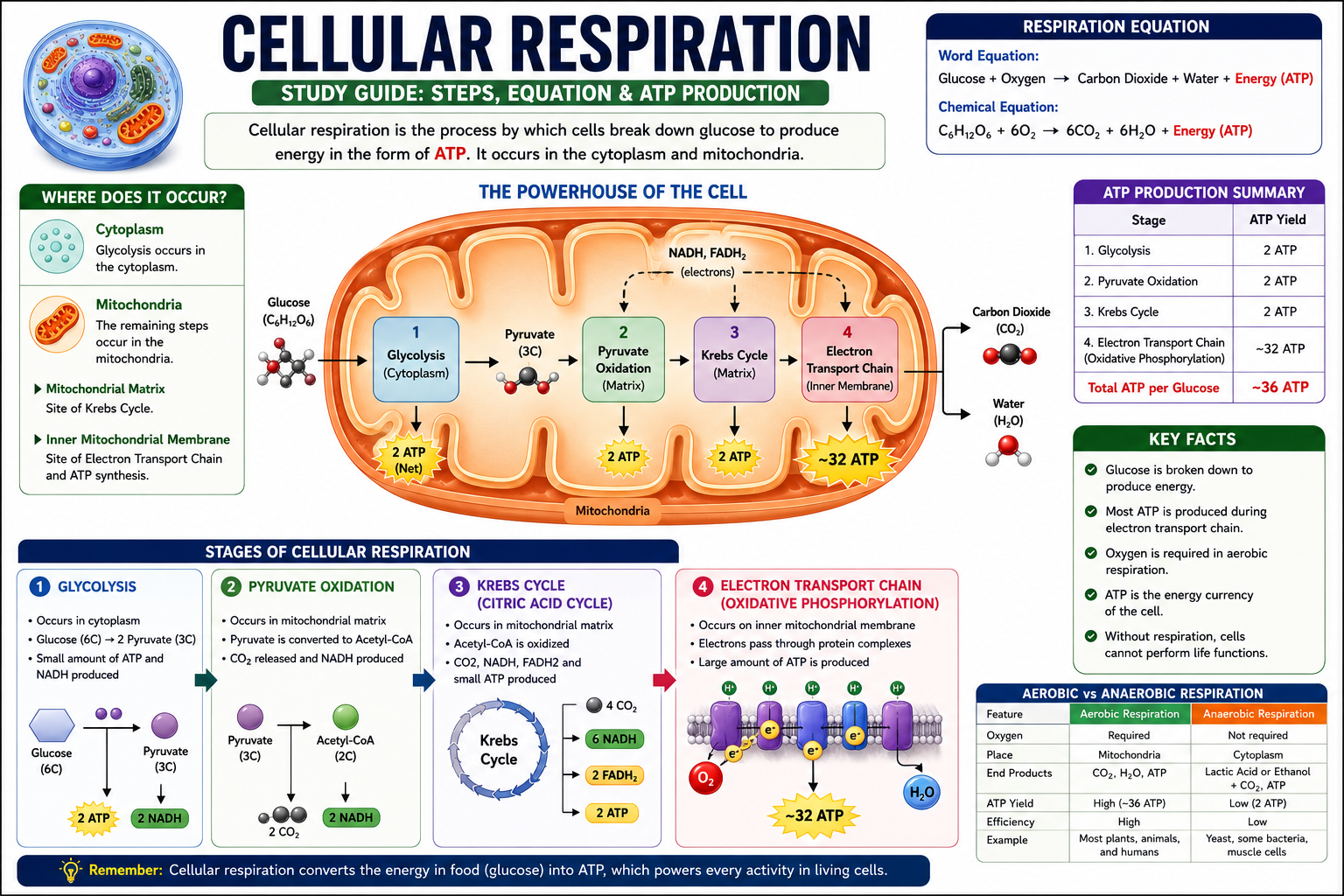
Cellular respiration occurs in different parts of the cell depending on the stage. In eukaryotic cells, such as plant and animal cells, the process begins in the cytoplasm and continues inside mitochondria.
Cytoplasm
The cytoplasm is the jelly-like material inside the cell membrane but outside the nucleus. The first stage of cellular respiration, glycolysis, occurs here.
This is important because glycolysis does not require oxygen and does not require mitochondria. That means even prokaryotic cells, such as bacteria, can perform glycolysis.
Mitochondria
The mitochondria are often called the “powerhouses” of the cell because they produce most of the cell’s ATP during aerobic respiration.
A mitochondrion has:
- An outer membrane
- An inner membrane
- A mitochondrial matrix
- Intermembrane space
- Folded inner membrane structures called cristae
The folds of the inner membrane increase surface area, allowing more electron transport chain proteins and ATP synthase enzymes to fit inside.
Mitochondrial Matrix
The mitochondrial matrix is the fluid-filled space inside the inner mitochondrial membrane.
Two important stages occur here:
- Pyruvate oxidation
- Krebs cycle
The matrix contains enzymes, mitochondrial DNA, ribosomes, and molecules needed for respiration.
Inner Mitochondrial Membrane
The inner mitochondrial membrane is where the electron transport chain and oxidative phosphorylation occur.
This membrane is highly folded into cristae. It contains:
- Electron transport chain protein complexes
- ATP synthase
- Carrier proteins
- Molecules involved in proton pumping
The inner membrane is especially important because it allows the cell to build a proton gradient. That gradient stores potential energy, which ATP synthase uses to make ATP.
Cellular Respiration Equation
The cellular respiration equation summarizes the overall process of glucose breakdown.
Word Equation
Glucose + Oxygen → Carbon dioxide + Water + Energy (ATP)
This word equation is usually the easiest version to remember.
Chemical Equation
C₆H₁₂O₆ + 6O₂ → 6CO₂ + 6H₂O + ATPIn many textbooks, “energy” is written instead of ATP. More accurately, cellular respiration transfers energy from glucose into ATP, while some energy is released as heat.
Reactants
| Reactant | Role in Cellular Respiration |
|---|---|
| Glucose (C₆H₁₂O₆) | Main fuel molecule broken down to release energy |
| Oxygen (O₂) | Final electron acceptor in aerobic respiration |
Glucose usually comes from carbohydrates in food. Oxygen enters the body through breathing and is carried by hemoglobin in red blood cells.
Products
| Product | What Happens to It |
|---|---|
| Carbon dioxide (CO₂) | Waste product exhaled from the lungs |
| Water (H₂O) | Produced when oxygen accepts electrons and hydrogen ions |
| ATP | Used immediately for cellular work |
| Heat | Helps maintain body temperature in warm-blooded animals |
Important Fact: Oxygen is not used in glycolysis or the Krebs cycle directly. Its main role is at the end of the electron transport chain, where it accepts electrons and helps form water.
Types of Cellular Respiration
Cells can release energy from glucose in different ways depending on whether oxygen is available and what kind of organism is involved.
Aerobic Respiration
Aerobic respiration requires oxygen. It is the most efficient form of cellular respiration and produces the highest ATP yield.
In eukaryotic cells, aerobic respiration includes:
- Glycolysis
- Pyruvate oxidation
- Krebs cycle
- Electron transport chain
- Oxidative phosphorylation
Aerobic respiration produces carbon dioxide, water, and a large amount of ATP.
Anaerobic Respiration
Anaerobic respiration occurs without oxygen but still uses an electron transport chain. Instead of oxygen, another inorganic molecule acts as the final electron acceptor.
Some bacteria use:
- Nitrate
- Sulfate
- Carbon dioxide
- Iron ions
Anaerobic respiration is common in certain bacteria and archaea, especially those living in oxygen-poor environments such as deep sediments, wetlands, and animal intestines.
Fermentation
Fermentation also occurs without oxygen, but it does not use the electron transport chain. Instead, fermentation allows glycolysis to continue by regenerating NAD⁺ from NADH.
Two common types are:
| Type of Fermentation | Organisms | Products |
|---|---|---|
| Lactic acid fermentation | Human muscle cells, some bacteria | Lactic acid |
| Alcoholic fermentation | Yeast, some plant cells | Ethanol + CO₂ |
Fermentation produces only 2 ATP per glucose because ATP is made only during glycolysis.
Stages of Cellular Respiration (Step-by-Step)
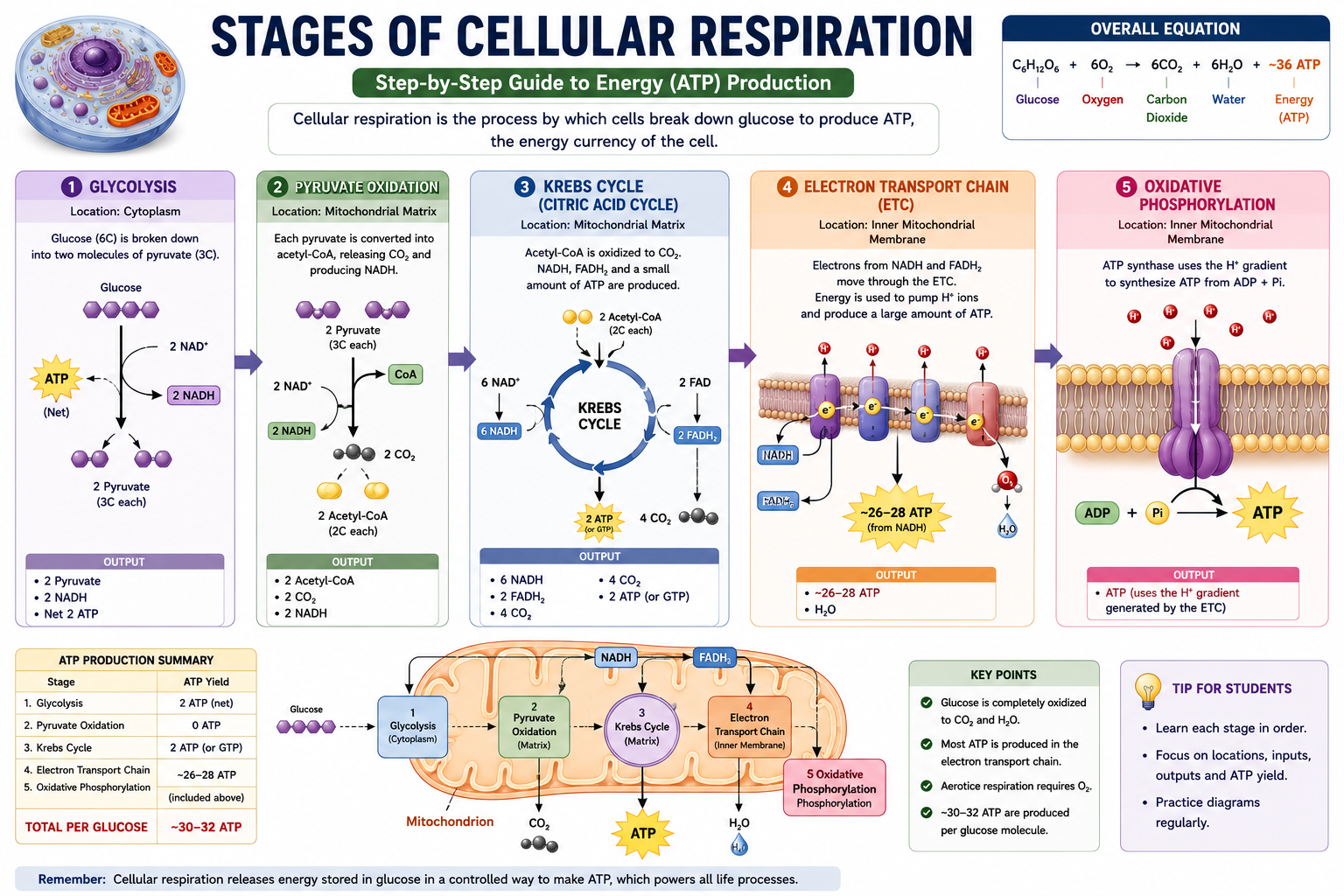
Cellular respiration happens in several connected stages. Each stage passes products to the next one.
Quick Flowchart
Glucose
  ↓
Glycolysis
  ↓
2 Pyruvate
  ↓
Pyruvate Oxidation
  ↓
2 Acetyl-CoA
  ↓
Krebs Cycle
  ↓
NADH + FADH₂
  ↓
Electron Transport Chain
  ↓
Proton Gradient
  ↓
ATP Synthase
  ↓
ATP
Glycolysis
Glycolysis means “splitting sugar.” It is the first stage of cellular respiration and occurs in the cytoplasm.
During glycolysis, one 6-carbon glucose molecule is split into two 3-carbon pyruvate molecules.
Main Events of Glycolysis
- Glucose is activated using 2 ATP.
- The 6-carbon molecule splits into two 3-carbon molecules.
- Electrons are transferred to NAD⁺, forming NADH.
- ATP is produced by substrate-level phosphorylation.
- Two pyruvate molecules are formed.
Net Products of Glycolysis Per Glucose
| Product | Amount |
|---|---|
| Pyruvate | 2 |
| ATP net | 2 |
| NADH | 2 |
Glycolysis does not require oxygen. This makes it one of the most ancient metabolic pathways in life.
Pyruvate Oxidation
If oxygen is available, pyruvate enters the mitochondrion. Before it can enter the Krebs cycle, each pyruvate is converted into acetyl-CoA.
This step occurs in the mitochondrial matrix.
For each pyruvate:
- One carbon is removed as CO₂
- NAD⁺ is reduced to NADH
- The remaining 2-carbon acetyl group attaches to coenzyme A, forming acetyl-CoA
Since one glucose produces two pyruvate molecules, pyruvate oxidation happens twice per glucose.
Products Per Glucose
| Product | Amount |
|---|---|
| Acetyl-CoA | 2 |
| CO₂ | 2 |
| NADH | 2 |
Krebs Cycle (Citric Acid Cycle)
The Krebs cycle, also called the citric acid cycle, occurs in the mitochondrial matrix. It completes the breakdown of glucose by oxidizing acetyl-CoA.
Each acetyl-CoA combines with a 4-carbon molecule called oxaloacetate to form citrate, a 6-carbon molecule. Through a series of enzyme-controlled reactions, citrate is gradually broken down, releasing CO₂ and transferring electrons to NAD⁺ and FAD.
Products Per Acetyl-CoA
| Product | Amount |
|---|---|
| CO₂ | 2 |
| NADH | 3 |
| FADH₂ | 1 |
| ATP or GTP | 1 |
Since each glucose produces two acetyl-CoA molecules, the Krebs cycle turns twice per glucose.
Products Per Glucose
| Product | Amount |
|---|---|
| CO₂ | 4 |
| NADH | 6 |
| FADH₂ | 2 |
| ATP or GTP | 2 |
The Krebs cycle itself produces only a small amount of ATP directly. Its main job is to produce NADH and FADH₂, which carry high-energy electrons to the electron transport chain.
Electron Transport Chain (ETC)
The electron transport chain is located in the inner mitochondrial membrane.
NADH and FADH₂ deliver high-energy electrons to protein complexes in the ETC. As electrons pass through the chain, energy is released. This energy pumps hydrogen ions (H⁺) from the mitochondrial matrix into the intermembrane space.
This creates a proton gradient, meaning there is a higher concentration of H⁺ in the intermembrane space than in the matrix.
Oxygen acts as the final electron acceptor. It combines with electrons and hydrogen ions to form water.
O₂ + electrons + H⁺ → H₂OWithout oxygen, electrons cannot move through the chain efficiently, NADH cannot unload electrons, and aerobic respiration slows or stops.
Oxidative Phosphorylation
Oxidative phosphorylation is the process of making ATP using energy from electrons and oxygen.
It includes two connected events:
- Electron transport creates a proton gradient.
- Chemiosmosis uses that proton gradient to power ATP synthase.
ATP synthase works like a tiny turbine. As H⁺ ions flow through it from the intermembrane space back into the matrix, ATP synthase uses that energy to join ADP and phosphate, producing ATP.
ADP + Pi → ATPThis stage produces most of the ATP in aerobic respiration.
ATP Production Explained
What Is ATP?
ATP stands for adenosine triphosphate. It is a molecule made of:
- Adenine
- Ribose sugar
- Three phosphate groups
ATP is often called the energy currency of the cell because cells “spend” it to power work.
How ATP Stores Energy
ATP stores energy in the bonds between its phosphate groups. When the third phosphate is removed, ATP becomes ADP and releases energy.
ATP → ADP + Pi + EnergyCells use this released energy for:
- Muscle contraction
- Active transport
- Protein synthesis
- DNA replication
- Cell movement
- Nerve signaling
Total ATP Yield Per Glucose Molecule
The ATP yield depends on the cell type and conditions. Modern biology textbooks usually estimate about 30–32 ATP per glucose molecule in eukaryotic cells. Some older textbooks list 36–38 ATP, especially in simplified high school models.
ATP Production Table
| Stage | ATP Produced Directly | NADH Produced | FADH₂ Produced | Approx. ATP Contribution |
|---|---|---|---|---|
| Glycolysis | 2 net | 2 | 0 | 5–7 total |
| Pyruvate oxidation | 0 | 2 | 0 | About 5 |
| Krebs cycle | 2 | 6 | 2 | About 20 |
| Electron transport chain | Most ATP made here | Uses NADH | Uses FADH₂ | About 26–28 |
| Total | 4 direct | 10 | 2 | About 30–32 ATP |
Exam Tip: If your textbook uses 36–38 ATP, follow your class or exam board. If you are writing a college-level answer, mention that modern estimates are usually 30–32 ATP per glucose in eukaryotic cells.
Cellular Respiration vs Photosynthesis
| Feature | Cellular Respiration | Photosynthesis |
|---|---|---|
| Main purpose | Releases energy from glucose | Stores light energy in glucose |
| Overall process | Catabolic | Anabolic |
| Main location | Mitochondria | Chloroplasts |
| Reactants | Glucose and oxygen | Carbon dioxide, water, light |
| Products | Carbon dioxide, water, ATP | Glucose and oxygen |
| Energy flow | Glucose → ATP | Light → glucose |
| Occurs in | Plants, animals, fungi, protists, many bacteria | Plants, algae, cyanobacteria |
| When it occurs | Day and night | Mainly in light |
| Oxygen role | Used as final electron acceptor | Released from water splitting |
| Carbon dioxide role | Produced as waste | Used to build glucose |
Photosynthesis and cellular respiration are connected. Photosynthesis stores energy; respiration releases it. The products of one process are often the reactants of the other.
Aerobic vs Anaerobic Respiration
| Feature | Aerobic Respiration | Anaerobic Respiration |
|---|---|---|
| Oxygen required? | Yes | No |
| Final electron acceptor | Oxygen | Another molecule, such as nitrate or sulfate |
| ATP yield | High | Lower than aerobic |
| Main organisms | Animals, plants, fungi, many bacteria | Certain bacteria and archaea |
| Products | CO₂ and H₂O | Varies by organism |
| Uses ETC? | Yes | Yes |
| Example | Human cell respiration | Nitrate respiration in bacteria |
Fermentation Compared
Fermentation is sometimes grouped with anaerobic processes, but technically it is different from anaerobic respiration because it does not use an electron transport chain.
| Feature | Fermentation |
|---|---|
| Oxygen needed? | No |
| ETC used? | No |
| ATP yield | 2 ATP per glucose |
| Purpose | Regenerates NAD⁺ so glycolysis can continue |
| Examples | Lactic acid fermentation, alcoholic fermentation |
Factors Affecting Cellular Respiration
Cellular respiration depends on enzymes, reactants, and suitable cellular conditions. Several factors can increase or decrease the rate.
Oxygen Availability
Oxygen is essential for aerobic respiration because it acts as the final electron acceptor in the electron transport chain.
When oxygen is limited:
- ETC slows down
- NADH cannot unload electrons efficiently
- ATP production decreases
- Cells may switch to fermentation
This happens in your muscles during very intense exercise when oxygen delivery cannot keep up with demand.
Temperature
Cellular respiration is enzyme-controlled, so temperature matters.
- Low temperatures slow enzyme activity
- Moderate temperatures increase reaction rates
- Very high temperatures can denature enzymes
This is why cold temperatures slow metabolism in many organisms, while fever can increase metabolic rate.
Enzyme Activity
Each stage of respiration depends on specific enzymes. If enzymes are inhibited or damaged, respiration slows.
For example:
- Cyanide blocks part of the electron transport chain
- Some genetic disorders affect mitochondrial enzymes
- Lack of certain vitamins can reduce coenzyme availability
Glucose Availability
Glucose is a major fuel for cellular respiration. If glucose supply is low, cells may use other molecules such as fats or amino acids.
During fasting or long exercise, the body breaks down stored glycogen and fat to provide fuel for ATP production.
Importance of Cellular Respiration in Living Organisms
Cellular respiration is important because it provides usable energy for almost every life process.
In Animals
Animals depend on respiration for:
- Movement
- Body temperature regulation
- Digestion
- Nerve impulses
- Blood circulation
- Growth and repair
High-energy tissues, such as heart muscle and brain tissue, contain many mitochondria because they require constant ATP.
In Plants
Plants use cellular respiration to:
- Power root growth
- Transport nutrients
- Build new tissues
- Repair damage
- Support seed germination
Seeds are especially active during germination. Before leaves form and photosynthesis begins, the young plant relies on stored food and respiration.
In Microorganisms
Bacteria and fungi use respiration or fermentation to release energy. Yeast fermentation is used in bread making, beer production, and wine making. Soil bacteria use different types of respiration to recycle nutrients in ecosystems.
In Ecosystems
Cellular respiration returns carbon dioxide to the atmosphere. This CO₂ can then be used by plants during photosynthesis, helping maintain the carbon cycle.
Cellular Respiration in Plants vs Animals
Plant and animal cells both perform cellular respiration, but their energy sources and roles differ slightly.
| Feature | Plant Cells | Animal Cells |
|---|---|---|
| Perform respiration? | Yes | Yes |
| Main organelle | Mitochondria | Mitochondria |
| Fuel source | Glucose from photosynthesis or stored starch | Glucose from food |
| Oxygen use | Used in mitochondria | Used in mitochondria |
| CO₂ production | Released from respiration | Released from respiration |
| Photosynthesis present? | Yes, in chloroplast-containing cells | No |
| Respiration timing | Day and night | Day and night |
A common misunderstanding is that plants photosynthesize during the day and respire only at night. Actually, plants respire all the time. During daylight, they usually photosynthesize faster than they respire, so they release oxygen overall. At night, photosynthesis stops, but respiration continues.
Cellular Respiration in Everyday Life
Cellular respiration is not just a textbook process. You experience its effects every day.
Exercise
When you exercise, your muscles need more ATP. To meet this demand:
- Breathing rate increases.
- Heart rate increases.
- More oxygen reaches muscle cells.
- More glucose is broken down.
- ATP production rises.
During moderate exercise, aerobic respiration supplies most of the ATP.
Muscle Fatigue
During intense exercise, oxygen may not reach muscles fast enough. Muscle cells then rely more on glycolysis and lactic acid fermentation.
This helps regenerate NAD⁺ so glycolysis can continue, but it produces much less ATP. The buildup of hydrogen ions associated with intense activity contributes to muscle fatigue and the burning feeling during hard exercise.
Lactic acid itself is not simply “waste.” It can be transported to the liver and converted back into glucose through the Cori cycle.
Energy Production
Even when you are resting, your cells are busy. Your heart beats, lungs move, kidneys filter blood, and brain processes information. All of this requires ATP from cellular respiration.
Sports Performance
Athletes train their bodies to improve oxygen delivery and mitochondrial efficiency. Endurance training can increase:
- Mitochondrial number in muscle cells
- Capillary density
- Oxygen use efficiency
- Ability to use fats as fuel
That is why trained runners can maintain aerobic respiration at higher intensities than untrained individuals.
Common Cellular Respiration Terms Every Student Should Know
| Term | Meaning |
|---|---|
| ATP | Main energy-carrying molecule in cells |
| ADP | Lower-energy molecule formed when ATP loses a phosphate |
| Glycolysis | Splitting of glucose into two pyruvate molecules |
| Pyruvate | 3-carbon product of glycolysis |
| Acetyl-CoA | 2-carbon molecule that enters the Krebs cycle |
| Krebs Cycle | Mitochondrial pathway that oxidizes acetyl-CoA |
| Citric Acid Cycle | Another name for the Krebs cycle |
| NAD⁺ | Electron carrier that becomes NADH |
| NADH | Reduced electron carrier carrying high-energy electrons |
| FADH₂ | Electron carrier produced in the Krebs cycle |
| Electron Transport Chain | Protein complexes that pass electrons and pump protons |
| Oxidative Phosphorylation | ATP production using electron transport and chemiosmosis |
| Chemiosmosis | ATP production driven by proton movement through ATP synthase |
| ATP Synthase | Enzyme that makes ATP from ADP and phosphate |
| Aerobic Respiration | Respiration using oxygen |
| Anaerobic Respiration | Respiration without oxygen but using an ETC |
| Fermentation | Anaerobic process that regenerates NAD⁺ without an ETC |
| Lactic Acid Fermentation | Fermentation in muscles and some bacteria |
| Alcoholic Fermentation | Fermentation in yeast producing ethanol and CO₂ |
| Cell Metabolism | All chemical reactions in a cell |
Common Mistakes Students Make
1. Thinking Respiration Means Breathing Only
Breathing and cellular respiration are related, but they are not the same. Breathing brings oxygen into the body and removes carbon dioxide. Cellular respiration happens inside cells and produces ATP.
2. Saying Glycolysis Happens in the Mitochondria
Glycolysis occurs in the cytoplasm, not the mitochondria. This is one of the most common exam errors.
3. Forgetting That Plants Respire
Plants carry out cellular respiration day and night. They photosynthesize only when light is available.
4. Confusing Anaerobic Respiration With Fermentation
Anaerobic respiration uses an electron transport chain with a final electron acceptor other than oxygen. Fermentation does not use an electron transport chain.
5. Memorizing ATP Yield Without Understanding It
ATP numbers vary between textbooks. Understand where ATP comes from: a little from glycolysis and the Krebs cycle, most from oxidative phosphorylation.
6. Thinking Oxygen Produces ATP Directly
Oxygen does not “make” ATP by itself. It allows the electron transport chain to keep running by accepting electrons at the end.
Exam Tip: If a question asks “Why is oxygen necessary for aerobic respiration?” the best answer is: oxygen acts as the final electron acceptor in the electron transport chain, allowing electron flow and ATP production to continue.
Best Tips to Study Cellular Respiration
1. Learn the Big Picture First
Before memorizing every molecule, understand the flow:
Glucose → Pyruvate → Acetyl-CoA → CO₂ + NADH/FADH₂ → ETC → ATPIf you know the overall pathway, the details are easier to place.
2. Use a Location Table
Many exam questions test where each stage happens. Make a simple table:
| Stage | Location |
|---|---|
| Glycolysis | Cytoplasm |
| Pyruvate oxidation | Mitochondrial matrix |
| Krebs cycle | Mitochondrial matrix |
| ETC | Inner mitochondrial membrane |
3. Separate Direct ATP From Indirect ATP
Direct ATP is made during glycolysis and the Krebs cycle. Most ATP is made indirectly when NADH and FADH₂ power the electron transport chain.
4. Draw the Mitochondrion
Sketch the outer membrane, inner membrane, matrix, cristae, and intermembrane space. Then place each stage in the correct location.
5. Connect Respiration to Real Life
When studying fermentation, think about sprinting. When studying aerobic respiration, think about distance running. When studying alcoholic fermentation, think about bread dough rising.
6. Practice Explaining Without Notes
Close your book and explain cellular respiration out loud in five minutes. If you get stuck, that section needs review.
Cellular Respiration Practice Questions
20 Multiple Choice Questions (MCQs) with Answers
- Where does glycolysis occur?
- A) Mitochondrial matrix
- B) Inner mitochondrial membrane
- C) Cytoplasm ✓
- D) Nucleus
- What is the final electron acceptor in aerobic respiration?
- A) Carbon dioxide
- B) Oxygen ✓
- C) Glucose
- D) ATP
- How many pyruvate molecules are produced from one glucose molecule?
- A) 1
- B) 2 ✓
- C) 4
- D) 6
- Which stage produces the most ATP?
- A) Glycolysis
- B) Pyruvate oxidation
- C) Krebs cycle
- D) Electron transport chain ✓
- The Krebs cycle occurs in the:
- A) Cytoplasm
- B) Mitochondrial matrix ✓
- C) Nucleus
- D) Cell membrane
- Which molecule enters the Krebs cycle?
- A) Glucose
- B) Pyruvate
- C) Acetyl-CoA ✓
- D) Oxygen
- What is the net ATP gain from glycolysis?
- A) 0
- B) 2 ✓
- C) 4
- D) 32
- Fermentation allows glycolysis to continue by regenerating:
- A) ATP
- B) Oxygen
- C) NAD⁺ ✓
- D) Acetyl-CoA
- Alcoholic fermentation produces:
- A) Lactic acid only
- B) Ethanol and CO₂ ✓
- C) Oxygen and water
- D) Acetyl-CoA and ATP
- Which structure contains the electron transport chain in eukaryotic cells?
- A) Outer mitochondrial membrane
- B) Inner mitochondrial membrane ✓
- C) Cytoplasm
- D) Nucleolus
- The chemical equation for cellular respiration begins with:
- A) CO₂ and H₂O
- B) Glucose and oxygen ✓
- C) ATP and oxygen
- D) Lactic acid and glucose
- ATP synthase produces ATP using energy from:
- A) Carbon dioxide movement
- B) Proton flow ✓
- C) Glucose splitting directly
- D) Oxygen diffusion
- Which molecule carries electrons from glycolysis to later stages?
- A) NADH ✓
- B) ATP
- C) CO₂
- D) Water
- What gas is produced during pyruvate oxidation and the Krebs cycle?
- A) Oxygen
- B) Nitrogen
- C) Carbon dioxide ✓
- D) Hydrogen
- Anaerobic respiration differs from fermentation because anaerobic respiration:
- A) Requires oxygen
- B) Uses an electron transport chain ✓
- C) Produces no ATP
- D) Only occurs in humans
- Which process happens first in cellular respiration?
- A) Krebs cycle
- B) Oxidative phosphorylation
- C) Glycolysis ✓
- D) Pyruvate oxidation
- Most ATP in aerobic respiration is produced by:
- A) Substrate-level phosphorylation only
- B) Oxidative phosphorylation ✓
- C) Fermentation
- D) Photosynthesis
- One glucose molecule produces how many acetyl-CoA molecules?
- A) 1
- B) 2 ✓
- C) 3
- D) 6
- Which process can occur without oxygen?
- A) Glycolysis ✓
- B) Electron transport chain in humans
- C) Krebs cycle at full speed
- D) Oxidative phosphorylation
- Modern estimates usually give the ATP yield per glucose in eukaryotes as:
- A) 2 ATP
- B) 4 ATP
- C) 30–32 ATP ✓
- D) 100 ATP
10 Short Answer Questions
- Define cellular respiration and explain why ATP is important to cells.
- Write the word equation and chemical equation for aerobic cellular respiration.
- Explain why glycolysis can occur without oxygen.
- Describe what happens during pyruvate oxidation.
- Why is the Krebs cycle important if it produces only a small amount of ATP directly?
- Explain the role of oxygen in the electron transport chain.
- Compare lactic acid fermentation and alcoholic fermentation.
- Why do muscle cells use fermentation during intense exercise?
- Explain why plants need cellular respiration even though they perform photosynthesis.
- Describe how ATP synthase produces ATP during chemiosmosis.
5 Long Answer Questions
- Describe the complete process of aerobic cellular respiration from glucose to ATP. Include glycolysis, pyruvate oxidation, the Krebs cycle, the electron transport chain, and oxidative phosphorylation. State where each stage occurs and identify the major products of each stage.
- Explain how the structure of the mitochondrion supports cellular respiration. Include the roles of the outer membrane, inner membrane, cristae, mitochondrial matrix, and intermembrane space.
- Compare aerobic respiration, anaerobic respiration, and fermentation. Discuss oxygen use, electron transport chains, final electron acceptors, ATP yield, and examples of organisms or situations where each occurs.
- Explain ATP production in cellular respiration. Describe substrate-level phosphorylation, oxidative phosphorylation, NADH, FADH₂, proton gradients, and ATP synthase. Why does oxidative phosphorylation produce most of the ATP?
- Discuss cellular respiration in everyday life. Explain how respiration changes during exercise, what happens during muscle fatigue, how fermentation helps cells temporarily, and why endurance training improves energy production.
Cellular Respiration Revision Checklist
Use this checklist before a quiz, test, or final exam.
- I can define cellular respiration clearly.
- I can write the word equation for cellular respiration.
- I can write the balanced chemical equation.
- I know the reactants and products.
- I can explain the difference between breathing and cellular respiration.
- I know where glycolysis occurs.
- I know where pyruvate oxidation occurs.
- I know where the Krebs cycle occurs.
- I know where the electron transport chain occurs.
- I can explain the role of NADH and FADH₂.
- I can explain why oxygen is needed.
- I can describe chemiosmosis and ATP synthase.
- I know the approximate ATP yield per glucose.
- I can compare aerobic and anaerobic respiration.
- I can compare respiration and fermentation.
- I can explain why plants also respire.
- I have practiced at least 20 MCQs.
- I can answer long questions using stage names, locations, and products.
Best Books for Learning Cellular Respiration
- Campbell Biology
A strong choice for high school, AP Biology, and college students. Its diagrams of cellular respiration are clear and exam-friendly. - OpenStax Biology 2e
A free, peer-reviewed textbook with clear explanations of glycolysis, the Krebs cycle, and oxidative phosphorylation. - Lehninger Principles of Biochemistry
Best for students who want a deeper biochemical explanation of ATP synthesis, enzymes, and metabolism. - Molecular Biology of the Cell by Alberts et al.
Excellent for understanding mitochondria, membranes, and energy conversion at a deeper level. - Biology by Raven and Johnson
A well-organized textbook with strong visual learning support for cell metabolism and respiration.
Free Online Biology Resources
- OpenStax Biology – openstax.org
Free textbook chapters covering cellular respiration and metabolism. - Khan Academy – khanacademy.org
Video lessons, diagrams, and practice questions on glycolysis, Krebs cycle, ETC, and fermentation. - Biology LibreTexts – bio.libretexts.org
Open-access biology notes for high school and college-level learners. - HHMI BioInteractive – biointeractive.org
High-quality animations, classroom resources, and biology interactives. - NCBI Bookshelf – ncbi.nlm.nih.gov/books
Trusted scientific textbook chapters and advanced biology references.
Frequently Asked Questions
1. What is cellular respiration in simple words?
Cellular respiration is the process cells use to break down glucose and make ATP, the usable energy molecule needed for cell work.
2. What is the main purpose of cellular respiration?
The main purpose is ATP production. Cells use ATP to power movement, transport, growth, repair, and many chemical reactions.
3. Where does cellular respiration happen?
Glycolysis happens in the cytoplasm. Pyruvate oxidation and the Krebs cycle happen in the mitochondrial matrix. The electron transport chain occurs in the inner mitochondrial membrane.
4. What is the equation for cellular respiration?
The chemical equation is:
C₆H₁₂O₆ + 6O₂ → 6CO₂ + 6H₂O + ATP5. Does cellular respiration require oxygen?
Aerobic respiration requires oxygen. Glycolysis and fermentation can occur without oxygen. Some bacteria use anaerobic respiration with final electron acceptors other than oxygen.
6. How much ATP is produced from one glucose molecule?
Modern estimates usually give about 30–32 ATP per glucose molecule in eukaryotic cells. Some older textbooks use 36–38 ATP.
7. What is the difference between aerobic respiration and fermentation?
Aerobic respiration uses oxygen and produces much more ATP. Fermentation does not use oxygen or an electron transport chain and produces only 2 ATP per glucose.
8. Why is oxygen important in cellular respiration?
Oxygen is the final electron acceptor in the electron transport chain. Without oxygen, electron flow stops and ATP production decreases sharply.
9. Do plants perform cellular respiration?
Yes. Plants perform cellular respiration day and night. Photosynthesis makes glucose, but respiration breaks glucose down to make ATP.
10. What causes muscle fatigue during intense exercise?
During intense exercise, oxygen supply may not meet ATP demand. Muscles rely more on glycolysis and fermentation, and changes in pH and ion balance contribute to fatigue.
11. What is oxidative phosphorylation?
Oxidative phosphorylation is ATP production using the electron transport chain, oxygen, a proton gradient, and ATP synthase.
12. Why is the mitochondrion called the powerhouse of the cell?
Mitochondria produce most of the ATP during aerobic respiration, especially through the electron transport chain and oxidative phosphorylation.
Summary
This cellular respiration study guide covered the complete process of how cells break down glucose to produce ATP. Cellular respiration is essential because ATP powers nearly every activity in living cells, from muscle contraction and nerve signaling to growth, repair, and active transport.
The overall equation is:
C₆H₁₂O₆ + 6O₂ → 6CO₂ + 6H₂O + ATPCellular respiration begins with glycolysis in the cytoplasm, where glucose splits into two pyruvate molecules. If oxygen is available, pyruvate enters the mitochondria and becomes acetyl-CoA. The Krebs cycle then breaks down acetyl-CoA, releasing CO₂ and producing NADH and FADH₂. These electron carriers deliver electrons to the electron transport chain in the inner mitochondrial membrane. Oxygen accepts the electrons at the end, and ATP synthase uses the proton gradient to produce most of the ATP.
Aerobic respiration is highly efficient, producing about 30–32 ATP per glucose in modern estimates. Anaerobic respiration and fermentation occur without oxygen but produce less ATP. Fermentation is especially important during intense exercise and in yeast-based food production.
For exam success, focus on stage order, locations, products, oxygen’s role, ATP yield, and the difference between respiration and fermentation. Practice explaining the process in your own words, not just memorizing diagrams.
Final Thoughts
Cellular respiration is one of the most important topics in biology because it explains how living cells actually power themselves. Once you understand it, many other topics become easier: exercise physiology, photosynthesis, metabolism, mitochondria, fermentation, and even certain medical conditions.
The best way to master cellular respiration is to learn it as a story. Glucose enters. Glycolysis splits it. Pyruvate becomes acetyl-CoA. The Krebs cycle loads electron carriers. The electron transport chain builds a proton gradient. ATP synthase turns that gradient into ATP.
That story is happening inside your cells right now.
Use the tables, flowcharts, revision checklist, and practice questions in this guide until the stages feel natural. If you can explain cellular respiration clearly to someone else, you probably understand it well enough for your exam.
Good luck with your biology studies—and remember, every thought you have while studying is powered by ATP.
References
- OpenStax Biology 2e – openstax.org
- Khan Academy – Cellular Respiration and Fermentation – khanacademy.org
- Biology LibreTexts – Cellular Respiration – bio.libretexts.org
- HHMI BioInteractive – biointeractive.org
- NCBI Bookshelf – ncbi.nlm.nih.gov/books
Article Disclaimer
This article is intended for educational and informational purposes only. While LearnMinto strives to provide accurate, well-researched, and up-to-date information, cellular respiration is a scientific topic that continues to be refined through ongoing biological research and educational updates. The content is designed to support learning, revision, and exam preparation and should not replace official textbooks, classroom instruction, or guidance from qualified educators. Readers are encouraged to verify important academic concepts through trusted educational resources, recognized examination boards, and reputable scientific organizations before relying on this content for academic purposes. LearnMinto is not affiliated with any specific school, university, research institution, or examination board. This article is intended solely for educational purposes and should not be considered professional scientific, medical, or academic advice.