
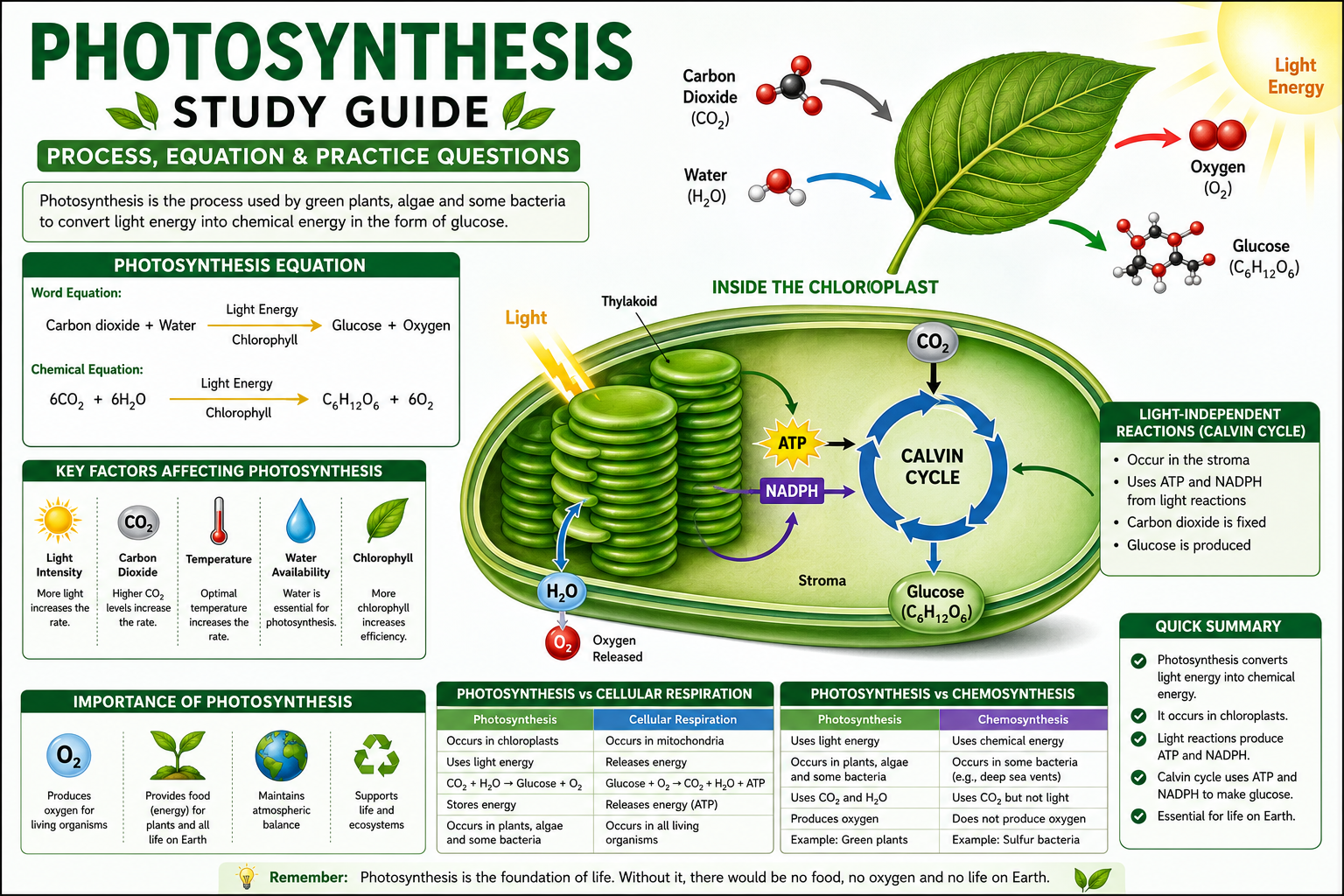
Introduction
Here’s something worth pausing on for a moment. Right now, while you’re reading this, plants are doing something that no human technology has been able to fully replicate—capturing light from a star 93 million miles away and using it to build sugar molecules from thin air. Not metaphorically. Literally from air. That process is photosynthesis, and it underpins essentially all life on Earth.
This photosynthesis study guide is designed to take you from a basic understanding all the way through the detailed biochemistry—step by step, in a way that actually makes sense. Whether you’re tackling AP Biology, preparing for A-levels, studying for a medical entrance exam, or simply trying to get a solid handle on one of biology’s most important topics, this guide gives you everything you need in one place.
Photosynthesis is one of those topics where students either love it or dread it. The ones who dread it usually do so for the same reason—they’ve been handed equations and diagrams without any sense of the underlying logic. Once you understand why photosynthesis has two stages, why light energy is captured in two separate photosystems, and why the Calvin cycle needs ATP and NADPH rather than light directly, the whole thing starts to feel elegant rather than overwhelming.
That’s exactly what this guide is built to do. We’ll work through the full photosynthesis process step by step, cover the equation in both word and chemical form, explore the factors that affect photosynthesis rates, compare C3, C4, and CAM plants, and tie everything back to why it matters—for ecosystems, agriculture, climate, and your next exam.
Let’s get into it. The sun’s already doing its part—time for you to do yours.
Key Takeaways
By the end of this guide, you’ll be able to:
- Define photosynthesis and explain its global significance
- Identify the structures within the chloroplast where each stage of photosynthesis occurs
- Write and interpret both the word equation and balanced chemical equation for photosynthesis
- Describe the light-dependent reactions and the Calvin cycle in sequence
- Explain how ATP and NADPH are produced and used in photosynthesis
- Identify and explain five factors that affect the rate of photosynthesis
- Compare C3, C4, and CAM plants and explain why these differences matter
- Distinguish photosynthesis from cellular respiration and chemosynthesis
- Avoid the most common exam mistakes in photosynthesis questions
What Is Photosynthesis?
Photosynthesis is the biological process by which plants, algae, and certain bacteria convert light energy—usually from the sun—into chemical energy stored in glucose. The word itself comes from Greek: photo (light) and synthesis (putting together). So at its most literal, photosynthesis means “putting together using light.”
In slightly more scientific terms: photosynthesis is the process of using light energy to drive the synthesis of organic compounds from inorganic raw materials—specifically carbon dioxide (CO₂) and water (H₂O). The process releases oxygen as a byproduct—the very oxygen that aerobic organisms, including humans, depend on for survival.
There’s an important distinction worth making early on. Photosynthesis is performed by photoautotrophs—organisms that can make their own food using light. This group includes:
- All land plants (from mosses to giant sequoias)
- Algae (from microscopic phytoplankton to giant kelp)
- Cyanobacteria (photosynthetic prokaryotes)
- Some other photosynthetic bacteria
Heterotrophs—animals, fungi, most bacteria—cannot photosynthesize. They depend, directly or indirectly, on photoautotrophs for their energy.
What makes photosynthesis so remarkable from a chemistry standpoint is that it’s an endergonic process—it requires an input of energy to proceed. The light energy absorbed by chlorophyll is what drives reactions that would otherwise be thermodynamically unfavorable. Light energy is converted first into chemical energy in the form of ATP and NADPH, and then used to build glucose—a stable, energy-rich organic molecule that can be stored, transported, and used later.
Why Is Photosynthesis Important?
Understanding why photosynthesis matters goes far beyond answering a test question. It’s genuinely one of the most consequential processes occurring on this planet.
Oxygen Production
Every molecule of oxygen in Earth’s atmosphere was produced by photosynthesis. Before photosynthetic life evolved—about 2.7 billion years ago with cyanobacteria—Earth’s atmosphere contained essentially no free oxygen. The Great Oxidation Event, driven by cyanobacterial photosynthesis, transformed our planet and made aerobic life possible. The oxygen you’re breathing right now is a photosynthetic byproduct.
Energy for Ecosystems
Photosynthesis is the primary entry point of energy into almost every ecosystem on Earth. Glucose produced by plants becomes the energy source for herbivores, which in turn become energy sources for carnivores. This flow of energy—captured originally from sunlight—is what powers virtually all food chains on land and in most aquatic environments.
Carbon Cycling and Climate
Plants absorb CO₂ during photosynthesis and store carbon in their tissues. This biological carbon sequestration is a critical part of the global carbon cycle. Deforestation disrupts this process, releasing stored carbon and contributing to atmospheric CO₂ increases and climate change.
Agriculture and Food Security
All the crops that feed humanity depend on photosynthesis. Understanding the factors that limit photosynthesis—CO₂ concentration, light availability, water stress, temperature—is directly applicable to improving agricultural yield and developing crops that perform well under changing climate conditions.
Medicine and Biotechnology
Plant-derived pharmaceuticals, biofuels, and industrial compounds all trace back to molecules synthesized through photosynthesis. Research into artificial photosynthesis—engineering systems that replicate the efficiency of the natural process—holds promise for sustainable energy production.
History of Photosynthesis Discovery
The scientific understanding of photosynthesis developed gradually over more than three centuries. Each discovery built on the last, and the story is full of clever experiments.
Jan Baptist van Helmont (1648)
Van Helmont planted a willow sapling in a pot of soil, carefully weighing both. Over five years, the tree gained 164 pounds while the soil lost almost nothing. He concluded that plants gain their mass from water—not quite right, but he correctly ruled out soil and opened the question of where plant mass comes from.
Joseph Priestley (1771)
Priestley discovered that a sprig of mint could “restore” air that had been “depleted” by a burning candle. He didn’t fully understand what he’d found, but he had essentially discovered that plants produce oxygen.
Jan Ingenhousz (1779)
Ingenhousz refined Priestley’s work crucially—he showed that plants only restore air (produce oxygen) in the light, not in darkness. He had identified the light requirement of photosynthesis, even without knowing the biochemistry.
Nicolas-Théodore de Saussure (1804)
De Saussure demonstrated that plants absorb CO₂ and that water is also a raw material—establishing that both are inputs to the process.
Julius von Sachs (1862)
Sachs demonstrated that starch is produced in chloroplasts during photosynthesis, confirming that the chloroplast is the site of the process.
C. B. van Niel (1930s)
Van Niel studied purple sulfur bacteria that use H₂S instead of water in a photosynthesis-like process, releasing sulfur instead of oxygen. His insight was crucial: water is split during photosynthesis, and the oxygen released comes from water—not from CO₂.
Melvin Calvin, Andrew Benson, and James Bassham (1950s)
Using radioactive carbon-14 as a tracer, this team traced the path of carbon through the light-independent reactions, elucidating what became known as the Calvin cycle. Calvin received the Nobel Prize in Chemistry in 1961.
Where Does Photosynthesis Occur?
Chloroplast
Photosynthesis in plant cells occurs in chloroplasts—specialized organelles found primarily in leaf cells, though they’re also present in stems and other green tissues. Chloroplasts are generally oval-shaped, approximately 5–10 micrometers long, and a single mesophyll cell in a leaf may contain 30–40 of them.
Like mitochondria, chloroplasts have two surrounding membranes and contain their own DNA and ribosomes—strong evidence that they evolved from ancient photosynthetic bacteria (specifically cyanobacteria) that were engulfed by early eukaryotic cells, a process called endosymbiosis.
The chloroplast has three distinct compartments, each housing different stages of photosynthesis:
- Intermembrane space – Between the outer and inner membranes
- Thylakoid system – An elaborate internal membrane network where light reactions occur
- Stroma – The fluid-filled space surrounding the thylakoids where the Calvin cycle takes place
Chlorophyll
Chlorophyll is the primary photosynthetic pigment in plants and is responsible for capturing light energy. It’s a complex molecule with a porphyrin ring at its center containing a magnesium atom—and that magnesium is why plants need magnesium as a nutrient.
Chlorophyll absorbs light most strongly in the red (~680 nm) and blue (~450 nm) regions of the visible spectrum. It reflects green light—which is why we perceive plants as green.
There are two main types in plants:
- Chlorophyll a – The primary reaction center pigment; directly involved in light reactions
- Chlorophyll b – An accessory pigment that absorbs slightly different wavelengths and passes energy to chlorophyll a
Plants also contain carotenoids (yellow/orange pigments) and xanthophylls, which absorb wavelengths chlorophyll misses and also protect the chloroplast from damage by excess light.
Thylakoids
Thylakoids are flattened, disc-shaped membrane sacs inside the chloroplast. They’re stacked into columns called grana (singular: granum), and the grana are interconnected by membrane channels called stroma lamellae.
The thylakoid membranes are densely packed with:
- Photosystems I and II (complexes of chlorophyll and associated proteins)
- Electron transport chain proteins
- ATP synthase
The thylakoid membrane is where the light-dependent reactions of photosynthesis take place—all the events involving actual light capture, water splitting, electron transport, and ATP synthesis happen here.
Stroma
The stroma is the fluid-filled matrix surrounding the thylakoid system inside the chloroplast. It contains:
- Enzymes for the Calvin cycle (including RuBisCO—the most abundant enzyme on Earth)
- Chloroplast DNA and ribosomes
- Starch granules (when the plant has excess glucose)
The Calvin cycle—the light-independent reactions—takes place in the stroma, using the ATP and NADPH produced by the light reactions in the thylakoids.
Photosynthesis Equation
Word Equation
Carbon dioxide + Water + Light Energy → Glucose + Oxygen
This is the simplest, most accessible way to express photosynthesis. Commit this to memory first—it encapsulates the inputs, the energy source, and both outputs.
Chemical Equation
6CO₂ + 6H₂O + Light Energy → C₆H₁₂O₆ + 6O₂Let’s unpack what this is really saying:
- 6CO₂ – Six molecules of carbon dioxide (from the air, entering through stomata)
- 6H₂O – Six molecules of water (absorbed through roots)
- Light Energy – Electromagnetic radiation, primarily from the sun
- C₆H₁₂O₆ – One molecule of glucose (the primary product, stored energy)
- 6O₂ – Six molecules of oxygen (released as a byproduct)
Reactants
| Reactant | Source | How It Enters |
|---|---|---|
| Carbon dioxide (CO₂) | Atmosphere | Diffuses through stomata in leaves |
| Water (H₂O) | Soil | Absorbed by roots; transported via xylem |
| Light energy | Sun (primarily) | Absorbed by chlorophyll in thylakoids |
Products
| Product | What It Is | What Happens to It |
|---|---|---|
| Glucose (C₆H₁₂O₆) | Simple sugar, primary product | Used for energy, stored as starch, used to build cellulose, sucrose, amino acids |
| Oxygen (O₂) | Byproduct of water splitting | Released through stomata into atmosphere |
Important Fact: The oxygen released during photosynthesis comes entirely from the splitting of water molecules—not from CO₂. This was confirmed by van Niel’s work and later verified using isotopic labeling. If you use water labeled with heavy oxygen (¹⁸O), the labeled oxygen appears in the O₂ released, not in the glucose.
Photosynthesis Process Explained
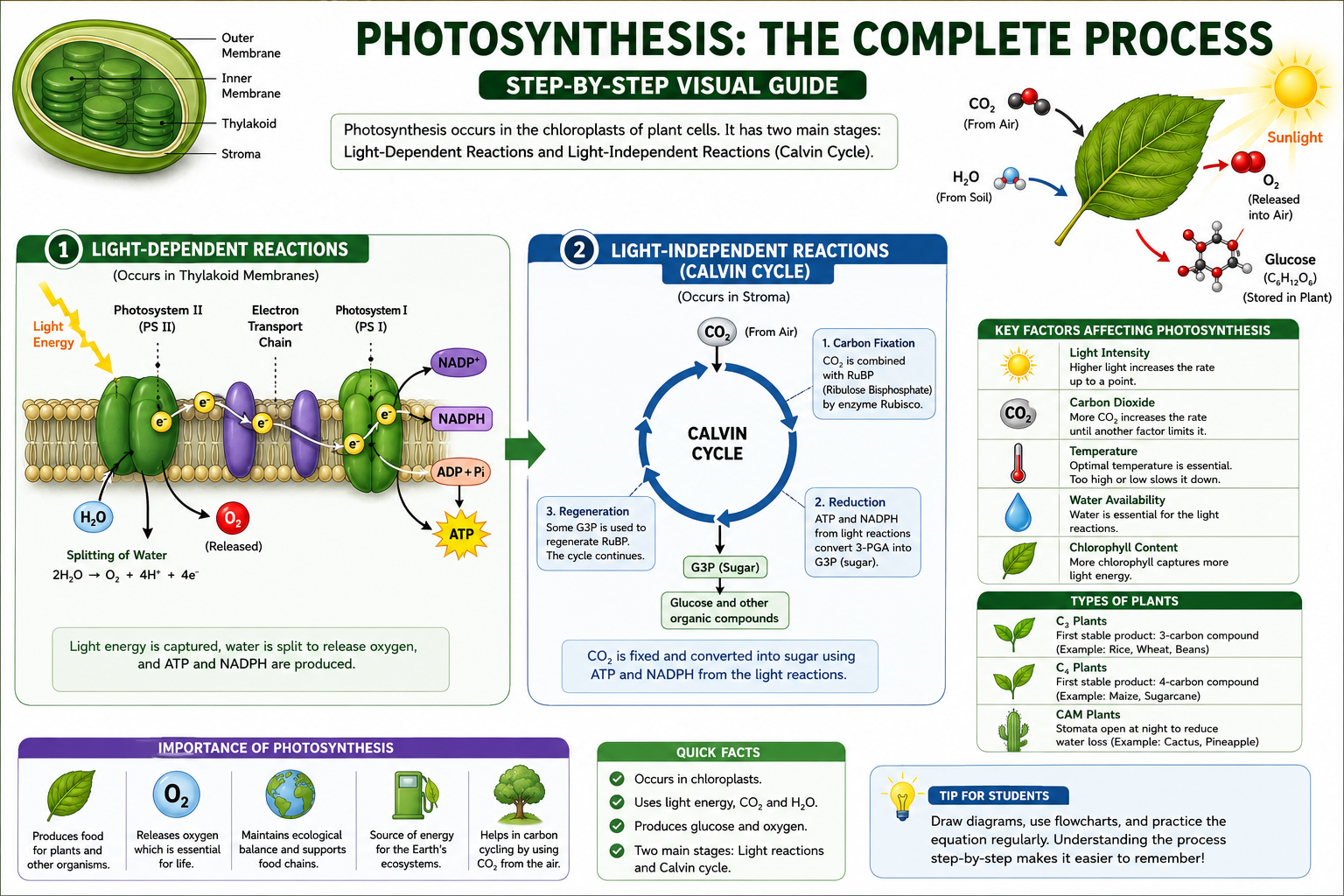
Photosynthesis is not a single reaction—it’s a series of coordinated reactions that occur in two distinct stages, linked by the molecules they pass between them.
Light-Dependent Reactions
The light-dependent reactions (also called the light reactions) take place in the thylakoid membranes. As the name suggests, these reactions directly require light. Their purpose is to capture light energy and convert it into chemical energy in the form of ATP and NADPH—the energy carriers that fuel the Calvin cycle.
Here’s what happens, in order:
Step 1: Light absorption by Photosystem II (PSII)
Light energy is absorbed by chlorophyll molecules in Photosystem II. The energy excites electrons in chlorophyll, boosting them to a higher energy state.
Step 2: Water splitting (photolysis)
To replace the electrons lost from PSII, water molecules are split:
2H₂O → 4H⁺ + 4e⁻ + O₂This is where the oxygen we breathe comes from. The H⁺ ions (protons) accumulate in the thylakoid lumen; the electrons replace those lost from PSII.
Step 3: Electron transport chain
The energized electrons from PSII pass through a series of electron carrier proteins (plastoquinone, cytochrome b₆f complex, plastocyanin), losing energy as they go. This energy is used to actively pump H⁺ ions from the stroma into the thylakoid lumen, building up a proton gradient.
Step 4: ATP synthesis (chemiosmosis)
The concentration of H⁺ ions in the thylakoid lumen becomes very high. These protons flow back out through ATP synthase (embedded in the thylakoid membrane), and the energy of this flow drives the synthesis of ATP from ADP + phosphate. This process is called chemiosmosis—the same mechanism used by mitochondria to produce ATP in cellular respiration.
Step 5: Light absorption by Photosystem I (PSI)
Electrons arriving from PSII reach Photosystem I, where they’re re-energized by absorbing more light energy.
Step 6: NADPH formation
The re-energized electrons from PSI are passed to NADP⁺, reducing it to NADPH (via the enzyme ferredoxin-NADP⁺ reductase). NADPH is the second energy carrier produced by the light reactions.
Outputs of the light-dependent reactions:
- ATP
- NADPH
- O₂ (released into atmosphere)
Calvin Cycle (Light-Independent Reactions)
The Calvin cycle takes place in the stroma of the chloroplast. It uses the ATP and NADPH produced by the light reactions to fix carbon dioxide into glucose. The cycle is called “light-independent” because it doesn’t directly use light—but it absolutely depends on the products of the light reactions and would stop immediately if light were removed.
The cycle was worked out by Melvin Calvin and his colleagues in the 1950s and is also called the C3 cycle or the dark reactions (though the latter term is misleading—the cycle works just as well in light as in darkness).
Three stages of the Calvin cycle:
Stage 1: Carbon Fixation
CO₂ from the atmosphere is attached to a 5-carbon molecule called RuBP (ribulose-1,5-bisphosphate) by the enzyme RuBisCO (ribulose bisphosphate carboxylase/oxygenase). The resulting 6-carbon compound is highly unstable and immediately splits into two molecules of 3-PGA (3-phosphoglycerate)—a 3-carbon compound.
Stage 2: Reduction
Each 3-PGA is phosphorylated using ATP and then reduced using NADPH to produce G3P (glyceraldehyde-3-phosphate). G3P is a 3-carbon sugar—the first stable organic product of photosynthesis. Some G3P molecules exit the cycle to be used for glucose synthesis.
Stage 3: Regeneration of RuBP
Most G3P molecules (5 out of every 6 produced) are used to regenerate RuBP using additional ATP. This keeps the cycle running continuously.
For every 3 CO₂ molecules fixed:
- 6 G3P produced; 1 net G3P available for glucose synthesis
- 9 ATP consumed
- 6 NADPH consumed
Two turns of the cycle = one glucose molecule (6 carbons)
ATP Production
ATP (adenosine triphosphate) is produced during the light-dependent reactions via chemiosmosis through ATP synthase. For every glucose molecule eventually synthesized, the Calvin cycle consumes 18 ATP and 12 NADPH. This is why the light reactions need to produce substantial amounts of these energy carriers.
NADPH Formation
NADPH is produced at Photosystem I when electrons reduce NADP⁺. It serves as the primary reducing agent in the Calvin cycle, providing the electrons needed to reduce 3-PGA to G3P. Without NADPH, carbon fixation could not proceed to produce glucose.
Factors Affecting Photosynthesis
The rate of photosynthesis is not constant—it fluctuates based on environmental conditions. Understanding limiting factors is essential for exam success and has practical applications in agriculture and horticulture. A limiting factor is any condition whose increase or decrease directly affects the rate of photosynthesis when all other conditions are held constant.
Light Intensity
Light provides the energy for the light-dependent reactions. As light intensity increases from zero, photosynthesis rate increases proportionally—more photons mean more electron excitation, more ATP and NADPH produced, more Calvin cycles running.
However, this relationship doesn’t continue indefinitely. At a certain point, the rate plateaus—the light saturation point—beyond which increased light intensity has no further effect because other factors (CO₂ concentration, enzyme capacity) become limiting.
At very high light intensities, photoinhibition can occur—the photosynthetic machinery is damaged by excess light energy. Carotenoid pigments help dissipate excess light energy to protect chloroplasts from this damage.
Practical application: Greenhouses use supplemental lighting to extend the productive photoperiod for crops. The light compensation point (where photosynthesis rate equals respiration rate) varies between plant species—shade plants have lower compensation points than sun plants.
Carbon Dioxide
CO₂ is the carbon source for the Calvin cycle. At typical atmospheric concentrations (~0.04% or 400 ppm), CO₂ is often a limiting factor for photosynthesis. Increasing CO₂ concentration generally increases photosynthesis rate—up to a point.
This is why:
- Greenhouse growers sometimes enrich greenhouse air with CO₂ to boost plant growth
- There’s concern that rising atmospheric CO₂ from fossil fuel burning may initially stimulate plant growth in some regions (a phenomenon sometimes called CO₂ fertilization), though other stresses complicate this
RuBisCO’s affinity for CO₂ is also relevant here. At low CO₂ concentrations, RuBisCO can accidentally bind O₂ instead, initiating photorespiration—a wasteful process that reduces photosynthetic efficiency. C4 and CAM plants evolved mechanisms to minimize this problem.
Temperature
Photosynthesis involves enzyme-catalyzed reactions, particularly in the Calvin cycle. Like all enzyme-mediated reactions, photosynthesis has an optimal temperature range—typically between 25–35°C for most plants.
- Below optimum: Enzyme activity slows; reaction rates decrease
- At optimum: Maximum photosynthesis rate
- Above optimum: Enzymes begin to denature; rate drops sharply; stomata may also close to prevent water loss, reducing CO₂ entry
The light reactions are less temperature-sensitive (they’re physical/electrochemical events), but the Calvin cycle enzymes are highly temperature-dependent.
Water Availability
Water is a direct reactant in photosynthesis—it’s split in the light reactions to provide electrons. More critically, water stress causes plants to close their stomata to prevent dehydration. Closed stomata prevent CO₂ from entering, which rapidly limits the Calvin cycle.
This is why drought so dramatically reduces crop yields—it’s not just that the plant lacks water as a reactant, but that stomatal closure starves the plant of CO₂.
Chlorophyll
Without chlorophyll, there are no light reactions. The amount and condition of chlorophyll in leaves directly determines how much light energy can be captured. Factors that reduce chlorophyll content—nutrient deficiency (especially nitrogen and magnesium, both required for chlorophyll synthesis), disease, aging, and heavy metal toxicity—all reduce photosynthesis rates.
The yellowing of leaves (chlorosis) due to nitrogen or magnesium deficiency is a direct symptom of chlorophyll degradation and reduced photosynthetic capacity.
Photosynthesis vs Cellular Respiration
These two processes are frequently compared because they’re essentially opposite reactions—and because students often confuse details between them on exams.
| Feature | Photosynthesis | Cellular Respiration |
|---|---|---|
| Overall direction | Builds organic molecules from inorganic | Breaks down organic molecules |
| Energy type | Endergonic (requires energy input) | Exergonic (releases energy) |
| Energy source | Light | Chemical energy in glucose |
| Location | Chloroplasts (plants) | Mitochondria (all eukaryotes) |
| Raw materials | CO₂ and H₂O | Glucose and O₂ |
| Products | Glucose and O₂ | CO₂, H₂O, and ATP |
| Oxygen | Produced (released) | Consumed |
| CO₂ | Consumed (fixed) | Produced (released) |
| ATP | Produced (during light reactions) | Produced (primary purpose) |
| Occurs in | Plants, algae, some bacteria | All living cells |
| When | Only in light | Continuously, day and night |
The two processes are complementary and interconnected. Glucose produced by photosynthesis is the fuel for cellular respiration. The CO₂ released by respiration is used in photosynthesis. The oxygen released by photosynthesis is used in aerobic respiration. In plants, both processes occur simultaneously during daylight hours.
Photosynthesis vs Chemosynthesis
Chemosynthesis is a less well-known but important process occurring in certain bacteria in environments without sunlight.
| Feature | Photosynthesis | Chemosynthesis |
|---|---|---|
| Energy source | Sunlight | Chemical energy (from inorganic compounds) |
| Organisms | Plants, algae, cyanobacteria | Certain bacteria and archaea |
| Where it occurs | Sunlit environments | Deep sea vents, sulfur springs, cave systems |
| Common examples | All green plants | Sulfur bacteria (Thiobacillus), iron bacteria |
| Chemical used | Water (H₂O) | H₂S, Fe²⁺, NH₄⁺, etc. |
| Product | Glucose + O₂ | Organic compounds (no O₂ necessarily) |
| Ecological role | Primary producers in terrestrial/aquatic ecosystems | Primary producers in aphotic (lightless) zones |
Chemosynthesis supports entire ecosystems at deep-sea hydrothermal vents—communities of tube worms, crabs, mussels, and other organisms that never receive sunlight and depend entirely on chemosynthetic bacteria as their primary producers.
Stages of Photosynthesis (Step-by-Step)
Here’s a consolidated step-by-step reference showing the complete photosynthesis process from start to finish:
| Step | Stage | Location | What Happens |
|---|---|---|---|
| 1 | Light absorption | Thylakoid membrane (PSII) | Chlorophyll absorbs light; electrons excited |
| 2 | Water splitting | Thylakoid lumen | 2H₂O → 4H⁺ + 4e⁻ + O₂; O₂ released |
| 3 | Electron transport | Thylakoid membrane | Electrons pass through chain; H⁺ pumped into lumen |
| 4 | ATP synthesis | Thylakoid membrane (ATP synthase) | H⁺ flows through ATP synthase; ATP produced |
| 5 | Re-energizing at PSI | Thylakoid membrane (PSI) | Electrons re-excited by second light absorption |
| 6 | NADPH formation | Thylakoid membrane | NADP⁺ + 2e⁻ + H⁺ → NADPH |
| 7 | Carbon fixation | Stroma | CO₂ + RuBP → 2× 3-PGA (by RuBisCO) |
| 8 | Reduction | Stroma | 3-PGA → G3P (using ATP and NADPH) |
| 9 | RuBP regeneration | Stroma | 5 G3P → RuBP (using ATP) |
| 10 | Glucose synthesis | Cytoplasm | 2 G3P → glucose (and other carbohydrates) |
Importance of Photosynthesis in Nature
Beyond individual organisms, photosynthesis operates at planetary scale.
Primary Production
In ecology, photosynthesis is responsible for essentially all primary production—the conversion of inorganic matter into organic matter at the base of food chains. The total amount of carbon fixed by photosynthesis globally is approximately 120 billion metric tons per year. Without this continuous input of organic carbon into ecosystems, food webs would collapse.
Oxygen Maintenance
Earth’s atmospheric oxygen—approximately 21%—is maintained by the balance between photosynthetic oxygen production and oxygen consumption through respiration and combustion. Photosynthetic organisms continuously replenish what aerobic organisms consume.
Carbon Sequestration
Forests, grasslands, and marine phytoplankton absorb massive quantities of CO₂ annually, playing a critical role in moderating greenhouse gas concentrations. Phytoplankton alone account for approximately half of Earth’s primary production and photosynthetic oxygen output.
Soil Formation and Nutrient Cycling
Plant material produced through photosynthesis becomes the organic matter in soils when plants die and decompose. This organic material is essential for soil fertility and supports diverse microbial communities that drive nutrient cycling.
Photosynthesis in Different Plants
Not all plants photosynthesize in exactly the same way. Three distinct photosynthetic pathways have evolved, each representing an adaptation to different environmental conditions.
C3 Plants
C3 plants are named for the 3-carbon compound (3-PGA) that is the first stable product of carbon fixation by RuBisCO. This is the most common photosynthetic pathway, used by approximately 85% of plant species.
Characteristics:
- Carbon fixation occurs directly in mesophyll cells
- RuBisCO operates normally in these cells
- Stomata open during the day, allowing CO₂ entry
- Susceptible to photorespiration when CO₂ is low and O₂ is high
Examples: Wheat, rice, soybeans, most trees, spinach
Problem: In hot, bright conditions, CO₂ inside leaves becomes depleted (stomata close to prevent water loss), and RuBisCO begins binding O₂ instead of CO₂, leading to photorespiration—a wasteful process that reduces photosynthetic efficiency by up to 25–50%.
C4 Plants
C4 plants evolved a biochemical solution to the photorespiration problem. They essentially “pre-concentrate” CO₂ before it reaches RuBisCO, keeping RuBisCO in a high-CO₂ environment where it can’t bind O₂.
How it works:
- CO₂ is first fixed in mesophyll cells by the enzyme PEP carboxylase (which has no affinity for O₂) into a 4-carbon compound (oxaloacetate → malate or aspartate)
- The 4-carbon compound is transported to bundle sheath cells surrounding the vascular bundles
- CO₂ is released in bundle sheath cells, where RuBisCO operates in a high-CO₂ environment—minimizing photorespiration
- The Calvin cycle proceeds normally in bundle sheath cells
This spatial separation of initial carbon fixation from the Calvin cycle is called Kranz anatomy.
Characteristics:
- Highly efficient in hot, sunny, low-humidity conditions
- Minimal photorespiration
- More efficient water use
Examples: Corn (maize), sugarcane, sorghum, millet
Significance: C4 crops like corn and sugarcane are among the highest-yielding crops in the world precisely because of this photosynthetic efficiency.
CAM Plants
CAM (Crassulacean Acid Metabolism) plants took a different approach to solving the water-loss/CO₂-uptake dilemma—they separated carbon fixation and the Calvin cycle in time rather than space.
How it works:
- At night, stomata open and CO₂ is fixed by PEP carboxylase into 4-carbon acids (malate), which are stored in vacuoles
- During the day, stomata remain closed (minimizing water loss)
- Stored malate is released and decarboxylated, releasing CO₂ for RuBisCO and the Calvin cycle in the same cells
Characteristics:
- Stomata open at night; closed during the day
- Extreme water use efficiency
- Slower growth than C3 or C4 plants
- Ideal for hot, arid environments
Examples: Cacti, agave, pineapple, jade plants, most succulents
Comparison Table:
| Feature | C3 Plants | C4 Plants | CAM Plants |
|---|---|---|---|
| First product of CO₂ fixation | 3-PGA (3-carbon) | Oxaloacetate (4-carbon) | Oxaloacetate (4-carbon) |
| Enzyme fixing CO₂ | RuBisCO | PEP carboxylase (initial) | PEP carboxylase (initial) |
| Where | Mesophyll cells | Mesophyll + bundle sheath | Same cells, different times |
| Photorespiration | Significant | Minimal | Minimal |
| Stomata pattern | Open day, closed night | Open day | Open night, closed day |
| Water efficiency | Low | Medium | Very high |
| Best environment | Temperate, moist | Hot, sunny | Hot, dry |
| Examples | Wheat, rice, soybeans | Corn, sugarcane | Cacti, agave, pineapple |
Photosynthesis in Everyday Life
Photosynthesis isn’t an abstract biological process confined to textbooks. It affects your life directly every single day.
The food on your plate: Every meal you eat ultimately came from photosynthesis. The bread, the vegetables, the rice, the fruit—all are direct products. Even meat comes from animals fed on photosynthetic plants.
The air you breathe: Every breath you take benefits from photosynthesis. The atmospheric oxygen that makes aerobic life possible is produced and continuously replenished by photosynthetic organisms.
Paper and wood products: Every piece of paper, every wooden piece of furniture, every cotton garment—all built from cellulose produced through photosynthesis.
Fossil fuels: Coal, oil, and natural gas are the remains of ancient organisms whose organic matter originated in photosynthesis hundreds of millions of years ago. Burning fossil fuels is essentially releasing stored photosynthetic energy—and the CO₂ captured millions of years ago.
Medicines and pharmaceuticals: Aspirin (originally from willow bark), morphine (opium poppy), taxol (Pacific yew), and hundreds of other pharmaceuticals are plant-synthesized compounds that began as photosynthetic products.
Biofuels: Ethanol from corn and sugarcane, biodiesel from soya and palm oil—all are photosynthetic products being explored as fossil fuel alternatives.
Climate regulation: As forests grow and photosynthesize, they absorb CO₂ from the atmosphere. Protecting forests isn’t just about biodiversity—it’s about maintaining Earth’s ability to regulate its own carbon balance.
Common Photosynthesis Terms Every Student Should Know
| Term | Definition |
|---|---|
| Photosynthesis | Process of converting light energy into chemical energy stored in glucose |
| Chloroplast | Organelle where photosynthesis occurs |
| Chlorophyll | Green photosynthetic pigment that absorbs light energy |
| Thylakoid | Flattened membrane sac in chloroplast where light reactions occur |
| Grana | Stacks of thylakoids within the chloroplast |
| Stroma | Fluid-filled space in chloroplast where the Calvin cycle occurs |
| Photosystem | Complex of chlorophyll and proteins that captures light energy |
| Photolysis | Splitting of water molecules using light energy |
| ATP | Adenosine triphosphate; the cell’s primary energy currency |
| NADPH | Nicotinamide adenine dinucleotide phosphate; electron carrier produced in light reactions |
| RuBisCO | Enzyme that fixes CO₂ in the Calvin cycle; most abundant enzyme on Earth |
| RuBP | Ribulose bisphosphate; the 5-carbon CO₂ acceptor in the Calvin cycle |
| 3-PGA | 3-phosphoglycerate; first stable product of carbon fixation |
| G3P | Glyceraldehyde-3-phosphate; the 3-carbon sugar produced in the Calvin cycle |
| Photorespiration | Wasteful process where RuBisCO binds O₂ instead of CO₂ |
| Chemiosmosis | ATP synthesis driven by proton gradient across a membrane |
| Limiting factor | Any variable that directly limits the rate of photosynthesis |
| Compensation point | Light intensity where photosynthesis rate equals respiration rate |
| Kranz anatomy | Specialized leaf anatomy in C4 plants with distinct mesophyll and bundle sheath cells |
| Carotenoids | Accessory photosynthetic pigments that absorb blue-green light |
Common Mistakes Students Make
Here are the errors that come up most consistently in photosynthesis answers—learn from them now.
1. Saying the oxygen in photosynthesis comes from CO₂
This is one of the most persistent misconceptions in biology. The oxygen released during photosynthesis comes from the splitting of water (photolysis)—not from CO₂. Van Niel’s work and isotopic tracer experiments confirmed this definitively.
2. Describing the Calvin cycle as occurring “in the dark”
The Calvin cycle is sometimes called the “dark reactions,” but this term is deeply misleading. The Calvin cycle occurs in the stroma and can proceed in both light and darkness—as long as ATP and NADPH are available. In practice, because ATP and NADPH come from the light reactions, the Calvin cycle effectively depends on light. Saying it “happens at night” is simply wrong.
3. Confusing the locations of the two stages
Light reactions → thylakoid membranes. Calvin cycle → stroma. This is a guaranteed exam question. Get it backwards and marks disappear.
4. Writing an unbalanced chemical equation
The balanced equation is: 6CO₂ + 6H₂O → C₆H₁₂O₆ + 6O₂. Students often forget the coefficients. Count the atoms on both sides—they must balance.
5. Saying photosynthesis produces ATP for the whole plant to use
The ATP produced during the light reactions is used within the chloroplast to power the Calvin cycle. It is not exported to the rest of the cell. The glucose produced by photosynthesis is what gets used throughout the plant for energy (via cellular respiration) and for building other compounds.
6. Assuming all plants photosynthesize the same way
Forgetting C3/C4/CAM differences is costly on higher-level exams. Know the differences, the environments each is adapted to, and at least two examples of each type.
Best Tips to Study Photosynthesis
1. Learn the two-stage structure first, then the details
Before you memorize any specific molecules, make sure you understand the big picture: Stage 1 (light reactions, thylakoids) captures light energy and produces ATP and NADPH. Stage 2 (Calvin cycle, stroma) uses ATP and NADPH to fix CO₂ into glucose. Everything else is detail hanging on that framework.
2. Draw the chloroplast diagram repeatedly
Label the outer membrane, inner membrane, thylakoid, grana, and stroma every time you draw it. Then add arrows showing where each stage of photosynthesis occurs. Drawing from memory is far more effective than copying a diagram from a textbook.
3. Trace the atoms
Follow a single carbon atom from CO₂ in the air all the way through to glucose. Follow an oxygen atom from water all the way to O₂ being released. This active tracing exercise forces you to understand the process rather than just memorize it.
4. Use the “currency” analogy for ATP and NADPH
Think of ATP as energy currency (like cash) and NADPH as a package of electrons (like a gift card). The light reactions are the “earning” phase—you collect ATP and NADPH. The Calvin cycle is the “spending” phase—you use them to build glucose. This analogy makes the relationship between the two stages much more intuitive.
5. Make a C3/C4/CAM comparison table yourself
After reading the section, close your notes and construct the comparison table from memory. This single exercise consistently separates students who can answer application questions from those who can only recall definitions.
6. Connect limiting factors to real-world scenarios
When you study each limiting factor, think of a real-world application: CO₂ enrichment in greenhouses, supplemental lighting for crops, choosing C4 crops for hot climates, drought’s effect on stomatal closure. Real-world connections make abstract factors memorable.
Photosynthesis Practice Questions
20 Multiple Choice Questions with Answers
- Where do the light-dependent reactions of photosynthesis occur?
- A) Stroma
- B) Thylakoid membrane ✓
- C) Cytoplasm
- D) Outer chloroplast membrane
- What is the source of oxygen released during photosynthesis?
- A) Carbon dioxide
- B) Glucose
- C) Water ✓
- D) NADPH
- Which enzyme catalyzes carbon fixation in the Calvin cycle?
- A) ATP synthase
- B) PEP carboxylase
- C) RuBisCO ✓
- D) Ferredoxin
- What is the first stable product of carbon fixation in C3 plants?
- A) G3P
- B) RuBP
- C) Glucose
- D) 3-PGA ✓
- Which pigment absorbs most light energy in the light-dependent reactions?
- A) Carotenoids
- B) Xanthophyll
- C) Chlorophyll ✓
- D) Anthocyanin
- CAM plants open their stomata:
- A) During the day only
- B) At night only ✓
- C) Continuously
- D) Only when well-watered
- The Calvin cycle uses which two energy-carrying molecules produced by light reactions?
- A) ADP and NADP⁺
- B) ATP and NADPH ✓
- C) AMP and FAD
- D) FADH₂ and NADH
- In C4 plants, initial carbon fixation occurs in:
- A) Bundle sheath cells
- B) Epidermal cells
- C) Mesophyll cells ✓
- D) Guard cells
- Which of the following is a limiting factor of photosynthesis?
- A) Oxygen concentration
- B) Nitrogen concentration
- C) CO₂ concentration ✓
- D) Glucose concentration
- What process produces ATP during the light reactions?
- A) Photolysis
- B) Carbon fixation
- C) Chemiosmosis ✓
- D) Photorespiration
- How many CO₂ molecules are needed to produce one molecule of glucose?
- A) 3
- B) 4
- C) 6 ✓
- D) 12
- Which plant type is most water-efficient?
- A) C3 plants
- B) C4 plants
- C) CAM plants ✓
- D) All use water equally
- Photorespiration is most significant in:
- A) C4 plants
- B) CAM plants
- C) C3 plants in hot, bright conditions ✓
- D) Cyanobacteria
- The stroma of the chloroplast is the site of:
- A) Light-dependent reactions
- B) Water splitting
- C) ATP synthase activity
- D) The Calvin cycle ✓
- Which of the following is NOT a product of photosynthesis?
- A) Glucose
- B) Oxygen
- C) Carbon dioxide ✓
- D) ATP (transiently)
- Chlorophyll reflects which wavelength, making plants appear green?
- A) Red light
- B) Blue light
- C) Green light ✓
- D) Ultraviolet light
- At very high light intensities, photosynthesis rate stops increasing because:
- A) Chlorophyll is destroyed
- B) The plant runs out of water
- C) Another factor becomes limiting ✓
- D) Oxygen inhibits the light reactions
- The splitting of water in the light reactions is called:
- A) Hydrolysis
- B) Photolysis ✓
- C) Electrolysis
- D) Osmosis
- Which molecule is the CO₂ acceptor in the Calvin cycle?
- A) G3P
- B) 3-PGA
- C) ATP
- D) RuBP ✓
- Which crop is an example of a C4 plant?
- A) Wheat
- B) Rice
- C) Corn ✓
- D) Soybean
10 Short Answer Questions
- Explain why the oxygen released during photosynthesis comes from water rather than CO₂. What experimental evidence supports this?
- Describe what happens to an electron from Photosystem II as it passes through the electron transport chain. What energy transformation occurs?
- A plant is kept in bright light but given no CO₂. Explain what will happen to the light reactions and the Calvin cycle.
- Explain the concept of a limiting factor in photosynthesis. Give three examples and explain how each limits the rate.
- Why do C4 plants have an advantage over C3 plants in hot, sunny conditions? Describe the mechanism that provides this advantage.
- Describe the three stages of the Calvin cycle. For each stage, name the key reactants, products, and energy inputs.
- Compare the absorption spectra of chlorophyll a and chlorophyll b. Why is it advantageous for plants to have multiple photosynthetic pigments?
- Explain what happens to the rate of photosynthesis when temperature rises above the optimum. Why does this occur at the molecular level?
- Describe how ATP is produced during the light-dependent reactions. Include the role of the proton gradient and ATP synthase.
- Explain why CAM plants grow more slowly than C3 or C4 plants, despite their superior water efficiency.
5 Long Answer Questions
- Describe the light-dependent reactions of photosynthesis in detail. In your answer, explain the roles of Photosystems I and II, the electron transport chain, photolysis of water, the production of ATP via chemiosmosis, and the formation of NADPH. Explain why these reactions are described as “light-dependent” and identify exactly where in the chloroplast each event occurs.
- Describe the Calvin cycle (light-independent reactions) in detail. For each of the three stages (carbon fixation, reduction, and regeneration of RuBP), explain what occurs, which molecules are involved, and what energy inputs are required. Calculate how many CO₂ molecules must be fixed, and how much ATP and NADPH are consumed, to produce one glucose molecule.
- Compare and contrast C3, C4, and CAM photosynthesis. For each type, describe the mechanism of CO₂ fixation, the location(s) within the plant where fixation and the Calvin cycle occur, the specific environmental conditions for which each is adapted, and name two specific plant species as examples. Explain how C4 and CAM plants avoid the problems of photorespiration that affect C3 plants.
- Discuss the factors that affect the rate of photosynthesis. For each of the five major limiting factors (light intensity, CO₂ concentration, temperature, water availability, and chlorophyll content), explain the mechanism by which it affects photosynthesis, describe what happens at both low and high levels of the factor, and give one practical application of this knowledge in agriculture or horticulture.
- Describe the complete process of photosynthesis from the absorption of a photon by chlorophyll to the production of glucose. Trace the flow of energy from light to ATP to glucose, the movement of electrons from water through the electron transport chain to NADPH, and the movement of carbon from CO₂ through RuBP to G3P and ultimately to glucose. Explain why the overall process is described as converting light energy into chemical energy.
Photosynthesis Revision Checklist
Use this before any exam. Be honest—if you can’t check it off, review that section.
- I can write the word equation and balanced chemical equation for photosynthesis from memory
- I can identify the reactants and products of photosynthesis and explain where each comes from or goes
- I can name the two stages of photosynthesis and state where in the chloroplast each occurs
- I can describe the light-dependent reactions step by step, including photolysis, electron transport, ATP synthesis, and NADPH formation
- I can describe the three stages of the Calvin cycle with key molecules at each step
- I know the roles of Photosystem I and Photosystem II and how they differ
- I can explain why the oxygen released in photosynthesis comes from water, not CO₂
- I can explain five factors that affect photosynthesis rate and the mechanism behind each
- I can compare C3, C4, and CAM plants with examples of each
- I can explain photorespiration and why C4 and CAM plants avoid it
- I can compare photosynthesis and cellular respiration across six features
- I can compare photosynthesis and chemosynthesis with examples
- I can define all 20 key terms from the glossary
- I have completed at least 20 MCQs and 3 long answer questions from this guide
Best Books for Learning Photosynthesis
- “Molecular Biology of the Cell” by Alberts et al. – Contains excellent chapters on chloroplast structure and photosynthesis biochemistry. The explanations of chemiosmosis and ATP synthesis are particularly clear and connect well to the equivalent process in mitochondria.
- Campbell Biology (any recent edition) – The definitive high school and undergraduate biology textbook. The photosynthesis chapters are among the best in any introductory text—clear, well-illustrated, and consistently exam-relevant.
- “Plant Physiology and Development” by Taiz, Zeiger, Møller, and Murphy – The comprehensive plant physiology reference. Goes far deeper on photosynthesis than any introductory text—ideal for students who want mastery rather than just exam preparation.
- “Photosynthesis” by David Hall and Krishna Rao – A focused, accessible text specifically on photosynthesis at an intermediate level. Excellent for students who want to go beyond what introductory textbooks cover without diving into the full complexity of specialist literature.
- “The Story of Life in 25 Fossils” by Donald Prothero – Not specifically about photosynthesis, but contains excellent evolutionary context for how photosynthesis changed Earth’s atmosphere and enabled the diversification of life. Highly readable and genuinely fascinating.
Free Online Biology Resources
- OpenStax Biology 2e – Photosynthesis Chapter – Free, peer-reviewed, and comprehensive. The photosynthesis chapters are excellent, with clear diagrams of the chloroplast, light reactions, and Calvin cycle.
- Khan Academy – Photosynthesis – Video lessons and practice questions covering every aspect of photosynthesis, well-structured for AP Biology level. Particularly strong for visual learners.
- Biology LibreTexts – Photosynthesis – Open-access, academically rigorous content covering photosynthesis at introductory through advanced levels.
- HHMI BioInteractive – Photosynthesis Resources – Research-quality animations and teaching resources from the Howard Hughes Medical Institute. The 3D animations of the light reactions and Calvin cycle are genuinely the best freely available visual resources.
- National Geographic Education – Photosynthesis – Accessible, well-illustrated explanations connecting photosynthesis to ecology, climate, and everyday life. Excellent for building conceptual understanding before tackling biochemical detail.
Frequently Asked Questions
1. What is photosynthesis in simple terms?
Photosynthesis is the process plants use to make food. They take in carbon dioxide from the air, water from the soil, and energy from sunlight, and convert these into glucose (sugar) and oxygen. The glucose is used for energy and building materials; the oxygen is released into the air.
2. What is the simple equation for photosynthesis?
The word equation is: Carbon dioxide + Water + Light Energy → Glucose + Oxygen. The chemical equation is: 6CO₂ + 6H₂O + Light Energy → C₆H₁₂O₆ + 6O₂.
3. What are the two stages of photosynthesis?
The two stages are: (1) the light-dependent reactions, which occur in the thylakoid membranes and produce ATP, NADPH, and O₂; and (2) the Calvin cycle (light-independent reactions), which occurs in the stroma and uses ATP and NADPH to fix CO₂ into glucose.
4. Where does photosynthesis occur?
Photosynthesis occurs in chloroplasts—specifically in the thylakoid membranes (light reactions) and the stroma (Calvin cycle). Chloroplasts are found primarily in leaf mesophyll cells.
5. Why do plants appear green?
Chlorophyll absorbs red and blue wavelengths of light for photosynthesis but reflects green wavelengths. Our eyes detect this reflected green light, which is why plants appear green.
6. Does photosynthesis occur at night?
The light-dependent reactions cannot occur at night because they require light. The Calvin cycle doesn’t directly require light but depends on ATP and NADPH from light reactions, so it effectively stops in extended darkness. Plants respire continuously day and night but only photosynthesize in light.
7. What is the difference between C3, C4, and CAM plants?
C3 plants fix CO₂ directly using RuBisCO (producing 3-carbon 3-PGA first) and are susceptible to photorespiration. C4 plants pre-fix CO₂ in mesophyll cells using PEP carboxylase, then transport it to bundle sheath cells where RuBisCO operates in a high-CO₂ environment—minimizing photorespiration. CAM plants fix CO₂ at night (with stomata open) and run the Calvin cycle during the day (with stomata closed)—an extreme water-saving adaptation.
8. What is photorespiration and why is it a problem?
Photorespiration occurs when RuBisCO binds O₂ instead of CO₂—particularly when CO₂ concentrations are low and O₂ concentrations are high (hot, bright conditions). Instead of fixing carbon, the plant effectively “undoes” some of its work, losing CO₂ and consuming energy without producing glucose. It can reduce C3 plant photosynthetic efficiency by 25–50%.
9. Why is the oxygen released from photosynthesis important?
The oxygen released as a byproduct of photosynthesis (from the splitting of water) is the source of Earth’s atmospheric oxygen. All aerobic organisms—including humans—depend on this oxygen for cellular respiration.
10. What happens when a limiting factor is increased?
When a limiting factor is increased (while holding other factors constant), the rate of photosynthesis increases until another factor becomes limiting. Beyond that point, further increases in the original factor have no effect. This is why plants in greenhouses benefit from increases in multiple factors simultaneously.
11. How does temperature affect photosynthesis?
Photosynthesis involves enzyme-catalyzed reactions (especially in the Calvin cycle). Rates increase with temperature up to an optimum (typically 25–35°C), then decline sharply as enzymes denature. The light reactions are less temperature-sensitive since they involve physical/electrochemical events.
12. What is the role of NADPH in photosynthesis?
NADPH is produced in the light-dependent reactions at Photosystem I. It carries high-energy electrons to the Calvin cycle, where it serves as the reducing agent—providing electrons and energy to convert 3-PGA into G3P. Without NADPH, the Calvin cycle cannot reduce 3-PGA and glucose cannot be synthesized.
Summary
This complete photosynthesis study guide has taken you from the historical discovery of photosynthesis all the way through the detailed biochemistry of the Calvin cycle, the ecological importance of photosynthetic diversity, and the practical applications of understanding this fundamental process.
The key threads to hold onto: Photosynthesis occurs in chloroplasts in two interconnected stages. The light-dependent reactions (thylakoid membranes) capture light energy and convert it into ATP and NADPH while splitting water to release oxygen. The Calvin cycle (stroma) uses those ATP and NADPH to fix CO₂ into glucose through the actions of RuBisCO, in three stages: carbon fixation, reduction, and RuBP regeneration.
Five factors—light intensity, CO₂ concentration, temperature, water, and chlorophyll—can each limit photosynthesis rates. C3, C4, and CAM plants represent evolutionary solutions to the challenges of photorespiration and water loss under different environmental conditions. Understanding these differences has direct implications for agriculture and food security.
Photosynthesis is not just a biological process—it’s the foundation of essentially all life on Earth, the source of atmospheric oxygen, the driver of the global carbon cycle, and the ultimate origin of nearly all food and energy available to living systems.
For your exam: know the equation, know the two stages and their locations, understand limiting factors, and be able to compare C3/C4/CAM plants. Use the revision checklist, work through the practice questions, and—most importantly—make sure you understand the logic behind the process rather than just the labels.
Final Thoughts
Photosynthesis rewards understanding over memorization. Once you see how the light reactions and the Calvin cycle are interdependent—how the first stage produces the exact molecules the second stage needs—the whole system clicks into place in a deeply satisfying way. And once you understand why C4 plants evolved bundle sheath cells, or why CAM plants open stomata at night, you’re not just memorizing facts—you’re thinking like a biologist.
The process of photosynthesis has been running on this planet for nearly 3 billion years. It oxygenated our atmosphere, made complex life possible, and continues right now in every leaf catching sunlight. The more clearly you understand it, the more remarkable it becomes.
Use this guide. Work the practice questions. Draw the chloroplast from memory. Trace the atoms. And when you sit down to your exam—or your next salad—you’ll appreciate photosynthesis in a way that goes well beyond the textbook.
Good luck with your studies.
References
- OpenStax Biology 2e – Photosynthesis – openstax.org/books/biology-2e
- Khan Academy – Photosynthesis – khanacademy.org
- Biology LibreTexts – Photosynthesis – bio.libretexts.org
- HHMI BioInteractive – Photosynthesis – biointeractive.org
- National Geographic Education – Photosynthesis – education.nationalgeographic.org
Article Disclaimer
This article is intended for educational and informational purposes only. While LearnMinto strives to provide accurate, well-researched, and up-to-date information, photosynthesis is a scientific topic that continues to be explored through ongoing biological research. The information provided is designed to support learning, revision, and exam preparation and should not replace official textbooks, classroom instruction, or guidance from qualified educators. Readers are encouraged to verify important academic concepts through trusted educational resources, recognized examination boards, and reputable scientific organizations. LearnMinto is not affiliated with any specific school, university, research institution, or examination board. This content is intended solely for educational purposes and should not be considered professional scientific or academic advice.