
Introduction
Before calculators, before algebra, before anything complicated — there is the number line. It is one of the most fundamental tools in mathematics, and once you understand it, you will see it everywhere: in counting, comparing numbers, adding, subtracting, understanding fractions, and even working with negative temperatures.
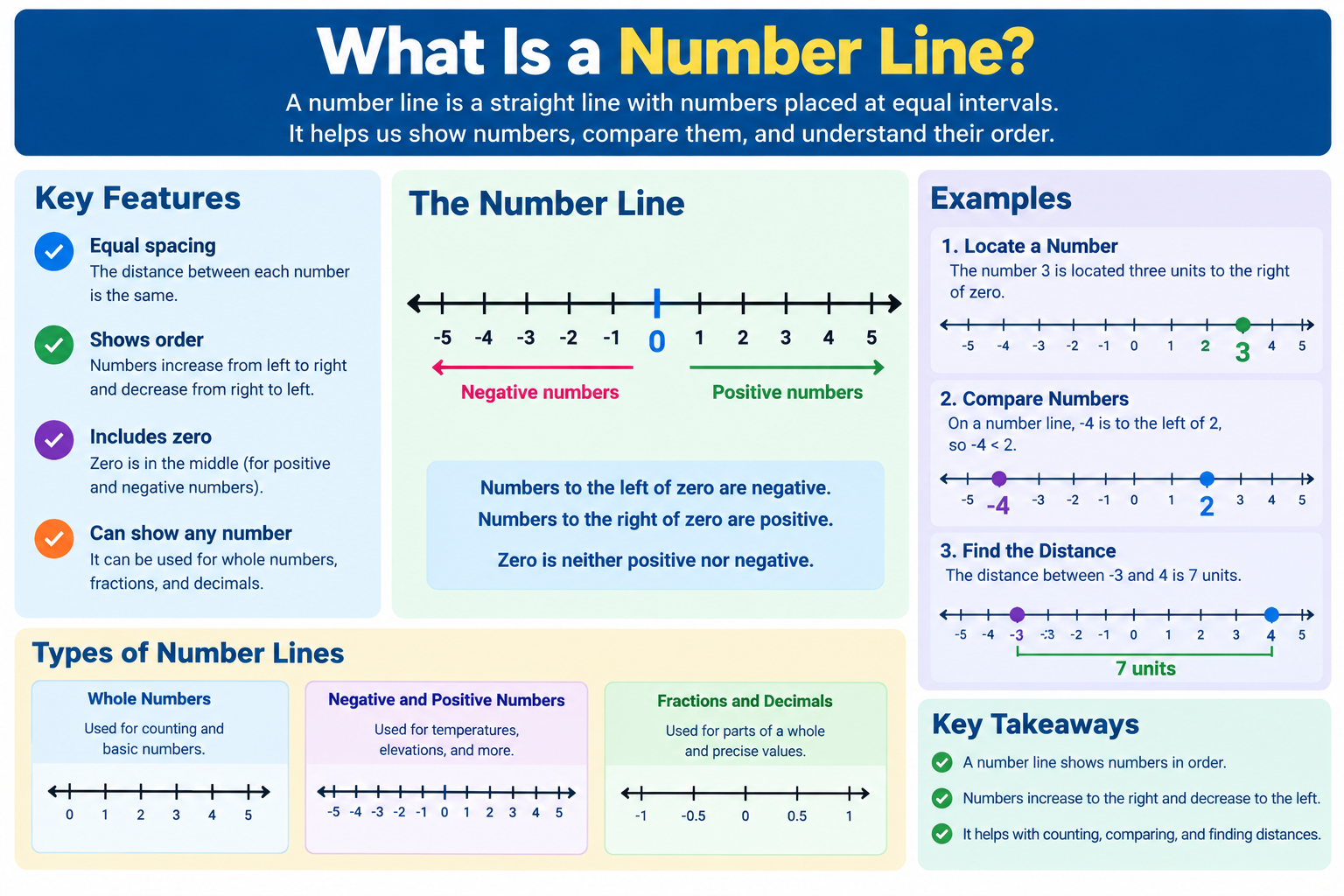
A number line is simply a straight line on which numbers are placed at equal intervals in order. Numbers increase as you move to the right and decrease as you move to the left. That is the whole idea — and from that simple concept, a remarkable amount of mathematics becomes visual and intuitive.
Whether you are a student just beginning to explore numbers, a parent helping with homework, or a teacher looking for a clear explanation to share with your class, this guide gives you a complete, honest introduction to the number line — what it is, how it works, and how to use it confidently across a wide range of mathematical tasks.
Key Takeaways
-
A number line is a straight line on which numbers are arranged in order at equal intervals.
-
Zero sits in the middle, with positive numbers to the right and negative numbers to the left.
-
Every real number — whole numbers, fractions, decimals, and negative numbers — has a place on the number line.
-
Number lines help with counting, comparing numbers, adding, subtracting, and understanding fractions and decimals.
-
Numbers further to the right on a number line are always greater.
-
Number lines are one of the most useful visual tools in early and intermediate mathematics.
-
Understanding the number line builds a strong foundation for algebra, coordinate geometry, and beyond.
What Is a Number Line?
A number line is a visual representation of numbers arranged in order along a straight horizontal line. Each number occupies a specific, fixed position on the line, and the spacing between consecutive numbers is always equal.
The line extends infinitely in both directions:
- To the right, numbers increase: 1, 2, 3, 4, and so on.
- To the left, numbers decrease: −1, −2, −3, −4, and so on.
- Zero sits at the centre, acting as the reference point that separates positive numbers from negative numbers.
A simple number line from −5 to 5 looks like this:
← −5 −4 −3 −2 −1 0 1 2 3 4 5 →Every number you can think of — whole numbers, fractions, decimals, negative numbers — has exactly one location on the number line. This makes the number line one of the most complete and versatile tools in mathematics.
Parts of a Number Line
Understanding the parts of a number line helps you read and use it correctly.
| Part | Description |
|---|---|
| The line | A straight horizontal line, usually drawn with arrows at both ends to show it continues infinitely |
| Arrows | Indicate that the number line extends without end in both directions |
| Zero (0) | The origin or reference point, sitting at the centre |
| Positive numbers | Numbers greater than zero, placed to the right of zero |
| Negative numbers | Numbers less than zero, placed to the left of zero |
| Tick marks | Short vertical marks placed at equal intervals to indicate positions |
| Labels | Numbers written below (or above) the tick marks to identify each position |
| Scale | The value represented by each interval between tick marks |
The scale matters enormously. A number line can be scaled in any increment — ones, twos, fives, tenths, hundredths — depending on what numbers you need to represent.
How to Draw a Number Line
Drawing a number line is a skill students use throughout their mathematical education. Here is how to do it correctly.
Step 1: Draw a straight horizontal line
Use a ruler. The line should be long enough to accommodate all the numbers you need.
Step 2: Add arrows at both ends
Draw a small arrow at each end to show the line continues infinitely.
Step 3: Mark a centre point for zero
Place zero roughly in the middle of the line. Label it clearly.
Step 4: Mark equal intervals
Decide on your scale. If you are working with whole numbers in steps of 1, space your tick marks evenly and label them: −5, −4, −3, −2, −1, 0, 1, 2, 3, 4, 5.
Step 5: Label the tick marks
Write the corresponding number below each tick mark. Keep labels neat and consistent.
Tip: Always use a ruler to keep intervals equal. Uneven spacing produces a misleading number line.
Positive and Negative Numbers on a Number Line
One of the most important things a number line teaches is the relationship between positive and negative numbers.
- Positive numbers are greater than zero. They sit to the right of zero on the number line: 1, 2, 3, 4, 5…
- Negative numbers are less than zero. They sit to the left of zero: −1, −2, −3, −4, −5…
- The further right a number is, the greater its value.
- The further left a number is, the smaller its value.
This means:
- 5 > 3 (5 is to the right of 3)
- −1 > −4 (−1 is to the right of −4)
- −2 < 1 (−2 is to the left of 1)
The number line makes these relationships visible and concrete, which is why it is so useful for students who are just beginning to work with negative numbers.
Zero on the Number Line
Zero holds a special position on the number line. It is neither positive nor negative — it is the origin, the point from which all other values are measured.
Zero acts as a boundary:
- Everything to its right is positive.
- Everything to its left is negative.
Zero also plays a key role in measuring distance on the number line. The distance from any number to zero is called its absolute value. For example:
- The absolute value of 4 is 4 (it is 4 units from zero, to the right).
- The absolute value of −4 is also 4 (it is 4 units from zero, to the left).
Both 4 and −4 are the same distance from zero — they are simply on opposite sides.
Whole Numbers on a Number Line
Whole numbers are the most natural starting point for a number line. They are the counting numbers — 0, 1, 2, 3, 4, 5… — placed at regular, equal intervals.
← 0 1 2 3 4 5 6 7 8 9 10 →Each step to the right increases the number by 1. Each step to the left decreases it by 1.
Whole numbers on a number line are used for:
- Counting objects
- Comparing quantities
- Performing addition and subtraction visually
- Introducing the concept of number order
If you are building your understanding of numbers from the ground up, the number line with whole numbers is the perfect starting point.
Fractions on a Number Line
Fractions also have exact positions on a number line. Placing fractions on a number line requires dividing the intervals between whole numbers into equal parts.
Example: Place 1/2 on a number line.
Divide the space between 0 and 1 into 2 equal parts. The midpoint is 1/2.
←  0  ---|---  1  →
        1/2
Example: Place 1/4, 2/4, and 3/4 on a number line.
Divide the interval between 0 and 1 into 4 equal parts:
←  0  -|-|-|-  1  →
      1/4 2/4 3/4
2/4 = 1/2, so it sits exactly at the midpoint.
Example: Place 1/3 and 2/3 on a number line.
Divide the interval from 0 to 1 into 3 equal parts:
←  0  --|--  1  →
       1/3 2/3
Placing fractions on a number line builds a genuine sense of how large or small a fraction is relative to whole numbers and to other fractions. If you would like to explore fractions in more depth, the article What Is a Fraction? on LearnMinto gives a thorough introduction to the topic.
Decimals on a Number Line
Decimals, like fractions, have precise positions between whole numbers on a number line.
Example: Place 0.5 on a number line from 0 to 1.
0.5 sits exactly halfway between 0 and 1, in the same position as 1/2.
Example: Place 0.1, 0.3, 0.7, and 0.9 on a number line.
Divide the interval from 0 to 1 into ten equal parts (each worth 0.1):
← 0 0.1 0.2 0.3 0.4 0.5 0.6 0.7 0.8 0.9 1.0 →Example: Place 1.5 and 2.7 on a number line from 0 to 3.
1.5 sits midway between 1 and 2. 2.7 sits seven tenths of the way between 2 and 3.
Decimals on a number line help students understand place value and the relative size of decimal numbers. This connects naturally to rounding — when you round a decimal to the nearest whole number, you are asking which whole number on the number line the decimal is closest to.
Negative Numbers on a Number Line
Negative numbers extend the number line to the left of zero. They are written with a minus sign and represent values below zero.
← −6 −5 −4 −3 −2 −1 0 1 2 3 4 5 6 →Key points about negative numbers on a number line:
- −1 is closer to zero than −5 is, so −1 > −5.
- −3 is between −4 and −2.
- Moving right always increases the value, even among negative numbers.
Real-life connections:
- Temperatures below zero: −10°C is colder than −3°C.
- Floors below ground in a building: Floor −2 is below Floor −1.
- Financial debt: −£50 means you owe £50.
The number line makes these real-world ideas tangible and easy to reason about.
Comparing Numbers Using a Number Line
One of the most practical uses of a number line is comparing numbers. The rule is simple and consistent:
The number further to the right is always greater.
Examples:
- 6 is to the right of 2, so 6 > 2
- −1 is to the right of −5, so −1 > −5
- 0 is to the right of −3, so 0 > −3
- 3 is to the right of −7, so 3 > −7
This visual approach is particularly helpful when comparing negative numbers, where students often get confused. On a number line, it is immediately clear that −2 is greater than −8, because −2 sits further to the right.
Comparing fractions on a number line is equally powerful. For a detailed guide on how fractions compare to one another, How to Compare Fractions With Different Denominators walks through every method clearly.
Ordering Numbers on a Number Line
To order a set of numbers, place them on a number line and read them from left to right (least to greatest) or right to left (greatest to least).
Example: Order 3, −2, 7, 0, −5 from least to greatest.
Place each number on the number line:
← −5 −2 0 3 7 →Reading left to right: −5, −2, 0, 3, 7
Example: Order 1/2, 0.3, 3/4, 0.6 from least to greatest.
Convert all to decimals for easy placement:
1/2 = 0.5, 0.3, 3/4 = 0.75, 0.6
Number line position: 0.3, 0.5, 0.6, 0.75
Order: 0.3, 1/2, 0.6, 3/4
Adding Numbers Using a Number Line
A number line turns addition into movement. To add, you start at the first number and move to the right by the amount you are adding.
Rule: Adding a positive number → move right
Example 1: 3 + 4
Start at 3. Move 4 steps to the right. Land on 7.
Answer: 7
Example 2: −2 + 5
Start at −2. Move 5 steps to the right. Land on 3.
Answer: 3
Example 3: −4 + 2
Start at −4. Move 2 steps to the right. Land on −2.
Answer: −2
Example 4: 0 + 6
Start at 0. Move 6 steps to the right. Land on 6.
Answer: 6
Subtracting Numbers Using a Number Line
Subtraction is movement to the left on the number line.
Rule: Subtracting a positive number → move left
Example 1: 7 − 3
Start at 7. Move 3 steps to the left. Land on 4.
Answer: 4
Example 2: 2 − 5
Start at 2. Move 5 steps to the left. Land on −3.
Answer: −3
Example 3: −1 − 3
Start at −1. Move 3 steps to the left. Land on −4.
Answer: −4
Example 4: 0 − 4
Start at 0. Move 4 steps to the left. Land on −4.
Answer: −4
Subtracting a negative number:
Subtracting a negative is the same as adding a positive — you move to the right.
5 − (−2) = 5 + 2 = 7
Start at 5, move 2 steps right. Land on 7.
Multiplying Using a Number Line
Number lines can represent multiplication as repeated addition, or as equal jumps.
Example: 3 × 4
Make 3 jumps of 4 to the right, starting at 0:
0 → 4 → 8 → 12
Answer: 12
Example: 4 × 2
Make 4 jumps of 2 to the right, starting at 0:
0 → 2 → 4 → 6 → 8
Answer: 8
This approach works well for smaller numbers and gives students an intuitive feel for multiplication as scaling or repeated addition.
Rounding Numbers Using a Number Line
A number line makes rounding visually clear. When rounding to the nearest whole number, you simply ask: which whole number is this value closest to?
Example: Round 3.7 to the nearest whole number.
Place 3.7 on a number line between 3 and 4. Since 3.7 is closer to 4 than to 3:
Answer: 4
Example: Round 2.3 to the nearest whole number.
2.3 is closer to 2 than to 3.
Answer: 2
Example: Round 4.5 to the nearest whole number.
4.5 sits exactly halfway between 4 and 5. Using the standard round-half-up rule:
Answer: 5
The number line approach makes rounding intuitive — you can literally see which value is nearer. For a more detailed guide on rounding decimals, the article What Is Rounding in Math? on LearnMinto explains the concept across different place values with plenty of examples.
Number Lines and Inequalities
Inequalities describe ranges of numbers rather than specific values, and the number line is perfect for representing them.
Symbols:
- > means greater than
- < means less than
- ≥ means greater than or equal to
- ≤ means less than or equal to
Representing inequalities on a number line:
- Use an open circle (○) for strict inequalities (> or <): the endpoint is not included.
- Use a closed circle (●) for non-strict inequalities (≥ or ≤): the endpoint is included.
- Draw a line (or arrow) extending in the appropriate direction.
Example 1: x > 2
Open circle at 2, arrow extending to the right.
Example 2: x ≤ −1
Closed circle at −1, arrow extending to the left.
Example 3: −3 < x ≤ 4
Open circle at −3, closed circle at 4, line connecting them.
Number lines make inequalities tangible, helping students understand that an inequality describes an entire set of values rather than a single point.
Types of Number Lines
Not all number lines look the same. Depending on the purpose, number lines can take different forms.
| Type | Description | Used For |
|---|---|---|
| Standard number line | Horizontal line with equally spaced integers | Counting, comparing, adding, subtracting |
| Fraction number line | Intervals divided into equal fractional parts | Understanding and comparing fractions |
| Decimal number line | Intervals divided into tenths or hundredths | Placing and comparing decimals |
| Negative number line | Extends clearly to the left of zero | Working with negative numbers |
| Vertical number line | Drawn vertically rather than horizontally | Thermometers, elevation, coordinate axes |
| Open number line | No fixed scale; marked only where needed | Mental arithmetic, flexible calculations |
| Double number line | Two parallel lines with proportional values | Ratios, rates, and proportional reasoning |
Each type serves a specific purpose, but all share the same fundamental principle: numbers in order, with consistent spacing.
Number Lines in Real Life
Number lines appear in everyday situations far more often than most people realise.
Thermometers: A thermometer is a vertical number line. Temperature rises as you go up (positive direction) and falls as you go down (negative direction). A reading of −5°C sits below zero on the scale.
Timelines: Historical timelines arrange events in chronological order along a horizontal line — exactly like a number line, but with years or dates instead of numbers.
Rulers and measuring tapes: A ruler is a physical number line, measuring length in centimetres or inches from zero outward.
Musical scales: Notes on a piano keyboard are arranged in order of increasing pitch — a kind of number line for sound.
Elevations: Maps showing sea level, hills, and underground depths use a vertical number line concept, with sea level as zero.
Bank balances: Account statements show balances that can be positive (money available) or negative (overdrawn), just as a number line extends in both directions from zero.
Number lines in sports: Athletics tracks, swimming pools, and football fields are all marked with measurements from a starting point — a practical number line in physical space.
Common Mistakes With Number Lines
1. Unequal spacing between numbers
Each interval on a number line must be exactly the same size. Uneven spacing produces a misleading representation where numbers appear closer or further apart than they really are.
2. Forgetting that negative numbers increase in value towards zero
Students often think −8 is greater than −2 because 8 is greater than 2. On the number line, −2 is to the right of −8, so −2 > −8.
3. Misplacing fractions
When placing 3/4 between 0 and 1, students sometimes place it too close to 0 or too close to 1. The interval must be divided into exactly 4 equal parts, and 3/4 sits at the third mark.
4. Moving in the wrong direction for subtraction
Subtraction means moving left, not right. Moving right for subtraction produces the wrong answer.
5. Confusing open and closed circles in inequalities
An open circle means the endpoint is not included (strict inequality). A closed circle means it is included. Mixing these up misrepresents the solution set.
6. Labelling the number line without a zero
A number line without zero loses its reference point. Always mark zero clearly, even if it is at one end of the portion you are drawing.
7. Assuming the number line only shows whole numbers
A number line is continuous — every point on it corresponds to a real number, including fractions and decimals. Students sometimes treat it as though only whole numbers have positions.
Worked Examples
Example 1: Draw a number line and mark −3, 0, 2, and 4.
← −4  −3  −2  −1   0   1   2   3   4   5 →
        ●            ●        ●        ●
Example 2: Use a number line to calculate 4 + 3.
Start at 4. Move 3 steps right. Land on 7.
Answer: 7
Example 3: Use a number line to calculate 6 − 9.
Start at 6. Move 9 steps left. Land on −3.
Answer: −3
Example 4: Place 3/4 on a number line between 0 and 1.
Divide the interval into 4 equal parts. Count 3 parts from zero.
3/4 is three-quarters of the way from 0 to 1.
Example 5: Which is greater — −3 or −7?
On the number line, −3 is to the right of −7.
Answer: −3 > −7
Example 6: Round 7.3 to the nearest whole number using a number line.
7.3 sits between 7 and 8. It is closer to 7.
Answer: 7
Example 7: Represent x ≥ 3 on a number line.
Closed circle at 3, arrow pointing to the right.
Example 8: Order −4, 1, −1, 3, 0 from least to greatest.
Number line position: −4, −1, 0, 1, 3
Answer: −4, −1, 0, 1, 3
Example 9: Use a number line to show 3 × 3.
Three jumps of 3 to the right from 0: 0 → 3 → 6 → 9
Answer: 9
Example 10: Where does 1.5 sit on a number line from 0 to 3?
Halfway between 1 and 2.
Answer: 1.5 is at the midpoint of the interval between 1 and 2.
Example 11: Calculate −2 + (−3) using a number line.
Start at −2. Adding a negative means moving left. Move 3 steps left. Land on −5.
Answer: −5
Example 12: Place 0.25, 0.5, and 0.75 on a number line from 0 to 1.
Divide the interval into 4 equal parts:
0 — 0.25 — 0.5 — 0.75 — 1.0
Example 13: Is −6 to the left or right of −2 on a number line?
−6 is to the left of −2.
Answer: −6 is to the left, meaning −6 < −2
Example 14: Show the inequality −2 < x < 5 on a number line.
Open circle at −2, open circle at 5, with a solid line connecting them.
Example 15: A temperature drops from 3°C to −4°C. How many degrees did it drop?
On the number line: from 3 to −4
Distance = 3 − (−4) = 3 + 4 = 7
Answer: 7 degrees
Practice Questions
Try these independently. Answers are provided in the section below.
Place on a number line.
- Mark −5, −2, 0, 3, and 6 on a number line.
- Place 1/2, 1/4, and 3/4 between 0 and 1 on a number line.
- Mark 0.2, 0.5, and 0.8 between 0 and 1.
Compare using a number line.
- Which is greater: −4 or −1?
- Which is smaller: 0 or −6?
- Write >, <, or = between each pair: −3 ___ 2; −5 ___ −8; 0 ___ −1
Add using a number line.
- 5 + 3
- −4 + 6
- −3 + (−2)
- 0 + (−7)
Subtract using a number line.
- 8 − 5
- 3 − 7
- −2 − 4
- 0 − 6
Order from least to greatest.
- −7, 2, −1, 5, 0
- 3/4, 1/4, 1/2, 1
- 0.6, 0.1, 0.9, 0.4
Round using a number line.
- Round 4.6 to the nearest whole number.
- Round 9.2 to the nearest whole number.
- Round 6.5 to the nearest whole number.
Inequalities.
- Draw x > 4 on a number line.
- Draw x ≤ −2 on a number line.
- Draw 1 ≤ x < 6 on a number line.
Word problems.
- The temperature at midnight is −3°C. By morning it rises by 7°C. What is the new temperature? Show on a number line.
- A submarine is at −40 metres. It rises 15 metres. What is its new depth? Use a number line to explain.
Answers:
- Correctly placed in order from left to right.
- 1/4 at the first quarter mark, 1/2 at the midpoint, 3/4 at the third quarter mark.
- 0.2, 0.5, and 0.8 placed at their respective tenths positions.
- −1 (it is to the right of −4)
- −6 (it is to the left of 0)
- −3 < 2; −5 > −8; 0 > −1
- 8
- 2
- −5
- −7
- 3
- −4
- −6
- −6
- −7, −1, 0, 2, 5
- 1/4, 1/2, 3/4, 1
- 0.1, 0.4, 0.6, 0.9
- 5
- 9
- 7
- Open circle at 4, arrow pointing right.
- Closed circle at −2, arrow pointing left.
- Closed circle at 1, open circle at 6, line between them.
- −3 + 7 = 4°C
- −40 + 15 = −25 metres
Multiple-Choice Questions
Question 1: Where does −4 sit on a number line relative to −1?
A) To the right of −1
B) At the same position as −1
C) To the left of −1
D) To the right of zero
Correct Answer: C — To the left of −1
On a number line, −4 is further from zero in the negative direction, so it sits to the left of −1.
Question 2: What is 2 + 5 using a number line?
A) 3
B) 7
C) 10
D) −3
Correct Answer: B — 7
Start at 2, move 5 steps to the right. You land on 7.
Question 3: Which set of numbers is correctly ordered from least to greatest?
A) 3, −1, −5, 0
B) −5, −1, 0, 3
C) 0, −1, −5, 3
D) −5, 0, −1, 3
Correct Answer: B — −5, −1, 0, 3
Reading a number line from left to right gives the correct ascending order.
Question 4: On a number line, 0.7 is located:
A) Between 0 and 0.5
B) Between 0.5 and 1
C) To the left of 0
D) At the same position as 7
Correct Answer: B — Between 0.5 and 1
0.7 is seven tenths of the way from 0 to 1, which is more than halfway.
Question 5: What does the arrow at each end of a number line represent?
A) The largest and smallest numbers on the line
B) That the line continues infinitely in both directions
C) The starting and ending points of counting
D) The positions of zero and one
Correct Answer: B — That the line continues infinitely in both directions
Arrows indicate the number line has no end in either direction.
Question 6: A student starts at −3 on a number line and moves 8 steps to the right. Where do they land?
A) −11
B) 5
C) 11
D) −5
Correct Answer: B — 5
−3 + 8 = 5. Moving right adds to the value.
Question 7: Which of the following represents x ≤ 2 on a number line?
A) Open circle at 2, arrow pointing right
B) Closed circle at 2, arrow pointing left
C) Open circle at 2, arrow pointing left
D) Closed circle at 2, arrow pointing right
Correct Answer: B — Closed circle at 2, arrow pointing left
≤ means “less than or equal to,” so 2 is included (closed circle) and values extend to the left.
Question 8: Where does 5/8 sit on a number line between 0 and 1?
A) Closer to 0 than to 1
B) Exactly at the midpoint
C) Closer to 1 than to 0
D) Beyond 1
Correct Answer: C — Closer to 1 than to 0
5/8 = 0.625, which is more than 0.5, so it sits beyond the midpoint, closer to 1.
Question 9: What is −5 − 3 on a number line?
A) −2
B) 8
C) −8
D) 2
Correct Answer: C — −8
Start at −5, move 3 steps further left. Land on −8.
Question 10: Which statement is always true about a number line?
A) It only shows positive whole numbers.
B) The spacing between numbers can vary.
C) Numbers increase from left to right.
D) Zero is always at the far left.
Correct Answer: C — Numbers increase from left to right.
This is the fundamental defining property of a number line.
Challenge Questions
Challenge 1: A diver is at −18 metres below sea level. She ascends 7 metres, then descends 12 metres. What is her final depth? Show the movements on a number line.
Start: −18
After ascending 7: −18 + 7 = −11
After descending 12: −11 − 12 = −23
Final depth: −23 metres
Challenge 2: Place the following numbers in order on a number line, then identify which is closest to zero: −4.5, 3.2, −0.7, 1.8, −2.1
Ordered from least to greatest: −4.5, −2.1, −0.7, 1.8, 3.2
Distance from zero:
- −4.5 → 4.5
- −2.1 → 2.1
- −0.7 → 0.7
- 1.8 → 1.8
- 3.2 → 3.2
Closest to zero: −0.7
Challenge 3: On a number line, point A is at −6 and point B is at 4. What is the distance between A and B? What is the midpoint of A and B?
Distance = 4 − (−6) = 4 + 6 = 10 units
Midpoint = (−6 + 4) ÷ 2 = −2 ÷ 2 = −1
Challenge 4: A number is 5 units to the left of 3 on the number line. What is the number? Another number is 5 units to the right of the same starting point. What is that number?
5 units to the left of 3: 3 − 5 = −2
5 units to the right of 3: 3 + 5 = 8
Challenge 5: Using only a number line, explain why adding a negative number always moves you to the left, regardless of your starting position.
On a number line, positive means direction to the right and negative means direction to the left. Adding a negative number is the same as moving in the negative (left) direction. The starting position does not matter — if you add −4, you always move 4 units left from wherever you are. This is consistent with the definition of a negative number as representing a value below zero or a movement in the opposing direction.
Quick Revision Notes
- A number line is a straight line with numbers arranged in order at equal intervals.
- Numbers increase going right; numbers decrease going left.
- Zero sits at the centre, separating positive (right) from negative (left).
- Addition → move right; subtraction → move left.
- The number further to the right is always greater.
- Fractions and decimals have exact positions between whole numbers.
- Negative numbers become greater as they get closer to zero.
- An open circle on an inequality means the endpoint is excluded.
- A closed circle means the endpoint is included.
- A number line extends infinitely in both directions.
Number Line Cheat Sheet
| Concept | Rule | Example |
|---|---|---|
| Comparing numbers | Further right = greater | −2 > −5 |
| Adding positive | Move right | 3 + 4 = 7 |
| Adding negative | Move left | 3 + (−4) = −1 |
| Subtracting positive | Move left | 5 − 8 = −3 |
| Subtracting negative | Move right | 5 − (−3) = 8 |
| Placing fractions | Divide interval equally | 1/4 is at the first quarter mark |
| Placing decimals | Divide into tenths | 0.7 is 7 tenths from 0 |
| Rounding | Find the nearest labelled value | 3.7 rounds to 4 |
| Inequality > or < | Open circle | x > 2: open circle at 2, arrow right |
| Inequality ≥ or ≤ | Closed circle | x ≤ 2: closed circle at 2, arrow left |
Exam Tips
- Always use a ruler when drawing a number line — uneven intervals are a common source of error and lost marks.
- Label zero clearly on every number line you draw.
- When placing fractions, divide the interval carefully into the correct number of equal parts before marking the position.
- For inequalities, double-check whether the circle should be open or closed before drawing.
- When comparing negative numbers, remember that the one closer to zero is the greater one.
- On addition and subtraction problems, trace your steps carefully on the number line and count each jump individually.
- For ordering problems, use a number line even if it is not explicitly required — it is the fastest and most reliable method.
- Always write your final answer using the original form of the numbers (do not leave the answer as a position on a number line without a label).
Frequently Asked Questions
1. What is a number line in simple terms?
A number line is a straight line on which numbers are arranged in order from left to right, with equal spacing between them. Zero sits at the centre, positive numbers are to the right, and negative numbers are to the left.
2. What is the purpose of a number line?
Number lines help you visualise numbers, compare their sizes, perform addition and subtraction, place fractions and decimals, and represent inequalities. They make abstract number relationships concrete and easy to understand.
3. Do number lines only show whole numbers?
No. A number line is continuous and can represent all real numbers — whole numbers, fractions, decimals, and negative numbers. Any point on the line corresponds to a specific numerical value.
4. Why do negative numbers go to the left?
By convention, the number line increases from left to right. Since negative numbers are less than zero, they sit to the left of zero — the reference point. This convention is used universally in mathematics.
5. How do you add numbers using a number line?
Start at the first number. If you are adding a positive number, move that many steps to the right. If you are adding a negative number, move that many steps to the left. The number where you land is the answer.
6. How do you subtract numbers using a number line?
Start at the first number. Move to the left by the amount you are subtracting. If you are subtracting a negative number, move to the right instead.
7. How do you place a fraction on a number line?
Identify the two whole numbers the fraction sits between. Divide that interval into as many equal parts as the denominator. Count as many parts from the left as the numerator indicates, and mark that point.
8. Which is greater — −3 or −7?
−3 is greater because it sits to the right of −7 on the number line. The closer a negative number is to zero, the greater its value.
9. What does an open circle mean on a number line?
An open circle indicates that the endpoint is not included in the solution set. It is used for strict inequalities (> or <).
10. What does a closed circle mean on a number line?
A closed circle indicates that the endpoint is included in the solution set. It is used for non-strict inequalities (≥ or ≤).
11. Can a number line go on forever?
Yes. A number line extends infinitely in both directions. The arrows at each end of a drawn number line represent this infinite extension.
12. How is a number line used in real life?
Number lines appear in thermometers, rulers, timelines, elevation maps, financial statements, and anywhere that ordered numerical values need to be displayed or compared.
13. What is the midpoint of a number line between two numbers?
The midpoint is the average of the two numbers. Add them together and divide by 2. For example, the midpoint between −4 and 6 is (−4 + 6) ÷ 2 = 1.
14. Is zero a positive or negative number?
Zero is neither positive nor negative. It is the neutral reference point on the number line, separating positive numbers on the right from negative numbers on the left.
15. How is a number line different from a coordinate plane?
A number line is one-dimensional — it shows values along a single straight line. A coordinate plane is two-dimensional — it uses two number lines (one horizontal called the x-axis and one vertical called the y-axis) crossing at zero to represent positions in a plane.
Summary
A number line is one of the most fundamental and versatile tools in mathematics. It is a straight, ordered line on which every number has a precise, fixed position. Numbers grow as you move right and diminish as you move left. Zero anchors the line at its centre.
From this simple structure, a number line can help you:
- Count and compare numbers of all types
- Add and subtract by moving left or right
- Place fractions and decimals between whole numbers
- Understand negative numbers intuitively
- Represent and interpret inequalities
- Round values by identifying the nearest labelled point
The beauty of the number line is that it works equally well for a young student learning to count and for a more advanced student working with inequalities, fractions, and negative numbers. It grows with you.
Understanding the number line is not just about a single topic — it connects to many areas of mathematics. Whether you are exploring what fractions mean, learning to add numbers with different signs, or beginning to study algebra and coordinates, the number line is always a reliable foundation to return to.
Final Thoughts
The number line is deceptively simple. At first glance, it is just a line with some numbers on it. But look more carefully, and you will find that it captures something profound: the idea that numbers have order, direction, and distance — that they exist in a continuous, structured space rather than as isolated symbols on a page.
If there is one tool in early mathematics that genuinely repays the time spent understanding it, it is the number line. Take the time to draw number lines by hand when you are practising. Trace your finger along the line when adding or subtracting. Divide intervals carefully when placing fractions. This physical engagement with the number line builds number sense in a way that abstract rules alone cannot.
As you progress in mathematics, you will encounter the number line in new contexts — on coordinate axes, in algebraic graphs, in statistics, and in calculus. In every case, the same principles apply: left is less, right is greater, and every number has exactly one place.
For students who want to continue building their number sense, understanding equivalent fractions is a natural next step. The article What Are Equivalent Fractions? on LearnMinto explores how the same value can be expressed in different ways — a concept that connects directly to placing fractions on a number line. And if you are ready to explore how numbers are used in algebraic expressions, What Is Standard Form in Math? offers a clear and accessible starting point.
Keep practising, keep drawing, and let the number line do what it does best: make numbers visible.
Helpful Resources
- Khan Academy — Number Lines
Clear video lessons and interactive exercises on reading, drawing, and using number lines with whole numbers, fractions, and negative numbers.
https://www.khanacademy.org/math/cc-sixth-grade-math/cc-6th-factors-and-multiples - Mathematics LibreTexts — Integers and the Number Line
A thorough open-access resource covering number line concepts including integers, absolute value, and ordering.
https://math.libretexts.org - OpenStax Prealgebra — Introduction to Integers
A free, peer-reviewed prealgebra textbook with a dedicated section on number lines, positive and negative numbers, and absolute value.
https://openstax.org/books/prealgebra-2e/pages/1-introduction - BBC Bitesize — Number Lines
A student-friendly UK resource with explanations, examples, and practice activities on number lines for different age groups.
https://www.bbc.co.uk/bitesize - National Council of Teachers of Mathematics (NCTM)
The leading professional body for mathematics education, with standards and resources supporting the teaching of number sense and number line concepts.
https://www.nctm.org
Disclaimer:
This article is intended for educational and informational purposes only. While LearnMinto strives to provide accurate and up-to-date mathematics information, readers should verify important academic concepts through official textbooks, educational institutions, examination boards, or trusted educational resources before using this content for exams or academic purposes. LearnMinto is not affiliated with any specific school, university, research institution, or examination board.
Author: Saad Qureshi
Author Role: Senior Education & Technology Editor at LearnMinto
Saad Qureshi is a Senior Education & Technology Editor at LearnMinto. He focuses on creating and reviewing clear, accessible educational content across mathematics, physics, chemistry, biology, computer science, technology, AI tools, and personal finance.