
Introduction
Numbers can get surprisingly awkward to work with. The distance from Earth to the Sun is approximately 150,000,000,000 metres. The mass of a single hydrogen atom is roughly 0.00000000000000000000000000167 kilograms. Writing, reading, and calculating with numbers like these in their full form is both impractical and prone to error.
This is where standard form comes in.
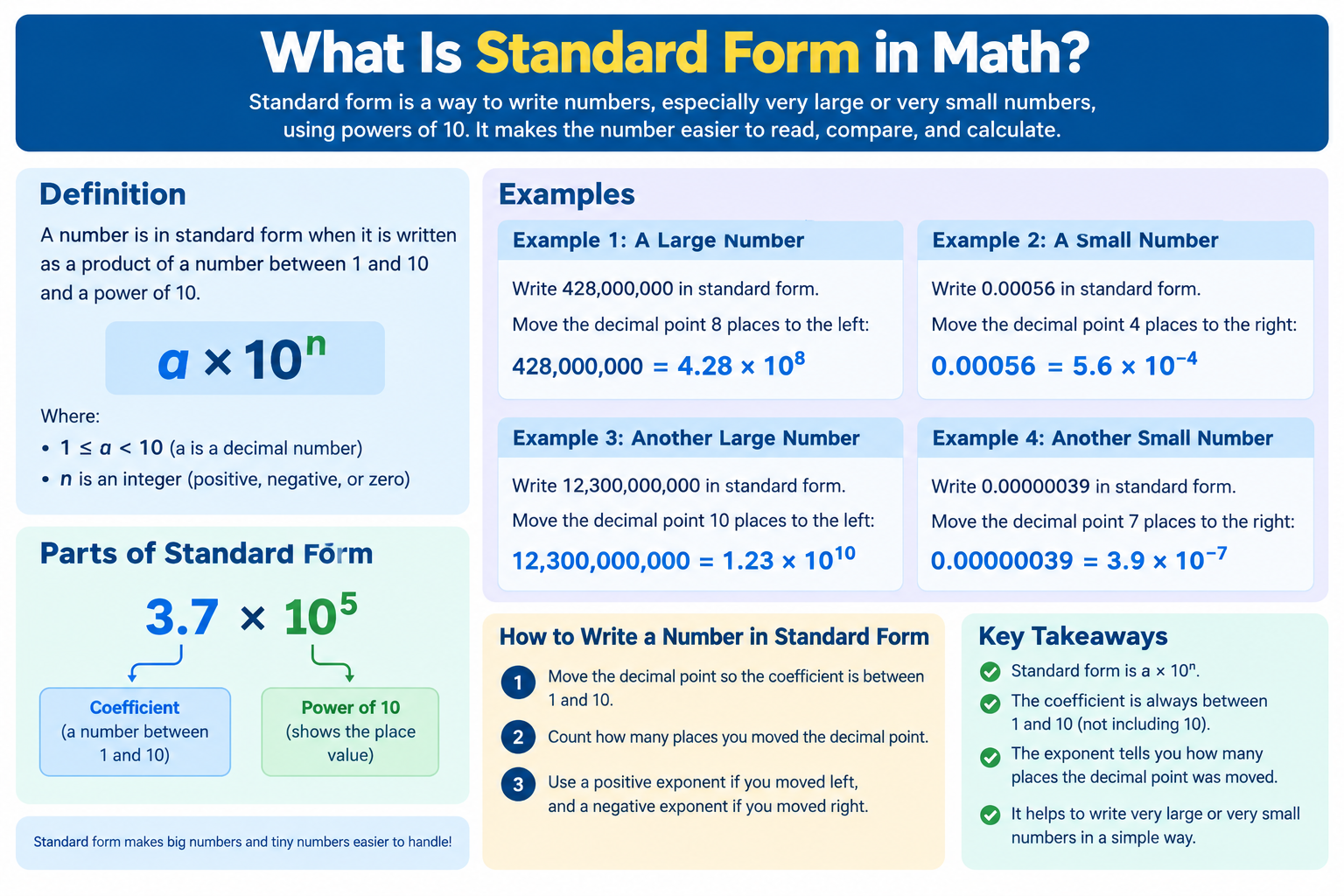
Standard form is a way of writing numbers — particularly very large or very small ones — in a clean, compact format that is easier to read, compare, and use in calculations. Beyond numbers, the term “standard form” also applies to how we write polynomials and linear equations in mathematics, following an agreed structure.
Understanding what standard form means in math, how to convert numbers into it, and how to work with it confidently is a skill that appears across arithmetic, algebra, science, and engineering. This guide explains everything clearly, step by step, with plenty of examples along the way.
Key Takeaways
-
Standard form for numbers (also called scientific notation in some countries) expresses values as a number between 1 and 10 multiplied by a power of 10.
-
It is especially useful for very large numbers (such as distances in space) and very small numbers (such as measurements in chemistry or biology).
-
The exponent (power of 10) is positive for large numbers and negative for small numbers.
-
Standard form also applies to polynomials, where terms are written in descending order of degree.
-
Standard form for linear equations follows the format Ax + By = C.
-
Converting between standard form and ordinary numbers requires understanding place value and powers of ten.
-
Standard form is widely used in science, engineering, finance, and computing.
What Is Standard Form in Math?
The term standard form refers to an agreed, conventional way of writing a mathematical expression so that it follows a consistent structure. The exact meaning depends slightly on context:
- When talking about numbers, standard form means writing a number as a value between 1 and 10 multiplied by a power of 10. This is what most students encounter first, and it is the primary focus of this article.
- When talking about polynomials, standard form means arranging the terms in descending order of their exponents.
- When talking about linear equations, standard form refers to the format Ax + By = C.
- When talking about quadratic equations, standard form is ax² + bx + c = 0.
Each of these uses the same underlying principle: express the mathematical object in a recognised, agreed structure that makes it easier to read and work with.
Standard Form for Numbers — The Basic Idea
The core idea behind standard form for numbers is elegantly simple. Instead of writing out every zero in a large or small number, you express it as a product of two parts:
- A number between 1 and 10 (this part is called the coefficient or mantissa)
- A power of 10 (written as 10 raised to an exponent)
General form:
a × 10ⁿ
Where:
- a is a number satisfying 1 ≤ a < 10
- n is an integer (it can be positive, negative, or zero)
Examples:
- 3,000,000 = 3 × 10⁶
- 0.00045 = 4.5 × 10⁻⁴
- 150,000,000,000 = 1.5 × 10¹¹
Each of these representations is compact, precise, and easy to compare.
Understanding Powers of Ten
Before working confidently with standard form, you need to be comfortable with powers of ten. A power of ten simply means 10 multiplied by itself a certain number of times.
| Power | Meaning | Value |
|---|---|---|
| 10⁰ | 10 × nothing — just 1 | 1 |
| 10¹ | 10 | 10 |
| 10² | 10 × 10 | 100 |
| 10³ | 10 × 10 × 10 | 1,000 |
| 10⁴ | 10 × 10 × 10 × 10 | 10,000 |
| 10⁵ | 100,000 | |
| 10⁶ | 1,000,000 | |
| 10⁻¹ | 1/10 | 0.1 |
| 10⁻² | 1/100 | 0.01 |
| 10⁻³ | 1/1,000 | 0.001 |
| 10⁻⁴ | 1/10,000 | 0.0001 |
The exponent tells you how many places the decimal point moves. A positive exponent means the number is large; a negative exponent means the number is small (between 0 and 1).
What Does Standard Form Look Like?
Here are some side-by-side comparisons of ordinary numbers and their standard form equivalents:
| Ordinary Number | Standard Form |
|---|---|
| 7,000 | 7 × 10³ |
| 52,000,000 | 5.2 × 10⁷ |
| 384,000,000 | 3.84 × 10⁸ |
| 0.006 | 6 × 10⁻³ |
| 0.00000071 | 7.1 × 10⁻⁷ |
| 93,000,000,000 | 9.3 × 10¹⁰ |
| 1 | 1 × 10⁰ |
| 45.3 | 4.53 × 10¹ |
Notice that the coefficient is always a number from 1 up to (but not including) 10. If your coefficient is 12 or 0.5, the number is not yet in correct standard form.
Rules for Writing Numbers in Standard Form
There are three essential rules:
Rule 1: The coefficient must be at least 1 and less than 10.
1 ≤ a < 10
This means the coefficient can be 1, 1.5, 3.7, 9.99 — but never 0.8, 12, or 15.
Rule 2: The second part must be a power of 10.
It must be written as 10 raised to an integer exponent: 10¹, 10⁻³, 10⁰, and so on.
Rule 3: The two parts are connected by multiplication.
The standard form is always: a × 10ⁿ
How to Convert Large Numbers to Standard Form
Converting a large number to standard form means moving the decimal point to the left until you have a coefficient between 1 and 10. The number of places you move becomes the positive exponent.
Step-by-Step Process
Step 1: Write the number with its decimal point shown. (For a whole number, the decimal point sits at the right end.)
Step 2: Move the decimal point to the left until only one non-zero digit sits to its left.
Step 3: Count how many places you moved the decimal point. This becomes n, the positive exponent.
Step 4: Write the number as a × 10ⁿ.
Example 1: Convert 4,700,000 to standard form.
4,700,000. → move decimal 6 places to the left → 4.7
n = 6
Answer: 4.7 × 10⁶
Example 2: Convert 385,000,000 to standard form.
385,000,000. → move decimal 8 places to the left → 3.85
n = 8
Answer: 3.85 × 10⁸
Example 3: Convert 60,200,000,000 to standard form.
60,200,000,000. → move decimal 10 places to the left → 6.02
n = 10
Answer: 6.02 × 10¹⁰
Example 4: Convert 5,000 to standard form.
5,000. → move decimal 3 places to the left → 5.0
n = 3
Answer: 5 × 10³
Example 5: Convert 72 to standard form.
- → move decimal 1 place to the left → 7.2
n = 1
Answer: 7.2 × 10¹
How to Convert Small Numbers to Standard Form
For small decimals (numbers between 0 and 1), you move the decimal point to the right until the coefficient is between 1 and 10. The number of places moved becomes a negative exponent.
Step-by-Step Process
Step 1: Identify where the decimal point currently sits.
Step 2: Move the decimal point to the right until one non-zero digit sits to its left.
Step 3: Count how many places you moved. This becomes n, expressed as a negative exponent.
Step 4: Write the number as a × 10⁻ⁿ.
Example 1: Convert 0.0053 to standard form.
0.0053 → move decimal 3 places to the right → 5.3
n = −3
Answer: 5.3 × 10⁻³
Example 2: Convert 0.000000072 to standard form.
0.000000072 → move decimal 8 places to the right → 7.2
n = −8
Answer: 7.2 × 10⁻⁸
Example 3: Convert 0.41 to standard form.
0.41 → move decimal 1 place to the right → 4.1
n = −1
Answer: 4.1 × 10⁻¹
Example 4: Convert 0.000305 to standard form.
0.000305 → move decimal 4 places to the right → 3.05
n = −4
Answer: 3.05 × 10⁻⁴
Example 5: Convert 0.000000001 to standard form.
0.000000001 → move decimal 9 places to the right → 1
n = −9
Answer: 1 × 10⁻⁹
How to Convert Standard Form Back to Ordinary Numbers
Going from standard form to an ordinary number is the reverse process.
- If the exponent is positive, move the decimal point to the right (the number is large).
- If the exponent is negative, move the decimal point to the left (the number is small).
Example 1: Write 3.6 × 10⁵ as an ordinary number.
Move decimal 5 places to the right: 3.60000 → 360,000
Answer: 360,000
Example 2: Write 8.04 × 10⁷ as an ordinary number.
Move decimal 7 places to the right: 8.0400000 → 80,400,000
Answer: 80,400,000
Example 3: Write 2.5 × 10⁻³ as an ordinary number.
Move decimal 3 places to the left: 0.0025
Answer: 0.0025
Example 4: Write 6.1 × 10⁻⁶ as an ordinary number.
Move decimal 6 places to the left: 0.0000061
Answer: 0.0000061
Example 5: Write 1 × 10⁰ as an ordinary number.
10⁰ = 1, so 1 × 1 = 1
Answer: 1
Standard Form With Negative Exponents
A negative exponent in standard form does not mean the number itself is negative. It simply means the original number is less than 1.
- 5 × 10⁻² = 0.05 (a small positive number)
- −5 × 10² = −500 (a negative number)
These are very different things. The sign of the exponent tells you about the size of the number. The sign of the coefficient tells you whether the number is positive or negative.
Negative numbers in standard form:
Negative numbers follow exactly the same rules, but the coefficient carries a negative sign.
- −3,400,000 = −3.4 × 10⁶
- −0.0072 = −7.2 × 10⁻³
Comparing Numbers in Standard Form
One of the great advantages of standard form is that comparing numbers becomes much quicker.
Step 1: Compare the exponents. The number with the larger exponent is greater.
Step 2: If the exponents are equal, compare the coefficients.
Example 1: Which is greater — 3.2 × 10⁸ or 8.7 × 10⁶?
Exponents: 8 > 6, so 3.2 × 10⁸ is greater.
Answer: 3.2 × 10⁸ > 8.7 × 10⁶
Example 2: Which is greater — 4.5 × 10⁵ or 6.1 × 10⁵?
Exponents are equal. Compare coefficients: 6.1 > 4.5
Answer: 6.1 × 10⁵ > 4.5 × 10⁵
Example 3: Order from smallest to largest: 2.3 × 10⁴, 8.1 × 10², 5.6 × 10⁴
Exponents: 10², 10⁴, 10⁴
8.1 × 10² is smallest. Then compare 2.3 × 10⁴ and 5.6 × 10⁴: 2.3 < 5.6
Order: 8.1 × 10² < 2.3 × 10⁴ < 5.6 × 10⁴
Adding and Subtracting in Standard Form
To add or subtract numbers in standard form, both numbers must have the same exponent. If they do not, adjust one of them before proceeding.
Example 1: Calculate 3.2 × 10⁵ + 4.1 × 10⁵
Same exponents — add the coefficients:
(3.2 + 4.1) × 10⁵ = 7.3 × 10⁵
Answer: 7.3 × 10⁵
Example 2: Calculate 5.4 × 10⁶ + 2.3 × 10⁵
Different exponents. Convert 2.3 × 10⁵ to match 10⁶:
2.3 × 10⁵ = 0.23 × 10⁶
Now add: (5.4 + 0.23) × 10⁶ = 5.63 × 10⁶
Answer: 5.63 × 10⁶
Example 3: Calculate 8.5 × 10⁴ − 3.2 × 10⁴
(8.5 − 3.2) × 10⁴ = 5.3 × 10⁴
Answer: 5.3 × 10⁴
Multiplying in Standard Form
Multiplying numbers in standard form is clean and efficient. Multiply the coefficients and add the exponents.
Rule: (a × 10ᵐ) × (b × 10ⁿ) = (a × b) × 10^(m+n)
Example 1: (3 × 10⁴) × (2 × 10³)
3 × 2 = 6
10⁴ × 10³ = 10⁷
Answer: 6 × 10⁷
Example 2: (4.5 × 10⁶) × (3 × 10²)
4.5 × 3 = 13.5
10⁶ × 10² = 10⁸
13.5 × 10⁸ — coefficient is not between 1 and 10, so adjust:
13.5 × 10⁸ = 1.35 × 10⁹
Answer: 1.35 × 10⁹
Example 3: (2.5 × 10⁻³) × (4 × 10⁻²)
2.5 × 4 = 10
10⁻³ × 10⁻² = 10⁻⁵
10 × 10⁻⁵ = 1 × 10⁻⁴
Answer: 1 × 10⁻⁴
Dividing in Standard Form
For division, divide the coefficients and subtract the exponents.
Rule: (a × 10ᵐ) ÷ (b × 10ⁿ) = (a ÷ b) × 10^(m−n)
Example 1: (8 × 10⁶) ÷ (2 × 10²)
8 ÷ 2 = 4
10⁶ ÷ 10² = 10⁴
Answer: 4 × 10⁴
Example 2: (9 × 10⁵) ÷ (3 × 10⁸)
9 ÷ 3 = 3
10⁵ ÷ 10⁸ = 10⁻³
Answer: 3 × 10⁻³
Example 3: (7.2 × 10⁴) ÷ (1.2 × 10⁻²)
7.2 ÷ 1.2 = 6
10⁴ ÷ 10⁻² = 10^(4−(−2)) = 10⁶
Answer: 6 × 10⁶
Standard Form for Polynomials
In algebra, the standard form of a polynomial means writing the terms in descending order of degree — from the highest exponent down to the lowest.
General standard form of a polynomial:
aₙxⁿ + aₙ₋₁xⁿ⁻¹ + … + a₁x + a₀
Example 1:
Non-standard: 4x + 7x³ − 2 + x²
Standard form: 7x³ + x² + 4x − 2
(Terms arranged from degree 3 down to degree 0)
Example 2:
Non-standard: 5 − 3x² + x⁴ + 2x
Standard form: x⁴ − 3x² + 2x + 5
Example 3:
Non-standard: 6x + 1 − x³
Standard form: −x³ + 6x + 1
Writing polynomials in standard form makes it easier to identify the degree, the leading coefficient, and the constant term — all of which are important in algebra.
Standard Form for Linear Equations
A linear equation in two variables has a standard form as well:
Ax + By = C
Where:
- A, B, and C are integers
- A is typically non-negative
- A and B are not both zero
Example 1:
y = 3x + 5
Rearrange: −3x + y = 5, or more conventionally: 3x − y = −5
Example 2:
y = −2x + 7
Rearrange: 2x + y = 7
Standard form: 2x + y = 7
Example 3:
y − 4 = 5(x − 1)
Expand: y − 4 = 5x − 5
Rearrange: −5x + y = −1
Standard form: 5x − y = 1
Standard form for linear equations is particularly useful when dealing with systems of equations and graphing.
Standard Form for Quadratic Equations
A quadratic equation in standard form is written as:
ax² + bx + c = 0
Where:
- a, b, and c are real numbers
- a ≠ 0
Example 1:
3x² − 12 = −5x
Rearrange: 3x² + 5x − 12 = 0
Example 2:
x(x + 4) = 21
Expand: x² + 4x = 21
Rearrange: x² + 4x − 21 = 0
Example 3:
2(x² − 3x) = 8
Expand: 2x² − 6x = 8
Rearrange: 2x² − 6x − 8 = 0
Writing quadratic equations in standard form is essential for applying the quadratic formula or completing the square.
Standard Form vs Scientific Notation — Is There a Difference?
This is a question that causes genuine confusion, and the answer depends on where you are studying.
- In the United Kingdom and many other countries, “standard form” is the term used for writing numbers as a × 10ⁿ.
- In the United States and some other countries, the same concept is called scientific notation.
The mathematical process and rules are identical. The only difference is terminology. If you are studying in the UK, you will likely use “standard form.” If you are studying in the US, you will likely hear “scientific notation.”
Both refer to the same format: a × 10ⁿ, where 1 ≤ a < 10 and n is an integer.
Common Mistakes in Standard Form
1. Coefficient outside the range 1 to 10
Writing 12.5 × 10³ instead of 1.25 × 10⁴. Always check that the coefficient satisfies 1 ≤ a < 10.
2. Moving the decimal point in the wrong direction
For large numbers, move left (positive exponent). For small numbers, move right (negative exponent). Getting this backwards is a frequent error.
3. Counting decimal places incorrectly
Miscounting the number of places moved leads to the wrong exponent. Write out the movement carefully, especially with numbers containing zeros.
4. Confusing a negative exponent with a negative number
5 × 10⁻³ is a small positive number (0.005), not a negative number. The negative exponent describes the size, not the sign.
5. Forgetting to adjust after multiplication or division
After multiplying or dividing, the coefficient may fall outside 1 to 10. Always check and adjust if needed.
6. Writing polynomials in ascending rather than descending order
Standard form for polynomials requires descending powers. Writing x + x² + x³ is not standard form.
7. Leaving the linear equation in slope-intercept form and calling it standard form
y = mx + b is slope-intercept form, not standard form. Standard form requires Ax + By = C.
8. Using a decimal coefficient unnecessarily in standard form for polynomials
In polynomial standard form, fractions and decimals in coefficients are acceptable, but terms must still appear in correct descending order.
Real-Life Applications of Standard Form
Standard form is not just a classroom exercise. It appears constantly in the real world:
Astronomy: The distance from Earth to the nearest star (Proxima Centauri) is approximately 4.014 × 10¹⁶ metres. Writing this as a full number — 40,140,000,000,000,000 — would be impractical.
Biology: The diameter of a human red blood cell is approximately 8 × 10⁻⁶ metres (8 micrometres).
Chemistry: Avogadro’s number — the number of atoms in one mole of a substance — is approximately 6.022 × 10²³.
Physics: The speed of light is approximately 3 × 10⁸ metres per second.
Computing: File sizes, memory capacity, and processor speeds often involve numbers that benefit from standard form notation.
Finance: National debts, global GDP figures, and market capitalisation values frequently run into trillions, making standard form a natural fit.
Geology: The age of the Earth is approximately 4.5 × 10⁹ years.
In every case, standard form makes the number manageable and communicates scale clearly.
Worked Examples
Example 1: Write 8,450,000 in standard form.
Move decimal 6 places left → 8.45
Answer: 8.45 × 10⁶
Example 2: Write 0.00000307 in standard form.
Move decimal 6 places right → 3.07
Answer: 3.07 × 10⁻⁶
Example 3: Write 2.9 × 10⁴ as an ordinary number.
Move decimal 4 places right: 29,000
Answer: 29,000
Example 4: Write 6.5 × 10⁻⁵ as an ordinary number.
Move decimal 5 places left: 0.000065
Answer: 0.000065
Example 5: Multiply (5 × 10³) × (3 × 10⁴)
5 × 3 = 15; 10³ × 10⁴ = 10⁷
15 × 10⁷ = 1.5 × 10⁸
Answer: 1.5 × 10⁸
Example 6: Divide (9.6 × 10⁸) ÷ (3.2 × 10³)
9.6 ÷ 3.2 = 3; 10⁸ ÷ 10³ = 10⁵
Answer: 3 × 10⁵
Example 7: Add 4.3 × 10⁶ + 2.7 × 10⁶
(4.3 + 2.7) × 10⁶ = 7 × 10⁶
Answer: 7 × 10⁶
Example 8: Subtract 8.1 × 10⁵ − 3.4 × 10⁵
(8.1 − 3.4) × 10⁵ = 4.7 × 10⁵
Answer: 4.7 × 10⁵
Example 9: Write the polynomial 3 + 2x³ − x in standard form.
Answer: 2x³ − x + 3
Example 10: Write the linear equation y = 4x − 9 in standard form.
Rearrange: 4x − y = 9
Answer: 4x − y = 9
Example 11: Is 23 × 10⁴ in standard form? If not, correct it.
No — the coefficient 23 is not between 1 and 10.
23 × 10⁴ = 2.3 × 10⁵
Answer: 2.3 × 10⁵
Example 12: Is 0.7 × 10⁻³ in standard form? If not, correct it.
No — the coefficient 0.7 is less than 1.
0.7 × 10⁻³ = 7 × 10⁻⁴
Answer: 7 × 10⁻⁴
Example 13: Write the speed of light (299,792,458 m/s) in standard form.
≈ 2.998 × 10⁸
Answer: approximately 3 × 10⁸ m/s
Example 14: A bacterium has a diameter of 0.000002 m. Write this in standard form.
Move decimal 6 places right → 2
Answer: 2 × 10⁻⁶ m
Example 15: Multiply (2.5 × 10⁻²) × (4 × 10⁶)
2.5 × 4 = 10; 10⁻² × 10⁶ = 10⁴
10 × 10⁴ = 1 × 10⁵
Answer: 1 × 10⁵
Practice Questions
Try each question independently. Answers follow below.
Convert to standard form.
- 670,000
- 4,300,000,000
- 0.0089
- 0.00000054
- 83
- 900,000,000,000
Convert to ordinary numbers.
- 3.7 × 10⁵
- 1.05 × 10⁸
- 4.4 × 10⁻³
- 9.2 × 10⁻⁷
Calculate and express answers in standard form.
- (4 × 10³) × (2 × 10⁵)
- (6 × 10⁸) ÷ (3 × 10²)
- 3.5 × 10⁴ + 2.5 × 10⁴
- 7.8 × 10⁶ − 4.3 × 10⁶
Write in standard form for polynomials.
- 5 − x + 3x³ + 2x²
- −4 + x²
Write in standard form for linear equations.
- y = 5x + 2
- y = −x + 3
True or false.
- 14 × 10² is in standard form.
- 3 × 10⁻⁵ represents a small positive number.
Word problems.
- The population of a city is 2,400,000. Write this in standard form.
- A grain of sand is approximately 0.0005 m wide. Write this in standard form.
- Light travels at approximately 3 × 10⁸ m/s. How far does it travel in 5 seconds? Give your answer in standard form.
Answers:
- 6.7 × 10⁵
- 4.3 × 10⁹
- 8.9 × 10⁻³
- 5.4 × 10⁻⁷
- 8.3 × 10¹
- 9 × 10¹¹
- 370,000
- 105,000,000
- 0.0044
- 0.00000092
- 8 × 10⁸
- 2 × 10⁶
- 6 × 10⁴
- 3.5 × 10⁶
- 3x³ + 2x² − x + 5
- x² − 4
- 5x − y = −2
- x + y = 3
- False — coefficient 14 is not between 1 and 10; correct form is 1.4 × 10³
- True
Word problems:
- 2.4 × 10⁶
- 5 × 10⁻⁴ m
- Distance = speed × time = 3 × 10⁸ × 5 = 15 × 10⁸ = 1.5 × 10⁹ metres
Multiple-Choice Questions
Question 1: Which of the following is written correctly in standard form?
A) 13.4 × 10³
B) 0.8 × 10⁵
C) 5.6 × 10⁴
D) 54 × 10²
Correct Answer: C — 5.6 × 10⁴
Only 5.6 satisfies 1 ≤ a < 10. Options A, B, and D all have coefficients outside the valid range.
Question 2: What is 0.00072 written in standard form?
A) 7.2 × 10⁴
B) 7.2 × 10⁻⁴
C) 72 × 10⁻⁵
D) 0.72 × 10⁻³
Correct Answer: B — 7.2 × 10⁻⁴
Move decimal 4 places right to get 7.2; the exponent is −4.
Question 3: What is 3.6 × 10⁶ written as an ordinary number?
A) 36,000
B) 360,000
C) 3,600,000
D) 36,000,000
Correct Answer: C — 3,600,000
Move decimal 6 places right: 3.600000 = 3,600,000.
Question 4: Calculate (5 × 10³) × (4 × 10⁴) and express in standard form.
A) 20 × 10⁷
B) 2 × 10⁸
C) 2 × 10⁷
D) 20 × 10¹²
Correct Answer: B — 2 × 10⁸
5 × 4 = 20; 10³ × 10⁴ = 10⁷; 20 × 10⁷ = 2 × 10⁸.
Question 5: Which number is largest?
A) 4.5 × 10⁶
B) 8.2 × 10⁵
C) 3.1 × 10⁷
D) 9.9 × 10⁶
Correct Answer: C — 3.1 × 10⁷
The largest exponent is 7, making 3.1 × 10⁷ the greatest.
Question 6: What is the standard form of the polynomial 4 + x³ − 3x?
A) x³ − 3x + 4
B) 4 − 3x + x³
C) −3x + x³ + 4
D) x³ + 4 − 3x
Correct Answer: A — x³ − 3x + 4
Descending order of powers: degree 3, then degree 1, then constant.
Question 7: What is the standard form of y = −3x + 1?
A) y + 3x = 1
B) 3x + y = 1
C) 3x − y = −1
D) −3x − y = −1
Correct Answer: B — 3x + y = 1
Rearranging y = −3x + 1: 3x + y = 1. A is also valid — let us verify: 3x + y = 1 with A non-negative → B is the standard convention.
Question 8: Which statement about negative exponents in standard form is correct?
A) The number is negative.
B) The coefficient is negative.
C) The number is between 0 and 1.
D) The number is less than −1.
Correct Answer: C — The number is between 0 and 1.
A negative exponent means 10 raised to a negative power, giving a fraction less than 1.
Question 9: (8 × 10⁶) ÷ (4 × 10⁻²) equals:
A) 2 × 10⁴
B) 2 × 10⁸
C) 2 × 10⁻⁸
D) 32 × 10⁴
Correct Answer: B — 2 × 10⁸
8 ÷ 4 = 2; 10⁶ ÷ 10⁻² = 10^(6−(−2)) = 10⁸.
Question 10: The mass of the Earth is approximately 5,970,000,000,000,000,000,000,000 kg. In standard form, this is:
A) 5.97 × 10²³ kg
B) 5.97 × 10²⁴ kg
C) 59.7 × 10²³ kg
D) 5.97 × 10²⁵ kg
Correct Answer: B — 5.97 × 10²⁴ kg
Count the digits after the first: there are 24 places, giving 10²⁴.
Challenge Questions
Challenge 1: The distance from Earth to the Moon is approximately 384,400 km. The distance from Earth to the Sun is approximately 149,600,000 km. How many times further is the Sun than the Moon? Give your answer in standard form.
Distance to Moon: 3.844 × 10⁵ km
Distance to Sun: 1.496 × 10⁸ km
Ratio = (1.496 × 10⁸) ÷ (3.844 × 10⁵)
= (1.496 ÷ 3.844) × 10³
= 0.3892 × 10³
= 3.892 × 10²
Answer: The Sun is approximately 3.89 × 10² (about 389) times further away than the Moon.
Challenge 2: Avogadro’s number is 6.022 × 10²³. The mass of one hydrogen atom is approximately 1.67 × 10⁻²⁷ kg. Calculate the total mass of one mole of hydrogen atoms in standard form.
Mass = 6.022 × 10²³ × 1.67 × 10⁻²⁷
Coefficient: 6.022 × 1.67 = 10.057
Exponent: 10²³ × 10⁻²⁷ = 10⁻⁴
10.057 × 10⁻⁴ = 1.0057 × 10⁻³
Answer: approximately 1.006 × 10⁻³ kg (or approximately 1 gram, which aligns with the known molar mass of hydrogen)
Challenge 3: A student writes 0.45 × 10⁻² as their answer in standard form. Identify the error and write the correct standard form.
The coefficient 0.45 is less than 1, which violates the rule 1 ≤ a < 10.
0.45 × 10⁻² = 4.5 × 10⁻³
Correct answer: 4.5 × 10⁻³
Challenge 4: Write the polynomial (2x − 3)(x² + x − 4) in standard form.
Expand:
2x(x² + x − 4) − 3(x² + x − 4)
= 2x³ + 2x² − 8x − 3x² − 3x + 12
= 2x³ + (2x² − 3x²) + (−8x − 3x) + 12
= 2x³ − x² − 11x + 12
Answer: 2x³ − x² − 11x + 12
Challenge 5: If 5 × 10ⁿ × 4 × 10³ = 2 × 10¹⁰, find the value of n.
Left side: (5 × 4) × 10^(n+3) = 20 × 10^(n+3) = 2 × 10^(n+4)
Set equal: 2 × 10^(n+4) = 2 × 10¹⁰
n + 4 = 10
n = 6
Quick Revision Notes
- Standard form for numbers: a × 10ⁿ, where 1 ≤ a < 10 and n is an integer.
- Large numbers → positive exponent; decimal point moves left when converting.
- Small numbers (between 0 and 1) → negative exponent; decimal point moves right when converting.
- To reverse standard form → move decimal point in the opposite direction.
- Multiply in standard form: multiply coefficients, add exponents.
- Divide in standard form: divide coefficients, subtract exponents.
- Add/subtract in standard form: match exponents first, then operate on coefficients.
- A negative exponent does not mean a negative number.
- Polynomial standard form: terms in descending order of degree.
- Linear standard form: Ax + By = C
- Quadratic standard form: ax² + bx + c = 0
Standard Form Cheat Sheet
| Situation | What to Do | Example |
|---|---|---|
| Large number → standard form | Move decimal left; count moves = positive exponent | 7,200,000 = 7.2 × 10⁶ |
| Small number → standard form | Move decimal right; count moves = negative exponent | 0.0052 = 5.2 × 10⁻³ |
| Standard form → ordinary number (positive n) | Move decimal right n places | 3.4 × 10⁵ = 340,000 |
| Standard form → ordinary number (negative n) | Move decimal left n places | 6.1 × 10⁻⁴ = 0.00061 |
| Multiply | Multiply coefficients; add exponents | (3 × 10²)(4 × 10³) = 1.2 × 10⁶ |
| Divide | Divide coefficients; subtract exponents | (8 × 10⁶) ÷ (4 × 10²) = 2 × 10⁴ |
| Add/Subtract | Match exponents; operate on coefficients | 3 × 10⁴ + 2 × 10⁴ = 5 × 10⁴ |
| Polynomial standard form | Descending order of powers | x³ + 2x² − x + 5 |
| Linear standard form | Ax + By = C | 3x + 2y = 6 |
| Quadratic standard form | ax² + bx + c = 0 | 2x² − 5x + 3 = 0 |
Exam Tips
- Always verify that your coefficient is between 1 and 10 before writing your final answer.
- Count decimal place movements carefully — use a dotted arrow or slash mark for each position to avoid miscounts.
- Remember: moving the decimal left increases the exponent; moving it right decreases it.
- After multiplying, check whether the result needs adjusting to proper standard form.
- For polynomial questions, scan all terms first, identify the highest degree, and work downwards.
- For linear equation standard form, ensure the coefficient of x (value A) is positive.
- In exam mark schemes, leaving a coefficient like 12 × 10⁴ unadjusted typically loses a mark.
- If asked to compare numbers in standard form, compare exponents first — this is usually faster than converting.
Frequently Asked Questions
1. What is standard form in math?
Standard form in math refers to an agreed way of expressing a number, equation, or expression. For numbers, it means writing values as a × 10ⁿ where 1 ≤ a < 10. For polynomials, it means arranging terms in descending order of degree. For linear equations, it means writing them as Ax + By = C.
2. Why do we use standard form?
Standard form makes very large and very small numbers easier to read, write, and calculate with. It is also widely used in science, engineering, and computing for exactly this reason.
3. What is the difference between standard form and scientific notation?
They refer to the same thing. In the UK, the term “standard form” is commonly used. In the USA, the same concept is called “scientific notation.” The format — a × 10ⁿ where 1 ≤ a < 10 — is identical in both.
4. Can the coefficient in standard form be exactly 1 or exactly 10?
The coefficient can be exactly 1 (for example, 1 × 10³). However, it cannot be exactly 10, because 10 would need to be written as 1 × 10¹, giving a higher exponent. The rule is 1 ≤ a < 10.
5. What does a negative exponent mean in standard form?
A negative exponent means the number is between 0 and 1 (a small positive number). For example, 4 × 10⁻³ = 0.004. It does not mean the number itself is negative.
6. How do I convert 0.00045 into standard form?
Move the decimal point 4 places to the right to get 4.5. The exponent is −4. Answer: 4.5 × 10⁻⁴.
7. How do I convert 6.2 × 10⁵ into an ordinary number?
Move the decimal point 5 places to the right: 620,000.
8. What is the standard form of a polynomial?
A polynomial in standard form has its terms arranged in descending order of exponent. For example, 5x⁴ − 3x² + x − 2.
9. What is the standard form of a linear equation?
Ax + By = C, where A, B, and C are integers and A is non-negative.
10. How do I multiply two numbers in standard form?
Multiply the coefficients together and add the exponents. If the resulting coefficient falls outside the range 1 to 10, adjust accordingly.
11. How do I add numbers in standard form?
Make sure both numbers have the same power of 10. If not, rewrite one of them to match. Then add the coefficients and keep the power of 10.
12. Is 1 × 10⁰ valid in standard form?
Yes. 10⁰ = 1, so 1 × 10⁰ = 1. This is a perfectly valid expression of the number 1 in standard form.
13. How is standard form used in real life?
Standard form is used in astronomy, chemistry, physics, biology, computing, and finance — anywhere that very large or very small quantities need to be written and compared efficiently.
14. How do I know whether my exponent should be positive or negative?
If the original number is 1 or greater, the exponent is positive or zero. If the original number is between 0 and 1, the exponent is negative.
15. Can standard form be used for negative numbers?
Yes. Negative numbers follow the same rules, but the coefficient carries a negative sign. For example, −45,000 = −4.5 × 10⁴.
Summary
Standard form is a versatile and essential mathematical convention. For numbers, it provides a clean, universally understood way to express values that would otherwise fill a line with zeros. The key rules are straightforward: keep the coefficient between 1 and 10, express the magnitude as a power of 10, and connect the two parts with multiplication.
Beyond numbers, standard form applies to polynomials (descending order of degree), linear equations (Ax + By = C), and quadratic equations (ax² + bx + c = 0). In each case, the principle is the same — a recognised structure that makes mathematics more consistent and easier to work with.
The ability to move fluently between ordinary numbers and standard form, and to perform calculations within standard form, is a skill that serves students across mathematics, physics, chemistry, and beyond.
Final Thoughts
Standard form is one of those topics where a small number of clear rules go a long way. Once you understand that the coefficient must always sit between 1 and 10, and that the exponent simply tracks how far the decimal point has moved, the rest follows naturally.
The best way to become confident with standard form is to practise converting numbers in both directions — from ordinary numbers into standard form and back again — until the process feels automatic. From there, practise the four operations (addition, subtraction, multiplication, division) within standard form, paying attention to when the coefficient needs adjusting after a calculation.
Understanding place value deeply is what underpins all of this. If you find factors and multiples helpful for working with denominators in fractions, you will find the same number sense helps when working with powers of ten here.
Standard form is not just an exam topic — it is the language that scientists, engineers, and mathematicians use every day to describe the universe at every scale, from the microscopic to the cosmic.
Helpful Resources
- Khan Academy — Scientific Notation
Comprehensive video lessons and practice exercises on writing numbers in scientific notation (standard form), including operations.
https://www.khanacademy.org/math/cc-eighth-grade-math/cc-8th-numbers-operations - Mathematics LibreTexts — Scientific Notation
A detailed open-access resource covering the rules and applications of scientific notation with worked examples.
https://math.libretexts.org - OpenStax Prealgebra — Integers and Scientific Notation
A free, peer-reviewed textbook with clear explanations of powers of ten, scientific notation, and standard form calculations.
https://openstax.org/books/prealgebra-2e/pages/1-introduction - BBC Bitesize — Standard Form
A student-friendly UK resource explaining standard form clearly, with examples and interactive questions aligned to the national curriculum.
https://www.bbc.co.uk/bitesize/topics/zfh5b82 - National Council of Teachers of Mathematics (NCTM)
The leading organisation for mathematics education, providing standards and guidance on number sense, place value, and notation.
https://www.nctm.org
Disclaimer:
This article is intended for educational and informational purposes only. While LearnMinto strives to provide accurate and up-to-date mathematics information, readers should verify important academic concepts through official textbooks, educational institutions, examination boards, or trusted educational resources before using this content for exams or academic purposes. LearnMinto is not affiliated with any specific school, university, research institution, or examination board.
Author: Saad Qureshi
Author Role: Senior Education & Technology Editor at LearnMinto
Saad Qureshi is a Senior Education & Technology Editor at LearnMinto. He focuses on creating and reviewing clear, accessible educational content across mathematics, physics, chemistry, biology, computer science, technology, AI tools, and personal finance.