
Introduction
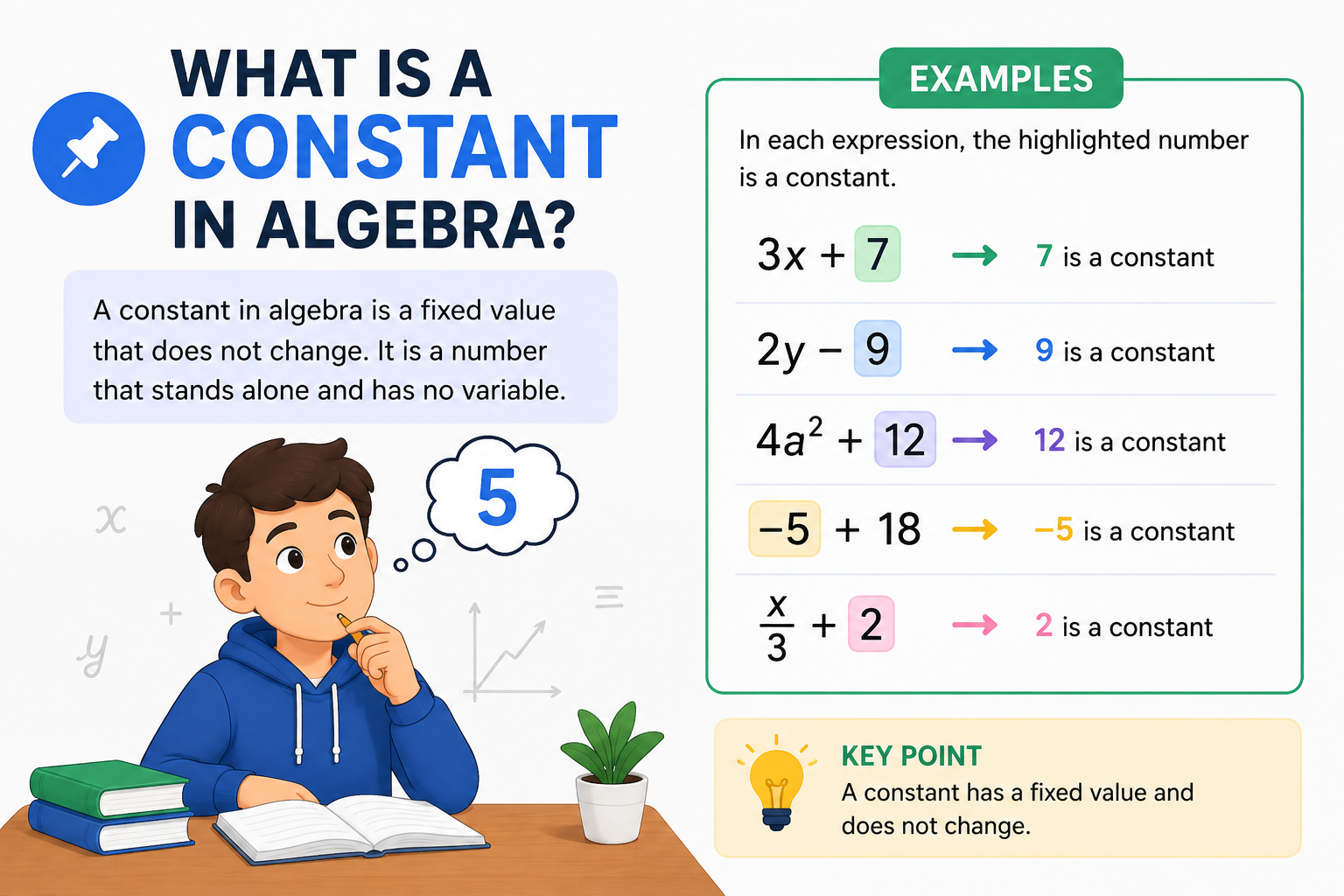
In algebra, a constant is a value that does not change. It is a fixed number that stays the same no matter what the variable in the expression equals.
So, what is a constant in algebra? A constant is any number in an algebraic expression or equation that has no variable attached to it. Examples include 5, -3, 10, 1/2, 0, and 2.5. Whether the expression is evaluated once or a thousand times, the constant always contributes the same fixed amount.
Constants are everywhere in algebra. They appear in simple expressions like x + 5, in linear equations like 3x + 4 = 10, in quadratic equations like x² + 5x + 6 = 0, and in polynomials of every kind. Understanding what a constant is and how to identify it is one of the very first skills you need to build in algebra.
Key Takeaways
-
A constant is a fixed number in an algebraic expression that does not change.
-
Constants contain no variables. A number multiplied by a variable is a coefficient, not a constant.
-
Constants can be positive, negative, zero, a fraction, or a decimal.
-
In any expression, the constant term is the term with no variable attached.
-
Constants are different from coefficients, variables, terms, and factors.
-
When simplifying expressions, constants are combined with other constants.
-
Understanding constants is essential for working with expressions, equations, polynomials, and formulas.
What Is a Constant in Algebra?
A constant in algebra is a number that represents a fixed, unchanging value. The word “constant” literally means something that stays the same, and in mathematics it does exactly that.
In an algebraic expression, some quantities can change. A variable like x can take different values depending on the situation. A constant cannot. It always contributes the same number to the expression.
Consider the expression 3x + 7.
If x = 1, the expression equals 10.
If x = 4, the expression equals 19.
If x = 10, the expression equals 37.
In every case, the value of 3x changes because x changes. But the 7 never changes. It is always 7. That fixed number is the constant.
Constants appear in:
- Algebraic expressions: 5x + 4 (the constant is 4)
- Equations: 2x + 9 = 15 (9 and 15 are constants)
- Formulas: Area of a circle, A = πr² (π is a mathematical constant with value approximately 3.14159)
- Polynomials: x³ + 4x² – 2x + 6 (the constant term is 6)
The key rule is simple: if a number has no variable attached to it, it is a constant.
Simple Examples of Constants
| Algebraic Expression | Constant | Variable | Coefficient |
|---|---|---|---|
| x + 5 | 5 | x | 1 |
| 3x + 7 | 7 | x | 3 |
| 2x – 4 | -4 | x | 2 |
| x² + 9 | 9 | x | 1 |
| 5x + 12 | 12 | x | 5 |
| 4a – 3 | -3 | a | 4 |
| y + 0 | 0 | y | 1 |
| 6m – 1/2 | -1/2 | m | 6 |
In each row, the constant is the number standing completely alone with no variable attached. The coefficient is the number multiplying the variable. The variable is the letter.
Notice that in x + 5, the coefficient of x is 1 even though no number is written in front of x. The constant 5 is separate from this coefficient entirely.
What Is a Constant Term?
A constant term is a term in an algebraic expression or equation that consists only of a number, with no variable part. It is simply the term that never contains a letter.
Here is how to find the constant term in several expressions:
- x + 4 — the constant term is 4
- 3x + 7 — the constant term is 7
- 5x² – 2x + 9 — the constant term is 9
- 8x³ + 4x – 6 — the constant term is -6
- 2a + 3b + 10 — the constant term is 10
The constant term always lacks a variable. In 5x² – 2x + 9, the terms 5x² and -2x both contain x, so they are not constants. The number 9 stands alone, making it the constant term.
When a constant term is negative, the negative sign is part of it. In 8x³ + 4x – 6, the constant term is -6, not 6.
Constants vs Variables
A variable is a letter that represents an unknown or changing value. A constant is a fixed number that never changes. These two concepts are fundamentally different.
| Feature | Constant | Variable |
|---|---|---|
| Changes value? | No | Yes |
| Represents | A fixed, known value | An unknown or changing value |
| Written as | A number (5, -3, 1/2) | A letter (x, y, a, b) |
| Example | 7 in 4x + 7 | x in 4x + 7 |
| Can appear alone? | Yes | Yes |
| Depends on other values? | Never | Can depend on context |
In the expression 2x + 8:
- x is the variable. If x = 3, the expression is 14. If x = 10, the expression is 28. x changes.
- 8 is the constant. It is always 8, regardless of x.
In a + b + 5:
- a and b are both variables.
- 5 is the constant.
Constants vs Coefficients
Students often confuse constants with coefficients. Both are numbers, but they play completely different roles.
A coefficient is a number that multiplies a variable. A constant is a number that stands alone with no variable.
In the expression 7x + 3:
- 7 is the coefficient. It multiplies x.
- x is the variable.
- 3 is the constant. It stands alone.
The difference becomes clear when you look at what each number is doing. The coefficient 7 is part of the term 7x. The constant 3 is its own separate term.
Another example: 5x² – 2x + 9
- 5 is the coefficient of x²
- -2 is the coefficient of x
- 9 is the constant (it multiplies nothing; it simply is)
For a complete explanation of how coefficients work, including negative and fractional coefficients and how to find them in any term, the article [What Is a Coefficient in Algebra?] covers everything you need.
Constants vs Terms
A term is a single unit within an algebraic expression, separated from other terms by a plus or minus sign.
In 5x + 3y – 7:
- 5x is the first term.
- 3y is the second term.
- -7 is the third term.
A constant term is a term that contains only a number and no variable. In the example above, -7 is a constant term.
All of the following are constant terms:
- 5
- 3x — not a constant (contains x)
- -7 — yes, constant
- 2x² — not a constant (contains x²)
- 4y — not a constant (contains y)
A constant is always a specific type of term. Not every term is a constant, but every constant (when it appears in an expression) is a term.
The article [What Is an Algebraic Expression?] provides a full breakdown of all the components of an algebraic expression, including terms, variables, coefficients, and constants.
Constants vs Factors
A factor is one of the numbers or expressions multiplied together to produce a term.
In the term 4x:
- 4 is the coefficient.
- x is the variable.
- Both 4 and x are factors of the term 4x, because 4 × x = 4x.
Now here is the important distinction:
- In the expression 4x + 9, the number 9 is a constant (it stands alone with no variable).
- The number 4 is a coefficient (it multiplies x) and also a factor of the term 4x.
- 9 is not a factor of 4x in this expression; it is a separate constant term.
A constant number can act as a factor inside a term, but a standalone constant term is not a factor of the overall expression in the same way.
The article [What Is a Factor?] explains exactly how factors work in mathematics, both in numerical and algebraic contexts.
Types of Constants in Algebra
Constants come in many forms. Understanding each type helps you recognise them quickly.
Positive Constants
A positive constant is any positive number that appears alone in an expression.
Examples:
- 5 in 2x + 5
- 12 in 7a + 12
- 100 in x² + 100
Negative Constants
A negative constant carries a minus sign as part of its value.
Examples:
- -3 in 4x – 3
- -8 in 9m – 8
- -15 in 2x² – 15
The negative sign is part of the constant, not a separate operator.
Zero as a Constant
Zero is a valid constant. It is a fixed number with a definite value (nothing), and it satisfies the definition of a constant perfectly.
Examples:
- x + 0 (constant is 0)
- 5x² + 0 (constant is 0)
In practice, a zero constant usually has no visible effect on the expression, but it can appear in standard forms of equations, particularly in quadratic equations where c = 0.
Fraction Constants
A constant can be a fraction. The fact that it is written as a fraction does not make it any less of a fixed value.
Examples:
- 1/2 in x + 1/2
- 3/4 in 5a + 3/4
- -5/6 in 3x – 5/6
For a thorough understanding of fractions and how to work with them, the article [What Is a Fraction?] covers the topic fully.
Decimal Constants
Decimal numbers are also valid constants.
Examples:
- 2.5 in 4x + 2.5
- 0.75 in 3m + 0.75
- -4.2 in 7y – 4.2
Whole Number and Integer Constants
The most common constants in school-level algebra are whole numbers and integers. These include:
- Whole numbers: 0, 1, 2, 3, 4, …
- Integers: …, -3, -2, -1, 0, 1, 2, 3, …
In expressions like 2x + 5 or x² – 7, the constant terms (5 and -7) are integers.
How to Identify a Constant in an Algebraic Expression
Use these five steps to find the constant in any expression:
- List every term in the expression. Terms are separated by + or – signs.
- Check each term for a variable (a letter such as x, y, a, or b).
- Ignore any term that contains a variable. Those terms are not constants.
- The term with no variable is the constant term.
- Check its sign. If a minus sign precedes it, the constant is negative.
Eight worked examples:
Expression 1: x + 6
Terms: x and 6. The term 6 has no variable. Constant = 6
Expression 2: 4y – 11
Terms: 4y and -11. The term -11 has no variable. Constant = -11
Expression 3: 3a² + 5a – 8
Terms: 3a², 5a, -8. Only -8 has no variable. Constant = -8
Expression 4: x + 0
Terms: x and 0. Zero is the standalone number. Constant = 0
Expression 5: 7m + 1/2
Terms: 7m and 1/2. The fraction has no variable. Constant = 1/2
Expression 6: 5x² + 3x + 2.5
Terms: 5x², 3x, 2.5. Only 2.5 has no variable. Constant = 2.5
Expression 7: 2p³ – p + 100
Terms: 2p³, -p, 100. Only 100 has no variable. Constant = 100
Expression 8: a + b + c – 4
Terms: a, b, c, -4. Only -4 has no variable. Constant = -4
Finding the Constant Term: Worked Examples
The following fifteen examples build gradually in difficulty.
Example 1: 2x + 3
Constant term: 3 (no variable attached)
Example 2: x – 5
Constant term: -5 (negative sign belongs to the constant)
Example 3: 4a + 0
Constant term: 0 (zero is a valid constant)
Example 4: 3x + 1/3
Constant term: 1/3 (fraction with no variable)
Example 5: 5x – 0.8
Constant term: -0.8 (decimal constant, negative)
Example 6: x² + 4x + 9
Constant term: 9 (only this term lacks a variable)
Example 7: 2x² – 3x – 5
Constant term: -5
Example 8: x² – 7
Constant term: -7 (the middle term bx is absent here; b = 0)
Example 9: 3x² + 0x + 4
Constant term: 4
Example 10: 4x³ + 2x² – x + 11
Constant term: 11
Example 11: a² + 3a – 1/2
Constant term: -1/2
Example 12: 6x⁴ – 5x³ + x² – x + 20
Constant term: 20
Example 13: 3m + 2n + 5p – 9
Constant term: -9 (all other terms contain variables)
Example 14: 2.5x² + 1.5x – 0.5
Constant term: -0.5
Example 15: x³ – x
Constant term: 0 (no standalone number is present, so the constant is 0 by convention in the standard form)
Constants in Linear Equations
A linear equation contains one variable raised to the power of 1, along with constant values.
In the equation x + 5 = 12:
- x is the variable.
- 5 is a constant on the left side.
- 12 is a constant on the right side.
In 3x + 4 = 10:
- 3 is the coefficient of x.
- 4 is the constant term on the left side.
- 10 is the constant on the right side.
In 5x – 7 = 18:
- 5 is the coefficient of x.
- -7 is the constant term on the left side.
- 18 is the constant on the right side.
Constants in equations are the known numerical values. They do not change as you work through the equation. To solve the equation, you use these constant values to isolate the variable.
The article [What Is a Linear Equation?] provides a complete guide to linear equations, including how to identify every component and how to solve them step by step.
Constants in Quadratic Equations
In the standard form of a quadratic equation:
ax² + bx + c = 0
The letter c represents the constant term.
Example: x² + 5x + 6 = 0
- x² is the quadratic term (coefficient a = 1).
- 5x is the linear term (coefficient b = 5).
- 6 is the constant term (c = 6).
Example with a negative constant: 2x² + 3x – 8 = 0
- a = 2 (coefficient of x²)
- b = 3 (coefficient of x)
- c = -8 (constant term)
Example with zero constant: x² + 4x = 0
- This can be written as x² + 4x + 0 = 0
- c = 0
The constant c plays a direct role in the quadratic formula and the discriminant. It also represents the y-intercept when the quadratic is written as a function.
The article [What Is a Quadratic Equation?] covers the standard form, the quadratic formula, and the role of c in full detail.
Constants in Polynomials
A polynomial is an algebraic expression with one or more terms involving non-negative integer exponents. The constant term in a polynomial is the term with no variable.
Example 1: 2x³ + 4x² + 7x + 9
- Constant term: 9
Example 2: x⁴ – 3x² + 5
- Constant term: 5
Example 3: 6x³ – 2x + 1
- Constant term: 1
Example 4: 5x⁴ – x³ + x – 12
- Constant term: -12
Example 5: x⁵ + x²
- No standalone number present, so the constant term is 0.
In a polynomial, the constant term is sometimes described as the term of degree zero, because any number multiplied by x⁰ = 1 gives that number. For instance, 9 = 9 × x⁰ = 9 × 1 = 9. This is why the constant term can be thought of as having a variable part of x⁰.
Constants and Simplifying Algebraic Expressions
When you simplify an algebraic expression, constants are treated like terms. They can only be combined with other constants, not with variable terms.
Example: 3x + 5 + 2x + 7
Step 1: Identify the like terms.
- Variable terms: 3x and 2x (both contain x)
- Constants: 5 and 7 (both have no variable)
Step 2: Combine the variable terms.
3x + 2x = 5x
Step 3: Combine the constants.
5 + 7 = 12
Step 4: Write the final simplified expression.
5x + 12
The constant 12 in the result comes from adding the two separate constants. The variable term 5x comes from combining the like variable terms.
Constants cannot be combined with variable terms. In 5x + 12, you cannot simplify this further because 5x and 12 are unlike terms. 5x involves a variable; 12 does not. They must remain separate.
Can a Constant Be Negative?
Yes, absolutely. A constant can be any fixed number, and that includes negative values.
In the expression 4x – 5, the constant is -5. The minus sign is part of the constant, not a separate operator acting on the constant.
More examples:
- -10 in 7x – 10
- -1/2 in 3a – 1/2
- -2.5 in 5m – 2.5
- -100 in x² – 100
When evaluating or simplifying expressions, always keep the negative sign attached to its constant. Dropping it changes the value entirely.
In the expression 3x – 8 + 2x + 5, the constants are -8 and 5. Combining them: -8 + 5 = -3. The simplified expression becomes 5x – 3.
Can Zero Be a Constant?
Yes. Zero is a constant. It is a fixed value, it does not change, and it has no variable attached to it. Zero meets every condition required to be called a constant.
Examples:
- In x + 0, the constant is 0. (In practice this simplifies to just x, but 0 is still technically the constant term.)
- In 5x² + 0, the constant is 0.
- In quadratic ax² + bx + c = 0, when c = 0, the constant term is zero.
Zero is also special because adding it to any expression leaves the expression unchanged. This is the additive identity property. But in terms of classification, zero is simply another constant.
Constant vs Coefficient vs Variable vs Term vs Factor
| Algebra Concept | Meaning | Example in 5x + 7 |
|---|---|---|
| Variable | An unknown or changing value | x |
| Coefficient | The number multiplying a variable | 5 |
| Constant | A fixed number with no variable | 7 |
| Term | An individual part of the expression | 5x and 7 are both terms |
| Factor | Values multiplied together within a term | 5 and x are factors of 5x |
Using the expression 5x + 7:
- 5 is the coefficient. It multiplies x to form the term 5x.
- x is the variable. Its value can change.
- 7 is the constant. It never changes.
- 5x is one complete term. 7 is another complete term (a constant term).
- 5 and x are the two factors of the term 5x (since 5 × x = 5x).
These five concepts are closely related but serve different roles. Confusing any two of them is one of the most common sources of errors in algebra.
Common Mistakes Students Make
Mistake 1: Thinking every number in an expression is a constant
Not every number is a constant. In 6x + 3, the number 6 is a coefficient (it multiplies x). Only 3 is the constant.
Correction: A constant must have no variable. If a number multiplies a variable, it is a coefficient.
Mistake 2: Confusing negative signs
In 4x – 9, students sometimes write the constant as 9 instead of -9.
Correction: The negative sign belongs to the constant. The constant is -9.
Mistake 3: Ignoring fraction constants
Students sometimes overlook 1/2 or 3/4 as constants if they expect only whole numbers.
Correction: Any fixed number is a constant, including fractions.
Mistake 4: Ignoring decimal constants
Similarly, 2.5 or 0.75 can be constants but are sometimes missed.
Correction: Decimals are fixed numbers and are valid constants.
Mistake 5: Thinking zero is not a constant
Zero is often dismissed, but it is a perfectly valid constant.
Correction: 0 qualifies as a constant because it is a fixed value.
Mistake 6: Confusing the variable with the constant
In the expression b + 7, students occasionally call b the constant because it looks like a number label.
Correction: b is a variable (a letter). 7 is the constant.
Mistake 7: Assuming the first number is always the constant
In 5x + 3, the first number 5 is the coefficient. The constant is 3.
Correction: Position in the expression does not determine whether a number is a constant. Presence or absence of a variable does.
Mistake 8: Calling a factor a constant
In 4x, the 4 is a coefficient and a factor of the term. It is not the constant term of the expression.
Correction: A constant term stands completely alone with no variable. 4 in 4x multiplies x, so it is not a constant term.
Mistake 9: Trying to combine a constant with a variable term
Writing 3x + 5 = 8x is incorrect. 3x and 5 are unlike terms.
Correction: Constants can only combine with other constants, not with variable terms.
Constant Term Cheat Sheet
| Expression | Constant Term |
|---|---|
| x + 8 | 8 |
| 4x – 3 | -3 |
| x² + 6x + 10 | 10 |
| 2x³ – 5x + 7 | 7 |
| 3a + 2b – 9 | -9 |
| 5m – 1/2 | -1/2 |
| 2.5x + 0.75 | 0.75 |
| y² – y | 0 (implied) |
| 8x³ + 4x² – x + 15 | 15 |
| -6x + 4 | 4 |
Practice Questions
Identify the Constant Term
Q1: What is the constant in x + 9?
Answer: 9
Q2: What is the constant in 5x – 4?
Answer: -4
Q3: What is the constant in 3x² + 2x + 1?
Answer: 1
Q4: What is the constant in 7m + 1/2?
Answer: 1/2
Q5: What is the constant in 4a – 0.6?
Answer: -0.6
Q6: What is the constant term in 2x³ – x² + 5x – 8?
Answer: -8
Q7: What is the constant in y² – y + 0?
Answer: 0
Q8: What is the constant in 6p + 3q – 11?
Answer: -11
Distinguish Constants from Coefficients
Q9: In 8x + 5, which is the coefficient and which is the constant?
Answer: Coefficient = 8 (multiplies x). Constant = 5 (no variable).
Q10: In 2a² – 7a + 3, identify the coefficient of a² and the constant term.
Answer: Coefficient of a² = 2. Constant = 3.
Q11: In -4x + 10, identify all numerical values and state their roles.
Answer: -4 is the coefficient of x. 10 is the constant.
Q12: In x – 1, what is the coefficient of x and what is the constant?
Answer: Coefficient of x = 1 (hidden). Constant = -1.
Multiple Choice Questions
Q13: Which of the following is the constant in 3x² + 5x – 12?
A) 3 B) 5 C) x D) -12
Answer: D. -12 is the only term with no variable.
Q14: What is the constant term in the expression 7a + 0?
A) 7 B) a C) 0 D) 7a
Answer: C. 0 is the constant. 7 is the coefficient of a.
Q15: In 4x + 6, if x = 2, which value stays fixed?
A) 4x B) 6 C) 2 D) x
Answer: B. 6 is the constant and does not change.
Q16: Which of the following is NOT a constant?
A) 7 B) -3 C) 2x D) 1/2
Answer: C. 2x contains the variable x.
Q17: What is the constant in the polynomial x⁴ – 3x + 8?
A) 1 B) -3 C) 8 D) 4
Answer: C. 8 is the standalone number with no variable.
Q18: Can a constant be a negative fraction?
A) Yes B) No C) Only if it is the last term D) Only in polynomials
Answer: A. A constant can be any fixed number, including a negative fraction.
Short Answer Questions
Q19: Write an algebraic expression with three terms where the constant is -7.
Sample Answer: 4x² + 3x – 7
Q20: In the equation 2x + 9 = 15, identify all constants.
Answer: 9 (left side constant) and 15 (right side constant). Both are fixed numbers.
Exam Tips
When answering algebra questions involving constants, use these quick strategies:
- Scan for terms with no letters. Any standalone number in an expression is a constant.
- Keep the sign. If a minus sign precedes the number, the constant is negative. Do not drop it.
- Do not confuse the coefficient with the constant. The coefficient is next to and multiplied by a variable. The constant stands alone.
- In standard quadratic form ax² + bx + c = 0, c is always the constant term. Look for the number at the end with no variable.
- In polynomials, the constant term is the term of lowest degree (degree zero). It is always the standalone number at the end.
- Zero counts. If no standalone number appears in the expression, the constant term is 0.
- Fractions and decimals qualify. Do not assume constants must be whole numbers.
Remember This
The simplest test for any number in an algebra expression: Does it multiply a variable? If yes, it is a coefficient. If no, it is a constant.
Frequently Asked Questions
1. What is a constant in algebra?
A constant in algebra is a fixed number that does not change. It appears in an algebraic expression as a standalone term with no variable attached to it.
2. What is a constant term?
A constant term is the specific term in an algebraic expression or equation that contains only a number and no variable. For example, in 3x + 7, the constant term is 7.
3. What is an example of a constant?
In the expression 5x + 12, the number 12 is a constant. It stays fixed no matter what value x takes.
4. Is 5 a constant in algebra?
Yes. The number 5 on its own is a constant. It is a fixed value that does not change.
5. Is zero a constant?
Yes. Zero is a constant. It is a fixed value (equal to nothing) and satisfies the definition of a constant in algebra.
6. Can a constant be negative?
Yes. Constants can be positive, negative, zero, fractions, or decimals. In 4x – 9, the constant is -9.
7. What is the difference between a constant and a variable?
A constant is a fixed number that never changes. A variable is a letter representing an unknown or changing value. In 6x + 3, x is the variable and 3 is the constant.
8. What is the difference between a constant and a coefficient?
A coefficient is a number that multiplies a variable. A constant is a standalone number with no variable. In 8x + 5, 8 is the coefficient and 5 is the constant.
9. How do you find the constant term?
Identify every term in the expression. Find the term that contains no variable. That term is the constant. Include its sign as part of its value.
10. Can fractions and decimals be constants?
Yes. Any fixed number is a constant, regardless of whether it is a whole number, a fraction, or a decimal. In 2x + 3/4, the constant is 3/4.
Summary
A constant in algebra is a fixed value that does not change. It is a number that appears in an algebraic expression or equation without any variable attached to it.
Constants can be positive, negative, zero, fractions, or decimals. They can appear in simple expressions like x + 5, in linear and quadratic equations, and in polynomials of any degree.
The most important distinction to remember is this: a coefficient multiplies a variable and is part of a variable term, while a constant stands completely on its own. In 7x + 4, the coefficient is 7 and the constant is 4.
When simplifying algebraic expressions, constants combine with other constants and cannot be merged with variable terms. Recognising the constant term quickly is one of the foundational skills of algebra.
References
- OpenStax – Elementary Algebra textbook covering constants, variables, and algebraic expressions.
https://openstax.org - Khan Academy – Free algebra lessons including constants, coefficients, and expressions.
https://www.khanacademy.org - Mathematics LibreTexts – Open-access coverage of algebraic terms, constants, and polynomial structure.
https://math.libretexts.org - Wolfram MathWorld – Mathematical reference covering constants, algebraic expressions, and polynomial terms.
https://mathworld.wolfram.com - Encyclopaedia Britannica – Reference articles on algebra, constants, and the structure of algebraic expressions.
https://www.britannica.com
Disclaimer:
This article is intended for educational and informational purposes only. While LearnMinto strives to provide accurate and up-to-date mathematics information, readers should verify important academic concepts through official textbooks, educational institutions, examination boards, or trusted educational resources before using this content for exams or academic purposes. LearnMinto is not affiliated with any specific school, university, research institution, or examination board.