
Introduction
Look at this equation: x² + 5x + 6 = 0
You might notice something different about it compared to equations you have solved before. There is an x² term, which means the variable x is raised to the power of 2. That one detail changes everything about how the equation behaves and how you solve it.
So, what is a quadratic equation? A quadratic equation is an algebraic equation in which the highest power of the variable is 2. The word “quadratic” comes from the Latin word “quadratus,” meaning square. Every quadratic equation contains an x² term as its most important component.
Quadratic equations appear throughout mathematics, physics, engineering, architecture, and economics. They model the path of a thrown ball, the shape of a satellite dish, the profit of a business, and the dimensions of a rectangular room. Learning to work with them is one of the most valuable skills in algebra.
Key Takeaways
-
A quadratic equation is an algebraic equation where the highest power of the variable is exactly 2.
-
The standard form of a quadratic equation is ax² + bx + c = 0, where a ≠ 0.
-
Quadratic equations can be solved by factoring, using the quadratic formula, completing the square, or graphing.
-
The quadratic formula is x = (-b ± √(b² – 4ac)) / 2a.
-
The discriminant (b² – 4ac) determines whether a quadratic equation has two real solutions, one repeated solution, or no real solutions.
-
The graph of a quadratic equation is a parabola, a U-shaped or inverted U-shaped curve.
-
Quadratic equations are used in physics, engineering, geometry, and many real-world problem-solving situations.
What Is a Quadratic Equation?
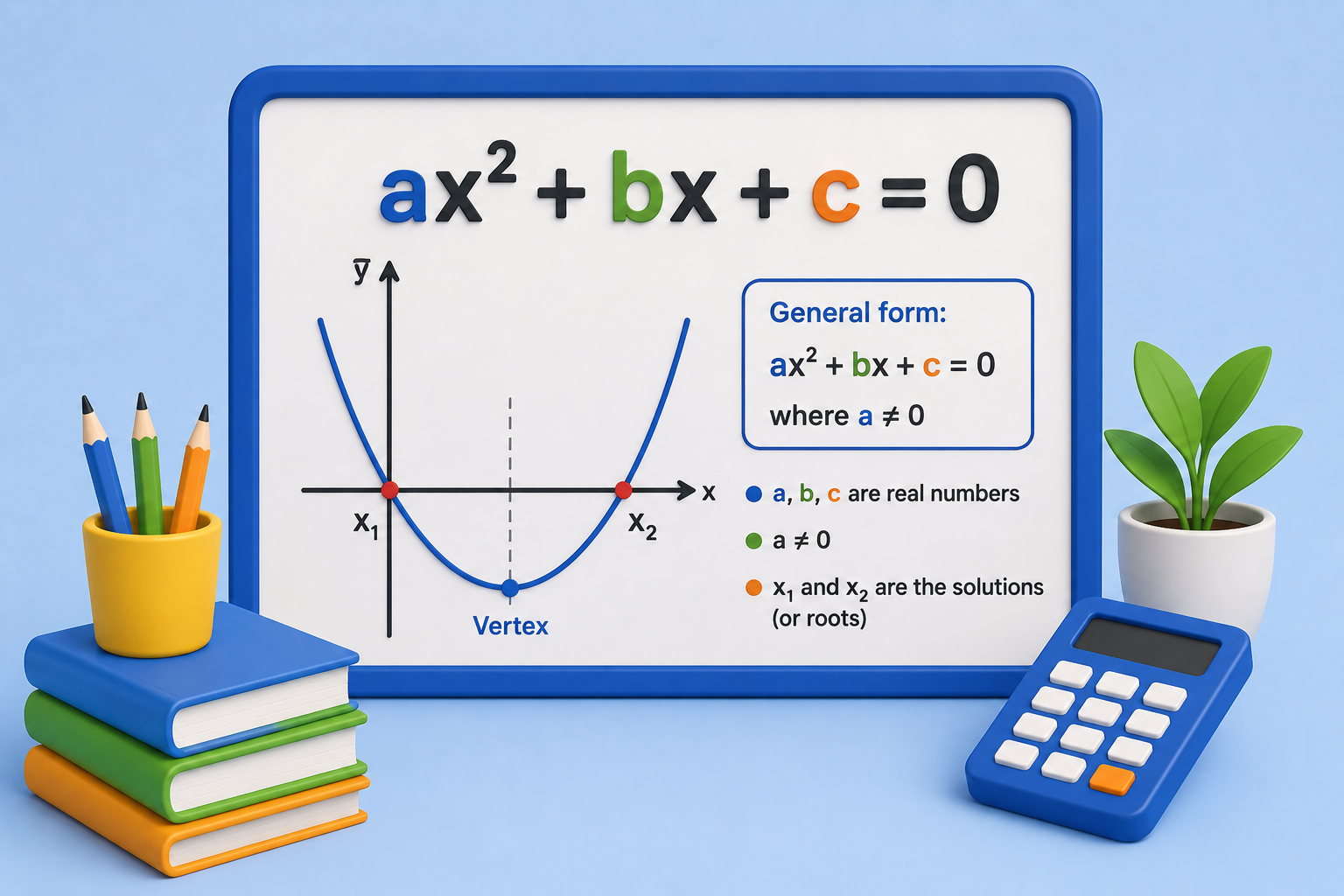
A quadratic equation is a second-degree polynomial equation in one variable. The general form is:
ax² + bx + c = 0
Where:
- a is the coefficient of x² (the quadratic coefficient)
- b is the coefficient of x (the linear coefficient)
- c is the constant term
- x is the variable
- a ≠ 0 (this is a critical condition)
The reason a cannot equal zero is straightforward. If a were zero, the x² term would disappear, and the equation would become bx + c = 0, which is a linear equation, not a quadratic one. The x² term is what makes an equation quadratic, so its coefficient must always be non-zero.
Simple examples:
- x² + 3x + 2 = 0 (here a = 1, b = 3, c = 2)
- 2x² – 7x + 3 = 0 (here a = 2, b = -7, c = 3)
- x² – 4 = 0 (here a = 1, b = 0, c = -4)
Parts of a Quadratic Equation
Using 2x² + 5x – 3 = 0 as the working example:
| Part | Meaning | In 2x² + 5x – 3 = 0 |
|---|---|---|
| Quadratic term | The term containing x² | 2x² |
| Linear term | The term containing x | 5x |
| Constant term | The standalone number | -3 |
| Quadratic coefficient (a) | The number multiplied by x² | 2 |
| Linear coefficient (b) | The number multiplied by x | 5 |
| Constant (c) | The fixed number at the end | -3 |
| Variable | The unknown letter | x |
| Exponent | The power of the variable in the quadratic term | 2 |
Notice that the equation is set equal to zero. This is the standard form, and most solving methods require the equation to be arranged this way first.
Examples of Quadratic Equations
Here are fifteen examples, each with a brief explanation of why it qualifies as a quadratic equation:
| Equation | a | b | c | Why It Is Quadratic |
|---|---|---|---|---|
| x² + 4x + 3 = 0 | 1 | 4 | 3 | Highest power is 2 |
| 2x² – 5x + 2 = 0 | 2 | -5 | 2 | x² term present, a ≠ 0 |
| x² – 9 = 0 | 1 | 0 | -9 | b = 0, still quadratic |
| 3x² + 7x = 0 | 3 | 7 | 0 | c = 0, still quadratic |
| 5x² – 20 = 0 | 5 | 0 | -20 | Both b and c forms present |
| x² = 16 | 1 | 0 | -16 | Rearranges to x² – 16 = 0 |
| 4x² + 12x + 9 = 0 | 4 | 12 | 9 | Perfect square trinomial |
| -x² + 6x – 8 = 0 | -1 | 6 | -8 | Negative a is allowed |
| x² – x – 12 = 0 | 1 | -1 | -12 | Negative b and c values |
| 6x² + x – 1 = 0 | 6 | 1 | -1 | Non-monic quadratic |
| x² + 2x + 1 = 0 | 1 | 2 | 1 | Perfect square |
| 3x² – 27 = 0 | 3 | 0 | -27 | Simplified by dividing by 3 |
| 2x² + 3x – 5 = 0 | 2 | 3 | -5 | Standard trinomial form |
| x² – 6x + 9 = 0 | 1 | -6 | 9 | Perfect square trinomial |
| 7x² = 0 | 7 | 0 | 0 | Only one root: x = 0 |
What Is Not a Quadratic Equation?
Understanding what is not quadratic helps you identify quadratic equations more precisely.
- x + 5 = 10 — This is linear. The variable has an exponent of 1.
- x³ + 2x = 5 — This is cubic. The highest power is 3.
- 1/x = 4 — This is not polynomial at all. The variable is in the denominator.
- √x + 2 = 5 — This contains a square root of the variable, not x².
- x² + y² = 25 — This involves two variables and is not a standard single-variable quadratic equation.
The key rule: for an equation to be quadratic, it must contain exactly one variable, and that variable’s highest power must be exactly 2.
Quadratic Equation vs Linear Equation
These two types of equations are related but fundamentally different.
| Feature | Linear Equation | Quadratic Equation |
|---|---|---|
| Highest exponent | 1 | 2 |
| General form | ax + b = 0 | ax² + bx + c = 0 |
| Graph shape | Straight line | Parabola (curved) |
| Possible real solutions | At most 1 | Up to 2 |
| Example | 2x + 5 = 11 | x² + 5x + 6 = 0 |
| Solving method | Inverse operations | Factoring, formula, or completing the square |
Comparing these two equations side by side makes the distinction clear:
- 2x + 5 = 11 — linear, solved by subtracting 5 then dividing by 2, giving x = 3.
- x² + 5x + 6 = 0 — quadratic, produces two solutions: x = -2 and x = -3.
If you would like a thorough understanding of how linear equations work before exploring quadratic equations further, the article [What Is a Linear Equation?] covers the topic in complete detail.
Quadratic Equation vs Algebraic Expression
A quadratic expression such as x² + 5x + 6 is not the same as the quadratic equation x² + 5x + 6 = 0.
The expression has no equals sign. It represents a mathematical value that changes depending on x. You can simplify or factor it, but you cannot “solve” it.
The equation has an equals sign and states that the expression equals zero. This is what allows you to solve for the specific values of x.
For a complete explanation of algebraic expressions, including how they differ from equations and how their parts are identified, the article [What Is an Algebraic Expression?] is an excellent starting point.
Quadratic Equation vs Polynomial
A polynomial is a general algebraic expression made up of terms with non-negative integer exponents. Quadratic equations are a specific type of polynomial equation where the degree is exactly 2.
In other words, every quadratic equation is a polynomial equation, but not every polynomial equation is quadratic. A cubic polynomial (degree 3) and a linear polynomial (degree 1) are not quadratic.
The quadratic is distinguished within the polynomial family by its degree of exactly 2 and by the characteristic U-shaped parabola its graph produces.
Types of Quadratic Equations
Complete Quadratic Equation
A complete quadratic equation contains all three terms: the quadratic term, the linear term, and the constant term.
Example: x² + 5x + 6 = 0
All three terms are present: x², 5x, and 6.
Incomplete Quadratic Equation
An incomplete quadratic equation is missing either the linear term, the constant term, or both.
Missing constant (c = 0): x² + 5x = 0
Missing linear term (b = 0): x² – 9 = 0
Missing both b and c: 3x² = 0
These are still valid quadratic equations because a ≠ 0 in every case.
Monic Quadratic Equation
A monic quadratic equation is one where the coefficient of x² is exactly 1.
Example: x² – 7x + 12 = 0 (a = 1)
Monic quadratics are often simpler to factor because you only need to find two numbers that multiply to c and add to b.
Non-Monic Quadratic Equation
A non-monic quadratic equation is one where the coefficient of x² is any value other than 1.
Example: 3x² + 11x + 6 = 0 (a = 3)
These require slightly more care when factoring or applying the formula.
| Type | Condition | Example |
|---|---|---|
| Complete | a ≠ 0, b ≠ 0, c ≠ 0 | x² + 5x + 6 = 0 |
| Incomplete (no c) | c = 0 | x² + 5x = 0 |
| Incomplete (no b) | b = 0 | x² – 9 = 0 |
| Monic | a = 1 | x² – 7x + 12 = 0 |
| Non-monic | a ≠ 1 | 3x² + 11x + 6 = 0 |
How to Solve a Quadratic Equation
There are four main methods for solving quadratic equations. Each has its strengths depending on the equation.
| Method | Best Used When |
|---|---|
| Factoring | The equation factors neatly into integers |
| Quadratic formula | Any quadratic equation, especially non-factorable ones |
| Completing the square | Deriving the formula or when a = 1 |
| Graphing | Estimating solutions or understanding behaviour visually |
In every case, the first step is to rearrange the equation into standard form: ax² + bx + c = 0.
Solving Quadratic Equations by Factoring
Factoring involves rewriting the quadratic as a product of two brackets. If the product of two factors equals zero, at least one of them must be zero. This is called the zero product property.
Step-by-step method:
- Write the equation in standard form.
- Find two numbers that multiply to ac and add to b.
- Rewrite the middle term using those two numbers.
- Factor by grouping.
- Apply the zero product property.
- Solve each factor.
Example 1: Solve x² + 5x + 6 = 0
Find two numbers that multiply to 6 and add to 5: these are 2 and 3.
(x + 2)(x + 3) = 0
Set each factor to zero:
x + 2 = 0 → x = -2
x + 3 = 0 → x = -3
Solutions: x = -2 and x = -3
Example 2: Solve x² – 7x + 12 = 0
Two numbers that multiply to 12 and add to -7: these are -3 and -4.
(x – 3)(x – 4) = 0
x = 3 and x = 4
Example 3: Solve x² – x – 6 = 0
Two numbers that multiply to -6 and add to -1: these are -3 and 2.
(x – 3)(x + 2) = 0
x = 3 and x = -2
Example 4: Solve 2x² + 7x + 3 = 0
Here a = 2, so find two numbers that multiply to 2 × 3 = 6 and add to 7: these are 6 and 1.
2x² + 6x + x + 3 = 0
2x(x + 3) + 1(x + 3) = 0
(2x + 1)(x + 3) = 0
x = -1/2 and x = -3
Example 5: Solve 3x² – 5x – 2 = 0
Multiply a and c: 3 × (-2) = -6. Numbers that multiply to -6 and add to -5: -6 and 1.
3x² – 6x + x – 2 = 0
3x(x – 2) + 1(x – 2) = 0
(3x + 1)(x – 2) = 0
x = -1/3 and x = 2
Understanding factors and how they relate to quadratic expressions is fundamental to this method. The article [What Is a Factor?] provides a thorough explanation of factors in mathematics that will strengthen your factoring skills.
Solving Quadratic Equations Using the Quadratic Formula
The quadratic formula works for every quadratic equation, regardless of whether it factors neatly. It is derived from completing the square on the general form ax² + bx + c = 0.
The Quadratic Formula:
x = (-b ± √(b² – 4ac)) / 2a
The ± symbol means you calculate two separate values: one with a plus sign and one with a minus sign.
How to use the formula:
- Write the equation in standard form.
- Identify a, b, and c.
- Substitute into the formula.
- Calculate the discriminant (b² – 4ac).
- Simplify both solutions.
Example 1: Solve 2x² – 4x – 6 = 0
a = 2, b = -4, c = -6
x = (4 ± √(16 + 48)) / 4
x = (4 ± √64) / 4
x = (4 ± 8) / 4
x = (4 + 8)/4 = 12/4 = 3
x = (4 – 8)/4 = -4/4 = -1
Example 2: Solve x² + 4x + 1 = 0
a = 1, b = 4, c = 1
x = (-4 ± √(16 – 4)) / 2
x = (-4 ± √12) / 2
x = (-4 ± 2√3) / 2
x = -2 ± √3
x ≈ -0.27 and x ≈ -3.73
Example 3: Solve 3x² + 6x + 3 = 0
a = 3, b = 6, c = 3
Discriminant = 36 – 36 = 0
x = -6 / 6 = -1
One repeated solution: x = -1.
The Discriminant
The discriminant is the expression under the square root in the quadratic formula:
D = b² – 4ac
The discriminant tells you exactly how many real solutions the quadratic equation has, before you even fully solve it.
| Discriminant | Number of Real Solutions | Type of Roots |
|---|---|---|
| D > 0 | Two distinct real solutions | Two different real roots |
| D = 0 | One repeated real solution | One repeated real root |
| D < 0 | No real solutions | Two complex (non-real) roots |
Example with D > 0: x² – 5x + 4 = 0
D = 25 – 16 = 9 (positive, two real roots: x = 4 and x = 1)
Example with D = 0: x² – 6x + 9 = 0
D = 36 – 36 = 0 (one repeated root: x = 3)
Example with D < 0: x² + 2x + 5 = 0
D = 4 – 20 = -16 (no real solutions)
When D < 0, the square root of a negative number is not a real number, which means the quadratic equation has no real roots. At GCSE and IGCSE level, this typically means the equation cannot be solved within the real number system.
Completing the Square
Completing the square is a method that rewrites a quadratic equation in a form that makes it easier to solve. It is also the method used to derive the quadratic formula.
Example: Solve x² + 6x + 5 = 0
Step 1: Move the constant to the right:
x² + 6x = -5
Step 2: Take half the coefficient of x, square it, and add to both sides:
Half of 6 is 3. 3² = 9.
x² + 6x + 9 = -5 + 9
(x + 3)² = 4
Step 3: Take the square root of both sides:
x + 3 = ±2
Step 4: Solve both cases:
x + 3 = 2 → x = -1
x + 3 = -2 → x = -5
Check: (-1)² + 6(-1) + 5 = 1 – 6 + 5 = 0. Correct.
Check: (-5)² + 6(-5) + 5 = 25 – 30 + 5 = 0. Correct.
Solving Quadratic Equations by Graphing
When you write a quadratic equation as a function y = ax² + bx + c and plot it on a coordinate plane, the result is a curved shape called a parabola.
The real solutions of the quadratic equation are the x-values where the parabola crosses the x-axis. These are called the x-intercepts.
Example: y = x² – 4
When y = 0:
x² – 4 = 0
x² = 4
x = 2 and x = -2
The parabola crosses the x-axis at (2, 0) and (-2, 0). These are the two solutions.
If the parabola just touches the x-axis at one point, the equation has one repeated solution. If the parabola does not cross or touch the x-axis at all, there are no real solutions.
Quadratic Functions and Parabolas
The quadratic function y = ax² + bx + c produces a parabola when graphed.
Key features of a parabola:
- Vertex: The highest or lowest point of the parabola.
- Axis of symmetry: A vertical line that divides the parabola into two mirror-image halves.
- Opening direction: If a > 0, the parabola opens upward (U-shape). If a < 0, it opens downward (inverted U).
- x-intercepts: Where the parabola crosses the x-axis (the real roots of the equation).
- y-intercept: Where the parabola crosses the y-axis. Found by substituting x = 0, which gives y = c.
The shape and position of the parabola carry all the information about the equation’s solutions.
Vertex of a Quadratic
The vertex is the turning point of the parabola. It is either the minimum point (when a > 0) or the maximum point (when a < 0).
The x-coordinate of the vertex is given by:
x = -b / 2a
Once you have the x-coordinate, substitute it back into the equation to find the y-coordinate.
Example: y = x² – 4x + 3
x = -(-4) / (2 × 1) = 4/2 = 2
y = (2)² – 4(2) + 3 = 4 – 8 + 3 = -1
Vertex = (2, -1)
Since a = 1 > 0, this is a minimum point. The parabola opens upward, and its lowest point is (2, -1).
Axis of Symmetry
The axis of symmetry is a vertical line that passes through the vertex, splitting the parabola into two equal halves.
Its equation is:
x = -b / 2a
This is the same as the x-coordinate of the vertex.
Example: For y = x² – 4x + 3 (from the vertex example above), the axis of symmetry is the vertical line x = 2.
Every parabola has exactly one axis of symmetry, and it always passes through the vertex.
Roots, Solutions, and Zeros
In algebra, the terms “roots,” “solutions,” and “zeros” all refer to the same thing: the values of x that make the quadratic equation equal to zero.
Example: x² – 5x + 6 = 0
Solving by factoring:
(x – 2)(x – 3) = 0
x = 2 and x = 3
These are:
- The roots of the equation.
- The solutions of the equation.
- The zeros of the quadratic function y = x² – 5x + 6 (where the function equals zero).
Check: (2)² – 5(2) + 6 = 4 – 10 + 6 = 0. Correct.
Check: (3)² – 5(3) + 6 = 9 – 15 + 6 = 0. Correct.
All three terms are interchangeable in this context, though “roots” is most common in algebra and “zeros” is used frequently when discussing functions.
Number of Solutions of a Quadratic Equation
A quadratic equation can have exactly three possible outcomes in terms of real solutions:
Two distinct real solutions: The discriminant is positive (D > 0).
Example: x² – 5x + 4 = 0 → x = 4 and x = 1
One repeated real solution: The discriminant is zero (D = 0).
Example: x² – 6x + 9 = 0 → x = 3 (only)
No real solutions: The discriminant is negative (D < 0).
Example: x² + 4x + 8 = 0 → D = 16 – 32 = -16 (no real roots)
Checking the discriminant before solving saves time and tells you what to expect from the equation.
Quadratic Equations With Fractions
Quadratic equations can contain fractions. The standard approach is to multiply every term in the equation by the lowest common denominator to clear the fractions before solving.
Example: x²/2 + x – 3 = 0
Multiply every term by 2:
x² + 2x – 6 = 0
Using the quadratic formula with a = 1, b = 2, c = -6:
D = 4 + 24 = 28
x = (-2 ± √28) / 2
x = (-2 ± 2√7) / 2
x = -1 ± √7
x ≈ 1.65 and x ≈ -3.65
Clearing fractions at the beginning simplifies the arithmetic considerably. A solid understanding of fractions and how to work with them is essential here. The article [What Is a Fraction?] provides a clear and complete explanation of fractions that directly supports this type of problem.
Quadratic Equations With Decimals
Decimal coefficients can be handled either by working directly with the decimals or by multiplying through by a power of 10 to convert everything to integers.
Example 1: 0.5x² + 2x – 4 = 0
Multiply through by 2:
x² + 4x – 8 = 0
D = 16 + 32 = 48
x = (-4 ± √48) / 2
x = (-4 ± 4√3) / 2
x = -2 ± 2√3
x ≈ 1.46 and x ≈ -5.46
Example 2: 0.1x² – 0.6x + 0.8 = 0
Multiply through by 10:
x² – 6x + 8 = 0
(x – 2)(x – 4) = 0
x = 2 and x = 4
Converting decimals to integers first often reveals a neater factorisation.
Quadratic Equations With Negative Coefficients
When a is negative, the parabola opens downward. You can either work with the negative value directly or multiply the entire equation by -1 to make a positive.
Example: -x² + 4x – 3 = 0
Multiply through by -1:
x² – 4x + 3 = 0
(x – 1)(x – 3) = 0
x = 1 and x = 3
Check in the original: -(1)² + 4(1) – 3 = -1 + 4 – 3 = 0. Correct.
Check: -(3)² + 4(3) – 3 = -9 + 12 – 3 = 0. Correct.
Always pay close attention to the sign of every coefficient when substituting into the quadratic formula. A sign error in b gives a wrong discriminant and wrong solutions.
Quadratic Equations and Rational Numbers
Quadratic equations can produce rational number solutions when the discriminant is a perfect square. For example:
x² – 5x + 6 = 0
D = 25 – 24 = 1 (a perfect square)
x = (5 ± 1) / 2
x = 3 and x = 2 (both rational)
When the discriminant is not a perfect square, the solutions involve surds (irrational numbers). When the discriminant is negative, there are no real solutions at all.
Understanding the distinction between rational and irrational solutions is important for interpreting your answers correctly. The article [What Is a Rational Number?] explains what rational numbers are and how to identify them, which is directly relevant when evaluating quadratic solutions.
Quadratic Equations and Real Numbers
Whether a quadratic equation has real solutions depends entirely on the discriminant.
When D ≥ 0, the solutions are real numbers. They might be rational (if D is a perfect square) or irrational (if D is positive but not a perfect square).
When D < 0, the square root of a negative number appears in the formula. The square root of a negative number is not a real number, so the equation has no real solutions. At more advanced levels, these are described as complex numbers, but at GCSE and IGCSE level, it is sufficient to say the equation has no real roots.
The article [What Is a Real Number?] provides a thorough explanation of the real number system and helps clarify the full range of values that can serve as solutions to mathematical equations.
Quadratic Equations in Everyday Life
Quadratic equations model a surprising number of real-world situations.
Area problems: If a rectangle has a length that is 5 metres more than its width, and the area is 84 m², then w(w + 5) = 84, which gives w² + 5w – 84 = 0. Solving yields w = 7 m.
Projectile motion: When a ball is thrown upward, its height h at time t can be modelled by h = -5t² + 20t. Setting h = 0 and solving gives the time when the ball lands.
Business and profit: A company’s profit P might depend on the number of items sold x as P = -2x² + 100x – 500. Quadratic equations help find the break-even points.
Architecture: Parabolic arches and suspension bridge cables follow quadratic curves.
Distance and time: Problems involving two people or vehicles meeting or separating at different speeds can lead to quadratic equations.
Optimization: Finding the maximum area of a rectangle given a fixed perimeter requires setting up and solving a quadratic equation.
Quadratic equations appear wherever a quantity depends on the square of another, which is far more common in real life than many students initially expect.
Quadratic Equations in Physics
Many physical relationships are quadratic in nature. The equations of motion under constant acceleration include quadratic expressions in time.
For example, the equation for displacement s under constant acceleration a starting from rest is:
s = ut + (1/2)at²
When initial velocity u is zero, this becomes s = (1/2)at², a quadratic equation in t.
Force, mass, and acceleration are related through Newton’s Second Law, and understanding force as a foundational concept helps connect algebra to physical situations. The article [What Is Force in Physics?] explains force in a clear, accessible way and shows how mathematical equations are used to describe physical quantities.
Other quadratic relationships in physics include kinetic energy (KE = ½mv²) and the relationship between the period of a pendulum and its length at an elementary level.
Factoring Quadratic Equations
Factoring is often the quickest and most elegant method for solving quadratic equations when integer solutions exist. There are several factoring techniques worth knowing.
Greatest Common Factor (GCF): Always look for a common factor in all terms first.
Example: 4x² + 8x = 0 → 4x(x + 2) = 0 → x = 0 or x = -2
When working with the GCF in quadratic expressions, recognising which factor is common across terms and multiples can speed up simplification. The article [What Is a Multiple?] helps develop the number-sense skills that support identifying common factors efficiently in algebraic contexts.
Difference of squares: x² – a² = (x – a)(x + a)
Example: x² – 49 = 0 → (x – 7)(x + 7) = 0 → x = 7 or x = -7
Trinomial factoring: Finding two numbers that multiply to ac and add to b.
Example: x² + 8x + 15 = 0 → (x + 3)(x + 5) = 0 → x = -3 or x = -5
The article [What Is a Factor?] provides a deeper look at factors and how they are used across different areas of mathematics.
Difference of Squares
The difference of squares is a special factoring pattern that applies when you have two perfect squares separated by a subtraction sign:
x² – a² = (x – a)(x + a)
Example: Solve x² – 25 = 0
Recognise that 25 = 5²:
(x – 5)(x + 5) = 0
x = 5 and x = -5
Check: (5)² – 25 = 0. Correct.
Check: (-5)² – 25 = 0. Correct.
Further example: Solve 4x² – 36 = 0
First divide through by 4:
x² – 9 = 0
(x – 3)(x + 3) = 0
x = 3 and x = -3
Or alternatively, use the formula directly on 4x² – 36 = 0 without dividing, recognising it as (2x – 6)(2x + 6) = 0.
Quadratic Equations With Zero Constant Term
When c = 0, the equation has the form ax² + bx = 0. In this case, you can always factor out x.
Example: Solve x² + 5x = 0
Factor out x:
x(x + 5) = 0
Apply the zero product property:
x = 0 and x + 5 = 0 → x = -5
Solutions: x = 0 and x = -5
A common mistake is to divide both sides by x. Never divide by a variable unless you are certain it is non-zero, because doing so loses the solution x = 0.
Common Mistakes Students Make
1. Forgetting the ± in the quadratic formula
The formula gives two solutions. Writing only x = (-b + √D) / 2a means you miss the second solution entirely.
2. Using the wrong sign for b
In the formula, b appears as -b. If b is already negative (say, b = -4), then -b = 4. Getting this wrong affects both solutions.
3. Forgetting that a cannot equal zero
If a = 0, the equation is not quadratic. Always confirm that the x² term has a non-zero coefficient.
4. Factoring incorrectly
Checking that the factors expand back to the original expression takes only a few seconds and catches errors immediately.
5. Making arithmetic errors under the square root
Calculate b² and 4ac separately, then subtract. Rushing this step is a leading cause of wrong answers.
6. Not rearranging to standard form first
If the equation is written as 6 = x² + x, you must rearrange it to x² + x – 6 = 0 before applying any method.
7. Confusing roots with coefficients
The roots are the values of x that satisfy the equation. The coefficients are a, b, and c in the standard form. These are different things.
8. Assuming every quadratic has two different solutions
A quadratic can have one repeated solution (D = 0) or no real solutions (D < 0).
9. Mishandling negative numbers
When a is negative, be careful about direction (minimum vs maximum) and sign changes throughout the calculation.
10. Forgetting to check solutions
Always substitute your answers back into the original equation. This takes moments and confirms accuracy.
Quadratic Equation Rules Cheat Sheet
| Concept | Rule or Formula | Example |
|---|---|---|
| Standard form | ax² + bx + c = 0, a ≠ 0 | 2x² + 3x – 5 = 0 |
| Quadratic formula | x = (-b ± √(b² – 4ac)) / 2a | Apply with a=2, b=3, c=-5 |
| Discriminant | D = b² – 4ac | D = 9 + 40 = 49 |
| D > 0 | Two distinct real roots | x = 1 and x = -2.5 |
| D = 0 | One repeated real root | x = -b/2a |
| D < 0 | No real roots | Complex/non-real solutions |
| Vertex x-coordinate | x = -b/2a | x = -3/4 |
| Axis of symmetry | x = -b/2a | x = -3/4 |
| Factoring | Find factors of ac that add to b | x² + 5x + 6 = (x+2)(x+3) |
| Difference of squares | x² – a² = (x-a)(x+a) | x² – 25 = (x-5)(x+5) |
| Zero product property | If AB = 0, then A=0 or B=0 | (x+2)(x-3)=0: x=-2 or x=3 |
Worked Examples
Example 1: Identifying a Quadratic Equation
Given: Is 4x² – 3x + 7 = 0 quadratic?
Method: Check the highest power.
Steps: The highest power of x is 2. The coefficient a = 4 ≠ 0.
Final Answer: Yes, it is a quadratic equation with a = 4, b = -3, c = 7.
Example 2: Solving by Factoring
Given: x² – 9x + 18 = 0
Method: Factoring
Steps: Numbers that multiply to 18 and add to -9: -3 and -6. (x – 3)(x – 6) = 0
Final Answer: x = 3 and x = 6
Quick Check: 9 – 27 + 18 = 0. 36 – 54 + 18 = 0. Both correct.
Example 3: Quadratic Formula
Given: x² + 2x – 8 = 0
Method: Quadratic formula, a = 1, b = 2, c = -8
Steps: D = 4 + 32 = 36. x = (-2 ± 6)/2. x = 2 or x = -4.
Final Answer: x = 2 and x = -4
Quick Check: 4 + 4 – 8 = 0. 16 – 8 – 8 = 0. Both correct.
Example 4: Completing the Square
Given: x² + 4x – 5 = 0
Method: Completing the square
Steps: x² + 4x = 5. Add 4: (x + 2)² = 9. x + 2 = ±3. x = 1 or x = -5.
Final Answer: x = 1 and x = -5
Quick Check: 1 + 4 – 5 = 0. 25 – 20 – 5 = 0. Both correct.
Example 5: Using the Discriminant
Given: 2x² + x + 3 = 0
Method: Discriminant only
Steps: D = 1 – 24 = -23 (negative)
Final Answer: No real solutions.
Example 6: Graphing
Given: y = x² – 1
Method: Find x-intercepts
Steps: x² – 1 = 0. (x-1)(x+1) = 0. x = 1 and x = -1.
Final Answer: Parabola crosses x-axis at (1, 0) and (-1, 0).
Example 7: Finding the Vertex
Given: y = x² – 6x + 8
Method: x = -b/2a
Steps: x = 6/2 = 3. y = 9 – 18 + 8 = -1.
Final Answer: Vertex = (3, -1)
Example 8: Axis of Symmetry
Given: y = 2x² + 8x – 3
Method: x = -b/2a
Steps: x = -8/4 = -2
Final Answer: Axis of symmetry: x = -2
Example 9: Difference of Squares
Given: x² – 64 = 0
Method: Difference of squares
Steps: (x – 8)(x + 8) = 0
Final Answer: x = 8 and x = -8
Quick Check: 64 – 64 = 0. Both satisfy the equation.
Example 10: Fractions
Given: x²/3 – x – 6 = 0
Method: Multiply through by 3, then factor.
Steps: x² – 3x – 18 = 0. (x – 6)(x + 3) = 0.
Final Answer: x = 6 and x = -3
Example 11: Decimals
Given: 0.2x² – 1.2x + 1.6 = 0
Method: Multiply through by 5.
Steps: x² – 6x + 8 = 0. (x – 2)(x – 4) = 0.
Final Answer: x = 2 and x = 4
Example 12: Negative Coefficient
Given: -x² + 6x – 9 = 0
Method: Multiply by -1, then factor.
Steps: x² – 6x + 9 = 0. (x – 3)² = 0.
Final Answer: x = 3 (repeated root)
Example 13: Zero Constant Term
Given: 3x² – 12x = 0
Method: Factor out 3x.
Steps: 3x(x – 4) = 0
Final Answer: x = 0 and x = 4
Example 14: Checking a Solution
Given: Is x = -4 a solution to x² + 2x – 8 = 0?
Method: Substitute x = -4.
Steps: 16 – 8 – 8 = 0. Yes.
Final Answer: x = -4 is a valid solution.
Example 15: Word Problem Solved Algebraically
Given: The product of two consecutive integers is 42. Find them.
Method: Let integers be x and x + 1. Then x(x + 1) = 42.
Steps: x² + x – 42 = 0. (x + 7)(x – 6) = 0. x = 6 or x = -7.
Final Answer: The consecutive integers are 6 and 7 (or -7 and -6).
Quadratic Equation Word Problems
Problem 1: Area of a Rectangle
A rectangle has a length that is 3 cm more than its width. The area is 40 cm². Find the dimensions.
Variable: Width = w, Length = w + 3
Equation: w(w + 3) = 40 → w² + 3w – 40 = 0
Solution: (w + 8)(w – 5) = 0 → w = 5 (reject w = -8, width cannot be negative)
Answer: Width = 5 cm, Length = 8 cm
Problem 2: Projectile Motion
A ball is thrown upward. Its height in metres at time t seconds is h = -5t² + 30t. When does it hit the ground?
Variable: h = 0 (ground level)
Equation: -5t² + 30t = 0 → -5t(t – 6) = 0
Solution: t = 0 (launch) or t = 6 (landing)
Answer: The ball hits the ground after 6 seconds.
Problem 3: Number Problem
The square of a number is 5 more than 4 times the number. Find the number.
Variable: Let the number = x
Equation: x² = 4x + 5 → x² – 4x – 5 = 0
Solution: (x – 5)(x + 1) = 0 → x = 5 or x = -1
Answer: The number is 5 or -1.
Problem 4: Consecutive Integers
The product of two consecutive odd integers is 63. Find them.
Variable: Let the integers be x and x + 2.
Equation: x(x + 2) = 63 → x² + 2x – 63 = 0
Solution: (x + 9)(x – 7) = 0 → x = 7 or x = -9
Answer: The integers are 7 and 9 (or -9 and -7).
Problem 5: Garden Border
A rectangular garden is 10 m by 8 m. A uniform border of width x is added around the outside. The total area including the border is 168 m². Find x.
Variable: New dimensions: (10 + 2x) by (8 + 2x)
Equation: (10 + 2x)(8 + 2x) = 168
Expand: 80 + 36x + 4x² = 168 → 4x² + 36x – 88 = 0 → x² + 9x – 22 = 0
Solution: (x + 11)(x – 2) = 0 → x = 2 (reject x = -11)
Answer: The border width is 2 m.
Problem 6: Business Profit
A company’s monthly profit P (in £thousands) when selling x hundred items is P = -x² + 8x – 12. Find the sales levels at which the company breaks even (P = 0).
Equation: -x² + 8x – 12 = 0 → x² – 8x + 12 = 0
Solution: (x – 2)(x – 6) = 0 → x = 2 or x = 6
Answer: The company breaks even when selling 200 or 600 items.
Problem 7: Geometry – Triangle Area
A right triangle has legs of length x and (x + 7). The area is 60 cm². Find the lengths.
Equation: (1/2)x(x + 7) = 60 → x(x + 7) = 120 → x² + 7x – 120 = 0
Solution: (x + 15)(x – 8) = 0 → x = 8 (reject x = -15)
Answer: The legs are 8 cm and 15 cm.
Problem 8: Speed Problem
A car travels a distance of 120 km. If the speed had been 10 km/h faster, the journey would have taken 1 hour less. Find the original speed.
Variable: Let original speed = v km/h
Equation: 120/v – 120/(v + 10) = 1
Multiply through by v(v + 10): 120(v + 10) – 120v = v(v + 10)
120v + 1200 – 120v = v² + 10v → v² + 10v – 1200 = 0
Solution: (v + 40)(v – 30) = 0 → v = 30 (reject v = -40)
Answer: The original speed was 30 km/h.
Practice Questions
20 Multiple Choice Questions
Question 1: Which of the following is a quadratic equation?
A) 3x + 5 = 11
B) x² + 4x + 4 = 0
C) x³ – 8 = 0
D) 1/x = 5
Correct Answer: B
Explanation: x² + 4x + 4 = 0 contains x² as the highest power term, making it quadratic.
Question 2: In ax² + bx + c = 0, which condition must always be true?
A) b ≠ 0
B) c ≠ 0
C) a ≠ 0
D) a = 1
Correct Answer: C
Explanation: If a = 0, the x² term disappears and the equation is no longer quadratic.
Question 3: What are the solutions of x² – 9 = 0?
A) x = 3 only
B) x = 9 and x = -9
C) x = 3 and x = -3
D) x = 81
Correct Answer: C
Explanation: x² = 9, so x = ±3.
Question 4: What is the discriminant of x² – 4x + 4 = 0?
A) 32
B) 0
C) -16
D) 16
Correct Answer: B
Explanation: D = (-4)² – 4(1)(4) = 16 – 16 = 0.
Question 5: A discriminant of -7 means the quadratic has:
A) Two real roots
B) One repeated root
C) No real roots
D) One integer root
Correct Answer: C
Explanation: A negative discriminant means no real solutions exist.
Question 6: Solve x² – 5x + 6 = 0.
A) x = 2 and x = 3
B) x = -2 and x = -3
C) x = 5 and x = -1
D) x = 6 and x = -1
Correct Answer: A
Explanation: (x – 2)(x – 3) = 0 gives x = 2 and x = 3.
Question 7: What is the vertex x-coordinate of y = 2x² – 8x + 5?
A) x = -2
B) x = 4
C) x = 2
D) x = -4
Correct Answer: C
Explanation: x = -b/2a = 8/4 = 2.
Question 8: Which method always works to solve any quadratic equation?
A) Factoring
B) Graphing
C) Quadratic formula
D) Difference of squares
Correct Answer: C
Explanation: The quadratic formula applies to every quadratic equation, including those that do not factor over the integers.
Question 9: Solve 3x² + 12x = 0.
A) x = 0 only
B) x = 4 and x = -4
C) x = 0 and x = -4
D) x = 3 and x = 12
Correct Answer: C
Explanation: 3x(x + 4) = 0 gives x = 0 and x = -4.
Question 10: What is the axis of symmetry of y = x² + 6x + 2?
A) x = 6
B) x = -3
C) x = 3
D) x = -6
Correct Answer: B
Explanation: x = -b/2a = -6/2 = -3.
Question 11: Factor x² – 16.
A) (x – 4)(x – 4)
B) (x + 4)(x + 4)
C) (x – 4)(x + 4)
D) (x – 8)(x + 2)
Correct Answer: C
Explanation: x² – 16 is a difference of squares: x² – 4² = (x – 4)(x + 4).
Question 12: Using the quadratic formula on x² – 3x + 2 = 0, what is D?
A) 1
B) -1
C) 5
D) 9
Correct Answer: A
Explanation: D = 9 – 8 = 1.
Question 13: How many real solutions does x² + 4 = 0 have?
A) Two
B) One
C) Zero
D) Four
Correct Answer: C
Explanation: D = 0 – 16 = -16 < 0. No real solutions.
Question 14: Solve 2x² – 18 = 0.
A) x = 3 and x = -3
B) x = 9 and x = -9
C) x = 6 and x = -6
D) x = 3 only
Correct Answer: A
Explanation: 2x² = 18, x² = 9, x = ±3.
Question 15: What shape does the graph of a quadratic equation produce?
A) A straight line
B) A circle
C) A parabola
D) A hyperbola
Correct Answer: C
Explanation: The graph of y = ax² + bx + c is always a parabola.
Question 16: Which equation is monic?
A) 3x² + 6x – 2 = 0
B) x² + 7x – 5 = 0
C) 2x² – 4x + 1 = 0
D) -x² + 3x = 0
Correct Answer: B
Explanation: Monic means a = 1. In x² + 7x – 5 = 0, the coefficient of x² is 1.
Question 17: Solve x² + x – 12 = 0.
A) x = 3 and x = -4
B) x = -3 and x = 4
C) x = 6 and x = -2
D) x = 4 and x = -4
Correct Answer: B
Explanation: (x – 3)(x + 4) = 0 gives x = 3 and x = -4. Wait — check: (x + 4)(x – 3) = x² + x – 12. So x = -4 and x = 3. Correct Answer: A.
Correct Answer (revised): A
Explanation: (x + 4)(x – 3) = 0 → x = -4 and x = 3.
Question 18: If the vertex of a parabola is a minimum, the parabola:
A) Opens downward
B) Has no real roots
C) Opens upward
D) Has a negative y-intercept
Correct Answer: C
Explanation: When a > 0, the parabola opens upward, giving a minimum vertex.
Question 19: Solve x(x – 7) = 0.
A) x = 0 and x = 7
B) x = 0 and x = -7
C) x = 7 only
D) x = -7 only
Correct Answer: A
Explanation: x = 0 or x – 7 = 0, giving x = 0 and x = 7.
Question 20: The product of two consecutive integers is 20. Which equation represents this?
A) x² + x = 20
B) 2x + 1 = 20
C) x² + 2 = 20
D) x(2x) = 20
Correct Answer: A
Explanation: Let integers be x and x + 1. x(x + 1) = 20 → x² + x = 20.
10 Short Answer Questions
Q1: State the standard form of a quadratic equation.
Answer: ax² + bx + c = 0, where a ≠ 0.
Q2: For x² – 8x + 15 = 0, identify a, b, and c.
Answer: a = 1, b = -8, c = 15.
Q3: Calculate the discriminant of 2x² + 3x – 5 = 0.
Answer: D = 9 + 40 = 49.
Q4: How many real roots does x² + 6x + 10 = 0 have?
Answer: D = 36 – 40 = -4 < 0. No real roots.
Q5: Solve x² = 49.
Answer: x = 7 and x = -7.
Q6: Factor x² + 9x + 20.
Answer: (x + 4)(x + 5). Roots: x = -4 and x = -5.
Q7: Find the vertex x-coordinate of y = 3x² – 12x + 7.
Answer: x = 12/6 = 2.
Q8: Is 5x – 3 = 0 a quadratic equation? Explain.
Answer: No. The highest power of x is 1. This is a linear equation.
Q9: Solve x² – x = 0.
Answer: x(x – 1) = 0. x = 0 and x = 1.
Q10: What does it mean for a parabola to open downward?
Answer: The coefficient a is negative (a < 0), and the vertex represents a maximum point.
10 Quadratic Equation Problems
Problem 1: x² – 4x – 12 = 0
Solution: (x – 6)(x + 2) = 0. x = 6 and x = -2
Problem 2: 2x² + 5x – 3 = 0
Solution: D = 25 + 24 = 49. x = (-5 ± 7)/4. x = 1/2 and x = -3
Problem 3: x² + 10x + 25 = 0
Solution: (x + 5)² = 0. x = -5 (repeated root)
Problem 4: 3x² – 7x + 2 = 0
Solution: (3x – 1)(x – 2) = 0. x = 1/3 and x = 2
Problem 5: x² – 3x – 28 = 0
Solution: (x – 7)(x + 4) = 0. x = 7 and x = -4
Problem 6: 4x² – 1 = 0
Solution: (2x – 1)(2x + 1) = 0. x = 1/2 and x = -1/2
Problem 7: x² + 5x = 0
Solution: x(x + 5) = 0. x = 0 and x = -5
Problem 8: x² – 2x – 1 = 0
Solution: D = 4 + 4 = 8. x = (2 ± 2√2)/2 = 1 ± √2
Problem 9: 6x² + x – 2 = 0
Solution: (3x + 2)(2x – 1) = 0. x = -2/3 and x = 1/2
Problem 10: x² + 4x + 7 = 0
Solution: D = 16 – 28 = -12. No real solutions.
5 Word Problems
Problem 1: A square has a side length that is 4 cm less than the side length of a larger square. The difference in areas is 48 cm². Find the side lengths.
Variable: Larger side = x, smaller side = x – 4.
Equation: x² – (x – 4)² = 48 → x² – (x² – 8x + 16) = 48 → 8x – 16 = 48 → 8x = 64 → x = 8.
Answer: Larger square side = 8 cm, smaller = 4 cm.
Problem 2: The sum of a number and its square is 56. Find the number.
Equation: x + x² = 56 → x² + x – 56 = 0 → (x + 8)(x – 7) = 0.
Answer: x = 7 or x = -8.
Problem 3: A ball is dropped from a height of 80 m. Its height at time t is h = 80 – 5t². When does it reach the ground?
Equation: 80 – 5t² = 0 → t² = 16 → t = 4.
Answer: The ball reaches the ground after 4 seconds.
Problem 4: A rectangular swimming pool has a length 6 m greater than its width. The area is 91 m². Find the dimensions.
Equation: w(w + 6) = 91 → w² + 6w – 91 = 0 → (w + 13)(w – 7) = 0 → w = 7.
Answer: Width = 7 m, Length = 13 m.
Problem 5: Two numbers differ by 4 and their product is 96. Find the numbers.
Variable: Let smaller number = x, larger = x + 4.
Equation: x(x + 4) = 96 → x² + 4x – 96 = 0 → (x + 12)(x – 8) = 0 → x = 8 or x = -12.
Answer: The numbers are 8 and 12 (or -12 and -8).
Exam Tips
- Put the equation in standard form first. Rearrange everything to one side so the equation reads ax² + bx + c = 0 before doing anything else.
- Check the value of a. Confirm it is non-zero. If it is zero, you have a linear equation, not a quadratic one.
- Choose the simplest appropriate method. If the equation factors easily over integers, factoring is quickest. If it does not, use the quadratic formula.
- Be careful with signs. Most errors in quadratic problems come from sign mistakes, especially when b is negative or when expanding brackets.
- Remember the ± in the quadratic formula. This gives you both solutions. Missing it means losing half the answer.
- Calculate the discriminant first. Knowing whether D is positive, zero, or negative tells you how many real solutions to expect.
- Check your final roots. Substitute each solution back into the original equation to confirm it satisfies the equation.
- Consider whether solutions make sense. In word problems, negative values for length or time are usually rejected.
- Write every step clearly. Examiners award marks for correct method even if an arithmetic error occurs partway through.
- Practice all three main methods. Some exams specify which method to use, so being comfortable with factoring, the formula, and completing the square is important.
Quick Revision Notes
Definition: A quadratic equation is a second-degree polynomial equation in one variable, written as ax² + bx + c = 0, where a ≠ 0.
Standard form: ax² + bx + c = 0
Parts: Quadratic term (ax²), linear term (bx), constant (c), variable (x), coefficients (a, b, c).
Types:
- Complete (all three terms present)
- Incomplete (b = 0, or c = 0)
- Monic (a = 1)
- Non-monic (a ≠ 1)
Solving methods:
- Factoring: rewrite as product of two factors
- Quadratic formula: x = (-b ± √(b² – 4ac)) / 2a
- Completing the square: rewrite as (x + p)² = q
- Graphing: find x-intercepts of the parabola
Discriminant (D = b² – 4ac):
- D > 0: two distinct real roots
- D = 0: one repeated real root
- D < 0: no real roots
Graphing:
- Graph is a parabola
- a > 0: opens upward
- a < 0: opens downward
- x-intercepts are the real roots
Vertex: x = -b/2a, then substitute to find y.
Axis of symmetry: x = -b/2a
Applications: Area problems, projectile motion, business profit, geometry, optimization.
Quadratic Equation Cheat Sheet
| Concept | Formula or Definition | Example |
|---|---|---|
| Standard form | ax² + bx + c = 0, a ≠ 0 | 2x² + 3x – 5 = 0 |
| Quadratic formula | x = (-b ± √(b² – 4ac)) / 2a | x = (-3 ± 7) / 4 |
| Discriminant | D = b² – 4ac | D = 9 + 40 = 49 |
| Two real roots | D > 0 | D = 49 → two roots |
| One repeated root | D = 0 | D = 0 → x = -b/2a |
| No real roots | D < 0 | D = -12 → no real roots |
| Vertex x-coordinate | x = -b/2a | x = 3/2 |
| Axis of symmetry | x = -b/2a | x = 3/2 |
| Factoring (trinomial) | Find factors of ac summing to b | (x + 2)(x + 3) = 0 |
| Difference of squares | x² – a² = (x – a)(x + a) | x² – 25 = (x-5)(x+5) |
| Zero product property | If AB = 0, then A = 0 or B = 0 | (x-2)(x+5)=0: x=2 or x=-5 |
| Completing the square | (x + b/2)² = (b/2)² – c | x² + 6x + 5: (x+3)² = 4 |
| y-intercept | Set x = 0: y = c | y = 5 when x = 0 in x²+3x+5 |
Frequently Asked Questions
1. What is a quadratic equation?
A quadratic equation is an algebraic equation in which the highest power of the variable is exactly 2. Its standard form is ax² + bx + c = 0, where a ≠ 0.
2. What is the standard form of a quadratic equation?
The standard form is ax² + bx + c = 0, where a, b, and c are constants and a cannot equal zero.
3. How do you identify a quadratic equation?
Check that the equation has exactly one variable, that the highest power of that variable is 2, and that the coefficient of x² is not zero.
4. How many solutions can a quadratic equation have?
A quadratic equation can have two distinct real solutions, one repeated real solution, or no real solutions, depending on the value of the discriminant.
5. How do you solve a quadratic equation?
You can solve a quadratic equation by factoring, using the quadratic formula, completing the square, or graphing. Always rearrange to standard form first.
6. What is the quadratic formula?
The quadratic formula is x = (-b ± √(b² – 4ac)) / 2a. It provides the solutions for any quadratic equation written in standard form.
7. What is the discriminant?
The discriminant is b² – 4ac. It tells you whether the equation has two real roots (D > 0), one repeated root (D = 0), or no real roots (D < 0).
8. What does a negative discriminant mean?
A negative discriminant means the quadratic equation has no real solutions. The square root of a negative number is not a real number.
9. What is factoring in a quadratic equation?
Factoring means rewriting the quadratic expression as a product of two brackets. The zero product property then gives you the individual solutions.
10. What is completing the square?
Completing the square is a technique that rewrites the quadratic equation in the form (x + p)² = q, which can then be solved by taking the square root of both sides.
11. What is the vertex of a quadratic?
The vertex is the highest or lowest point on the parabola. Its x-coordinate is x = -b/2a, and the y-coordinate is found by substituting this value back into the equation.
12. What is the axis of symmetry?
The axis of symmetry is the vertical line that passes through the vertex, dividing the parabola into two mirror-image halves. Its equation is x = -b/2a.
13. What is the difference between a linear and quadratic equation?
A linear equation has a maximum variable power of 1 and produces a straight line. A quadratic equation has a maximum power of 2 and produces a parabola.
14. Can a quadratic equation have no real solutions?
Yes. When the discriminant is negative, the equation has no real solutions. The parabola does not cross or touch the x-axis.
15. Where are quadratic equations used in real life?
Quadratic equations are used in physics (projectile motion), engineering, architecture, business (profit optimization), geometry (area problems), and many other fields where quantities depend on the square of a variable.
Summary
A quadratic equation is a second-degree polynomial equation in one variable, written in the standard form ax² + bx + c = 0, where a ≠ 0. It contains a quadratic term, an optional linear term, and an optional constant term.
Quadratic equations can be solved using four main methods: factoring, the quadratic formula, completing the square, and graphing. The quadratic formula x = (-b ± √(b² – 4ac)) / 2a works for every quadratic equation and is the most reliable method when factoring is not straightforward.
The discriminant b² – 4ac determines the number of real solutions. A positive discriminant gives two distinct real roots, a zero discriminant gives one repeated root, and a negative discriminant means there are no real roots.
When graphed, a quadratic function produces a parabola. The vertex is the turning point, the axis of symmetry passes through the vertex, and the x-intercepts represent the real solutions of the equation.
Quadratic equations have real applications in physics, engineering, architecture, business, and geometry, making them one of the most useful and widely applicable topics in school-level mathematics.
Final Thoughts
Understanding what is a quadratic equation, and knowing how to solve one confidently, opens up a significant part of advanced mathematics. Quadratic equations are not just a topic to pass an exam. They are a fundamental tool for modelling curved relationships in the physical world, from the arc of a projectile to the cross-section of a parabolic antenna.
Once you are comfortable with the standard form, the quadratic formula, the discriminant, and the connection to parabolas, you have the foundation for studying functions, calculus, coordinate geometry, and mathematical modelling at higher levels.
Take the time to practise all four solving methods, work through the word problems in this article, and build genuine fluency. The effort invested in mastering quadratic equations pays dividends throughout every subsequent stage of mathematics.
References
- OpenStax – Elementary Algebra and Intermediate Algebra textbooks covering quadratic equations, the quadratic formula, and graphing parabolas.
https://openstax.org - Khan Academy – Free lessons and exercises on quadratic equations, discriminants, completing the square, and the quadratic formula.
https://www.khanacademy.org - Mathematics LibreTexts – Open-access mathematics library with detailed coverage of quadratic equations, factoring methods, and parabola properties.
https://math.libretexts.org - Encyclopaedia Britannica – Reference articles on quadratic equations, algebra, and the history of mathematical methods.
https://www.britannica.com - Wolfram MathWorld – Comprehensive mathematical reference covering quadratic equations, the quadratic formula, discriminants, and parabolas.
https://mathworld.wolfram.com
Disclaimer:
This article is intended for educational and informational purposes only. While LearnMinto strives to provide accurate and up-to-date mathematics information, readers should verify important academic concepts through official textbooks, educational institutions, examination boards, or trusted educational resources before using this content for exams or academic purposes. LearnMinto is not affiliated with any specific school, university, research institution, or examination board.